
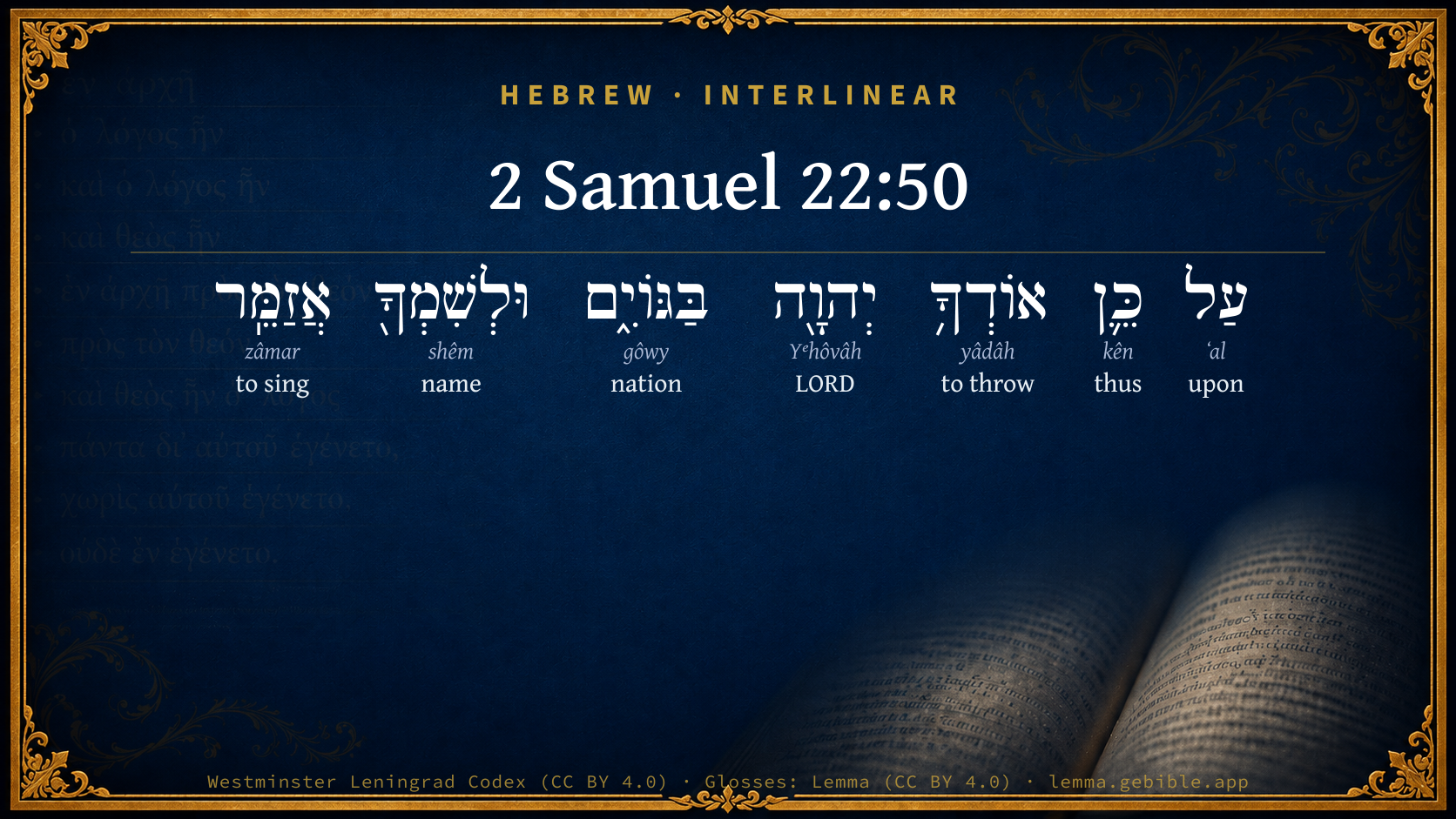
2 Samuel 22:50

Hebrew (Westminster Leningrad Codex) 2 Samuel 22:50 appears in the Hebrew Old Testament. The text above is from the Westminster Leningrad Codex. Each word links to its Strong’s number, a concise gloss, and parsing drawn from the Open Scriptures Hebrew Bible morphology. Click any word for its full Brown-Driver-Briggs (BDB) entry.
Download image
Cite this verse

2 Samuel 22:50 (World English Bible). Public Domain. Lemma interlinear Bible study tool, https://lemma.gebible.app/v/2-samuel/22/50.

Show BibTeX & RIS
BibTeX
RIS
English Translation
Therefore I will give thanks to you, Yahweh, among the nations, Will sing praises to your name.
World English Bible · Public Domain
Download a study sheet

One document with this verse’s original text, its word-by-word gloss line, the meaning frame, cross-references with their text, attributed commentary, and full source and license credits — printable, and it pastes into notes with its structure intact.

This verse Autodidact and up

Study sheet (.html) Plain text (.txt)

A passage Seminary Student

Up to 50 verses in one chapter. A passage sheet keeps up to 6 commentary sources and 12 cross-references per verse, in the order this page ranks them, and says so on the sheet whenever that leaves anything out. Ask for a single verse and you get the Autodidact verse sheet above.

Everything on this page stays free to read, with no account — the sheet is a download of what is already on screen, not access to it.

Want to remove ads? Support Godless Engineer
Compare translations 3

The same verse in 3 English versions, stacked beneath the original-language interlinear above. Click any original word for its lexicon entry.

Each is an independent rendering of the whole verse — the interlinear is not word-aligned to these translations.

Highlighted words mark where these versions differ — a whole-verse word diff, not a word-by-word alignment.

  • World English Bible Public Domain
    Therefore I will give thanks to you, Yahweh, among the nations, Will sing praises to your name.
  • King James Version Public Domain
    Therefore I will give thanks unto thee, O LORD, among the heathen, and I will sing praises unto thy name.
  • unfoldingWord Literal Text CC BY-SA 4.0
    Therefore I thank you, Yahweh, among the nations, and I sing praise to your name,

unfoldingWord Literal Text — © unfoldingWord, licensed CC BY-SA 4.0. Word-aligned USFM3 via Door43 (git.door43.org/unfoldingWord/en_ult).

Versions to compare (up to 4)

3 of 4 selected

Show all 18 translations

Every available English version of this verse, each an independent rendering of the whole verse.

  • World English Bible Public Domain
    Therefore I will give thanks to you, Yahweh, among the nations, Will sing praises to your name.
  • Berean Standard Bible Public Domain
    Therefore I will praise You, O LORD, among the nations; I will sing praises to Your name.
  • Majority Standard Bible Public Domain
    Therefore I will praise You, O LORD, among the nations; I will sing praises to Your name.
  • King James Version Public Domain
    Therefore I will give thanks unto thee, O LORD, among the heathen, and I will sing praises unto thy name.
  • American Standard Version (1901) Public Domain
    Therefore I will give thanks unto thee, O Jehovah, among the nations, And will sing praises unto thy name.
  • Revised Version (1885) Public Domain
    Therefore I will give thanks unto thee, O LORD, among the nations, and will sing praises unto thy name.
  • Geneva Bible (1599) Public Domain
    Therefore I will praise thee, O Lord amog the nations, and will sing vnto thy Name)
  • Douay-Rheims (1899) Public Domain
    Therefore will I give thanks to thee. O Lord, among the Gentiles, and will sing to thy name.
  • Young's Literal Translation Public Domain
    Therefore I confess Thee, O Jehovah, among nations. And to Thy name I sing praise.
  • Literal Standard Version CC BY-SA 4.0
    Therefore I confess You, O YHWH, among nations, || And I sing praise to Your Name.
  • Unlocked Literal Bible CC BY-SA 4.0
    Therefore I will give thanks to you, Yahweh, among the nations; I will sing praises to your name.
  • unfoldingWord Literal Text CC BY-SA 4.0
    Therefore I thank you, Yahweh, among the nations, and I sing praise to your name,
  • Darby Bible Public Domain
    Therefore will I give thanks to thee, Jehovah, among the nations, And will sing psalms to thy name.
  • World Messianic Bible Public Domain
    Therefore I will give thanks to you, LORD, among the nations, and will sing praises to your name.
  • Webster's Bible Public Domain
    Therefore I will give thanks to thee, O LORD, among the heathen, and I will sing praises to thy name.
  • Free Bible Version CC BY-SA 4.0
    That's why I will praise you among the nations, Lord; I will sing praises about who you are.
  • Bible in Basic English Public Domain
    Because of this I will give you praise, O Lord, among the nations, and will make a song of praise to your name.
  • JPS Tanakh (1917) Public Domain
    Therefore I will give thanks unto Thee, O LORD, among the nations, and will sing praises unto Thy name.

Literal Standard Version (2020), Covenant Press — licensed CC BY-SA 4.0. Text via the HelloAO Bible API (eBible.org). Unlocked Literal Bible (unfoldingWord) — licensed CC BY-SA 4.0. Text via the HelloAO Bible API (eBible.org). unfoldingWord Literal Text — © unfoldingWord, licensed CC BY-SA 4.0. Word-aligned USFM3 via Door43 (git.door43.org/unfoldingWord/en_ult). Free Bible Version, Dr. Jonathan Gallagher — licensed CC BY-SA 4.0. Text via the HelloAO Bible API (eBible.org).

Word by word

More ways to search: Search by grammar → Find every occurrence → Compare this word →

Practice this passage: Drill this verse → Learn its vocabulary →

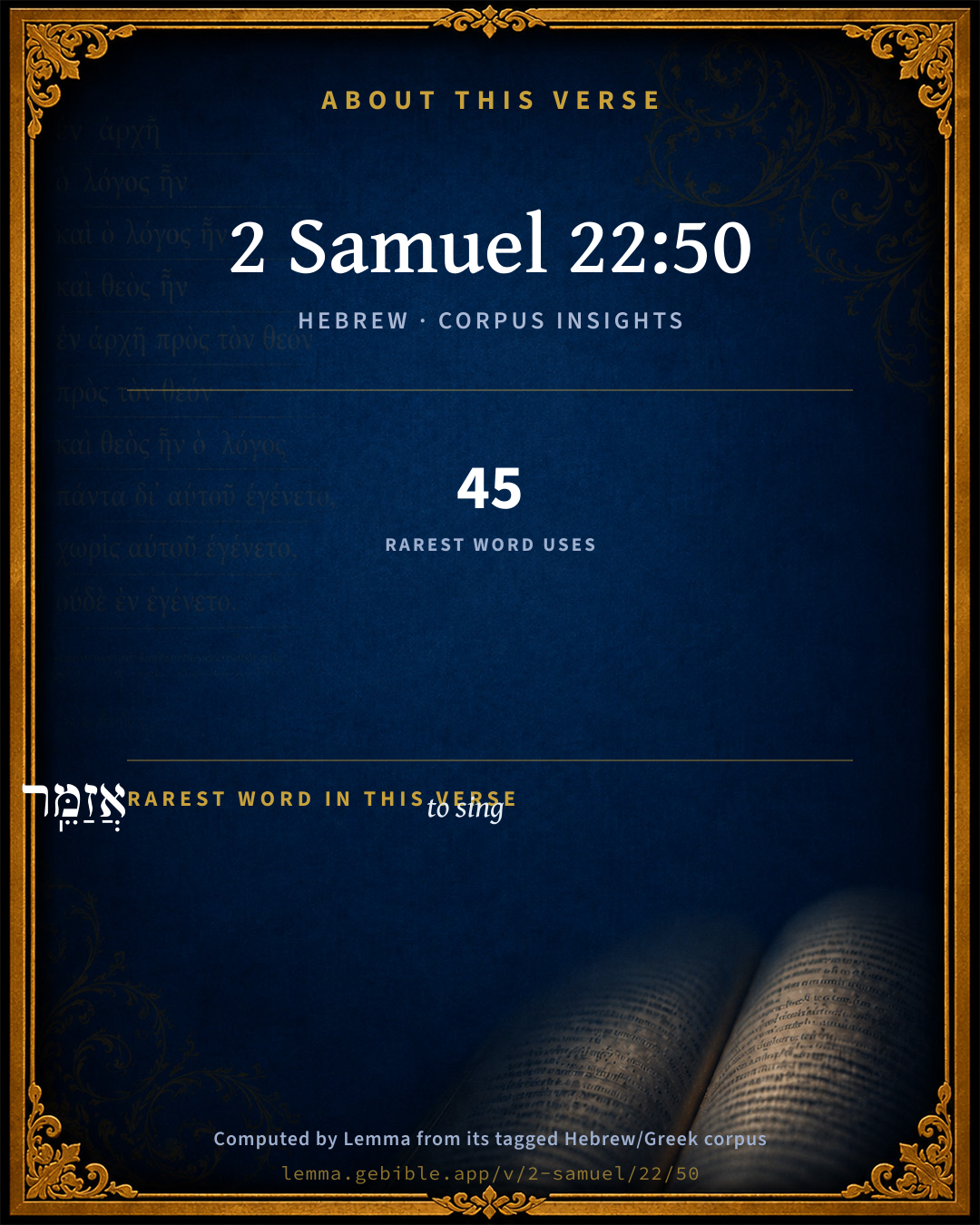
About this verse

These counts appear in no published source. They are computed here, from the morphology-tagged text and Lemma’s own curated glosses. What Lemma adds →

7
words
7
distinct lemmas
Historical
section

Shared distinctive vocabulary

אֲזַמֵּֽר to sing H2167 occurs in 41 verses of the Hebrew Bible. Also found in:

Grammatical profile

  • 2 verbs
  • 3 nouns
  • 1 preposition
  • 1 particle

Verb forms

  • אוֹדְךָ֥ Hiphil · Imperfect
  • אֲזַמֵּֽר Piel · Imperfect

Hebrew & Septuagint length

In English translation the verse runs 17 words from the Hebrew and 16 from the Septuagint (LXX English) — closely comparable.

A rough comparison of the two English renderings, which tokenize alike — not a word-level alignment.

Word counts can differ between the Hebrew and the Greek without any difference in meaning — e.g. the Hebrew direct-object marker אֵת has no separate Greek word, and Greek often adds the article ὁ.

Cross-references

5

Topical passages linked to 2 Samuel 22:50 in the Treasury of Scripture Knowledge — connected by theme and wording, ordered by reader-vote popularity; previews shown in the World English Bible.

  • Romans 15:9 and that the Gentiles might glorify God for his mercy. As it is written, "Therefore will I give praise to you among the Gentiles, And sing to your name."
  • Psalms 18:49 Therefore I will give thanks to you, Yahweh, among the nations, And will sing praises to your name.
  • Psalms 145:1–2 I will exalt you, my God, the King. I will praise your name forever and ever.
  • Psalms 146:1–2 Praise Yah! Praise Yahweh, my soul.
  • Isaiah 12:1–6 In that day you will say, "I will give thanks to you, Yahweh; for though you were angry with me, your anger has turned away and you comfort me.

Cross-references courtesy of OpenBible.info (CC BY 4.0).

Hebrew and Greek witnesses Masoretic Hebrew ↔ Greek Septuagint

The same verse in the two great witnesses to the Old Testament, shown verse-for-verse.

These are two independent witnesses, not word-aligned to each other, and the Septuagint is shown in lemma (dictionary) form.

Hebrew 2 Samuel 22:50 Masoretic · Westminster Leningrad Codex

עַל כֵּ֛ן אוֹדְךָ֥ יְהוָ֖ה בַּגּוֹיִ֑ם וּלְשִׁמְךָ֖ אֲזַמֵּֽר

Therefore I will give thanks to you, Yahweh, among the nations, Will sing praises to your name.

World English Bible · Public Domain

Greek LXX 2 Samuel 22:50 Septuagint · lemma form

διά οὗτος ἐκὁμολογέω σύ κύριος ἐν ὁ ἔθνος καί ἐν ὁ ὄνομα σύ ψάλλω

Therefore will I confess to you, O Lord, among the Gentiles, and sing to your name.

LXX2012 (modern English Septuagint) · Public Domain

Hebrew: Westminster Leningrad Codex (CC BY 4.0). Greek: Septuagint (public domain); English from LXX2012 (modern English Septuagint) (Public Domain). How the Septuagint differs from the Hebrew →

Targum (Aramaic paraphrase)

1

The Targum is the ancient Jewish Aramaic paraphrase of the Hebrew Scriptures — an interpretive translation, not the Hebrew text itself. Onkelos (literal) and Pseudo-Jonathan (expansive) render the Torah, and Jonathan the Prophets. Coverage is partial: where no permissively-licensed English translation exists for a verse, only the Aramaic is shown. This is verse-level text, not a word-by-word alignment to the Hebrew.

  1. Targum Jonathan Prophets (Joshua–Malachi)
    עַל כֵּן אוֹדֵי קֳדָמָךְ יְיָ בְּעַמְמַיָא וְלִשְׁמָךְ אֵימַר תּוּשְׁבְּחָן:

    (no public-domain English translation for this verse)

    Targum Jonathan — Aramaic: “Mikraot Gedolot” (public domain). English: “Sefaria Community Translation” (CC0 1.0 (public-domain dedication)); “London "Chaldee Paraphrase," 1871” (public domain). Text via Sefaria.

Commentary

Notes on 2 Samuel 22:50 from classic Christian and Jewish commentators (each source and its license shown beneath its notes). The classic Christian expositions comment on the surrounding passage and are grouped to its opening verse, so a note may address several verses; the Jewish commentaries on the Tanakh (Rashi and others) are per-verse, so they appear only where the commentator wrote on this verse.

Lemma curates 59 commentaries, every one of them public domain or Creative Commons licensed, each selected and text-cleaned for this edition rather than reprinted as found. About our sources →

Keil & Delitzsch

C. F. Keil & F. Delitzsch

50 Therefore will I praise Thee, O Jehovah, among the nations,

And sing praise to Thy name.

51 As He who magnifies the salvation of His king,

And showeth grace to His anointed,

To David, and his seed for ever.

The grace which the Lord had shown to David was so great, that the praise thereof could not be restricted to the narrow limits of Israel. With the dominion of David over the nations, there spread also the knowledge, and with this the praise, of the Lord who had given him the victory. Paul was therefore perfectly justified in quoting the verse before us (Sa2 22:50) in Rom 16:9, along with Deu 32:43 and Psa 117:1, as a proof that the salvation of God was intended for the Gentiles also. The king whose salvation the Lord had magnified, was not David as an individual, but David and his seed for ever-that is to say, the royal family of David which culminated in Christ. David could thus sing praises upon the ground of the promise which he had received (Sa2 7:12-16), and which is repeated almost verbatim in the last clause of Sa2 22:51. The Chethib מגדיל is the Hiphil participle מגדּיל, according to Ps. 18:51; and the Keri מגדּול, "tower of the fulness of salvation," is a singular conjecture.

Keil & Delitzsch — Biblical Commentary on the Old Testament (1861–1891) — public domain (CC PDM 1.0). Text via the HelloAO Bible API. (Old Testament only.)

The Cambridge Bible for Schools and Colleges

gen. ed. J. J. S. Perowne

50. The celebration of Jehovah’s faithfulness to His servant is not to be confined within the narrow limits of Israel. His praise is to be proclaimed among the heathen, who, as they are brought under the dominion of His people, may also be brought to the knowledge of Jehovah. Cp. Psa_96:3; Psa_96:10. This verse is quoted by St Paul in Rom_15:9 (along with Deu_32:43; Psa_117:1; Isa_11:10), to prove that the Old Testament anticipated the admission of the Gentiles to the blessings of salvation.

The Cambridge Bible for Schools and Colleges (gen. ed. J. J. S. Perowne; Cambridge University Press, 1878–1918) — public domain. Text from a community e-Sword module.

The Pulpit Commentary

Vers. 50, 51.

Therefore will I praise thee among the nations, And to thy Name will I sing. Great deliverance giveth he to his king, And showeth grace to his messiah To David, and to his seed forever.

Great deliverance; literally, he maketh great the salvation of his king; that is, he rescueth him marvellously again and again. The K"ri substitutes tower, but it has no support either from the versions or from Psalm 18., though admitted into the Authorized Version. The difference between the two words "making great" and "tower" is, in the Hebrew, trifling. To his messiah. This mercy was shown to David as the anointed theocratic king, whose rule was the symbol of that of Christ.

Ver. 50. (Psa_18:49)

The praise of God among the heathen.

will I give thanks unto thee, O Jehovah, among the heathen". (Rom_15:9) The purpose of God to below the blessings of salvation upon all nations was made known in the earliest ages (Gen_12:3; Num_14:21; Deu_32:43) "From the beginning there existed a power to rise above the exclusiveness of Old Testament religion, namely, the vital germ of knowledge, that the kingdom of God would one day find its completion in a universal monarchy embracing all people" (Riehm, "Messianic Prophecy"). In sympathy and cooperation with the Divine purpose David here speaks. That purpose is, in its highest sense, fulfilled in the extension of the kingdom of Christ. (1Sa_2:10 1Sa_5:3) This language is such as might be adopted by Christ himself (Psa_2:8; Heb_2:9-13) It should be that of all his followers; to whom he said, "Go ye, therefore", (Mat_28:18-20) "proclaim the good news to every creature"; (Mar_16:15) "Ye are witnesses of these things" (Luk_24:48; Act_1:8) As such it indicates

I A JOYFUL PROCLAMATION of the Word of truth, by which God is glorified in his Son; (2Sa_7:14, 2Sa_7:26) pertaining to:

1. His marvellous doings, in conflict with the powers of evil and in victory over them, through humiliation, suffering, and sacrifice. (Ps 22) "Make

2. known his deeds among the people" (Psa_105:1, Psa_105:2; Joh_12:31, Joh_12:32)

3. His glorious exaltation and reign (ver. 47). "Say among the heathen, The Lord is King" (Psa_96:10; Php_2:9-11) His reign is righteous, beneficent, and universal.

4. His saving benefits the remission of sins, deliverance from oppression, "righteousness, peace, and joy in the Holy Ghost." "Praise him, all ye people: for his merciful kindness is great," etc.. (Psa_117:1, Psa_117:2) "The means of bringing them to the knowledge of God is not the sword, but the proclamation of God"s great deeds for his people. As David in his character of missionary to the heathen world praises his God"s grace, so at bottom all missionary work among the heathen is, in the announcement of the Word of the God who is revealed in Christ, a continuous praise of the Name of the living God" (Erdmann).

II A SACRED RESOLVE. "I will praise thee." This determination, or "vow of thanksgiving," ought to be made by every one who has himself received the knowledge of salvation, from:

1. A feeling of compassion for the urgent need of the heathen. (Act_16:9) He may not keep the "good tidings" to himself. (1Ki_7:9)

2. A conviction of duty, arising from acquaintance with the merciful purpose and express commands of the Lord.

3. An impulse of grateful love, on account of the condescending grace shown toward himself, constraining him to obey the Lord"s will, promote his purpose, and glorify his Name. It will also lead him to employ every means in his power that "Christ may be magnified". (Php_1:20)

III A CONFIDENT PERSUASION that the heathen will listen to "the joyful sound," freely submit themselves (vers. 44-46), and join in the praise of God; founded on:

1. His power to effect his purposes.

2. His faithfulness in fulfilling his promises.

3. His past achievements (vers. 48, 49).

shall come and declare his righteousness". (Psa_22:27-31) "Above eighteen centuries have verified the prediction of the permanency of his kingdom, founded as it was by no human means, endowed with inextinguishable life, ever conquering and to conquer in the four quarters of the world; a kingdom one and alone since the world has been, embracing all climes and times, and still expanding, unworn by the destroyer of all things, time; strong amid the decay of empires; the freshness and elasticity of youth written on the brow which has outlived eighteen centuries" (Pusey, "Daniel," p. 62). D.

Vers. 50, 51.

Praising God among the nations.

In bringing to a close this grand psalm of praise, the royal writer looks around and forward. He reveals a purpose and expectation that his song will be heard among the nations at large, and he expresses his assurance that the kindness of God which he had experienced would be extended to his family down to the latest ages, yea, forevermore. The two verses are closely connected. Translate "nations" instead of "heathen;" and instead of "He is the Tower of salvation for his king," read, "Effecting great salvations deliverances for his king." Thus the verses will run. "Therefore I will give thanks unto thee, O Lord, among the nations, and to thy Name will I sing praises; who effecteth great deliverances for his king, and showeth loving kindness to his anointed, to David and to his seed forevermore.

I THE GROUNDS OF THE PSALMIST"S PRAISE.

1. His position. God"s "king," "his anointed," the messiah (Christ) of God. David was literally anointed by Samuel as the future king of Israel, and had been prepared for and brought to the throne in marvellous ways. He recognized, as Saul had failed to do, that he was God"s king and representative, ruling God"s people in subjection to him. The position was far more honourable than that of any heathen monarch, however much wider his dominion.

2. His experience of the goodness and power of God. Protecting, delivering, giving victory, exalting to the throne, and preserving in it. "Therefore," because of all that I have hem recorded of the Divine favour to me, "I will give thanks," etc. Note the value of experience as a help and incentive to praise. It gives reality to our thoughts of God, and personal knowledge of his power and goodness. It stirs the heart to gratitude, and to a desire that all should know and praise him. It furnishes interesting subjects for praise.

3. The assurance be had of the future kindness of God to himself and his family. This assurance sprang from the promise of God by Nathan, (2Sa_7:12-16) and which finds its ultimate and complete fulfilment in the exaltation of the Christ, the Son of David, to be King of all men, of all beings and things in heaven as well as earth. It was a great honour conferred on David and his family to be made rulers for many generations of the people in and through whom true religion was preserved, to be at length diffused through all the earth; it was a far greater for HIM to spring from them who should be the Saviour of all men, and the eternal King. For consider:

(1) His personal glory. Not only Son of David, but Son of God, filled "with all the fulness of the Godhead"; (Col_2:9) the incarnate Word.

(2) The nature of his rule. Especially his spiritual reign the reign of Divine truth, holiness, and love in the hearts and lives of men; the reign of peace and joy.

(3) Its extent. Far wider than that of David or Solomon. To include at length all nations. (Psa_72:8, Psa_72:11)

(4) Its duration. "Forevermore." David discerned, in the Divine promise to him and his, enough to fill his heart with gladness and thankfulness; if he could have seen even as much as we are permitted to behold, his wonder and gratitude would have known no bounds.

II THE SPHERE OF HIS PRAISE. "Among the nations.

1. The fulness of his gratitude moved him to make known God"s goodness as widely as possible.

2. He desired to instruct other nations, and bring them to worship a Godso able and willing to bless his worshippers. He may have felt a special obligation to instruct and benefit the peoples who had been brought into subjection to himself.

3. The interest which the nations at large had in what God had done and promised to him. (See Rom_15:9, where ver. 50 is quoted by St. Paul in proof that it was the purpose of God that the Gentiles should "glorify God for his mercy. G.W.

The Pulpit Commentary (1880–1919), ed. H.D.M. Spence-Jones & Joseph S. Exell — public domain. Text from a community e-Sword module.

unfoldingWord translationNotes

Door43 World Missions Community

General Information:

David concludes his song to Yahweh.

to your name

Here the metonym "name" refers to Yahweh's reputation. (See: Metonymy)

he shows his covenant loyalty to his anointed one

Here David may be referring to the promises Yahweh made in 2 Samuel 7:8

translationWords

nation

praise

name

king

covenant faithfulness

anoint

descend

eternity

unfoldingWord translationNotes — © Distant Shores Media and the Door43 World Missions Community, licensed CC BY-SA 4.0. Source: git.door43.org/Door43/en_tn.

Lesson kit

Teaching starters — assembled from the data on this page, not authored interpretation. Every prompt links to the verse data it draws on. Edit before teaching.

2 Samuel, in the Historical, opens this verse with 7 words (7 distinct Hebrew lemmas). Its most distinctive word is zâmar (“to sing”). A historical commentator’s framing appears above. Read the whole chapter for the surrounding context.

Discussion questions

  1. What does “to sing” (zâmar) contribute to the verse as a whole?
  2. Judges 5:3 shares the word «to sing» with this verse. How do the two illuminate each other?
  3. These translations render this verse differently. What is at stake in choosing one wording over another?
  4. The verb «אוֹדְךָ֥» is Hiphil Imperfect. How does its form color the action?
  5. Reading how Keil & Delitzsch and The Cambridge Bible for Schools and Colleges read this verse, where do the two commentators agree and where do they part?

Things to notice

Reading settings

Reading text

Shown beneath each verse's original-language words.

Old Testament
Old Testament edition

Read the OT as the Masoretic Hebrew (MT) or the Greek Septuagint (LXX).

English shown for the Greek Septuagint (in the Hebrew ↔ Greek comparison).

Comparing translations? Open the Compare panel on any verse page to stack up to four side by side.