2 Chronicles 15:6

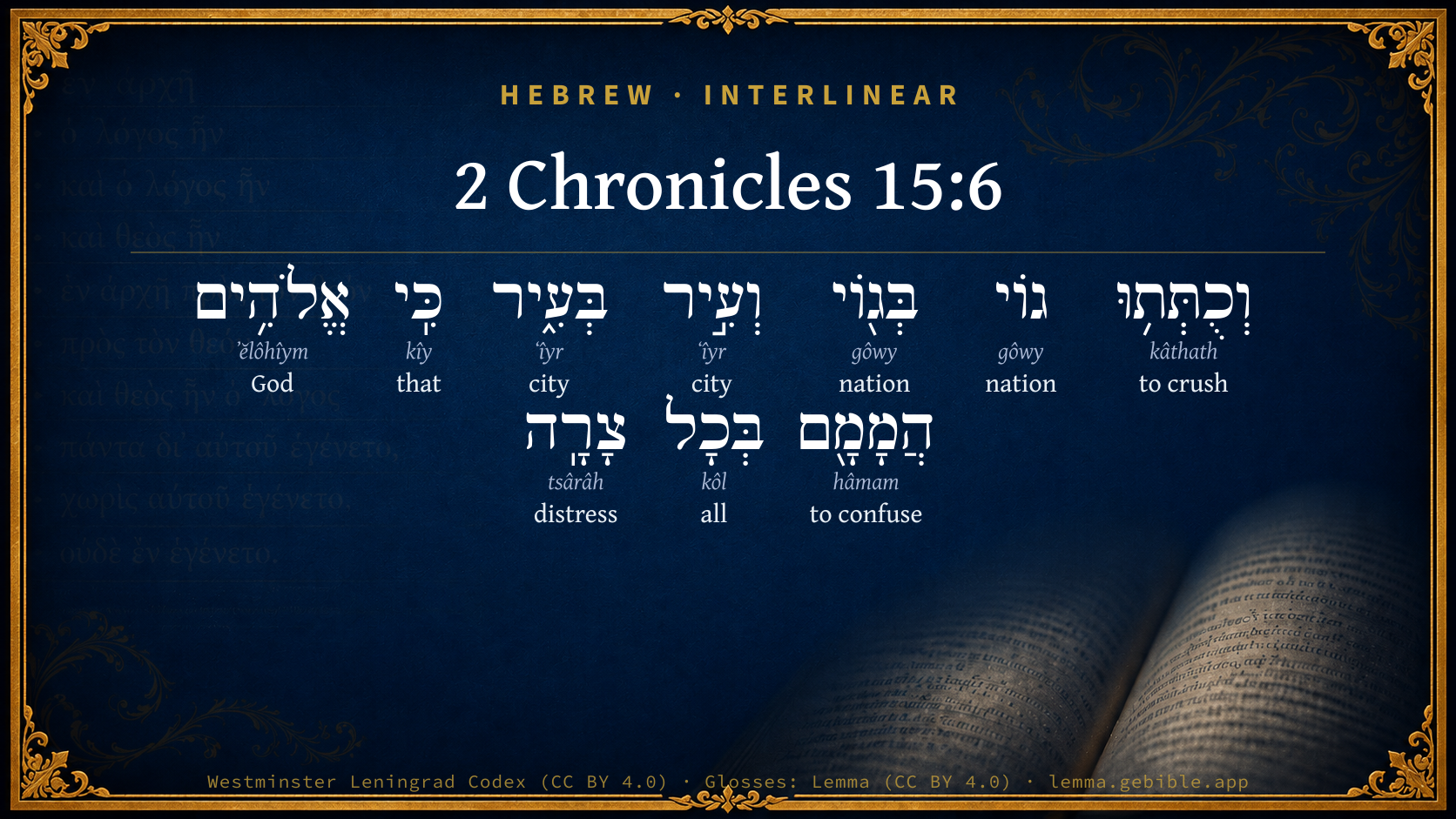
Hebrew (Westminster Leningrad Codex) 2 Chronicles 15:6 appears in the Hebrew Old Testament. The text above is from the Westminster Leningrad Codex. Each word links to its Strong’s number, a concise gloss, and parsing drawn from the Open Scriptures Hebrew Bible morphology. Click any word for its full Brown-Driver-Briggs (BDB) entry.
Download image
Cite this verse

2 Chronicles 15:6 (World English Bible). Public Domain. Lemma interlinear Bible study tool, https://lemma.gebible.app/v/2-chronicles/15/6.

Show BibTeX & RIS
BibTeX
RIS
English Translation
They were broken in pieces, nation against nation, and city against city; for God did vex them with all adversity.
World English Bible · Public Domain
Download a study sheet

One document with this verse’s original text, its word-by-word gloss line, the meaning frame, cross-references with their text, attributed commentary, and full source and license credits — printable, and it pastes into notes with its structure intact.

This verse Autodidact and up

Study sheet (.html) Plain text (.txt)

A passage Seminary Student

Up to 50 verses in one chapter. A passage sheet keeps up to 6 commentary sources and 12 cross-references per verse, in the order this page ranks them, and says so on the sheet whenever that leaves anything out. Ask for a single verse and you get the Autodidact verse sheet above.

Everything on this page stays free to read, with no account — the sheet is a download of what is already on screen, not access to it.

Want to remove ads? Support Godless Engineer
Compare translations 3

The same verse in 3 English versions, stacked beneath the original-language interlinear above. Click any original word for its lexicon entry.

Each is an independent rendering of the whole verse — the interlinear is not word-aligned to these translations.

Highlighted words mark where these versions differ — a whole-verse word diff, not a word-by-word alignment.

  • World English Bible Public Domain
    They were broken in pieces, nation against nation, and city against city; for God did vex them with all adversity.
  • King James Version Public Domain
    And nation was destroyed of nation, and city of city: for God did vex them with all adversity.
  • unfoldingWord Literal Text CC BY-SA 4.0
    And they were beaten down, nation by nation, and city by city, for God confused them in all distress.

unfoldingWord Literal Text — © unfoldingWord, licensed CC BY-SA 4.0. Word-aligned USFM3 via Door43 (git.door43.org/unfoldingWord/en_ult).

Versions to compare (up to 4)

3 of 4 selected

Show all 18 translations

Every available English version of this verse, each an independent rendering of the whole verse.

  • World English Bible Public Domain
    They were broken in pieces, nation against nation, and city against city; for God did vex them with all adversity.
  • Berean Standard Bible Public Domain
    Nation was crushed by nation, and city by city, for God afflicted them with all kinds of adversity.
  • Majority Standard Bible Public Domain
    Nation was crushed by nation, and city by city, for God afflicted them with all kinds of adversity.
  • King James Version Public Domain
    And nation was destroyed of nation, and city of city: for God did vex them with all adversity.
  • American Standard Version (1901) Public Domain
    And they were broken in pieces, nation against nation, and city against city; for God did vex them with all adversity.
  • Revised Version (1885) Public Domain
    And they were broken in pieces, nation against nation, and city against city: for God did vex them with all adversity.
  • Geneva Bible (1599) Public Domain
    For nation was destroyed of nation, and citie of citie: for God troubled them with all aduersitie.
  • Douay-Rheims (1899) Public Domain
    For nation shall fight against nation, and city against city, for the Lord will trouble them with all distress.
  • Young's Literal Translation Public Domain
    and they have been beaten down, nation by nation, and city by city, for God hath troubled them with every adversity;
  • Literal Standard Version CC BY-SA 4.0
    and they have been beaten down, nation by nation, and city by city, for God has troubled them with every adversity;
  • Unlocked Literal Bible CC BY-SA 4.0
    They were broken in pieces, nation against nation, and city against city, for God troubled them with all kinds of suffering.
  • unfoldingWord Literal Text CC BY-SA 4.0
    And they were beaten down, nation by nation, and city by city, for God confused them in all distress.
  • Darby Bible Public Domain
    And nation was broken against nation, and city against city; for God disturbed them with all manner of distress.
  • World Messianic Bible Public Domain
    They were broken in pieces, nation against nation, and city against city; for God troubled them with all adversity.
  • Webster's Bible Public Domain
    And nation was destroyed by nation, and city by city: for God troubled them with all adversity.
  • Free Bible Version CC BY-SA 4.0
    Nation fought nation, and town fought town, for God threw them into a panic with all kinds of trouble.
  • Bible in Basic English Public Domain
    And they were broken by divisions, nation against nation and town against town, because God sent all sorts of trouble on them.
  • JPS Tanakh (1917) Public Domain
    And they were broken in pieces, nation against nation, and city against city; for God did discomfit them with all manner of adversity.

Literal Standard Version (2020), Covenant Press — licensed CC BY-SA 4.0. Text via the HelloAO Bible API (eBible.org). Unlocked Literal Bible (unfoldingWord) — licensed CC BY-SA 4.0. Text via the HelloAO Bible API (eBible.org). unfoldingWord Literal Text — © unfoldingWord, licensed CC BY-SA 4.0. Word-aligned USFM3 via Door43 (git.door43.org/unfoldingWord/en_ult). Free Bible Version, Dr. Jonathan Gallagher — licensed CC BY-SA 4.0. Text via the HelloAO Bible API (eBible.org).

Word by word

More ways to search: Search by grammar → Find every occurrence → Compare this word →

Practice this passage: Drill this verse → Learn its vocabulary →

הֲמָמָ֖ם
hâmam
H2000
“to confuse · them”
Verb, Qal, Perfect, 3rd Person, Masculine, Singular + Suffix, Personal, 3rd Person, Masculine, Plural
Part of Speech
Verb
Stem
Qal
Form
Perfect
Person
3rd Person
Gender
Masculine
Number
Singular
Full BDB Definition

Origin: a primitive root [compare H1949 , H1993 ]

TWOT: 507

to move noisily, confuse, make a noise, discomfit, break, consume, crush, destroy, trouble, vex - (Qal) - to move noisily - to confuse, discomfit, vex
  1. וְכֻתְּת֥וּ kâthath H3807 “and · to crush” Conjunction + Verb, Pual, Perfect, 3rd Person, Common, Plural
  2. גוֹי gôwy H1471 “nation” Noun, Common, Masculine, Singular, Absolute
  3. בְּג֖וֹי gôwy H1471 “in/at · nation” Preposition + Noun, Common, Masculine, Singular, Absolute
  4. וְעִ֣יר ʻîyr H5892 “and · city” Conjunction + Noun, Common, Feminine, Singular, Absolute
  5. בְּעִ֑יר ʻîyr H5892 “in/at · city” Preposition + Noun, Common, Feminine, Singular, Absolute
  6. כִּֽי kîy H3588 “that” Conjunction
  7. אֱלֹהִ֥ים ʼĕlôhîym H430 “God(s)” Noun, Common, Masculine, Plural, Absolute
  8. בְּכָל kôl H3605 “in/at · all of” Preposition + Noun, Common, Masculine, Singular, Construct
  9. צָרָֽה tsârâh H6869 “distress” Noun, Common, Feminine, Singular, Absolute

About this verse

These counts appear in no published source. They are computed here, from the morphology-tagged text and Lemma’s own curated glosses. What Lemma adds →

10
words
8
distinct lemmas
Historical
section

Notable vocabulary

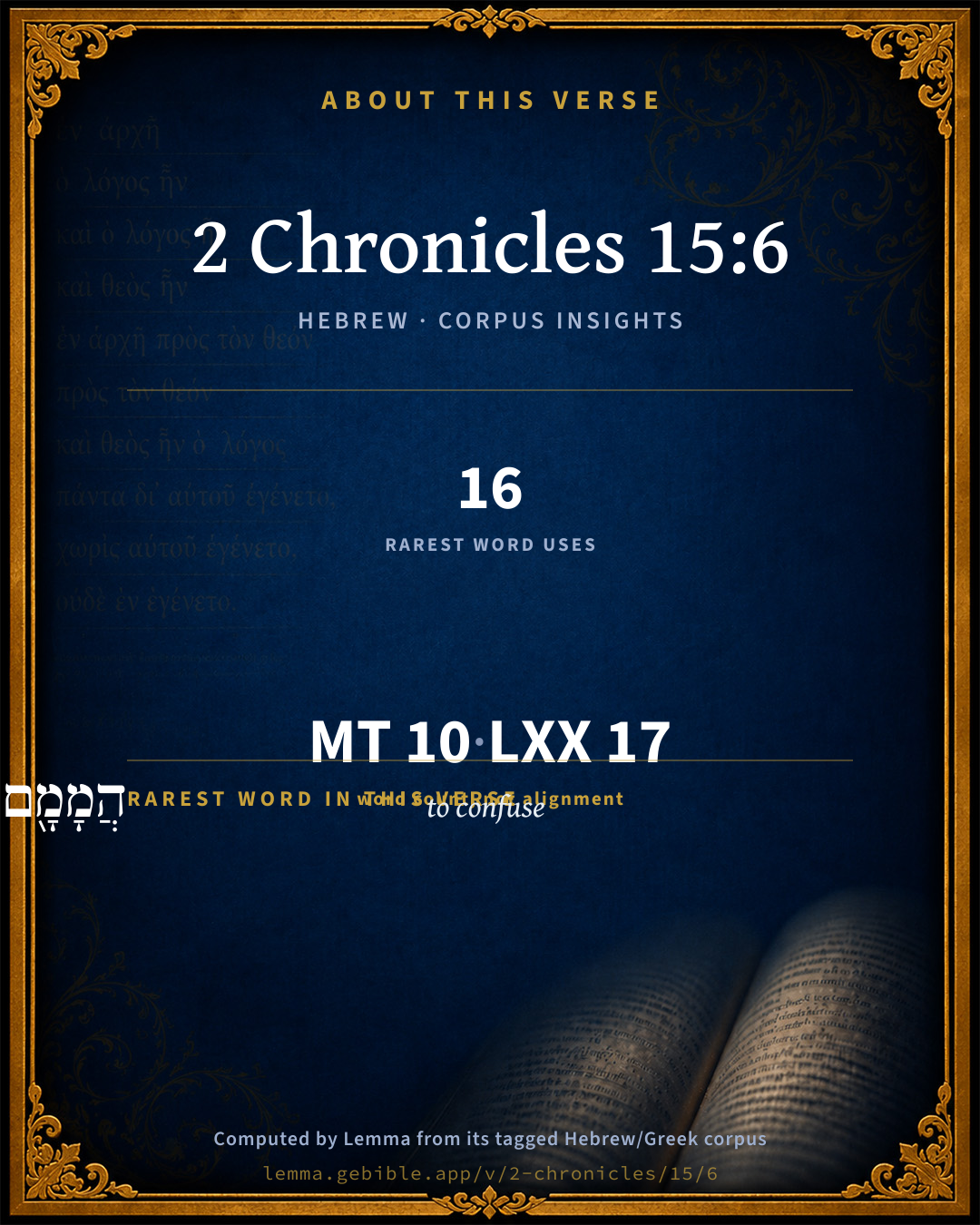
The rarest word here is הֲמָמָ֖ם to confuse H2000 — appearing just 16 times in the whole Hebrew Bible.

Shared distinctive vocabulary

הֲמָמָ֖ם to confuse H2000 occurs in 14 verses of the Hebrew Bible. Also found in:

Grammatical profile

  • 2 verbs
  • 7 nouns
  • 1 conjunction

Verb forms

  • וְכֻתְּת֥וּ Pual · Perfect
  • הֲמָמָ֖ם Qal · Perfect

Repetition

Words recur within this verse — often emphatic in Hebrew:

  • גוֹי nation H1471 ×2
  • וְעִ֣יר city H5892 ×2

Hebrew & Septuagint length

In English translation the verse runs 20 words from the Hebrew and 20 from the Septuagint (LXX English) — the same length.

A rough comparison of the two English renderings, which tokenize alike — not a word-level alignment.

Word counts can differ between the Hebrew and the Greek without any difference in meaning — e.g. the Hebrew direct-object marker אֵת has no separate Greek word, and Greek often adds the article ὁ.

In the original languages it is 10 Hebrew tokens and 17 Greek tokens — but the two are counted differently (Hebrew bundles its prefixes and suffixes into one token; the Greek is in lemma form), so that isn’t a like-for-like length.

Cross-references

12

Topical passages linked to 2 Chronicles 15:6 in the Treasury of Scripture Knowledge — connected by theme and wording, ordered by reader-vote popularity; previews shown in the World English Bible.

  • Luke 21:22–24 For these are days of vengeance, that all things which are written may be fulfilled.
  • Judges 2:14 The anger of Yahweh was kindled against Israel, and he delivered them into the hands of spoilers who despoiled them; and he sold them into the hands of their enemies round about, so that they could not any longer stand before their enemies.
  • 2 Chronicles 12:15 Now the acts of Rehoboam, first and last, aren't they written in the histories of Shemaiah the prophet and of Iddo the seer, after the manner of genealogies? There were wars between Rehoboam and Jeroboam continually.
  • 2 Chronicles 13:17 Abijah and his people killed them with a great slaughter: so there fell down slain of Israel five hundred thousand chosen men.
  • 2 Chronicles 33:11 Therefore Yahweh brought on them the captains of the host of the king of Assyria, who took Manasseh in chains, and bound him with fetters, and carried him to Babylon.
  • 2 Chronicles 36:17 Therefore he brought on them the king of the Chaldeans, who killed their young men with the sword in the house of their sanctuary, and had no compassion on young man or virgin, old man or gray-headed: he gave them all into his hand.
  • Psalms 106:41 He gave them into the hand of the nations. Those who hated them ruled over them.
  • Isaiah 10:6 I will send him against a profane nation, and against the people of my wrath will I give him a charge, to take the spoil, and to take the prey, and to tread them down like the mire of the streets.
  • Amos 3:6 Does the trumpet alarm sound in a city, Without the people being afraid? Does evil happen to a city, And Yahweh hasn't done it?
  • Matthew 24:7 For nation will rise against nation, and kingdom against kingdom; and there will be famines, plagues, and earthquakes in various places.
  • Mark 13:8 For nation will rise against nation, and kingdom against kingdom. There will be earthquakes in various places. There will be famines and troubles. These things are the beginning of birth pains.
  • Luke 21:9–10 When you hear of wars and disturbances, don't be terrified, for these things must happen first, but the end won't come immediately."

Cross-references courtesy of OpenBible.info (CC BY 4.0).

Hebrew and Greek witnesses Masoretic Hebrew ↔ Greek Septuagint

The same verse in the two great witnesses to the Old Testament, shown verse-for-verse.

These are two independent witnesses, not word-aligned to each other, and the Septuagint is shown in lemma (dictionary) form.

Hebrew 2 Chronicles 15:6 Masoretic · Westminster Leningrad Codex

וְכֻתְּת֥וּ גוֹי בְּג֖וֹי וְעִ֣יר בְּעִ֑יר כִּֽי אֱלֹהִ֥ים הֲמָמָ֖ם בְּכָל צָרָֽה

They were broken in pieces, nation against nation, and city against city; for God did vex them with all adversity.

World English Bible · Public Domain

Greek LXX 2 Chronicles 15:6 Septuagint · lemma form

καί πολεμέω ἔθνος πρός ἔθνος καί πόλις πρός πόλις ὅτι ὁ θεός ἐκἵστημι αὐτός ἐν πᾶς θλῖψις

And nation shall fight against nation, and city against city; for God has confounded them with every kind of affliction.

LXX2012 (modern English Septuagint) · Public Domain

On this verse, Ellicott's Commentary for English Readers discusses the Septuagint’s reading. Read the note in Commentary ↓

Hebrew: Westminster Leningrad Codex (CC BY 4.0). Greek: Septuagint (public domain); English from LXX2012 (modern English Septuagint) (Public Domain). How the Septuagint differs from the Hebrew →

Commentary

Notes on 2 Chronicles 15:6 from classic Christian and Jewish commentators (each source and its license shown beneath its notes). The classic Christian expositions comment on the surrounding passage and are grouped to its opening verse, so a note may address several verses; the Jewish commentaries on the Tanakh (Rashi and others) are per-verse, so they appear only where the commentator wrote on this verse.

Lemma curates 59 commentaries, every one of them public domain or Creative Commons licensed, each selected and text-cleaned for this edition rather than reprinted as found. About our sources →

Trapp's Complete Commentary

John Trapp

2Ch 15:6 And nation was destroyed of nation, and city of city: for God did vex them with all adversity.

Ver. 6. And nation was destroyed.] Heb., Beaten to pieces: such is the woe of war, that no words, however so wide, are sufficient to set it forth.

John Trapp, A Commentary or Exposition upon All the Books of the Old and New Testament (1647–1656) — public domain. Text from a community e-Sword module.

Joseph Benson's Commentary

2Ch 15:6. Nation was destroyed of nation — One part of the people of Israel destroyed the other by civil wars; of which see instances, Jdg 9:23, &c., and 2Ch 12:1, &c. As all Israel, so the several tribes of them are sometimes called nations.

Joseph Benson's Commentary on the Old and New Testaments (1811–1818) — public domain. Text from a community e-Sword module.

Keil & Delitzsch

C. F. Keil & F. Delitzsch

"And one people is dashed in pieces by the other, and one city by the other; for God confounds them by all manner of adversity." המם denotes confusion, which God brings about in order to destroy His enemies (Exo 14:24; Jos 10:10; Jdg 4:15). Days when they were without the true God, without teaching prophets, and without law, Israel had already experienced in the times of defection after Joshua (cf. Jdg 2:11.), but will experience them in the future still oftener and more enduringly under the idolatrous kings in the Assyrian and Babylonian exile, and still even now in its dispersion among all nations. That this saying refers to the future is also suggested by the fact that Hosea (Hos 3:4) utters, with a manifest reference to Ch2 15:3 of our speech, a threat that the ten tribes will be brought into a similar condition (cf. Hos 9:3-4); and even Moses proclaimed to the people that the punishment of defection from the Lord would be dispersion among the heathen, where Israel would be compelled to serve idols of wood and stone (Deu 4:27., Deu 28:36, Deu 28:64), i.e., would be without the true God. That Israel would, in such oppression, turn to its God, would seek Him, and that the Lord would be found of them, is a thought also expressed by Moses, the truth of which Israel had not only had repeated experience of during the time of the judges, but also would again often experience in the future (cf. Hos 3:5; Jer 31:1; Eze 36:24.; Rom 11:25.). בּצּר־לו refers back to Deu 4:30; the expression in Ch2 15:4 is founded upon Deu 4:29 (cf. Isa 55:6). - Of the oppression in the times of defection portrayed in Ch2 15:5., Israel had also had in the time of the judges repeated experience (cf. Jdg 5:6), most of all under the Midianite yoke (Jdg 6:2); but such times often returned, as the employment of the very words of the first hemistich of Ch2 15:5 in Zac 8:10, in reference to the events of the post-exilic time, shows; and not only the prophet Amos (Amo 3:9) sees רבּות מהוּמות, great confusions, where all is in an indistinguishable whirl in the Samaria of his time, but they repeated themselves at all times when the defection prevailed, and godlessness degenerated into revolution and civil war. Azariah portrays the terrors of such times in strong colours (Ch2 15:6): "Dashed to pieces is people by people, and city by city." The war of the tribes of Israel against Benjamin (Judg 20:f.), and the struggle of the Gileadites under Jephthah with Ephraim (Jdg 12:4.), were civil wars; but they were only mild preludes of the bellum omnium contra omnes depicted by Azariah, which only commenced with the dissolution of both kingdoms, and was announced by the later prophets as the beginning of the judgment upon rebellious Israel (e.g., Isa 9:17-20), and upon all peoples and kingdoms hostile to God (Zac 14:13; Mat 24:7). With הממם אלהים כּי cf. רבּה יי מהוּמת, Zac 14:13. To this portrayal of the dread results of defection from the Lord, Azariah adds (Ch2 15:7) the exhortation, "Be ye strong (vigorous), and show yourselves not slack, languid" (cf. Zep 3:16; Neh 6:9); i.e., in this connection, proceed courageously and vigorously to keep yourselves true to the Lord, to exterminate all idolatry; then you shall obtain a great reward: cf. on these words, Jer 31:16.

Keil & Delitzsch — Biblical Commentary on the Old Testament (1861–1891) — public domain (CC PDM 1.0). Text via the HelloAO Bible API. (Old Testament only.)

Ellicott's Commentary for English Readers

(6) And nation was destroyed of nation.—And they were crushed, nation by nation and city by city. The verb khathath occurs Isa_2:4 (“to beat”); but in its (intensive) passive form only here. Some MSS. have the (intensive) active form, which is found elsewhere. So LXX. and Vulg.: “And nation shall fight against nation.” Nation is gôy, i.e., a community of kindred, such as a tribe or clan, rather than a merely political aggregate. The allusion is to the old feuds and contentions between rival tribes, e.g., between Ephraim and Gilead (Manasseh) (Judges 12), or between Benjamin and the other tribes (Judges 20). The verse vividly pourtrays an internecine strife, like that described in Isa_19:2 : “And I will set the Egyptians against the Egyptians, and they shall fight every one against his brother, and every one against his neighbour; city against city, kingdom against kingdom;” or like that depicted by the same prophet (Isa_9:18-21): “No man shall spare his brother . . . they shall eat every man the flesh of his own arm [i.e., of his natural ally]: Manasseh, Ephraim; and Ephraim, Manasseh; and they together shall be against Judah.”

Did vex them with all adversity.—Had confounded (or, discomfited) them with every kind of distress. (Comp. Zec_14:13 : “A great confusion from the Lord.”)

A Bible Commentary for English Readers, edited by Charles John Ellicott (1878–1897) — public domain. Text from a community e-Sword module.

The Cambridge Bible for Schools and Colleges

gen. ed. J. J. S. Perowne

6. nation was destroyed of nation, and city of city] R.V. they were broken in pieces, nation against nation, and city against city. Israel is meant. In the civil strife of the days of the Judges Israel appeared more than once as two nations destroying one another: cp. Jdg_8:13-17; Jdg_9:26 ff; Jdg_12:1 ff; Jdg_20:12 ff.

vex] Rather, afflict; see 2Ch_15:5.

The Cambridge Bible for Schools and Colleges (gen. ed. J. J. S. Perowne; Cambridge University Press, 1878–1918) — public domain. Text from a community e-Sword module.

John Gill's Exposition

And nation was destroyed of nation, and city of city,.... Or one tribe of another; as the Ephraimites by the Gileadites, and the tribe of Benjamin by the other tribes; and Shechem by Abimelech, Jdg 9:45,

for God did vex them with all adversity; both with foreign enemies and civil wars; and now it is intimated that this would be their case again, should they not keep close to the Lord their God.

John Gill's Exposition of the Whole Bible (1746–1763) — public domain (CC PDM 1.0). Text via the HelloAO Bible API.

Albert Barnes' Notes on the Bible

The allusion is probably to the destructions recorded in Jdg 9:45; 20:33-48.

Albert Barnes' Notes on the Bible (1834–1885) — public domain. Text from a community e-Sword/MySword module.

Haydock's Catholic Bible Commentary

Nation, both in the times of Baasa, who fought against Asa, and afterwards. For the same prophecy may be literally explained of more thing than one. (Menochius) --- Distress. Our Saviour says, Then shall they deliver you up to be afflicted, &c. But he that shall persevere to the end, shall be saved. [Matthew xxiv. 9-13.]

George Leo Haydock (1774–1849), Haydock's Catholic Family Bible and Commentary, 1859 edition — public domain. Excludes Psalms (Douay-Rheims chapter numbering differs from Protestant) and Deuterocanonical books (Catholic canon only).

Matthew Poole's English Annotations

Nation was destroyed of nation, i.e. one part of the people of Israel destroyed the other by civil wars; of which see instances, Jdg 9:23, &c.; Jdg 12:1, &c. As all the people of Israel are called a nation, so the several tribes and families of them are sometimes called nations, as Gen 17:4; Eze 2:3 Act 4:27, compared with Psa 2:1.

Matthew Poole's English Annotations on the Holy Bible (1683–1685) — public domain. Text from a community e-Sword/MySword module.

Whedon's Commentary on the Bible

Daniel D. Whedon

6. Nation… destroyed of nation — “It is quite in harmony with the rhetorical nature of the passage that the contentions of the Israelites among themselves (for example, in the time of the Judges between the inhabitants of Gilead and Ephraim, and between Benjamin and the rest of the tribes, Jdg_12:4; Judges 20, 21; and in later times between the two Israelitish kingdoms) should be described as a crushing of one people by the other.” — Bertheau.

City of city — Comp. Jdg_9:45.

Daniel D. Whedon (gen. ed.), Commentary on the Old and New Testaments (1874–1909) — public domain. Text from a community e-Sword module.

The Pulpit Commentary

Among other patent instances, not the least remarkable are found in Jud 20:35-45 9:44-47; these forecast and heralded that final rupture of Rehoboam and Jeroboam, which showed the "house divided against itself," and the sure consequences thereof.

The Pulpit Commentary (1880–1919), ed. H.D.M. Spence-Jones & Joseph S. Exell — public domain. Text from a community e-Sword module.

John Wesley's Explanatory Notes

And nation, &c. - One part of the people of Israel destroyed the other by civil wars. As all Israel are called a nation, so the several tribes of them are sometimes called nations.

John Wesley, Explanatory Notes Upon the Whole Bible (1754–1765) — public domain. Text via the GEBible commentary corpus.

unfoldingWord translationNotes

Door43 World Missions Community

They were broken in pieces, nation against nation, and city against city

The word "they" refers to the words "nation" and "city." Conquering one another is spoken of as if they were breaking each other into pieces. AT: "Nations and cities destroyed each other, nations fighting nations, cities fighting cities" (See: Metaphor)

They were broken in pieces, nation against nation, and city against city

Here "nation" and "city" are metonyms for the people who live there. You may also supply a connecting word to clarify the relationship between these two phrases. AT: "Nations and cities destroyed each other, as the people of one nation fought against the people of another nation, and the people of one city fought against the people of another city" (See: Metonymy and Connecting Words)

do not let your hands be weak

Here the word "hands" represents the people who work. AT: "do not become weak as you work" (See: Synecdoche)

for your work will be rewarded

This can be stated in active form. Yahweh is the implied subject. AT: "for Yahweh will reward your work" (See: Active or Passive and Assumed Knowledge and Implicit Information)

translationWords

nation

trouble

suffer

hand

works

reward

unfoldingWord translationNotes — © Distant Shores Media and the Door43 World Missions Community, licensed CC BY-SA 4.0. Source: git.door43.org/Door43/en_tn.

Rashi

Rabbi Shlomo Yitzchaki (Rashi)

And nation was crushed by nation - Heb. וְכֻתְּתוּ. Another instance of this is (Num. 14:45): “and they struck them and crushed them (וַיַּכְּתוּם).”

Rashi on the Tanakh — English translations: “The Judaica Press complete Tanach with Rashi, translated by A. J. Rosenberg” (CC BY 4.0); “Pentateuch with Rashi's commentary by M. Rosenbaum and A.M. Silbermann, 1929-1934” (public domain); “The Metsudah Tanach series, Lakewood, N.J” (CC BY 4.0); and “The Book of Joshua, Metsudah Publications, 1997” (CC BY 4.0). Text via Sefaria.

Lesson kit

Teaching starters — assembled from the data on this page, not authored interpretation. Every prompt links to the verse data it draws on. Edit before teaching.

2 Chronicles, in the Historical, opens this verse with 10 words (8 distinct Hebrew lemmas). Its most distinctive word is hâmam (“to confuse”). A historical commentator’s framing appears above. Read the whole chapter for the surrounding context.

Discussion questions

  1. What does “to confuse” (hâmam) contribute to the verse as a whole?
  2. Exodus 14:24 shares the word «to confuse» with this verse. How do the two illuminate each other?
  3. “nation” occurs 2× in this one verse. What is the effect of the repetition?
  4. These translations render this verse differently; the difference is in the English rendering, not the original. What questions does that raise?
  5. The verb «וְכֻתְּת֥וּ» is Pual Perfect. How does its form color the action?
  6. Reading how Trapp's Complete Commentary and Joseph Benson's Commentary read this verse, where do the two commentators agree and where do they part?

Things to notice

Reading settings

Reading text

Shown beneath each verse's original-language words.

Old Testament
Old Testament edition

Read the OT as the Masoretic Hebrew (MT) or the Greek Septuagint (LXX).

English shown for the Greek Septuagint (in the Hebrew ↔ Greek comparison).

Comparing translations? Open the Compare panel on any verse page to stack up to four side by side.