
Deuteronomy 32:43

Hebrew (Westminster Leningrad Codex) Deuteronomy 32:43 appears in the Hebrew Old Testament. The text above is from the Westminster Leningrad Codex. Each word links to its Strong’s number, a concise gloss, and parsing drawn from the Open Scriptures Hebrew Bible morphology. Click any word for its full Brown-Driver-Briggs (BDB) entry.
Download image
Cite this verse

Deuteronomy 32:43 (World English Bible). Public Domain. Lemma interlinear Bible study tool, https://lemma.gebible.app/v/deuteronomy/32/43.

Show BibTeX & RIS
BibTeX
RIS
English Translation
Rejoice, you nations, [with] his people: For he will avenge the blood of his servants, Will render vengeance to his adversaries, Will make expiation for his land, for his people.
World English Bible · Public Domain
Download a study sheet

One document with this verse’s original text, its word-by-word gloss line, the meaning frame, cross-references with their text, attributed commentary, and full source and license credits — printable, and it pastes into notes with its structure intact.

This verse Autodidact and up

Study sheet (.html) Plain text (.txt)

A passage Seminary Student

Up to 50 verses in one chapter. A passage sheet keeps up to 6 commentary sources and 12 cross-references per verse, in the order this page ranks them, and says so on the sheet whenever that leaves anything out. Ask for a single verse and you get the Autodidact verse sheet above.

Everything on this page stays free to read, with no account — the sheet is a download of what is already on screen, not access to it.

Want to remove ads? Support Godless Engineer
Compare translations 3

The same verse in 3 English versions, stacked beneath the original-language interlinear above. Click any original word for its lexicon entry.

Each is an independent rendering of the whole verse — the interlinear is not word-aligned to these translations.

Highlighted words mark where these versions differ — a whole-verse word diff, not a word-by-word alignment.

  • World English Bible Public Domain
    Rejoice, you nations, [with] his people: For he will avenge the blood of his servants, Will render vengeance to his adversaries, Will make expiation for his land, for his people.
  • King James Version Public Domain
    Rejoice, O ye nations, with his people: for he will avenge the blood of his servants, and will render vengeance to his adversaries, and will be merciful unto his land, and to his people.
  • unfoldingWord Literal Text CC BY-SA 4.0
    Nations, make his people rejoice, for he will avenge the blood of his servants, and he will return vengeance on his adversaries, and atone for his land his people.”

unfoldingWord Literal Text — © unfoldingWord, licensed CC BY-SA 4.0. Word-aligned USFM3 via Door43 (git.door43.org/unfoldingWord/en_ult).

Versions to compare (up to 4)

3 of 4 selected

Show all 18 translations

Every available English version of this verse, each an independent rendering of the whole verse.

  • World English Bible Public Domain
    Rejoice, you nations, [with] his people: For he will avenge the blood of his servants, Will render vengeance to his adversaries, Will make expiation for his land, for his people.
  • Berean Standard Bible Public Domain
    Rejoice, O heavens, with Him, and let all God’s angels worship Him. Rejoice, O nations, with His people; for He will avenge the blood of His children. He will take vengeance on His adversaries and repay those who hate Him; He will cleanse His land and His people.
  • Majority Standard Bible Public Domain
    Rejoice, O heavens, with Him, and let all God’s angels worship Him. Rejoice, O nations, with His people; for He will avenge the blood of His children. He will take vengeance on His adversaries and repay those who hate Him; He will cleanse His land and His people.
  • King James Version Public Domain
    Rejoice, O ye nations, with his people: for he will avenge the blood of his servants, and will render vengeance to his adversaries, and will be merciful unto his land, and to his people.
  • American Standard Version (1901) Public Domain
    Rejoice, O ye nations, `with' his people: For he will avenge the blood of his servants, And will render vengeance to his adversaries, And will make expiation for his land, for his people.
  • Revised Version (1885) Public Domain
    Rejoice, O ye nations, with his people: For he will avenge the blood of his servants, And will render vengeance to his adversaries, And will make expiation for his land, for his people.
  • Geneva Bible (1599) Public Domain
    Ye nations, praise his people: for he will auenge the blood of his seruants, and will execute vengeance vpon his aduersaries, and will bee mercifull vnto his lande, and to his people.
  • Douay-Rheims (1899) Public Domain
    Praise his people, ye nations, for he will revenge the blood of his servants: and will render vengeance to their enemies, and he will be merciful to the land of his people.
  • Young's Literal Translation Public Domain
    Sing ye nations -- `with' his people, For the blood of His servants He avengeth, And vengeance He turneth back on His adversaries, And hath pardoned His land -- His people.'
  • Literal Standard Version CC BY-SA 4.0
    Sing, O nations, [with] His people, || For He avenges the blood of His servants, || And He turns back vengeance on His adversaries, || And has pardoned His land [and] His people.”
  • Unlocked Literal Bible CC BY-SA 4.0
    Rejoice, you nations, with God's people, for he will avenge the blood of his servants; he will render vengeance on his enemies, and he will make atonement for his land, for his people.
  • unfoldingWord Literal Text CC BY-SA 4.0
    Nations, make his people rejoice, for he will avenge the blood of his servants, and he will return vengeance on his adversaries, and atone for his land his people.”
  • Darby Bible Public Domain
    Shout for joy, ye nations, with his people, For he avengeth the blood of his servants, And rendereth vengeance to his enemies, And maketh atonement for his land, for his people.
  • World Messianic Bible Public Domain
    Rejoice, you nations, with his people, for he will avenge the blood of his servants. He will take vengeance on his adversaries, and will make atonement for his land and for his people.
  • Webster's Bible Public Domain
    Rejoice, O ye nations, with his people: for he will avenge the blood of his servants, and will render vengeance to his adversaries, and will be merciful to his land, and to his people.
  • Free Bible Version CC BY-SA 4.0
    Celebrate with him! Let all God's angels worship him! Celebrate, foreigners, with his people; because he will pay back those who killed his children. He will punish his enemies, and repay those who hate him; he will purify his land and his people.
  • Bible in Basic English Public Domain
    Be glad, O you his people, over the nations; for he will take payment for the blood of his servants, and will give punishment to his haters, and take away the sin of his land, for his people.
  • JPS Tanakh (1917) Public Domain
    Sing aloud, O ye nations, of His people; for He doth avenge the blood of His servants, and doth render vengeance to His adversaries, and doth make expiation for the land of His people.

Literal Standard Version (2020), Covenant Press — licensed CC BY-SA 4.0. Text via the HelloAO Bible API (eBible.org). Unlocked Literal Bible (unfoldingWord) — licensed CC BY-SA 4.0. Text via the HelloAO Bible API (eBible.org). unfoldingWord Literal Text — © unfoldingWord, licensed CC BY-SA 4.0. Word-aligned USFM3 via Door43 (git.door43.org/unfoldingWord/en_ult). Free Bible Version, Dr. Jonathan Gallagher — licensed CC BY-SA 4.0. Text via the HelloAO Bible API (eBible.org).

Word by word

More ways to search: Search by grammar → Find every occurrence → Compare this word →

Practice this passage: Drill this verse → Learn its vocabulary →

וְנָקָם֙
nâqâm
H5359
“and · vengeance”
Conjunction + Noun, Common, Masculine, Singular, Absolute
Part of Speech
Conjunction + Noun
Type
Common
Gender
Masculine
Number
Singular
State
Absolute
Full BDB Definition

Origin: from H5358

TWOT: 1413a

vengeance - vengeance (by God, by Samson, by enemies of Judah)
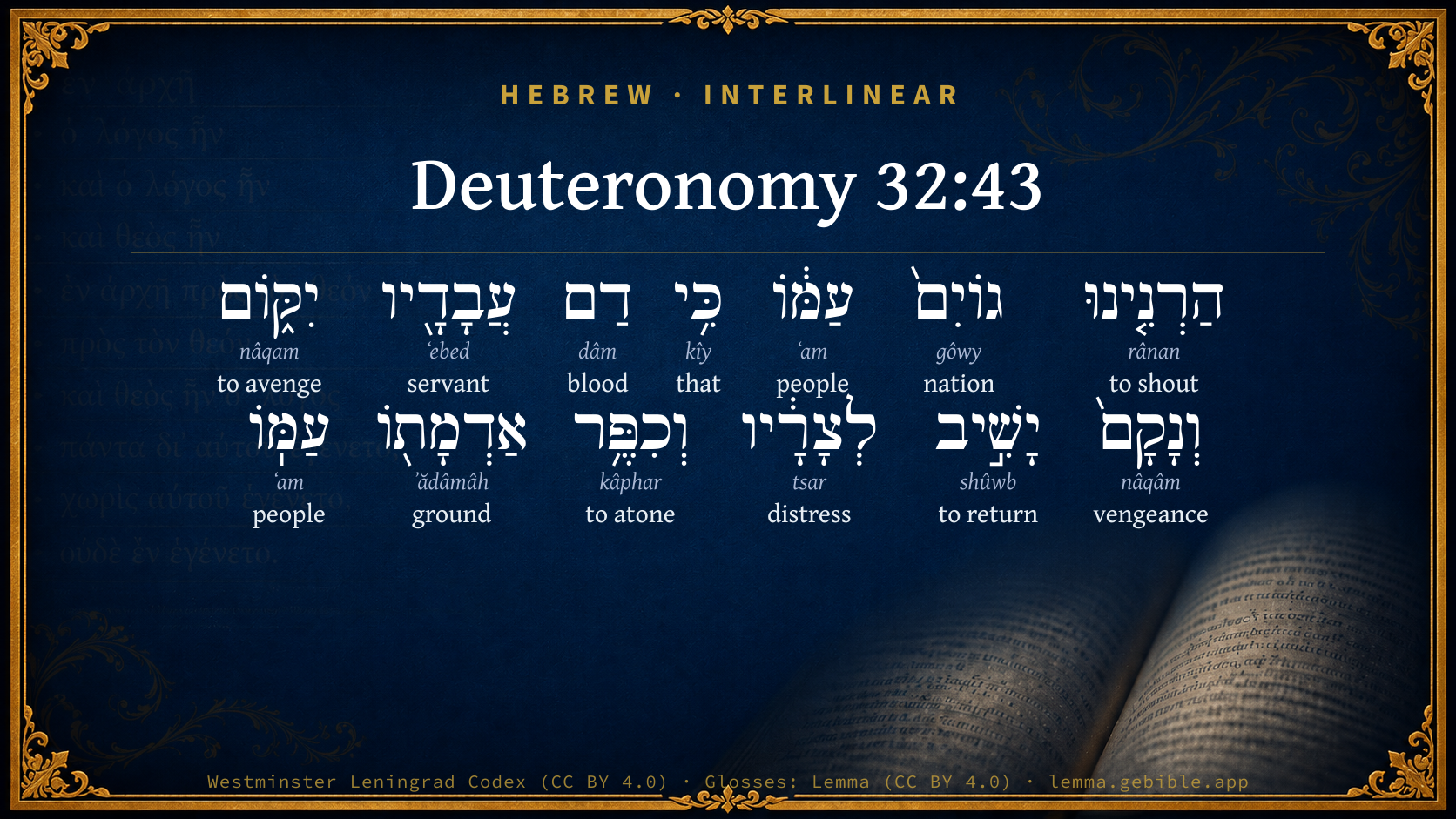
  1. הַרְנִ֤ינוּ rânan H7442 “shout” Verb, Hiphil, Imperative, 2nd Person, Masculine, Plural
  2. גוֹיִם֙ gôwy H1471 “nations” Noun, Common, Masculine, Plural, Absolute
  3. עַמּ֔וֹ ʻam H5971 “people · his” Noun, Common, Masculine, Singular, Construct + Suffix, Personal, 3rd Person, Masculine, Singular
  4. כִּ֥י kîy H3588 “that” Conjunction
  5. דַם dâm H1818 “blood of” Noun, Common, Masculine, Singular, Construct
  6. עֲבָדָ֖יו ʻebed H5650 “servants · his” Noun, Common, Masculine, Plural, Construct + Suffix, Personal, 3rd Person, Masculine, Singular
  7. יִקּ֑וֹם nâqam H5358 “to avenge” Verb, Qal, Imperfect, 3rd Person, Masculine, Singular
  8. יָשִׁ֣יב shûwb H7725 “to return” Verb, Hiphil, Imperfect, 3rd Person, Masculine, Singular
  9. לְצָרָ֔יו tsar H6862 “to/for · distresses · his” Preposition + Noun, Common, Masculine, Plural, Construct + Suffix, Personal, 3rd Person, Masculine, Singular
  10. וְכִפֶּ֥ר kâphar H3722 “and · to atone” Conjunction + Verb, Piel, Sequential Perfect, 3rd Person, Masculine, Singular
  11. אַדְמָת֖וֹ ʼădâmâh H127 “ground · his” Noun, Common, Feminine, Singular, Construct + Suffix, Personal, 3rd Person, Masculine, Singular
  12. עַמּֽוֹ ʻam H5971 “people · his” Noun, Common, Masculine, Singular, Construct + Suffix, Personal, 3rd Person, Masculine, Singular

About this verse

These counts appear in no published source. They are computed here, from the morphology-tagged text and Lemma’s own curated glosses. What Lemma adds →

13
words
12
distinct lemmas
Pentateuch
section

Notable vocabulary

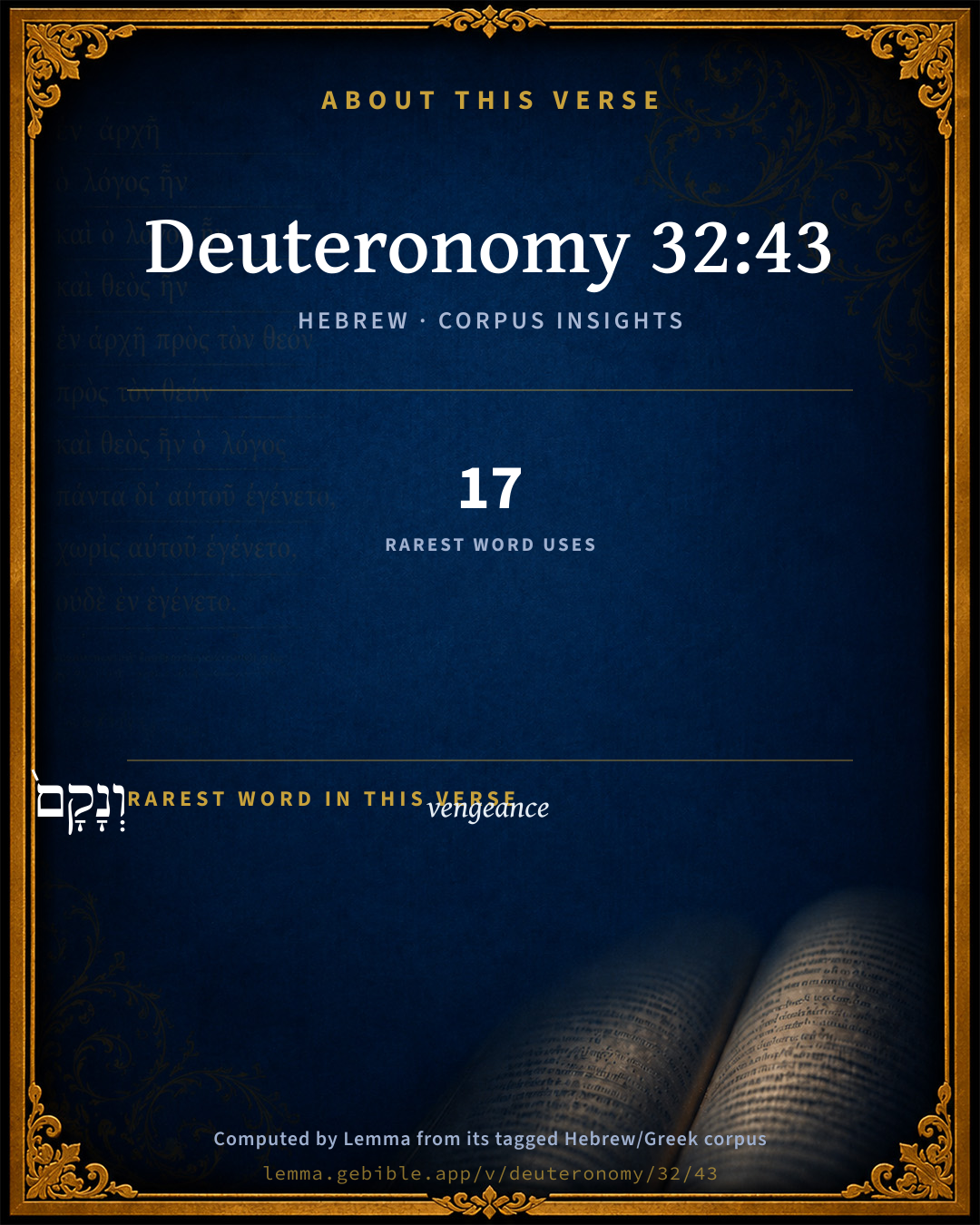
The rarest word here is וְנָקָם֙ vengeance H5359 — appearing just 17 times in the whole Hebrew Bible.

Shared distinctive vocabulary

וְנָקָם֙ vengeance H5359 occurs in 17 verses of the Hebrew Bible. Also found in:

Grammatical profile

  • 4 verbs
  • 8 nouns
  • 1 conjunction

Verb forms

  • הַרְנִ֤ינוּ Hiphil · Imperative
  • יִקּ֑וֹם Qal · Imperfect
  • יָשִׁ֣יב Hiphil · Imperfect
  • וְכִפֶּ֥ר Piel · Sequential Perfect

Repetition

A word recurs within this verse — often emphatic in Hebrew:

  • עַמּ֔וֹ people H5971 ×2

Hebrew & Septuagint length

In English translation the verse runs 30 words from the Hebrew and 68 from the Septuagint (LXX English) — the Septuagint runs noticeably longer here. See the side-by-side →

A rough comparison of the two English renderings, which tokenize alike — not a word-level alignment.

Word counts can differ between the Hebrew and the Greek without any difference in meaning — e.g. the Hebrew direct-object marker אֵת has no separate Greek word, and Greek often adds the article ὁ.

Cross-references

28

Topical passages linked to Deuteronomy 32:43 in the Treasury of Scripture Knowledge — connected by theme and wording, ordered by reader-vote popularity; previews shown in the World English Bible.

  • Romans 12:19 Don't seek revenge yourselves, beloved, but give place to God's wrath. For it is written, "Vengeance belongs to me; I will repay, says the Lord."
  • Revelation 19:2 for true and righteous are his judgments. For he has judged the great prostitute, who corrupted the earth with her sexual immorality, and he has avenged the blood of his servants at her hand."
  • Revelation 6:10 They cried with a loud voice, saying, "How long, Master, the holy and true, until you judge and avenge our blood on those who dwell on the earth?"
  • Deuteronomy 32:35 Vengeance is mine, and recompense, At the time when their foot shall slide: For the day of their calamity is at hand, The things that are to come on them shall make haste.
  • Psalms 85:1 Yahweh, you have been favorable to your land. You have restored the fortunes of Jacob.
  • Job 13:24 Why hide you your face, And hold me for your enemy?
  • 2 Kings 9:7 You shall strike the house of Ahab your master, that I may avenge the blood of my servants the prophets, and the blood of all the servants of Yahweh, at the hand of Jezebel.
  • Psalms 65:3 Sins overwhelmed me, But you atoned for our transgressions.
  • Isaiah 11:10 It shall happen in that day, that the root of Jesse, who stands for an ensign of the peoples, to him shall the nations seek; and his resting-place shall be glorious.
  • Isaiah 19:23 In that day shall there be a highway out of Egypt to Assyria, and the Assyrian shall come into Egypt, and the Egyptian into Assyria; and the Egyptians shall worship with the Assyrians.
  • Isaiah 19:25 because Yahweh of Hosts has blessed them, saying, Blessed be Egypt my people, and Assyria the work of my hands, and Israel my inheritance.
  • Jeremiah 13:14 I will dash them one against another, even the fathers and the sons together, says Yahweh: I will not pity, nor spare, nor have compassion, that I should not destroy them.
  • Lamentations 2:5 The Lord is become as an enemy, he has swallowed up Israel; He has swallowed up all her palaces, he has destroyed his strongholds; He has multiplied in the daughter of Judah mourning and lamentation.
  • Luke 2:10–11 The angel said to them, "Don't be afraid, for behold, I bring you good news of great joy which will be to all the people.
  • Luke 2:32 A light for revelation to the Gentiles, And the glory of your people Israel."
  • Luke 19:27 But bring those enemies of mine who didn't want me to reign over them here, and kill them before me.'"
  • Luke 21:22–24 For these are days of vengeance, that all things which are written may be fulfilled.
  • Acts 13:47–48 For so has the Lord commanded us, saying, 'I have set you as a light for the Gentiles, That you should bring salvation to the uttermost parts of the earth.'"
  • Romans 15:9–13 and that the Gentiles might glorify God for his mercy. As it is written, "Therefore will I give praise to you among the Gentiles, And sing to your name."
  • Revelation 5:9–10 They sang a new song, saying, "You are worthy to take the book, And to open its seals: For you were killed, And bought us for God with your blood, Out of every tribe, language, people, and nation,
  • Revelation 15:2 I saw something like a sea of glass mixed with fire, and those who overcame the beast, his image, and the number of his name, standing on the sea of glass, having harps of God.
  • Revelation 15:4 Who wouldn't fear you, Lord, And glorify your name? For you only are holy. For all the nations will come and worship before you. For your righteous acts have been revealed."
  • Revelation 18:2 He cried with a mighty voice, saying, "Fallen, fallen is Babylon the great, and she has become a habitation of demons, a prison of every unclean spirit, and a prison of every unclean and hateful bird!
  • Revelation 18:20 Rejoice over her, O heaven, you saints, apostles, and prophets; for God has judged your judgment on her."
  • Genesis 12:3 I will bless those who bless you, and I will curse him who curses you. In you will all of the families of the earth be blessed."
  • 1 Kings 8:43 hear in heaven, your dwelling-place, and do according to all that the foreigner calls to you for; that all the peoples of the earth may know your name, to fear you, as does your people Israel, and that they may know that this house which I have built is called by my name.
  • Psalms 22:27 All the ends of the earth shall remember and turn to Yahweh. All the relatives of the nations shall worship before you.
  • Luke 19:43–44 For the days will come on you, when your enemies will throw up a barricade against you, surround you, hem you in on every side,

Cross-references courtesy of OpenBible.info (CC BY 4.0).

Hebrew and Greek witnesses Masoretic Hebrew ↔ Greek Septuagint

The same verse in the two great witnesses to the Old Testament, shown verse-for-verse.

Here the Septuagint runs noticeably longer than the Hebrew — LXX2012 (modern English Septuagint) 68 words vs World English Bible 30. A rough length comparison of the two English translations, not a word-level alignment — read both below.

These are two independent witnesses, not word-aligned to each other, and the Septuagint is shown in lemma (dictionary) form.

Hebrew Deuteronomy 32:43 Masoretic · Westminster Leningrad Codex

הַרְנִ֤ינוּ גוֹיִם֙ עַמּ֔וֹ כִּ֥י דַם עֲבָדָ֖יו יִקּ֑וֹם וְנָקָם֙ יָשִׁ֣יב לְצָרָ֔יו וְכִפֶּ֥ר אַדְמָת֖וֹ עַמּֽוֹ

Rejoice, you nations, [with] his people: For he will avenge the blood of his servants, Will render vengeance to his adversaries, Will make expiation for his land, for his people.

World English Bible · Public Domain

Greek LXX Deuteronomy 32:43 Septuagint · lemma form

εὐφραίνω οὐρανός ἅμα αὐτός καί προςκυνέω αὐτός πᾶς υἱός θεός εὐφραίνω ἔθνος μετά ὁ λαός αὐτός καί ἐνἰσχύω αὐτός πᾶς ἄγγελος θεός ὅτι ὁ αἷμα ὁ υἱός αὐτός ἐκδικάζω καί ἐκδικέω καί ἀντι ἀποδίδωμι δίκη ὁ ἐχθρός καί ὁ μισέω ἀντι ἀποδίδωμι καί ἐκκαθαρίζω κύριος ὁ γῆ ὁ λαός αὐτός

Rejoice, you⌃ heavens, with him, and let all the angels of God worship him; rejoice you⌃ Gentiles, with his people, and let all the sons of God strengthen themselves in him; for he will avenge the blood of his sons, and he will render vengeance, and recompense justice to his enemies, and will reward them that hate him; and the Lord shall purge the land of his people.

LXX2012 (modern English Septuagint) · Public Domain

On this verse, Ellicott's Commentary for English Readers discusses the Septuagint’s reading. Read the note in Commentary ↓

Hebrew: Westminster Leningrad Codex (CC BY 4.0). Greek: Septuagint (public domain); English from LXX2012 (modern English Septuagint) (Public Domain). How the Septuagint differs from the Hebrew →

Targum (Aramaic paraphrase)

2

The Targum is the ancient Jewish Aramaic paraphrase of the Hebrew Scriptures — an interpretive translation, not the Hebrew text itself. Onkelos (literal) and Pseudo-Jonathan (expansive) render the Torah, and Jonathan the Prophets. Coverage is partial: where no permissively-licensed English translation exists for a verse, only the Aramaic is shown. This is verse-level text, not a word-by-word alignment to the Hebrew.

  1. Targum Onkelos Torah (Genesis–Deuteronomy)
    שַׁבָּחוּ עַמְמַיָא עַמֵהּ אֲרֵי פֻּרְעֲנוּת עַבְדוֹהִי צַדִיקַיָא יִתְפְּרַע וּפֻרְעֲנוּת יָתֵיב לְסָנְאוֹהִי וִיכַפֵּר עַל אַרְעֵהּ וְעַל עַמֵהּ

    (no public-domain English translation for this verse)

    Targum Onkelos — Aramaic: “Onkelos Genesis” (public domain); “Onkelos Exodus” (public domain); “Onkelos Leviticus” (public domain); “Onkelos Numbers” (public domain); “Onkelos Deuteronomy” (public domain). English: “Sefaria Community Translation” (CC0 1.0 (public-domain dedication)); “J.W. Etheridge. The Targums of Onkelos and Jonathan Ben Uzziel on the Pentateuch. London: Longmans, Green, 1862” (public domain). Text via Sefaria.

  2. Targum Pseudo-Jonathan Torah (Genesis–Deuteronomy)
    שַׁבְּחוּ אוּמַיָא עַמֵיהּ בֵּית יִשְרָאֵל אֲרוּם אֲדַם עַבְדוֹי דְאִשְׁתַּיְדֵי הוּא פָּרְעוּ נְטַר וּנְקָמָה דְפוּרְעָנוּתָא יַחֲזוֹר עַל בַּעֲלֵי דְבָבוֹי וְהוּא בְּמֵימְרֵיהּ יְכַפֵּר עַל אַנְפֵּי אַרְעֵיהּ וְעַמֵיהּ

    Rejoice, ye nations, (and) ye people of Beth Israel; for the blood of His servants which was shed, He hath avenged. He hath kept (in mind) and returned just vengeance upon His adversaries, and by His Word will He make Atonement for His land, and for His people.

    Targum Pseudo-Jonathan — Aramaic: “Targum Jonathan on Genesis” (public domain); “Targum Jonathan on Exodus” (public domain); “Targum Jonathan on Leviticus” (public domain); “Targum Jonathan on Numbers” (public domain); “Targum Jonathan on Deuteronomy” (public domain). English: “The Targum of Jonathan ben Uzziel, trans. J. W. Etheridge, London, 1862” (public domain). Text via Sefaria.

Commentary

Notes on Deuteronomy 32:43 from classic Christian and Jewish commentators (each source and its license shown beneath its notes). The classic Christian expositions comment on the surrounding passage and are grouped to its opening verse, so a note may address several verses; the Jewish commentaries on the Tanakh (Rashi and others) are per-verse, so they appear only where the commentator wrote on this verse.

Lemma curates 59 commentaries, every one of them public domain or Creative Commons licensed, each selected and text-cleaned for this edition rather than reprinted as found. About our sources →

Trapp's Complete Commentary

John Trapp

Deu 32:43 Rejoice, O ye nations, [with] his people: for he will avenge the blood of his servants, and will render vengeance to his adversaries, and will be merciful unto his land, [and] to his people.

Ver. 43. Rejoice, O ye nations.] Give God the glory of his just severity, which is no less commendable in a judge than seasonable clemency.

John Trapp, A Commentary or Exposition upon All the Books of the Old and New Testament (1647–1656) — public domain. Text from a community e-Sword module.

Joseph Benson's Commentary

Deu 32:43. Rejoice, O ye nations, with his people — So the Seventy, a translation followed by St. Paul, (Rom 15:10,) where this passage is quoted, and where we are directed to consider it as a prediction of the bringing in of the Gentiles to share the privileges of the gospel, and become one church of God in conjunction with the Jews. Or, if it be translated more literally, according to the Hebrew, Rejoice, O ye nations, (or Gentiles) his people; that is, being now his people, the sense will be much the same. Either way the words seem evidently to relate to the last great deliverance of the Jews, and their conversion to Christianity, and the bringing in of the fulness of the Gentiles, which undoubtedly will be the completion of the divine dispensations, and will spread peace and happiness over all the earth. He therefore calls upon all the nations of the earth to rejoice in prospect of this great event, which they had all reason to do, considering the singular advantages which all nations would enjoy at that time and upon that occasion.

Joseph Benson's Commentary on the Old and New Testaments (1811–1818) — public domain. Text from a community e-Sword module.

Geneva Bible (1599)

Geneva Bible translators

Whether the blood of God’s people be shed for their sins or trial of their faith, he promiseth to revenge it.

Geneva Bible (1599) marginal notes — public domain. Text via Bolls.life.

Adam Clarke's Commentary

Verse 43. Rejoice, O ye nations] Ye Gentiles, for the casting off of the Jews shall be the means of your ingathering with his people, for they shall not be utterly cast off. (See Ro 15:9, for in this way the apostle applies it.) But how shall the Gentiles be called, and the Jews have their iniquity purged? He will be merciful unto his land and to his people, vechipper, he shall cause an atonement to be made for his land and people; i. e., Jesus Christ, the long promised Messiah, shall be crucified for Jews and Gentiles, and the way to the holiest be made plain by his blood.

The people have long been making atonements for themselves, but to none effect, for their atonements were but signs, and not the thing signified, for the body is Christ; now the Lord himself makes an atonement, for the Lamb of God alone taketh away the sin of the world. This is a very proper and encouraging conclusion to the awfully important matter of this poem.

Israel shall be long scattered, peeled, and punished, but they shall have mercy in the latter times; they also shall rejoice with the Gentiles, in the common salvation purchased by the blood of the Saviour of all mankind.

Adam Clarke's Commentary on the Bible (1810–1826) — public domain. Text from a community e-Sword/MySword module.

Ellicott's Commentary for English Readers

(43) Rejoice, O ye nations, with his people.[9]—This is cited by St. Paul to show that the Gentiles must also “glorify God for His mercy” in sending Jesus Christ. But it is not wholly fulfilled yet. “If the fall of God’s people was the wealth of the world . . . what will the receiving of them be. but life from the dead?” (See Rom_11:12; Rom_11:15; Rom_15:10.)

[9] The LXX. have a longer version of this verse, “Rejoice, ye heavens, with Him, and let all the angels of God worship Him (Heb_1:7); Rejoice, ye Gentiles, with His people, and let all the sons of God be strong in Him; for,” &c.

And will be merciful unto.—Literally, will reconcile or make atonement for His land, the land of His people, or for the land of His people. He will cleanse, forgive, and be merciful to it. The very last words speak of local restoration of the land to the people, and the people to the land. Of no other land has He said “The land is mine” “Israel” alone is called His “firstborn.”

A Bible Commentary for English Readers, edited by Charles John Ellicott (1878–1897) — public domain. Text from a community e-Sword module.

The Cambridge Bible for Schools and Colleges

gen. ed. J. J. S. Perowne

43. For this LXX gives eight lines, part quoted in Rom_15:10.

Sing] Heb. harnînû, the most ringing of the vbs with this meaning.

assoils] Covers, or clears, from guilt, cp. Deu_21:8.

the land of His people] So Sam., LXX, etc., doubtless rightly. Heb. as in R.V.

The Cambridge Bible for Schools and Colleges (gen. ed. J. J. S. Perowne; Cambridge University Press, 1878–1918) — public domain. Text from a community e-Sword module.

John Gill's Exposition

And Moses came,.... To the people, as the Greek version, the heads of the people being gathered together according to his order, Deu 31:28; The Targum of Jonathan says, he came from the tabernacle, the house of instruction:

and spake all the words of this song in the ears of the people; which is observed both before and after the reading of it, to show the certainty of it, and how punctually and faithfully he had delivered it:

he, and Hoshea the son of Nun; the same with Joshua, whose name at first was Hoshea, Num 13:16, probably Joshua read the song to one part of the people, while Moses read it to the other.

John Gill's Exposition of the Whole Bible (1746–1763) — public domain (CC PDM 1.0). Text via the HelloAO Bible API.

Albert Barnes' Notes on the Bible

Rejoice, O ye nations, with His people - Some prefer the marginal rendering.

In this profound passage, there is shadowed forth the purpose of God to overrule:

(1) the unbelief of the Jews to the bringing in of the Gentiles; and

(2) the mercy shown to the Gentries to the eventual restoration of the Jews (compare Rom 11:25-36).

The Song closes as it began Deu 32:1-3, with an invitation to praise. It has reached, through a long series of divine interpositions, its grandest theme in this call to the Gentiles, now pagan no more, to rejoice over God’s restored people, the Jews.

Albert Barnes' Notes on the Bible (1834–1885) — public domain. Text from a community e-Sword/MySword module.

Haydock's Catholic Bible Commentary

People. Though God afflicted the Israelites for a time, he was always disposed to receive them to his favour again upon their repentance; and he will even receive them into his Church before the day of judgment, Romans xi. 25. (Calmet) --- This decided predilection for them, would naturally induce other nations to praise them. Grabe’s Septuagint reads, "Rejoice ye heavens with him, and let all the sons of God adore him, and let all the angels of God strengthen them, because He revengeth the blood of his sons; and he will continue to do so, and he will punish his enemies, and will render to those who hate him; and the Lord will purify the land of his people." (Haydock) --- In some editions, after Let all the angels of God adore him, (cited [in] Hebrews i. 6.; Cappel.) they read, Rejoice, ye Gentiles, with his people, which St. Paul quotes, Romans xv. 10; and then they add, "And Moses wrote this canticle on that day, and he taught it to the children of Israel; (Calmet) (Ver. 44.) and Moses came forth to the people, and spoke all the words of this law, in the ears of the people, he and Jesus, the son of Nave," by which name they designate Josue, the son of Nun. (Haydock) --- He assisted Moses in singing the canticle, as his colleague in office, to whom the obligation of withdrawing the people from idolatry would henceforth devolve. (Menochius) --- God always preserved some of the Jews from the general corruption, till the time of the Messias. (Worthington)

George Leo Haydock (1774–1849), Haydock's Catholic Family Bible and Commentary, 1859 edition — public domain. Excludes Psalms (Douay-Rheims chapter numbering differs from Protestant) and Deuterocanonical books (Catholic canon only).

Matthew Poole's English Annotations

With his people. This translation is justified by St. Paul, Rom 15:10, the particle with being oft understood, as Lev 26:42. He calls upon the nations to rejoice and bless God for his favours, and especially for the last wonderful deliverance which shall be given to the Jews when they shall be converted unto the gospel in the last days, which they have all reason to do, not only kern that duty of sympathy which they owe to all people, and especially to God’s ancient people, whereby they are to rejoice with them that rejoice, but because of that singular advantage and happiness which all nations will have at that time, and upon that occasion. Or, Rejoice, O ye Gentiles, his people; i.e. O you Gentiles, who once were not God’s people, but now are his people, do you rejoice for God’s mercies to the Jews his ancient people, bless God for their conversion and salvation.

Matthew Poole's English Annotations on the Holy Bible (1683–1685) — public domain. Text from a community e-Sword/MySword module.

Whedon's Commentary on the Bible

Daniel D. Whedon

43. Rejoice, O ye nations, with his people — Or, rather, Praise, O ye nations, his people. The English versions follow the reading of the Septuagint. And the passage is thus quoted in Rom_15:10.

Daniel D. Whedon (gen. ed.), Commentary on the Old and New Testaments (1874–1909) — public domain. Text from a community e-Sword module.

The Pulpit Commentary

"As this song commenced with an appeal to heaven and earth to give glory to the Lord (vers. 1-3), so it very suitably closes with an appeal to the heathen to rejoice with his people on account of the acts of the Lord" (Keil). Rejoice, O ye nations, with his people. The Authorized Version here follows the LXX, eujfranqhte eqnh meta tou laou aujtou, and so St. Paul cites the passage in Rom_15:10. The Jewish interpreters generally render, Praise his people, O nations; and this several Christian interpreters adopt. But as Rosenm remarks, it is the Divine righteousness manifested in the vindication of his people from their enemies that is to be celebrated, and not the people themselves, as what follows shows. Here as elsewhere the nations and the people are in contrast.

The Pulpit Commentary (1880–1919), ed. H.D.M. Spence-Jones & Joseph S. Exell — public domain. Text from a community e-Sword module.

John Wesley's Explanatory Notes

Rejoice - He calls upon the nations to rejoice and bless God for his favours, and especially for the last wonderful deliverance which shall be given to the Jews, when they shall be converted to the gospel in the last days; which they have all reason to do, because of that singular advantage which all nations will have at that time and upon that occasion.

John Wesley, Explanatory Notes Upon the Whole Bible (1754–1765) — public domain. Text via the GEBible commentary corpus.

unfoldingWord translationNotes

Door43 World Missions Community

General Information:

This is the end of Moses' song. (See: Parallelism)

Rejoice, you nations

Moses addresses the peoples of all the nations as if they were there listening. (See: Metonymy and Apostrophe)

for he will avenge the blood of his servants; he will render vengeance on his enemies

Here "blood of his servants" represents the lives of his innocent servants who were killed. AT: "for he will take revenge on his enemies, who killed his servants" (See: Metonymy)

translationWords

joy

nation

people of God

avenge

blood

servant

adversary

atonement

unfoldingWord translationNotes — © Distant Shores Media and the Door43 World Missions Community, licensed CC BY-SA 4.0. Source: git.door43.org/Door43/en_tn.

Rashi

Rabbi Shlomo Yitzchaki (Rashi)

הרנינו גוים עמו SING ALOUD, O YE NATIONS, OF HIS PEOPLE — At that time (when I shall take vengeance on them) the nations will praise Israel (Sifrei Devarim 333:2): “See, how praiseworthy is this people, — that they have cleaved to the Holy One, blessed be He, amidst all the troubles which have passed over them, and have not forsaken Him, for they had constantly experienced His goodness and His excellence”.

כי דם עבדיו יקם FOR HE WILL AVENGE THE BLOOD OF HIS SERVANTS — i.e., the shedding of their blood, as the phrase usually implies.

ונקם ישיב לצריו AND HE WILL RENDER VENGEANCE TO HIS ADVERSARIES for their robbery and their violence, just as it is stated, (Joel 4:19) “Egypt shall be a desolation and Edom shall be a desolate wilderness, for the violence against the children of Judah …”, and it states in another passage (Obadiah 10) “For the violence against thy brother Jacob [shame shall cover thee]” (cf. Sifrei Devarim 333:3).

וכפר אדמתו עמו means, and He will appease His land and His people for the miseries that have passed over them and for that which the enemy has caused them.

וכפר is an expression denoting appeasing and calming, as e.g. (Genesis 32:21) אכפרה פניו which is rendered in the Targum by “I will appease his anger” (cf. Rashi on that verse).

וכפר אדמתו AND HE WILL PROPITIATE HIS LAND — and what is His land? עמו HIS PEOPLE — when His people receives comfort His land, too, receives comfort, and so, too, it states, (Psalms 85:2) “Thou hast been favourable, O Lord, unto Thy land” — whereby hast Thou been favourable unto Thy land? The words that follow in the text give the answer: “Thou hast brought back the captivity of Jacob” (Thy people).

— In a different manner is it (the section from v. 26 onwards) expounded in Sifrei, and there is a difference of opinion regarding it between R. Judah and R. Nehemiah. R. Judah expounds the whole of it as having reference to Israel, whilst R. Nehemiah refers the whole of it as referring to the other nations (Sifrei Devarim 327). R. Judah explains it as referring to Israel as follows: (26) אמרתי אפאיהם in the same manner as I have explained it, up to (27) כי גוי אבד עצות המה (28).ולא ה' פעל כל זאת FOR THEY ARE A NATION LOSING COUNSEL, i.e., they have lost My Torah, which was a fitting counsel for them, ואין בהם תבונה AND THERE IS NO UNDERSTANDING IN THEM to consider,# (30) איכה ירדף אחד HOW ONE MAN of the nations COULD PURSUE אלף A THOUSAND of them, אם לא כי צורם מכרם EXCEPT THAT THEIR ROCK HAD DELIVERED THEM into their power.# (31) כי לא כצורנו צורם — all as I have explained, right up to the end. — R. Nehemiah expounds it as referring to the other nations as follows: (28) כי גוי אבד עצות המה — This he explains as I have explained it at first up to (31): ואיבינו פלילים

— (‎32) כי מגפן סדם גפנם FOR AS THE VINE OF SODOM IS THEIR VINE — i.e. the vine of the other nations.

ומשדמת עמרה AND OF THE FIELDS OF GOMORRAH etc., — and they do not set their mind to attribute the greatness to Me.

ענבמו ענבי רוש THEIR GRAPES ARE GRAPES OF GALL — This is what it stated above לולא כעס אויב אגור WERE IT NOT THAT THE ANGER OF THE ENEMY IS HEAPED UP against Israel to destroy them (cf. Rashi’s explanation of אגור above) — so, too, here: "their grapes are grapes of gall”, to make them (the Israelites) reel and to embitter their lives, and therefore אשכלות מררות למו BITTER CLUSTERS ARE FOR THEM to make them swallow them for what they have done to My children.

(33) חמת תנינם יינם WINE OF DRAGONS IS THEIR WINE — i.e., the wine prepared to give them to drink for what they have done to them (יינם “their wine” is not the wine which they prepare, but that which is prepared for them).

(34) כמס עמדי IS IT NOT LAID WITH ME — “it” means that cup (which is implied in the word יינם, “the wine prepared for them”), as it states. (Psalms 75:9) “For in the hand of the Lord is a cup … [and the dregs thereof all the wicked of the earth shall drink them]”.

(35) לעת תמוט רגלם AT THE TIME THEIR FOOT (i.e., of the enemies) SHALL TOTTER — this is similar to what is said, (Isaiah 26:6) “The foot shall tread it down”.

(36) כי ידין ה׳ עמו — In this explanation, in the phrase כי ידין the word כי is used in the meaning of “because” (not as in the former explanation where it means “when”), and ידין is not an expression for sufferings (the meaning it was given above) but it means as much as: For He (God) will plead their cause (take their parts) against the power of their oppressors, כי יראה כי אזלת יד וגו׳, when He sees that the hand of the enemy waxes mighty, etc.

(37) ואמר אי אלהימו AND HE SAYS WHERE IS THEIR GOD — i.e., when the enemy (cf. this with Rashi’s previous explanation) will say, “Where is the God of Israel?” — even as Titus, the wicked, asked, when he pierced the curtain of the Holy of Holies (cf. Gittin 56b), just as it is said, (Micah 7:10) “Then my enemy shall see it, and shame shall cover her who said unto Me, Where is the Lord, thy God?”

(39) ראו עתה כי אני וגו׳ means, then the Lord will display His saving power and will say, SEE NOW, THAT IT IS I, EVEN I — from Me came the evil upon them (the Israelites) and from Me will good come upon them.

ואין מידי מציל AND THERE IS NONE THAT CAN DELIVER OUT OF MY HAND — i.e. that can deliver you (the nations) from the evil which I shall now bring upon you.

(40) כי אשא אל שמים ידי — The first two words (continuing this exposition) are as much as כי נשאתי, “Because I have lifted up”, and the text means: everlasting I made the heaven the dwelling-place of My Glory, — as the Targum takes it (“For I have established in heaven the place of My Divine Glory”) — therefore there will surely be none that can deliver you, for even when the weak person is above and the strong below, the fear of him that is above lies upon him that is below; how much more is this so when “I”, the strong, am above and you, the weak, are below.

— ידי means the place of My Divine Glory, as (Numbers 2:17) “every man by his place (ידו)”, — therefore I had the power to punish you immediately, but I said that I shall live forever, therefore I need not hasten to exact punishment, because I have time for this matter: I live for ever and in later generations can punish them, for I have the power to exact punishment both from the living and the dead. A human king who is always going to die (may die at any moment), takes quick vengeance to punish during his lifetime, because either he or his enemy may die with the result that he would never exact his vengeance from him; but I live for ever, and if they (My enemies) should die and I shall not have exacted punishment from them during their lifetime, I can exact it when they are dead.

(41) אם שנותי ברק חרבי — There are many instances where the particle אם is not used conditionally (i.e., it does not signify “if”). Here, also: when I shall whet ברק חרבי MY GLITTERING SWORD AND MY HAND SHALL HOLD FAST ON JUSTICE, etc., etc., all as I have explained above.

Rashi on the Tanakh — English translations: “The Judaica Press complete Tanach with Rashi, translated by A. J. Rosenberg” (CC BY 4.0); “Pentateuch with Rashi's commentary by M. Rosenbaum and A.M. Silbermann, 1929-1934” (public domain); “The Metsudah Tanach series, Lakewood, N.J” (CC BY 4.0); and “The Book of Joshua, Metsudah Publications, 1997” (CC BY 4.0). Text via Sefaria.

Lesson kit

Teaching starters — assembled from the data on this page, not authored interpretation. Every prompt links to the verse data it draws on. Edit before teaching.

Deuteronomy, in the Pentateuch, opens this verse with 13 words (12 distinct Hebrew lemmas). Its most distinctive word is nâqâm (“vengeance”). The Greek Septuagint runs longer here. A historical commentator’s framing appears above. Read the whole chapter for the surrounding context.

Discussion questions

  1. What does “vengeance” (nâqâm) contribute to the verse as a whole?
  2. How does Leviticus 26:25, which shares the word «vengeance», read alongside this verse?
  3. What does the repetition of “people” (2× in this one verse) do in this verse?
  4. The Septuagint runs longer here than the Hebrew. What might account for the difference?
  5. These translations render this verse differently; the difference is in the English rendering, not the original. What questions does that raise?
  6. «הַרְנִ֤ינוּ» is a Hiphil Imperative verb. How does that grammatical form shape the action described?
  7. Compare how Trapp's Complete Commentary and Joseph Benson's Commentary read this verse. Where do they agree or differ?

Things to notice

Reading settings

Reading text

Shown beneath each verse's original-language words.

Old Testament
Old Testament edition

Read the OT as the Masoretic Hebrew (MT) or the Greek Septuagint (LXX).

English shown for the Greek Septuagint (in the Hebrew ↔ Greek comparison).

Comparing translations? Open the Compare panel on any verse page to stack up to four side by side.