Numbers 14:12

Hebrew (Westminster Leningrad Codex) Numbers 14:12 appears in the Hebrew Old Testament. The text above is from the Westminster Leningrad Codex. Each word links to its Strong’s number, a concise gloss, and parsing drawn from the Open Scriptures Hebrew Bible morphology. Click any word for its full Brown-Driver-Briggs (BDB) entry.
Download image
Cite this verse

Numbers 14:12 (World English Bible). Public Domain. Lemma interlinear Bible study tool, https://lemma.gebible.app/v/numbers/14/12.

Show BibTeX & RIS
BibTeX
RIS
English Translation
I will strike them with the pestilence, and disinherit them, and will make of you a nation greater and mightier than they.
World English Bible · Public Domain
Download a study sheet

One document with this verse’s original text, its word-by-word gloss line, the meaning frame, cross-references with their text, attributed commentary, and full source and license credits — printable, and it pastes into notes with its structure intact.

This verse Autodidact and up

Study sheet (.html) Plain text (.txt)

A passage Seminary Student

Up to 50 verses in one chapter. A passage sheet keeps up to 6 commentary sources and 12 cross-references per verse, in the order this page ranks them, and says so on the sheet whenever that leaves anything out. Ask for a single verse and you get the Autodidact verse sheet above.

Everything on this page stays free to read, with no account — the sheet is a download of what is already on screen, not access to it.

Want to remove ads? Support Godless Engineer
Compare translations 3

The same verse in 3 English versions, stacked beneath the original-language interlinear above. Click any original word for its lexicon entry.

Each is an independent rendering of the whole verse — the interlinear is not word-aligned to these translations.

Highlighted words mark where these versions differ — a whole-verse word diff, not a word-by-word alignment.

  • World English Bible Public Domain
    I will strike them with the pestilence, and disinherit them, and will make of you a nation greater and mightier than they.
  • King James Version Public Domain
    I will smite them with the pestilence, and disinherit them, and will make of thee a greater nation and mightier than they.
  • unfoldingWord Literal Text CC BY-SA 4.0
    I will strike it with the plague, and I will dispossess it, and I will make you into a nation greater and mightier than it.”

unfoldingWord Literal Text — © unfoldingWord, licensed CC BY-SA 4.0. Word-aligned USFM3 via Door43 (git.door43.org/unfoldingWord/en_ult).

Versions to compare (up to 4)

3 of 4 selected

Show all 18 translations

Every available English version of this verse, each an independent rendering of the whole verse.

  • World English Bible Public Domain
    I will strike them with the pestilence, and disinherit them, and will make of you a nation greater and mightier than they.
  • Berean Standard Bible Public Domain
    I will strike them with a plague and destroy them—and I will make you into a nation greater and mightier than they are.”
  • Majority Standard Bible Public Domain
    I will strike them with a plague and destroy them—and I will make you into a nation greater and mightier than they are.”
  • King James Version Public Domain
    I will smite them with the pestilence, and disinherit them, and will make of thee a greater nation and mightier than they.
  • American Standard Version (1901) Public Domain
    I will smite them with the pestilence, and disinherit them, and will make of thee a nation greater and mightier than they.
  • Revised Version (1885) Public Domain
    I will smite them with the pestilence, and disinherit them, and will make of thee a nation greater and mightier than they.
  • Geneva Bible (1599) Public Domain
    I will smite them with the pestilence and destroy them, and will make thee a greater nation and mightier then they.
  • Douay-Rheims (1899) Public Domain
    I will strike them therefore with pestilence, and will consume them: but thee I will make a ruler over a great nation, and a mightier than this is.
  • Young's Literal Translation Public Domain
    I smite it with pestilence, and dispossess it, and make thee become a nation greater and mightier than it.'
  • Literal Standard Version CC BY-SA 4.0
    I strike it with pestilence, and dispossess it, and make you become a nation greater and mightier than it.”
  • Unlocked Literal Bible CC BY-SA 4.0
    I will attack them with plague, disinherit them, and make from your own clan a nation that will be greater and mightier than they are.”
  • unfoldingWord Literal Text CC BY-SA 4.0
    I will strike it with the plague, and I will dispossess it, and I will make you into a nation greater and mightier than it.”
  • Darby Bible Public Domain
    I will smite them with the pestilence, and destroy them, and will make of thee a nation greater and mightier than they.
  • World Messianic Bible Public Domain
    I will strike them with the pestilence, and disinherit them, and will make of you a nation greater and mightier than they.”
  • Webster's Bible Public Domain
    I will smite them with the pestilence, and disinherit them, and will make of thee a greater nation and mightier than they.
  • Free Bible Version CC BY-SA 4.0
    I'm going to make them sick with a disease and kill them. Then I will make you into a nation that's greater and stronger than they are.”
  • Bible in Basic English Public Domain
    I will send disease on them for their destruction, and take away their heritage, and I will make of you a nation greater and stronger than they.
  • JPS Tanakh (1917) Public Domain
    I will smite them with the pestilence, and destroy them, and will make of thee a nation greater and mightier than they.'

Literal Standard Version (2020), Covenant Press — licensed CC BY-SA 4.0. Text via the HelloAO Bible API (eBible.org). Unlocked Literal Bible (unfoldingWord) — licensed CC BY-SA 4.0. Text via the HelloAO Bible API (eBible.org). unfoldingWord Literal Text — © unfoldingWord, licensed CC BY-SA 4.0. Word-aligned USFM3 via Door43 (git.door43.org/unfoldingWord/en_ult). Free Bible Version, Dr. Jonathan Gallagher — licensed CC BY-SA 4.0. Text via the HelloAO Bible API (eBible.org).

Word by word

More ways to search: Search by grammar → Find every occurrence → Compare this word →

Practice this passage: Drill this verse → Learn its vocabulary →

וְעָצ֖וּם
ʻâtsûwm
H6099
“and · mighty”
Conjunction + Adjective, Adjective, Masculine, Singular, Absolute
Part of Speech
Conjunction + Adjective
Type
Adjective
Gender
Masculine
Number
Singular
State
Absolute
Full BDB Definition

Origin: pass. part. of H6105

TWOT: 1673d

mighty, vast, numerous - mighty, strong (in number) - numerous, countless
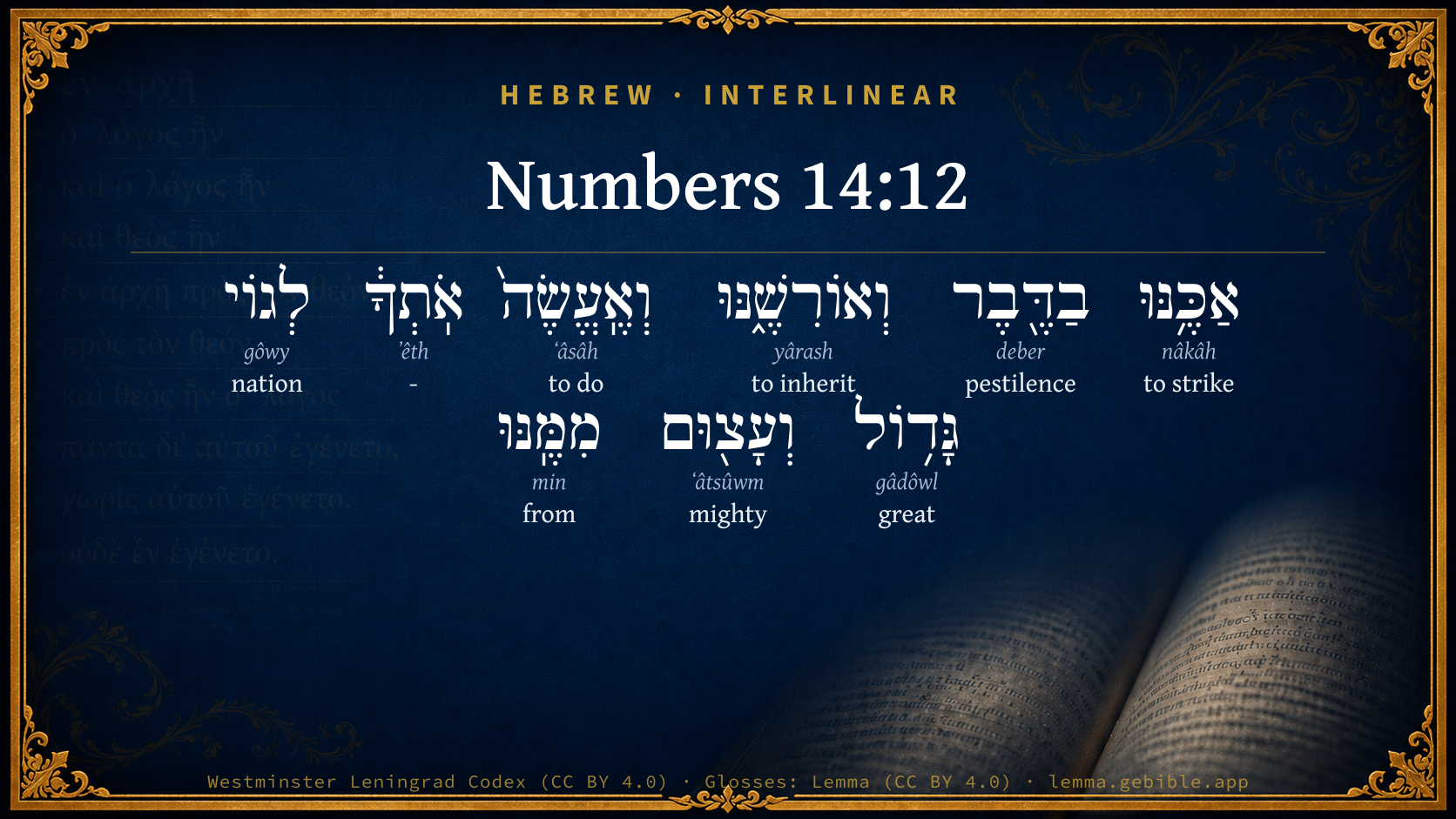
  1. אַכֶּ֥נּוּ nâkâh H5221 “to strike · him” Verb, Hiphil, Imperfect, 1st Person, Common, Singular + Suffix, Personal, 3rd Person, Masculine, Singular
  2. בַדֶּ֖בֶר deber H1698 “in/at the · pestilence” Preposition, Determined + Noun, Common, Masculine, Singular, Absolute
  3. וְאוֹרִשֶׁ֑נּוּ yârash H3423 “and · to inherit · him” Conjunction + Verb, Hiphil, Imperfect, 1st Person, Common, Singular + Suffix, Personal, 3rd Person, Masculine, Singular
  4. וְאֶֽעֱשֶׂה֙ ʻâsâh H6213 “and · to do” Conjunction + Verb, Qal, Imperfect, 1st Person, Common, Singular
  5. אֹֽתְךָ֔ ʼêth H853 “- · you” Particle, Direct Object + Suffix, Personal, 2nd Person, Masculine, Singular
  6. לְגוֹי gôwy H1471 “to/for · nation” Preposition + Noun, Common, Masculine, Singular, Absolute
  7. גָּד֥וֹל gâdôwl H1419 “great” Adjective, Adjective, Masculine, Singular, Absolute
  8. מִמֶּֽנּוּ min H4480 “from · him” Preposition + Suffix, Personal, 3rd Person, Masculine, Singular

About this verse

These counts appear in no published source. They are computed here, from the morphology-tagged text and Lemma’s own curated glosses. What Lemma adds →

9
words
9
distinct lemmas
Pentateuch
section

Shared distinctive vocabulary

וְעָצ֖וּם mighty H6099 occurs in 31 verses of the Hebrew Bible. Also found in:

Grammatical profile

  • 3 verbs
  • 2 nouns
  • 2 adjectives
  • 1 preposition
  • 1 particle

Verb forms

  • אַכֶּ֥נּוּ Hiphil · Imperfect
  • וְאוֹרִשֶׁ֑נּוּ Hiphil · Imperfect
  • וְאֶֽעֱשֶׂה֙ Qal · Imperfect

Hebrew & Septuagint length

In English translation the verse runs 22 words from the Hebrew and 28 from the Septuagint (LXX English) — closely comparable.

A rough comparison of the two English renderings, which tokenize alike — not a word-level alignment.

Word counts can differ between the Hebrew and the Greek without any difference in meaning — e.g. the Hebrew direct-object marker אֵת has no separate Greek word, and Greek often adds the article ὁ.

Cross-references

6

Topical passages linked to Numbers 14:12 in the Treasury of Scripture Knowledge — connected by theme and wording, ordered by reader-vote popularity; previews shown in the World English Bible.

  • Exodus 32:10 Now therefore leave me alone, that my wrath may burn hot against them, and that I may consume them; and I will make of you a great nation."
  • Numbers 16:46–49 Moses said to Aaron, Take your censer, and put fire therein from off the altar, and lay incense thereon, and carry it quickly to the congregation, and make atonement for them: for there is wrath gone out from Yahweh; the plague is begun.
  • Numbers 25:9 Those who died by the plague were twenty-four thousand.
  • 2 Samuel 24:1 Again the anger of Yahweh was kindled against Israel, and he moved David against them, saying, Go, number Israel and Judah.
  • 2 Samuel 24:12–15 Go and speak to David, Thus says Yahweh, I offer you three things: choose you one of them, that I may do it to you.
  • Exodus 5:3 They said, "The God of the Hebrews has met with us. Please let us go three days' journey into the wilderness, and sacrifice to Yahweh, our God, lest he fall on us with pestilence, or with the sword."

Cross-references courtesy of OpenBible.info (CC BY 4.0).

Hebrew and Greek witnesses Masoretic Hebrew ↔ Greek Septuagint

The same verse in the two great witnesses to the Old Testament, shown verse-for-verse.

These are two independent witnesses, not word-aligned to each other, and the Septuagint is shown in lemma (dictionary) form.

Hebrew Numbers 14:12 Masoretic · Westminster Leningrad Codex

אַכֶּ֥נּוּ בַדֶּ֖בֶר וְאוֹרִשֶׁ֑נּוּ וְאֶֽעֱשֶׂה֙ אֹֽתְךָ֔ לְגוֹי גָּד֥וֹל וְעָצ֖וּם מִמֶּֽנּוּ

I will strike them with the pestilence, and disinherit them, and will make of you a nation greater and mightier than they.

World English Bible · Public Domain

Greek LXX Numbers 14:12 Septuagint · lemma form

πατάσσω αὐτός θάνατος καί ἀποὀλλύω αὐτός καί ποιέω σύ καί ὁ οἶκος ὁ πατήρ σύ εἰς ἔθνος μέγας καί πολύς μᾶλλον ἤ οὗτος

I will strike them with death, and destroy them; and I will make of you and of your father's house a great nation, and much greater than this.

LXX2012 (modern English Septuagint) · Public Domain

Hebrew: Westminster Leningrad Codex (CC BY 4.0). Greek: Septuagint (public domain); English from LXX2012 (modern English Septuagint) (Public Domain). How the Septuagint differs from the Hebrew →

Targum (Aramaic paraphrase)

2

The Targum is the ancient Jewish Aramaic paraphrase of the Hebrew Scriptures — an interpretive translation, not the Hebrew text itself. Onkelos (literal) and Pseudo-Jonathan (expansive) render the Torah, and Jonathan the Prophets. Coverage is partial: where no permissively-licensed English translation exists for a verse, only the Aramaic is shown. This is verse-level text, not a word-by-word alignment to the Hebrew.

  1. Targum Onkelos Torah (Genesis–Deuteronomy)
    אֶמְחִנוּן בְּמוֹתָא וַאֲשֵׁצִנוּן וְאֶעְבֵּד יָתָךְ לְעַם רַב וְתַקִיף מִנְהוֹן

    (no public-domain English translation for this verse)

    Targum Onkelos — Aramaic: “Onkelos Genesis” (public domain); “Onkelos Exodus” (public domain); “Onkelos Leviticus” (public domain); “Onkelos Numbers” (public domain); “Onkelos Deuteronomy” (public domain). English: “Sefaria Community Translation” (CC0 1.0 (public-domain dedication)); “J.W. Etheridge. The Targums of Onkelos and Jonathan Ben Uzziel on the Pentateuch. London: Longmans, Green, 1862” (public domain). Text via Sefaria.

  2. Targum Pseudo-Jonathan Torah (Genesis–Deuteronomy)
    אֶמְחֵי יַתְהוֹן בְּמַחְתָא דְמוֹתָא וְאֵישֵׁצֵי יַתְהוֹן וְאַמְנֵי יָתָךְ לְעַם רַב וְתַקִיף מִנְהוֹן

    I will strike them with deadly plague and destroy them, and will appoint thee for a people greater and stronger than they.

    Targum Pseudo-Jonathan — Aramaic: “Targum Jonathan on Genesis” (public domain); “Targum Jonathan on Exodus” (public domain); “Targum Jonathan on Leviticus” (public domain); “Targum Jonathan on Numbers” (public domain); “Targum Jonathan on Deuteronomy” (public domain). English: “The Targum of Jonathan ben Uzziel, trans. J. W. Etheridge, London, 1862” (public domain). Text via Sefaria.

Commentary

Notes on Numbers 14:12 from classic Christian and Jewish commentators (each source and its license shown beneath its notes). The classic Christian expositions comment on the surrounding passage and are grouped to its opening verse, so a note may address several verses; the Jewish commentaries on the Tanakh (Rashi and others) are per-verse, so they appear only where the commentator wrote on this verse.

Lemma curates 59 commentaries, every one of them public domain or Creative Commons licensed, each selected and text-cleaned for this edition rather than reprinted as found. About our sources →

Trapp's Complete Commentary

John Trapp

Num 14:12 I will smite them with the pestilence, and disinherit them, and will make of thee a greater nation and mightier than they.

Ver. 12. And I will make of thee a greater nation.] Here God offered Moses a private fortune, which he prudently refuseth, because God should be a loser by it. And surely, saith a divine, as God was displeased with Balsam for going, though he bade him go: so the Lord would not have taken it so kindly of Moses if he had taken him upon the offer he made in a time of his heat, against his people.

John Trapp, A Commentary or Exposition upon All the Books of the Old and New Testament (1647–1656) — public domain. Text from a community e-Sword module.

The Biblical Illustrator

Joseph S. Exell

Num_14:12

I will smite them . . . and will make of thee a greater nation.

Proffer of Jehovah, and answer of Moses

This is the second time that Jehovah, in His holy anger, had proposed to deal thus with Moses and make him the head of a righteous seed to receive the inheritance which Israel has so justly forfeited. How would any one else have acted in his place? As the offer comes from Jehovah, can the Judge of all the earth do wrong? And if the forbearance of Jehovah is exhausted, may not the patience of Moses well be? Here is an offer that will release him from the thankless burden of a cowardly, degraded people, which has again and again almost crushed him. Shall he not accept it, and not only free himself from trouble, but rise to the greatness in history of being the outflowing stock of the visible kingdom of God? No, Moses has in himself an intrinsic greatness of soul beyond all that, though it may make his name less celebrated. He will not dissociate himself from his people. He will rather be the type of the great Intercessor who is to come. The singleness of heart with which, as a saint, he loves God shall not impair the passionate love that bound him to his people. Yea, and above the love of his people rises his passionate earnestness for the honour of Jehovah. Lying there prostrate on the ground before the brightness at the tabernacle, hear--as you may almost hear in the Hebrew--his sobs in broken sentences, as he argues the case with Jehovah and pleads for his people. And Egypt will hear that Thou hast brought Thy people in Thy might out of the midst of her; and they will say to the inhabitants of this land, they have heard how Thou, Jehovah, went in the midst of Thy people, seen of them face to face, and Thy cloud standing over them; even Thou, Jehovah, going in front of them in a pillar of cloud by day and in a pillar of fire by night. And Thou wilt make Thy people die as one man. And they will say, the nations that have heard tell of Thee: Through being not able to lead His people into the land that He had sworn to them, He hath slain them in the wilderness. And now, I beseech Thee, the might of Jehovah shall be magnified, even as Thou hast spoken, saying, Jehovah, long-suffering and of great mercy, bearing iniquity and transgression, and not cleansing, but visiting the iniquity of fathers upon children to the third and fourth generation: forgive, I pray Thee, the iniquity of this people according to Thy great mercy, and as Thou hast been gracious to them from Egypt up to this present time. Do not these passionate pleadings raise Moses nearer than any born of woman to the type of the great Intercessor? And yet, now, with the great Intercessor on his side, the least in the kingdom of heaven, who is truly in Christ--one with Christ, is greater in power than Moses at the throne. (S. Robinson, D. D.)

The gentleness of Moses

Of Moses it was to be said in miniature what of his Antitype can be said in full--that his gentleness made him great. Not when he parted the waters of the Red Sea, not when he sang his hymn of triumph on the shores of liberty, is he half so great as when he bore the sorrows and endured the murmurings of that rude, undisciplined multitude. If ever a man has inherited the earth by meekness, that man was Moses. His was a grand, unselfish life, made to wait upon the lives of others. (G. Matheson, D. D.)

The Biblical Illustrator, edited by Joseph S. Exell (c. 1880s–1900s) — public domain. Text from a community e-Sword module.

Joseph Benson's Commentary

Num 14:12. I will smite them — This was not an absolute determination, but a commination, like that of Nineveh’s destruction, with a condition implied, except there be speedy repentance, or powerful intercession.

Joseph Benson's Commentary on the Old and New Testaments (1811–1818) — public domain. Text from a community e-Sword module.

Tyndale Open Study Notes

Tyndale Open Resources

14:12 God is patient, but he will not tolerate outright rebellion from his people (cp. Exod 32:7-10). The writer of Hebrews refers to this episode in his effort to strengthen the faith of Christians whose trust in the Good News was wavering (Heb 3:7-19; 12:3, 25; cp. Ps 95:8-11).

Tyndale Open Study Notes — © Tyndale Open Resources, licensed CC BY-SA 4.0. Text via the HelloAO Bible API.

Jamieson, Fausset & Brown

Robert Jamieson, A. R. Fausset & David Brown

the Lord said, . . . I will smite them with the pestilence--not a final decree, but a threatening, suspended, as appeared from the issue, on the intercession of Moses and the repentance of Israel.

Jamieson, Fausset & Brown — Commentary Critical and Explanatory on the Whole Bible (1871) — public domain (CC PDM 1.0). Text via the HelloAO Bible API.

Ellicott's Commentary for English Readers

(12) And will make of thee a greater nation and mightier than they.—A similar promise had been given to Moses on occasion of the rebellion at Sinai, and Moses on that occasion interceded with God on behalf of His people in like manner as at this time (Exo_32:10-12).

A Bible Commentary for English Readers, edited by Charles John Ellicott (1878–1897) — public domain. Text from a community e-Sword module.

The Cambridge Bible for Schools and Colleges

gen. ed. J. J. S. Perowne

12. make of thee a nation] Moses would be a second Abraham, the whole nation being descended from him.

The Cambridge Bible for Schools and Colleges (gen. ed. J. J. S. Perowne; Cambridge University Press, 1878–1918) — public domain. Text from a community e-Sword module.

John Gill's Exposition

I will smite them with the pestilence, and disinherit them,.... Deprive them of inhabiting the land; so as many as died of the pestilence were even all the spies who brought an evil report of the good land, Num 14:37; with respect to the body of the people, this is to be considered not as a peremptory decree or a determined point; but is delivered partly by way of proposal to Moses, to draw out from him what he would say to it; and partly by way of threatening to the people, to bring them to a sense of their sin and repentance for it:

and will make of thee a greater nation, and mightier than they: this anticipates an objection that might be made, should the people of Israel be cut off by the plague, and so disinherited of the land of Canaan, what will become of the oath of God made to their fathers? to which the answer is, it would be fulfilled in making the posterity of Moses as great or a greater and more powerful nation than Israel now was, and by introducing them into the land of Canaan, who would be of the seed of the fathers of Israel, as Jarchi observes, as those people were; and this was said to prove Moses, and try his affection to the people of Israel; and give him an opportunity of showing his public and disinterested spirit.

John Gill's Exposition of the Whole Bible (1746–1763) — public domain (CC PDM 1.0). Text via the HelloAO Bible API.

Albert Barnes' Notes on the Bible

And disinherit them - By the proposed extinction of Israel the blessings of the covenant would revert to their original donor.

Albert Barnes' Notes on the Bible (1834–1885) — public domain. Text from a community e-Sword/MySword module.

Matthew Poole's English Annotations

This was not an absolute determination, as the event showed, but only a condition, like that of Nineveh’s destruction within forty days, with a condition implied, except there be speedy repentance, or powerful intercession.

Matthew Poole's English Annotations on the Holy Bible (1683–1685) — public domain. Text from a community e-Sword/MySword module.

Whedon's Commentary on the Bible

Daniel D. Whedon

12. The pestilence — Greek, death, violent and sudden. See Num_14:15. Thus in Lev_26:25; Deu_28:21. Comp. Rev_2:23; Rev_6:8.

Disinherit them — Annul their adoption into sonship. Exo_4:22. This shows that the covenant made with the patriarchs relating to the future of their posterity was not absolute, but conditioned on the fidelity of each generation. This is corroborated by the fact that Moses, in his plea for the life of the nation, fails to urge the covenant made with Abraham, Isaac, and Jacob.

Make of thee a greater nation — One man, fully trusting in God, is mightier than a million of infidels, since God and one are virtually a majority. All things are possible to him that believeth. The Almighty can accomplish more through one unwavering, heroic believer, than he can through a whole nation of unbelievers. This is amply verified in the life of John Wesley and the opposition of that apathetic national Church which he sought to vitalize. In the light of this suggestion, that Moses was to become the founder of a new nation, the unselfish prayer for Israel, which immediately follows, stands forth in marked contrast with that ambition which has often waded through slaughter to a throne.

Daniel D. Whedon (gen. ed.), Commentary on the Old and New Testaments (1874–1909) — public domain. Text from a community e-Sword module.

The Pulpit Commentary

And will make of thee a greater nation and mightier than they. By electing Moses, in the place of Jacob, to be the founder and ancestor of the chosen race, God would still have made good his promises to Abraham, and would only have vindicated for himself the same freedom of choice which he had used in the case of Ishmael and of Esau. We cannot, however, regard this offer as embodying a deliberate intention, for we know that God did not really mean to cast off Israel; nor can we regard it as expressing the anger of the moment, for it is not of God to be hasty. We must understand it distinctly as intended to try the loyalty and charity of Moses, and to give him an opportunity of rising to the loftiest height of magnanimity, unselfishness, and courage. Moses would unquestionably have been less noble than he was if he had listened to the offer; it is therefore certain that the offer was only made in order that it might be refused. (cf. Exo_32:10)

God makes three propositions.

1. As to the fate of the unbelieving nation. "I will smite them with the pestilence." If Israel is to perish, it shall not be at the hands of some other nation, which may thus glorify and exalt itself. The occasion is one on which, if a blow is to be struck, it must be a manifestly supernatural one, even as in the Deluge or the destruction of Sodom. The destruction, too, shall be sudden. The people shall not be left to wander and droop and die in the wilderness. The disease which comes from sin and works out death shall have its energy concentrated in one swift tremendous blow.

2. As to the aspect in which this visitation is to be regarded. "I will disinherit them." God looked on Israel as the legitimate and responsible heir to Canaan. It was considered as Abraham"s land, by a solemn covenant, even when he was a stranger in it. (Gen_12:7 Gen_13:14-17 Gen_15:7, 18-21 17:8) The aspect of Canaan as an inheritance was still further confirmed in Isaac as the child of promise, and Jacob as acquirer of the birthright. But in spite of all this, Israel obstinately refused to make ready for the great inheritance. The heirs to high rank and great possessions in this world are watched with great solicitude. Hereafter they will not only have great means for indulgence, but great opportunities for good and evil. And sometimes a parent, with deep pain of heart, will feel compelled to disinherit an unworthy son. This word "disinherit," rightly considered, puts a tone of inexpressible sadness into this verse. Recollect that tone as well as words, manner as well as matter, has to be considered in listening to any judicial sentence of God. A skeptic talking" with Dr. Channing reproached Jesus Christ for what he called his angry denunciations in Mat_11:20-24. In answer, Channing opened the New Testament, and read the passages referred to aloud. As soon as he had finished, his hearer said, "Oh, if that was the tone in which he spoke, it alters the case.

3. As to the future of Moses. "I will make of thee a greater nation, and mightier than they." Here is the suggestion of another experiment. Abraham was an eminent believer. Against all his shortcomings and infirmities in other respects, and they are very plain, his faith stands out in relief, conspicuous, almost colossal, one may say, in its manifestations. Nevertheless, his descendants turned out utter unbelievers. Take away from them for a single moment the light of things seen and temporal, and they become frantic and rebellious as a child left alone in the dark. And now God seems to suggest that possibly the seed of Moses may prove of a better sort. Thus we have in the propositions of this verse what we may call alternative suggestions. They show what things might, conceivably, and not unjustly, have happened at this critical turning-point. Y.

The Pulpit Commentary (1880–1919), ed. H.D.M. Spence-Jones & Joseph S. Exell — public domain. Text from a community e-Sword module.

John Wesley's Explanatory Notes

I will smite them - This was not an absolute determination, but a commination, like that of Nineveh's destruction, with a condition implied, except there be speedy repentance, or powerful intercession.

John Wesley, Explanatory Notes Upon the Whole Bible (1754–1765) — public domain. Text via the GEBible commentary corpus.

Rashi

Rabbi Shlomo Yitzchaki (Rashi)

ואורישנו is an expression for “driving out” (here, driving out from the world, destroying). — And if you ask what I will do regarding the oath I have sworn to the Patriarchs (viz., to give the Land to their children; cf. Exodus 6:3—4), then I reply:

ואעשה אתך לגוי גדול I WILL MAKE OF THEE A GREAT NATION — [whereby My oath will be fulfilled] since you are one of their descendants (cf. Midrash Tanchuma, Sh'lach 13).

Rashi on the Tanakh — English translations: “The Judaica Press complete Tanach with Rashi, translated by A. J. Rosenberg” (CC BY 4.0); “Pentateuch with Rashi's commentary by M. Rosenbaum and A.M. Silbermann, 1929-1934” (public domain); “The Metsudah Tanach series, Lakewood, N.J” (CC BY 4.0); and “The Book of Joshua, Metsudah Publications, 1997” (CC BY 4.0). Text via Sefaria.

Lesson kit

Teaching starters — assembled from the data on this page, not authored interpretation. Every prompt links to the verse data it draws on. Edit before teaching.

Numbers, in the Pentateuch, opens this verse with 9 words (9 distinct Hebrew lemmas). Its most distinctive word is ʻâtsûwm (“mighty”). A historical commentator’s framing appears above. Read the whole chapter for the surrounding context.

Discussion questions

  1. The word ʻâtsûwm carries the sense “mighty.” How does it shape the verse?
  2. Genesis 18:18 shares the word «mighty» with this verse. How do the two illuminate each other?
  3. These translations render this verse differently. What is at stake in choosing one wording over another?
  4. The verb «אַכֶּ֥נּוּ» is Hiphil Imperfect. How does its form color the action?
  5. Reading how Trapp's Complete Commentary and The Biblical Illustrator read this verse, where do the two commentators agree and where do they part?

Things to notice

Reading settings

Reading text

Shown beneath each verse's original-language words.

Old Testament
Old Testament edition

Read the OT as the Masoretic Hebrew (MT) or the Greek Septuagint (LXX).

English shown for the Greek Septuagint (in the Hebrew ↔ Greek comparison).

Comparing translations? Open the Compare panel on any verse page to stack up to four side by side.