
Judges 4:2

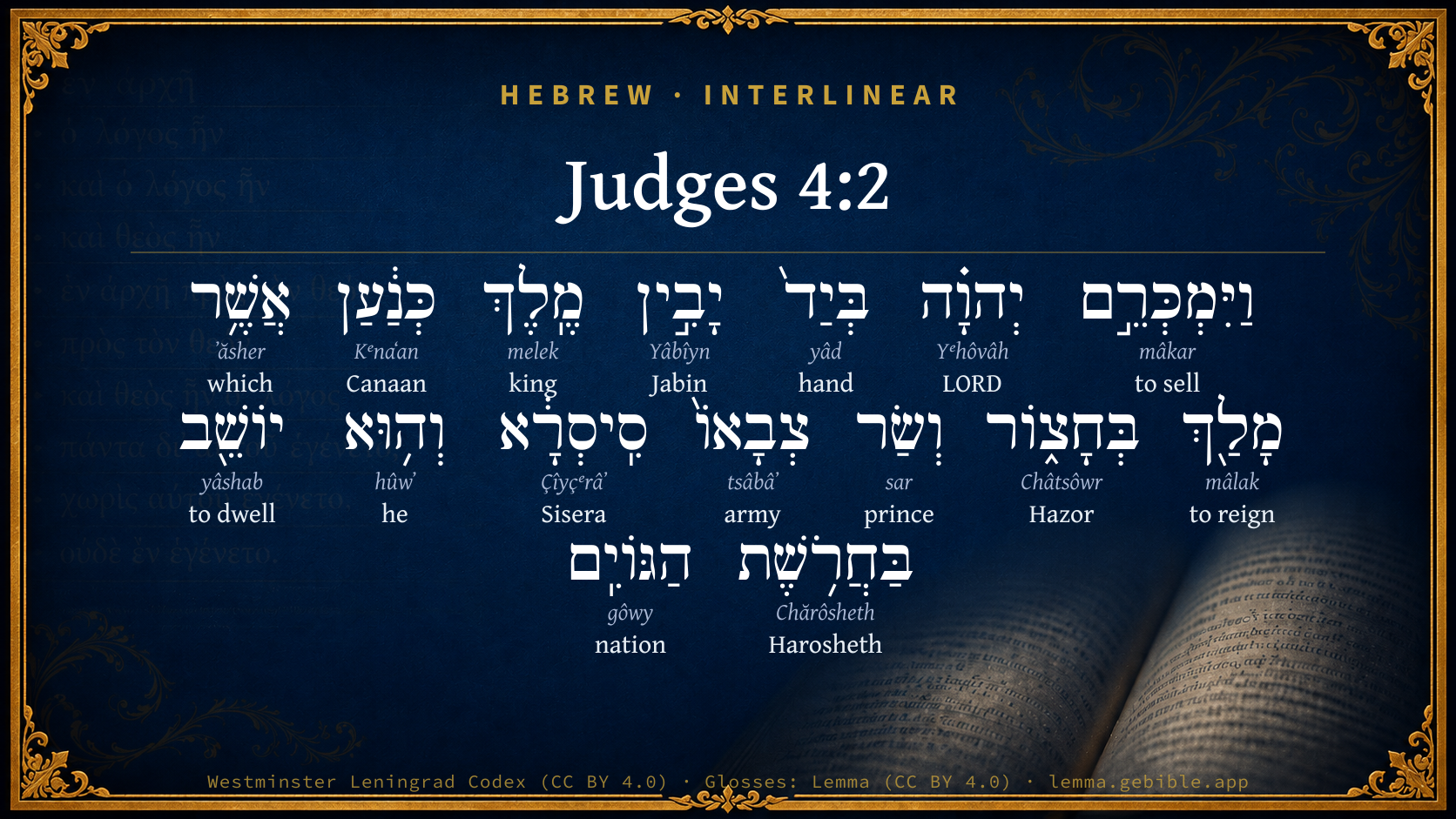
Hebrew (Westminster Leningrad Codex) Judges 4:2 appears in the Hebrew Old Testament. The text above is from the Westminster Leningrad Codex. Each word links to its Strong’s number, a concise gloss, and parsing drawn from the Open Scriptures Hebrew Bible morphology. Click any word for its full Brown-Driver-Briggs (BDB) entry.
Download image
Cite this verse

Judges 4:2 (World English Bible). Public Domain. Lemma interlinear Bible study tool, https://lemma.gebible.app/v/judges/4/2.

Show BibTeX & RIS
BibTeX
RIS
English Translation
Yahweh sold them into the hand of Jabin king of Canaan, who reigned in Hazor; the captain of whose host was Sisera, who lived in Harosheth of the Gentiles.
World English Bible · Public Domain
Highlights
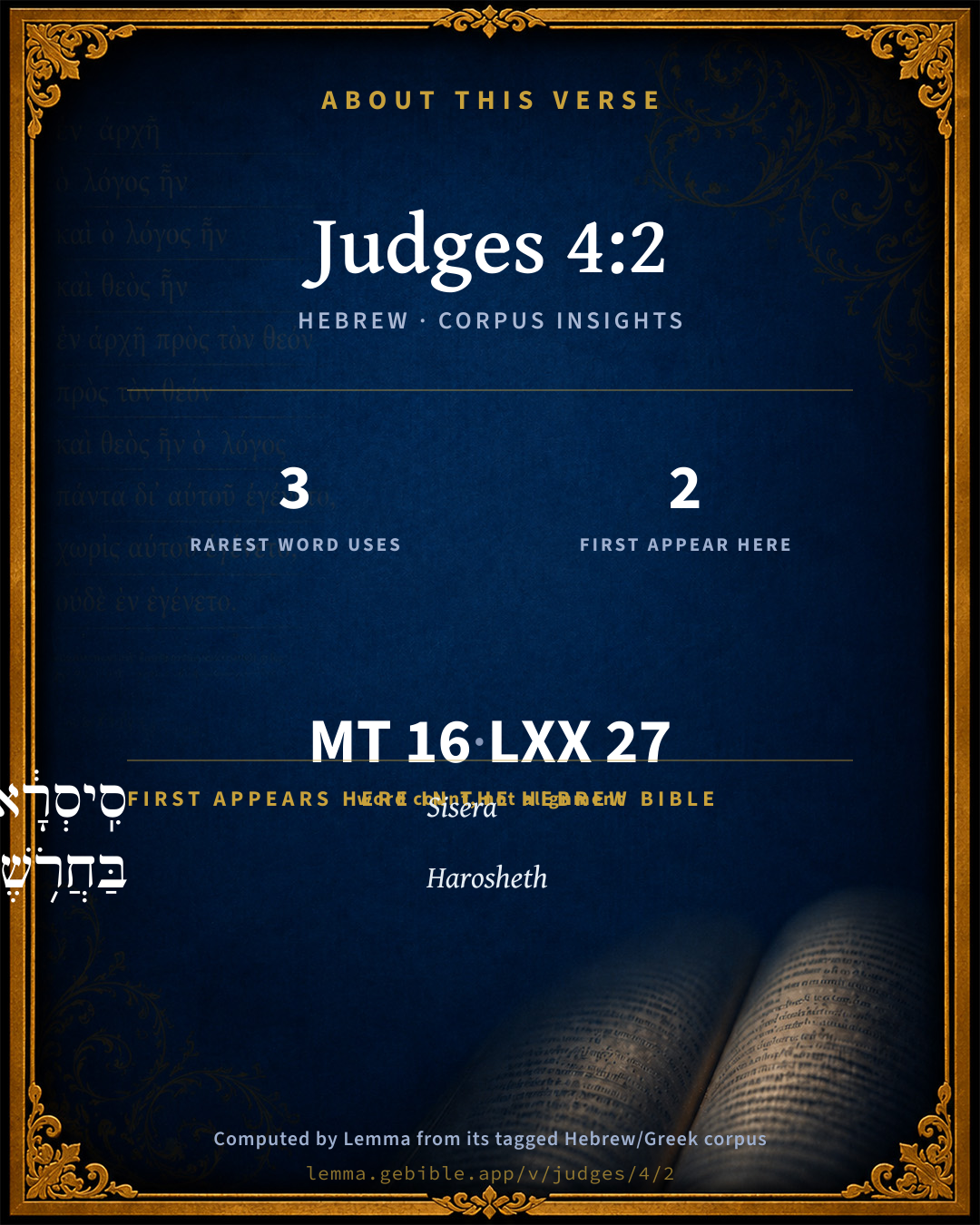
  • 2 first appearances in the Hebrew Bible
Full analysis ↓
Download a study sheet

One document with this verse’s original text, its word-by-word gloss line, the meaning frame, cross-references with their text, attributed commentary, and full source and license credits — printable, and it pastes into notes with its structure intact.

This verse Autodidact and up

Study sheet (.html) Plain text (.txt)

A passage Seminary Student

Up to 50 verses in one chapter. A passage sheet keeps up to 6 commentary sources and 12 cross-references per verse, in the order this page ranks them, and says so on the sheet whenever that leaves anything out. Ask for a single verse and you get the Autodidact verse sheet above.

Everything on this page stays free to read, with no account — the sheet is a download of what is already on screen, not access to it.

Want to remove ads? Support Godless Engineer
Compare translations 3

The same verse in 3 English versions, stacked beneath the original-language interlinear above. Click any original word for its lexicon entry.

Each is an independent rendering of the whole verse — the interlinear is not word-aligned to these translations.

Highlighted words mark where these versions differ — a whole-verse word diff, not a word-by-word alignment.

  • World English Bible Public Domain
    Yahweh sold them into the hand of Jabin king of Canaan, who reigned in Hazor; the captain of whose host was Sisera, who lived in Harosheth of the Gentiles.
  • King James Version Public Domain
    And the LORD sold them into the hand of Jabin king of Canaan, that reigned in Hazor; the captain of whose host was Sisera, which dwelt in Harosheth of the Gentiles.
  • unfoldingWord Literal Text CC BY-SA 4.0
    And Yahweh sold them into the hand of Jabin king of Canaan, who reigned in Hazor. Now the commander of his army Sisera, and he dwelling in Harosheth Hagoyim.

unfoldingWord Literal Text — © unfoldingWord, licensed CC BY-SA 4.0. Word-aligned USFM3 via Door43 (git.door43.org/unfoldingWord/en_ult).

Versions to compare (up to 4)

3 of 4 selected

Show all 18 translations

Every available English version of this verse, each an independent rendering of the whole verse.

  • World English Bible Public Domain
    Yahweh sold them into the hand of Jabin king of Canaan, who reigned in Hazor; the captain of whose host was Sisera, who lived in Harosheth of the Gentiles.
  • Berean Standard Bible Public Domain
    So the LORD sold them into the hand of Jabin king of Canaan, who reigned in Hazor. The commander of his forces was Sisera, who lived in Harosheth-hagoyim.
  • Majority Standard Bible Public Domain
    So the LORD sold them into the hand of Jabin king of Canaan, who reigned in Hazor. The commander of his forces was Sisera, who lived in Harosheth-hagoyim.
  • King James Version Public Domain
    And the LORD sold them into the hand of Jabin king of Canaan, that reigned in Hazor; the captain of whose host was Sisera, which dwelt in Harosheth of the Gentiles.
  • American Standard Version (1901) Public Domain
    And Jehovah sold them into the hand of Jabin king of Canaan, that reigned in Hazor; the captain of whose host was Sisera, who dwelt in Harosheth of the Gentiles.
  • Revised Version (1885) Public Domain
    And the LORD sold them into the hand of Jabin king of Canaan, that reigned in Hazor; the captain of whose host was Sisera, which dwelt in Harosheth of the Gentiles.
  • Geneva Bible (1599) Public Domain
    And the Lord sold them into the hande of Iabin King of Canaan, that reigned in Hazor, whose chiefe Captaine was called Sisera, which dwelt in Harosheth of the Gentiles.
  • Douay-Rheims (1899) Public Domain
    And the Lord delivered them up into the hands of Jaban king of Chanaan, who reigned in Asor: and he had a general of his army named Sisara, and he dwelt in Haroseth of the Gentiles.
  • Young's Literal Translation Public Domain
    and Jehovah selleth them into the hand of Jabin king of Canaan, who hath reigned in Hazor, and the head of his host `is' Sisera, and he is dwelling in Harosheth of the Goyim;
  • Literal Standard Version CC BY-SA 4.0
    and YHWH sells them into the hand of Jabin king of Canaan, who has reigned in Hazor, and Sisera [is] the head of his host, and he is dwelling in Harosheth of the nations;
  • Unlocked Literal Bible CC BY-SA 4.0
    Yahweh sold them into the hand of Jabin king of Canaan who reigned in Hazor. The commander of his army was named Sisera, and he lived in Harosheth Haggoyim.
  • unfoldingWord Literal Text CC BY-SA 4.0
    And Yahweh sold them into the hand of Jabin king of Canaan, who reigned in Hazor. Now the commander of his army Sisera, and he dwelling in Harosheth Hagoyim.
  • Darby Bible Public Domain
    And the LORD sold them into the hand of Jabin king of Canaan, who reigned in Hazor; the commander of his army was Sis'era, who dwelt in Haro'sheth-ha-goiim.
  • World Messianic Bible Public Domain
    The LORD sold them into the hand of Jabin king of Canaan, who reigned in Hazor; the captain of whose army was Sisera, who lived in Harosheth of the Gentiles.
  • Webster's Bible Public Domain
    And the LORD sold them into the hand of Jabin king of Canaan that reigned in Hazor, the captain of whose host was Sisera, who dwelt in Harosheth of the Gentiles.
  • Free Bible Version CC BY-SA 4.0
    So the Lord sold them to Jabin, king of Canaan, who ruled from Hazor. His army commander was Sisera, who lived in Harosheth-hagoyim.
  • Bible in Basic English Public Domain
    And the Lord gave them up into the hands of Jabin, king of Canaan, who was ruling in Hazor; the captain of his army was Sisera, who was living in Harosheth of the Gentiles.
  • JPS Tanakh (1917) Public Domain
    And the LORD gave them over into the hand of Jabin king of Canaan, that reigned in Hazor; the captain of whose host was Sisera, who dwelt in Harosheth-goiim.

Literal Standard Version (2020), Covenant Press — licensed CC BY-SA 4.0. Text via the HelloAO Bible API (eBible.org). Unlocked Literal Bible (unfoldingWord) — licensed CC BY-SA 4.0. Text via the HelloAO Bible API (eBible.org). unfoldingWord Literal Text — © unfoldingWord, licensed CC BY-SA 4.0. Word-aligned USFM3 via Door43 (git.door43.org/unfoldingWord/en_ult). Free Bible Version, Dr. Jonathan Gallagher — licensed CC BY-SA 4.0. Text via the HelloAO Bible API (eBible.org).

Word by word

More ways to search: Search by grammar → Find every occurrence → Compare this word →

Practice this passage: Drill this verse → Learn its vocabulary →

בַּחֲרֹ֥שֶׁת
Chărôsheth
H2800
“in/at · Harosheth”
Preposition + Noun, Proper
Part of Speech
Preposition + Noun
Type
Proper
Full BDB Definition

Origin: the same as H2799

TWOT: None

Harosheth = "woodland" - a city in the north of the land of Canaan on the west coast of the lake Merom
  1. וַיִּמְכְּרֵ֣ם mâkar H4376 “and · to sell · them” Conjunction + Verb, Qal, Sequential Imperfect, 3rd Person, Masculine, Singular + Suffix, Personal, 3rd Person, Masculine, Plural
  2. יְהוָ֗ה Yᵉhôvâh H3068 “LORD” Noun, Proper
  3. בְּיַד֙ yâd H3027 “in/at · hand of” Preposition + Noun, Common, Both, Singular, Construct
  4. יָבִ֣ין Yâbîyn H2985 “Jabin” Noun, Proper
  5. מֶֽלֶךְ melek H4428 “king of” Noun, Common, Masculine, Singular, Construct
  6. כְּנַ֔עַן Kᵉnaʻan H3667 “Canaan” Noun, Proper
  7. אֲשֶׁ֥ר ʼăsher H834 “which” Particle, Relative
  8. מָלַ֖ךְ mâlak H4427 “to reign” Verb, Qal, Perfect, 3rd Person, Masculine, Singular
  9. בְּחָצ֑וֹר Châtsôwr H2674 “in/at · Hazor” Preposition + Noun, Proper
  10. וְשַׂר sar H8269 “and · prince of” Conjunction + Noun, Common, Masculine, Singular, Construct
  11. צְבָאוֹ֙ tsâbâʼ H6635 “army · his” Noun, Common, Both, Singular, Construct + Suffix, Personal, 3rd Person, Masculine, Singular
  12. סִֽיסְרָ֔א Çîyçᵉrâʼ H5516 “Sisera” Noun, Proper
  13. וְה֥וּא hûwʼ H1931 “and · he” Conjunction + Pronoun, Personal, 3rd Person, Masculine, Singular
  14. יוֹשֵׁ֖ב yâshab H3427 “dwelling” Verb, Qal, Participle Active, Masculine, Singular, Absolute
  15. הַגּוֹיִֽם gôwy H1471 “nation” Noun, Proper

About this verse

These counts appear in no published source. They are computed here, from the morphology-tagged text and Lemma’s own curated glosses. What Lemma adds →

16
words
16
distinct lemmas
Historical
section

Notable vocabulary

The rarest word here is בַּחֲרֹ֥שֶׁת Harosheth H2800 — appearing just 3 times in the whole Hebrew Bible.

First appearance in Scripture

These words make their first canonical appearance in the Hebrew Bible here:

  • סִֽיסְרָ֔א Sisera H5516
  • בַּחֲרֹ֥שֶׁת Harosheth H2800

Shared distinctive vocabulary

בַּחֲרֹ֥שֶׁת Harosheth H2800 occurs in 3 verses of the Hebrew Bible. Also found in:

Grammatical profile

  • 3 verbs
  • 11 nouns
  • 1 pronoun
  • 1 particle

Verb forms

  • וַיִּמְכְּרֵ֣ם Qal · Sequential Imperfect
  • מָלַ֖ךְ Qal · Perfect
  • יוֹשֵׁ֖ב Qal · Participle Active

Hebrew & Septuagint length

In English translation the verse runs 29 words from the Hebrew and 36 from the Septuagint (LXX English) — closely comparable.

A rough comparison of the two English renderings, which tokenize alike — not a word-level alignment.

Word counts can differ between the Hebrew and the Greek without any difference in meaning — e.g. the Hebrew direct-object marker אֵת has no separate Greek word, and Greek often adds the article ὁ.

In the original languages it is 16 Hebrew tokens and 27 Greek tokens — but the two are counted differently (Hebrew bundles its prefixes and suffixes into one token; the Greek is in lemma form), so that isn’t a like-for-like length.

Cross-references

11

Topical passages linked to Judges 4:2 in the Treasury of Scripture Knowledge — connected by theme and wording, ordered by reader-vote popularity; previews shown in the World English Bible.

  • Joshua 11:1 It happened, when Jabin king of Hazor heard of it, that he sent to Jobab king of Madon, and to the king of Shimron, and to the king of Achshaph,
  • Judges 4:13 Sisera gathered together all his chariots, even nine hundred chariots of iron, and all the people who were with him, from Harosheth of the Gentiles, to the river Kishon.
  • Judges 4:16 But Barak pursued after the chariots, and after the host, to Harosheth of the Gentiles: and all the host of Sisera fell by the edge of the sword; there was not a man left.
  • 1 Samuel 12:9 But they forgot Yahweh their God; and he sold them into the hand of Sisera, captain of the host of Hazor, and into the hand of the Philistines, and into the hand of the king of Moab; and they fought against them.
  • Psalms 83:9 Do to them as you did to Midian, As to Sisera, as to Jabin, at the river Kishon;
  • Joshua 11:10–11 Joshua turned back at that time, and took Hazor, and struck the king of it with the sword: for Hazor before was the head of all those kingdoms.
  • Judges 10:7 The anger of Yahweh was kindled against Israel, and he sold them into the hand of the Philistines, and into the hand of the children of Ammon.
  • Joshua 19:36 and Adamah, and Ramah, and Hazor,
  • Judges 2:14–15 The anger of Yahweh was kindled against Israel, and he delivered them into the hands of spoilers who despoiled them; and he sold them into the hands of their enemies round about, so that they could not any longer stand before their enemies.
  • Isaiah 50:1 Thus says Yahweh, Where is the bill of your mother's divorce, with which I have put her away? or which of my creditors is it to whom I have sold you? Behold, for your iniquities were you sold, and for your transgressions was your mother put away.
  • Matthew 18:25 But because he couldn't pay, his lord commanded him to be sold, with his wife, his children, and all that he had, and payment to be made.

Cross-references courtesy of OpenBible.info (CC BY 4.0).

Hebrew and Greek witnesses Masoretic Hebrew ↔ Greek Septuagint

The same verse in the two great witnesses to the Old Testament, shown verse-for-verse.

These are two independent witnesses, not word-aligned to each other, and the Septuagint is shown in lemma (dictionary) form.

Hebrew Judges 4:2 Masoretic · Westminster Leningrad Codex

וַיִּמְכְּרֵ֣ם יְהוָ֗ה בְּיַד֙ יָבִ֣ין מֶֽלֶךְ כְּנַ֔עַן אֲשֶׁ֥ר מָלַ֖ךְ בְּחָצ֑וֹר וְשַׂר צְבָאוֹ֙ סִֽיסְרָ֔א וְה֥וּא יוֹשֵׁ֖ב בַּחֲרֹ֥שֶׁת הַגּוֹיִֽם

Yahweh sold them into the hand of Jabin king of Canaan, who reigned in Hazor; the captain of whose host was Sisera, who lived in Harosheth of the Gentiles.

World English Bible · Public Domain

Greek LXX Judges 4:2 Septuagint · lemma form

καί ἀποδίδωμι αὐτός κύριος ἐν χείρ ιαβιν βασιλεύς χανααν ὅς βασιλεύω ἐν ασωρ καί ὁ ἄρχω ὁ δύναμις αὐτός σισαρα καί αὐτός καταοἰκέω ἐν αρισωθ ὁ ἔθνος

And the Lord sold the children of Israel into the hand of Jabin king of Chanaan, who ruled in Asor; and the chief of his host was Sisara, and he lived in Arisoth of the Gentiles.

LXX2012 (modern English Septuagint) · Public Domain

Hebrew: Westminster Leningrad Codex (CC BY 4.0). Greek: Septuagint (public domain); English from LXX2012 (modern English Septuagint) (Public Domain). How the Septuagint differs from the Hebrew →

Targum (Aramaic paraphrase)

1

The Targum is the ancient Jewish Aramaic paraphrase of the Hebrew Scriptures — an interpretive translation, not the Hebrew text itself. Onkelos (literal) and Pseudo-Jonathan (expansive) render the Torah, and Jonathan the Prophets. Coverage is partial: where no permissively-licensed English translation exists for a verse, only the Aramaic is shown. This is verse-level text, not a word-by-word alignment to the Hebrew.

  1. Targum Jonathan Prophets (Joshua–Malachi)
    וּמְסַרְנוּן יְיָ בְּיַד יָבִין מַלְכָּא דִכְנַעַן דִי מְלַךְ בְּחָצוֹר וְרַב חֵילֵיה סִיסְרָא וְהוּא יָתֵיב בִּתְקוֹף כְּרַכֵּי עַמְמַיָא:

    (no public-domain English translation for this verse)

    Targum Jonathan — Aramaic: “Mikraot Gedolot” (public domain). English: “Sefaria Community Translation” (CC0 1.0 (public-domain dedication)); “London "Chaldee Paraphrase," 1871” (public domain). Text via Sefaria.

Commentary

Notes on Judges 4:2 from classic Christian and Jewish commentators (each source and its license shown beneath its notes). The classic Christian expositions comment on the surrounding passage and are grouped to its opening verse, so a note may address several verses; the Jewish commentaries on the Tanakh (Rashi and others) are per-verse, so they appear only where the commentator wrote on this verse.

Lemma curates 59 commentaries, every one of them public domain or Creative Commons licensed, each selected and text-cleaned for this edition rather than reprinted as found. About our sources →

Trapp's Complete Commentary

John Trapp

Jdg 4:2 And the LORD sold them into the hand of Jabin king of Canaan, that reigned in Hazor; the captain of whose host [was] Sisera, which dwelt in Harosheth of the Gentiles.

Ver. 2. And the Lord sold them.] As Jdg 2:14. It must not be troublesome to us to hear the same things often: Verba toties repetita viva sunt, vera sunt, sans sunt, plana sunt, saith Augustine.

Into the hand of Jabin.] Whose father or grandfather, of the same name, Joshua had slain, and burnt his city. {Jos 11:1; Jos 11:11} He therefore, on revenge, having got now the better of the Israelites, oppressed them most grievously for twenty years together, using them like beasts which are bought and sold to carry burdens, as Ferus noteth.

Which dwelt in Harosheth of the Gentiles.] Or, In the wood of the nations, {a} as some render it; that is, of the remaining Canaanites, who had hither betaken themselves for safety and conveniency of issuing forth against the enemy.

{a} In loco sylvatico. Jun.

John Trapp, A Commentary or Exposition upon All the Books of the Old and New Testament (1647–1656) — public domain. Text from a community e-Sword module.

Joseph Benson's Commentary

Jdg 4:2. Jabin — This Jabin was probably descended from the other prince of that name, who fell by the hands of Joshua, Jos 11:11. He doubtless had watched all opportunities to recover his ancient possessions, and to revenge his own and his father’s quarrel. King of Canaan — That is, of the land where most of the Canaanites, strictly so called, now dwelt, which seems to have been the northern part of Canaan. That reigned in Hazor — In the territory or kingdom of Hazor, which might now be restored to its former extent and power. Perhaps he had seized on the spot where Hazor formerly stood, and rebuilt that city. Harosheth of the Gentiles — So called, because it was much frequented and inhabited by the Gentiles; either by the Canaanites, who, being beaten out of their former possessions, seated themselves in those northern parts; or by other nations coming thither for traffic, whence Galilee, where this was, is called Galilee of the Gentiles.

Joseph Benson's Commentary on the Old and New Testaments (1811–1818) — public domain. Text from a community e-Sword module.

Geneva Bible (1599)

Geneva Bible translators

There was another Jabin, whom Joshua killed and burnt his city Hazor, Josh. 11:13.

That is in a wood, or strong place.

Geneva Bible (1599) marginal notes — public domain. Text via Bolls.life.

Jamieson, Fausset & Brown

Robert Jamieson, A. R. Fausset & David Brown

Jabin king of Canaan--"Jabin," a royal title (see on Jos 11:1). The second Jabin built a new capital on the ruins of the old (Jos 11:10-11). The northern Canaanites had recovered from the effect of their disastrous overthrow in the time of Joshua, and now triumphed in their turn over Israel. This was the severest oppression to which Israel had been subjected. But it fell heaviest on the tribes in the north, and it was not till after a grinding servitude of twenty years that they were awakened to view it as the punishment of their sins and to seek deliverance from God.

Jamieson, Fausset & Brown — Commentary Critical and Explanatory on the Whole Bible (1871) — public domain (CC PDM 1.0). Text via the HelloAO Bible API.

Adam Clarke's Commentary

Verse 2. Jabin king of Canaan] Probably a descendant of the Jabin mentioned Jos 11:1, c., who had gathered together the wrecks of the army of that Jabin defeated by Joshua. Calmet supposes that these Canaanites had the dominion over the tribes of Naphtali, Zebulun, and Issachar while Deborah judged in Ephraim, and Shamgar in Judah.

Adam Clarke's Commentary on the Bible (1810–1826) — public domain. Text from a community e-Sword/MySword module.

Ellicott's Commentary for English Readers

(2) Sold them.—See Jdg_2:14.

Jabin.—The name means, “he is wise.” It may have been a dynastic name, like Abimelech, Melchizedek, Pharaoh, Hadad, Agag, &c.

King of Canaan—i.e., of some great tribe or nation of the Canaanite8. In Jos_11:1 Jabin is called king of Hazor, and sends messages to all the other Canaanite princes.

Reigned in Hazor.—See Jos_11:1. Hazor was in the tribe of Naphtali (Jos_19:36), and overlooked the waters of Merom (Jos., Antt. v. 5, § 1). We find from Egyptian inscriptions of Barneses II., &c., that it was a flourishing town in very ancient days. Owing to its importance, it was fortified by Solomon (1Ki_9:15). Its inhabitants were taken captive by Tiglath-pileser (2Ki_15:29); and it is last mentioned in 1Ma_9:27. (Comp. Jos., Antt. xiii. 5, § 7.) De Saulcy discovered large and ancient ruins to the north of Merom, which he identifies with this town. The Bishop of Bath and Wells (Lord A. Hervey On the Genealogies, p. 28) has pointed out the strange resemblance between the circumstances of this defeat and that recorded in Joshua 11. In both we have a Jabin, king of Hazor; in both there are subordinate kings (Jdg_5:19; Jos_11:1); in both chariots are prominent, which, as we conjecture from Jos_11:8, were burnt at Misrephoth-maim (“burnings by the waters”); and in both the general outline of circumstances is the same, and the same names occur in the list of conquered kings (Jos_11:21-22). This seems to be the reason why Josephus, in his account of the earlier event (Antt. v. 1, § 18), does not mention either Jabin or Hazor, though strangely enough he says, in both instances, with his usual tendency to exaggeration, that the Canaanites had 300,000 foot, 10,000 horse, and 3,000 chariots. It is again a curious, though it may be an unimportant circumstance, that in 1Sa_12:9 the prophet mentions Sisera before Eglon. Of course, if the received view of the chronology be correct, we must make the not impossible supposition, that in the century and a half which is supposed to have elapsed since the death of Joshua, Hazor had risen from its obliteration and its ashes (Jos_11:11; Jos., Antt. v. 5, § 4), under a new Canaanite settlement, governed by a king who adopted the old dynastic name. If, on the other hand, there are chronological indications that the whole period of the Judges must be greatly shortened, we may perhaps suppose that the armies of Joshua and Barak combined the full strength of the central and northern tribes in an attack from different directions, which ended in a common victory. In that case, the different tribal records can only have dwelt on that part of the victory in which they were themselves concerned. It is remarkable that even so conservative a critic as Bishop Wordsworth holds “that some of the judges of Israel were only judges of portions of Canaan, and that the years run parallel to those of other judges in other districts of the same country.” If there are difficulties in whatever scheme of chronology we adopt, we must remember the antiquity and the fragmentary nature of the records, which were written with other and far higher views than that of furnishing us with an elaborate consecutive history.

The captain of whose host.—In Eastern narratives it is common for the king to play a very subordinate personal part. In the last campaign of Crœsus we hear much more of Surenas, the general of the Parthians, than of Orodes (Arsaces, 14).

Sisera.—The name long lingered among the Israelites. It occurs again in Ezr_2:53, as the name of the founder of a family of Nethinim (minor servants of the Levites, of Canaanite origin, 2 Samuel 21; Ezr_2:43; 1Ch_9:2); and in the strange fashion which prevailed among some of the Rabbis of claiming a foreign descent, the great Rabbi Akhivah professed to be descended from Sisera.

Harosheth.—The name means “wood-cutting.” The Chaldee renders it, “In the strength of citadels of the nations.” It was an ingenious and not improbable conjecture of the late Dr. Donaldson, that the town was named from the fact that Sisera made the subject Israelites serve as “hewers of wood” in the cedar-woods and fir-woods of Lebanon. The site of Harosheth has been precariously identified with Harsthîeh, a hill on the south-east of the plain of Akka. (Thomson’s Land and Book, ch. 29)

Of the Gentiles—i.e., of the nations; of mixed inhabitants; lying as it did in “Galilee of the Gentiles.” (Comp. “Tidal, king of nations,” Gen_14:1, and “The king of the nations in Gilgal,” Jos_12:23.)

A Bible Commentary for English Readers, edited by Charles John Ellicott (1878–1897) — public domain. Text from a community e-Sword module.

The Cambridge Bible for Schools and Colleges

gen. ed. J. J. S. Perowne

2. Jabin king of Canaan, that reigned in Hazor] Hazor, already a royal city in the 15 cent. b.c. (Amarna Tablets 154, 41), lay in the neighbourhood of Kedesh-naphtali (Jos_19:36 f., 2Ki_15:20) and to the S. of it (1Ma_11:63; 1Ma_11:67 ff.); the name (= enclosure) is preserved in Jebel Ḥaḍîreh (= sheep-fold) and Merj el-Ḥaḍîreh, W. of the lake of Ḥûleh, but the site is not known with certainty; Guthe (Bibel Atlas) places it at Ḥurçbeh, 2 m. E. of Jebel Ḥaḍîreh; in any case Jabin’s city was at least 30 m. N. of the scene of Barak’s victory. The compiler here and in Jdg_4:23-24 raises Jabin king of Hazor (Jdg_4:17, Jos_11:1) to the rank of king of Canaan (cf. Gen_26:1; Gen_26:8 ‘king of the Philistines’), an anomalous title, for Canaan was not an organized kingdom under a single head, but a general name for a region of independent towns each with a chief of its own (Jos_5:1; Jos_9:1; Jos_11:1 etc.). The tradition is further magnified in Jos_11:1-15, where the struggle between Jabin king of Hazor and the two tribes of Zebulun and Naphtali, a reminiscence of which probably underlies the present narrative and Joshua 11, becomes the conquest of N. Canaan by Joshua and all Israel.

the captain of whose host was Sisera] Cf. Jdg_4:7. By subordinating Sisera in this way an attempt was made to combine the two traditions. But the narrative as it proceeds makes it clear that Sisera was an independent chief; the nine hundred chariots of iron (see Jdg_1:19 n.) in Jdg_4:13 belong to him; like Jabin, he had his own capital, Harosheth, probably Ḥârithîyeh, on the right bank of the Kishon, at the S.W. corner of the Plain of Jezreel, where the chariots could be used with effect. The name Sisera, which occurs again in Ezr_2:53, is foreign, cf. the Assyr. sasur ‘progeny,’ seseru ‘child’: it may not be Semitic at all; Moore compares the Hittite names ending in -sira, Ḥtasira, Maurasira (W. H. Müller, As. u. Eur., p. 332).

The Cambridge Bible for Schools and Colleges (gen. ed. J. J. S. Perowne; Cambridge University Press, 1878–1918) — public domain. Text from a community e-Sword module.

John Gill's Exposition

And the Lord sold them,.... Delivered them into a state of bondage and slavery, where they were like men sold for slaves, see Jdg 3:8,

into the hand of Jabin king of Canaan, that reigned in Hazor; there was a city of this name, and a king of it of the same name, as here, in the times of Joshua, which city was taken and burnt by him, and its king slain, Jos 11:1; and either the country about it is here meant, as Jericho in the preceding chapter is put for the country adjacent to it; or this city had been rebuilt, over which reigned one of the posterity of the ancient kings of it, and of the same name; or Jabin was a name common to the kings of Canaan, as Pharaoh to the Egyptian kings; and by Canaan is meant, not the land of Canaan in general, but a particular part of it inhabited by that, or some of that nation or tribe, which was peculiarly so called:

the captain of whose host was Sisera; Jabin maintained a standing army to keep the people of Israel in subjection, the general of which was Sisera, of whom many things are after said:

which dwelt in Harosheth of the Gentiles; not Jabin, as many understand it, for he had his royal seat and residence in Hazor; but Sisera his general, and where the army under his command was. This place had its name either because it was built by same of various nations, or inhabited by workmen of different countries; or rather it was a wood originally, as the name signifies, to which many of the seven nations of the Canaanites fled from before Joshua, and hid and sheltered themselves, and in process of time built strong towers and fortresses in it, and became numerous and powerful; and so the Targum paraphrases the words,"and he dwelt in the strength of the towers of the people;''

and in other times, as Strabo relates (w), the northern parts of the land of Canaan, as those were where Hazor and Harosheth were, were inhabited by a mixed people, Egyptians, Arabians, and Phoenicians; such were they, he says, that held Galilee, Jericho, Philadelphia, and Samaria.

(w) Geograph. l. 16. p. 525.

John Gill's Exposition of the Whole Bible (1746–1763) — public domain (CC PDM 1.0). Text via the HelloAO Bible API.

Albert Barnes' Notes on the Bible

See Jos 11:1 note. Since the events there narrated, Hazor must have been rebuilt, and have resumed its position as the metropolis of the northern Canaanites; the other cities must also have resumed their independence, and restored the fallen dynasties.

Harosheth (identified by Conder with El Harathlyeh, see Jdg 4:6) is marked by the addition of the Gentiles, as in Galilee of the nations Gen 14:1; Isa 9:1. The name Harosheth signifies workmanship, cutting and carving, whether in stone or wood Exo 31:5, and hence, might be applied to the place where such works are carried on. It has been conjectured that this being a great timber district, rich in cedars and fir-trees, and near Great Zidon Jos 11:8, Jabin kept a large number of oppressed Israelites at work in hewing wood, and preparing it at Harosheth for transport to Zidon; and that these woodcutters, armed with axes and hatchets, formed the soldiers of Barak’s army.

Albert Barnes' Notes on the Bible (1834–1885) — public domain. Text from a community e-Sword/MySword module.

Haydock's Catholic Bible Commentary

Asor. Josue defeated the king of this country, Josue xi. 8. But some of his successors had contrived to raise themselves again to power. His dominion probably extended only over the tribes of Nephthali, Zabulon, and Issachar, while Debbora judged in Mount Ephraim, and Samgar in Juda. --- He dwelt. It is not clear whether Jabin or Sisara dwelt in Haroseth, but most probably it was the latter, ver. 13. This city was on the northern banks of the Semechonite lake, (Calmet) surrounded with "woods," as the Hebrew word signifies; (Vatable) though Bonfrere explains it "a shop, foundry, or arsenal," as if the arms and chariots were made and kept here. A mixture of different idolatrous nations dwelt in it.

George Leo Haydock (1774–1849), Haydock's Catholic Family Bible and Commentary, 1859 edition — public domain. Excludes Psalms (Douay-Rheims chapter numbering differs from Protestant) and Deuterocanonical books (Catholic canon only).

Matthew Poole's English Annotations

King of Canaan, i.e. of the land where the most of the Canaanites, strictly so called, now dwelt, which seems to be in thee northern part of Canaan. This seems to be of the posterity of that Jabin, whom Joshua slew, Jos 11:10 who watched all opportunities to recover his ancient possessions, and to revenge his own and father’s quarrel upon the Israelites.

In Hazor; either,

1. In the city of Hazor, which though taken and burnt by Joshua, Jos 11:11, yet might be retaken and rebuilt by the Canaanites. Or,

2. In the territory or kingdom of Hazor, which might now be restored to its former largeness and power, Jos 11:10, the names of cities being oft put for their territories, as Zorah, a city, Jos 15:33, is put for the fields belonging to it, Jdg 13:2, in which Samson’s parents lived, Jdg 13:25; 16:31; 18:2.

Harosheth of the Gentiles; so called, because it was much frequented and inhabited by the Gentiles; either by the Canaanites, who being beaten out of their former possessions, seated themselves in those northern parts; or by other nations coming there for traffic, or upon other occasions, as Strabo notes of those parts; whence Galilee, where this was, is called Galilee of the Gentiles.

Matthew Poole's English Annotations on the Holy Bible (1683–1685) — public domain. Text from a community e-Sword/MySword module.

Whedon's Commentary on the Bible

Daniel D. Whedon

2. Sold them — See note on Jdg_2:14.

Jabin king of Canaan — This powerful monarch was probably a descendant of the Jabin who headed the confederacy of the northern Canaanites against Joshua, but who was signally defeated by that great conqueror. Jos_11:1-15. He had taken advantage of Israel’s many oppressions, and gradually strengthened his power in the north, and enlarged his kingdom, until he could send into the field a vast army with nearly a thousand iron chariots. Jdg_4:3. Having reduced all Israel to the most servile subjection, he was virtually ruler of the whole land, and called king of Canaan. The name Jabin was probably a royal title of the kings that reigned in Hazor. On this capital, see note at Jos_11:1.

Captain… Sisera — Jabin, like Abimelech, (Gen_21:22,) had a captain, or general, to command his army. Most of the kings of that time commanded their armies in person. Doubtless Sisera’s great military skill and sagacity had won him this honour. The famous Rabbi Akiba is said to have descended from this Canaanite general.

Harosheth — “About eight miles from Megiddo, at the entrance of the pass to Esdraelon from the plain of Acre, is an enormous double mound called Harothieh. It is still covered with the remains of old walls and buildings. It was probably called Harosheth of the Gentiles, or nations, because it belonged to those Gentiles of Acre and the neighbouring plains which we know, from Jdg_1:31, the Hebrews could not subdue.” — Thomson.

Daniel D. Whedon (gen. ed.), Commentary on the Old and New Testaments (1874–1909) — public domain. Text from a community e-Sword module.

The Pulpit Commentary

Sold them. See Jud_1:2:14, note. Jabin king of Hazor. The exact site of Hazor has not been identified with certainty, but it is conjectured by Robinson, with great probability, to have stood on the Tell now called Khuraibeh, overlooking the waters of Merom (now called Lake Huleh), where are remains of a sepulchre, Cyclopean walls, and other buildings. In Jos_11:1-14 we read of the total destruction by fire of Hazor, and of the slaughter of Jabin, the king thereof, with all the inhabitants of the city, and of the slaughter of all the confederate kings, and the capture of their cities; Hazor, however, "the head of all those kingdoms," being the only one which was "burnt with fire." It is a little surprising, therefore, to read here of another Jabin reigning in Hazor, with confederate kings under him, (Jud_1:5:19) having, like his predecessor, a vast number of chariots, (cf. Jud_1:4:3, 13 with Jos_11:4, Jos_11:9) and attacking Israel at the head of a great force. (cf. Jud_1:4:7, 13, 16 with Jos_11:4) It is impossible not to suspect that these are two accounts of the same event. If, however, the two events are distinct, we must suppose that the Canaanite kingdoms had been revived under a descendant of the former king, that Hazor had been rebuilt, and that Jabin was the hereditary name of its king. Gentiles, or nations, or Goim , as Jos_12:23, and Gen_14:1. Whether Goim was the proper name of a particular people, or denoted a collection of different tribes, their seat was in Galilee, called in Isa_9:1 Mat_4:15, Galilee, of the nations, or Gentiles , in Hebrew Goim.

The Pulpit Commentary (1880–1919), ed. H.D.M. Spence-Jones & Joseph S. Exell — public domain. Text from a community e-Sword module.

John Wesley's Explanatory Notes

Of Canaan - That is, of the land where most of the Canaanites, strictly so called, now dwelt, which seems to be in the northern part of Canaan. This seems to be of the posterity of that Jabin, whom Joshua slew, Josh. xi, 11, who watched all opportunities to recover his ancient possessions, and to revenge his own and his father's quarrel. In Hazor - In the territory or the kingdom of Hazor, which might now be restored to its former largeness and power. Of the Gentiles - So called, because it was much frequented and inhabited by the Gentiles; either by the Canaanites, who being beaten out of their former possessions, seated themselves in those northern parts; or by other nations coming there for traffick, whence Galilee, where this was, is called Galilee of the Gentiles.

John Wesley, Explanatory Notes Upon the Whole Bible (1754–1765) — public domain. Text via the GEBible commentary corpus.

Scofield Reference Notes

C. I. Scofield

sold them

See, 1Sa 12:9; Psa 83:9. It seems to concern only north Israel.

The Scofield Reference Bible (1917 edition), notes by C. I. Scofield — public domain. Text from a community e-Sword module.

Rashi

Rabbi Shlomo Yitzchaki (Rashi)

Charoshes Hogoyim. The name of a city, so entitled because it was a stronghold, and the seat of authority.

Rashi on the Tanakh — English translations: “The Judaica Press complete Tanach with Rashi, translated by A. J. Rosenberg” (CC BY 4.0); “Pentateuch with Rashi's commentary by M. Rosenbaum and A.M. Silbermann, 1929-1934” (public domain); “The Metsudah Tanach series, Lakewood, N.J” (CC BY 4.0); and “The Book of Joshua, Metsudah Publications, 1997” (CC BY 4.0). Text via Sefaria.

Lesson kit

Teaching starters — assembled from the data on this page, not authored interpretation. Every prompt links to the verse data it draws on. Edit before teaching.

Judges, in the Historical, opens this verse with 16 words (16 distinct Hebrew lemmas). Its most distinctive word is Chărôsheth (“Harosheth”). A historical commentator’s framing appears above. Read the whole chapter for the surrounding context.

Discussion questions

  1. What does “Harosheth” (Chărôsheth) contribute to the verse as a whole?
  2. 2 words here appear for the first time in Scripture. What is being introduced at this debut?
  3. Judges 4:13 shares the word «Harosheth» with this verse. How do the two illuminate each other?
  4. The translations on this page render this verse differently — a whole-verse word diff, not a word-by-word alignment. What might account for the different wordings?
  5. The verb «וַיִּמְכְּרֵ֣ם» is Qal Sequential Imperfect. How does its form color the action?
  6. Reading how Trapp's Complete Commentary and Joseph Benson's Commentary read this verse, where do the two commentators agree and where do they part?

Things to notice

Reading settings

Reading text

Shown beneath each verse's original-language words.

Old Testament
Old Testament edition

Read the OT as the Masoretic Hebrew (MT) or the Greek Septuagint (LXX).

English shown for the Greek Septuagint (in the Hebrew ↔ Greek comparison).

Comparing translations? Open the Compare panel on any verse page to stack up to four side by side.