Ezekiel 5:14

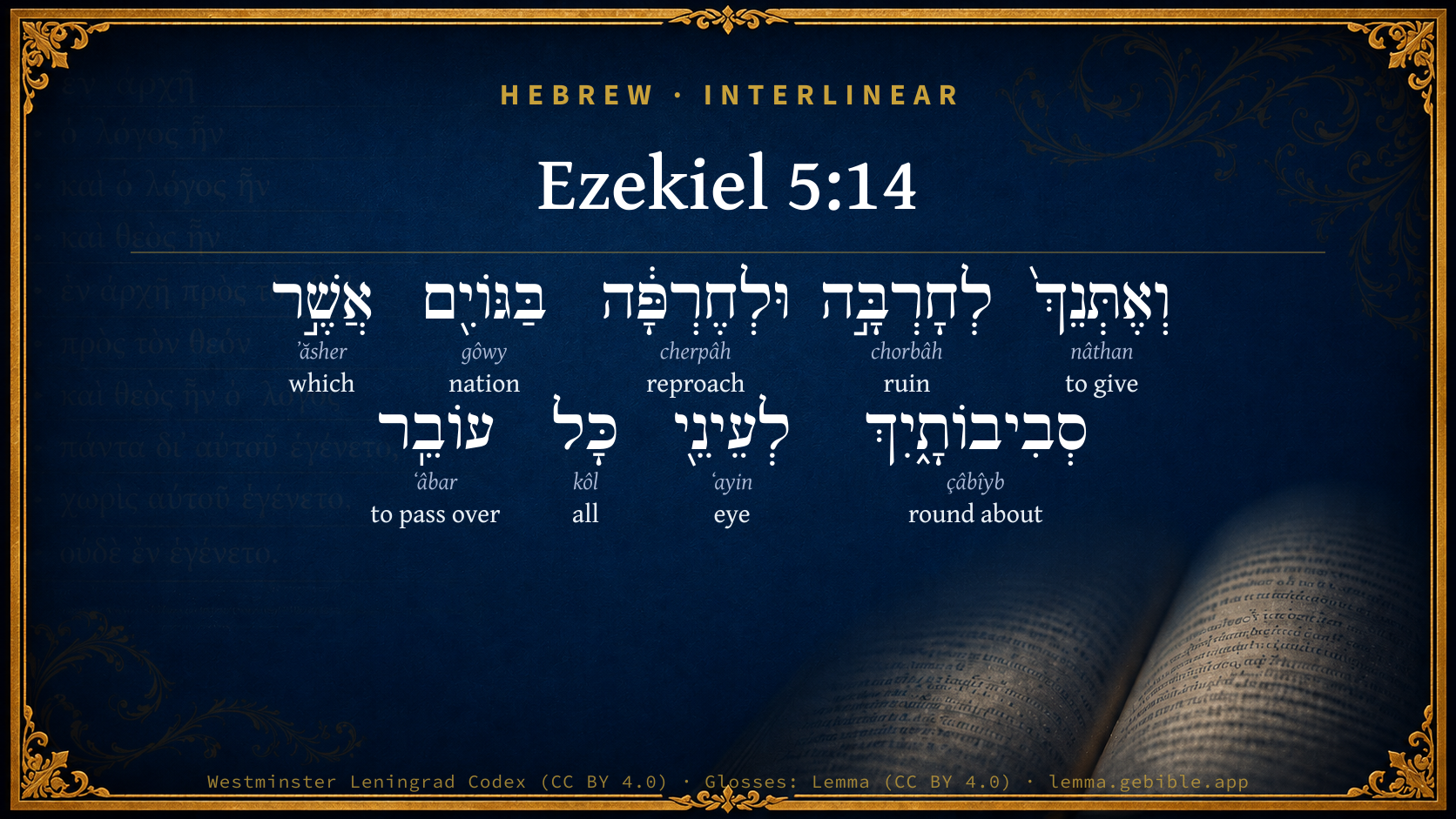
Hebrew (Westminster Leningrad Codex) Ezekiel 5:14 appears in the Hebrew Old Testament. The text above is from the Westminster Leningrad Codex. Each word links to its Strong’s number, a concise gloss, and parsing drawn from the Open Scriptures Hebrew Bible morphology. Click any word for its full Brown-Driver-Briggs (BDB) entry.
Download image
Cite this verse

Ezekiel 5:14 (World English Bible). Public Domain. Lemma interlinear Bible study tool, https://lemma.gebible.app/v/ezekiel/5/14.

Show BibTeX & RIS
BibTeX
RIS
English Translation
Moreover I will make you a desolation and a reproach among the nations that are round about you, in the sight of all that pass by.
World English Bible · Public Domain
Download a study sheet

One document with this verse’s original text, its word-by-word gloss line, the meaning frame, cross-references with their text, attributed commentary, and full source and license credits — printable, and it pastes into notes with its structure intact.

This verse Autodidact and up

Study sheet (.html) Plain text (.txt)

A passage Seminary Student

Up to 50 verses in one chapter. A passage sheet keeps up to 6 commentary sources and 12 cross-references per verse, in the order this page ranks them, and says so on the sheet whenever that leaves anything out. Ask for a single verse and you get the Autodidact verse sheet above.

Everything on this page stays free to read, with no account — the sheet is a download of what is already on screen, not access to it.

Want to remove ads? Support Godless Engineer
Compare translations 3

The same verse in 3 English versions, stacked beneath the original-language interlinear above. Click any original word for its lexicon entry.

Each is an independent rendering of the whole verse — the interlinear is not word-aligned to these translations.

Highlighted words mark where these versions differ — a whole-verse word diff, not a word-by-word alignment.

  • World English Bible Public Domain
    Moreover I will make you a desolation and a reproach among the nations that are round about you, in the sight of all that pass by.
  • King James Version Public Domain
    Moreover I will make thee waste, and a reproach among the nations that are round about thee, in the sight of all that pass by.
  • unfoldingWord Literal Text CC BY-SA 4.0
    I will make you a desolation and a reproach to the nations that surround you in the sight of everyone who passes by.

unfoldingWord Literal Text — © unfoldingWord, licensed CC BY-SA 4.0. Word-aligned USFM3 via Door43 (git.door43.org/unfoldingWord/en_ult).

Versions to compare (up to 4)

3 of 4 selected

Show all 18 translations

Every available English version of this verse, each an independent rendering of the whole verse.

  • World English Bible Public Domain
    Moreover I will make you a desolation and a reproach among the nations that are round about you, in the sight of all that pass by.
  • Berean Standard Bible Public Domain
    I will make you a ruin and a disgrace among the nations around you, in the sight of all who pass by.
  • Majority Standard Bible Public Domain
    I will make you a ruin and a disgrace among the nations around you, in the sight of all who pass by.
  • King James Version Public Domain
    Moreover I will make thee waste, and a reproach among the nations that are round about thee, in the sight of all that pass by.
  • American Standard Version (1901) Public Domain
    Moreover I will make thee a desolation and a reproach among the nations that are round about thee, in the sight of all that pass by.
  • Revised Version (1885) Public Domain
    Moreover I will make thee a desolation and a reproach, among the nations that are round about thee, in the sight of all that pass by.
  • Geneva Bible (1599) Public Domain
    Moreouer, I will make thee waste, and abhorred among the nations, that are round about thee, and in the sight of all that passe by.
  • Douay-Rheims (1899) Public Domain
    And I will make thee desolate, and a reproach among the nations that are round about thee, in the sight of every one that passeth by.
  • Young's Literal Translation Public Domain
    And I give thee for a waste, And for a reproach among nations that `are' round about thee, Before the eyes of every passer by.
  • Literal Standard Version CC BY-SA 4.0
    And I give you for a ruin, || And for a reproach among nations that [are] around you, || Before the eyes of everyone passing by.
  • Unlocked Literal Bible CC BY-SA 4.0
    I will make you a desolation and a reproach to the nations that surround you in the sight of everyone who passes by.
  • unfoldingWord Literal Text CC BY-SA 4.0
    I will make you a desolation and a reproach to the nations that surround you in the sight of everyone who passes by.
  • Darby Bible Public Domain
    And I will make thee a waste and a reproach among the nations that are round about thee, in the sight of all that pass by.
  • World Messianic Bible Public Domain
    “‘Moreover I will make you a desolation and a reproach among the nations that are around you, in the sight of all that pass by.
  • Webster's Bible Public Domain
    Moreover I will make thee waste, and a reproach among the nations that are around thee, in the sight of all that pass by.
  • Free Bible Version CC BY-SA 4.0
    I'm going to ruin you and humiliate you in front of the nations surrounding you, in the sight of every passer-by.
  • Bible in Basic English Public Domain
    And I will make you a waste and a name of shame among the nations round about you, in the eyes of everyone who goes by.
  • JPS Tanakh (1917) Public Domain
    Moreover I will make thee an amazement and a reproach, among the nations that are round about thee, in the sight of all that pass by.

Literal Standard Version (2020), Covenant Press — licensed CC BY-SA 4.0. Text via the HelloAO Bible API (eBible.org). Unlocked Literal Bible (unfoldingWord) — licensed CC BY-SA 4.0. Text via the HelloAO Bible API (eBible.org). unfoldingWord Literal Text — © unfoldingWord, licensed CC BY-SA 4.0. Word-aligned USFM3 via Door43 (git.door43.org/unfoldingWord/en_ult). Free Bible Version, Dr. Jonathan Gallagher — licensed CC BY-SA 4.0. Text via the HelloAO Bible API (eBible.org).

Word by word

More ways to search: Search by grammar → Find every occurrence → Compare this word →

Practice this passage: Drill this verse → Learn its vocabulary →

לְחָרְבָּ֣ה
chorbâh
H2723
“to/for · ruin”
Preposition + Noun, Common, Feminine, Singular, Absolute
Part of Speech
Preposition + Noun
Type
Common
Gender
Feminine
Number
Singular
State
Absolute
Full BDB Definition

Origin: from H2721

TWOT: 731d

a place laid waste, ruin, waste, desolation
  1. וְאֶתְּנֵךְ֙ nâthan H5414 “and · to give · you” Conjunction + Verb, Qal, Imperfect, 1st Person, Common, Singular + Suffix, Personal, 2nd Person, Feminine, Singular
  2. וּלְחֶרְפָּ֔ה cherpâh H2781 “and · to/for · reproach” Conjunction + Preposition + Noun, Common, Feminine, Singular, Absolute
  3. בַּגּוֹיִ֖ם gôwy H1471 “in/at the · nations” Preposition, Determined + Noun, Common, Masculine, Plural, Absolute
  4. אֲשֶׁ֣ר ʼăsher H834 “which” Particle, Relative
  5. סְבִיבוֹתָ֑יִךְ çâbîyb H5439 “surroundings · your” Noun, Common, Both, Plural, Construct + Suffix, Personal, 2nd Person, Feminine, Singular
  6. לְעֵינֵ֖י ʻayin H5869 “to/for · eyes of” Preposition + Noun, Common, Both, Dual, Construct
  7. כָּל kôl H3605 “all of” Noun, Common, Masculine, Singular, Construct
  8. עוֹבֵֽר ʻâbar H5674 “passing over” Verb, Qal, Participle Active, Masculine, Singular, Absolute

About this verse

These counts appear in no published source. They are computed here, from the morphology-tagged text and Lemma’s own curated glosses. What Lemma adds →

9
words
9
distinct lemmas
Prophets
section

Shared distinctive vocabulary

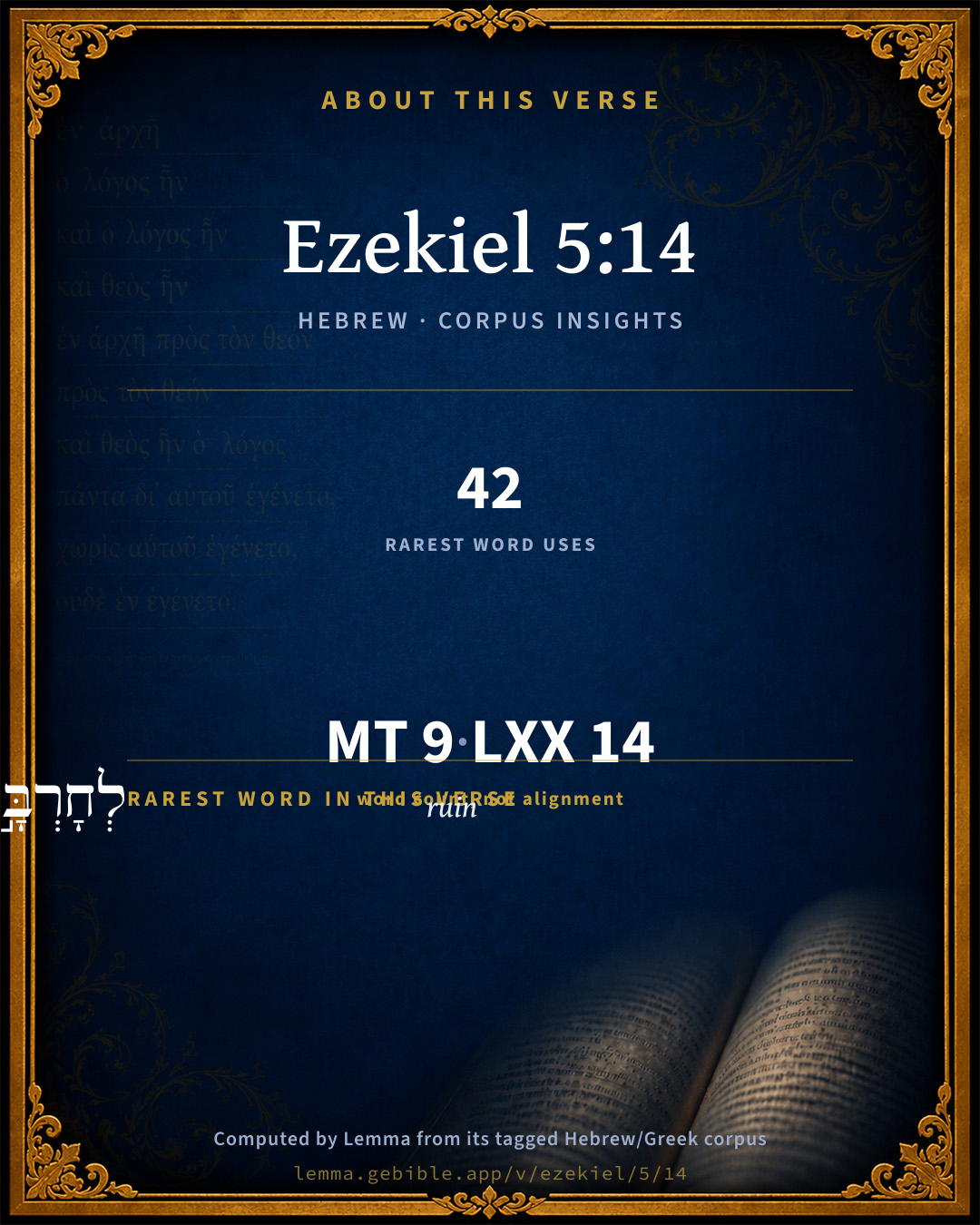
לְחָרְבָּ֣ה ruin H2723 occurs in 42 verses of the Hebrew Bible. Also found in:

Grammatical profile

  • 2 verbs
  • 6 nouns
  • 1 particle

Verb forms

  • וְאֶתְּנֵךְ֙ Qal · Imperfect
  • עוֹבֵֽר Qal · Participle Active

Hebrew & Septuagint length

In English translation the verse runs 26 words from the Hebrew and 21 from the Septuagint (LXX English) — closely comparable.

A rough comparison of the two English renderings, which tokenize alike — not a word-level alignment.

Word counts can differ between the Hebrew and the Greek without any difference in meaning — e.g. the Hebrew direct-object marker אֵת has no separate Greek word, and Greek often adds the article ὁ.

In the original languages it is 9 Hebrew tokens and 14 Greek tokens — but the two are counted differently (Hebrew bundles its prefixes and suffixes into one token; the Greek is in lemma form), so that isn’t a like-for-like length.

Cross-references

16

Topical passages linked to Ezekiel 5:14 in the Treasury of Scripture Knowledge — connected by theme and wording, ordered by reader-vote popularity; previews shown in the World English Bible.

  • Nehemiah 2:17 Then said I to them, You see the evil case that we are in, how Jerusalem lies waste, and the gates of it are burned with fire: come, and let us build up the wall of Jerusalem, that we be no more a reproach.
  • Psalms 74:3–10 Lift up your feet to the perpetual ruins, All the evil that the enemy has done in the sanctuary.
  • Psalms 79:1–4 God, the nations have come into your inheritance. They have defiled your holy temple. They have laid Jerusalem in heaps.
  • Ezekiel 22:4 You have become guilty in your blood that you have shed, and are defiled in your idols which you have made; and you have caused your days to draw near, and are come even to your years: therefore have I made you a reproach to the nations, and a mocking to all the countries.
  • Leviticus 26:31–32 I will lay your cities waste, and will bring your sanctuaries to desolation, and I will not take delight in the sweet fragrence of your offerings.
  • Deuteronomy 28:37 You shall become an astonishment, a proverb, and a byword, among all the peoples where Yahweh shall lead you away.
  • 2 Chronicles 7:20–21 then will I pluck them up by the roots out of my land which I have given them; and this house, which I have made holy for my name, will I cast out of my sight, and I will make it a proverb and a byword among all peoples.
  • Isaiah 64:10–11 Your holy cities are become a wilderness, Zion is become a wilderness, Jerusalem a desolation.
  • Jeremiah 19:8 I will make this city an astonishment, and a hissing; everyone who passes thereby shall be astonished and hiss because of all the plagues of it.
  • Jeremiah 24:9–10 I will even give them up to be tossed back and forth among all the kingdoms of the earth for evil; to be a reproach and a proverb, a taunt and a curse, in all places where I shall drive them.
  • Jeremiah 42:18 For thus says Yahweh of Hosts, the God of Israel: As my anger and my wrath has been poured forth on the inhabitants of Jerusalem, so shall my wrath be poured forth on you, when you shall enter into Egypt; and you shall be an object of horror, and an astonishment, and a curse, and a reproach; and you shall see this place no more.
  • Lamentations 1:4 The ways of Zion do mourn, because none come to the solemn assembly; All her gates are desolate, her priests do sigh: Her virgins are afflicted, and she herself is in bitterness.
  • Lamentations 1:8 Jerusalem has grievously sinned; therefore she is become as an unclean thing; All who honored her despise her, because they have seen her nakedness: Yes, she sighs, and turns backward.
  • Lamentations 2:15–17 All that pass by clap their hands at you; They hiss and wag their head at the daughter of Jerusalem, [saying], Is this the city that men called The perfection of beauty, The joy of the whole earth?
  • Lamentations 5:18 For the mountain of Zion, which is desolate: The foxes walk on it.
  • Micah 3:12 Therefore Zion for your sake will be plowed like a field, And Jerusalem will become heaps of rubble, And the mountain of the temple like the high places of a forest.

Cross-references courtesy of OpenBible.info (CC BY 4.0).

Hebrew and Greek witnesses Masoretic Hebrew ↔ Greek Septuagint

The same verse in the two great witnesses to the Old Testament, shown verse-for-verse.

These are two independent witnesses, not word-aligned to each other, and the Septuagint is shown in lemma (dictionary) form.

Hebrew Ezekiel 5:14 Masoretic · Westminster Leningrad Codex

וְאֶתְּנֵךְ֙ לְחָרְבָּ֣ה וּלְחֶרְפָּ֔ה בַּגּוֹיִ֖ם אֲשֶׁ֣ר סְבִיבוֹתָ֑יִךְ לְעֵינֵ֖י כָּל עוֹבֵֽר

Moreover I will make you a desolation and a reproach among the nations that are round about you, in the sight of all that pass by.

World English Bible · Public Domain

Greek LXX Ezekiel 5:14 Septuagint · lemma form

καί τίθημι σύ εἰς ἔρημος καί ὁ θυγάτηρ σύ κύκλος σύ ἐνώπιον πᾶς διαὁδεύω

And I will make you desolate, and your daughters round about you, in the sight of every one that passes through.

LXX2012 (modern English Septuagint) · Public Domain

On this verse, Haydock's Catholic Bible Commentary discusses the Septuagint’s reading. Read the note in Commentary ↓

Hebrew: Westminster Leningrad Codex (CC BY 4.0). Greek: Septuagint (public domain); English from LXX2012 (modern English Septuagint) (Public Domain). How the Septuagint differs from the Hebrew →

Targum (Aramaic paraphrase)

1

The Targum is the ancient Jewish Aramaic paraphrase of the Hebrew Scriptures — an interpretive translation, not the Hebrew text itself. Onkelos (literal) and Pseudo-Jonathan (expansive) render the Torah, and Jonathan the Prophets. Coverage is partial: where no permissively-licensed English translation exists for a verse, only the Aramaic is shown. This is verse-level text, not a word-by-word alignment to the Hebrew.

  1. Targum Jonathan Prophets (Joshua–Malachi)
    וְאֶתְּנִנָךְ לְחַרְבָּא וּלְחִסוּדִין בֵּינֵי עַמְמַיָא דִי בְסַחְרָנָךְ לְעֵינֵי כָּל דְעָדֵי:

    (no public-domain English translation for this verse)

    Targum Jonathan — Aramaic: “Mikraot Gedolot” (public domain). English: “Sefaria Community Translation” (CC0 1.0 (public-domain dedication)); “London "Chaldee Paraphrase," 1871” (public domain). Text via Sefaria.

Commentary

Notes on Ezekiel 5:14 from classic Christian and Jewish commentators (each source and its license shown beneath its notes). The classic Christian expositions comment on the surrounding passage and are grouped to its opening verse, so a note may address several verses; the Jewish commentaries on the Tanakh (Rashi and others) are per-verse, so they appear only where the commentator wrote on this verse.

Lemma curates 59 commentaries, every one of them public domain or Creative Commons licensed, each selected and text-cleaned for this edition rather than reprinted as found. About our sources →

Trapp's Complete Commentary

John Trapp

Eze 5:14 Moreover I will make thee waste, and a reproach among the nations that [are] round about thee, in the sight of all that pass by.

Ver. 14. Moreover, I will make thee waste.] In ariditatem, a dry and barren wilderness, whose fruitfulness and pleasantness is so much celebrated, not only by divine, but profane authors also. See Psa 107:34. {See Trapp on "Psa 107:34"}

In the sight of all.] See on Eze 5:8.

John Trapp, A Commentary or Exposition upon All the Books of the Old and New Testament (1647–1656) — public domain. Text from a community e-Sword module.

Jamieson, Fausset & Brown

Robert Jamieson, A. R. Fausset & David Brown

reproach among the nations--They whose idolatries Israel had adopted, instead of comforting, would only exult in their calamities brought on by those idolatries (compare Luk 15:15).

Jamieson, Fausset & Brown — Commentary Critical and Explanatory on the Whole Bible (1871) — public domain (CC PDM 1.0). Text via the HelloAO Bible API.

John Calvin's Commentaries

He explains what we saw before more at length, whence also we understand that in the next verse God had not softened his anger, but proclaimed the ultimate destruction of the nation. He says therefore, that the Jews shall be desolate, as they translate it: it also signifies dryness, and hence is the name for a desert. But it suits this place to say, the Jews shall be laid waste, and a reproach among the nations: for they were formerly a celebrated nation: God had ennobled them with remarkable gifts, so that they excelled in dignity in the sight of all the nations. Now he says, they should be like a vast desert, and in utter ruin, and a reproach; and not only is this rumor spread abroad, but all travelers through that land are witnesses of this reproach. But in the next verse this is followed out more at length.

John Calvin's Commentaries (1540-1563) — public domain. Text from the Calvin Translation Society English edition (1840s-50s) via the Christian Classics Ethereal Library (ccel.org). Calvin's coverage is partial (roughly two-thirds of the Bible); uncommented books and verses are honest gaps, never fabricated. The 19th-century editor's footnotes and remarks are omitted so the notes are faithfully Calvin's own voice.

The Cambridge Bible for Schools and Colleges

gen. ed. J. J. S. Perowne

14. reproach among the nations] Lam_2:15-16, “All that pass by clap their hands at thee, they hiss and wag their head at the daughter of Jerusalem, saying, Is this the city that they called the perfection of beauty?”

The Cambridge Bible for Schools and Colleges (gen. ed. J. J. S. Perowne; Cambridge University Press, 1878–1918) — public domain. Text from a community e-Sword module.

John Gill's Exposition

Moreover I will make thee waste,.... That is, their land; which, being without inhabitants, lay untilled; and so became barren and unfruitful:

and a reproach among the nations that are round about thee, in the sight of all that pass by; who, seeing it in this desolate condition, shall throw out their taunts and jeers upon it, as in Lam 2:15.

John Gill's Exposition of the Whole Bible (1746–1763) — public domain (CC PDM 1.0). Text via the HelloAO Bible API.

Haydock's Catholic Bible Commentary

And a. Septuagint, "and thy daughters (dependances. Calmet) round," &c. (Haydock)

George Leo Haydock (1774–1849), Haydock's Catholic Family Bible and Commentary, 1859 edition — public domain. Excludes Psalms (Douay-Rheims chapter numbering differs from Protestant) and Deuterocanonical books (Catholic canon only).

Matthew Poole's English Annotations

Judgments should empty the land of men that might till and manure it, and so your fruitful land shall be turned and continued a waste and desolate land.

A reproach, Jer 24:9; 29:18,22; a reproach or curse; men should taunt at them, and, in wishing the worst they can, wish their enemies like the Jews. So it was Lam 2:15,16.

Matthew Poole's English Annotations on the Holy Bible (1683–1685) — public domain. Text from a community e-Sword/MySword module.

Whedon's Commentary on the Bible

Daniel D. Whedon

14, 15. I will make thee waste,… a reproach and a taunt, an instruction and an astonishment unto the nations (Deu_28:37; Lam_2:15-16) — These warnings of Jehovah were intended to move the people to repentance, but, failing in that, they were sorrowfully fulfilled. In the light of history no one dare affirm that this prophecy has not been literally accomplished. The history of the Jews is the history of fulfilled prophecy.

In anger and in fury and in furious rebukes — No doubt there were limitations to Ezekiel’s conception of God. This revelation of Jehovah’s nature does not read like the one given in the Gospels. Yet we can now see that it is the reverse side of a perfect being. The “wrath of the Lamb” is most furious. No anger is like that of insulted love. Ezekiel had need to arouse “the terrifying sense of divine anger against sin” in order to make a place for the Gospel of pardon and eternal love (Eze_23:11-20; Lev_26:6; Lev_26:22; Deu_32:24).

Daniel D. Whedon (gen. ed.), Commentary on the Old and New Testaments (1874–1909) — public domain. Text from a community e-Sword module.

The Pulpit Commentary

In the sight of them that pass by. The phrase reminds us of Lam_1:12 Lam_2:15: and the latter was probably a conscious reproduction of it. The scorn and mockery of the heathen who rejoiced in her humiliation were to be the keenest pang in the punishment of the guilty city.

Vers. 14, 15. The shame of moral shipwreck, and its lessons.

All the nations round about were to be witnesses of the shipwreck of Israel. The eyes of the world are upon the Church. No single Christian man can fall without his ruin being observed by many neighbor"s. The city set on a hill cannot be hid in its prosperity and splendour; much less will it be unnoticed when it is wrapped in flames, and even later when its melancholy ruins tell the world a tale of fallen greatness. The spectacle is striking; the thoughts which it suggests should be instructive. Let us note four things about this moral shipwreck.

I IT IS CULPABLE. The condition of Israel is to be "a reproach," i.e. blame will be attached to it. Nations must stand the chance of war, in which the most just and brave may suffer grievous loss; and yet history rarely, if ever, shows an instance of a people crushed and exterminated without any fault of its own. Moral corruption precedes total national overthrow. This was certainly the case with Israel, which fell in its wickedness, and was scattered for its sin. Misfortune may visit the Church, or an individual good man such as Job without guilt on the part of the sufferer, because a wholesome discipline or some other high and distant Divine purpose of love is to be wrought out through this means. But utter shipwreck of life does not come without moral delinquency. Unhappily, the reproach does not cease with the guilty person; it is laid against the cause of Christ, and it brings dishonour on his Name. This new "reproach of Christ" is the greatest hindrance to the progress of the gospel, and far more of a stumbling block than the old shame of the cross.

II IT IS SHAMEFUL AND DEGRADING. The evil condition of the fallen nation will be "a taunt." Contempt will succeed to the old respect. The Church may expect to meet with opposition from the world, but she is indeed in an evil state when she has earned its contempt. To be despised wrongfully through the pride and superficial judgment of ethers is a fate which brave men can learn to endure. But to merit contempt is to lie in abject wretchedness. When Christian men fall from their pure profession, they sink into this most shocking ignominy. Even godless people can look clown upon them, and taunt them with their high pretensions and boasted attainments and prized privileges.

III IT IS INSTRUCTIVE. The condition of the people will be "an instruction." As "no man liveth to himself," so also "no man dieth to himself." The ruin of nations is a lesson to the world. History is studded with beacon warnings. The greatest nations have been defeated and destroyed. The prosperity of the Church in one age has been succeeded by corruption and shame in another. Men called "pillars" of the Church have fallen. People praised as "ornaments" of society have left tarnished reputations. Such sights not only warn us against pride and self-assurance; in searching for the explanation of them we may learn many a lesson as to the causes of success and failure, e.g. that secret sin leads to open shame, that past prosperity will not prevent present failure, that a good name is not an impregnable bulwark, that to forsake God is to court ruin.

IV IT IS ASTONISHING. Israel"s state will be "an astonishment.

1. It surprises the sufferers. They never expected such a fall. Living m a fool"s paradise, they spent their days at their ease till the crash came. Careless Christians are surprised at their own shipwreck.

2. It surprises the onlookers. It is contrary to expectation founded on previous observation and confident pretensions. Can the long successful nation fall, and the people favoured of Heaven be abandoned to ruin? There will be many surprises in the future judgment, because ignorance of the awful power of moral law and of the just retribution of God destroys men"s expectations of the punishment of sin. To some it will come with a shock of amazement, unless they now turn to the redemption of Christ.

Vers. 14, 15. A reproach and a lesson.

The symbolical prediction recorded m this chapter was evidently intended to convey to the minds of the Jews the Divine purpose that their city should be destroyed, and their nation dispersed and politically extinguished. A third part should perish by pestilence and famine, a third part should be slain, and the remaining third part should be scattered throughout the earth. So far, all seems vengeance. There appears, for the present, no ray of light to irradiate the gloom, i.e. so far as the once favoured and now depressed and threatened Hebrew people are concerned. But, however calamity may affect the Jews, the prophet was assured that it should not be in vain with respect to neighbouring nations. They should learn the lesson, whether the scourged and scattered seed of Jacob would hear or forbear, This purpose, at least, the fate of Jerusalem and the calamities of the Jews in their exile and dispersion should not fail to accomplish; a lesson should be taught to the nations of the earth concerning the sinfulness of sin and the justice and truth of God, which should not be forgotten down to the end of time.

I THE DESOLATION OF JERUSALEM WAS DESIGNED TO BE A REPROACH AND A TAUNT, AND THUS AN EXHIBITION TO ALL THE NATIONS OF THE DIVINE JUSTICE. The attribute of justice has its punitive side; and this was displayed in the fate of the proud and once highly favoured city. If this purpose was answered by the fall of Jerusalem and the calamities which followed, it may surely be acknowledged that the destruction of Jerusalem by the Romans, which followed upon the rejection of the Divine Messiah, and the dispersion of the Jews during the following centuries of history, have constituted a lesson of similar import for the warning of mankind.

II THE SAME EVENT WAS AN INSTRUCTION AND AN ASTONISHMENT, AND THUS AN INCULCATION UPON THE NATIONS OF THE DIVINE LAW AND AUTHORITY. Justice has its distributive as well as its corrective side. Not only is Law to be vindicated by the sanction of penalty inflicted upon the disobedient; the excellence and glory of the Law has to be displayed as the proper rule for the moral guidance and government of mankind. Thus the nations were not only to wonder and to tremble, when they beheld the just indignation of outraged Divine authority manifest itself in a city"s siege, capture, and subjection; they were to learn to inquire into the Law which had been broken, the authority which had been defied. There is an aspect of construction, as well as an aspect of destruction, in the government of the world. It is the part of wisdom, not merely to recognize the power which avenges infraction of Divine decrees, but to admire the holy Law, to submit to the righteous Lawgiver, to forsake evil, and to do good. T.

The Pulpit Commentary (1880–1919), ed. H.D.M. Spence-Jones & Joseph S. Exell — public domain. Text from a community e-Sword module.

Rashi

Rabbi Shlomo Yitzchaki (Rashi)

a ruin Heb. לְחָרְבָּה, destroyer in Old French, to make desolate, destroy.

Rashi on the Tanakh — English translations: “The Judaica Press complete Tanach with Rashi, translated by A. J. Rosenberg” (CC BY 4.0); “Pentateuch with Rashi's commentary by M. Rosenbaum and A.M. Silbermann, 1929-1934” (public domain); “The Metsudah Tanach series, Lakewood, N.J” (CC BY 4.0); and “The Book of Joshua, Metsudah Publications, 1997” (CC BY 4.0). Text via Sefaria.

Lesson kit

Teaching starters — assembled from the data on this page, not authored interpretation. Every prompt links to the verse data it draws on. Edit before teaching.

Ezekiel, in the Prophets, opens this verse with 9 words (9 distinct Hebrew lemmas). Its most distinctive word is chorbâh (“ruin”). A historical commentator’s framing appears above. Read the whole chapter for the surrounding context.

Discussion questions

  1. How does “ruin” (chorbâh) shape what this verse is saying?
  2. How does Leviticus 26:31, which shares the word «ruin», read alongside this verse?
  3. The translations on this page render this verse differently — a whole-verse word diff, not a word-by-word alignment. What might account for the different wordings?
  4. «וְאֶתְּנֵךְ֙» is a Qal Imperfect verb. How does that grammatical form shape the action described?
  5. Compare how Trapp's Complete Commentary and Jamieson, Fausset & Brown read this verse. Where do they agree or differ?

Things to notice

Reading settings

Reading text

Shown beneath each verse's original-language words.

Old Testament
Old Testament edition

Read the OT as the Masoretic Hebrew (MT) or the Greek Septuagint (LXX).

English shown for the Greek Septuagint (in the Hebrew ↔ Greek comparison).

Comparing translations? Open the Compare panel on any verse page to stack up to four side by side.