
2 Samuel 7:23

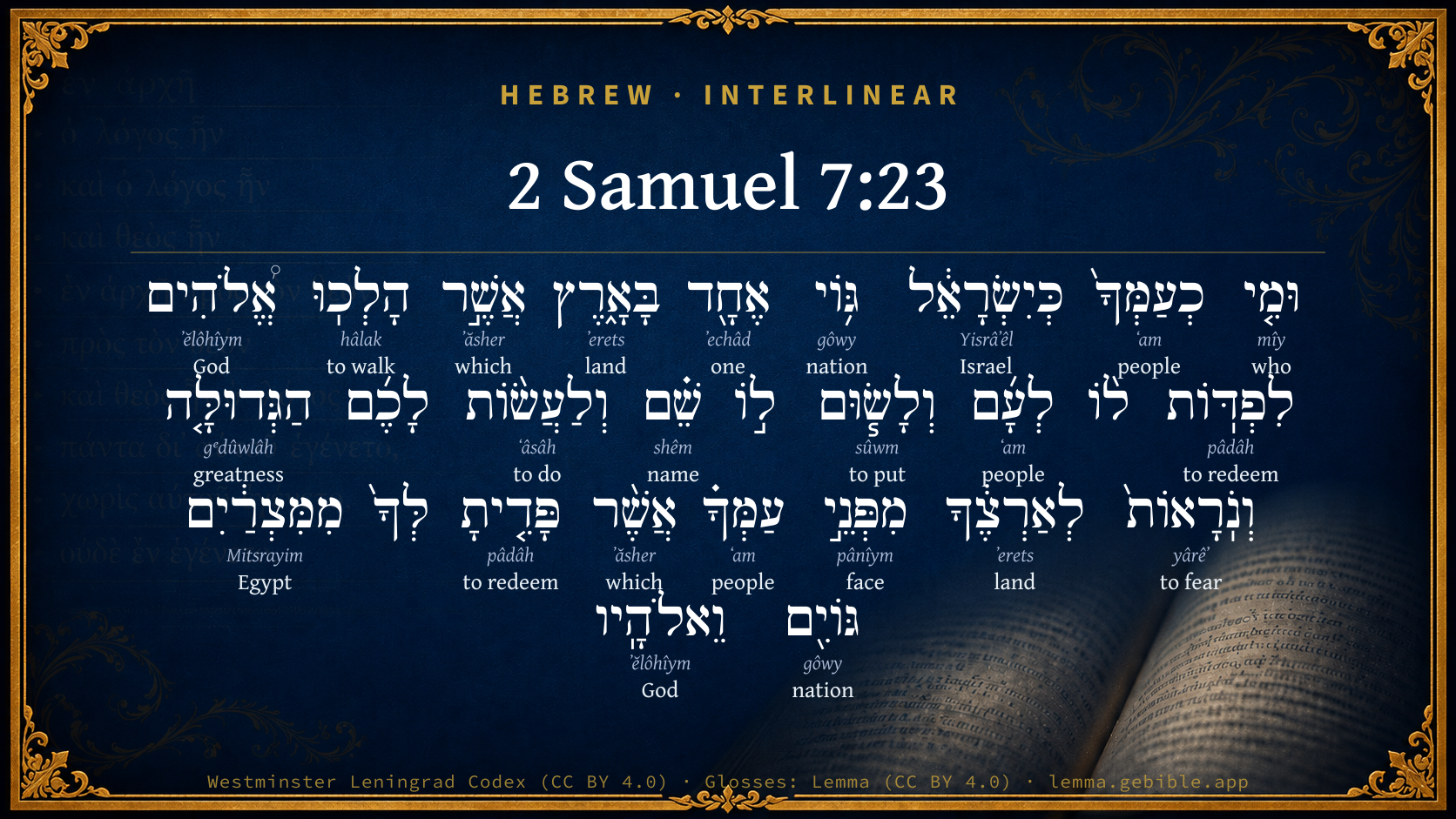
Hebrew (Westminster Leningrad Codex) 2 Samuel 7:23 appears in the Hebrew Old Testament. The text above is from the Westminster Leningrad Codex. Each word links to its Strong’s number, a concise gloss, and parsing drawn from the Open Scriptures Hebrew Bible morphology. Click any word for its full Brown-Driver-Briggs (BDB) entry.
Download image
Cite this verse

2 Samuel 7:23 (World English Bible). Public Domain. Lemma interlinear Bible study tool, https://lemma.gebible.app/v/2-samuel/7/23.

Show BibTeX & RIS
BibTeX
RIS
English Translation
What one nation in the earth is like your people, even like Israel, whom God went to redeem to himself for a people, and to make him a name, and to do great things for you, and awesome things for your land, before your people, whom you redeem to you out of Egypt, [from] the nations and their gods?
World English Bible · Public Domain
Download a study sheet

One document with this verse’s original text, its word-by-word gloss line, the meaning frame, cross-references with their text, attributed commentary, and full source and license credits — printable, and it pastes into notes with its structure intact.

This verse Autodidact and up

Study sheet (.html) Plain text (.txt)

A passage Seminary Student

Up to 50 verses in one chapter. A passage sheet keeps up to 6 commentary sources and 12 cross-references per verse, in the order this page ranks them, and says so on the sheet whenever that leaves anything out. Ask for a single verse and you get the Autodidact verse sheet above.

Everything on this page stays free to read, with no account — the sheet is a download of what is already on screen, not access to it.

Want to remove ads? Support Godless Engineer
Compare translations 3

The same verse in 3 English versions, stacked beneath the original-language interlinear above. Click any original word for its lexicon entry.

Each is an independent rendering of the whole verse — the interlinear is not word-aligned to these translations.

Highlighted words mark where these versions differ — a whole-verse word diff, not a word-by-word alignment.

  • World English Bible Public Domain
    What one nation in the earth is like your people, even like Israel, whom God went to redeem to himself for a people, and to make him a name, and to do great things for you, and awesome things for your land, before your people, whom you redeem to you out of Egypt, [from] the nations and their gods?
  • King James Version Public Domain
    And what one nation in the earth is like thy people, even like Israel, whom God went to redeem for a people to himself, and to make him a name, and to do for you great things and terrible, for thy land, before thy people, which thou redeemedst to thee from Egypt, from the nations and their gods?
  • unfoldingWord Literal Text CC BY-SA 4.0
    And who like your people, like Israel, the one nation on earth whose God went to redeem a people for himself and to make for himself a name and to do greatness for you and being feared for your land, from the face of your people whom you redeemed for yourself from Egypt, nations and its gods?

unfoldingWord Literal Text — © unfoldingWord, licensed CC BY-SA 4.0. Word-aligned USFM3 via Door43 (git.door43.org/unfoldingWord/en_ult).

Versions to compare (up to 4)

3 of 4 selected

Show all 18 translations

Every available English version of this verse, each an independent rendering of the whole verse.

  • World English Bible Public Domain
    What one nation in the earth is like your people, even like Israel, whom God went to redeem to himself for a people, and to make him a name, and to do great things for you, and awesome things for your land, before your people, whom you redeem to you out of Egypt, [from] the nations and their gods?
  • Berean Standard Bible Public Domain
    And who is like Your people Israel—the one nation on earth whom God went out to redeem as a people for Himself and to make a name for Himself? You performed great and awesome wonders by driving out nations and their gods from before Your people, whom You redeemed for Yourself from Egypt.
  • Majority Standard Bible Public Domain
    And who is like Your people Israel—the one nation on earth whom God went out to redeem as a people for Himself and to make a name for Himself? You performed great and awesome wonders by driving out nations and their gods from before Your people, whom You redeemed for Yourself from Egypt.
  • King James Version Public Domain
    And what one nation in the earth is like thy people, even like Israel, whom God went to redeem for a people to himself, and to make him a name, and to do for you great things and terrible, for thy land, before thy people, which thou redeemedst to thee from Egypt, from the nations and their gods?
  • American Standard Version (1901) Public Domain
    And what one nation in the earth is like thy people, even like Israel, whom God went to redeem unto himself for a people, and to make him a name, and to do great things for you, and terrible things for thy land, before thy people, whom thou redeemest to thee out of Egypt, `from' the nations and their gods?
  • Revised Version (1885) Public Domain
    And what one nation in the earth is like thy people, even like Israel, whom God went to redeem unto himself for a people, and to make him a name, and to do great things for you, and terrible things for thy land, before thy people, which thou redeemedst to thee out of Egypt, from the nations and their gods?
  • Geneva Bible (1599) Public Domain
    And what one people in the earth is like thy people, like Israel? whose God went and redeemed them to himselfe, that they might be his people, and that hee might make him a name, and do for you great things, and terrible for thy land, O Lord, euen for thy people, whome thou redeemedst to thee out of Egypt, from the nations, and their gods?
  • Douay-Rheims (1899) Public Domain
    And what nation is there upon earth, as thy people Israel, whom God went to redeem for a people to himself, and to make him a name, and to do for them great and terrible things, upon the earth, before the face of thy people, whom thou redeemedst to thyself out of Egypt, from the nations and their gods.
  • Young's Literal Translation Public Domain
    `And who `is' as Thy people, as Israel -- one nation in the earth, whom God hath gone to redeem to Him for a people, and to make for Him a name -- and to do for you the greatness -- even fearful things for Thy land, at the presence of Thy people, whom Thou hast redeemed to Thee out of Egypt -- `among the' nations and their gods?
  • Literal Standard Version CC BY-SA 4.0
    And who [is] as Your people, as Israel—one nation in the earth, whom God has gone to redeem for a people for Himself, and to make for Himself a name—and to do for Yourself the greatness—even fearful things for Your land, at the presence of Your people, whom You have redeemed for Yourself out of Egypt—[among the] nations and their gods?
  • Unlocked Literal Bible CC BY-SA 4.0
    What nation is like your people Israel, the one nation on earth whom you, God, went and rescued for yourself? You did this so that they would become a people for yourself, to make a name for yourself, and to do great and fearful deeds for your land. You drove out nations and their gods from before your people, whom you rescued from Egypt.
  • unfoldingWord Literal Text CC BY-SA 4.0
    And who like your people, like Israel, the one nation on earth whose God went to redeem a people for himself and to make for himself a name and to do greatness for you and being feared for your land, from the face of your people whom you redeemed for yourself from Egypt, nations and its gods?
  • Darby Bible Public Domain
    And who is like thy people, like Israel, the one nation in the earth that God went to redeem to be a people to himself, and to make himself a name, and to do for them great things and terrible, for thy land, before thy people, which thou redeemedst to thyself from Egypt, from the nations and their gods?
  • World Messianic Bible Public Domain
    What one nation in the earth is like your people, even like Israel, whom God went to redeem to himself for a people, and to make himself a name, and to do great things for you, and awesome things for your land, before your people, whom you redeemed to yourself out of Egypt, from the nations and their gods?
  • Webster's Bible Public Domain
    And what one nation in the earth is like thy people, even like Israel, whom God went to redeem for a people to himself, and to make him a name, and to do for you great things and terrible, for thy land, before thy people which thou redeemedst to thee from Egypt, from the nations and their gods?
  • Free Bible Version CC BY-SA 4.0
    Who else is as fortunate as your people Israel? Who else on earth did God go and redeem to make his own people? You gained a wonderful reputation for yourself by all the tremendous, amazing things you did in driving out other nations and their gods before your people as you redeemed them from Egypt.
  • Bible in Basic English Public Domain
    And what other nation in the earth, like your people Israel, did a god go out to take for himself, to be his people, and to make a name for himself, and to do great and strange things for them, driving out a nation and its gods from before his people?
  • JPS Tanakh (1917) Public Domain
    And who is like Thy people, like Israel, a nation one in the earth, whom God went to redeem unto Himself for a people, and to make Him a name, and to do for Thy land great things and tremendous, even for you, in driving out from before Thy people, whom Thou didst redeem to Thee out of Egypt, the nations and their gods?

Literal Standard Version (2020), Covenant Press — licensed CC BY-SA 4.0. Text via the HelloAO Bible API (eBible.org). Unlocked Literal Bible (unfoldingWord) — licensed CC BY-SA 4.0. Text via the HelloAO Bible API (eBible.org). unfoldingWord Literal Text — © unfoldingWord, licensed CC BY-SA 4.0. Word-aligned USFM3 via Door43 (git.door43.org/unfoldingWord/en_ult). Free Bible Version, Dr. Jonathan Gallagher — licensed CC BY-SA 4.0. Text via the HelloAO Bible API (eBible.org).

Word by word

More ways to search: Search by grammar → Find every occurrence → Compare this word →

Practice this passage: Drill this verse → Learn its vocabulary →

הַגְּדוּלָּ֤ה
gᵉdûwlâh
H1420
“the · greatness”
Particle, Definite Article + Noun, Common, Feminine, Singular, Absolute
Part of Speech
Particle + Noun
Type
Common
Gender
Feminine
Number
Singular
State
Absolute
Full BDB Definition

Origin: from H1419

TWOT: 315e

greatness - of man - of God's greatness (as an attribute)
  1. וּמִ֤י mîy H4310 “and · who” Conjunction + Particle, Interrogative
  2. כְעַמְּךָ֙ ʻam H5971 “like/as · people · your” Preposition + Noun, Common, Masculine, Singular, Construct + Suffix, Personal, 2nd Person, Masculine, Singular
  3. כְּיִשְׂרָאֵ֔ל Yisrâʼêl H3478 “like/as · Israel” Preposition + Noun, Proper
  4. גּ֥וֹי gôwy H1471 “nation” Noun, Common, Masculine, Singular, Absolute
  5. אֶחָ֖ד ʼechâd H259 “one” Adjective, Cardinal number, Masculine, Singular, Absolute
  6. בָּאָ֑רֶץ ʼerets H776 “in/at the · land” Preposition, Determined + Noun, Common, Both, Singular, Absolute
  7. אֲשֶׁ֣ר ʼăsher H834 “which” Particle, Relative
  8. הָלְכֽוּ hâlak H1980 “to walk” Verb, Qal, Perfect, 3rd Person, Common, Plural
  9. אֱ֠לֹהִים ʼĕlôhîym H430 “God(s)” Noun, Common, Masculine, Plural, Absolute
  10. לִפְדּֽוֹת pâdâh H6299 “to redeem” Preposition + Verb, Qal, Infinitive Construct
  11. לְעָ֜ם ʻam H5971 “to/for · people” Preposition + Noun, Common, Masculine, Singular, Absolute
  12. וְלָשׂ֧וּם sûwm H7760 “and · to put” Conjunction + Preposition + Verb, Qal, Infinitive Construct
  13. שֵׁ֗ם shêm H8034 “name” Noun, Common, Masculine, Singular, Absolute
  14. וְלַעֲשׂ֨וֹת ʻâsâh H6213 “and · to do” Conjunction + Preposition + Verb, Qal, Infinitive Construct
  15. וְנֹֽרָאוֹת֙ yârêʼ H3372 “and · fearing” Conjunction + Verb, Niphal, Participle Active, Feminine, Plural, Absolute
  16. לְאַרְצֶ֔ךָ ʼerets H776 “to/for · land · your” Preposition + Noun, Common, Both, Singular, Construct + Suffix, Personal, 2nd Person, Masculine, Singular
  17. מִפְּנֵ֣י pânîym H6440 “from · face(s) of” Preposition + Noun, Common, Both, Plural, Construct
  18. עַמְּךָ֗ ʻam H5971 “people · your” Noun, Common, Masculine, Singular, Construct + Suffix, Personal, 2nd Person, Masculine, Singular
  19. אֲשֶׁ֨ר ʼăsher H834 “which” Particle, Relative
  20. פָּדִ֤יתָ pâdâh H6299 “to redeem” Verb, Qal, Perfect, 2nd Person, Masculine, Singular
  21. מִמִּצְרַ֔יִם Mitsrayim H4714 “from · Egypt” Preposition + Noun, Proper
  22. גּוֹיִ֖ם gôwy H1471 “nations” Noun, Common, Masculine, Plural, Absolute
  23. וֵאלֹהָֽיו ʼĕlôhîym H430 “and · God(s) · his” Conjunction + Noun, Common, Masculine, Plural, Construct + Suffix, Personal, 3rd Person, Masculine, Singular

About this verse

These counts appear in no published source. They are computed here, from the morphology-tagged text and Lemma’s own curated glosses. What Lemma adds →

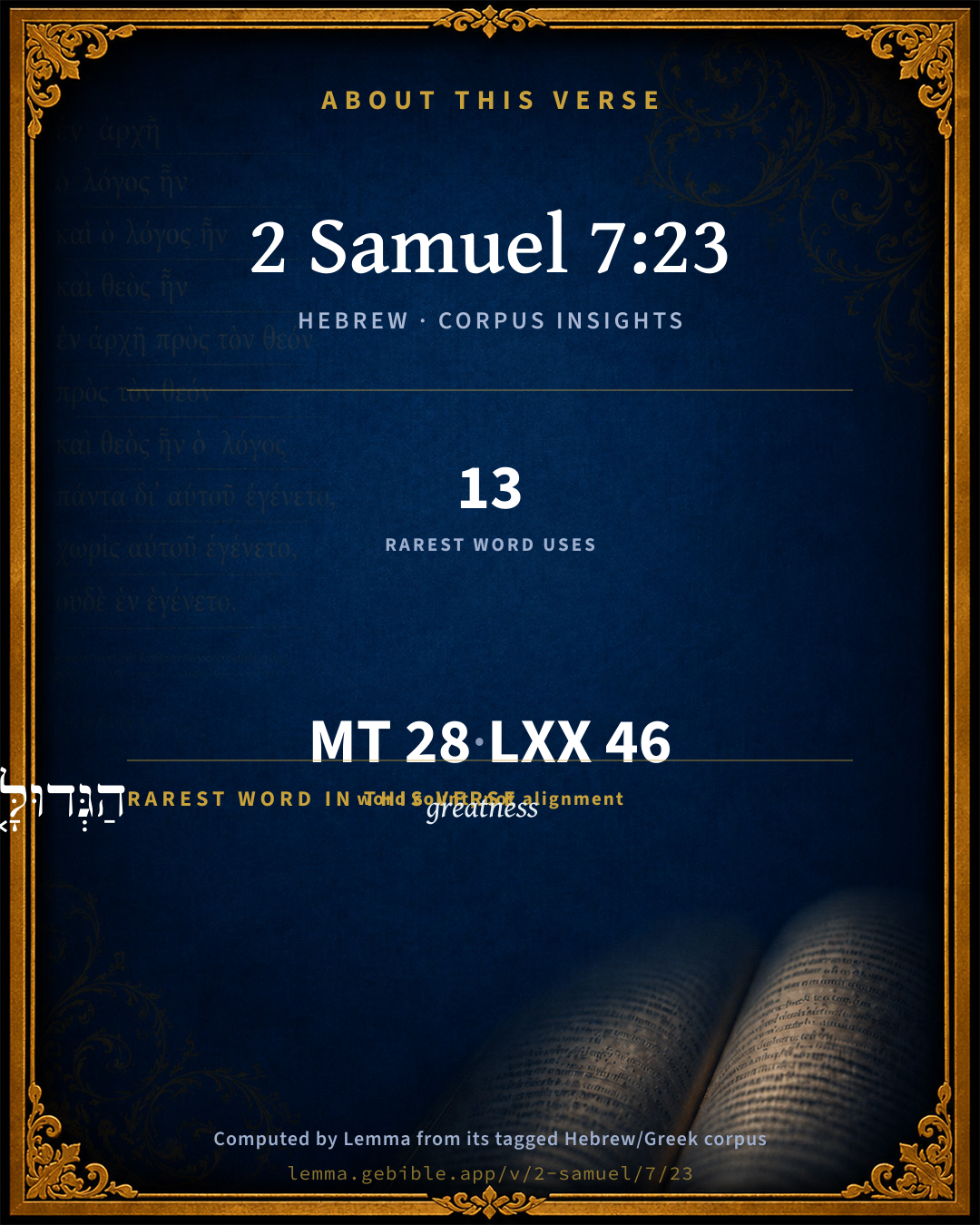
28
words
17
distinct lemmas
Historical
section

Notable vocabulary

The rarest word here is הַגְּדוּלָּ֤ה greatness H1420 — appearing just 13 times in the whole Hebrew Bible.

Shared distinctive vocabulary

הַגְּדוּלָּ֤ה greatness H1420 occurs in 11 verses of the Hebrew Bible. Also found in:

Grammatical profile

  • 6 verbs
  • 14 nouns
  • 1 adjective
  • 4 prepositions
  • 3 particles

Verb forms

  • הָלְכֽוּ Qal · Perfect
  • לִפְדּֽוֹת Qal · Infinitive Construct
  • וְלָשׂ֧וּם Qal · Infinitive Construct
  • וְלַעֲשׂ֨וֹת Qal · Infinitive Construct
  • וְנֹֽרָאוֹת֙ Niphal · Participle Active
  • פָּדִ֤יתָ Qal · Perfect

Repetition

Words recur within this verse — often emphatic in Hebrew:

  • כְעַמְּךָ֙ people H5971 ×3
  • גּ֥וֹי nation H1471 ×2
  • בָּאָ֑רֶץ land H776 ×2
  • אֱ֠לֹהִים God H430 ×2
  • לִפְדּֽוֹת to redeem H6299 ×2
  • אֲשֶׁ֣ר which H834 ×2

Hebrew & Septuagint length

In English translation the verse runs 59 words from the Hebrew and 58 from the Septuagint (LXX English) — closely comparable.

A rough comparison of the two English renderings, which tokenize alike — not a word-level alignment.

Word counts can differ between the Hebrew and the Greek without any difference in meaning — e.g. the Hebrew direct-object marker אֵת has no separate Greek word, and Greek often adds the article ὁ.

In the original languages it is 28 Hebrew tokens and 46 Greek tokens — but the two are counted differently (Hebrew bundles its prefixes and suffixes into one token; the Greek is in lemma form), so that isn’t a like-for-like length.

Cross-references

28

Topical passages linked to 2 Samuel 7:23 in the Treasury of Scripture Knowledge — connected by theme and wording, ordered by reader-vote popularity; previews shown in the World English Bible.

  • Deuteronomy 10:21 He is your praise, and he is your God, who has done for you these great and awesome things, which your eyes have seen.
  • Deuteronomy 9:26 I prayed to Yahweh, and said, Lord Yahweh, don't destroy your people and your inheritance, that you have redeemed through your greatness, that you have brought forth out of Egypt with a mighty hand.
  • Deuteronomy 15:15 You shall remember that you were a bondservant in the land of Egypt, and Yahweh your God redeemed you: therefore I command you this thing today.
  • Deuteronomy 33:29 Happy are you, Israel: Who is like you, a people saved by Yahweh, The shield of your help, The sword of your excellency! Your enemies shall submit themselves to you; You shall tread on their high places.
  • Nehemiah 1:10 Now these are your servants and your people, whom you have redeemed by your great power, and by your strong hand.
  • Psalms 111:9 He has sent redemption to his people. He has ordained his covenant forever. His name is holy and awesome!
  • Psalms 147:20 He has not done this for just any nation. They don't know his ordinances. Praise Yah!
  • Deuteronomy 4:32–38 For ask now of the days that are past, which were before you, since the day that God created man on the earth, and from the one end of the sky to the other, whether there has been [any such thing] as this great thing is, or has been heard like it?
  • Psalms 40:5 Many, Yahweh, my God, are the wonderful works which you have done, And your thoughts which are toward us. They can't be set in order to you; If I would declare and speak of them, they are more than can be numbered.
  • Ezekiel 20:9 But I worked for my name's sake, that it should not be profaned in the sight of the nations, among which they were, in whose sight I made myself known to them, in bringing them forth out of the land of Egypt.
  • Exodus 3:7–8 Yahweh said, "I have surely seen the affliction of my people who are in Egypt, and have heard their cry because of their taskmasters, for I know their sorrows.
  • Exodus 9:16 but indeed for this cause I have made you stand: to show you my power, and that my name may be declared throughout all the earth;
  • Exodus 12:12 For I will go through the land of Egypt in that night, and will strike all the firstborn in the land of Egypt, both man and animal. Against all the gods of Egypt I will execute judgments: I am Yahweh.
  • Deuteronomy 4:7–8 For what great nation is there, that has a god so near to them, as Yahweh our God is whenever we call on him?
  • Joshua 7:9 For the Canaanites and all the inhabitants of the land will hear of it, and will compass us round, and cut off our name from the earth: and what will you do for your great name?
  • 1 Chronicles 17:21 What one nation in the earth is like your people Israel, whom God went to redeem to himself for a people, to make you a name by great and awesome things, in driving out nations from before your people, whom you redeem out of Egypt?
  • Psalms 65:5 By awesome deeds of righteousness, you answer us, God of our salvation. You who are the hope of all the ends of the earth, Of those who are far away on the sea;
  • Psalms 145:6 Men will speak of the might of your awesome acts. I will declare your greatness.
  • Isaiah 63:7–14 I will make mention of the loving kindnesses of Yahweh, [and] the praises of Yahweh, according to all that Yahweh has bestowed on us, and the great goodness toward the house of Israel, which he has bestowed on them according to his mercies, and according to the multitude of his loving kindnesses.
  • Romans 3:1–2 Then what advantage does the Jew have? Or what is the profit of circumcision?
  • Ephesians 1:6 to the praise of the glory of his grace, by which he freely bestowed favor on us in the Beloved,
  • Titus 2:14 who gave himself for us, that he might redeem us from all iniquity, and purify for himself a people for his own possession, zealous for good works.
  • 1 Peter 2:9 But you are a chosen race, a royal priesthood, a holy nation, a people for God's own possession, that you may show forth the excellencies of him who called you out of darkness into his marvelous light:
  • Revelation 5:9 They sang a new song, saying, "You are worthy to take the book, And to open its seals: For you were killed, And bought us for God with your blood, Out of every tribe, language, people, and nation,
  • Exodus 19:5–6 Now therefore, if you will indeed obey my voice, and keep my covenant, then you shall be my own possession from among all peoples; for all the earth is mine;
  • Numbers 14:13–14 Moses said to Yahweh, Then the Egyptians will hear it; for you brought up this people in your might from among them;
  • Psalms 66:3 Tell God, "How awesome are your deeds! Through the greatness of your power, your enemies submit themselves to you.
  • Psalms 106:22 Wondrous works in the land of Ham, And awesome things by the Red Sea.

Cross-references courtesy of OpenBible.info (CC BY 4.0).

Hebrew and Greek witnesses Masoretic Hebrew ↔ Greek Septuagint

The same verse in the two great witnesses to the Old Testament, shown verse-for-verse.

These are two independent witnesses, not word-aligned to each other, and the Septuagint is shown in lemma (dictionary) form.

Hebrew 2 Samuel 7:23 Masoretic · Westminster Leningrad Codex

וּמִ֤י כְעַמְּךָ֙ כְּיִשְׂרָאֵ֔ל גּ֥וֹי אֶחָ֖ד בָּאָ֑רֶץ אֲשֶׁ֣ר הָלְכֽוּ אֱ֠לֹהִים לִפְדּֽוֹת ל֨וֹ לְעָ֜ם וְלָשׂ֧וּם ל֣וֹ שֵׁ֗ם וְלַעֲשׂ֨וֹת לָכֶ֜ם הַגְּדוּלָּ֤ה וְנֹֽרָאוֹת֙ לְאַרְצֶ֔ךָ מִפְּנֵ֣י עַמְּךָ֗ אֲשֶׁ֨ר פָּדִ֤יתָ לְּךָ֙ מִמִּצְרַ֔יִם גּוֹיִ֖ם וֵאלֹהָֽיו

What one nation in the earth is like your people, even like Israel, whom God went to redeem to himself for a people, and to make him a name, and to do great things for you, and awesome things for your land, before your people, whom you redeem to you out of Egypt, [from] the nations and their gods?

World English Bible · Public Domain

Greek LXX 2 Samuel 7:23 Septuagint · lemma form

καί τίς ὡς ὁ λαός σύ ἰσραήλ ἔθνος ἄλλος ἐν ὁ γῆ ὡς ὁδηγέω αὐτός ὁ θεός ὁ λυτρόω αὐτός λαός ὁ τίθημι σύ ὄνομα ὁ ποιέω μεγαλωσύνη καί ἐπιφάνεια ὁ ἐκβάλλω σύ ἐκ πρόσωπον ὁ λαός σύ ὅς λυτρόω σεαυτοῦ ἐκ αἴγυπτος ἔθνος καί σκήνωμα

And what other nation in the earth is as your people Israel? whereas God was his guide, to redeem for himself a people to make you a name, to do mightily and nobly, so that you should cast out nations and their tabernacles from the presence of your people, whom you did redeem for yourself out of Egypt?

LXX2012 (modern English Septuagint) · Public Domain

On this verse, Ellicott's Commentary for English Readers discusses the Septuagint’s reading. Read the note in Commentary ↓

Hebrew: Westminster Leningrad Codex (CC BY 4.0). Greek: Septuagint (public domain); English from LXX2012 (modern English Septuagint) (Public Domain). How the Septuagint differs from the Hebrew →

Targum (Aramaic paraphrase)

1

The Targum is the ancient Jewish Aramaic paraphrase of the Hebrew Scriptures — an interpretive translation, not the Hebrew text itself. Onkelos (literal) and Pseudo-Jonathan (expansive) render the Torah, and Jonathan the Prophets. Coverage is partial: where no permissively-licensed English translation exists for a verse, only the Aramaic is shown. This is verse-level text, not a word-by-word alignment to the Hebrew.

  1. Targum Jonathan Prophets (Joshua–Malachi)
    וּמַן כְּעַמָךְ כְּיִשְׂרָאֵל עַמָא חַד בְּחִיר בְּאַרְעָא דַאֲזַלוּ שְׁלוּחִין מִן קֳדָם יְיָ לְמִפְרַק לֵיהּ לְעָם וּלְשַׁוָאָה לֵיהּ שׁוּם וּלְמֶעְבַּד לְכוֹן רַבְרְבָן וַחֲסִינָן עַד דִי עָלוּ לַאֲרַע בֵּית שְׁכִנְתָּךְ דִיהַבְתְּ לְהוֹן מִן קֳדָם עַמָךְ דִי פְרַקְתָּא לָךְ מִמִצְרַיִם גוֹיִם וֵאלֹהָיו:

    (no public-domain English translation for this verse)

    Targum Jonathan — Aramaic: “Mikraot Gedolot” (public domain). English: “Sefaria Community Translation” (CC0 1.0 (public-domain dedication)); “London "Chaldee Paraphrase," 1871” (public domain). Text via Sefaria.

Commentary

Notes on 2 Samuel 7:23 from classic Christian and Jewish commentators (each source and its license shown beneath its notes). The classic Christian expositions comment on the surrounding passage and are grouped to its opening verse, so a note may address several verses; the Jewish commentaries on the Tanakh (Rashi and others) are per-verse, so they appear only where the commentator wrote on this verse.

Lemma curates 59 commentaries, every one of them public domain or Creative Commons licensed, each selected and text-cleaned for this edition rather than reprinted as found. About our sources →

Trapp's Complete Commentary

John Trapp

2Sa 7:23 And what one nation in the earth [is] like thy people, [even] like Israel, whom God went to redeem for a people to himself, and to make him a name, and to do for you great things and terrible, for thy land, before thy people, which thou redeemedst to thee from Egypt, [from] the nations and their gods?

Ver. 23. And what one nation … is like thy people?] See Deu 4:7; Deu 33:29. {See Trapp on "Deu 4:7"} {See Trapp on "Deu 33:29"}

Whom God went to redeem.] Came down from heaven, as it were, to display his glorious power upon earth {Exo 3:7-8} The whole Trinity did so in a special manner, when God the Son took our nature, and therein came to visit us.

And to defer you.] This he speaketh by a most emphatical apostrophe to the people: and then presently turneth him to God again, having his heart as full of heaven as it could hold.

John Trapp, A Commentary or Exposition upon All the Books of the Old and New Testament (1647–1656) — public domain. Text from a community e-Sword module.

Joseph Benson's Commentary

2Sa 7:23. What one nation in the earth, &c. — He seems to have in view the words of Moses in Deu 4:7; Deu 4:34. To make him a name — That all the world might know and acknowledge his power and glory. To do for you great things and terrible, &c. — Instead of, for you, the Seventy, Vulgate, and Arabic read, for them. Or the words may be understood, according to Le Clerc’s interpretation, who supplies some words evidently intended to be supplied to perfect the sense, thus: To do for you great things, O Israel, and terrible for thy land, O God, by casting out the nations before thy people, &c. But the parallel place, 1Ch 17:2, to which the reader is referred, will best explain the sense of this whole verse. From the nations and their gods — Some, by gods, understand their rulers; but their gods were no more able, nay, being mere imaginary beings, were less able to save the nations whom Jehovah drove out, than their kings and rulers.

Joseph Benson's Commentary on the Old and New Testaments (1811–1818) — public domain. Text from a community e-Sword module.

Tyndale Open Study Notes

Tyndale Open Resources

7:23 Israel was set apart from every other nation by the uniqueness of its God and by the relationship the people had with him.

Tyndale Open Study Notes — © Tyndale Open Resources, licensed CC BY-SA 4.0. Text via the HelloAO Bible API.

Geneva Bible (1599)

Geneva Bible translators

And inheritance, which is Israel.

From the Egyptians and their idols.

O Israel.

Geneva Bible (1599) marginal notes — public domain. Text via Bolls.life.

Ellicott's Commentary for English Readers

(23) Whom God went to redeem.—The word here used for God in this its usual plural form is always construed with a singular verb when it refers to the true God. Here the verb is plural, because the thought is, “What nation is there whom its gods went to redeem?”

For you.—These words, which can only refer to Israel, seem strange in a prayer to God. They are omitted by the LXX., and changed into for them by the Vulg. If they are retained as they are, it must be understood that David for the moment turns in thought to the people, instead of to God whom he is immediately addressing.

For thy land.—The LXX. and the parallel passage (1Ch_17:21), instead of this have, “by driving out.” If the text here may be corrected in this way, there will be no occasion for inserting from before the nations, which is not in the Hebrew. This part of the verse will then read, to do great things and terrible, by driving out before thy people, which thou redeemedst to thee from Egypt, nations and their gods. The phrase, “great things and terrible,” in reference to the Exodus, is taken from Deu_10:21. The whole of this part of the prayer is evidently founded upon Deu_4:7; Deu_4:32-34.

A Bible Commentary for English Readers, edited by Charles John Ellicott (1878–1897) — public domain. Text from a community e-Sword module.

The Cambridge Bible for Schools and Colleges

gen. ed. J. J. S. Perowne

23. And what, &c.] For what, &c., a further reason for the last statement. Cp. Deu_4:7; Deu_4:32-38.

whom God went &c.] Better, which their god went to redeem. Elôhîm, the Heb. word for God, is a plural noun, but regularly takes a singular verb when it denotes the true God. Here the verb “went” is in the plural, which indicates that the gods of the nations are meant to be included. The sense is, ‘Where can any nation be found, which has been delivered by the deity it worships, as Israel was delivered from Egypt by Jehovah?’

for you] “You” can only refer to Israel, and an address to the people is quite out of place in David’s prayer to God. We must either omit for you with the LXX, or read for them, i.e. the nation, with the Vulgate.

for thy land] This gives no satisfactory sense, and “the nations and their gods” at the end of the verse has no proper construction in the existing text. It is best to emend the text by the help of the LXX, compared with 1Ch_17:21, and read to drive out in place of for thy land. The close of the verse will then stand thus; “and to do great things and terrible, to drive out nations and their gods before thy people, which thou redeemedst for thyself out of Egypt.”

The construction, which began in the third person, in connexion with the relative clause, returns at the end of the verse to a direct address to God.

great things and terrible] The miracles of the Exodus, the journey through the wilderness, the Entry into Canaan. Cp. Deu_10:21 for the phrase.

The Cambridge Bible for Schools and Colleges (gen. ed. J. J. S. Perowne; Cambridge University Press, 1878–1918) — public domain. Text from a community e-Sword module.

John Gill's Exposition

And what one nation in the earth is like thy people, even like Israel,.... For the knowledge and worship of the true God among them, for laws and or given them, and for blessings of goodness bestowed upon them:

whom God went to redeem for a people to himself; the words are plural, "whom the gods went to redeem"; the Targum is,"they that were sent from the Lord,''meaning Moses and Aaron, of whom Jarchi interprets them, of the first of which it is said, "I have made thee a god unto Pharaoh", Exo 7:1; but Kimchi and R. Isaiah understand it of the true God, only suppose, as the former, that the plural expression is used for the sake of honour and glory; whereas, no doubt, respect is had to the three divine Persons in the Trinity, who were all concerned in the redemption of Israel, see Isa 63:9, where mention is made of the Lord, and of the Angel of his presence, and of his holy Spirit, as engaged therein:

and to make him a name; either to get himself a name, and honour and glory in the world, to show forth his power and might, as well as his mercy and goodness, or to make his people famous, great, and glorious in the earth:

and to do for you great things and terrible; as he did in the land of Ham, at the Red sea, and in the wilderness, and in the land of Canaan, great things for his people, and terrible ones to their enemies:

for thy land; which is either spoken to God, whose was the land of Israel, and which he had chosen to dwell in, and had given to his people; or else to Israel, to whom the grant of this land was made, and who were put into the possession of it:

before thy people which thou redeemedst to thee from Egypt: that is, the great and terrible things were done in their sight, when they were redeemed from the bondage of Egypt, see Psa 78:12,

from the nations, and their gods? meaning, that they were redeemed not only from Egypt, but the nations of the Canaanites were driven out before them; nor could their idols save them, but destruction came upon them as upon the gods of the Egyptians: some leave out the supplement "from", and interpret this of the persons redeemed, even of the nations and tribes of Israel, and their great men, their rulers and civil magistrates, sometimes called gods.

John Gill's Exposition of the Whole Bible (1746–1763) — public domain (CC PDM 1.0). Text via the HelloAO Bible API.

Albert Barnes' Notes on the Bible

The nations and their gods - i e. the people and the idols of Canaan.

Albert Barnes' Notes on the Bible (1834–1885) — public domain. Text from a community e-Sword/MySword module.

Haydock's Catholic Bible Commentary

CHAPTER VII.

A name. So that all might praise God, for the favours which he had bestowed upon his people, (Haydock) and admire his power and glory. --- Gods, whom thou didst cast out of Chanaan. (Paralipomenon) (Calmet) --- From, is not expressed in the Vulgate or Hebrew, though Protestants also supply it. (Haydock) --- Some explain Elohim, "gods," of the chief men of the Hebrew nation. The power of the idols was overthrown; (Numbers xxxiii. 4,) and the Israelites were rescued both from oppression, and from the service of false gods, Ezechiel xvi. (Calmet) --- Adonai is often substituted for Jehova; as appears from 1 Paralipomenon xvii. 21, 22. (Kennicott)

George Leo Haydock (1774–1849), Haydock's Catholic Family Bible and Commentary, 1859 edition — public domain. Excludes Psalms (Douay-Rheims chapter numbering differs from Protestant) and Deuterocanonical books (Catholic canon only).

Matthew Poole's English Annotations

God went, to wit, into Egypt; an expression of God after the manner of men.

To make him a name; to advance the glory of his power and goodness, and other perfections. Compare Exo 9:16.

Matthew Poole's English Annotations on the Holy Bible (1683–1685) — public domain. Text from a community e-Sword/MySword module.

Whedon's Commentary on the Bible

Daniel D. Whedon

23. To do for you great things — For you refers to Israel. In the rapt earnestness and enthusiasm of his prayer, David seems in heart to have all Israel before him, and addresses them unconsciously as with an orator’s directness.

Thy land — God’s land, the land of Canaan, because it was the land of divine promise.

This prayer of David is a model for all who approach the spiritual mercy-seat. It embodies confession, adoration, and supplication. David confesses his own unworthiness of blessings already received, (18,) adores Jehovah for personal favours, (19-21,) and also for the amazing displays of mercy and love for his chosen people, (22-24,) and lastly, with devout supplication, prays for the fulfilment of the Divine promise, (25-29.) Let the reader here observe that though the Divine promise to David and his seed was unconditional, and sure as the pledge of God could make it, (2Sa_7:15-16,) the pious monarch still prays for its fulfilment. Compare Eze_36:36-37.

Daniel D. Whedon (gen. ed.), Commentary on the Old and New Testaments (1874–1909) — public domain. Text from a community e-Sword module.

The Pulpit Commentary

And what one nation, etc.? The translation should be, And who is like thy people, like Israel, the one nation upon earth which God went to redeem for himself to be his people, and to make for him a name, etc.? Israel both was and remains to this day a nation unique in its history, both in those early dealings of God with it, and also in its later history and its marvellous preservation unto this day. It is remarkable that in this place the word for "God," Elohim, is followed by a verb plural, the almost invariable rule in Hebrew being that, though Elohim is itself plural, it takes a verb singular whenever it refers to the true God. In the corresponding passage (1Ch_17:21) the verb is in the singular. No adequate reason has been given for this deviation, but probably the usage in these early times was not so strict as it became subsequently. It is the influence of writing, and of the eye becoming conversant with writing, that makes men correct in their use of language and in the spelling of words. In the Syriac Church, God the Word and God the Holy Ghost were at first spoken of in the feminine gender, because "Word" and "Spirit" are both feminine nouns; but grammar soon gave way to soundness of thought and feeling. So probably in colloquial language Elohim was often used with a verb plural, but correct thinking forbade and overruled grammar. We may regard this, then, as one of the few passages in which the colloquial usage has escaped correction, and attach no further importance to it. For you. "You" is plural, and refers to the people. The Vulgate has "for them," which is in accordance with the greater exactness of modern grammar. But sudden changes of person are very common in Hebrew, which follows the rules of thought rather than of written composition; and so David speaks of Israel as you, because they seemed to him to be present. We must note, however, that in the words that follow, for thy land, and thy people, the pronoun is singular, and refers to God. From the nations and their gods. Both the Authorized Version and the Revised Version, by inserting "from," which is not in the Hebrew, take "nations" as in apposition with "Egypt;" but a moment"s consideration shows that this is untenable, as "nations" is plural. But the whole verse is so full of grammatical difficulties as to make it extremely probable that the text is corrupt, and that we ought to supply the verb "to drive out," which is actually read in 1Ch_17:21, or even to substitute it in the place of "for thy land," which is omitted in the parallel passage. The nations which God drove out had nothing to do with Egypt, but were the seven dominant tribes of Canaan; and the bestowal upon Israel of their territories was as essential a part of Jehovah"s dealings with his people as the Exodus itself. Thus the reading will be, To drive out before thy people, whom thou purchasedst for thee from Egypt, nations and their gods.

Vers. 23, 24.

The blessedness of God"s people.

The thought of the greatness of God, in contrast with other objects of worship, naturally leads to that of the happiness of the people to whom he has revealed himself, and on whose behalf he has shown his greatness by his works. Israel was thus blessed above all other nations; Christians inherit the same blessedness with large increase. The people of God are distinguished above all others by

I THEIR REDEMPTION. (Ver. 23.)

1. The nature of it. Israel was redeemed from bondage in Egypt, and afterwards from the Canaanite "nations and their gods." A wonderful and happy deliverance. Christians are the subjects of a higher redemption. They are delivered from sin, from a bondage more cruel and degrading than that of Egypt; They are redeemed "from all iniquity", (Tit_2:14) "from this present evil world"; (Gal_1:4) "from their vain manner of life handed down from their fathers". (1Pe_1:18, Revised Version) They are redeemed from the consequences of sin. They have "redemption, even the forgiveness of sins"; (Col_1:14) they are redeemed "from the curse of the Law"; (Gal_3:13) from the power of the devil, and so from the power and the dread of death; (Heb_2:14, Heb_2:15) they await "the redemption of their body"; (Rom_8:23) they are delivered "from the wrath to come". (1Th_1:10) Such are some of the

2. statements of Scripture respecting the "redemption that is in Christ Jesus". (Rom_3:24)

3. The manner of it. The deliverance from Egypt was effected by marvels of Divine power. God "went" forth to their rescue, doing "great things and terrible," in which the people themselves had and could have no part. In the destruction of the Canaanitish peoples they did take part, but their deliverances were by the power of God as really as their redemption from Egypt. For the spiritual and eternal redemption God has interposed in ways yet more marvellous. By wonders of love and righteousness and power combined, he delivers men from sin and death and hell. "He sent his Son to be the Propitiation for our sins". (1Jn_4:10) "We have redemption through his blood"; (Eph_1:7) and so the saints on earth and those in heaven unite in praise of him who, by his blood, washed them from their sins, and redeemed them to God. (Rev_1:5 Rev_5:9) Mere power could not effect this redemption.

(1) God must, in redeeming men, "declare his righteousness.., that he might be just," as well as "the Justifier"; (Rom_3:26) and this is effected by the death of Jesus, "the Just for the unjust". (1Pe_3:18)

(2) Men are to be delivered from sin by moral suasion; and this also is effected by the manifestation at once of the evil of sin, and the greatness of the Divine love, in the sacrifice of Christ. Thus the great redemptive act is the sacrificial death of the Lord Jesus. But this is rendered effectual in the experience of men by

(3) the power of the Holy Spirit, revealing to the heart the gospel of redemption, which then becomes "the power of God unto salvation". (Rom_1:16) To have thus realized redemption is the greatest blessedness and honour, and those who have this experience are the true "Israel of God". (Gal_6:16)

4. The glory which this Redemption brings to the Redeemer. "God went to redeem,.., and to make him a Name." This aspect of the deliverance of Israel is not unfrequently presented in Holy Writ (see Exo_9:16; Isa_63:12, Isa_63:14) Similarly, the Christian redemption is said to be "to the praise of the glory of his grace". (Eph_1:6, 12 2:7; 2Co_4:15) It is not that, like some ambitious human hero, he cares for a great name for his own sake; but by his Name he is known, and men are drawn to him and saved. (see Joh_17:26) In like manner, our Lord is said to have acquired through his humiliation and obedience unto death "a Name which is above every name," even "the Name of Jesus," and this also" to the glory of God the Father". (Php_2:9-11)

II THE RELATION ESTABLISHED BETWEEN THEM AND GOD. (Ver. 24.) This also distinguishes them above all others. They are constituted the people of God; he becomes their God. It is for this purpose they are redeemed. This representation of the relation between God and his people appears first in a promise made to Abraham, (Gen_17:7, Gen_17:8) is repeated in promises given through Moses, (Exo_6:7, etc.) is adopted by David here, reappears in the prophets (e.g. , Jer_31:33) is applied in the New Testament to Christians, (2Co_6:16, etc.) and is finally used in a description of the perfect blessedness of the inhabitants of the New Jerusalem. (Rev_21:3) It comprehends all that the most enlightened and holy can desire.

1. They are constituted the people of God. Thus to Israel it is said by Moses, "Thou art a holy people unto the Lord thy God, and the Lord hath chosen thee to be a peculiar people unto himself, above all the nations that are upon the earth". (Deu_14:2; see also 26:18) St. Peter employs similar language to describe the position of Christians; (1Pe_2:9) and St. Paul says (Tit_2:14) that our Lord "gave himself for us, that he might purify unto himself a peculiar people "a people for his own possession," Revised Version." The representation includes:

(1) Ownership. They are his by right of creation and of purchase. "I gave Egypt for thy ransom"; (Isa_43:3) "Ye are not your own; for ye arebought with a price". (1Co_6:19, 1Co_6:20)

(2) Appropriation. God takes possession of the people who are his; in the case of Christians, by his Spirit.

(3) Self-consecration.

(4) Homage, including trust, love, worship (while other peoples worship other gods, the people of God worship him), and obedience.

(5) Glorification. They "show forth his praise" (Isa_43:21; 1Pe_2:9) They promote his kingdom.

1. He is their God. All that men expect from their God he is to his people, and far more. He is theirs by covenant and promise. He gives himself to them. He exercises authority over them. They enjoy his love, his presence,

2. the employment of his power to teach and guide, to purify, to comfort, to chastise, to protect, to employ, to perfect, to honour, to save.

3. The relation is eternal. "Forever." This is true in a sense of the relation between Israel and God. Although no longer a nation, they still are used to witness for him as no other people; and by their inspired men, and especially by him who is of them "according to the flesh," they have become the chief religious teachers and benefactors of mankind. And the day is coming when they will accept their Messiah, and, "with the fulness of the Gentiles," form one people of God. The real, spiritual Israel of all ages and lands are God"s, and he is theirs forever and ever.

Then:

1. Happy are the people thus favoured by the Most High! He confers on them greater honour and blessing than on any others. This is true of Israel; of any nation who have the Word and ordinances of God amongst them; of the visible Church of Christ; and emphatically of the true spiritual Church. The distinction and glory become more marked as the reality of what is included in the title, "people of God" increases. To have a Divine revelation is a great privilege; but greater to receive and be renewed by it, and thus be heirs of all its promises.

2. Be concerned to be one of the true people of God, who have Jehovah for their God forever.

3. Take heed to live in a manner becoming your relation to him whom youacknowledge as your God. (See Leviticus 19., passim. ) The people of a God of holiness and love should be distinguished by these qualities. Only thus can they prove themselves to be his. Only such people are his in any lastingly happy sense. Would that it were possible to point to every Christian Church, and challenge the world to produce any communities equal to them in all that is pure, righteous, and benevolent! G.W.

The Pulpit Commentary (1880–1919), ed. H.D.M. Spence-Jones & Joseph S. Exell — public domain. Text from a community e-Sword module.

Scofield Reference Notes

C. I. Scofield

redeem

(See Scofield "Exo 14:30")

The Scofield Reference Bible (1917 edition), notes by C. I. Scofield — public domain. Text from a community e-Sword module.

Rashi

Rabbi Shlomo Yitzchaki (Rashi)

For whom leaders went. Moshe and Aharon as it is said, (Shemos 7:1). "I have made you a judge over Pharaoh" and so too did Yonasan translate, "messengers went from before Hashem."

To redeem for Him a people. This is what the messengers said to Yisroel, The Holy One, blessed is he sent us to redeem for Him a people, to put forth His Name and to make great [things happen] for you.

Awesome things You have done for your land after [Bnei Yisroel] left there [i.e., Egypt]. And what are the awesome things? From before Your people You expelled nations and their gods. This verse is missing [the word] "לגרש", [however] in Divrei Hayomim (I 17:21) it explains, "To expel from before Your people that You redeemed from Egypt, nations and their gods." [Our verse] isn't [really] missing [this word] because from the sense conveyed as it is said, "From before Your people, nations" we understand that it means pushed and driven out.

Rashi on the Tanakh — English translations: “The Judaica Press complete Tanach with Rashi, translated by A. J. Rosenberg” (CC BY 4.0); “Pentateuch with Rashi's commentary by M. Rosenbaum and A.M. Silbermann, 1929-1934” (public domain); “The Metsudah Tanach series, Lakewood, N.J” (CC BY 4.0); and “The Book of Joshua, Metsudah Publications, 1997” (CC BY 4.0). Text via Sefaria.

Lesson kit

Teaching starters — assembled from the data on this page, not authored interpretation. Every prompt links to the verse data it draws on. Edit before teaching.

2 Samuel, in the Historical, opens this verse with 28 words (17 distinct Hebrew lemmas). Its most distinctive word is gᵉdûwlâh (“greatness”). A historical commentator’s framing appears above. Read the whole chapter for the surrounding context.

Discussion questions

  1. What does “greatness” (gᵉdûwlâh) contribute to the verse as a whole?
  2. How does 2 Samuel 7:21, which shares the word «greatness», read alongside this verse?
  3. What does the repetition of “people” (3× in this one verse) do in this verse?
  4. These translations render this verse differently. What is at stake in choosing one wording over another?
  5. «הָלְכֽוּ» is a Qal Perfect verb. How does that grammatical form shape the action described?
  6. Compare how Trapp's Complete Commentary and Joseph Benson's Commentary read this verse. Where do they agree or differ?

Things to notice

Reading settings

Reading text

Shown beneath each verse's original-language words.

Old Testament
Old Testament edition

Read the OT as the Masoretic Hebrew (MT) or the Greek Septuagint (LXX).

English shown for the Greek Septuagint (in the Hebrew ↔ Greek comparison).

Comparing translations? Open the Compare panel on any verse page to stack up to four side by side.