
Genesis 14:9

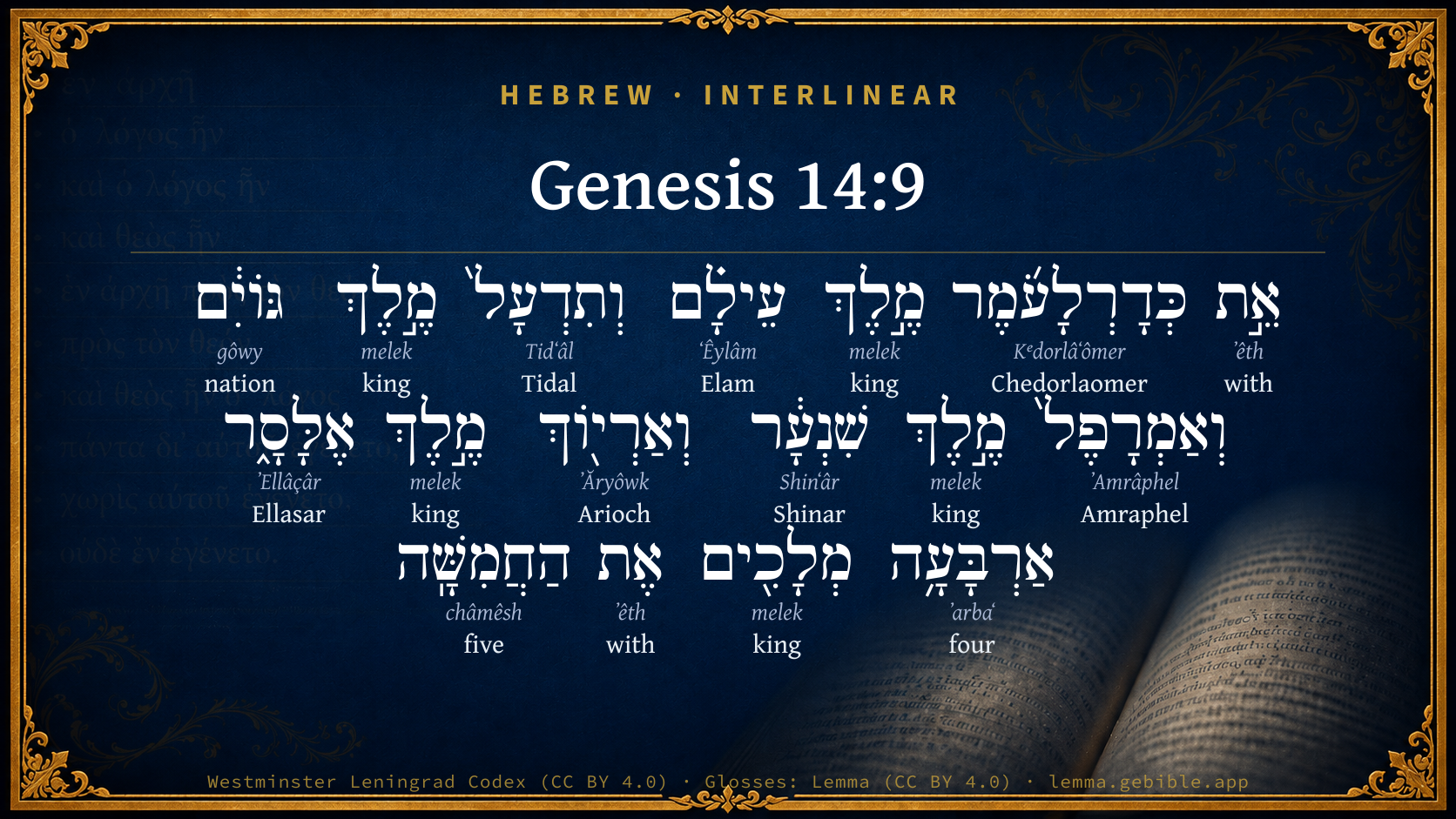
Hebrew (Westminster Leningrad Codex) Genesis 14:9 appears in the Hebrew Old Testament. The text above is from the Westminster Leningrad Codex. Each word links to its Strong’s number, a concise gloss, and parsing drawn from the Open Scriptures Hebrew Bible morphology. Click any word for its full Brown-Driver-Briggs (BDB) entry.
Download image
Cite this verse

Genesis 14:9 (World English Bible). Public Domain. Lemma interlinear Bible study tool, https://lemma.gebible.app/v/genesis/14/9.

Show BibTeX & RIS
BibTeX
RIS
English Translation
against Chedorlaomer king of Elam, and Tidal king of Goiim, and Amraphel king of Shinar, and Arioch king of Ellasar; four kings against the five.
World English Bible · Public Domain
Download a study sheet

One document with this verse’s original text, its word-by-word gloss line, the meaning frame, cross-references with their text, attributed commentary, and full source and license credits — printable, and it pastes into notes with its structure intact.

This verse Autodidact and up

Study sheet (.html) Plain text (.txt)

A passage Seminary Student

Up to 50 verses in one chapter. A passage sheet keeps up to 6 commentary sources and 12 cross-references per verse, in the order this page ranks them, and says so on the sheet whenever that leaves anything out. Ask for a single verse and you get the Autodidact verse sheet above.

Everything on this page stays free to read, with no account — the sheet is a download of what is already on screen, not access to it.

Want to remove ads? Support Godless Engineer
Compare translations 3

The same verse in 3 English versions, stacked beneath the original-language interlinear above. Click any original word for its lexicon entry.

Each is an independent rendering of the whole verse — the interlinear is not word-aligned to these translations.

Highlighted words mark where these versions differ — a whole-verse word diff, not a word-by-word alignment.

  • World English Bible Public Domain
    against Chedorlaomer king of Elam, and Tidal king of Goiim, and Amraphel king of Shinar, and Arioch king of Ellasar; four kings against the five.
  • King James Version Public Domain
    With Chedorlaomer the king of Elam, and with Tidal king of nations, and Amraphel king of Shinar, and Arioch king of Ellasar; four kings with five.
  • unfoldingWord Literal Text CC BY-SA 4.0
    against Chedorlaomer king of Elam, and Tidal king of Goiim, and Amraphel king of Shinar, and Arioch king of Ellasar, four kings against the five.

unfoldingWord Literal Text — © unfoldingWord, licensed CC BY-SA 4.0. Word-aligned USFM3 via Door43 (git.door43.org/unfoldingWord/en_ult).

Versions to compare (up to 4)

3 of 4 selected

Show all 18 translations

Every available English version of this verse, each an independent rendering of the whole verse.

  • World English Bible Public Domain
    against Chedorlaomer king of Elam, and Tidal king of Goiim, and Amraphel king of Shinar, and Arioch king of Ellasar; four kings against the five.
  • Berean Standard Bible Public Domain
    against Chedorlaomer king of Elam, Tidal king of Goiim, Amraphel king of Shinar, and Arioch king of Ellasar—four kings against five.
  • Majority Standard Bible Public Domain
    against Chedorlaomer king of Elam, Tidal king of Goiim, Amraphel king of Shinar, and Arioch king of Ellasar—four kings against five.
  • King James Version Public Domain
    With Chedorlaomer the king of Elam, and with Tidal king of nations, and Amraphel king of Shinar, and Arioch king of Ellasar; four kings with five.
  • American Standard Version (1901) Public Domain
    against Chedorlaomer king of Elam, and Tidal king of Goiim, and Amraphel king of Shinar, and Arioch king of Ellasar; four kings against the five.
  • Revised Version (1885) Public Domain
    against Chedorlaomer king of Elam, and Tidal king of Goiim, and Amraphel king of Shinar, and Arioch king of Ellasar; four kings against the five.
  • Geneva Bible (1599) Public Domain
    To wit, with Chedor-laomer king of Elam, and Tidal king of nations, and Amraphel king of Shinar, and Arioch king of Ellasar: foure Kings against fiue.
  • Douay-Rheims (1899) Public Domain
    To wit, against Chodorlahomor king of the Elamites, and Thadal king of nations, and Amraphel king of Sennaar, and Arioch king of Pontus: four kings against five.
  • Young's Literal Translation Public Domain
    with Chedorlaomer king of Elam, and Tidal king of Goyim, and Amraphel king of Shinar, and Arioch king of Ellasar; four kings with the five.
  • Literal Standard Version CC BY-SA 4.0
    with Chedorlaomer king of Elam, and Tidal king of nations, and Amraphel king of Shinar, and Arioch king of Ellasar; four kings with the five.
  • Unlocked Literal Bible CC BY-SA 4.0
    against Kedorlaomer, king of Elam, Tidal, king of Goiim, Amraphel, king of Shinar, Arioch, king of Ellasar; four kings against the five.
  • unfoldingWord Literal Text CC BY-SA 4.0
    against Chedorlaomer king of Elam, and Tidal king of Goiim, and Amraphel king of Shinar, and Arioch king of Ellasar, four kings against the five.
  • Darby Bible Public Domain
    with Chedorlaomer the king of Elam, and Tidal the king of nations, and Amraphel the king of Shinar, and Arioch the king of Ellasar -- four kings with the five.
  • World Messianic Bible Public Domain
    against Chedorlaomer king of Elam, Tidal king of Goiim, Amraphel king of Shinar, and Arioch king of Ellasar; four kings against the five.
  • Webster's Bible Public Domain
    With Chedorlaomer the king of Elam, and with Tidal king of nations, and Amraphel king of Shinar, and Arioch king of Ellasar; four kings with five.
  • Free Bible Version CC BY-SA 4.0
    They fought Chedorlaomer, king of Elam, Tidal, king of Goiim, Amraphel, king of Shinar, and Arioch, king of Ellasar—four kings on one side against five on the other.
  • Bible in Basic English Public Domain
    Against Chedorlaomer, king of Elam, and Tidal, king of Goiim, and Amraphel, king of Shinar, and Arioch, king of Ellasar: four kings against the five.
  • JPS Tanakh (1917) Public Domain
    against Chedorlaomer king of Elam, and Tidal king of Goiim, and Amraphel king of Shinar, and Arioch king of Ellasar; four kings against the five.

Literal Standard Version (2020), Covenant Press — licensed CC BY-SA 4.0. Text via the HelloAO Bible API (eBible.org). Unlocked Literal Bible (unfoldingWord) — licensed CC BY-SA 4.0. Text via the HelloAO Bible API (eBible.org). unfoldingWord Literal Text — © unfoldingWord, licensed CC BY-SA 4.0. Word-aligned USFM3 via Door43 (git.door43.org/unfoldingWord/en_ult). Free Bible Version, Dr. Jonathan Gallagher — licensed CC BY-SA 4.0. Text via the HelloAO Bible API (eBible.org).

Word by word

More ways to search: Search by grammar → Find every occurrence → Compare this word →

Practice this passage: Drill this verse → Learn its vocabulary →

וְתִדְעָל֙
Tidʻâl
H8413
“and · Tidal”
Conjunction + Noun, Proper
Part of Speech
Conjunction + Noun
Type
Proper
Full BDB Definition

Origin: perhaps from H1763

TWOT: None

Tidal = "great son" - chief of various nomadic tribes and an ally of Chedorlaomer
  1. אֵ֣ת ʼêth H854 “with” Preposition
  2. כְּדָרְלָעֹ֜מֶר Kᵉdorlâʻômer H3540 “Chedorlaomer” Noun, Proper
  3. מֶ֣לֶךְ melek H4428 “king of” Noun, Common, Masculine, Singular, Construct
  4. עֵילָ֗ם ʻÊylâm H5867 “Elam” Noun, Proper
  5. מֶ֣לֶךְ melek H4428 “king of” Noun, Common, Masculine, Singular, Construct
  6. גּוֹיִ֔ם gôwy H1471 “nation” Noun, Proper
  7. וְאַמְרָפֶל֙ ʼAmrâphel H569 “and · Amraphel” Conjunction + Noun, Proper
  8. מֶ֣לֶךְ melek H4428 “king of” Noun, Common, Masculine, Singular, Construct
  9. שִׁנְעָ֔ר Shinʻâr H8152 “Shinar” Noun, Proper
  10. וְאַרְי֖וֹךְ ʼĂryôwk H746 “and · Arioch” Conjunction + Noun, Proper
  11. מֶ֣לֶךְ melek H4428 “king of” Noun, Common, Masculine, Singular, Construct
  12. אֶלָּסָ֑ר ʼEllâçâr H495 “Ellasar” Noun, Proper
  13. אַרְבָּעָ֥ה ʼarbaʻ H702 “four” Adjective, Cardinal number, Masculine, Singular, Absolute
  14. מְלָכִ֖ים melek H4428 “kings” Noun, Common, Masculine, Plural, Absolute
  15. אֶת ʼêth H854 “with” Preposition
  16. הַחֲמִשָּֽׁה châmêsh H2568 “the · five” Particle, Definite Article + Adjective, Cardinal number, Masculine, Singular, Absolute

About this verse

These counts appear in no published source. They are computed here, from the morphology-tagged text and Lemma’s own curated glosses. What Lemma adds →

17
words
12
distinct lemmas
Pentateuch
section

Notable vocabulary

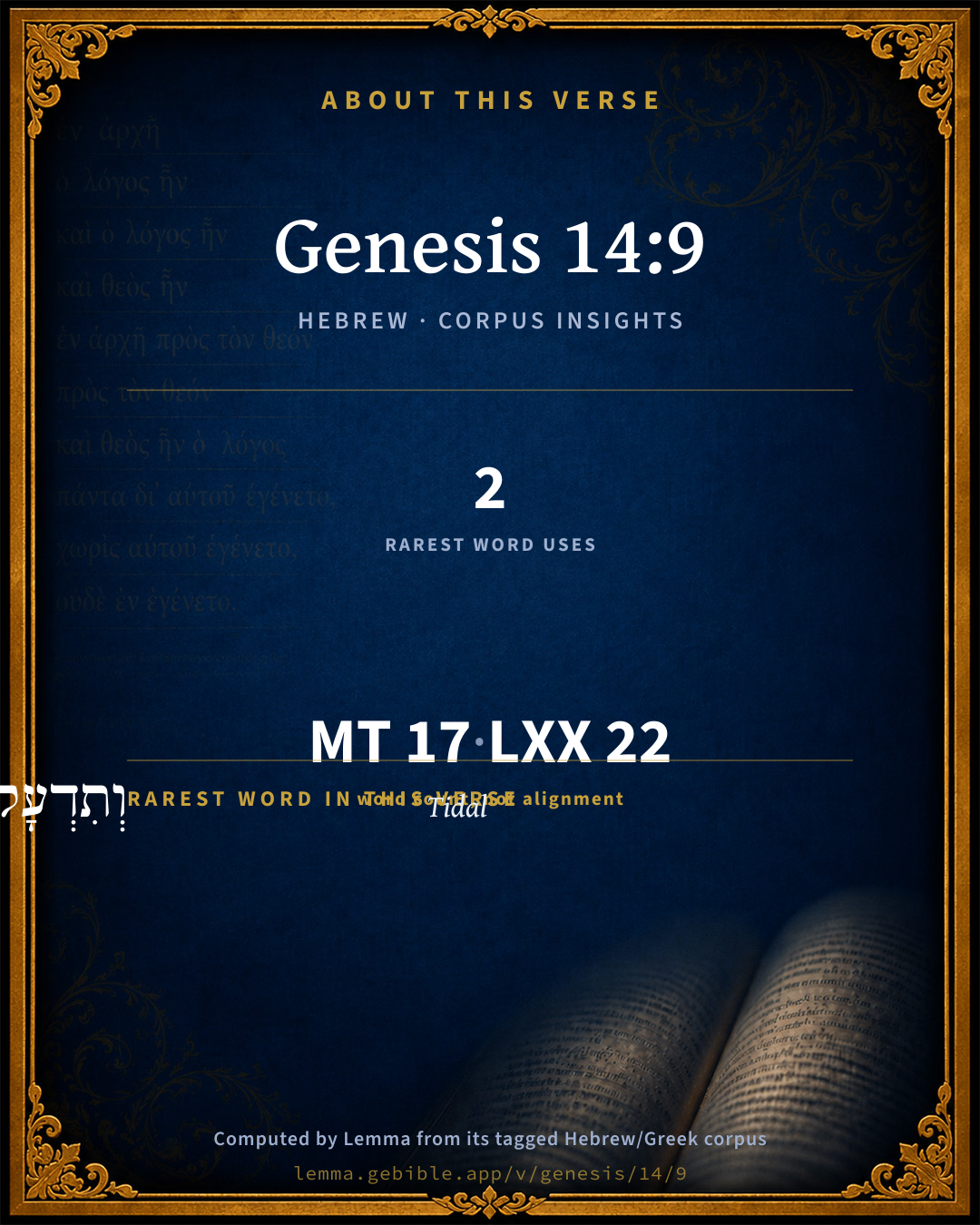
The rarest word here is וְתִדְעָל֙ Tidal H8413 — appearing just 2 times in the whole Hebrew Bible.

Shared distinctive vocabulary

וְתִדְעָל֙ Tidal H8413 occurs in 2 verses of the Hebrew Bible. Also found in:

Grammatical profile

  • 13 nouns
  • 2 adjectives
  • 2 prepositions

Repetition

Words recur within this verse — often emphatic in Hebrew:

  • מֶ֣לֶךְ king H4428 ×5
  • אֵ֣ת with H854 ×2

Hebrew & Septuagint length

In English translation the verse runs 25 words from the Hebrew and 26 from the Septuagint (LXX English) — closely comparable.

A rough comparison of the two English renderings, which tokenize alike — not a word-level alignment.

Word counts can differ between the Hebrew and the Greek without any difference in meaning — e.g. the Hebrew direct-object marker אֵת has no separate Greek word, and Greek often adds the article ὁ.

In the original languages it is 17 Hebrew tokens and 22 Greek tokens — but the two are counted differently (Hebrew bundles its prefixes and suffixes into one token; the Greek is in lemma form), so that isn’t a like-for-like length.

Hebrew and Greek witnesses Masoretic Hebrew ↔ Greek Septuagint

The same verse in the two great witnesses to the Old Testament, shown verse-for-verse.

These are two independent witnesses, not word-aligned to each other, and the Septuagint is shown in lemma (dictionary) form.

Hebrew Genesis 14:9 Masoretic · Westminster Leningrad Codex

אֵ֣ת כְּדָרְלָעֹ֜מֶר מֶ֣לֶךְ עֵילָ֗ם וְתִדְעָל֙ מֶ֣לֶךְ גּוֹיִ֔ם וְאַמְרָפֶל֙ מֶ֣לֶךְ שִׁנְעָ֔ר וְאַרְי֖וֹךְ מֶ֣לֶךְ אֶלָּסָ֑ר אַרְבָּעָ֥ה מְלָכִ֖ים אֶת הַחֲמִשָּֽׁה

against Chedorlaomer king of Elam, and Tidal king of Goiim, and Amraphel king of Shinar, and Arioch king of Ellasar; four kings against the five.

World English Bible · Public Domain

Greek LXX Genesis 14:9 Septuagint · lemma form

πρός χοδολλογομορ βασιλεύς αιλαμ καί θαργαλ βασιλεύς ἔθνος καί αμαρφαλ βασιλεύς σεννααρ καί αριωχ βασιλεύς ελλασαρ ὁ τέσσαρες βασιλεύς πρός ὁ πέντε

against Chodollogomor king of Elam, and Thargal king of nations, and Amarphal king of Sennaar, and Arioch king of Ellasar, the four kings against the five.

LXX2012 (modern English Septuagint) · Public Domain

Hebrew: Westminster Leningrad Codex (CC BY 4.0). Greek: Septuagint (public domain); English from LXX2012 (modern English Septuagint) (Public Domain). How the Septuagint differs from the Hebrew →

Targum (Aramaic paraphrase)

2

The Targum is the ancient Jewish Aramaic paraphrase of the Hebrew Scriptures — an interpretive translation, not the Hebrew text itself. Onkelos (literal) and Pseudo-Jonathan (expansive) render the Torah, and Jonathan the Prophets. Coverage is partial: where no permissively-licensed English translation exists for a verse, only the Aramaic is shown. This is verse-level text, not a word-by-word alignment to the Hebrew.

  1. Targum Onkelos Torah (Genesis–Deuteronomy)
    עִם כְּדָרְלָעֹמֶר מַלְכָּא דְעֵילָם וְתִדְעָל מַלְכָּא דְעַמְמִין וְאַמְרָפֶל מַלְכָּא דְבָבֶל וְאַרְיוֹךְ מַלְכָּא דְאֶלָסָר אַרְבְּעָה מַלְכִין לָקֳבֵיל חַמְשָׁא

    with Kedar‑laomer king of Elam, and Thidal, king of peoples, and Amraphel, king of Babel, and Ariok, king of Elasar; four kings against five.

    Targum Onkelos — Aramaic: “Onkelos Genesis” (public domain); “Onkelos Exodus” (public domain); “Onkelos Leviticus” (public domain); “Onkelos Numbers” (public domain); “Onkelos Deuteronomy” (public domain). English: “Sefaria Community Translation” (CC0 1.0 (public-domain dedication)); “J.W. Etheridge. The Targums of Onkelos and Jonathan Ben Uzziel on the Pentateuch. London: Longmans, Green, 1862” (public domain). Text via Sefaria.

  2. Targum Pseudo-Jonathan Torah (Genesis–Deuteronomy)
    עִם כְּדָרְלָעוֹמֶר מַלְכָּא דְעֵילָם וְתִידְעָל מַלְכָּא דְעַמְמַיָא מִשְׁתַּמְעִין לֵיהּ וְאַמְרָפֶל מַלְכָּא דְפוּנְטוֹס וְאַרְיוֹךְ מַלְכָּא דִתְלָסַר אַרְבַּעַת מַלְכִין סַדָרוּ קְרָבָא לִקְבֵיל חַמְשָׁא

    with Kedarlaomer king of Elam, and Thidal king of the nations obedient to him, and Amraphel king of Pontos, and Ariok king of Thelasar; four kings arrayed in battle against five.

    Targum Pseudo-Jonathan — Aramaic: “Targum Jonathan on Genesis” (public domain); “Targum Jonathan on Exodus” (public domain); “Targum Jonathan on Leviticus” (public domain); “Targum Jonathan on Numbers” (public domain); “Targum Jonathan on Deuteronomy” (public domain). English: “The Targum of Jonathan ben Uzziel, trans. J. W. Etheridge, London, 1862” (public domain). Text via Sefaria.

Commentary

Notes on Genesis 14:9 from classic Christian and Jewish commentators (each source and its license shown beneath its notes). The classic Christian expositions comment on the surrounding passage and are grouped to its opening verse, so a note may address several verses; the Jewish commentaries on the Tanakh (Rashi and others) are per-verse, so they appear only where the commentator wrote on this verse.

Lemma curates 59 commentaries, every one of them public domain or Creative Commons licensed, each selected and text-cleaned for this edition rather than reprinted as found. About our sources →

Trapp's Complete Commentary

John Trapp

Gen 14:9 With Chedorlaomer the king of Elam, and with Tidal king of nations, and Amraphel king of Shinar, and Arioch king of Ellasar; four kings with five.

Ver. 9. Four kings with five.] These five were but free princes of cities, petty kings, such as we had here of old in this island; which is therefore said, by Jerome, to be tyrannorum fertilis , fertile of tyrants.

John Trapp, A Commentary or Exposition upon All the Books of the Old and New Testament (1647–1656) — public domain. Text from a community e-Sword module.

The Cambridge Bible for Schools and Colleges

gen. ed. J. J. S. Perowne

9. four kings against the five] After Gen_14:8 we should expect the “five kings against the four.” Notice the impressive repetition of the names of the kings, and the variation in the order of the names or the eastern kings, Chedorlaomer coming first, as the over-lord against whom the rebellion had been made.

The description of the battle itself has most unfortunately not been preserved.

The Cambridge Bible for Schools and Colleges (gen. ed. J. J. S. Perowne; Cambridge University Press, 1878–1918) — public domain. Text from a community e-Sword module.

John Gill's Exposition

With Chedorlaomer king of Elam,.... Who is here mentioned first, being the principal in the war, and against whom the kings of Sodom, &c. had rebelled:

and with Tidal king of nations, and Amraphel king of Shinar, and Arioch king of Ellasar; who were his allies, confederates, and auxiliaries:

four kings with five; those four last mentioned, with the other five before spoken of, that is, they fought with them; or rather four kings against five, as the Vulgate Latin and Tigurine versions, and some others.

John Gill's Exposition of the Whole Bible (1746–1763) — public domain (CC PDM 1.0). Text via the HelloAO Bible API.

Whedon's Commentary on the Bible

Daniel D. Whedon

9. Four kings with five — And the four, flushed with many victories and grown fierce by war, conquered the five. What were the weapons and what the modes of warfare used by these ancient kings we have no means of knowing. Their principal arms were probably the sword, the bow, and the spear.

Daniel D. Whedon (gen. ed.), Commentary on the Old and New Testaments (1874–1909) — public domain. Text from a community e-Sword module.

Rashi

Rabbi Shlomo Yitzchaki (Rashi)

'ארבעה מלכים וגו FOUR KINGS [AGAINST THE FIVE]— and yet the fewer were victorious; this statement is expressly made to tell you how powerful they were, and yet Abraham did not refrain from pursuing them.

Rashi on the Tanakh — English translations: “The Judaica Press complete Tanach with Rashi, translated by A. J. Rosenberg” (CC BY 4.0); “Pentateuch with Rashi's commentary by M. Rosenbaum and A.M. Silbermann, 1929-1934” (public domain); “The Metsudah Tanach series, Lakewood, N.J” (CC BY 4.0); and “The Book of Joshua, Metsudah Publications, 1997” (CC BY 4.0). Text via Sefaria.

Lesson kit

Teaching starters — assembled from the data on this page, not authored interpretation. Every prompt links to the verse data it draws on. Edit before teaching.

Genesis, in the Pentateuch, opens this verse with 17 words (12 distinct Hebrew lemmas). Its most distinctive word is Tidʻâl (“Tidal”). A historical commentator’s framing appears above. Read the whole chapter for the surrounding context.

Discussion questions

  1. The word Tidʻâl carries the sense “Tidal.” How does it shape the verse?
  2. Genesis 14:1 shares the word «Tidal» with this verse. How do the two illuminate each other?
  3. “king” occurs 5× in this one verse. What is the effect of the repetition?
  4. These translations render this verse differently; the difference is in the English rendering, not the original. What questions does that raise?
  5. Reading how Trapp's Complete Commentary and The Cambridge Bible for Schools and Colleges read this verse, where do the two commentators agree and where do they part?

Things to notice

Reading settings

Reading text

Shown beneath each verse's original-language words.

Old Testament
Old Testament edition

Read the OT as the Masoretic Hebrew (MT) or the Greek Septuagint (LXX).

English shown for the Greek Septuagint (in the Hebrew ↔ Greek comparison).

Comparing translations? Open the Compare panel on any verse page to stack up to four side by side.