Judges 2:23

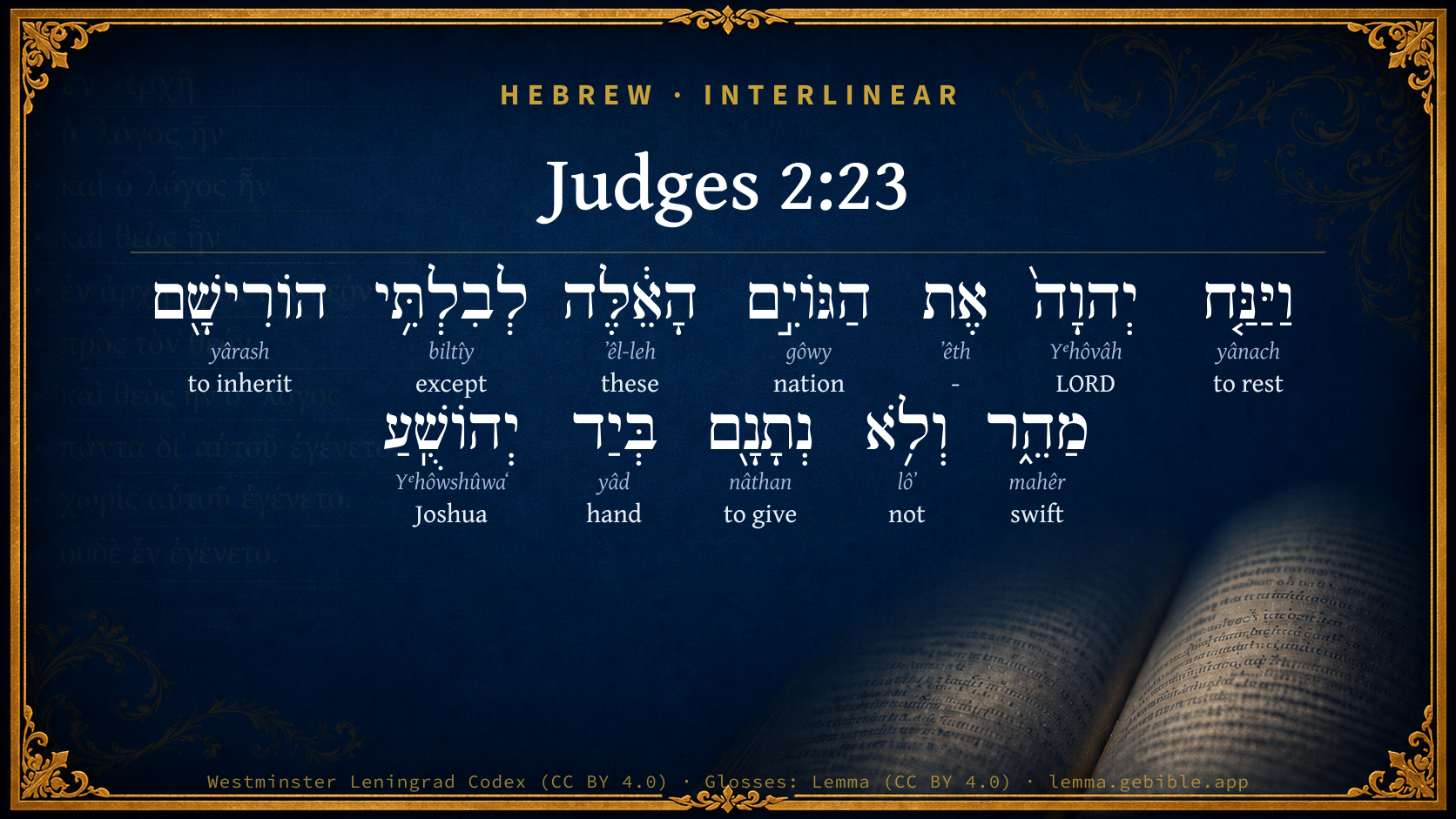
Hebrew (Westminster Leningrad Codex) Judges 2:23 appears in the Hebrew Old Testament. The text above is from the Westminster Leningrad Codex. Each word links to its Strong’s number, a concise gloss, and parsing drawn from the Open Scriptures Hebrew Bible morphology. Click any word for its full Brown-Driver-Briggs (BDB) entry.
Download image
Cite this verse

Judges 2:23 (World English Bible). Public Domain. Lemma interlinear Bible study tool, https://lemma.gebible.app/v/judges/2/23.

Show BibTeX & RIS
BibTeX
RIS
English Translation
So Yahweh left those nations, without driving them out hastily; neither delivered he them into the hand of Joshua.
World English Bible · Public Domain
Download a study sheet

One document with this verse’s original text, its word-by-word gloss line, the meaning frame, cross-references with their text, attributed commentary, and full source and license credits — printable, and it pastes into notes with its structure intact.

This verse Autodidact and up

Study sheet (.html) Plain text (.txt)

A passage Seminary Student

Up to 50 verses in one chapter. A passage sheet keeps up to 6 commentary sources and 12 cross-references per verse, in the order this page ranks them, and says so on the sheet whenever that leaves anything out. Ask for a single verse and you get the Autodidact verse sheet above.

Everything on this page stays free to read, with no account — the sheet is a download of what is already on screen, not access to it.

Want to remove ads? Support Godless Engineer
Compare translations 3

The same verse in 3 English versions, stacked beneath the original-language interlinear above. Click any original word for its lexicon entry.

Each is an independent rendering of the whole verse — the interlinear is not word-aligned to these translations.

Highlighted words mark where these versions differ — a whole-verse word diff, not a word-by-word alignment.

  • World English Bible Public Domain
    So Yahweh left those nations, without driving them out hastily; neither delivered he them into the hand of Joshua.
  • King James Version Public Domain
    Therefore the LORD left those nations, without driving them out hastily; neither delivered he them into the hand of Joshua.
  • unfoldingWord Literal Text CC BY-SA 4.0
    So Yahweh left those nations, so as not to dispossess them quickly, and he did not give them into the hand of Joshua.

unfoldingWord Literal Text — © unfoldingWord, licensed CC BY-SA 4.0. Word-aligned USFM3 via Door43 (git.door43.org/unfoldingWord/en_ult).

Versions to compare (up to 4)

3 of 4 selected

Show all 17 translations

Every available English version of this verse, each an independent rendering of the whole verse.

  • World English Bible Public Domain
    So Yahweh left those nations, without driving them out hastily; neither delivered he them into the hand of Joshua.
  • Berean Standard Bible Public Domain
    That is why the LORD had left those nations in place and had not driven them out immediately by delivering them into the hand of Joshua.
  • Majority Standard Bible Public Domain
    That is why the LORD had left those nations in place and had not driven them out immediately by delivering them into the hand of Joshua.
  • King James Version Public Domain
    Therefore the LORD left those nations, without driving them out hastily; neither delivered he them into the hand of Joshua.
  • American Standard Version (1901) Public Domain
    So Jehovah left those nations, without driving them out hastily; neither delivered he them into the hand of Joshua.
  • Revised Version (1885) Public Domain
    So the LORD left those nations, without driving them out hastily; neither delivered he them into the hand of Joshua.
  • Geneva Bible (1599) Public Domain
    So the Lord left those nations, and droue them not out immediatly, neither deliuered them into the hand of Ioshua.
  • Young's Literal Translation Public Domain
    And Jehovah leaveth these nations, so as not to dispossess them hastily, and did not give them into the hand of Joshua.
  • Literal Standard Version CC BY-SA 4.0
    And YHWH leaves these nations, so as not to dispossess them quickly, and did not give them into the hand of Joshua.
  • Unlocked Literal Bible CC BY-SA 4.0
    That is why Yahweh left those nations and did not drive them out quickly and give them into the hand of Joshua.
  • unfoldingWord Literal Text CC BY-SA 4.0
    So Yahweh left those nations, so as not to dispossess them quickly, and he did not give them into the hand of Joshua.
  • Darby Bible Public Domain
    So the LORD left those nations, not driving them out at once, and he did not give them into the power of Joshua.
  • World Messianic Bible Public Domain
    So the LORD left those nations, without driving them out hastily. He didn’t deliver them into Joshua’s hand.
  • Webster's Bible Public Domain
    Therefore the LORD left those nations, without driving them out speedily, neither did he deliver them into the hand of Joshua.
  • Free Bible Version CC BY-SA 4.0
    This is the reason why the Lord allowed those nations to remain, and didn't immediately drive them out by handing them over to Joshua.
  • Bible in Basic English Public Domain
    So the Lord let those nations go on living in the land, not driving them out quickly, and did not give them up into the hands of Joshua.
  • JPS Tanakh (1917) Public Domain
    So the LORD left those nations, without driving them out hastily; neither delivered He them into the hand of Joshua.

Literal Standard Version (2020), Covenant Press — licensed CC BY-SA 4.0. Text via the HelloAO Bible API (eBible.org). Unlocked Literal Bible (unfoldingWord) — licensed CC BY-SA 4.0. Text via the HelloAO Bible API (eBible.org). unfoldingWord Literal Text — © unfoldingWord, licensed CC BY-SA 4.0. Word-aligned USFM3 via Door43 (git.door43.org/unfoldingWord/en_ult). Free Bible Version, Dr. Jonathan Gallagher — licensed CC BY-SA 4.0. Text via the HelloAO Bible API (eBible.org).

Word by word

More ways to search: Search by grammar → Find every occurrence → Compare this word →

Practice this passage: Drill this verse → Learn its vocabulary →

מַהֵ֑ר
mahêr
H4118
“swift”
Verb, Piel, Infinitive Absolute
Part of Speech
Verb
Stem
Piel
Form
Infinitive Absolute
Full BDB Definition

Origin: from H4116

TWOT: 1152a , 1152b

hurrying, speedy, swift, hastening (adjective) - quickly, speedily (adverb)
  1. וַיַּנַּ֤ח yânach H3240 “and · to rest” Conjunction + Verb, Hiphil, Sequential Imperfect, 3rd Person, Masculine, Singular
  2. יְהוָה֙ Yᵉhôvâh H3068 “LORD” Noun, Proper
  3. אֶת ʼêth H853 “-” Particle, Direct Object
  4. הַגּוֹיִ֣ם gôwy H1471 “the · nations” Particle, Definite Article + Noun, Common, Masculine, Plural, Absolute
  5. הָאֵ֔לֶּה ʼêl-leh H428 “the · these” Particle, Definite Article + Pronoun, Demonstrative, Common, Plural
  6. לְבִלְתִּ֥י biltîy H1115 “to/for · except” Preposition + Conjunction
  7. הוֹרִישָׁ֖ם yârash H3423 “to inherit · them” Verb, Hiphil, Infinitive Construct + Suffix, Personal, 3rd Person, Masculine, Plural
  8. וְלֹ֥א lôʼ H3808 “and · not” Conjunction + Particle, Negative
  9. נְתָנָ֖ם nâthan H5414 “to give · them” Verb, Qal, Perfect, 3rd Person, Masculine, Singular + Suffix, Personal, 3rd Person, Masculine, Plural
  10. בְּיַד yâd H3027 “in/at · hand of” Preposition + Noun, Common, Both, Singular, Construct
  11. יְהוֹשֻֽׁעַ Yᵉhôwshûwaʻ H3091 “Joshua” Noun, Proper

About this verse

These counts appear in no published source. They are computed here, from the morphology-tagged text and Lemma’s own curated glosses. What Lemma adds →

12
words
12
distinct lemmas
Historical
section

Notable vocabulary

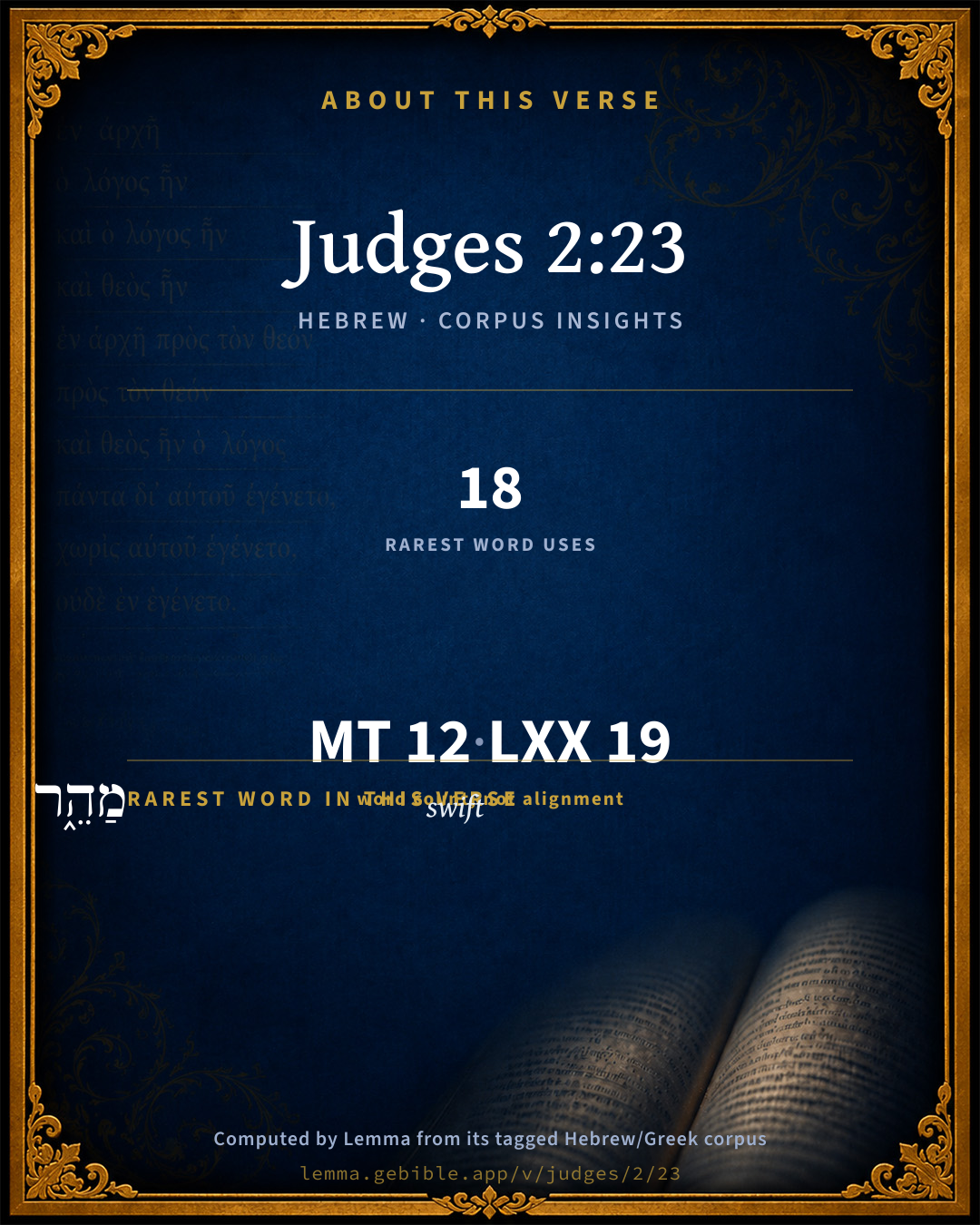
The rarest word here is מַהֵ֑ר swift H4118 — appearing just 18 times in the whole Hebrew Bible.

Shared distinctive vocabulary

מַהֵ֑ר swift H4118 occurs in 17 verses of the Hebrew Bible. Also found in:

Grammatical profile

  • 4 verbs
  • 4 nouns
  • 1 pronoun
  • 1 conjunction
  • 2 particles

Verb forms

  • וַיַּנַּ֤ח Hiphil · Sequential Imperfect
  • הוֹרִישָׁ֖ם Hiphil · Infinitive Construct
  • מַהֵ֑ר Piel · Infinitive Absolute
  • נְתָנָ֖ם Qal · Perfect

Hebrew & Septuagint length

In English translation the verse runs 19 words from the Hebrew and 25 from the Septuagint (LXX English) — closely comparable.

A rough comparison of the two English renderings, which tokenize alike — not a word-level alignment.

Word counts can differ between the Hebrew and the Greek without any difference in meaning — e.g. the Hebrew direct-object marker אֵת has no separate Greek word, and Greek often adds the article ὁ.

In the original languages it is 12 Hebrew tokens and 19 Greek tokens — but the two are counted differently (Hebrew bundles its prefixes and suffixes into one token; the Greek is in lemma form), so that isn’t a like-for-like length.

Hebrew and Greek witnesses Masoretic Hebrew ↔ Greek Septuagint

The same verse in the two great witnesses to the Old Testament, shown verse-for-verse.

These are two independent witnesses, not word-aligned to each other, and the Septuagint is shown in lemma (dictionary) form.

Hebrew Judges 2:23 Masoretic · Westminster Leningrad Codex

וַיַּנַּ֤ח יְהוָה֙ אֶת הַגּוֹיִ֣ם הָאֵ֔לֶּה לְבִלְתִּ֥י הוֹרִישָׁ֖ם מַהֵ֑ר וְלֹ֥א נְתָנָ֖ם בְּיַד יְהוֹשֻֽׁעַ

So Yahweh left those nations, without driving them out hastily; neither delivered he them into the hand of Joshua.

World English Bible · Public Domain

Greek LXX Judges 2:23 Septuagint · lemma form

καί ἀποἵημι κύριος ὁ ἔθνος οὗτος ὁ μή ἐκαἴρω αὐτός ὁ τάχος καί οὐ παραδίδωμι αὐτός ἐν χείρ ἰησοῦς

So the Lord will leave these nations, so as not to cast them out suddenly; and he delivered them not into the hand of Joshua.

LXX2012 (modern English Septuagint) · Public Domain

Hebrew: Westminster Leningrad Codex (CC BY 4.0). Greek: Septuagint (public domain); English from LXX2012 (modern English Septuagint) (Public Domain). How the Septuagint differs from the Hebrew →

Targum (Aramaic paraphrase)

1

The Targum is the ancient Jewish Aramaic paraphrase of the Hebrew Scriptures — an interpretive translation, not the Hebrew text itself. Onkelos (literal) and Pseudo-Jonathan (expansive) render the Torah, and Jonathan the Prophets. Coverage is partial: where no permissively-licensed English translation exists for a verse, only the Aramaic is shown. This is verse-level text, not a word-by-word alignment to the Hebrew.

  1. Targum Jonathan Prophets (Joshua–Malachi)
    וּשְׁבַק יְיָ יַת כָּל עַמְמַיָא הָאִלֵין בְּדִיל דְלָא לְתָרָכוּתְהוֹן בִּפְרִיעַ וְלָא מַסְרִינוּן בִידָא דִיהוֹשֻׁעַ:

    (no public-domain English translation for this verse)

    Targum Jonathan — Aramaic: “Mikraot Gedolot” (public domain). English: “Sefaria Community Translation” (CC0 1.0 (public-domain dedication)); “London "Chaldee Paraphrase," 1871” (public domain). Text via Sefaria.

Commentary

Notes on Judges 2:23 from classic Christian and Jewish commentators (each source and its license shown beneath its notes). The classic Christian expositions comment on the surrounding passage and are grouped to its opening verse, so a note may address several verses; the Jewish commentaries on the Tanakh (Rashi and others) are per-verse, so they appear only where the commentator wrote on this verse.

Lemma curates 59 commentaries, every one of them public domain or Creative Commons licensed, each selected and text-cleaned for this edition rather than reprinted as found. About our sources →

The Cambridge Bible for Schools and Colleges

gen. ed. J. J. S. Perowne

23. Taking this verse as the conclusion of Jdg_2:20-22, the emphasis falls on hastily, i.e. during Joshua’s life-time; the nations were not destroyed all at once, because Jehovah wished to test the fidelity of the succeeding generations. But this adds little to the thought of Jdg_2:20-22; and the last half of the verse takes us back to Joshua’s life-time, whereas Jdg_2:7-8; Jdg_2:21 presuppose his death. The word left (not the word for left in Jdg_2:21) seems rather to connect with Jdg_3:1, and most critics regard Jdg_2:23 a as leading up to Jdg_3:1-3, where the nations are left to teach Israel the art of war. If this is the case, Jdg_2:23 a, like the nucleus of Jdg_3:1-3, will belong to J, and form the close of ch. 1; these nations (not the nations in Jdg_3:3) will then mean the nations alluded to in ch. 1. The last part of the verse is a harmonizing gloss.

The Cambridge Bible for Schools and Colleges (gen. ed. J. J. S. Perowne; Cambridge University Press, 1878–1918) — public domain. Text from a community e-Sword module.

Trapp's Complete Commentary

John Trapp

Jdg 2:23 Therefore the LORD left those nations, without driving them out hastily; neither delivered he them into the hand of Joshua.

Ver. 23. Therefore the Lord left those nations.] Those mentioned in the beginning of the next chapter.

John Trapp, A Commentary or Exposition upon All the Books of the Old and New Testament (1647–1656) — public domain. Text from a community e-Sword module.

Adam Clarke's Commentary

Verse 23. Without driving them out hastily] Had God expelled all the ancient inhabitants at once, we plainly see, from the subsequent conduct of the people, that they would soon have abandoned his worship, and in their prosperity forgotten their deliverer. He drove out at first as many as were necessary in order to afford the people, as they were then, a sufficiency of room to settle in; as the tribes increased in population, they were to extend themselves to the uttermost of their assigned borders, and expel all the remaining inhabitants. On these accounts God did not expel the aboriginal inhabitants hastily or at once; and thus gave the Israelites time to increase; and by continuing the ancient inhabitants, prevented the land from running into waste, and the wild beasts from multiplying; both of which must have infallibly taken place had God driven out all the old inhabitants at once, before the Israelites were sufficiently numerous to occupy the whole of the land.

THESE observations are important, as they contain the reason why God did not expel the Canaanites. God gave the Israelites a grant of the whole land, and promised to drive out their enemies from before them if they continued faithful. While they continued faithful, God did continue to fulfil his promise; their borders were enlarged, and their enemies fled before them. When they rebelled against the Lord, he abandoned them, and their enemies prevailed against them. Of this, their frequent lapses and miscarriages, with God's repeated interpositions in their behalf, are ample evidence. One or two solitary instances might not be considered as sufficient proof; but by these numerous instances the fact is established. Each rebellion against God produced a consequent disaster in their affairs; each true humiliation was invariably followed by an especial Divine interposition in their behalf. These afforded continual proof of God's being, providence, and grace. The whole economy is wondrous; and its effects, impressive and convincing. The people were not hastily put in possession of the promised land, because of their infidelity. Can the infidels controvert this statement? If not then their argument against Divine revelation, from "the failure of positive promises and oaths," falls to the ground. They have not only in this, but in all other respects, lost all their props.

"Helpless and prostrate all their system lies

Cursing its fate, and, as it curses, dies."

Adam Clarke's Commentary on the Bible (1810–1826) — public domain. Text from a community e-Sword/MySword module.

John Gill's Exposition

Therefore the Lord left these nations, without driving them out hastily,.... Left them unsubdued, or suffered them to continue among the Israelites, and did not drive them out as he could have done; which was permitted, either that it might be seen and known whether Israel would give into the idolatry of these nations or not, Jdg 2:22; of which there could have been no trial, if they and their idols had been utterly destroyed; or because the children of Israel had transgressed the covenant of the Lord, therefore he would drive no more of them out, but leave them to afflict and distress them, and thereby prove and try them, Jdg 2:20; both senses may very well stand, but the former seems rather to agree with what follows:

neither delivered he them into the hand of Joshua; having an end to be answered by them, before suggested, namely, to prove and try Israel; and, for a like reason, the indwelling sin and corruptions of God's people are suffered to remain in them, for the trial of their graces, and that the power of God in the support and deliverance of them might appear the more manifest.

Next: Judges Chapter 3

John Gill's Exposition of the Whole Bible (1746–1763) — public domain (CC PDM 1.0). Text via the HelloAO Bible API.

Matthew Poole's English Annotations

Hastily, or speedily; when the Israelites desired it and needed it.

Matthew Poole's English Annotations on the Holy Bible (1683–1685) — public domain. Text from a community e-Sword/MySword module.

Whedon's Commentary on the Bible

Daniel D. Whedon

23. Therefore — In Deu_7:22, another reason is assigned for leaving the Canaanites in the land, namely, “lest the beasts of the field increase upon thee.” But that passage contemplates the destruction of the idolaters, “little by little,” through an uncompromising aggression upon them, while in this the Israelites are rebuked and punished for giving up the contest as hopeless, and for making covenants with those whom God had doomed to a gradual extermination.

Daniel D. Whedon (gen. ed.), Commentary on the Old and New Testaments (1874–1909) — public domain. Text from a community e-Sword module.

Keil & Delitzsch

C. F. Keil & F. Delitzsch

In consequence of this resolution, the Lord let these tribes (those mentioned in Jdg 3:3) remain at rest, i.e., quietly, in the land, without exterminating them rapidly. The expression מהר, hastily, quickly, i.e., according to the distinct words of the following clause, through and under Joshua, appears strange after what has gone before. For what is threatened in Jdg 2:21 is not the suspension of rapid extermination, but of any further extermination. This threat, therefore, is so far limited by the word "hastily," as to signify that the Lord would not exterminate any more of these nations so long as Israel persisted in its idolatry. But as soon as and whenever Israel returned to the Lord its God in true repentance, to keep His covenant, the Lord would recall His threat, and let the promised extermination of the Canaanites go forward again. Had Israel not forsaken the Lord its God so soon after Joshua's death, the Lord would have exterminated the Canaanites who were left in the land much sooner than He did, or have carried out their gradual extermination in a much shorter time than was actually the case, in consequence of the continual idolatry of the people.

Keil & Delitzsch — Biblical Commentary on the Old Testament (1861–1891) — public domain (CC PDM 1.0). Text via the HelloAO Bible API. (Old Testament only.)

Lesson kit

Teaching starters — assembled from the data on this page, not authored interpretation. Every prompt links to the verse data it draws on. Edit before teaching.

Judges, in the Historical, opens this verse with 12 words (12 distinct Hebrew lemmas). Its most distinctive word is mahêr (“swift”). A historical commentator’s framing appears above. Read the whole chapter for the surrounding context.

Discussion questions

  1. How does “swift” (mahêr) shape what this verse is saying?
  2. How does Exodus 32:8, which shares the word «swift», read alongside this verse?
  3. The translations on this page render this verse differently — a whole-verse word diff, not a word-by-word alignment. What might account for the different wordings?
  4. «וַיַּנַּ֤ח» is a Hiphil Sequential Imperfect verb. How does that grammatical form shape the action described?
  5. Compare how The Cambridge Bible for Schools and Colleges and Trapp's Complete Commentary read this verse. Where do they agree or differ?

Things to notice

Reading settings

Reading text

Shown beneath each verse's original-language words.

Old Testament
Old Testament edition

Read the OT as the Masoretic Hebrew (MT) or the Greek Septuagint (LXX).

English shown for the Greek Septuagint (in the Hebrew ↔ Greek comparison).

Comparing translations? Open the Compare panel on any verse page to stack up to four side by side.