
2 Chronicles 20:6

Hebrew (Westminster Leningrad Codex) 2 Chronicles 20:6 appears in the Hebrew Old Testament. The text above is from the Westminster Leningrad Codex. Each word links to its Strong’s number, a concise gloss, and parsing drawn from the Open Scriptures Hebrew Bible morphology. Click any word for its full Brown-Driver-Briggs (BDB) entry.
Download image
Cite this verse

2 Chronicles 20:6 (World English Bible). Public Domain. Lemma interlinear Bible study tool, https://lemma.gebible.app/v/2-chronicles/20/6.

Show BibTeX & RIS
BibTeX
RIS
English Translation
and he said, Yahweh, the God of our fathers, aren't you God in heaven? and aren't you ruler over all the kingdoms of the nations? and in your hand is power and might, so that none is able to withstand you.
World English Bible · Public Domain
Download a study sheet

One document with this verse’s original text, its word-by-word gloss line, the meaning frame, cross-references with their text, attributed commentary, and full source and license credits — printable, and it pastes into notes with its structure intact.

This verse Autodidact and up

Study sheet (.html) Plain text (.txt)

A passage Seminary Student

Up to 50 verses in one chapter. A passage sheet keeps up to 6 commentary sources and 12 cross-references per verse, in the order this page ranks them, and says so on the sheet whenever that leaves anything out. Ask for a single verse and you get the Autodidact verse sheet above.

Everything on this page stays free to read, with no account — the sheet is a download of what is already on screen, not access to it.

Want to remove ads? Support Godless Engineer
Compare translations 3

The same verse in 3 English versions, stacked beneath the original-language interlinear above. Click any original word for its lexicon entry.

Each is an independent rendering of the whole verse — the interlinear is not word-aligned to these translations.

Highlighted words mark where these versions differ — a whole-verse word diff, not a word-by-word alignment.

  • World English Bible Public Domain
    and he said, Yahweh, the God of our fathers, aren't you God in heaven? and aren't you ruler over all the kingdoms of the nations? and in your hand is power and might, so that none is able to withstand you.
  • King James Version Public Domain
    And said, O LORD God of our fathers, art not thou God in heaven? and rulest not thou over all the kingdoms of the heathen? and in thine hand is there not power and might, so that none is able to withstand thee?
  • unfoldingWord Literal Text CC BY-SA 4.0
    And he said, “Yahweh, the God of our fathers, are you not he, the God in the heavens? And you rule in all the kingdoms of the nations. And in your hand are power and might and none stands himself with you.

unfoldingWord Literal Text — © unfoldingWord, licensed CC BY-SA 4.0. Word-aligned USFM3 via Door43 (git.door43.org/unfoldingWord/en_ult).

Versions to compare (up to 4)

3 of 4 selected

Show all 18 translations

Every available English version of this verse, each an independent rendering of the whole verse.

  • World English Bible Public Domain
    and he said, Yahweh, the God of our fathers, aren't you God in heaven? and aren't you ruler over all the kingdoms of the nations? and in your hand is power and might, so that none is able to withstand you.
  • Berean Standard Bible Public Domain
    and said, “O LORD, God of our fathers, are You not the God who is in heaven, and do You not rule over all the kingdoms of the nations? Power and might are in Your hand, and no one can stand against You.
  • Majority Standard Bible Public Domain
    and said, “O LORD, God of our fathers, are You not the God who is in heaven, and do You not rule over all the kingdoms of the nations? Power and might are in Your hand, and no one can stand against You.
  • King James Version Public Domain
    And said, O LORD God of our fathers, art not thou God in heaven? and rulest not thou over all the kingdoms of the heathen? and in thine hand is there not power and might, so that none is able to withstand thee?
  • American Standard Version (1901) Public Domain
    and he said, O Jehovah, the God of our fathers, art not thou God in heaven? and art not thou ruler over all the kingdoms of the nations? and in thy hand is power and might, so that none is able to withstand thee.
  • Revised Version (1885) Public Domain
    and he said, O LORD, the God of our fathers, art not thou God in heaven? and art not thou ruler over all the kingdoms of the nations? and in thine hand is power and might, so that none is able to withstand thee.
  • Geneva Bible (1599) Public Domain
    And saide, O Lord God of our fathers, art not thou God in heauen? and reignest not thou on all the kingdomes of the heathen? and in thine hande is power and might, and none is able to withstand thee.
  • Douay-Rheims (1899) Public Domain
    And said: O Lord God of our fathers, thou art God in heaven, and rulest over all the kingdoms and nations, in thy hand is strength and power, and no one can resist thee.
  • Young's Literal Translation Public Domain
    and saith, `O Jehovah, God of our fathers, art not Thou -- God in the heavens? yea, Thou art ruling over all kingdoms of the nations, and in Thy hand `is' power and might, and there is none with Thee to station himself.
  • Literal Standard Version CC BY-SA 4.0
    and says, “O YHWH, God of our fathers, are You not God in the heavens? Indeed, You are ruling over all kingdoms of the nations, and power and might [are] in Your hand, and there is none with You to station himself.
  • Unlocked Literal Bible CC BY-SA 4.0
    He said, “Yahweh, the God of our ancestors, are you not God in heaven? Are you not the ruler over all the kingdoms of the nations? Power and might are in your hand, so no one is able to resist you.
  • unfoldingWord Literal Text CC BY-SA 4.0
    And he said, “Yahweh, the God of our fathers, are you not he, the God in the heavens? And you rule in all the kingdoms of the nations. And in your hand are power and might and none stands himself with you.
  • Darby Bible Public Domain
    and he said, Jehovah, God of our fathers, art not thou God in the heavens, and rulest thou not over all the kingdoms of the nations? And in thy hand there is power and might, and none can withstand thee.
  • World Messianic Bible Public Domain
    and he said, “LORD, the God of our fathers, aren’t you God in heaven? Aren’t you ruler over all the kingdoms of the nations? Power and might are in your hand, so that no one is able to withstand you.
  • Webster's Bible Public Domain
    And said, O LORD God of our fathers, art not thou God in heaven? and rulest thou not over all the kingdoms of the heathen? and in thy hand is there not power and might, so that none is able to withstand thee?
  • Free Bible Version CC BY-SA 4.0
    and said, “Lord, God of our forefathers, aren't you the God of heaven? Don't you rule over all earthly kingdoms? You possess strength and power, and no one can stand against you!
  • Bible in Basic English Public Domain
    And said, O Lord, the God of our fathers, are you not God in heaven? are you not ruler over all the kingdoms of the nations? and in your hands are power and strength so that no one is able to keep his place against you.
  • JPS Tanakh (1917) Public Domain
    and he said: 'O LORD, the God of our fathers, art not Thou alone God in heaven? and art not Thou ruler over all the kingdoms of the nations? and in Thy hand is power and might, so that none is able to withstand Thee.

Literal Standard Version (2020), Covenant Press — licensed CC BY-SA 4.0. Text via the HelloAO Bible API (eBible.org). Unlocked Literal Bible (unfoldingWord) — licensed CC BY-SA 4.0. Text via the HelloAO Bible API (eBible.org). unfoldingWord Literal Text — © unfoldingWord, licensed CC BY-SA 4.0. Word-aligned USFM3 via Door43 (git.door43.org/unfoldingWord/en_ult). Free Bible Version, Dr. Jonathan Gallagher — licensed CC BY-SA 4.0. Text via the HelloAO Bible API (eBible.org).

Word by word

More ways to search: Search by grammar → Find every occurrence → Compare this word →

Practice this passage: Drill this verse → Learn its vocabulary →

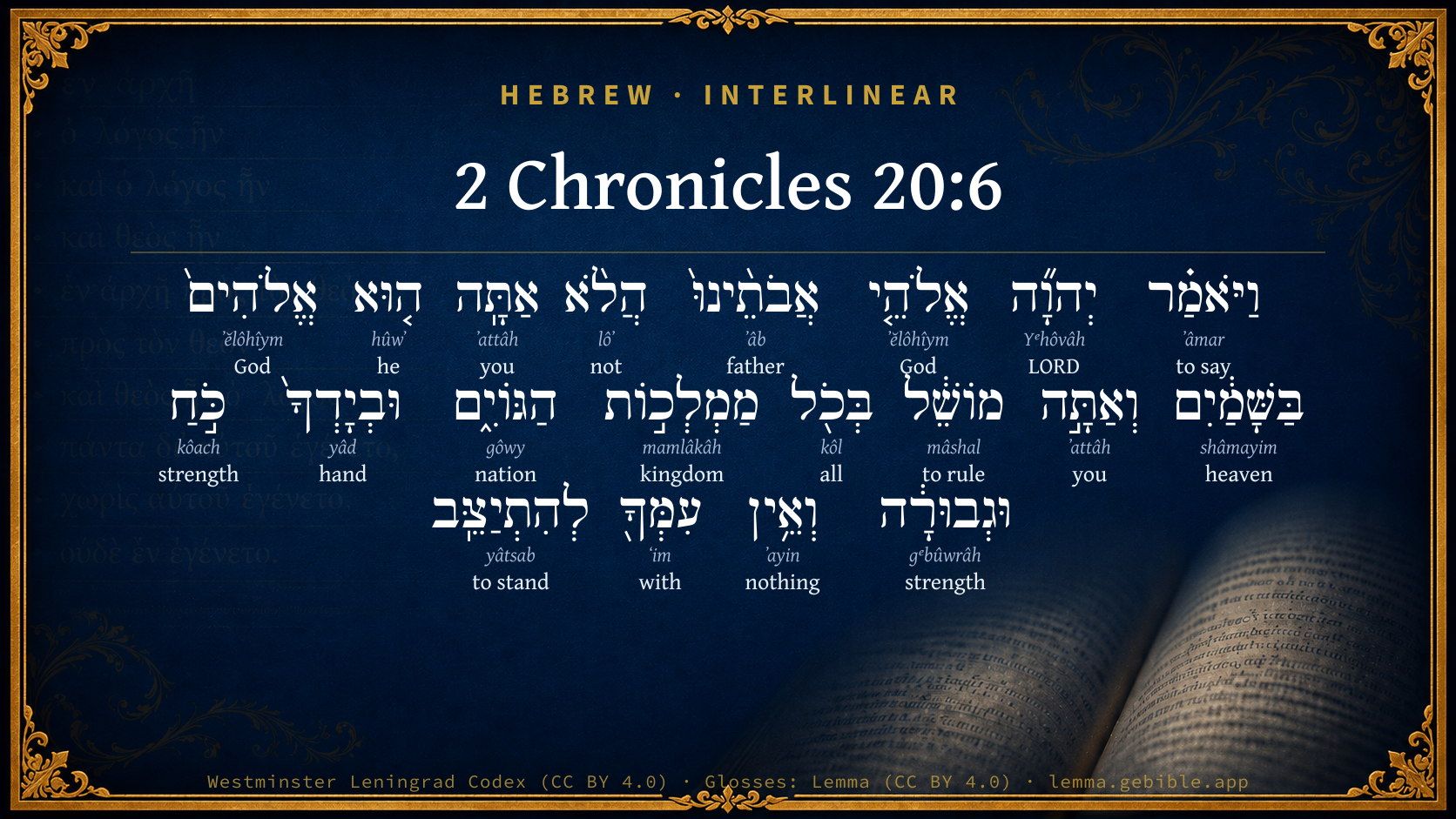
לְהִתְיַצֵּֽב
yâtsab
H3320
“to stand”
Preposition + Verb, Hithpael, Infinitive Construct
Part of Speech
Preposition + Verb
Stem
Hithpael
Form
Infinitive Construct
Full BDB Definition

Origin: a primitive root

TWOT: 894

to place, set, stand, set or station oneself, present oneself - (Hithpael) to station oneself, take one's stand, stand, present oneself, stand with someone
  1. וַיֹּאמַ֗ר ʼâmar H559 “and · to say” Conjunction + Verb, Qal, Sequential Imperfect, 3rd Person, Masculine, Singular
  2. יְהוָ֞ה Yᵉhôvâh H3068 “LORD” Noun, Proper
  3. אֱלֹהֵ֤י ʼĕlôhîym H430 “God(s) of” Noun, Common, Masculine, Plural, Construct
  4. אֲבֹתֵ֨ינוּ֙ ʼâb H1 “fathers · our” Noun, Common, Masculine, Plural, Construct + Suffix, Personal, 1st Person, Common, Plural
  5. הֲלֹ֨א lôʼ H3808 “not” Particle, Interrogative + Particle, Negative
  6. אַתָּֽה ʼattâh H859 “you” Pronoun, Personal, 2nd Person, Masculine, Singular
  7. ה֤וּא hûwʼ H1931 “he” Pronoun, Personal, 3rd Person, Masculine, Singular
  8. אֱלֹהִים֙ ʼĕlôhîym H430 “God(s)” Noun, Common, Masculine, Plural, Absolute
  9. בַּשָּׁמַ֔יִם shâmayim H8064 “in/at the · heaven(s)” Preposition, Determined + Noun, Common, Masculine, Plural, Absolute
  10. וְאַתָּ֣ה ʼattâh H859 “and · you” Conjunction + Pronoun, Personal, 2nd Person, Masculine, Singular
  11. מוֹשֵׁ֔ל mâshal H4910 “ruling” Verb, Qal, Participle Active, Masculine, Singular, Absolute
  12. בְּכֹ֖ל kôl H3605 “in/at · all of” Preposition + Noun, Common, Masculine, Singular, Construct
  13. מַמְלְכ֣וֹת mamlâkâh H4467 “kingdoms of” Noun, Common, Feminine, Plural, Construct
  14. הַגּוֹיִ֑ם gôwy H1471 “the · nations” Particle, Definite Article + Noun, Common, Masculine, Plural, Absolute
  15. וּבְיָדְךָ֙ yâd H3027 “and · in/at · hand · your” Conjunction + Preposition + Noun, Common, Both, Singular, Construct + Suffix, Personal, 2nd Person, Masculine, Singular
  16. כֹּ֣חַ kôach H3581 “strength” Noun, Common, Masculine, Singular, Absolute
  17. וּגְבוּרָ֔ה gᵉbûwrâh H1369 “and · strength” Conjunction + Noun, Common, Feminine, Singular, Absolute
  18. וְאֵ֥ין ʼayin H369 “and · nothing” Conjunction + Particle, Negative
  19. עִמְּךָ֖ ʻim H5973 “with · you” Preposition + Suffix, Personal, 2nd Person, Masculine, Singular

About this verse

These counts appear in no published source. They are computed here, from the morphology-tagged text and Lemma’s own curated glosses. What Lemma adds →

20
words
18
distinct lemmas
Historical
section

Shared distinctive vocabulary

לְהִתְיַצֵּֽב to stand H3320 occurs in 45 verses of the Hebrew Bible. Also found in:

Grammatical profile

  • 3 verbs
  • 11 nouns
  • 3 pronouns
  • 1 preposition
  • 2 particles

Verb forms

  • וַיֹּאמַ֗ר Qal · Sequential Imperfect
  • מוֹשֵׁ֔ל Qal · Participle Active
  • לְהִתְיַצֵּֽב Hithpael · Infinitive Construct

Repetition

Words recur within this verse — often emphatic in Hebrew:

  • אֱלֹהֵ֤י God H430 ×2
  • אַתָּֽה you H859 ×2

Hebrew & Septuagint length

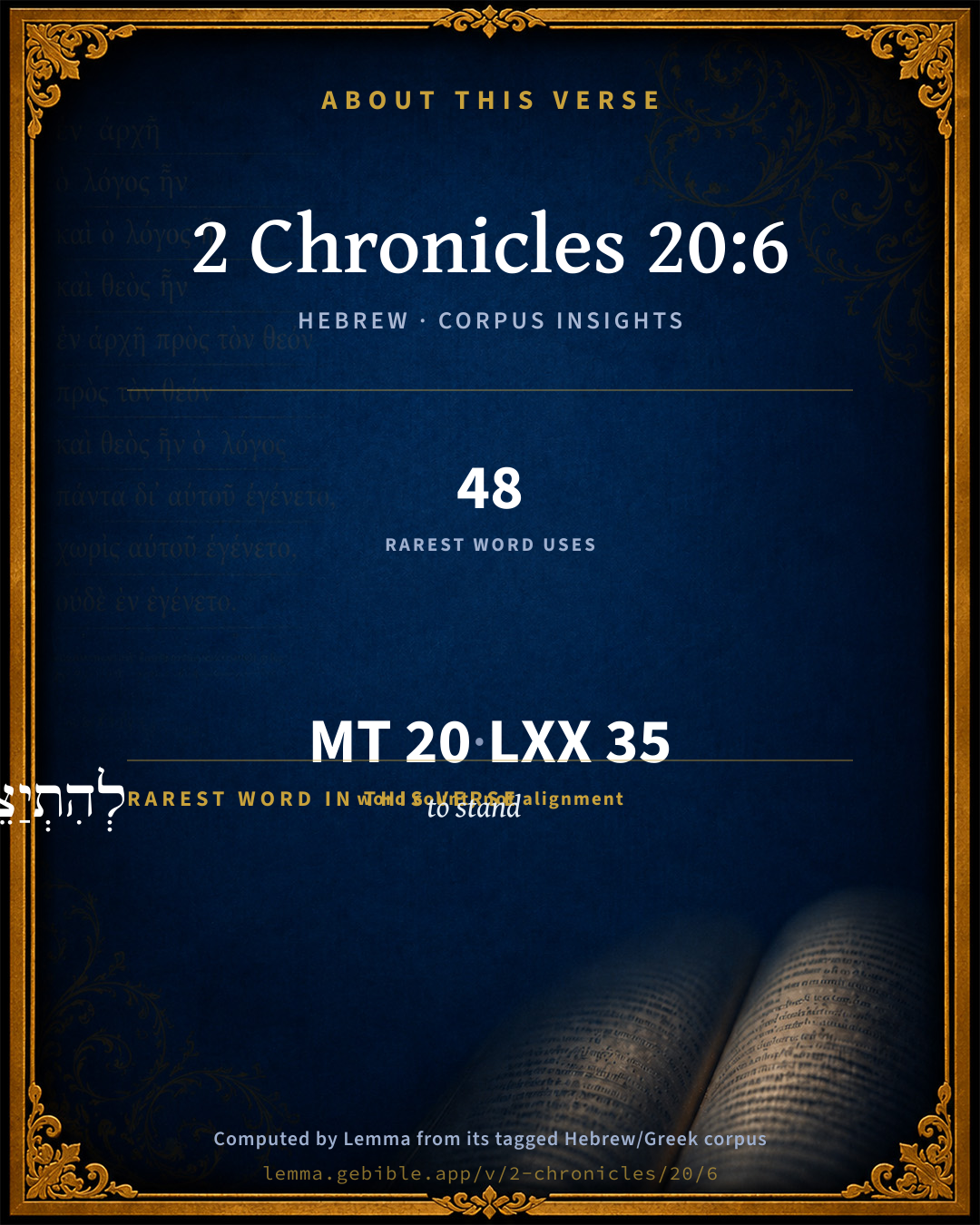
In English translation the verse runs 41 words from the Hebrew and 48 from the Septuagint (LXX English) — closely comparable.

A rough comparison of the two English renderings, which tokenize alike — not a word-level alignment.

Word counts can differ between the Hebrew and the Greek without any difference in meaning — e.g. the Hebrew direct-object marker אֵת has no separate Greek word, and Greek often adds the article ὁ.

In the original languages it is 20 Hebrew tokens and 35 Greek tokens — but the two are counted differently (Hebrew bundles its prefixes and suffixes into one token; the Greek is in lemma form), so that isn’t a like-for-like length.

Cross-references

20

Topical passages linked to 2 Chronicles 20:6 in the Treasury of Scripture Knowledge — connected by theme and wording, ordered by reader-vote popularity; previews shown in the World English Bible.

  • Deuteronomy 4:39 Know therefore this day, and lay it to your heart, that Yahweh he is God in heaven above and on the earth beneath; there is none else.
  • 1 Chronicles 29:11–12 Yours, Yahweh, is the greatness, the power, the glory, the victory, and the majesty: for all that is in the heavens and in the earth is yours. Yours is the kingdom, Yahweh, and you are exalted as head above all.
  • Daniel 4:17 The sentence is by the decree of the watchers, and the demand by the word of the holy ones; to the intent that the living may know that the Most High rules in the kingdom of men, and gives it to whoever he will, and sets up over it the lowest of men.
  • Psalms 47:8 God reigns over the nations. God sits on his holy throne.
  • Joshua 2:11 As soon as we had heard it, our hearts did melt, neither did there remain any more spirit in any man, because of you: for Yahweh your God, he is God in heaven above, and on earth beneath.
  • 1 Kings 8:23 and he said, Yahweh, the God of Israel, there is no God like you, in heaven above, or on earth beneath; who keep covenant and loving kindness with your servants, who walk before you with all their heart;
  • Psalms 115:3 But our God is in the heavens. He does whatever he pleases.
  • Isaiah 57:15–16 For thus says the high and lofty One who inhabits eternity, whose name is Holy: I dwell in the high and holy place, with him also who is of a contrite and humble spirit, to revive the spirit of the humble, and to revive the heart of the contrite.
  • Isaiah 66:1 Thus says Yahweh, heaven is my throne, and the earth is my footstool: what manner of house will you build to me? and what place shall be my rest?
  • Daniel 4:25 that you shall be driven from men, and your dwelling shall be with the animals of the field, and you shall be made to eat grass as oxen, and shall be wet with the dew of the sky, and seven times shall pass over you; until you know that the Most High rules in the kingdom of men, and gives it to whoever he will.
  • Matthew 6:9 Pray like this: 'Our Father in heaven, may your name be kept holy.
  • Matthew 6:13 Bring us not into temptation, but deliver us from the evil one. For yours is the Kingdom, the power, and the glory forever. Amen.'
  • Acts 11:17 If then God gave to them the same gift as us, when we believed in the Lord Jesus Christ, who was I, that I could withstand God?"
  • Exodus 3:6 Moreover he said, "I am the God of your father, the God of Abraham, the God of Isaac, and the God of Jacob." Moses hid his face; for he was afraid to look at God.
  • Exodus 3:15–16 God said moreover to Moses, "You shall tell the children of Israel this, 'Yahweh, the God of your fathers, the God of Abraham, the God of Isaac, and the God of Jacob, has sent me to you.' This is my name forever, and this is my memorial to all generations.
  • 1 Chronicles 29:18 Yahweh, the God of Abraham, of Isaac, and of Israel, our fathers, keep this forever in the imagination of the thoughts of the heart of your people, and prepare their heart to you;
  • Psalms 47:2 For Yahweh Most High is awesome. He is a great King over all the earth.
  • Psalms 62:11 God has spoken once, Twice I have heard this, That power belongs to God.
  • Jeremiah 27:5–8 I have made the earth, the men and the animals that are on the surface of the earth, by my great power and by my outstretched arm; and I give it to whom it seems right to me.
  • Daniel 4:32–35 and you shall be driven from men; and they dwelling shall be with the animals of the field; you shall be made to eat grass as oxen; and seven times shall pass over you; until you know that the Most High rules in the kingdom of men, and gives it to whoever he will.

Cross-references courtesy of OpenBible.info (CC BY 4.0).

Hebrew and Greek witnesses Masoretic Hebrew ↔ Greek Septuagint

The same verse in the two great witnesses to the Old Testament, shown verse-for-verse.

These are two independent witnesses, not word-aligned to each other, and the Septuagint is shown in lemma (dictionary) form.

Hebrew 2 Chronicles 20:6 Masoretic · Westminster Leningrad Codex

וַיֹּאמַ֗ר יְהוָ֞ה אֱלֹהֵ֤י אֲבֹתֵ֨ינוּ֙ הֲלֹ֨א אַתָּֽה ה֤וּא אֱלֹהִים֙ בַּשָּׁמַ֔יִם וְאַתָּ֣ה מוֹשֵׁ֔ל בְּכֹ֖ל מַמְלְכ֣וֹת הַגּוֹיִ֑ם וּבְיָדְךָ֙ כֹּ֣חַ וּגְבוּרָ֔ה וְאֵ֥ין עִמְּךָ֖ לְהִתְיַצֵּֽב

and he said, Yahweh, the God of our fathers, aren't you God in heaven? and aren't you ruler over all the kingdoms of the nations? and in your hand is power and might, so that none is able to withstand you.

World English Bible · Public Domain

Greek LXX 2 Chronicles 20:6 Septuagint · lemma form

καί εἶπον κύριος ὁ θεός ὁ πατήρ ἐγώ οὐ σύ εἰμί θεός ἐν οὐρανός καί σύ κυριεύω πᾶς ὁ βασιλεία ὁ ἔθνος καί ἐν ὁ χείρ σύ ἰσχύς δυναστεία καί οὐ εἰμί πρός σύ ἀντιἵστημι

And he said, O Lord God of my fathers, are not you God in heaven above, and are not you Lord of all the kingdoms of the nations? and is there not in your hand the might of dominion, and there is no one who can resist you?

LXX2012 (modern English Septuagint) · Public Domain

On this verse, Ellicott's Commentary for English Readers discusses the Septuagint’s reading. Read the note in Commentary ↓

Hebrew: Westminster Leningrad Codex (CC BY 4.0). Greek: Septuagint (public domain); English from LXX2012 (modern English Septuagint) (Public Domain). How the Septuagint differs from the Hebrew →

Commentary

Notes on 2 Chronicles 20:6 from classic Christian and Jewish commentators (each source and its license shown beneath its notes). The classic Christian expositions comment on the surrounding passage and are grouped to its opening verse, so a note may address several verses; the Jewish commentaries on the Tanakh (Rashi and others) are per-verse, so they appear only where the commentator wrote on this verse.

Lemma curates 59 commentaries, every one of them public domain or Creative Commons licensed, each selected and text-cleaned for this edition rather than reprinted as found. About our sources →

Trapp's Complete Commentary

John Trapp

2Ch 20:6 And said, O LORD God of our fathers, [art] not thou God in heaven? and rulest [not] thou over all the kingdoms of the heathen? and in thine hand [is there not] power and might, so that none is able to withstand thee?

Ver. 6. Art not thou God in heaven? &c.] The choice of fit attributes, whereby to represent God to the soul in prayer, doth notably help faith and cause fervency.

John Trapp, A Commentary or Exposition upon All the Books of the Old and New Testament (1647–1656) — public domain. Text from a community e-Sword module.

Albert Barnes' Notes on the Bible

Jehoshaphat’s appeal is threefold:

(1) to God omnipotent 2Ch 20:6;

(2) to “our God;”

(3) the God especially “of this house” the temple.

2Ch 20:7

Abraham thy friend - Historically, this is the first use of this remarkable expression, afterward repeated (marginal references). The ground of the expression is to be found principally in Gen 18:23-33, where Abraham spoke with God as a man with his friend (compare Exo 33:11).

2Ch 20:8, 2Ch 20:9

The appeal recalls Solomon’s prayer (marginal references), which God had formally accepted by sending down fire from heaven to consume the accompanying offering.

Albert Barnes' Notes on the Bible (1834–1885) — public domain. Text from a community e-Sword/MySword module.

Joseph Benson's Commentary

2Ch 20:6-7. And said, O Lord God, &c. — Jehoshaphat himself was the mouth of the congregation to God, and did not devolve the work upon his chaplains. For though the kings were forbidden to burn incense, they were allowed to pray and preach. Art thou not God in heaven, &c. — Which none of the gods of the heathen are. Is not thy dominion supreme, over kingdoms themselves, and universal, over all kingdoms, even those of the heathen, that know thee not? Art thou not our God? — In covenant with us? To whom should we seek, to whom should we trust for relief, but to him whom we have chosen for our God, and who has chosen us for his people? Who gavest it to the seed of Abraham thy friend — To whom thou didst engage thyself to be his friend, and the friend of his seed for ever, and therefore we trust thou wilt not forsake us, his posterity.

Joseph Benson's Commentary on the Old and New Testaments (1811–1818) — public domain. Text from a community e-Sword module.

Jamieson, Fausset & Brown

Robert Jamieson, A. R. Fausset & David Brown

And said, O Lord God of our fathers--This earnest and impressive prayer embraces every topic and argument which, as king and representative of the chosen people, he could urge. Then it concludes with an earnest appeal to the justice of God to protect those who, without provocation, were attacked and who were unable to defend themselves against overwhelming numbers.

Jamieson, Fausset & Brown — Commentary Critical and Explanatory on the Whole Bible (1871) — public domain (CC PDM 1.0). Text via the HelloAO Bible API.

Adam Clarke's Commentary

Verse 6. Jehoshaphat stood] What an instructive sight was this! The king who proclaimed the fast was foremost to observe it, and was on this occasion the priest of the people; offering in the congregation, without form or any premeditation, one of the most sensible, pious, correct, and as to its composition one of the most elegant prayers ever offered under the Old Testament dispensation.

Adam Clarke's Commentary on the Bible (1810–1826) — public domain. Text from a community e-Sword/MySword module.

Ellicott's Commentary for English Readers

(6) Art not thou God in heaven.—So Psa_115:2-3. Jehovah, the Worship of Israel, is no limited local or tribal deity, but God over all. (Comp. also the first clause of the Lord’s Prayer.)

And rulest not thou over all the kingdoms?—Comp. 1Ch_29:12 (David’s prayer), “and Thou reignest (rulest) over all; and in Thine hand is power and might.” This and next sentence should be rendered affirmatively, as in that place. (Comp. also Psa_47:8 : “God reigneth over the heathen.”)

So that none is able to withstand thee.—Vulg., “nec quisquam tibi potest resistere;” LXX., καὶ οὐκ ἔστιν πρὸς σὲ ἀντιστῆναι. Literally, and there is none against thee to stand up. For this construction, comp. Psa_94:16 : “Who will stand up for me with (i.e., against) workers of wickedness. (Comp. also Psa_2:2; and the last words of Asa’s Prayer, 2Ch_14:11.) Syr. and Arab., “and I am standing and praying before thee.”

A Bible Commentary for English Readers, edited by Charles John Ellicott (1878–1897) — public domain. Text from a community e-Sword module.

The Cambridge Bible for Schools and Colleges

gen. ed. J. J. S. Perowne

6. O Lord God] R.V. O LORD, the God; cp. 2Ch_21:10; 2Ch_21:12.

art not thou God] cp. Jos_2:11.

rulest not thou over all the kingdoms of the heathen?] R.V. art not thou ruler over all the kingdoms of the nations? Cp. Psa_22:28.

is there not power] R.V. is power. Cp. 2Ch_14:11 (Asa’s prayer).

The Cambridge Bible for Schools and Colleges (gen. ed. J. J. S. Perowne; Cambridge University Press, 1878–1918) — public domain. Text from a community e-Sword module.

John Gill's Exposition

And said, O Lord God of our fathers,.... Abraham, Isaac, and Jacob, whose covenant God he was:

art not thou God in heaven? that dwellest and rulest there, and dost whatever thou pleasest in the armies of it:

and rulest not thou over all the kingdoms of the Heathens? being King of kings, and Lord of lords, all the world over:

and in thine hand is there not power and might, so that none is able to withstand thee? his power being infinite, unlimited, and uncontrollable, and so not resistible by finite creatures, at least not so as to be stopped and overcome.

John Gill's Exposition of the Whole Bible (1746–1763) — public domain (CC PDM 1.0). Text via the HelloAO Bible API.

Whedon's Commentary on the Bible

Daniel D. Whedon

6-12. This prayer should be compared with that of Asa, (2Ch_14:11,) and parts of Solomon’s at the dedication of the temple. 2Ch_6:28-31.

Daniel D. Whedon (gen. ed.), Commentary on the Old and New Testaments (1874–1909) — public domain. Text from a community e-Sword module.

The Pulpit Commentary

Vers. 6-12. The recorded prayers of Scripture are indeed what they might be expected to be, model prayers, and the present a model instance of the same (see homiletics). The prayer before us invokes the one God "in heaven;" claims him the God "of our fathers;" recites his universal authority above, below; pleads his former conduct of.the "people Israel," in especial his stablishing of that people in their present land; most touchingly recalls his covenant of condescending, everlasting "friendship" with Abraham, the grand original of the people (Gen_18:17-19, Gen_18:33; Exo_33:11) makes mention of the consecration of the land by the sanctuary, and in particular of the very service of consecration and the special foreseeing provision in that service for a crisis like the present (1Ki_8:33-45; 2Ch_6:24-35 2Ch_7:1) and then (vers. 10, 11) states pointedly the case and complaint with its aggravations Deu_2:4, Deu_2:8, Deu_2:9, Deu_2:19; Num_20:21; and (Jud_1:11:18) with a parting appeal, confession of their own weakness, ignorance, and dependence unfeigned, commits the cause of the alarmed people to God. Our eyes are upon thee. So, with a multitude of other passages, that supreme pattern one, (Psa_123:2.

The Pulpit Commentary (1880–1919), ed. H.D.M. Spence-Jones & Joseph S. Exell — public domain. Text from a community e-Sword module.

Keil & Delitzsch

C. F. Keil & F. Delitzsch

The prayer which Jehoshaphat directed to Jahve the God of the fathers, as the almighty Ruler over all kingdoms, consists of a short representation of the circumstances of the case. Jahve had given the land to His people Israel for an everlasting possession, and Israel had built a sanctuary to His name therein (Ch2 20:7 and Ch2 20:8); but they had in no way provoked the Ammonites, Moabites, and Edomites to fall upon them, and to drive them out of their land (Ch2 20:10 and Ch2 20:11). On these two facts Jehoshaphat founds his prayer for help, in a twofold manner: in respect to the first, calling to mind the divine promise to hear the prayers offered up to God in the temple (Ch2 20:9); and in reference to the second, laying emphasis upon the inability of Israel to fight against so numerous an enemy (Ch2 20:12). In his manner of addressing Jahve, "God of our fathers," there is contained a reason why God should protect His people in their present distress. Upon Him, who had given the land to the fathers for a possession, it was incumbent to maintain the children in the enjoyment of it, if they had not forfeited it by their sins. Now Jahve as a covenant God was bound to do this, and also as God and ruler of heaven and earth He had the requisite power and might; cf. Psa 115:3. להתיצּב עמּך אין, there is none with Thee who could set himself, i.e., could withstand Thee: cf. the similar phrase, Ch2 14:10; and for the thought, see Ch1 29:12. - On Ch2 20:7, cf. Jos 23:9; Jos 24:12; Exo 23:20., etc.; on Ch2 20:7, cf. Gen 13:15., Ch2 15:18, etc.; on אהבך, Isa 41:8.

Keil & Delitzsch — Biblical Commentary on the Old Testament (1861–1891) — public domain (CC PDM 1.0). Text via the HelloAO Bible API. (Old Testament only.)

Rashi

Rabbi Shlomo Yitzchaki (Rashi)

and that You rule over all the kingdoms of the nations and in Your hand is strength and might to conduct Your rule over them; therefore, we beseech You to save us from them.

and in Your hand is strength and might in wars and might, hardiess in French, boldness.

and no one can stand with You No creature can stand against You of all the kingdoms of the nations, and an example of this is (Josh. 1:5): “No man shall stand before You.” (Rabbi Menahem the son of Helbo explained it in this manner.)

Rashi on the Tanakh — English translations: “The Judaica Press complete Tanach with Rashi, translated by A. J. Rosenberg” (CC BY 4.0); “Pentateuch with Rashi's commentary by M. Rosenbaum and A.M. Silbermann, 1929-1934” (public domain); “The Metsudah Tanach series, Lakewood, N.J” (CC BY 4.0); and “The Book of Joshua, Metsudah Publications, 1997” (CC BY 4.0). Text via Sefaria.

Lesson kit

Teaching starters — assembled from the data on this page, not authored interpretation. Every prompt links to the verse data it draws on. Edit before teaching.

2 Chronicles, in the Historical, opens this verse with 20 words (18 distinct Hebrew lemmas). Its most distinctive word is yâtsab (“to stand”). A historical commentator’s framing appears above. Read the whole chapter for the surrounding context.

Discussion questions

  1. What does “to stand” (yâtsab) contribute to the verse as a whole?
  2. Exodus 2:4 shares the word «to stand» with this verse. How do the two illuminate each other?
  3. “God” occurs 2× in this one verse. What is the effect of the repetition?
  4. These translations render this verse differently; the difference is in the English rendering, not the original. What questions does that raise?
  5. The verb «וַיֹּאמַ֗ר» is Qal Sequential Imperfect. How does its form color the action?
  6. Reading how Trapp's Complete Commentary and Albert Barnes' Notes on the Bible read this verse, where do the two commentators agree and where do they part?

Things to notice

Reading settings

Reading text

Shown beneath each verse's original-language words.

Old Testament
Old Testament edition

Read the OT as the Masoretic Hebrew (MT) or the Greek Septuagint (LXX).

English shown for the Greek Septuagint (in the Hebrew ↔ Greek comparison).

Comparing translations? Open the Compare panel on any verse page to stack up to four side by side.