Psalms 106:47

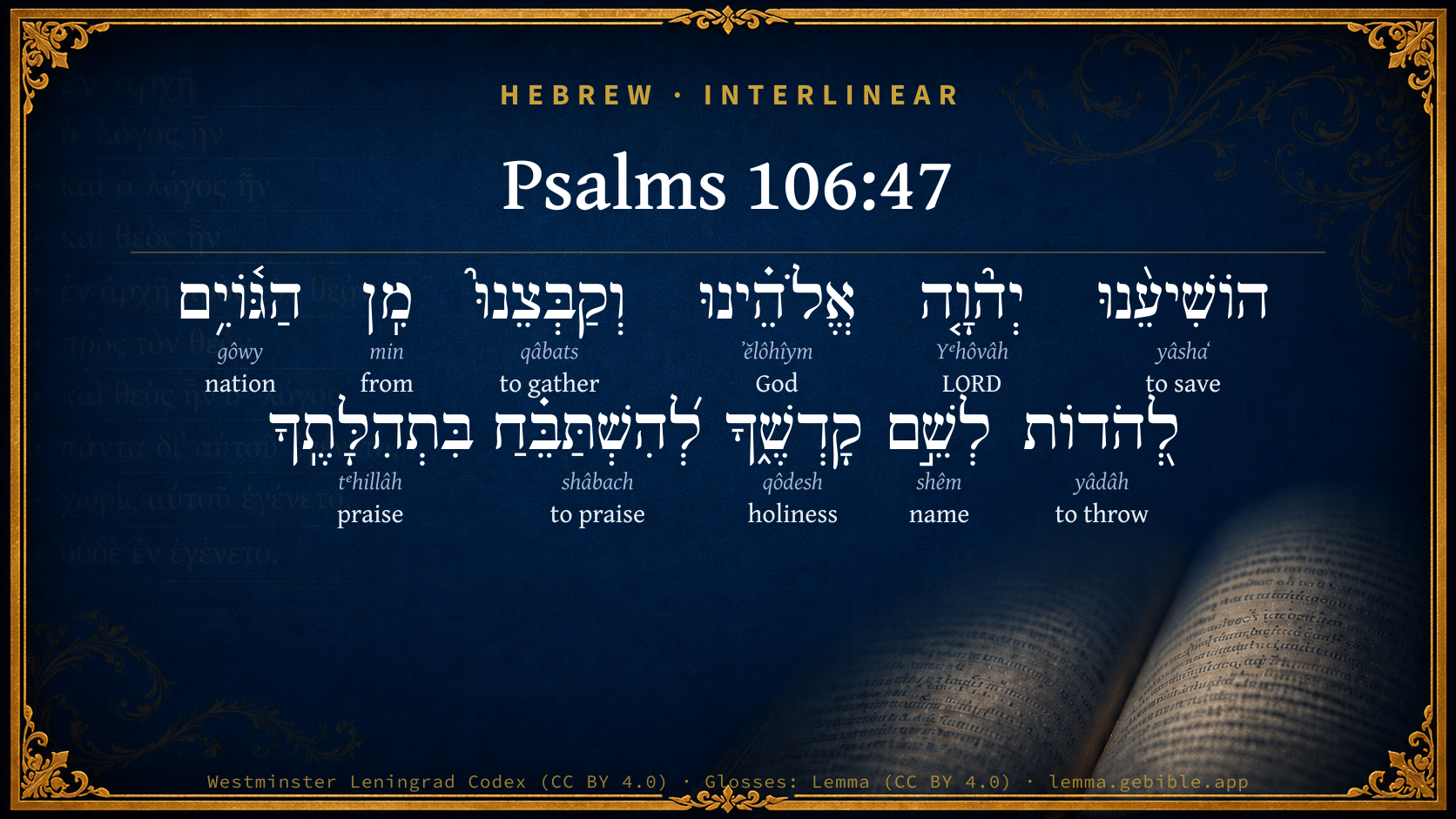
Hebrew (Westminster Leningrad Codex) Psalms 106:47 appears in the Hebrew Old Testament. The text above is from the Westminster Leningrad Codex. Each word links to its Strong’s number, a concise gloss, and parsing drawn from the Open Scriptures Hebrew Bible morphology. Click any word for its full Brown-Driver-Briggs (BDB) entry.
Download image
Cite this verse

Psalms 106:47 (World English Bible). Public Domain. Lemma interlinear Bible study tool, https://lemma.gebible.app/v/psalms/106/47.

Show BibTeX & RIS
BibTeX
RIS
English Translation
Save us, Yahweh, our God, Gather us from among the nations, To give thanks to your holy name, To triumph in your praise!
World English Bible · Public Domain
Download a study sheet

One document with this verse’s original text, its word-by-word gloss line, the meaning frame, cross-references with their text, attributed commentary, and full source and license credits — printable, and it pastes into notes with its structure intact.

This verse Autodidact and up

Study sheet (.html) Plain text (.txt)

A passage Seminary Student

Up to 50 verses in one chapter. A passage sheet keeps up to 6 commentary sources and 12 cross-references per verse, in the order this page ranks them, and says so on the sheet whenever that leaves anything out. Ask for a single verse and you get the Autodidact verse sheet above.

Everything on this page stays free to read, with no account — the sheet is a download of what is already on screen, not access to it.

Want to remove ads? Support Godless Engineer
Compare translations 3

The same verse in 3 English versions, stacked beneath the original-language interlinear above. Click any original word for its lexicon entry.

Each is an independent rendering of the whole verse — the interlinear is not word-aligned to these translations.

Highlighted words mark where these versions differ — a whole-verse word diff, not a word-by-word alignment.

  • World English Bible Public Domain
    Save us, Yahweh, our God, Gather us from among the nations, To give thanks to your holy name, To triumph in your praise!
  • King James Version Public Domain
    Save us, O LORD our God, and gather us from among the heathen, to give thanks unto thy holy name, and to triumph in thy praise.
  • unfoldingWord Literal Text CC BY-SA 4.0
    Save us, Yahweh, our God! Gather us from the nations to give thanks to the name of your holiness, to glory in your praises.

unfoldingWord Literal Text — © unfoldingWord, licensed CC BY-SA 4.0. Word-aligned USFM3 via Door43 (git.door43.org/unfoldingWord/en_ult).

Versions to compare (up to 4)

3 of 4 selected

Show all 18 translations

Every available English version of this verse, each an independent rendering of the whole verse.

  • World English Bible Public Domain
    Save us, Yahweh, our God, Gather us from among the nations, To give thanks to your holy name, To triumph in your praise!
  • Berean Standard Bible Public Domain
    Save us, O LORD our God, and gather us from the nations, that we may give thanks to Your holy name, that we may glory in Your praise.
  • Majority Standard Bible Public Domain
    Save us, O LORD our God, and gather us from the nations, that we may give thanks to Your holy name, that we may glory in Your praise.
  • King James Version Public Domain
    Save us, O LORD our God, and gather us from among the heathen, to give thanks unto thy holy name, and to triumph in thy praise.
  • American Standard Version (1901) Public Domain
    Save us, O Jehovah our God, And gather us from among the nations, To give thanks unto thy holy name, And to triumph in thy praise.
  • Revised Version (1885) Public Domain
    Save us, O LORD our God, and gather us from among the nations, to give thanks unto thy holy name, and to triumph in thy praise.
  • Geneva Bible (1599) Public Domain
    Saue vs, O Lord our God, and gather vs from among the heathen, that we may praise thine holy Name, and glorie in thy praise.
  • Douay-Rheims (1899) Public Domain
    Save us, O Lord, our God: and gather us from among nations: That we may give thanks to thy holy name, and may glory in thy praise.
  • Young's Literal Translation Public Domain
    Save us, O Jehovah our God, and gather us from the nations, To give thanks to Thy holy name, To glory in Thy praise.
  • Literal Standard Version CC BY-SA 4.0
    Save us, O our God YHWH, and gather us from the nations, || To give thanks to Your Holy Name, || To glory in Your praise.
  • Unlocked Literal Bible CC BY-SA 4.0
    Save us, Yahweh, our God. Gather us from among the nations so that we may give thanks to your holy name and glory in your praises.
  • unfoldingWord Literal Text CC BY-SA 4.0
    Save us, Yahweh, our God! Gather us from the nations to give thanks to the name of your holiness, to glory in your praises.
  • Darby Bible Public Domain
    Save us, Jehovah our God, and gather us from among the nations, to give thanks unto thy holy name, [and] to triumph in thy praise.
  • World Messianic Bible Public Domain
    Save us, LORD, our God, gather us from among the nations, to give thanks to your holy name, to triumph in your praise!
  • Webster's Bible Public Domain
    Save us, O LORD our God, and gather us from among the heathen, to give thanks to thy holy name, and to triumph in thy praise.
  • Free Bible Version CC BY-SA 4.0
    Save us, Lord, our God! Bring us back together from among the nations, so we can thank you and declare how magnificent and holy you are.
  • Bible in Basic English Public Domain
    Be our saviour, O Lord our God, and let us come back together from among the nations, so that we may give honour to your holy name, and have glory in your praise.
  • JPS Tanakh (1917) Public Domain
    Save us, O LORD our God, and gather us from among the nations, that we may give thanks unto Thy holy name, that we may triumph in Thy praise.

Literal Standard Version (2020), Covenant Press — licensed CC BY-SA 4.0. Text via the HelloAO Bible API (eBible.org). Unlocked Literal Bible (unfoldingWord) — licensed CC BY-SA 4.0. Text via the HelloAO Bible API (eBible.org). unfoldingWord Literal Text — © unfoldingWord, licensed CC BY-SA 4.0. Word-aligned USFM3 via Door43 (git.door43.org/unfoldingWord/en_ult). Free Bible Version, Dr. Jonathan Gallagher — licensed CC BY-SA 4.0. Text via the HelloAO Bible API (eBible.org).

Word by word

More ways to search: Search by grammar → Find every occurrence → Compare this word →

Practice this passage: Drill this verse → Learn its vocabulary →

לְ֝הִשְׁתַּבֵּ֗חַ
shâbach
H7623
“to praise”
Preposition + Verb, Hithpael, Infinitive Construct
Part of Speech
Preposition + Verb
Stem
Hithpael
Form
Infinitive Construct
Full BDB Definition

Origin: a primitive root

TWOT: 2312 , 2313

to soothe, still, stroke - (Piel) to soothe, still - (Hiphil) stilling (participle) - to laud, praise, commend - (Piel) - to laud, praise (God) - to commend, congratulate (the dead) - (Hithpael) to boast
  1. הוֹשִׁיעֵ֨נוּ yâshaʻ H3467 “save · us” Verb, Hiphil, Imperative, 2nd Person, Masculine, Singular + Suffix, Personal, 1st Person, Common, Plural
  2. יְה֘וָ֤ה Yᵉhôvâh H3068 “LORD” Noun, Proper
  3. אֱלֹהֵ֗ינוּ ʼĕlôhîym H430 “God(s) · our” Noun, Common, Masculine, Plural, Construct + Suffix, Personal, 1st Person, Common, Plural
  4. וְקַבְּצֵנוּ֮ qâbats H6908 “and · gather · us” Conjunction + Verb, Piel, Imperative, 2nd Person, Masculine, Singular + Suffix, Personal, 1st Person, Common, Plural
  5. מִֽן min H4480 “from” Preposition
  6. הַגּ֫וֹיִ֥ם gôwy H1471 “the · nations” Particle, Definite Article + Noun, Common, Masculine, Plural, Absolute
  7. לְ֭הֹדוֹת yâdâh H3034 “to throw” Preposition + Verb, Hiphil, Infinitive Construct
  8. לְשֵׁ֣ם shêm H8034 “to/for · name of” Preposition + Noun, Common, Masculine, Singular, Construct
  9. קָדְשֶׁ֑ךָ qôdesh H6944 “holiness · your” Noun, Common, Masculine, Singular, Construct + Suffix, Personal, 2nd Person, Masculine, Singular
  10. בִּתְהִלָּתֶֽךָ tᵉhillâh H8416 “in/at · praise · your” Preposition + Noun, Common, Feminine, Singular, Construct + Suffix, Personal, 2nd Person, Masculine, Singular

About this verse

These counts appear in no published source. They are computed here, from the morphology-tagged text and Lemma’s own curated glosses. What Lemma adds →

11
words
11
distinct lemmas
Wisdom
section

Notable vocabulary

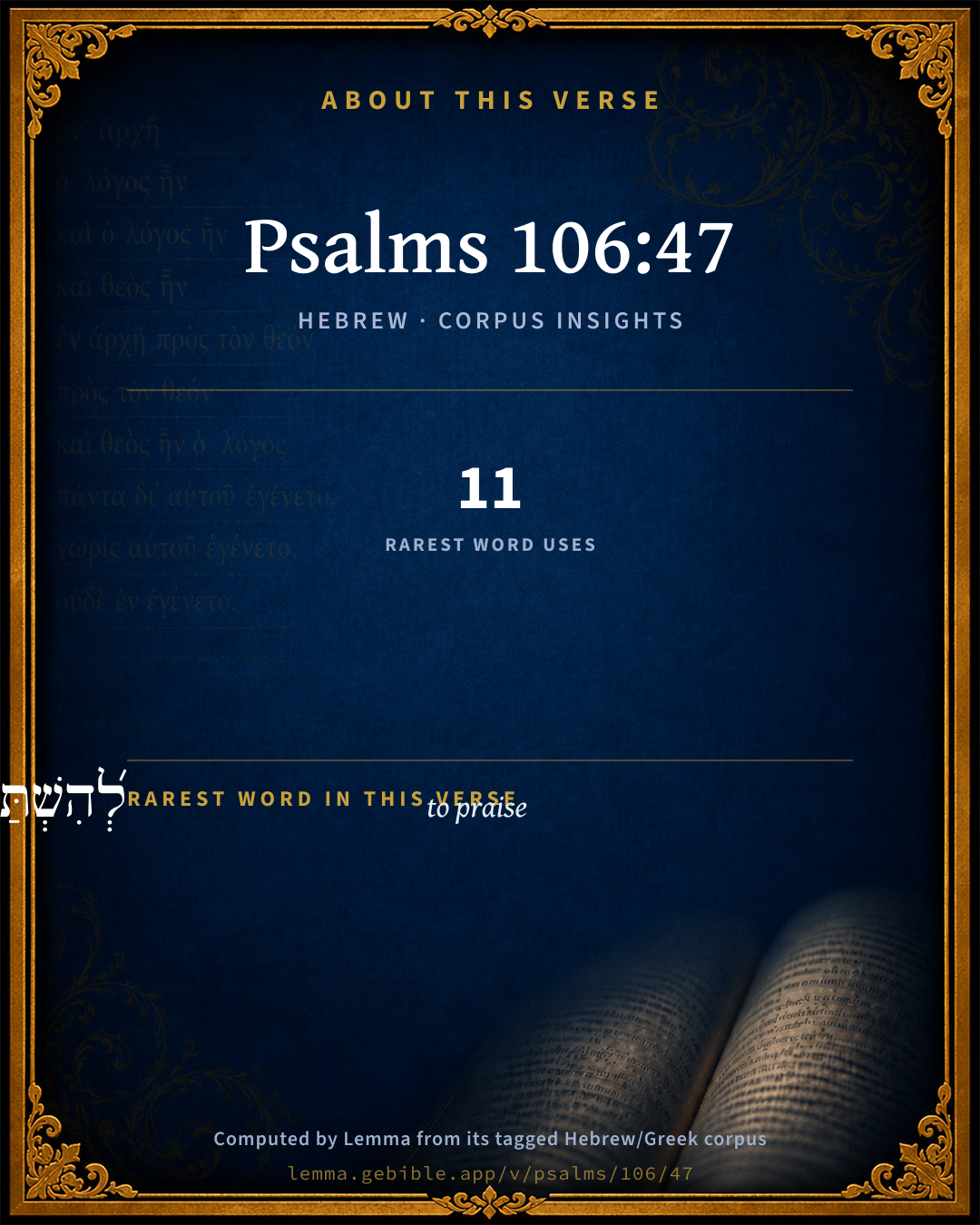
The rarest word here is לְ֝הִשְׁתַּבֵּ֗חַ to praise H7623 — appearing just 11 times in the whole Hebrew Bible.

Shared distinctive vocabulary

לְ֝הִשְׁתַּבֵּ֗חַ to praise H7623 occurs in 11 verses of the Hebrew Bible. Also found in:

Grammatical profile

  • 4 verbs
  • 6 nouns
  • 1 preposition

Verb forms

  • הוֹשִׁיעֵ֨נוּ Hiphil · Imperative
  • וְקַבְּצֵנוּ֮ Piel · Imperative
  • לְ֭הֹדוֹת Hiphil · Infinitive Construct
  • לְ֝הִשְׁתַּבֵּ֗חַ Hithpael · Infinitive Construct

Hebrew & Septuagint length

In English translation the verse runs 23 words from the Hebrew and 29 from the Septuagint (LXX English) — closely comparable.

A rough comparison of the two English renderings, which tokenize alike — not a word-level alignment.

Word counts can differ between the Hebrew and the Greek without any difference in meaning — e.g. the Hebrew direct-object marker אֵת has no separate Greek word, and Greek often adds the article ὁ.

Cross-references

11

Topical passages linked to Psalms 106:47 in the Treasury of Scripture Knowledge — connected by theme and wording, ordered by reader-vote popularity; previews shown in the World English Bible.

  • 1 Chronicles 16:35–36 Say you, Save us, God of our salvation, Gather us together and deliver us from the nations, To give thanks to your holy name, To triumph in your praise.
  • 2 Corinthians 2:14 Now thanks be to God, who always leads us in triumph in Christ, and reveals through us the sweet aroma of his knowledge in every place.
  • Revelation 7:10–12 They cried with a loud voice, saying, "Salvation be to our God, who sits on the throne, and to the Lamb!"
  • Psalms 14:7 Oh that the salvation of Israel would come out of Zion! When Yahweh restores the fortunes of his people, Then Jacob shall rejoice, and Israel shall be glad.
  • Psalms 107:1–3 Give thanks to Yahweh, For he is good, For his loving kindness endures forever.
  • Ezekiel 36:24–28 For I will take you from among the nations, and gather you out of all the countries, and will bring you into your own land.
  • Psalms 126:1 When Yahweh brought back those who returned to Zion, We were like those who dream.
  • Psalms 147:2 Yahweh builds up Jerusalem. He gathers together the outcasts of Israel.
  • Jeremiah 32:37–41 Behold, I will gather them out of all the countries, where I have driven them in my anger, and in my wrath, and in great indignation; and I will bring them again to this place, and I will cause them to dwell safely:
  • Ezekiel 37:21–28 Say to them, Thus says the Lord Yahweh: Behold, I will take the children of Israel from among the nations, where they are gone, and will gather them on every side, and bring them into their own land:
  • Ezekiel 39:25–29 Therefore thus says the Lord Yahweh: Now will I bring back the captivity of Jacob, and have mercy on the whole house of Israel; and I will be jealous for my holy name.

Cross-references courtesy of OpenBible.info (CC BY 4.0).

Hebrew and Greek witnesses Masoretic Hebrew ↔ Greek Septuagint

The same verse in the two great witnesses to the Old Testament, shown verse-for-verse.

You’re reading Greek Psalm 105 (Hebrew Psalm 106). The Septuagint counts the superscription, so verse numbers can differ from the Hebrew — chapter-level alignment, not verse-by-verse. Numbering follows Rahlfs.

These are two independent witnesses, not word-aligned to each other, and the Septuagint is shown in lemma (dictionary) form.

Hebrew Psalms 106:47 Masoretic · Westminster Leningrad Codex

הוֹשִׁיעֵ֨נוּ יְה֘וָ֤ה אֱלֹהֵ֗ינוּ וְקַבְּצֵנוּ֮ מִֽן הַגּ֫וֹיִ֥ם לְ֭הֹדוֹת לְשֵׁ֣ם קָדְשֶׁ֑ךָ לְ֝הִשְׁתַּבֵּ֗חַ בִּתְהִלָּתֶֽךָ

Save us, Yahweh, our God, Gather us from among the nations, To give thanks to your holy name, To triumph in your praise!

World English Bible · Public Domain

Greek LXX Greek Psalm 105:47 Septuagint · lemma form

σώζω ἐγώ κύριος ὁ θεός ἐγώ καί ἐπι συνἄγω ἐγώ ἐκ ὁ ἔθνος ὁ ἐκὁμολογέω ὁ ὄνομα ὁ ἅγιος σύ ὁ ἐκκαυχάομαι ἐν ὁ αἴνεσις σύ

Save us, O Lord our God, and gather us from among the heathen, that we may give thanks to your holy name, that we may glory in your praise.

LXX2012 (modern English Septuagint) · Public Domain

Hebrew: Westminster Leningrad Codex (CC BY 4.0). Greek: Septuagint (public domain); English from LXX2012 (modern English Septuagint) (Public Domain). How the Septuagint differs from the Hebrew →

Commentary

Notes on Psalms 106:47 from classic Christian and Jewish commentators (each source and its license shown beneath its notes). The classic Christian expositions comment on the surrounding passage and are grouped to its opening verse, so a note may address several verses; the Jewish commentaries on the Tanakh (Rashi and others) are per-verse, so they appear only where the commentator wrote on this verse.

Lemma curates 59 commentaries, every one of them public domain or Creative Commons licensed, each selected and text-cleaned for this edition rather than reprinted as found. About our sources →

Trapp's Complete Commentary

John Trapp

Psa 106:47 Save us, O LORD our God, and gather us from among the heathen, to give thanks unto thy holy name, [and] to triumph in thy praise.

Ver. 47. Save us, O Lord our God] This is the main request of the psalm, and the chief thing intended; for for this cause prefaced the prophet, as Psa 106:1-2, &c., and reckoned up the people’s sins and God’s deliverances, that he might bring in this, "Save us," as thou ever hast done.

To give thanks unto thy holy name] Good ends propounded in prayer is a special means of speeding. Hypocrites do all in themselves, so do not the saints, Hos 14:8; and all for themselves, as Zec 7:5 Hos 10:1, which is not the saints’ practice, Son 5:1, they have good aims in their good actions.

John Trapp, A Commentary or Exposition upon All the Books of the Old and New Testament (1647–1656) — public domain. Text from a community e-Sword module.

Joseph Benson's Commentary

Psa 106:47-48. Save us, O Lord our God — O thou, who hast so often pardoned and saved us, notwithstanding our former and manifold provocations, be thou pleased again to interpose and deliver us, how unworthy soever we may be, from all our present enemies. Gather us from the heathen — Restore into their own country such of us as are fallen into their hands. To give thanks unto thy holy name — That they may join with us in giving thanks for thy incomparable goodness; and to triumph in thy praise — In thy praiseworthy works, wrought for us: saying, Blessed be the Lord God of Israel — Let the great Lord of all the world, who has been so gracious to Israel as to choose them for his own peculiar people, be most heartily praised, from everlasting to everlasting — From one generation to another, as long as the world shall last, and unto all eternity. And let all the people say, Amen — In token of their cheerful concurrence in all these prayers, praises, and confessions. Praise ye the Lord — Hebrew, Hallelujah. By these two comprehensive words, Amen and Hallelujah, “it is very proper,” says Mr. Henry, “in religious assemblies, for the people to testify their joining with their ministers in the prayers and praises which, as their mouth, they offer up to God according to his will, saying Amen to the prayers, and Hallelujah to the praises.

Joseph Benson's Commentary on the Old and New Testaments (1811–1818) — public domain. Text from a community e-Sword module.

J. A. Alexander on Psalms

Joseph Addison Alexander

47. (Psa 106:47) Save us, Jehovah, our God, and gather us from the nations, to give thanks unto thy holy name, to glory in thy praise. Encouraged by these tokens of returning favour, the church prays that the hopes thus raised may not be disappointed, but abundantly fulfilled in the restoration of the exiles to their own land, in return for which she indirectly engages to render praise and thanksgiving to Jehovah as her liberator. We are thus brought back to the beginning of the psalm, and the voice of confession is again lost in that of anticipated praise. Instead of our God, the parallel passage (1Ch 16:36) has God of our Salvation. The word translated glory occurs only in that passage and the one before us. It is synonymous, however, with the one used in Psa 105:3, and often elsewhere, both meaning properly to praise one's self. With the second clause compare Psa 30:4.

Joseph Addison Alexander, The Psalms Translated and Explained (1850) — public domain. Text from a community e-Sword module.

Tyndale Open Study Notes

Tyndale Open Resources

106:47 Gather us back: The community prays for restoration from exile (see 102:19-22; 107:3; see also Isa 11:12; 40:11; 43:5; 54:7; 56:8; 66:18).

Tyndale Open Study Notes — © Tyndale Open Resources, licensed CC BY-SA 4.0. Text via the HelloAO Bible API.

Geneva Bible (1599)

Geneva Bible translators

Gather thy Church, which is dispersed, and give us constancy under the cross, that with one consent we may all praise thee.

Geneva Bible (1599) marginal notes — public domain. Text via Bolls.life.

Adam Clarke's Commentary

Verse 47. Save us. O Lord - and gather us] These words, says Calmet, are found in the hymn that was sung at the ceremony of bringing the ark to Jerusalem, 1Ch 16:35-36; but it is supposed they were added by Ezra or some other prophet: here they are in their natural place. The author of the Psalm begs the Lord to gather the Israelites who were dispersed through different countries; for at the dedication of the second temple, under Nehemiah, (where it is probable this Psalm, with the cvth and the cviith, was sung,) there were very few Jews who had as yet returned from their captivity.

Adam Clarke's Commentary on the Bible (1810–1826) — public domain. Text from a community e-Sword/MySword module.

John Calvin's Commentaries

47. Save us, Jehovah our God! From the conclusion of the psalm, it is evident, that it was composed during the sad and calamitous dispersion of the people. And although subsequent to the times of Haggai and Malachi, no famous prophets appeared among the people, it is nevertheless probable that some of the priests were endued with the spirit of prophecy, in order that they might direct them to the source whence they might receive all needful consolation. It is my opinion, that after they were dispersed by the tyranny of Antiochus, this form of prayer was adapted to the exigency of their existing circumstances, in which the people, by reflecting upon their former history, might acknowledge that their fathers had, in ways innumerable, provoked God to wrath, since the time he had delivered them. For it was needful for them to be completely humbled, to prevent them from murmuring against God’s dispensations. And seeing that God had extended pardon to their fathers though undeserving of it, that was calculated to inspire them hereafter with the hope of forgiveness, provided they carefully and cordially sought to be reconciled to him; and especially is this the case, because there is here a solemn remembrance of the covenant, through the faith of which they might draw near to God, though his anger was not yet turned away. Besides, as God had chosen them to be his peculiar people, they call upon him to collect into one body the dissevered and bleeding members, according to the prediction of Moses,

“If any of thine be driven out unto the utmost parts of heaven, from thence will the Lord thy God gather thee, and from thence will he fetch thee,” Deuteronomy 30:4

This prediction was at length accomplished, when the widely separated multitude were gathered together, and grew up in the unity of the faith. For although that people never regained their earthly kingdom and polity, yet their being grafted into the body of Christ, was a more preferable gathering together. Wherever they were, they were united to each other, and also to the Gentile converts, by the holy and spiritual bond of faith, so that they constituted but one Church, extending itself over the whole earth. They subjoin the end contemplated by their redemption from captivity, namely, that they might celebrate the name of God, and employ themselves continually in his praises.

John Calvin's Commentaries (1540-1563) — public domain. Text from the Calvin Translation Society English edition (1840s-50s) via the Christian Classics Ethereal Library (ccel.org). Calvin's coverage is partial (roughly two-thirds of the Bible); uncommented books and verses are honest gaps, never fabricated. The 19th-century editor's footnotes and remarks are omitted so the notes are faithfully Calvin's own voice.

Ellicott's Commentary for English Readers

(47) Save us.—For this prayer the whole psalm has prepared the way.

A Bible Commentary for English Readers, edited by Charles John Ellicott (1878–1897) — public domain. Text from a community e-Sword module.

The Cambridge Bible for Schools and Colleges

gen. ed. J. J. S. Perowne

47. This prayer is the point to which the long confession of national sin, from Psa_106:6 onward, has been leading up. ‘We have sinned, often and grievously; we are bearing the just punishment of our sins; but we confess our guilt; Thy lovingkindness is inexhaustible, once more bring us to our own land, that we may fulfil the purpose of our calling.’

to give thanks &c.] For Jehovah’s praise is the end and object of Israel’s existence. Cp. Isa_43:21; Psa_22:3, note.

The Cambridge Bible for Schools and Colleges (gen. ed. J. J. S. Perowne; Cambridge University Press, 1878–1918) — public domain. Text from a community e-Sword module.

Albert Barnes' Notes on the Bible

Save us, O Lord our God, and gather us from among the heathen - From among the nations. From this it would seem that the psalm was composed when the nation was in captivity, or was dispersed among the nations that were hostile to them. The prayer is, that as God had, in former periods, recovered his people when they were in exile, or were scattered abroad, he would again graciously interpose and bring them to the land of their fathers, where they had been accustomed to worship God.

To give thanks unto thy holy name - Unto thee; a holy God. That we may praise thee in the place where thou art accustomed to be worshipped - in the sanctuary.

And to triumph in thy praise - To exult; to rejoice; to be glad in praising thee - in thy worship.

Albert Barnes' Notes on the Bible (1834–1885) — public domain. Text from a community e-Sword/MySword module.

Matthew Poole's English Annotations

Save us, O Lord our God: O thou who hast so often pardoned and saved us, notwithstanding our former and manifold provocations, be thou pleased once more to deliver us.

In thy praise; in thy praiseworthy work wrought for us;

praise being put for actions worthy of praise, as it is here, above, Psa 106:2; 1Ch 16:35; Psa 9:14; Phi 4:8, and oft elsewhere.

Matthew Poole's English Annotations on the Holy Bible (1683–1685) — public domain. Text from a community e-Sword/MySword module.

The Treasury of David

Charles H. Spurgeon

Ver. 47. This is the closing prayer, arranged by prophecy for those who would in future time be captives, and suitable for all who before David's days had been driven from home by the tyranny of the various scatterings by famine and distress which had happened in the iron age of the judges.

Save us, O Lord our God. The mention of the covenant encouraged the afflicted to call the Lord their God, and this enabled them with greater boldness to entreat him to interpose on their behalf and rescue them.

And gather us from among the Heathen. Weary now of the ungodly and their ways, they long to be brought into their own separated country, where they might again enjoy the means of grace, enter into holy fellowship with their brethren, escape from contaminating examples, and be free to wait upon the Lord. How often do true believers now a days long to be removed from ungodly households, where their souls are vexed with the conversation of the wicked.

To give thanks unto thy holy name, and to triumph in thy praise. Weaned from idols, they desire to make mention of Jehovah's name alone, and to ascribe their mercies to his ever abiding faithfulness and love. The Lord had often saved them for his holy name's sake, and therefore they feel that when again restored they would render all their gratitude to that saving name, yea, it should be their glory to praise Jehovah and none else.

Ver. 47. Gather us. Bishop Patrick says that, in his opinion, this verse refers to those, who, in the days of Saul, or before, were taken prisoners by the Philistines, or other nations; whom David prays God to gather to their own land again; that they might worship him in that place which he had prepared for the ark of his presence. Thomas Fenton.

Ver. 47.

1. An earnest Prayer: "Save us, O Lord", etc.

2. A Believing Prayer: "O Lord our God."

3. A humble Prayer: "Gather us from among the heathen."

4. A sincere Prayer: "To give thanks unto thy holy name"; to own thy justice and holiness in all thy ways.

5. A confident Prayer: "To triumph in thy praise." None but bruised spices give forth such odours.

G.R.

Psalms 106:48*

Ver 48. Blessed be the LORD God of Israel from everlasting to everlasting. Has not his mercy endured for ever, and should not his praise be of like duration? Jehovah, the God of Israel, has blessed his people, should they not also bless him?

And let all the people say, Amen. They have all seen spared by his grace, let them all join in the adoration with loud unanimous voice. What a thunder of praise would thus be caused! Yet should a nation thus magnify him, yea, should all the nations past and present unite in the solemn acclaim, it mould fall far short of his deserts. O for the happy day when all flesh shall see the glory of God, and all shall aloud proclaim his praise.

Praise ye the LORD, or "Hallelujah".

Reader, praise thou the Lord, as he who writes this feeble exposition now does with his whole heart.

"Now blest, for ever blest, be He,

The same throughout eternity,

Our Israel's God adored!

Let all the people join the lay,

And loudly, `Hallelujah', say,

`Praise ye the living Lord!'"

Charles H. Spurgeon's The Treasury of David (1869–1885) — public domain. Psalms only. Text from a community e-Sword/MySword module.

Whedon's Commentary on the Bible

Daniel D. Whedon

47. Save us… and gather us—This was promised by Moses, when they should repent. Deu_30:3. This verse, as Delitzsch says, is the point of the psalm. The sins of the nation have been confessed, divine judgments and compassion have been faithfully recorded, and all culminate in this final purpose of the author—a devout prayer for the salvation and gathering together of Israel, that they may praise God. The form slightly varies from the historic entry, (1Ch_16:35;) which indicates that our psalm may have been modified from it for a subsequent occasion.

Daniel D. Whedon (gen. ed.), Commentary on the Old and New Testaments (1874–1909) — public domain. Text from a community e-Sword module.

The Pulpit Commentary

The historical portion of the psalm here ends, and the writer, in a brief epilogue, returns to the topic of prayer (see vers. 4, 5), only substituting now for the personal supplications of the prologue, a general prayer for the entire nation, and especially for its deliverance from captivity. "It can scarcely be doubted," as Dean Johnson well observes, "that the words of ver. 47 refer to deliverance from the Babylonish captivity," which was the only one that involved the dispersion of the whole people, and the suspension of the liturgical offering of thanks and praise.

Save us, O Lord our God. Contrast with this the "remember me" of ver. 4. The review of the national history has quickened the psalmist"s sympathies and widened them. Previously he prayed only for himself. Now it will not content him unless the people generally are "saved." And gather us from among the heathen. (On the wide dispersion of the Israelites at the time of the Babylonian captivity, see the comment on ver. 27) To give thanks unto thy holy Name, and to triumph in thy praise. This is spoken of as the consequence of the gathering together. Dispersion could not, of course, prevent the rendering of praise and thanks by individual Israelites; (Dan_6:10) hut it had stopped the united liturgical expression of them. On the restoration of the Israelites to their own land, this was resumed. (Ezr_3:2-11)

The Pulpit Commentary (1880–1919), ed. H.D.M. Spence-Jones & Joseph S. Exell — public domain. Text from a community e-Sword module.

Keil & Delitzsch

C. F. Keil & F. Delitzsch

He has now reached the goal, to which his whole Psalm struggles forth, by the way of self-accusation and the praise of the faithfulness of God. השׁתּבּח (found only here) is the reflexive of the Piel, to account happy, Ecc 4:2, therefore: in order that we may esteem ourselves happy to be able to praise Thee. In this reflexive (and also passive) sense השׁתבח is customary in Aramaic and post-biblical Hebrew.

Keil & Delitzsch — Biblical Commentary on the Old Testament (1861–1891) — public domain (CC PDM 1.0). Text via the HelloAO Bible API. (Old Testament only.)

unfoldingWord translationNotes

Door43 World Missions Community

General Information:

Here Psa 106:48 is more than the end of this psalm. It is the closing statement for all of Book 4 of the Psalms, which starts at Psalm 90 and ends with Psalm 106.

May Yahweh, the God of Israel, be praised

This can be stated in active form. AT: "May people praise Yahweh the God of Israel" (See: Active or Passive)

to your holy name

Here Yahweh is referred to by his "holy name." AT: "to you" (See: Metonymy)

from everlasting to everlasting

This refers to two extremes and means for all time. See how you translated this in Psalms 41:13. AT: "for all eternity" (See: Merism)

translationWords

save

holy

name

glory

praise

Israel

eternity

people group

amen

unfoldingWord translationNotes — © Distant Shores Media and the Door43 World Missions Community, licensed CC BY-SA 4.0. Source: git.door43.org/Door43/en_tn.

Rashi

Rabbi Shlomo Yitzchaki (Rashi)

save us now also, O Lord, our God.

Rashi on the Tanakh — English translations: “The Judaica Press complete Tanach with Rashi, translated by A. J. Rosenberg” (CC BY 4.0); “Pentateuch with Rashi's commentary by M. Rosenbaum and A.M. Silbermann, 1929-1934” (public domain); “The Metsudah Tanach series, Lakewood, N.J” (CC BY 4.0); and “The Book of Joshua, Metsudah Publications, 1997” (CC BY 4.0). Text via Sefaria.

Lesson kit

Teaching starters — assembled from the data on this page, not authored interpretation. Every prompt links to the verse data it draws on. Edit before teaching.

Psalms, in the Wisdom, opens this verse with 11 words (11 distinct Hebrew lemmas). Its most distinctive word is shâbach (“to praise”). A historical commentator’s framing appears above. Read the whole chapter for the surrounding context.

Discussion questions

  1. The word shâbach carries the sense “to praise.” How does it shape the verse?
  2. 1 Chronicles 16:35 shares the word «to praise» with this verse. How do the two illuminate each other?
  3. These translations render this verse differently; the difference is in the English rendering, not the original. What questions does that raise?
  4. The verb «הוֹשִׁיעֵ֨נוּ» is Hiphil Imperative. How does its form color the action?
  5. Reading how Trapp's Complete Commentary and Joseph Benson's Commentary read this verse, where do the two commentators agree and where do they part?

Things to notice

Reading settings

Reading text

Shown beneath each verse's original-language words.

Old Testament
Old Testament edition

Read the OT as the Masoretic Hebrew (MT) or the Greek Septuagint (LXX).

English shown for the Greek Septuagint (in the Hebrew ↔ Greek comparison).

Comparing translations? Open the Compare panel on any verse page to stack up to four side by side.