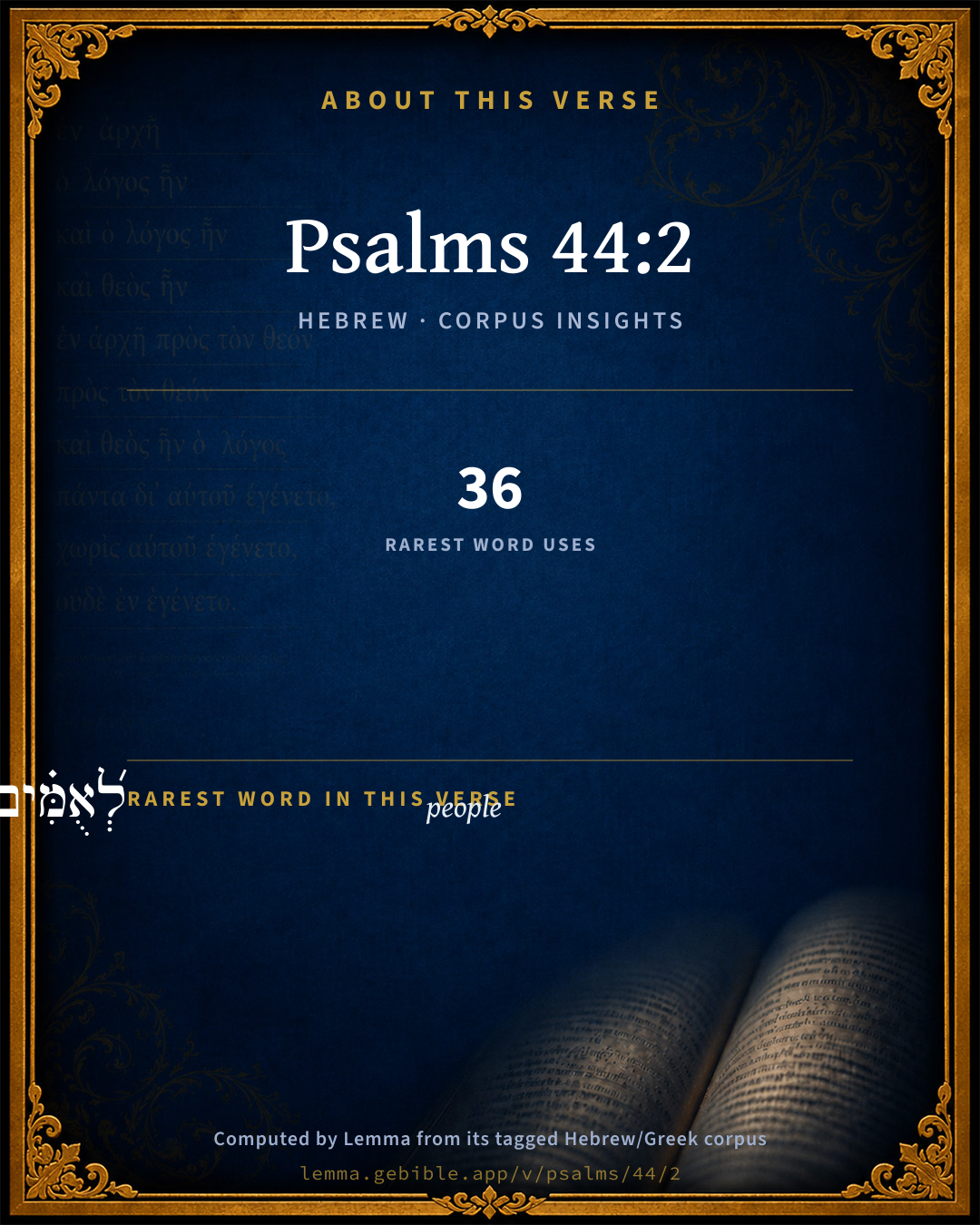
Psalms 44:2

Hebrew (Westminster Leningrad Codex) Psalms 44:2 appears in the Hebrew Old Testament. The text above is from the Westminster Leningrad Codex. Each word links to its Strong’s number, a concise gloss, and parsing drawn from the Open Scriptures Hebrew Bible morphology. Click any word for its full Brown-Driver-Briggs (BDB) entry.
Download image
Cite this verse

Psalms 44:2 (World English Bible). Public Domain. Lemma interlinear Bible study tool, https://lemma.gebible.app/v/psalms/44/2.

Show BibTeX & RIS
BibTeX
RIS
English Translation
You drove out the nations with your hand, But you planted them. You afflicted the peoples, But you spread them abroad.
World English Bible · Public Domain
Download a study sheet

One document with this verse’s original text, its word-by-word gloss line, the meaning frame, cross-references with their text, attributed commentary, and full source and license credits — printable, and it pastes into notes with its structure intact.

This verse Autodidact and up

Study sheet (.html) Plain text (.txt)

A passage Seminary Student

Up to 50 verses in one chapter. A passage sheet keeps up to 6 commentary sources and 12 cross-references per verse, in the order this page ranks them, and says so on the sheet whenever that leaves anything out. Ask for a single verse and you get the Autodidact verse sheet above.

Everything on this page stays free to read, with no account — the sheet is a download of what is already on screen, not access to it.

Want to remove ads? Support Godless Engineer
Compare translations 3

The same verse in 3 English versions, stacked beneath the original-language interlinear above. Click any original word for its lexicon entry.

Each is an independent rendering of the whole verse — the interlinear is not word-aligned to these translations.

Highlighted words mark where these versions differ — a whole-verse word diff, not a word-by-word alignment.

  • World English Bible Public Domain
    You drove out the nations with your hand, But you planted them. You afflicted the peoples, But you spread them abroad.
  • King James Version Public Domain
    How thou didst drive out the heathen with thy hand, and plantedst them; how thou didst afflict the people, and cast them out.
  • unfoldingWord Literal Text CC BY-SA 4.0
    You, you drove out the nations your hand, but you planted them. You caused harm to the peoples, but you sent them.

unfoldingWord Literal Text — © unfoldingWord, licensed CC BY-SA 4.0. Word-aligned USFM3 via Door43 (git.door43.org/unfoldingWord/en_ult).

Versions to compare (up to 4)

3 of 4 selected

Show all 18 translations

Every available English version of this verse, each an independent rendering of the whole verse.

  • World English Bible Public Domain
    You drove out the nations with your hand, But you planted them. You afflicted the peoples, But you spread them abroad.
  • Berean Standard Bible Public Domain
    With Your hand You drove out the nations and planted our fathers there; You crushed the peoples and cast them out.
  • Majority Standard Bible Public Domain
    With Your hand You drove out the nations and planted our fathers there; You crushed the peoples and cast them out.
  • King James Version Public Domain
    How thou didst drive out the heathen with thy hand, and plantedst them; how thou didst afflict the people, and cast them out.
  • American Standard Version (1901) Public Domain
    Thou didst drive out the nations with thy hand; But them thou didst plant: Thou didst afflict the peoples; But them thou didst spread abroad.
  • Revised Version (1885) Public Domain
    Thou didst drive out the nations with thy hand, and plantedst them in; thou didst afflict the peoples, and didst spread them abroad.
  • Geneva Bible (1599) Public Domain
    Howe thou hast driuen out the heathen with thine hand, and planted them: how thou hast destroyed the people, and caused them to grow.
  • Douay-Rheims (1899) Public Domain
    We have heard, O God, with our ears: our fathers have declared to us, The work, thou hast wrought in their days, and in the days of old.
  • Young's Literal Translation Public Domain
    Thou, `with' Thy hand, nations hast dispossessed. And Thou dost plant them. Thou afflictest peoples, and sendest them away.
  • Literal Standard Version CC BY-SA 4.0
    You, [with] Your hand, have dispossessed nations. And You plant them. You afflict peoples, and send them away.
  • Unlocked Literal Bible CC BY-SA 4.0
    You drove out the nations with your hand, but you planted our people; you afflicted the peoples, but you spread our people out in the land.
  • unfoldingWord Literal Text CC BY-SA 4.0
    You, you drove out the nations your hand, but you planted them. You caused harm to the peoples, but you sent them.
  • Darby Bible Public Domain
    Thou, by thy hand, didst dispossess the nations, but them thou didst plant; thou didst afflict the peoples, but them didst thou cause to spread out.
  • World Messianic Bible Public Domain
    You drove out the nations with your hand, but you planted them. You afflicted the peoples, but you spread them abroad.
  • Webster's Bible Public Domain
    \\44:1\\To the chief Musician for the sons of Korah, Maschil. We have heard with our ears, O God, our fathers have told us, what work thou didst in their days, in the times of old.
  • Free Bible Version CC BY-SA 4.0
    Through your power you drove out the other nations so you could settle our ancestors there; you defeated the nations and you sent our ancestors to occupy the land.
  • Bible in Basic English Public Domain
    Uprooting the nations with your hand, and planting our fathers in their place; cutting down the nations, but increasing the growth of your people.
  • JPS Tanakh (1917) Public Domain
    (44-3) Thou with Thy hand didst drive out the nations, and didst plant them in; Thou didst break the peoples, and didst spread them abroad.

Literal Standard Version (2020), Covenant Press — licensed CC BY-SA 4.0. Text via the HelloAO Bible API (eBible.org). Unlocked Literal Bible (unfoldingWord) — licensed CC BY-SA 4.0. Text via the HelloAO Bible API (eBible.org). unfoldingWord Literal Text — © unfoldingWord, licensed CC BY-SA 4.0. Word-aligned USFM3 via Door43 (git.door43.org/unfoldingWord/en_ult). Free Bible Version, Dr. Jonathan Gallagher — licensed CC BY-SA 4.0. Text via the HelloAO Bible API (eBible.org).

Word by word

More ways to search: Search by grammar → Find every occurrence → Compare this word →

Practice this passage: Drill this verse → Learn its vocabulary →

לְ֝אֻמִּ֗ים
lᵉʼôm
H3816
“peoples”
Noun, Common, Masculine, Plural, Absolute
Part of Speech
Noun
Type
Common
Gender
Masculine
Number
Plural
State
Absolute
Full BDB Definition

Origin: from an unused root meaning to gather

TWOT: 1069a

a people, nation
  1. אַתָּ֤ה ʼattâh H859 “you” Pronoun, Personal, 2nd Person, Masculine, Singular
  2. יָדְךָ֡ yâd H3027 “hand · your” Noun, Common, Both, Singular, Construct + Suffix, Personal, 2nd Person, Masculine, Singular
  3. גּוֹיִ֣ם gôwy H1471 “nations” Noun, Common, Masculine, Plural, Absolute
  4. ה֭וֹרַשְׁתָּ yârash H3423 “to inherit” Verb, Hiphil, Perfect, 2nd Person, Masculine, Singular
  5. וַתִּטָּעֵ֑ם nâṭaʻ H5193 “and · to plant · them” Conjunction + Verb, Qal, Sequential Imperfect, 2nd Person, Masculine, Singular + Suffix, Personal, 3rd Person, Masculine, Plural
  6. תָּרַ֥ע râʻaʻ H7489 “to do evil” Verb, Hiphil, Imperfect, 2nd Person, Masculine, Singular
  7. וַֽתְּשַׁלְּחֵֽם shâlach H7971 “and · to send · them” Conjunction + Verb, Piel, Sequential Imperfect, 2nd Person, Masculine, Singular + Suffix, Personal, 3rd Person, Masculine, Plural

About this verse

These counts appear in no published source. They are computed here, from the morphology-tagged text and Lemma’s own curated glosses. What Lemma adds →

8
words
8
distinct lemmas
Wisdom
section

Shared distinctive vocabulary

לְ֝אֻמִּ֗ים people H3816 occurs in 31 verses of the Hebrew Bible. Also found in:

Grammatical profile

  • 4 verbs
  • 3 nouns
  • 1 pronoun

Verb forms

  • ה֭וֹרַשְׁתָּ Hiphil · Perfect
  • וַתִּטָּעֵ֑ם Qal · Sequential Imperfect
  • תָּרַ֥ע Hiphil · Imperfect
  • וַֽתְּשַׁלְּחֵֽם Piel · Sequential Imperfect

Hebrew & Septuagint length

In English translation the verse runs 21 words from the Hebrew and 20 from the Septuagint (LXX English) — closely comparable.

A rough comparison of the two English renderings, which tokenize alike — not a word-level alignment.

Word counts can differ between the Hebrew and the Greek without any difference in meaning — e.g. the Hebrew direct-object marker אֵת has no separate Greek word, and Greek often adds the article ὁ.

Cross-references

20

Topical passages linked to Psalms 44:2 in the Treasury of Scripture Knowledge — connected by theme and wording, ordered by reader-vote popularity; previews shown in the World English Bible.

  • Exodus 15:17 You shall bring them in, and plant them in the mountain of your inheritance, The place, Yahweh, which you have made for yourself to dwell in; The sanctuary, Lord, which your hands have established.
  • Psalms 78:55 He also drove out the nations before them, Allotted them for an inheritance by line, And made the tribes of Israel to dwell in their tents.
  • Joshua 11:23 So Joshua took the whole land, according to all that Yahweh spoke to Moses; and Joshua gave it for an inheritance to Israel according to their divisions by their tribes. The land had rest from war.
  • Joshua 21:43 So Yahweh gave to Israel all the land which he swore to give to their fathers; and they possessed it, and lived therein.
  • 2 Samuel 7:10 I will appoint a place for my people Israel, and will plant them, that they may dwell in their own place, and be moved no more; neither shall the children of wickedness afflict them any more, as at the first,
  • Exodus 34:11 Observe that which I command you this day. Behold, I drive out before you the Amorite, the Canaanite, the Hittite, the Perizzite, the Hivite, and the Jebusite.
  • Psalms 80:8–11 You brought a vine out of Egypt. You drove out the nations, and planted it.
  • Psalms 135:10–12 Who struck many nations, And killed mighty kings,
  • Exodus 15:19 For the horses of Pharaoh went in with his chariots and with his horsemen into the sea, and Yahweh brought back the waters of the sea on them; but the children of Israel walked on dry land in the midst of the sea.
  • Exodus 23:28 I will send the hornet before you, which will drive out the Hivite, the Canaanite, and the Hittite, from before you.
  • Numbers 13:32 They brought up an evil report of the land which they had spied out to the children of Israel, saying, The land, through which we have gone to spy it out, is a land that eats up the inhabitants of it; and all the people who we saw in it are men of great stature.
  • Deuteronomy 7:1 When Yahweh your God shall bring you into the land where you go to possess it, and shall cast out many nations before you, the Hittite, and the Girgashite, and the Amorite, and the Canaanite, and the Perizzite, and the Hivite, and the Jebusite, seven nations greater and mightier than you;
  • Joshua 3:10 Joshua said, Hereby you shall know that the living God is among you, and that he will without fail drive out from before you the Canaanite, and the Hittite, and the Hivite, and the Perizzite, and the Girgashite, and the Amorite, and the Jebusite.
  • Joshua 10:11 It happened, as they fled from before Israel, while they were at the descent of Beth Horon, that Yahweh cast down great stones from the sky on them to Azekah, and they died: they were more who died with the hailstones than they whom the children of Israel killed with the sword.
  • Joshua 10:42 All these kings and their land did Joshua take at one time, because Yahweh, the God of Israel, fought for Israel.
  • Joshua 24:12 I sent the hornet before you, which drove them out from before you, even the two kings of the Amorites; not with your sword, nor with your bow.
  • 1 Samuel 5:6–7 But the hand of Yahweh was heavy on them of Ashdod, and he destroyed them, and struck them with tumors, even Ashdod and the borders of it.
  • Nehemiah 9:22–27 Moreover you gave them kingdoms and peoples, which you did allot after their portions: so they possessed the land of Sihon, even the land of the king of Heshbon, and the land of Og king of Bashan.
  • Psalms 105:44 He gave them the lands of the nations. They took the labor of the peoples in possession,
  • Psalms 136:17–22 To him who struck great kings; For his loving kindness endures forever;

Cross-references courtesy of OpenBible.info (CC BY 4.0).

Hebrew and Greek witnesses Masoretic Hebrew ↔ Greek Septuagint

The same verse in the two great witnesses to the Old Testament, shown verse-for-verse.

You’re reading Greek Psalm 43 (Hebrew Psalm 44). The Septuagint counts the superscription, so verse numbers can differ from the Hebrew — chapter-level alignment, not verse-by-verse. Numbering follows Rahlfs.

These are two independent witnesses, not word-aligned to each other, and the Septuagint is shown in lemma (dictionary) form.

Hebrew Psalms 44:2 Masoretic · Westminster Leningrad Codex

אַתָּ֤ה יָדְךָ֡ גּוֹיִ֣ם ה֭וֹרַשְׁתָּ וַתִּטָּעֵ֑ם תָּרַ֥ע לְ֝אֻמִּ֗ים וַֽתְּשַׁלְּחֵֽם

You drove out the nations with your hand, But you planted them. You afflicted the peoples, But you spread them abroad.

World English Bible · Public Domain

Greek LXX Greek Psalm 43:2 Septuagint · lemma form

ὁ θεός ἐν ὁ οὖς ἐγώ ἀκούω ὁ πατήρ ἐγώ ἀναἀγγέλλω ἐγώ ἔργον ὅς ἐργάζομαι ἐν ὁ ἡμέρα αὐτός ἐν ἡμέρα ἀρχαῖος

Your hand utterly destroyed the heathen, and you did plant them: you did afflict the nations, and cast them out.

LXX2012 (modern English Septuagint) · Public Domain

On this verse, The Pulpit Commentary discusses the Septuagint’s reading. Read the note in Commentary ↓

Hebrew: Westminster Leningrad Codex (CC BY 4.0). Greek: Septuagint (public domain); English from LXX2012 (modern English Septuagint) (Public Domain). How the Septuagint differs from the Hebrew →

Commentary

Notes on Psalms 44:2 from classic Christian and Jewish commentators (each source and its license shown beneath its notes). The classic Christian expositions comment on the surrounding passage and are grouped to its opening verse, so a note may address several verses; the Jewish commentaries on the Tanakh (Rashi and others) are per-verse, so they appear only where the commentator wrote on this verse.

Lemma curates 59 commentaries, every one of them public domain or Creative Commons licensed, each selected and text-cleaned for this edition rather than reprinted as found. About our sources →

Trapp's Complete Commentary

John Trapp

Psa 44:2 [How] thou didst drive out the heathen with thy hand, and plantedst them; [how] thou didst afflict the people, and cast them out.

Ver. 2. How thou didst drive out the heathen] i.e. The Canaanites. These God, the great proprietary of all, supplanted, after that they had for a long time grown there as trees, and abounded with all kind of sensual delights, till they had filled the land from one end to the other with their uncleanness, Ezr 9:11.

How thou didst afflict (or break in pieces) the people, and cast them out] Or, cause them (the Israelites) to spread and propagate (so Mollerus readeth it), as the vine sendeth out her branches.

John Trapp, A Commentary or Exposition upon All the Books of the Old and New Testament (1647–1656) — public domain. Text from a community e-Sword module.

Joseph Benson's Commentary

Psa 44:2-3. How thou didst drive out the heathen, &c. — The seven nations of the Canaanites out of Canaan, and settled in their stead thy people Israel, whom thou didst transplant thither from Egypt. Didst afflict the people — The heathen; and cast them out. They got not the land, &c., by their own sword — That is, by their arms or valour. But thy right hand, &c., and the light of thy countenance — Thy favour, as the next words explain it; thy gracious and glorious presence, which went along with them. The many complete victories which Israel obtained over the Canaanites, under the command of Joshua, were not to be attributed to themselves; nor could they claim the glory of them. They were neither owing to their own merit nor their own light, but to God’s favour and power engaged for them; without which all their own efforts and endeavours would have been fruitless.

Joseph Benson's Commentary on the Old and New Testaments (1811–1818) — public domain. Text from a community e-Sword module.

J. A. Alexander on Psalms

Joseph Addison Alexander

3. (Psa 44:2). Thou (with), thy hand didst nations dispossess and plant them, didst crush peoples and extend them. This, though a literal translation, is obscure in English, because the pronoun them in both clauses refers to Israel. In the second clause it might indeed have reference to the Canaanites, and the verb be taken in the sense of sending out, expelling, as in Gen 3:23, 1Ki 9:7, Isa 1:1. But as it is also used to signify the sending out of shoots or branches by a tree or vine, Psa 80:12 (11), Jer 17:8, Eze 17:6-7; Eze 31:5, the parallelism seems decisive in favour of that meaning here. The verb translated dispossess means properly to cause to inherit, but is sometimes applied to the substitution of one heir or possessor for another. See Exo 34:24, Num 32:21; Num 33:52, Deu 4:38. The verb translated crush may simply mean to injure; but the stronger sense is here entitled to the preference.

Joseph Addison Alexander, The Psalms Translated and Explained (1850) — public domain. Text from a community e-Sword module.

Tyndale Open Study Notes

Tyndale Open Resources

44:2 God drove out the pagan nations during the conquests recorded in Joshua.

Tyndale Open Study Notes — © Tyndale Open Resources, licensed CC BY-SA 4.0. Text via the HelloAO Bible API.

Geneva Bible (1599)

Geneva Bible translators

That is, the Canaanites.

To wit, our fathers.

Of Canaan.

That is, our fathers.

Geneva Bible (1599) marginal notes — public domain. Text via Bolls.life.

Jamieson, Fausset & Brown

Robert Jamieson, A. R. Fausset & David Brown

plantedst them--that is, "our fathers," who are also, from the parallel construction of the last clause, to be regarded as the object of "cast them out," which means--literally, "send" them out, or, "extend them." Heathen and people denote the nations who were driven out to make room for the Israelites.

Jamieson, Fausset & Brown — Commentary Critical and Explanatory on the Whole Bible (1871) — public domain (CC PDM 1.0). Text via the HelloAO Bible API.

Adam Clarke's Commentary

Verse 2. Thou didst drove out the heathen] The Canaanites were as a bad tree planted in a good soil, and bringing forth bad fruit with great luxuriance. God plucked up this bad tree from the roots, and in its place planted the Hebrews as a good tree, a good vine, and caused them to take root, and fill the land.

Adam Clarke's Commentary on the Bible (1810–1826) — public domain. Text from a community e-Sword/MySword module.

John Calvin's Commentaries

2. Thou hast expelled the heathen with thy hand. This is an illustration of the preceding verse: for the inspired writer had not yet expressly referred to that work of God, the fame of which had been preserved by their fathers. He therefore now adds, that God with his own hand expelled the heathen, in order to plant in their room the children of Abraham: and that he wasted and destroyed them, that he might increase and multiply the seed of Abraham. He compares the ancient inhabitants of the land of Canaan to trees; for, from long continued possession of the country, they had, as it were, taken root in it. The sudden change, therefore, which had happened to them, was as if a man plucked up trees by the roots to plant others in their stead. But as it would not have been enough for God’s ancient people to have been planted at first in the country, another metaphor is here added, by which the faithful testify that the blessing of God had caused this chosen people to increase and multiply, even as a tree, extending it roots and its branches far and wide, gains still greater strength in the place where it has been planted. Besides, it is necessary to observe for what purpose it is that the faithful here magnify this manifestation of the grace of God. It often happens that our own hearts suggest to us grounds of despair, when we begin to conclude that God has rejected us, because he does not continue to bestow upon us the same benefits which in his goodness he vouchsafed to our fathers. But it were altogether inconsistent, that the faithful here disposing their hearts for prayer, should allow such an obstacle to prevent them from exercising the confidence which is proper in prayer. I freely admit, that the more we think of the benefits which God has bestowed upon others, the greater is the grief which we experience when he does not relieve us in our adversities. But faith directs us to another conclusion, namely, that we should assuredly believe that we shall also in due time experience some relief, since God continues unchangeably the same. There can be no reason to doubt, that the faithful now call to remembrance the things which God had formerly done for the welfare of his Church, with the view of inspiring their minds with stronger hope, as we have seen them acting in a similar manner in the beginning of the twenty-second psalm. They do not simply state the comparison, which would tend to draw a line of separation between those who have in former times been preserved by the power of God, and those who now labored and groaned under afflictions; but they rather set forth the covenant of God as the bond of holy alliance between them and their fathers, that they might conclude from this, that whatever amount of goodness the Church had at any time experienced in God pertained also to them. At first, indeed, they use the language of complaint, asking why it is that the course of God’s fatherly favor towards his people is, as it were, interrupted; but straightway they correct their mistake, and take courage from a new consideration — the consideration that God, who had adopted them as well as their fathers, is faithful and immutable. It is, however, no great wonder if the faithful, even in prayer, have in their hearts divers and conflicting affections. But the Holy Spirit, who dwells in them, by assuaging the violence of their sorrow, pacifies all their complaints and leads them patiently and cordially to obey. Moreover, when they here say that their fathers have declared to them the deliverances which God had accomplished in behalf of his Church, what the fathers did in this respect corresponds with the precept of the law, by which the fathers were commanded to teach their children. And all the faithful ought to reflect that the same charge is enjoined upon them by God even to this day. He communicates to them the doctrine of salvation, and commits it to their charge for this purpose — that they may transmit it to their posterity, and, as much as in them lies, endeavor to extend its authority, that his worship may be preserved from age to age.

John Calvin's Commentaries (1540-1563) — public domain. Text from the Calvin Translation Society English edition (1840s-50s) via the Christian Classics Ethereal Library (ccel.org). Calvin's coverage is partial (roughly two-thirds of the Bible); uncommented books and verses are honest gaps, never fabricated. The 19th-century editor's footnotes and remarks are omitted so the notes are faithfully Calvin's own voice.

Ellicott's Commentary for English Readers

(2) Thou . . . with thy hand.—Literally, Thou, Thy hand, which may be, as in the Authorised Version, taken as accusative of instrument, or as a repeated subject.

And cast them out.—This entirely misses the meaning and destroys the parallelism. The Hebrew word is that used for a treo spreading its branches out; comp. Jer_17:8; Eze_17:6; Eze_31:5, and especially Psa_80:11, a passage which is simply an amplification of the figure in this verse, viz., of a vine or other exotic, planted in a soil cleared for its reception, and there caused to grow and flourish. The pronoun them in each clause plainly refers to Israel.

Thou, with thine hand, didst dispossess the heathen,

And planted them (Israel) in.

Thou didst afflict the peoples.

But didst make them to spread.

A Bible Commentary for English Readers, edited by Charles John Ellicott (1878–1897) — public domain. Text from a community e-Sword module.

The Cambridge Bible for Schools and Colleges

gen. ed. J. J. S. Perowne

2. With thine own hand didst thou dispossess nations, and plant them in,

Didst afflict peoples, and cause them to spread abroad.

Thou with thy hand are the first words of the verse in the Heb., emphasising by their position the prominent thought of this stanza, that Israel owed its possession of Canaan not to its own courage but to Jehovah’s help. The metaphor of planting is frequently applied to the establishment of Israel in Canaan (cp. Exo_15:17; 2Sa_7:10), and it is continued in the next line, where the rendering cause them to spread abroad is commended by the usage of the word and by the parallelism. Israel is compared to a tree which struck root and spread its branches far and wide. Cp. Psa_80:8 ff, Psa_80:11. Note the artistic parallelism, the first clause in each line referring to the nations, the second to Israel.

The Cambridge Bible for Schools and Colleges (gen. ed. J. J. S. Perowne; Cambridge University Press, 1878–1918) — public domain. Text from a community e-Sword module.

John Gill's Exposition

How thou didst drive out the Heathen with thy hand,.... Of power; that is, the Canaanites, as the Targum; the seven nations which inhabited the land of Canaan before the children of Israel came into it, Deu 7:1;

and plantedst them: not the Canaanites elsewhere; but, as the same Targum explains it the house of Israel in their land; which, like a vine, was removed from one place, and planted in another; and the settlement of the children of Israel in the land of Canaan is frequently expressed by this metaphor, Exo 15:17, Jer 2:21;

how thou didst afflict the people; the Egyptians, according to Arama; rather the Canaanitish nations by wars and desolating judgments;

and cast them out; that is, the same nations out of their land; though some render this clause, "and didst send them out"; the captive Israelites, as Arama; or "didst propagate them" (q); meaning the people of Israel; who being like a vine planted in the and, sent out its boughs and branches, and became very flourishing and fruitful; see Psa 80:9; and so the Syriac version renders it, "and thou confirmedst them"; but the former sense seems best, agreeably to which is the Targum, "thou hast broken the nations, and hast consumed them"; and that all this was the Lord's work appears by what follows.

(q) "has autem germinare fecisti", Tigurine version; "propagasti ipsos", Piscator; so Ainsworth; but rejected by Gussetius, Ebr. Comment. p. 859.

John Gill's Exposition of the Whole Bible (1746–1763) — public domain (CC PDM 1.0). Text via the HelloAO Bible API.

Albert Barnes' Notes on the Bible

How thou didst drive out the heathen with thy hand - The word rendered “heathen” means simply nations without necessarily conveying the idea of paganism, as that word is now understood. It means the nations, to wit, of the land of Canaan, or the Canaanites; and as these nations were in fact idolaters, or strangers to the true religion, the word came in time to have that idea attached to it. It is in that sense that we use the term now, though the word nations would accurately express the meaning of the original. The word rendered “drive out” - ירשׁ yârash - means properly to take, seize, or take possession of; and then, in the form here used (Hiphil), it means to cause to possess; to give possession of; and then, to take possession of, to drive out of a possession, to dispossess, to disinherit. The meaning here is, he dispossessed them of their country; he disinherited them. This, the psalmist says, God had done “by his hand;” that is, it was by his own power.

And plantedst them - That is, planted his people - the children of Israel. He put them in the place of those whom he had disinherited or dispossessed. The word is properly applicable to a tree, but it is also used with reference to a nation, and means that he assigned them a fixed and permanent residence. Thus we say in English, “to plant a colony.” Compare Amo 9:15; Jer 24:6; Jer 32:41; Psa 80:8; 2Sa 7:10.

How thou didst afflict the people - That is, the people of the land of Canaan; the nations that dwelt there. The word means to bring evil or calamity upon anyone.

And cast them out - The word used here may be taken in the sense of sending out or expelling, as in Gen 3:23; 1Ki 9:7 - and then it would be applicable to the Canaanites, as meaning that God had expelled or driven them out - as it is understood by our translators; or it may be used to denote the sending out of shoots or branches by a tree or vine, as in Psa 80:11; Jer 17:8; Eze 17:6-7 - and then it would refer here to the Israelites, and would mean that God caused them to increase; multiplied them; spread them over the land, as a vine spreads, Psa 80:8-11. The parallelism here clearly demands the latter interpretation. So it is understood by Luther, DeWette, Tholuck, and Prof. Alexander.

Albert Barnes' Notes on the Bible (1834–1885) — public domain. Text from a community e-Sword/MySword module.

Matthew Poole's English Annotations

The heathen; the Canaanites.

Plantedst them, to wit, our fathers, easily understood both from the matter, and from Psa 44:1, where they are expressed; the pronoun being referred unto the remoter antecedent, as it is Gen 10:12; 19:13; Psa 18:5, and oft elsewhere.

Cast them out: so them must be the people, or heathens. But because the comparing of this branch of the verse with the former, plantedst them, to which this answers, and with the following they, makes it more than probable that this them belongs to the fathers, this is to be otherwise rendered; either,

1. Thus, send them out, to wit, free or manumitted out of Egypt, of which this same verb is used, Exo 5:1; 12:33. And then the foregoing people are the Egyptians, not the Canaanites; which yet seems not to agree with the foregoing and following passages both which speak of the Canaanites only; nor with the order of the words in this verse, it being improper to mention their coming out of Egypt, after their being planted in Canaan. Or rather,

2. Thus, make them send or shoot forth, to wit, branches, as it is more fully expressed, Psa 80:11; Eze 17:6, where this verb is used. And this most naturally and properly follows upon and after their planting mentioned in the former clause.

Matthew Poole's English Annotations on the Holy Bible (1683–1685) — public domain. Text from a community e-Sword/MySword module.

The Treasury of David

Charles H. Spurgeon

Ver. 2. How thou didst drive out the heathen with thy hand. The destruction of the Canaanites from the promised land is the work here brought to remembrance. A people numerous, warlike, gigantic and courageous, firmly established and strongly fortified, were driven out by a far feebler nation, because the Lord was against them in the fight. It is clear from Scripture that God sent a plague (so that the land ate up the inhabitants thereof), and also a visitation of hornets against the Canaanites, and by other means dispirited them, so that the easy victories of Joshua were but the results of God's having worked beforehand against the idolatrous nation. And plantedst them. The tribes of Israel were planted in the places formerly occupied by the heathen. Hivites and Jebusites were chased from their cities to make room for Ephraim and Judah. The Great Wonder worker tore up by the roots the oaks of Bashan, that he might plant instead thereof his own chosen "vineyard of red wine." How thou didst afflict the people. With judgments and plagues the condemned nations were harassed, by fire and sword they were hunted to the death, till they were all expelled, and the enemies of Israel were banished far away. And cast them out. This most probably refers to Israel and should be read, "caused them to increase." He who troubled his enemies smiled on his friends; he meted out vengeance to the ungodly nations, but he reserved of his mercy for the chosen tribes. How fair is mercy when she stands by the side of justice! Bright beams the star of grace amid the night of wrath! It is a solemn thought that the greatness of divine love has its counterpart in the greatness of his indignation. The weight of mercy bestowed on Israel is balanced by the tremendous vengeance which swept the thousands of Amorites and Hittites down to hell with the edge of the sword. Hell is as deep as heaven is high, and the flame of Tophet is as everlasting as the blaze of the celestial glory. God's might, as shown in deeds both of mercy and justice, should be called to mind in troublous times as a stay to our fainting faith.

Ver. 2.

"Thou with thine hand hast driven out heathen,

And hast planted them;

The nations thou hast broken down,

But them thou hast engrafted."

The two clauses of this verse stand in regular contrast. The first has the figure of rooting out one kind of tree, and planting another, as the Canaanites were rooted out of Palestine, and Israel was planted in their stead. (Compare Ps 80:8). The second figure is that of cutting off bad branches, and engrafting others in their place, in the same root, which is Palestine again. Benjamin Weiss.

Ver. 2. The contrast; or, the dealings of God with saints and sinners.

Psalms 44:3*

Charles H. Spurgeon's The Treasury of David (1869–1885) — public domain. Psalms only. Text from a community e-Sword/MySword module.

Whedon's Commentary on the Bible

Daniel D. Whedon

2. With thy hand—By the direct interposition of thy power.

Plantedst them—That is, the Hebrew people. The figure is borrowed from Exo_15:17, and is often used: Psa_80:8; Isa_5:1-7. It denotes a fixed abode, as opposed to a wandering or nomadic life.

Afflict the people—The nations of Canaan. The word signifies to do evil to. By their corrupt and cruel practices they had forfeited their right to the land. God gave them warning to depart, and many did, as Procopius informs us, spreading themselves over Northern Africa.

Cast them out—This may apply to the Canaanitish nations. But the verb often means, in a good sense, to enlarge, to send forth, to make free, and thus may better apply to Israel, who enlarged, or sent forth, his root and branch. This accords withthe figure of planting just used, and with Psa_80:11, “She sent out her boughs unto the sea, and her branches unto the river.” It also better preserves the antithetic parallelism. Thus Conant:—

“Thou, with thy hand, didst dispossess the heathen,

And them thou plantedst;

Didst crush peoples,

And them thou didst extend.”

Or Bishop Mant:—

“Thy hand the people forth didst cast,

And Jacob plant instead,

Thy hand the stranger tribes didst waste,

And make thine Israel spread.”

Daniel D. Whedon (gen. ed.), Commentary on the Old and New Testaments (1874–1909) — public domain. Text from a community e-Sword module.

The Pulpit Commentary

How thou didst drive out the heathen with thy hand; i.e. "by thy power." The conquest of Canaan is the historical fact referred to. And plantedst them. (comp. Exo_15:17, "Thou wilt bring them in, and plant them in the mountain of thine inheritance;" and see also Psa_80:8, "Thou hast brought a vine out of Egypt; thou hast cast out the heathen, and planted it How thou didst afflict the people; rather, the peoples, i.e. the Canaanitish nations. And cast them out. So the LXX, the Vulgate, and even the Revised Version. But most moderns, understanding "them" of Israel, render, but didst spread them out. (comp. Psa_80:11)

The Pulpit Commentary (1880–1919), ed. H.D.M. Spence-Jones & Joseph S. Exell — public domain. Text from a community e-Sword module.

Rashi

Rabbi Shlomo Yitzchaki (Rashi)

with our ears we heard From here you learn that the sons of Korah were speaking for the generations following them, for if it were for themselves, they should not say, “our fathers told us,” because they themselves witnessed the miracles of the desert, the Jordan, and Joshua’s war. In this manner, it is explained in the Aggadah of Psalms (Mid. Ps. 44:1).

Rashi on the Tanakh — English translations: “The Judaica Press complete Tanach with Rashi, translated by A. J. Rosenberg” (CC BY 4.0); “Pentateuch with Rashi's commentary by M. Rosenbaum and A.M. Silbermann, 1929-1934” (public domain); “The Metsudah Tanach series, Lakewood, N.J” (CC BY 4.0); and “The Book of Joshua, Metsudah Publications, 1997” (CC BY 4.0). Text via Sefaria.

Lesson kit

Teaching starters — assembled from the data on this page, not authored interpretation. Every prompt links to the verse data it draws on. Edit before teaching.

Psalms, in the Wisdom, opens this verse with 8 words (8 distinct Hebrew lemmas). Its most distinctive word is lᵉʼôm (“people”). A historical commentator’s framing appears above. Read the whole chapter for the surrounding context.

Discussion questions

  1. How does “people” (lᵉʼôm) shape what this verse is saying?
  2. Genesis 25:23 shares the word «people» with this verse. How do the two illuminate each other?
  3. The translations on this page render this verse differently — a whole-verse word diff, not a word-by-word alignment. What might account for the different wordings?
  4. The verb «ה֭וֹרַשְׁתָּ» is Hiphil Perfect. How does its form color the action?
  5. Reading how Trapp's Complete Commentary and Joseph Benson's Commentary read this verse, where do the two commentators agree and where do they part?

Things to notice

Reading settings

Reading text

Shown beneath each verse's original-language words.

Old Testament
Old Testament edition

Read the OT as the Masoretic Hebrew (MT) or the Greek Septuagint (LXX).

English shown for the Greek Septuagint (in the Hebrew ↔ Greek comparison).

Comparing translations? Open the Compare panel on any verse page to stack up to four side by side.