
Deuteronomy 9:4

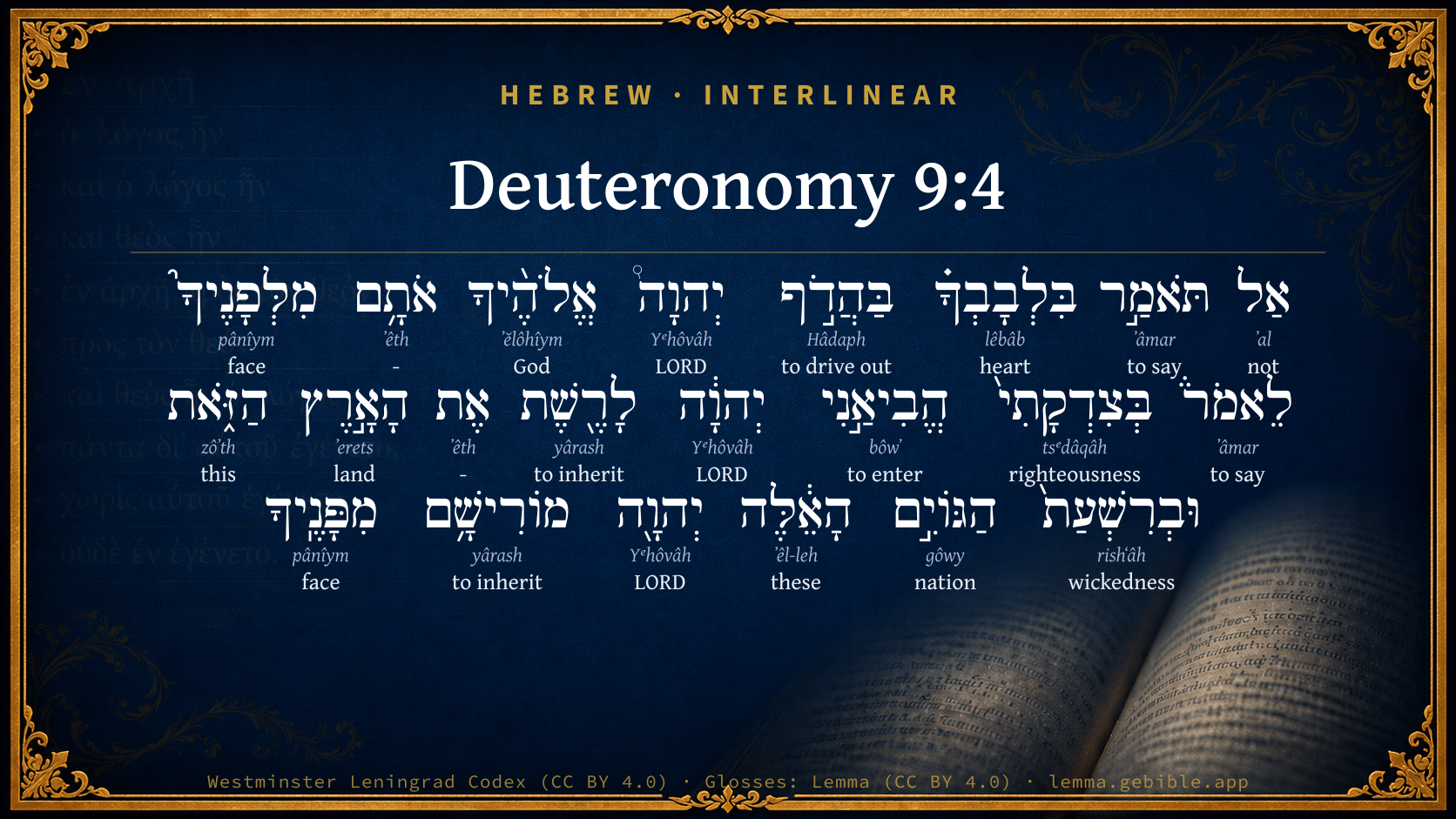
Hebrew (Westminster Leningrad Codex) Deuteronomy 9:4 appears in the Hebrew Old Testament. The text above is from the Westminster Leningrad Codex. Each word links to its Strong’s number, a concise gloss, and parsing drawn from the Open Scriptures Hebrew Bible morphology. Click any word for its full Brown-Driver-Briggs (BDB) entry.
Download image
Cite this verse

Deuteronomy 9:4 (World English Bible). Public Domain. Lemma interlinear Bible study tool, https://lemma.gebible.app/v/deuteronomy/9/4.

Show BibTeX & RIS
BibTeX
RIS
English Translation
Don't speak in your heart, after that Yahweh your God has thrust them out from before you, saying, For my righteousness Yahweh has brought me in to possess this land; whereas for the wickedness of these nations Yahweh does drive them out from before you.
World English Bible · Public Domain
Highlights Full analysis ↓
Download a study sheet

One document with this verse’s original text, its word-by-word gloss line, the meaning frame, cross-references with their text, attributed commentary, and full source and license credits — printable, and it pastes into notes with its structure intact.

This verse Autodidact and up

Study sheet (.html) Plain text (.txt)

A passage Seminary Student

Up to 50 verses in one chapter. A passage sheet keeps up to 6 commentary sources and 12 cross-references per verse, in the order this page ranks them, and says so on the sheet whenever that leaves anything out. Ask for a single verse and you get the Autodidact verse sheet above.

Everything on this page stays free to read, with no account — the sheet is a download of what is already on screen, not access to it.

Want to remove ads? Support Godless Engineer
Compare translations 3

The same verse in 3 English versions, stacked beneath the original-language interlinear above. Click any original word for its lexicon entry.

Each is an independent rendering of the whole verse — the interlinear is not word-aligned to these translations.

Highlighted words mark where these versions differ — a whole-verse word diff, not a word-by-word alignment.

  • World English Bible Public Domain
    Don't speak in your heart, after that Yahweh your God has thrust them out from before you, saying, For my righteousness Yahweh has brought me in to possess this land; whereas for the wickedness of these nations Yahweh does drive them out from before you.
  • King James Version Public Domain
    Speak not thou in thine heart, after that the LORD thy God hath cast them out from before thee, saying, For my righteousness the LORD hath brought me in to possess this land: but for the wickedness of these nations the LORD doth drive them out from before thee.
  • unfoldingWord Literal Text CC BY-SA 4.0
    You shall not say in your heart, when Yahweh your God has thrust them out from to your face, saying, ‘In my righteousness Yahweh has brought me in to possess this land,’ but in the wickedness of these nations, Yahweh is driving them out from your face.

unfoldingWord Literal Text — © unfoldingWord, licensed CC BY-SA 4.0. Word-aligned USFM3 via Door43 (git.door43.org/unfoldingWord/en_ult).

Versions to compare (up to 4)

3 of 4 selected

Show all 18 translations

Every available English version of this verse, each an independent rendering of the whole verse.

  • World English Bible Public Domain
    Don't speak in your heart, after that Yahweh your God has thrust them out from before you, saying, For my righteousness Yahweh has brought me in to possess this land; whereas for the wickedness of these nations Yahweh does drive them out from before you.
  • Berean Standard Bible Public Domain
    When the LORD your God has driven them out before you, do not say in your heart, “Because of my righteousness the LORD has brought me in to possess this land.” Rather, the LORD is driving out these nations before you because of their wickedness.
  • Majority Standard Bible Public Domain
    When the LORD your God has driven them out before you, do not say in your heart, “Because of my righteousness the LORD has brought me in to possess this land.” Rather, the LORD is driving out these nations before you because of their wickedness.
  • King James Version Public Domain
    Speak not thou in thine heart, after that the LORD thy God hath cast them out from before thee, saying, For my righteousness the LORD hath brought me in to possess this land: but for the wickedness of these nations the LORD doth drive them out from before thee.
  • American Standard Version (1901) Public Domain
    Speak not thou in thy heart, after that Jehovah thy God hath thrust them out from before thee, saying, For my righteousness Jehovah hath brought me in to possess this land; whereas for the wickedness of these nations Jehovah doth drive them out from before thee.
  • Revised Version (1885) Public Domain
    Speak not thou in thine heart, after that the LORD thy God hath thrust them out from before thee, saying, For my righteousness the LORD hath brought me in to possess this land: whereas for the wickedness of these nations the LORD doth drive them out from before thee.
  • Geneva Bible (1599) Public Domain
    Speake not thou in thine heart (after that the Lord thy God hath cast them out before thee) saying, For my righteousnesse the Lord hath brought me in, to possesse this land: but for the wickednesse of these nations the Lord hath cast them out before thee.
  • Douay-Rheims (1899) Public Domain
    Say not in thy heart, when the Lord thy God shall have destroyed them in thy sight: For my justice hath the Lord brought me in to possess this land, whereas these nations are destroyed for their wickedness.
  • Young's Literal Translation Public Domain
    `Thou dost not speak in thy heart (in Jehovah thy God's driving them away from before thee), saying, For my righteousness hath Jehovah brought me in to possess this land, seeing for the wickedness of these nations is Jehovah dispossessing them from thy presence;
  • Literal Standard Version CC BY-SA 4.0
    You do not speak in your heart (in your God YHWH’s driving them away from before you), saying, In my righteousness YHWH has brought me in to possess this land; but in YHWH dispossessing these nations from your presence, [it is because of] their being wicked.
  • Unlocked Literal Bible CC BY-SA 4.0
    Do not say in your heart, after Yahweh your God has thrust them out from before you, 'It was because of my righteousness that Yahweh has brought me in to possess this land,' for it was because of the wickedness of these nations that Yahweh is driving them out from before you.
  • unfoldingWord Literal Text CC BY-SA 4.0
    You shall not say in your heart, when Yahweh your God has thrust them out from to your face, saying, ‘In my righteousness Yahweh has brought me in to possess this land,’ but in the wickedness of these nations, Yahweh is driving them out from your face.
  • Darby Bible Public Domain
    Thou shalt not say in thy heart, when Jehovah thy God thrusteth them out from before thee, saying, For my righteousness Jehovah hath brought me in to possess this land; but for the wickedness of these nations doth Jehovah dispossess them from before thee.
  • World Messianic Bible Public Domain
    Don’t say in your heart, after the LORD your God has thrust them out from before you, “For my righteousness the LORD has brought me in to possess this land;” because the LORD drives them out before you because of the wickedness of these nations.
  • Webster's Bible Public Domain
    Speak not thou in thy heart, after that the LORD thy God hath cast them out from before thee, saying, For my righteousness the LORD hath brought me in to possess this land: but for the wickedness of these nations the LORD doth drive them out from before thee.
  • Free Bible Version CC BY-SA 4.0
    When the Lord your God has driven them out ahead of you, don't say to yourselves, “It's because I'm such a good person that the Lord has brought me here to take over this land.” No, the Lord is driving out these nations ahead of you because they're so wicked.
  • Bible in Basic English Public Domain
    And after the Lord has sent them in flight from before you, say not in your heart, Because of my righteousness the Lord has given me this land; when it is because of their evil-doing that the Lord is driving these nations out before you.
  • JPS Tanakh (1917) Public Domain
    Speak not thou in thy heart, after that the LORD thy God hath thrust them out from before thee, saying: 'For my righteousness the LORD hath brought me in to possess this land'; whereas for the wickedness of these nations the LORD doth drive them out from before thee.

Literal Standard Version (2020), Covenant Press — licensed CC BY-SA 4.0. Text via the HelloAO Bible API (eBible.org). Unlocked Literal Bible (unfoldingWord) — licensed CC BY-SA 4.0. Text via the HelloAO Bible API (eBible.org). unfoldingWord Literal Text — © unfoldingWord, licensed CC BY-SA 4.0. Word-aligned USFM3 via Door43 (git.door43.org/unfoldingWord/en_ult). Free Bible Version, Dr. Jonathan Gallagher — licensed CC BY-SA 4.0. Text via the HelloAO Bible API (eBible.org).

Word by word

More ways to search: Search by grammar → Find every occurrence → Compare this word →

Practice this passage: Drill this verse → Learn its vocabulary →

בַּהֲדֹ֣ף
Hâdaph
H1920
“in/at · to drive out”
Preposition + Verb, Qal, Infinitive Construct
Part of Speech
Preposition + Verb
Stem
Qal
Form
Infinitive Construct
Full BDB Definition

Origin: a primitive root

TWOT: 476

to thrust, push, drive, cast away, cast out, expel, thrust away - (Qal) - to thrust, push - to drive out, thrust out - to depose
  1. אַל ʼal H408 “not” Particle, Negative
  2. תֹּאמַ֣ר ʼâmar H559 “to say” Verb, Qal, Jussive, 2nd Person, Masculine, Singular
  3. בִּלְבָבְךָ֗ lêbâb H3824 “in/at · heart · your” Preposition + Noun, Common, Masculine, Singular, Construct + Suffix, Personal, 2nd Person, Masculine, Singular
  4. יְהוָה֩ Yᵉhôvâh H3068 “LORD” Noun, Proper
  5. אֱלֹהֶ֨יךָ ʼĕlôhîym H430 “God(s) · your” Noun, Common, Masculine, Plural, Construct + Suffix, Personal, 2nd Person, Masculine, Singular
  6. אֹתָ֥ם ʼêth H853 “- · them” Particle, Direct Object + Suffix, Personal, 3rd Person, Masculine, Plural
  7. מִלְּפָנֶיךָ֮ pânîym H6440 “from · to/for · face(s) · your” Preposition + Preposition + Noun, Common, Both, Plural, Construct + Suffix, Personal, 2nd Person, Masculine, Singular
  8. לֵאמֹר֒ ʼâmar H559 “to say” Preposition + Verb, Qal, Infinitive Construct
  9. בְּצִדְקָתִי֙ tsᵉdâqâh H6666 “in/at · righteousness · my” Preposition + Noun, Common, Feminine, Singular, Construct + Suffix, Personal, 1st Person, Common, Singular
  10. הֱבִיאַ֣נִי bôwʼ H935 “to enter · me” Verb, Hiphil, Perfect, 3rd Person, Masculine, Singular + Suffix, Personal, 1st Person, Common, Singular
  11. יְהוָ֔ה Yᵉhôvâh H3068 “LORD” Noun, Proper
  12. לָרֶ֖שֶׁת yârash H3423 “to inherit” Preposition + Verb, Qal, Infinitive Construct
  13. אֶת ʼêth H853 “-” Particle, Direct Object
  14. הָאָ֣רֶץ ʼerets H776 “the · land” Particle, Definite Article + Noun, Common, Both, Singular, Absolute
  15. הַזֹּ֑את zôʼth H2063 “the · this” Particle, Definite Article + Pronoun, Demonstrative, Feminine, Singular
  16. וּבְרִשְׁעַת֙ rishʻâh H7564 “and · in/at · wickedness of” Conjunction + Preposition + Noun, Common, Feminine, Singular, Construct
  17. הַגּוֹיִ֣ם gôwy H1471 “the · nations” Particle, Definite Article + Noun, Common, Masculine, Plural, Absolute
  18. הָאֵ֔לֶּה ʼêl-leh H428 “the · these” Particle, Definite Article + Pronoun, Demonstrative, Common, Plural
  19. יְהוָ֖ה Yᵉhôvâh H3068 “LORD” Noun, Proper
  20. מוֹרִישָׁ֥ם yârash H3423 “inheriting · them” Verb, Hiphil, Participle Active, Masculine, Singular, Construct + Suffix, Personal, 3rd Person, Masculine, Plural
  21. מִפָּנֶֽיךָ pânîym H6440 “from · face(s) · your” Preposition + Noun, Common, Both, Plural, Construct + Suffix, Personal, 2nd Person, Masculine, Singular

About this verse

These counts appear in no published source. They are computed here, from the morphology-tagged text and Lemma’s own curated glosses. What Lemma adds →

22
words
16
distinct lemmas
Pentateuch
section

Notable vocabulary

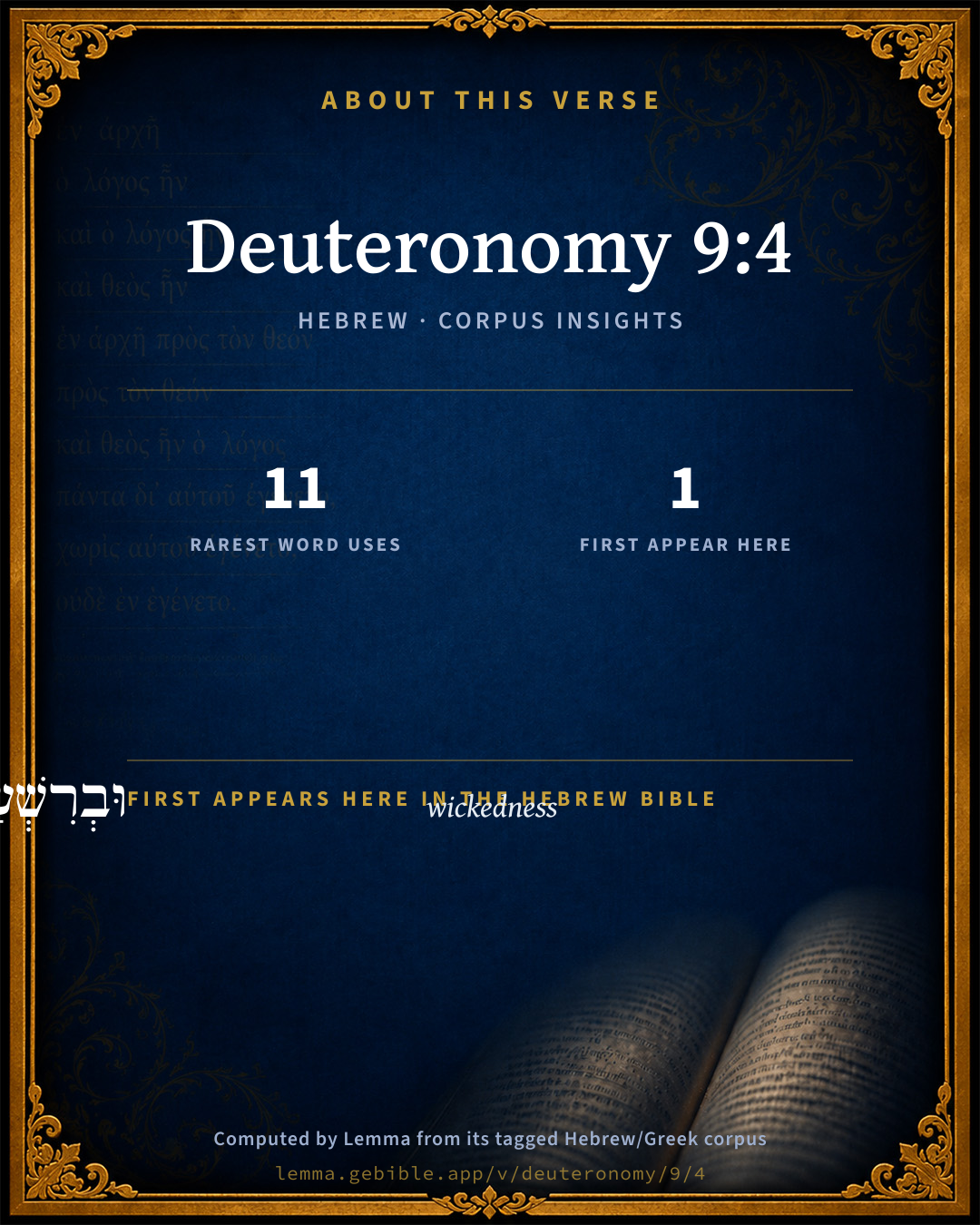
The rarest word here is בַּהֲדֹ֣ף to drive out H1920 — appearing just 11 times in the whole Hebrew Bible.

First appearance in Scripture

This word makes its first canonical appearance in the Hebrew Bible here:

  • וּבְרִשְׁעַת֙ wickedness H7564

Shared distinctive vocabulary

בַּהֲדֹ֣ף to drive out H1920 occurs in 11 verses of the Hebrew Bible. Also found in:

Grammatical profile

  • 6 verbs
  • 11 nouns
  • 2 pronouns
  • 3 particles

Verb forms

  • תֹּאמַ֣ר Qal · Jussive
  • בַּהֲדֹ֣ף Qal · Infinitive Construct
  • לֵאמֹר֒ Qal · Infinitive Construct
  • הֱבִיאַ֣נִי Hiphil · Perfect
  • לָרֶ֖שֶׁת Qal · Infinitive Construct
  • מוֹרִישָׁ֥ם Hiphil · Participle Active

Repetition

Words recur within this verse — often emphatic in Hebrew:

  • יְהוָה֩ LORD H3068 ×3
  • תֹּאמַ֣ר to say H559 ×2
  • מִלְּפָנֶיךָ֮ face H6440 ×2
  • לָרֶ֖שֶׁת to inherit H3423 ×2

Hebrew & Septuagint length

In English translation the verse runs 45 words from the Hebrew and 31 from the Septuagint (LXX English) — the Septuagint runs noticeably shorter here. See the side-by-side →

A rough comparison of the two English renderings, which tokenize alike — not a word-level alignment.

Word counts can differ between the Hebrew and the Greek without any difference in meaning — e.g. the Hebrew direct-object marker אֵת has no separate Greek word, and Greek often adds the article ὁ.

Cross-references

16

Topical passages linked to Deuteronomy 9:4 in the Treasury of Scripture Knowledge — connected by theme and wording, ordered by reader-vote popularity; previews shown in the World English Bible.

  • Deuteronomy 8:17 and [lest] you say in your heart, My power and the might of my hand has gotten me this wealth.
  • Deuteronomy 9:5 Not for your righteousness, or for the uprightness of your heart, do you go in to possess their land; but for the wickedness of these nations Yahweh your God does drive them out from before you, and that he may establish the word which Yahweh swore to your fathers, to Abraham, to Isaac, and to Jacob.
  • Deuteronomy 18:9–14 When you are come into the land which Yahweh your God gives you, you shall not learn to do after the abominations of those nations.
  • 2 Timothy 1:9 who saved us and called us with a holy calling, not according to our works, but according to his own purpose and grace, which was given to us in Christ Jesus before times eternal,
  • Leviticus 18:24–30 "'Don't defile yourselves in any of these things: for in all these the nations which I am casting out before you were defiled.
  • 1 Corinthians 4:7 For who makes you different? And what do you have that you didn't receive? But if you did receive it, why do you boast as if you had not received it?
  • Genesis 15:16 In the fourth generation they will come here again, for the iniquity of the Amorite is not yet full."
  • Deuteronomy 7:7–8 Yahweh didn't set his love on you, nor choose you, because you were more in number than any people; for you were the fewest of all peoples:
  • Deuteronomy 12:31 You shall not do so to Yahweh your God: for every abomination to Yahweh, which he hates, have they done to their gods; for even their sons and their daughters do they burn in the fire to their gods.
  • Romans 11:6 And if by grace, then it is no longer of works; otherwise grace is no longer grace. But if it is of works, it is no longer grace; otherwise work is no longer work.
  • Titus 3:3–5 For we were also once foolish, disobedient, deceived, serving various lusts and pleasures, living in malice and envy, hateful, and hating one another.
  • Ezekiel 36:22 Therefore tell the house of Israel, Thus says the Lord Yahweh: I don't do [this] for your sake, house of Israel, but for my holy name, which you have profaned among the nations, where you went.
  • Ezekiel 36:32 Nor for your sake do I [this], says the Lord Yahweh, be it known to you: be ashamed and confounded for your ways, house of Israel.
  • Romans 11:20 True; by their unbelief they were broken off, and you stand by your faith. Don't be conceited, but fear;
  • 1 Corinthians 4:4 For I know nothing against myself. Yet I am not justified by this, but he who judges me is the Lord.
  • Ephesians 2:4–5 But God, being rich in mercy, for his great love with which he loved us,

Cross-references courtesy of OpenBible.info (CC BY 4.0).

Hebrew and Greek witnesses Masoretic Hebrew ↔ Greek Septuagint

The same verse in the two great witnesses to the Old Testament, shown verse-for-verse.

Here the Septuagint runs noticeably shorter than the Hebrew — LXX2012 (modern English Septuagint) 31 words vs World English Bible 45. A rough length comparison of the two English translations, not a word-level alignment — read both below.

These are two independent witnesses, not word-aligned to each other, and the Septuagint is shown in lemma (dictionary) form.

Hebrew Deuteronomy 9:4 Masoretic · Westminster Leningrad Codex

אַל תֹּאמַ֣ר בִּלְבָבְךָ֗ בַּהֲדֹ֣ף יְהוָה֩ אֱלֹהֶ֨יךָ אֹתָ֥ם מִלְּפָנֶיךָ֮ לֵאמֹר֒ בְּצִדְקָתִי֙ הֱבִיאַ֣נִי יְהוָ֔ה לָרֶ֖שֶׁת אֶת הָאָ֣רֶץ הַזֹּ֑את וּבְרִשְׁעַת֙ הַגּוֹיִ֣ם הָאֵ֔לֶּה יְהוָ֖ה מוֹרִישָׁ֥ם מִפָּנֶֽיךָ

Don't speak in your heart, after that Yahweh your God has thrust them out from before you, saying, For my righteousness Yahweh has brought me in to possess this land; whereas for the wickedness of these nations Yahweh does drive them out from before you.

World English Bible · Public Domain

Greek LXX Deuteronomy 9:4 Septuagint · lemma form

μή εἶπον ἐν ὁ καρδία σύ ἐν ὁ ἐκ ἀναἁλίσκω κύριος ὁ θεός σύ ὁ ἔθνος οὗτος ἀπό πρόσωπον σύ λέγω διά ὁ δικαιοσύνη ἐγώ εἰςἄγω ἐγώ κύριος κληρονομέω ὁ γῆ ὁ ἀγαθός οὗτος ἀλλά διά ὁ ἀσέβεια ὁ ἔθνος οὗτος κύριος ἐκὀλεθρεύω αὐτός πρό πρόσωπον σύ

Speak not in your heart, when the Lord your God has destroyed these nations before your face, saying, For my righteousness the Lord brought me in to inherit this good land.

LXX2012 (modern English Septuagint) · Public Domain

On this verse, The Cambridge Bible for Schools and Colleges discusses the Septuagint’s reading. Read the note in Commentary ↓

Hebrew: Westminster Leningrad Codex (CC BY 4.0). Greek: Septuagint (public domain); English from LXX2012 (modern English Septuagint) (Public Domain). How the Septuagint differs from the Hebrew →

Targum (Aramaic paraphrase)

2

The Targum is the ancient Jewish Aramaic paraphrase of the Hebrew Scriptures — an interpretive translation, not the Hebrew text itself. Onkelos (literal) and Pseudo-Jonathan (expansive) render the Torah, and Jonathan the Prophets. Coverage is partial: where no permissively-licensed English translation exists for a verse, only the Aramaic is shown. This is verse-level text, not a word-by-word alignment to the Hebrew.

  1. Targum Onkelos Torah (Genesis–Deuteronomy)
    לָא תֵימַר בְּלִבָּךְ בִּדְיִתְּבַר יְיָ אֱלָהָךְ יָתְהוֹן מִקֳדָמָךְ לְמֵימַר בְּזָכוּתִי אַעֲלַנִי יְיָ לְמֵירַת יָת אַרְעָא הָדָא וּבְחוֹבֵי עַמְמַיָא הָאִלֵין יְיָ מְתָרֶכְהוֹן מֵקֳדָמָךְ

    (no public-domain English translation for this verse)

    Targum Onkelos — Aramaic: “Onkelos Genesis” (public domain); “Onkelos Exodus” (public domain); “Onkelos Leviticus” (public domain); “Onkelos Numbers” (public domain); “Onkelos Deuteronomy” (public domain). English: “Sefaria Community Translation” (CC0 1.0 (public-domain dedication)); “J.W. Etheridge. The Targums of Onkelos and Jonathan Ben Uzziel on the Pentateuch. London: Longmans, Green, 1862” (public domain). Text via Sefaria.

  2. Targum Pseudo-Jonathan Torah (Genesis–Deuteronomy)
    לָא תֵימְרוּן בְּלִבְּכוֹן כַּד יַדְחֵי יְיָ אֱלָהָכוֹן יַתְהוֹן מִן קֳדָמֵיכוֹן לְמֵימָר בִּזְכוּתִי אַעֲלַנִי יְיָ לְמֵירַת יַת אַרְעָא הָדָא וּבְחוֹבֵי עַמְמַיָא הָאִלֵין יְיָ מְתַרְכְהוֹן מִן קֳדָמֵיכוֹן

    Speak not in your heart when the Lord your God hath driven them away from before you saying, For the sake of my righteousness hath the Lord brought me in to inherit this land; for on account of the sins of these people the Lord driveth them out before you.

    Targum Pseudo-Jonathan — Aramaic: “Targum Jonathan on Genesis” (public domain); “Targum Jonathan on Exodus” (public domain); “Targum Jonathan on Leviticus” (public domain); “Targum Jonathan on Numbers” (public domain); “Targum Jonathan on Deuteronomy” (public domain). English: “The Targum of Jonathan ben Uzziel, trans. J. W. Etheridge, London, 1862” (public domain). Text via Sefaria.

Commentary

Notes on Deuteronomy 9:4 from classic Christian and Jewish commentators (each source and its license shown beneath its notes). The classic Christian expositions comment on the surrounding passage and are grouped to its opening verse, so a note may address several verses; the Jewish commentaries on the Tanakh (Rashi and others) are per-verse, so they appear only where the commentator wrote on this verse.

Lemma curates 59 commentaries, every one of them public domain or Creative Commons licensed, each selected and text-cleaned for this edition rather than reprinted as found. About our sources →

Trapp's Complete Commentary

John Trapp

Deu 9:4 Speak not thou in thine heart, after that the LORD thy God hath cast them out from before thee, saying, For my righteousness the LORD hath brought me in to possess this land: but for the wickedness of these nations the LORD doth drive them out from before thee.

Ver. 4. For my righteousness.] We are all apt to weave a web of righteousness of our own, to spin a thread of our own to climb up to heaven by, to set a price upon ourselves above the market, to think great thoughts of ourselves, and to seek great things for ourselves. Caelum gratis non accipiam, saith one merit monger, I will not have heaven for nothing; and, Redde mihi aeternam vitam quam debes, saith another; Give me heaven, for thou owest it me. How blasphemous is that direction of the Papists to dying men, Coniunge, Domine, obsequium meum cum omnibus quae Christus passus est prome: Join, Lord, my righteousness with Christ’s righteousness! How much better was it with those ancient Papists here in England, to whom, upon their deathbeds, the ordinary instruction appointed to be given was, that they should look to come to glory, not by their own merits, but alone by the virtue and merit of the passion of our Lord Jesus Christ; that they should place their whole confidence in his death only, and in no other thing! {a} &c. Those justiciaries, that seek to be saved by their works, Luther fitly calls the devil’s martyrs; they suffer much, and take much pains to go to hell, and by their much boasting, Haec ego feci, haec ego feci, they become no better than Faeces, saith he wittily. It is a good observation of a reverend divine, {b} that the Church in the Canticles is nowhere described by the beauty of her hands or fingers. Christ concealeth the mention of her hands - that is, of her works - (1.) Because he had rather his Church should abound in good works in silence, than boast of them, especially when they are wanting, as Rome doth; (2.) Because it is he alone that "worketh all our works for us." {Isa 26:12 Hos 14:8}

{a} Dr Ussher, Ser. on Eph 4:13.

{b} Mr Cotton, on Cantic., p. 217.

John Trapp, A Commentary or Exposition upon All the Books of the Old and New Testament (1647–1656) — public domain. Text from a community e-Sword module.

The Biblical Illustrator

Joseph S. Exell

Deu_9:4-5

Not for thy righteousness.

That outward success, prosperity, and greatness in the world is no true evidence of grace

I. Men are very prone to make the outward prosperity and increase which God giveth them an argument of their righteousness, and so of Gods love to them, to save them. They think it impossible that, seeing God hath so blessed them here, He should damn them hereafter. For the discovery of the weakness of this prop take notice first of these particulars.

1. Prosperity, wealth, and success are in themselves blessings, mercies, and so good things to be desired. Hence we read of the people of God praying for these earthly mercies, and we have a direction for it in the Lords Prayer, when we pray for daily bread. It is true, indeed, the very petition doth much limit our desires, for it is after the great things that belong to Gods glory; and it is but one petition, whereas there are divers for spiritual things, so that our Saviour would have us to be above these earthly things, as those fowls of the heaven are which on a sudden fall on the ground for their food, but presently fly up to heaven again; and then it is daily food, or as the most learned expound it, food convenient, and decent for our place and calling, not superfluity.

2. Although these are blessings and mercies, and so good things, yet they are not sanctifying of those that have them. Dives said he had good things laid up in store, but how were they good which made him bad? How were they good which could not keep him out of hell? Riches, therefore, are neither good nor bad, but indifferent in their nature. Those are good things which make us good.

3. As outward wealth and increase are blessings, so they do belong by promise unto godliness (1Ti_4:8). I do not say with some divines that wicked men have no right to their goods, that they are usurpers, and shall answer for every bit of bread they eat, as robbers and thieves. No, it is a dangerous position to hold civil dominion and right to be placed upon godliness. The earth hath He given to the children of men, saith the Psalmist, to all men as well as to the godly; but as there is a lawful, civil right, so there is a sanctified use, and this only the godly have.

4. Although we cannot conclude grace by outward mercies, yet thus far we must by Scripture say, that God out of a general love in a providential way doth give many a man outward prosperity and wealth for his diligence, industry, upright and honest dealing in the world. Thus Solomon saith, The hand of the diligent maketh rich, and truth and justice in our day is blessed by God to increase.

5. Some go into another extremity, and conclude of their good estate and holy condition because they are in a poor, needy, and miserable estate, and destitute of all earthly comforts. But every poor man is not a Lazarus, nay, there are many times none more wicked, cursed, profane, and enemies to all goodness, than those that are in a low and miserable condition. A woeful thing it is, indeed, to have nothing but misery here, and nothing but torments hereafter.

II. Why outward prosperity and blessings do not argue a mans good estate.

1. It may be demonstrated from the original, or fountain, whence they flow. It is not only from Gods love, but His anger also. Sometimes God giveth men the outward comforts of this life in His hot displeasure.

2. Therefore may not outward plenty and mercies be made a sign of our good estate, because they have always in corrupt hearts corrupt and sinful operations. As--

(1) Outward comforts in the plenty of them are apt to beget pride and loftiness of heart, so as to despise and contemn those that are under them.

(2) If these outward mercies deaden thy heart to the things of God, or the exercise of those means of grace God hath appointed, oh, thou hast cause then to tremble in the increase of them.

(3) Then can outward abundance be no comfortable sign, when the means to get it and the way to preserve it are unlawful, and such as the Scripture condemneth.

3. Therefore may we not trust in outward prosperity, because God many times giveth a man all the good things he shall have in this life only, and afterwards there is nothing but everlasting woe and misery.

4. Therefore may we not trust in these, because we many times abuse them to a contrary end for which God gave them; He gave them to be instruments of much glory to God and good to others. Rich men are the greatest men in debt of all others; they owe much to God, much to the public, much to others necessities; now what comfort canst thou take if God bless thee with these things if thou dost not also find Him making thee thereby instrumental to His glory? If thou keepest all the good mercies God vouchsafeth to thee, as the ants and pismires do their grain and corn, which they hide in their little hills, and, as they say, bite it that it may not grow.

5. They are not to be relied on, because though all power to get wealth and prosper in the world argue God is with thee, yet He may be only with thee providentially and powerfully, not graciously; as when Nebuchadnezzar conquered and prevailed, when Alexander became great, Augustus happy. God was with these in a mighty, providential way, but not graciously.

Use--1. Of reproof to those who desire these outward good things more than inward and spiritual.

Use--2. Of instruction to those who meet with much prosperity and outward encouragements in this world. Take heed of thinking that God doth this to thee for thy righteousness, for thy piety.

Use--3. Of consolation to the godly, who, it may be, want many of those outward mercies the wicked have. Let them know they are no arguments of true godliness, or of Gods dear love in Christ. (Anthony Burgess.)

The warnings of Moses

I. Principles of Gods government.

1. Mark the assertion that God governs mankind.

2. That God governs by law in the moral as in the material world.

II. They point out a national danger--self-righteousness.

1. A subtlety in self-righteousness. It is so multiform.

(1) There may be the form of godliness, etc.

(2) A power to criticise.

(3) Freedom from observable faults.

(4) Possession of some great virtues.

2. And its danger is--

(1) To mistake the outward for the inward.

(2) To lose sight of personal sin through the glorification of some real or imaginary virtue.

(3) To rest on privileges.

(4) To simulate virtues.

(5) To blind the soul as to its real state and need.

Application--

1. Self-righteousness the great hindrance to the reception of the Gospel now (Luk_18:10; Rom_10:3; Rev_3:17).

2. Use Davids prayer (Psa_139:23).

3. Work of the Holy Spirit (Joh_16:8). (H. W. Dearden, M. A.)

The address of Moses

I. The address of Moses is very different from the addresses of most captains of armies under similar circumstances.

1. He makes no attempt to underrate the power of the enemies with whom the Israelites had to contend. He begins his address by telling the people that they are that day to pass over Jordan, to go in and possess nations greater and mightier than themselves. The reason for his giving such information was that the design of God was not merely to conquer the Canaanites, but to educate Israel, to teach them that by Gods power weakness may be made strength and the mighty vanquished by the feeble.

2. Moses assures the people in plain language that no righteousness of theirs had gained them the land. They might be ready enough to admit that it was not their own courage or their own bodily strength, but they might still be disposed to think that they had deserved Gods favour, that if they had not been deserving of the victory, God would not have given it to them. Self-flattery is easy, and therefore Moses very wisely and decidedly protested once for all against such a view of Gods doings.

II. The principle of spiritual life with ourselves is precisely that which Moses laid down as the principle of national life for the Israelites. God gives us the land of promise for no righteousness of our own. Everything depends on Gods mercy, Gods will, Gods purpose; the certainty of victory depends, not upon any feelings or experiences or conflicts of ours, but upon the ever-present help of the Almighty God. (Bp. Harvey Goodwin.)

Heaven and glory not the reward of our own righteousness

One would think this too obvious to be disputed in the mind of an Israelite. Then I ask if any man or woman, taking a calm retrospect of his or her life, has not to say the same?

I. Let us inquire to what subjects this principle may be applied.

1. To our lot in life, and to our temporal affairs. The earth is the Lords, and the fulness thereof. He may do what He will with His own. In the independence and infinite sovereignty of His government He sends small means and penury, or He dispenses riches and honours, according to His own good pleasure, and to accomplish the inscrutable purposes of His heavenly providence.

2. To our religious condition and privileges.

3. To success in the ministry.

4. To the rest and glory of the heavenly world. Eternal life is the gift of God.

II. What are the reasons for which we shall possess the land?

1. The choice and will, the purpose and pleasure of the Almighty.

2. Gods justice on the one hand, and His goodness on the other.

3. The faithfulness of God to His promises.

III. What is the use of this doctrine?

1. It is taught us that we may understand it. Acknowledge your own poverty and Gods riches. Submit to His method and plan of justification and acceptance by Christ. Do not go about to establish your own righteousness.

2. I cannot conclude without one caution. A farthing is a farthing, and a sixpence is a sixpence; so of an ingot of gold or a banknote. And a farthing will only purchase what it is worth. A sixpence will not buy what is worth a hundred pounds. But let it buy what it will. If you want an estate you must give the ingots and the banknotes. So let the work of Christ alone, the costly and prodigious sum, secure for you the glory and the heritage of heaven. But let your own righteousness and your small virtues do what they will. You cannot purchase glory with them, but they will do much for the welfare of men and the honour of God, and they will show forth your gratitude and love. (James Stratten.)

Mercy, not merit

Mercy, not merit, is the cause of all the blessings of our being.

I. This is true of our secular possessions. If we say that our comfortable homes, our freedom from temporal anxiety, and our possession of a competency, have come to us as the result of industrious efforts and economical habits, that they are our reward for honest labour: the reply is--

1. That to such a reward we have no right. We are sinners, and justly deserve not only destitution but destruction.

2. That both the materials of labour, and the power to labour, which have brought us these comforts, are to be ascribed to Gods mercy.

II. This is true of our religious advantages. Bibles, sanctuaries, religious literature. The tender mercies of our God have visited us.

III. This is true of our Christian experience.

IV. This is true of our spiritual usefulness. Not by might, nor by power, etc.

V. This is true of our heavenly inheritance. (Homilist.)

The favoured peoples of the earth

There are favoured peoples in all communities--persons specially favoured by their healthful constitutions, vigorous intellect, lofty genius, high culture, worldly wealth.

I. Whatever favours distinguish one class of men from another in society, they are the gifts of God. This should teach us--

1. Not to be proud for our superiorities.

2. To thank God for our superiorities.

3. To bless men by our superiorities.

II. These distinguished gifts are bestowed, not on the ground or any special moral excellence.

III. The fact that they are not bestowed on the ground of moral superiority should be well understood by men.

1. Understand it, that you may not deceive yourself. Let no man conclude because he is prosperous that he is the favoured of heaven.

2. Understand it, that you may realise your responsibility. (Homilist.)

The Biblical Illustrator, edited by Joseph S. Exell (c. 1880s–1900s) — public domain. Text from a community e-Sword module.

Geneva Bible (1599)

Geneva Bible translators

Man of himself can deserve nothing but God’s anger, and if God spare any it cometh of his great mercy.

Geneva Bible (1599) marginal notes — public domain. Text via Bolls.life.

Jamieson, Fausset & Brown

Robert Jamieson, A. R. Fausset & David Brown

Speak not thou in thine heart, . . . saying, For my righteousness the Lord hath brought me in to possess this land--Moses takes special care to guard his countrymen against the vanity of supposing that their own merits had procured them the distinguished privilege. The Canaanites were a hopelessly corrupt race, and deserved extermination; but history relates many remarkable instances in which God punished corrupt and guilty nations by the instrumentality of other people as bad as themselves. It was not for the sake of the Israelites, but for His own sake, for the promise made to their pious ancestors, and in furtherance of high and comprehensive purposes of good to the world, that God was about to give them a grant of Canaan.

Jamieson, Fausset & Brown — Commentary Critical and Explanatory on the Whole Bible (1871) — public domain (CC PDM 1.0). Text via the HelloAO Bible API.

Ellicott's Commentary for English Readers

(4) But for the wickedness.—“Say not in thine heart, ‘in my righteousness,’ when it is in consequence of their wickedness that Jehovah is dispossessing them from before thee.”

A Bible Commentary for English Readers, edited by Charles John Ellicott (1878–1897) — public domain. Text from a community e-Sword module.

The Cambridge Bible for Schools and Colleges

gen. ed. J. J. S. Perowne

4. Speak … in thine heart] See on Deu_8:17.

thrust them out] See on Deu_6:19.

For my righteousness] Here ethical: contr. Deu_6:25.

whereas for the wickedness … from before thee] The whole clause is wanting in LXX B and seems a gloss or expansion anticipating the next v. and weakening the connection (Valeton, Dillm., Driver, Steuern., Berth.).

The Cambridge Bible for Schools and Colleges (gen. ed. J. J. S. Perowne; Cambridge University Press, 1878–1918) — public domain. Text from a community e-Sword module.

John Gill's Exposition

Speak not thou in thine heart,.... Never once think within thyself, or give way to such a vain imagination, and please thyself with it:

after that the Lord thy God hath cast them out from before thee; to make way for the Israelites, and put them into the possession of their land; which is to be ascribed not to them, but to the Lord:

saying, for my righteousness the Lord hath brought me in to possess this land; such a thought as this was not to be secretly cherished in their hearts, and much less expressed with their lips; nothing being more foreign from truth than this, and yet a notion they were prone to entertain. They were always a people, more or less, from first to last, tainted with a conceit of their own righteousness, and goodness, which they laboured to establish, and were ready to attribute all the good things to it they enjoyed, and nothing is more natural to men, than to fancy they shall be brought to the heavenly Canaan by and for their own righteousness; which is contrary to the perfections of God, his purity, holiness, and justice, which can never admit of an imperfect righteousness in the room of a perfect one; to justify anyone thereby, is contrary to the Gospel scheme of salvation; which is not by works of righteousness men have done, but by the grace and mercy of God through Christ; it would make useless, null, and void, the righteousness of Christ, which only can justify men in the sight of God, give a title to heaven and happiness, and an abundant entrance into it; and would occasion boasting, not only in the present state, but even in heaven itself; whereas the scheme of salvation is so framed and fixed, that there may be no room for boasting, here or hereafter, see Rom 3:27,

but for the wickedness of these nations the Lord doth drive them out from before thee; namely, their idolatry, incest, and other notorious crimes; see Lev 18:3, which sufficiently justifies God in all his dealings with these nations.

John Gill's Exposition of the Whole Bible (1746–1763) — public domain (CC PDM 1.0). Text via the HelloAO Bible API.

Whedon's Commentary on the Bible

Daniel D. Whedon

4, 5. Speak not,… For my righteousness — Moses sees as one of the perils to which the people will be exposed the disposition to ascribe their success to themselves, or as bestowed upon them on account of their own righteousness; so he repeats, to make it more impressive, Not for thy righteousness,… but for the wickedness of these nations.

In Deu_9:7-24 Moses reminds the people of the long record of their rebellious acts against Jehovah. From Egypt to the borders of the land promised to them for an inheritance they have murmured and rebelled.

Daniel D. Whedon (gen. ed.), Commentary on the Old and New Testaments (1874–1909) — public domain. Text from a community e-Sword module.

The Pulpit Commentary

Vers. 4, 5. Speak not thou in thine heart. (cf. Deu_8:17) The distinction between righteousness and uprightness (straightness) of heart, is that the former (dx) has reference to rectitude of conduct, the latter (rvy) to rectitude of motive and purpose. "By naming justice righteousness, he excludeth all merit of works, and by righteousness uprightness of heart, all inward affections and purposes. which men might plead, notwithstanding that they fail in action. Yet these two are the chief things which God respecteth in men" (Psa_15:1, Psa_15:2; 1Ch_29:17) (Ainsworth).

Vers. 4, 5. See Homilies on (Deu_3:11 Deu_7:1-11)

HOMILIES BY J. ORR. Vers. 4-7. Self-righteousness.

Strange capacity of human nature for self-delusion! It was an extraordinary error to fall into, when the Jew began to fancy that by his own power and might he had conquered Palestine. (Deu_8:17) Yet more extraordinary was the delusion that he had been brought into the land on account of righteousness. The two errors sprang from the same root. The worldly mind, which spurns at the acknowledgment of God"s bestowal of what it has, has its counterpart in the self-righteous mind, which attributes God"s dealings with it to its superior sanctity. Self-exaltation, pride, in both. In the one case, "my power," etc., in the other, "my righteousness.

I THE NATURE OF THE ERROR. A magnified opinion of one"s righteousness. The idea that it is our righteousness which is the meritorious ground of the bestowal of blessing. The Jews might not suppose that they were absolutely righteous though some of the later Pharisees seem almost to have got this length. (Luk_18:11) But they thought that they were so far righteous as to have established a claim on God"s justice for what they had. This is a state of mind into which men glide half unconsciously. We often say it "in our hearts," when we would be ashamed to avow it with our lips. The self-complacency, e.g. which accepts prosperity as the reward of superior virtue; the self-satisfaction which esteems such reward due to it; the complaint of injustice which is raised when blessings are removed, betray its presence. In the spiritual sphere, the tendency is evidenced in the denial of the need of salvation; in the self-justifying spirit which refuses to accept the position of one condemned, and justly exposed to wrath; in the reassertion in subtler or coarser forms of the principle of salvation by works. In whatever degree a man thinks himself entitled to acceptance with God, and to spiritual blessings, whether on the ground of obedience to prescribed rules, or on the ground of internal characteristics (faith, holiness, etc.), he is permitting himself to fall into this error.

II THE SOURCE OF THE ERROR. The Israelites might fall into it:

1. By emphasizing their acts of obedience and forgetting their rebellions. This, as Moses shows, is practically what they did. It is not an uncommon fault. We forget our sins, and, thinking only of obediences, slide by easy stages into a self-satisfied and pleased view of ourselves.

2. By comparing themselves with the former generation. They had not been, as their fathers were, absolutely disobedient and recalcitrant. They were going up to possess the land. This comparing of ourselves with others is not wise. If a little in advance of our neighbors, it is extremely apt to inflate our consciousness of integrity. (2Co_10:12)

3. By arguing from the fulfillment of promise. God had promised victory and possession on condition of obedience. Having got the blessings, they might argue that, in God"s judgment, they must have been obedient. We, in like manner, may argue from God"s kindness to us that we must have been peculiarly, pleasing to him. Hence that we are deserving of what we have received. The spring of all is the natural egoism of the heart. It is its own center. It wishes to exalt and glorify itself. It has no idea of glorying only in God. It is self-exalting, not God-exalting. (1Co_1:29-31; Gal_6:14; Php_3:7-10)

III THE REFUTATION OF THE ERROR. Even perfect righteousness would not justify self-righteousness. The very indulgence of the self-glorying spirit refutes the contention of righteousness. Whoever is the righteous man, it is not he who boasts of righteousness!

For merit lives from man to man, And not from man, O Lord, to thee.

But:

1. We are not righteous. The only justifying righteousness is a perfect one, and that no man can plead. The legal ground is destroyed when we admit failure in even one point. (Jam_2:10)

2. We are, in many ways, disobedient and rebellious. Past acts testify against us. Our daily life testifies against us. He knows little of self who does not read, in his disinclinations to duty, in his reluctant performances, in his rebellions at difficulties, in his secret impatience, in his frequent inclining to things forbidden, the signs of a wayward and rebellious disposition.

The true ground on which blessing is bestowed is wrapped up in that old oath sworn to the fathers (ver. 5), in the seed of Christ, in whom only we have acceptance. J.O.

The Pulpit Commentary (1880–1919), ed. H.D.M. Spence-Jones & Joseph S. Exell — public domain. Text from a community e-Sword module.

unfoldingWord translationNotes

Door43 World Missions Community

General Information:

Moses continues to speak to the Israelites as if they are one person. (See: Forms of You)

Do not say in your heart

Here "in your heart" means "in your thoughts." AT: "Do not think to yourselves" (See: Metonymy)

has thrust them out

"has driven the other peoples out"

translationWords

heart

righteous

possess

evil

cast out

unfoldingWord translationNotes — © Distant Shores Media and the Door43 World Missions Community, licensed CC BY-SA 4.0. Source: git.door43.org/Door43/en_tn.

Rashi

Rabbi Shlomo Yitzchaki (Rashi)

אל תאמר בלבבך SAY NOT IN THY HEART, “My righteousness and the wickedness of these nations brought it about that I possess the land;

Rashi on the Tanakh — English translations: “The Judaica Press complete Tanach with Rashi, translated by A. J. Rosenberg” (CC BY 4.0); “Pentateuch with Rashi's commentary by M. Rosenbaum and A.M. Silbermann, 1929-1934” (public domain); “The Metsudah Tanach series, Lakewood, N.J” (CC BY 4.0); and “The Book of Joshua, Metsudah Publications, 1997” (CC BY 4.0). Text via Sefaria.

Ramban (Nachmanides)

Rabbi Moshe ben Nachman (Ramban / Nachmanides)

SPEAK NOT THOU IN THY HEART. After cautioning that you should not think ‘my power and the might of my hand hath gotten me this wealth.’ but instead you are to know that the power over the vanquished was given to you by G-d, and that [the victory over] their mighty ones and fortified cities that you will have conquered [was made possible by] G-d in His Glory Who did it for you in a generally known miracle from Him, he further warned them, “Do not think that G-d did all this for you because of your righteousness; rather, He has done so for you only because of the wickedness of these nations.” Now this is a cause for the destruction of these nations, but he gave no reason for Israel’s possession of the Land. Therefore he reverted and explained, Not for thy righteousness that you will be righteous in conduct, nor even because of the upright heart that you will have, but only because of the wickedness of these nations will they be destroyed, and because of [His] oath to your fathers will you possess the Land, for your sin cannot annul the gift He gave to your fathers since He gave it to them by an oath. And Rashi wrote: “Speak not thou in thy heart — my righteousness and the wickedness of these nations caused me [to possess the Land]. Not for thy righteousness.” But this is not correct. the wickedness of the nations was a cause of one thing — their coming into the possession of the Land. On this Ramban comments that the verses indicate instead that there are two separate warnings here: “Do not think that because of your righteousness you are coming to possess the Land, and do not think that because of the wickedness of these nations they are driven out from it” (Mizrachi).Now one should ask, “Has he not said, But because the Eternal loved you, thus establishing that they are beloved on high, and, [as we know], G-d loves only those who are good, for the wicked and him that loveth violence His soul hateth, and if so, [it is justifiable that] they come to possess the Land also for their [own] righteousness [so, how can he say here Not for thy righteousness, etc.]?” The answer is that there he speaks of Israel in general, and here he reproves that particular generation that has been rebellious against the Eternal from the day they were in the wilderness.

Ramban (Nachmanides) on the Tanakh — English translation: “Commentary on the Torah by Ramban (Nachmanides). Translated and annotated by Charles B. Chavel. New York, Shilo Pub. House, 1971-1976” (CC BY 4.0). Text via Sefaria.

Sforno

Rabbi Ovadia Sforno

Do not think. When you see your miraculous victory and recognize that it is the work of Hashem,

do not mistakenly think that it was your righteousness that brought you to inherit the land, and that you are worthy of inheriting the land in your merit.

Because of the wickedness of these nations is Hashem expelling them before you. The reason that Hashem fought for you was because of the wickedness of the gentile nations, not in order that you should inherit quickly.

Sforno on the Tanakh — English translation: “Yalkut, Sifsei Chachomim Chumash, Metsudah Publications, 2009” (CC BY 4.0). Text via Sefaria.

Lesson kit

Teaching starters — assembled from the data on this page, not authored interpretation. Every prompt links to the verse data it draws on. Edit before teaching.

Deuteronomy, in the Pentateuch, opens this verse with 22 words (16 distinct Hebrew lemmas). Its most distinctive word is Hâdaph (“to drive out”). The Greek Septuagint runs shorter here. A historical commentator’s framing appears above. Read the whole chapter for the surrounding context.

Discussion questions

  1. How does “to drive out” (Hâdaph) shape what this verse is saying?
  2. The word “wickedness” first appears here in Scripture. What is being introduced at this debut?
  3. Numbers 35:20 shares the word «to drive out» with this verse. How do the two illuminate each other?
  4. “LORD” occurs 3× in this one verse. What is the effect of the repetition?
  5. Compared with the Hebrew, the Septuagint runs shorter here. What questions does that raise?
  6. These translations render this verse differently; the difference is in the English rendering, not the original. What questions does that raise?
  7. The verb «תֹּאמַ֣ר» is Qal Jussive. How does its form color the action?
  8. Reading how Trapp's Complete Commentary and The Biblical Illustrator read this verse, where do the two commentators agree and where do they part?

Things to notice

  • 1 word makes its first canonical appearance in Scripture here.
  • These translations choose different wording for 18 words in this verse.
  • “LORD” occurs 3× in this single verse.
  • 16 distinct Hebrew lemmas span 22 words in this verse.

Reading settings

Reading text

Shown beneath each verse's original-language words.

Old Testament
Old Testament edition

Read the OT as the Masoretic Hebrew (MT) or the Greek Septuagint (LXX).

English shown for the Greek Septuagint (in the Hebrew ↔ Greek comparison).

Comparing translations? Open the Compare panel on any verse page to stack up to four side by side.