Ezekiel 31:17

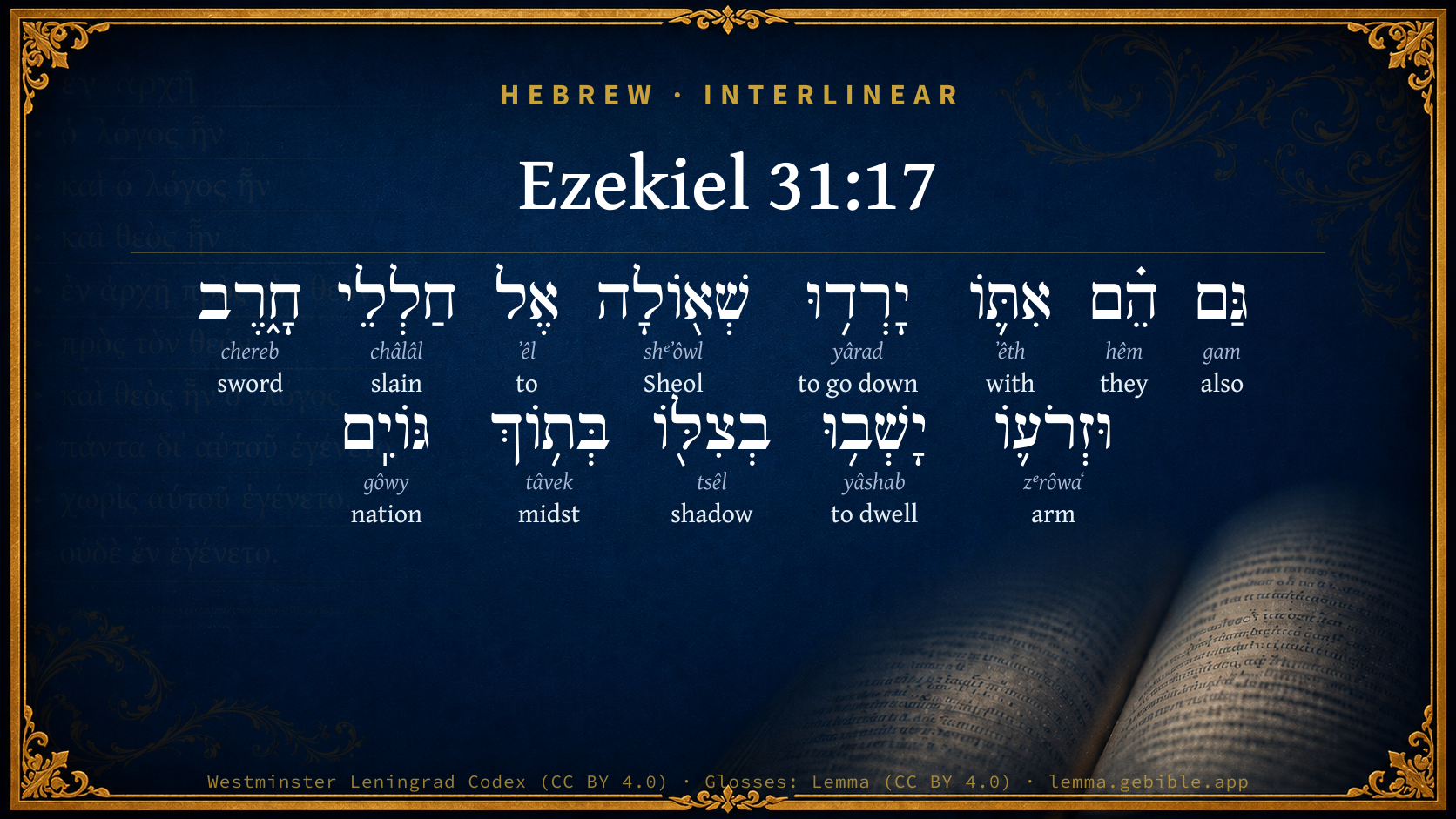
Hebrew (Westminster Leningrad Codex) Ezekiel 31:17 appears in the Hebrew Old Testament. The text above is from the Westminster Leningrad Codex. Each word links to its Strong’s number, a concise gloss, and parsing drawn from the Open Scriptures Hebrew Bible morphology. Click any word for its full Brown-Driver-Briggs (BDB) entry.
Download image
Cite this verse

Ezekiel 31:17 (World English Bible). Public Domain. Lemma interlinear Bible study tool, https://lemma.gebible.app/v/ezekiel/31/17.

Show BibTeX & RIS
BibTeX
RIS
English Translation
They also went down into Sheol with him to those who are slain by the sword; yes, those who were his arm, [that] lived under his shadow in the midst of the nations.
World English Bible · Public Domain
Download a study sheet

One document with this verse’s original text, its word-by-word gloss line, the meaning frame, cross-references with their text, attributed commentary, and full source and license credits — printable, and it pastes into notes with its structure intact.

This verse Autodidact and up

Study sheet (.html) Plain text (.txt)

A passage Seminary Student

Up to 50 verses in one chapter. A passage sheet keeps up to 6 commentary sources and 12 cross-references per verse, in the order this page ranks them, and says so on the sheet whenever that leaves anything out. Ask for a single verse and you get the Autodidact verse sheet above.

Everything on this page stays free to read, with no account — the sheet is a download of what is already on screen, not access to it.

Want to remove ads? Support Godless Engineer
Compare translations 3

The same verse in 3 English versions, stacked beneath the original-language interlinear above. Click any original word for its lexicon entry.

Each is an independent rendering of the whole verse — the interlinear is not word-aligned to these translations.

Highlighted words mark where these versions differ — a whole-verse word diff, not a word-by-word alignment.

  • World English Bible Public Domain
    They also went down into Sheol with him to those who are slain by the sword; yes, those who were his arm, [that] lived under his shadow in the midst of the nations.
  • King James Version Public Domain
    They also went down into hell with him unto them that be slain with the sword; and they that were his arm, that dwelt under his shadow in the midst of the heathen.
  • unfoldingWord Literal Text CC BY-SA 4.0
    For they also went down with it to Sheol, to the ones who had been killed by the sword. These were its strong arm, those nations who had lived in its shade.

unfoldingWord Literal Text — © unfoldingWord, licensed CC BY-SA 4.0. Word-aligned USFM3 via Door43 (git.door43.org/unfoldingWord/en_ult).

Versions to compare (up to 4)

3 of 4 selected

Show all 18 translations

Every available English version of this verse, each an independent rendering of the whole verse.

  • World English Bible Public Domain
    They also went down into Sheol with him to those who are slain by the sword; yes, those who were his arm, [that] lived under his shadow in the midst of the nations.
  • Berean Standard Bible Public Domain
    They too descended with it to Sheol, to those slain by the sword. As its allies they had lived in its shade among the nations.
  • Majority Standard Bible Public Domain
    They too descended with it to Sheol, to those slain by the sword. As its allies they had lived in its shade among the nations.
  • King James Version Public Domain
    They also went down into hell with him unto them that be slain with the sword; and they that were his arm, that dwelt under his shadow in the midst of the heathen.
  • American Standard Version (1901) Public Domain
    They also went down into Sheol with him unto them that are slain by the sword; yea, they that were his arm, `that' dwelt under his shadow in the midst of the nations.
  • Revised Version (1885) Public Domain
    They also went down into hell with him unto them that be slain by the sword; yea, they that were his arm, that dwelt under his shadow in the midst of the nations.
  • Geneva Bible (1599) Public Domain
    They also went downe to hell with him vnto them that be slaine with the sworde, and his arme, and they that dwelt vnder his shadowe in the middes of the heathen.
  • Douay-Rheims (1899) Public Domain
    For they also shall go down with him to hell to them that are slain by the sword: and the arm of every one shall sit down under his shadow in the midst of the nations.
  • Young's Literal Translation Public Domain
    Also they with him have gone down to sheol, Unto the pierced of the sword, And -- his arm -- they dwelt in his shade in the midst of nations.
  • Literal Standard Version CC BY-SA 4.0
    Those with him have also gone down to Sheol, || To the pierced of the sword, || And—his arm—they dwelt in his shade in the midst of nations.
  • Unlocked Literal Bible CC BY-SA 4.0
    For they also went down with it to Sheol, to the ones who had been killed by the sword. These were its strong arm, those nations who had lived in its shade.
  • unfoldingWord Literal Text CC BY-SA 4.0
    For they also went down with it to Sheol, to the ones who had been killed by the sword. These were its strong arm, those nations who had lived in its shade.
  • Darby Bible Public Domain
    They also went down into Sheol with him unto them that were slain with the sword, and [that were] his arm, that dwelt under his shadow in the midst of the nations.
  • World Messianic Bible Public Domain
    They also went down into Sheol with him to those who are slain by the sword; yes, those who were his arm, who lived under his shadow in the middle of the nations.
  • Webster's Bible Public Domain
    They also went down into the grave with him to them that are slain with the sword; and they that were his arm, that dwelt under his shade in the midst of the heathen.
  • Free Bible Version CC BY-SA 4.0
    They also went down with it into Sheol, to those who had been killed by the sword. They had been part of its army living in its shade among the nations.
  • Bible in Basic English Public Domain
    And they will go down with him to the underworld, to those who have been put to the sword; even those who were his helpers, living under his shade among the nations
  • JPS Tanakh (1917) Public Domain
    They also went down into the nether-world with him unto them that are slain by the sword; yea, they that were in his arm, that dwelt under his shadow in the midst of the nations.

Literal Standard Version (2020), Covenant Press — licensed CC BY-SA 4.0. Text via the HelloAO Bible API (eBible.org). Unlocked Literal Bible (unfoldingWord) — licensed CC BY-SA 4.0. Text via the HelloAO Bible API (eBible.org). unfoldingWord Literal Text — © unfoldingWord, licensed CC BY-SA 4.0. Word-aligned USFM3 via Door43 (git.door43.org/unfoldingWord/en_ult). Free Bible Version, Dr. Jonathan Gallagher — licensed CC BY-SA 4.0. Text via the HelloAO Bible API (eBible.org).

Word by word

More ways to search: Search by grammar → Find every occurrence → Compare this word →

Practice this passage: Drill this verse → Learn its vocabulary →

בְצִלּ֖וֹ
tsêl
H6738
“in/at · shadow · his”
Preposition + Noun, Common, Masculine, Singular, Construct + Suffix, Personal, 3rd Person, Masculine, Singular
Part of Speech
Preposition + Noun
Type
Common
Gender
Masculine
Number
Singular
State
Construct
Full BDB Definition

Origin: from H6751

TWOT: 1921a

shadow, shade - shadow (on dial) - shadow, shade (as protection) - shadow (symbolic of transitoriness of life)
  1. גַּם gam H1571 “also” Particle, Accusative
  2. הֵ֗ם hêm H1992 “they” Pronoun, Personal, 3rd Person, Masculine, Plural
  3. אִתּ֛וֹ ʼêth H854 “with · him” Preposition + Suffix, Personal, 3rd Person, Masculine, Singular
  4. יָרְד֥וּ yârad H3381 “to go down” Verb, Qal, Perfect, 3rd Person, Common, Plural
  5. שְׁא֖וֹלָה shᵉʼôwl H7585 “Sheol · toward” Noun, Proper + Suffix, Demonstrative
  6. אֶל ʼêl H413 “to” Preposition
  7. חַלְלֵי châlâl H2491 “slain of” Adjective, Adjective, Masculine, Plural, Construct
  8. חָ֑רֶב chereb H2719 “sword” Noun, Common, Feminine, Singular, Absolute
  9. וּזְרֹע֛וֹ zᵉrôwaʻ H2220 “and · arm · his” Conjunction + Noun, Common, Both, Singular, Construct + Suffix, Personal, 3rd Person, Masculine, Singular
  10. יָשְׁב֥וּ yâshab H3427 “to dwell” Verb, Qal, Perfect, 3rd Person, Common, Plural
  11. בְּת֥וֹךְ tâvek H8432 “in/at · midst of” Preposition + Noun, Common, Masculine, Singular, Construct
  12. גּוֹיִֽם gôwy H1471 “nations” Noun, Common, Masculine, Plural, Absolute

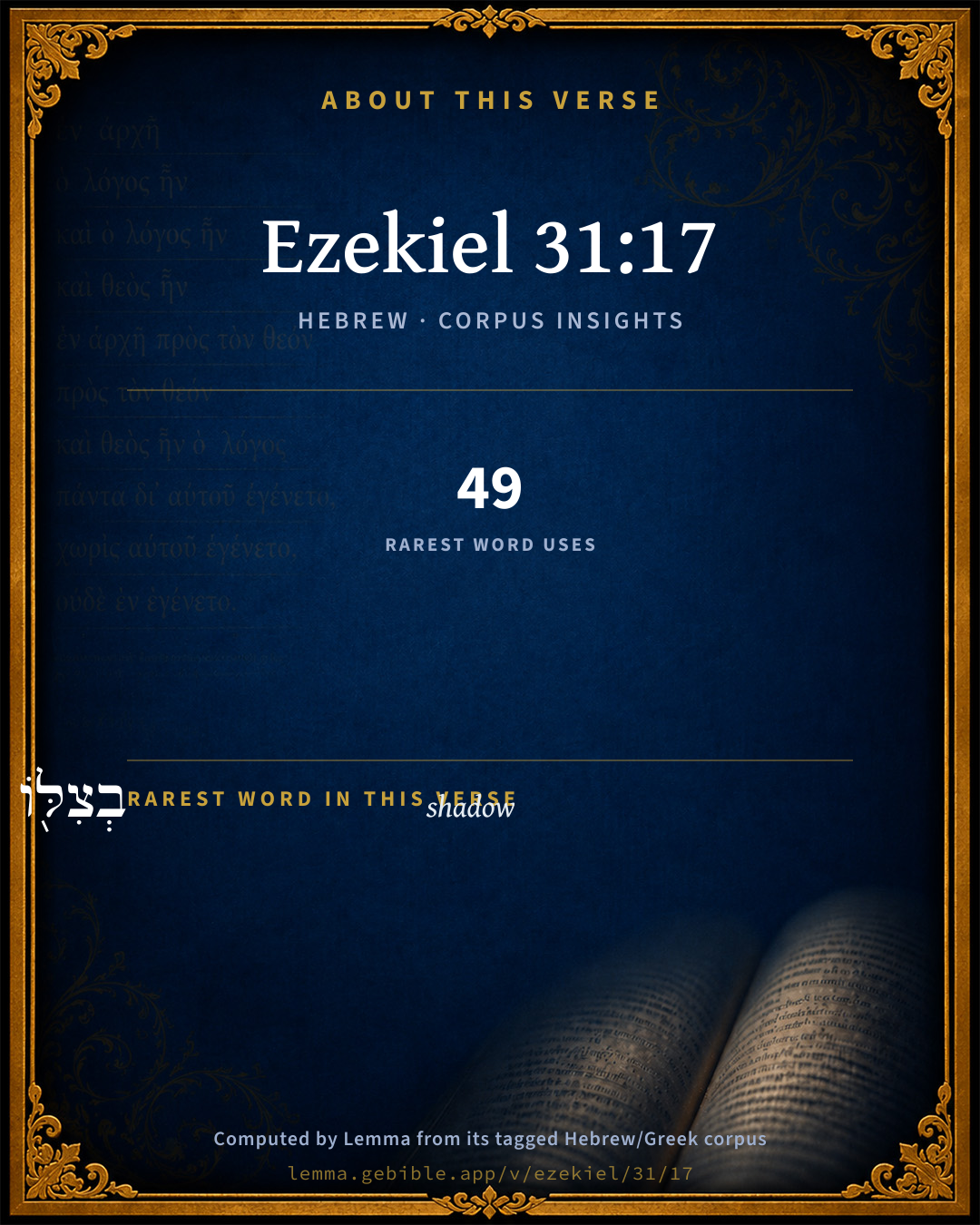
About this verse

These counts appear in no published source. They are computed here, from the morphology-tagged text and Lemma’s own curated glosses. What Lemma adds →

13
words
13
distinct lemmas
Prophets
section

Shared distinctive vocabulary

בְצִלּ֖וֹ shadow H6738 occurs in 47 verses of the Hebrew Bible. Also found in:

Grammatical profile

  • 2 verbs
  • 6 nouns
  • 1 adjective
  • 1 pronoun
  • 2 prepositions
  • 1 particle

Verb forms

  • יָרְד֥וּ Qal · Perfect
  • יָשְׁב֥וּ Qal · Perfect

Hebrew & Septuagint length

In English translation the verse runs 33 words from the Hebrew and 31 from the Septuagint (LXX English) — closely comparable.

A rough comparison of the two English renderings, which tokenize alike — not a word-level alignment.

Word counts can differ between the Hebrew and the Greek without any difference in meaning — e.g. the Hebrew direct-object marker אֵת has no separate Greek word, and Greek often adds the article ὁ.

Cross-references

11

Topical passages linked to Ezekiel 31:17 in the Treasury of Scripture Knowledge — connected by theme and wording, ordered by reader-vote popularity; previews shown in the World English Bible.

  • Psalms 9:17 The wicked shall be turned back to Sheol, Even all the nations that forget God.
  • Ezekiel 31:6 All the birds of the sky made their nests in its boughs; and under its branches did all the animals of the field bring forth their young; and under its shadow lived all great nations.
  • Ezekiel 31:3 Behold, the Assyrian was a cedar in Lebanon with beautiful branches, and with a forest-like shade, and of high stature; and its top was among the thick boughs.
  • Nehemiah 3:17–18 After him repaired the Levites, Rehum the son of Bani. Next to him repaired Hashabiah, the ruler of half the district of Keilah, for his district.
  • Isaiah 14:9 Sheol from beneath is moved for you to meet you at your coming; it stirs up the dead for you, even all the chief ones of the earth; it has raised up from their thrones all the kings of the nations.
  • Lamentations 4:20 The breath of our nostrils, the anointed of Yahweh, was taken in their pits; Of whom we said, Under his shadow we shall live among the nations.
  • Ezekiel 30:6–8 Thus says Yahweh: They also who uphold Egypt shall fall; and the pride of her power shall come down: from the tower of Seveneh shall they fall in it by the sword, says the Lord Yahweh.
  • Ezekiel 30:21–25 Son of man, I have broken the arm of Pharaoh king of Egypt; and, behold, it has not been bound up, to apply [healing] medicines, to put a bandage to bind it, that it be strong to hold the sword.
  • Ezekiel 32:20–31 They shall fall in the midst of those who are slain by the sword: she is delivered to the sword; draw her away and all her multitudes.
  • Daniel 4:11–12 The tree grew, and was strong, and the height of it reached to the sky, and the sight of it to the end of all the earth.
  • Mark 4:32 yet when it is sown, grows up, and becomes greater than all the herbs, and puts out great branches, so that the birds of the sky can lodge under its shadow."

Cross-references courtesy of OpenBible.info (CC BY 4.0).

Hebrew and Greek witnesses Masoretic Hebrew ↔ Greek Septuagint

The same verse in the two great witnesses to the Old Testament, shown verse-for-verse.

These are two independent witnesses, not word-aligned to each other, and the Septuagint is shown in lemma (dictionary) form.

Hebrew Ezekiel 31:17 Masoretic · Westminster Leningrad Codex

גַּם הֵ֗ם אִתּ֛וֹ יָרְד֥וּ שְׁא֖וֹלָה אֶל חַלְלֵי חָ֑רֶב וּזְרֹע֛וֹ יָשְׁב֥וּ בְצִלּ֖וֹ בְּת֥וֹךְ גּוֹיִֽם

They also went down into Sheol with him to those who are slain by the sword; yes, those who were his arm, [that] lived under his shadow in the midst of the nations.

World English Bible · Public Domain

Greek LXX Ezekiel 31:17 Septuagint · lemma form

καί γάρ αὐτός καταβαίνω μετά αὐτός εἰς ᾅδης ἐν ὁ τραυματίας ἀπό μάχαιρα καί ὁ σπέρμα αὐτός ὁ καταοἰκέω ὑπό ὁ σκέπης αὐτός ἐν μέσος ὁ ζωή αὐτός ἀποὀλλύω

For they went down to hell with him among the slain with the sword; and his seed, even they that lived under his shadow, perished in the midst of their life.

LXX2012 (modern English Septuagint) · Public Domain

On this verse, The Cambridge Bible for Schools and Colleges discusses the Septuagint’s reading. Read the note in Commentary ↓

Hebrew: Westminster Leningrad Codex (CC BY 4.0). Greek: Septuagint (public domain); English from LXX2012 (modern English Septuagint) (Public Domain). How the Septuagint differs from the Hebrew →

Targum (Aramaic paraphrase)

1

The Targum is the ancient Jewish Aramaic paraphrase of the Hebrew Scriptures — an interpretive translation, not the Hebrew text itself. Onkelos (literal) and Pseudo-Jonathan (expansive) render the Torah, and Jonathan the Prophets. Coverage is partial: where no permissively-licensed English translation exists for a verse, only the Aramaic is shown. This is verse-level text, not a word-by-word alignment to the Hebrew.

  1. Targum Jonathan Prophets (Joshua–Malachi)
    אַף אִינוּן עִמֵיהּ אִתְחָתוּ לִשְׁאוֹל עִם קְטִילֵי חַרְבָּא וְשִׁלְטוֹנוֹהִי אִתְּבָרוּ מַתְקִיפֵיהוֹן בְּגוֹ מַלְכוּתָא:

    (no public-domain English translation for this verse)

    Targum Jonathan — Aramaic: “Mikraot Gedolot” (public domain). English: “Sefaria Community Translation” (CC0 1.0 (public-domain dedication)); “London "Chaldee Paraphrase," 1871” (public domain). Text via Sefaria.

Commentary

Notes on Ezekiel 31:17 from classic Christian and Jewish commentators (each source and its license shown beneath its notes). The classic Christian expositions comment on the surrounding passage and are grouped to its opening verse, so a note may address several verses; the Jewish commentaries on the Tanakh (Rashi and others) are per-verse, so they appear only where the commentator wrote on this verse.

Lemma curates 59 commentaries, every one of them public domain or Creative Commons licensed, each selected and text-cleaned for this edition rather than reprinted as found. About our sources →

Trapp's Complete Commentary

John Trapp

Eze 31:17 They also went down into hell with him unto [them that be] slain with the sword; and [they that were] his arm, [that] dwelt under his shadow in the midst of the heathen.

Ver. 17. They also went down into hell with him.] It was wont to be said that hell was paved with kings’ crests and shavelings’ bald pates. Henry VIII was told on his deathbed that he was now going to the place of kings. See Isa 30:33. What a coil kept this Esarhaddon in his time, as being superstitibus terror, praemortuis laeitia, complicibus exitium, sui ipsius ruina! {a}

{a} Oecolamp.

John Trapp, A Commentary or Exposition upon All the Books of the Old and New Testament (1647–1656) — public domain. Text from a community e-Sword module.

The Biblical Illustrator

Joseph S. Exell

Eze_31:17

They . . . that dwelt under His shadow in the midst of the heathen.

Under God's shadow among the heathen

Whatever may be the primary meaning of these words, they have a very blessed application to those who have gone forth from so many Christian families into heathen lands. For no choice of their own, and simply in obedience to their King's command, hundreds of our sons and daughters have gone forth to dwell in the midst of the heathen. They have taken up their home amid conditions which they would not have chosen had it not been for the constraining love of Christ, and the imperative need of dying men; and as fond relatives and friends regard their lot from a distance, they are often filled with anxious forebodings. May they not be involved in some sudden riot, and sacrificed to a frenzy of hate? May not the sanitary conditions and methods of life be seriously detrimental to their health or morals? "Oh, if only I could be there," you sigh. Hush! Christ is there; as near them as He is to you, casting over them the shadow of His presence, beckoning them to His secret place. He is the shadow of a great Rock in a weary land; or like the canopy of cloud that hovered over the camp of Israel by day, screening it from the torrid glare. Do not fear to trust your loved ones to the immortal Lover, who fainteth not, neither is weary. The hand that would harm is arrested and paralysed when it attempts to penetrate that safe enclosure. (F. B. Meyer, B. A.)

.

The Biblical Illustrator, edited by Joseph S. Exell (c. 1880s–1900s) — public domain. Text from a community e-Sword module.

Jamieson, Fausset & Brown

Robert Jamieson, A. R. Fausset & David Brown

his arm, that dwelt under his shadow--those who were the helpers or tool of his tyranny, and therefore enjoyed his protection (for example, Syria and her neighbors). These were sure to share her fate. Compare the same phrase as to the Jews living under the protection of their king (Lam 4:20); both alike "making flesh their arm, and in heart departing from the Lord" (Jer 17:5).

Jamieson, Fausset & Brown — Commentary Critical and Explanatory on the Whole Bible (1871) — public domain (CC PDM 1.0). Text via the HelloAO Bible API.

Adam Clarke's Commentary

Verse 17. They also went down into hell with him] Into remediless destruction.

Adam Clarke's Commentary on the Bible (1810–1826) — public domain. Text from a community e-Sword/MySword module.

The Cambridge Bible for Schools and Colleges

gen. ed. J. J. S. Perowne

17. They also … into hell] These also are gone down into Sheòl, ref. being to the “trees of Eden,” Eze_31:16.

were his arm, that dwelt] and his arm, that dwelt. His “arm” is his helpers (Eze_17:9). The construction is difficult (read probably cons. plur. of part. for “that dwelt;” om. of rel. improbable); cf. Eze_32:15. LXX. points “his seed” for “his arm,” but that “seed” could mean underwood (Corn.) has no probability.

The Cambridge Bible for Schools and Colleges (gen. ed. J. J. S. Perowne; Cambridge University Press, 1878–1918) — public domain. Text from a community e-Sword module.

John Gill's Exposition

They also went down to hell with him,.... To the grave with him; many of his nobles, princes, generals, soldiers, and subjects:

unto them that be slain with the sword; to be buried and lie with them who had fallen by the sword, as a just punishment for their iniquities:

and they that were his arm; either that leaned on his arm, were dependents upon him; or his ministers, his instruments, whom he employed under him as his deputies, to govern the several provinces that belonged to him; or rather his allies and auxiliaries, who helped and assisted him on occasion:

that dwelt under his shadow in the midst of the Heathen; in the midst of the nations subject to the Assyrian empire; such who put themselves under the protection of it, lived comfortably under it, and continued with it to the last; these shared the same fate as that did. The Targum is,

"his governors are broken, whom he strengthened in the midst of the kingdom.''

John Gill's Exposition of the Whole Bible (1746–1763) — public domain (CC PDM 1.0). Text via the HelloAO Bible API.

Haydock's Catholic Bible Commentary

Arm; those in power. Septuagint, "his seed." Hebrew Zora, (Haydock) means both.

George Leo Haydock (1774–1849), Haydock's Catholic Family Bible and Commentary, 1859 edition — public domain. Excludes Psalms (Douay-Rheims chapter numbering differs from Protestant) and Deuterocanonical books (Catholic canon only).

Matthew Poole's English Annotations

They also; either his neighbour kings and princes, or those that were his own subjects, but rich and mighty.

Went down into hell; were broken and perished with him, and went to those God had slain for their pride and wickedness.

They that were his arm; his loyal and faithful subjects and friends abroad, who having been protected by him, remembered it, and adhered to him to support him; but all fell, are extinct, and gone down to the pit, where are many proud, but o pride; where all know themselves dust and ashes, and God glorious, holy, and just.

Matthew Poole's English Annotations on the Holy Bible (1683–1685) — public domain. Text from a community e-Sword/MySword module.

Whedon's Commentary on the Bible

Daniel D. Whedon

17. They that were his arm — See note Eze_30:21.

Daniel D. Whedon (gen. ed.), Commentary on the Old and New Testaments (1874–1909) — public domain. Text from a community e-Sword module.

The Pulpit Commentary

They that were his arm. The words point to the allies, in the first instance of Assyria, and secondly of Egypt. The last words of the verse present a striking parallel to Lam_4:20.

The Pulpit Commentary (1880–1919), ed. H.D.M. Spence-Jones & Joseph S. Exell — public domain. Text from a community e-Sword module.

John Wesley's Explanatory Notes

They also - His neighbouring kings. Hell - Perished with him, and went to those whom God had slain for their pride and wickedness. They that were his arm - His loyal and faithful subjects and friends, on whom he relied, and by whom he acted.

John Wesley, Explanatory Notes Upon the Whole Bible (1754–1765) — public domain. Text via the GEBible commentary corpus.

unfoldingWord translationNotes

Door43 World Missions Community

General Information:

Yahweh's parable about the cedar continues.

they also went down with it to Sheol

Here "went down ... to Sheol" is an idiom that means to die. AT: "those trees of Lebanon also died and went down to Sheol with the cedar" (See: Idiom)

who had been killed by the sword

Here "sword" represents enemies who fought them in battle. This can be stated in active form. AT: "whom enemies had killed with swords" or "who had died in battle" (See: Active or Passive and Metonymy)

These were its strong arm

"These trees of Lebanon were its strong arm." The phrase "strong arm" represents "power." AT: "These trees of Lebanon were the power of the cedar" or "These trees strengthened the cedar" (See: Metonymy)

Which of the trees in Eden was your equal in glory and greatness?

"Which of these trees in Eden had as much glory as you and was as great as you?" God asks Pharaoh this question to show him that the parable applies to him and his country. It can start with "So Pharaoh" or "So Egypt." AT: "None of the trees in Eden was your equal in glory and greatness!" (See: Rhetorical Question)

For you will be brought down

This can be stated in active form. AT: "For I will bring you down" (See: Active or Passive)

with the trees of Eden

"like the other trees of Eden"

to the lowest parts of the earth

"to a place deep in the ground"

among the uncircumcised

"where you will be with people who are not circumcised"

this is the Lord Yahweh's declaration

Yahweh speaks of himself by name to express the certainty of what he is declaring. See how you translated this in Ezekiel 5:11. AT: "this is what the Lord Yahweh has declared" or "this is what I, the Lord Yahweh, have declared" (See: First, Second, or Third Person)

translationWords

Hades

sword

Eden

glory

earth

circumcise

Lord Yahweh

declare

unfoldingWord translationNotes — © Distant Shores Media and the Door43 World Missions Community, licensed CC BY-SA 4.0. Source: git.door43.org/Door43/en_tn.

Rashi

Rabbi Shlomo Yitzchaki (Rashi)

and his allies, who dwelt in his shade [Heb. וּזְרֹעוֹ, lit. and his arm,] and his helpers, who dwelt in his shade.

Rashi on the Tanakh — English translations: “The Judaica Press complete Tanach with Rashi, translated by A. J. Rosenberg” (CC BY 4.0); “Pentateuch with Rashi's commentary by M. Rosenbaum and A.M. Silbermann, 1929-1934” (public domain); “The Metsudah Tanach series, Lakewood, N.J” (CC BY 4.0); and “The Book of Joshua, Metsudah Publications, 1997” (CC BY 4.0). Text via Sefaria.

Lesson kit

Teaching starters — assembled from the data on this page, not authored interpretation. Every prompt links to the verse data it draws on. Edit before teaching.

Ezekiel, in the Prophets, opens this verse with 13 words (13 distinct Hebrew lemmas). Its most distinctive word is tsêl (“shadow”). A historical commentator’s framing appears above. Read the whole chapter for the surrounding context.

Discussion questions

  1. What does “shadow” (tsêl) contribute to the verse as a whole?
  2. How does Genesis 19:8, which shares the word «shadow», read alongside this verse?
  3. These translations render this verse differently. What is at stake in choosing one wording over another?
  4. «יָרְד֥וּ» is a Qal Perfect verb. How does that grammatical form shape the action described?
  5. Compare how Trapp's Complete Commentary and The Biblical Illustrator read this verse. Where do they agree or differ?

Things to notice

Reading settings

Reading text

Shown beneath each verse's original-language words.

Old Testament
Old Testament edition

Read the OT as the Masoretic Hebrew (MT) or the Greek Septuagint (LXX).

English shown for the Greek Septuagint (in the Hebrew ↔ Greek comparison).

Comparing translations? Open the Compare panel on any verse page to stack up to four side by side.