Hosea 8:10

Hebrew (Westminster Leningrad Codex) Hosea 8:10 appears in the Hebrew Old Testament. The text above is from the Westminster Leningrad Codex. Each word links to its Strong’s number, a concise gloss, and parsing drawn from the Open Scriptures Hebrew Bible morphology. Click any word for its full Brown-Driver-Briggs (BDB) entry.
Download image
Cite this verse

Hosea 8:10 (World English Bible). Public Domain. Lemma interlinear Bible study tool, https://lemma.gebible.app/v/hosea/8/10.

Show BibTeX & RIS
BibTeX
RIS
English Translation
But although they sold themselves among the nations, I will now gather them; and they begin to waste away because of the oppression of the king of mighty ones.
World English Bible · Public Domain
Download a study sheet

One document with this verse’s original text, its word-by-word gloss line, the meaning frame, cross-references with their text, attributed commentary, and full source and license credits — printable, and it pastes into notes with its structure intact.

This verse Autodidact and up

Study sheet (.html) Plain text (.txt)

A passage Seminary Student

Up to 50 verses in one chapter. A passage sheet keeps up to 6 commentary sources and 12 cross-references per verse, in the order this page ranks them, and says so on the sheet whenever that leaves anything out. Ask for a single verse and you get the Autodidact verse sheet above.

Everything on this page stays free to read, with no account — the sheet is a download of what is already on screen, not access to it.

Want to remove ads? Support Godless Engineer
Compare translations 3

The same verse in 3 English versions, stacked beneath the original-language interlinear above. Click any original word for its lexicon entry.

Each is an independent rendering of the whole verse — the interlinear is not word-aligned to these translations.

Highlighted words mark where these versions differ — a whole-verse word diff, not a word-by-word alignment.

  • World English Bible Public Domain
    But although they sold themselves among the nations, I will now gather them; and they begin to waste away because of the oppression of the king of mighty ones.
  • King James Version Public Domain
    Yea, though they have hired among the nations, now will I gather them, and they shall sorrow a little for the burden of the king of princes.
  • unfoldingWord Literal Text CC BY-SA 4.0
    Even though they hire among the nations, now I will gather them. And they will begin a little from the burden of the king of princes.

unfoldingWord Literal Text — © unfoldingWord, licensed CC BY-SA 4.0. Word-aligned USFM3 via Door43 (git.door43.org/unfoldingWord/en_ult).

Versions to compare (up to 4)

3 of 4 selected

Show all 18 translations

Every available English version of this verse, each an independent rendering of the whole verse.

  • World English Bible Public Domain
    But although they sold themselves among the nations, I will now gather them; and they begin to waste away because of the oppression of the king of mighty ones.
  • Berean Standard Bible Public Domain
    Though they hire allies among the nations, I will now round them up, and they will begin to diminish under the oppression of the king of princes.
  • Majority Standard Bible Public Domain
    Though they hire allies among the nations, I will now round them up, and they will begin to diminish under the oppression of the king of princes.
  • King James Version Public Domain
    Yea, though they have hired among the nations, now will I gather them, and they shall sorrow a little for the burden of the king of princes.
  • American Standard Version (1901) Public Domain
    Yea, though they hire among the nations, now will I gather them; and they begin to be diminished by reason of the burden of the king of princes.
  • Revised Version (1885) Public Domain
    Yea, though they hire among the nations, now will I gather them; and they begin to be minished by reason of the burden of the king of princes.
  • Geneva Bible (1599) Public Domain
    Yet though they haue hired among the nations, nowe will I gather them, and they shall sorowe a litle, for the burden of the King and the princes.
  • Douay-Rheims (1899) Public Domain
    But even though they shall have hired the nations, now will I gather them together: and they shall rest a while from the burden of the king, and the princes.
  • Young's Literal Translation Public Domain
    Also though they hire among nations, Now I gather them, and they are pained a little, From the burden of a king of princes.
  • Literal Standard Version CC BY-SA 4.0
    Also though they hire among nations, || Now I gather them, and they are pained a little, || From the burden of a king of princes.
  • Unlocked Literal Bible CC BY-SA 4.0
    Even though they have hired lovers among the nations, I will now gather them together. They will begin to waste away because of the oppression of the king of princes.
  • unfoldingWord Literal Text CC BY-SA 4.0
    Even though they hire among the nations, now I will gather them. And they will begin a little from the burden of the king of princes.
  • Darby Bible Public Domain
    Although they hire among the nations, now will I gather them, and they shall begin to be straitened under the burden of the king of princes.
  • World Messianic Bible Public Domain
    But although they sold themselves among the nations, I will now gather them; and they begin to waste away because of the oppression of the king of mighty ones.
  • Webster's Bible Public Domain
    Yes, though they have hired among the nations, now will I gather them, and they shall sorrow a little for the burden of the king of princes.
  • Free Bible Version CC BY-SA 4.0
    Even though they have hired allies among the nations, I will gather them together. Then they will writhe under the burden of the great king.
  • Bible in Basic English Public Domain
    But though they give money to the nations for help, still I will send them in all directions; and in a short time they will be without a king and rulers.
  • JPS Tanakh (1917) Public Domain
    Yea, though they hire among the nations, now will I gather them up; and they begin to be minished by reason of the burden of king and princes.

Literal Standard Version (2020), Covenant Press — licensed CC BY-SA 4.0. Text via the HelloAO Bible API (eBible.org). Unlocked Literal Bible (unfoldingWord) — licensed CC BY-SA 4.0. Text via the HelloAO Bible API (eBible.org). unfoldingWord Literal Text — © unfoldingWord, licensed CC BY-SA 4.0. Word-aligned USFM3 via Door43 (git.door43.org/unfoldingWord/en_ult). Free Bible Version, Dr. Jonathan Gallagher — licensed CC BY-SA 4.0. Text via the HelloAO Bible API (eBible.org).

Word by word

More ways to search: Search by grammar → Find every occurrence → Compare this word →

Practice this passage: Drill this verse → Learn its vocabulary →

יִתְנ֥וּ
tânâh
H8566
“to hire”
Verb, Qal, Imperfect, 3rd Person, Masculine, Plural
Part of Speech
Verb
Stem
Qal
Form
Imperfect
Person
3rd Person
Gender
Masculine
Number
Plural
Full BDB Definition

Origin: a primitive root

TWOT: 2524

to hire - (Qal) to hire - (Hiphil) to hire (a prostitute), give amorous favours
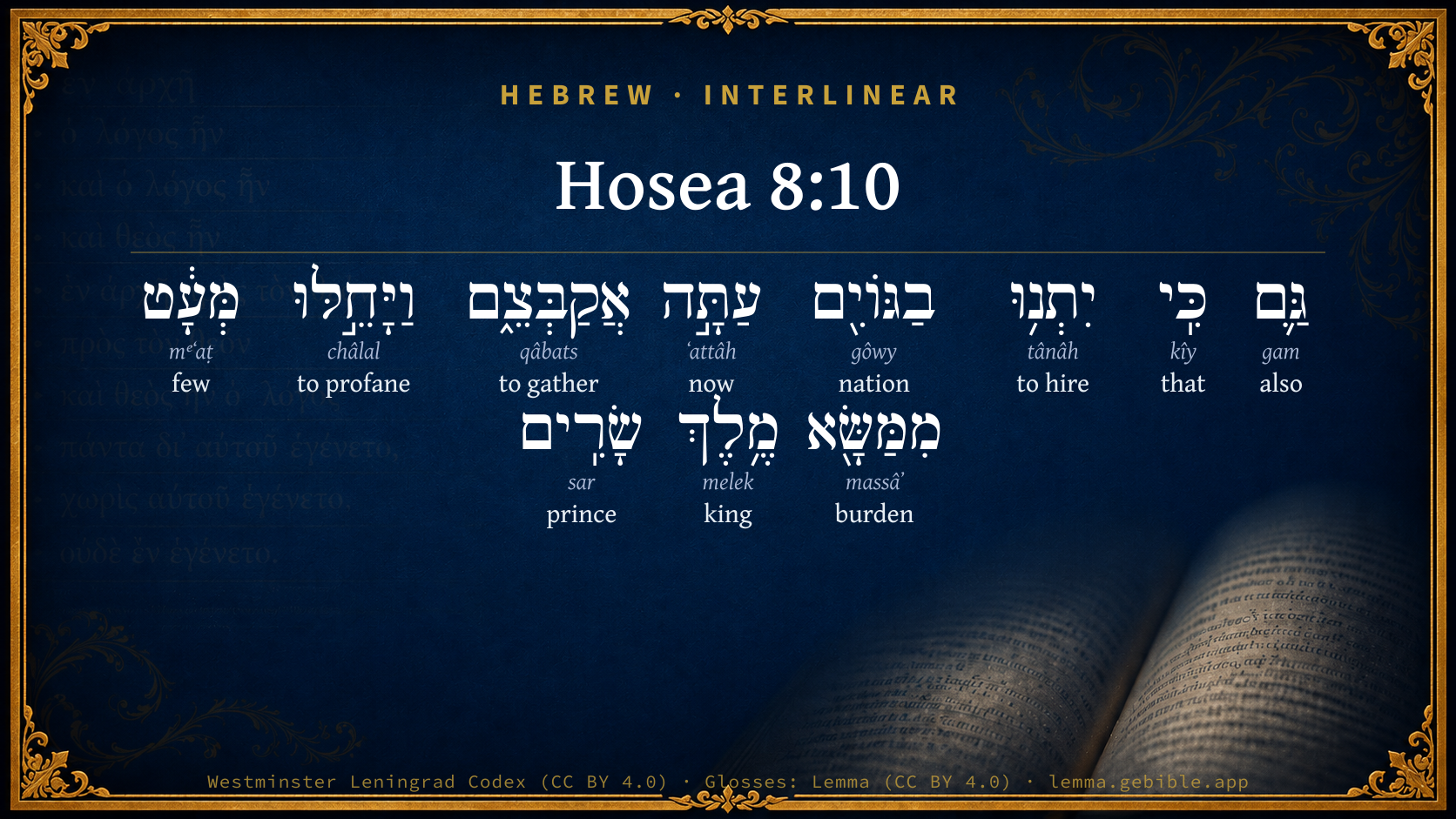
  1. גַּ֛ם gam H1571 “also” Particle, Accusative
  2. כִּֽי kîy H3588 “that” Conjunction
  3. בַגּוֹיִ֖ם gôwy H1471 “in/at the · nations” Preposition, Determined + Noun, Common, Masculine, Plural, Absolute
  4. עַתָּ֣ה ʻattâh H6258 “now” Adverb
  5. אֲקַבְּצֵ֑ם qâbats H6908 “to gather · them” Verb, Piel, Imperfect, 1st Person, Common, Singular + Suffix, Personal, 3rd Person, Masculine, Plural
  6. וַיָּחֵ֣לּוּ châlal H2490 “and · to profane” Conjunction + Verb, Hiphil, Sequential Imperfect, 3rd Person, Masculine, Plural
  7. מְּעָ֔ט mᵉʻaṭ H4592 “few” Adjective, Adjective, Masculine, Singular, Absolute
  8. מִמַּשָּׂ֖א massâʼ H4853 “from · burden of” Preposition + Noun, Common, Masculine, Singular, Construct
  9. מֶ֥לֶךְ melek H4428 “king” Noun, Common, Masculine, Singular, Absolute
  10. שָׂרִֽים sar H8269 “princes” Noun, Common, Masculine, Plural, Absolute

About this verse

These counts appear in no published source. They are computed here, from the morphology-tagged text and Lemma’s own curated glosses. What Lemma adds →

11
words
11
distinct lemmas
Prophets
section

Notable vocabulary

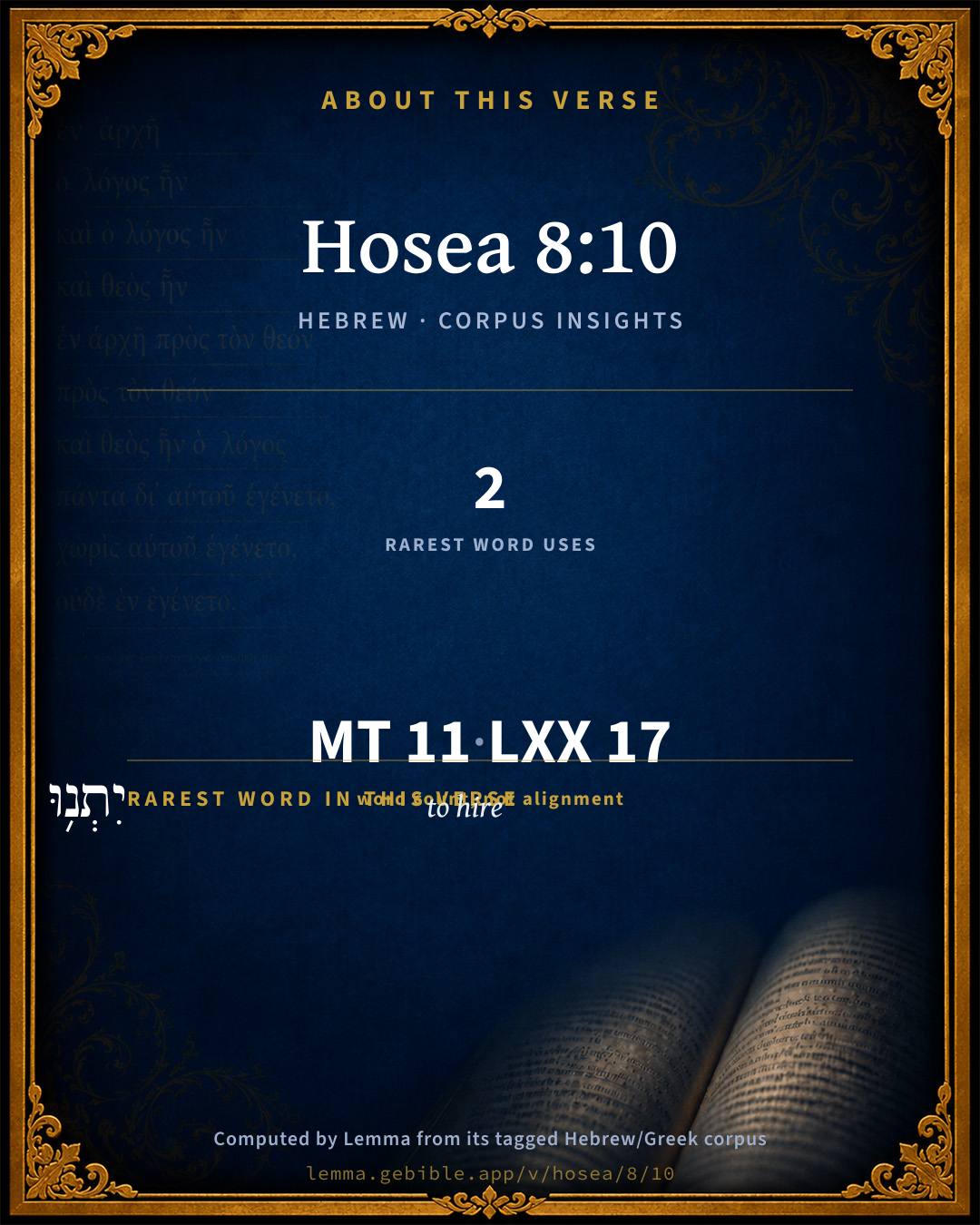
The rarest word here is יִתְנ֥וּ to hire H8566 — appearing just 2 times in the whole Hebrew Bible.

Shared distinctive vocabulary

יִתְנ֥וּ to hire H8566 occurs in 2 verses of the Hebrew Bible. Also found in:

Grammatical profile

  • 3 verbs
  • 4 nouns
  • 1 adjective
  • 1 conjunction
  • 1 adverb
  • 1 particle

Verb forms

  • יִתְנ֥וּ Qal · Imperfect
  • אֲקַבְּצֵ֑ם Piel · Imperfect
  • וַיָּחֵ֣לּוּ Hiphil · Sequential Imperfect

Hebrew & Septuagint length

In English translation the verse runs 29 words from the Hebrew and 25 from the Septuagint (LXX English) — closely comparable.

A rough comparison of the two English renderings, which tokenize alike — not a word-level alignment.

Word counts can differ between the Hebrew and the Greek without any difference in meaning — e.g. the Hebrew direct-object marker אֵת has no separate Greek word, and Greek often adds the article ὁ.

In the original languages it is 11 Hebrew tokens and 17 Greek tokens — but the two are counted differently (Hebrew bundles its prefixes and suffixes into one token; the Greek is in lemma form), so that isn’t a like-for-like length.

Cross-references

16

Topical passages linked to Hosea 8:10 in the Treasury of Scripture Knowledge — connected by theme and wording, ordered by reader-vote popularity; previews shown in the World English Bible.

  • Ezekiel 16:37 therefore see, I will gather all your lovers, with whom you have taken pleasure, and all those who you have loved, with all those who you have hated; I will even gather them against you on every side, and will uncover your nakedness to them, that they may see all your nakedness.
  • Ezekiel 26:7 For thus says the Lord Yahweh: Behold, I will bring on Tyre Nebuchadrezzar king of Babylon, king of kings, from the north, with horses, and with chariots, and with horsemen, and a company, and much people.
  • Isaiah 10:8 For he says, Aren't my princes all of them kings?
  • Jeremiah 42:2 and said to Jeremiah the prophet, Let, we pray you, our supplication be presented before you, and pray for us to Yahweh your God, even for all this remnant; for we are left but a few of many, as your eyes do see us:
  • Ezekiel 23:22–26 Therefore, Oholibah, thus says the Lord Yahweh: Behold, I will raise up your lovers against you, from whom your soul is alienated, and I will bring them against you on every side:
  • Hosea 10:10 When it is my desire, I will chastise them; And the nations will be gathered against them, When they are bound to their two transgressions.
  • Haggai 2:6 For this is what Yahweh of Hosts says: 'Yet once, it is a little while, and I will shake the heavens, the earth, the sea, and the dry land;
  • 2 Kings 14:26 For Yahweh saw the affliction of Israel, that it was very bitter; for there was none shut up nor left at large, neither was there any helper for Israel.
  • 2 Kings 15:19–20 There came against the land Pul the king of Assyria; and Menahem gave Pul one thousand talents of silver, that his hand might be with him to confirm the kingdom in his hand.
  • 2 Kings 17:3 Against him came up Shalmaneser king of Assyria; and Hoshea became his servant, and brought him tribute.
  • 1 Chronicles 5:26 The God of Israel stirred up the spirit of Pul king of Assyria, and the spirit of Tilgath Pilneser king of Assyria, and he carried them away, even the Reubenites, and the Gadites, and the half-tribe of Manasseh, and brought them to Halah, and Habor, and Hara, and to the river of Gozan, to this day.
  • Isaiah 36:13 Then Rabshakeh stood, and cried with a loud voice in the Jews' language, and said, Hear you the words of the great king, the king of Assyria.
  • Ezekiel 22:20 As they gather silver and brass and iron and lead and tin into the midst of the furnace, to blow the fire on it, to melt it; so will I gather you in my anger and in my wrath, and I will lay you there, and melt you.
  • Ezekiel 23:9–10 Therefore I delivered her into the hand of her lovers, into the hand of the Assyrians, on whom she doted.
  • Ezekiel 23:46–47 For thus says the Lord Yahweh: I will bring up a company against them, and will give them to be tossed back and forth and robbed.
  • Daniel 2:37 You, O king, are king of kings, to whom the God of heaven has given the kingdom, the power, and the strength, and the glory;

Cross-references courtesy of OpenBible.info (CC BY 4.0).

Hebrew and Greek witnesses Masoretic Hebrew ↔ Greek Septuagint

The same verse in the two great witnesses to the Old Testament, shown verse-for-verse.

These are two independent witnesses, not word-aligned to each other, and the Septuagint is shown in lemma (dictionary) form.

Hebrew Hosea 8:10 Masoretic · Westminster Leningrad Codex

גַּ֛ם כִּֽי יִתְנ֥וּ בַגּוֹיִ֖ם עַתָּ֣ה אֲקַבְּצֵ֑ם וַיָּחֵ֣לּוּ מְּעָ֔ט מִמַּשָּׂ֖א מֶ֥לֶךְ שָׂרִֽים

But although they sold themselves among the nations, I will now gather them; and they begin to waste away because of the oppression of the king of mighty ones.

World English Bible · Public Domain

Greek LXX Hosea 8:10 Septuagint · lemma form

διά οὗτος παραδίδωμι ἐν ὁ ἔθνος νῦν εἰςδέχομαι αὐτός καί κοπάζω μικρός ὁ χρίω βασιλεύς καί ἄρχων

Therefore shall they be delivered to the nations: now I will receive them, and they shall cease a little to anoint a king and princes.

LXX2012 (modern English Septuagint) · Public Domain

On this verse, The Cambridge Bible for Schools and Colleges discusses the Septuagint’s reading. Read the note in Commentary ↓

Hebrew: Westminster Leningrad Codex (CC BY 4.0). Greek: Septuagint (public domain); English from LXX2012 (modern English Septuagint) (Public Domain). How the Septuagint differs from the Hebrew →

Targum (Aramaic paraphrase)

1

The Targum is the ancient Jewish Aramaic paraphrase of the Hebrew Scriptures — an interpretive translation, not the Hebrew text itself. Onkelos (literal) and Pseudo-Jonathan (expansive) render the Torah, and Jonathan the Prophets. Coverage is partial: where no permissively-licensed English translation exists for a verse, only the Aramaic is shown. This is verse-level text, not a word-by-word alignment to the Hebrew.

  1. Targum Jonathan Prophets (Joshua–Malachi)
    אַף אִם יְשַׁווּן בֵּית יִשְׂרָאֵל דַחַלְתִּי עַל לִבְּהוֹן מִבֵּינֵי עַמְמַיָא אֲקָרֵיב גָלוּתְהוֹן וַאֲפִילוּ יֶחְכְּמוּן כִּזְעֵיר אַעְדֵי מִנְהוֹן מַרְוַת מַלְכִּין וְשִׁלְטוֹנִין:

    (no public-domain English translation for this verse)

    Targum Jonathan — Aramaic: “Mikraot Gedolot” (public domain). English: “Sefaria Community Translation” (CC0 1.0 (public-domain dedication)); “London "Chaldee Paraphrase," 1871” (public domain). Text via Sefaria.

Commentary

Notes on Hosea 8:10 from classic Christian and Jewish commentators (each source and its license shown beneath its notes). The classic Christian expositions comment on the surrounding passage and are grouped to its opening verse, so a note may address several verses; the Jewish commentaries on the Tanakh (Rashi and others) are per-verse, so they appear only where the commentator wrote on this verse.

Lemma curates 59 commentaries, every one of them public domain or Creative Commons licensed, each selected and text-cleaned for this edition rather than reprinted as found. About our sources →

Trapp's Complete Commentary

John Trapp

Hos 8:10 Yea, though they have hired among the nations, now will I gather them, and they shall sorrow a little for the burden of the king of princes.

Ver. 10. Yea, though they have hired among the nations] The uncircumcised; strangers to the promises, and aliens from the commonwealth of Israel, that they should so far distrust God and debase themselves as to seek help of such; this went near to the heart of God, and was very grievous. They brought up an evil report upon God’s housekeeping, charged him with unfaithfulness to his people, whom he now seemed to leave in the lurch, to shift for themselves in their straits; and hardened his enemies in their wicked but yet more prosperous condition. Felix scelus virtus vocatur Pleasent wickedness is called virtue. (Cic. de Divin., lib. ii.). How would these heathens hug themselves in the conceit that Israel should do thus, who was God’s portion, Deu 32:9, the dearly beloved of his soul, Jer 12:7, of whom it was anciently sung, and commonly said among the heathen, "The Lord hath done great things for them," Psa 126:2. "Happy art thou, O Israel; who is like unto thee, O people saved by the Lord, the shield of thy help; and who is the sword of thine excellence! and thine enemies shall he found liars unto thee, and thou shalt tread upon their high places," Deu 33:29. Whosoever was free of the city of Rome might not accept any freedom in another city; for they were counted a dishonour to Rome. And will not God take it in ill part from his covenanters, to seek or make after correspondence with his enemies, and safety by them? The help of the wicked are at the best perfidious, and at length pernicious to the Church: Ecclesiae sunt tandem perniciosa et semper perfidiosa.

Now will I gather them] This the Chaldee and the Vulgate make to he a promise of bringing back their captivity; when indeed it is a commination of carrying them into captivity.

I will gather them] That is, either the enemies against Israel or else Israel for the enemies; ut eos acervatim perdam, that I may lay them heaps upon heaps, and gather them, as dead corpses slain in battle are gathered together for burial. Or, I will gather them, to the end that I may disperse them.

And they shall sorrow a little] And but a little now,

for the burden of the king of princes] For the taxes and tributes exacted from them by the king of Assyria (whose nobles were princes, 2Ki 18:24 Isa 10:5-7 2Ki 15:19; 2Ki 15:29. But all this is but a little; it is but the beginning of sorrows; it is but small drops forerunning the great storm; or as a crack forerunning the fall of the house. They shall sorrow much more hereafter, when carried captive, and made a scorn to the scum of the people: see Deu 32:42. Some read the whole verse, "Yea, because they have hired among the nations, now will I gather them together (for they have begun a little): because of the burden of the king of princes." And they thus paraphrase it: Well may they bribe and hire, but this will be the end: the Israelites themselves shall fall by heaps; the nations whom they hire shall come so tumbling in upon them (as Isaiah told Ahaz, Isa 8:9). Do you not see it prettily well begun already? Look upon the late example that is yet now fresh and bleeding before your eyes; so you will the better believe my threatening in that which is to come; I mean, the sacking and carrying away of the tribes beyond Jordan, by Pul and Tiglathpileser. If you ask me the reason why God should be so angry with you? it is because you are so foolish, or so wicked rather, to send presents and tributes to the king of Ashur (who in the pride and vanity of his heart nameth himself the king of princes, the mighty and most potent king) with the pilling, polling, and burdening of your subjects.

John Trapp, A Commentary or Exposition upon All the Books of the Old and New Testament (1647–1656) — public domain. Text from a community e-Sword module.

Joseph Benson's Commentary

Hos 8:10. Yea, though they have hired — Namely, allies; among the nations — And have been no way solicitous to gain my favour or help; now will I gather them — I will now (though they make so little account of my power) bring those very allies, namely, the Assyrians, against them. Here God tells them, that whatever sums they might offer, or expense they might be at, in order to raise armies of foreign auxiliaries, he would imbody those armies, he would press the men, paid by their money, into his own service against them. And they shall sorrow a little — Or, in a little time; for the burden of the king of princes — “They shall be severely galled by the yoke of the Assyrian king, and of the princes set over his several provinces.” — Newcome. Bishop Horsley, who thinks that the kings and princes, or rulers, of Israel are here intended, renders this clause differently, thus: And ere long they shall sorrow on account of the burden, the king and the rulers: that is, “Ere long the king and the rulers will lament the impolitic expense incurred in gifts and presents to their faithless allies, and the burden of taxes for that purpose laid upon the people.” The reading of

ושׂרים, and rulers, “is supported,” says he, “by such a weight of authority, that I cannot but adopt it; and yet there is no difficulty in the construction of the common text. For it might be thus rendered: And ere long the rulers shall sorrow for the burden of the king, that is, for the burden imposed by the king [namely, the king of Israel] in taxes.”

Joseph Benson's Commentary on the Old and New Testaments (1811–1818) — public domain. Text from a community e-Sword module.

Tyndale Open Study Notes

Tyndale Open Resources

8:10 I will now gather them together: Although God sometimes promises to gather his people for deliverance (Zech 10:8-10), here the Lord would gather them for judgment (Joel 3:11).

Tyndale Open Study Notes — © Tyndale Open Resources, licensed CC BY-SA 4.0. Text via the HelloAO Bible API.

Geneva Bible (1599)

Geneva Bible translators

That is, for the king and the princes shall lay upon them: which means the Lord useth to bring them to repentance.

Geneva Bible (1599) marginal notes — public domain. Text via Bolls.life.

Jamieson, Fausset & Brown

Robert Jamieson, A. R. Fausset & David Brown

will I gather them--namely, the nations (Assyria, &c.) against Israel, instead of their assisting her as she had wished (Eze 16:37).

a little--rather, "in a little" [HENDERSON]. English Version gives good sense: They shall sorrow "a little" at the imposition of the tribute; God suspended yet the great judgment, namely, their deportation by Assyria.

the burden of the king of princes--the tribute imposed on Israel (under Menahem) by the Assyrian king Pul, (Kg2 15:19-22), who had many "princes" under his sway (Isa 10:8).

Jamieson, Fausset & Brown — Commentary Critical and Explanatory on the Whole Bible (1871) — public domain (CC PDM 1.0). Text via the HelloAO Bible API.

Adam Clarke's Commentary

Verse 10. For the burden of the king of princes.] The exactions of the Assyrian king, and the princes of the provinces.

Adam Clarke's Commentary on the Bible (1810–1826) — public domain. Text from a community e-Sword/MySword module.

John Calvin's Commentaries

But it follows, Though they have hired among the nations, now will I gather them. This place may be variously expounded. The commonly received explanation is, that God would gather the hired nations against Israel; but I would rather refer it to the people themselves. But it admits of a twofold sense: the first is, that the great forces which the people has on every side acquired for themselves, would not prevent God from destroying them; for the verb קבף, kobets, which they render, “to gather,” often means in Hebrew to throw by a slaughter into an heap, as we say in French, Trousser, (to bundle.) And this meaning would be very suitable — that though they extended themselves far and wide, by gathering forces on every side, they would yet be collected in another way, for they would be brought together into a heap. The second sense is this — that when Israel should be drawn away to the Gentiles, the Lord would gather him; as though he said, “Israel burns with mad lusts, and runs here and there among the Gentiles; this heat is nothing else than dispersion; it is the same as if he designedly wished to destroy the unity in which his safety consists; but I will yet gather him against his will; that is, preserve him for a time.”

It then follows, They shall grieve a little for the burden of the king and princes. The word which the Prophet uses interpreters expound in two ways. Some derive יחלו, ichelu, from the verb חל, chel, and others from חלל, chelal, which means, “to begin;” and therefore give this rendering, “They shall begin with the burden of the king and princes;” that is, They shall begin to be burdened by the king and princes. Others offer this version, “They shall grieve a little for the burden of the king and princes;” that is, They shall be tributaries before the enemies shall bring them into exile; and this will be a moderate grief.

If the first interpretation which I have mentioned be approved, then there is here a comparison between the scourges with which God at first gently chastised the people, and the last punishment which he was at length constrained to inflict on them; as though he said, “They complain of being burdened by tributes; it is nothing, or at least it is nothing so grievous, in comparison with the dire future grief which their last destruction will bring with it.”

But this clause may well be joined with that mitigation which I have briefly explained, and that is, that when the people had willingly dispersed themselves, they had been preserved beyond expectation, so that they did not immediately perish; for they would have run headlong into destruction, had not God interposed an hindrance. Thus the two verses are to be read conjointly, They ascended into Assyria as a wild ass; that is, “They showed their unnameable and wild disposition, when thus unrestrainedly carried away; and then they offer me a grievous insult; for as if they were destitute of my help, they run to the profane Gentiles, and esteem as nothing my power, which would have been ready to help them, had they depended on me, and placed their salvation in my hand.” He then reproaches their perfidy, that they were like unchaste women, who leave their husbands, and abandon themselves to lewdness. Then it follows, Though they do this, that is, “Though having despised my aid, they seek deliverance from the profane Gentiles, and though they despise me, and choose to submit themselves to adulterers rather than to keep their conjugal faith with me, I will yet gather them, when thus dispersed.” The Lord here enhances the sin of the people; for he did not immediately punish their ingratitude and wickedness, but deferred doing so for a time; and in his kindness he would have led them to repentance, had not their madness been wholly incurable: though then they thus hire among the Gentiles, I will yet gather them, that is, “preserve them;” and for what purpose? That they may grieve a little, and that is, that they may not wholly perish, as persons running headlong into utter ruin; for they seemed designedly to seek their last destruction, when they were thus wilfully and violently carried away to profane nations. That is indeed a most dreadful tearing of the body, which cannot be otherwise than fatal. They shall, however, grieve a little; that is, “I will so act, that they may by degrees return to me, even by the means of moderate grief.”

We hence see more clearly why the Prophet said, that this grief would be small, which was to be from the burden of the king and princes. It was designed by the Israelites to excite the Assyrians immediately to war; and this would have turned out to their destruction, as it did at last; but the Lord suspended his vengeance, and at the same time mitigated their grief, when they were made tributaries. The king and his counsellors were constrained to exact great tributes; the people then grieved: but they had no other than a moderate grief, that they might consider their sins and return to the Lord; yet all this was without any fruit. Hence the less excusable was the obstinacy of the people. We now perceive what the Prophet meant. It now follows —

John Calvin's Commentaries (1540-1563) — public domain. Text from the Calvin Translation Society English edition (1840s-50s) via the Christian Classics Ethereal Library (ccel.org). Calvin's coverage is partial (roughly two-thirds of the Bible); uncommented books and verses are honest gaps, never fabricated. The 19th-century editor's footnotes and remarks are omitted so the notes are faithfully Calvin's own voice.

Ellicott's Commentary for English Readers

(10) There is much difference of opinion as to the interpretation of this verse. Much depends on the reference of the word “them.” We prefer to regard it as referring to Ephraim rather than to the nations (i.e., Assyria and Egypt). Render, I will gather them (Israel) together, so that in a short time they may delay (this translation approved by Ewald, Wünsche, and Simson) to render the tribute burden due to the king of princes (i.e., the Assyrian monarch). “Gather them together,” i.e., in restraint, so that they cannot roam so wildly, seeking help (Ewald). This accords with Hos_2:8-9; Hos_3:4. Such non-payment of tribute actually occurred a few years later (2Ki_17:4). Others render it: I will gather these nations (of the East) round about her to look scornfully on her ruin, and they shall sorrow a little (used ironically) at the imposition of the king of the princes.

A Bible Commentary for English Readers, edited by Charles John Ellicott (1878–1897) — public domain. Text from a community e-Sword module.

The Cambridge Bible for Schools and Colleges

gen. ed. J. J. S. Perowne

10. This verse is obscure, and open to a variety of interpretations; the following however seems by far the most probable.

Yea, though they have hired among the nations] Rather, Yea, though they hire, &c. i.e. though they attain a certain amount of success in their negotiations, and win the protection of some stronger nation, yet the time has come for me to check their misplaced activity.

now will I gather them] Surely not, ‘now will I gather the Assyrian army to fight against them’, which does not suit the context (mark ‘yea, though’), but, ‘now will I restrain their roving propensities.’ Where or how, we are not yet told; it is captivity which is dimly hinted at. This interpretation is strongly confirmed by the next clause.

and they shall sorrow a little for the burden of the king of princes] ‘The king of princes’ is a phrase not found elsewhere, but might conceivably = ‘the king of kings’, which is a title claimed by Tiglath-Pileser I. (Records of the Past, Hos_5:8, comp. Eze_26:7). The ‘burden’ might be the heavy tribute paid by Menahem (2Ki_15:20). But why ‘sorrow a little’? No better sense is made by rendering ‘and they shall begin to be diminished [in numbers, or in prosperity] by reason of the burden of the king of princes’; why ‘begin’? A third rendering, ‘and they shall soon be in anguish through the burden’ &c. involves a violation of Hebrew usage (‘soon’ should be ‘a little’). The only remedy is to follow the Septuagint, which reads two of the Hebrew words differently, and render that they may cease for a little from anointing a king and princes (all the versions and some Hebr. MSS. sanction ‘and’). Comp. Hos_13:10 ‘Give me a king and princes’, from which it seems as if the personnel of the class of ‘princes’ would vary according as the king were of one dynasty or another. In Judah, at any rate, as well as in Egypt, we know that the royal princes enjoyed many of the more important offices under the crown (comp. Isa_7:13; Jer_17:20; 1Ki_22:26; 2Ki_25:25).

The Cambridge Bible for Schools and Colleges (gen. ed. J. J. S. Perowne; Cambridge University Press, 1878–1918) — public domain. Text from a community e-Sword module.

John Gill's Exposition

Yea, though they have hired among the nations,.... That is, lovers, as before; got into confederacies and alliances with the nations about them, thinking thereby to strengthen their hands, and secure themselves and their kingdom; particular regard may be had to the Egyptians, as distinct from the Assyrians, whom they privately engaged on their side to shake off the Assyrian yoke, or their obligation to send yearly presents to the Assyrian king:

now will I gather them; either the Assyrians against them, to invade their land, besiege their city, and take and carry them captive; or the Israelites in a body into the city of Samaria, and there be cooped up, and taken and destroyed, or carried captive; for this is not to be interpreted of the collection of them out of their captivity, as the Targum and Jarchi, but of the gathering of them together for their destruction:

and they shall sorrow a little for the burden of the king of princes; the tax or tribute imposed upon them by the king of Assyria, whose princes were altogether kings, Isa 10:8; and who used to be called king of kings, being at the head of a monarchy, which had many kings subject to it; as the kings of Babylon were afterwards called, Eze 26:7; this may refer to the yearly present or tribute, which Hoshea king of Israel was obliged to give to the king of Assyria, which he was very uneasy at, and did not pay it, which drew upon him the resentment of the Assyrian king; and that sorrow and uneasiness which that tribute gave the king of Israel and his people were but little and small in comparison of what they after found; it was the beginning of sorrows to them: and so some render the words, "they began" (l); that is, to sorrow and complain "a little"; or this may refer to their burdens and oppressions when in captivity, which were laid upon them by the king of Assyria, and the princes, the rulers, and governors of the several places where the Israelites were carried captive: even the "few that shall remain" (m), as some render it; and not die by famine, pestilence, and sword. Kimchi and Ben Melech think there is a deficiency of the copulative and between king and princes; which is supplied by the Targum, and by the Septuagint, Vulgate Latin, Syriac, and Arabic versions, which read, "the king and princes".

(l) "incipient", Calvin; "ceperunt enim paululum", Junius & Tremellius, Piscator, Zanchius, Drusius, Tarnovius, so Ben Melech. (m) "et remanebunt pauci", Schmidt; a rad. "durare, permanere".

John Gill's Exposition of the Whole Bible (1746–1763) — public domain (CC PDM 1.0). Text via the HelloAO Bible API.

Albert Barnes' Notes on the Bible

Yea, though they have hired - Or better, “because or when they hinge among the pagan, now will I gather them;” i. e., I will gather the nations together. The sin of Israel should bring its own punishment. He sent presents to the king of Assyria, in order to strengthen himself against the will of God; “he thought himself secured by his league made with them; but he should find himself much deceived in his policy;” he had “hired among them” only; “now,” ere long, very speedily, God Himself would “gather them,” i. e., those very nations, not in part, but altogether; not for the help of Israel, but for its destruction. As though a man would let out some water from a deep lake ponded up, the water, as it oozed out, loosened more and more the barriers which withheld it, until, at length, all gave way, and the water of the lake was poured out in one wide wild waste, desolating all, over which it swept. It may be, that Assyria would not have known of, or noticed Israel, had not Israel first invited him.

And they shall sorrow a little for the burden of the king of princes - So great shall be the burden of the captivity hereafter, that they shall then sorrow but little for any burdens put upon them now, and which they now feel so heavy. “The king of princes” is the king of Assyria, who said, “Are not my princes altogether kings?” Isa 10:8. The burden of plained will then be the thousand talents of silver which Menahem gave to Pul, king of Assyria, to support him in his usurpation, and in order to pay which, he “exacted the money of Israel, even of all the mighty men of wealth, of each man fifty shekels of silver” 2Ki 15:19-20.

If we adopt the English margin, “begin,” we must render, “and they shall begin to be minished through the burden of the king of the princes,” i. e., they shall be gradually reduced and brought low through the exactions of the Assyrians, until in the end they shall be carried away. This describes the gradual decay of Israel, first through the exactions of Pul, then through the captivity of Gilead by Tiglathpileser.

Albert Barnes' Notes on the Bible (1834–1885) — public domain. Text from a community e-Sword/MySword module.

Haydock's Catholic Bible Commentary

Princes. Hebrew, "king of kings." This proud title was afterwards taken by the monarchs of Babylon and Persia. Israel ceased to pay taxes, having nothing left. They shall cease to be a people. (Calmet) --- Septuagint, "I will receive them, and they shall cease a little to anoint a king and princes." (Haydock) --- They had none during the captivity, as they would not consult God before in their appointment, ver. 4. He speaks ironically. I will conduct them beyond the Euphrates, where they shall have nothing to pay for some time. (Calmet) --- This wretched condition was of long continuance; (Tournemine) though short, if compared with their crimes. (Haydock)

George Leo Haydock (1774–1849), Haydock's Catholic Family Bible and Commentary, 1859 edition — public domain. Excludes Psalms (Douay-Rheims chapter numbering differs from Protestant) and Deuterocanonical books (Catholic canon only).

Matthew Poole's English Annotations

Yea, though; or, Yea, because; they think this the way to prevent their calamities, but it shall appear this was the ready way to bring their calamities upon them; and forasmuch as they have hired the aid of the nations to secure them against their God and his judgments, therefore, &c.

Gather them; bring Israel together by a secret and unfailing train. I will, saith God, assemble and herd them together, that they may be taken and destroyed together. Others say, God will gather the nations together against Israel.

They shall sorrow a little, for a while before their final captivity they shall complain and be grieved,

for the burden of the king of princes; the tribute laid on them by the king and princes, i.e. of Israel; but better as we read it, the king of Assyria, the great king who boasted of his princes.

Matthew Poole's English Annotations on the Holy Bible (1683–1685) — public domain. Text from a community e-Sword/MySword module.

The Pulpit Commentary

Yea, though they have hired among the nations, now will I gather them. Instead of "have hired," "sue" would make the sense more obvious. But who are they of whom it is here said, "I will gather them"?

(1) The nations, among whom Ephraim has been suing for endearments from paramours, shall be gathered together to effect the hurt or ruin of Ephraim; while for this explanation Eze_16:37, is cited as parallel: "Behold, therefore, I will gather all thy lovers, with whom thou hast taken pleasure, and all them that thou hast loved, with all them that thou hast hated; I will even gather them round about against thee, and will discover thy nakedness unto them, that they may see all thy nakedness." But

(2) others maintain that the persons gathered are the Ephraimites whom the Lord will gather, that is to say,

(a) will bring them all together among the nations, leading them thither; and to this exposition Hos_9:6 is thought to furnish a parallel, at least as far as the meaning of the verb to gather" is concerned: Egypt shall gather them up, Memphis shall bury them.

(b) Or the Ephraimites shall be gathered together to be led away in chains and dispersed among the nations;

(c) or shall be gathered for death and to perish by sword and famine; or

(d) to be gathered together unto Samaria and other fortified cities, in order to be taken to. gather and carried by their enemies away into captivity.

(3) Rashi understands the gathering together of Israel, but in the sense of a promise. "Though they have sued for endearments among the nations, I will gather them out of the nations among which they have been dispersed, as the same verb, xbq, is used in Isa 54 and Jer_31:10, viz. "I will not delay their deliverance. This exposition is not in harmony with the context, from which we expect a threat of punishment rather than a promise of reward. Both Kimchi and Aben Ezra favor exposition (1) "What benefit is it to them, asks the prophet, that they sue among the nations? For soon I will gather the nations against them to carry them into captivity." Thus Kimchi and somewhat similarly Aben Ezra. Whether we take the verb as pointed with daghesh in the tav, and so from jn, to give, that is, gifts to lovers, or without daghesh, and from hnj equivalent to jnijia, jn, to hire or bargain, makes little difference in the general sense of the clause. And they shall sorrow a little for the burden of the king of princes. This fixes with more definiteness the meaning of the foregoing member of the verse. According to

(1) this rendering of Wljey (Qeri) Hiph. from lWh, "a little" would require to be taken Ironically; it is better, therefore, to render it "in a little time." The burden is not that of taxation or even deportation, but of oppression in exile. The oppressor is the monarch of Assyria, who asks boastingly. "Are not my princes altogether kings?" Another

(2) translation is, "They will begin to diminish on account of the burden of the king of princes." According to this the verb WlheYw is future of Hiph. ljeje from llj, to begin, and fm is either an infinitive for fm, or rather a verbal adjective: and the sense is that they begin to be or become fewer in consequence of the Assyrian"s oppression. But

(3) taking the verb from the same root llj cognate with Greek calaw , loose, set free, Gesenius translates, And they (the hostile nations) shall presently force them from the burden (i.e. the unpleasant dominion)of the king." The Septuagint

(4) read jvMmi instead of aCMmi, and a copula between, i.e." and princes;" and render, Kai kopasousi mikroein basilea kai arcpntav , equivalent to And they shall cease a little to anoint a king and princes." Our choice must lie between (1) and (2) in interpreting this difficult clause; there is a modification of (1) worth mentioning; it is: "They shall in a little while sorrow for the burden which they pay ( i.e. the tribute which they pay) kings and princes," viz. all of them, the two concluding words being thus in apposition to the subject of the verb. On the whole, we prefer there rendering of the clause in the Authorized Version, as both grammatical and supplying a sense consistent with the context. The prophet foretells that Israel would ere long feel painfully the sorrowful consequences of their going to Assyria and suing there for help. Oppressed by a yearly tribute to the Assyrian king, they would smart under the yoke, and long to be free.

The Pulpit Commentary (1880–1919), ed. H.D.M. Spence-Jones & Joseph S. Exell — public domain. Text from a community e-Sword module.

John Wesley's Explanatory Notes

Gather them - I will assemble them together, that they may be taken and destroyed together. A little - For a while before their final captivity. The burden - The tribute laid on them by the king.

John Wesley, Explanatory Notes Upon the Whole Bible (1754–1765) — public domain. Text via the GEBible commentary corpus.

Rashi

Rabbi Shlomo Yitzchaki (Rashi)

Although they pay hire among the nations Although they did this, that they paid for lovers of the nations.

now I will gather them When the time of their redemption arrives, I will not delay it.

and they will be humbled a little from the burden of the king and the princes And they will be humbled a little in their exile from the fear of the burden of the king and the princes, i.e. from the yoke of the kings of the nations among whom they were.

Rashi on the Tanakh — English translations: “The Judaica Press complete Tanach with Rashi, translated by A. J. Rosenberg” (CC BY 4.0); “Pentateuch with Rashi's commentary by M. Rosenbaum and A.M. Silbermann, 1929-1934” (public domain); “The Metsudah Tanach series, Lakewood, N.J” (CC BY 4.0); and “The Book of Joshua, Metsudah Publications, 1997” (CC BY 4.0). Text via Sefaria.

Lesson kit

Teaching starters — assembled from the data on this page, not authored interpretation. Every prompt links to the verse data it draws on. Edit before teaching.

Hosea, in the Prophets, opens this verse with 11 words (11 distinct Hebrew lemmas). Its most distinctive word is tânâh (“to hire”). A historical commentator’s framing appears above. Read the whole chapter for the surrounding context.

Discussion questions

  1. The word tânâh carries the sense “to hire.” How does it shape the verse?
  2. How does Hosea 8:9, which shares the word «to hire», read alongside this verse?
  3. The translations on this page render this verse differently — a whole-verse word diff, not a word-by-word alignment. What might account for the different wordings?
  4. «יִתְנ֥וּ» is a Qal Imperfect verb. How does that grammatical form shape the action described?
  5. Compare how Trapp's Complete Commentary and Joseph Benson's Commentary read this verse. Where do they agree or differ?

Things to notice

Reading settings

Reading text

Shown beneath each verse's original-language words.

Old Testament
Old Testament edition

Read the OT as the Masoretic Hebrew (MT) or the Greek Septuagint (LXX).

English shown for the Greek Septuagint (in the Hebrew ↔ Greek comparison).

Comparing translations? Open the Compare panel on any verse page to stack up to four side by side.