Lamentations 4:20

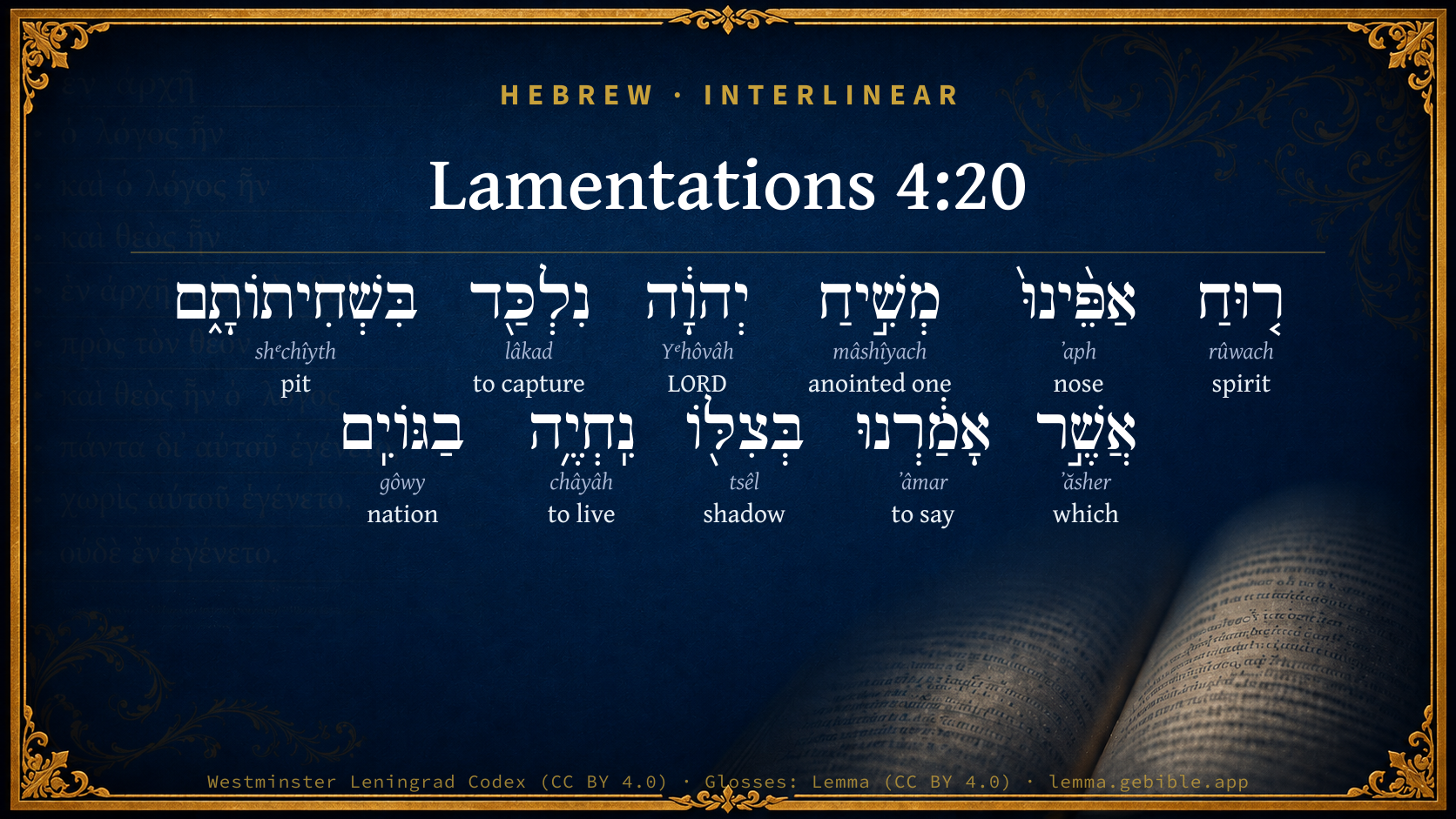
Hebrew (Westminster Leningrad Codex) Lamentations 4:20 appears in the Hebrew Old Testament. The text above is from the Westminster Leningrad Codex. Each word links to its Strong’s number, a concise gloss, and parsing drawn from the Open Scriptures Hebrew Bible morphology. Click any word for its full Brown-Driver-Briggs (BDB) entry.
Download image
Cite this verse

Lamentations 4:20 (World English Bible). Public Domain. Lemma interlinear Bible study tool, https://lemma.gebible.app/v/lamentations/4/20.

Show BibTeX & RIS
BibTeX
RIS
English Translation
The breath of our nostrils, the anointed of Yahweh, was taken in their pits; Of whom we said, Under his shadow we shall live among the nations.
World English Bible · Public Domain
Download a study sheet

One document with this verse’s original text, its word-by-word gloss line, the meaning frame, cross-references with their text, attributed commentary, and full source and license credits — printable, and it pastes into notes with its structure intact.

This verse Autodidact and up

Study sheet (.html) Plain text (.txt)

A passage Seminary Student

Up to 50 verses in one chapter. A passage sheet keeps up to 6 commentary sources and 12 cross-references per verse, in the order this page ranks them, and says so on the sheet whenever that leaves anything out. Ask for a single verse and you get the Autodidact verse sheet above.

Everything on this page stays free to read, with no account — the sheet is a download of what is already on screen, not access to it.

Want to remove ads? Support Godless Engineer
Compare translations 3

The same verse in 3 English versions, stacked beneath the original-language interlinear above. Click any original word for its lexicon entry.

Each is an independent rendering of the whole verse — the interlinear is not word-aligned to these translations.

Highlighted words mark where these versions differ — a whole-verse word diff, not a word-by-word alignment.

  • World English Bible Public Domain
    The breath of our nostrils, the anointed of Yahweh, was taken in their pits; Of whom we said, Under his shadow we shall live among the nations.
  • King James Version Public Domain
    The breath of our nostrils, the anointed of the LORD, was taken in their pits, of whom we said, Under his shadow we shall live among the heathen.
  • unfoldingWord Literal Text CC BY-SA 4.0
    The breath of our nostrils, the anointed of Yahweh, was captured in their pits, of whom we said, “In his shadow we will live among the nations.” SIN

unfoldingWord Literal Text — © unfoldingWord, licensed CC BY-SA 4.0. Word-aligned USFM3 via Door43 (git.door43.org/unfoldingWord/en_ult).

Versions to compare (up to 4)

3 of 4 selected

Show all 18 translations

Every available English version of this verse, each an independent rendering of the whole verse.

  • World English Bible Public Domain
    The breath of our nostrils, the anointed of Yahweh, was taken in their pits; Of whom we said, Under his shadow we shall live among the nations.
  • Berean Standard Bible Public Domain
    The LORD’s anointed, the breath of our life, was captured in their pits. We had said of him, “Under his shadow we will live among the nations.”
  • Majority Standard Bible Public Domain
    The LORD’s anointed, the breath of our life, was captured in their pits. We had said of him, “Under his shadow we will live among the nations.”
  • King James Version Public Domain
    The breath of our nostrils, the anointed of the LORD, was taken in their pits, of whom we said, Under his shadow we shall live among the heathen.
  • American Standard Version (1901) Public Domain
    The breath of our nostrils, the anointed of Jehovah, was taken in their pits; Of whom we said, Under his shadow we shall live among the nations.
  • Revised Version (1885) Public Domain
    The breath of our nostrils, the anointed of the LORD, was taken in their pits; of whom we said, Under his shadow we shall live among the nations.
  • Geneva Bible (1599) Public Domain
    The breath of our nostrels, the Anoynted of the Lord was taken in their nets, of whome we sayde, Vnder his shadowe we shalbe preserued aliue among the heathen.
  • Douay-Rheims (1899) Public Domain
    Res. The breath of our mouth, Christ the Lord, is taken in our sins: to whom we said: Under thy shadow we shall live among the Gentiles.
  • Young's Literal Translation Public Domain
    The breath of our nostrils -- the anointed of Jehovah, Hath been captured in their pits, of whom we said: `In his shadow we do live among nations.'
  • Literal Standard Version CC BY-SA 4.0
    The breath of our nostrils—the anointed of YHWH, || Has been captured in their pits, of whom we said: “We live among nations in his shadow.”
  • Unlocked Literal Bible CC BY-SA 4.0
    The breath in our nostrils—Yahweh's anointed one—he was the one who was captured in their pits; of whom it was said, “Under his shadow we will live among the nations.”
  • unfoldingWord Literal Text CC BY-SA 4.0
    The breath of our nostrils, the anointed of Yahweh, was captured in their pits, of whom we said, “In his shadow we will live among the nations.” SIN
  • Darby Bible Public Domain
    The breath of our nostrils, the anointed of Jehovah, was taken in their pits; of whom we said, Under his shadow we shall live among the nations.
  • World Messianic Bible Public Domain
    The breath of our nostrils, the anointed of the LORD, was taken in their pits; of whom we said, under his shadow we will live among the nations.
  • Webster's Bible Public Domain
    The breath of our nostrils, the anointed of the LORD, was taken in their pits, of whom we said, Under his shadow we shall live among the heathen.
  • Free Bible Version CC BY-SA 4.0
    The king, the Lord's anointed, our country's “life-breath,” was trapped and captured by them. We had said about him, “Under his protection we will live among the nations.”
  • Bible in Basic English Public Domain
    Our breath of life, he on whom the holy oil was put, was taken in their holes; of whom we said, Under his shade we will be living among the nations.
  • JPS Tanakh (1917) Public Domain
    The breath of our nostrils, the anointed of the LORD, was taken in their pits; of whom we said: 'Under his shadow we shall live among the nations.'

Literal Standard Version (2020), Covenant Press — licensed CC BY-SA 4.0. Text via the HelloAO Bible API (eBible.org). Unlocked Literal Bible (unfoldingWord) — licensed CC BY-SA 4.0. Text via the HelloAO Bible API (eBible.org). unfoldingWord Literal Text — © unfoldingWord, licensed CC BY-SA 4.0. Word-aligned USFM3 via Door43 (git.door43.org/unfoldingWord/en_ult). Free Bible Version, Dr. Jonathan Gallagher — licensed CC BY-SA 4.0. Text via the HelloAO Bible API (eBible.org).

Word by word

More ways to search: Search by grammar → Find every occurrence → Compare this word →

Practice this passage: Drill this verse → Learn its vocabulary →

בִּשְׁחִיתוֹתָ֑ם
shᵉchîyth
H7825
“in/at · pits · their”
Preposition + Noun, Common, Feminine, Plural, Construct + Suffix, Personal, 3rd Person, Masculine, Plural
Part of Speech
Preposition + Noun
Type
Common
Gender
Feminine
Number
Plural
State
Construct
Full BDB Definition

Origin: from H7812

TWOT: 2360b

pit
  1. ר֤וּחַ rûwach H7307 “spirit of” Noun, Common, Both, Singular, Construct
  2. אַפֵּ֨ינוּ֙ ʼaph H639 “nostrils · our” Noun, Common, Masculine, Dual, Construct + Suffix, Personal, 1st Person, Common, Plural
  3. מְשִׁ֣יחַ mâshîyach H4899 “anointed one of” Noun, Common, Masculine, Singular, Construct
  4. יְהוָ֔ה Yᵉhôvâh H3068 “LORD” Noun, Proper
  5. נִלְכַּ֖ד lâkad H3920 “to capture” Verb, Niphal, Perfect, 3rd Person, Masculine, Singular
  6. אֲשֶׁ֣ר ʼăsher H834 “which” Particle, Relative
  7. אָמַ֔רְנוּ ʼâmar H559 “to say” Verb, Qal, Perfect, 1st Person, Common, Plural
  8. בְּצִלּ֖וֹ tsêl H6738 “in/at · shadow · his” Preposition + Noun, Common, Masculine, Singular, Construct + Suffix, Personal, 3rd Person, Masculine, Singular
  9. נִֽחְיֶ֥ה châyâh H2421 “to live” Verb, Qal, Imperfect, 1st Person, Common, Plural
  10. בַגּוֹיִֽם gôwy H1471 “in/at the · nations” Preposition, Determined + Noun, Common, Masculine, Plural, Absolute

About this verse

These counts appear in no published source. They are computed here, from the morphology-tagged text and Lemma’s own curated glosses. What Lemma adds →

11
words
11
distinct lemmas
Prophets
section

Notable vocabulary

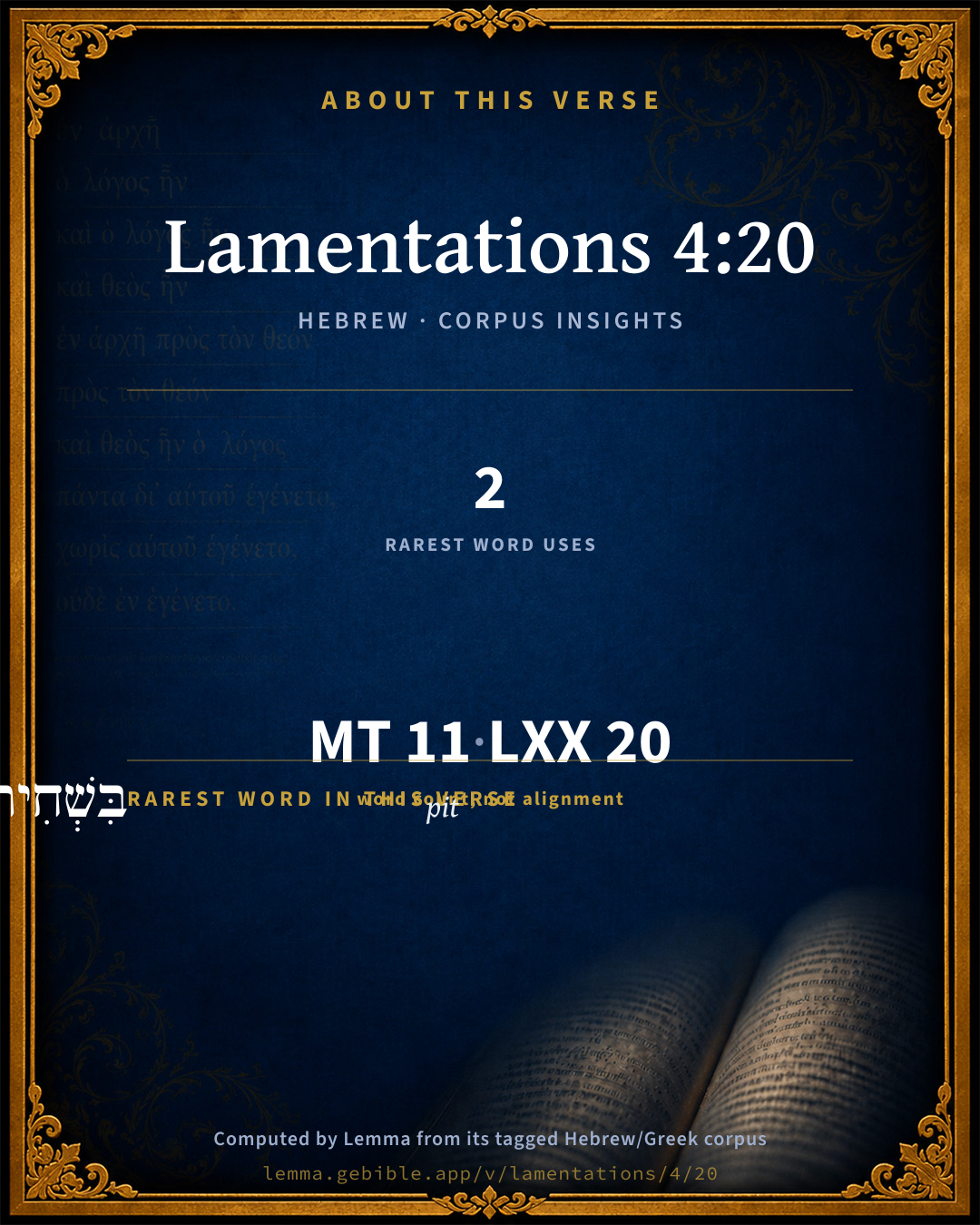
The rarest word here is בִּשְׁחִיתוֹתָ֑ם pit H7825 — appearing just 2 times in the whole Hebrew Bible.

Shared distinctive vocabulary

בִּשְׁחִיתוֹתָ֑ם pit H7825 occurs in 2 verses of the Hebrew Bible. Also found in:

Grammatical profile

  • 3 verbs
  • 7 nouns
  • 1 particle

Verb forms

  • נִלְכַּ֖ד Niphal · Perfect
  • אָמַ֔רְנוּ Qal · Perfect
  • נִֽחְיֶ֥ה Qal · Imperfect

Hebrew & Septuagint length

In English translation the verse runs 27 words from the Hebrew and 28 from the Septuagint (LXX English) — closely comparable.

A rough comparison of the two English renderings, which tokenize alike — not a word-level alignment.

Word counts can differ between the Hebrew and the Greek without any difference in meaning — e.g. the Hebrew direct-object marker אֵת has no separate Greek word, and Greek often adds the article ὁ.

In the original languages it is 11 Hebrew tokens and 20 Greek tokens — but the two are counted differently (Hebrew bundles its prefixes and suffixes into one token; the Greek is in lemma form), so that isn’t a like-for-like length.

Cross-references

20

Topical passages linked to Lamentations 4:20 in the Treasury of Scripture Knowledge — connected by theme and wording, ordered by reader-vote popularity; previews shown in the World English Bible.

  • Genesis 2:7 Yahweh God formed man from the dust of the ground, and breathed into his nostrils the breath of life; and man became a living soul.
  • 2 Samuel 1:14 David said to him, How were you not afraid to put forth your hand to destroy Yahweh's anointed?
  • 2 Samuel 19:21 But Abishai the son of Zeruiah answered, Shall Shimei not be put to death for this, because he cursed Yahweh's anointed?
  • Jeremiah 39:5 But the army of the Chaldeans pursued after them, and overtook Zedekiah in the plains of Jericho: and when they had taken him, they brought him up to Nebuchadrezzar king of Babylon to Riblah in the land of Hamath; and he gave judgment on him.
  • Ezekiel 12:13 My net also will I spread on him, and he shall be taken in my snare; and I will bring him to Babylon to the land of the Chaldeans; yet shall he not see it, though he shall die there.
  • 2 Samuel 1:21 You mountains of Gilboa, Let there be no dew nor rain on you, neither fields of offerings: For there the shield of the mighty was vilely cast away, The shield of Saul, not anointed with oil.
  • Psalms 89:20–21 I have found David, my servant. I have anointed him with my holy oil,
  • Lamentations 2:9 Her gates are sunk into the ground; he has destroyed and broken her bars: Her king and her princes are among the nations where the law is not; Yes, her prophets find no vision from Yahweh.
  • Ezekiel 17:18 For he has despised the oath by breaking the covenant; and behold, he had given his hand, and yet has done all these things; he shall not escape.
  • Genesis 44:30 Now therefore when I come to your servant my father, and the boy is not with us; seeing that his life is bound up in the boy's life;
  • 1 Samuel 12:3 Here I am: witness against me before Yahweh, and before his anointed: whose ox have I taken? or whose donkey have I taken? or whom have I defrauded? whom have I oppressed? or of whose hand have I taken a ransom to blind my eyes therewith? and I will restore it you.
  • 1 Samuel 16:6 It happened, when they had come, that he looked at Eliab, and said, Surely Yahweh's anointed is before him.
  • 1 Samuel 24:6 He said to his men, Yahweh forbid that I should do this thing to my lord, Yahweh's anointed, to put forth my hand against him, seeing he is Yahweh's anointed.
  • 1 Samuel 24:10 Behold, this day your eyes have seen how that Yahweh had delivered you today into my hand in the cave: and some bade me kill you; but [my eye] spared you; and I said, I will not put forth my hand against my lord; for he is Yahweh's anointed.
  • 1 Samuel 26:9 David said to Abishai, Don't destroy him; for who can put forth his hand against Yahweh's anointed, and be guiltless?
  • 1 Samuel 26:16 This thing isn't good that you have done. As Yahweh lives, you are worthy to die, because you have not kept watch over your lord, Yahweh's anointed. Now see where the king's spear is, and the jar of water that was at his head.
  • 2 Samuel 18:3 But the people said, You shall not go forth: for if we flee away, they will not care for us; neither if half of us die, will they care for us: but you are worth ten thousand of us; therefore now it is better that you are ready to help us out of the city.
  • Jeremiah 52:8 But the army of the Chaldeans pursued after the king, and overtook Zedekiah in the plains of Jericho; and all his army was scattered from him.
  • Ezekiel 19:4–8 The nations also heard of him; he was taken in their pit; and they brought him with hooks to the land of Egypt.
  • 1 Samuel 12:5 He said to them, Yahweh is witness against you, and his anointed is witness this day, that you have not found anything in my hand. They said, He is witness.

Cross-references courtesy of OpenBible.info (CC BY 4.0).

Hebrew and Greek witnesses Masoretic Hebrew ↔ Greek Septuagint

The same verse in the two great witnesses to the Old Testament, shown verse-for-verse.

These are two independent witnesses, not word-aligned to each other, and the Septuagint is shown in lemma (dictionary) form.

Hebrew Lamentations 4:20 Masoretic · Westminster Leningrad Codex

ר֤וּחַ אַפֵּ֨ינוּ֙ מְשִׁ֣יחַ יְהוָ֔ה נִלְכַּ֖ד בִּשְׁחִיתוֹתָ֑ם אֲשֶׁ֣ר אָמַ֔רְנוּ בְּצִלּ֖וֹ נִֽחְיֶ֥ה בַגּוֹיִֽם

The breath of our nostrils, the anointed of Yahweh, was taken in their pits; Of whom we said, Under his shadow we shall live among the nations.

World English Bible · Public Domain

Greek LXX Lamentations 4:20 Septuagint · lemma form

πνεῦμα πρόσωπον ἐγώ χριστός κύριος συνλαμβάνω ἐν ὁ διαφθορά αὐτός ὅς εἶπον ἐν ὁ σκιά αὐτός ζάω ἐν ὁ ἔθνος

RECHS. The breath of our nostrils, our anointed Lord, was taken in their destructive snares, of whom we said, In his shadow we shall live among the Gentiles.

LXX2012 (modern English Septuagint) · Public Domain

On this verse, The Pulpit Commentary discusses the Septuagint’s reading. Read the note in Commentary ↓

Hebrew: Westminster Leningrad Codex (CC BY 4.0). Greek: Septuagint (public domain); English from LXX2012 (modern English Septuagint) (Public Domain). How the Septuagint differs from the Hebrew →

Commentary

Notes on Lamentations 4:20 from classic Christian and Jewish commentators (each source and its license shown beneath its notes). The classic Christian expositions comment on the surrounding passage and are grouped to its opening verse, so a note may address several verses; the Jewish commentaries on the Tanakh (Rashi and others) are per-verse, so they appear only where the commentator wrote on this verse.

Lemma curates 59 commentaries, every one of them public domain or Creative Commons licensed, each selected and text-cleaned for this edition rather than reprinted as found. About our sources →

Trapp's Complete Commentary

John Trapp

Lam 4:20 The breath of our nostrils, the anointed of the LORD, was taken in their pits, of whom we said, Under his shadow we shall live among the heathen.

Ver. 20. The breath, of our nostrils.] King Zedekiah, in whose downfall we drew, as it were, our last breath. The Chaldee paraphrast understandeth it of Josiah, with whom, indeed, died all the prosperity of the Jews as with Epaminondas did that of the Thebans, and with Theodosius that of the Western Empire.

The anointed of the Lord.] Who yet, for his perfidy, was vilely cast away like Saul, as though he had not been anointed with oil. {2Sa 1:21}

Was taken in their pits.] A term taken from hunters (Eze 12:13; see Lam 4:20 Jer 52:8).

Under his shadow.] As the chickens do under the hen’s.

John Trapp, A Commentary or Exposition upon All the Books of the Old and New Testament (1647–1656) — public domain. Text from a community e-Sword module.

Tyndale Open Study Notes

Tyndale Open Resources

4:20 Our king . . . was caught: A reference to Zedekiah, who tried to flee but was caught and treated cruelly by Nebuchadnezzar (2 Kgs 25:4-7; Jer 39:4-7; 52:9-11).

Tyndale Open Study Notes — © Tyndale Open Resources, licensed CC BY-SA 4.0. Text via the HelloAO Bible API.

Geneva Bible (1599)

Geneva Bible translators

Our king Josiah, in whom stood our hope of God’s favor, and on whom depended our state and life, was slain, whom he calleth Anointed, because he was a figure of Christ.

Geneva Bible (1599) marginal notes — public domain. Text via Bolls.life.

Jamieson, Fausset & Brown

Robert Jamieson, A. R. Fausset & David Brown

breath . . . anointed of . . . Lord--our king, with whose life ours was bound up. The original reference seems to have been to Josiah (Ch2 35:25), killed in battle with Pharaoh-necho; but the language is here applied to Zedekiah, who, though worthless, was still lineal representative of David, and type of Messiah, the "Anointed." Viewed personally the language is too favorable to apply to him.

live among the heathen--Under him we hoped to live securely, even in spite of the surrounding heathen nations [GROTIUS].

Jamieson, Fausset & Brown — Commentary Critical and Explanatory on the Whole Bible (1871) — public domain (CC PDM 1.0). Text via the HelloAO Bible API.

Adam Clarke's Commentary

Verse 20. The breath of our nostrils, the anointed of the Lord] That is, Zedekiah the king, who was as the life of the city, was taken in his flight by the Chaldeans, and his eyes were put out; so that he was wholly unfit to perform any function of government; though they had fondly hoped that if they surrendered and should be led captives, yet they should be permitted to live under their own laws and king in the land of their bondage.

Adam Clarke's Commentary on the Bible (1810–1826) — public domain. Text from a community e-Sword/MySword module.

John Calvin's Commentaries

This verse, as I have said elsewhere, has been ignorantly applied to Josiah, who fell in battle long before the fall of the city. The royal dignity continued after his death; he was himself buried in the grave of his fathers; and though the enemy was victorious, yet he did not conic to the city. It is then absurd to apply to that king what is here properly said of Zedekiah, the last king; for though he was wholly unlike Josiah, yet he was one of David’s posterity, and a type of Christ.

As it was, then, God’s will that the posterity of David should represent Christ, Zedekiah is here rightly called the Christ of Jehovah, by which term Scripture designates all kings, and even Saul; and though his kingdom was temporary, and soon decayed, yet he is called “the Anointed of Jehovah;” and doubtless the anointing, which he received by the hand of Samuel, was not altogether in vain. But David is properly called the Anointed of Jehovah, together with his posterity. Hence he often used these words, “Look on thy Christ.” (Psalm 84:10.) And when Hannah in her song spoke of the Christ of Jehovah, she had no doubt a regard to this idea. (1 Samuel 2:10.) And, at length, our Lord was called the Christ of the Lord, for so Simeon called him. (Luke 2:26.)

Now, then, we perceive that this passage cannot be understood except of king Zedekiah. It ought at the same time to be added, that he is called the Christ of Jehovah, because his crown was not as yet cast down, but he still bore that diadem by which he had been adorned by God. As, then, the throne of David still remained, Zedekiah, however unworthy he was of that honor, was yet the Christ of Jehovah, as Manasseh was, and others who were wholly degenerated.

The Prophet, however, seems to ascribe to Zedekiah far more than he deserved, when he calls the life of the people. But this difficulty may be easily removed; the man himself is not regarded according to his merits, but as he was called by God, and endued with that high and singular honor; for we know that what is here said extended to all the posterity of David, —

“I have made him the first-begotten among all the kings of the earth.” (Psalm 89:27.)

For though the kings of the earth obtained not their authority, except as they were established by God’s decree, yet the king from David’s posterity was first-begotten among them all. In short, it was a sacerdotal, and even a sacred kingdom, because God had peculiarly dedicated that throne to himself. This peculiarity ought then to be borne in mind, that we may not look on the individual in himself.

Then the passage runs consistently, when he says, that the Messiah, or the anointed of Jehovah, had been taken it snares; for we know that he was taken; and this is consistent with history. He had fled by a hidden way into the desert, and he thought that lie had escaped from the hands of his enemies; but he was soon seized, and brought to king Nebuchadnezzar. As, then, he had unexpectedly fallen into the hands of his enemies, rightly does the Prophet say metaphorically, that he was taken in their snares.

He calls him the spirit of the nostrils of the people, because the people without their king was like a mutilated and an imperfect body. For God made David king, and also his posterity, for this end, that the life of the people might in a manner reside in him. As far, then, as David was the head of the people, and so constituted by God, he was even their life. The same was the case with all his posterity, as long as the succession continued; for the favor of God was not extinguished until all liberty vanished, when the city was destroyed, and even the name of the people was as it were abolished.

But we must observe what we have before said, that these high terms in which the posterity of David were spoken of, properly belong to Christ only; for David was not the life of the people, except as he was the type of Christ, and represented his person. Then what is said was not really found in the posterity of David, but only typically. Hence the truth, the reality, is to be sought in no other but in Christ And we hence learn that the Church is dead, and is like a maimed body, when separated from its head. If, then, we desire to live before God, we must come to Christ, who is really the spirit or the breath of our nostrils; for as man that is dead does no longer breathe, so also we are said to be dead when separated from Christ. On the other hand, as long as there is between him and us a sacred union, though our life is hid, and we die, yet we live in him, and though we are dead to the world, yet our life is in heaven, as also Paul and Peter call us thither. (Colossians 3:3, 4; 2 Peter 3:16.) In short, Jeremiah means that the favor of God was as it were extinguished when the king was taken away, because the happiness of the people depended on the king, and the royal dignity was as it were a sure pledge of the grace and favor of God; hence the blessing of God ceased, when the king was taken away from the Jews.

It follows at length, Of whom we have said, Under thy shadow we shall live among the nations. The Prophet shews that the Jews in vain hoped for anything any more as to their restoration; for the origin of all blessing was from the king. God had bereaved them of their king; it then follows that they were in a hopeless state. But the Prophet that he might more clearly express this, says, that the people thought that they would be safe, provided the kingdom remained, — We shall live, they said, even among the nations under the shadow of our king; that is, “Though we may be driven to foreign nations, yet the king will be able to gather us, and his shadow will extend far and wide to keep us safe.” So the Jews believed, but falsely, because by their defection they had cast away the yoke of Christ and of God, as it is said in Psalm 2:3. As then they had shaken off the heavenly yoke, they in vain trusted in the shadow of an earthly king, and were wholly unworthy of the guardianship and protection of God. It afterwards follows, —

John Calvin's Commentaries (1540-1563) — public domain. Text from the Calvin Translation Society English edition (1840s-50s) via the Christian Classics Ethereal Library (ccel.org). Calvin's coverage is partial (roughly two-thirds of the Bible); uncommented books and verses are honest gaps, never fabricated. The 19th-century editor's footnotes and remarks are omitted so the notes are faithfully Calvin's own voice.

Ellicott's Commentary for English Readers

(20) The breath of our nostrils.—The “breath of life” of Gen_2:7. The phrase emphasises the ideal character of the king as the centre of the nation’s life. So Seneca (Clement. i. 4) speaks of a ruler as the spiritus vitalis of his people.

Of whom we said.—The words that follow point to the scheme which was rendered abortive by Zedekiah’s capture. Those who followed him had hoped to find a refuge among some friendly neighbouring nation, where they might at least have maintained the continuity of their national existence, and waited for better days.

A Bible Commentary for English Readers, edited by Charles John Ellicott (1878–1897) — public domain. Text from a community e-Sword module.

The Cambridge Bible for Schools and Colleges

gen. ed. J. J. S. Perowne

20. The breath of our nostrils] Pe. remarks that the phrase is an ancient one, being found in the Tell el Amarna letters (fifteenth century b.c.). Cp. Seneca (ad Neronem de Clementia, I. 4) “He (the Emperor) is the breath of life, which these many thousand (subjects) draw.” As regards its application to Zedekiah individually we are to remember that whatever may have been his personal weaknesses (and he was weak rather than vicious), he was the one on whom the whole of the people’s hopes depended for the continuance of their national life. So “the romantic enthusiasm of Cavaliers and Non-jurors for the Stuarts was not to be accounted for by the merits and attractions of the various successive sovereigns and pretenders towards whom it was directed,” Adeney, op. cit. p. 298.

Of whom we said …] The reference may very possibly be to a hope entertained by the fugitives that by escaping to the mountainous region of Moab or Ammon they might maintain in some sort their national existence under Zedekiah.

The Cambridge Bible for Schools and Colleges (gen. ed. J. J. S. Perowne; Cambridge University Press, 1878–1918) — public domain. Text from a community e-Sword module.

John Gill's Exposition

The breath of our nostrils, the anointed of the Lord, was taken in their pits,.... Or "the Messiah", or "the Christ of the Lord" (n); not Josiah, as the Targum; and so Jarchi and others; for though he was the Lord's anointed, and the life of the people, being the head of them, as every king is, especially a good one; yet he was slain, and not taken, and much less in their pits, and that not by the Chaldeans, but by the Egyptians; nor did the kingdom cease with him, or the end of the Jewish state then come, which continued some years after: but rather Zedekiah, as Aben Ezra and others, the last of the kings of Judah, with whom all agrees; he was the Lord's anointed as king, and the preserver of the lives and liberties of the people, at least as they hoped; but when the city was taken by the Chaldeans, and he fled for his life, they pursued him, and took him; he fell into their hands, their pits, snares, and nets, as was foretold he should; and which are sometimes called the net and snare of the Lord; see Eze 12:13; See Gill on Lam 4:19. Many of the ancient Christian writers apply this to Christ; and particularly Theodoret takes it to be a direct prophecy of him and his sufferings. Vatablus, who interprets it of Josiah, makes him to be a type of Christ; as Calvin does Zedekiah, of whom he expounds the words; and the Targum, in the king of Spain's Bible, is,

"the King Messiah, who was beloved by us, as the breath of the spirit of life, which is in our nostrils.''

What is here said may be applied to Christ; he is the life of men, he gives them life and breath, and in him they live and move; their spiritual life is from him, and is maintained and preserved by him; he lives in his people, and they in him, and they cannot live without him, no more than a man without his breath: he is the Christ of God, anointed with the Holy Ghost to the offices of Prophet, Priest, and King; and from whom Christians have their holy unction and their name: he was taken, not by the Chaldeans, but by the wicked Jews; who looked upon him as a very mischievous person, as if he had been an evil beast, a beast of prey, though the pure spotless Lamb of God; and they dug pits, laid snares, and formed schemes to take him, and at last did, and with wicked hands crucified him, and slew him; though not without his own and his Father's will and knowledge, Act 2:23;

of whom we said, under his shadow we shall live among the Heathen; in the midst of the nations round about them, unmolested by them, none daring to meddle with them; at least safe from being carried captive, as now they were. Though Jeconiah was taken and carried into Babylon, yet Zedekiah being placed upon the throne, the Jews hoped to live peaceable and quiet lives under his government, undisturbed by their neighbours; the wise and good government of a prince, and protection under it, being sometimes compared in Scripture to the shadow of a rock or tree, Isa 32:2; but now it was all over with them; their hope was gone, he being taken. Something like this may be observed in the disciples of Christ; they hoped he would have restored the kingdom to Israel, and they should have lived gloriously under his government; they trusted that it was he that should have redeemed Israel; but, when he was taken and crucified, their hope was in a manner gone, Luk 24:21. True believers in Christ do live peaceably, comfortably, and safely under him; they are among the Heathen, among the men of the world, liable to their reproaches, insults, and injuries; Christ is a tree, to which he is often compared, one and another, that casts a delightful, reviving, refreshing, and fructifying shadow, under which they sit with great delight, pleasure, and profit, Sol 2:3; he is a rock, the shadow of which affords rest to weary souls, and shelters from the heat of divine wrath, the fiery law of God, and darts of Satan, and persecutions of men, Isa 32:2; and under his government, protection, and power, they dwell safely, that sin cannot destroy them, nor Satan devour them, nor the world hurt them; here they live spiritually, and shall never die eternally, Jer 23:5.

(n) , Sept. "Christus Dominus", V. L. "Christus Domini", Pagninus.

John Gill's Exposition of the Whole Bible (1746–1763) — public domain (CC PDM 1.0). Text via the HelloAO Bible API.

Haydock's Catholic Bible Commentary

Christ, &c. According to the letter, is spoken of their king, who is called the Christ; that is, the anointed of the Lord. But is also relates in the spiritual sense to Christ our Lord, suffering for out sins. (Challoner) (Isaias liii. 5.) (St. Augustine, City of God xviii. 33.) --- It literally speaks of Josias, or of Sedecias. (Worthington) --- Josias was slain by the Egyptians. (St. Jerome, in Zacharias xii.) --- But Sedecias seems chiefly to be meant. The people were much attached to him, though he was wicked; and they expected that he would have rescued them from the power of the Chaldeans, as his league with the neighbouring Gentiles (Calmet) seemed to insure, (Haydock) if they had proved faithful. (Calmet) --- But all was useless against the Lord. (Haydock)

George Leo Haydock (1774–1849), Haydock's Catholic Family Bible and Commentary, 1859 edition — public domain. Excludes Psalms (Douay-Rheims chapter numbering differs from Protestant) and Deuterocanonical books (Catholic canon only).

Matthew Poole's English Annotations

That he calls some prince here the breath of their nostrils, that is, their life, Gen 2:7, is out of doubt; and though some of the Jews would have it understood of Josiah, yet whoso considereth that he was not taken, but slain, and that not by the Chaldeans, but by the Egyptians twenty-three years before the city was taken, will see reason to conclude that he meaneth Zedekiah, who though a bad man, yet was a king, and of David’s line, and afforded some protection to the Jews. We promised ourselves that though the land of Judah was encompassed with pagan nations, yet through Zedekiah’s valour and good conduct in government we should live comfortably, he being a covering and refreshing to us; but, saith the prophet, he also is fallen into the enemies’ hands.

Matthew Poole's English Annotations on the Holy Bible (1683–1685) — public domain. Text from a community e-Sword/MySword module.

Whedon's Commentary on the Bible

Daniel D. Whedon

20. The breath of our nostrils — A designation of the king; in this instance Zedekiah, but applicable to the true king, whoever might be the anointed of the Lord. He is here described as captured like a wild animal, in their pits.

Daniel D. Whedon (gen. ed.), Commentary on the Old and New Testaments (1874–1909) — public domain. Text from a community e-Sword module.

The Pulpit Commentary

The breath of our nostrils. The theocratic king was the direct representative of the people with Jehovah, and to him the promises of 2Sa 7 were conveyed. He was also, in a sense, the representative of Jehovah with the people. His throne was "the throne of Jehovah". (1Ch_29:23) A similar conception of the king was generally prevalent in antiquity. Most of all among the Egyptians; but, even in imperial Rome, we find Seneca ("De Clementia," 1:4, quoted by Archbishop Seeker, in Blayney) declaring, "Ille (Princeps) est spiritus vitalis, quem haec tot millia (civium) trahunt." For the Jewish, or Old Testament, conception, see Psa_28:8, where (as the Septuagint shows) "his people" and "his anointed" are used almost synonymously. Was taken in their pits. A figure from hunting. (comp. Lam_1:13 Psa_7:15) The fate of Zedekiah is referred to. Among the heathen; better, among the nations. The rendering of the Authorized Version suggests that the Jews hoped to preserve at least a qualified independence under their own king, even after their captivity.

A disappointed confidence and a desecrated sanctity.

There seems to be indicated in these words a great attachment to the kingly office and a great confidence in it. It is the same spirit continuing and probably intensified which caused the people ages before to demand a king. And is it not thus suggested to us what a deep feeling there is in the human heart to have some one individual to look up to as having rule over us? "The right Divine of kings" is a principle which more than once in history has been seen pushing itself to disastrous issues, but that is no reason for asserting that "the right Divine of kings" is an absurdity. It is only an absurdity when a weak fallible mortal holds himself, by virtue of his ancestry and kinship, to have little less than absolute control over multitudes of his fellow men. The question is not whether kingship is right, but who shall be the king. And especially does this need to be recollected among the changing forms of government so perceptible in modern times. Now that despotisms are tending to limited monarchies, and limited monarchies becoming more limited, and extensions being made of republican territory, it is more than ever important to insist on the kingdom of God, the kingdom of heaven. Not without deep reason does the proper government for man stand before us in the New Testament as a kingdom. The collective wisdom of mankind can only be at best a puzzling mixture of knowledge and ignorance, prudence and rashness. Blessed is he who feels that the real Anointed of the Lord is the proper Being to guide. Under his shadow we can live the true life in that safety of the spirit which is of far more moment than that mere external safety from the Gentiles, which counted for so much in the esteem of the Israelite of old. In no pits has the Lord Jesus Christ ever been taken. Y.

The Pulpit Commentary (1880–1919), ed. H.D.M. Spence-Jones & Joseph S. Exell — public domain. Text from a community e-Sword module.

John Wesley's Explanatory Notes

The anointed - Zedekiah, who though a bad man yet afforded some protection to the Jews. We said - We promised ourselves that though the land of Judah was encompassed with Pagan nations, yet through Zedekiah's valour and good conduct we should live comfortably.

John Wesley, Explanatory Notes Upon the Whole Bible (1754–1765) — public domain. Text via the GEBible commentary corpus.

Rashi

Rabbi Shlomo Yitzchaki (Rashi)

The breath of our nostrils, the Lord’s anointed That is Josiah, as it is stated in Chronicles (II Chron. 35:25): “And Jeremiah lamented Josiah.”

in their pits in the pits that they dug.

Rashi on the Tanakh — English translations: “The Judaica Press complete Tanach with Rashi, translated by A. J. Rosenberg” (CC BY 4.0); “Pentateuch with Rashi's commentary by M. Rosenbaum and A.M. Silbermann, 1929-1934” (public domain); “The Metsudah Tanach series, Lakewood, N.J” (CC BY 4.0); and “The Book of Joshua, Metsudah Publications, 1997” (CC BY 4.0). Text via Sefaria.

Lesson kit

Teaching starters — assembled from the data on this page, not authored interpretation. Every prompt links to the verse data it draws on. Edit before teaching.

Lamentations, in the Prophets, opens this verse with 11 words (11 distinct Hebrew lemmas). Its most distinctive word is shᵉchîyth (“pit”). A historical commentator’s framing appears above. Read the whole chapter for the surrounding context.

Discussion questions

  1. How does “pit” (shᵉchîyth) shape what this verse is saying?
  2. How does Psalms 107:20, which shares the word «pit», read alongside this verse?
  3. The translations on this page render this verse differently — a whole-verse word diff, not a word-by-word alignment. What might account for the different wordings?
  4. «נִלְכַּ֖ד» is a Niphal Perfect verb. How does that grammatical form shape the action described?
  5. Compare how Trapp's Complete Commentary and Tyndale Open Study Notes read this verse. Where do they agree or differ?

Things to notice

Reading settings

Reading text

Shown beneath each verse's original-language words.

Old Testament
Old Testament edition

Read the OT as the Masoretic Hebrew (MT) or the Greek Septuagint (LXX).

English shown for the Greek Septuagint (in the Hebrew ↔ Greek comparison).

Comparing translations? Open the Compare panel on any verse page to stack up to four side by side.