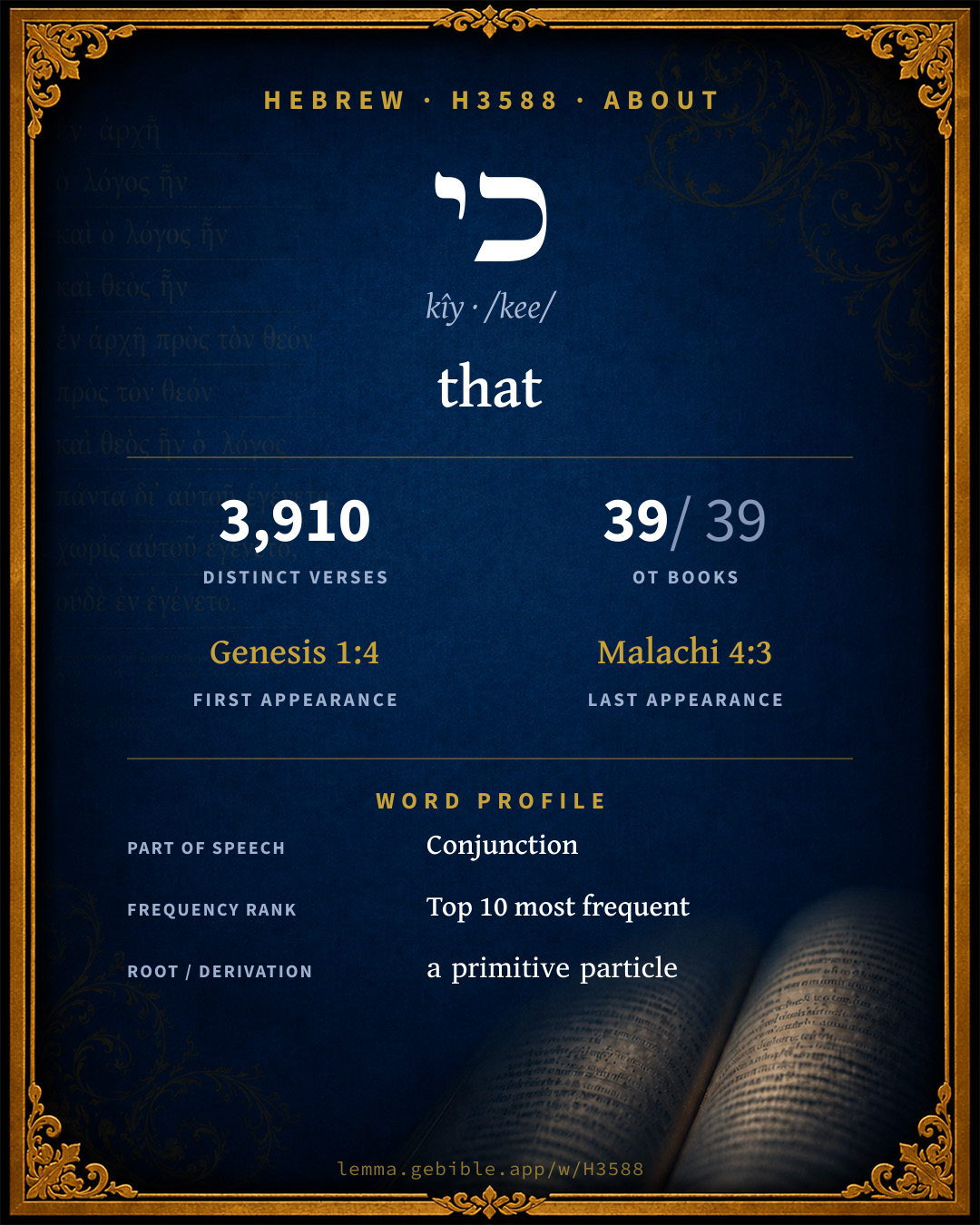
כִּי
that
also: for, because, when, as though fuller range ↓
Full lexicon entry — Brown-Driver-Briggs (BDB)
From Brown-Driver-Briggs (BDB)
Where this word appears
Grammar key — what these labels mean
Part of speech
- Conjunction
- A joining word (e.g. “and,” “but”) linking words or clauses.
- Preposition
- A relational word (e.g. “in,” “to,” “from”) governing a noun.
Grammatical forms
- Conjunction 4,487 times (100%)
- Preposition 1 time (0%)
Parsed forms decoded from the imported morphology (morphhb / Westminster Leningrad Codex — WLC text public domain, morphhb tagging CC BY 4.0), counted across 4,488 parsed occurrences — not distinct verses.
Page 12 of 20 — showing verses 2,201–2,400 of 3,910 distinct verses where H3588 appears, across 39 books. Click any verse to open its interlinear word-by-word view. Verse text shown in the World English Bible for context — . Each verse’s Hebrew form is shown with its reference; the English is not keyword-highlighted, since the data carries no word-level English alignment. Use “Compare translations” on any verse to read it across multiple English versions. This concordance covers the Hebrew Bible; Septuagint (Greek Old Testament) occurrences are not indexed here.
Psalms 411 verses
- Psalms 6:8 כִּֽי conj Depart from me, all you workers of iniquity, For Yahweh has heard the voice of my weeping.
- Psalms 8:3 כִּֽי conj When I consider your heavens, the work of your fingers, The moon and the stars, which you have ordained;
- Psalms 8:4 כִּֽי כִּ֣י conj conj What is man, that you think of him? The son of man, that you care for him?
- Psalms 9:4 כִּֽי conj For you have maintained my just cause. You sit on the throne judging righteously.
- Psalms 9:10 כִּ֤י conj Those who know your name will put their trust in you, For you, Yahweh, have not forsaken those who seek you.
- Psalms 9:12 כִּֽי conj For he who avenges blood remembers them. He doesn't forget the cry of the afflicted.
- Psalms 9:18 כִּ֤י conj For the needy shall not always be forgotten, Nor the hope of the poor perish forever.
- Psalms 10:3 כִּֽי conj For the wicked boasts of his heart's cravings, He blesses the greedy, and condemns Yahweh.
- Psalms 10:14 כִּֽי conj But you do see trouble and grief; You consider it to take it into your hand. You help the victim and the fatherless.
- Psalms 11:2 כִּ֤י conj For, behold, the wicked bend their bows. They set their arrows on the strings, That they may shoot in darkness at the upright in heart.
- Psalms 11:3 כִּ֣י conj If the foundations are destroyed, What can the righteous do?
- Psalms 11:7 כִּֽי conj For Yahweh is righteous. He loves righteousness. The upright shall see his face.
- Psalms 12:1 כִּי כִּי conj conj Help, Yahweh; for the godly man ceases. For the faithful fail from among the children of men.
- Psalms 13:4 כִּ֣י conj Lest my enemy say, "I have prevailed against him;" Lest my adversaries rejoice when I fall.
- Psalms 13:6 כִּ֖י conj I will sing to Yahweh, Because he has been good to me.
- Psalms 14:5 כִּֽי conj There they were in great fear, For God is in the generation of the righteous.
- Psalms 14:6 כִּ֖י conj You frustrate the plan of the poor, Because Yahweh is his refuge.
- Psalms 16:1 כִּֽי conj Preserve me, God, for in you do I take refuge.
- Psalms 16:8 כִּ֥י conj I have set Yahweh always before me. Because he is at my right hand, I shall not be moved.
- Psalms 16:10 כִּ֤י conj For you will not leave my soul in Sheol, Neither will you allow your holy one to see corruption.
- Psalms 17:6 כִֽי conj I have called on you, for you will answer me, God: Turn your ear to me. Hear my speech.
- Psalms 18:7 כִּי conj Then the earth shook and trembled. The foundations also of the mountains quaked and were shaken, Because he was angry.
- Psalms 18:17 כִּֽי conj He delivered me from my strong enemy, From those who hated me; for they were too mighty for me.
- Psalms 18:19 כִּ֘י conj He brought me forth also into a large place. He delivered me, because he delighted in me.
- Psalms 18:21 כִּֽי conj For I have kept the ways of Yahweh, And have not wickedly departed from my God.
- Psalms 18:22 כִּ֣י conj For all his ordinances were before me. I didn't put away his statutes from me.
- Psalms 18:27 כִּֽי conj For you will save the afflicted people, But the haughty eyes you will bring down.
- Psalms 18:28 כִּֽי conj For you will light my lamp, Yahweh. My God will light up my darkness.
- Psalms 18:29 כִּֽי conj For by you, I advance through a troop. By my God, I leap over a wall.
- Psalms 18:31 כִּ֤י conj For who is God, except Yahweh? Who is a rock, besides our God,
- Psalms 20:6 כִּ֤י conj Now I know that Yahweh saves his anointed. He will answer him from his holy heaven, With the saving strength of his right hand.
- Psalms 21:3 כִּֽי conj For you meet him with the blessings of goodness; You set a crown of fine gold on his head.
- Psalms 21:6 כִּֽי conj For you make him most blessed forever. You make him glad with joy in your presence.
- Psalms 21:7 כִּֽי conj For the king trusts in Yahweh. Through the loving kindness of the Most High, he shall not be moved.
- Psalms 21:11 כִּי conj For they intended evil against you. They plotted evil against you which cannot succeed.
- Psalms 21:12 כִּ֭י conj For you will make them turn their back, When you aim drawn bows at their face.
- Psalms 22:8 כִּ֘י conj "He trusts in Yahweh; Let him deliver him; Let him rescue him, since he delights in him."
- Psalms 22:9 כִּֽי conj But you brought me out of the womb. You made me trust at my mother's breasts.
- Psalms 22:11 כִּי כִּי conj conj Don't be far from me, for trouble is near. For there is none to help.
- Psalms 22:16 כִּ֥י conj For dogs have surrounded me. A company of evil-doers have enclosed me. They pierced my hands and my feet.
- Psalms 22:24 כִּ֤י conj For he has not despised nor abhorred the affliction of the afflicted, Neither has he hidden his face from him; But when he cried to him, he heard.
- Psalms 22:28 כִּ֣י conj For the kingdom is Yahweh's. He is the ruler over the nations.
- Psalms 22:31 כִּ֣י conj They shall come and shall declare his righteousness to a people that shall be born, For he has done it.
- Psalms 23:4 כִּֽי כִּי conj conj Even though I walk through the valley of the shadow of death, I will fear no evil, for you are with me. Your rod and your staff, they comfort me.
- Psalms 24:2 כִּי conj For he has founded it on the seas, And established it on the floods.
- Psalms 25:5 כִּֽי conj Guide me in your truth, and teach me, For you are the God of my salvation, I wait for you all day long.
- Psalms 25:6 כִּ֖י conj Yahweh, remember your tender mercies and your loving kindness, For they are from old times.
- Psalms 25:11 כִּ֣י conj For your name's sake, Yahweh, Pardon my iniquity, for it is great.
- Psalms 25:15 כִּ֤י conj My eyes are ever on Yahweh, For he will pluck my feet out of the net.
- Psalms 25:16 כִּֽי conj Turn to me, and have mercy on me, For I am desolate and afflicted.
- Psalms 25:19 כִּי conj Consider my enemies, for they are many. They hate me with cruel hatred.
- Psalms 25:20 כִּֽי conj Oh keep my soul, and deliver me. Let me not be disappointed, for I take refuge in you.
- Psalms 25:21 כִּ֝֗י conj Let integrity and uprightness preserve me, For I wait for you.
- Psalms 26:1 כִּֽי conj Judge me, Yahweh, for I have walked in my integrity. I have trusted also in Yahweh without wavering.
- Psalms 26:3 כִּֽי conj For your loving kindness is before my eyes. I have walked in your truth.
- Psalms 27:5 כִּ֤י conj For in the day of trouble he will keep me secretly in his pavilion. In the covert of his tent he will hide me. He will lift me up on a rock.
- Psalms 27:10 כִּי conj When my father and my mother forsake me, Then Yahweh will take me up.
- Psalms 27:12 כִּ֥י conj Don't deliver me over to the desire of my adversaries, For false witnesses have risen up against me, Such as breathe out cruelty.
- Psalms 28:5 כִּ֤י conj Because they don't regard the works of Yahweh, Nor the operation of his hands, He will break them down and not build them up.
- Psalms 28:6 כִּי conj Blessed be Yahweh, Because he has heard the voice of my petitions.
- Psalms 30:1 כִּ֣י conj I will extol you, Yahweh, for you have raised me up, And have not made my foes to rejoice over me.
- Psalms 30:5 כִּ֤י conj For his anger is but for a moment; His favor is for a lifetime. Weeping may stay for the night, But joy comes in the morning.
- Psalms 31:3 כִּֽי conj For you are my rock and my fortress, Therefore for your name's sake lead me and guide me.
- Psalms 31:4 כִּֽי conj Pluck me out of the net that they have laid secretly for me, For you are my stronghold.
- Psalms 31:9 כִּ֤י conj Have mercy on me, Yahweh, for I am in distress. My eye, my soul, and my body waste away with grief.
- Psalms 31:10 כִּ֤י conj For my life is spent with sorrow, My years with sighing. My strength fails because of my iniquity. My bones are wasted away.
- Psalms 31:13 כִּ֤י conj For I have heard the slander of many, terror on every side, While they conspire together against me, They plot to take away my life.
- Psalms 31:17 כִּ֣י conj Let me not be disappointed, Yahweh, for I have called on you. Let the wicked be disappointed. Let them be silent in Sheol.
- Psalms 31:21 כִּ֥י conj Praise be to Yahweh, For he has shown me his marvelous loving kindness in a strong city.
- Psalms 32:3 כִּֽי conj When I kept silence, my bones wasted away through my groaning all day long.
- Psalms 32:4 כִּ֤י conj For day and night your hand was heavy on me. My strength was sapped in the heat of summer. Selah.
- Psalms 33:4 כִּֽי conj For the word of Yahweh is right. All his work is done in faithfulness.
- Psalms 33:9 כִּ֤י conj For he spoke, and it was done. He commanded, and it stood firm.
- Psalms 33:21 כִּי כִּ֤י conj conj For our heart rejoices in him, Because we have trusted in his holy name.
- Psalms 34:8 כִּי conj Oh taste and see that Yahweh is good. Blessed is the man who takes refuge in him.
- Psalms 34:9 כִּי conj Oh fear Yahweh, you his saints, For there is no lack with those who fear him.
- Psalms 35:7 כִּֽי conj For without cause they have hidden their net in a pit for me. Without cause they have dug a pit for my soul.
- Psalms 35:20 כִּ֤י conj For they don't speak peace, But they devise deceitful words against those who are quiet in the land.
- Psalms 36:2 כִּֽי conj For he flatters himself in his own eyes, Too much to detect and hate his sin.
- Psalms 36:9 כִּֽי conj For with you is the spring of life. In your light shall we see light.
- Psalms 37:2 כִּ֣י conj For they shall soon be cut down like the grass, And wither like the green herb.
- Psalms 37:9 כִּֽי conj For evildoers shall be cut off, But those who wait for Yahweh shall inherit the land.
- Psalms 37:13 כִּֽי כִּֽי conj conj The Lord will laugh at him, For he sees that his day is coming.
- Psalms 37:17 כִּ֤י conj For the arms of the wicked shall be broken, But Yahweh upholds the righteous.
- Psalms 37:20 כִּ֤י conj But the wicked shall perish. The enemies of Yahweh shall be like the beauty of the fields. They will vanish-- Vanish like smoke.
- Psalms 37:22 כִּ֣י conj For such as are blessed by him shall inherit the land. Those who are cursed by him shall be cut off.
- Psalms 37:24 כִּֽי כִּֽי conj conj Though he stumble, he shall not fall, For Yahweh holds him up with his hand.
- Psalms 37:28 כִּ֤י conj For Yahweh loves justice, And doesn't forsake his saints. They are preserved forever, But the children of the wicked shall be cut off.
- Psalms 37:37 כִּֽי conj Mark the perfect man, and see the upright, For there is a future for the man of peace.
- Psalms 37:40 כִּי conj Yahweh helps them, and rescues them. He rescues them from the wicked, and saves them, Because they have taken refuge in him.
- Psalms 38:2 כִּֽי conj For your arrows have pierced me, Your hand presses hard on me.
- Psalms 38:4 כִּ֣י conj For my iniquities have gone over my head. As a heavy burden, they are too heavy for me.
- Psalms 38:7 כִּֽי conj For my loins are filled with burning. There is no soundness in my flesh.
- Psalms 38:15 כִּֽי conj For in you, Yahweh, do I hope. You will answer, Lord my God.
- Psalms 38:16 כִּֽי conj For I said, "Don't let them gloat over me, Or exalt themselves over me when my foot slips."
- Psalms 38:17 כִּֽי conj For I am ready to fall. My pain is continually before me.
- Psalms 38:18 כִּֽי conj For I will declare my iniquity. I will be sorry for my sin.
- Psalms 39:9 כִּ֖י conj I was mute. I didn't open my mouth, Because you did it.
- Psalms 39:12 כִּ֤י conj "Hear my prayer, Yahweh, and give ear to my cry. Don't be silent at my tears. For I am a stranger with you, A foreigner, as all my fathers were.
- Psalms 40:12 כִּ֤י conj For innumerable evils have surrounded me. My iniquities have overtaken me, so that I am not able to look up. They are more than the hairs of my head. My heart has failed me.
- Psalms 41:4 כִּי conj I said, "Yahweh, have mercy on me! Heal me, for I have sinned against you."
- Psalms 41:11 כִּֽי כִּ֤י conj conj By this I know that you delight in me, Because my enemy doesn't triumph over me.
- Psalms 42:4 כִּ֤י conj These things I remember, and pour out my soul within me, How I used to go with the crowd, and led them to the house of God, With the voice of joy and praise, a multitude keeping a holy day.
- Psalms 42:5 כִּי conj Why are you in despair, my soul? Why are you disturbed within me? Hope in God! For I shall still praise him for the saving help of his presence.
- Psalms 42:11 כִּי conj Why are you in despair, my soul? Why are you disturbed within me? Hope in God! For I shall still praise him, The saving help of my countenance, and my God.
- Psalms 43:2 כִּֽי conj For you are the God of my strength. Why have you rejected me? Why do I go mourning because of the oppression of the enemy?
- Psalms 43:5 כִּי conj Why are you in despair, my soul? Why are you disturbed within me? Hope in God! For I shall still praise him: My Savior, my helper, and my God.
- Psalms 44:3 כִּ֤י כִּֽי כִּ֣י conj conj conj For they didn't get the land in possession by their own sword, Neither did their own arm save them; But your right hand, and your arm, and the light of your face, Because you were favorable to them.
- Psalms 44:6 כִּ֤י conj For I will not trust in my bow, Neither shall my sword save me.
- Psalms 44:7 כִּ֣י conj But you have saved us from our adversaries, And have shamed those who hate us.
- Psalms 44:19 כִּ֣י conj Though you have crushed us in the haunt of jackals, And covered us with the shadow of death.
- Psalms 44:21 כִּֽי conj Won't God search this out? For he knows the secrets of the heart.
- Psalms 44:22 כִּֽי conj Yes, for your sake we are killed all day long. We are regarded as sheep for the slaughter.
- Psalms 44:25 כִּ֤י conj For our soul is bowed down to the dust. Our body cleaves to the earth.
- Psalms 45:11 כִּי conj So the king will desire your beauty, Honor him, for he is your lord.
- Psalms 46:10 כִּי conj "Be still, and know that I am God. I will be exalted among the nations. I will be exalted in the earth."
- Psalms 47:2 כִּֽי conj For Yahweh Most High is awesome. He is a great King over all the earth.
- Psalms 47:7 כִּ֤י conj For God is the King of all the earth. Sing praises with understanding.
- Psalms 47:9 כִּ֣י conj The princes of the peoples are gathered together, The people of the God of Abraham. For the shields of the earth belong to God. He is greatly exalted!
- Psalms 48:4 כִּֽי conj For, behold, the kings assembled themselves, They passed by together.
- Psalms 48:14 כִּ֤י conj For this God is our God forever and ever. He will be our guide even to death.
- Psalms 49:10 כִּ֤י conj For he sees that wise men die; Likewise the fool and the senseless perish, And leave their wealth to others.
- Psalms 49:15 כִּ֖י conj But God will redeem my soul from the power of Sheol, For he will receive me. Selah.
- Psalms 49:16 כִּֽי כִּֽי conj conj Don't be afraid when a man is made rich, When the glory of his house is increased.
- Psalms 49:17 כִּ֤י conj For when he dies he shall carry nothing away. His glory shall not descend after him.
- Psalms 49:18 כִּֽי כִּי conj conj Though while he lived he blessed his soul-- And men praise you when you do well for yourself--
- Psalms 50:6 כִּֽי conj The heavens shall declare his righteousness, For God himself is judge. Selah.
- Psalms 50:10 כִּי conj For every animal of the forest is mine, And the cattle on a thousand hills.
- Psalms 50:12 כִּי conj If I were hungry, I would not tell you, For the world is mine, and all that is in it.
- Psalms 51:3 כִּֽי conj For I know my transgressions. My sin is constantly before me.
- Psalms 51:16 כִּ֤י conj For you don't delight in sacrifice, or else I would give it. You have no pleasure in burnt offering.
- Psalms 52:9 כִּ֣י כִֽי conj conj I will give you thanks forever, because you have done it. I will hope in your name, for it is good, In the presence of your saints.
- Psalms 53:5 כִּֽי כִּֽי conj conj There they were in great fear, where no fear was, For God has scattered the bones of him who encamps against you. You have put them to shame, Because God has rejected them.
- Psalms 54:3 כִּ֤י conj For strangers have risen up against me. Violent men have sought after my soul. They haven't set God before them. Selah.
- Psalms 54:6 כִּי conj With a free will offering, I will sacrifice to you. I will give thanks to your name, Yahweh, for it is good.
- Psalms 54:7 כִּ֣י conj For he has delivered me out of all trouble. My eye has seen triumph over my enemies.
- Psalms 55:3 כִּי conj Because of the voice of the enemy, Because of the oppression of the wicked. For they bring suffering on me. In anger they hold a grudge against me.
- Psalms 55:9 כִּֽי conj Confuse them, Lord, and confound their language, For I have seen violence and strife in the city.
- Psalms 55:12 כִּ֤י conj For it was not an enemy who insulted me, Then I could have endured it. Neither was it he who hated me who raised himself up against me, Then I would have hid myself from him.
- Psalms 55:15 כִּֽי conj Let death come suddenly on them. Let them go down alive into Sheol. For wickedness is in their dwelling, in the midst of them.
- Psalms 55:18 כִּֽי conj He has redeemed my soul in peace from the battle that was against me, Although there are many who oppose me.
- Psalms 56:1 כִּֽי conj Be merciful to me, God, for man wants to swallow me up. All day long, he attacks and oppresses me.
- Psalms 56:2 כִּֽי conj My enemies want to swallow me up all day long, For they are many who fight proudly against me.
- Psalms 56:9 כִּֽי conj Then my enemies shall turn back in the day that I call. I know this, that God is for me.
- Psalms 56:13 כִּ֤י conj For you have delivered my soul from death, And prevented my feet from falling, That I may walk before God in the light of the living.
- Psalms 57:1 כִּ֥י conj Be merciful to me, God, be merciful to me, For my soul takes refuge in you. Yes, in the shadow of your wings, I will take refuge, Until disaster has passed.
- Psalms 57:10 כִּֽי conj For your great loving kindness reaches to the heavens, And your truth to the skies.
- Psalms 58:10 כִּי conj The righteous shall rejoice when he sees the vengeance. He shall wash his feet in the blood of the wicked;
- Psalms 59:3 כִּ֤י conj For, behold, they lie in wait for my soul. The mighty gather themselves together against me, Not for my disobedience, nor for my sin, Yahweh.
- Psalms 59:7 כִּי conj Behold, they spew with their mouth. Swords are in their lips, "For," they say, "who hears us?"
- Psalms 59:9 כִּֽי conj Oh, my Strength, I watch for you, For God is my high tower.
- Psalms 59:13 כִּֽי conj Consume them in wrath. Consume them, and they will be no more. Let them know that God rules in Jacob, To the ends of the earth. Selah.
- Psalms 59:16 כִּֽי conj But I will sing of your strength. Yes, I will sing aloud of your loving kindness in the morning. For you have been my high tower, A refuge in the day of my distress.
- Psalms 59:17 כִּֽי conj To you, my strength, I will sing praises. For God is my high tower, the God of my mercy.
- Psalms 60:2 כִי conj You have made the land tremble. You have torn it. Mend its fractures, For it quakes.
- Psalms 61:3 כִּֽי conj For you have been a refuge for me, A strong tower from the enemy.
- Psalms 61:5 כִּֽי conj For you, God, have heard my vows. You have given me the heritage of those who fear your name.
- Psalms 62:5 כִּי conj My soul, wait in silence for God alone, For my expectation is from him.
- Psalms 62:10 כִּֽי conj Don't trust in oppression. Don't become vain in robbery. If riches increase, Don't set your heart on them.
- Psalms 62:11 כִּ֥י conj God has spoken once, Twice I have heard this, That power belongs to God.
- Psalms 62:12 כִּֽי conj Also to you, Lord, belongs loving kindness, For you reward every man according to his work.
- Psalms 63:3 כִּי conj Because your loving kindness is better than life, My lips shall praise you.
- Psalms 63:7 כִּֽי conj For you have been my help. I will rejoice in the shadow of your wings.
- Psalms 63:11 כִּ֥י conj But the king shall rejoice in God. Everyone who swears by him will praise him, For the mouth of those who speak lies shall be silenced.
- Psalms 65:9 כִּי conj You visit the earth, and water it. You greatly enrich it. The river of God is full of water. You provide them grain, for so you have ordained it.
- Psalms 66:10 כִּֽי conj For you, God, have tested us. You have refined us, as silver is refined.
- Psalms 67:4 כִּֽי conj Oh let the nations be glad and sing for joy, For you will judge the peoples with equity, And govern the nations on earth. Selah.
- Psalms 69:1 כִּ֤י conj Save me, God, For the waters have come up to my neck!
- Psalms 69:7 כִּֽי conj Because for your sake, I have borne reproach. Shame has covered my face.
- Psalms 69:9 כִּֽי conj For the zeal of your house consumes me. The reproaches of those who reproach you have fallen on me.
- Psalms 69:16 כִּי conj Answer me, Yahweh, for your loving kindness is good. According to the multitude of your tender mercies, turn to me.
- Psalms 69:17 כִּֽי conj Don't hide your face from your servant, For I am in distress. Answer me speedily!
- Psalms 69:26 כִּֽי conj For they persecute him whom you have wounded. They tell of the sorrow of those whom you have hurt.
- Psalms 69:33 כִּֽי conj For Yahweh hears the needy, And doesn't despise his captive people.
- Psalms 69:35 כִּ֤י conj For God will save Zion, and build the cities of Judah. They shall settle there, and own it.
- Psalms 71:3 כִּֽי conj Be to me a rock of refuge to which I may always go. Give the command to save me, For you are my rock and my fortress.
- Psalms 71:5 כִּֽי conj For you are my hope, Lord Yahweh; My confidence from my youth.
- Psalms 71:10 כִּֽי conj For my enemies talk about me. Those who watch for my soul conspire together,
- Psalms 71:11 כִּי conj Saying, "God has forsaken him. Pursue and take him, for no one will rescue him."
- Psalms 71:15 כִּ֤י conj My mouth will tell about your righteousness, And of your salvation all day, Though I don't know its full measure.
- Psalms 71:23 כִּ֣י conj My lips shall shout for joy! My soul, which you have redeemed, sings praises to you!
- Psalms 71:24 כִּי כִֽי conj conj My tongue will also talk about your righteousness all day long, For they are disappointed, and they are confounded, who want to harm me.
- Psalms 72:12 כִּֽי conj For he will deliver the needy when he cries; The poor, who has no helper.
- Psalms 73:3 כִּֽי conj For I was envious of the arrogant, When I saw the prosperity of the wicked.
- Psalms 73:4 כִּ֤י conj For there are no struggles in their death, But their strength is firm.
- Psalms 73:21 כִּ֭י conj For my soul was grieved. I was embittered in my heart.
- Psalms 73:27 כִּֽי conj For, behold, those who are far from you shall perish. You have destroyed all those who are unfaithful to you.
- Psalms 74:20 כִּ֥י conj Honor your covenant, For haunts of violence fill the dark places of the earth.
- Psalms 75:2 כִּ֭י conj When I choose the appointed time, I will judge blamelessly.
- Psalms 75:6 כִּ֤י conj For neither from the east, nor from the west, Nor yet from the south, comes exaltation.
- Psalms 75:7 כִּֽי conj But God is the judge. He puts down one, and lifts up another.
- Psalms 75:8 כִּ֤י conj For in the hand of Yahweh there is a cup, Full of foaming wine mixed with spices. He pours it out. Indeed the wicked of the earth drink and drink it to its very dregs.
- Psalms 76:10 כִּֽי conj Surely the wrath of man praises you. The survivors of your wrath are restrained.
- Psalms 77:11 כִּֽי conj I will remember Yah's deeds; For I will remember your wonders of old.
- Psalms 78:22 כִּ֤י conj Because they didn't believe in God, And didn't trust in his salvation.
- Psalms 78:35 כִּֽי conj They remembered that God was their rock, The Most High God their redeemer.
- Psalms 78:39 כִּי conj He remembered that they were but flesh, A wind that passes away, and doesn't come again.
- Psalms 79:7 כִּ֭י conj For they have devoured Jacob, And destroyed his homeland.
- Psalms 79:8 כִּ֖י conj Don't hold the iniquities of our forefathers against us. Let your tender mercies speedily meet us, For we are in desperate need.
- Psalms 81:4 כִּ֤י conj For it is a statute for Israel, An ordinance of the God of Jacob.
About this entry
At a glance — auto-summarized from this page’s data, not written by a person. Every figure links to its source below. This summary describes the numbers; it doesn’t interpret them.
כי (kîy) is a Hebrew conjunction most often rendered “that.” Beyond its headline sense, its full sense range takes in “for”, “because”, and “when”. With 3,910 verses in 39 books, it is one of the most common word in the Hebrew Bible. It first appears in Genesis 1:4. For the data behind this summary, explore the sense tree and the renderings breakdown below.
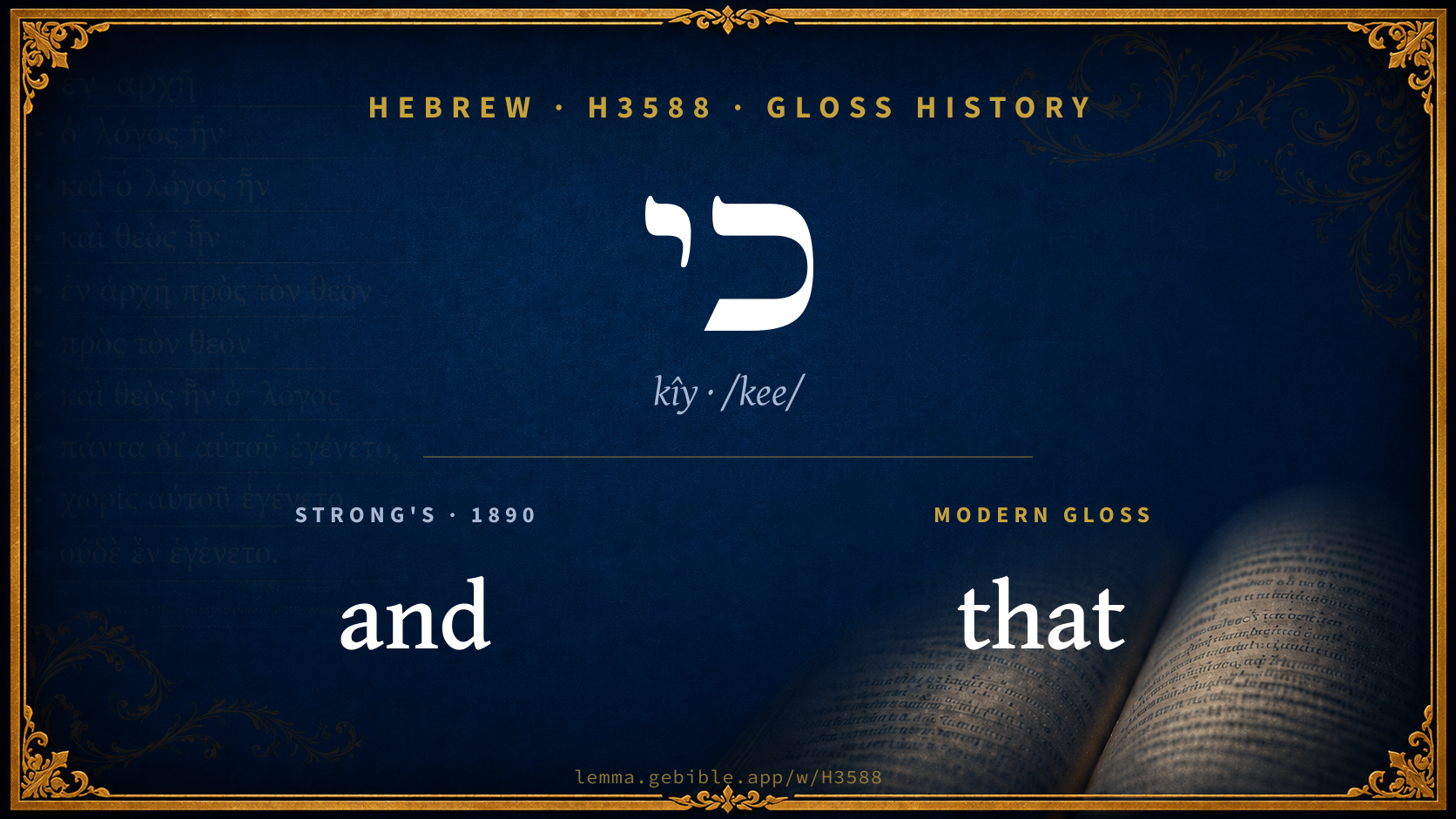
Gloss history
Strong's 1890 vs modern scholarship
About this word
Strong's H3588 catalogs a Hebrew word from the Hebrew Old Testament.
These counts are not copied from any lexicon or concordance. They are computed here, from the morphology-tagged Hebrew Old Testament. What Lemma adds →
- 3,910
- distinct verses
- The word appears in 3,910 distinct verses.
- 39 / 39
- OT books
- The word appears in 39 of 39 Old Testament books.
- #10
- by frequency
- Top 10 most frequent Hebrew words (rank 10 of 8,640 Hebrew words by occurrence).
View all 3,910 occurrences in the concordance →
By section of the Old Testament
By traditional corpus
Conventional, traditional groupings — biblical authorship is debated, so this is a traditional corpus grouping, not an authorship claim. Each share is this word’s portion of its verses in that division of the Hebrew canon. Each figure is a share of the word’s 3,910 distinct verses.
- Prophets (Nevi'im) 1,823 verses · 47%
- Writings (Ketuvim) 1,160 verses · 30%
- Torah (Pentateuch) 927 verses · 24%
How translations render this word
Counts come from each version’s own published word-to-Strong’s tagging or interlinear alignment — an approximate guide to how each version renders this word, not a word-level alignment the data otherwise carries. Because each total is that version’s own tagged count, the per-version totals vary from one another and need not match the appearance or distinct-verse counts above. These counts may also differ from a printed concordance because Lemma counts each distinctly tagged rendering and does not collapse phrase taggings into a single head-word total. This is a fixed set of word-tagged versions (KJV, ASV, BSB, ULT) and does not change with the reading translation you choose elsewhere. Each version’s license is shown beside its name below (and on Sources).
BDB lists this Strong’s number as 3 distinct words (homographs). Each count above pools all of them and is not split by sense — see the Senses section below. A low-frequency rendering may belong to a different one of those words, not the primary meaning.
- King James Version†: That 3×, For 2×, Until 2×
- American Standard Version†: For 6×, That 3×, It 2×
- Berean Standard Bible†: For 1,773×, That 596×, Because 530×
- unfoldingWord Literal Text†: For 2,227×, That 666×, Because 471×
King James Version Public Domain
Renders H3588 across 45† tagged occurrences — most commonly:
Plus 38 renderings that appear only once — usually multi-word phrases or single function words the recovered tagging swept in, not distinct renderings. Not rendered by a distinct English word in 1 further occurrence.
American Standard Version Public Domain
Renders H3588 across 45† tagged occurrences — most commonly:
Plus 32 renderings that appear only once — usually multi-word phrases or single function words the recovered tagging swept in, not distinct renderings.
Berean Standard Bible Public Domain
Renders H3588 across 3,989† tagged occurrences — most commonly:
Plus other, less common renderings. Plus 74 renderings that appear only once — usually multi-word phrases or single function words the recovered tagging swept in, not distinct renderings. Not rendered by a distinct English word in 484 further occurrences.
unfoldingWord Literal Text CC BY-SA 4.0
Renders H3588 across 4,287† tagged occurrences — most commonly:
Plus other, less common renderings. Plus 58 renderings that appear only once — usually multi-word phrases or single function words the recovered tagging swept in, not distinct renderings.
18 senses and sub-senses in the full BDB
What do BDB’s symbols mean?
BDB uses these scholarly abbreviations:
| Symbol | Meaning |
|---|---|
| 𝔊 | the Septuagint (the ancient Greek translation, LXX) |
| 𝔙 | the Vulgate (the Latin translation) |
| 𝔖 | the Syriac version (the Peshitta) |
| 𝔗 | the Targum (the Aramaic translation) |
| ψ | the Psalms |
| √ | root (the underlying root or stem) |
| ‖ | parallel passage (a synonymous or contrasted parallel) |
| † | the dagger: every passage where the word occurs is cited |
The 18 senses and sub-senses the full Brown-Driver-Briggs lexicon distinguishes for this word, in lexicon order (not ranked by frequency), with BDB’s own verbatim wording and sub-sense lettering. Shown in Hebrew script with BDB’s own scholarly abbreviations. The condensed entry is in the Lexicon Entry tab. See also the Forms in the corpus table below.
כי I [m.] burning, branding (for form, cf. רִי from רָוָה, אִי, צִי, עִי
כי II conj. that, for, when (Moab. id.
- 1. that (ὅτι, Germ. dass):
- a. prefixed to sentences depending on an active verb, and occupying to it the place of an accus.: so constantly, after vbs. of seeing, as Gn 1:10 וַיַּרְא אֱלֹהִים כִּי טוֹב and God saw that it was good, 3:6; 6:2, 5; 12:14 + often, hearing 14:14; 29:33, knowing 22:12; 24:14, telling 3:11; 12:18, repenting 6:6, 7, swearing Gn 22:16 Je 22:5, believing Ex 4:5 La 4:12, remembering ψ 78:35, forgetting Jb 39:15; אָמַר = command (late; in early Heb. the words said are quoted) Jb 36:10, 24) זְכֹר in a command) 37:20b 1 Ch 21:18 (contrast 2 S 24:18) etc.; טוֹב כּי it is good that … 2 S 18:3 + (v. p. 374b: usually the inf. c., as Gn 2:18; v. ibid.); Gn 37:26 מַה־בֶּצַע כִּי נַהֲרֹג what profit that we should slay (impf.) …? Mal 3:14 what profit כִּי שָׁמַרְנוּ that we have kept (pf.) …? Jb 22:3 הַחֵפֶץ לְשַׁדַּי כִּי is it pleasure to Shaddai that …? after a pron., as ψ 41:12 by this I know that thou hast pleasure in me, that my enemy cannot triumph over me, 42:5 these things will I remember … that (or how) I used to go, etc., 56:10 this I know that god is for me, Jb 13:16 (הוא). And with כִּי repeated pleon. after an intervening clause 2 S 19:7 Je 26:15 +; כִּי … וְכִי Gn 3:6; 29:12 Ex 4:31 Jos 2:9; 8:21; 10:1 1 S 31:7 2 S 5:12 1 K 11:21 Je 40:7, 11; לֵאמֹר … וְכִי Gn 45:26 Ju 10:10. e.g. Genesis 1:10
- b. כִּי often introduces the direct narration (like ܕ, أَنْ, and the Gk. ὅτι recitativum, e.g. Luke 4:21), in which case it cannot be represented in English (except by inverted commas), Gn 21:30; 29:33 and she said, כִּי שׁמע י׳ Yahweh hath heard, etc.; Ex 3:12 = Ju 6:16 and he said, כִּי אֶהְיֶה עִמָּ֑ךְ I will be with thee, Jos 2:24 1 S 2:16 (v. Dr) 10:19 and ye have said to him, כִּי מֶלֶךְ תָּשִׂים עָלֵינוּ Thou shalt set a king over us, 2 S 11:23 1 K 1:13; 20:5 Ru 1:10, cf. 2:21 (but in reply to a qu. כִּי may = because, v. sub 3; and so also in sentences giving the expl. of a proper name, Gn 26:22; 29:32 (but De surely: v. infr.), Ex 2:10 (cf. Gn 4:25; 41:51, 52); in כִּי מָה, introducing an expostulation, 1 S 29:8 1 K 11:22 2 K 8:13, it gives the reason for a suppressed ‘Why do you say this?’). e.g. Genesis 21:30
- c. especially after an oath חַי אָ֫נִי, חַי י׳ etc., introducing the fact sworn to, Gn 42:16 by the life of Pharaoh, כִּי מְרַגְּלִים אַתֶּם (I say) that ye are spies; but through Heb. usage prob. gave it an asseverative force, Engl. idiom does not require it to be expressed: Nu 14:22 1 S 20:3 as י׳ liveth, כִּי כִפֶשַׂע בֵּינִי וּבֵין הַמָּוֶת there is but a step between me and death! 26:16; 29:6 Is 49:18 +; 1 S 14:44 כֹּה־יַעֲשֶׂה אֱלֹהִים וְכֹה יוֹסִיף כִּי מוֹת תָּמוּת thus may God do and more also: thou shalt surely die! 2 S 3:35 1 K 2:23 Ru 1:17 al.—Note that כִּי when thus used is often repeated after an intervening clause, in order that its force may be fully preserved: Gn 22:16f. 1 S 14:39 כִּי מוֹת יָמוּת (אִם־יֶשְׁנוֹ בְּיוֹנָתָן בְּנִי) חַי י׳ כִּי 25:34 2 S 2:27 כִּי אָז וג׳ (לוּלֵא דִּבַּרְתָּ) כִּי, 3:9; 15:21 Qr 1 K 1:30 Je 22:24. e.g. Genesis 42:16
- d. כִּי is used sometimes with advs. and interjs. to add force or distinctness to the affirmation which follows: (a) so especially in אַף כִּי (v. אַף); †הֲכִי is it that …? (as a neutral interrrog.) 2 S 9:1, (expecting a neg. answer) Gn 29:15 is it that thou art my brother, and shalt (therefore) serve me for nothing? Jb 6:22 is it that I have said, Give unto me? expressing surprise Gn 27:36 is it that he is called Jacob, and has (hence) supplanted me twice? 2 S 23:19 an affirm. answer is required (wh. would imply הֲלֹא כִי): read prob. with the ‖ 1 Ch 11:25 הִנּוֹ behold, he, etc.; †אִם־לֹא כִּי Dt 32:30 were it not that …; †אָמְנָם כִּי Jb 12:2 of a truth (is it) that ye are the people, etc.; †אַךְ כִּי 1 S 8:9; אֶפֶס כִּי Nu 13:28 +; גַּם כִּי †Ru 2:21; †הֲלֹא כִי 1 S 10:1 (but v. 𝔊 Dr), 2 S 13:28; †הִנֵּה כִי ψ 128:4; cf. ψ 118:10–12 בְּשֵׁם י׳ כִּי אֲמִילַֽם in the name of י׳ (is it) that—or (I say) that—I will mow them down; Jb 39:27 doth the vulture mount up at thy command, וְכִי יָרִים קִנּוֹ and (is it) that it (so) makes high its nest? Is 36:19 have the gods of the nations delivered each his land etc.? … וְכִי הִצִּילוּ i.e. (Hi) and (is it) that they have delivered Samaria out of my hand? > (Ew§ 354 c De Di) and that they have delivered Samaria out of my hand! = how much less (אַף כִּי) have they, etc.! (‖ 2 K 18:34 כִּי alone, perhaps conformed by error to v 35; 2 Ch 32:15 אַף כִּי, which however does not decide the sense of the orig. וְכִי). 1 Ch 29:14 וְכִי מִי read ומי or כי מי. (b) in introducing the apodosis, especially in כִּי עַתָּה (chiefly after לוּלֵא) indeed then …, Gn 31:42; 43:10 for unless we had tarried כִּי עַתָּה שַׁבְנוּ surely then we had returned twice, Nu 22:23 (read לוּלֵי for אוּלַי); so 1 S 14:30 𝔊 (after לוּא), and 13:13 Hi We (לֻא for לֹא); after אִם Jb 8:6 surely then he will awake over thee, etc. (But elsewhere כִּי עַתָּה is simply for now, Gn 29:32 Jb 7:21 +; or for then = for in that case, Ex 9:15 Nu 22:29 Jb 3:13; 6:3 +). It is dub. whether כִּי אָז has the same sense: for 2 S 2:27; 19:7 the כִּי in כִּי אָז may be merely resumptive of the כִּי recitat. preceding (vid. a, c). Rare otherwise: Ex 22:22 if thou afflict him כִּי אִם־צָעֹק יִצְעַק ’tis that (= indeed), if he cries unto me, I will hear him, Is 7:9 if ye believe not כִּי לֹא תֵאָמֵֽנוּ ׃ indeed ye will not be established. e.g. 2 Samuel 9:1
- e. there seem also to be other cases in which כִּי, standing alone, has an intensive force, introducing a statement with emph., yea, surely, certainly (Germ. ja—a lighter particle than these Engl. words): see in EVV Gn 22:17 Ex 18:11 Nu 23:23 1 S 17:25; 20:26 2 K 23:22 Is 32:13; 60:9 Je 22:22; 31:19 Ho 6:9; 8:6; 9:12; 10:3 Am 3:7 ψ 76:11; 77:12 (Ew Che), Pr 30:2 (but not if construed as RVm), Ec 4:16; 7:7, 20 Jb 28:1 +; La 3:22 (𝔖 𝔗 Ew Th Öt) the mercies of י׳, surely they are not consumed (read prob. תַמּוּ or תָֽמְמוּ for תמנו), Ru 3:12 כִּי אָמְנָם yea, indeed. But it is doubtful whether כִּי has this force in all the passages for which scholars have had recourse to it, and whether in some it is not simply = for. De Pr 30:1 would restrict the usage to cases in which a suppressed clause may be understood. e.g. Genesis 22:17
- f. that, expressing consecution, especially after a question implying surprise or deprecation: sq. perf., Gn 20:9 what have I sinned against thee כִּי הֵבֵאתָ עָלַי that thou hast brought on me? 1 S 17:26; 22:8 Is 22:1 what aileth thee, that thou art gone up, etc.? v 16 36:5; 52:5 Mic 4:9 Hb 2:18; sq. ptcp. Ju 14:3 1 S 20:1 1 K 18:9 how have I sinned that thou art giving, etc.? 2 K 5:7 Ez 24:19; usually sq. impf. Ex 3:11 who am I כִּי אֵלֵךְ that I should go, etc.? 16:7 Ju 8:6; 9:28; 2 K 8:13 Is 7:13; 29:16 (also pf.), ψ 8:5 what is man כִּי תִזְכְּרֶנּוּ? Jb 3:12 or why the breasts כִּי אִינָקֽ ׃ that I should suck? 6:11 מַה־כֹּחִי כִּי אֲיַחֵל, 7:12, 17; 10:5f.; 13:25f; 15:12f. 14; 16:3; 21:15 +; after a neg., Gn 40:15 here also I have done nothing כִּי שָׂמוּ that they should have placed me in the dungeon, ψ 44:19f. our heart has not turned backward, etc. כִּי דִכִּיתָנוּ that thou shouldst have crushed us, etc., Is 43:22 not me hast thou called on, כִּי יָגַעְתָּ בִּי that thou shouldst have wearied thyself with me, Ho 1:6 (v. RV), Jb 41:2 Ru 1:12 I am too old to have an husband כִּי אָמַרְתָּי that I should have said, etc. (cf. Ew§337a; Dr§ 39 δ). e.g. Genesis 20:9
- g. added to preps. כִּי converts them, like אֲשֶׁר, into conjs. …, as יַעַן כִּי because that …: v. sub יַעַן, עַד, עַל, עֵקֶב, תַּחַת.
- 2.
- a. Of time, when, of the past וַיְהִי כִּי Gn 6:1 (cf. BuUrg. 6), 26:8; 27:1 2 S 6:13; 7:1; 19:26 + (כַּאֲשֶׁר, and especially כְּ c. inf., are more freq.); וְהָיָה כִּי (simple וְ) 1 S 1:12; 17:48; Jos 22:7 Ju 2:18; 12:5 והיה כי יאמרו and it would be, whenever (freq.) they said, Je 44:19 (ptcp.), Ho 11:1 ψ 32:3 כי החרשׁתר when I was silent, Jb 31:21, 26, 29; of present (usually with impf.) as Ex 18:16 כִּי יִהְיֶה לָהֶם דָּבָר when they have a matter, 1 S 24:20 Is 1:12; 30:21 Je 14:12 Zc 7:5, 6 Mal 1:8 ψ 49:19 and men praise thee כִּי תֵיטִיב לָ֑ךְ when thou doest well to thyself, 102:1; 127:5 +, with pf. Ez 3:19–21; 33:9 Pr 11:15; 23:22; especially of future, as Gn 4:12 כִּי תַעֲבֹד אֶת־הָאֲדָמָה when thou shalt till the ground it shall not, etc., 24:41; 30:33; 31:49; 32:18 Ex 7:9 when Pharaoh shall speak unto you, Dt 4:25; 6:20 +; in phrase (תֹּאמַר וג׳) וְכִי תֹּאמְרוּ Lv 25:20 Dt 18:21 Is 8:19; 36:7 Je 13:22; and especially in וְהָיָה כִּי … Gn 12:12; 46:33 Dt 6:10; 15:16 1 S 10:7; 25:30 Is 8:21; 10:12 + often; with pf. Is 16:12 1 Ch 17:11 (altered from impf. 2 S 7:12); with ptcp. (unusual) Nu 33:51; 34:2 Dt 11:31; 18:9. e.g. Genesis 6:1
- b. elsewhere כִּי has a force approximating to if, though it usually represents a case as more likely to occur than אִם:—(mostly with impf.) Gn 38:16 Nu 5:10; 10:32 Dt 6:25; 7:17; 28:2, 13 1 S 20:13 2 S 19:8 2 K 4:29; 18:22 Je 38:15 Pr 4:8 Jb 7:13 (כי אמרתי when I say), 19:28; often in laws, as Ex 21:14, 33, 35, 37; 22:4, 5 etc., Dt 13:13; 14:24; 15:7, 12; 17:2; 18:6, 21 etc.; sometimes, in particular, to state a principle broadly, after which special cases are introduced by אִם, as Ex 21:2 when (כִּי) thou buyest a Hebrew servant, he shall serve thee six years, after which v 3–5 follow four special cases with אִם if: so 21:7 (כי), v 8–11 (אם); v 18 (כי), v 19 (אם); v 20 (כי), v 21 (אם); v 22 f. 28–32; Lv 1:2 (כי), v 3, 10 (אם) 4:2, 3, 13, 27, 32; 13:2 ff. Nu 30:3 ff. +; though this distinction is not uniformly observed, contrast e.g. Ex 21:5 with Dt 15:16; Nu 5:19 and v 20.—N.B. with כִּי = when or if, the subject is often prefixed for distinctness and emph.: 1 K 8:37 רָעָב כִּי־יִהְיֶה בָאָרֶץ דֶּבֶר כִּי יִהְיֶה וג׳, Is 28:18 Mi 5:4 אַשּׁוּר כִּי־יָבֹא בְאַרְצֵנוּ, ψ 62:11 Ez 3:19 (וְאַתָּה), 14:9, 13; 18:5, 18, 21; 33:6 (cf. v 2); and especially in laws of P, as אָדָם כִּי … Lv 1:2; 13:2, נֶפֶשׁ כִּי … 2:1; 4:2; 5:1, 4, 15, similiarly 15:2, 16, 19, 25; 22:12, 13, 14 etc., rather differently Nu 5:20. e.g. Genesis 38:16
- c. when or if, with a concessive force, i.e. though:—(a) with impf. Je 4:30(×3); 14:12; 49:16 כִּי־תַגְבִּיהַּ כַּנֶּשֶׁר קִנֶּ֑ךָ though thou make high like the vulture thy nest, I will bring thee down thence, 51:53 Ho 13:15 Zc 8:6 ψ 37:24; 49:19 f. though in his lifetime he bless himself … he shall come, etc., perhaps also Je 46:23 Ew (but Hi Gf Ke for), 50:11 Ew Ke (Hi yea); and strengthened by גַּם, גַּם כִּי Is 1:15 ψ 23:4 (cf. Dr§ 143); (b) with perf. (rare) Mi 7:8 כִּי נָפַלְתִּי קָ֑מְתִּי though I have fallen, I rise, Na 1:10 (si vera l.), ψ 21:12 (Hi Ew Now), 119:83 (Ew De). e.g. Jeremiah 4:30
- 3. Because, since (ὅτι)—
- a. Gn 3:14 because thou hast done this, cursed art thou, etc., v 17 18:20 the cry of S. and G.—because it is great … (subj. prefixed for emph.: cf. 2 N.B.) Is 28:15; in answer to a qu., Gn 27:20 Ex 1:19; 18:15 2 S 19:43 +. Enunciating the conditions under which a fut. action is conceived as possible (Germ. indem) Lv 22:9 Dt 4:29 כי תדרשׁנו, 12:20 (v.Dr), v 25, 28; 13:19; 14:24; 16:15; 19:6, 9 +, 1 K 8:35 (cf. v 33 אֲשֶׁר), v 36 כִּי תוֹרֵם, Pr 4:8b. e.g. Genesis 3:14
- b. more commonly the causal sentence follows, as Gn 2:3 and God blessed the seventh day כִּי בוֹ שָׁבַת וג׳ because on it he rested, etc., 4:25 etc., in which case it may often be rendered for, Gn 2:5, 23; 3:20; 5:24; 6:7; 12, 13 ψ 6:3 heal me כִּי נִבְהֲלוּ עֲצָמָ֑י for my bones are vexed, 10:14; 25:16; 27:10 + very often Spec. after vbs. expressive of mental emotions, as rejoicing Is 14:29 ψ 58:11, being angry Gn 31:35; 45:5, fearing 43:18 ψ 49:17 etc. Iron. 1 K 18:27 for he is a god etc. (4 times); Pr 30:4 Jb 38:5 כִּי תֵדָ֑ע for or since thou knowest. With subj. prefixed ψ 128:2. Repeated (with anacol.) Is 49:19. e.g. Genesis 2:3
- c. the causal relation expressed by כִּי is sometimes subtle, especially in poetry, and not apparent without careful study of a passage. Thus sometimes it justifies a statement or description by pointing to a pregnant fact which involves it, as Is 3:8a Jb 6:21 (ground of the comparison v 15–20), 14:16 (For …: ground of the wishes expressed v 13–15), 16:22 (ground of v 20 f.) 30:26 (For …), or by pointing to a general truth which it exemplifies Jb 5:6 (reason why complaining v 2–5 is foolish), 15:34; 23:14; sometimes it is explicative, justifying a statement by unfolding the particulars wh. establish or exemplify it 2 S 23:5a Is 1:30; 5:7; 7:8; 9:4; 10:8–11; 13:10 (development of v 9a), 32:6 f. (developing the characters of the נָבָל and כִּילַי, and so explaining why they will no longer be esteemed v 5); Jb 11:16 ff. (explic. of v 15b), 18:8 ff. (justifying v 7), 22:26 ff. (justifying v 25); elsewhere the cause is expressed indirectly or figuratively Is 2:6 (reason why invitation v 5 is needed), 5:10 (sterility of the soil the cause of the desolation v 9), 18:5; 28:8 (proof of the intoxication v 7), 31:7 (reason for the exhortation v 6: the certainty that the folly of idolatry will soon be recognized), Jb 7:21 (for soon it will be too late to pardon), 27:8–10 (Job wishes his enemy the lot of the wicked, because this is so hopeless); or כִּי relates not to the v. which immed. precedes or follows, but to several, as Is 7:16 f. (v 17 specially the ground of the people being reduced to simple fare v 15), 21:6 ff. (ground of the statements v1–5), Jb 4:5 (ground of v 2), 14:7–12 (v 10–12 specially the ground for the appeal in v 6), 23:10–13 (ground why God cannot be found v 8 f.), ψ 73:21 (ground not of v 20, but of general train of thought v 2–14); so also Gn 4:24 Dt 18:14 Is 12:1 Je 30:11 the reason lies not in the words immed. after כִּי, but in the second part of the sentence; or, on the other hand, it may state the reason for a partic. word, Is 28:20 (justifying ‘nought but terror’ v 19), Jb 23:17 (God’s hostility v 16 the cause of his misery, not the calamity as such). Sometimes also כִּי, in a poet. or rhet. style, gives the reason for a thought not expressed but implied, especially the answer to a qu.; Is 28:11 (the mockeries of v 10 have a meaning) ‘for with men of strange lips, etc. he will speak unto this people,’ who will retort the mockeries, charged with a new and terrible meaning, upon those who uttered them (v 13); = (no,) for Is 28:28 (see RVm), Jb 22:2b no, he that is wise is profitable to himself, 31:18; 39:14 (see v 13b), ψ 44:24 (he cannot do this, v 23) for for thy sake are we killed, etc., 130:4 no, with thee is forgiveness; = (yes,) for Is 49:25 (see the qu. v 24), 66:8. e.g. Isaiah 3:8
- d. כִּי … כִּי ἀσυνδέτως sometimes introduce the proximate and ultimate cause respectively, Gn 3:19; 26:7; 43:32; 47:20 Ex 23:33 for [else] thou wilt serve their gods, for it will be a snare to thee, Is 2:6(×2); 3:8(×2); 6:5a, b; 10:22f. Jb 6:3f.; 8:8, 9(×2); 24:17(×2); 29:11f.; sometimes they introduce two co-ordinate causes (where we should insert and), Ex 23:21, 22 Is 6:5b, c I am undone, because I am of unclean lips …, because mine eyes have seen י׳ of hosts, 15:5(×2), 6(×2), 8, 9 Zp 3:8f. Jb 15:25, 27; 20:19f.; 31:11f. But כִּי … וְכִי also occurs, Gn 33:11 Nu 5:20 (if), Jo 1:15 Ju 6:30 1 S 19:4; 22:17 1 K 2:26 Is 65:16 +. e.g. Genesis 3:19
- e. after a neg. כִּי for becomes = but (Germ. sondern): Gn 17:15 thou shalt not call her name Sarai, כִּי שָׂרָה שְׁמָהּ for (= but) Sarah shall be her name, 24:3f.; 45:8 Ex 1:19; 16:8 not against us are your murmurings, כי על־י׳ for (they are) agst. י׳ = but agst. י׳, Dt 21:17 1 S 6:3 (אַל), 27:1 (v. Dr), 1 K 21:15 Is 10:7; 28:27; 29:23; 30:5 ψ 44:8; 118:17 + often; so in לא כי nay, for = nay, but, as Gn 18:15 לֹא כִּי צָחָֽקְתְּ nay, but thou didst laugh, 19:2; 42:12 Jos 5:14 1 S 2:16 MSS 𝔊 (v. Dr), 12:12 2 S 16:18; 24:24 1 K 2:30; 3:22; 11:22 Is 30:16 nay, but we will flee upon horses. e.g. Genesis 17:15
- —כִּי is sometimes of difficult and uncertain interpretation, and in some of the passages quoted a different expl. is tenable. Authorities especially read the Heb. differently, when the choice is between for and yea. E.g. Is 8:23 Ges Ew§ 330 b doch (no, but); Hi Di for (taking v 22 as RVm); Ch surely: 15:1 Ges Ew Hi Di surely; De for: 39:8 Ges Hi De surely; Di for (expl. of טוֹב): Ez 11:16 Hi Ke Co surely; Ew Sm because.—In Ex 20:25 the tense of וַתְּחַלֲלֶהָ makes it prob. that כִּי is for (Dr§ 153). Jb 22:29 is taken with least violence to usage (גַּאֲוָה) as Hi: When they humble thee, and thou sayest (= complainest) Pride! he will save, etc. e.g. Isaiah 8:23
כי III branding, v. sub כוה.
Senses from the full Brown-Driver-Briggs lexicon (Brown, Driver, Briggs; Oxford 1906 — public domain), digitized via Sefaria, supplemented by the OpenScriptures HebrewLexicon (CC BY 4.0). Full attribution on Sources.
Word origin
I. n.[m.] burning, branding (for form, cf. רִי from רָוָה, אִי, צִי, עִי: Köii. 1. 64)—only כִּי תַּחַת יֹ֑פִי Is 3:24 branding instead of beauty, in judgment on women of Jerusalem.
II. conj. that, for, when (Moab. id.: Ph. כ. Prob. from the same demonstr. basis found in ܟܳܐ here, and in certain pronouns, as Aramaic דֵּךְ this (WSG 110 f.); perhaps also ultim. akin with كَىْ that, in order that, and ܟܰܝ then, enclit., like Lat. nam in quisnam?)—
III. branding, v. sub כוה.
— Brown-Driver-Briggs (Oxford 1906, public domain), digitized via Sefaria, supplemented by the OpenScriptures HebrewLexicon (CC BY 4.0). See Sources.
Origin: a primitive particle
Jastrow Dictionary
A second Hebrew/Aramaic lexicon for comparison, covering Aramaic and post-biblical (Talmudic, Targumic, Midrashic) usage that the biblical-Hebrew BDB does not. Matched by lemma rather than by Strong’s number, so a lemma may carry more than one Jastrow headword (shown separately below), and the entries cover usage well beyond the Bible.
כְּ־
- prefix, h. (v. כֵּן)
- 1. as, like. Targ. Gen. IX, 3. Targ. Hos. IV, 9; a. v. fr.—Ber. I, 2 כאדם וכ׳ like one reading in the Torah. Ib. 3 כדרכו as usual; a. v. fr.—
- *2. whereas. Tosef. Snh. II, 6 כגוזלייא … וכאימרייא וכ׳ ed. Zuck. (Var. דגוזלייא … ואמרייא, as Snh. 11ᵃ, Y. ib. I, 18ᵈ top) whereas the spring pigeons are yet tender &c.—[Ib. 5 בגוזלייא וכ׳.]—[Compound particles כְּדֵי, כְּוָת &c., v. s. vv. or second component.—ך as affix, frequ. indicating place (כ locale) or instrument, as בָּזָךְ, דוּךְ, אוּשְׁפְּזִיכָא &c.]
כי
- the Greek letter Chi (χ). Men. VI, 3 כמין כי, expl. ib. 75ᵃ כמין כי יוני (Ar. יונית) drawing the figure of a Greek Chi; Tosef. ib. VIII, 8; 10; Ker. 5ᵇ; Hor. 12ᵃ, expl. כמין כף יוני ed. (Ms. M. כי). Kel. XX, 7.
כֵּי
- (= כְּאֵי, v. אֵי III) like which?; כֵּי זֶה צַד, כֵּיזֶה צד how?, in what manner? Tosef. B. Kam. III, 4. Tosef. Ter. I, 5; a. fr. ed. Zuck. (ed. usu. כֵּיצַד).
כִּי
- v. כּ־)
- 1. like. Sot. 35ᵇ כי סיד like lime. Y. Yeb. XVI, end, 16ᵃ כי חיה like a lying-in woman; a. fr.
- 2. when. Ex. R. s. 9, beg. (ref. to Ex. VII, 9) … אם ידבר אלא כי וכ׳ it does not read, ‘if Pharaoh …, but when …; he will say so. R. Hash. 3ᵃ, v. אִי II. e.g. Exodus 7:9
- 3. so, thus. Y. Ḥag. III, 77ᵇ וכי היה המעשה and thus it came to pass. Yeb. VIII, 3 לא כי הלכה וכ׳ (some ed. לא כי אלא וכ׳) it is not so; I am reciting a Halakhah. Shek. I, 4 לא כי אלא וכ׳ it is not so, but &c. B. Kam. 25ᵇ; a. fr.
- 4. for. Yoma 87ᵇ (quoting from a prayer) כי עונותינו וכ׳ for our iniquities are &c.
- 5. וְכִי (introducing a question to which a negative answer is expected) is it really so that? R. Hash. 9ᵃ וכי בתשעה … והלא וכ׳ do we fast on the ninth? Is it not the tenth &c.? Sabb. 4ᵃ וכי אומרים וכ׳ dare we say to a man &c.?; Men. 48ᵃ. Yoma 7ᵃ; a. v. fr.
כִּי ²
- 1. as, like. Targ. Is. XIV, 19, v. יְחַט; a. fr., v. כְּ־.—M. Kat. 28ᵇ מותא כי מותא וכ׳ death like death, i.e. death must naturally ensue, v. חֲבוּלְיָא. Sabb. 140ᵇ. v. אוּרְכָּא.—Kidd. 81ᵃ יומא כי האידנא on a day like this.—כי הא ד־ as that which is told of &c. Pes. 117ᵃ; a. fr.—Ḥag. 2ᵃ, a. fr. דלא כי האי תנא which is not in agreement with the opinion of &c.—B. Kam. 46ᵃ לְכִי הא דאיתמר for a case like the one that is told.—Ned. 49ᵃ, a. fr. כי אתריה, v. אֲתַר.—Hor. 13ᵇ נתקין … כי לדידן let us institute something like that which has been done concerning ourselves; a. fr.
- 2. when. Targ. Y. II, Lev. XXVI, 44; a. fr.—Ḥull. 110ᵃ; B. Bath. 87ᵃ כי סליק וכ׳ when R. El. went to Palestine. Snh. 74ᵃ, a. fr. כי אתא וכ׳ when R. … came (from Palestine).—וכי תימא (abbr. וכ"ת), v. אֲמָא II.—Y. Snh. VII, end, 25ᵈ כי יתבון וכ׳ (not כיי) when they sat down to eat; a. v. fr.—כי היכי a) in order that, v. הֵיכִי.—b) as well as, in the same way as. Taan. 9ᵇ כי ה׳ … הכי וכ׳ as the Babylonians are deceitful, so are their rains; a. fr.—[כַּי, v. כַּיי.]
A Dictionary of the Targumim, the Talmud Babli and Yerushalmi, and the Midrashic Literature (Marcus Jastrow; London, Luzac, 1903) — Public Domain. Digitized via Sefaria. Digitized via Sefaria. Full attribution on Sources.
Forms in the corpus
The 44 distinct written forms H3588 takes in the Hebrew Bible, most frequent first — each parse links to that state’s occurrences in the concordance. Hebrew forms include their vowel points and cantillation, so a single lemma takes many written forms.
| Form | Parsing | Example | Uses |
|---|---|---|---|
| כִּֽי | Conjunction | Amos 4:12 | 1,428 |
| כִּ֣י | Conjunction | Amos 3:7 | 821 |
| כִּ֥י | Conjunction | Amos 7:2 | 543 |
| כִּ֤י | Conjunction | Amos 5:5 | 411 |
| כִּי | Conjunction | Amos 7:11 | 397 |
| כִּ֛י | Conjunction | Amos 4:2 | 179 |
| כִּ֚י | Conjunction | Amos 3:7 | 149 |
| כִּי֩ | Conjunction | Daniel 12:7 | 104 |
| כִּ֖י | Conjunction | Daniel 8:17 | 97 |
| כִּ֠י | Conjunction | Amos 9:8 | 68 |
| כִּ֧י | Conjunction | Deuteronomy 7:25 | 54 |
| וְ/כִֽי | Conjunction | Deuteronomy 14:24 | 51 |
| כִּ֗י | Conjunction | Amos 3:14 | 39 |
| כִּ֡י | Conjunction | Amos 4:13 | 22 |
| כִֽי | Conjunction | Deuteronomy 30:1 | 18 |
| וְ/כִ֥י | Conjunction | Deuteronomy 18:21 | 17 |
| כִּ֞י | Conjunction | Deuteronomy 9:5 | 10 |
| וְ/כִ֣י | Conjunction | Genesis 33:11 | 9 |
| וְ/כִ֤י | Conjunction | Exodus 4:31 | 9 |
| כִּ֭י | Conjunction | Job 23:14 | 9 |
| וְ/כִי | Conjunction | 1 Chronicles 10:7 | 8 |
| כִּ֘י | Conjunction | Job 32:5 | 5 |
| וְ/כִ֨י | Conjunction | 1 Chronicles 29:14 | 4 |
| כִי | Conjunction | 1 Samuel 10:14 | 4 |
| וְ/כִ֧י | Conjunction | Genesis 3:6 | 3 |
| וְ/כִי֙ | Conjunction | 2 Samuel 5:12 | 3 |
| כִ֔י | Conjunction | 1 Kings 3:22 | 3 |
| כִּ֝֗י | Conjunction | Proverbs 18:2 | 3 |
| כי | Conjunction | 2 Samuel 16:10 | 3 |
| הֲ/כִ֣י | Conjunction | 2 Samuel 9:1 | 2 |
| כִ֤י | Conjunction | Deuteronomy 24:3 | 2 |
| הֲ/כִי | Conjunction | Genesis 29:15 | 1 |
| הֲ/כִי֩ | Conjunction | Genesis 27:36 | 1 |
| הֲֽ/כִי | Conjunction | Job 6:22 | 1 |
| ו/כי | Conjunction | 2 Samuel 16:10 | 1 |
| וְ֝/כִ֗י | Conjunction | Job 39:27 | 1 |
| כִ֗י | Conjunction | 1 Kings 3:22 | 1 |
| כִ֛י | Conjunction | Isaiah 30:16 | 1 |
| כִ֥י | Conjunction | Leviticus 13:16 | 1 |
| כִּ֨י | Conjunction | Leviticus 22:13 | 1 |
| כִּ֩י | Conjunction | Jeremiah 44:17 | 1 |
| כִּ֪י | Conjunction | Proverbs 23:31 | 1 |
| כִּ֬י | Conjunction | Psalms 96:13 | 1 |
| ל/כי | Preposition | 2 Kings 4:2 | 1 |
Septuagint verse parallels
Most of the 3,910 Hebrew verses this word occurs in also exist in the Greek Old Testament (Septuagint), so the same passages can be read in Greek by switching the Old Testament edition to the Septuagint.
Read these verses in the Septuagint
- Genesis 1:4
- Exodus 1:10
- Leviticus 1:2
- Numbers 3:13
- Deuteronomy 1:17
- Joshua 1:6
- Judges 1:15
- Ruth 1:6
- 1 Samuel 1:5
- 2 Samuel 1:5
- 1 Kings 1:11
- 2 Kings 1:4
This is a verse-level parallel only — the same verses exist in both the Hebrew and Greek Old Testaments. No word-level Hebrew↔Greek correspondence is claimed: the data carries no such alignment, so no Greek word is shown as this Hebrew word’s translation. Coverage is not total — the Septuagint omits the deuterocanon and renumbers the Psalms, so some Hebrew verses have no direct Greek parallel.