
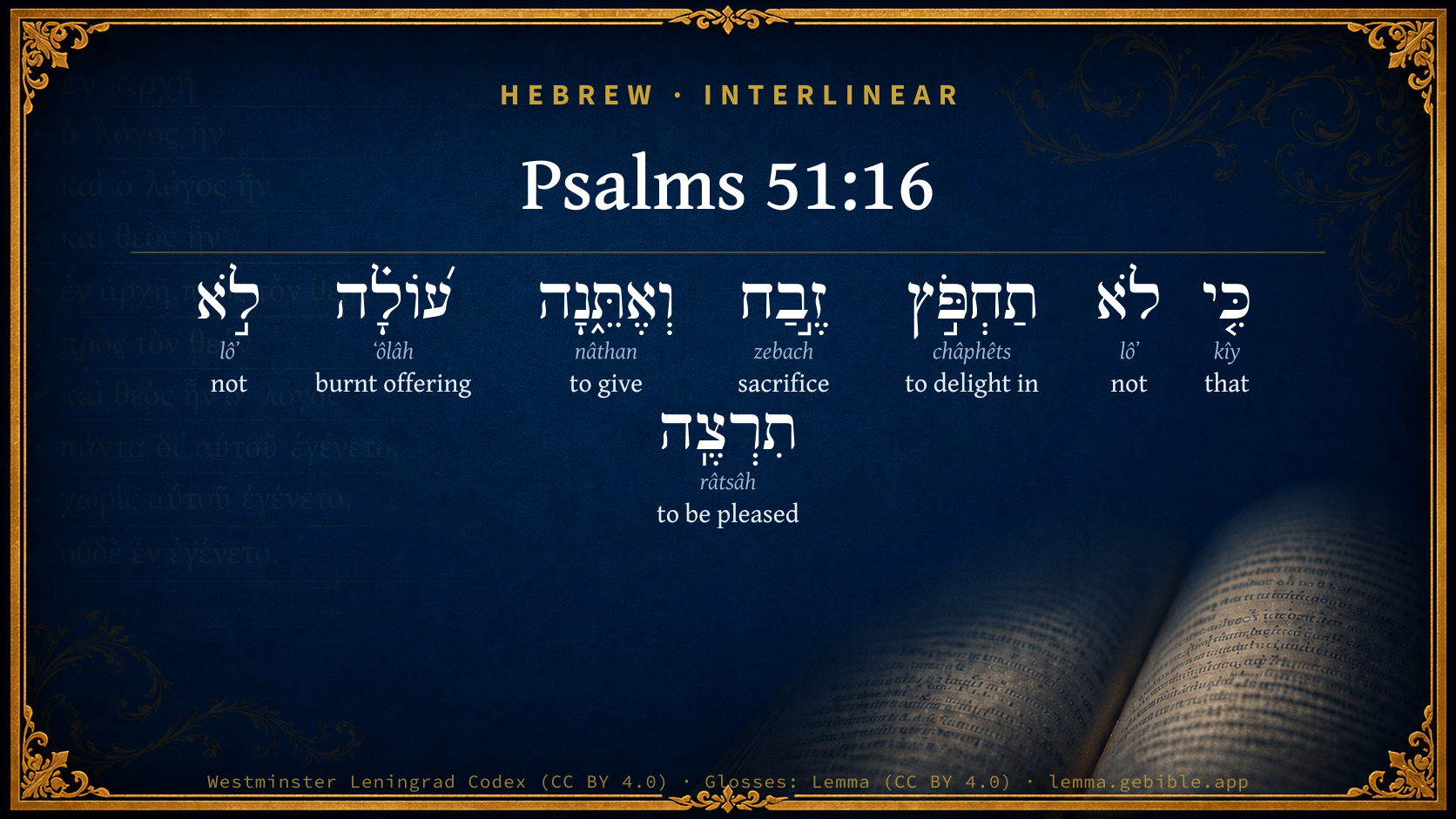
Psalms 51:16

Hebrew (Westminster Leningrad Codex) Psalms 51:16 appears in the Hebrew Old Testament. The text above is from the Westminster Leningrad Codex. Each word links to its Strong’s number, a concise gloss, and parsing drawn from the Open Scriptures Hebrew Bible morphology. Click any word for its full Brown-Driver-Briggs (BDB) entry.
Download image
Cite this verse

Psalms 51:16 (World English Bible). Public Domain. Lemma interlinear Bible study tool, https://lemma.gebible.app/v/psalms/51/16.

Show BibTeX & RIS
BibTeX
RIS
English Translation
For you don't delight in sacrifice, or else I would give it. You have no pleasure in burnt offering.
World English Bible · Public Domain
Download a study sheet

One document with this verse’s original text, its word-by-word gloss line, the meaning frame, cross-references with their text, attributed commentary, and full source and license credits — printable, and it pastes into notes with its structure intact.

This verse Autodidact and up

Study sheet (.html) Plain text (.txt)

A passage Seminary Student

Up to 50 verses in one chapter. A passage sheet keeps up to 6 commentary sources and 12 cross-references per verse, in the order this page ranks them, and says so on the sheet whenever that leaves anything out. Ask for a single verse and you get the Autodidact verse sheet above.

Everything on this page stays free to read, with no account — the sheet is a download of what is already on screen, not access to it.

Want to remove ads? Support Godless Engineer
Compare translations 3

The same verse in 3 English versions, stacked beneath the original-language interlinear above. Click any original word for its lexicon entry.

Each is an independent rendering of the whole verse — the interlinear is not word-aligned to these translations.

Highlighted words mark where these versions differ — a whole-verse word diff, not a word-by-word alignment.

  • World English Bible Public Domain
    For you don't delight in sacrifice, or else I would give it. You have no pleasure in burnt offering.
  • King James Version Public Domain
    For thou desirest not sacrifice; else would I give it: thou delightest not in burnt offering.
  • unfoldingWord Literal Text CC BY-SA 4.0
    For you do not delight in sacrifice, or I would give; you do not accept a burnt offering.

unfoldingWord Literal Text — © unfoldingWord, licensed CC BY-SA 4.0. Word-aligned USFM3 via Door43 (git.door43.org/unfoldingWord/en_ult).

Versions to compare (up to 4)

3 of 4 selected

Show all 18 translations

Every available English version of this verse, each an independent rendering of the whole verse.

  • World English Bible Public Domain
    For you don't delight in sacrifice, or else I would give it. You have no pleasure in burnt offering.
  • Berean Standard Bible Public Domain
    For You do not delight in sacrifice, or I would bring it; You take no pleasure in burnt offerings.
  • Majority Standard Bible Public Domain
    For You do not delight in sacrifice, or I would bring it; You take no pleasure in burnt offerings.
  • King James Version Public Domain
    For thou desirest not sacrifice; else would I give it: thou delightest not in burnt offering.
  • American Standard Version (1901) Public Domain
    For thou delightest not in sacrifice; else would I give it: Thou hast no pleasure in burnt-offering.
  • Revised Version (1885) Public Domain
    For thou delightest not in sacrifice; else would I give it: thou hast no pleasure in burnt offering.
  • Geneva Bible (1599) Public Domain
    For thou desirest no sacrifice, though I would giue it: thou delitest not in burnt offering.
  • Douay-Rheims (1899) Public Domain
    Deliver me from blood, O God, thou God of my salvation: and my tongue shall extol thy justice.
  • Young's Literal Translation Public Domain
    For Thou desirest not sacrifice, or I give `it', Burnt-offering Thou acceptest not.
  • Literal Standard Version CC BY-SA 4.0
    For You do not desire sacrifice, or I give [it], || You do not accept burnt-offering.
  • Unlocked Literal Bible CC BY-SA 4.0
    For you do not delight in sacrifice, or I would give it; you have no pleasure in burnt offerings.
  • unfoldingWord Literal Text CC BY-SA 4.0
    For you do not delight in sacrifice, or I would give; you do not accept a burnt offering.
  • Darby Bible Public Domain
    For thou desirest not sacrifice; else would I give it: thou hast no pleasure in burnt-offering.
  • World Messianic Bible Public Domain
    For you don’t delight in sacrifice, or else I would give it. You have no pleasure in burnt offering.
  • Webster's Bible Public Domain
    \\51:14\\Deliver me from blood-guiltiness, O God, thou God of my salvation: and my tongue shall sing aloud of thy righteousness.
  • Free Bible Version CC BY-SA 4.0
    For sacrifices don't make you happy, or I would bring one; burnt offerings aren't what pleases you.
  • Bible in Basic English Public Domain
    You have no desire for an offering or I would give it; you have no delight in burned offerings.
  • JPS Tanakh (1917) Public Domain
    (51-18) For Thou delightest not in sacrifice, else would I give it; Thou hast no pleasure in burnt-offering.

Literal Standard Version (2020), Covenant Press — licensed CC BY-SA 4.0. Text via the HelloAO Bible API (eBible.org). Unlocked Literal Bible (unfoldingWord) — licensed CC BY-SA 4.0. Text via the HelloAO Bible API (eBible.org). unfoldingWord Literal Text — © unfoldingWord, licensed CC BY-SA 4.0. Word-aligned USFM3 via Door43 (git.door43.org/unfoldingWord/en_ult). Free Bible Version, Dr. Jonathan Gallagher — licensed CC BY-SA 4.0. Text via the HelloAO Bible API (eBible.org).

Word by word

More ways to search: Search by grammar → Find every occurrence → Compare this word →

Practice this passage: Drill this verse → Learn its vocabulary →

תִרְצֶֽה
râtsâh
H7521
“to be pleased”
Verb, Qal, Imperfect, 2nd Person, Masculine, Singular
Part of Speech
Verb
Stem
Qal
Form
Imperfect
Person
2nd Person
Gender
Masculine
Number
Singular
Full BDB Definition

Origin: a primitive root

TWOT: 2207

to be pleased with, be favourable to, accept favourably - (Qal) - to be pleased with, be favourable to - to accept - to be pleased, be determined - to make acceptable, satisfy - to please - (Niphal) to be accepted, be pleased with - (Piel) to seek favour of - (Hiphil) to please, pay off - (Hithpael) to make oneself acceptable or pleasing
  1. כִּ֤י kîy H3588 “that” Conjunction
  2. לֹא lôʼ H3808 “not” Particle, Negative
  3. תַחְפֹּ֣ץ châphêts H2654 “to delight in” Verb, Qal, Imperfect, 2nd Person, Masculine, Singular
  4. זֶ֣בַח zebach H2077 “sacrifice” Noun, Common, Masculine, Singular, Absolute
  5. וְאֶתֵּ֑נָה nâthan H5414 “and · to give” Conjunction + Verb, Qal, Cohortative, 1st Person, Common, Singular
  6. ע֝וֹלָ֗ה ʻôlâh H5930 “burnt offering” Noun, Common, Feminine, Singular, Absolute
  7. לֹ֣א lôʼ H3808 “not” Particle, Negative

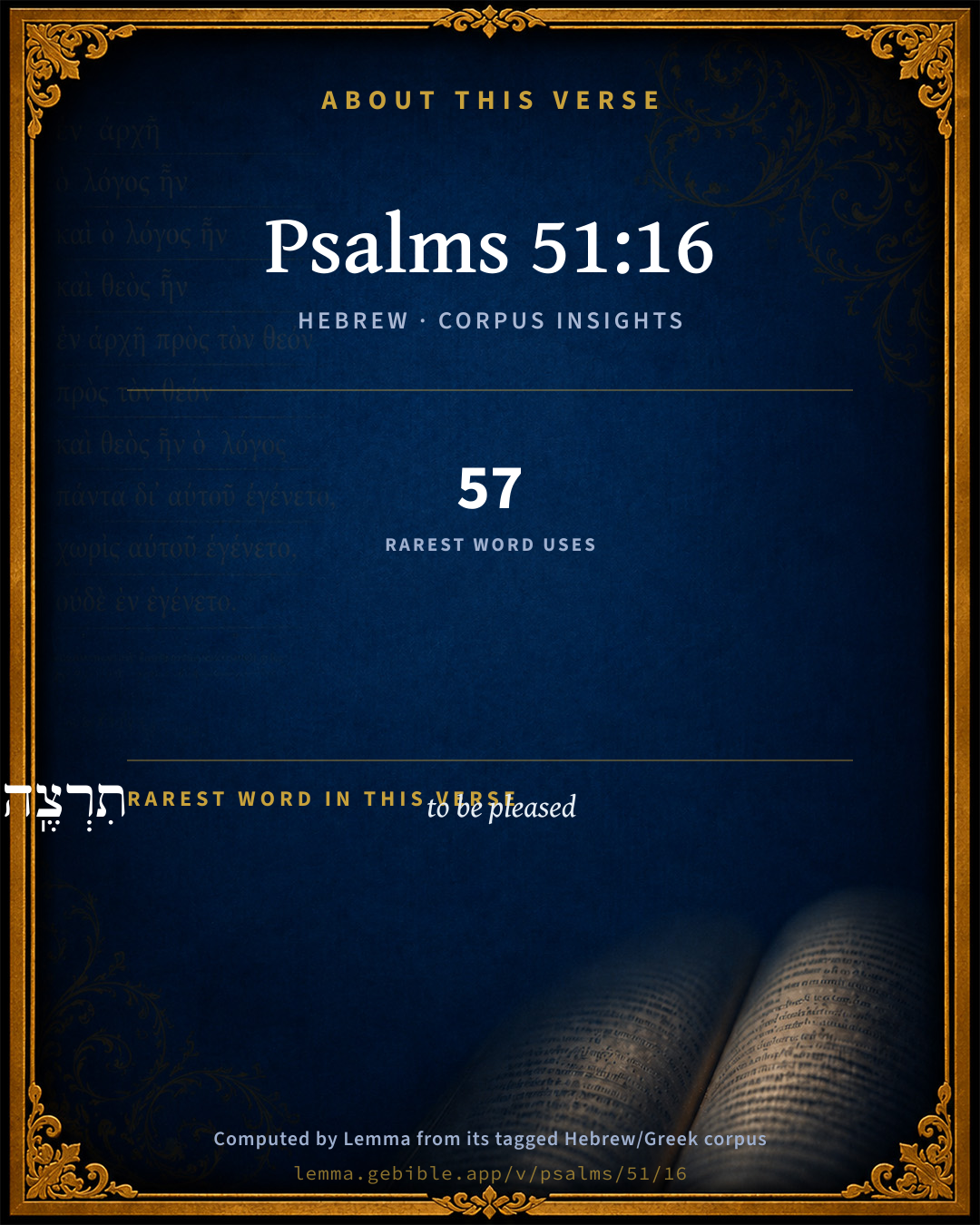
About this verse

These counts appear in no published source. They are computed here, from the morphology-tagged text and Lemma’s own curated glosses. What Lemma adds →

8
words
7
distinct lemmas
Wisdom
section

Shared distinctive vocabulary

תִרְצֶֽה to be pleased H7521 occurs in 55 verses of the Hebrew Bible. Also found in:

Grammatical profile

  • 3 verbs
  • 2 nouns
  • 1 conjunction
  • 2 particles

Verb forms

  • תַחְפֹּ֣ץ Qal · Imperfect
  • וְאֶתֵּ֑נָה Qal · Cohortative
  • תִרְצֶֽה Qal · Imperfect

Repetition

A word recurs within this verse — often emphatic in Hebrew:

Hebrew & Septuagint length

In English translation the verse runs 19 words from the Hebrew and 19 from the Septuagint (LXX English) — the same length.

A rough comparison of the two English renderings, which tokenize alike — not a word-level alignment.

Word counts can differ between the Hebrew and the Greek without any difference in meaning — e.g. the Hebrew direct-object marker אֵת has no separate Greek word, and Greek often adds the article ὁ.

Cross-references

17

Topical passages linked to Psalms 51:16 in the Treasury of Scripture Knowledge — connected by theme and wording, ordered by reader-vote popularity; previews shown in the World English Bible.

  • Hosea 6:6 For I desire mercy, and not sacrifice; And the knowledge of God more than burnt offerings.
  • Psalms 40:6 Sacrifice and offering you didn't desire. You have opened my ears: Burnt offering and sin offering you have not required.
  • Hebrews 10:5–6 Therefore when he comes into the world, he says, "Sacrifice and offering you didn't desire, But a body did you prepare for me;
  • 1 Samuel 15:22 Samuel said, Has Yahweh as great delight in burnt offerings and sacrifices, as in obeying the voice of Yahweh? Behold, to obey is better than sacrifice, and to listen than the fat of rams.
  • Psalms 51:6 Behold, you desire truth in the inward parts. You teach me wisdom in the inmost place.
  • Proverbs 21:27 The sacrifice of the wicked is an abomination: How much more, when he brings it with a wicked mind!
  • Isaiah 1:11–15 "What are the multitude of your sacrifices to me?," says Yahweh. "I have had enough of the burnt offerings of rams, And the fat of fed animals. I don't delight in the blood of bulls, Or of lambs, Or of male goats.
  • Proverbs 15:8 The sacrifice made by the wicked is an abomination to Yahweh, But the prayer of the upright is his delight.
  • Jeremiah 7:22–23 For I didn't speak to your fathers, nor command them in the day that I brought them out of the land of Egypt, concerning burnt offerings or sacrifices:
  • Amos 5:21–23 I hate, I despise your feasts, And I can't stand your solemn assemblies.
  • Psalms 50:8 I don't rebuke you for your sacrifices. Your burnt offerings are continually before me.
  • Exodus 21:14 If a man schemes and comes presumptuously on his neighbor to kill him, you shall take him from my altar, that he may die.
  • Numbers 15:30–31 But the soul who does anything with a high hand, whether he is home-born or a foreigner, the same blasphemes Yahweh; and that soul shall be cut off from among his people.
  • Numbers 15:27 If one person sin unwittingly, then he shall offer a female goat a year old for a sin-offering.
  • Numbers 35:31 Moreover you shall take no ransom for the life of a murderer who is guilty of death; but he shall surely be put to death.
  • Deuteronomy 22:22 If a man be found lying with a woman married to a husband, then they shall both of them die, the man who lay with the woman, and the woman: so shall you put away the evil from Israel.
  • Jeremiah 7:27 You shall speak all these words to them; but they will not listen to you: you shall also call to them; but they will not answer you.

Cross-references courtesy of OpenBible.info (CC BY 4.0).

Hebrew and Greek witnesses Masoretic Hebrew ↔ Greek Septuagint

The same verse in the two great witnesses to the Old Testament, shown verse-for-verse.

You’re reading Greek Psalm 50 (Hebrew Psalm 51). The Septuagint counts the superscription, so verse numbers can differ from the Hebrew — chapter-level alignment, not verse-by-verse. Numbering follows Rahlfs.

These are two independent witnesses, not word-aligned to each other, and the Septuagint is shown in lemma (dictionary) form.

Hebrew Psalms 51:16 Masoretic · Westminster Leningrad Codex

כִּ֤י לֹא תַחְפֹּ֣ץ זֶ֣בַח וְאֶתֵּ֑נָה ע֝וֹלָ֗ה לֹ֣א תִרְצֶֽה

For you don't delight in sacrifice, or else I would give it. You have no pleasure in burnt offering.

World English Bible · Public Domain

Greek LXX Greek Psalm 50:16 Septuagint · lemma form

ῥύομαι ἐγώ ἐκ αἷμα ὁ θεός ὁ θεός ὁ σωτηρία ἐγώ ἀγαλλιάομαι ὁ γλῶσσα ἐγώ ὁ δικαιοσύνη σύ

For if you desired sacrifice, I would have given it: you will not take pleasure in whole burnt offerings.

LXX2012 (modern English Septuagint) · Public Domain

Hebrew: Westminster Leningrad Codex (CC BY 4.0). Greek: Septuagint (public domain); English from LXX2012 (modern English Septuagint) (Public Domain). How the Septuagint differs from the Hebrew →

Commentary

Notes on Psalms 51:16 from classic Christian and Jewish commentators (each source and its license shown beneath its notes). The classic Christian expositions comment on the surrounding passage and are grouped to its opening verse, so a note may address several verses; the Jewish commentaries on the Tanakh (Rashi and others) are per-verse, so they appear only where the commentator wrote on this verse.

Lemma curates 59 commentaries, every one of them public domain or Creative Commons licensed, each selected and text-cleaned for this edition rather than reprinted as found. About our sources →

Trapp's Complete Commentary

John Trapp

Psa 51:16 For thou desirest not sacrifice; else would I give [it]: thou delightest not in burnt offering.

Ver. 16. For thou desirest not sacrifice] This is the reason why David restipulateth praise, if God will pardon his great sin, Psa 51:15, viz. because he well understood that God preferred praise before all sacrifices whatsoever, provided that it came from a broken spirit, Psa 51:17, rightly humbled for sin, and thankfully accepting of pardon. See Psa 50:14-15; Psa 50:23.

Thou delightest not in burnt offering] viz. Comparatively, and indeed not at all without a contrite heart.

Una Dei est, purum, gratissima victima, pectus (Nazianzen).

Much less, then, doth God respect the sacrifice of the mass, that hath no footing or warrant in the word. A certain Sorbonist finding it written at the end of St Paul’s Epistles Missa est, &c., bragged he had found the mass in his Bible. And another reading Joh 1:44, Invenimus Messiam, made the same conclusion (Beehive, cap. 3). Some of them, as Bellarmine for one, would fain ground it upon Mal 1:11. Others fetch the name Missa from the Hebrew mass for tribute (Buxtorf); which comes from Masas, to melt (because it many times melteth away men’s estates), Recte quidem, saith Rivet; per missam scilicet pietas omnis liquefacta est et dissoluta.

John Trapp, A Commentary or Exposition upon All the Books of the Old and New Testament (1647–1656) — public domain. Text from a community e-Sword module.

The Biblical Illustrator

Joseph S. Exell

Psa_51:16

For Thou desirest not sacrifice; else would I give it; Thou delightest not in burnt-offering.

The service which David would not render

1. He declines a superfluous and unnecessary service; he will not give that; this is one thing which he resolves on, and it is a good resolution in him. In the worship of God, whatever is more than needful, it may very well be spared; we cannot supererogate with Him; those that think to do so exceedingly deceive themselves, yea, and wrong themselves also, while they draw out the strength of their spirits upon that which might be better bestowed.

2. He declines an arbitrary service. He will not serve God in any other way than as Himself shall allow of and prescribe. Because God does not desire sacrifice, therefore he will not give sacrifice to Him; this is the rule which he holds to in Gods worship, to do no more than Himself has commanded. And this is that which the Scripture does continually press upon us, the declining of all will-worship in the service of God as that which is abominable with Him.

3. He declines an unacceptable service; he will not do more in Gods service than shall be well received. This is the main thing which Gods people look after in their services which they present unto Him; to wit, His acceptance of them in those services; all without this, it is nothing worth. This is that which David says here; because he thinks that God delights not in burnt-offerings, therefore He shall not have them. Gods complacency is all in all. (Thomas Horton, D. D.)

What we bring to God must be such as God requires

There are some soldiers here to-night. Now, suppose one of these received orders from the commanding officer to keep guard at such and such a door. All of a sudden he thinks to himself, I am very fond of our commander, and I should like to do something for him. He puts his musket against the wall, and starts out to find a shop where he can buy a bunch of flowers. He is away from his post all the while, of course, and when he comes back he is discovered to have been away from his post of duty. He says, Here is the bunch of flowers I went to get. But I hear his officer say, We cannot allow you--military discipline would not permit it--to run off at every whim and wish of yours and neglect your duty; for who knows what mischief must ensue. It is a holier and better thing to do ones duty than to make duties for oneself. (C. H. Spurgeon.)

The Biblical Illustrator, edited by Joseph S. Exell (c. 1880s–1900s) — public domain. Text from a community e-Sword module.

The Treasury of David

Charles H. Spurgeon

Ver. 16. For thou desirest not sacrifice. This was the subject of the last Psalm. The psalmist was so illuminated as to see far beyond the symbolic ritual; his eye of faith gazed with delight upon the actual atonement. Else would I give it. He would have been glad enough to present tens of thousands of victims if these would have met the case. Indeed, anything which the Lord prescribed he would cheerfully have rendered. We are ready to give up all we have if we may but be cleared of our sins; and when sin is pardoned our joyful gratitude is prepared for any sacrifice. Thou delightest not in burnt offering. He knew that no form of burnt sacrifice was a satisfactory propitiation. His deep soul need made him look from the type to the antitype, from the external rite to the inward grace.

Ver. 16. For thou desirest not sacrifice; etc. There may be another reason why David here affirms that God would not accept of a sacrifice, nor be pleased with a burnt offering. No particular sacrifices were appointed by the law of Moses to expiate the guilt of murder and adultery. The person who had perpetrated these crimes was, according to the divine law, to be punished with death. David therefore may be understood as declaring, that it was utterly vain for him to think of resorting to sacrifices and burnt offerings with a view to the expiation of his guilt; that his criminality was of such a character, that the ceremonial law made no provision for his deliverance from the doom which his deeds of horror deserved; and that the only sacrifices which would avail were those mentioned in the succeeding verse, "The sacrifice of a broken heart." John Calvin.

Ver. 16. Else would I give it thee. And good reason it is, that we who lie daily at the beautiful gate of the temple begging alms of him, and receiving from his open hand, who openeth his hand, and filleth with his plenty every living thing, should not think much to return to him such offerings of our goods as his law requireth. Samuel Page.

Ver. 16-17. And now I was thinking what were fit to offer to God for all his lovingkindness he has showed me; and I thought upon sacrifices, for they have sometimes been pleasing to him, and he hath oftentimes smelt a sweet odour from them; but I considered that sacrifices were but shadows of things to come, are not now in that grace they have been; for old things are past, and new are now come; the shadows are gone, the substances are come in place. The bullocks that are to be sacrificed now are our hearts; it were easier for me to give him bullocks for sacrifice, than to give him my heart. But why should I offer him that he care not for? my heart, I know, he cares for; and if it be broken, and offered up by penitence and contrition, it is the only sacrifice that now he delights in. But can we think God to be so indifferent that he will accept of a broken heart? Is a thing that is broken good for anything? Can we drink in a broken glass? Or can we lean upon a broken staff? But though other things may be the worse for breaking, yet a heart is never at the best till it be broken; for till it be broken we cannot see what is in it; till it be broken, it cannot send forth its sweetest odour; and therefore, though God loves a whole heart in affection, yet he loves a broken heart in sacrifice. And no marvel, indeed, seeing it is himself that breaks it; for as nothing but goat's blood can break the adamant, so nothing but the blood of our scapegoat, Jesus Christ, is able to break our adamantine hearts. Therefore, accept, O God, my broken heart, which I offer thee with a whole heart; seeing thou canst neither except against it for being whole, which is broken in sacrifice, nor except against it for being broken, which is whole in affection. Sir Richard Baker.

Ver. 16-17.

1. Men would gladly do something towards their own salvation if they could. "Thou desirest not, "etc., else would I give it.

2. All that they can do is not of the least avail. All the ceremonial observances of Jewish or Gentile churches could not procure pardon for the least transgression of the moral law.

3. The only offering of man which God will not despise is a broken and a contrite heart.

4. All other requirement for his salvation God himself will provide.

Psalms 51:17*

Ver. 16-17. See Psalms on "Ps 51:16" for further information.

Ver. 16-17. See Psalms on "Ps 51:16" for further information.

Psalms 51:18*

Charles H. Spurgeon's The Treasury of David (1869–1885) — public domain. Psalms only. Text from a community e-Sword/MySword module.

Joseph Benson's Commentary

Psa 51:16-17. For thou desirest not sacrifice — Which is not to be understood absolutely and universally, as appears from Psa 51:19, but comparatively, (see on Psa 40:6,) and with particular respect to David’s crimes of murder and adultery, which were not to be expiated by any sacrifice, but, according to the law of God, were to be punished with death. Thou requirest more and better sacrifices, namely, such as are mentioned Psa 51:17. Else would I give it — I should have spared no cost of that kind. The sacrifices of God — Which God, in such cases as mine, requires, and will accept; are a broken spirit, &c. — A heart deeply afflicted and grieved for sin, humbled under a sense of God’s displeasure, and earnestly seeking, and willing to accept of, reconciliation with God upon any terms: see Isa 57:15; Isa 61:2; Isa 66:2; Mat 11:28. This is opposed to that hard or stony heart, of which we read so often, which implies an insensibility of the burden of sin, a spirit stubborn and rebellious against God, impenitent and incorrigible. O God, thou wilt not despise — This is such an acceptable sacrifice that thou canst not possibly reject it.

Joseph Benson's Commentary on the Old and New Testaments (1811–1818) — public domain. Text from a community e-Sword module.

J. A. Alexander on Psalms

Joseph Addison Alexander

18. (Psa 51:16). For thou desirest not sacrifice, else would I give (it), (in) burnt-offering thou delightest not. He now assigns the reason why he is determined to requite God's favour by becoming praise. The literal translation of the first clause is, thou wilt not desire sacrifice, and I will give (it), i.e. but if thou dost desire it, I will give it. By sacrifice we must here understand the mere material oblation, apart from the penitent and thankful spirit, of which it was the required expression. See above, on Psa 40:7, (6). The parallel terms, sacrifice and burnt-offering, are commonly regarded as generic and specific expressions of the same idea. But some interpreters deny that they are ever confounded or promiscuously used, and give the first the sense of thank-offerings, which are then joined with expiatory offerings, as a general description of all animal oblations.

Joseph Addison Alexander, The Psalms Translated and Explained (1850) — public domain. Text from a community e-Sword module.

Jamieson, Fausset & Brown

Robert Jamieson, A. R. Fausset & David Brown

Praise is better than sacrifice (Psa 50:14), and implying faith, penitence, and love, glorifies God. In true penitents the joys of pardon mingle with sorrow for sin.

Jamieson, Fausset & Brown — Commentary Critical and Explanatory on the Whole Bible (1871) — public domain (CC PDM 1.0). Text via the HelloAO Bible API.

Adam Clarke's Commentary

Verse 16. For thou desirest not sacrifice] This is the same sentiment which he delivers in Ps 40:6, c., where see the notes. There may be here, however, a farther meaning: Crimes, like mine, are not to be expiated by any sacrifices that the law requires nor hast thou appointed in the law any sacrifices to atone for deliberate murder and adultery: if thou hadst, I would cheerfully have given them to thee. The matter is before thee as Judge.

Adam Clarke's Commentary on the Bible (1810–1826) — public domain. Text from a community e-Sword/MySword module.

John Calvin's Commentaries

16. For thou wilt not accept a sacrifice By this language he expresses his confidence of obtaining pardon, although he brought nothing to God in the shape of compensation, but relied entirely upon the riches of Divine mercy. He confesses that he comes to God both poor and needy; but is persuaded that this will not prevent the success of his suit, because God attaches no importance to sacrifices. In this he indirectly reproves the Jews for an error which prevailed amongst them in all ages. In proclaiming that the sacrifices made expiation for sin, the Law had designed to withdraw them from all trust in their own works to the one satisfaction of Christ; but they presumed to bring their sacrifices to the altar as a price by which they hoped to procure their own redemption. In opposition to this proud and preposterous notion, David declares that God had no delight in sacrifices, and that he had nothing to present which could purchase his favor. God had enjoined the observance of sacrifice, and David was far from neglecting it. He is not to be understood as asserting that the rite might warrantably be omitted, or that God would absolutely reject the sacrifices of his own institution, which, along with the other ceremonies of the Law, proved important helps, as we have already observed, both to David and the whole Church of God. He speaks of them as observed by the proud and the ignorant, under an impression of meriting the divine favor. Diligent as he was, therefore, in the practice of sacrifice, resting his whole dependence upon the satisfaction of Christ, who atoned for the sins of the world, he could yet honestly declare that he brought nothing to God in the shape of compensation, and that he trusted entirely to a gratuitous reconciliation. The Jews, when they presented their sacrifices, could not be said to bring anything of their own to the Lord, but must rather be viewed as borrowing from Christ the necessary purchase-money of redemption. They were passive, not active, in this divine service.

John Calvin's Commentaries (1540-1563) — public domain. Text from the Calvin Translation Society English edition (1840s-50s) via the Christian Classics Ethereal Library (ccel.org). Calvin's coverage is partial (roughly two-thirds of the Bible); uncommented books and verses are honest gaps, never fabricated. The 19th-century editor's footnotes and remarks are omitted so the notes are faithfully Calvin's own voice.

Ellicott's Commentary for English Readers

(16) Sacrifice.—The rabbinical commentators on this verse represent the penitence of David as having taken the place of the sin-offering prescribed by the Law. In the mouth of an individual, language with such an intention would not have been possible. To the nation exiled and deprived of the legal rites, and by that very deprivation compelled to look beyond their outward form to their inner spirit, the words are most appropriate.

A Bible Commentary for English Readers, edited by Charles John Ellicott (1878–1897) — public domain. Text from a community e-Sword module.

The Cambridge Bible for Schools and Colleges

gen. ed. J. J. S. Perowne

16. For thou desirest not sacrifice] R.V., For thou delightest not in sacrifice. The verb is the same as in Psa_51:6; Psa_51:19, and Psa_40:6. For gives the reason for the nature of the thank-offering which he proposes to offer:—not material sacrifice which God does not desire, but the sacrifice of a contrite heart. Cp. Psa_40:6, the sacrifice of obedience; Psa_50:14; Psa_50:23; the sacrifice of thanksgiving.

thou delightest not] R.V., thou hast no pleasure: a word used of accepting a sacrifice (Psa_119:108; cp. Psa_19:14). For the sense in which God is said to have no pleasure in sacrifice, see Introd. to Psalms 50. An absolute repudiation of all sacrificial worship cannot be intended.

The Cambridge Bible for Schools and Colleges (gen. ed. J. J. S. Perowne; Cambridge University Press, 1878–1918) — public domain. Text from a community e-Sword module.

John Gill's Exposition

For thou desirest not sacrifice,.... Legal sacrifice; for there was no sacrifice appointed under the law for murder and adultery;

else would I give it; he would gladly have offered it up;

thou delightest not in burnt offering; at least such kind of sacrifices, though they were of divine appointment, and at that time in full force and use; yet they were not the only and principal sacrifices God desired and delighted in; nor were they at all acceptable to him without faith in Christ, and an humble sense of sin; and when offered in the best manner, yet spiritual obedience, acts of mercy, and sacrifices of praise and thanksgiving, were more pleasing to him, Sa1 15:15; wherefore the psalmist proposed to offer praise in Psa 51:15, and adds what follows.

John Gill's Exposition of the Whole Bible (1746–1763) — public domain (CC PDM 1.0). Text via the HelloAO Bible API.

Albert Barnes' Notes on the Bible

For thou desirest not sacrifice ... - On the words rendered in this verse “sacrifice” and “burnt-offering,” see the notes at Isa 1:11. On the main sentiment here expressed - that God did not “desire” such sacrifices - see the notes at Psa 40:6-8. The idea here is, that any mere external offering, however precious or costly it might be, was not what God required in such cases. He demanded the expression of deep and sincere repentance; the sacrifices of a contrite heart and of a broken spirit: Psa 51:17. No offering without this could be acceptable; nothing without this could secure pardon. In mere outward sacrifices - in bloody offerings themselves, unaccompanied with the expression of genuine penitence, God could have no pleasure. This is one of the numerous passages in the Old Testament which show that the external offerings of the law were valueless unless accompanied by the religion of the heart; or that the Jewish religion, much as it abounded in forms, yet required the offerings of pure hearts in order that man might be acceptable to God. Under all dispensations the real nature of religion is the same. Compare the notes at Heb 9:9-10. The phrase “else would I give it,” in the margin, “that I should give it,” expresses a willingness to make such an offering, if it was required, while, at the same time, there is the implied statement that it would be valueless without the heart.

Albert Barnes' Notes on the Bible (1834–1885) — public domain. Text from a community e-Sword/MySword module.

Matthew Poole's English Annotations

Thou desirest not sacrifice; which is not to be understood absolutely, and universally, as appears from Psa 51:19, but comparatively, of which See Poole "Psa 40:6", and with particular respect to David’s crimes of murder and adultery, which were not to be expiated by any sacrifice, but by the law of God were to be punished with death. Thou requirest more and better sacrifices, which here follow.

Else would I give it; else I should have spared no cost in that kind.

Matthew Poole's English Annotations on the Holy Bible (1683–1685) — public domain. Text from a community e-Sword/MySword module.

Whedon's Commentary on the Bible

Daniel D. Whedon

16. Thou desirest not sacrifice—The word זבח, (zebahh,) sacrifice, is the generic term for bloody offerings, but more especially for sin and trespass offerings. The law of Moses made no provision for the forgiveness or expiation of such sins as David had committed. See Num_15:30-31. He felt that he had passed the ordinary limits of expiable sins. Forms and types now availed nothing. But if the letter and the form were impotent, he would still appeal to the spirit of the sacrificial system. If the blood of a bullock or of a lamb could avail nothing now, and the death penalty still hung darkly over him, yet God would not overlook the true spirit of contrition, and a heart bleeding and broken by penitential sorrow. This is another instance of his profoundly evangelical views of the expiatory system of Moses, as pointing to an expiation and a pardoning power beyond the letter of the law. Afterwards he referred back to this crisis of his agony, where he felt the conscious insufficiency of the bloody sacrifices under the law, and it became the occasion of a glorious Messianic prophecy. See on Psa_40:6-8, and compare Heb_10:5-10, and the notes there.

Daniel D. Whedon (gen. ed.), Commentary on the Old and New Testaments (1874–1909) — public domain. Text from a community e-Sword module.

The Pulpit Commentary

For thou desirest not sacrifice; else would I give it. If there had been any sacrifices which God desired or required for such offences as adultery and murder, David would have willingly offered them. But there were none. As Hammond observes, "The Mosaical Law allows no reconciliation, no sacrifice, for such sins." Thou delightest not in burnt offering. In the mere act of sacrifice the untimely slaying of his own creatures God could at no time have had any pleasure. His satisfaction could only arise from the spirit in which sacrifices were offered the gratitude, devotion, self-renunciation, obedience, of those who approached him with them. (comp. Psa_40:6 Isa_1:11-17, etc.)

The Pulpit Commentary (1880–1919), ed. H.D.M. Spence-Jones & Joseph S. Exell — public domain. Text from a community e-Sword module.

John Wesley's Explanatory Notes

Not sacrifice - This is not to be understood absolutely, with respect to David's crimes, which were not to be expiated by any sacrifice.

John Wesley, Explanatory Notes Upon the Whole Bible (1754–1765) — public domain. Text via the GEBible commentary corpus.

Rashi

Rabbi Shlomo Yitzchaki (Rashi)

Save me from blood that I should not die by the sword as a punishment for Uriah, whom I killed.

Rashi on the Tanakh — English translations: “The Judaica Press complete Tanach with Rashi, translated by A. J. Rosenberg” (CC BY 4.0); “Pentateuch with Rashi's commentary by M. Rosenbaum and A.M. Silbermann, 1929-1934” (public domain); “The Metsudah Tanach series, Lakewood, N.J” (CC BY 4.0); and “The Book of Joshua, Metsudah Publications, 1997” (CC BY 4.0). Text via Sefaria.

Lesson kit

Teaching starters — assembled from the data on this page, not authored interpretation. Every prompt links to the verse data it draws on. Edit before teaching.

Psalms, in the Wisdom, opens this verse with 8 words (7 distinct Hebrew lemmas). Its most distinctive word is râtsâh (“to be pleased”). A historical commentator’s framing appears above. Read the whole chapter for the surrounding context.

Discussion questions

  1. How does “to be pleased” (râtsâh) shape what this verse is saying?
  2. How does Genesis 33:10, which shares the word «to be pleased», read alongside this verse?
  3. What does the repetition of “not” (2× in this one verse) do in this verse?
  4. The translations on this page render this verse differently — a whole-verse word diff, not a word-by-word alignment. What might account for the different wordings?
  5. «תַחְפֹּ֣ץ» is a Qal Imperfect verb. How does that grammatical form shape the action described?
  6. Compare how Trapp's Complete Commentary and The Biblical Illustrator read this verse. Where do they agree or differ?

Things to notice

Reading settings

Reading text

Shown beneath each verse's original-language words.

Old Testament
Old Testament edition

Read the OT as the Masoretic Hebrew (MT) or the Greek Septuagint (LXX).

English shown for the Greek Septuagint (in the Hebrew ↔ Greek comparison).

Comparing translations? Open the Compare panel on any verse page to stack up to four side by side.