
Psalms 31:3

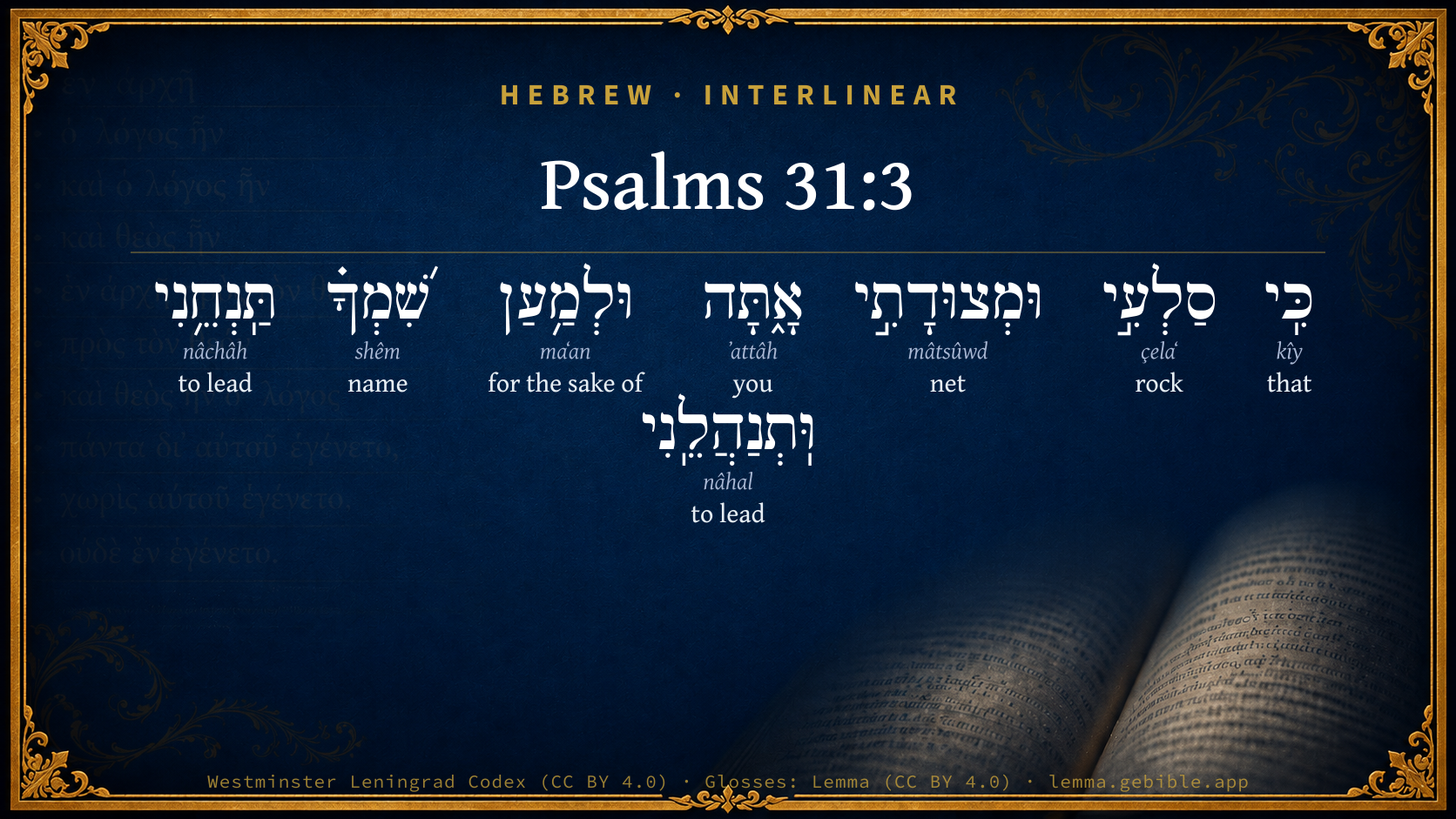
Hebrew (Westminster Leningrad Codex) Psalms 31:3 appears in the Hebrew Old Testament. The text above is from the Westminster Leningrad Codex. Each word links to its Strong’s number, a concise gloss, and parsing drawn from the Open Scriptures Hebrew Bible morphology. Click any word for its full Brown-Driver-Briggs (BDB) entry.
Download image
Cite this verse

Psalms 31:3 (World English Bible). Public Domain. Lemma interlinear Bible study tool, https://lemma.gebible.app/v/psalms/31/3.

Show BibTeX & RIS
BibTeX
RIS
English Translation
For you are my rock and my fortress, Therefore for your name's sake lead me and guide me.
World English Bible · Public Domain
Download a study sheet

One document with this verse’s original text, its word-by-word gloss line, the meaning frame, cross-references with their text, attributed commentary, and full source and license credits — printable, and it pastes into notes with its structure intact.

This verse Autodidact and up

Study sheet (.html) Plain text (.txt)

A passage Seminary Student

Up to 50 verses in one chapter. A passage sheet keeps up to 6 commentary sources and 12 cross-references per verse, in the order this page ranks them, and says so on the sheet whenever that leaves anything out. Ask for a single verse and you get the Autodidact verse sheet above.

Everything on this page stays free to read, with no account — the sheet is a download of what is already on screen, not access to it.

Want to remove ads? Support Godless Engineer
Compare translations 3

The same verse in 3 English versions, stacked beneath the original-language interlinear above. Click any original word for its lexicon entry.

Each is an independent rendering of the whole verse — the interlinear is not word-aligned to these translations.

Highlighted words mark where these versions differ — a whole-verse word diff, not a word-by-word alignment.

  • World English Bible Public Domain
    For you are my rock and my fortress, Therefore for your name's sake lead me and guide me.
  • King James Version Public Domain
    For thou art my rock and my fortress; therefore for thy name's sake lead me, and guide me.
  • unfoldingWord Literal Text CC BY-SA 4.0
    Indeed, you are my rock and my stronghold; therefore for the sake of your name you lead me and guide me.

unfoldingWord Literal Text — © unfoldingWord, licensed CC BY-SA 4.0. Word-aligned USFM3 via Door43 (git.door43.org/unfoldingWord/en_ult).

Versions to compare (up to 4)

3 of 4 selected

Show all 18 translations

Every available English version of this verse, each an independent rendering of the whole verse.

  • World English Bible Public Domain
    For you are my rock and my fortress, Therefore for your name's sake lead me and guide me.
  • Berean Standard Bible Public Domain
    For You are my rock and my fortress; lead me and guide me for the sake of Your name.
  • Majority Standard Bible Public Domain
    For You are my rock and my fortress; lead me and guide me for the sake of Your name.
  • King James Version Public Domain
    For thou art my rock and my fortress; therefore for thy name's sake lead me, and guide me.
  • American Standard Version (1901) Public Domain
    For thou art my rock and my fortress; Therefore for thy name's sake lead me and guide me.
  • Revised Version (1885) Public Domain
    For thou art my rock and my fortress; therefore for thy name’s sake lead me and guide me.
  • Geneva Bible (1599) Public Domain
    For thou art my rocke and my fortresse: therefore for thy Names sake direct mee and guide me.
  • Douay-Rheims (1899) Public Domain
    Bow down thy ear to me: make haste to deliver me. Be thou unto me a God, a protector, and a house of refuge, to save me.
  • Young's Literal Translation Public Domain
    For my rock and my bulwark `art' Thou, For Thy name's sake lead me and tend me.
  • Literal Standard Version CC BY-SA 4.0
    For You [are] my rock and my bulwark, || For Your Name’s sake lead me and tend me.
  • Unlocked Literal Bible CC BY-SA 4.0
    For you are my rock and my fortress; therefore for your name's sake, lead and guide me.
  • unfoldingWord Literal Text CC BY-SA 4.0
    Indeed, you are my rock and my stronghold; therefore for the sake of your name you lead me and guide me.
  • Darby Bible Public Domain
    For thou art my rock and my fortress; and, for thy name's sake, thou wilt lead me and guide me.
  • World Messianic Bible Public Domain
    For you are my rock and my fortress, therefore for your name’s sake lead me and guide me.
  • Webster's Bible Public Domain
    \\31:2\\Bow down thy ear to me; deliver me speedily: be thou my strong rock, for a house of defense to save me.
  • Free Bible Version CC BY-SA 4.0
    You are my rock and my fortress. For the sake of your reputation, please lead me and guide me.
  • Bible in Basic English Public Domain
    For you are my Rock and my strong tower; go in front of me and be my guide, because of your name.
  • JPS Tanakh (1917) Public Domain
    (31-4) For Thou art my rock and my fortress; therefore for Thy name's sake lead me and guide me.

Literal Standard Version (2020), Covenant Press — licensed CC BY-SA 4.0. Text via the HelloAO Bible API (eBible.org). Unlocked Literal Bible (unfoldingWord) — licensed CC BY-SA 4.0. Text via the HelloAO Bible API (eBible.org). unfoldingWord Literal Text — © unfoldingWord, licensed CC BY-SA 4.0. Word-aligned USFM3 via Door43 (git.door43.org/unfoldingWord/en_ult). Free Bible Version, Dr. Jonathan Gallagher — licensed CC BY-SA 4.0. Text via the HelloAO Bible API (eBible.org).

Word by word

More ways to search: Search by grammar → Find every occurrence → Compare this word →

Practice this passage: Drill this verse → Learn its vocabulary →

וּֽתְנַהֲלֵֽנִי
nâhal
H5095
“and · to lead · me”
Conjunction + Verb, Piel, Imperfect, 2nd Person, Masculine, Singular + Suffix, Personal, 1st Person, Common, Singular
Part of Speech
Conjunction + Verb
Stem
Piel
Form
Imperfect
Person
2nd Person
Gender
Masculine
Number
Singular
Full BDB Definition

Origin: a primitive root

TWOT: 1312

to lead, give rest, lead with care, guide to a watering place or station, cause to rest, bring to a station or place of rest, guide, refresh - (Piel) - to lead to a watering-place or station and cause to rest there - to lead or bring to a station or goal - to lead, guide - to give rest to - to refresh (with food) - (Hithpael) - to lead on - to journey by stations or stages
  1. כִּֽי kîy H3588 “that” Conjunction
  2. סַלְעִ֣י çelaʻ H5553 “rock · my” Noun, Common, Masculine, Singular, Construct + Suffix, Personal, 1st Person, Common, Singular
  3. וּמְצוּדָתִ֣י mâtsûwd H4686 “and · net · my” Conjunction + Noun, Common, Both, Singular, Construct + Suffix, Personal, 1st Person, Common, Singular
  4. אָ֑תָּה ʼattâh H859 “you” Pronoun, Personal, 2nd Person, Masculine, Singular
  5. וּלְמַ֥עַן maʻan H4616 “and · for the sake of” Conjunction + Preposition
  6. שִׁ֝מְךָ֗ shêm H8034 “name · your” Noun, Common, Masculine, Singular, Construct + Suffix, Personal, 2nd Person, Masculine, Singular
  7. תַּֽנְחֵ֥נִי nâchâh H5148 “to lead · me” Verb, Hiphil, Imperfect, 2nd Person, Masculine, Singular + Suffix, Personal, 1st Person, Common, Singular

About this verse

These counts appear in no published source. They are computed here, from the morphology-tagged text and Lemma’s own curated glosses. What Lemma adds →

8
words
8
distinct lemmas
Wisdom
section

Notable vocabulary

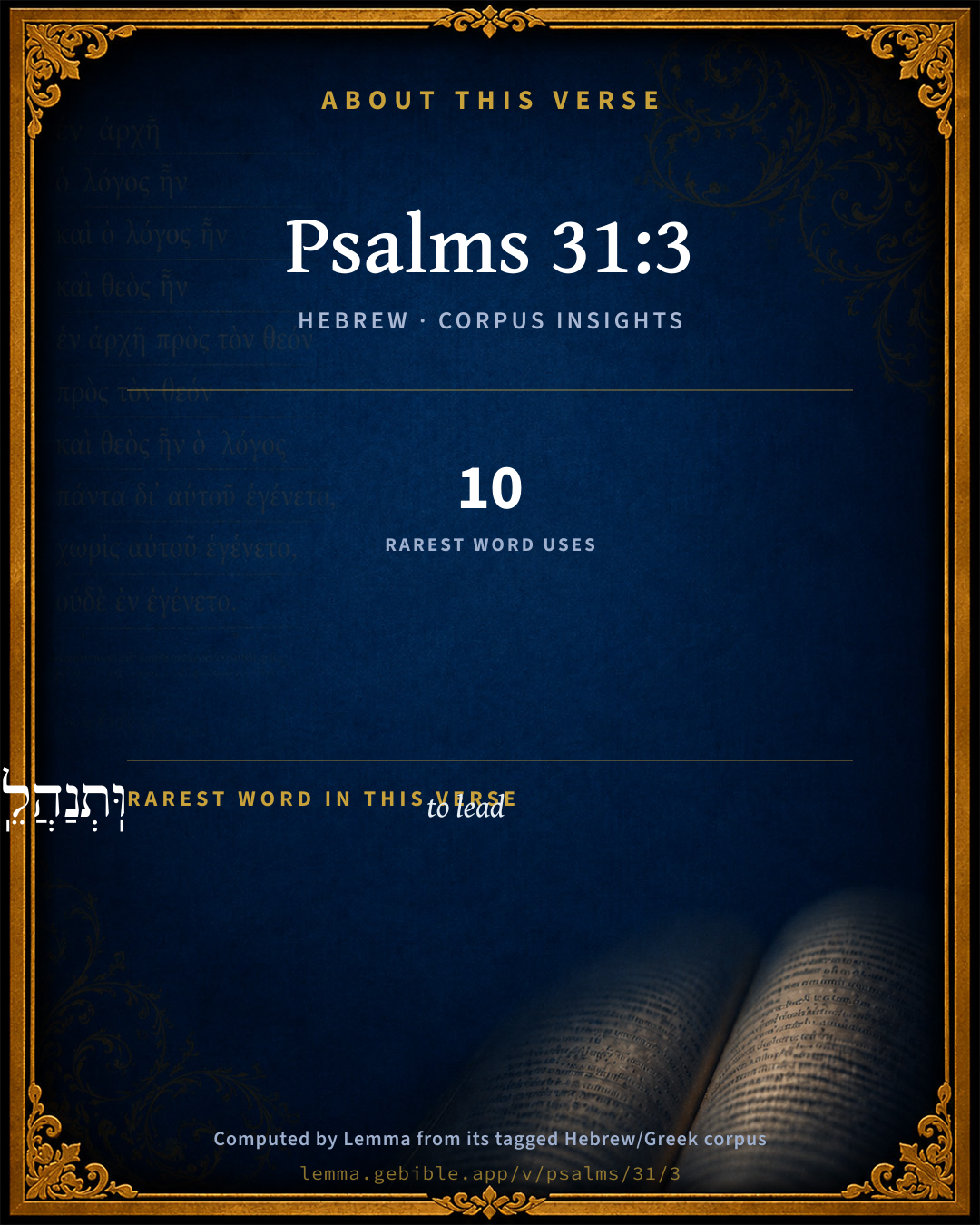
The rarest word here is וּֽתְנַהֲלֵֽנִי to lead H5095 — appearing just 10 times in the whole Hebrew Bible.

Shared distinctive vocabulary

וּֽתְנַהֲלֵֽנִי to lead H5095 occurs in 10 verses of the Hebrew Bible. Also found in:

Grammatical profile

  • 2 verbs
  • 3 nouns
  • 1 pronoun
  • 1 preposition
  • 1 conjunction

Verb forms

  • תַּֽנְחֵ֥נִי Hiphil · Imperfect
  • וּֽתְנַהֲלֵֽנִי Piel · Imperfect

Hebrew & Septuagint length

In English translation the verse runs 18 words from the Hebrew and 20 from the Septuagint (LXX English) — closely comparable.

A rough comparison of the two English renderings, which tokenize alike — not a word-level alignment.

Word counts can differ between the Hebrew and the Greek without any difference in meaning — e.g. the Hebrew direct-object marker אֵת has no separate Greek word, and Greek often adds the article ὁ.

Cross-references

18

Topical passages linked to Psalms 31:3 in the Treasury of Scripture Knowledge — connected by theme and wording, ordered by reader-vote popularity; previews shown in the World English Bible.

  • Psalms 143:10–11 Teach me to do your will, For you are my God. Your Spirit is good. Lead me in the land of uprightness.
  • Luke 1:79 To shine on those who sit in darkness and the shadow of death; To guide our feet into the way of peace."
  • Psalms 79:9 Help us, God of our salvation, for the glory of your name. Deliver us, and forgive our sins, for your name's sake.
  • Isaiah 49:10 They shall not hunger nor thirst; neither shall the heat nor sun strike them: for he who has mercy on them will lead them, even by springs of water will he guide them.
  • John 16:13 However when he, the Spirit of truth, has come, he will guide you into all truth, for he will not speak from himself; but whatever he hears, he will speak. He will declare to you things that are coming.
  • Nehemiah 9:12 Moreover in a pillar of cloud you led them by day; and in a pillar of fire by night, to give them light in the way in which they should go.
  • Psalms 23:2–3 He makes me lie down in green pastures. He leads me beside still waters.
  • Psalms 25:5 Guide me in your truth, and teach me, For you are the God of my salvation, I wait for you all day long.
  • Psalms 25:11 For your name's sake, Yahweh, Pardon my iniquity, for it is great.
  • Jeremiah 14:7 Though our iniquities testify against us, work you for your name's sake, Yahweh; for our backslidings are many; we have sinned against you.
  • Psalms 25:9 He will guide the humble in justice. He will teach the humble his way.
  • Psalms 43:3 Oh, send out your light and your truth. Let them lead me. Let them bring me to your holy hill, To your tents.
  • Psalms 139:24 See if there is any wicked way in me, And lead me in the everlasting way.
  • Joshua 7:9 For the Canaanites and all the inhabitants of the land will hear of it, and will compass us round, and cut off our name from the earth: and what will you do for your great name?
  • Nehemiah 9:19 yet you in your manifold mercies didn't forsake them in the wilderness: the pillar of cloud didn't depart from over them by day, to lead them in the way; neither the pillar of fire by night, to show them light, and the way in which they should go.
  • Psalms 18:2 Yahweh is my rock, my fortress, and my deliverer; My God, my rock, in whom I take refuge; My shield, and the horn of my salvation, my high tower.
  • Ezekiel 36:21–22 But I had regard for my holy name, which the house of Israel had profaned among the nations, where they went.
  • Ephesians 1:12 to the end that we should be to the praise of his glory, we who had before hoped in Christ:

Cross-references courtesy of OpenBible.info (CC BY 4.0).

Hebrew and Greek witnesses Masoretic Hebrew ↔ Greek Septuagint

The same verse in the two great witnesses to the Old Testament, shown verse-for-verse.

You’re reading Greek Psalm 30 (Hebrew Psalm 31). The Septuagint counts the superscription, so verse numbers can differ from the Hebrew — chapter-level alignment, not verse-by-verse. Numbering follows Rahlfs.

These are two independent witnesses, not word-aligned to each other, and the Septuagint is shown in lemma (dictionary) form.

Hebrew Psalms 31:3 Masoretic · Westminster Leningrad Codex

כִּֽי סַלְעִ֣י וּמְצוּדָתִ֣י אָ֑תָּה וּלְמַ֥עַן שִׁ֝מְךָ֗ תַּֽנְחֵ֥נִי וּֽתְנַהֲלֵֽנִי

For you are my rock and my fortress, Therefore for your name's sake lead me and guide me.

World English Bible · Public Domain

Greek LXX Greek Psalm 30:3 Septuagint · lemma form

κλίνω πρός ἐγώ ὁ οὖς σύ ταχύνω ὁ ἐκαἱρέω ἐγώ γίγνομαι ἐγώ εἰς θεός ὑπερασπιστής καί εἰς οἶκος καταφυγή ὁ σώζω ἐγώ

For you are my strength and my refuge; and you shall guide me for your name's sake, and maintain me.

LXX2012 (modern English Septuagint) · Public Domain

On this verse, Ellicott's Commentary for English Readers discusses the Septuagint’s reading. Read the note in Commentary ↓

Hebrew: Westminster Leningrad Codex (CC BY 4.0). Greek: Septuagint (public domain); English from LXX2012 (modern English Septuagint) (Public Domain). How the Septuagint differs from the Hebrew →

Commentary

Notes on Psalms 31:3 from classic Christian and Jewish commentators (each source and its license shown beneath its notes). The classic Christian expositions comment on the surrounding passage and are grouped to its opening verse, so a note may address several verses; the Jewish commentaries on the Tanakh (Rashi and others) are per-verse, so they appear only where the commentator wrote on this verse.

Lemma curates 59 commentaries, every one of them public domain or Creative Commons licensed, each selected and text-cleaned for this edition rather than reprinted as found. About our sources →

Ellicott's Commentary for English Readers

(3) Rock.—As rock in this verse is selâ (LXX. and Vulg., “strength”) instead of tsûr, as in Psa_31:2, it is better to render “for thou art my cliff fortress;” literally, cliff and fortress.

For thy name’s sake—i.e., because Thou hast this name of rock and fortress.

Lead me, and guide me.—The future is better,

“Thou wilt lead and guide me.”

To pray for protection and then stoutly affirm belief, as in Psa_31:3, has been called illogical; but it is the logic of the heart if not of the intellect; the logic, it may be added, of every prayer of faith.

A Bible Commentary for English Readers, edited by Charles John Ellicott (1878–1897) — public domain. Text from a community e-Sword module.

Trapp's Complete Commentary

John Trapp

Psa 31:3 For thou [art] my rock and my fortress; therefore for thy name’s sake lead me, and guide me.

Ver. 3. For thou art my rock and my fortress] Such places David had been forced to fly to; but still he trusted in God.

Lead me, and guide me] Duc me, et deduc me. A metaphor from captains and generals, who lead on their armies with greatest art and industry (Vatab.).

John Trapp, A Commentary or Exposition upon All the Books of the Old and New Testament (1647–1656) — public domain. Text from a community e-Sword module.

J. A. Alexander on Psalms

Joseph Addison Alexander

4. (Psa 31:3). For my rock and my fortress (art) thou, and for thy name's sake thou wilt lead me and conduct me (or provide for me). What he asks in the preceding verse he here asserts, to wit, that God is his protector, and must therefore, of necessity, protect him, not only for the sufferer's sake, but for the honour of his own name or manifested nature. See above, Psa 23:3, for the meaning of this phrase, and on the second verse of the same psalm, for that of the last verb.—The futures in the second clause suggest the idea of necessity, and might perhaps be correctly rendered by the use of our auxiliary must.

Joseph Addison Alexander, The Psalms Translated and Explained (1850) — public domain. Text from a community e-Sword module.

John Calvin's Commentaries

3. For thou art my rock. This verse may be read as one sentence, thus: As thou art like a tower for my defense, for thy name’s sake direct and guide me during my whole life. And thus the conjunction, as in many similar cases, would be superfluous. But I rather prefer a different sense, namely, that David, by interjecting this reflection, encourages himself not only to earnestness in prayer, but also in the confident hope of obtaining his requests. We know, at all events, that it is usual with him to mingle such things in his prayers as may serve to remove his doubts, and to confirm his assurance. Having, therefore, expressed his need, he assures himself, in order to encourage and animate himself, that his prayer shall certainly have a happy answer. He had formerly said, Be thou my strong rock and fortress; and now he adds, Assuredly thou art my rock, and my fortress: intimating, that he did not throw out these words rashly, like unbelievers, who, although they are accustomed to ask much from God, are kept in suspense by the dread of uncertain events. From this he also draws another encouragement, that he shall have God for his guide and governor during the whole course of his life. He uses two words, lead and guide, to express the same thing, and this he does (at least so I explain it) on account of the various accidents and unequal vicissitudes by which the lives of men are tried: as if he had said, Whether I must climb the steep mountain, or struggle along through rough places, or walk among thorns, I trust that thou wilt be my continual guide. Moreover, as men will always find in themselves matter for doubt, if they look to their own merits, “Si los hommes regardent a leur dignite.” — Fr.

John Calvin's Commentaries (1540-1563) — public domain. Text from the Calvin Translation Society English edition (1840s-50s) via the Christian Classics Ethereal Library (ccel.org). Calvin's coverage is partial (roughly two-thirds of the Bible); uncommented books and verses are honest gaps, never fabricated. The 19th-century editor's footnotes and remarks are omitted so the notes are faithfully Calvin's own voice.

John Gill's Exposition

For thou art my rock and my fortress,.... What he prayed for he knew him to be, and to have been in times past, and could claim his interest in him; and therefore entreats that he would appear to be to him what he was in himself, and what he had been to him;

therefore for thy name's sake lead me, and guide me; either as a shepherd does his flock, gently, as they are able to bear it; into the green pastures of the word and ordinances, and beside the still waters of divine love, and to the overflowing fountain, and fulness of grace in himself; or as a general leads and guides his army; Christ being a Leader and Commander of the people, and the great Captain of their salvation, and who being at the head of them, they fear no enemy; or as a guide leads and directs such as are ignorant, and out of the way. The psalmist desires the Lord would lead him in the way of truth and paths of righteousness, according to his word; and guide him with his counsel, and by his Spirit, that so he might walk in the way in which he should go; and this he entreats he would do "for his name's sake"; not for any merit or worthiness in him; but for the glory of his own name, and for the honour of his free grace and mercy, for which the Lord often does many things; he defers his anger, he purges away the sins of his people, he forgives their transgressions, and remembers their sins no more, for his name's sake.

John Gill's Exposition of the Whole Bible (1746–1763) — public domain (CC PDM 1.0). Text via the HelloAO Bible API.

Albert Barnes' Notes on the Bible

For thou art my rock and my fortress - See the notes at Psa 18:2.

Therefore for thy name’s sake - For the sake of thine own honor, or for the glory of thy name. See the notes at Psa 23:3. That is, since thou art my rock and my defense - since I put my trust in thee - show, by leading and guiding me, that my trust is well founded, or that this is Thy character, and that Thou wilt be true and faithful to those who commit their all to thee. See the notes at Psa 31:1.

Albert Barnes' Notes on the Bible (1834–1885) — public domain. Text from a community e-Sword/MySword module.

Matthew Poole's English Annotations

For thy name’s sake; for the glory of thy name, i.e. of thy power, and truth, and mercy to thy miserable servant.

Lead me, and guide me; two words expressing the same thing with more emphasis. Direct me clearly and continually in a right and safe path; for without thy conduct I can neither discern the right way, or continue in it.

Matthew Poole's English Annotations on the Holy Bible (1683–1685) — public domain. Text from a community e-Sword/MySword module.

The Treasury of David

Charles H. Spurgeon

Ver. 3. For thou art my rock and my fortress. Here the tried soul avows yet again its full confidence in God. Faith's repetitions are not vain. The avowal of our reliance upon God in times of adversity is a principle method of glorifying him. Active service is good, but the passive confidence of faith is not one jot less esteemed in the sight of God. The words before us appear to embrace and fasten upon the Lord with a fiducial grip which is not to be relaxed. The two personal pronouns, like sure nails, lay hold upon the faithfulness of the Lord. O for grace to have our heart fixed in firm unstaggering belief in God! The figure of a rock and a fortress may be illustrated to us in these times by the vast fortress of Gibraltar, often besieged by our enemies, but never wrested from us: ancient strongholds, though far from impregnable by our modes of warfare, were equally important in those remoter ageswhen in the mountain fastnesses, feeble bands felt themselves to be secure. Note the singular fact that David asked the Lord to be his rock Ps 31:2 because he was his rock; and learn from it that we may pray to enjoy in experience what we grasp by faith. Faith is the foundation of prayer. Therefore for thy name's sake lead me, and guide me. The psalmist argues like a logician with his fors and therefores. Since I do sincerely trust thee, saith he, O my God, be my director. To lead and to guide are two things very like each other, but patient thought will detect different shades of meaning, especially as the last may mean provide for me. The double word indicates an urgent needwe require double direction, for we are fools, and the way is rough. Lead me as a soldier, guide me as a traveller! lead me as a babe, guide me as a man; lead me when thou art with me, but guide me even if thou be absent; lead me by thy hand, guide me by thy word. The argument used is one which is fetched from the armoury of free grace: not for my own sake, but for thy name's sake guide me. Our appeal is not to any fancied virtue in our own names, but to the glorious goodness and graciousness which shines resplendent in the character of Israel's God. It is not possible that the Lord should suffer his own honour to be tarnished, but this would certainly be the case if those who trusted him should perish. This was Moses' plea, "What wilt thou do unto thy great name?"

Ver. 3. For thy name's sake. If merely a creature's honour, the credit of ministers, or the glory of angels were involved, man's salvation would indeed be uncertain. But every step involves the honour of God. We plead for his name's sake. If God should begin and not continue, or if he should carry on but not complete the work, all would admit that it was for some reason that must bring reproach on the Almighty. This can never be. God was self moved to undertake man's salvation. His glorious name makes it certain the top stone shall be laid in glory. William S. Plumer.

Ver. 3. For thy name's sake. On account of the fame of thy power, thy goodness, thy truth, &c. Lead me. As a shepherd an erring sheep, as a leader military bands, or as one leads another ignorant of the way. See Ge 24:27 Ne 9:12-13 Ps 23:3 73:24. Govern my counsels, my affections, and my thoughts. Martin Geier, 1614-1681.

Ver. 3. Work out the metaphor of God as a rocky fastness of the soul.

Ver. 3. (last clause).

1. A blessing needed, lead me.

2. A blessing obtainable.

3. An argument for its being granted, for thy name's sake..

Psalms 31:4*

Charles H. Spurgeon's The Treasury of David (1869–1885) — public domain. Psalms only. Text from a community e-Sword/MySword module.

Whedon's Commentary on the Bible

Daniel D. Whedon

3. For thy name’s sake—See on Psa_23:3

Daniel D. Whedon (gen. ed.), Commentary on the Old and New Testaments (1874–1909) — public domain. Text from a community e-Sword module.

The Pulpit Commentary

For thou art my Rock; or, my cliff (yls, not yrwx). And my Fortress. David prays God to be his Rock and Fortress in the future, because he has always looked to him as his Rock and Fortress in the past. Faith establishes a claim to have its anticipations made good. Therefore for thy Name"s sake lead me, and guide me. Metaphor is dropped, and God is simply asked for guidance and direction. In the struggle between Absalom and David more depended upon wise counsel than upon mere force. (2Sa_15:31-37 2Sa 16:15-23:17:5-23)

A prayer for guidance.

"For thy Name"s sake... guide me." God leads men, whether they ask him or not. He guides their lives, though they may not know him even may deny his very existence. Belshazzar. (Dan_5:23, "in whose hand," etc) Cyrus. (Isa_45:1-5) Heathen nations. (Act_17:26, Act_17:27) Does this make such a prayer as the text superfluous? On the contrary, it is the very reason for it. God"s guidance of men without their knowledge, or even against their will, is very different from his guidance of those who ask it for his Name"s sake. (As you speak of "driving a horse," or "driving a friend" who asks a seat by your side.) Consider the meaning and the plea of the psalmist"s prayer.

I WHAT DOES THIS PRAYER ASK FOR? In other words, how can God grant it?

1. By the lending of his providence. Q.d.: his unfailing, unerring, unlimited control of all events and creatures, great or small. The old-fashioned phrase, "particular providence," is often strongly objected to; rightly, if it be taken to mean some special interference with the course of things here, not there; now, not then; a touch to the helm sectionally, not the firm hand never taken off it. But remember, what cleverest people (busy with wide generalizations and laws) are most apt to forget that all reality is particular. A pound of iron weighs a pound because each atom of iron is precisely like every other, and obeys exactly the same force. The harvest ripens because the same life is working in every several grain. A lifetime is not made up of weeks and years, but breaths and heart-beats. We must not liken God"s knowledge to ours. We are compelled to store ours in abstract ideas, names, laws, etc., just as we arrange books on shelves, with titles on their back useless else. Divine knowledge, lust because infinite, must take in every movement of every atom. Inconceivable! But not more inconceivable than that God has set going movements at the rate of hundreds of millions of millions in a second, which keep time throughout the universe. And what his power has called into being and sustains, and his knowledge surveys, his wisdom and goodness guide. This, at once deepest truth and plain common sense, is the Bible doctrine of providence. "He maketh grass to grow on the mountains each blade from its own root. Not a bird falls to the earth without our heavenly Father. "The steps of a good man are ordered by the Lord". (Psa_139:3, Psa_139:9, Psa_139:10)

2. By his Word. (2Ti_3:15 Psa_119:105) What is a lamp for? To give light. How do I know that light is light? Simply by its shining. Light is its own evidence. If a lamp cannot be kindled, or, being kindled, refuses to burn, no argument will persuade you that it is a good lamp. If it burns bright and steady, shedding a clear light on the page you read, the work you handle, the path you walk in, no argument will persuade you that it is not a good lamp. So with God"s Word. Men may dispute as they please about inspiration, pile up mountains of criticism, publish every few years a new work that is to finally dispose of the Bible; they cannot stop the light from shining. This main fact remains solid, unanswerable, that a life guided by this light rises to a level, gains a purity, strength, beauty, hopeful courage, and calm settled peace not otherwise attainable. The light, observe, not of mere precept. Pagan teachers Buddha, Confucius, Seneca, and I know not how many, have given noble and lofty precepts, enabling men to say, with the old Roman poet, "I see and approve what is good, though I practise what is bad." But only from the Bible shines, along with precept, the light of pardon and the light of promise . (1Jn_2:12, 1Jn_2:25) Against the sceptics" learning and logic the plain Christian sets his experience. If you could find a grey-haired Christian saying, "I have framed my life according to the Bible, and I wish I had not; I have lived a life of prayer to God, and trust in Jesus as my Saviour, and obedience to his Word, and if I could begin again, I would be wiser, then you would at least have something to set against the lives ruined by despising the Bible, and flinging faith and prayer away. But the testimony is the other way. (Psa_119:165 Psa_19:11 2Ti_4:6-8)

3. By his Spirit. (Joh_14:13 Rom_8:14) The Bible itself affords no countenance to the idea that life can be rightly guided by the written Word alone, severed from the living presence and personal teaching of the Holy Spirit. For three plain reasons. A rightly guided life means:

(1) A life of faith in Christ; and this is the Holy Spirit"s gift and work. (Mat_16:17)

(2) A life of prayer; and the Holy Spirit is at once the Answer to prayer and the Inspirer of prayer. (Luk_11:13 Jud_1:20)

(3) The true meaning of Scripture is hidden from an unspiritual mind. (1Co_2:14)

II WHAT IS THE FORCE OF THE PLEA HERE URGED thy Name"s sake"? If one may venture to put it so plainly, it is putting God on his honour to fulfil his promises. The "Name" of God stands for all that he has made known to us of himself. Especially it includes his words of promise, because here his faithfulness stands pledged. Not that God promises to grant every request, wise or foolish, right or wrong. (Who would dare to pray?) But he does promise to attend to our prayer to give good things to those who ask. He has filled the Bible with encouragements and commands to pray, and with examples of prayer answered. As our Lord Jesus is himself the full Revelation of the Father, so he authorizes us to pray in his Name. (Joh_14:13, Joh_14:14)

Conclusion. Of all prayers there is none we need to offer more earnestly, more constantly.

1. Without God"s guidance we shall miss our way. A life at the mercy of passion, expediency, fashion, fancy, is like a rudderless ship. Especially in trouble and temptation. The traveller in fair, calm weather may think the mountain-track is plain enough without a guide; but the snowstorm comes on, and he is lost.

2. If God be not your Guide, you will have some other. Conformity to the world is practical submission to the enemy of souls. (Eph_2:2, "He who bows not to him has bowed to me," Byron"s "Cain Like a ship that has taken on board a false pilot, who steers her on the quicksand.

3. Life is a journey to be taken but once. The wrong path cannot be retraced.

The Pulpit Commentary (1880–1919), ed. H.D.M. Spence-Jones & Joseph S. Exell — public domain. Text from a community e-Sword module.

unfoldingWord translationNotes

Door43 World Missions Community

my rock

Yahweh is spoke of as if he were a huge rock that would protect the writer from attack. AT: "like a huge rock on which I can be safe" (See: Metaphor)

my fortress

Yahweh is spoken of as if he were a strong fortress in which the writer would be protected from his enemies. (See: Metaphor)

for your name's sake

In this phrase "name" represents Yahweh. AT: "so that your name may be honored" or "so that I may worship you" (See: Metonymy)

lead and guide me

The words "lead" and "guide" mean basically the same thing and strengthen the request that Yahweh lead him. AT: "lead me where you want me to go" (See: Doublet)

Pluck me out of the net that they have hidden for me

The writer is spoken of as if he were a bird caught in a hidden net, and waiting for Yahweh to free him from the trap. (See: Metaphor)

you are my refuge

Yahweh is spoken of as if he is a place where the writer can hide from people who are attacking him. AT: "you always protect me" or "you give me constant protection" (See: Metaphor)

translationWords

name

unfoldingWord translationNotes — © Distant Shores Media and the Door43 World Missions Community, licensed CC BY-SA 4.0. Source: git.door43.org/Door43/en_tn.

Rashi

Rabbi Shlomo Yitzchaki (Rashi)

a stronghold Pleysiz in Old French, a fortress.

Rashi on the Tanakh — English translations: “The Judaica Press complete Tanach with Rashi, translated by A. J. Rosenberg” (CC BY 4.0); “Pentateuch with Rashi's commentary by M. Rosenbaum and A.M. Silbermann, 1929-1934” (public domain); “The Metsudah Tanach series, Lakewood, N.J” (CC BY 4.0); and “The Book of Joshua, Metsudah Publications, 1997” (CC BY 4.0). Text via Sefaria.

Lesson kit

Teaching starters — assembled from the data on this page, not authored interpretation. Every prompt links to the verse data it draws on. Edit before teaching.

Psalms, in the Wisdom, opens this verse with 8 words (8 distinct Hebrew lemmas). Its most distinctive word is nâhal (“to lead”). A historical commentator’s framing appears above. Read the whole chapter for the surrounding context.

Discussion questions

  1. The word nâhal carries the sense “to lead.” How does it shape the verse?
  2. How does Genesis 33:14, which shares the word «to lead», read alongside this verse?
  3. These translations render this verse differently. What is at stake in choosing one wording over another?
  4. «תַּֽנְחֵ֥נִי» is a Hiphil Imperfect verb. How does that grammatical form shape the action described?
  5. Compare how Ellicott's Commentary for English Readers and Trapp's Complete Commentary read this verse. Where do they agree or differ?

Things to notice

Reading settings

Reading text

Shown beneath each verse's original-language words.

Old Testament
Old Testament edition

Read the OT as the Masoretic Hebrew (MT) or the Greek Septuagint (LXX).

English shown for the Greek Septuagint (in the Hebrew ↔ Greek comparison).

Comparing translations? Open the Compare panel on any verse page to stack up to four side by side.