
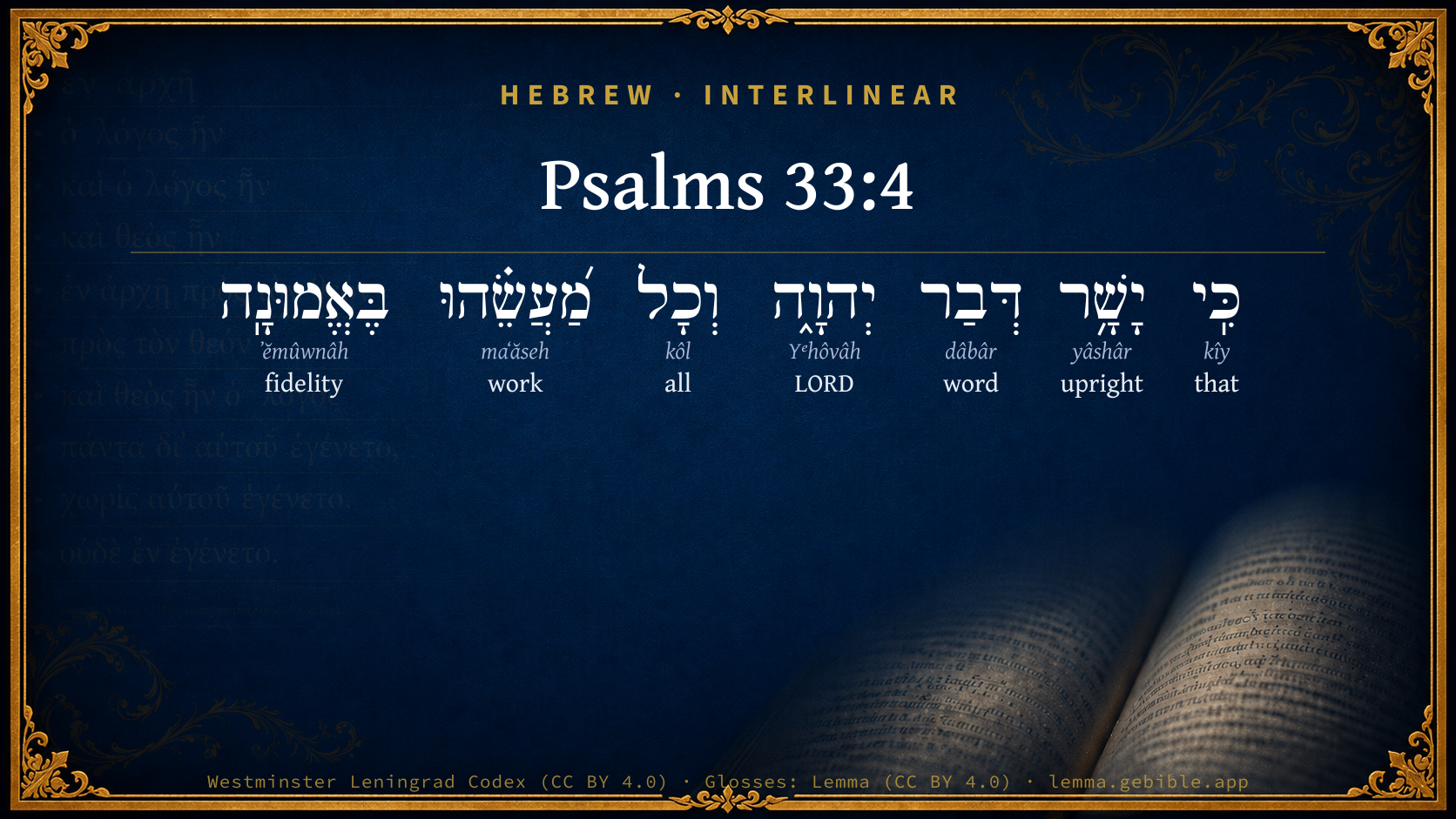
Psalms 33:4

Hebrew (Westminster Leningrad Codex) Psalms 33:4 appears in the Hebrew Old Testament. The text above is from the Westminster Leningrad Codex. Each word links to its Strong’s number, a concise gloss, and parsing drawn from the Open Scriptures Hebrew Bible morphology. Click any word for its full Brown-Driver-Briggs (BDB) entry.
Download image
Cite this verse

Psalms 33:4 (World English Bible). Public Domain. Lemma interlinear Bible study tool, https://lemma.gebible.app/v/psalms/33/4.

Show BibTeX & RIS
BibTeX
RIS
English Translation
For the word of Yahweh is right. All his work is done in faithfulness.
World English Bible · Public Domain
Download a study sheet

One document with this verse’s original text, its word-by-word gloss line, the meaning frame, cross-references with their text, attributed commentary, and full source and license credits — printable, and it pastes into notes with its structure intact.

This verse Autodidact and up

Study sheet (.html) Plain text (.txt)

A passage Seminary Student

Up to 50 verses in one chapter. A passage sheet keeps up to 6 commentary sources and 12 cross-references per verse, in the order this page ranks them, and says so on the sheet whenever that leaves anything out. Ask for a single verse and you get the Autodidact verse sheet above.

Everything on this page stays free to read, with no account — the sheet is a download of what is already on screen, not access to it.

Want to remove ads? Support Godless Engineer
Compare translations 3

The same verse in 3 English versions, stacked beneath the original-language interlinear above. Click any original word for its lexicon entry.

Each is an independent rendering of the whole verse — the interlinear is not word-aligned to these translations.

Highlighted words mark where these versions differ — a whole-verse word diff, not a word-by-word alignment.

  • World English Bible Public Domain
    For the word of Yahweh is right. All his work is done in faithfulness.
  • King James Version Public Domain
    For the word of the LORD is right; and all his works are done in truth.
  • unfoldingWord Literal Text CC BY-SA 4.0
    For the word of Yahweh upright, and all of his work in faithfulness.

unfoldingWord Literal Text — © unfoldingWord, licensed CC BY-SA 4.0. Word-aligned USFM3 via Door43 (git.door43.org/unfoldingWord/en_ult).

Versions to compare (up to 4)

3 of 4 selected

Show all 18 translations

Every available English version of this verse, each an independent rendering of the whole verse.

  • World English Bible Public Domain
    For the word of Yahweh is right. All his work is done in faithfulness.
  • Berean Standard Bible Public Domain
    For the word of the LORD is upright, and all His work is trustworthy.
  • Majority Standard Bible Public Domain
    For the word of the LORD is upright, and all His work is trustworthy.
  • King James Version Public Domain
    For the word of the LORD is right; and all his works are done in truth.
  • American Standard Version (1901) Public Domain
    For the word of Jehovah is right; And all his work is `done' in faithfulness.
  • Revised Version (1885) Public Domain
    For the word of the LORD is right; and all his work is done in faithfulness.
  • Geneva Bible (1599) Public Domain
    For the word of the Lord is righteous, and all his workes are faithfull.
  • Douay-Rheims (1899) Public Domain
    For the word of the Lord is right, and all his works are done with faithfulness.
  • Young's Literal Translation Public Domain
    For upright `is' the word of Jehovah, And all His work `is' in faithfulness.
  • Literal Standard Version CC BY-SA 4.0
    For the word of YHWH [is] upright, || And all His work [is] in faithfulness.
  • Unlocked Literal Bible CC BY-SA 4.0
    For Yahweh's word is upright, and everything he does is fair.
  • unfoldingWord Literal Text CC BY-SA 4.0
    For the word of Yahweh upright, and all of his work in faithfulness.
  • Darby Bible Public Domain
    For the word of Jehovah is right, and all his work is in faithfulness.
  • World Messianic Bible Public Domain
    For the LORD’s word is right. All his work is done in faithfulness.
  • Webster's Bible Public Domain
    For the word of the LORD is right; and all his works are done in truth.
  • Free Bible Version CC BY-SA 4.0
    For the word of the Lord is true, and he is trustworthy in everything he does.
  • Bible in Basic English Public Domain
    For the word of the Lord is upright, and all his works are certain.
  • JPS Tanakh (1917) Public Domain
    For the word of the LORD is upright; and all His work is done in faithfulness.

Literal Standard Version (2020), Covenant Press — licensed CC BY-SA 4.0. Text via the HelloAO Bible API (eBible.org). Unlocked Literal Bible (unfoldingWord) — licensed CC BY-SA 4.0. Text via the HelloAO Bible API (eBible.org). unfoldingWord Literal Text — © unfoldingWord, licensed CC BY-SA 4.0. Word-aligned USFM3 via Door43 (git.door43.org/unfoldingWord/en_ult). Free Bible Version, Dr. Jonathan Gallagher — licensed CC BY-SA 4.0. Text via the HelloAO Bible API (eBible.org).

Word by word

More ways to search: Search by grammar → Find every occurrence → Compare this word →

Practice this passage: Drill this verse → Learn its vocabulary →

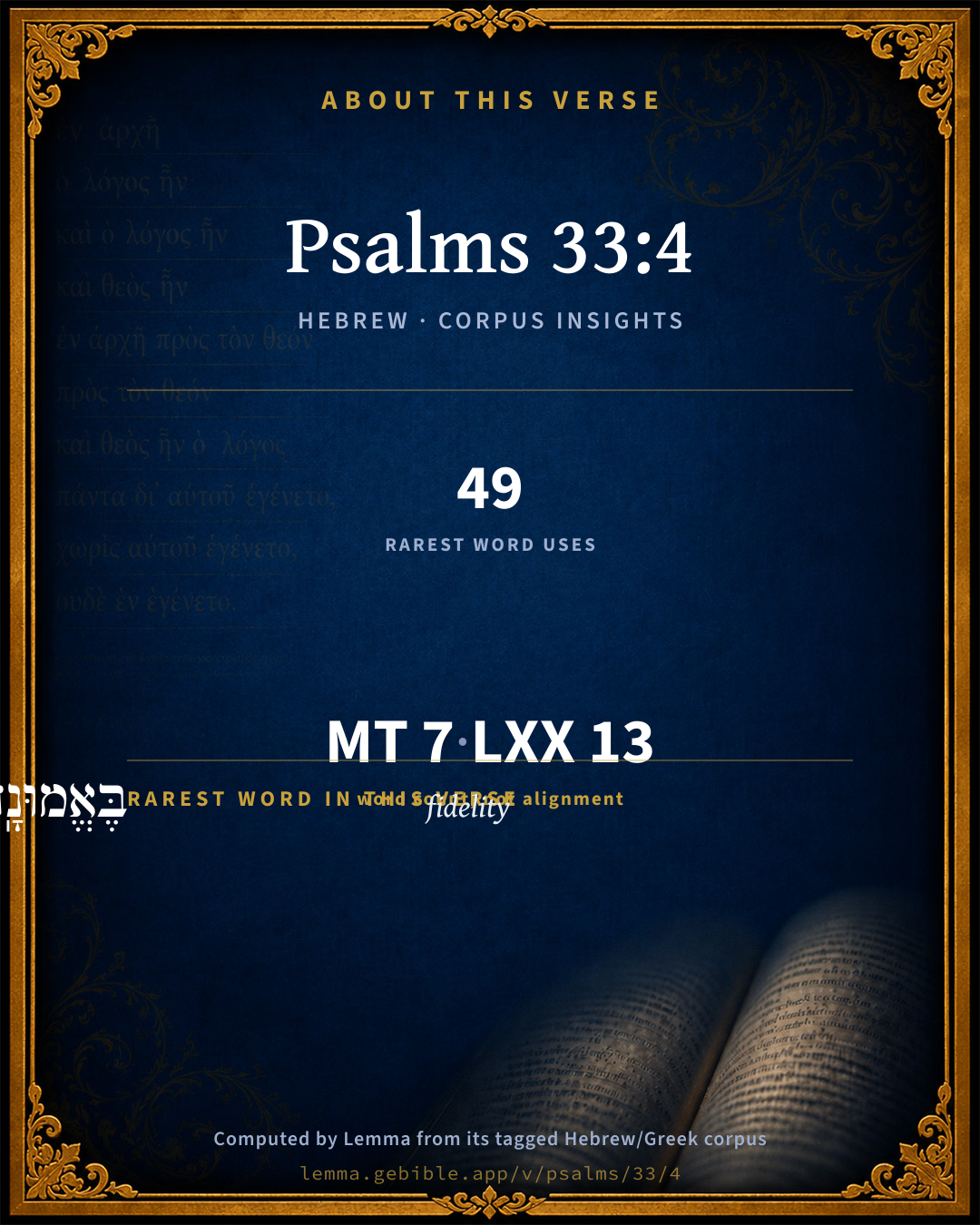
About this verse

These counts appear in no published source. They are computed here, from the morphology-tagged text and Lemma’s own curated glosses. What Lemma adds →

7
words
7
distinct lemmas
Wisdom
section

Shared distinctive vocabulary

בֶּאֱמוּנָֽה fidelity H530 occurs in 49 verses of the Hebrew Bible. Also found in:

Grammatical profile

  • 5 nouns
  • 1 adjective
  • 1 conjunction

Hebrew & Septuagint length

In English translation the verse runs 14 words from the Hebrew and 14 from the Septuagint (LXX English) — the same length.

A rough comparison of the two English renderings, which tokenize alike — not a word-level alignment.

Word counts can differ between the Hebrew and the Greek without any difference in meaning — e.g. the Hebrew direct-object marker אֵת has no separate Greek word, and Greek often adds the article ὁ.

In the original languages it is 7 Hebrew tokens and 13 Greek tokens — but the two are counted differently (Hebrew bundles its prefixes and suffixes into one token; the Greek is in lemma form), so that isn’t a like-for-like length.

Cross-references

17

Topical passages linked to Psalms 33:4 in the Treasury of Scripture Knowledge — connected by theme and wording, ordered by reader-vote popularity; previews shown in the World English Bible.

  • Psalms 12:6 The words of Yahweh are flawless words, As silver refined in a clay furnace, purified seven times.
  • Deuteronomy 32:4 The Rock, his work is perfect; For all his ways are justice: A God of faithfulness and without iniquity, Just and right is he.
  • Titus 1:2 in hope of eternal life, which God, who can't lie, promised before eternal times;
  • Psalms 119:75 Yahweh, I know that your judgments are righteous, That in faithfulness you have afflicted me.
  • Proverbs 30:5 "Every word of God is flawless. He is a shield to those who take refuge in him.
  • Daniel 4:37 Now I, Nebuchadnezzar, praise and extol and honor the King of heaven; for all his works are truth, and his ways justice; and those who walk in pride he is able to abase.
  • Psalms 19:8 Yahweh's precepts are right, rejoicing the heart. Yahweh's commandment is pure, enlightening the eyes.
  • Psalms 36:5–6 Your loving kindness, Yahweh, is in the heavens. Your faithfulness reaches to the skies.
  • John 14:6 Jesus said to him, "I am the way, the truth, and the life. No one comes to the Father, except through me.
  • Romans 7:12 Therefore the law indeed is holy, and the commandment holy, and righteous, and good.
  • Genesis 24:27 He said, "Blessed be Yahweh, the God of my master Abraham, who has not forsaken his loving kindness and his truth toward my master. As for me, Yahweh has led me in the way to the house of my master's relatives."
  • Psalms 25:10 All the paths of Yahweh are loving kindness and truth To such as keep his covenant and his testimonies.
  • Psalms 96:13 Before Yahweh; for he comes, For he comes to judge the earth. He will judge the world with righteousness, The peoples with his truth.
  • Psalms 119:128 Therefore I consider all of your precepts to be right. I hate every false way.
  • Psalms 85:10–11 Mercy and truth meet together. Righteousness and peace have kissed each other.
  • Micah 2:7 Shall it be said, O house of Jacob: "Is the Spirit of Yahweh angry? Are these his doings? Don't my words do good to him who walks blamelessly?"
  • Romans 15:8–9 Now I say that Christ has been made a minister of the circumcision for the truth of God, that he might confirm the promises given to the fathers,

Cross-references courtesy of OpenBible.info (CC BY 4.0).

Hebrew and Greek witnesses Masoretic Hebrew ↔ Greek Septuagint

The same verse in the two great witnesses to the Old Testament, shown verse-for-verse.

You’re reading Greek Psalm 32 (Hebrew Psalm 33). The Septuagint counts the superscription, so verse numbers can differ from the Hebrew — chapter-level alignment, not verse-by-verse. Numbering follows Rahlfs.

These are two independent witnesses, not word-aligned to each other, and the Septuagint is shown in lemma (dictionary) form.

Hebrew Psalms 33:4 Masoretic · Westminster Leningrad Codex

כִּֽי יָשָׁ֥ר דְּבַר יְהוָ֑ה וְכָל מַ֝עֲשֵׂ֗הוּ בֶּאֱמוּנָֽה

For the word of Yahweh is right. All his work is done in faithfulness.

World English Bible · Public Domain

Greek LXX Greek Psalm 32:4 Septuagint · lemma form

ὅτι εὐθής ὁ λόγος ὁ κύριος καί πᾶς ὁ ἔργον αὐτός ἐν πίστις

For the word of the Lord is right; and all his works are faithful.

LXX2012 (modern English Septuagint) · Public Domain

Hebrew: Westminster Leningrad Codex (CC BY 4.0). Greek: Septuagint (public domain); English from LXX2012 (modern English Septuagint) (Public Domain). How the Septuagint differs from the Hebrew →

Commentary

Notes on Psalms 33:4 from classic Christian and Jewish commentators (each source and its license shown beneath its notes). The classic Christian expositions comment on the surrounding passage and are grouped to its opening verse, so a note may address several verses; the Jewish commentaries on the Tanakh (Rashi and others) are per-verse, so they appear only where the commentator wrote on this verse.

Lemma curates 59 commentaries, every one of them public domain or Creative Commons licensed, each selected and text-cleaned for this edition rather than reprinted as found. About our sources →

Trapp's Complete Commentary

John Trapp

Psa 33:4 For the word of the LORD [is] right; and all his works [are done] in truth.

Ver. 4. For the word of the Lord is right] Every word of God is pure and precious, Pro 30:5; his commandment holy, and just, and good, Rom 7:12; but by word here we are to understand God’s counsel and decree concerning the creation and government of the world, which is unquestionably right, and agreeable to sound reason, and therefore they are to blame that dislike his doings. If any evil befall them, the saints confess God’s righteousness, and praise him, as Isa 12:1 Psa 10:1, saith Kimchi here.

And all his works are done in truth] Or, in faith; that is, in faithfulness, without deceit or fickleness. This is to be understood as the execution of God’s decree, all is done well, and equitably.

John Trapp, A Commentary or Exposition upon All the Books of the Old and New Testament (1647–1656) — public domain. Text from a community e-Sword module.

Joseph Benson's Commentary

Psa 33:4-5. The word of the Lord is right — All God’s counsels and commands, whether contained in the Scriptures, or given forth in his providence, for the government of the world, are wise, and just, and good, without deceit or defect. All his works are done in truth — All his dispensations of providence agree with his word, and are no other than the accomplishment of his promises, or threatenings, or other declarations of his mind and will in his word; although sometimes, for a season, they may seem contrary to it. He loveth righteousness and judgment — That is, just judgment: or righteousness may relate to the sentence, and judgment to the execution of it. He not only doth justice to all men, but, which is more, he loves and delights in it. The earth is full of the goodness of the Lord — He not only doth no man wrong, but he is very kind and merciful to all men in the world, on whom he bestows many favours, and to whom he gives many invitations to his love and service.

Joseph Benson's Commentary on the Old and New Testaments (1811–1818) — public domain. Text from a community e-Sword module.

J. A. Alexander on Psalms

Joseph Addison Alexander

4. (Psa 33:4) For right is the word of Jehovah, and all his work is (done) in faithfulness. The word here meant is the word of promise, and the work is its performance or fulfilment. The word is right or upright, i.e. uttered in sincerity and with a full determination to redeem it. In faithfulness, executed faithfully. Compare Num 23:19, Psa 105:42.

Joseph Addison Alexander, The Psalms Translated and Explained (1850) — public domain. Text from a community e-Sword module.

Tyndale Open Study Notes

Tyndale Open Resources

33:4-7 God’s word displays his character and his power.

Tyndale Open Study Notes — © Tyndale Open Resources, licensed CC BY-SA 4.0. Text via the HelloAO Bible API.

Geneva Bible (1599)

Geneva Bible translators

That is, counsel or commandment in governing the world.

That is, the effect and execution.

Geneva Bible (1599) marginal notes — public domain. Text via Bolls.life.

Jamieson, Fausset & Brown

Robert Jamieson, A. R. Fausset & David Brown

Reasons for praise: first, God's truth, faithfulness, and mercy, generally; then, His creative power which all must honor.

Jamieson, Fausset & Brown — Commentary Critical and Explanatory on the Whole Bible (1871) — public domain (CC PDM 1.0). Text via the HelloAO Bible API.

Adam Clarke's Commentary

Verse 4. The word of the Lord is right] He is infinitely wise, and can make no mistakes; and all his works are done in truth. All the words, laws, promises, and threatenings of God are perfectly true and just. The dispensations of his providence and mercy are equally so. When he rewards or punishes, it is according to truth and justice.

Adam Clarke's Commentary on the Bible (1810–1826) — public domain. Text from a community e-Sword/MySword module.

John Calvin's Commentaries

4. For the word of Jehovah is right. As I have just remarked, the Psalmist first sets forth God’s general providence by which he governs the whole world; and he tells us that he so exerts his power in the whole course of his operations, that the most perfect equity and faithfulness shine forth everywhere. Some will have the terms word and work to be synonymous; but I think there is a distinction, and that word means the same thing as counsel or ordinance, while work signifies the effect or execution of his counsel. I grant that here the same subject is repeated in different words, as is the case in other places; but a slight variation will be found in such repetitions, that the same thing may he expressed in various ways. The amount of what is stated is, that whatever God appoints and commands is right; and whatever he brings to pass in actual operation is faithful and true. Meanwhile, it ought to be observed, that the term word is not to be understood of doctrine, but of the method by which God governs the world.

John Calvin's Commentaries (1540-1563) — public domain. Text from the Calvin Translation Society English edition (1840s-50s) via the Christian Classics Ethereal Library (ccel.org). Calvin's coverage is partial (roughly two-thirds of the Bible); uncommented books and verses are honest gaps, never fabricated. The 19th-century editor's footnotes and remarks are omitted so the notes are faithfully Calvin's own voice.

Ellicott's Commentary for English Readers

(4) Right.—The first inspiring cause of praise for a faithful Israelite is the righteousness of the God of the Covenant. But the pregnant expression, “word of Jehovah,” naturally leads him on from the thought of its truth to the thought of its power, and in Psa_33:6-7 we have praise of the creative act of the Almighty.

A Bible Commentary for English Readers, edited by Charles John Ellicott (1878–1897) — public domain. Text from a community e-Sword module.

The Cambridge Bible for Schools and Colleges

gen. ed. J. J. S. Perowne

4, 5. The moral attributes of Jehovah. Jehovah’s word is upright: the same word as in Psa_33:1; cp. Psa_19:8; Psa_25:8; Psa_92:15; Hos_14:9 : and all his work is in faithfulness: cp. Deu_32:4; Psa_36:5; Psa_92:2. Word and work need not be limited; they include all the expressions of the Will of Him Who is always consistent with Himself (Jas_1:17).

4–11. The grounds of praise.

The Cambridge Bible for Schools and Colleges (gen. ed. J. J. S. Perowne; Cambridge University Press, 1878–1918) — public domain. Text from a community e-Sword module.

John Gill's Exposition

For the word of the Lord is right,.... The revealed word of God: the law of God is right; its precepts are holy, just, and good; its sanction or penalty is righteous; it is impartial unto all; it is just in condemning the wicked, and in acquitting believers on the account of Christ's perfect righteousness, by which it is magnified and made honourable: the Gospel part of the word is right; it publishes right and good things; it directs to the right way, to heaven and happiness; it makes men right when it works effectually in them; it engages them to walk in right ways; and its doctrines are right or plain to them that have a spiritual understanding given them; and all this is matter of joy and praise;

and all his works are done in truth; his works of creation are done in the truth of things, with the utmost exactness and accuracy, and are a wonderful display of his power, wisdom, and goodness: his works of providence are according to the counsel of his own will, and are done in the wisest and best manner; and his work of redemption is a proof of his veracity and faithfulness to his covenant oath and promise; and his work of grace upon the hearts of his people is truth in the inward parts; and which, as he has promised to carry on and finish, he is faithful and will do it; in short, his way of acting both towards the godly and ungodly agrees with his promises to the one and his threatenings to the other, and so is in truth; and the whole of this is a reason why the saints should praise the Lord.

John Gill's Exposition of the Whole Bible (1746–1763) — public domain (CC PDM 1.0). Text via the HelloAO Bible API.

Albert Barnes' Notes on the Bible

For the word of the Lord is right - The command; the law; the promise of God. Whatever he “says” is right; or, is true. It is worthy of universal belief; and should, therefore, be a reason for praise. The fact that God says a thing is the highest proof that it is true.

And all his works are done in truth - Or rather, “in faithfulness.” That is, All that he does is executed faithfully. He does all that he promises, and all that he does is such as to claim universal confidence. Whatever he does is, from the very fact that He does it, worthy of the confidence of all his creatures. None, however they may be affected by what he does, have any reason to doubt that it is perfectly right. God is the only Being of whom we have any knowledge, concerning whom we can feel this certain assurance.

Albert Barnes' Notes on the Bible (1834–1885) — public domain. Text from a community e-Sword/MySword module.

Matthew Poole's English Annotations

All God’s counsels and commands, either contained in the Scriptures, or given forth in his providence, for the government of the world, are wise, and just, and good, without deceit or defect: and all his works of providence agree with his word, and are no other than the accomplishment of his promises or threatenings, or other declarations of his mind and will in his word, although sometimes for a season they may seem contrary to it.

Matthew Poole's English Annotations on the Holy Bible (1683–1685) — public domain. Text from a community e-Sword/MySword module.

The Treasury of David

Charles H. Spurgeon

Ver. 4. For the word of the Lord is right. His ordinances both natural, moral, and spiritual, are right, and especially his incarnate Word, who is the Lord our righteousness. Whatever God has ordained must be good, and just, and excellent. There are no anomalies in God's universe, except what sin has made; his word of command made all things good. When we look at his word of promise, and remember its faithfulness, what reasons have we for joy and thankfulness! And all his works are done in truth. His work is the outflow of his word, and it is true to it. He neither doth nor saith anything ill; in deed and speech he agrees with himself and the purest truth. There is no lie in God's word, and no sham in his works; in creation, providence, and revelation, unalloyed truth abounds. To act truth as well as to utter it is divine. Let not children of God ever yield their principles in practice any more than in heart. What a God we serve! The more we know of him, the more our better natures approve his surpassing excellence; even his afflicting works are according to his truthful word.

"Why should I complain of want of distress,

Afflictions or pain? he told me no less;

The heirs of salvation, I know from his word,

Through much tribulation must follow their Lord."

God writes with a pen that never blots, speaks with a tongue that never slips, acts with a hand which never fails. Bless his name.

Ver. 4. The word of the Lord is right. His word of promise given to the church. The divine revelation to all setting forth what is to be believed, hoped for, and done. The decrees of God and his penal judgments. The whole counsel and determination of God in the creation and government of the world. Is right, without defect or error. The word right is opposed to tortuous; it means true or certain. John de Pineda (1577-1637); D.H. Mollerus (1639), and others, in Synopsis.

Ver. 4. All his works are done in truth.

Truth is in each flower

As well as in the most solemn things of God:

Truth is the voice of nature and of time--

Truth is the startling monitor within us--

Nought is without it, it comes from the stars,

The golden sun, and every breeze that blows--

Truth, it is God! and God is everywhere!

William Thomas Bacon.

Ver. 4. God's word and works, their rightness, and agreement, and our view of both.

Ver. 4. (first clause). The word doctrinal, preceptive, historical, prophetic, promissory, and experimental, always right, i.e., free from error or evil.

Ver. 4. (second clause). God's work of creation, providence, and grace, always in conformity with truth. His hatred of everything like a sham.

Ver. 4-5. A fourfold argument for praise, from the truth, the faithfulness, the justice, and goodness of God:

1. For the word of the Lord is right.

2. All his works are done in truth.

3. He loveth righteousness and judgment.

4. The earth is full of his goodness.

Adam Clarke.

Psalms 33:5*

Ver. 4-5. A fourfold argument for praise, from the truth, the faithfulness the justice, and goodness of God:

1. For the word of the Lord is right.

2. All his works are done in truth.

3. He loveth righteousness and judgment.

4. The earth is full of his goodness.

Adam Clarke.

Charles H. Spurgeon's The Treasury of David (1869–1885) — public domain. Psalms only. Text from a community e-Sword/MySword module.

Whedon's Commentary on the Bible

Daniel D. Whedon

4. Right—The principle of eternal moral fitness, of which there is no measurement but by the attributes of God, and the relations of things which he has established. God’s word is the exponent and outbeaming of his own nature, and supplies the only perfect rule of moral order and harmony in all his works.

Truth—The word should here be taken in the sense of faithfulness, as in Psa_98:3; Psa_100:5

Daniel D. Whedon (gen. ed.), Commentary on the Old and New Testaments (1874–1909) — public domain. Text from a community e-Sword module.

The Pulpit Commentary

The psalmist proceeds to give reasons why God is to be praised, and puts in the forefront this reason: For the word of the lord is right; i.e. the revealed will of God is exactly in accord with the eternal rule of right. We cannot imagine it otherwise, for God would contradict his own nature, if he ordained by a positive law anything contrary to that rule. But still we maybe thankful that there is no such contradiction that "the Law is holy, just, and good". (Rom_7:12) And all his works are done in truth. (comp. Psa_111:7, Psa_111:8, "The works of his hands are verity and judgment; all his commandments are sure. They stand fast for ever and ever, and are done in truth and equity All God"s working (hcm), all his dealings with his creatures have truth and equity and faithfulness for their basis. He can be thoroughly trusted. This is a second and very strong ground for thanksgiving.

The Pulpit Commentary (1880–1919), ed. H.D.M. Spence-Jones & Joseph S. Exell — public domain. Text from a community e-Sword module.

John Wesley's Explanatory Notes

The word - All God's counsels and commands are wise, and just, and good. His works - All his works of providence agree with his word, and are the accomplishment of his promises or threatenings.

John Wesley, Explanatory Notes Upon the Whole Bible (1754–1765) — public domain. Text via the GEBible commentary corpus.

Keil & Delitzsch

C. F. Keil & F. Delitzsch

Now beings the body of the song. The summons to praise God is supported (1) by a setting forth of His praiseworthiness

(Note: We have adopted the word "praiseworthiness" for the sake of conciseness of expression, in order to avoid an awkward periphrasis, in the sense of being worthy to be praised. - Tr.)

(a) as the God of revelation in the kingdom of Grace. His word is ישׂר, upright in intention, and, without becoming in any way whatever untrue to itself, straightway fulfilling itself. His every act is an act in אמוּנה, truth, which verifies the truth of His word, and one which accomplishes itself. On אהב, equivalent to אהב הוּא, vid., Psa 7:10; Psa 22:29. צדקה is righteousness as conduct; משׁפּט is right as a rule of judgment and a state or condition. חסד is an accusative, as in Psa 119:64 : misericordia Domini plena est terra (the introit for Misercordias Sunday or the second Sunday after Easter).

Keil & Delitzsch — Biblical Commentary on the Old Testament (1861–1891) — public domain (CC PDM 1.0). Text via the HelloAO Bible API. (Old Testament only.)

unfoldingWord translationNotes

Door43 World Missions Community

General Information:

Each verse consists of two lines that have very similar meanings. (See: Parallelism)

Yahweh's word is upright

Here "upright" is used as a metaphor for something that is true. AT: "Yahweh always does what he says that he will do" (See: Metaphor)

He loves righteousness and justice

These abstract nouns can be stated as actions. AT: "He loves doing what is right and just" or "He loves those who do what is right and just" (See: Abstract Nouns)

The earth is full of Yahweh's covenant faithfulness

People everywhere in the world being able to see evidence of Yahweh's covenant faithfulness is spoken of as if his covenant faithfulness filled the earth. The abstract noun "covenant faithfulness" can be translated as an adjective. AT: "People everywhere on earth can see that Yahweh is faithful to his covenant" or "Throughout the earth, there is evidence that Yahweh is faithful to his covenant" (See: Metaphor and Abstract Nouns)

By the word of Yahweh the heavens were made

This can be stated in active form. AT: "By using his word, Yahweh made the heavens" (See: Active or Passive)

by the breath of his mouth

This refers to Yahweh's word. AT: "by his word" (See: Metonymy)

translationWords

word

righteous

love

righteous

just

earth

covenant faithfulness

word of God

heaven

breath

unfoldingWord translationNotes — © Distant Shores Media and the Door43 World Missions Community, licensed CC BY-SA 4.0. Source: git.door43.org/Door43/en_tn.

Lesson kit

Teaching starters — assembled from the data on this page, not authored interpretation. Every prompt links to the verse data it draws on. Edit before teaching.

Psalms, in the Wisdom, opens this verse with 7 words (7 distinct Hebrew lemmas). Its most distinctive word is ʼĕmûwnâh (“fidelity”). A historical commentator’s framing appears above. Read the whole chapter for the surrounding context.

Discussion questions

  1. What does “fidelity” (ʼĕmûwnâh) contribute to the verse as a whole?
  2. Exodus 17:12 shares the word «fidelity» with this verse. How do the two illuminate each other?
  3. The translations on this page render this verse differently — a whole-verse word diff, not a word-by-word alignment. What might account for the different wordings?
  4. Reading how Trapp's Complete Commentary and Joseph Benson's Commentary read this verse, where do the two commentators agree and where do they part?

Things to notice

Reading settings

Reading text

Shown beneath each verse's original-language words.

Old Testament
Old Testament edition

Read the OT as the Masoretic Hebrew (MT) or the Greek Septuagint (LXX).

English shown for the Greek Septuagint (in the Hebrew ↔ Greek comparison).

Comparing translations? Open the Compare panel on any verse page to stack up to four side by side.