
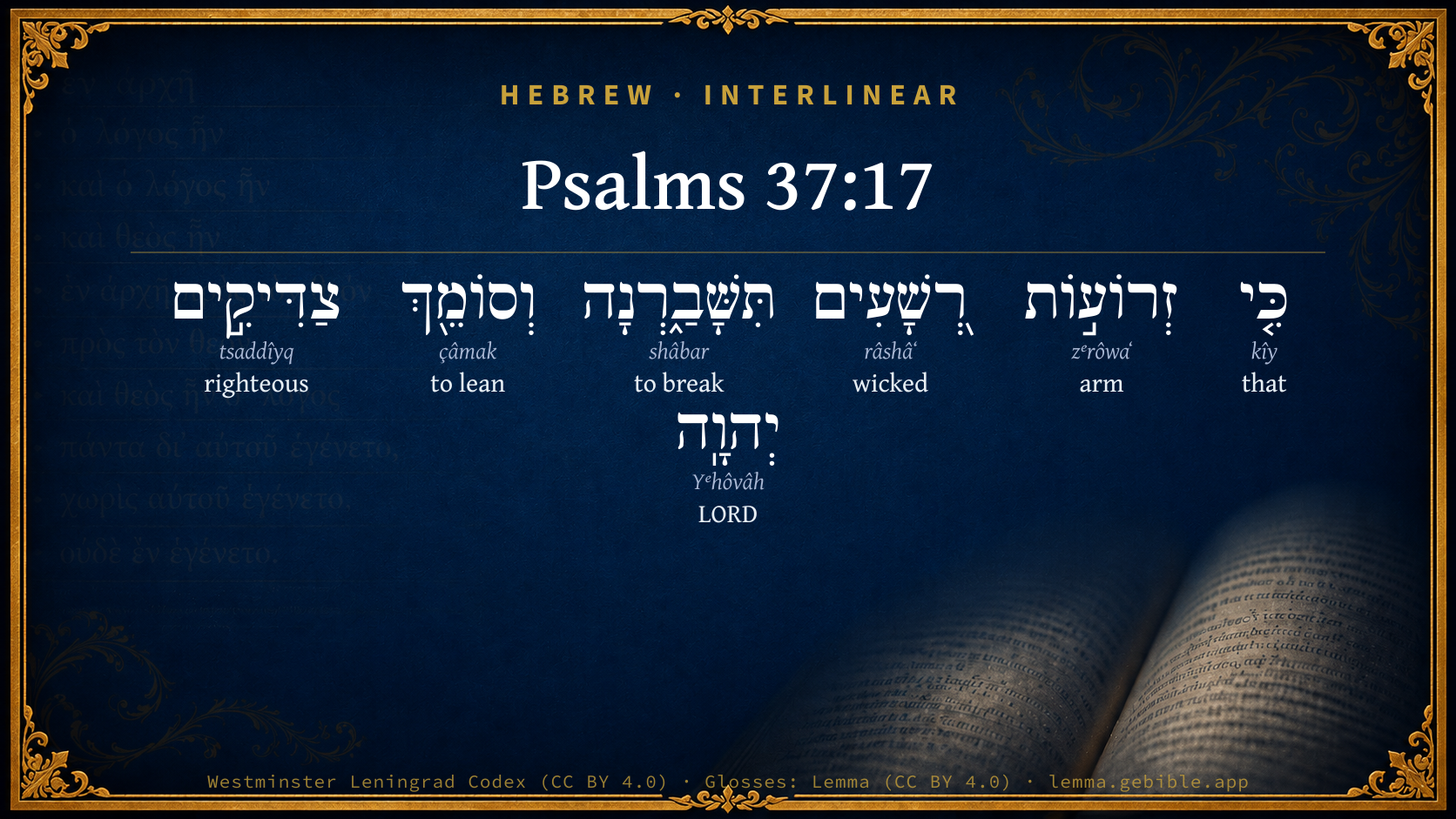
Psalms 37:17

Hebrew (Westminster Leningrad Codex) Psalms 37:17 appears in the Hebrew Old Testament. The text above is from the Westminster Leningrad Codex. Each word links to its Strong’s number, a concise gloss, and parsing drawn from the Open Scriptures Hebrew Bible morphology. Click any word for its full Brown-Driver-Briggs (BDB) entry.
Download image
Cite this verse

Psalms 37:17 (World English Bible). Public Domain. Lemma interlinear Bible study tool, https://lemma.gebible.app/v/psalms/37/17.

Show BibTeX & RIS
BibTeX
RIS
English Translation
For the arms of the wicked shall be broken, But Yahweh upholds the righteous.
World English Bible · Public Domain
Download a study sheet

One document with this verse’s original text, its word-by-word gloss line, the meaning frame, cross-references with their text, attributed commentary, and full source and license credits — printable, and it pastes into notes with its structure intact.

This verse Autodidact and up

Study sheet (.html) Plain text (.txt)

A passage Seminary Student

Up to 50 verses in one chapter. A passage sheet keeps up to 6 commentary sources and 12 cross-references per verse, in the order this page ranks them, and says so on the sheet whenever that leaves anything out. Ask for a single verse and you get the Autodidact verse sheet above.

Everything on this page stays free to read, with no account — the sheet is a download of what is already on screen, not access to it.

Want to remove ads? Support Godless Engineer
Compare translations 3

The same verse in 3 English versions, stacked beneath the original-language interlinear above. Click any original word for its lexicon entry.

Each is an independent rendering of the whole verse — the interlinear is not word-aligned to these translations.

Highlighted words mark where these versions differ — a whole-verse word diff, not a word-by-word alignment.

  • World English Bible Public Domain
    For the arms of the wicked shall be broken, But Yahweh upholds the righteous.
  • King James Version Public Domain
    For the arms of the wicked shall be broken: but the LORD upholdeth the righteous.
  • unfoldingWord Literal Text CC BY-SA 4.0
    For the arms of the wicked will be broken, but Yahweh is supporting the righteous.

unfoldingWord Literal Text — © unfoldingWord, licensed CC BY-SA 4.0. Word-aligned USFM3 via Door43 (git.door43.org/unfoldingWord/en_ult).

Versions to compare (up to 4)

3 of 4 selected

Show all 18 translations

Every available English version of this verse, each an independent rendering of the whole verse.

  • World English Bible Public Domain
    For the arms of the wicked shall be broken, But Yahweh upholds the righteous.
  • Berean Standard Bible Public Domain
    For the arms of the wicked will be broken, but the LORD upholds the righteous.
  • Majority Standard Bible Public Domain
    For the arms of the wicked will be broken, but the LORD upholds the righteous.
  • King James Version Public Domain
    For the arms of the wicked shall be broken: but the LORD upholdeth the righteous.
  • American Standard Version (1901) Public Domain
    For the arms of the wicked shall be broken; But Jehovah upholdeth the righteous.
  • Revised Version (1885) Public Domain
    For the arms of the wicked shall be broken: but the LORD upholdeth the righteous.
  • Geneva Bible (1599) Public Domain
    For the armes of the wicked shall be broken: but the Lord vpholdeth the iust men.
  • Douay-Rheims (1899) Public Domain
    For the arms of the wicked shall be broken in pieces; but the Lord strengtheneth the just.
  • Young's Literal Translation Public Domain
    For the arms of the wicked are shivered, And Jehovah is sustaining the righteous.
  • Literal Standard Version CC BY-SA 4.0
    For the arms of the wicked are shattered, || And YHWH is sustaining the righteous.
  • Unlocked Literal Bible CC BY-SA 4.0
    For the arms of the wicked people will be broken, but Yahweh supports the righteous people.
  • unfoldingWord Literal Text CC BY-SA 4.0
    For the arms of the wicked will be broken, but Yahweh is supporting the righteous.
  • Darby Bible Public Domain
    for the arms of the wicked shall be broken, but Jehovah upholdeth the righteous.
  • World Messianic Bible Public Domain
    For the arms of the wicked shall be broken, but the LORD upholds the righteous.
  • Webster's Bible Public Domain
    For the arms of the wicked shall be broken: but the LORD upholdeth the righteous.
  • Free Bible Version CC BY-SA 4.0
    For the power of the wicked will be broken, but the Lord supports those who do right.
  • Bible in Basic English Public Domain
    For the arms of the evil-doers will be broken: but the Lord is the support of the good.
  • JPS Tanakh (1917) Public Domain
    For the arms of the wicked shall be broken; but the LORD upholdeth the righteous.

Literal Standard Version (2020), Covenant Press — licensed CC BY-SA 4.0. Text via the HelloAO Bible API (eBible.org). Unlocked Literal Bible (unfoldingWord) — licensed CC BY-SA 4.0. Text via the HelloAO Bible API (eBible.org). unfoldingWord Literal Text — © unfoldingWord, licensed CC BY-SA 4.0. Word-aligned USFM3 via Door43 (git.door43.org/unfoldingWord/en_ult). Free Bible Version, Dr. Jonathan Gallagher — licensed CC BY-SA 4.0. Text via the HelloAO Bible API (eBible.org).

Word by word

More ways to search: Search by grammar → Find every occurrence → Compare this word →

Practice this passage: Drill this verse → Learn its vocabulary →

About this verse

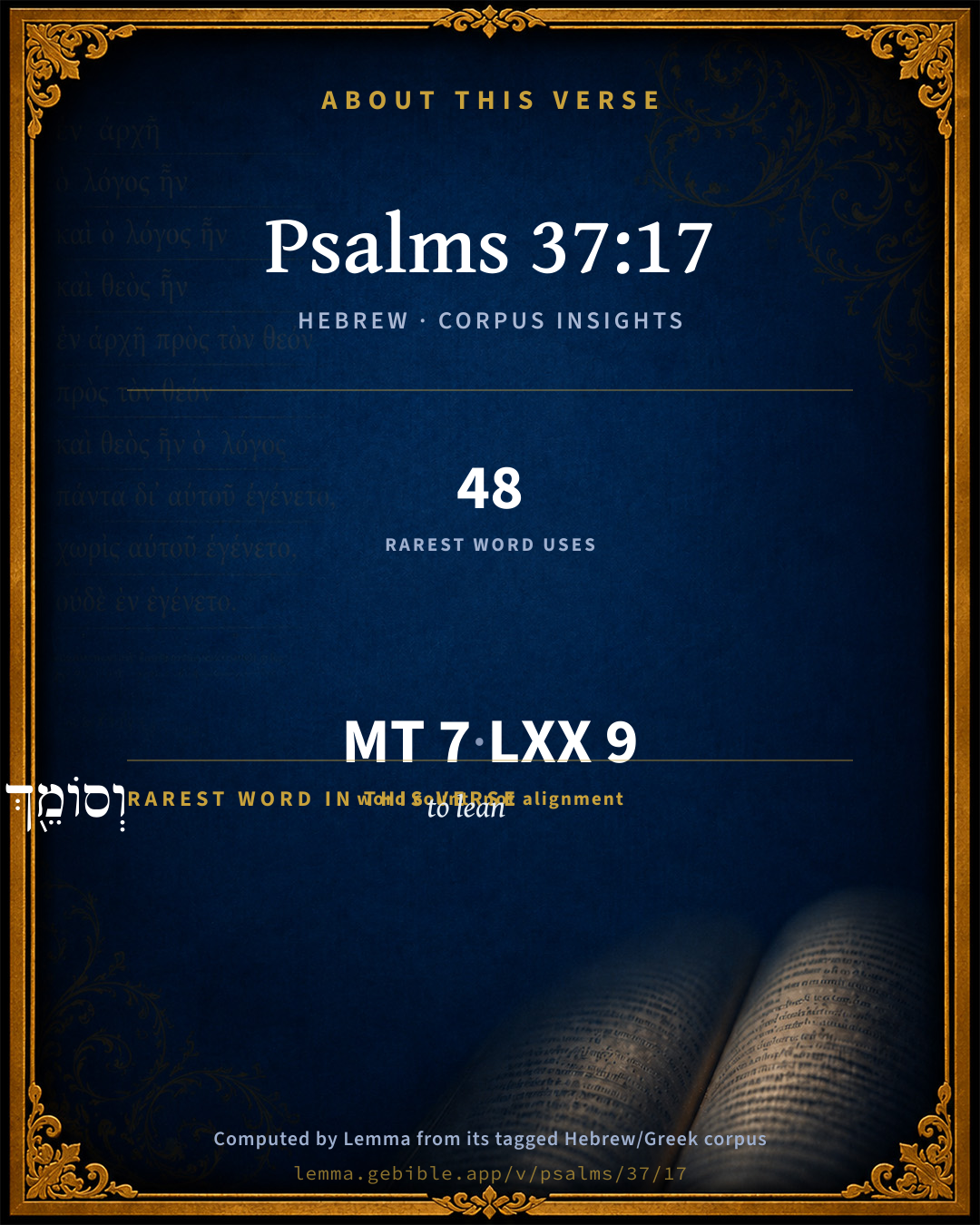
These counts appear in no published source. They are computed here, from the morphology-tagged text and Lemma’s own curated glosses. What Lemma adds →

7
words
7
distinct lemmas
Wisdom
section

Shared distinctive vocabulary

וְסוֹמֵ֖ךְ to lean H5564 occurs in 47 verses of the Hebrew Bible. Also found in:

Grammatical profile

  • 2 verbs
  • 2 nouns
  • 2 adjectives
  • 1 conjunction

Verb forms

  • תִּשָּׁבַ֑רְנָה Niphal · Imperfect
  • וְסוֹמֵ֖ךְ Qal · Participle Active

Hebrew & Septuagint length

In English translation the verse runs 14 words from the Hebrew and 14 from the Septuagint (LXX English) — the same length.

A rough comparison of the two English renderings, which tokenize alike — not a word-level alignment.

Word counts can differ between the Hebrew and the Greek without any difference in meaning — e.g. the Hebrew direct-object marker אֵת has no separate Greek word, and Greek often adds the article ὁ.

In the original languages it is 7 Hebrew tokens and 9 Greek tokens — but the two are counted differently (Hebrew bundles its prefixes and suffixes into one token; the Greek is in lemma form), so that isn’t a like-for-like length.

Cross-references

12

Topical passages linked to Psalms 37:17 in the Treasury of Scripture Knowledge — connected by theme and wording, ordered by reader-vote popularity; previews shown in the World English Bible.

  • Isaiah 41:10 Don't you be afraid, for I am with you; don't be dismayed, for I am your God; I will strengthen you; yes, I will help you; yes, I will uphold you with the right hand of my righteousness.
  • Psalms 63:8 My soul stays close to you. Your right hand holds me up.
  • Psalms 145:14 Yahweh upholds all who fall, And raises up all those who are bowed down.
  • Isaiah 42:1 Behold, my servant, whom I uphold; my chosen, in whom my soul delights: I have put my Spirit on him; he will bring forth justice to the Gentiles.
  • Psalms 37:24 Though he stumble, he shall not fall, For Yahweh holds him up with his hand.
  • Psalms 119:116–117 Uphold me according to your word, that I may live. Let me not be ashamed of my hope.
  • Psalms 51:12 Restore to me the joy of your salvation. Uphold me with a willing spirit.
  • Jude 1:24 Now to him who is able to keep them from stumbling, and to present you faultless before the presence of his glory in great joy,
  • Psalms 10:15 Break the arm of the wicked. As for the evil man, seek out his wickedness until you find none.
  • Job 38:15 From the wicked, their light is withheld, The high arm is broken.
  • Psalms 41:12 As for me, you uphold me in my integrity, And set me in your presence forever.
  • Ezekiel 30:21–25 Son of man, I have broken the arm of Pharaoh king of Egypt; and, behold, it has not been bound up, to apply [healing] medicines, to put a bandage to bind it, that it be strong to hold the sword.

Cross-references courtesy of OpenBible.info (CC BY 4.0).

Hebrew and Greek witnesses Masoretic Hebrew ↔ Greek Septuagint

The same verse in the two great witnesses to the Old Testament, shown verse-for-verse.

You’re reading Greek Psalm 36 (Hebrew Psalm 37). The Septuagint counts the superscription, so verse numbers can differ from the Hebrew — chapter-level alignment, not verse-by-verse. Numbering follows Rahlfs.

These are two independent witnesses, not word-aligned to each other, and the Septuagint is shown in lemma (dictionary) form.

Hebrew Psalms 37:17 Masoretic · Westminster Leningrad Codex

כִּ֤י זְרוֹע֣וֹת רְ֭שָׁעִים תִּשָּׁבַ֑רְנָה וְסוֹמֵ֖ךְ צַדִּיקִ֣ים יְהוָֽה

For the arms of the wicked shall be broken, But Yahweh upholds the righteous.

World English Bible · Public Domain

Greek LXX Greek Psalm 36:17 Septuagint · lemma form

ὅτι βραχίων ἁμαρτωλός συντρίβω ὑποστηρίζω δέ ὁ δίκαιος κύριος

For the arms of sinners shall be broken; but the Lord supports the righteous.

LXX2012 (modern English Septuagint) · Public Domain

Hebrew: Westminster Leningrad Codex (CC BY 4.0). Greek: Septuagint (public domain); English from LXX2012 (modern English Septuagint) (Public Domain). How the Septuagint differs from the Hebrew →

Commentary

Notes on Psalms 37:17 from classic Christian and Jewish commentators (each source and its license shown beneath its notes). The classic Christian expositions comment on the surrounding passage and are grouped to its opening verse, so a note may address several verses; the Jewish commentaries on the Tanakh (Rashi and others) are per-verse, so they appear only where the commentator wrote on this verse.

Lemma curates 59 commentaries, every one of them public domain or Creative Commons licensed, each selected and text-cleaned for this edition rather than reprinted as found. About our sources →

Trapp's Complete Commentary

John Trapp

Psa 37:17 For the arms of the wicked shall be broken: but the LORD upholdeth the righteous.

Ver. 17. For the arms of the wicked shall be broken] i.e. His power, valour, all that wherein they think their strength and help standeth. See Psa 37:15; the strongest sinew in the arm of flesh cracks.

But the Lord upholdeth the righteous] Though seemingly never so weak and wealthless.

John Trapp, A Commentary or Exposition upon All the Books of the Old and New Testament (1647–1656) — public domain. Text from a community e-Sword module.

J. A. Alexander on Psalms

Joseph Addison Alexander

17. (Psa 37:17) For the arms of the wicked shall be broken. The ambiguity of our word arms has othing corresponding to it in the Hebrew, where the only possible sense is that of arms as members of the body. Not only their weapons, but their arms, not only their implements of death, but the strength with which they wielded them, is broken, weakened, rendered useless.—And, or, as our idiom requires an adversative in such connections, but sustaining the righteous, their habitual supporter, (is) Jehovah, the divine name being placed emphatically at the close, a feature copied in the ancient versions, but obliterated in most modern ones.

Joseph Addison Alexander, The Psalms Translated and Explained (1850) — public domain. Text from a community e-Sword module.

Jamieson, Fausset & Brown

Robert Jamieson, A. R. Fausset & David Brown

Even the members of the body needed to hold weapons are destroyed.

Jamieson, Fausset & Brown — Commentary Critical and Explanatory on the Whole Bible (1871) — public domain (CC PDM 1.0). Text via the HelloAO Bible API.

Adam Clarke's Commentary

Verse 17. The arms of the wicked] Their power to do evil. Of this they are often deprived. Talents lent and abused shall be resumed, and the misuser called to a severe account by the Lord of the talents.

Adam Clarke's Commentary on the Bible (1810–1826) — public domain. Text from a community e-Sword/MySword module.

Ellicott's Commentary for English Readers

(17) The arms—i.e., of the body, not the sword and bow mentioned above. In contrast, the arms of Jehovah are under the righteous, and uphold him.

A Bible Commentary for English Readers, edited by Charles John Ellicott (1878–1897) — public domain. Text from a community e-Sword module.

The Cambridge Bible for Schools and Colleges

gen. ed. J. J. S. Perowne

17. For the arms &c.] All the power which they have misused for evil will be rendered impotent. Cp. Psa_10:15; Job_38:15.

upholdeth] When the wicked strives to make him fall (Psa_37:14), and at all times. See Psa_37:24; Psa_37:31. Cp. Psa_3:5; Psa_54:4; Psa_71:6.

The Cambridge Bible for Schools and Colleges (gen. ed. J. J. S. Perowne; Cambridge University Press, 1878–1918) — public domain. Text from a community e-Sword module.

John Gill's Exposition

The Lord knoweth the days of the upright,.... Not only how long they shall live, and so fill up their days, the number of them, as Aben Ezra interprets it; but the nature of their days, whether prosperous or adverse; and causes both to work together for their good; and he knows the work of their days, as Jarchi explains it, the actions done by them in faith and love, and to his honour and glory, and which he approves and accepts of in Christ; see Psa 1:6;

and their inheritance shall be for ever; in heaven, which is an eternal and never fading one, Heb 9:15; and therefore they ought not to fret and be envious.

John Gill's Exposition of the Whole Bible (1746–1763) — public domain (CC PDM 1.0). Text via the HelloAO Bible API.

Albert Barnes' Notes on the Bible

For the arms of the wicked shall be broken - See the notes at Psa 10:15. The “arm” is the instrument by which we accomplish a purpose; and the meaning here is, that that will be broken on which the wicked rely, or, in other words, that their plans will fail, and that they will be disappointed - as a man is rendered helpless whose arms are broken. Compare the notes at Job 38:15.

But the Lord upholdeth the righteous - The Lord will sustain and strengthen him. While the plans of the wicked will be defeated, while they themselves will be overthrown, and fail to accomplish their purposes of wickedness, the Lord will uphold the righteous, and enable them fully to carry out their plans. Their great scheme or purpose of life, the promotion of the glory of God, and the salvation of their own souls, will be fully accomplished - for in that purpose God will be their helper and friend.

Albert Barnes' Notes on the Bible (1834–1885) — public domain. Text from a community e-Sword/MySword module.

Matthew Poole's English Annotations

This is a proof of what he said Psa 37:16. For what the wicked have shall suddenly be lost and gone, but God will maintain the righteous in their happy estate.

Matthew Poole's English Annotations on the Holy Bible (1683–1685) — public domain. Text from a community e-Sword/MySword module.

The Treasury of David

Charles H. Spurgeon

Ver. 17. For the arms of the wicked shall be broken. Their power to do mischief shall be effectually taken away, for the arms which they lifted up against God shall be crushed even to the bone. God often makes implacable men incapable men. What is a more contemptible sight than toothless malice, armless malevolence! But the Lord upholdeth the righteous. Their cause and course shall be safe, for they are in good keeping. The sword of two edges smites the wicked and defends the just.

Ver. 17. For the arms of the wicked shall be broken: but he upholdeth (or underprops) the righteous. By the arms of the wicked, you are to understand their strength, their valour, their power, their wit, their wealth, their abundance, which is all the arms they have to support and bear up themselves in the world with. Now, these arms shall be broken, and when they are broken, then, even then, will God uphold the righteous, that is, God will be a continual overflowing fountain of good to his righteous ones; so that they shall never want, though all the springs of the wicked are dried up round about them. Thomas Brooks.

Ver. 17. (last clause).

1. The favoured persons.

2. Their evident need, "upholding."

3. Their singular blessedness, "upheld, "above trial, under trial, after trial.

4. Their august Patron.

Psalms 37:18*

Charles H. Spurgeon's The Treasury of David (1869–1885) — public domain. Psalms only. Text from a community e-Sword/MySword module.

Whedon's Commentary on the Bible

Daniel D. Whedon

17. Arms of the wicked—Their instruments of power.

Daniel D. Whedon (gen. ed.), Commentary on the Old and New Testaments (1874–1909) — public domain. Text from a community e-Sword module.

The Pulpit Commentary

For the arms of the wicked shall be broken. (scrap. Psa_10:15) The wicked shall be disabled from doing more mischief. If not slain outright, they shall return from the combats that they have provoked with shattered weapons (ver. 15) and damaged persons. But the Lord up-holdeth the righteous. Their adversaries in the encounters.

The Pulpit Commentary (1880–1919), ed. H.D.M. Spence-Jones & Joseph S. Exell — public domain. Text from a community e-Sword module.

Lesson kit

Teaching starters — assembled from the data on this page, not authored interpretation. Every prompt links to the verse data it draws on. Edit before teaching.

Psalms, in the Wisdom, opens this verse with 7 words (7 distinct Hebrew lemmas). Its most distinctive word is çâmak (“to lean”). A historical commentator’s framing appears above. Read the whole chapter for the surrounding context.

Discussion questions

  1. The word çâmak carries the sense “to lean.” How does it shape the verse?
  2. Genesis 27:37 shares the word «to lean» with this verse. How do the two illuminate each other?
  3. The translations on this page render this verse differently — a whole-verse word diff, not a word-by-word alignment. What might account for the different wordings?
  4. The verb «תִּשָּׁבַ֑רְנָה» is Niphal Imperfect. How does its form color the action?
  5. Reading how Trapp's Complete Commentary and J. A. Alexander on Psalms read this verse, where do the two commentators agree and where do they part?

Things to notice

Reading settings

Reading text

Shown beneath each verse's original-language words.

Old Testament
Old Testament edition

Read the OT as the Masoretic Hebrew (MT) or the Greek Septuagint (LXX).

English shown for the Greek Septuagint (in the Hebrew ↔ Greek comparison).

Comparing translations? Open the Compare panel on any verse page to stack up to four side by side.