
1 Samuel 10:14

Hebrew (Westminster Leningrad Codex) 1 Samuel 10:14 appears in the Hebrew Old Testament. The text above is from the Westminster Leningrad Codex. Each word links to its Strong’s number, a concise gloss, and parsing drawn from the Open Scriptures Hebrew Bible morphology. Click any word for its full Brown-Driver-Briggs (BDB) entry.
Download image
Cite this verse

1 Samuel 10:14 (World English Bible). Public Domain. Lemma interlinear Bible study tool, https://lemma.gebible.app/v/1-samuel/10/14.

Show BibTeX & RIS
BibTeX
RIS
English Translation
Saul's uncle said to him and to his servant, Where went you? He said, To seek the donkeys; and when we saw that they were not found, we came to Samuel.
World English Bible · Public Domain
Download a study sheet

One document with this verse’s original text, its word-by-word gloss line, the meaning frame, cross-references with their text, attributed commentary, and full source and license credits — printable, and it pastes into notes with its structure intact.

This verse Autodidact and up

Study sheet (.html) Plain text (.txt)

A passage Seminary Student

Up to 50 verses in one chapter. A passage sheet keeps up to 6 commentary sources and 12 cross-references per verse, in the order this page ranks them, and says so on the sheet whenever that leaves anything out. Ask for a single verse and you get the Autodidact verse sheet above.

Everything on this page stays free to read, with no account — the sheet is a download of what is already on screen, not access to it.

Want to remove ads? Support Godless Engineer
Compare translations 3

The same verse in 3 English versions, stacked beneath the original-language interlinear above. Click any original word for its lexicon entry.

Each is an independent rendering of the whole verse — the interlinear is not word-aligned to these translations.

Highlighted words mark where these versions differ — a whole-verse word diff, not a word-by-word alignment.

  • World English Bible Public Domain
    Saul's uncle said to him and to his servant, Where went you? He said, To seek the donkeys; and when we saw that they were not found, we came to Samuel.
  • King James Version Public Domain
    And Saul's uncle said unto him and to his servant, Whither went ye? And he said, To seek the asses: and when we saw that they were no where, we came to Samuel.
  • unfoldingWord Literal Text CC BY-SA 4.0
    And the uncle of Saul said to him and to his servant, “Where did you go?” And he said, “To seek the female donkeys. And we saw that not, so we came to Samuel.”

unfoldingWord Literal Text — © unfoldingWord, licensed CC BY-SA 4.0. Word-aligned USFM3 via Door43 (git.door43.org/unfoldingWord/en_ult).

Versions to compare (up to 4)

3 of 4 selected

Show all 18 translations

Every available English version of this verse, each an independent rendering of the whole verse.

  • World English Bible Public Domain
    Saul's uncle said to him and to his servant, Where went you? He said, To seek the donkeys; and when we saw that they were not found, we came to Samuel.
  • Berean Standard Bible Public Domain
    Now Saul’s uncle asked him and his servant, “Where did you go?” “To look for the donkeys,” Saul replied. “When we saw they were not to be found, we went to Samuel.”
  • Majority Standard Bible Public Domain
    Now Saul’s uncle asked him and his servant, “Where did you go?” “To look for the donkeys,” Saul replied. “When we saw they were not to be found, we went to Samuel.”
  • King James Version Public Domain
    And Saul's uncle said unto him and to his servant, Whither went ye? And he said, To seek the asses: and when we saw that they were no where, we came to Samuel.
  • American Standard Version (1901) Public Domain
    And Saul's uncle said unto him and to his servant, Whither went ye? And he said, To seek the asses; and when we saw that they were not found, we came to Samuel.
  • Revised Version (1885) Public Domain
    And Saul’s uncle said unto him and to his servant, Whither went ye? And he said, To seek the asses: and when we saw that they were not found, we came to Samuel.
  • Geneva Bible (1599) Public Domain
    And Sauls vncle saide vnto him, and to his seruant, Whither went ye? And he saide, To seeke the asses: and when we sawe that they were no where, we came to Samuel.
  • Douay-Rheims (1899) Public Domain
    And Saul's uncle said to him, and to his servant: Whither went you? They answered: To seek the asses: and not finding them we went to Samuel.
  • Young's Literal Translation Public Domain
    and the uncle of Saul saith unto him, and unto his young man, `Whither went ye?' and he saith, `To seek the asses; and we see that they are not, and we come in unto Samuel.'
  • Literal Standard Version CC BY-SA 4.0
    and the uncle of Saul says to him, and to his young man, “To where did you go?” And he says, “To seek the donkeys; and we see that they are not, and we come to Samuel.”
  • Unlocked Literal Bible CC BY-SA 4.0
    Then Saul's uncle said to him and his servant, “Where did you go?” He replied, “To look for the donkeys. When we saw that we could not find them, we went to Samuel.”
  • unfoldingWord Literal Text CC BY-SA 4.0
    And the uncle of Saul said to him and to his servant, “Where did you go?” And he said, “To seek the female donkeys. And we saw that not, so we came to Samuel.”
  • Darby Bible Public Domain
    And Saul's uncle said to him and to his servant, Whither went ye? And he said, To seek the asses; and when we saw that they were nowhere, we went to Samuel.
  • World Messianic Bible Public Domain
    Saul’s uncle said to him and to his servant, “Where did you go?” He said, “To seek the donkeys. When we saw that they were not found, we came to Samuel.”
  • Webster's Bible Public Domain
    And Saul's uncle said to him and to his servant, Whither went ye? And he said, To seek the asses: and when we saw that they were no where, we came to Samuel.
  • Free Bible Version CC BY-SA 4.0
    Saul's uncle asked Saul and his servant, “Where have you been?” “We were looking for the donkeys,” Saul replied. “When we couldn't find them we went to Samuel.”
  • Bible in Basic English Public Domain
    And Saul's father's brother said to him and his servant, Where have you been? And he said, Searching for the asses: and when we saw no sign of them, we came to Samuel.
  • JPS Tanakh (1917) Public Domain
    And Saul's uncle said unto him and to his servant: 'Whither went ye?' And he said: 'To seek the asses; and when we saw that they were not found, we came to Samuel.'

Literal Standard Version (2020), Covenant Press — licensed CC BY-SA 4.0. Text via the HelloAO Bible API (eBible.org). Unlocked Literal Bible (unfoldingWord) — licensed CC BY-SA 4.0. Text via the HelloAO Bible API (eBible.org). unfoldingWord Literal Text — © unfoldingWord, licensed CC BY-SA 4.0. Word-aligned USFM3 via Door43 (git.door43.org/unfoldingWord/en_ult). Free Bible Version, Dr. Jonathan Gallagher — licensed CC BY-SA 4.0. Text via the HelloAO Bible API (eBible.org).

Word by word

More ways to search: Search by grammar → Find every occurrence → Compare this word →

Practice this passage: Drill this verse → Learn its vocabulary →

הָ֣אֲתֹנ֔וֹת
ʼâthôwn
H860
“the · donkeys”
Particle, Definite Article + Noun, Common, Feminine, Plural, Absolute
Part of Speech
Particle + Noun
Type
Common
Gender
Feminine
Number
Plural
State
Absolute
Full BDB Definition

Origin: probably from the same as H386 (sense of patience)

TWOT: 190a

she-ass, she-donkey
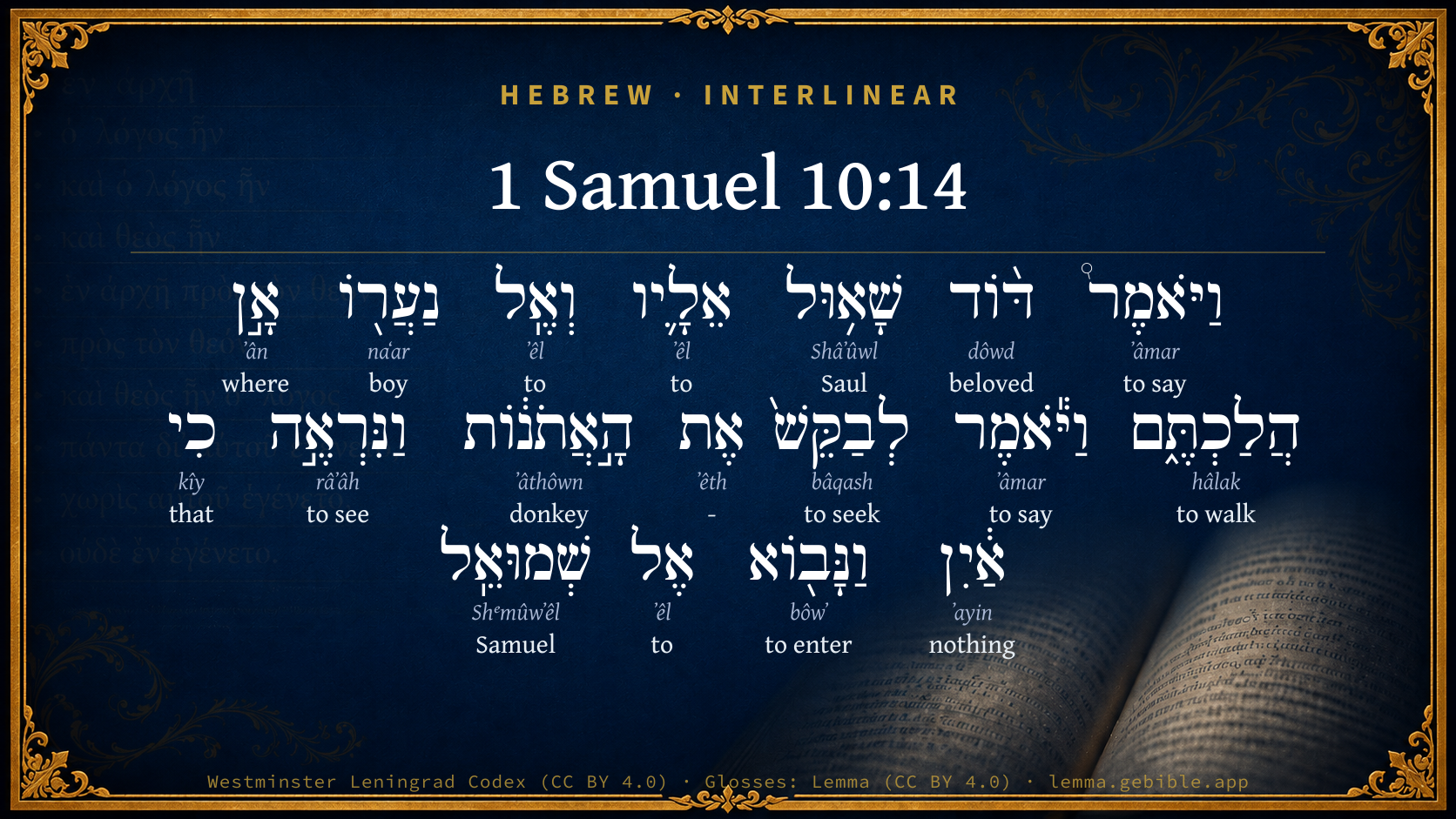
  1. וַיֹּאמֶר֩ ʼâmar H559 “and · to say” Conjunction + Verb, Qal, Sequential Imperfect, 3rd Person, Masculine, Singular
  2. דּ֨וֹד dôwd H1730 “beloved of” Noun, Common, Masculine, Singular, Construct
  3. שָׁא֥וּל Shâʼûwl H7586 “Saul” Noun, Proper
  4. אֵלָ֛יו ʼêl H413 “to · him” Preposition + Suffix, Personal, 3rd Person, Masculine, Singular
  5. וְאֶֽל ʼêl H413 “and · to” Conjunction + Preposition
  6. נַעֲר֖וֹ naʻar H5288 “boy · his” Noun, Common, Masculine, Singular, Construct + Suffix, Personal, 3rd Person, Masculine, Singular
  7. אָ֣ן ʼân H575 “where” Particle, Interrogative
  8. הֲלַכְתֶּ֑ם hâlak H1980 “to walk” Verb, Qal, Perfect, 2nd Person, Masculine, Plural
  9. וַיֹּ֕אמֶר ʼâmar H559 “and · to say” Conjunction + Verb, Qal, Sequential Imperfect, 3rd Person, Masculine, Singular
  10. לְבַקֵּשׁ֙ bâqash H1245 “to seek” Preposition + Verb, Piel, Infinitive Construct
  11. אֶת ʼêth H853 “-” Particle, Direct Object
  12. וַנִּרְאֶ֣ה râʼâh H7200 “and · to see” Conjunction + Verb, Qal, Sequential Imperfect, 1st Person, Common, Plural
  13. כִי kîy H3588 “that” Conjunction
  14. אַ֔יִן ʼayin H369 “nothing” Particle, Negative
  15. וַנָּב֖וֹא bôwʼ H935 “and · to enter” Conjunction + Verb, Qal, Sequential Imperfect, 1st Person, Common, Plural
  16. אֶל ʼêl H413 “to” Preposition
  17. שְׁמוּאֵֽל Shᵉmûwʼêl H8050 “Samuel” Noun, Proper

About this verse

These counts appear in no published source. They are computed here, from the morphology-tagged text and Lemma’s own curated glosses. What Lemma adds →

18
words
15
distinct lemmas
Historical
section

Shared distinctive vocabulary

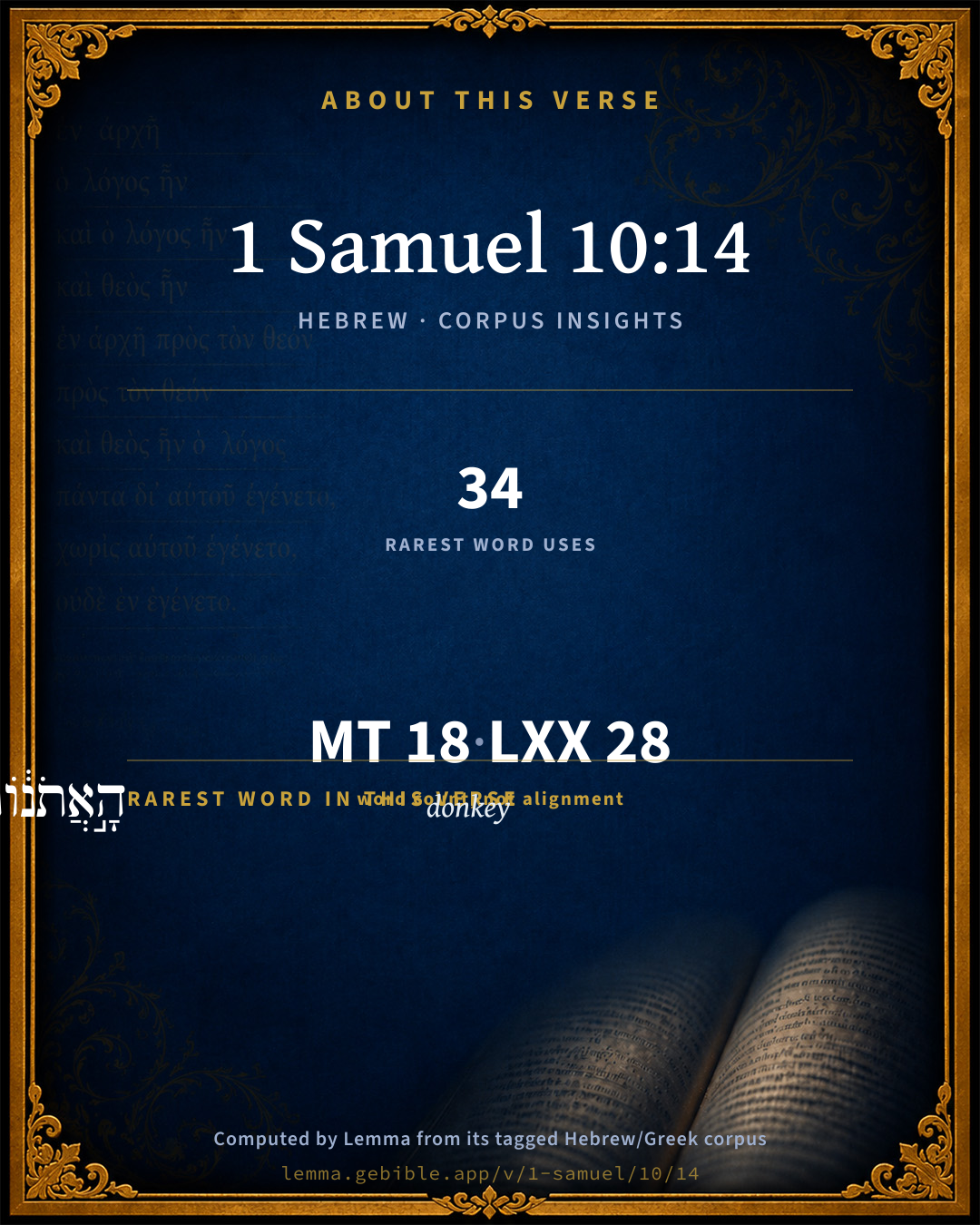
הָ֣אֲתֹנ֔וֹת donkey H860 occurs in 28 verses of the Hebrew Bible. Also found in:

Grammatical profile

  • 6 verbs
  • 5 nouns
  • 3 prepositions
  • 1 conjunction
  • 3 particles

Verb forms

  • וַיֹּאמֶר֩ Qal · Sequential Imperfect
  • הֲלַכְתֶּ֑ם Qal · Perfect
  • וַיֹּ֕אמֶר Qal · Sequential Imperfect
  • לְבַקֵּשׁ֙ Piel · Infinitive Construct
  • וַנִּרְאֶ֣ה Qal · Sequential Imperfect
  • וַנָּב֖וֹא Qal · Sequential Imperfect

Repetition

Words recur within this verse — often emphatic in Hebrew:

  • וַיֹּאמֶר֩ to say H559 ×2
  • אֵלָ֛יו to H413 ×3

Hebrew & Septuagint length

In English translation the verse runs 31 words from the Hebrew and 33 from the Septuagint (LXX English) — closely comparable.

A rough comparison of the two English renderings, which tokenize alike — not a word-level alignment.

Word counts can differ between the Hebrew and the Greek without any difference in meaning — e.g. the Hebrew direct-object marker אֵת has no separate Greek word, and Greek often adds the article ὁ.

In the original languages it is 18 Hebrew tokens and 28 Greek tokens — but the two are counted differently (Hebrew bundles its prefixes and suffixes into one token; the Greek is in lemma form), so that isn’t a like-for-like length.

Cross-references

3

Topical passages linked to 1 Samuel 10:14 in the Treasury of Scripture Knowledge — connected by theme and wording, ordered by reader-vote popularity; previews shown in the World English Bible.

  • 1 Samuel 14:50 and the name of Saul's wife was Ahinoam the daughter of Ahimaaz. The name of the captain of his host was Abner the son of Ner, Saul's uncle.
  • 1 Samuel 9:3–10 The donkeys of Kish, Saul's father, were lost. Kish said to Saul his son, Take now one of the servants with you, and arise, go seek the donkeys.
  • 2 Kings 5:25 But he went in, and stood before his master. Elisha said to him, Whence come you, Gehazi? He said, Your servant went no where.

Cross-references courtesy of OpenBible.info (CC BY 4.0).

Hebrew and Greek witnesses Masoretic Hebrew ↔ Greek Septuagint

The same verse in the two great witnesses to the Old Testament, shown verse-for-verse.

These are two independent witnesses, not word-aligned to each other, and the Septuagint is shown in lemma (dictionary) form.

Hebrew 1 Samuel 10:14 Masoretic · Westminster Leningrad Codex

וַיֹּאמֶר֩ דּ֨וֹד שָׁא֥וּל אֵלָ֛יו וְאֶֽל נַעֲר֖וֹ אָ֣ן הֲלַכְתֶּ֑ם וַיֹּ֕אמֶר לְבַקֵּשׁ֙ אֶת הָ֣אֲתֹנ֔וֹת וַנִּרְאֶ֣ה כִי אַ֔יִן וַנָּב֖וֹא אֶל שְׁמוּאֵֽל

Saul's uncle said to him and to his servant, Where went you? He said, To seek the donkeys; and when we saw that they were not found, we came to Samuel.

World English Bible · Public Domain

Greek LXX 1 Samuel 10:14 Septuagint · lemma form

καί εἶπον ὁ οἰκεῖος αὐτός πρός αὐτός καί πρός ὁ παιδάριον αὐτός ποῦ πορεύομαι καί εἶπον ζητέω ὁ ὄνος καί ὀράω ὅτι οὐ εἰμί καί εἰςἔρχομαι πρός σαμουηλ

And his kinsman said to him and to his servant, Whither went you⌃? and they said, To seek the asses; and we saw that they were lost, and we went in to Samuel.

LXX2012 (modern English Septuagint) · Public Domain

Hebrew: Westminster Leningrad Codex (CC BY 4.0). Greek: Septuagint (public domain); English from LXX2012 (modern English Septuagint) (Public Domain). How the Septuagint differs from the Hebrew →

Targum (Aramaic paraphrase)

1

The Targum is the ancient Jewish Aramaic paraphrase of the Hebrew Scriptures — an interpretive translation, not the Hebrew text itself. Onkelos (literal) and Pseudo-Jonathan (expansive) render the Torah, and Jonathan the Prophets. Coverage is partial: where no permissively-licensed English translation exists for a verse, only the Aramaic is shown. This is verse-level text, not a word-by-word alignment to the Hebrew.

  1. Targum Jonathan Prophets (Joshua–Malachi)
    וַאֲמַר אַח אֲבוּהִי דְשָׁאוּל לֵיהּ וּלְעוּלֵימֵיהּ לְאָן אֲזַלְתּוּן וַאֲמַר לְמִבְעֵי יַת אֲתָנַיָא וַחֲזֵינָא אֲרֵי לָא אַשְׁכַּחְנָא וַאֲתֵינָא לְוַת שְׁמוּאֵל:

    (no public-domain English translation for this verse)

    Targum Jonathan — Aramaic: “Mikraot Gedolot” (public domain). English: “Sefaria Community Translation” (CC0 1.0 (public-domain dedication)); “London "Chaldee Paraphrase," 1871” (public domain). Text via Sefaria.

Commentary

Notes on 1 Samuel 10:14 from classic Christian and Jewish commentators (each source and its license shown beneath its notes). The classic Christian expositions comment on the surrounding passage and are grouped to its opening verse, so a note may address several verses; the Jewish commentaries on the Tanakh (Rashi and others) are per-verse, so they appear only where the commentator wrote on this verse.

Lemma curates 59 commentaries, every one of them public domain or Creative Commons licensed, each selected and text-cleaned for this edition rather than reprinted as found. About our sources →

Trapp's Complete Commentary

John Trapp

1Sa 10:14 And Saul’s uncle said unto him and to his servant, Whither went ye? And he said, To seek the asses: and when we saw that [they were] no where, we came to Samuel.

Ver. 14. And Saul’s uncle.] Ner, the father of Abner, likely, wondering with the rest, was thus inquisitive after the news. We have all a natural itch after novelties.

John Trapp, A Commentary or Exposition upon All the Books of the Old and New Testament (1647–1656) — public domain. Text from a community e-Sword module.

Adam Clarke's Commentary

Verse 14. Saul's uncle] The word דוד dod signifies a beloved one, love, a lover, friend, c. and is the same as David. It is supposed to mean uncle here; but I think it means some familiar friend.

Adam Clarke's Commentary on the Bible (1810–1826) — public domain. Text from a community e-Sword/MySword module.

Ellicott's Commentary for English Readers

(14) Saul’s uncle.—Most probably, this uncle was the subsequently famous Abner—so Ewald, Josephus, and others. Kish, the father of Saul, a quiet, plain man, evidently was quite content that his beasts were found, and that his son had returned in safety and so asks no curious questions about his son’s journey. Not so Abner, who was a restless, ambitious man, and who, very probably, had heard something already from the servant who accompanied Saul (traditionally supposed to have been Doeg) of the strange honours paid to his nephew by the great and revered judge of Israel, the famous Samuel, and also of the long private interview between them. Abner, the uncle of the future king, an observant man, might well have been struck with the change that had passed over his nephew since he had last seen him; hence his question, “Tell me what Samuel said unto you?”

A Bible Commentary for English Readers, edited by Charles John Ellicott (1878–1897) — public domain. Text from a community e-Sword module.

The Cambridge Bible for Schools and Colleges

gen. ed. J. J. S. Perowne

14. Saul’s uncle] Possibly Ner. See note on 1Sa_14:50. He may have been at the high-place for some public solemnity, at which the prophets also had been present; or the conversation may have occurred on a subsequent occasion.

The Cambridge Bible for Schools and Colleges (gen. ed. J. J. S. Perowne; Cambridge University Press, 1878–1918) — public domain. Text from a community e-Sword module.

John Gill's Exposition

And Saul's uncle said unto him, and to his servant, whither went ye?.... Since they had been absent so long a time. This was his father's brother, as the Targum, and so Aquila; whose name was Ner, the father of Abner, Sa1 14:50 who met with him at the high place, or found him in the city, in his father's house it may be. Josephus (g) says, Saul went into the house of his kinsman Abner, whom he loved above all his relations, and that it was he that discoursed with Saul, and asked him, the questions before and after related:

and he said, to seek the asses: he first observes the end of their going, the business they went upon, in which not succeeding, then he answers more directly to the question:

and when we saw that they were nowhere; could not see them, nor find them any where, or hear of them where they went:

we came to Samuel; at Ramah, to inquire of him, if he could direct us which way to go, and what methods to take, to find the asses.

(g) Ut supra, (Antiqu. l. 6. c. 4.) sect. 3.

John Gill's Exposition of the Whole Bible (1746–1763) — public domain (CC PDM 1.0). Text via the HelloAO Bible API.

Albert Barnes' Notes on the Bible

From the order of the narrative, and the mention of Saul’s servant, it looks as if Saul found his uncle at the high place. Perhaps some solemnity similar to that mentioned in 1Sa 9:19 was going on at this time, in which the prophets had been taking part.

Albert Barnes' Notes on the Bible (1834–1885) — public domain. Text from a community e-Sword/MySword module.

Matthew Poole's English Annotations

Saul’s uncle, being there present, and observing this great alteration in his nephew.

Matthew Poole's English Annotations on the Holy Bible (1683–1685) — public domain. Text from a community e-Sword/MySword module.

Whedon's Commentary on the Bible

Daniel D. Whedon

14. Saul’s uncle — Perhaps Abner, who was afterwards captain of Saul’s host. 1Sa_14:50. But the word דוד, here translated uncle, frequently means a beloved friend, and may here refer to some familiar friend of Saul who was not a relative. The earnestness with which he asks what Samuel had said to Saul is another intimation that Saul’s relatives and friends were interested in his case, and had possibly proposed him as a proper person for king. Compare note on 1Sa_9:20.

Daniel D. Whedon (gen. ed.), Commentary on the Old and New Testaments (1874–1909) — public domain. Text from a community e-Sword module.

The Pulpit Commentary

Vers. 14-16. Saul"s uncle. According to 1Sa_14:50, 1Sa_14:51; 1Ch_8:33, this would be Abner. The conversation probably took place after Saul had returned from the Bamah and gone to his own home, for in so brief a summary much necessarily is omitted. It is curious that the conversation should have taken place with the uncle, and not with the father; but possibly the latter was too well pleased to have his son back again to be very particular in his inquiries. Not so Abner. He was evidently excited by his nephew s visit to the prophet, and struck perhaps by the change in Saul himself, and would gladly have heard more. But Saul does not gratify his curiosity. Of the matter of the kingdom he told him not. It was not merely prudent, but right to keep the matter secret. An able man like Abner would probably have begun to scheme for so great an end. Saul s silence left the fulfilment of the prophet"s words entirely to God.

Vers. 14-16. (GIBEAH.)

Inquisitiveness.

Inquiry after truth is a necessary and invaluable exercise. But inquiry, when it is directed to matters in which we have no proper concern, degenerates into vain curiosity, or mere inquisitiveness. And this often appears both in relation to Divine affairs (Gen_3:6; Deu_29:29; 1Sa_6:19; Luk_13:23; and Act_1:6) human affairs. (Joh_21:21) Of the latter we have here an illustration. Saul, having reached his home, was asked by his uncle concerning his journey and interview with Samuel. "Whither went ye?" "Tell me, I pray thee, what Samuel said to you." This man was doubtless acquainted with the popular agitation about a king, but what his precise motives were we are not told. Such inquisitiveness as he displayed

I MANIFESTS A WRONG DISPOSITION.

1. An unrestrained desire of knowledge. There must be self-restraint in thisdesire, as in every other; else it leads to recklessness, irreverence, and pride.

2. An unjust disregard of the rights of others. The claims of familyrelationship are sometimes exaggerated so as to ignore or interfere with those rights. It is imagined that they justify the expectation of an answer to any inquiry, however little it affects the inquirer.

3. Uncharitable and suspicious thoughts about the conduct of others,expressed in impertinent and annoying questions, which naturally cause resentment and discord. It may be added, that persons who are "busybodies in other men"s matters" (1Pe_4:15) are seldom so diligent and faithful in their own as they ought to be. The proper province of every man affords plenty of scope for his attention and effort. (1Ti_5:13)

II REQUIRES TO BE PROMPTLY CHECKED.

1. Out of due regard to higher claims. What Samuel said to Saul was intended for him alone, and to divulge it would be a breach of duty.

1. Lest the information given should be used to the disadvantage of him who gives it. Who knows how Saul"s uncle would have employed the knowledge of his having been appointed king by the prophet? He might

2. have done irreparable mischief. Many excellent projects have been frustrated by an untimely disclosure of them.

3. For the good of the inquirer himself. The gratification of his curiosity tends to increase his inquisitiveness, the mortification thereof to its cure. It was for the benefit of the Apostle Peter that the Lord said, "What is that to thee? Follow thou me.

III SHOULD BE CHECKED IN A RIGHT MANNER. Judiciously, discreetly, and, more particularly

1. With strict truthfulness. "He told us plainly that the asses were found" (ver. 16). Saul spoke the truth, but not the whole truth; nor was he in the circumstances described under any obligation to do so. "A fool uttereth all his mind; but a wise man keepeth it till afterwards". (Pro_29:11)

2. With due courtesy. By a blunt refusal and rude repulsion Saul might have alienated his uncle, and turned him into an enemy. "Honour all men." "Be courteous.

3. With few words or resolute silence. "But of the matter of the kingdom whereof Samuel spake he told him not." There is a "time to keep silence". (Ecc_3:7; Amo_5:13) "Then he (Herod) questioned him with many words; but he answered him nothing". (Luk_23:9) Our Lord himself is thus an example of silence to us when addressed with questions which it would not be prudent or beneficial to answer. "Silence is golden.

Conclusion.

1. Check the tendency to curiosity in yourselves, so that it may not be checked, disappointed, and reproved by others.

2. In checking it in others seek their improvement rather than your owndignity and honour. D.

The Pulpit Commentary (1880–1919), ed. H.D.M. Spence-Jones & Joseph S. Exell — public domain. Text from a community e-Sword module.

Kretzmann's Popular Commentary

Paul E. Kretzmann

Saul Chosen King by Lot

v. 14. And Saul’s uncle said unto him and to his servant, upon their return home, Whither went ye? And he said, To seek the asses; and when we saw that they were no where, we came to Samuel.

v. 15. And Saul’s uncle said, Tell me, I pray thee, what Samuel said unto you, he was anxious to have a detailed account of the visit.

v. 16. And Saul said unto his uncle, He told us plainly that the asses were found, hoping therewith to dispose of this matter. But of the matter of the kingdom, whereof Samuel spake, he told him not, for it was evident from Samuel’s entire manner that the matter was not yet to be made public.

v. 17. And Samuel called the people together unto the Lord to Mizpeh, for a great popular assembly;

v. 18. and said unto the children of Israel, Thus saith the Lord God of Israel, I brought up Israel out of Egypt and delivered you out of the hand of the Egyptians and out of the hand of all kingdoms and of them that oppressed you, these were the mighty deeds performed by God under the old order, when He was still the only acknowledged King of the nation;

v. 19. and ye have this day rejected your God, who Himself saved you out of all your adversities and your tribulations, all the evils and oppressions which they suffered from the very kingdoms after which they now intended to pattern their state; and ye have said unto Him, Nay, but set a king over us. This was a last warning regarding a step the taking of which they might some day bitterly repent. Now, therefore, present yourselves before the Lord by your tribes and by your thousands, the divisions of the people by the command of the Lord, Num 1:16. This solemn act took place in the presence of Jehovah, before the altar which had been erected in Mizpeh.

v. 20. And when Samuel had caused all the tribes of Israel to come near, in order that lots might be cast or drawn, the tribe of Benjamin was taken.

v. 21. When he had caused the tribe of Benjamin to come nearby their families, the largest subdivision of the tribe, the family of Matri was taken, and, after the father-houses had been treated the same way and the individual heads of families came forward, Saul, the son of Kish, was taken; and when they sought him, he could not be found, his shyness having caused him to hide himself, since he knew the outcome of the selection.

v. 22. Therefore they enquired of the Lord further, through the Urim and Thummim of the high priest, if the man should yet come thither, whether they should search for Saul at home or elsewhere. And the Lord answered, Behold, he hath hid himself among the stuff, the traveling baggage of the great assembly.

v. 23. And they ran and fetched him thence; and when he stood among the people, having been obliged to overcome his diffidence, he was higher than any of the people from his shoulders and upward, he extended above them, head and shoulders, a magnificent specimen of physical manhood, truly kingly in appearance.

v. 24. And Samuel said to all the people, See ye him whom the Lord hath chosen, the election being the confirmation of the previous divine choice, that there is none like him among all the people? And all the people shouted, in a cry of salutation and homage, God save the king! literally, "May the king live!"

v. 25. Then Samuel told the people the manner of the kingdom, the relation of the temporal monarchy to the theocracy, the rule of God, for it was Jehovah’s purpose to rule through Saul as His instrument, Cf Deu 17:14-20, and wrote it in a book, and laid it up before the Lord, to be preserved for future generations, the Lord Himself being a witness of the act. And Samuel sent all the people away, every man to his house.

v. 26. And Saul also went home to Gibeah; and there went with him a band of men whose hearts God had touched, of their own free will they constituted themselves his body-guard, his escort of honor. They represented the majority of the people, who were willing to bow under the authority of the man whom God had chosen as their leader.

v. 27. But the children of Belial, the worthless, vain rabble, said, How shall this man save us? They questioned his fitness for the office and declared their unwillingness to submit to his authority. And they despised him and brought him no presents, gifts which were a part of the regular income of the princes. But he held his peace, literally, "he was as a deaf man," paying no attention to these foolish attacks, and thus showing great foresight and prudence. To this day men in the public office of the Church are subjected to mocking attacks by vain and foolish people. The best way of meeting such a situation is by ignoring attacks of this kind; for the truly faithful, men whose hearts God has. touched, will be on the side of right and justice.

Paul E. Kretzmann, Popular Commentary of the Bible (1921–1924) — public domain. Text from a community e-Sword module.

unfoldingWord translationNotes

Door43 World Missions Community

Then Saul's uncle said to him

"Then the brother of Saul's father said to Saul"

he did not tell him about the matter of the kingdom

"Saul did not tell his uncle that God had appointed him to be the king of Israel"

translationWords

servant

donkey

kingdom

unfoldingWord translationNotes — © Distant Shores Media and the Door43 World Missions Community, licensed CC BY-SA 4.0. Source: git.door43.org/Door43/en_tn.

Lesson kit

Teaching starters — assembled from the data on this page, not authored interpretation. Every prompt links to the verse data it draws on. Edit before teaching.

1 Samuel, in the Historical, opens this verse with 18 words (15 distinct Hebrew lemmas). Its most distinctive word is ʼâthôwn (“donkey”). A historical commentator’s framing appears above. Read the whole chapter for the surrounding context.

Discussion questions

  1. What does “donkey” (ʼâthôwn) contribute to the verse as a whole?
  2. Genesis 12:16 shares the word «donkey» with this verse. How do the two illuminate each other?
  3. “to say” occurs 2× in this one verse. What is the effect of the repetition?
  4. These translations render this verse differently. What is at stake in choosing one wording over another?
  5. The verb «וַיֹּאמֶר֩» is Qal Sequential Imperfect. How does its form color the action?
  6. Reading how Trapp's Complete Commentary and Adam Clarke's Commentary read this verse, where do the two commentators agree and where do they part?

Things to notice

Reading settings

Reading text

Shown beneath each verse's original-language words.

Old Testament
Old Testament edition

Read the OT as the Masoretic Hebrew (MT) or the Greek Septuagint (LXX).

English shown for the Greek Septuagint (in the Hebrew ↔ Greek comparison).

Comparing translations? Open the Compare panel on any verse page to stack up to four side by side.