
Psalms 41:11

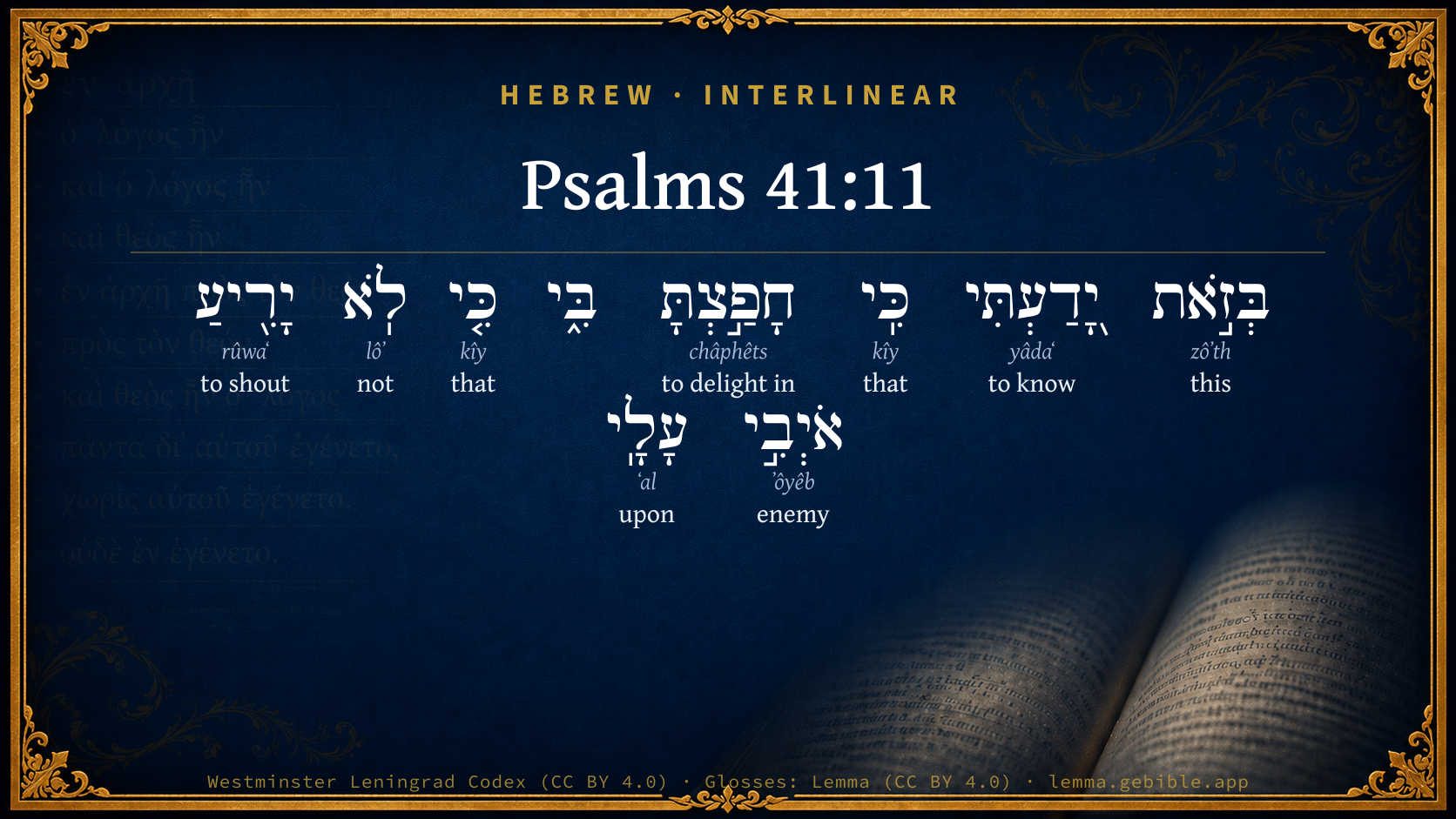
Hebrew (Westminster Leningrad Codex) Psalms 41:11 appears in the Hebrew Old Testament. The text above is from the Westminster Leningrad Codex. Each word links to its Strong’s number, a concise gloss, and parsing drawn from the Open Scriptures Hebrew Bible morphology. Click any word for its full Brown-Driver-Briggs (BDB) entry.
Download image
Cite this verse

Psalms 41:11 (World English Bible). Public Domain. Lemma interlinear Bible study tool, https://lemma.gebible.app/v/psalms/41/11.

Show BibTeX & RIS
BibTeX
RIS
English Translation
By this I know that you delight in me, Because my enemy doesn't triumph over me.
World English Bible · Public Domain
Download a study sheet

One document with this verse’s original text, its word-by-word gloss line, the meaning frame, cross-references with their text, attributed commentary, and full source and license credits — printable, and it pastes into notes with its structure intact.

This verse Autodidact and up

Study sheet (.html) Plain text (.txt)

A passage Seminary Student

Up to 50 verses in one chapter. A passage sheet keeps up to 6 commentary sources and 12 cross-references per verse, in the order this page ranks them, and says so on the sheet whenever that leaves anything out. Ask for a single verse and you get the Autodidact verse sheet above.

Everything on this page stays free to read, with no account — the sheet is a download of what is already on screen, not access to it.

Want to remove ads? Support Godless Engineer
Compare translations 3

The same verse in 3 English versions, stacked beneath the original-language interlinear above. Click any original word for its lexicon entry.

Each is an independent rendering of the whole verse — the interlinear is not word-aligned to these translations.

Highlighted words mark where these versions differ — a whole-verse word diff, not a word-by-word alignment.

  • World English Bible Public Domain
    By this I know that you delight in me, Because my enemy doesn't triumph over me.
  • King James Version Public Domain
    By this I know that thou favourest me, because mine enemy doth not triumph over me.
  • unfoldingWord Literal Text CC BY-SA 4.0
    By this I know that you delight in me, that my enemy does not shout over me.

unfoldingWord Literal Text — © unfoldingWord, licensed CC BY-SA 4.0. Word-aligned USFM3 via Door43 (git.door43.org/unfoldingWord/en_ult).

Versions to compare (up to 4)

3 of 4 selected

Show all 18 translations

Every available English version of this verse, each an independent rendering of the whole verse.

  • World English Bible Public Domain
    By this I know that you delight in me, Because my enemy doesn't triumph over me.
  • Berean Standard Bible Public Domain
    By this I know that You delight in me, for my enemy does not triumph over me.
  • Majority Standard Bible Public Domain
    By this I know that You delight in me, for my enemy does not triumph over me.
  • King James Version Public Domain
    By this I know that thou favourest me, because mine enemy doth not triumph over me.
  • American Standard Version (1901) Public Domain
    By this I know that thou delightest in me, Because mine enemy doth not triumph over me.
  • Revised Version (1885) Public Domain
    By this I know that thou delightest in me, because mine enemy doth not triumph over me.
  • Geneva Bible (1599) Public Domain
    By this I know that thou fauourest me, because mine enemie doth not triumph against me.
  • Douay-Rheims (1899) Public Domain
    But thou, O Lord, have mercy on me, and raise me up again: and I will requite them.
  • Young's Literal Translation Public Domain
    By this I have known, That Thou hast delighted in me, Because my enemy shouteth not over me.
  • Literal Standard Version CC BY-SA 4.0
    By this I have known, || That You have delighted in me, || Because my enemy does not shout over me.
  • Unlocked Literal Bible CC BY-SA 4.0
    By this I know that you delight in me, for my enemy does not triumph over me.
  • unfoldingWord Literal Text CC BY-SA 4.0
    By this I know that you delight in me, that my enemy does not shout over me.
  • Darby Bible Public Domain
    By this I know that thou delightest in me, because mine enemy doth not triumph over me.
  • World Messianic Bible Public Domain
    By this I know that you delight in me, because my enemy doesn’t triumph over me.
  • Webster's Bible Public Domain
    \\41:10\\But thou, O LORD, be merciful to me, and raise me up, that I may requite them.
  • Free Bible Version CC BY-SA 4.0
    I know you are pleased with me because you have not let my enemies win and shout in triumph over me.
  • Bible in Basic English Public Domain
    By this I see that you have pleasure in me, because my hater does not overcome me.
  • JPS Tanakh (1917) Public Domain
    (41-12) By this I know that Thou delightest in me, that mine enemy doth not triumph over me.

Literal Standard Version (2020), Covenant Press — licensed CC BY-SA 4.0. Text via the HelloAO Bible API (eBible.org). Unlocked Literal Bible (unfoldingWord) — licensed CC BY-SA 4.0. Text via the HelloAO Bible API (eBible.org). unfoldingWord Literal Text — © unfoldingWord, licensed CC BY-SA 4.0. Word-aligned USFM3 via Door43 (git.door43.org/unfoldingWord/en_ult). Free Bible Version, Dr. Jonathan Gallagher — licensed CC BY-SA 4.0. Text via the HelloAO Bible API (eBible.org).

Word by word

More ways to search: Search by grammar → Find every occurrence → Compare this word →

Practice this passage: Drill this verse → Learn its vocabulary →

יָרִ֖יעַ
rûwaʻ
H7321
“to shout”
Verb, Hiphil, Imperfect, 3rd Person, Masculine, Singular
Part of Speech
Verb
Stem
Hiphil
Form
Imperfect
Person
3rd Person
Gender
Masculine
Number
Singular
Full BDB Definition

Origin: a primitive root

TWOT: 2135

to shout, raise a sound, cry out, give a blast - (Hiphil) - to shout a war-cry or alarm of battle - to sound a signal for war or march - to shout in triumph (over enemies) - to shout in applause - to shout (with religious impulse) - to cry out in distress - (Polal) to utter a shout - (Hithpolel) - to shout in triumph - to shout for joy - (Niphal) destroyed
  1. בְּזֹ֣את zôʼth H2063 “in/at · this” Preposition + Pronoun, Demonstrative, Feminine, Singular
  2. יָ֭דַעְתִּי yâdaʻ H3045 “to know” Verb, Qal, Perfect, 1st Person, Common, Singular
  3. כִּֽי kîy H3588 “that” Conjunction
  4. חָפַ֣צְתָּ châphêts H2654 “to delight in” Verb, Qal, Perfect, 2nd Person, Masculine, Singular
  5. כִּ֤י kîy H3588 “that” Conjunction
  6. לֹֽא lôʼ H3808 “not” Particle, Negative
  7. אֹיְבִ֣י ʼôyêb H341 “enemy · me” Verb, Qal, Participle Active, Masculine, Singular, Construct + Suffix, Personal, 1st Person, Common, Singular
  8. עָלָֽי ʻal H5921 “upon · me” Preposition + Suffix, Personal, 1st Person, Common, Singular

About this verse

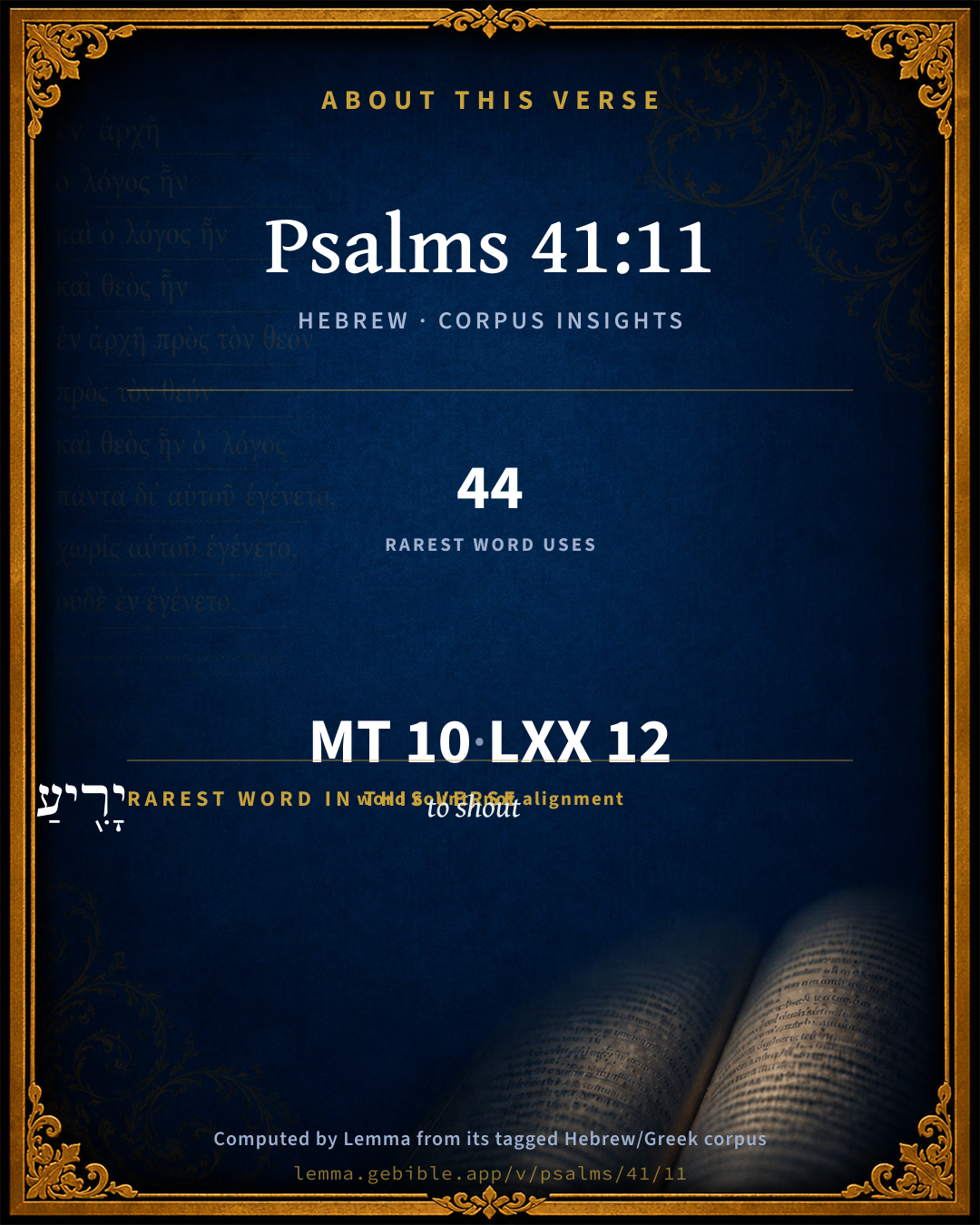
These counts appear in no published source. They are computed here, from the morphology-tagged text and Lemma’s own curated glosses. What Lemma adds →

10
words
8
distinct lemmas
Wisdom
section

Shared distinctive vocabulary

יָרִ֖יעַ to shout H7321 occurs in 40 verses of the Hebrew Bible. Also found in:

Grammatical profile

  • 4 verbs
  • 1 pronoun
  • 2 prepositions
  • 2 conjunctions
  • 1 particle

Verb forms

  • יָ֭דַעְתִּי Qal · Perfect
  • חָפַ֣צְתָּ Qal · Perfect
  • יָרִ֖יעַ Hiphil · Imperfect
  • אֹיְבִ֣י Qal · Participle Active

Repetition

A word recurs within this verse — often emphatic in Hebrew:

  • כִּֽי that H3588 ×2

Hebrew & Septuagint length

In English translation the verse runs 16 words from the Hebrew and 18 from the Septuagint (LXX English) — closely comparable.

A rough comparison of the two English renderings, which tokenize alike — not a word-level alignment.

Word counts can differ between the Hebrew and the Greek without any difference in meaning — e.g. the Hebrew direct-object marker אֵת has no separate Greek word, and Greek often adds the article ὁ.

In the original languages it is 10 Hebrew tokens and 12 Greek tokens — but the two are counted differently (Hebrew bundles its prefixes and suffixes into one token; the Greek is in lemma form), so that isn’t a like-for-like length.

Cross-references

9

Topical passages linked to Psalms 41:11 in the Treasury of Scripture Knowledge — connected by theme and wording, ordered by reader-vote popularity; previews shown in the World English Bible.

  • Colossians 2:15 having stripped the principalities and the powers, he made a show of them openly, triumphing over them in it.
  • Psalms 124:6 Blessed be Yahweh, Who has not given us as a prey to their teeth.
  • Psalms 25:2 My God, I have trusted in you, Don't let me be shamed. Don't let my enemies triumph over me.
  • Psalms 147:11 Yahweh takes pleasure in those who fear him, In those who hope in his loving kindness.
  • Jeremiah 20:13 Sing to Yahweh, praise you Yahweh; for he has delivered the soul of the needy from the hand of evil-doers.
  • Psalms 31:8 You have not shut me up into the hand of the enemy. You have set my feet in a large place.
  • Psalms 86:17 Show me a sign of your goodness, That those who hate me may see it, and be shamed, Because you, Yahweh, have helped me, and comforted me.
  • Psalms 13:4 Lest my enemy say, "I have prevailed against him;" Lest my adversaries rejoice when I fall.
  • Psalms 35:25 Don't let them say in their heart, "Aha! That's the way we want it!" Don't let them say, "We have swallowed him up!"

Cross-references courtesy of OpenBible.info (CC BY 4.0).

Hebrew and Greek witnesses Masoretic Hebrew ↔ Greek Septuagint

The same verse in the two great witnesses to the Old Testament, shown verse-for-verse.

You’re reading Greek Psalm 40 (Hebrew Psalm 41). The Septuagint counts the superscription, so verse numbers can differ from the Hebrew — chapter-level alignment, not verse-by-verse. Numbering follows Rahlfs.

These are two independent witnesses, not word-aligned to each other, and the Septuagint is shown in lemma (dictionary) form.

Hebrew Psalms 41:11 Masoretic · Westminster Leningrad Codex

בְּזֹ֣את יָ֭דַעְתִּי כִּֽי חָפַ֣צְתָּ בִּ֑י כִּ֤י לֹֽא יָרִ֖יעַ אֹיְבִ֣י עָלָֽי

By this I know that you delight in me, Because my enemy doesn't triumph over me.

World English Bible · Public Domain

Greek LXX Greek Psalm 40:11 Septuagint · lemma form

σύ δέ κύριος ἐλεέω ἐγώ καί ἀναἵστημι ἐγώ καί ἀντι ἀποδίδωμι αὐτός

By this I know that you have delighted in me, because my enemy shall not rejoice over me.

LXX2012 (modern English Septuagint) · Public Domain

Hebrew: Westminster Leningrad Codex (CC BY 4.0). Greek: Septuagint (public domain); English from LXX2012 (modern English Septuagint) (Public Domain). How the Septuagint differs from the Hebrew →

Commentary

Notes on Psalms 41:11 from classic Christian and Jewish commentators (each source and its license shown beneath its notes). The classic Christian expositions comment on the surrounding passage and are grouped to its opening verse, so a note may address several verses; the Jewish commentaries on the Tanakh (Rashi and others) are per-verse, so they appear only where the commentator wrote on this verse.

Lemma curates 59 commentaries, every one of them public domain or Creative Commons licensed, each selected and text-cleaned for this edition rather than reprinted as found. About our sources →

Trapp's Complete Commentary

John Trapp

Psa 41:11 By this I know that thou favourest me, because mine enemy doth not triumph over me.

Ver. 11. By this I know that thou favourest me] This is the triumph of trust and the fruit of faithful prayer; ever answered, sometimes before it is uttered, sometimes in, and sometimes alter the act; but we may be sure of an unmiscarrying return if we pray and not faint, Luk 18:1, even such as shall bring us word that God favoureth our persons.

John Trapp, A Commentary or Exposition upon All the Books of the Old and New Testament (1647–1656) — public domain. Text from a community e-Sword module.

The Biblical Illustrator

Joseph S. Exell

Psa_41:11-13

By this I know that Thou favourest me, because mine enemy doth not triumph over me.

Present favour and boundless hope

The last words of the psalm are sunny with the assurance of present favour and with boundless hope. The man is still lying on his sick-bed, ringed by whispering foes. There is no change without, but this change has passed: that he has tightened his hold of God, and therefore can feel that his enemies whispers will never rise or swell into a shout of victory over him. He can speak of the future deliverance as if present; and lie can look ahead over an indefinite stretch of sunlit country, scarcely knowing whether the furthest point is earth or no. His integrity is not sinless, nor does lie plead it as a reason for Jehovahs upholding, but hopes for it as the consequence of His sustaining hand. He knows that he will have close approach to Jehovah; and though, no doubt, for ever on his lips meant less than it does on ours, his assurance of continuous communion with God reached, if not to actual, clear consciousness of immortality, at all events to assurance of a future so indefinitely extended, and so brightened by the sunlight of Gods face, that it wanted but little additional extension or brightening to be the full assurance of life immortal. (A. Maclaren, D. D.)

Psa_42:1-11

The Biblical Illustrator, edited by Joseph S. Exell (c. 1880s–1900s) — public domain. Text from a community e-Sword module.

Joseph Benson's Commentary

Psa 41:11-12. By this I know that thou favourest me — Bearest a good will to me, and art resolved to make good thy promises to me, and wilt plead my righteous cause; because mine enemy doth not triumph over me — Because hitherto thou hast supported me, and prolonged my days to the disappointment of his hopes, and designed triumphs. This mercy I thankfully receive as a token of further mercy. Thou upholdest me in mine integrity — As, through thy grace, I have kept my integrity, so thou hast kept me in and with it. Or, thou upholdest me for my integrity; that is, because thou hast seen my innocence, notwithstanding all the calumnies of mine enemies; and settest me before thy face for ever — Hebrew, ותציבני, vetatzibeeni, wilt set, confirm, or establish me in thy presence, under thine eye and special care; to minister unto thee, as a king over thy people. And in regard of his posterity, the kingdom was established for ever. Let us learn from hence, if at any time we suffer in our reputation, to make it our chief care to preserve our integrity, and then cheerfully to leave it to God to secure our reputation. We must remember, however, that we cannot hold our integrity any longer than God upholds us in it; for, by his grace we are what we are: if we be left to ourselves we shall not only fall but fall, away. But it may be a comfort to us to know, that, however weak we are, God is able to uphold us in our integrity, and will do it, if we commit the keeping of our souls to him in well doing; and that those whom he now upholds in their integrity, he will set before his face for ever, and make them happy in the vision and fruition of himself. He that endures to the end shall be saved.

Joseph Benson's Commentary on the Old and New Testaments (1811–1818) — public domain. Text from a community e-Sword module.

J. A. Alexander on Psalms

Joseph Addison Alexander

12. (Psa 41:11). By this have I known that thou hast delighted in me, because any enemy is not to triumph over me. This implies a previous divine assurance that his enemy should not so triumph. For a similar intimation, see above, Psa 20:7 (6). The certainty thus afforded is expressed by the past tenses of the two first verbs. "Since thou hast assured me that my enemy is not to triumph over me, I know already that thou hast even heretofore regarded me with favour." The original expression is a very strong one, and denotes not only preference but warm and tender affection. See Gen 34:19, where it first occurs. The last verb means properly to shout or make a noise as a sign of exultation, more especially in war. See 1Sa 17:20.

Joseph Addison Alexander, The Psalms Translated and Explained (1850) — public domain. Text from a community e-Sword module.

Tyndale Open Study Notes

Tyndale Open Resources

41:11-12 The psalmist knows that the Lord has forgiven him and will bless him.

Tyndale Open Study Notes — © Tyndale Open Resources, licensed CC BY-SA 4.0. Text via the HelloAO Bible API.

Jamieson, Fausset & Brown

Robert Jamieson, A. R. Fausset & David Brown

favourest--or tenderly lovest me (Gen 34:19), evinced by relief from his enemies, and, farther, God recognizes his innocence by upholding him.

Jamieson, Fausset & Brown — Commentary Critical and Explanatory on the Whole Bible (1871) — public domain (CC PDM 1.0). Text via the HelloAO Bible API.

Adam Clarke's Commentary

Verse 11. By this I know that thou favourest me] If thou hadst not been on my side, I had perished by this disease; and then my enemies would have had cause to triumph.

This also has been applied to our Lord; and Calmet says it is the greatest proof we have of the divinity of Christ, that he did not permit the malice of the Jews, nor the rage of the devil, to prevail against him. They might persecute, blaspheme, mock, insult, crucify, and slay him; but his resurrection confounded them; and by it he gained the victory over sin, death, and hell.

Adam Clarke's Commentary on the Bible (1810–1826) — public domain. Text from a community e-Sword/MySword module.

John Calvin's Commentaries

11 By this I know that I have been acceptable to thee David now proceeds to the exercise of thanksgiving; unless, indeed, by altering the tense of the verb, we would rather with some read this verse in connection with the preceding, in this way: In this I shall know that thou favorest me, if thou suffer not my enemies to triumph over me; but it suits much better to understand it as an expression of joy on account of some deliverance which God had vouchsafed to him. After having offered up his prayers, he now ascribes his deliverance to God, and speaks of it as a manifest and singular benefit he had received from him. It might, however, be asked, whether it is a sufficiently sure method of our coming to the knowledge of God’s love towards us, that he does not suffer our enemies to triumph over us? for it will often happen, that a man is delivered from danger, whom, nevertheless, God does not regard with pleasure; and, besides, the good-will of God towards us is known chiefly from his word, and not simply by experience. The answer to this is easy: David was not destitute of faith, but for the confirmation of it he took advantage of the helps which God had afterwards added to his word. In speaking thus, he seems to refer not only to the favor and good-will which God bears to all the faithful in common, but to the special favor which God had conferred upon him in choosing him to be king; as if he had said, Now, Lord, I am more and more confirmed in the belief that thou hast vouchsafed to adopt me to be the first-born among the kings of the earth. Thus he extends to the whole state of the realm the help of God, by means of which he had been delivered from some particular calamity.

John Calvin's Commentaries (1540-1563) — public domain. Text from the Calvin Translation Society English edition (1840s-50s) via the Christian Classics Ethereal Library (ccel.org). Calvin's coverage is partial (roughly two-thirds of the Bible); uncommented books and verses are honest gaps, never fabricated. The 19th-century editor's footnotes and remarks are omitted so the notes are faithfully Calvin's own voice.

Ellicott's Commentary for English Readers

(11) By this I know.—Better, shall know. His restoration would be a sign of the Divine favour, and a pledge of his victory over his enemies.

Triumph.—Literally, shout; “sing a paean.”

A Bible Commentary for English Readers, edited by Charles John Ellicott (1878–1897) — public domain. Text from a community e-Sword module.

The Cambridge Bible for Schools and Colleges

gen. ed. J. J. S. Perowne

11. By this I know that thou delightest in me.

In the confidence of faith he can use the present: I know. Cp. Psa_20:6. For delightest in me, cp. Psa_18:19; Psa_22:8; Psa_35:27; 2Sa_15:26.

doth not triumph] Lit. raise a shout of victory. Cp. Psa_25:2 (a different Heb. word); Psa_30:1; Psa_35:19; Psa_38:16.

The Cambridge Bible for Schools and Colleges (gen. ed. J. J. S. Perowne; Cambridge University Press, 1878–1918) — public domain. Text from a community e-Sword module.

John Gill's Exposition

By this I know that thou favourest me,.... Or "delightest in me" (z); as he did, both as his Son and his servant; in his obedience, sufferings, and death, whereby his counsels were accomplished, his covenant ratified, and the salvation of his people procured; and which delight and well pleasedness in him was the ground of his deliverance from the power of death and the grave; see Psa 18:19; the token by which Christ knew this was,

because mine enemy doth not triumph over me; Judas could not; he was too short lived, he was quickly taken away, and all the woes fall upon him imprecated on him, Psa 109:6; nor the Jews; for though they were highly delighted when they had fastened him to the cross, and when he was dead, and laid in the grave; yet they could not sing their jubilee song over him until the third day was past; for they knew he had given out that he should rise again the third day; on which day he did rise, and his apostles preached that he was alive, and through him the resurrection of the dead, to their great grief, vexation, and mortification: nor did Satan, the enemy of Christ, personal and mystical, triumph over him; not in the wilderness, where, after he had tempted him, he was obliged to leave him; nor in the garden, and his agony there, where he was strengthened by an angel; nor even on the cross; for on that Christ himself triumphed over Satan and his principalities, whom he spoiled, and destroyed the devil and all his works; and, at his ascension to heaven, led captivity captive, and gave gifts to men, in token of triumph, and went forth, in the ministration of the Gospel, conquering, and to conquer; turning men from the power of Satan, and causing his servants to triumph in him, while they were in every place diffusing the savour of his knowledge.

(z) "complacuisti in me", Pagninus, Montanus, Vatablus; "delectaris me", Junius & Tremellius, Piscator, Cocceius.

John Gill's Exposition of the Whole Bible (1746–1763) — public domain (CC PDM 1.0). Text via the HelloAO Bible API.

Albert Barnes' Notes on the Bible

By this I know - Compare the notes at Psa 20:6. This indicates a confident assurance that his prayer would be answered, and that he would be restored to health. How he had this assurance we are not informed, but it seems most probable that it was by an intimation conveyed to his mind by God himself. Compare, for a similar case, Phi 1:25. See the notes at that passage.

That thou favorest me - That thou dost delight in me; that thou art my friend.

Because mine enemy doth not triumph over me - The word here rendered triumph properly means to shout, or to make a noise. As a sign of exultation, more especially in war: 1Sa 17:20. Here it means that his enemy would not secure a victory over him; or would not shout as if such a victory were obtained. That is, he felt assured now that all the machinations of his goes would be defeated; that all the hopes which they cherished that he was soon to die would be disappointed; that he himself would be recovered from Iris sickness, contrary to their malicious anticipations and desires. This he regarded as an evidence that God was his friend.

Albert Barnes' Notes on the Bible (1834–1885) — public domain. Text from a community e-Sword/MySword module.

Matthew Poole's English Annotations

Thou favourest me; bearest a good will to me, and art resolved to make good thy promises to me, and wilt plead my righteous cause against them.

Because mine enemy doth not triumph over me; because hitherto thou hast helped and supported me, and prolonged my days to the disappointment of their hopes and designed triumphs. This mercy I thankfully receive as a token of further mercy. Compare 1Sa 17:37; 2Co 1:9,10.

Matthew Poole's English Annotations on the Holy Bible (1683–1685) — public domain. Text from a community e-Sword/MySword module.

The Treasury of David

Charles H. Spurgeon

Ver. 11. We are all cheered by tokens for good, and the psalmist felt it to be an auspicious omen, that after all his deep depression he was not utterly given over to his foe. By this I know that thou favourest me. Thou hast a special regard to me, I have the secret assurance of this in my heart, and, therefore, thine outward dealings do not dismay me, for I know that thou lovest me in them all. Because mine enemy doth not triumph over me. What if the believer has no triumph over his foes, he must be glad that they do not triumph over him. If we have not all we would we should praise God for all we have. Much there is in us over which the ungodly might exult, and if God's mercy keeps the dog's mouths closed when they might be opened, we must give him our heartiest gratitude. What a wonder it is that when the devil enters the lists with a poor, erring, bedridden, deserted, slandered saint, and has a thousand evil tongues to aid him, yet he cannot win the day, but in the end slinks off without renown.

"The feeblest saint shall win the day

Though death and hell obstruct the way, "

Ver. 11. By this I know that thou favourest me, because mine enemy doth not triumph over me: not because I have no enemies, or because I have no trouble which would overcome me. Therefore when he wrote down many troubles, he blotted it (as it were) with his pen again, as a merchant razes his book when the debt is discharged; and instead of many troubles, he putteth in, the Lord delivereth. Because he forgiveth all sins, he is said to deliver from all troubles, to show that we have need of no Saviour, no helper, no comforter, but him. Henry Smith.

Ver. 11. By this I know that thou favourest me. In this text we see two things. 1. How David assures himself of God's love towards him. 2. How thankful he is to God for assuring him of his love. The first he doth by two arguments; one is taken from his enemies, they were prevented of their expectation"Therefore thou lovest me." The other is taken from his own estate, which was not one whit hurt, or impaired, but bettered by them...Here the prophet speaketh of his knowledge, and telleth us that though he knew not all things, yet he knew that God loved him, and so long as he knoweth that, he careth not greatly for other matters, how the world goeth with him, etc. And, to say the truth, he need not, for he that is sure of that, is sure of all. God loveth all his creatures as a good God, and hateth nothing that he made, but he loveth his elect children with a more especial love than the rest, as a Father in Christ Jesus, and he that is sure that God doth so favour him, is sure, I say, of all. For to him whom God loveth, he will deny no good thing, no, not his own Son; and if he gave us his Son, because he loved us, how shall he not with him give us all things else?

When the child is persuaded that his father loveth him, he is bold to ask this and that of his father: so may we be bold to ask anything of God our heavenly Father that is good for us, when we be sure that he loveth us. As Mary and Martha put Christ in mind but of two things; the first was, that Christ loved their brother Lazarus; the second was, that Lazarus was sick; "He whom thou lovest is sick:" it was no need to tell him what he should do, for they knew he would do what might be done for him, because he loved him. So we may say to the Lord, when we are sure that he loveth us: Lord, he whom thou lovest wanteth this or that for his body or his soul. We need not then appoint him what to do, or when, or how; for look what he seeth most convenient for us, and for his own glory, he will surely do it. Therefore whatsoever David knoweth, he will be sure to know this; and whatsoever he is ignorant of, yet of this he will not be ignorant; to teach is that whatsoever we seek to make sure, this must first be made sure, or else nothing is sure. Peter bids us make our election sure; Job, when he saith, "I am sure that my Redeemer liveth, "teacheth us to make our redemption sure. And here David teacheth us to make God's favour sure: now if we make that sure, then our election is sure, our redemption is sure, our vocation is sure, and our salvation is sure. William Barton, 1602.

Ver. 11. Because mine enemy doth not triumph over me. When God doth deliver us from the hands of our enemies, or any trouble else, we may persuade ourselves thereby, he hath a favour unto us, as David did. But then it may be demanded, If God doth love his church, why doth he suffer his church to be troubled and molested with enemies? The reason is this, because by this means his love may be made more manifest in saving and delivering them. For as a sure friend is not known but in time of need, so God's goodness and love is never so well perceived as it is in helping of us when we cannot help ourselves. As Adam's fall did serve to manifest God's justice and mercy, the one in punishing, the other is pardoning of sin, which otherwise we had never known: so the troubles of the church serve to manifest, first, our deserts by reason of our sins; secondly, our weakness and inability to help ourselves; and, thirdly, the lovingkindness of the Lord our God, in saving and defending, that so we might be truly thankful, and return all the praise and glory to God, and none to ourselves. So that the church of God may have enemies, and yet be still the beloved of God, as Lazarus was beloved of Christ, although he was sick; for whom the Lord loveth he correcteth, and therefore he correcteth them because he loveth them. William Burton.

Ver. 11. God preserves his own, and bringeth their foes to nought: after Passion week comes Easter. J. P. Lange's Commentary.

Ver. 11. Deliverance from temptation a token of divine favour.

Psalms 41:12*

Charles H. Spurgeon's The Treasury of David (1869–1885) — public domain. Psalms only. Text from a community e-Sword/MySword module.

Whedon's Commentary on the Bible

Daniel D. Whedon

11. By this I know—Already David discovers the hand of God in his favour, because, although not yet restored to health and power, his enemies do not succeed.

Daniel D. Whedon (gen. ed.), Commentary on the Old and New Testaments (1874–1909) — public domain. Text from a community e-Sword module.

The Pulpit Commentary

By this I know that thou favourest me; or, delightest in me. (comp. Psa_18:19 Psa_22:8 2Sa_15:26) Because mine enemy doth not triumph over me. David"s enemies had not triumphed over him, and he felt assured that they would not be allowed to triumph. This assurance was so strong that he could make it an argument on which to ground his belief that God "delighted in him." David argues from effect to cause.

The Pulpit Commentary (1880–1919), ed. H.D.M. Spence-Jones & Joseph S. Exell — public domain. Text from a community e-Sword module.

John Wesley's Explanatory Notes

By this - Because hitherto thou hast supported me, and prolonged my days to the disappointment of their hopes.

John Wesley, Explanatory Notes Upon the Whole Bible (1754–1765) — public domain. Text via the GEBible commentary corpus.

Lesson kit

Teaching starters — assembled from the data on this page, not authored interpretation. Every prompt links to the verse data it draws on. Edit before teaching.

Psalms, in the Wisdom, opens this verse with 10 words (8 distinct Hebrew lemmas). Its most distinctive word is rûwaʻ (“to shout”). A historical commentator’s framing appears above. Read the whole chapter for the surrounding context.

Discussion questions

  1. What does “to shout” (rûwaʻ) contribute to the verse as a whole?
  2. How does Numbers 10:7, which shares the word «to shout», read alongside this verse?
  3. What does the repetition of “that” (2× in this one verse) do in this verse?
  4. These translations render this verse differently. What is at stake in choosing one wording over another?
  5. «יָ֭דַעְתִּי» is a Qal Perfect verb. How does that grammatical form shape the action described?
  6. Compare how Trapp's Complete Commentary and The Biblical Illustrator read this verse. Where do they agree or differ?

Things to notice

Reading settings

Reading text

Shown beneath each verse's original-language words.

Old Testament
Old Testament edition

Read the OT as the Masoretic Hebrew (MT) or the Greek Septuagint (LXX).

English shown for the Greek Septuagint (in the Hebrew ↔ Greek comparison).

Comparing translations? Open the Compare panel on any verse page to stack up to four side by side.