
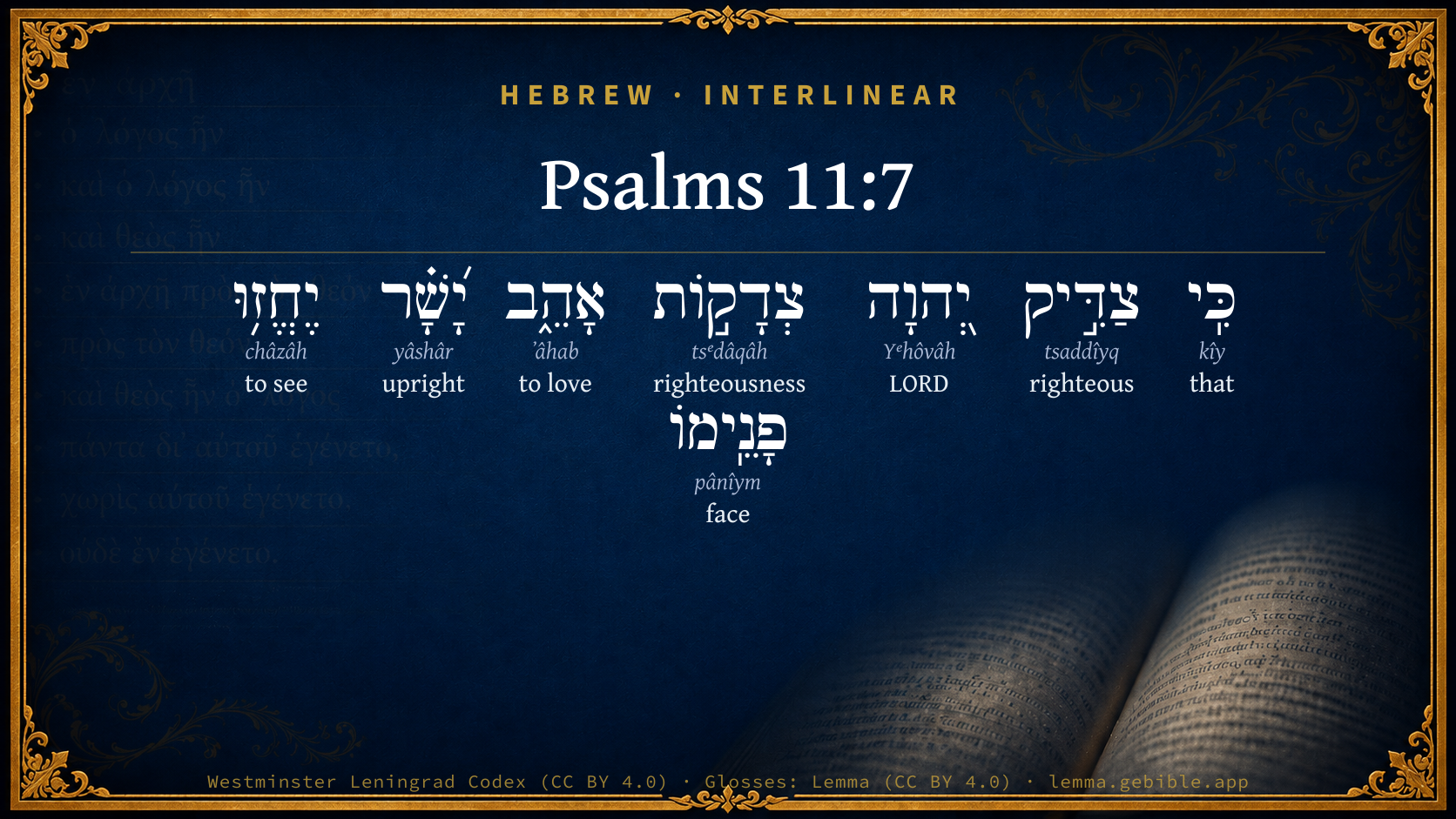
Psalms 11:7

Hebrew (Westminster Leningrad Codex) Psalms 11:7 appears in the Hebrew Old Testament. The text above is from the Westminster Leningrad Codex. Each word links to its Strong’s number, a concise gloss, and parsing drawn from the Open Scriptures Hebrew Bible morphology. Click any word for its full Brown-Driver-Briggs (BDB) entry.
Download image
Cite this verse

Psalms 11:7 (World English Bible). Public Domain. Lemma interlinear Bible study tool, https://lemma.gebible.app/v/psalms/11/7.

Show BibTeX & RIS
BibTeX
RIS
English Translation
For Yahweh is righteous. He loves righteousness. The upright shall see his face.
World English Bible · Public Domain
Download a study sheet

One document with this verse’s original text, its word-by-word gloss line, the meaning frame, cross-references with their text, attributed commentary, and full source and license credits — printable, and it pastes into notes with its structure intact.

This verse Autodidact and up

Study sheet (.html) Plain text (.txt)

A passage Seminary Student

Up to 50 verses in one chapter. A passage sheet keeps up to 6 commentary sources and 12 cross-references per verse, in the order this page ranks them, and says so on the sheet whenever that leaves anything out. Ask for a single verse and you get the Autodidact verse sheet above.

Everything on this page stays free to read, with no account — the sheet is a download of what is already on screen, not access to it.

Want to remove ads? Support Godless Engineer
Compare translations 3

The same verse in 3 English versions, stacked beneath the original-language interlinear above. Click any original word for its lexicon entry.

Each is an independent rendering of the whole verse — the interlinear is not word-aligned to these translations.

Highlighted words mark where these versions differ — a whole-verse word diff, not a word-by-word alignment.

  • World English Bible Public Domain
    For Yahweh is righteous. He loves righteousness. The upright shall see his face.
  • King James Version Public Domain
    For the righteous LORD loveth righteousness; his countenance doth behold the upright.
  • unfoldingWord Literal Text CC BY-SA 4.0
    For Yahweh is righteous, he loves righteousness; the upright will see his face.

unfoldingWord Literal Text — © unfoldingWord, licensed CC BY-SA 4.0. Word-aligned USFM3 via Door43 (git.door43.org/unfoldingWord/en_ult).

Versions to compare (up to 4)

3 of 4 selected

Show all 17 translations

Every available English version of this verse, each an independent rendering of the whole verse.

  • World English Bible Public Domain
    For Yahweh is righteous. He loves righteousness. The upright shall see his face.
  • Berean Standard Bible Public Domain
    For the LORD is righteous; He loves justice. The upright will see His face.
  • Majority Standard Bible Public Domain
    For the LORD is righteous; He loves justice. The upright will see His face.
  • King James Version Public Domain
    For the righteous LORD loveth righteousness; his countenance doth behold the upright.
  • American Standard Version (1901) Public Domain
    For Jehovah is righteous; he loveth righteousness: The upright shall behold his face. Psalm 12 For the Chief Musician; set to the Sheminith. A Psalm of David.
  • Revised Version (1885) Public Domain
    For the LORD is righteous; he loveth righteousness: the upright shall behold his face.
  • Geneva Bible (1599) Public Domain
    For the righteous Lord loueth righteousnes: his countenance doeth beholde the iust.
  • Young's Literal Translation Public Domain
    For righteous `is' Jehovah, Righteousness He hath loved, The upright doth His countenance see!'
  • Literal Standard Version CC BY-SA 4.0
    For YHWH [is] righteous, || He has loved righteousness, || His countenance sees the upright!
  • Unlocked Literal Bible CC BY-SA 4.0
    For Yahweh is righteous, and he loves righteousness; the upright will see his face.
  • unfoldingWord Literal Text CC BY-SA 4.0
    For Yahweh is righteous, he loves righteousness; the upright will see his face.
  • Darby Bible Public Domain
    For righteous is Jehovah; he loveth righteousness, his countenance doth behold the upright.
  • World Messianic Bible Public Domain
    For the LORD is righteous. He loves righteousness. The upright shall see his face.
  • Webster's Bible Public Domain
    For the righteous LORD loveth righteousness; his countenance beholdeth the upright.
  • Free Bible Version CC BY-SA 4.0
    The Lord does what is right, and he loves those who live right. Those who do good will see him face to face.
  • Bible in Basic English Public Domain
    For the Lord is upright; he is a lover of righteousness: the upright will see his face.
  • JPS Tanakh (1917) Public Domain
    For the LORD is righteous, He loveth righteousness; the upright shall behold His face.

Literal Standard Version (2020), Covenant Press — licensed CC BY-SA 4.0. Text via the HelloAO Bible API (eBible.org). Unlocked Literal Bible (unfoldingWord) — licensed CC BY-SA 4.0. Text via the HelloAO Bible API (eBible.org). unfoldingWord Literal Text — © unfoldingWord, licensed CC BY-SA 4.0. Word-aligned USFM3 via Door43 (git.door43.org/unfoldingWord/en_ult). Free Bible Version, Dr. Jonathan Gallagher — licensed CC BY-SA 4.0. Text via the HelloAO Bible API (eBible.org).

Word by word

More ways to search: Search by grammar → Find every occurrence → Compare this word →

Practice this passage: Drill this verse → Learn its vocabulary →

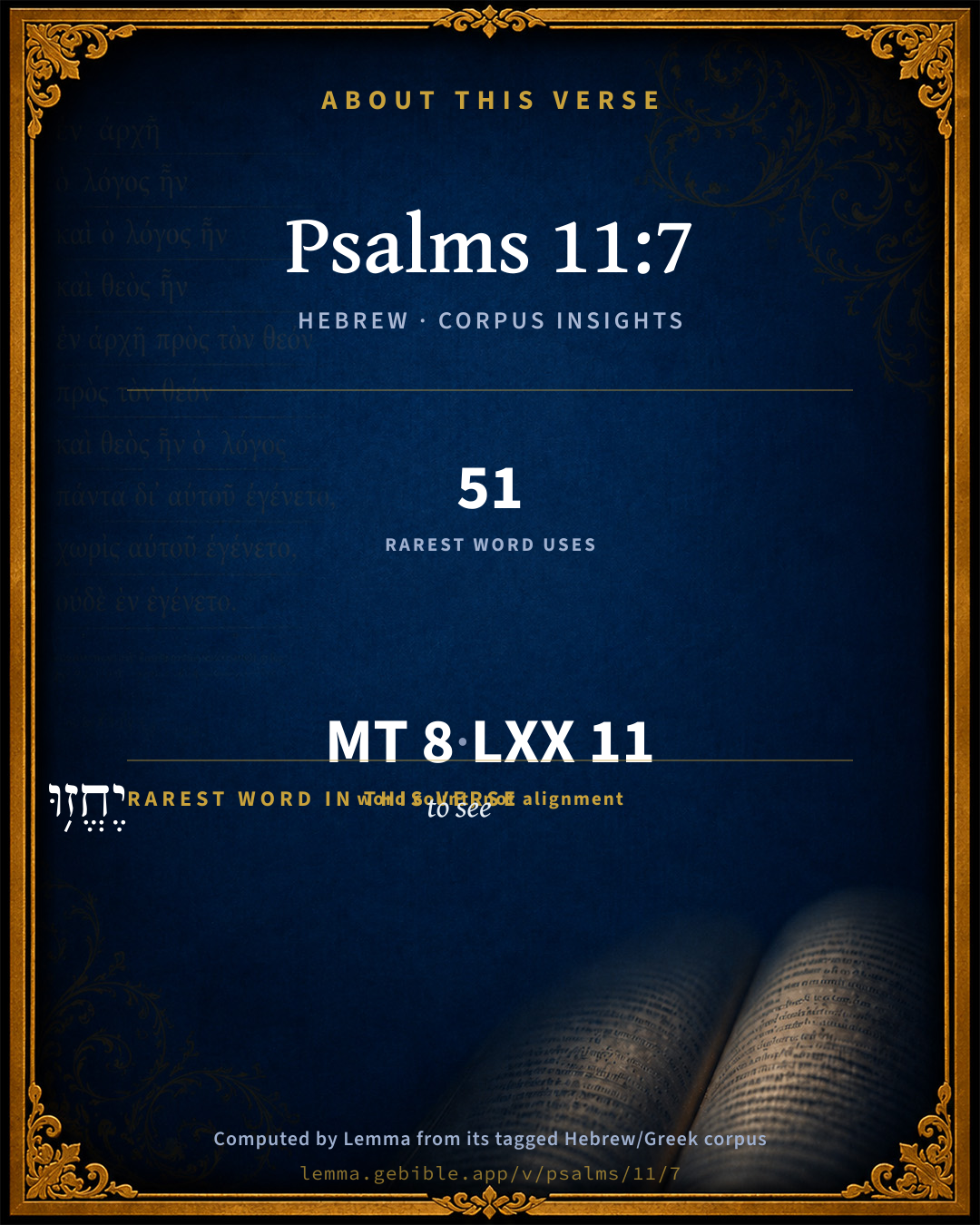
About this verse

These counts appear in no published source. They are computed here, from the morphology-tagged text and Lemma’s own curated glosses. What Lemma adds →

8
words
8
distinct lemmas
Wisdom
section

Shared distinctive vocabulary

יֶחֱז֥וּ to see H2372 occurs in 47 verses of the Hebrew Bible. Also found in:

Grammatical profile

  • 2 verbs
  • 3 nouns
  • 2 adjectives
  • 1 conjunction

Verb forms

  • אָהֵ֑ב Qal · Perfect
  • יֶחֱז֥וּ Qal · Imperfect

Hebrew & Septuagint length

In English translation the verse runs 13 words from the Hebrew and 20 from the Septuagint (LXX English) — closely comparable.

A rough comparison of the two English renderings, which tokenize alike — not a word-level alignment.

Word counts can differ between the Hebrew and the Greek without any difference in meaning — e.g. the Hebrew direct-object marker אֵת has no separate Greek word, and Greek often adds the article ὁ.

In the original languages it is 8 Hebrew tokens and 11 Greek tokens — but the two are counted differently (Hebrew bundles its prefixes and suffixes into one token; the Greek is in lemma form), so that isn’t a like-for-like length.

Cross-references

17

Topical passages linked to Psalms 11:7 in the Treasury of Scripture Knowledge — connected by theme and wording, ordered by reader-vote popularity; previews shown in the World English Bible.

  • Revelation 22:4 They will see his face, and his name will be on their foreheads.
  • Psalms 17:15 As for me, I shall see your face in righteousness; I shall be satisfied, when I awake, with seeing your form.
  • 1 Peter 3:12 For the eyes of the Lord are on the righteous, And his ears open to their prayer; But the face of the Lord is against those who do evil."
  • Psalms 45:7 You have loved righteousness, and hated wickedness. Therefore God, your God, has anointed you with the oil of gladness above your fellows.
  • Job 36:7 He doesn't withdraw his eyes from the righteous, But with kings on the throne, He sets them forever, and they are exalted.
  • 1 John 3:2 Beloved, now we are children of God, and it is not yet revealed what we will be. But we know that, when he is revealed, we will be like him; for we will see him just as he is.
  • Psalms 33:18 Behold, Yahweh's eye is on those who fear him, On those who hope in his loving kindness;
  • Psalms 34:15 Yahweh's eyes are toward the righteous. His ears listen to their cry.
  • Psalms 5:12 For you will bless the righteous. Yahweh, you will surround him with favor as with a shield.
  • Psalms 21:6 For you make him most blessed forever. You make him glad with joy in your presence.
  • Psalms 33:5 He loves righteousness and justice. The earth is full of the loving kindness of Yahweh.
  • Psalms 42:5 Why are you in despair, my soul? Why are you disturbed within me? Hope in God! For I shall still praise him for the saving help of his presence.
  • Psalms 99:4 The King's strength also loves justice. You do establish equity. You execute justice and righteousness in Jacob.
  • Psalms 7:9 Oh let the wickedness of the wicked come to an end, But establish the righteous; Their minds and hearts are searched by the righteous God.
  • Psalms 146:8 Yahweh opens the eyes of the blind. Yahweh raises up those who are bowed down. Yahweh loves the righteous.
  • Isaiah 61:8 For I, Yahweh, love justice, I hate robbery with iniquity; and I will give them their recompense in truth, and I will make an everlasting covenant with them.
  • Psalms 7:11 God is a righteous judge, Yes, a God who has indignation every day.

Cross-references courtesy of OpenBible.info (CC BY 4.0).

Hebrew and Greek witnesses Masoretic Hebrew ↔ Greek Septuagint

The same verse in the two great witnesses to the Old Testament, shown verse-for-verse.

You’re reading Greek Psalm 10 (Hebrew Psalm 11). The Septuagint counts the superscription, so verse numbers can differ from the Hebrew — chapter-level alignment, not verse-by-verse. Numbering follows Rahlfs.

These are two independent witnesses, not word-aligned to each other, and the Septuagint is shown in lemma (dictionary) form.

Hebrew Psalms 11:7 Masoretic · Westminster Leningrad Codex

כִּֽי צַדִּ֣יק יְ֭הוָה צְדָק֣וֹת אָהֵ֑ב יָ֝שָׁ֗ר יֶחֱז֥וּ פָנֵֽימוֹ

For Yahweh is righteous. He loves righteousness. The upright shall see his face.

World English Bible · Public Domain

Greek LXX Greek Psalm 10:7 Septuagint · lemma form

ὅτι δίκαιος κύριος καί δικαιοσύνη ἀγαπάω εὐθύτης ὁράω ὁ πρόσωπον αὐτός

He shall rain upon sinners snares, fire, and brimstone, and a stormy blast shall be the portion of their cup.

LXX2012 (modern English Septuagint) · Public Domain

On this verse, Keil & Delitzsch discusses the Septuagint’s reading. Read the note in Commentary ↓

Hebrew: Westminster Leningrad Codex (CC BY 4.0). Greek: Septuagint (public domain); English from LXX2012 (modern English Septuagint) (Public Domain). How the Septuagint differs from the Hebrew →

Commentary

Notes on Psalms 11:7 from classic Christian and Jewish commentators (each source and its license shown beneath its notes). The classic Christian expositions comment on the surrounding passage and are grouped to its opening verse, so a note may address several verses; the Jewish commentaries on the Tanakh (Rashi and others) are per-verse, so they appear only where the commentator wrote on this verse.

Lemma curates 59 commentaries, every one of them public domain or Creative Commons licensed, each selected and text-cleaned for this edition rather than reprinted as found. About our sources →

Jamieson, Fausset & Brown

Robert Jamieson, A. R. Fausset & David Brown

his countenance--literally, "their faces," a use of the plural applied to God, as in Gen 1:26; Gen 3:22; Gen 11:7; Isa 6:8, &c., denoting the fulness of His perfections, or more probably originating in a reference to the trinity of persons. "Faces" is used as "eyes" (Psa 11:4), expressing here God's complacency towards the upright (compare Psa 34:15-16).

Next: Psalms Chapter 12

Jamieson, Fausset & Brown — Commentary Critical and Explanatory on the Whole Bible (1871) — public domain (CC PDM 1.0). Text via the HelloAO Bible API.

Trapp's Complete Commentary

John Trapp

Psa 11:7 For the righteous LORD loveth righteousness; his countenance doth behold the upright.

Ver. 7. For the righteous Lord loveth righteousness] sc. As a reflection of himself, as a piece of his own image. This is better than eyes opened, limbs restored, Psa 146:8.

His countenance] Heb. countenances, or their faces, in mystery of the Holy Trinity.

Doth behold the upright] With singular delight and complacency ( Vide Vicars in loc.).

John Trapp, A Commentary or Exposition upon All the Books of the Old and New Testament (1647–1656) — public domain. Text from a community e-Sword module.

The Biblical Illustrator

Joseph S. Exell

Psa_11:7

The righteous Lord loveth righteousness.

The righteous God and righteousness

Righteousness may be taken as but another word for rightness, equity, justice, the being and rendering what is right. Here it describes God. It is the quality which binds and blends into a perfect unity all His Divine perfections. We feel instinctively that righteousness is essential to Divine perfection. Show how this statement that God is a righteous God bears on matters of faith and practice. God, because He is the righteous Lord, loveth righteousness.

1. This will explain a peculiarity in the redemption accomplished for us through the atoning death of Christ. The problem to be solved was, how can the love of God be manifested, and righteousness be at the same time upheld in all the majesty of its eternal rectitude?

2. There is much which is mysterious, perplexing, and inexplicable in Gods providential dealings. But throw on all these mysterious providences the light of this statement, that the Lord is righteous and loveth righteousness, and you calm the troubled spirit to patience and submission. Then with entire trustfulness you would leave yourselves in Gods hands. In the conviction of His righteousness, let us face the problems and perplexities which confront us in the world. Now see how this statement bears on all the business of life between man and man. His countenance doth behold the upright: beholds them, that is, with special favour and approval, because He sees reflected in them, however imperfectly, the lineaments of His own Divine image. (R. Allen, M. A.)

.

Psa_12:1-8

The Biblical Illustrator, edited by Joseph S. Exell (c. 1880s–1900s) — public domain. Text from a community e-Sword module.

Joseph Benson's Commentary

Psa 11:7. For the righteous Lord loveth righteousness — This is mentioned as the reason why God punishes the wicked so dreadfully. It is because, being righteous, essentially righteous, himself, he cannot but love righteousness, which is his own image stamped on the faithful, by his own Spirit. He therefore must proportionably hate wickedness, and of course show his hatred to it before the whole intelligent creation, by punishing such as live and die in the commission of it. His countenance doth behold the upright — Namely, with an eye of approbation and paternal affection, his gracious providence watching continually over and taking care of them.

Joseph Benson's Commentary on the Old and New Testaments (1811–1818) — public domain. Text from a community e-Sword module.

Keil & Delitzsch

C. F. Keil & F. Delitzsch

Psa 11:7, which assumes a declaration of something that is near at hand, is opposed to our rendering the voluntative form of the fut., ימטר, as expressive of a wish. The shorter form of the future is frequently indicative in the sense of the future, e.g., Psa 72:13, or of the present, e.g., Psa 58:5, or of the past, Psa 18:12. Thus it here affirms a fact of the future which follows as a necessity from Psa 11:4, Psa 11:5. Assuming that פּהים might be equivalent to פּחמים, even then the Hebrew פּחם, according to the general usage of the language, in distinction from גּחלת, does not denote burning, but black coals. It ought therefore to have been אשׁ פּחמי. Hitzig reads פּהים from פּיח ashes; but a rain of ashes is no medium of punishment. Bצttcher translates it "lumps" according to Exo 39:3; Num 17:3; but in these passages the word means thin plates. We adhere to the signification snares, Job 22:10, cf. Job 21:17, Pro 27:5; and following the accentuation, we understand it to be a means of punishment by itself. First of all descends a whole discharge of missiles which render all attempt at flight impossible, viz., lightnings; for the lightning striking out its course and travelling from one point in the distance, bending itself like a serpent, may really be compared to a snare, or noose, thrown down from above. In addition to fire and brimstone (Gen 19:24) we have also רוּח זלעפות. The lxx renders it πνεῦμα καταιγίδος, and the Targum זעפא עלעוּלא, procella turbinea. The root is not לעף, which cannot be sustained as a cognate form of להב, לאב to burn, but זעף, which (as Sa1 5:10 shows) exactly corresponds to the Latin aestuare which combines in itself the characteristics of heat and violent motion, therefore perhaps: a wind of flames, i.e., the deadly simoom, which, according to the present division of the verse is represented in connection with אשׁ וגפרית, as the breath of the divine wrath pouring itself forth like a stream of brimstone, Isa 30:33. It thus also becomes clear how this can be called the portion of their cup, i.e., what is adjudged to them as the contents of their cup which they must drain off. מנת (only found in the Davidic Psalms, with the exception of Ch2 31:4) is both absolutivus and constructivus according to Olshausen (108, c, 165, i), and is derived from manajath, or manawath, which the original feminine termination ath, the final weak radical being blended with it. According to Hupfeld it is constr., springing from מנית, like קצת (in Dan. and Neh.) form קצות. But probably it is best to regard it as = מנות or מנית, like גּלות = גּלות.

Thus then Jahve is in covenant with David. Even though he cannot defend himself against his enemies, still, when Jahve gives free course to His hatred in judgment, they will then have to do with the powers of wrath and death, which they will not be able to escape. When the closing distich bases this different relation of God towards the righteous and the unrighteous and this judgment of the latter on the righteousness of God, we at once perceive what a totally different and blessed end awaits the righteous. As Jahve Himself is righteous, so also on His part (Sa1 12:7; Mic 6:5, and frequently) and on the part of man (Isa 33:15) He loves צדקות, the works of righteousness. The object of אהב (= אהב) stands at the head of the sentence, as in Psa 99:4, cf. Psa 10:14. In Psa 11:7 ישׂר designates the upright as a class, hence it is the more natural for the predicate to follow in the plur. (cf. Psa 9:7; Job 8:19) than to precede as elsewhere (Pro 28:1; Isa 16:4). The rendering: "His countenance looks upon the upright man" (Hengst. and others) is not a probable one, just because one expects to find something respecting the end of the upright in contrast to that of the ungodly. This rendering is also contrary to the general usage of the language, according to which פנים is always used only as that which is to be seen, not as that which itself sees. It ought to have been עינימו, Psa 33:18; Psa 34:16; Job 36:7. It must therefore be translated according to Psa 17:15; Psa 140:13 : the upright (quisquis probus est) shall behold His countenance. The pathetic form פנימו instead of פּניו was specially admissible here, where God is spoken of (as in Deu 33:2, cf. Isa 44:15). It ought not to be denied any longer that mo is sometimes (e.g., Job 20:23, cf. Job 22:2; Job 27:23) a dignified singular suffix. To behold the face of God is in itself impossible to mortals without dying. But when God reveals Himself in love, then He makes His countenance bearable to the creature. And to enjoy this vision of God softened by love is the highest honour God in His mercy can confer on a man; it is the blessedness itself that is reserved for the upright, 140:14. It is not possible to say that what is intended is a future vision of God; but it is just as little possible to say that it is exclusively a vision in this world. To the Old Testament conception the future עולם is certainly lost in the night of Shel. But faith broke through this night, and consoled itself with a future beholding of God, Job 19:26. The redemption of the New Testament has realised this aspiration of faith, since the Redeemer has broken through the night of the realm of the dead, has borne on high with Him the Old Testament saints, and translated them into the sphere of the divine love revealed in heaven.

Keil & Delitzsch — Biblical Commentary on the Old Testament (1861–1891) — public domain (CC PDM 1.0). Text via the HelloAO Bible API. (Old Testament only.)

J. A. Alexander on Psalms

Joseph Addison Alexander

7. (Psa 11:7) For righteous (is) Jehovah; righteousness he loves; the upright (man) shall his face behold. The for suggests the intimate connection between God's judgment on the wicked and his favour to the righteous. The second clause is a necessary inference from the first. The nature of God determines his judgments and his acts. He who is righteous in himself cannot but approve of righteousness in others. The righteousness of others is in fact nothing more than conformity to his will and nature. Nor does he merely approve of righteousness in the abstract; he rewards it in the person of the righteous man. This idea is expressed in the last clause, which admits of several constructions. It may mean that the upright shall behold his face, i.e. enjoy his favourable presence, as in Psa 17:15. But the collocation of the singular noun and the plural verb, with the analogy of Psa 11:4 above, is in favour of a different construction: his face shall behold (or does behold), the righteous, i.e. view them with favour and affection. Because the original expression is not properly his face, but their face or faces, Luther explains this as a reason why God loves the righteous, to wit, because their faces look upon (the) right, or that which is right. Another construction, founded on the same fact, is, the righteous shall behold (it with) their faces. It is better, however, to regard this as an instance of that remarkable idiom in Hebrew, which applies to the One True God, verbs, nouns, and pronouns in the plural, and which some explain as a pluralis majestaticus, like that employed by kings at present, and others as a form of speech transferred from polytheism to the true religion. Most probably, however, it was intended to express the fulness of perfection in the divine nature, not without a mystical allusion to the personal distinction in the Godhead. The most remarkable examples of this usage may be found in Gen 1:26; Gen 3:22; Gen 11:7, Job 35:10, Ps. 58:12, Ecc 12:1, Isa 6:8; Isa 54:5.—The face is here, like the eyelids in Psa 11:4, a poetical equivalent to eyes, and the same parallelism reappears in Psa 34:16-17 (15, 16): "the eyes of Jehovah (are) towards the righteous;" "the face of Jehovah (is) against evil-doers."

Joseph Addison Alexander, The Psalms Translated and Explained (1850) — public domain. Text from a community e-Sword module.

Tyndale Open Study Notes

Tyndale Open Resources

11:7 The godly are assured of the Lord’s favorable presence when they see his face (see 23:6).

Tyndale Open Study Notes — © Tyndale Open Resources, licensed CC BY-SA 4.0. Text via the HelloAO Bible API.

Adam Clarke's Commentary

Verse 7. The righteous Lord loveth righteousness] He loves that which resembles himself. His countenance - his face - is ever open and unclouded to the upright. They always enjoy his salvation, and know that he is pleased with them.

The preceding verse my old MS. translates and paraphrases thus: -

He sal rayne on synful, snares, fyre, brimstane, and gost of stormis.

Par. - He sal rayne on synful in this werld, snares, that es wiked Lare: fyre is covatyse: brunstane, that es stynk of il werkes: and gost of stormis, that es a stormy though that es withoutyn rest in Ihesu Crist, and ay es traveld with the wynd of the devel. Or the gast of stormys, es the last depertyng of synful fra ryghtwis men, and there fyre, brunston, storm, er part of the chalyie of thaim: that es, thai ar thair part in pyne. He cals thair pyne a Cop, for ilk dampned man sal drynk of the sorow of Hel, eftir the mesure of hys Syn. Behald the pynes of wikid men: fyrst, God raynes upon thaim snares, that es qwen he suffers fals prophetes that comes in clathing of mekenes; and withinnen er wers than wolves, to desayf thaim thurgh errour. Sythen the fyre of lychery, and covatys wastes al the gude that thai haf done: eftirward for stynk of il werkes that er castyn fra Crist, and al his Halows, and then er in sentence of dome; as in a grete storme, dryven in til a pitte of Hel, to bryn in fyre withoutyn ende. This es the entent of this wers.

Ver. 7. For ryghtwis es Lord; and he lufes ryghtwisnes; evennes saw the face of hym] Yf ge ask qwy oure lorde yelded pyne to synful? lo here an answere; for he es rightwis. Als so if ge wil witt qwy he gifes ioy til gude men? Lo here an answere; for he lufed ryghtwisnes: that es, ryghtwis men, in the qwilk er many ryghtwisneses: thof ane be the ryghtwisnes of God, in the qwilk al ryghtwise men or parcenel. Evenes saw his face: that es, evenes es sene in his knawyng inence, both the partys of gud and il. This es ogayne wryches at sais, If God saf me noght, I dar say he es unryghtwis: bot thof thai say it now, qwen he suffris wryched men errour in thought, and worde and dede; thai sal noght be so hardy to speke a worde qwen he comes to dampne thaire errour. Bot who so lufes here and haldes that na unevenes may be in hym, qwam so he dampnes, or qwam so he saves, he sal have thaire myght to stand and to speke gude space. Now er swilk in a wonderful wodenes, that wenes for grete wordes to get ought of God.

The former part of this Psalm, Flee as a bird, c., this ancient author considers as the voice of heresy inviting the true Church to go away into error and intimates that those who were separating from haly kyrk were very pure, and unblameable in all their conduct; and that mountain or hill, as he translates it, signifies eminent virtues, of which they had an apparently good stock. So it appears that those called heretics lived then a holier life than those called halows or saints.

ANALYSIS OF THE ELEVENTH PSALM

This Psalm is composed dialoguewise, betwixt David and those of his counsellors that persuaded him to fly to some place of safety from Saul's fury; which, if he did not, he was in a desperate condition. The Psalm has two parts.

I. He relates his counsellors' words Ps 11:1-3.

II. To which he returns his answer, Ps 11:1, and confirms it, Ps 11:4-7.

I. You, my counsellors, whether of good or bad will I know not, tempt me, that, giving up all hope of the kingdom, I go into perpetual banishment. Such, you say, is Saul's fury against me. Thus, then, ye advise, "Flee as a bird to your mountain:" and your arguments are,

1. The greatness of the danger I am in: "For lo, the wicked bend their bow."

2. The want of aid; there is no hope of help. For the foundations are cast down. Saul has broken all the leagues and covenants he has made with you. He has slain the priests with the sword, has taken thy fortresses, laws subverted. If thou stay, perish thou must: some righteous men, it is true, are left; but what can the righteous do?

II. To these their arguments and counsel, David returns his answer in a sharp reprehension. I tell you,

1. "I trust in God: how say you then to my soul." And he gives his reasons for it from the sufficiency and efficiency of God.

1. You say the foundations are cast down; yet I despair not, for God is sufficient.

1. Present in his holy temple; he can defend.

2. He is a great King, and his throne is in heaven.

3. Nothing is hidden from him: "His eyes behold, and his eyelids," c.

4. He is a just God, and this is seen in his proceedings both to the just and unjust. 1. He trieth the righteous, by a fatherly and gentle correction. 2. "But the wicked, and him that loveth violence, his soul hateth."

These two last propositions he expounds severally, and begins with the wicked.

1. "Upon the wicked he shall rain snares, fire and brimstone," &c. 1. He shall rain upon them when they least think of it, even in the midst of their jollity, as rain falls on a fair day. 2. Or, he shall rain down the vengeance when he sees good, for it rains not always. Though he defer it, yet it will rain. 3. The punishment shall come to their utter subversion, as the fire on Sodom, &c. 4. This is the portion of their cup, that which they must expect from him.

2. But he does good to the just: "For the righteous Lord loveth righteousness his countenance doth behold the upright." He bears him good will, and is careful to defend him.

On the whole the Psalm shows, 1. That David had the strongest conviction of his own uprightness. 2. That he had the fullest persuasion that God would protect him from all his enemies, and give him a happy issue out of all his distresses.

Adam Clarke's Commentary on the Bible (1810–1826) — public domain. Text from a community e-Sword/MySword module.

John Calvin's Commentaries

7. For the righteous Jehovah loveth righteousness. The Psalmist has just now reasoned from the office of God that he will punish the wicked, and now, from the nature of God, he concludes, that he will be the defender of the good and the upright. As he is righteous, David shows that, as the consequence of this, he must love righteousness, for otherwise he would deny himself. Besides, it would be a cold speculation to conceive of righteousness as inherent in God, unless, at the same time, we could come to the settled conclusion that God graciously owns whatever is his own, and furnishes evidence of this in the government of the world. Some think that the abstract term righteousness is put for righteous persons. But, in my opinion, the literal sense is here more suitable, namely, that righteousness is well pleasing to God, and that, therefore, he favors good causes. From this the Psalmist concludes, that the upright are the objects of his regard: His countenance approveth the upright He had said a little before in a different sense, that God beholds the children of men, meaning that he will judge the life of every man; but here he means that God graciously exercises a special care over the upright and the sincere, takes them under his protection, and keeps them in perfect safety. This conclusion of the psalm sufficiently shows, that the scope of the whole of it was to make it manifest that all those who, depending upon the grace of God, sincerely follow after righteousness, shall be safe under his protection. The Psalmist himself was one of this number and, indeed, the very chief of them. This last clause, His countenance approveth the upright, is, indeed, variously explained; but the true meaning, I have no doubt, is, that God has always a regard for the upright, and never turns away his eyes from them. It is a strained interpretation to view the words as meaning that the upright shall behold the face of God. But I will not stop to refute the opinions of other men.

John Calvin's Commentaries (1540-1563) — public domain. Text from the Calvin Translation Society English edition (1840s-50s) via the Christian Classics Ethereal Library (ccel.org). Calvin's coverage is partial (roughly two-thirds of the Bible); uncommented books and verses are honest gaps, never fabricated. The 19th-century editor's footnotes and remarks are omitted so the notes are faithfully Calvin's own voice.

Ellicott's Commentary for English Readers

(7) His countenance.—Better, the upright shall behold His countenance. This beautiful religious hope finds its highest expression in the beatitude on the pure in heart. The beatific vision in Dante is its most glorious poetical development. By the vision of God the Hebrew poet means triumph of right and the acknowledgment of his innocence—light and peace after darkness and trouble, as in Job_33:26. (Comp. Psa_17:15; Psa_41:12.)

A Bible Commentary for English Readers, edited by Charles John Ellicott (1878–1897) — public domain. Text from a community e-Sword module.

The Cambridge Bible for Schools and Colleges

gen. ed. J. J. S. Perowne

7. For Jehovah is righteous; he loveth righteous deeds;

The upright shall behold his face.

The character of Jehovah is the ground of the judgement which has been described; and the reward of the upright is contrasted with the punishment of the wicked.

Righteous deeds may denote the manifestations of Jehovah’s righteousness (Jdg_5:11; 1Sa_12:7), as well as the righteous acts of men. (Isa_33:15); but the context points to the latter meaning here.

The A.V. rendering of the second line gives a good sense:—He beholds the upright with favour. The P.B.V. follows the ancient versions in its rendering, ‘will behold the thing that is just.’ But usage and parallel passages are decisive in favour of the rendering of R.V. given above. The wicked are banished and destroyed; but the upright are admitted to the presence of Jehovah, as trusted courtiers to the presence of their sovereign (cp. Psa_5:4-5; Psa_15:1; Psa_17:15; Psa_140:13); they gaze upon that Face which is the source of light and joy and salvation (Psa_4:6; Psa_16:11; Psa_44:3). It is one of the ‘golden sayings’ of the Psalter, ‘fulfilled’ in the revelation of the Gospel. See Mat_5:8; 1Jn_3:2; Rev_22:4.

The Cambridge Bible for Schools and Colleges (gen. ed. J. J. S. Perowne; Cambridge University Press, 1878–1918) — public domain. Text from a community e-Sword module.

John Gill's Exposition

For the righteous Lord loveth righteousness,.... The Lord is righteous in himself, and in all his ways and works; and therefore righteousness, as it lies both in punishing the wicked, and in maintaining the righteous cause of his people, must be loved by him, it being agreeable to his nature: he loves to exercise righteousness in the earth, to administer it to and among men; this he delights in. He is well pleased with the righteousness of his Son, it being satisfactory to his justice, and that by which his law is magnified and made honourable; and he is well pleased with his people, as they are clothed with it: and he approves of their righteous actions, as they are done in obedience to his righteous law, in faith, from a principle of love, and with a view to his glory; these are acceptable to him in Christ;

his countenance doth behold the upright; whom wicked men privily shoot at, Psa 11:2; God looks with pleasure upon them, and takes delight in them, and takes care of them, protects and defends them, and at last saves them; and which, with all that goes before, was an encouragement to David to trust in the Lord; see Psa 7:10; and moreover, the Lord lifts up the light of his countenance on such, and indulges them with his gracious presence, than which nothing is more comfortable and desirable. Some choose to render the word, "their countenance" (y), meaning the trinity of Persons, Father, Son, and Spirit, who all have a gracious regard to such: others render the clause thus, "the upright shall see his face", the face of God; so the Chaldee paraphrase and the Arabic version; see Psa 17:15.

(y) "facies eorum", Genebrardus, Vatablus, Gussetius; so R. Japhet in Aben Ezra, who compares it with Genesis xx. 13.

Next: Psalms Chapter 12

John Gill's Exposition of the Whole Bible (1746–1763) — public domain (CC PDM 1.0). Text via the HelloAO Bible API.

Albert Barnes' Notes on the Bible

For the righteous Lord loveth righteousness - This would be more correctly rendered, “For Jehovah is righteous; he loves righteousness.” The idea is, that God is himself righteous, and, consequently, he loves those who are righteous. He may be confided in, therefore, by the righteous as their friend, and being under his protection they have nothing to fear.

His countenance doth behold the upright - The word rendered “countenance” is, in the Hebrew, in the plural number; literally,” his faces.” It is not easy to account for this use of the plural, though it is common in the Scriptures. There may be an allusion to the fact that man seems to have two faces - one on the right side, and one on the left, two eyes, two cheeks, two nostrils, etc., as if made up of two persons. Applied to God, it has no other signification than it has when applied to man; nor should we seek to find anything mystical in the fact that the plural form is used. The term here, like the eyelids in Psa 11:6, is equivalent to eyes, since the most remarkable feature of the countenance is the eyes; and the idea is, that God looks upon the upright; that is, he sees their dangers amid their wants; he looks upon them with favor and affection. Being thus constantly under his eye, and being objects of his favorable regard, they can have nothing to fear; or, in other words, they are safe. This, then, is the argument of the righteous man, in reply to the suggestion Psa 11:1 that he should “flee” from danger. The argument is, that God would be his defender, and that he might safely rely on His protection. The wicked have everything to fear; the righteous, nothing. The one is never safe; the other, always. The one will be delivered out of all his troubles; the end of the other can be only ruin.

Albert Barnes' Notes on the Bible (1834–1885) — public domain. Text from a community e-Sword/MySword module.

Matthew Poole's English Annotations

This is given as the reason why God hateth and punisheth wicked men so dreadfully, because he loves righteousness, and therefore must needs hate wickedness and punish wicked men. Or, but, as this particle is oft rendered; for this seems to be added by way of opposition to what he now said concerning the state of wicked men.

His countenance doth behold the upright; to wit, with an eye of approbation, and true and tender affection, and watchful and gracious providence; which is oft signified by God’s beholding or looking upon men, as Exo 2:25; Ezr 5:5; Psa 25:18; 33:18; 34:15, &c.: as, on the contrary, God is oft said to hide or turn away his face or eyes from wicked men.

Matthew Poole's English Annotations on the Holy Bible (1683–1685) — public domain. Text from a community e-Sword/MySword module.

The Treasury of David

Charles H. Spurgeon

Ver. 7. The delightful contrast of the last verse is well worthy of our observation, and it affords another overwhelming reason why we should be stedfast, unmoveable, not carried away with fear, or led to adopt carnal expedients in order to avoid trial.

For the righteous Lord loveth righteousness. It is not only his office to defend it, but his nature to love it. He would deny himself if he did not defend the just. It is essential to the very being of God that he should be just; fear not, then, the end of all your trials, but "be just, and fear not." God approves, and, if men oppose, what matters it?

His countenance doth behold the upright. We need never be out of countenance, for God countenances us. He observes, he approves, he delights in the upright. He sees his own image in them, an image of his own fashioning, and therefore with complacency he regards them. Shall we dare to put forth our hand unto iniquity in order to escape affliction? Let us have done with byways and short turnings, and let us keep to that fair path of right along which Jehovah's smile shall light us. Are we tempted to put our light under a bushel, to conceal our religion from our neighbours? Is it suggested to us that there are ways of avoiding the cross, and shunning the reproach of Christ? Let us not hearken to the voice of the charmer, but seek an increase of faith, that we may wrestle with principalities and powers, and follow the Lord, fully going without the camp, bearing his reproach. Mammon, the flesh, the devil, will all whisper in our ear, "Flee as a bird to your mountain; "but let us come forth and defy them all. "Resist the devil, and he will flee from you." There is no room or reason for retreat. Advance! Let the vanguard push on! To the front! all ye powers and passions of our soul. On! on! in God's name, on! for "the Lord of hosts is with us; the God of Jacob is our refuge."

Ver. 7. That God may give grace without glory is intelligible; but to admit a man to communion with him in glory without grace, is not intelligible. It is not agreeable to God's holiness to make any inhabitant of heaven, and converse freely with him in a way of intimate love, without such a qualification of grace: The righteous Lord loveth righteousness; his countenance doth behold the upright; he looks upon him with a smiling eye, and therefore he cannot favourably look upon an unrighteous person; so that this necessity is not founded only in the command of God that we should be renewed, but in the very nature of the thing, because God, in regard to his holiness, cannot converse with an impure creature. God must change his nature, or the sinner's nature must be changed. There can be no friendly communion between two of different natures without the change of one of them into the likeness of the other. Wolves and sheep, darkness and light, can never agree. God cannot love a sinner as a sinner, because he hates impurity by a necessity of nature as well as a choice of will. It is as impossible for him to love it as to cease to be holy. Stephen Charnock.

Ver. 7. The Lord possesses righteousness as a personal attribute, loves it in the abstract, and blesses those who practise it.

Charles H. Spurgeon's The Treasury of David (1869–1885) — public domain. Psalms only. Text from a community e-Sword/MySword module.

Whedon's Commentary on the Bible

Daniel D. Whedon

7. His countenance doth behold the upright—That is, with complaisance and delight, as the verb often signifies. But most modern critics read, The upright shall behold his face, which, though either is defensible, makes a better sense, and better suits the doctrinal antithesis of the context respecting the divine treatment of the righteous and the wicked. See note on Psa_17:15; and compare 1Jn_3:2. The passage is a clear recognition of the future life.

Daniel D. Whedon (gen. ed.), Commentary on the Old and New Testaments (1874–1909) — public domain. Text from a community e-Sword module.

The Pulpit Commentary

For the righteous Lord loveth righteousness; rather, for the Lord is righteous; he loveth righteousness (see the Revised Version); literally, righteousnesses; i.e. good and righteous deeds. His countenance doth behold the upright. So the LXX, the Vulgate, Hengstenberg, Bishop Horsley, and ethers; but the bulk of modern commentators prefer to render, "The upright will behold his countenance." Either translation yields a good sense.

"The righteous Lord loveth righteousness.

This is true for ever.

I RIGHTEOUSNESS IS CONGRUOUS TO GOD"S NATURE. If light is pleasant to the eye, and music to the ear, and beauty to the soul, it is because they are in the line of rightness. "No man ever yet hated his own flesh": (Eph_5:29) how much more must God love that which is akin to himself which is of the very essence of his character!

II RIGHTEOUSNESS FULFILS GOD"S PURPOSES. What God seeks is righteousness. This is the end of the Law; this is the purpose of all good government; this is the teaching of the prophets and the great object of Christ. (Isa_42:1-14 Mat_3:15 Rom_5:21) Christ is the "Righteous One;" and of him the Father said, "This is my beloved Son, in whom I am well pleased." "Christ suffered once the Just for the unjust;" and we see how dear righteousness was to God when "he made him to be sin for us who knew no sin, that we might be made the righteousness of God in him." The cross is the measure of God"s love of righteousness.

III RIGHTEOUSNESS SECURES THE BLESSEDNESS OF GOD"S CREATURES. Sin brought death into the world, and all our woe. It is by the taking away of sin and the re-establishment of the rule of God in the heart, that happiness is restored. (Rom_14:17) The prophets tell with rapture of the good time coming; and note it as the peculiar glory of the new heavens and the new earth, that in them "dwelleth righteousness". (Isa_65:17-25 2Pe_3:13, 2Pe_3:14)

Here is a test: Do we love as God loves? "Whosoever doeth not righteousness is not of God". W.F. (1Jn_3:5-10)

The Pulpit Commentary (1880–1919), ed. H.D.M. Spence-Jones & Joseph S. Exell — public domain. Text from a community e-Sword module.

Rashi

Rabbi Shlomo Yitzchaki (Rashi)

For the Lord is righteous; He loves [workers of] righteousness and has mercy on the righteous and loves those whose faces see the straight [way], in whose sight the straight way is proper.

whose faces approve of the straight This refers to “The Lord is righteous; He loves [workers of] righteousness and those whose faces approve of the straight [way].” Our Sages [Mid. Ps. 11:2, Sanh. 26a, Lev. Rabbah 5:5] interpreted “the wicked tread the bow” as referring to Shebna and his company, and they interpreted “the upright of heart” as referring to Hezekiah and his company.

For the foundations are destroyed If the foundations are destroyed by them, what did the Righteous One of the world accomplish? The sequence of verses, though, does not concur with the Midrash.

Rashi on the Tanakh — English translations: “The Judaica Press complete Tanach with Rashi, translated by A. J. Rosenberg” (CC BY 4.0); “Pentateuch with Rashi's commentary by M. Rosenbaum and A.M. Silbermann, 1929-1934” (public domain); “The Metsudah Tanach series, Lakewood, N.J” (CC BY 4.0); and “The Book of Joshua, Metsudah Publications, 1997” (CC BY 4.0). Text via Sefaria.

Lesson kit

Teaching starters — assembled from the data on this page, not authored interpretation. Every prompt links to the verse data it draws on. Edit before teaching.

Psalms, in the Wisdom, opens this verse with 8 words (8 distinct Hebrew lemmas). Its most distinctive word is châzâh (“to see”). A historical commentator’s framing appears above. Read the whole chapter for the surrounding context.

Discussion questions

  1. The word châzâh carries the sense “to see.” How does it shape the verse?
  2. How does Exodus 18:21, which shares the word «to see», read alongside this verse?
  3. These translations render this verse differently. What is at stake in choosing one wording over another?
  4. «אָהֵ֑ב» is a Qal Perfect verb. How does that grammatical form shape the action described?
  5. Compare how Jamieson, Fausset & Brown and Trapp's Complete Commentary read this verse. Where do they agree or differ?

Things to notice

Reading settings

Reading text

Shown beneath each verse's original-language words.

Old Testament
Old Testament edition

Read the OT as the Masoretic Hebrew (MT) or the Greek Septuagint (LXX).

English shown for the Greek Septuagint (in the Hebrew ↔ Greek comparison).

Comparing translations? Open the Compare panel on any verse page to stack up to four side by side.