Amos 3:7

Hebrew (Westminster Leningrad Codex) Amos 3:7 appears in the Hebrew Old Testament. The text above is from the Westminster Leningrad Codex. Each word links to its Strong’s number, a concise gloss, and parsing drawn from the Open Scriptures Hebrew Bible morphology. Click any word for its full Brown-Driver-Briggs (BDB) entry.
Download image
Cite this verse

Amos 3:7 (World English Bible). Public Domain. Lemma interlinear Bible study tool, https://lemma.gebible.app/v/amos/3/7.

Show BibTeX & RIS
BibTeX
RIS
English Translation
Surely the Lord Yahweh will do nothing, Unless he reveals his secret to his servants the prophets.
World English Bible · Public Domain
Download a study sheet

One document with this verse’s original text, its word-by-word gloss line, the meaning frame, cross-references with their text, attributed commentary, and full source and license credits — printable, and it pastes into notes with its structure intact.

This verse Autodidact and up

Study sheet (.html) Plain text (.txt)

A passage Seminary Student

Up to 50 verses in one chapter. A passage sheet keeps up to 6 commentary sources and 12 cross-references per verse, in the order this page ranks them, and says so on the sheet whenever that leaves anything out. Ask for a single verse and you get the Autodidact verse sheet above.

Everything on this page stays free to read, with no account — the sheet is a download of what is already on screen, not access to it.

Want to remove ads? Support Godless Engineer
Compare translations 3

The same verse in 3 English versions, stacked beneath the original-language interlinear above. Click any original word for its lexicon entry.

Each is an independent rendering of the whole verse — the interlinear is not word-aligned to these translations.

Highlighted words mark where these versions differ — a whole-verse word diff, not a word-by-word alignment.

  • World English Bible Public Domain
    Surely the Lord Yahweh will do nothing, Unless he reveals his secret to his servants the prophets.
  • King James Version Public Domain
    Surely the Lord GOD will do nothing, but he revealeth his secret unto his servants the prophets.
  • unfoldingWord Literal Text CC BY-SA 4.0
    Surely the Lord Yahweh will not do anything unless he reveals his plan to his servants the prophets.

unfoldingWord Literal Text — © unfoldingWord, licensed CC BY-SA 4.0. Word-aligned USFM3 via Door43 (git.door43.org/unfoldingWord/en_ult).

Versions to compare (up to 4)

3 of 4 selected

Show all 18 translations

Every available English version of this verse, each an independent rendering of the whole verse.

  • World English Bible Public Domain
    Surely the Lord Yahweh will do nothing, Unless he reveals his secret to his servants the prophets.
  • Berean Standard Bible Public Domain
    Surely the Lord GOD does nothing without revealing His plan to His servants the prophets.
  • Majority Standard Bible Public Domain
    Surely the Lord GOD does nothing without revealing His plan to His servants the prophets.
  • King James Version Public Domain
    Surely the Lord GOD will do nothing, but he revealeth his secret unto his servants the prophets.
  • American Standard Version (1901) Public Domain
    Surely the Lord Jehovah will do nothing, except he reveal his secret unto his servants the prophets.
  • Revised Version (1885) Public Domain
    Surely the Lord GOD will do nothing, but he revealeth his secret unto his servants the prophets.
  • Geneva Bible (1599) Public Domain
    Surely the Lord God will doe nothing, but he reueileth his secrete vnto his seruantes the Prophets.
  • Douay-Rheims (1899) Public Domain
    For the Lord God doth nothing without revealing his secret to his servants the prophets.
  • Young's Literal Translation Public Domain
    For the Lord Jehovah doth nothing, Except He hath revealed His counsel unto His servants the prophets.
  • Literal Standard Version CC BY-SA 4.0
    For Lord YHWH does nothing, || Except He has revealed His counsel to His servants the prophets.
  • Unlocked Literal Bible CC BY-SA 4.0
    Surely the Lord Yahweh will do nothing unless he reveals his plan to his servants the prophets.
  • unfoldingWord Literal Text CC BY-SA 4.0
    Surely the Lord Yahweh will not do anything unless he reveals his plan to his servants the prophets.
  • Darby Bible Public Domain
    But the Lord Jehovah will do nothing, but he revealeth his secret unto his servants the prophets.
  • World Messianic Bible Public Domain
    Surely the Lord GOD will do nothing, unless he reveals his secret to his servants the prophets.
  • Webster's Bible Public Domain
    Surely the Lord GOD will do nothing, but he revealeth his secret to his servants the prophets.
  • Free Bible Version CC BY-SA 4.0
    For the Lord God does nothing without revealing his intentions to his servants the prophets.
  • Bible in Basic English Public Domain
    Certainly the Lord will do nothing without making clear his secret to his servants, the prophets.
  • JPS Tanakh (1917) Public Domain
    For the Lord GOD will do nothing, but He revealeth His counsel unto His servants the prophets.

Literal Standard Version (2020), Covenant Press — licensed CC BY-SA 4.0. Text via the HelloAO Bible API (eBible.org). Unlocked Literal Bible (unfoldingWord) — licensed CC BY-SA 4.0. Text via the HelloAO Bible API (eBible.org). unfoldingWord Literal Text — © unfoldingWord, licensed CC BY-SA 4.0. Word-aligned USFM3 via Door43 (git.door43.org/unfoldingWord/en_ult). Free Bible Version, Dr. Jonathan Gallagher — licensed CC BY-SA 4.0. Text via the HelloAO Bible API (eBible.org).

Word by word

More ways to search: Search by grammar → Find every occurrence → Compare this word →

Practice this passage: Drill this verse → Learn its vocabulary →

סוֹד֔וֹ
çôwd
H5475
“council · his”
Noun, Common, Masculine, Singular, Construct + Suffix, Personal, 3rd Person, Masculine, Singular
Part of Speech
Noun
Type
Common
Gender
Masculine
Number
Singular
State
Construct
Full BDB Definition

Origin: from H3245

TWOT: 1471a

council, counsel, assembly - council (of familiar conversation) - divan, circle (of familiar friends) - assembly, company - counsel - counsel (itself) - secret counsel - familiar converse, intimacy (with God)
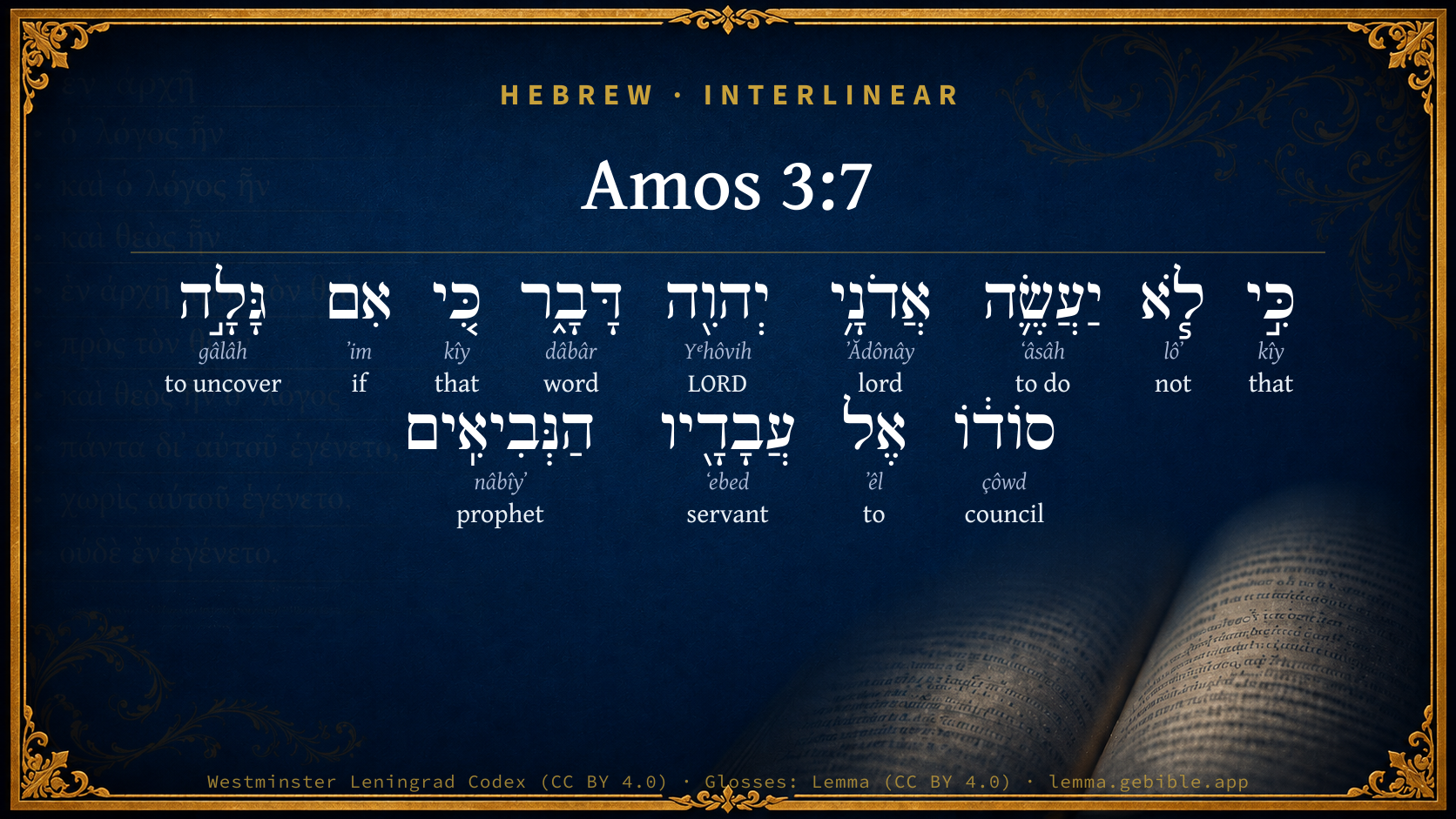
  1. כִּ֣י kîy H3588 “that” Conjunction
  2. לֹ֧א lôʼ H3808 “not” Particle, Negative
  3. יַעֲשֶׂ֛ה ʻâsâh H6213 “to do” Verb, Qal, Imperfect, 3rd Person, Masculine, Singular
  4. אֲדֹנָ֥י ʼĂdônây H136 “Lord · my” Noun, Common, Masculine, Plural, Construct + Suffix, Personal, 1st Person, Common, Singular
  5. יְהוִ֖ה Yᵉhôvih H3069 “LORD” Noun, Proper
  6. דָּבָ֑ר dâbâr H1697 “word” Noun, Common, Masculine, Singular, Absolute
  7. כִּ֚י kîy H3588 “that” Conjunction
  8. אִם ʼim H518 “if” Conjunction
  9. גָּלָ֣ה gâlâh H1540 “to uncover” Verb, Qal, Perfect, 3rd Person, Masculine, Singular
  10. אֶל ʼêl H413 “to” Preposition
  11. עֲבָדָ֖יו ʻebed H5650 “servants · his” Noun, Common, Masculine, Plural, Construct + Suffix, Personal, 3rd Person, Masculine, Singular
  12. הַנְּבִיאִֽים nâbîyʼ H5030 “the · prophets” Particle, Definite Article + Noun, Common, Masculine, Plural, Absolute

About this verse

These counts appear in no published source. They are computed here, from the morphology-tagged text and Lemma’s own curated glosses. What Lemma adds →

13
words
12
distinct lemmas
Prophets
section

Notable vocabulary

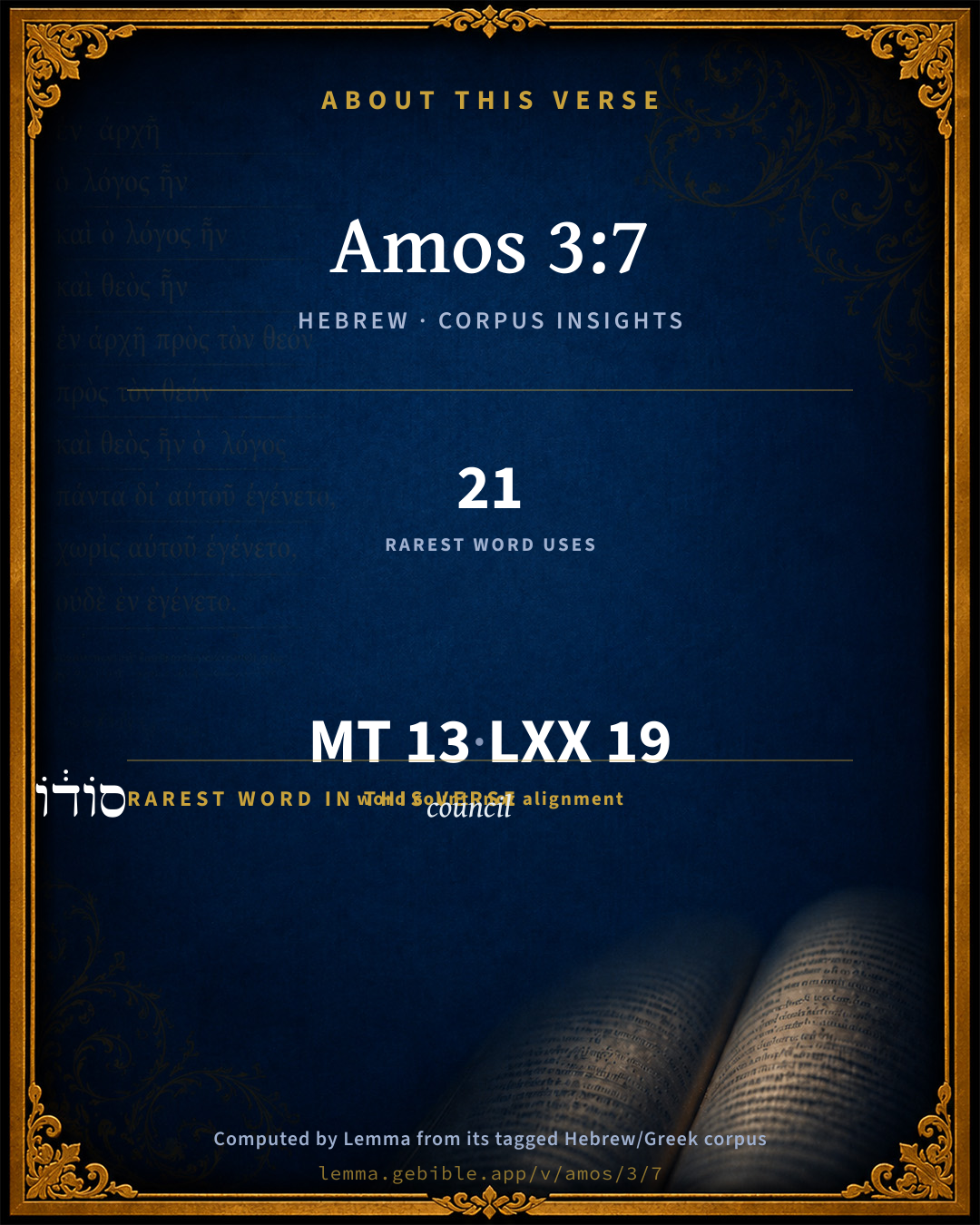
The rarest word here is סוֹד֔וֹ council H5475 — appearing just 21 times in the whole Hebrew Bible.

Shared distinctive vocabulary

סוֹד֔וֹ council H5475 occurs in 21 verses of the Hebrew Bible. Also found in:

Grammatical profile

  • 2 verbs
  • 6 nouns
  • 1 preposition
  • 3 conjunctions
  • 1 particle

Verb forms

  • יַעֲשֶׂ֛ה Qal · Imperfect
  • גָּלָ֣ה Qal · Perfect

Repetition

A word recurs within this verse — often emphatic in Hebrew:

  • כִּ֣י that H3588 ×2

Hebrew & Septuagint length

In English translation the verse runs 17 words from the Hebrew and 15 from the Septuagint (LXX English) — closely comparable.

A rough comparison of the two English renderings, which tokenize alike — not a word-level alignment.

Word counts can differ between the Hebrew and the Greek without any difference in meaning — e.g. the Hebrew direct-object marker אֵת has no separate Greek word, and Greek often adds the article ὁ.

In the original languages it is 13 Hebrew tokens and 19 Greek tokens — but the two are counted differently (Hebrew bundles its prefixes and suffixes into one token; the Greek is in lemma form), so that isn’t a like-for-like length.

Cross-references

17

Topical passages linked to Amos 3:7 in the Treasury of Scripture Knowledge — connected by theme and wording, ordered by reader-vote popularity; previews shown in the World English Bible.

  • John 15:15 No longer do I call you servants, for the servant doesn't know what his lord does. But I have called you friends, for everything that I heard from my Father, I have made known to you.
  • Genesis 18:17 Yahweh said, "Will I hide from Abraham what I do,
  • Psalms 25:14 The friendship of Yahweh is with those who fear him. He will show them his covenant.
  • Revelation 1:1 This is the Revelation of Jesus Christ, which God gave him to show to his servants the things which must happen soon, which he sent and made known by his angel to his servant, John,
  • Daniel 9:22–27 He instructed me, and talked with me, and said, Daniel, I am now come forth to give you wisdom and understanding.
  • Genesis 6:13 God said to Noah, "The end of all flesh has come before me, for the earth is filled with violence through them. Behold, I will destroy them with the earth.
  • Revelation 4:1 After these things I looked and saw a door opened in heaven, and the first voice that I heard, like a trumpet speaking with me, was one saying, "Come up here, and I will show you the things which must happen after this."
  • Daniel 10:21 But I will tell you that which is inscribed in the writing of truth: and there is none who holds with me against these, but Michael your prince."
  • Revelation 1:19 Write therefore the things which you have seen, and the things which are, and the things which will happen hereafter;
  • Jeremiah 23:22 But if they had stood in my council, then had they caused my people to hear my words, and had turned them from their evil way, and from the evil of their doings.
  • 2 Kings 22:13 Go you, inquire of Yahweh for me, and for the people, and for all Judah, concerning the words of this book that is found; for great is the wrath of Yahweh that is kindled against us, because our fathers have not listened to the words of this book, to do according to all that which is written concerning us.
  • Daniel 11:2 Now will I show you the truth. Behold, there shall stand up yet three kings in Persia; and the fourth shall be far richer than they all: and when he has grown strong through his riches, he shall stir up all against the realm of Greece.
  • 2 Kings 6:12 One of his servants said, No, my lord, O king; but Elisha, the prophet who is in Israel, tells the king of Israel the words that you speak in your bedchamber.
  • 1 Kings 22:19–23 [Micaiah] said, Therefore hear you the word of Yahweh: I saw Yahweh sitting on his throne, and all the host of heaven standing by him on his right hand and on his left.
  • 2 Kings 22:20 Therefore, behold, I will gather you to your fathers, and you shall be gathered to your grave in peace, neither shall your eyes see all the evil which I will bring on this place. They brought the king word again.
  • 2 Kings 3:17–20 For thus says Yahweh, You shall not see wind, neither shall you see rain; yet that valley shall be filled with water, and you shall drink, both you and your cattle and your animals.
  • Revelation 6:1–17 I saw that the Lamb opened one of the seven seals, and I heard one of the four living creatures saying, as with a voice of thunder, "Come and see!"

Cross-references courtesy of OpenBible.info (CC BY 4.0).

Hebrew and Greek witnesses Masoretic Hebrew ↔ Greek Septuagint

The same verse in the two great witnesses to the Old Testament, shown verse-for-verse.

These are two independent witnesses, not word-aligned to each other, and the Septuagint is shown in lemma (dictionary) form.

Hebrew Amos 3:7 Masoretic · Westminster Leningrad Codex

כִּ֣י לֹ֧א יַעֲשֶׂ֛ה אֲדֹנָ֥י יְהוִ֖ה דָּבָ֑ר כִּ֚י אִם גָּלָ֣ה סוֹד֔וֹ אֶל עֲבָדָ֖יו הַנְּבִיאִֽים

Surely the Lord Yahweh will do nothing, Unless he reveals his secret to his servants the prophets.

World English Bible · Public Domain

Greek LXX Amos 3:7 Septuagint · lemma form

διότι οὐ μή ποιέω κύριος ὁ θεός πρᾶγμα ἐάν μή ἀποκαλύπτω παιδεία αὐτός πρός ὁ δοῦλος αὐτός ὁ προφήτης

For the Lord God will do nothing, without revealing instruction to his servants the prophets.

LXX2012 (modern English Septuagint) · Public Domain

On this verse, The Pulpit Commentary discusses the Septuagint’s reading. Read the note in Commentary ↓

Hebrew: Westminster Leningrad Codex (CC BY 4.0). Greek: Septuagint (public domain); English from LXX2012 (modern English Septuagint) (Public Domain). How the Septuagint differs from the Hebrew →

Targum (Aramaic paraphrase)

1

The Targum is the ancient Jewish Aramaic paraphrase of the Hebrew Scriptures — an interpretive translation, not the Hebrew text itself. Onkelos (literal) and Pseudo-Jonathan (expansive) render the Torah, and Jonathan the Prophets. Coverage is partial: where no permissively-licensed English translation exists for a verse, only the Aramaic is shown. This is verse-level text, not a word-by-word alignment to the Hebrew.

  1. Targum Jonathan Prophets (Joshua–Malachi)
    אֲרֵי לָא כָשְׁרִין פִּתְגָמִין דְמִתְעַבְּדִין מִן קֳדָם יְיָ אֱלֹהִים אֱלָהִין גְלָא רָזֵיהּ לְעַבְדוֹהִי נְבִיַיָא:

    (no public-domain English translation for this verse)

    Targum Jonathan — Aramaic: “Mikraot Gedolot” (public domain). English: “Sefaria Community Translation” (CC0 1.0 (public-domain dedication)); “London "Chaldee Paraphrase," 1871” (public domain). Text via Sefaria.

Commentary

Notes on Amos 3:7 from classic Christian and Jewish commentators (each source and its license shown beneath its notes). The classic Christian expositions comment on the surrounding passage and are grouped to its opening verse, so a note may address several verses; the Jewish commentaries on the Tanakh (Rashi and others) are per-verse, so they appear only where the commentator wrote on this verse.

Lemma curates 59 commentaries, every one of them public domain or Creative Commons licensed, each selected and text-cleaned for this edition rather than reprinted as found. About our sources →

The Cambridge Bible for Schools and Colleges

gen. ed. J. J. S. Perowne

7. Surely] For,—the reason, however, following not in Amo_3:7 but in Amo_3:8 (to which Amo_3:7 is subordinate): ‘I give all these examples of events and occurrences in nature being due regularly to their proper cause, for Jehovah does nothing without communicating His purpose to His prophets, and when He does so the call to declare it is an irresistible one (Amo_3:8)’: hence when the prophet speaks, and especially when he comes forward with a message such as that contained in Amo_3:2, it may be inferred that it is because he has heard Jehovah’s voice commanding him to do so.

doeth nothing, except he have revealed &c.] An exaggeration, of course, of the actual fact; but Amos means naturally nothing of importance, so far as Israel was concerned. Prophets, whose mission it was to guide and advise Israel, appeared at all important crises in the national history.

secret] Heb. sôd, properly friendly or confidential conversation (ὁμιλία, which the corresponding word in Syriac is often used to express), Psa_55:14 : then, on the one hand, friendliness, friendship (Job_29:4; Psa_25:14; Pro_3:32,—see R.V. marg. in these passages), and in a more concrete sense, a secret (Pro_25:9); on the other hand, a body holding confidential intercourse together, a council, or conclave, of familiar friends (Job_19:19, R.V. marg.; Jer_15:17). In the latter sense sôd occurs in two passages illustrating the present one, Jer_23:18; Jer_23:22, where Jeremiah implies that the true prophets have access to the “council” of Jehovah, and preach the principles which are there approved (cf. Job_15:8, R.V. marg.; also Psa_89:7).

his servants the prophets] An expression otherwise used chiefly by writers of the age of Jeremiah (2Ki_17:13; 2Ki_17:23; 2Ki_21:10; 2Ki_24:2; Jer_7:25; Jer_25:4; Jer_26:5; Jer_29:19; Jer_35:15; Eze_38:17; also Zec_1:6; Dan_9:10).

The Cambridge Bible for Schools and Colleges (gen. ed. J. J. S. Perowne; Cambridge University Press, 1878–1918) — public domain. Text from a community e-Sword module.

Trapp's Complete Commentary

John Trapp

Amo 3:7 Surely the Lord GOD will do nothing, but he revealeth his secret unto his servants the prophets.

Ver. 7. Surely the Lord God will do nothing] i.e. hardly anything. He loveth to foresignify, to warn before he wound; and this merely out of his philanthropy. Howbeit sometimes, and in some cases, he is more sudden and still in his revenges; that he may thereby, first, maintain his honour and glory, the eyes whereof are by some sins extraordinarily provoked, as Act 12:23. And secondly, to teach men not to continue in sin, no, not for a moment; since they may be presently cut off from all further time of repentance, acceptation, and grace for ever; this made Austin say that he would not be an atheist, no, not one half hour, to gain all the world. See Luk 17:32; Luk 12:20. Pharaoh had warning of the first and second plagues, not so of the third; and again of the fourth and fifth, but not of the sixth; and yet again of the seventh and eighth, but not of the ninth. And when neither warning nor no warning would do good, then came that sweeping plague;

“ Tandem prototocos ultima plaga necat. ”

But he revealeth his secret to his servants the prophets] God’s prophets, then, are his menial servants; not his underlings, or inferior hinds but of noblest employment about him. Every faithful minister is servant to the King of heaven (Act 27:23, "whose I am, and whom I serve"; this the devil denied not, Act 16:16-17), yea, his steward, ambassador, herald (as here), by whom he proclaims war, but first proffers pardon and proposes conditions of peace: a practice usual not only among the people of God, by his appointment, Deu 20:10, but also among the heathens, as histories inform us. The Romans had their Lex Faecialis; by their heralds they sent to such as had wronged them, Caduceum et Hastam, as ensigns of peace and war, that within thirty days they might take their choice; within which time, if they did them not right, the herald presently denounced war against them, casting forth a dart in token thereof. Alexander’s course was as follows, when he sat down before a city, to set up a torch; to show that if they would come in and submit before that torch were burnt out, they should have hearing; Tamerlane hanged out first a white flag, then a red, and lastly a black; and the Turks to this day first make to their enemies some offer of peace, how unreasonable soever it matters not. God’s offers in this kind are all of grace, and for our good. If it were otherwise, what need he give warning? and why doth he not as Absalom did, when, intending to murder Amnon, he spake neither good nor evil to him? Well might the Lord say, "Fury is not in me: O Israel, thou hast destroyed thyself. As I live, I desire not the death of a sinner," &c. If he did, why might he not rush suddenly upon such and confound them at once, as he did the reprobate angels, even in the very act and first moment of their sin? Why comes he first in a soft still voice, when he might justly thunder strike us? and why sendeth he his heralds to proclaim war, but yet with articles of peace and reconciliation open in their hands? Why was he but six days in making tbe world, and yet seven days in unmaking and destroying one city, Jericho? (Chrysost.). Was it not to show that "the Lord is merciful and gracious, slow to anger, and of great kindness?" Psa 103:8. And this he hath commanded his prophets to make known, that the goodness of God may lead men to repentance, Rom 2:4. As, if they turn his grace into wantonness, and pervert his patience to presumption, their commission is to declaim against such practices with all authority, Tit 2:15, and to proclaim hell fire, in case men amend not. Necessity is laid upon them so to do, and woe be to them if they preach not law as well as gospel; that when they return up their commission they may report the matter, saying, "Behold, we have done as thou hast commanded us," Eze 9:11. True it is, that perverse people question the prophets, and quarrel them for this plain dealing; as Ahab did Elijah for a troubler of Israel, and Amaziah our prophet Amos for a trumpeter of rebellion. But this is as great folly as if some fond people should accuse the herald or the trumpet as the cause of their war; or as if some ignorant peasant, when he seeth his fowls bathing in his pond, should cry out of them as the causes of foul weather.

John Trapp, A Commentary or Exposition upon All the Books of the Old and New Testament (1647–1656) — public domain. Text from a community e-Sword module.

The Biblical Illustrator

Joseph S. Exell

Amo_3:7

Surely the Lord God will do nothing, but He revealeth His secret unto His servants the prophets.

Prophecy: a disclosure of Gods secrets

I. God and the prophet (or Gods revelations to the prophet). The seventh verse gives a striking picture of the dignity of the prophetic office. God, the Ruler of the earth, is watching the tides of human life. Before God interposes He admits the prophets into His councils and reveals to them what is yet concealed from the world (Gen_18:17). Deluge to Noah, etc. The lives of all the prophets of Israel illustrate Amoss words.

II. The prophet and the world (or the prophets utterances to the world). The prophet, admitted to the secrets of God, was bound to utter them. He was a daysman between heaven and earth. Aware of danger, he would neither have been a man nor a patriot had he failed to prophesy. God foretold the evil that He might escape the pain of inflicting it. They were reckoned troublers of the land (Ahab to Elijah), yet they persisted in their message. Application. God still reveals His purposes concerning men. The fate of individuals is not known, but the fate of sin and the sinner is clearly revealed. Listen to all warnings. Regard every one who utters them as a friend who may aid you to avert the evil. Do not attempt to silence such warning voices (Act_4:20; Act_5:20; Act_5:29; 1Co_9:16). (J. Telford, B. A.)

On the argument from prophecy

This has been the least understood of all the evidences in support of Christianity. Superior difficulties attend the subject. Not difficulties which stagger our faith, but such as require attention to overcome. Trace out the causes from which the difficulties attending this subject have arisen. The obscurity of the prophecies is generally supposed to have arisen from the metaphorical or figurative language in which they are conveyed. But figurative language is not necessarily obscure; it is the style that always did, and still does, predominate throughout all the East. It is the natural language of all rude and uncivilised nations, and may be made, if a writer is inclined to make it so, as clear and as intelligible as the most literal expressions. The obscurity of prophecies neither did nor does arise from any one peculiarity, property, or principle of language. It is still more evident that it did not arise from anything in the subject to which they allude. For whatever event is capable of being described after it has happened, is equally capable of being described before it has happened, the change of tenses being in this case the only thing required. The obscurity of the prophets can be attributed to nothing else, but to the original intention and plan of their Divine Author. The full evidence of prophecy does by no means appear from the discussion of one or of a few single predictions concerning Messiah, but from the consideration of all the prophecies taken together, dispersed as they arc throughout the Bible. We have the same right to unite them into one body of evidence, that we every day assume, of drawing the character of any eminent person in the records of history, by the general tone of all his actions compared with one another and taken together. The prophecies are not only dispersed in various parts of Scripture, but are in most places connected with some other circumstance or transaction near the time at which they were delivered, and to which and to its immediate consequences they also allude. These events are often so interwoven in the very texture of the prophecy that to separate them requires a superior knowledge of ancient history, and superior powers of discrimination. Besides the predictions of Moses and the prophets, the law itself, the Mosaical and Levitical law forms in its very structure and essence a distinct series of prophecy. The ceremonies of Jewish worship were a shadow of good things to come, whilst the body was of Christ. To extract the prophetical matter out of the Levitical law, and to show what weight it has, as an evidence for Christianity, requires not only sagacity, but in a much higher degree, the greatest sobriety, moderation, and good sense. May not these difficulties suggest some arguments even in favour of the pretensions of prophecy?

1. The evidence of prophecy is by no means absolutely necessary to the proof of a Divine revelation. The working of miracles is of itself sufficient to prove that a teacher came from God. The Divine authority of Moses, for instance, was never foretold by any prophecy, but was grounded on the belief of his miracles alone.

2. The evidence drawn from the ancient Jewish history is considerably increased by the obscurity of the prophets, which has been so much complained of. Obscurity, at least before their completion, was in the original intention of their Divine Author. No one, before their com pletion, was able to unravel or understand them, so no one but God was able to work their accomplishment. Other means might co-operate, but the obscurity of the prophecies alone was a sufficient guard and security for reserving their completion in the hands of God Himself. We have shown that it is from a view of the whole, not from single predictions, that our arguments are drawn. Such a view carries with it the force of the strongest circumstantial evidence, which in many cases is more convincing than evidence which is direct. Independent circumstances are facts, not liable to suspicion, unbiassed and invariable. Should an unbeliever insinuate any suspicion of collusion in the first settling of Christianity, his argument would immediately lose its force when applied to the prophecies. It must insinuate a collusion between persons of different countries, who lived many centuries distant from one another, between our first parents, and all the patriarchs, prophets, apostles, and martyrs who succeeded. (W. Pearce, D. D. , F. R. S.)

The irrepressibility of moral truth

I. God has made a special revelation to his servants. He revealeth His secret unto His servants the prophets. In all ages God has selected men to whom He has made communications of Himself. The Bible is indeed a special revelation.

1. Special in its occasion. It is made on account of the abnormal moral condition into which man has fallen,--made in consequence of human sin and its dire consequences.

2. Special in its doctrines.

II. That the right reception of this special revelation necessitates preaching. The lion hath roared, who will not fear? the Lord God hath spoken, who can but prophesy? The idea is, that the men who have rightly taken the truth into them can no more conceal it than men can avoid terror at the roar of the lion. There are some truths which men may receive and feel no disposition to communicate, such as the truths of abstract science, which have no relation to the social heart. But Gospel truth has such a relation to the tenderest affections of the spirit that their genuine recipients find them to be irrepressible. Who can but prophesy? None but those who have not received the truth. (Homilist.)

Gods message through the prophets

God has given to different nations different missions. He has given to Rome the mission of teaching the world the meaning of law; to Greece the meaning of art and philosophy; to the Hebrew race the meaning of religion. He has given this race this message: Tell the world what you can learn of God and His relation to men. The Hebrew people have added nothing to the architecture, the art, the philosophy of life; but they have been a prophetic race--discoverers of God. In this race there were pre-eminently religious men, who saw God more clearly than their fellows, and Gods relation to mankind more clearly, and Gods relation to human events more clearly, and told their fellows what they saw. And, from all their telling, natural selection says the scientist, providence says the theologian--I say the two are the same--elected those that had in them the most vital truth, the most enduring, the most worthy to endure. Thus we have in the Old Testament something like two score of writers, the most spiritually-minded of a spiritually-minded race, telling us what they have discovered concerning God. This is the Bible. It is the gradual discovery of God in the hearts and through the tongues of prophets who were themselves members of a prophetic race. (Lyman Abbott, D. D.)

The lion hath roared, who will not fear?--

The power of looking at facts in the face

St. Bernard has described the first stage of the vision of God as the Vision Distributive, in which the eager mind distributes her attention upon common things and common duties in themselves. It was in this elementary school that the earliest of the new prophets passed his apprenticeship and received his gifts. Others excel Amos in the powers of the imagination and the intellect. But by the incorrupt habits of his shepherd life, by daily wakefulness to its alarms, and daily faithfulness to its opportunities, he was trained in that simple power of appreciating facts and causes, which, applied to the great phenomena of the spirit and of history, forms his distinction among his peers. In this we find perhaps the reason why he records of himself no solemn hour of cleansing and initiation. Jehovah took me from following the flock, and Jehovah said unto me, Go, prophesy unto My people Israel. Amos was of them of whom it is written, Blessed are those servants whom the Lord, when He cometh, shall find watching. Through all his hard life this shepherd had kept his mind open and his conscience quick, so that when the Word of God came to him he knew it, as fast as he knew the roar of the lion across the moor. Certainly there is no habit which so much as this of watching facts with a single eye and a responsible mind is indispensable alike in the humblest duties and in the highest speculations of life. When Amos gives those naive illustrations of how real the voice of God s to him, we receive them as the tokens of a man, honest and awake. (Geo. Adam Smith, D. D.)

The Biblical Illustrator, edited by Joseph S. Exell (c. 1880s–1900s) — public domain. Text from a community e-Sword module.

Joseph Benson's Commentary

Amo 3:7-8. The Lord will do nothing, but he revealeth, &c. — As if he had said, You cannot complain of your not being forewarned of these calamities coming upon you, for God hath not done, nor will do any thing, without revealing it to his prophets, and by them to you; so that you have now warning of all that he intends to do, unless you prevent it by an alteration in your behaviour. It may be observed further on this verse, that there was no great revolution in the affairs, either of the kingdoms of Judah and Israel, or in those of the neighbouring nations, which the prophets of God did not foretel; in order that the Jews might constantly be reminded of their God, either as a rewarder or punisher. The lion hath roared, who will not fear? — As when a lion roars, no one who hears can avoid fearing, so now, God having threatened, all who are made acquainted with the threatening ought to be alarmed and to stand in awe. The Lord God hath spoken, who can but prophesy? — When God himself speaks, or commands, who will dare to do otherwise than obey? or, what prophet will have courage to refuse or forbear uttering what God reveals to him, and orders him to utter; for if the anger of a lion is to be feared, how much more the anger of God?

Joseph Benson's Commentary on the Old and New Testaments (1811–1818) — public domain. Text from a community e-Sword module.

Geneva Bible (1599)

Geneva Bible translators

God dealeth not with the Israelites, as he doeth with other people: for he ever warneth them before of his plagues by his Prophets.

Geneva Bible (1599) marginal notes — public domain. Text via Bolls.life.

Jamieson, Fausset & Brown

Robert Jamieson, A. R. Fausset & David Brown

his secret--namely, His purpose hidden from all, until it is revealed to His prophets (compare Gen 18:17). In a wider sense, God's will is revealed to all who love God, which it is not to the world (Psa 25:14; Joh 15:15; Joh 17:25-26).

unto his servants--who being servants cannot but obey their Lord in setting forth His purpose (namely, that of judgment against Israel) (Jer 20:9; Eze 9:11). Therefore the fault which the ungodly find with them is groundless (Kg1 18:17). It aggravates Israel's sin, that God is not about to inflict judgment, without having fully warned the people, if haply they might repent.

Jamieson, Fausset & Brown — Commentary Critical and Explanatory on the Whole Bible (1871) — public domain (CC PDM 1.0). Text via the HelloAO Bible API.

Adam Clarke's Commentary

Verse 7. Surely the Lord God will do nothing] In reference to the punishment, correction, or blessing of his people-

But he revealeth his secret unto his servants the prophets.] They are in strict correspondence with him, and he shows them things to come. Such secrets of God are revealed to them, that they may inform the people; that, by repentance and conversion, they may avoid the evil, and, by walking closely with God, secure the continuance of his favour.

Adam Clarke's Commentary on the Bible (1810–1826) — public domain. Text from a community e-Sword/MySword module.

John Calvin's Commentaries

But he had before spoken of the sound of the trumpet; for every excuse was thereby taken away from the Israelites, as God had not only recalled them to the right way by his scourges but also preceded these by his word: and he shows how justly he was displeased with them; hence the Prophet adds another sentence, For the Lord Jehovah will do nothing without revealing his secret to his servants, the Prophets. The Prophet declares in this verse, that God dealt not with the Israelites as with heathen nations; for God punished other people without warning them by his word; he summoned to judgment neither the Idumeans, nor the Ammonites, nor the Egyptians, but executed his vengeance, though he never addressed them. Different was his dealing with the Israelites; for God not only brought on them such punishment as they deserved, but he preceded it by His word, and showed beforehand what evil was nigh them, that they might anticipate it; he indeed gave them time to repent, and was ready to pardon them, had they been capable of being restored. Now then the Prophet aggravates the guilt of the people, because they had not only been chastised by the Lord, but they might, if they chose, have turned aside their punishment; instead of doing so they hardened themselves in their wickedness.

God then will do nothing without revealing his secret to his servants, the Prophets. This ought to be confined to that people, and it ought also to be confined to the punishments of which the Prophet speaks. It is certain that God executes many judgments which are hid both from men and angels; and Amos did not intend to impose a necessity on God, as if he was not free to do any thing without previously revealing it; such was not the Prophet’s design; but his object was simply to condemn the Israelites for their irreclaimable perverseness and obstinacy, that, having been warned, they did not seriously think of repenting, but despised all God’s threatening, and even scorned them. God then will do nothing, that is, “God will not treat you in an ordinary way, as he does with other nations, whom he chastises without speaking to them. They, for the most part, understand not what is done; but God in a paternal manner kindly reminds you of your sins, shows why he resolves to chastise you and forewarns you, that you may have time to seek and ask forgiveness.”

God therefore reveals his secret to his Prophets; that is, “He does not suddenly or unexpectedly punish you, as he might do, and as ye see that he does with respect to others; but he proclaims what he will do, and sends his messengers, as though they were heralds sent to denounce war on you; and at the same time they open a way for reconciliation, provided ye are not wholly past recovery, and perverse in your wickedness. Ye are then doubly inexcusable, if God can do nothing by his word and by the punishment which he afterwards subjoins to his word.” We now comprehend the object of the Prophet. Then foolish is the question, at least unreasonable, “Does God here bind himself by a certain law, that he will do nothing, but what he previously reveals to his Prophets?” For Amos means not this, but only affirms that it was the common method which the Lord adopted in chastising that people. It is certain, that the Prophets did not know many things; for God distributed his Spirit to them by measure: all things then were not revealed to the Prophets. But Amos here only intimates that God did not deal with his chosen people as he did with heathen nations; for these often found God unexpectedly displeased with them, and had no time to reflect, that they might repent. Much more kindly and mercifully has God acted, says Amos, with that people; for God was unwilling suddenly to overwhelm or to surprise them, but has warned them by his Prophets. We see how widely this doctrine opens; but it is enough to understand the Prophet’s design, and to know the purpose to which his discourse ought to be applied.

God then will do nothing without revealing first his secret to the Prophets. He calls it a secret, because men are perplexed when God executes vengeance on them, and stand amazed: but when they are in time warned, then what God designs becomes evident to them, and they know the cause and the source of punishment. Thus then the secret is revealed which was hid from miserable men: and the guilt of the people is doubled, when, after these threatening, they do not repent.

John Calvin's Commentaries (1540-1563) — public domain. Text from the Calvin Translation Society English edition (1840s-50s) via the Christian Classics Ethereal Library (ccel.org). Calvin's coverage is partial (roughly two-thirds of the Bible); uncommented books and verses are honest gaps, never fabricated. The 19th-century editor's footnotes and remarks are omitted so the notes are faithfully Calvin's own voice.

John Gill's Exposition

The lion hath roared, who will not fear?.... Amos said this from his own experience, who, having been a herdsman in the wilderness of Tekoa, had often heard a lion roar, which had put him into a panic, both for himself, and the cattle he kept; the figure is explained in the next clause:

the Lord God hath spoken, who can but prophesy? whether it be to foretell future events, which the Lord has made known shall come to pass; or to preach the word, which is to prophesy to edification, to exhortation, and comfort, Co1 14:3; or to perform the more private exercises of religion, as singing of psalms, praying, &c. Ch1 25:1; these things who can forbear doing, to whom the Lord has spoken either in a dream or vision, or in his word, and by his Spirit; and to whom he has given a call and commissions, and gifts and graces, qualifying them for such service? who that has the fear of God in his heart, and his glory in view, and the good of others, that can refrain from it? nay, it is of dangerous consequence to refuse it; for if the roaring of a lion is so terrible, and if the wrath of an earthly king is as the roaring of a lion, much more the wrath and displeasure of the King of kings. Jonah declined prophesying when the Lord spoke to him, but what was the consequence of it? the prophet by this seems to justify himself in prophesying, and that he ought not to be blamed for it, seeing the Lord had given him the word, and therefore he ought to publish it. This may be particularly applied to the ministers of the word, who have a call, a charge and gifts from Christ, and on whom there is a necessity laid to preach the Gospel; and who should not shut, to declare it on any account; nor can they, who have it in their hearts, and as fire in their bones; who have seen and heard, and handled of the word of life, let what will be the consequence of it; see Psa 68:11.

John Gill's Exposition of the Whole Bible (1746–1763) — public domain (CC PDM 1.0). Text via the HelloAO Bible API.

Albert Barnes' Notes on the Bible

Surely the Lord God will do - For the Lord God “doeth”

Nothing, but He revealeth His secret unto His servants the prophets - So our Lord saith, “And now I have told you before it come to pass, that, when it is come to pass, ye may believe” (Joh 14:29; compare Joh 13:19). While it is yet a “secret” counsel within Himself, He admitteth to it His servants the prophets. The same word signifies “secret” and “secret counsel with a friend.” So , “God revealed to Noah that tie would bring the deluge, and to Abraham and Lot, that He would destroy the cities of the plain, and to Joseph the 7 years’ famine in Egypt, and to Moses its plagues, and to Moses and Joshua all the chastisements of His people, and to Jonah the destruction of Nineveh, that they who heard of the coming punishment, might eithcr avoid it by repentance, or, if they should despise it, might be more justly punished. And so now the Lord is about to reveal through Amos, His servant and prophet, what He willeth to do to the 10 tribes, that forsaking their idols and turning to Him, they might be freed from the impending peril; which is of the great mercy of God. He foretelleth evil to come, that He may not be compelled to inflict it. For He who forewarneth, willeth not to punish sinners.”

Lap.: “So He inflicted not on Egypt any plagues by the hand of Moses, but He first forewarned Pharaoh and the Egyptians by him; nor the sufferings by the Ammonites, Midianites and Philistines, related in the Book of Judges, but He foremonished Israel by Joshua Jos 23:12-16; Jos 24:19-20; nor did He inflict on the Jews that destruction by Titus and the Romans, but He foremonished them by Christ Luk 19:42-44 and the Apostles. So neither will He bring that last destruction on the world, without having first sent the prophets and Angels, who, sounding with the seven trumpets, shall proclaim it throughout the world” Rev 8:2.

Albert Barnes' Notes on the Bible (1834–1885) — public domain. Text from a community e-Sword/MySword module.

Haydock's Catholic Bible Commentary

Prophets. In vain then would you silence them, chap. ii. 12, and vii. 12. He always tends to the conclusion, ver. 8. (Calmet)

George Leo Haydock (1774–1849), Haydock's Catholic Family Bible and Commentary, 1859 edition — public domain. Excludes Psalms (Douay-Rheims chapter numbering differs from Protestant) and Deuterocanonical books (Catholic canon only).

Matthew Poole's English Annotations

Surely, since that, or, forasmuch as, the Lord God will do nothing; usually the Lord doth no great tiring for or against his people, neither brings great judgments upon them for sin, nor bestows great good upon them for their encouragement to duty,

but he revealeth, but he foretelleth the one and the other by his prophets to his people, that they may by repentance prevent the evil threatened, and by constancy in obedience attain the good promised.

His secret; his purpose and determinate counsel, which would never be known aforehand if he did not reveal it.

Unto his servants; who fear the Lord, and do his will in the midst of worst of times; they are holy men of God to whom the Lord revealeth his will.

The prophets; by office called of God to this, and by gifts fitted for this, and by extraordinary assistance carried through this work.

Matthew Poole's English Annotations on the Holy Bible (1683–1685) — public domain. Text from a community e-Sword/MySword module.

The Pulpit Commentary

This and the following verse apply the foregoing, parables All the evils announced come from the Lord; but he brings none of them on the people without first warning by his prophets. (comp. Joh_13:19 Joh_14:29) His secret (sod); unrevealed till then. Septuagint, paideian, "instruction;" so the Arabic.

The hounds that bay before they bite.

The prophet speaks here as if he were announcing axiomatic truth. And it is nothing less. It might be argued from reason; it is historic fact; and it is a prominent Scripture doctrine.

I JUDGMENT NEVER COMES WITHOUT WARNING. The Deluge, the destruction of Sodom, the plagues of Egypt, and the fall of Jerusalem, are cases in point. Sometimes judgment has taken people unawares, (Mat_24:39) but this is because the warning has been disregarded. (Gen_19:14 Gen_6:3) When there has been no warning the judgment has been provoked, not by a course of wickedness, but by a single flagrant transgression in connection with which warning was out of the question (Exo_32:27, Exo_32:26; Num_26:10; Act_12:23) The warning of coming judgment is:

1. A disclosure of sin. To allow men to sin unheeded, and to find it satisfactory, would be to amnesty evil doing and practically to encourage it. To erect the gallows of impending judgment, on the other hand, brings into sight the fact of sin, and emphasizes its demerit. Next to execution, the sentence of death is a revelation to the criminal of the enormity of his crime. It is a mental association of guilt with penalty, and so measuring of its moral proportions. It is also:

2. A deterrent from sin. Judgment executed without warning loses half its value. The fear of the rod is a wholesome restraint on the folly of the child; greater often than the actual blow, because it operates through a longer Period. God"s moral government in its relation to sin aims at cure rather than mere punishment, at prevention rather than either. His blows fall only after his threats have failed to move. (Pro_1:24, etc.; Jer_6:10, Jer_6:11) Accordingly:

3. To denounce judgment sometimes makes it unnecessary to inflict it. A notable instance was that of Nineveh. If her repentance were more common, her escape would be more common also. (Mat_12:41) God frights with the thunder of his threats, that he may not be compelled to smite with the lightning, of his judgments. He makes a display of his resistless forces that the rebels may yield without going into action. "Turn ye, turn ye: why will ye die?" that is the message of his open preparations to destroy.

II THIS WARNING REACHES MEN THROUGH THE PROPHETS. On his way to the establishment of personal relations, God always treats with men through mediators. Covenants are made with representatives, such as Adam, Noah, Abraham, and Christ. Justifying righteousness is negotiated typically through a priesthood, and antitypically through Jesus Christ. So saving knowledge is negotiated through the Holy Ghost, and by the instrumentality of inspired men.

1. This was the only feasible way. Not every man is fit to receive a revelation direct from God. To do so implies mental and moral conditions that are realized in but a small percentage of men. His revelation must reach many through a third party in any case. If the worse qualified must be spoken to through the better qualified, it is only carrying out the principle to speak to both through the best qualified of all, i.e. the prophet selected by God himself. The Scripture is God"s revelation, and adequate to man"s. (2Ti_3:15-17) The attempt to substitute for it an "inner light" or any other device, is to substitute our own nonentity for God"s reality.

1. It tends to call faith into action. God wants his Word believed. And he wants it believed in a certain way and on certain grounds. To believe what we see is not the faith he wants, (Joh_20:29) nor properly faith at all. "Blessed are they who have not seen, and yet have believed." Only such believing is intelligent or voluntary, and therefore possesed of moral qualities. If God revealed his will directly to each individual, bearing it in resistlessly on his consciousness, the moral discipline involved in faith would be lost to men.

2. It secures a record of Gods message for universal use. A revelation given to men individually would be only for the individual, and for the time then being, It would neither be common property nor permanent property. And it is worth being made both. God"s way is one in all ages. He is in the came mind about sin, and deals with it on the same principles always. The record of what he has done is the prophecy of what in similar circumstances he will do. The prophet wrote so much of his message as had permanent interest, and the aggregate of such inspired deliverances is the Scripture, which is "a light in a dark place until the day dawn." It is not a revelation for an individual merely. Having served its turn with one, it is no less available for others in endless succession.

III GOD"S PROPHETS ARE FIRST OF ALL HIS SERVANTS. "His servants the prophets." The explanatory words, "his servants," widen greatly the sentiment of the clause.

1. To prophesy under Divine direction is itself an act of service. There is a wide sense in which all are God"s servants who carry out any of his purposes. Thus Cyrus and Nebuchadnezzar (Isa_45:1; Jer_25:9) are styled respectively the "anointed" and the "servant" of God, because they were designated to and did a work for him. This was a purely external relation, but it was real. All the prophets, even the wicked Balaam, were God"s servants in this sense. They represented his interest. They went his errand. They carried his message. They laboured to accomplish his purpose. Their exercise of the prophetic office was service.

2. Official relations have their basis in personal relations. Shepherds and sheep alike come into the fold by the Door, Jesus Christ. (Joh_10:1-14) All come in to the effect of their own salvation first, and being in fall into rank as gatherers-in of others. First faith, and then works, is thus the spiritual order; faith establishing personal relations with Christ, and work, among other things, trying to get others to do likewise. Hence Church officers are to be chosen out of the number of Church members. The conditions of spiritual work are spiritual gifts, and the condition of spiritual gifts is to be in the spiritual connection (Joh_14:6; Eph_2:18)

The revelation of secrets.

That there must be assumed to be some limitation to this broad statement is manifest. It is not intended to declare that God made his prophets acquainted with all his counsels and intentions, but rather that revelation and inspiration are realities, and that prophecy is a Divine ordinance.

I THE ACTIONS OF GOD ARE THE RESULT OF DELIBERATE COUNSEL AND PURPOSE. This way of representing the conduct of Divine affairs is out of harmony with much current teaching of our time. We are often told that it is childish to conceive of God as personal, as thinking, feeling, and acting. But so far from such representations being derogatory to the Divine dignity, they do, in fact, enhance our conceptions of him. Reason and will are the lofty attributes of mind; and whilst the Eternal is not bound by the limitations which circumscribe our faculties, these faculties are the finite reflection of what is infinite in him. It is the glory of our Scriptures that they reveal to us a God who commands, not a blind awe, but an intelligent veneration, and elicits an appreciative and grateful love.

II THE COUNSELS AND PURPOSES OF GOD ARE REVEALED TO THE SYMPATHETIC MINDS OF HIS SERVANTS THE PROPHETS. The mode of this communication is concealed from us; it may have been but partially understood even by the prophets themselves. There is nothing unreasonable in the fellowship of mind between the Creator and created spirits. The human consciousness is above all vehicles surely the fittest medium for the intercourse between the Divine and the finite. God has his own servants employed in his household, his husbandry; and he chooses his own agents for the several works he has for them to do. Among his servants are the prophets men selected and qualified to speak forth his mind and will to their fellow men. Perhaps we are too restricted in the view we commonly take of the prophetic office. We know that there were schools of prophets among the Hebrews, and that there was an order of prophets in the primitive Church. There were oases in which by the agency of prophets new truth was revealed, but there were also cases in which prophets were inspired to apprehend and republish truth already familiar. Prophets in this second sense there certainly are among us to this day.

III THE COUNSELS AND PURPOSES OF GOD COMMUNICATED BY THE PROPHETS DEMAND OUR REFERENTIAL ATTENTION AND CHEERFUL OBEDIENCE. When the Omniscient declares his mind, when the Omnipotent unfolds his purpose, by the agency he has chosen, the revelation is first made by the Spirit to the human minister, and then by the human minister to his fellow men. The holiness of the Divine character and the righteousness of the Divine government are thus brought effectively before the minds of the intelligent and responsible sons of men. The secret is revealed, not simply to excite wonder, but to guide conduct. The appropriate attitude of those privileged with a revelation so precious is that expressed in the resolution, "All the words which the Lord hath spoken will we do. T.

Vers. 7, 8.

The irrepressibility of moral truth.

the Lord God will do nothing, but he revealeth his secret unto his servants the prophets," etc. These words mean that although punishment for the guilty Israelites was natural, arranged, and withal Divine, yet it would come according to a warning made to them through the prophets, and which these would feel compelled to deliver. The words suggest two remarks.

I GOD HAS MADE A SPECIAL REVELATION TO HIS SERVANTS. "He revealeth his secret unto his servants the prophets." In all ages God has selected men to whom he has made communications of himself. In times past he spake unto the fathers by the prophets. In truth, he makes special revelations of himself to all true men. "Shall I hide from Abraham the thing that I do?" "The secrets of the Lord are with them that fear him, and he will show them his covenant." God has given to all men a general revelation. In nature without and within, in the material domain, and in the spiritual. But he makes a special revelation to some. The Bible is indeed a special revelation.

1. Special in its occasion. It is made on account of the abnormal moral condition into which man has fallen made in consequence of human sin and its dire consequences. Had there been no sin, in all probability we should have had no written revelation. The great book of nature would have sufficed.

2. Special in its doctrines The grand characteristic truth is this that God so loved men as sinners that he gave his only begotten Son for their redemption. This is the epitome of the gospel,

II THAT THE RIGHT RECEPTION OF THIS SPECIAL REVELATION NECESSITATES PREACHING. "The lion hath roared, who will not fear? the Lord God hath spoken, who can but prophesy?" The idea is that the men who have rightly taken the truth into them can no more conceal it than men can avoid terror at the roar of the lion. There are some truths which men may receive and feel no disposition to communicate, such as the truths of abstract science, which have no relation to the social heart. But gospel truths have such a relation to the tenderest and profoundest affections of the spirit, that their genuine recipients find them to be irrepressible. They feel like Jeremiah, that they have fire shut up in their bones; like the apostles before the Sanhedrin, "We cannot but speak the things that we have seen and heard;" like Paul, "Necessity is laid upon me to preach the gospel." "Who can but prophesy?" None but those who have not received the truth. D.T.

The Pulpit Commentary (1880–1919), ed. H.D.M. Spence-Jones & Joseph S. Exell — public domain. Text from a community e-Sword module.

John Wesley's Explanatory Notes

Will do nothing - Usually the Lord doth no great thing for or against his people, without giving warning of it before it comes.

John Wesley, Explanatory Notes Upon the Whole Bible (1754–1765) — public domain. Text via the GEBible commentary corpus.

unfoldingWord translationNotes

Door43 World Missions Community

Surely the Lord Yahweh will do nothing unless ... the prophets

The relationship between this sentence and the rhetorical questions in Amos 3:3 to Amos 3:6 can be shown with the words "So also." AT: "So also, the Lord Yahweh will do nothing unless ... the prophets" (See: Assumed Knowledge and Implicit Information)

Surely the Lord Yahweh will do nothing unless he reveals ... prophets

This can be stated positively. AT: "Surely the Lord Yahweh will reveal ... prophets before he does anything" or "So also, the Lord will punish people only if he has revealed his plan to his servants the prophets" (See: Double Negatives)

The lion has roared; who will not fear?

Amos uses this question to remind people of what people do when a lion roars. This can be translated as a statement. AT: "The lion has roared; so we know that everyone will be afraid." or "The lion has roared; so of course everyone will be afraid." (See: Rhetorical Question)

The Lord Yahweh has spoken; who will not prophesy?

Amos uses this question to emphasize what people should already know about what prophets do when God speaks. This question can be translated as a statement. AT: "The Lord Yahweh has spoken; so we know that the prophets will prophesy." or "The Lord Yahweh has spoken; so of course the prophets will prophesy." (See: Rhetorical Question)

translationWords

Lord Yahweh

reveal

servant

prophet

unfoldingWord translationNotes — © Distant Shores Media and the Door43 World Missions Community, licensed CC BY-SA 4.0. Source: git.door43.org/Door43/en_tn.

Rashi

Rabbi Shlomo Yitzchaki (Rashi)

For the Lord God does nothing unless He has revealed His secret—That secret to His servants, the prophets.

Rashi on the Tanakh — English translations: “The Judaica Press complete Tanach with Rashi, translated by A. J. Rosenberg” (CC BY 4.0); “Pentateuch with Rashi's commentary by M. Rosenbaum and A.M. Silbermann, 1929-1934” (public domain); “The Metsudah Tanach series, Lakewood, N.J” (CC BY 4.0); and “The Book of Joshua, Metsudah Publications, 1997” (CC BY 4.0). Text via Sefaria.

Lesson kit

Teaching starters — assembled from the data on this page, not authored interpretation. Every prompt links to the verse data it draws on. Edit before teaching.

Amos, in the Prophets, opens this verse with 13 words (12 distinct Hebrew lemmas). Its most distinctive word is çôwd (“council”). A historical commentator’s framing appears above. Read the whole chapter for the surrounding context.

Discussion questions

  1. How does “council” (çôwd) shape what this verse is saying?
  2. Genesis 49:6 shares the word «council» with this verse. How do the two illuminate each other?
  3. “that” occurs 2× in this one verse. What is the effect of the repetition?
  4. The translations on this page render this verse differently — a whole-verse word diff, not a word-by-word alignment. What might account for the different wordings?
  5. The verb «יַעֲשֶׂ֛ה» is Qal Imperfect. How does its form color the action?
  6. Reading how The Cambridge Bible for Schools and Colleges and Trapp's Complete Commentary read this verse, where do the two commentators agree and where do they part?

Things to notice

Reading settings

Reading text

Shown beneath each verse's original-language words.

Old Testament
Old Testament edition

Read the OT as the Masoretic Hebrew (MT) or the Greek Septuagint (LXX).

English shown for the Greek Septuagint (in the Hebrew ↔ Greek comparison).

Comparing translations? Open the Compare panel on any verse page to stack up to four side by side.