
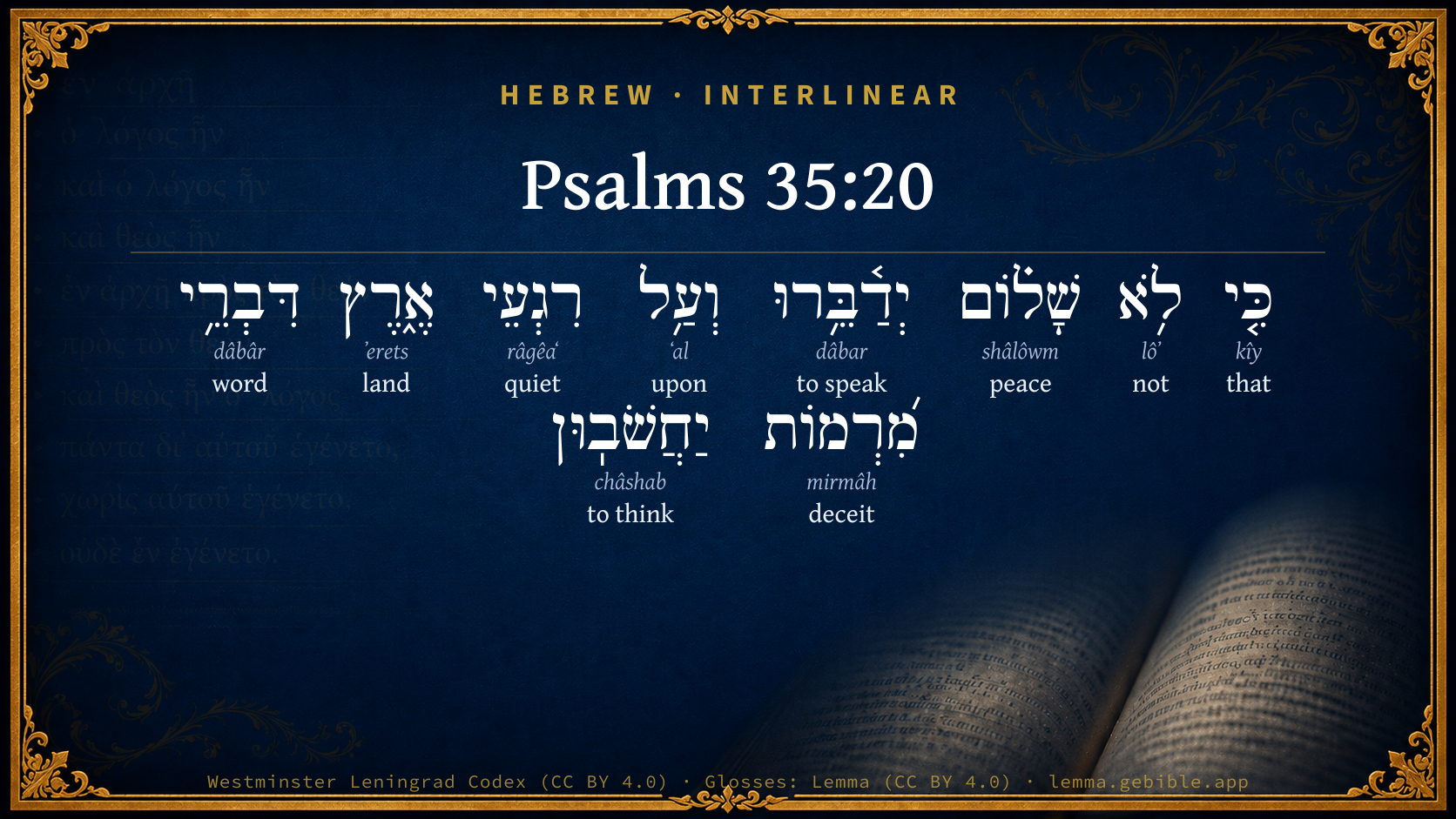
Psalms 35:20

Hebrew (Westminster Leningrad Codex) Psalms 35:20 appears in the Hebrew Old Testament. The text above is from the Westminster Leningrad Codex. Each word links to its Strong’s number, a concise gloss, and parsing drawn from the Open Scriptures Hebrew Bible morphology. Click any word for its full Brown-Driver-Briggs (BDB) entry.
Download image
Cite this verse

Psalms 35:20 (World English Bible). Public Domain. Lemma interlinear Bible study tool, https://lemma.gebible.app/v/psalms/35/20.

Show BibTeX & RIS
BibTeX
RIS
English Translation
For they don't speak peace, But they devise deceitful words against those who are quiet in the land.
World English Bible · Public Domain
Highlights
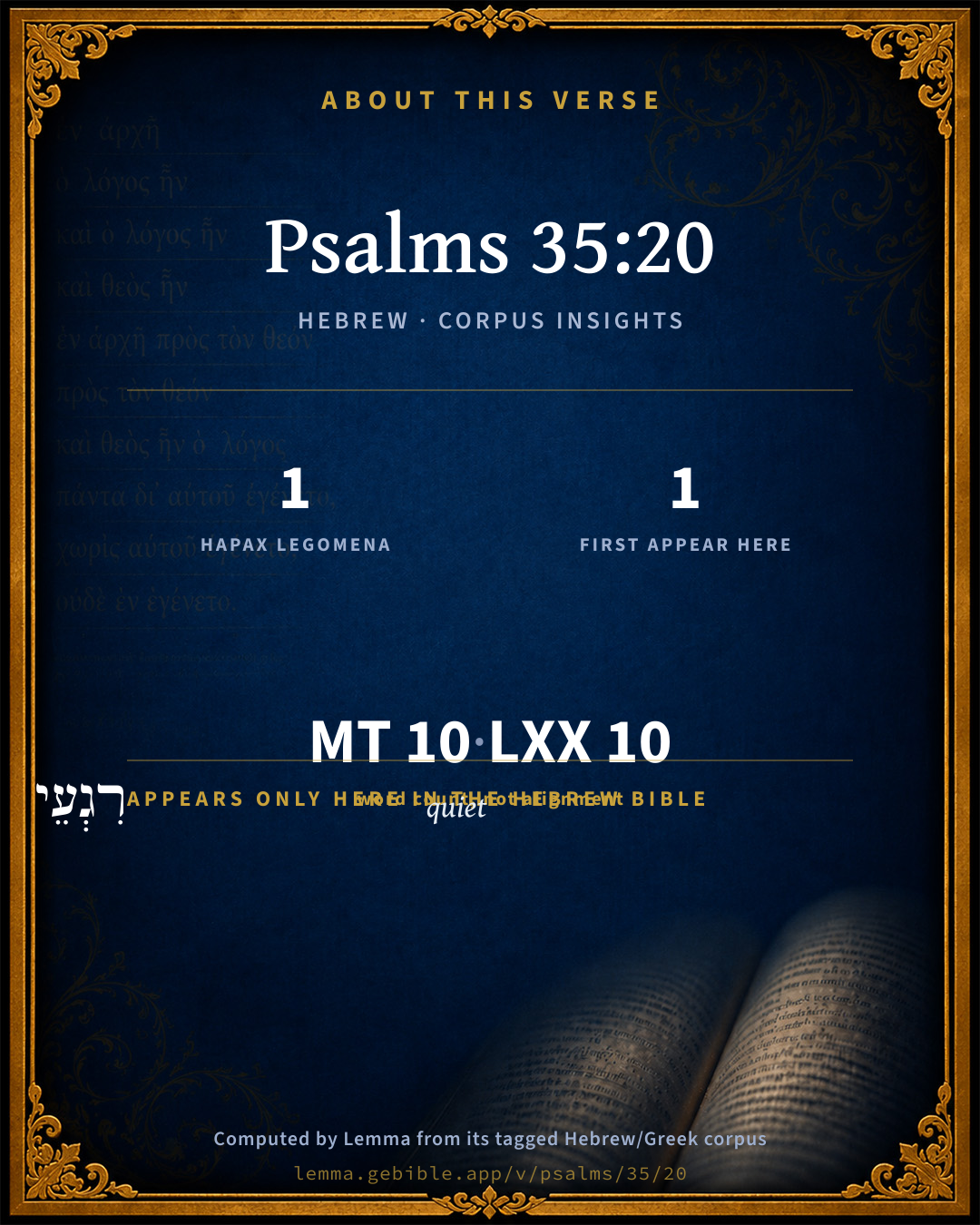
  • 1 hapax legomenon — only here in the Hebrew Bible
  • 1 first appearance in the Hebrew Bible
Full analysis ↓
Download a study sheet

One document with this verse’s original text, its word-by-word gloss line, the meaning frame, cross-references with their text, attributed commentary, and full source and license credits — printable, and it pastes into notes with its structure intact.

This verse Autodidact and up

Study sheet (.html) Plain text (.txt)

A passage Seminary Student

Up to 50 verses in one chapter. A passage sheet keeps up to 6 commentary sources and 12 cross-references per verse, in the order this page ranks them, and says so on the sheet whenever that leaves anything out. Ask for a single verse and you get the Autodidact verse sheet above.

Everything on this page stays free to read, with no account — the sheet is a download of what is already on screen, not access to it.

Want to remove ads? Support Godless Engineer
Compare translations 3

The same verse in 3 English versions, stacked beneath the original-language interlinear above. Click any original word for its lexicon entry.

Each is an independent rendering of the whole verse — the interlinear is not word-aligned to these translations.

Highlighted words mark where these versions differ — a whole-verse word diff, not a word-by-word alignment.

  • World English Bible Public Domain
    For they don't speak peace, But they devise deceitful words against those who are quiet in the land.
  • King James Version Public Domain
    For they speak not peace: but they devise deceitful matters against them that are quiet in the land.
  • unfoldingWord Literal Text CC BY-SA 4.0
    For they do not speak peace, and against the quiet of the earth they devise words of deceits.

unfoldingWord Literal Text — © unfoldingWord, licensed CC BY-SA 4.0. Word-aligned USFM3 via Door43 (git.door43.org/unfoldingWord/en_ult).

Versions to compare (up to 4)

3 of 4 selected

Show all 18 translations

Every available English version of this verse, each an independent rendering of the whole verse.

  • World English Bible Public Domain
    For they don't speak peace, But they devise deceitful words against those who are quiet in the land.
  • Berean Standard Bible Public Domain
    For they do not speak peace, but they devise deceitful schemes against those who live quietly in the land.
  • Majority Standard Bible Public Domain
    For they do not speak peace, but they devise deceitful schemes against those who live quietly in the land.
  • King James Version Public Domain
    For they speak not peace: but they devise deceitful matters against them that are quiet in the land.
  • American Standard Version (1901) Public Domain
    For they speak not peace; But they devise deceitful words against them that are quiet in the land.
  • Revised Version (1885) Public Domain
    For they speak not peace: but they devise deceitful words against them that are quiet in the land.
  • Geneva Bible (1599) Public Domain
    For they speake not as friendes: but they imagine deceitfull woordes against the quiet of the lande.
  • Douay-Rheims (1899) Public Domain
    For they spoke indeed peaceably to me; and speaking in the anger of the earth they devised guile.
  • Young's Literal Translation Public Domain
    For they speak not peace, And against the quiet of the land, Deceitful words they devise,
  • Literal Standard Version CC BY-SA 4.0
    For they do not speak peace, || And against the quiet of the land, || They devise deceitful words,
  • Unlocked Literal Bible CC BY-SA 4.0
    For they do not speak peace, but they devise deceitful words against those in our land who live in peace.
  • unfoldingWord Literal Text CC BY-SA 4.0
    For they do not speak peace, and against the quiet of the earth they devise words of deceits.
  • Darby Bible Public Domain
    For they speak not peace; and they devise deceitful words against the quiet in the land.
  • World Messianic Bible Public Domain
    For they don’t speak peace, but they devise deceitful words against those who are quiet in the land.
  • Webster's Bible Public Domain
    For they speak not peace: but they devise deceitful matters against them that are quiet in the land.
  • Free Bible Version CC BY-SA 4.0
    They are not looking for peace; they invent malicious and deceptive schemes against innocent peace-loving people.
  • Bible in Basic English Public Domain
    For they do not say words of peace; in their deceit they are designing evil things against the quiet ones in the land.
  • JPS Tanakh (1917) Public Domain
    For they speak not peace; but they devise deceitful matters against them that are quiet in the land.

Literal Standard Version (2020), Covenant Press — licensed CC BY-SA 4.0. Text via the HelloAO Bible API (eBible.org). Unlocked Literal Bible (unfoldingWord) — licensed CC BY-SA 4.0. Text via the HelloAO Bible API (eBible.org). unfoldingWord Literal Text — © unfoldingWord, licensed CC BY-SA 4.0. Word-aligned USFM3 via Door43 (git.door43.org/unfoldingWord/en_ult). Free Bible Version, Dr. Jonathan Gallagher — licensed CC BY-SA 4.0. Text via the HelloAO Bible API (eBible.org).

Word by word

More ways to search: Search by grammar → Find every occurrence → Compare this word →

Practice this passage: Drill this verse → Learn its vocabulary →

About this verse

These counts appear in no published source. They are computed here, from the morphology-tagged text and Lemma’s own curated glosses. What Lemma adds →

10
words
10
distinct lemmas
Wisdom
section

Notable vocabulary

1 hapax legomenon — a word that appears only here in the entire Hebrew Bible:

  • רִגְעֵי quiet H7282

First appearance in Scripture

This word makes its first canonical appearance in the Hebrew Bible here:

  • רִגְעֵי quiet H7282

Shared distinctive vocabulary

מִ֝רְמוֹת deceit H4820 occurs in 38 verses of the Hebrew Bible. Also found in:

Grammatical profile

  • 2 verbs
  • 4 nouns
  • 1 adjective
  • 1 preposition
  • 1 conjunction
  • 1 particle

Verb forms

  • יְדַ֫בֵּ֥רוּ Piel · Imperfect
  • יַחֲשֹׁבֽוּן Qal · Imperfect

Hebrew & Septuagint length

In English translation the verse runs 18 words from the Hebrew and 12 from the Septuagint (LXX English) — closely comparable.

A rough comparison of the two English renderings, which tokenize alike — not a word-level alignment.

Word counts can differ between the Hebrew and the Greek without any difference in meaning — e.g. the Hebrew direct-object marker אֵת has no separate Greek word, and Greek often adds the article ὁ.

In the original languages it is 10 Hebrew tokens and 10 Greek tokens — but the two are counted differently (Hebrew bundles its prefixes and suffixes into one token; the Greek is in lemma form), so that isn’t a like-for-like length.

Cross-references

15

Topical passages linked to Psalms 35:20 in the Treasury of Scripture Knowledge — connected by theme and wording, ordered by reader-vote popularity; previews shown in the World English Bible.

  • Matthew 26:4 They took counsel together that they might take Jesus by deceit, and kill him.
  • Jeremiah 11:19 But I was like a gentle lamb that is led to the slaughter; and I didn't know that they had devised devices against me, [saying], Let us destroy the tree with the fruit of it, and let us cut him off from the land of the living, that his name may be no more remembered.
  • 1 Peter 2:22–23 who did not sin, "neither was deceit found in his mouth."
  • Psalms 31:13 For I have heard the slander of many, terror on every side, While they conspire together against me, They plot to take away my life.
  • Psalms 36:3–4 The words of his mouth are iniquity and deceit. He has ceased to be wise and to do good.
  • Psalms 38:12 They also who seek after my life lay snares. Those who seek my hurt speak mischievous things, And meditate deceits all day long.
  • Psalms 52:2 Your tongue plots destruction, Like a sharp razor, working deceitfully.
  • Psalms 64:4–6 To shoot innocent men from ambushes. They shoot at him suddenly and fearlessly.
  • Psalms 120:5–7 Woe is me, that I live in Meshech, That I dwell among the tents of Kedar!
  • Psalms 140:2–5 Those who devise mischief in their hearts. They continually gather themselves together for war.
  • Daniel 6:5 Then said these men, We shall not find any occasion against this Daniel, except we find it against him concerning the law of his God.
  • Matthew 12:19 He will not strive, nor shout; Neither will anyone hear his voice in the streets.
  • Matthew 12:24 But when the Pharisees heard it, they said, "This man does not cast out demons, except by Beelzebul, the prince of the demons."
  • Acts 23:15 Now therefore, you with the council inform the commanding officer that he should bring him down to you tomorrow, as though you were going to judge his case more exactly. We are ready to kill him before he comes near."
  • Acts 25:3 asking a favor against him, that he would summon him to Jerusalem; plotting to kill him on the way.

Cross-references courtesy of OpenBible.info (CC BY 4.0).

Hebrew and Greek witnesses Masoretic Hebrew ↔ Greek Septuagint

The same verse in the two great witnesses to the Old Testament, shown verse-for-verse.

You’re reading Greek Psalm 34 (Hebrew Psalm 35). The Septuagint counts the superscription, so verse numbers can differ from the Hebrew — chapter-level alignment, not verse-by-verse. Numbering follows Rahlfs.

These are two independent witnesses, not word-aligned to each other, and the Septuagint is shown in lemma (dictionary) form.

Hebrew Psalms 35:20 Masoretic · Westminster Leningrad Codex

כִּ֤י לֹ֥א שָׁל֗וֹם יְדַ֫בֵּ֥רוּ וְעַ֥ל רִגְעֵי אֶ֑רֶץ דִּבְרֵ֥י מִ֝רְמוֹת יַחֲשֹׁבֽוּן

For they don't speak peace, But they devise deceitful words against those who are quiet in the land.

World English Bible · Public Domain

Greek LXX Greek Psalm 34:20 Septuagint · lemma form

ὅτι ἐγώ μέν εἰρηνικός λαλέω καί ἐπί ὀργή δόλος διαλογίζομαι

For to me they spoke peaceably, but imagined deceits in their anger.

LXX2012 (modern English Septuagint) · Public Domain

On this verse, John Gill's Exposition discusses the Septuagint’s reading. Read the note in Commentary ↓

Hebrew: Westminster Leningrad Codex (CC BY 4.0). Greek: Septuagint (public domain); English from LXX2012 (modern English Septuagint) (Public Domain). How the Septuagint differs from the Hebrew →

Commentary

Notes on Psalms 35:20 from classic Christian and Jewish commentators (each source and its license shown beneath its notes). The classic Christian expositions comment on the surrounding passage and are grouped to its opening verse, so a note may address several verses; the Jewish commentaries on the Tanakh (Rashi and others) are per-verse, so they appear only where the commentator wrote on this verse.

Lemma curates 59 commentaries, every one of them public domain or Creative Commons licensed, each selected and text-cleaned for this edition rather than reprinted as found. About our sources →

Trapp's Complete Commentary

John Trapp

Psa 35:20 For they speak not peace: but they devise deceitful matters against [them that are] quiet in the land.

Ver. 20. For they speak not peace] Which yet God doth to his people, Psa 85:9, and that is their comfort. "I am for peace," saith David elsewhere, "but when I speak, they are for war," Psa 120:7.

Against the quiet of the land] i.e. Against myself, and such as I am, who study to be quiet and to do our own business, 1Th 4:11, affecting rather quietness from the world than acquaintance with it.

John Trapp, A Commentary or Exposition upon All the Books of the Old and New Testament (1647–1656) — public domain. Text from a community e-Sword module.

The Biblical Illustrator

Joseph S. Exell

Psa_35:20

They devise deceitful matters against them that are quiet in the land.

Sin approaching the unsuspecting

There is no temptation, said John of Wesel, one of the greatest of the pre-Lutheran reformers, so great as not to be tempted at all. We have a vivid illustration of this in a picture given us by a late writer on natural history. When the wild horses of Mexico, he tells us, are grazing unconsciously in a prairie, there may sometimes be seen gathering in the distance a troop of wolves, whom hunger has driven out after food. At first the horses snuff up the scent and become alarmed, and as long as they continue so all is safe; for their fleetness puts a barrier between themselves and their assailants, which the latter are wholly unable to surmount. But so grave and innocent do the wolves look--so solely graminivorous and gentle--that their intended victims soon become relieved from all fear, and begin again quietly to graze upon the same spot. Presently, two of the older and more wary of the wolves stroll forth, as it were listlessly, and apparently for the mere purpose of pastime, sometimes advancing, sometimes retreating, and every now and then stopping to gambol with each other, as if to show their disengaged simplicity and buoyancy of heart. Again the horses become alarmed; but again, observing how very innocent and friendly their visitors appear, they fall once more to grazing secure on the fields. But the fatal moment has now come; and with an unerring spring, the nearest of the victims finds the fangs of one of his gaunt and wily pursuers fastened in his haunches, and those of another in his neck, and in a moment he is covered by the whole of the greedy pack that has been thus waiting till this moment to dash upon his prostrate frame. So it is that sin presents itself to the incautious soul. First it lounges listlessly in the distance, as if to show its harmlessness and disengagedness of purpose. Then, when suspicion is disarmed, it comes nearer still, gambolling about as if it was mere pastime. It is not till the soul feels its fangs that it discovers that it is now the victim and slave of a master whose bitter and cruel yoke must be borne, not only through time, but through eternity. (The Preachers Lantern.)

The Biblical Illustrator, edited by Joseph S. Exell (c. 1880s–1900s) — public domain. Text from a community e-Sword module.

J. A. Alexander on Psalms

Joseph Addison Alexander

20. (Psa 35:20) For not peace will they speak, and against the quiet of the land words of deceits will they devise. The for assigns a reason why they ought not to be suffered to rejoice in the success of their designs. The reason is, because their design, are evil, tending not to peace—in the strict sense, as opposed to strife, or in the wide sense, as opposed to trouble and calamity —but to the disturbance of those who are peacefully inclined, the quiet (or tranquil) of the land, i. e. the land of promise, considered as the home of God's chosen people, who, as its rightful proprietors, are characteristically peaceful, and averse from all strife and disorder. Compare Mat 5:5. To disturb these, the wicked devise words of deceits, in which phrase words is not an idiomatic pleonasm,—compare Psa 41:9 (8), Psa 65:4 (3), —but a substantive expression, meaning false (or lying) words, and more specifically slanders—see below, Psa 36:4 (3)—the utterers of which are called lying enemies in Psa 35:19. The futures of this verse include the present: they do so now and will do so still. Some connect not peace as an emphatic compound, meaning just the opposite of peace. Compare Isa 10:15.

Joseph Addison Alexander, The Psalms Translated and Explained (1850) — public domain. Text from a community e-Sword module.

Geneva Bible (1599)

Geneva Bible translators

Or, clefts of the earth: meaning, himself and others in their misery.

Geneva Bible (1599) marginal notes — public domain. Text via Bolls.life.

Jamieson, Fausset & Brown

Robert Jamieson, A. R. Fausset & David Brown

deceitful matters--or, "words of deceit."

quiet in the land--the pious lovers of peace.

Jamieson, Fausset & Brown — Commentary Critical and Explanatory on the Whole Bible (1871) — public domain (CC PDM 1.0). Text via the HelloAO Bible API.

John Calvin's Commentaries

In the following verse, that he may cherish still greater confidence in God, David again declares, that he has to do with enemies of an irreconcilable character, and who are fully bent upon cruelty. Of this we ought to be firmly persuaded, that the more grievously we are oppressed, so much the more certainly ought we to expect deliverance. He therefore says, that they speak of nothing but of tumults and slaughter. The meaning of the latter clause is somewhat obscure, arising from the ambiguous signification of the word רגע, rige. As the word from which it is derived sometimes signifies to cut, and sometimes to rest, or to be quiet and peaceable, there are some who translate it the meek and peaceable of the earth: others translate it, with the tranquil and easy of the earth; meaning by this, those who live in the midst of riches and abundance, in the enjoyment of undisturbed repose. Both these seem to me to be forced interpretations. Others, too, though not more correctly, expound the word in caves or secret places, in order that, as they say, the wicked and deceitful counsels of such persons may not come to light. But it may be very appropriately rendered, the clefts of the earth, and by this metaphor are meant the miserable and afflicted, who are, as it were, broken and maimed. David, therefore, declares that as soon as his enemies see any opening, that is to say, some calamity befall him, they instantly put forth all their efforts to accomplish his destruction. Those who, in the time of his prosperity and power, never dared even to utter a word against him, began now, when they saw that his influence was feeble, to plot his ruin, just as we know that the wicked are for the most part persons of a servile and cowardly disposition, and assume not the tone of insolence save when an advantageous opportunity presents itself, as when the good and simple are in adversity. To the same purpose he represents them in the next verse, as crying out with open mouth, Aha! aha! and clapping their hands for joy that they saw David overcome, and, as it were, laid prostrate in the dust, a spectacle in which they took great delight.

John Calvin's Commentaries (1540-1563) — public domain. Text from the Calvin Translation Society English edition (1840s-50s) via the Christian Classics Ethereal Library (ccel.org). Calvin's coverage is partial (roughly two-thirds of the Bible); uncommented books and verses are honest gaps, never fabricated. The 19th-century editor's footnotes and remarks are omitted so the notes are faithfully Calvin's own voice.

Ellicott's Commentary for English Readers

(20) Quiet in the land.—For the construction, comp. Isa_23:8 : “The honourable of the earth.” They are evidently the pious Jews who wished to preserve their national life and religion against foreign influence and intervention, and certainly among them were Levites.

A Bible Commentary for English Readers, edited by Charles John Ellicott (1878–1897) — public domain. Text from a community e-Sword module.

The Cambridge Bible for Schools and Colleges

gen. ed. J. J. S. Perowne

20. Their conduct is just the opposite of ‘the fear of the Lord’ (Psa_34:13-14). For it is not peace that they speak, but against them that are quiet in the land they imagine words of guile, accusing them of being ‘troublers of Israel’ and disturbers of the peace.

The Cambridge Bible for Schools and Colleges (gen. ed. J. J. S. Perowne; Cambridge University Press, 1878–1918) — public domain. Text from a community e-Sword module.

John Gill's Exposition

For they speak not peace,.... Meaning to himself, or any good man; as Joseph's brethren could not to him, Gen 37:4; such were the men David had to do with, Psa 120:6; and such were the enemies of Christ, who could not give him a good word, nor speak one to him, Joh 10:20; and such are the enemies of his people, who breathe out nothing but threatenings and slaughter, and not anything that tends to peace, to promote and maintain it. Some versions, as the Septuagint, and they that follow that, render it, "they do speak peace to me"; but then it was in an hypocritical way, as in Psa 28:3; and as the Jews did to Christ, Mat 22:16; for it follows:

but they devise deceitful matters against them that are quiet in the land; meaning not the wicked, as Kimchi thinks; the rich, who live at ease and in quietness, having as much as heart can wish, "with" whom, as he renders it, David's enemies devised mischief in a deceitful way; but the righteous of the earth, as the Targum; such as David and his men were, who desired to live peaceable and quiet lives under Saul's government; and had no intention to disturb his government, or wrest the crown from him; and as the Messiah, David's son, was, "the humble one in the earth"; as the Arabic version renders it in the singular number; a character that well agrees with Christ, who showed great humility in coming into this world, and during his stay in it; it was a state of humiliation with him, and in which he behaved in the most lowly and humble manner; he was the quiet one in the land; he strove not, nor cried, nor was his voice heard in the street; he was not noisy and clamorous, quarrelsome and litigious; but all the reverse; he bore all insults, reproaches, and sufferings, patiently and quietly: and such are his people, so far as they are influenced by his grace and Spirit; they are quiet and peaceable in kingdoms, cities, and neighbourhoods, and in the churches of God; and yet the wicked are continually plotting against them, and devising things, to their hurt.

John Gill's Exposition of the Whole Bible (1746–1763) — public domain (CC PDM 1.0). Text via the HelloAO Bible API.

Albert Barnes' Notes on the Bible

For they speak not peace - They seek a quarrel. They are unwilling to be on good terms with others, or to live in peace with them. The idea is that they were “disposed” or “inclined” to quarrel. Thus we speak now of persons who are “quarrelsome.

They devise deceitful matters - literally, “they think of words of deceit.” That is, they set their hearts on misrepresentation, and they study such misrepresentations as occasions for strife with others. They falsely represent my character; they attribute conduct to me of which I am not guilty; they pervert my words; they state that to be true which never occurred, and thus they attempt to justify their own conduct. Almost all the quarrels in the world, whether pertaining to nations, to neighborhoods, to families, or to individuals, are based on some “misrepresentation” of facts, designed or undesigned, and could have been avoided if men had been willing to look at facts as they are, or perfectly understood each other.

Against them that are quiet in the land - That are disposed to be quiet, or that are inclined to live in peace with those around them. The word rendered “quiet” means literally those who are “timid;” then, those who shrink back, and gather together from fear; then, those in general who are disposed to be peaceful and quiet, or who are indisposed to contention and strife. David implicitly asserts himself to be one of that class; a man who preferred peace to war, and who had no disposition to keep up a strife with his neighbors.

Albert Barnes' Notes on the Bible (1834–1885) — public domain. Text from a community e-Sword/MySword module.

Matthew Poole's English Annotations

Verse 20. They are enemies to all peaceable counsels; they breathe out nothing but threatenings and war. They use not only open violence, but deceit, and subtle artifices, against me and my followers, who desire nothing more than to live quietly and peaceably under Saul’s government.

Matthew Poole's English Annotations on the Holy Bible (1683–1685) — public domain. Text from a community e-Sword/MySword module.

The Treasury of David

Charles H. Spurgeon

Verse 20. ["For they speak not peace."] They love it not; how can they speak it? They are such troublers themselves that they cannot judge others to be peaceable. Out of the mouth comes what is in the heart. Riotous men charge others with sedition. ["They devise deceitful matters against them that are quiet in the land."] David would fain have been an orderly citizen, but they laboured to make him a rebel. He could do nothing aright, all his dealings were misrepresented. This is an old trick of the enemy to brand good men with S.S. on their cheeks, as sowers of sedition, though they have ever been a harmless race, like sheep among wolves. When mischief is meant, mischief is soon made. Unscrupulous partisans could even charge Jesus with seeking to overturn Csar, much more will they thus accuse his household. At this very hour, those who stand up for the crown rights of King Jesus are called enemies of the church, favourers of Popery, friends of Atheists, levellers, red republicans, and it were hard to say what besides. Billingsgate and Babylon are in league.

None.

None.

Charles H. Spurgeon's The Treasury of David (1869–1885) — public domain. Psalms only. Text from a community e-Sword/MySword module.

Whedon's Commentary on the Bible

Daniel D. Whedon

20. Quiet in the land—The peaceable, inoffensive ones—the pious.

Daniel D. Whedon (gen. ed.), Commentary on the Old and New Testaments (1874–1909) — public domain. Text from a community e-Sword module.

The Pulpit Commentary

For they speak not peace. Once more the language of complaint. David"s enemies, though they have driven him from the court, and made him a fugitive and a wanderer, were not yet satisfied. They did not speak him peace. They continued to scheme against him. But they devise deceitful matters against them that are quiet in the land. David, if let alone, was willing enough to have remained "quiet in the land." He was a fugitive and an outlaw; but, could he have obtained a safe refuge the cave of Adullam, or any other would gladly have remained peacefully within it. But his enemies would not allow him to remain quiet. They stirred up the jealousy and hatred of Saul by false tales, and caused him to be "hunted upon the mountains". (1Sa_26:20)

The Pulpit Commentary (1880–1919), ed. H.D.M. Spence-Jones & Joseph S. Exell — public domain. Text from a community e-Sword module.

John Wesley's Explanatory Notes

For - They breathe out nothing but threatenings and war; they use not open violence but subtile artifices, against me and my followers, who desire nothing more than to live quietly and peaceably.

John Wesley, Explanatory Notes Upon the Whole Bible (1754–1765) — public domain. Text via the GEBible commentary corpus.

Rashi

Rabbi Shlomo Yitzchaki (Rashi)

and against the crushed people of the earth Heb. רגעי, on the crushed people of the earth, and so (in Jer. 31:34): “Who stirs up (רגע) the sea”; (Job 7:5), “my skin wrinkled (רגע).” And so did Dunash explain it.

Rashi on the Tanakh — English translations: “The Judaica Press complete Tanach with Rashi, translated by A. J. Rosenberg” (CC BY 4.0); “Pentateuch with Rashi's commentary by M. Rosenbaum and A.M. Silbermann, 1929-1934” (public domain); “The Metsudah Tanach series, Lakewood, N.J” (CC BY 4.0); and “The Book of Joshua, Metsudah Publications, 1997” (CC BY 4.0). Text via Sefaria.

Lesson kit

Teaching starters — assembled from the data on this page, not authored interpretation. Every prompt links to the verse data it draws on. Edit before teaching.

Psalms, in the Wisdom, opens this verse with 10 words (10 distinct Hebrew lemmas). Its most distinctive word is râgêaʻ (“quiet”). A historical commentator’s framing appears above. Read the whole chapter for the surrounding context.

Discussion questions

  1. The word râgêaʻ carries the sense “quiet.” How does it shape the verse?
  2. This verse holds 1 word here found nowhere else in the Hebrew Bible. What might the rare word draw attention to?
  3. The word “quiet” first appears here in Scripture. What is being introduced at this debut?
  4. Genesis 27:35 shares the word «deceit» with this verse. How do the two illuminate each other?
  5. These translations render this verse differently. What is at stake in choosing one wording over another?
  6. The verb «יְדַ֫בֵּ֥רוּ» is Piel Imperfect. How does its form color the action?
  7. Reading how Trapp's Complete Commentary and The Biblical Illustrator read this verse, where do the two commentators agree and where do they part?

Things to notice

Reading settings

Reading text

Shown beneath each verse's original-language words.

Old Testament
Old Testament edition

Read the OT as the Masoretic Hebrew (MT) or the Greek Septuagint (LXX).

English shown for the Greek Septuagint (in the Hebrew ↔ Greek comparison).

Comparing translations? Open the Compare panel on any verse page to stack up to four side by side.