
Psalms 17:6

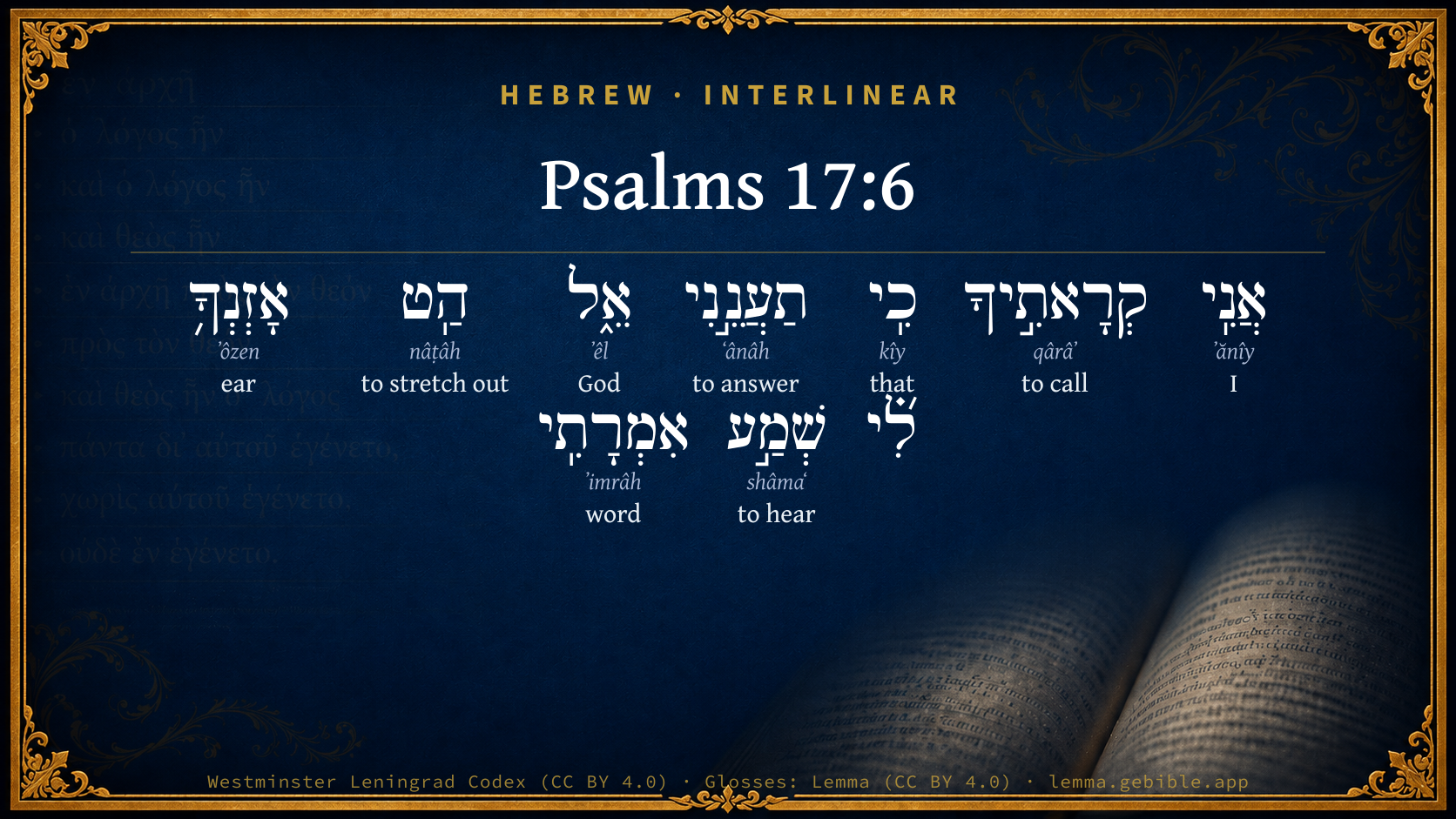
Hebrew (Westminster Leningrad Codex) Psalms 17:6 appears in the Hebrew Old Testament. The text above is from the Westminster Leningrad Codex. Each word links to its Strong’s number, a concise gloss, and parsing drawn from the Open Scriptures Hebrew Bible morphology. Click any word for its full Brown-Driver-Briggs (BDB) entry.
Download image
Cite this verse

Psalms 17:6 (World English Bible). Public Domain. Lemma interlinear Bible study tool, https://lemma.gebible.app/v/psalms/17/6.

Show BibTeX & RIS
BibTeX
RIS
English Translation
I have called on you, for you will answer me, God: Turn your ear to me. Hear my speech.
World English Bible · Public Domain
Download a study sheet

One document with this verse’s original text, its word-by-word gloss line, the meaning frame, cross-references with their text, attributed commentary, and full source and license credits — printable, and it pastes into notes with its structure intact.

This verse Autodidact and up

Study sheet (.html) Plain text (.txt)

A passage Seminary Student

Up to 50 verses in one chapter. A passage sheet keeps up to 6 commentary sources and 12 cross-references per verse, in the order this page ranks them, and says so on the sheet whenever that leaves anything out. Ask for a single verse and you get the Autodidact verse sheet above.

Everything on this page stays free to read, with no account — the sheet is a download of what is already on screen, not access to it.

Want to remove ads? Support Godless Engineer
Compare translations 3

The same verse in 3 English versions, stacked beneath the original-language interlinear above. Click any original word for its lexicon entry.

Each is an independent rendering of the whole verse — the interlinear is not word-aligned to these translations.

Highlighted words mark where these versions differ — a whole-verse word diff, not a word-by-word alignment.

  • World English Bible Public Domain
    I have called on you, for you will answer me, God: Turn your ear to me. Hear my speech.
  • King James Version Public Domain
    I have called upon thee, for thou wilt hear me, O God: incline thine ear unto me, and hear my speech.
  • unfoldingWord Literal Text CC BY-SA 4.0
    I have called upon you, for you will answer me, God; Incline your ear to me; listen to my speech.

unfoldingWord Literal Text — © unfoldingWord, licensed CC BY-SA 4.0. Word-aligned USFM3 via Door43 (git.door43.org/unfoldingWord/en_ult).

Versions to compare (up to 4)

3 of 4 selected

Show all 18 translations

Every available English version of this verse, each an independent rendering of the whole verse.

  • World English Bible Public Domain
    I have called on you, for you will answer me, God: Turn your ear to me. Hear my speech.
  • Berean Standard Bible Public Domain
    I call on You, O God, for You will answer me. Incline Your ear to me; hear my words.
  • Majority Standard Bible Public Domain
    I call on You, O God, for You will answer me. Incline Your ear to me; hear my words.
  • King James Version Public Domain
    I have called upon thee, for thou wilt hear me, O God: incline thine ear unto me, and hear my speech.
  • American Standard Version (1901) Public Domain
    I have called upon thee, for thou wilt answer me, O God: Incline thine ear unto me, `and' hear my speech.
  • Revised Version (1885) Public Domain
    I have called upon thee, for thou wilt answer me, O God: incline thine ear unto me, and hear my speech.
  • Geneva Bible (1599) Public Domain
    I haue called vpon thee: surely thou wilt heare me, O God: incline thine eare to me, and hearken vnto my wordes.
  • Douay-Rheims (1899) Public Domain
    I have cried to thee, for thou, O God, hast heard me: O incline thy ear unto me, and hear my words.
  • Young's Literal Translation Public Domain
    I -- I called Thee, for Thou dost answer me, O God, incline Thine ear to me, hear my speech.
  • Literal Standard Version CC BY-SA 4.0
    I called You, for You answer me, || O God, incline Your ear to me, hear my speech.
  • Unlocked Literal Bible CC BY-SA 4.0
    I call to you, for you answer me, God; turn your ear to me and listen when I speak.
  • unfoldingWord Literal Text CC BY-SA 4.0
    I have called upon you, for you will answer me, God; Incline your ear to me; listen to my speech.
  • Darby Bible Public Domain
    I have called upon thee, for thou answerest me, O ùGod. Incline thine ear unto me, hear my speech.
  • World Messianic Bible Public Domain
    I have called on you, for you will answer me, God. Turn your ear to me. Hear my speech.
  • Webster's Bible Public Domain
    I have called upon thee, for thou wilt hear me, O God: incline thy ear to me, and hear my speech.
  • Free Bible Version CC BY-SA 4.0
    God, I call out to you because I know you will answer; please listen carefully to what I have to say.
  • Bible in Basic English Public Domain
    My cry has gone up to you, for you will give me an answer, O God: let your ear be turned to me, and give attention to my words.
  • JPS Tanakh (1917) Public Domain
    As for me, I call upon Thee, for Thou wilt answer me, O God; incline Thine ear unto me, hear my speech.

Literal Standard Version (2020), Covenant Press — licensed CC BY-SA 4.0. Text via the HelloAO Bible API (eBible.org). Unlocked Literal Bible (unfoldingWord) — licensed CC BY-SA 4.0. Text via the HelloAO Bible API (eBible.org). unfoldingWord Literal Text — © unfoldingWord, licensed CC BY-SA 4.0. Word-aligned USFM3 via Door43 (git.door43.org/unfoldingWord/en_ult). Free Bible Version, Dr. Jonathan Gallagher — licensed CC BY-SA 4.0. Text via the HelloAO Bible API (eBible.org).

Word by word

More ways to search: Search by grammar → Find every occurrence → Compare this word →

Practice this passage: Drill this verse → Learn its vocabulary →

אִמְרָתִֽי
ʼimrâh
H565
“word · my”
Noun, Common, Feminine, Singular, Construct + Suffix, Personal, 1st Person, Common, Singular
Part of Speech
Noun
Type
Common
Gender
Feminine
Number
Singular
State
Construct
Full BDB Definition

Origin: from H561

TWOT: 118b

utterance, speech, word - word of God, the Torah
  1. אֲנִֽי ʼănîy H589 “I” Pronoun, Personal, 1st Person, Common, Singular
  2. קְרָאתִ֣יךָ qârâʼ H7121 “to call · you” Verb, Qal, Perfect, 1st Person, Common, Singular + Suffix, Personal, 2nd Person, Masculine, Singular
  3. כִֽי kîy H3588 “that” Conjunction
  4. תַעֲנֵ֣נִי ʻânâh H6030 “to answer · me” Verb, Qal, Imperfect, 2nd Person, Masculine, Singular + Suffix, Personal, 1st Person, Common, Singular
  5. אֵ֑ל ʼêl H410 “God” Noun, Common, Masculine, Singular, Absolute
  6. הַֽט nâṭâh H5186 “stretch out” Verb, Hiphil, Imperative, 2nd Person, Masculine, Singular
  7. אָזְנְךָ֥ ʼôzen H241 “ear · your” Noun, Common, Feminine, Singular, Construct + Suffix, Personal, 2nd Person, Masculine, Singular
  8. שְׁמַ֣ע shâmaʻ H8085 “hear” Verb, Qal, Imperative, 2nd Person, Masculine, Singular

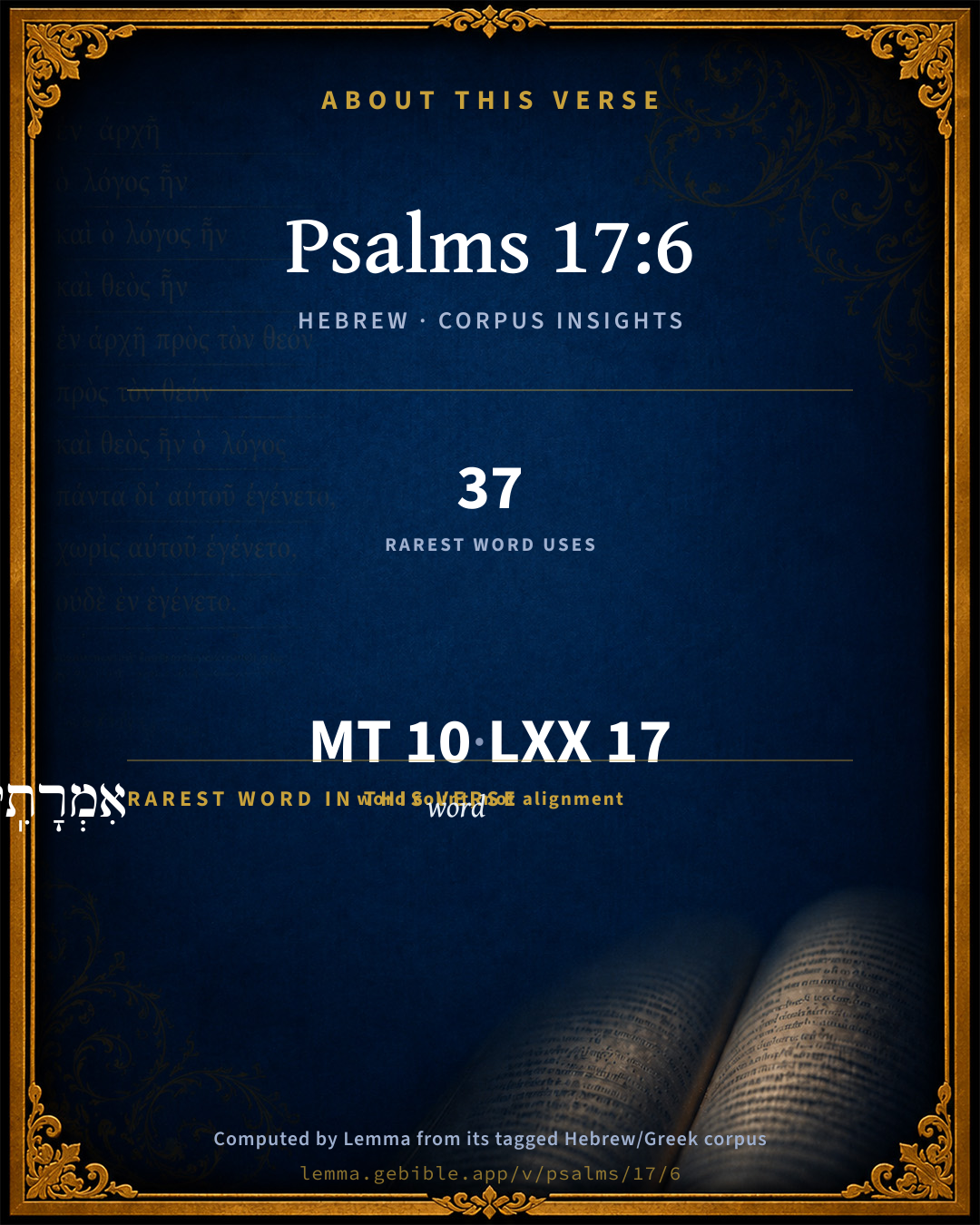
About this verse

These counts appear in no published source. They are computed here, from the morphology-tagged text and Lemma’s own curated glosses. What Lemma adds →

10
words
9
distinct lemmas
Wisdom
section

Shared distinctive vocabulary

אִמְרָתִֽי word H565 occurs in 35 verses of the Hebrew Bible. Also found in:

Grammatical profile

  • 4 verbs
  • 3 nouns
  • 1 pronoun
  • 1 preposition
  • 1 conjunction

Verb forms

  • קְרָאתִ֣יךָ Qal · Perfect
  • תַעֲנֵ֣נִי Qal · Imperfect
  • הַֽט Hiphil · Imperative
  • שְׁמַ֣ע Qal · Imperative

Hebrew & Septuagint length

In English translation the verse runs 19 words from the Hebrew and 19 from the Septuagint (LXX English) — the same length.

A rough comparison of the two English renderings, which tokenize alike — not a word-level alignment.

Word counts can differ between the Hebrew and the Greek without any difference in meaning — e.g. the Hebrew direct-object marker אֵת has no separate Greek word, and Greek often adds the article ὁ.

In the original languages it is 10 Hebrew tokens and 17 Greek tokens — but the two are counted differently (Hebrew bundles its prefixes and suffixes into one token; the Greek is in lemma form), so that isn’t a like-for-like length.

Cross-references

9

Topical passages linked to Psalms 17:6 in the Treasury of Scripture Knowledge — connected by theme and wording, ordered by reader-vote popularity; previews shown in the World English Bible.

  • Psalms 116:2 Because he has turned his ear to me, Therefore I will call on him as long as I live.
  • Psalms 86:7 In the day of my trouble I will call on you, For you will answer me.
  • Psalms 66:19–20 But most assuredly, God has listened. He has heard the voice of my prayer.
  • Psalms 88:2 Let my prayer enter into your presence. Turn your ear to my cry.
  • Psalms 55:16 As for me, I will call on God. Yahweh will save me.
  • Isaiah 37:17 Turn your ear, Yahweh, and hear; open your eyes, Yahweh, and behold; and hear all the words of Sennacherib, who has sent to defy the living God.
  • Daniel 9:17–19 Now therefore, our God, listen to the prayer of your servant, and to his petitions, and cause your face to shine on your sanctuary that is desolate, for the Lord's sake.
  • Isaiah 37:20 Now therefore, Yahweh our God, save us from his hand, that all the kingdoms of the earth may know that you are Yahweh, even you only.
  • Psalms 13:3–4 Behold, and answer me, Yahweh, my God. Give light to my eyes, lest I sleep in death;

Cross-references courtesy of OpenBible.info (CC BY 4.0).

Hebrew and Greek witnesses Masoretic Hebrew ↔ Greek Septuagint

The same verse in the two great witnesses to the Old Testament, shown verse-for-verse.

You’re reading Greek Psalm 16 (Hebrew Psalm 17). The Septuagint counts the superscription, so verse numbers can differ from the Hebrew — chapter-level alignment, not verse-by-verse. Numbering follows Rahlfs.

These are two independent witnesses, not word-aligned to each other, and the Septuagint is shown in lemma (dictionary) form.

Hebrew Psalms 17:6 Masoretic · Westminster Leningrad Codex

אֲנִֽי קְרָאתִ֣יךָ כִֽי תַעֲנֵ֣נִי אֵ֑ל הַֽט אָזְנְךָ֥ לִ֝֗י שְׁמַ֣ע אִמְרָתִֽי

I have called on you, for you will answer me, God: Turn your ear to me. Hear my speech.

World English Bible · Public Domain

Greek LXX Greek Psalm 16:6 Septuagint · lemma form

ἐγώ κράζω ὅτι ἐπιἀκούω ἐγώ ὁ θεός κλίνω ὁ οὖς σύ ἐγώ καί εἰςἀκούω ὁ ῥῆμα ἐγώ

I have cried, for you heard me, O God: incline your ear to me, and listen to my words.

LXX2012 (modern English Septuagint) · Public Domain

On this verse, John Calvin's Commentaries discusses the Septuagint’s reading. Read the note in Commentary ↓

Hebrew: Westminster Leningrad Codex (CC BY 4.0). Greek: Septuagint (public domain); English from LXX2012 (modern English Septuagint) (Public Domain). How the Septuagint differs from the Hebrew →

Commentary

Notes on Psalms 17:6 from classic Christian and Jewish commentators (each source and its license shown beneath its notes). The classic Christian expositions comment on the surrounding passage and are grouped to its opening verse, so a note may address several verses; the Jewish commentaries on the Tanakh (Rashi and others) are per-verse, so they appear only where the commentator wrote on this verse.

Lemma curates 59 commentaries, every one of them public domain or Creative Commons licensed, each selected and text-cleaned for this edition rather than reprinted as found. About our sources →

Trapp's Complete Commentary

John Trapp

Psa 17:6 I have called upon thee, for thou wilt hear me, O God: incline thine ear unto me, [and hear] my speech.

Ver. 6. I have called upon thee, for thou wilt hear me] q.d. Thou wast always wont to hear me, and therefore I presume thou wilt. Experience breeds confidence.

Incline thine ear] See how he reinforceth his former request; as if he would wring the blessing out of God’s hands by a holy violence, and take no denial.

John Trapp, A Commentary or Exposition upon All the Books of the Old and New Testament (1647–1656) — public domain. Text from a community e-Sword module.

Joseph Benson's Commentary

Psa 17:6. I have called upon thee — It hath been, still is, and shall be, my constant course, to apply myself to thee for assistance and deliverance. For thou wilt hear, O God — Though thou mayest delay for a season, I am well assured that thou wilt hear and answer me.

Joseph Benson's Commentary on the Old and New Testaments (1811–1818) — public domain. Text from a community e-Sword module.

J. A. Alexander on Psalms

Joseph Addison Alexander

6. (Psa 17:6) I have invoked thee because thou wilt answer me, O God! Incline thine ear to me, hear my speech. The alternation of the tenses is significant. "I have invoked thee heretofore, and do so still, because I know that thou wilt hear me." It is needless to observe how much the sentence is enfeebled by the change of either to the present.—Thou wilt hear me, in the pregnant sense of hearing graciously or answering a prayer. See above, on Psa 3:5 (4). —O (mighty) God! The divine name here used is the one denoting God's omnipotence. See above, Psa 5:5 (4), Psa 7:12 (11), Psa 10:11-12; Psa 16:1. —My speech, what I say, from the Hebrew means "to say."

Joseph Addison Alexander, The Psalms Translated and Explained (1850) — public domain. Text from a community e-Sword module.

Tyndale Open Study Notes

Tyndale Open Resources

17:6-9 This prayer for God’s care returns to the petition begun in 17:1-2 for redemption from evil.

Tyndale Open Study Notes — © Tyndale Open Resources, licensed CC BY-SA 4.0. Text via the HelloAO Bible API.

Geneva Bible (1599)

Geneva Bible translators

He was assured that God would not refuse his request.

Geneva Bible (1599) marginal notes — public domain. Text via Bolls.life.

Jamieson, Fausset & Brown

Robert Jamieson, A. R. Fausset & David Brown

wilt hear me--that is, graciously (Psa 3:4).

Jamieson, Fausset & Brown — Commentary Critical and Explanatory on the Whole Bible (1871) — public domain (CC PDM 1.0). Text via the HelloAO Bible API.

Adam Clarke's Commentary

Verse 6. Incline thine ear unto me] David prayed from a conviction that God would hear: but he could not be satisfied unless he received an answer. In a believer's mind the petition and the answer should not be separated.

Adam Clarke's Commentary on the Bible (1810–1826) — public domain. Text from a community e-Sword/MySword module.

John Calvin's Commentaries

6. I have called upon thee, etc. This verb being put in the past tense denotes a continued act; and, therefore, it includes the present time. The Hebrew word כי, ki, which we translate surely, often signifies because, and if it is so understood in this passage, the meaning will be, that David took encouragement to pray, because, depending upon the promise of God, he hoped that his prayers would not be in vain. But, perhaps, it may be thought preferable to change the tense of the verb as some do, so as to give this meaning, I will pray, because I have hitherto experienced that thou hast heard The Septuagint renders the verb in the past tense, “Επηκουσας μου,” “Thou hast heard me.” The Syriac and Vulgate give a similar rendering. The verb, in the Hebrew, is in the future; but it is a common thing in Hebrew to use the future tense for the past.

John Calvin's Commentaries (1540-1563) — public domain. Text from the Calvin Translation Society English edition (1840s-50s) via the Christian Classics Ethereal Library (ccel.org). Calvin's coverage is partial (roughly two-thirds of the Bible); uncommented books and verses are honest gaps, never fabricated. The 19th-century editor's footnotes and remarks are omitted so the notes are faithfully Calvin's own voice.

Ellicott's Commentary for English Readers

(6) I—is emphatic, “As for me, I,” &c.

A Bible Commentary for English Readers, edited by Charles John Ellicott (1878–1897) — public domain. Text from a community e-Sword module.

The Cambridge Bible for Schools and Colleges

gen. ed. J. J. S. Perowne

6. I have called upon thee] I is emphatic. Being such an one as I am, I have called upon Thee, in full confidence that Thou wilt answer me.

O God] El, as in Psa_16:1. See note on Psa_5:4.

hear] Wrongly printed in italics in many editions.

6–9. After protesting his integrity he resumes his prayer.

The Cambridge Bible for Schools and Colleges (gen. ed. J. J. S. Perowne; Cambridge University Press, 1878–1918) — public domain. Text from a community e-Sword module.

John Gill's Exposition

I have called upon thee,.... In prayer. This had been the constant practice of the psalmist, and he still continued in it;

for thou wilt hear me, O God; God is a God hearing prayer; he is used to hear his people, and they have frequent experience of it, and they may be assured that whatsoever they ask according to his will, and in the name of Christ, he will hear; and such an assurance is a reason engaging the saints to a constant calling upon God, Psa 116:2; and such confidence of being always heard Christ had, Joh 11:41;

incline thine ear unto me, and hear my speech; meaning his prayer, which he now directed to him in full assurance of being heard, and is as follows.

John Gill's Exposition of the Whole Bible (1746–1763) — public domain (CC PDM 1.0). Text via the HelloAO Bible API.

Albert Barnes' Notes on the Bible

I have called upon thee for thou wilt hear me, O God - The meaning of this is, “I have called on thee heretofore, and will do it still, because I am certain that thou wilt hear me.” That is, he was encouraged to call upon God by the conviction that he would hear his prayer, and would grant his request. In other words, he came to God in faith; in the full belief of his readiness to answer prayer, and to bestow needed blessings. Compare Joh 11:42; Heb 11:6.

Incline thine ear unto me - See the notes at Psa 17:1.

My speech - My prayer. The reference here, as in Psa 17:1, is to prayer “uttered” before God; and not mere mental prayer.

Albert Barnes' Notes on the Bible (1834–1885) — public domain. Text from a community e-Sword/MySword module.

Matthew Poole's English Annotations

I have called upon thee; it hath been, and still is, and shall be my constant course to apply myself to thee for assistance and for deliverance.

For thou wilt hear me, O God; for though thou mayst delay for a season, I am well assured that thou wilt hear and answer me.

Matthew Poole's English Annotations on the Holy Bible (1683–1685) — public domain. Text from a community e-Sword/MySword module.

The Treasury of David

Charles H. Spurgeon

Ver. 6. I have called upon thee, for thou wilt hear me, O God. Thou hast always heard me, O my Lord, and therefore I have the utmost confidence in again approaching thine altar. Experience is a blessed teacher. He who has tried the faithfulness of God in hours of need, has great boldness in laying his case before the throne. The well of Bethlehem, from which we drew such cooling draughts in years gone by, our souls long for still; nor will we leave it for the broken cisterns of earth.

Incline thine ear unto me, and hear my speech. Stoop out of heaven and put thine ear to my mouth; give me thine ear all to myself, as men do when they lean over to catch every word from their friend. The Psalmist here comes back to his first prayer, and thus sets us an example of pressing our suit again and again, until we have a full assurance that we have succeeded.

Ver. 6. I have called upon thee, for thou wilt hear me. I have cried, says the Psalmist, because thou hast heard me. One would think he should have said contrariwise; thou hast heard me because I have cried; yet, he says, I have cried because thou hast heard me; to show that crying doth not always go before hearing with God, as it doth with us; but that God will not only hear our cry, but also hear us before we cry, and will help us. T. Playfere.

Ver. 6. I have called upon thee, etc. Prayer is the best remedy in a calamity. This is indeed a true catholicon, a general remedy for every malady. Not like the empiric's catholicon, which sometimes may work, but for the most part fails, but that which upon assured evidence and constant experience hath its probatum est; being that which the most wise, learned, honest, and skilful Physician that ever was, or can be, hath prescribed, even he that teacheth us how to bear what is to be borne, or how to heal and help what hath been borne. William Gough, 1575-1653.

Ver. 6. I have called upon thee formerly, therefore, Lord, hear me now. It will be a great comfort to us if trouble, when it comes, finds the wheels of prayer going, for then may we come with the more boldness to the throne of grace. Tradesmen are willing to oblige those that have been long their customers.

Matthew Henry.

Ver. 6. Two words, both great, though little, call and hear. Two persons, one little and the other great, "I", "Thee, O God". Two tenses: past, "I have; "future, "Thou wilt." Two wonders, that we do not call more, and that God hears such unworthy prayers.

Psalms 17:7*

Charles H. Spurgeon's The Treasury of David (1869–1885) — public domain. Psalms only. Text from a community e-Sword/MySword module.

Whedon's Commentary on the Bible

Daniel D. Whedon

6. Having laid open his inmost thoughts, and protested his innocence before God, the psalmist now resumes his prayer.

Daniel D. Whedon (gen. ed.), Commentary on the Old and New Testaments (1874–1909) — public domain. Text from a community e-Sword module.

The Pulpit Commentary

I have called upon thee, for thou wilt hear me, O God (comp. vers. 1, 2). Having established, as the ground of his claim to be heard of God, his own sincerity, steadfastness, and virtuous course in life (vers. 3-5), David now recurs to his original intent, and resumes his "prayer." He is sure that God will hear him, since his prayer is grounded on "right." Incline thine ear unto me, and hear my speech. (comp. Psa_71:2 Psa_88:2, etc.)

Vers. 6-15. Confidence in God.

From the first to the fifth verse the prayer bases his confidence in God on four pleas.

1. He prays for the righteous cause.

2. In a righteous spirit.

3. On the ground of a righteous character.

4. On the ground of righteous conduct.

Now we come to other grounds upon which he urges God to save him.

I THE COMPASSION OF GOD for THOSE WHO URGENTLY CRY TO HIM. (Vers. 6, 7) He calls, because God answers him; and now he calls for a special exercise of mercy, because God saves those who find their refuge or safety in him. He was pleading according to the law of God"s nature, and had, therefore, a Divine warrant for his prayer: "If we ask anything according to his will, he heareth us.

II HIS IMMINENT DANGER. (Vers. 7, 9, 11, 12) His enemies were the enemies of God (ver. 7). They would destroy him (ver. 9). They haunted his footsteps everywhere (ver. 11). He prays, therefore, to be protected as the pupil of the eye is protected, as if he could not be kept secure enough; and to be hidden under the shadow of the Divine wings, where no danger could reach him. (Deu_32:10, Deu_32:11)

III THE WICKEDNESS OF HIS ADVERSARIES.

1. Their want of sympathy and their hard pride. (Ver. 10) "Enclosed in fat" is equivalent to "have become gross and unfeeling.

2. They were bent on the ruin of others as well as themselves. (Ver. 11)

3. They were fierce and furious in their wicked efforts. (Ver. 12) Like a greedy lion, like a young vigorous lion lurking in his lair.

IV THEY WERE MEN WHO SOUGHT THEIR PORTION IN THIS PASSING LIFE; WHILE HE SOUGHT HIS IN GOD. (Vers. 13-15)

1. They were satisfied with the treasures of this world. With children and worldly substance, and were not worthy, therefore, to triumph over the righteous cause and the righteous persons. Deliver me from such worldlings.

2. He was seeking after the highest good. (Ver. 15) "In righteousness let me behold thy face; let me be satisfied, when I awake, with thine image." An echo of the eleventh verse of the previous psalm, which reveals his trust in a future life. "There is an allusion probably to such a manifestation of God as that made to Moses, (Num_12:8) where God declares that with Moses he will speak "mouth to mouth, even apparently, and not in dark speeches, and the similitude rather, "form," the same word as here of Jehovah shall he behold. S.

The Pulpit Commentary (1880–1919), ed. H.D.M. Spence-Jones & Joseph S. Exell — public domain. Text from a community e-Sword module.

Keil & Delitzsch

C. F. Keil & F. Delitzsch

It is only now, after his inward parts and his walk have been laid open to Jahve, that he resumes his petition, which is so well justified and so soundly based, and enters into detail. The אני

(Note: The word is pointed אני, in correct texts, as אני always is when it has Munach and Dech follows, e.g., also Psa 116:16. This Gaja demands an emphatic intonation of the secondary word in its relation to the principal word (which here is קראתיך).)

found beside קראתיך (the perfect referring to that which has just now been put into execution) is meant to imply: such an one as he has described himself to be according to the testimony of his conscience, may call upon God, for God hears such and will therefore also hear him. הט אזנך exactly corresponds to the Latin au-di (aus-cul-ta). The Hiph. הפלה (הפליא, Psa 31:22, cf. Psa 4:4) signifies here to work in an extraordinary and marvellous manner. The danger of him who thus prays is great, but the mercies of God, who is ready and able to help, are still greater. Oh that He may, then, exhibit all its fulness on his behalf. The form of the address resembles the Greek, which is so fond of participles. If it is translated as Luther translates it: "Show Thy marvellous lovingkindness, Thou Saviour of those who trust in Thee, Against those who so set themselves against Thy right hand," then חוסים is used just as absolutely as in Pro 14:32, and the right hand of God is conceived of as that which arranges and makes firm. But "to rebel against God's right (not statuta, but desteram)" is a strange expression. There are still two other constructions from which to choose, viz., "Thou Deliverer of those seeking protection from adversaries, with Thy right hand" (Hitz.), or: "Thou Helper of those seeking protection from adversaries, at Thy right hand" (Aben-Ezra, Tremell.). This last rendering is to be preferred to the two others. Since, on the one hand, one says מחסה מן, refuge from..., and on the other, חסה בּ to hide one's self in any one, or in any place, this determining of the verbal notion by the preposition (on this, see above on Psa 2:12) must be possible in both directions. ממּתקוממים is equivalent to ממתקוממיהם Job 27:7; and חוסים בימינך, those seeking protection at the strong hand of Jahve. The force of the ב is just the same as in connection with הסתּתּר, Sa1 23:19. In Damascus and throughout Syria - Wetzstein observes on this passage - the weak make use of these words when they surrender themselves to the strong: Arab. anâ b-qabḍt ydk, "I am in the grasp of thy hand (in thy closed hand) i.e., I give myself up entirely to thee."

(Note: Cognate in meaning to חסה ב are Arab. 'sttr b and tadarrâ b, e.g., Arab. tḏrrâ b-'l-ḥâ'ṭ mn 'l-rı̂ḥ he shelters (hides) himself by the wall from the wind, or Arab. bâl‛ḍât mn 'l-brd, by a fire against the cold, and Arab. ‛âḏ, which is often applied in like manner to God's protection. Thus, e.g., (according to Bochri's Sunna) a woman, whom Muhammed wanted to seize, cried out: Arab. a‛ûḏu b-'llh mnk, I place myself under God's protection against thee, and he replied: Arab. ‛uḏti bi-ma‛âḏin, thou hast taken refuge in an (inaccessible) asylum (cf. Job, i. 310 n. and ii. 22 n. 2).)

Keil & Delitzsch — Biblical Commentary on the Old Testament (1861–1891) — public domain (CC PDM 1.0). Text via the HelloAO Bible API. (Old Testament only.)

Kretzmann's Popular Commentary

Paul E. Kretzmann

David Calls upon God for Help

v. 6. I have called upon Thee, namely, in the capacity in which he described himself, as a child of God who could rightfully point to the righteousness of his life, for Thou wilt hear me, O God, of this David was sure. Incline Thine ear unto me, in the attitude of most careful attention, and hear my speech.

v. 7. Show Thy marvelous loving-kindness, giving him a proof, an exhibition, of His grace, O Thou that savest by Thy right hand them which put their trust in Thee from those that rise up against them, this being the reason why David puts his trust in the Lord with such firm confidence.

v. 8. Keep me as the apple of the eye, this being named as a possession most dear to men; hide me under the shadow of Thy wings, as the mother-bird shelters her young in tender protection, Cf Deu 32:10-11; Psa 36:7; Mat 23:37,

v. 9. from the wicked that oppress me, greedily surrounding him for the purpose of wasting and devouring him, from my deadly enemies, who compass me about, ready to attack him from all sides.

v. 10. They are enclosed in their own fat, they are dead to all human feeling; with their mouth they speak proudly, they are insolent in their behavior, as though certain victory were near.

v. 11. They have now compassed us in our steps, so that the believers cannot make a move without their knowledge; they have set their eyes bowing down to the earth, they were eagerly watching in order to take their chance and throw down the believers to the ground, thereby completely overwhelming them;

v. 12. like as a lion that is greedy of his prey, eagerly lurking on its path, and as it were a young lion lurking in secret places, cowering in his hiding-places, ready to spring upon an unsuspecting victim.

v. 13. Arise, O Lord, again David’s ringing appeal, disappoint him, going forth to meet the adversary and to anticipate his wicked move, cast him down; deliver my soul from the wicked, from all the unrighteous under the leadership of Satan, which is Thy Sword, by His almighty sword the Lord can quickly bring deliverance,

v. 14. from men which are Thy hand, rather, delivering from the wicked projects of these people with His hand, O Lord, from men of the world, whose entire interest is in this life, which have their portion, the measure of all they desire, in this life, and whose belly Thou fillest with Thy hid treasure, giving them of the rich store of temporal goods which are under His control. They are full of children, being blessed also in this respect, and leave the rest of their substance to their babes, their children inheriting this world’s goods from them in great plenty. Thus the good fortune of the ungodly is shown to consist only in this world’s treasures, the height of their ambition being reached when money, honor, and pleasures are theirs. But the psalmist, in conclusion, places himself in direct contrast to all this earthly happiness with its attendant sins.

v. 15. As for me, I will behold Thy face in righteousness, as the happy possessor of the righteousness of God in Christ Jesus, the most glorious treasure of the Christian; I shall be satisfied, with an everlasting satisfaction, unlike any transient enjoyment in this world, when I awake, with Thy likeness, the original image of God restored in the risen believers in the form of a perfect knowledge of God and in true righteousness and holiness, Eph 4:24; Col 3:10. That, in a word, will be the happiness of the great resurrection at the end of time, to see God face to face and to be with Him in everlasting righteousness and holiness, world without end.

Paul E. Kretzmann, Popular Commentary of the Bible (1921–1924) — public domain. Text from a community e-Sword module.

unfoldingWord translationNotes

Door43 World Missions Community

turn your ear to me ... listen when I speak

These phrases mean the same thing. Here "your ear" refers to God's willingness to hear someone who prays to him. AT: "pay attention to me ... listen when I speak" (See: Parallelism and Metonymy)

Show your covenant faithfulness in a wonderful way

The abstract noun "faithfulness" can be translated as an adjective. AT: "Show in a wonderful way that you are faithful to your covenant" (See: Abstract Nouns)

your right hand

The "right hand" refers to God's power. AT: "your mighty power" (See: Metonymy)

take refuge in you

Going to Yahweh for protection is spoken of as taking refuge in him. AT: "go to you for protection" (See: Metaphor)

translationWords

call

God

covenant faithfulness

save

right hand

refuge

unfoldingWord translationNotes — © Distant Shores Media and the Door43 World Missions Community, licensed CC BY-SA 4.0. Source: git.door43.org/Door43/en_tn.

Rashi

Rabbi Shlomo Yitzchaki (Rashi)

because You shall answer me, O God Because I am confident that You will answer me.

Rashi on the Tanakh — English translations: “The Judaica Press complete Tanach with Rashi, translated by A. J. Rosenberg” (CC BY 4.0); “Pentateuch with Rashi's commentary by M. Rosenbaum and A.M. Silbermann, 1929-1934” (public domain); “The Metsudah Tanach series, Lakewood, N.J” (CC BY 4.0); and “The Book of Joshua, Metsudah Publications, 1997” (CC BY 4.0). Text via Sefaria.

Radak

Rabbi David Kimhi (Radak)

I have called upon Thee, for Thou wilt answer me, God: – Therefore I have called upon Thee because I trusted in Thee that Thou wouldest answer me and art able to help me. This also is the sense of

Incline Thine ear unto me, and hear my speech. –

Radak on the Tanakh — English translations: “Sefaria Community Translation” (CC0 1.0 (public-domain dedication)); “Eliyahu Munk, HaChut Hameshulash” (CC BY 4.0); “Rabbi Mike Feuer, Jerusalem Anthology” (CC BY 4.0); and “R. David Kimhi on the first book of Psalms, Translated by R.G. Finch, London, 1919” (public domain). Text via Sefaria.

Lesson kit

Teaching starters — assembled from the data on this page, not authored interpretation. Every prompt links to the verse data it draws on. Edit before teaching.

Psalms, in the Wisdom, opens this verse with 10 words (9 distinct Hebrew lemmas). Its most distinctive word is ʼimrâh (“word”). A historical commentator’s framing appears above. Read the whole chapter for the surrounding context.

Discussion questions

  1. What does “word” (ʼimrâh) contribute to the verse as a whole?
  2. Genesis 4:23 shares the word «word» with this verse. How do the two illuminate each other?
  3. These translations render this verse differently. What is at stake in choosing one wording over another?
  4. The verb «קְרָאתִ֣יךָ» is Qal Perfect. How does its form color the action?
  5. Reading how Trapp's Complete Commentary and Joseph Benson's Commentary read this verse, where do the two commentators agree and where do they part?

Things to notice

Reading settings

Reading text

Shown beneath each verse's original-language words.

Old Testament
Old Testament edition

Read the OT as the Masoretic Hebrew (MT) or the Greek Septuagint (LXX).

English shown for the Greek Septuagint (in the Hebrew ↔ Greek comparison).

Comparing translations? Open the Compare panel on any verse page to stack up to four side by side.