
Psalms 47:2

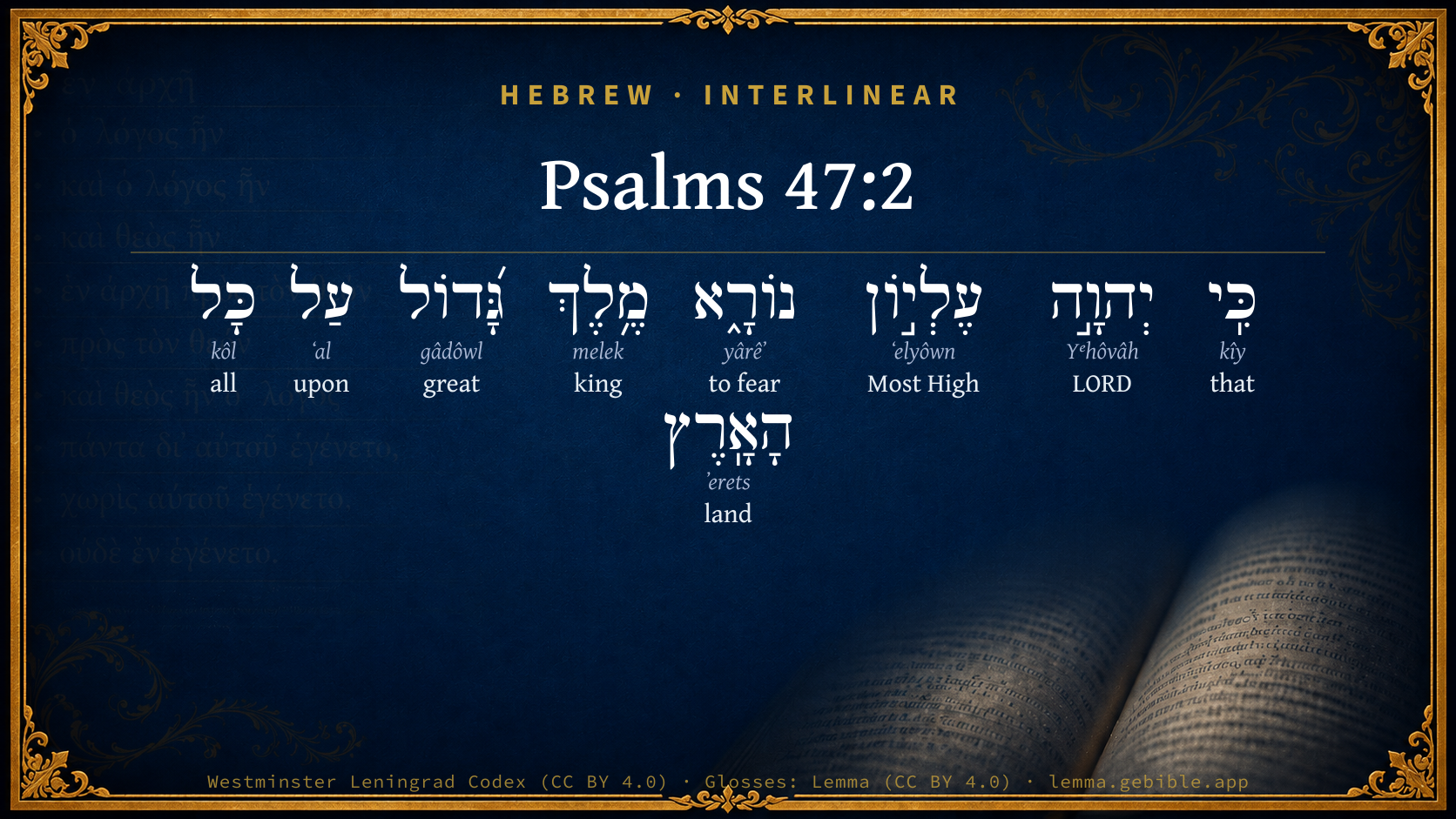
Hebrew (Westminster Leningrad Codex) Psalms 47:2 appears in the Hebrew Old Testament. The text above is from the Westminster Leningrad Codex. Each word links to its Strong’s number, a concise gloss, and parsing drawn from the Open Scriptures Hebrew Bible morphology. Click any word for its full Brown-Driver-Briggs (BDB) entry.
Download image
Cite this verse

Psalms 47:2 (World English Bible). Public Domain. Lemma interlinear Bible study tool, https://lemma.gebible.app/v/psalms/47/2.

Show BibTeX & RIS
BibTeX
RIS
English Translation
For Yahweh Most High is awesome. He is a great King over all the earth.
World English Bible · Public Domain
Download a study sheet

One document with this verse’s original text, its word-by-word gloss line, the meaning frame, cross-references with their text, attributed commentary, and full source and license credits — printable, and it pastes into notes with its structure intact.

This verse Autodidact and up

Study sheet (.html) Plain text (.txt)

A passage Seminary Student

Up to 50 verses in one chapter. A passage sheet keeps up to 6 commentary sources and 12 cross-references per verse, in the order this page ranks them, and says so on the sheet whenever that leaves anything out. Ask for a single verse and you get the Autodidact verse sheet above.

Everything on this page stays free to read, with no account — the sheet is a download of what is already on screen, not access to it.

Want to remove ads? Support Godless Engineer
Compare translations 3

The same verse in 3 English versions, stacked beneath the original-language interlinear above. Click any original word for its lexicon entry.

Each is an independent rendering of the whole verse — the interlinear is not word-aligned to these translations.

Highlighted words mark where these versions differ — a whole-verse word diff, not a word-by-word alignment.

  • World English Bible Public Domain
    For Yahweh Most High is awesome. He is a great King over all the earth.
  • King James Version Public Domain
    For the LORD most high is terrible; he is a great King over all the earth.
  • unfoldingWord Literal Text CC BY-SA 4.0
    For Yahweh, the Most High, is to be feared, the great king over all of the earth.

unfoldingWord Literal Text — © unfoldingWord, licensed CC BY-SA 4.0. Word-aligned USFM3 via Door43 (git.door43.org/unfoldingWord/en_ult).

Versions to compare (up to 4)

3 of 4 selected

Show all 18 translations

Every available English version of this verse, each an independent rendering of the whole verse.

  • World English Bible Public Domain
    For Yahweh Most High is awesome. He is a great King over all the earth.
  • Berean Standard Bible Public Domain
    How awesome is the LORD Most High, the great King over all the earth!
  • Majority Standard Bible Public Domain
    How awesome is the LORD Most High, the great King over all the earth!
  • King James Version Public Domain
    For the LORD most high is terrible; he is a great King over all the earth.
  • American Standard Version (1901) Public Domain
    For Jehovah Most High is terrible; He is a great King over all the earth.
  • Revised Version (1885) Public Domain
    For the LORD Most High is terrible; he is a great King over all the earth.
  • Geneva Bible (1599) Public Domain
    For the Lord is high, and terrible: a great King ouer all the earth.
  • Douay-Rheims (1899) Public Domain
    O clap your hands, all ye nations: shout unto God with the voice of Joy,
  • Young's Literal Translation Public Domain
    For Jehovah Most High `is' fearful, A great king over all the earth.
  • Literal Standard Version CC BY-SA 4.0
    For YHWH Most High [is] fearful, || A great King over all the earth.
  • Unlocked Literal Bible CC BY-SA 4.0
    For Yahweh Most High is terrifying; he is a great King over all the earth.
  • unfoldingWord Literal Text CC BY-SA 4.0
    For Yahweh, the Most High, is to be feared, the great king over all of the earth.
  • Darby Bible Public Domain
    For Jehovah, the Most High, is terrible, a great king over all the earth.
  • World Messianic Bible Public Domain
    For the LORD Most High is awesome. He is a great King over all the earth.
  • Webster's Bible Public Domain
    \\47:1\\To the chief Musician, A Psalm for the sons of Korah. O clap your hands, all ye people; shout to God with the voice of triumph.
  • Free Bible Version CC BY-SA 4.0
    For the Lord Most High is awe-inspiring; he is the great King of all the earth.
  • Bible in Basic English Public Domain
    For the Lord Most High is to be feared; he is a great King over all the earth.
  • JPS Tanakh (1917) Public Domain
    (47-3) For the LORD is most high, awful; a great King over all the earth.

Literal Standard Version (2020), Covenant Press — licensed CC BY-SA 4.0. Text via the HelloAO Bible API (eBible.org). Unlocked Literal Bible (unfoldingWord) — licensed CC BY-SA 4.0. Text via the HelloAO Bible API (eBible.org). unfoldingWord Literal Text — © unfoldingWord, licensed CC BY-SA 4.0. Word-aligned USFM3 via Door43 (git.door43.org/unfoldingWord/en_ult). Free Bible Version, Dr. Jonathan Gallagher — licensed CC BY-SA 4.0. Text via the HelloAO Bible API (eBible.org).

Word by word

More ways to search: Search by grammar → Find every occurrence → Compare this word →

Practice this passage: Drill this verse → Learn its vocabulary →

About this verse

These counts appear in no published source. They are computed here, from the morphology-tagged text and Lemma’s own curated glosses. What Lemma adds →

9
words
9
distinct lemmas
Wisdom
section

Shared distinctive vocabulary

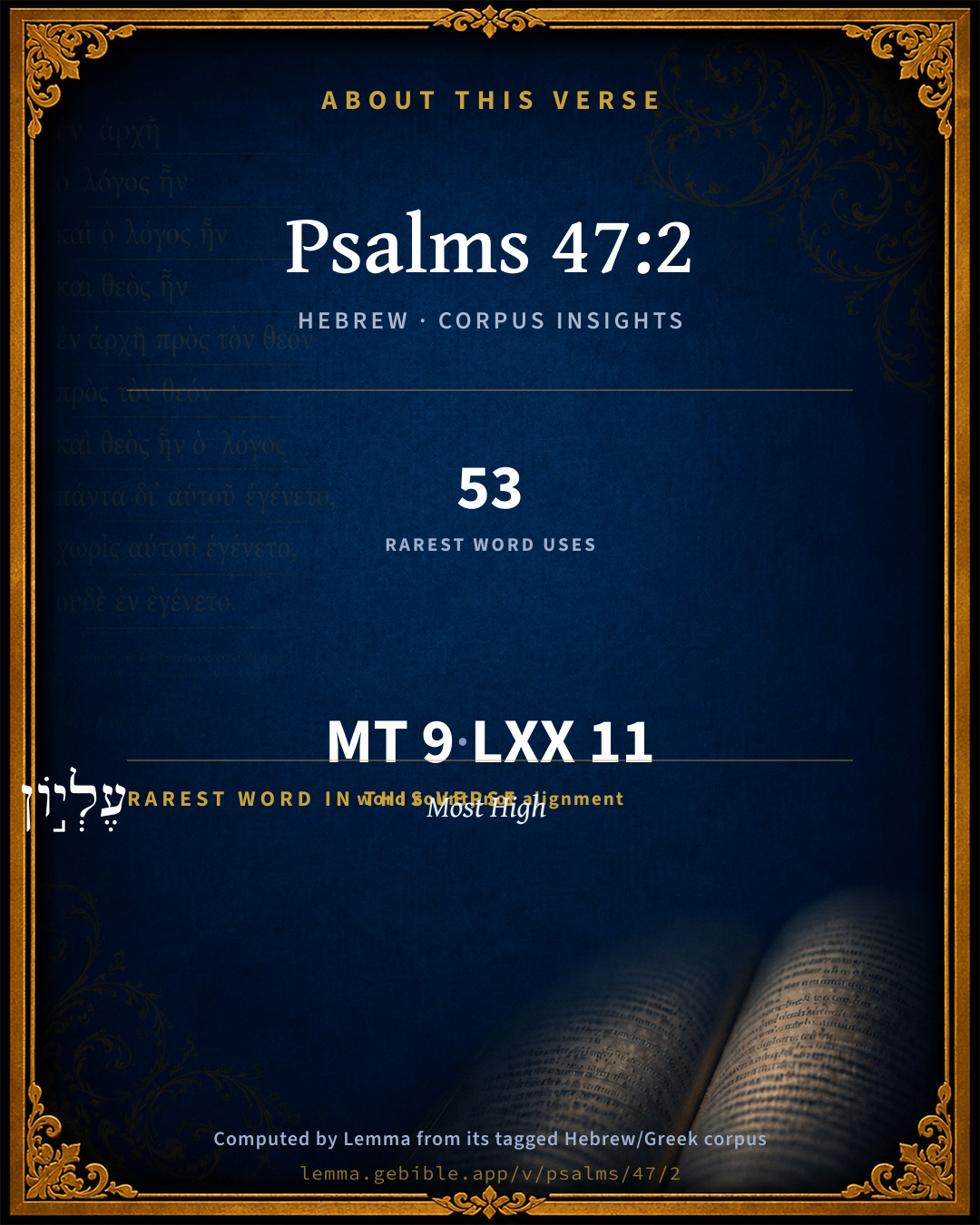
עֶלְי֣וֹן Most High H5945 occurs in 53 verses of the Hebrew Bible. Also found in:

Grammatical profile

  • 1 verb
  • 4 nouns
  • 2 adjectives
  • 1 preposition
  • 1 conjunction

Verb forms

  • נוֹרָ֑א Niphal · Participle Active

Hebrew & Septuagint length

In English translation the verse runs 15 words from the Hebrew and 16 from the Septuagint (LXX English) — closely comparable.

A rough comparison of the two English renderings, which tokenize alike — not a word-level alignment.

Word counts can differ between the Hebrew and the Greek without any difference in meaning — e.g. the Hebrew direct-object marker אֵת has no separate Greek word, and Greek often adds the article ὁ.

In the original languages it is 9 Hebrew tokens and 11 Greek tokens — but the two are counted differently (Hebrew bundles its prefixes and suffixes into one token; the Greek is in lemma form), so that isn’t a like-for-like length.

Cross-references

18

Topical passages linked to Psalms 47:2 in the Treasury of Scripture Knowledge — connected by theme and wording, ordered by reader-vote popularity; previews shown in the World English Bible.

  • Psalms 95:3 For Yahweh is a great God, A great King above all gods.
  • Psalms 99:3 Let them praise your great and awesome name. He is Holy!
  • Malachi 1:14 "But the deceiver is cursed, who has in his flock a male, and vows, and sacrifices to the Lord a blemished thing; for I am a great King," says Yahweh of hosts, "and my name is awesome among the nations."
  • Deuteronomy 7:21 You shall not be scared of them; for Yahweh your God is in the midst of you, a great and awesome God.
  • Psalms 68:35 You are awesome, God, in your sanctuaries. The God of Israel gives strength and power to his people. Praise be to God!
  • Nehemiah 1:5 and said, I beg you, Yahweh, the God of heaven, the great and awesome God, who keeps covenant and loving kindness with those who love him and keep his commandments:
  • Psalms 47:7 For God is the King of all the earth. Sing praises with understanding.
  • Psalms 65:5 By awesome deeds of righteousness, you answer us, God of our salvation. You who are the hope of all the ends of the earth, Of those who are far away on the sea;
  • Psalms 66:3–5 Tell God, "How awesome are your deeds! Through the greatness of your power, your enemies submit themselves to you.
  • Matthew 28:18 Jesus came to them and spoke to them, saying, "All authority has been given to me in heaven and on earth.
  • Psalms 22:27–29 All the ends of the earth shall remember and turn to Yahweh. All the relatives of the nations shall worship before you.
  • Psalms 76:12 He will cut off the spirit of princes. He is feared by the kings of the earth.
  • Psalms 145:6 Men will speak of the might of your awesome acts. I will declare your greatness.
  • Daniel 7:13–14 I saw in the night-visions, and, behold, there came with the clouds of the sky one like a son of man, and he came even to the ancient of days, and they brought him near before him.
  • Nahum 1:6–7 Who can stand before his indignation? Who can endure the fierceness of his anger? His wrath is poured out like fire, and the rocks are broken apart by him.
  • Philippians 2:9–11 Therefore God also highly exalted him, and gave to him the name which is above every name;
  • Revelation 6:16–17 They told the mountains and the rocks, "Fall on us, and hide us from the face of him who sits on the throne, and from the wrath of the Lamb,
  • Deuteronomy 28:58 If you will not observe to do all the words of this law that are written in this book, that you may fear this glorious and fearful name, YAHWEH YOUR GOD;

Cross-references courtesy of OpenBible.info (CC BY 4.0).

Hebrew and Greek witnesses Masoretic Hebrew ↔ Greek Septuagint

The same verse in the two great witnesses to the Old Testament, shown verse-for-verse.

You’re reading Greek Psalm 46 (Hebrew Psalm 47). The Septuagint counts the superscription, so verse numbers can differ from the Hebrew — chapter-level alignment, not verse-by-verse. Numbering follows Rahlfs.

These are two independent witnesses, not word-aligned to each other, and the Septuagint is shown in lemma (dictionary) form.

Hebrew Psalms 47:2 Masoretic · Westminster Leningrad Codex

כִּֽי יְהוָ֣ה עֶלְי֣וֹן נוֹרָ֑א מֶ֥לֶךְ גָּ֝דוֹל עַל כָּל הָאָֽרֶץ

For Yahweh Most High is awesome. He is a great King over all the earth.

World English Bible · Public Domain

Greek LXX Greek Psalm 46:2 Septuagint · lemma form

πάς ὁ ἔθνος κροτέω χείρ ἀλαλάζω ὁ θεός ἐν φωνή ἀγαλλίασις

For the Lord most high is terrible; he is a great king over all the earth.

LXX2012 (modern English Septuagint) · Public Domain

Hebrew: Westminster Leningrad Codex (CC BY 4.0). Greek: Septuagint (public domain); English from LXX2012 (modern English Septuagint) (Public Domain). How the Septuagint differs from the Hebrew →

Commentary

Notes on Psalms 47:2 from classic Christian and Jewish commentators (each source and its license shown beneath its notes). The classic Christian expositions comment on the surrounding passage and are grouped to its opening verse, so a note may address several verses; the Jewish commentaries on the Tanakh (Rashi and others) are per-verse, so they appear only where the commentator wrote on this verse.

Lemma curates 59 commentaries, every one of them public domain or Creative Commons licensed, each selected and text-cleaned for this edition rather than reprinted as found. About our sources →

Trapp's Complete Commentary

John Trapp

Psa 47:2 For the LORD most high [is] terrible; [he is] a great King over all the earth.

Ver. 2. For the Lord most high is terrible] Amiable to his own, terrible to his rebels. This Son, if not kissed, will be angry, Psa 2:12 This Lamb, for a need, can show himself a lion; as he is the Father of mercies, so the God of recompenses, &c., and being most high, he can easily overtop and subdue the stoutest of his enemies.

He is a great King over all the earth] As having taken possession, by his wonderful ascension, of the universal kingdom given him by his Father, and gathered himself a Church out of all mankind, which he wonderfully ruleth and defendeth against the rage of earth and of hell.

John Trapp, A Commentary or Exposition upon All the Books of the Old and New Testament (1647–1656) — public domain. Text from a community e-Sword module.

J. A. Alexander on Psalms

Joseph Addison Alexander

3. (Psa 47:2). For Jehovah, Most High, is terrible, a great king over all the earth. He is not, as the heathen were disposed to imagine, a mere local deity, the God of the Hebrews only, but the God of the whole earth, the Universal Sovereign, and an object of fear to its inhabitants. See the same epithet applied to him in Ps. 68:36 (35).

Joseph Addison Alexander, The Psalms Translated and Explained (1850) — public domain. Text from a community e-Sword module.

Jamieson, Fausset & Brown

Robert Jamieson, A. R. Fausset & David Brown

His universal sovereignty now exists, and will be made known.

Jamieson, Fausset & Brown — Commentary Critical and Explanatory on the Whole Bible (1871) — public domain (CC PDM 1.0). Text via the HelloAO Bible API.

Adam Clarke's Commentary

Verse 2. For the Lord most high is terrible] He has insufferable majesty, and is a great King-the mightiest of all emperors, for he is Sovereign over the whole earth.

Adam Clarke's Commentary on the Bible (1810–1826) — public domain. Text from a community e-Sword/MySword module.

John Calvin's Commentaries

Since, then, no servitude is happy and desirable but that by which God subdues and brings under the standard and authority of Christ his Son those who before were rebels, it follows that this language is applicable only to the kingdom of Christ, who is called a high and terrible King, (verse 2;) not that he makes the wretched beings over whom he reigns to tremble by the tyranny and violence of his sway, but because his majesty, which before had been held in contempt, will suffice to quell the rebellion of the whole world. It is to be observed, that the design of the Holy Spirit is here to teach, that as the Jews had been long contumeliously treated, oppressed with wrongs, and afflicted from time to time with divers calamities, the goodness and liberality of God towards them was now so much the more illustrious, when the kingdom of David had subdued the neighboring nations on every sidle, and had attained to such a height of glory. We may, however, easily gather from the connection of the words the truth of what I have suggested, that when God is called a terrible and great King over all the earth, this prophecy applies to the kingdom of Christ. There is, therefore, no doubt, that the grace of God was celebrated by these titles, to strengthen the hearts of the godly during the period that intervened till the advent of Christ, in which not only the triumphant state of the people of Israel had fallen into decay, but in which also the people, being oppressed with the bitterest contumely, could have no taste of the favor of God, and no consolation from it, but by relying on the promises of God alone. We know that there was a long interruption of the splendor of the kingdom of God’s ancient people, which continued from the death of Solomon to the coming of Christ. This interval formed, as it were, a gulf or chasm, which would have swallowed up the minds of the godly, had they not been supported and upheld by the Word of God. As, therefore, God exhibited in the person of David a type of the kingdom of Christ, which is here extolled, although there followed shortly after a sad and almost shameful diminution of the glory of David’s kingdom, then the most grievous calamities, and, finally, the captivity and a most miserable dispersion, which differed little from a total destruction, the Holy Spirit has exhorted the faithful to continue clapping their hands for joy, until the advent of the promised Redeemer.

John Calvin's Commentaries (1540-1563) — public domain. Text from the Calvin Translation Society English edition (1840s-50s) via the Christian Classics Ethereal Library (ccel.org). Calvin's coverage is partial (roughly two-thirds of the Bible); uncommented books and verses are honest gaps, never fabricated. The 19th-century editor's footnotes and remarks are omitted so the notes are faithfully Calvin's own voice.

Ellicott's Commentary for English Readers

(2) Most high.—Or, possibly, a predicate, is exalted.

Terrible.—Literally, feared. (Comp. 2Ch_20:29).

A Bible Commentary for English Readers, edited by Charles John Ellicott (1878–1897) — public domain. Text from a community e-Sword module.

The Cambridge Bible for Schools and Colleges

gen. ed. J. J. S. Perowne

2. We may also render as in R.V. marg.,

For the Lord is most high (and) terrible,

or better still,

For Jehovah, the Most High, the terrible,

Is a great King over all the earth,

for the universal sovereignty of Jehovah is the prominent thought of the Psalm. He is not merely King of Israel (Psa_47:6) but King of all the earth (Psa_47:7). It is to Him that the title ‘great King,’ so arrogantly assumed by the king of Assyria (Isa_36:4), really belongs. This verse links together Psa_46:4 and Psa_48:2. For the epithet ‘terrible’ cp. Psa_76:7; Psa_76:12; Exo_15:11; Deu_7:21; Deu_10:17.

The Cambridge Bible for Schools and Colleges (gen. ed. J. J. S. Perowne; Cambridge University Press, 1878–1918) — public domain. Text from a community e-Sword module.

John Gill's Exposition

For the Lord most high is terrible,.... Christ is not only the Son of the Highest, but he himself is the most high God, God over all, blessed for ever. He is higher than the highest, than the angels in heaven, or any of the sons of men on earth. He is the high and lofty One, that dwells in the high and lofty place. And even this character agrees with him as the ascended Lord and King in his human nature; he is ascended on high, is set down on the right hand of the Majesty on high. He is highly exalted to be a Prince and a Saviour; he is made higher than the heavens, and than the kings of the earth are; angels, authorities, and powers, are subject to him. And this is a reason exciting all the people to joy and gladness. And he is "terrible" to his enemies, being the Lion of the tribe of Judah; who will rule the nations with a rod of iron, and break them in pieces as a potter's vessel: and so he will be when he shall come in the clouds of heaven, land descend from thence, in flaming fire, to take vengeance on those who have despised and rejected him; and at the same time will be glorious to and admired by them that believe in him. His appearance, which will be terrible to others, will be matter of joy to them. Though the word used may be rendered as it is in Psa 111:9; "reverend" or "to be feared" (b), as he is; see Isa 8:13; both on account of his goodness, as the Redeemer and Saviour of his people, Hos 3:5; and of his greatness, being equal with God, and King of saints. As it follows;

he is a great King over all the earth; as he must needs be, since he is the great God and our Saviour; and is King of kings, and Lord of lords. He is now King of Zion, and head over all things to the church; and before long the kingdoms of this world will become his, and he will take to himself his great power and reign, and shall be King over all the earth openly and visibly; he shall be one, and his name One, Zac 14:9; which is another reason for joy and gladness among the people.

(b) "reverendus", Junius & Tremellius; "timendus est", Coccius; "venerandus", Michaelis.

John Gill's Exposition of the Whole Bible (1746–1763) — public domain (CC PDM 1.0). Text via the HelloAO Bible API.

Albert Barnes' Notes on the Bible

For the Lord most high - Yahweh, the Most High God; that is, who is exalted above all other beings. Compare Exo 18:11; 1Ch 16:25 Psa 96:4; 2Ch 2:5; Psa 95:3.

Is terrible - literally, is to be feared; that is, reverenced and adored. There is an idea in the words “terrible” and “terror” which is not contained in the original, as if there were something harsh, severe, stern, in his character. The word in the original does not go beyond the notion of inspiring reverence or awe, and is the common word by which the worship of God is designated in the Scriptures. The meaning is, that he is worthy of profound reverence or adoration.

He is a great king over all the earth - He rules the world. He is a universal Sovereign. The immediate “occasion” of saying this, when the psalm was composed, was evidently some victory (which had been achieved over the enemies of the people of God) so decided, and so immediately by the divine power, as to prove that he has absolute control over all nations.

Albert Barnes' Notes on the Bible (1834–1885) — public domain. Text from a community e-Sword/MySword module.

Matthew Poole's English Annotations

Most high is terrible; or, is most high (in himself, above all gods) and (which conjunction is off understood) terrible, to all his enemies.

A great King over all the earth; the universal Monarch of the whole world, and not of Israel only.

Matthew Poole's English Annotations on the Holy Bible (1683–1685) — public domain. Text from a community e-Sword/MySword module.

The Treasury of David

Charles H. Spurgeon

Ver. 2. For the Lord, or JEHOVAH, the self existent and only God; Most high, most great in power, lofty in dominion, eminent in wisdom, elevated in glory. Is terrible, none can resist his power or stand before his vengeance; yet as these terrors are wielded on the behalf of his subjects, they are fit reasons for rejoicing. Omnipotence, which is terrible to crush, is almighty to protect. At a grand review of the troops of a great prince, all his loyal subjects are filled with triumph, because their liege lord is so able to defend his own, and so much dreaded by his foes. He is a great King over all the earth. Not over Judea only, but even to the utmost isles his reign extends. Our God is no local deity, no petty ruler of a tribe; in infinite majesty he rules the mightiest realm as absolute arbiter of destiny, sole monarch of all lands, King of kings, and Lord of lords. Not a hamlet or an islet is excluded from his dominion. How glorious will that era be when this is seen and known of all; when in the person of Jesus all flesh shall behold the glory of the Lord!

Ver. 2. For the Lord most high is terrible; he is a great king over all the earth. The church celebrates the ascension of Christ, because then he was "highly exalted; "then he became terrible to his enemies, all power in heaven and earth being committed to him; and then he began to display the excellent majesty of his universal kingdom, to which he was then inaugurated, being crowned "King of kings, and Lord of lords." George Horne.

Ver. 2. The Lord most high is terrible. Christ is terrible, that is, fearful, or meet to be feared, not of his children only for their good, but of the wicked also for their punishment; terrible to the devil, as being stronger than he, casting out the prince of darkness by the finger of God. Lu 11:22 Joh 12:31. And therefore so soon as an unclean spirit saw Jesus, he cried out, "What have we to do with thee, thou Jesus of Nazareth? art thou come to destroy us?" Mr 1:24; or as other devils, Mt 8:29, "Art thou come hither to torment us before the time?" for the devils in believing tremble. Terrible to hypocrites, and other impious agents of the devil, as having his fan in his hand to make clean his floor, and to gather his wheat into his garner, but he will burn up the chaff with unquenchable fire. Mt 3:12. Or Christ is excelsus in potentia, terribilis in justitia; high in power, and fearful in justice; high in exalting the good, and terrible in humbling the bad. John Boys.

Ver. 2. The terrors of the Lord viewed by faith as a subject of joy.

Ver. 2. (second clause). The universal reign of Christ as it is and is to be.

Psalms 47:3*

Charles H. Spurgeon's The Treasury of David (1869–1885) — public domain. Psalms only. Text from a community e-Sword/MySword module.

The Pulpit Commentary

For the Lord Most High is terrible. (comp. Deu_7:21; and see also Psa_65:5 Psa_68:35 Psa_76:7-9) God is "terriblei.e. awful to contemplate-on account of his vast power and his absolute holiness. He is a great King over all the earth. Not only over Israel, or over the nations which David has conquered, but ever every nation on the face of the earth. (comp. Psa_95:3, 4 96:10 97:1, etc.)

The Pulpit Commentary (1880–1919), ed. H.D.M. Spence-Jones & Joseph S. Exell — public domain. Text from a community e-Sword module.

Rashi

Rabbi Shlomo Yitzchaki (Rashi)

clap hands Join together with one another to shout to God with a voice of praise.

Rashi on the Tanakh — English translations: “The Judaica Press complete Tanach with Rashi, translated by A. J. Rosenberg” (CC BY 4.0); “Pentateuch with Rashi's commentary by M. Rosenbaum and A.M. Silbermann, 1929-1934” (public domain); “The Metsudah Tanach series, Lakewood, N.J” (CC BY 4.0); and “The Book of Joshua, Metsudah Publications, 1997” (CC BY 4.0). Text via Sefaria.

Lesson kit

Teaching starters — assembled from the data on this page, not authored interpretation. Every prompt links to the verse data it draws on. Edit before teaching.

Psalms, in the Wisdom, opens this verse with 9 words (9 distinct Hebrew lemmas). Its most distinctive word is ʻelyôwn (“Most High”). A historical commentator’s framing appears above. Read the whole chapter for the surrounding context.

Discussion questions

  1. What does “Most High” (ʻelyôwn) contribute to the verse as a whole?
  2. How does Genesis 14:18, which shares the word «Most High», read alongside this verse?
  3. These translations render this verse differently. What is at stake in choosing one wording over another?
  4. «נוֹרָ֑א» is a Niphal Participle Active verb. How does that grammatical form shape the action described?
  5. Compare how Trapp's Complete Commentary and J. A. Alexander on Psalms read this verse. Where do they agree or differ?

Things to notice

Reading settings

Reading text

Shown beneath each verse's original-language words.

Old Testament
Old Testament edition

Read the OT as the Masoretic Hebrew (MT) or the Greek Septuagint (LXX).

English shown for the Greek Septuagint (in the Hebrew ↔ Greek comparison).

Comparing translations? Open the Compare panel on any verse page to stack up to four side by side.