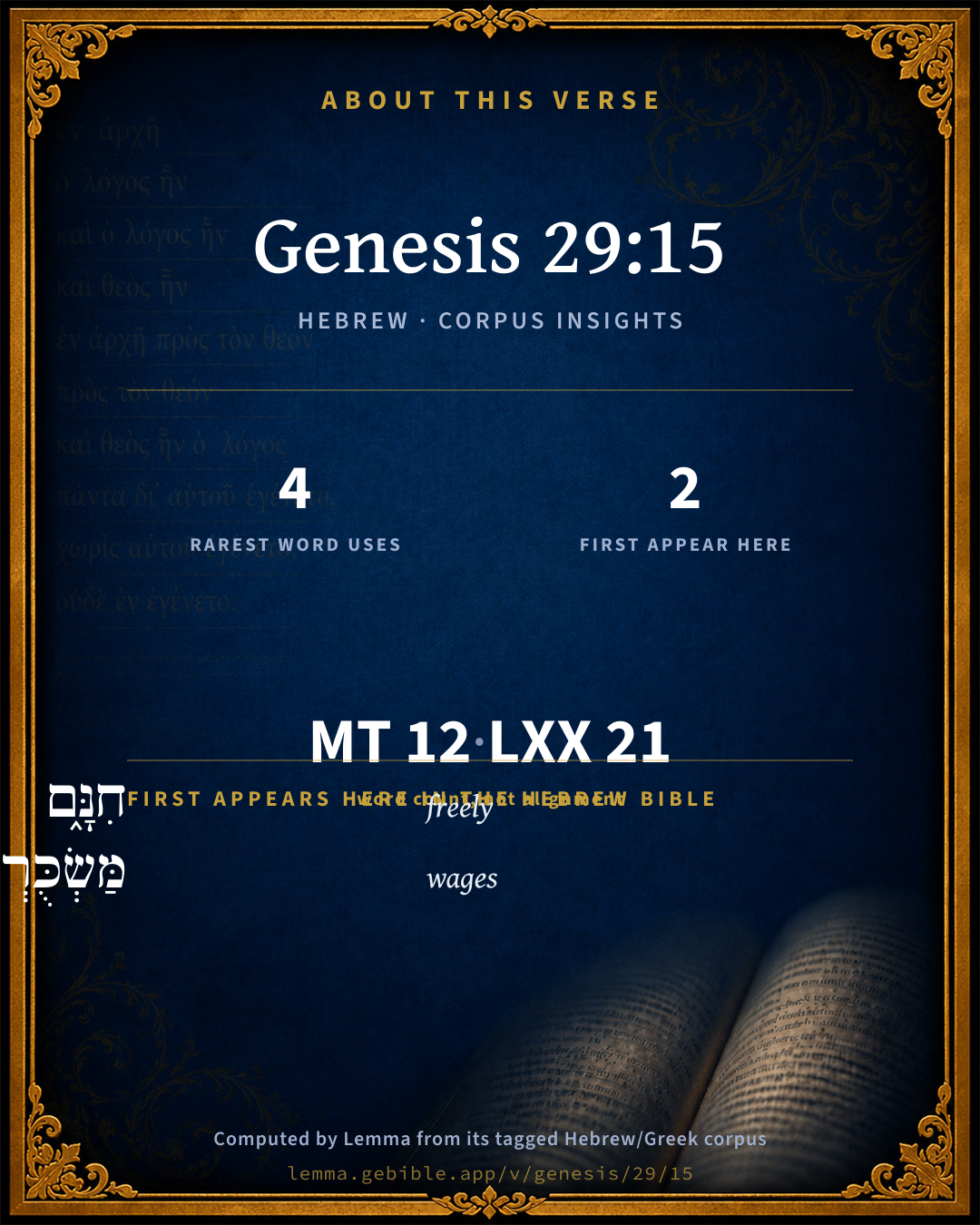
Genesis 29:15

Hebrew (Westminster Leningrad Codex) Genesis 29:15 appears in the Hebrew Old Testament. The text above is from the Westminster Leningrad Codex. Each word links to its Strong’s number, a concise gloss, and parsing drawn from the Open Scriptures Hebrew Bible morphology. Click any word for its full Brown-Driver-Briggs (BDB) entry.
Download image
Cite this verse

Genesis 29:15 (World English Bible). Public Domain. Lemma interlinear Bible study tool, https://lemma.gebible.app/v/genesis/29/15.

Show BibTeX & RIS
BibTeX
RIS
English Translation
Laban said to Jacob, "Because you are my brother, should you therefore serve me for nothing? Tell me, what will your wages be?"
World English Bible · Public Domain
Highlights
  • 2 first appearances in the Hebrew Bible
Full analysis ↓
Download a study sheet

One document with this verse’s original text, its word-by-word gloss line, the meaning frame, cross-references with their text, attributed commentary, and full source and license credits — printable, and it pastes into notes with its structure intact.

This verse Autodidact and up

Study sheet (.html) Plain text (.txt)

A passage Seminary Student

Up to 50 verses in one chapter. A passage sheet keeps up to 6 commentary sources and 12 cross-references per verse, in the order this page ranks them, and says so on the sheet whenever that leaves anything out. Ask for a single verse and you get the Autodidact verse sheet above.

Everything on this page stays free to read, with no account — the sheet is a download of what is already on screen, not access to it.

Want to remove ads? Support Godless Engineer
Compare translations 3

The same verse in 3 English versions, stacked beneath the original-language interlinear above. Click any original word for its lexicon entry.

Each is an independent rendering of the whole verse — the interlinear is not word-aligned to these translations.

Highlighted words mark where these versions differ — a whole-verse word diff, not a word-by-word alignment.

  • World English Bible Public Domain
    Laban said to Jacob, "Because you are my brother, should you therefore serve me for nothing? Tell me, what will your wages be?"
  • King James Version Public Domain
    And Laban said unto Jacob, Because thou art my brother, shouldest thou therefore serve me for nought? tell me, what shall thy wages be?
  • unfoldingWord Literal Text CC BY-SA 4.0
    Then Laban said to Jacob, “Because you my relative, should you then serve me for nothing? Tell me, what your wages?”

unfoldingWord Literal Text — © unfoldingWord, licensed CC BY-SA 4.0. Word-aligned USFM3 via Door43 (git.door43.org/unfoldingWord/en_ult).

Versions to compare (up to 4)

3 of 4 selected

Show all 18 translations

Every available English version of this verse, each an independent rendering of the whole verse.

  • World English Bible Public Domain
    Laban said to Jacob, "Because you are my brother, should you therefore serve me for nothing? Tell me, what will your wages be?"
  • Berean Standard Bible Public Domain
    Laban said to him, “Just because you are my relative, should you work for nothing? Tell me what your wages should be.”
  • Majority Standard Bible Public Domain
    Laban said to him, “Just because you are my relative, should you work for nothing? Tell me what your wages should be.”
  • King James Version Public Domain
    And Laban said unto Jacob, Because thou art my brother, shouldest thou therefore serve me for nought? tell me, what shall thy wages be?
  • American Standard Version (1901) Public Domain
    And Laban said unto Jacob, Because thou art my brother, shouldest thou therefore serve me for nought? Tell me, what shall thy wages be?
  • Revised Version (1885) Public Domain
    And Laban said unto Jacob, Because thou art my brother, shouldest thou therefore serve me for nought? tell me, what shall thy wages be?
  • Geneva Bible (1599) Public Domain
    For Laban sayde vnto Iaakob, Though thou be my brother, shouldest thou therfore serue me for nought? tell me, what shalbe thy wages?
  • Douay-Rheims (1899) Public Domain
    He said to him: Because thou art my brother, shalt thou serve me without wages? Tell me what wages thou wilt have.
  • Young's Literal Translation Public Domain
    And Laban saith to Jacob, `Is it because thou `art' my brother that thou hast served me for nought? declare to me what `is' thy hire.'
  • Literal Standard Version CC BY-SA 4.0
    And Laban says to Jacob, “Is it because you [are] my brother that you have served me for nothing? Declare to me what your hire [is].”
  • Unlocked Literal Bible CC BY-SA 4.0
    Then Laban said to Jacob, “Should you serve me for nothing because you are my relative? Tell me, what will your wages be?”
  • unfoldingWord Literal Text CC BY-SA 4.0
    Then Laban said to Jacob, “Because you my relative, should you then serve me for nothing? Tell me, what your wages?”
  • Darby Bible Public Domain
    And Laban said to Jacob, Because thou art my brother, shouldest thou serve me for nothing? tell me, what shall be thy wages?
  • World Messianic Bible Public Domain
    Laban said to Jacob, “Because you are my relative, should you therefore serve me for nothing? Tell me, what will your wages be?”
  • Webster's Bible Public Domain
    And Laban said to Jacob, Because thou art my brother, shouldest thou therefore serve me for naught? tell me, what shall thy wages be?
  • Free Bible Version CC BY-SA 4.0
    One day Laban said to him, “You're my relative so you shouldn't be working for me for nothing! Tell me, what should I pay you?”
  • Bible in Basic English Public Domain
    Then Laban said to Jacob, Because you are my brother are you to be my servant for nothing? say now, what is your payment to be?
  • JPS Tanakh (1917) Public Domain
    And Laban said unto Jacob: 'Because thou art my brother, shouldest thou therefore serve me for nought? tell me, what shall thy wages be?'

Literal Standard Version (2020), Covenant Press — licensed CC BY-SA 4.0. Text via the HelloAO Bible API (eBible.org). Unlocked Literal Bible (unfoldingWord) — licensed CC BY-SA 4.0. Text via the HelloAO Bible API (eBible.org). unfoldingWord Literal Text — © unfoldingWord, licensed CC BY-SA 4.0. Word-aligned USFM3 via Door43 (git.door43.org/unfoldingWord/en_ult). Free Bible Version, Dr. Jonathan Gallagher — licensed CC BY-SA 4.0. Text via the HelloAO Bible API (eBible.org).

Word by word

More ways to search: Search by grammar → Find every occurrence → Compare this word →

Practice this passage: Drill this verse → Learn its vocabulary →

מַּשְׂכֻּרְתֶּֽךָ
maskôreth
H4909
“wages · your”
Noun, Common, Feminine, Singular, Construct + Suffix, Personal, 2nd Person, Masculine, Singular
Part of Speech
Noun
Type
Common
Gender
Feminine
Number
Singular
State
Construct
Full BDB Definition

Origin: from H7936

TWOT: 2264 . 1d

wages
  1. וַיֹּ֤אמֶר ʼâmar H559 “and · to say” Conjunction + Verb, Qal, Sequential Imperfect, 3rd Person, Masculine, Singular
  2. לָבָן֙ Lâbân H3837 “Laban” Noun, Proper
  3. לְיַעֲקֹ֔ב Yaʻăqôb H3290 “to/for · Jacob” Preposition + Noun, Proper
  4. הֲכִי kîy H3588 “that” Particle, Interrogative + Conjunction
  5. אָחִ֣י ʼâch H251 “brother · my” Noun, Common, Masculine, Singular, Construct + Suffix, Personal, 1st Person, Common, Singular
  6. אַ֔תָּה ʼattâh H859 “you” Pronoun, Personal, 2nd Person, Masculine, Singular
  7. וַעֲבַדְתַּ֖נִי ʻâbad H5647 “and · to serve · me” Conjunction + Verb, Qal, Sequential Perfect, 2nd Person, Masculine, Singular + Suffix, Personal, 1st Person, Common, Singular
  8. חִנָּ֑ם chinnâm H2600 “freely” Adverb
  9. הַגִּ֥ידָה nâgad H5046 “make known” Verb, Hiphil, Imperative, 2nd Person, Masculine, Singular + Suffix, h
  10. מַה mâh H4100 “what” Particle, Interrogative

About this verse

These counts appear in no published source. They are computed here, from the morphology-tagged text and Lemma’s own curated glosses. What Lemma adds →

12
words
11
distinct lemmas
Pentateuch
section

Notable vocabulary

The rarest word here is מַּשְׂכֻּרְתֶּֽךָ wages H4909 — appearing just 4 times in the whole Hebrew Bible.

First appearance in Scripture

These words make their first canonical appearance in the Hebrew Bible here:

  • חִנָּ֑ם freely H2600
  • מַּשְׂכֻּרְתֶּֽךָ wages H4909

Shared distinctive vocabulary

מַּשְׂכֻּרְתֶּֽךָ wages H4909 occurs in 4 verses of the Hebrew Bible. Also found in:

Grammatical profile

  • 3 verbs
  • 4 nouns
  • 1 pronoun
  • 1 preposition
  • 1 conjunction
  • 1 adverb
  • 1 particle

Verb forms

  • וַיֹּ֤אמֶר Qal · Sequential Imperfect
  • וַעֲבַדְתַּ֖נִי Qal · Sequential Perfect
  • הַגִּ֥ידָה Hiphil · Imperative

Hebrew & Septuagint length

In English translation the verse runs 23 words from the Hebrew and 26 from the Septuagint (LXX English) — closely comparable.

A rough comparison of the two English renderings, which tokenize alike — not a word-level alignment.

Word counts can differ between the Hebrew and the Greek without any difference in meaning — e.g. the Hebrew direct-object marker אֵת has no separate Greek word, and Greek often adds the article ὁ.

In the original languages it is 12 Hebrew tokens and 21 Greek tokens — but the two are counted differently (Hebrew bundles its prefixes and suffixes into one token; the Greek is in lemma form), so that isn’t a like-for-like length.

Cross-references

2

Topical passages linked to Genesis 29:15 in the Treasury of Scripture Knowledge — connected by theme and wording, ordered by reader-vote popularity; previews shown in the World English Bible.

  • Genesis 30:28 He said, "Appoint me your wages, and I will give it."
  • Genesis 31:7 Your father has deceived me, and changed my wages ten times, but God didn't allow him to hurt me.

Cross-references courtesy of OpenBible.info (CC BY 4.0).

Hebrew and Greek witnesses Masoretic Hebrew ↔ Greek Septuagint

The same verse in the two great witnesses to the Old Testament, shown verse-for-verse.

These are two independent witnesses, not word-aligned to each other, and the Septuagint is shown in lemma (dictionary) form.

Hebrew Genesis 29:15 Masoretic · Westminster Leningrad Codex

וַיֹּ֤אמֶר לָבָן֙ לְיַעֲקֹ֔ב הֲכִי אָחִ֣י אַ֔תָּה וַעֲבַדְתַּ֖נִי חִנָּ֑ם הַגִּ֥ידָה לִּ֖י מַה מַּשְׂכֻּרְתֶּֽךָ

Laban said to Jacob, "Because you are my brother, should you therefore serve me for nothing? Tell me, what will your wages be?"

World English Bible · Public Domain

Greek LXX Genesis 29:15 Septuagint · lemma form

εἶπον δέ λαβαν ὁ ἰακώβ ὅτι γάρ ἀδελφός ἐγώ εἰμί οὐ δουλεύω ἐγώ δωρεά ἀποἀγγέλλω ἐγώ τίς ὁ μισθός σύ εἰμί

And Laban said to Jacob, Surely you shall not serve me for nothing, because you are my brother; tell me what your reward is to be.

LXX2012 (modern English Septuagint) · Public Domain

Hebrew: Westminster Leningrad Codex (CC BY 4.0). Greek: Septuagint (public domain); English from LXX2012 (modern English Septuagint) (Public Domain). How the Septuagint differs from the Hebrew →

Targum (Aramaic paraphrase)

2

The Targum is the ancient Jewish Aramaic paraphrase of the Hebrew Scriptures — an interpretive translation, not the Hebrew text itself. Onkelos (literal) and Pseudo-Jonathan (expansive) render the Torah, and Jonathan the Prophets. Coverage is partial: where no permissively-licensed English translation exists for a verse, only the Aramaic is shown. This is verse-level text, not a word-by-word alignment to the Hebrew.

  1. Targum Onkelos Torah (Genesis–Deuteronomy)
    וַאֲמַר לָבָן לְיַעֲקֹב הֲמִדְּאָחִי אַתְּ וְתִפְלְחִנַּנִּי מַגָּן חַוִּי לִי מָה אַגְרָךְ

    (no public-domain English translation for this verse)

    Targum Onkelos — Aramaic: “Onkelos Genesis” (public domain); “Onkelos Exodus” (public domain); “Onkelos Leviticus” (public domain); “Onkelos Numbers” (public domain); “Onkelos Deuteronomy” (public domain). English: “Sefaria Community Translation” (CC0 1.0 (public-domain dedication)); “J.W. Etheridge. The Targums of Onkelos and Jonathan Ben Uzziel on the Pentateuch. London: Longmans, Green, 1862” (public domain). Text via Sefaria.

  2. Targum Pseudo-Jonathan Torah (Genesis–Deuteronomy)
    וַאֲמַר לָבָן לְיַעֲקב הַמִדְאָחִי אַנְתְּ חָשִׁיב וְתִפְלְחִינַנִי מַגַן תַּנִי לִי מַן יְהִי אַגְרָךְ

    And Laban said to Jakob, Though thou art reputed my brother, shouldst thou serve me for nothing? Tell me, what shall be thy wages?

    Targum Pseudo-Jonathan — Aramaic: “Targum Jonathan on Genesis” (public domain); “Targum Jonathan on Exodus” (public domain); “Targum Jonathan on Leviticus” (public domain); “Targum Jonathan on Numbers” (public domain); “Targum Jonathan on Deuteronomy” (public domain). English: “The Targum of Jonathan ben Uzziel, trans. J. W. Etheridge, London, 1862” (public domain). Text via Sefaria.

Commentary

Notes on Genesis 29:15 from classic Christian and Jewish commentators (each source and its license shown beneath its notes). The classic Christian expositions comment on the surrounding passage and are grouped to its opening verse, so a note may address several verses; the Jewish commentaries on the Tanakh (Rashi and others) are per-verse, so they appear only where the commentator wrote on this verse.

Lemma curates 59 commentaries, every one of them public domain or Creative Commons licensed, each selected and text-cleaned for this edition rather than reprinted as found. About our sources →

Matthew Henry's Commentary

Here is, I. The fair contract made between Laban and Jacob, during the month that Jacob spent there as a guest, Gen 29:14. It seems he was not idle, nor did he spend his time in sport and pastime; but like a man of business, though he had no stock of his own, he applied himself to serve his uncle, as he had begun (Gen 29:10) when he watered his flock. Note, Wherever we are, it is good to be employing ourselves in some useful business, which will turn to a good account to ourselves or others. Laban, it seems, was so taken with Jacob's ingenuity and industry about his flocks that he was desirous he should continue with him, and very fairly reasons thus: "Because thou art my brother, shouldst thou therefore serve me for nought? Gen 29:15. No, what reason for that?" If Jacob be so respectful to his uncle as to give him his service without demanding any consideration for it, yet Laban will not be so unjust to his nephew as to take advantage either of his necessity or of his good-nature. Note, Inferior relations must not be imposed upon; if it be their duty to serve us, it is our duty to reward them. Now Jacob had a fair opportunity to make known to Laban the affection he had for his daughter Rachel; and, having no worldly goods in his hand with which to endow her, he promises him seven years' service, upon condition that, at the end of the seven years, he would bestow her upon him for his wife. It appears by computation that Jacob was now seventy-seven years old when he bound himself apprentice for a wife, and for a wife he kept sheep, Hos 12:12. His posterity are there reminded of it long afterwards, as an instance of the meanness of their origin: probably Rachel was young, and scarcely marriageable, when Jacob first came, which made him the more willing to stay for her till his seven years' service had expired.

II. Jacob's honest performance of his part of the bargain, Gen 29:20. He served seven years for Rachel. If Rachel still continued to keep her father's sheep (as she did, Gen 29:9), his innocent and religious conversation with her, while they kept the flocks, could not but increase their mutual acquaintance and affection (Solomon's song of love is a pastoral); if she now left it off, his easing her of that care was very obliging. Jacob honestly served out his seven years, and did not forfeit his indentures, though he was old; nay, he served them cheerfully: They seemed to him but a few days, for the love he had to her, as if it were more his desire to earn her than to have her. Note, Love makes long and hard services short and easy; hence we read of the labour of love, Heb 6:10. If we know how to value the happiness of heaven, the sufferings of this present time will be as nothing to us in comparison of it. An age of work will be but as a few days to those that love God and long for Christ's appearing.

III. The base cheat which Laban put upon him when he was out of his time: he put Leah into his arms instead of Rachel, Gen 29:23. This was Laban's sin; he wronged both Jacob and Rachel, whose affections, doubtless, were engaged to each other, and, if (as some say) Leah was herein no better than an adulteress, it was no small wrong to her too. But it was Jacob's affliction, a damp to the mirth of the marriage-feast, when in the morning behold it was Leah, Gen 29:25. It is easy to observe here how Jacob was paid in his own coin. He had cheated his own father when he pretended to be Esau, and now his father-in-law cheated him. Herein, how unrighteous soever Laban was, the Lord was righteous; as Jdg 1:7. Even the righteous, if they take a false step, are sometimes thus recompensed on the earth. Many that are not, like Jacob, disappointed in the person, soon find themselves, as much to their grief, disappointed in the character. The choice of that relation therefore, on both sides, ought to be made with good advice and consideration, that, if there should be a disappointment, it may not be aggravated by a consciousness of mismanagement.

IV. The excuse and atonement Laban made for the cheat. 1. The excuse was frivolous: It must not be so done in our country, Gen 29:26. We have reason to think there was no such custom of his country as he pretends; only he banters Jacob with it, and laughs at his mistake. Note, Those that can do wickedly and then think to turn it off with a jest, though they may deceive themselves and others, will find at last that God is not mocked. But if there had been such a custom, and he had resolved to observe it, he should have told Jacob so when he undertook to serve him for his younger daughter. Note, As saith the proverb of the ancients, Wickedness proceeds from the wicked, Sa1 24:13. Those that deal with treacherous men must expect to be dealt treacherously with 2. His compounding the matter did but make bad worse: We will give thee this also, Gen 29:27. Hereby he drew Jacob into the sin, and snare, and disquiet, of multiplying wives, which remains a blot in his escutcheon, and will be so to the end of the world. Honest Jacob did not design it, but to have kept as true to Rachel as his father had done to Rebekah. He that had lived without a wife to the eighty-fourth year of his age could then have been very well content with one; but Laban, to dispose of his two daughters without portions, and to get seven years' service more out of Jacob, thus imposes upon him, and draws him into such a strait by his fraud, that (the matter not being yet settled, as it was afterwards by the divine law, Lev 18:18, and more fully since by our Saviour, Mat 19:5) he had some colourable reasons for marrying them both. He could not refuse Rachel, for he had espoused her; still less could he refuse Leah, for he had married her; and therefore Jacob must be content, and take two talents, Kg2 5:23. Note, One sin is commonly the inlet of another. Those that go in by one door of wickedness seldom find their way out but by another. The polygamy of the patriarchs was, in some measure, excusable in them, because, though there was a reason against it as ancient as Adam's marriage (Mal 2:15), yet there was no express command against it; it was in them a sin of ignorance. It was not he product of any sinful lust, but for the building up of the church, which was the good that Providence brought out of it; but it will by no means justify the like practice now, when God's will is plainly made known, that one man and one woman only must be joined together, Co1 7:2. The having of many wives suits well enough with the carnal sensual spirit of the Mahomedan imposture, which allows it; but we have not so learned Christ. Dr. Lightfoot makes Leah and Rachel to be figures of the two churches, the Jews under the law and the Gentiles under the gospel: the younger the more beautiful, and more in the thoughts of Christ when he came in the form of a servant; but he other, like Leah, first embraced: yet in this the allegory does not hold, that the Gentiles, the younger, were more fruitful, Gal 4:27.

Matthew Henry's Commentary on the Whole Bible (1708–1710) — public domain (CC PDM 1.0). Text via the HelloAO Bible API.

Trapp's Complete Commentary

John Trapp

Gen 29:15 And Laban said unto Jacob, Because thou [art] my brother, shouldest thou therefore serve me for nought? tell me, what [shall] thy wages [be]?

Ver. 15. Shouldest thou therefore serve me.] He pretends love and equity to his covetous aims and reaches. Candid he would needs seem (according to his name) {a} and considerate. But as blackmoors have their teeth only white, so is Laban’s kindness from the teeth outward. He was as a whited wall or painted sepulchre, or an Egyptian temple - fair and specious without, but within, some cat, rat, or calf there idolised and adored. Hypocrites, whatever they pretend, have a hawk’s eye to praise or profit: they must be gainers by their piety or humanity, which must be another Diana, to bring gain to the craftsmaster. The eagle, when she soareth highest, hath an eye ever to the prey.

{a} Laban, est candidus.

John Trapp, A Commentary or Exposition upon All the Books of the Old and New Testament (1647–1656) — public domain. Text from a community e-Sword module.

The Biblical Illustrator

Joseph S. Exell

Gen_29:15-20

Jacob served seven years for Rachel

Jacobs lowly estate

I.

ITS EVIDENCE.

1. He is obliged to accept a position of servitude.

2. He is obliged to prostitute the most sacred affections by consenting to a mercenary bargain.

II. ITS CONSOLATION (Gen_29:20). Love lightens and cheers every task of labour and endurance. A week of years was like a week of days to him. Coleridge says, No man could be a bad man who loved as Jacob loved Rachel.

III. ITS LESSONS FOR HIS POSTERITY. Israel was destined to rise to eminence and power amongst the family of nations. But it was necessary for that people to be reminded of the lowly estate of their forefather. When the Israelite presented his basket of first fruits before the Lord, he was instructed to confess, A Syrian ready to perish was my father Deu_26:5). The nation was thus taught that all its greatness and prosperity were not due to natural endowments and industry, but to the electing love of God. The strength of His grace was made perfect in weakness. (T. H. Leale.)

Jacobs servitude

1. His agreement with Laban.

(1) The degraded position in which women were regarded among the ancients.

(2) Labans dishonesty in the non-fulfilment of his agreement.

2. In this servitude of Jacob, we find the principle of inevitable retribution. He had deceived his father, and here in his turn he was overreached. Leah deceived her husband, and in consequence lost his affection. Here both deceivers were justly punished. O my beloved brethren, be sure, be sure, be sure, your sin will find you out.

3. We have here, lastly, the principle of compensation; Leah lost her husbands affections, but she was blessed in her family (Gen_29:31). Here we have punishment tempered with mercy. This is what the Cross has done for us; it prevents penalty from being simply penalty; it leaves us not alone to punishment, but mingles all with blessing and forgiveness. Through it life has its bright as well as its dark side. (F. W. Robertson, M. A.)

The education of home

I. THE FOUR CONDITIONS OF A TRUE HOME.

1. There must be a supreme affection (Gen_29:18). No two should marry unless each feels that life without the other would be incomplete.

2. Marriage must be only in the Lord (see Deu_7:3; 1Co_7:39;

2. Corinthians 6:14, 15). A mixed marriage is a prolific source of misery. The ungodly partner despises the Christian for marrying in the teeth of principle. The Christian is disappointed because the apparent influence gained before marriage is dissipated soon after the knot is irrevocably tied.

3. A true home should be based on the good will of parents and friends Gen_28:1-5).

4. There should be some prospect of suitable livelihood.

II. THE EXPULSIVE POWER OF SUPREME AFFECTION (Gen_28:20). Loves labour is always light. (F. B. Meyer, B. A.)

Marriage difficulties

1. No sin against our bodies, or against the trust which man should repose in man or God, goes altogether unpunished.

2. Changes in life are steps in our education by God.

3. God deals with all parts of human dispositions.

4. Yield yourselves unto God.

5. Expect difficulties in your way to do right. (D. G. Watt, M. A.)

The years of exile and servitude

I. THE ERRORS OF THE YEARS OF SERVITUDE.

II. ITS TRIALS.

III. ITS BLESSINGS. (T. S. Dickson.)

Lessons

1. Honest, gracious souls dare not be idle when they do but visit friends. Jacob.

2. Laborious men in Gods fear will want no hirers; Laban looks after such a servant.

3. Labans are first motioners for Jacobs; the covetous masters for honest servants.

4. The most unrighteous men may grant principles of equity which they never mean to practice. So Laban.

5. The faithful servant and labourer is worthy of his due reward. A brother servant that is faithful is worthy of any wages reasonably to be expected (Gen_29:15). (G. Hughes, B. D.)

The purchase of a wife

As Jacob possessed no property, and could not, therefore, buy his wife, he paid for her by seven years of service. But was this indeed so degrading as it has, by almost general consent, been denounced to be? It is alleged that, as the wife is, in the East, regarded only as a kind of slave, first subordinate to the father, and then to the husband, she was, like the slave, acquired by purchase, and for almost exactly the same price. Such certainly was and is the case among many uncivilized tribes. But does the purchase not admit of another construction? Among some nations, the marriage-price is distinctly regarded as a compensation due to the parents for the trouble and expense incurred by the education of the daughter. From this view there is but one step to the notion that the parents deserve the gratitude of the man to whom they give their child; and the Hebrews, who assigned to the women a position eminently high and honourable, who regarded the wife as an integral part of the husband, and as the indispensable condition of his happiness, and among whom it was a proverbial adage, that an excellent wife is far more precious than riches--the Hebrews bought their wives as a treasure and the most valuable possession. It may be seriously asked whether such a purchase was, in principle, not more dignified than the custom according to which the wife buys, as it were, a husband by her dowry, and in consequence of which the daughters of poor parents are in a very precarious position, while, in the East, daughters are at least no burden on their fathers. In practice, that custom is certainly liable to considerable abuses; heartless or avaricious parents, without consulting the inclination of their daughters, may sell them to those who bid the highest price; but scarcely any principle, however lofty, is safe against abuse; besides, it was a law among most tribes, that the daughters consent must first be obtained; and it was a custom among some, that the money received by the parents should be applied for the benefit of the bride or the young couple. But suppose even that the manner of courting and acquiring the wife was not in every respect noble and delicate among the Hebrews, it certainly did not affect the relative position of husband and wife; the one was no master, the other no slave; the usual customs could, therefore, safely be retained, as long as they did not endanger the beautiful principles which guaranteed the dignity of the other sex. (M. M. Kalisch, Ph. D.)

Serving for a bride

It is related that a rich saddler, whose daughter was afterwards married to Dunk, the celebrated Earl of Halifax, ordered in his will that she should lose the whole of her fortune if she did not marry a saddler. The young Earl of Halifax, in order to win the bride, served an apprenticeship of seven years to a saddler, and afterwards bound himself to the rich saddlers daughter for life.

The Biblical Illustrator, edited by Joseph S. Exell (c. 1880s–1900s) — public domain. Text from a community e-Sword module.

Joseph Benson's Commentary

Gen 29:15. Because thou art my brother — That is, kinsman; shouldst thou therefore serve me for naught? — Is that reasonable? If Jacob be so respectful as to give him his service, without demanding any consideration for it, yet Laban will not be so unjust as to take advantage either of his necessity or of his good-nature. Relations frequently look for more from each other than they ought, as if mere affinity were a sufficient reason for expecting to be served gratuitously. But the conduct of the nearest relations toward each other, as well as that of strangers, should be regulated by justice and equity. It appears by computation that Jacob was now seventy years old or upward, when he bound himself apprentice for a wife; probably Rachel was young and scarcely marriageable when Jacob came first, which might make him the more willing to stay for her till his seven years were expired.

Gen 29:18-19. I will serve thee seven years for Rachel — It was not the custom of those countries for fathers to give a dowry with their daughters, but to receive a considerable present from those who married them; therefore Jacob, having no riches to give, as not being the inheritor of his father’s substance, offers his service for seven years instead thereof. It is better that I should give her to thee than to another — His answer is ambiguous and crafty. For he does not directly grant Jacob’s desire, but only insinuates his consent to it, in such terms as hid his design, which the event showed.

Joseph Benson's Commentary on the Old and New Testaments (1811–1818) — public domain. Text from a community e-Sword module.

Whedon's Commentary on the Bible

Daniel D. Whedon

JACOB’S DOUBLE MARRIAGE, Gen_29:15-30.

What shall thy wages be — Jacob, the plain, domestic man, (Gen_25:27,) doubtless made himself very useful in Laban’s household. His service at the well was but a specimen of his agility and readiness to do whatever work might offer itself. Observing all this during the month of his sojourn, (Gen_29:14,) Laban generously proposes that his kinsman shall not serve him for nothing.

Daniel D. Whedon (gen. ed.), Commentary on the Old and New Testaments (1874–1909) — public domain. Text from a community e-Sword module.

The Pulpit Commentary

CHAPTER 29:15-30

And Laban said unto Jacob (probably at the month"s end), Because thou art literally, is it not that. thou art (cf. Gen_27:36; 2Sa_23:19) my brother, my kinsman ( vide on ver. 12)shouldest thou therefore serve me for naught? (literally, arid thou server me gratuitously) tell me, what shall thy wages be? A proof of Laban"s generosity and justice (Kalisch); of his selfishness and greed (Keil); of his prudence and sagacity in opening up the way for a love-suit (Large).

HOMILETICS.

Vers. 15-30.

Jacob and Laban, or the deceiver deceived.

I JACOB"S CONTRACT WITH LABAN. The promised service seven years of pastoral assistance.

(1) Freely offered. "I will serve thee seven years." Contracts are legally and morally invalid where freedom in the promiser does not exist.

(2) Faithfully rendered. Jacob "served seven years," as he had stipulated. Voluntary engagements should be deemed sacred.

(3) Readily accepted. Laban both appreciated Jacob"s merits as a shepherd and regarded Jacob"s terms as easy. If Laban"s words in closing with Jacob"s offer did not indicate his guile, they were at least evidence of his greed.

(4) Harshly exacted. Jacob testifies as much on leaving Laban. Covetous souls do not" shrink from making hard bargains even with relatives and friends.

2. The stipulated wages Rachel in marriage as a wife. This part of the contract was

(1) Eagerly desired by Jacob. "Jacob loved Rachel," who was beautiful both in face and form. It is not sinful either to appreciate or desire personal symmetry and grace in those to whom we yield our affections. Female loveliness, though it may enkindle love, need not render the heart that loves less pure.

(2) Patiently waited for by Jacob. This was a testimony to the purity, tenderness, and strength of Jacob"s affection. Besides transforming seven years into a few days, and making pleasant and lightsome labor of what would otherwise have been galling bondage, it enabled him to wait God"s time for receiving his bride.

(3) Cheerfully assented to by Laban. "It is better that I give her to thee than that I should give her to another man." Yet

(4) Guilefully withheld by Laban. Avaricious men seldom scruple at deceiving others for the sake of profit. Greed of gain is commonly accompanied by guile of men.

II LABAN"S DECEPTION OF JACOB.

1. The just request. "Give me my wife." "The laborer is worthy of his hire," and the servant is entitled to his wages.

2. The marriage festival. "Laban made a feast." Seemingly assenting to his nephew"s request, the crafty uncle prepares a wedding banquet. Feasting and rejoicing are both becoming and allowable in connection with marriage celebrations.

3. The substituted bride. Either at the end of the first day or at the close of the festivities, "Laban took Leah and brought her," veiled and in silence, to the bridal chamber. For the wickedness of Laban in breaking his promise, defrauding his nephew, wronging his younger daughter, and practically prostituting his elder, excuse is, impossible; for Leah"s acquiescence in her father"s plot explanation, though not apology, may be found in her manifest love for Jacob, and perhaps in her belief that Laban had secured Jacob"s consent to the arrangement. The man who could sell one daughter"s affections and sacrifice another"s would not stick at deceiving both, if he could.

4. The discovered fraud. "In the morning, behold, it was Leah." The day manifests what the night hides the sins of men; and the light of the great day will disclose what the darkness of time conceals.

5. The lame excuse. Interrogated by Jacob, Laban offers in extenuation of his heartless deception that popular custom demanded the marriage of an elder sister before a younger. So, public opinion, prevailing habit, universal practice, are often pled in apology for offences against the law of God. But the conventional maxims of society are of no weight when set against Divine commandments.

6. The righteous retribution. Though indefensible on the part of Laban, the substitution of Leah for Rachel was a deserved punishment of Jacob. Having wronged Esau his brother, he is in turn wronged by "a brother Laban. Having substituted the younger (himself) for the older (Esau), he is recompensed by having the older put into the place of the younger. As Isaac knew not when he blessed Jacob, so Jacob knows not when he marries Leah. As Jacob acted at the instigation of his mother, Leah yields to the suggestion of her father.

7. The amicable settlement. Jacob celebrates the week of festival for Leah, and then receives Rachel as a wife, engaging to serve another term of seven years for her who had lightened the labor of the previous seven. If Jacob"s conduct evinced sincere attachment to Rachel and peaceful disposition towards Laban, it displayed doubtful regard for the law of God,

The Pulpit Commentary (1880–1919), ed. H.D.M. Spence-Jones & Joseph S. Exell — public domain. Text from a community e-Sword module.

The Preacher's Complete Homiletical Commentary

Joseph S. Exell (gen. ed.)

CRITICAL NOTES.—

Gen_29:15. Because thou art my brother.] That is, my kinsman. This word, like “sister,” “son,” etc., is used with great latitude in the sacred writings.

Gen_29:17. Leah was tender-eyed—weak-eyed.] “Leah’s eyes were feeble, i.e., dull, without brilliancy and freshness. In the East the clear expressive lustrous eye is accounted the chief feature in female beauty. It was compared to the eyes of a gazelle (1Sa_16:12). (Alford)—Beautiful and well-favoured.] Having a fine shape and fine features—beautiful both in form and in appearance.

Gen_29:18. I will serve thee seven years for Rashel.] It is still the custom in the East to serve for a wife. “Jacob could only pay by service. The daughter was not necessarily sold as a slave; but the parent received a price as a compensation for her rearing and training.” (Jacobus.)—

MAIN HOMILETICS OF THE PARAGRAPH.—Gen_29:15-20

JACOB’S LOWLY ESTATE

I. Its evidence. Jacob is now found in a mean condition, as is evident from these circumstances:—

1. That he is obliged to accept a position of servitude. For the space of one month Jacob served his uncle, but nothing was said with respect to terms. It was not for Jacob to speak on such a subject, for he had nothing to offer except his labour, he was poor and dependent. Jacob could not assume the proud and advantageous position of one who came with pomp, retinue, and riches. It was, therefore, Laban’s part to propose the terms, and Jacob was forced by circumstances to accept the humiliating conditions.

2. He is obliged to prostitute the most sacred affections by consenting to a mercenary bargain. Laban demands of Jacob what his wages should be, which gives Jacob an opportunity of declaring his love for Rachel. He had no dowry to offer her, like his father Isaac. He could only purchase her by his labours, a bargain which was rendered possible by primitive custom. It was humiliating to be obliged thus to earn his wife before he could have her. It was degrading the most tender feelings of the heart thus to make them a subject of commercial treaty. In the days of Hosea, when the children of Israel had grown haughty, the prophet reminds them of these degrading circumstances concerning their ancestor, “Jacob fled into the country of Syria, and Israel served for a wife, and for a wife he kept sheep.” (Hos_12:12.)

II. Its consolation. The seven years that Jacob had to serve for Rachel passed away so pleasantly, that they seemed to him but a few days. (Gen_29:20.) Love lightens and cheers every task of labour and endurance. A week of years was like a week of days to him. Coleridge says, “No man could be a bad man who loved as Jacob loved Rachel.”

III. Its lessons for his posterity. Israel was destined to rise to eminence and power amongst the family of nations. But it was necessary for that people to be reminded of the lowly estate of their forefather. When the Israelite presented his basket of first fruits before the Lord, he was instructed to confess, “A Syrian ready to perish was my father” (Deu_26:5). The nation was thus taught that all its greatness and prosperity were not due to natural endowments and industry, but to the electing love of God. The strength of His grace was made perfect in weakness.

SUGGESTIVE COMMENTS ON THE VERSES

Gen_29:15. Laban proposes a fixed contract. This may have been only to protect himself against any undue expectations of Jacob. He will pay him like an ordinary servant. Or it may have been in a fair and manly generosity.—(Jacobus).

Jacob was the type of the active, industrious man. He was not an idle guest, but employed himself about his uncle’s business, thus making such return as was in his power for the kindness he received.

Laban pretends love and equity to his covetous aims and reaches. Hypocrites, whatever they pretend, have a hawk’s eye to praise or profit. They must be gainers by their piety or humanity, which must be another Diana to bring gain to the crafts-master. The eagle, when she soareth highest, hath an eye ever to the prey.—(Trapp.)

Gen_29:16-17. Daughters in those countries and times were also objects of value, for which their parents were wont to receive considerable presents (Gen_24:53).—(Murphy).

Gen_29:18. He had nothing to endow her with; he would therefore earn her with his hard labour, which, as it shows Laban’s churlishness to suffer it, and his baseness to make a prize and a prey of his two daughters, so it sets forth Jacob’s meekness, poverty, patience, and hard condition here. He was a man of many sorrows, and from him, therefore, the Church hath her denomination; neither were the faithful ever since called Abrahamites but Israelites.—(Trapp).

We see here the degraded position in which women were regarded among the ancients. They were looked upon merely as slaves or servants; and therefore, as by marriage the father was deprived of his daughter’s services, he always demanded some dowry or compensation; thus, Jacob served seven years to recompense Laban for the loss of his daughter’s services.—(Robertson.)

Gen_29:19. Jacob, as a younger brother, had an unquestionable claim to Rachel, the youngest daughter of Laban. Among all the Bedouin Arabs at the present day a man has the exclusive right to the hand of his first cousin; he is not obliged to marry her, but she cannot be married to another without his consent.—(Bush.)

Gen_29:20. This verse beautifully represents Jacob’s lightheartedness in the presence of his beloved. It is wonderful to our minds to remember that these seven years were from the 78th to the 85th year of Jacob’s age.—(Alford.)

No other feeling of the human mind could have shortened and sweetened the term of that lengthened bondage. Ambition, avarice, fear, and a host of similar passions, will all make the bond-slave obedient to the beck of the hardest taskmaster; but there is none, save love, the master passion of the human heart, which can enable its possessor to render not only a willing, but a happy and joyful obedience.—(Blunt.)

And yet lovers’ hours are full of eternity. But love facilitated the service, and made the time seem short. Should anything seem hard or heavy to us, so we may have heaven at length. The affliction is but light and momentary; the glory massy, and for all eternity. Hold out, Faith and Patience. Love is a passion, and seen most in suffering; “much water cannot quench it.” (Son_8:7.) Nay, like fire, it devours all delays and difficulties, spending and exhaling itself, as it were, in continual wishes to be at home, “to be with Christ; is far better.” (Php_1:23.) Oh, let the eternal weight of the crown weigh down with us the light and momentary weight of the cross.—(Trapp.)

The Preacher's Complete Homiletical Commentary (gen. ed. Joseph S. Exell; Funk & Wagnalls, c. 1892) — public domain (pre-1929). A full-Bible homiletical/sermon-outline anthology covering 65 of 66 books (2 John is absent from the source module). Text from a community e-Sword module.

Adam Clarke's Commentary

Verse 15. Because thou art my brother, &c.] Though thou art my nearest relative, yet I have no right to thy services without giving thee an adequate recompense. Jacob had passed a whole month in the family of Laban, in which he had undoubtedly rendered himself of considerable service. As Laban, who was of a very saving if not covetous disposition, saw that he was to be of great use to him in his secular concerns, he wished to secure his services, and therefore asks him what wages he wished to have.

Adam Clarke's Commentary on the Bible (1810–1826) — public domain. Text from a community e-Sword/MySword module.

Ellicott's Commentary for English Readers

(15) What shall thy wages be?—As Jacob had given upon his arrival a full account of himself (Gen_29:13), Laban probably expected the very answer he received; nevertheless, the proposal was fair and upright. Doubtless he had seen, during Jacob’s stay of a month, that his services would be very valuable.

A Bible Commentary for English Readers, edited by Charles John Ellicott (1878–1897) — public domain. Text from a community e-Sword module.

The Cambridge Bible for Schools and Colleges

gen. ed. J. J. S. Perowne

15–30. Jacob’s Marriage with Leah and Rachel

15. Because … brother] Lit. “art thou a brother, and shouldest thou serve me for nothing?” For “brother,” see note on Gen_29:12. Laban asks Jacob to state on what terms he would serve.

The Cambridge Bible for Schools and Colleges (gen. ed. J. J. S. Perowne; Cambridge University Press, 1878–1918) — public domain. Text from a community e-Sword module.

John Gill's Exposition

And Laban said unto Jacob, because thou art my brother,.... Or nephew, his sister's son; see Gill on Gen 29:12,

shouldest thou therefore serve me for nought? nearness of kin was no reason why he should serve him freely, or for nothing, but rather why he should be more kind to him than to a stranger, and give him better wages:

tell me, what shall thy wages be? by the day, or month, or year; signifying he was willing to give him anything that was just and reasonable, which was very well spoken; and this gave Jacob a fair opportunity of opening his mind more freely to him, and for answering a principal end for which he came, as follows:

John Gill's Exposition of the Whole Bible (1746–1763) — public domain (CC PDM 1.0). Text via the HelloAO Bible API.

John Wesley's Explanatory Notes

Because thou art my brother - That is, kinsman. Should thou therefore serve me for nought? - No, what reason for that? If Jacob be so respectful as to give him his service without demanding any consideration for it, yet Laban will not be so unjust as to take advantage either of his necessity, or of his good nature. It appears by computation that Jacob was now seventy years old when he bound himself apprentice for a wife; probably Rachel was young and scarce marriageable when Jacob came first, which made him the more willing to stay for her till his seven years were expired.

John Wesley, Explanatory Notes Upon the Whole Bible (1754–1765) — public domain. Text via the GEBible commentary corpus.

Keil & Delitzsch

C. F. Keil & F. Delitzsch

Jacob's Double Marriage. - After a full month ("a month of days," Gen 41:4; Num 11:20, etc.), during which time Laban had discovered that he was a good and useful shepherd, he said to him, "Shouldst thou, because thou art my relative, serve me for nothing? fix me thy wages." Laban's selfishness comes out here under the appearance of justice and kindness. To preclude all claim on the part of his sister's son to gratitude or affection in return for his services, he proposes to pay him like an ordinary servant. Jacob offered to serve him seven years for Rachel, the younger of his two daughters, whom he loved because of her beauty; i.e., just as many years as the week has days, that he might bind himself to a complete and sufficient number of years of service. For the elder daughter, Leah, had weak eyes, and consequently was not so good-looking; since bright eyes, with fire in them, are regarded as the height of beauty in Oriental women. Laban agreed. He would rather give his daughter to him than to a stranger.

(Note: This is the case still with the Bedouins, the Druses, and other Eastern tribes (Burckhardt, Voleny, Layard, and Lane).

Jacob's proposal may be explained, partly on the ground that he was not then in a condition to give the customary dowry, or the usual presents to relations, and partly also from the fact that his situation with regard to Esau compelled him to remain some time with Laban. The assent on the part of Laban cannot be accounted for from the custom of selling daughters to husbands, for it cannot be shown that the purchase of wives was a general custom at that time; but is to be explained solely on the ground of Laban's selfishness and avarice, which came out still more plainly afterwards. To Jacob, however, the seven years seemed but "a few days, because he loved Rachel." This is to be understood, as C. a Lapide observes, "not affective, but appretiative," i.e., in comparison with the reward to be obtained for his service.

Keil & Delitzsch — Biblical Commentary on the Old Testament (1861–1891) — public domain (CC PDM 1.0). Text via the HelloAO Bible API. (Old Testament only.)

Kretzmann's Popular Commentary

Paul E. Kretzmann

Jacob Serves Laban for Rachel

v. 15. And Laban said unto Jacob, Because thou art my brother, shouldest thou therefore serve me for naught? Tell me, what shall thy wages be? Jacob had not been idle during the month after his arrival, but had shown himself so willing and so skilful that Laban was glad to take him into his employ, if they could agree upon terms.

v. 16. And Laban had two daughters; the name of the elder was Leah, and the name of the younger wag Rachel. That Jacob would eventually press his suit for one of these Laban knew, and his offer served to pave the way.

v. 17. Leah was tender-eyed, that is, her eyes were weak and dull, she was no beauty in the sense of the Orient; but Rachel was beautiful and well favored, she had beauty of form and beauty of face, her eyes especially showing a brightness and luster which is regarded so highly in the East.

v. 18. And Jacob loved Rachel and said, I will serve thee seven years for Rachel, thy younger daughter, this service taking the place of the customary dowry and the presents given to the relatives.

v. 19. And Laban said, It is better that I give her to thee than that I should give her to another man; abide with me. Laban acted with assumed indifference, for his selfishness and covetousness expected great gain for himself by this arrangement.

v. 20. And Jacob served seven years for Rachel; and they seemed unto him but a few days for the love he had to her. In comparison with the prize which was held out to him at the end of the seven years, all the hardships of the service seemed insignificant. His love for Rachel made him cheerful and joyful, even while he longed for the end of the seven years.

Paul E. Kretzmann, Popular Commentary of the Bible (1921–1924) — public domain. Text from a community e-Sword module.

unfoldingWord translationNotes

Door43 World Missions Community

Should you serve me for nothing ... my relative?

Laban uses a question to emphasize that he should pay Jacob for working for him. The question can be translated as a statement. This can also be stated in positive form. AT: "It is certainly right that I should pay you for working for me even though you are my relative." (See: Rhetorical Question and Litotes)

Now Laban had

The word "now" is used here to mark a change from the story to background information about Laban and his daughters. (See: Background Information)

Leah's eyes were tender

Possible meanings are 1) "Leah's eyes were pretty" or 2) "Leah's eyes were plain"

Jacob loved Rachel

Here the word "loved" refers to a romantic attraction between a man and a woman.

translationWords

servant

Leah

Rachel

love

year

unfoldingWord translationNotes — © Distant Shores Media and the Door43 World Missions Community, licensed CC BY-SA 4.0. Source: git.door43.org/Door43/en_tn.

Rashi

Rabbi Shlomo Yitzchaki (Rashi)

הכי אחי אתה This is a question: — IS IT BECAUSE THOU ART MY BROTHER THAT THOU SHOULDST SERVE ME FOR NOUGHT?

ועבדתני is the same in sense as ותעבדני THAT THOU SHOULDST SERVE ME. So, too, in the case of every verb in the past tense, if one adds as prefix a ו it may change the verb to the future.

Rashi on the Tanakh — English translations: “The Judaica Press complete Tanach with Rashi, translated by A. J. Rosenberg” (CC BY 4.0); “Pentateuch with Rashi's commentary by M. Rosenbaum and A.M. Silbermann, 1929-1934” (public domain); “The Metsudah Tanach series, Lakewood, N.J” (CC BY 4.0); and “The Book of Joshua, Metsudah Publications, 1997” (CC BY 4.0). Text via Sefaria.

Ramban (Nachmanides)

Rabbi Moshe ben Nachman (Ramban / Nachmanides)

IS IT BECAUSE THOU ART MY BROTHER, THAT THOU SHOULDEST SERVE ME FOR NOUGHT? Scripture did not relate that Jacob served Laban. It is possible that from the time Scripture stated, And he watered the flock of Laban his mother’s brother, the flock never left his care, for when he saw that Rachel was a shepherdess, Jacob had compassion for her and desired that she no longer tend the sheep. So, out of his love for her, he tended them.It is also possible to say that Laban spoke with cunning. First he said to him that he is his bone and his flesh, and that he will have compassion for him as a man has compassion for his own bone and flesh, but when he saw that Jacob tarried there, supporting himself from Laban’s belongings, he said to him, “Is it because thou art my brother, that thou shouldest serve me for nought? For I know that you will henceforth serve me for you are an ethical man, and you will not support yourself from the property of others. Nor do I desire that the labor you perform for me be free without full compensation. Therefore tell me what you want for your hire, and I will give it.” Jacob then discerned Laban’s mind, and he told him that he would serve him for seven years for Rachel. Undefined, “serving” here means tending the sheep, for this is what was needed and this was the subject of their conversation.

Ramban (Nachmanides) on the Tanakh — English translation: “Commentary on the Torah by Ramban (Nachmanides). Translated and annotated by Charles B. Chavel. New York, Shilo Pub. House, 1971-1976” (CC BY 4.0). Text via Sefaria.

Radak

Rabbi David Kimhi (Radak)

ויאמר...הכי אחי אתה, the meaning is: “seeing that you are my brother it is not good that you should work for me as if for nothing, in exchange only for food clothing and lodging. I want you to feel comfortable with me and to have a chance to grow economically also.

Radak on the Tanakh — English translations: “Sefaria Community Translation” (CC0 1.0 (public-domain dedication)); “Eliyahu Munk, HaChut Hameshulash” (CC BY 4.0); “Rabbi Mike Feuer, Jerusalem Anthology” (CC BY 4.0); and “R. David Kimhi on the first book of Psalms, Translated by R.G. Finch, London, 1919” (public domain). Text via Sefaria.

Lesson kit

Teaching starters — assembled from the data on this page, not authored interpretation. Every prompt links to the verse data it draws on. Edit before teaching.

Genesis, in the Pentateuch, opens this verse with 12 words (11 distinct Hebrew lemmas). Its most distinctive word is maskôreth (“wages”). A historical commentator’s framing appears above. Read the whole chapter for the surrounding context.

Discussion questions

  1. The word maskôreth carries the sense “wages.” How does it shape the verse?
  2. 2 words make their first appearance in Scripture here. What does this debut establish?
  3. How does Genesis 31:7, which shares the word «wages», read alongside this verse?
  4. These translations render this verse differently; the difference is in the English rendering, not the original. What questions does that raise?
  5. «וַיֹּ֤אמֶר» is a Qal Sequential Imperfect verb. How does that grammatical form shape the action described?
  6. Compare how Matthew Henry's Commentary and Trapp's Complete Commentary read this verse. Where do they agree or differ?

Things to notice

Reading settings

Reading text

Shown beneath each verse's original-language words.

Old Testament
Old Testament edition

Read the OT as the Masoretic Hebrew (MT) or the Greek Septuagint (LXX).

English shown for the Greek Septuagint (in the Hebrew ↔ Greek comparison).

Comparing translations? Open the Compare panel on any verse page to stack up to four side by side.