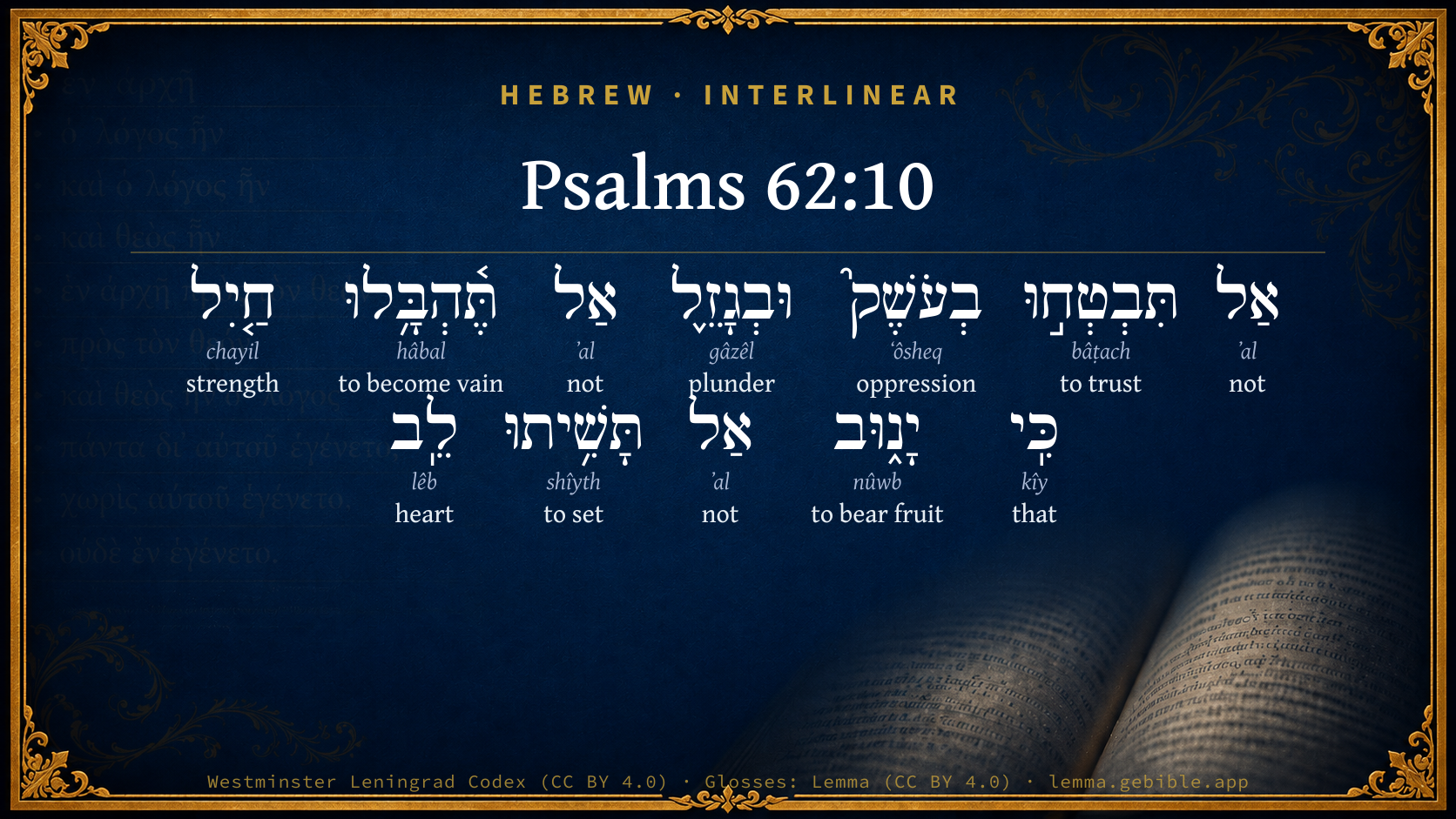
Psalms 62:10

Hebrew (Westminster Leningrad Codex) Psalms 62:10 appears in the Hebrew Old Testament. The text above is from the Westminster Leningrad Codex. Each word links to its Strong’s number, a concise gloss, and parsing drawn from the Open Scriptures Hebrew Bible morphology. Click any word for its full Brown-Driver-Briggs (BDB) entry.
Download image
Cite this verse

Psalms 62:10 (World English Bible). Public Domain. Lemma interlinear Bible study tool, https://lemma.gebible.app/v/psalms/62/10.

Show BibTeX & RIS
BibTeX
RIS
English Translation
Don't trust in oppression. Don't become vain in robbery. If riches increase, Don't set your heart on them.
World English Bible · Public Domain
Highlights
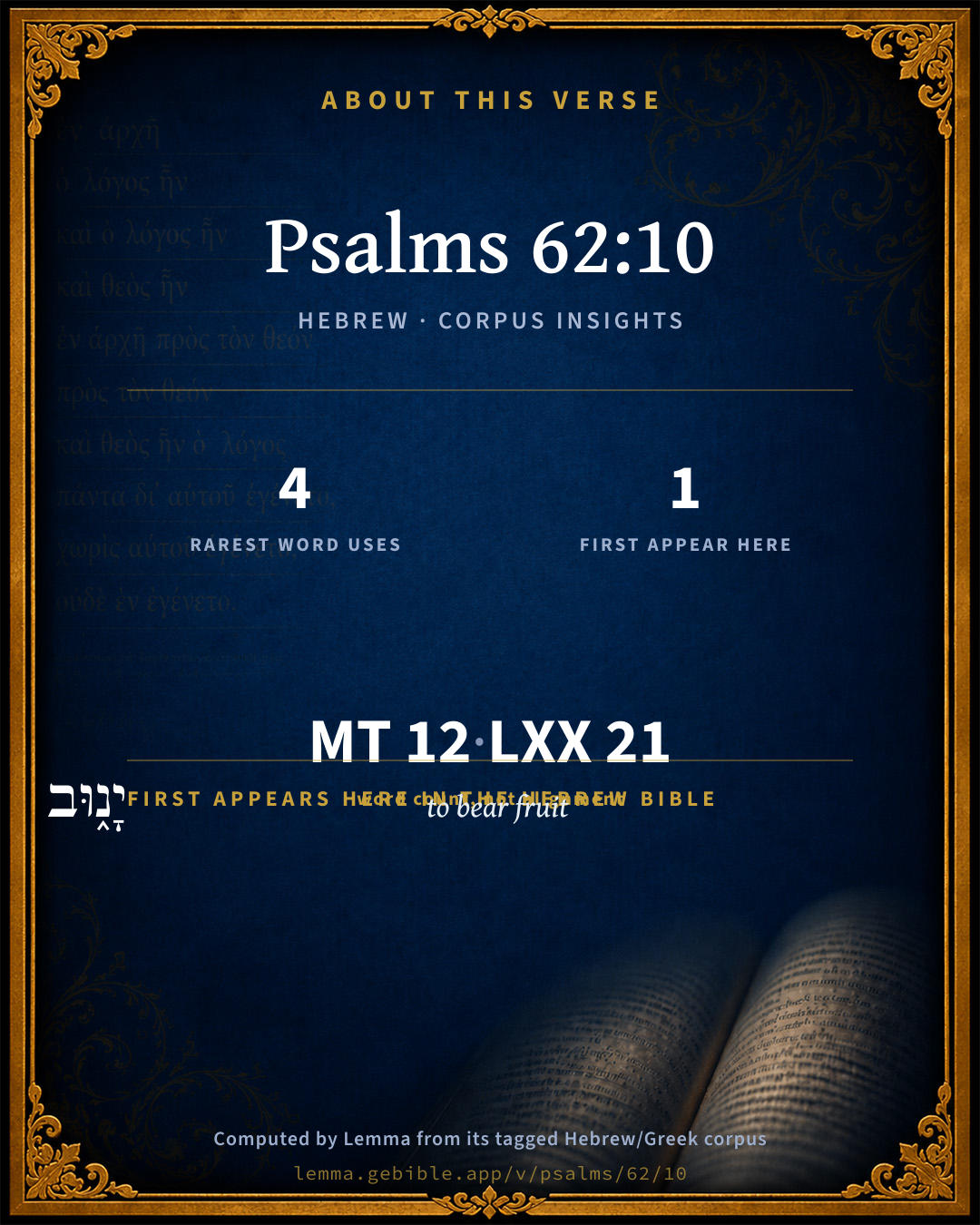
  • 1 first appearance in the Hebrew Bible
Full analysis ↓
Download a study sheet

One document with this verse’s original text, its word-by-word gloss line, the meaning frame, cross-references with their text, attributed commentary, and full source and license credits — printable, and it pastes into notes with its structure intact.

This verse Autodidact and up

Study sheet (.html) Plain text (.txt)

A passage Seminary Student

Up to 50 verses in one chapter. A passage sheet keeps up to 6 commentary sources and 12 cross-references per verse, in the order this page ranks them, and says so on the sheet whenever that leaves anything out. Ask for a single verse and you get the Autodidact verse sheet above.

Everything on this page stays free to read, with no account — the sheet is a download of what is already on screen, not access to it.

Want to remove ads? Support Godless Engineer
Compare translations 3

The same verse in 3 English versions, stacked beneath the original-language interlinear above. Click any original word for its lexicon entry.

Each is an independent rendering of the whole verse — the interlinear is not word-aligned to these translations.

Highlighted words mark where these versions differ — a whole-verse word diff, not a word-by-word alignment.

  • World English Bible Public Domain
    Don't trust in oppression. Don't become vain in robbery. If riches increase, Don't set your heart on them.
  • King James Version Public Domain
    Trust not in oppression, and become not vain in robbery: if riches increase, set not your heart upon them.
  • unfoldingWord Literal Text CC BY-SA 4.0
    Do not trust in oppression, and do not hope vainly in robbery. Wealth, if it increases, do not set the heart.

unfoldingWord Literal Text — © unfoldingWord, licensed CC BY-SA 4.0. Word-aligned USFM3 via Door43 (git.door43.org/unfoldingWord/en_ult).

Versions to compare (up to 4)

3 of 4 selected

Show all 18 translations

Every available English version of this verse, each an independent rendering of the whole verse.

  • World English Bible Public Domain
    Don't trust in oppression. Don't become vain in robbery. If riches increase, Don't set your heart on them.
  • Berean Standard Bible Public Domain
    Place no trust in extortion, or false hope in stolen goods. If your riches increase, do not set your heart upon them.
  • Majority Standard Bible Public Domain
    Place no trust in extortion or false hope in stolen goods. If your riches increase, do not set your heart upon them.
  • King James Version Public Domain
    Trust not in oppression, and become not vain in robbery: if riches increase, set not your heart upon them.
  • American Standard Version (1901) Public Domain
    Trust not in oppression, And become not vain in robbery: If riches increase, set not your heart `thereon'.
  • Revised Version (1885) Public Domain
    Trust not in oppression, and become not vain in robbery: if riches increase, set not your heart thereon.
  • Geneva Bible (1599) Public Domain
    Trust not in oppression nor in robberie: be not vaine: if riches increase, set not your heart thereon.
  • Douay-Rheims (1899) Public Domain
    But vain are the sons of men, the sons of men are liars in the balances: that by vanity they may together deceive.
  • Young's Literal Translation Public Domain
    Trust not in oppression, And in robbery become not vain, Wealth -- when it increaseth -- set not the heart.
  • Literal Standard Version CC BY-SA 4.0
    Do not trust in oppression, || And do not become vain in robbery, || Do not set the heart [on] wealth when it increases.
  • Unlocked Literal Bible CC BY-SA 4.0
    Do not trust in oppression or robbery; and do not hope uselessly in riches, for they will bear no fruit; do not fix your heart on them.
  • unfoldingWord Literal Text CC BY-SA 4.0
    Do not trust in oppression, and do not hope vainly in robbery. Wealth, if it increases, do not set the heart.
  • Darby Bible Public Domain
    Put not confidence in oppression, and become not vain in robbery; if wealth increase, set not your heart upon it.
  • World Messianic Bible Public Domain
    Don’t trust in oppression. Don’t become vain in robbery. If riches increase, don’t set your heart on them.
  • Webster's Bible Public Domain
    \\62:9\\Surely men of low degree are vanity, and men of high degree are a lie: to be laid in the balance, they are altogether lighter than vanity.
  • Free Bible Version CC BY-SA 4.0
    Don't trust in money made by extortion or robbery. Don't be proud of your wealth even if you are successful—don't make money what you live for.
  • Bible in Basic English Public Domain
    Have no faith in the rewards of evil-doing, or in profits wrongly made: if your wealth is increased, do not put your hopes on it.
  • JPS Tanakh (1917) Public Domain
    (62-11) Trust not in oppression, and put not vain hope in robbery; if riches increase, set not your heart thereon.

Literal Standard Version (2020), Covenant Press — licensed CC BY-SA 4.0. Text via the HelloAO Bible API (eBible.org). Unlocked Literal Bible (unfoldingWord) — licensed CC BY-SA 4.0. Text via the HelloAO Bible API (eBible.org). unfoldingWord Literal Text — © unfoldingWord, licensed CC BY-SA 4.0. Word-aligned USFM3 via Door43 (git.door43.org/unfoldingWord/en_ult). Free Bible Version, Dr. Jonathan Gallagher — licensed CC BY-SA 4.0. Text via the HelloAO Bible API (eBible.org).

Word by word

More ways to search: Search by grammar → Find every occurrence → Compare this word →

Practice this passage: Drill this verse → Learn its vocabulary →

וּבְגָזֵ֪ל
gâzêl
H1498
“and · in/at · plunder”
Conjunction + Preposition + Noun, Common, Masculine, Singular, Absolute
Part of Speech
Conjunction + Preposition + Noun
Type
Common
Gender
Masculine
Number
Singular
State
Absolute
Full BDB Definition

Origin: from H1497

TWOT: 337a

robbery, something plundered
  1. אַל ʼal H408 “not” Particle, Negative
  2. תִּבְטְח֣וּ bâṭach H982 “to trust” Verb, Qal, Jussive, 2nd Person, Masculine, Plural
  3. בְעֹשֶׁק֮ ʻôsheq H6233 “in/at · oppression” Preposition + Noun, Common, Masculine, Singular, Absolute
  4. אַל ʼal H408 “not” Particle, Negative
  5. תֶּ֫הְבָּ֥לוּ hâbal H1891 “to become vain” Verb, Qal, Jussive, 2nd Person, Masculine, Plural
  6. חַ֤יִל chayil H2428 “strength” Noun, Common, Masculine, Singular, Absolute
  7. כִּֽי kîy H3588 “that” Conjunction
  8. יָנ֑וּב nûwb H5107 “to bear fruit” Verb, Qal, Imperfect, 3rd Person, Masculine, Singular
  9. אַל ʼal H408 “not” Particle, Negative
  10. תָּשִׁ֥יתוּ shîyth H7896 “to set” Verb, Qal, Jussive, 2nd Person, Masculine, Plural
  11. לֵֽב lêb H3820 “heart” Noun, Common, Masculine, Singular, Absolute

About this verse

These counts appear in no published source. They are computed here, from the morphology-tagged text and Lemma’s own curated glosses. What Lemma adds →

12
words
10
distinct lemmas
Wisdom
section

Notable vocabulary

The rarest word here is וּבְגָזֵ֪ל plunder H1498 — appearing just 4 times in the whole Hebrew Bible.

First appearance in Scripture

This word makes its first canonical appearance in the Hebrew Bible here:

  • יָנ֑וּב to bear fruit H5107

Shared distinctive vocabulary

וּבְגָזֵ֪ל plunder H1498 occurs in 4 verses of the Hebrew Bible. Also found in:

Grammatical profile

  • 4 verbs
  • 4 nouns
  • 1 conjunction
  • 3 particles

Verb forms

  • תִּבְטְח֣וּ Qal · Jussive
  • תֶּ֫הְבָּ֥לוּ Qal · Jussive
  • יָנ֑וּב Qal · Imperfect
  • תָּשִׁ֥יתוּ Qal · Jussive

Repetition

A word recurs within this verse — often emphatic in Hebrew:

  • אַל not H408 ×3

Hebrew & Septuagint length

In English translation the verse runs 18 words from the Hebrew and 20 from the Septuagint (LXX English) — closely comparable.

A rough comparison of the two English renderings, which tokenize alike — not a word-level alignment.

Word counts can differ between the Hebrew and the Greek without any difference in meaning — e.g. the Hebrew direct-object marker אֵת has no separate Greek word, and Greek often adds the article ὁ.

In the original languages it is 12 Hebrew tokens and 21 Greek tokens — but the two are counted differently (Hebrew bundles its prefixes and suffixes into one token; the Greek is in lemma form), so that isn’t a like-for-like length.

Cross-references

23

Topical passages linked to Psalms 62:10 in the Treasury of Scripture Knowledge — connected by theme and wording, ordered by reader-vote popularity; previews shown in the World English Bible.

  • 1 Timothy 6:17 Charge those who are rich in this present world that they not be haughty, nor have their hope set on the uncertainty of riches, but on the living God, who richly provides us with everything to enjoy;
  • Psalms 52:7 "Behold, this is the man who didn't make God his strength, But trusted in the abundance of his riches, And strengthened himself in his wickedness."
  • Jeremiah 17:11 As the partridge that sits on [eggs] which she has not laid, so is he who gets riches, and not by right; in the midst of his days they shall leave him, and at his end he shall be a fool.
  • Deuteronomy 6:10–12 It shall be, when Yahweh your God shall bring you into the land which he swore to your fathers, to Abraham, to Isaac, and to Jacob, to give you, great and goodly cities, which you didn't build,
  • Job 31:24–25 "If I have made gold my hope, And have said to the fine gold, 'You are my confidence;'
  • Isaiah 61:8 For I, Yahweh, love justice, I hate robbery with iniquity; and I will give them their recompense in truth, and I will make an everlasting covenant with them.
  • 1 Timothy 6:10 For the love of money is a root of all kinds of evil. Some have been led astray from the faith in their greed, and have pierced themselves through with many sorrows.
  • Deuteronomy 8:12–14 lest, when you have eaten and are full, and have built goodly houses, and lived therein;
  • Job 20:19 For he has oppressed and forsaken the poor. He has violently taken away a house, and he shall not build it up.
  • Job 20:29 This is the portion of a wicked man from God, The heritage appointed to him by God."
  • Job 27:16–23 Though he heap up silver as the dust, And prepare clothing as the clay;
  • Psalms 49:6 Those who trust in their wealth, And boast in the multitude of their riches--
  • Isaiah 30:12 Therefore thus says the Holy One of Israel, "Because you despise this word, and trust in oppression and perverseness, and rely thereon;
  • Mark 10:23 Jesus looked around, and said to his disciples, "How difficult it is for those who have riches to enter into the Kingdom of God!"
  • Luke 12:15–21 He said to them, "Beware! Keep yourselves from covetousness, for a man's life doesn't consist of the abundance of the things which he possesses."
  • Psalms 39:6 "Surely every man walks like a shadow. Surely they busy themselves in vain. He heaps up, and doesn't know who shall gather.
  • Psalms 91:14 "Because he has set his love on me, therefore I will deliver him. I will set him on high, because he has known my name.
  • Proverbs 23:5 Why do you set your eyes on that which is not? For it certainly sprouts wings like an eagle and flies in the sky.
  • Isaiah 47:10 For you have trusted in your wickedness; you have said, None sees me; your wisdom and your knowledge, it has perverted you, and you have said in your heart, I am, and there is none else besides me.
  • Isaiah 59:4 None sues in righteousness, and none pleads in truth: they trust in vanity, and speak lies; they conceive mischief, and bring forth iniquity.
  • Mark 8:36–37 For what does it profit a man, to gain the whole world, and forfeit his life?
  • Isaiah 28:15 Because you have said, We have made a covenant with death, and with Sheol are we at agreement; when the overflowing scourge shall pass through, it shall not come to us; for we have made lies our refuge, and under falsehood have we hid ourselves:
  • Jeremiah 13:25 This is your lot, the portion measured to you from me, says Yahweh; because you have forgotten me, and trusted in falsehood.

Cross-references courtesy of OpenBible.info (CC BY 4.0).

Hebrew and Greek witnesses Masoretic Hebrew ↔ Greek Septuagint

The same verse in the two great witnesses to the Old Testament, shown verse-for-verse.

You’re reading Greek Psalm 61 (Hebrew Psalm 62). The Septuagint counts the superscription, so verse numbers can differ from the Hebrew — chapter-level alignment, not verse-by-verse. Numbering follows Rahlfs.

These are two independent witnesses, not word-aligned to each other, and the Septuagint is shown in lemma (dictionary) form.

Hebrew Psalms 62:10 Masoretic · Westminster Leningrad Codex

אַל תִּבְטְח֣וּ בְעֹשֶׁק֮ וּבְגָזֵ֪ל אַל תֶּ֫הְבָּ֥לוּ חַ֤יִל כִּֽי יָנ֑וּב אַל תָּשִׁ֥יתוּ לֵֽב

Don't trust in oppression. Don't become vain in robbery. If riches increase, Don't set your heart on them.

World English Bible · Public Domain

Greek LXX Greek Psalm 61:10 Septuagint · lemma form

πλήν μάταιος ὁ υἱός ὁ ἄνθρωπος ψευδής ὁ υἱός ὁ ἄνθρωπος ἐν ζυγός ὁ ἀδικέω αὐτός ἐκ ματαιότης ἐπί ὁ αὐτός

Trust not in unrighteousness, and lust not after robberies: if wealth should flow in, set not your heart upon it.

LXX2012 (modern English Septuagint) · Public Domain

Hebrew: Westminster Leningrad Codex (CC BY 4.0). Greek: Septuagint (public domain); English from LXX2012 (modern English Septuagint) (Public Domain). How the Septuagint differs from the Hebrew →

Commentary

Notes on Psalms 62:10 from classic Christian and Jewish commentators (each source and its license shown beneath its notes). The classic Christian expositions comment on the surrounding passage and are grouped to its opening verse, so a note may address several verses; the Jewish commentaries on the Tanakh (Rashi and others) are per-verse, so they appear only where the commentator wrote on this verse.

Lemma curates 59 commentaries, every one of them public domain or Creative Commons licensed, each selected and text-cleaned for this edition rather than reprinted as found. About our sources →

Trapp's Complete Commentary

John Trapp

Psa 62:10 Trust not in oppression, and become not vain in robbery: if riches increase, set not your heart [upon them].

Ver. 10. Trust not in oppression, &c.] In the fail of persons. Some may think that things may be trusted to, as wealth, wit, power, &c., but especially wealth, 1Ti 6:17. Trust not to that, saith the Psalmist, whether it will be ill or well gotten, unless you covet to be deceived; for, first, he who getteth riches and not by right shall leave them in the midst of his days, and in his end be a fool, a poor fool God will make of him, Jer 17:11, Male parta male dilabentur.

If riches increase] Though by means lawful and laudable, though they come in at the street door, and not at a postern, Non minimum felieitatis argumentum Metello fuit bona malta bona mode invenisse (Policrat. lib. 8, c. 4), yet

Set not your heart upon them] Place not your felicity in them, think not yourselves simply the better or the safer for them. Be not puffed up with outward things, as a bubble with a child s blast in a walnut shell, when he hath in it a little scope. Wilt thou cause thine eyes to fly upon that which is not? Pro 23:5. An eagle will not catch flies (that is no game for her), much less will she make a flight at nothing, when there is no game sprung at all. He is the true rich man, who loveth his riches poorly, saith one.

John Trapp, A Commentary or Exposition upon All the Books of the Old and New Testament (1647–1656) — public domain. Text from a community e-Sword module.

The Biblical Illustrator

Joseph S. Exell

Psa_62:10

If riches increase, set not your heart upon them.

The increase of wealth

I. Here is a circumstance which most desire. Who does not desire the increase of his secular possessions? This desire is virtuous, or otherwise, according to the grand reason that originates and governs it.

1. There is a wrong reason. When wealth is desired either for its own sake, or for purposes of display, ease, voluptuousness, and self-indulgence, the desire for acquisition is vitiated and corrupt. These are the ends of mere worldly men in the aspiration.

2. There is a right reason. He who desires wealth in order properly to discipline his spiritual nature, alleviate the woes of humanity, and help forward the cause of truth, right and benevolence, is righteous in this acquisitive propensity.

II. Here is a possibility which some may possess. The possibility is the increase of riches. This increase in the ease of many, perhaps, is all but impossible; still, in the case of others, it is not so. Poor men often get rich in one of two ways; either with, or without, their own efforts.

1. With their own efforts. By inventive skill, well-directed industry, mercantile forecast, and systematic economy, very often we find poor men rising from great poverty to immense wealth. When such a result is reached apart from fallacious representations, fraudulent transactions and unrighteous speculations, it is at once gratifying and commend: able.

2. Without their own efforts, Not a few indolent and worthless men become rich. By birth they come into an inheritance, or by a kind of luck they are endowed with handsome legacies. Seldom in such cases is wealth of any real worth to its possessors: and it often proves their moral ruin.

III. Here is a duty which all should obey. What is that? Set not your heart upon them. However in manner, or amount, they may increase, they should not occupy the heart. But why?

1. Because to love them is unworthy of your nature. The soul was made to set its affections upon moral, not material, worth, upon the Divine attributes of imperishable mind, not upon the qualities of corruptible matter, The money-lover prostitutes his affections and degrades his nature.

2. Because to love them is to injure your nature. The man who loves wealth offers violence to the dictates of his conscience, fills his heart with harassing cares and anxieties, and materializes the Divine affections of his nature. We become like the objects we love; the man who loves his gold becomes like a miserable grub or a lump of clay.

3. Because to love them is to exclude God from your nature. The soul is so constituted that it cannot love two opposite things supremely at the same time.

4. Because to love them is to bring ruin on your nature. The greatest agony of the soul is bereavement--the separation from the object we love. Such a separation is inevitable where wealth is loved; here the lover and the loved must eternally part. (Homilist.)

The heart in the wrong place

In one of the art galleries of Italy there is a curious picture, by an early painter, which represents a sick man stretched on his bed, and his physicians come to visit him. They have examined their patient, and ascertained his malady to be that his heart is gone--it has altogether disappeared. From a pulpit near by, St. Anthony of Padua is preaching on the text, For where your treasure is, there will your heart be also. He announces where the sick mans heart will be found; and the clue he furnishes is followed up in another compartment by a group of the sick mans friends, who open his strong box, and stand amazed at discovering the missing member reposing among the abundant gold pieces. It is as true as though it was a literal fact, that the heart may be enticed from its rightful place to lie among earthly treasures.

The Biblical Illustrator, edited by Joseph S. Exell (c. 1880s–1900s) — public domain. Text from a community e-Sword module.

The Treasury of David

Charles H. Spurgeon

Ver. 10. Trust not in oppression, and become not vain in robbery. Wealth ill gotten is the trust only of fools, for the deadly pest lies in it; it is full of canker, it reeks with God's curse. To tread down the poor and silence their cries for justice, is the delight of many a braggart bully, who in his arrogance imagines that he may defy both God and man; but he is warned in these words, and it will be well for him if he takes the warning, for the Judge of all the earth will surely visit upon men the oppression of the innocent, and the robbery of the poor: both of these may be effected legally in the courts of man, but no twistings of the law, no tricks and evasions will avail with the Court of Heaven.

If riches increase, set not your heart upon them. If they grow in an honest, providential manner, as the result of industry or commercial success, do not make much account of the circumstance; be not unduly elated, do not fix your love upon your money bags. To bow an immortal spirit to the constant contemplation of fading possessions is extreme folly. Shall those who call the Lord their glory, glory in yellow earth? Shall the image and superscription of Caesar deprive them of communion with him who is the image of the invisible God? As we must not rest in men, so neither must we repose in money. Gain and fame are only so much foam of the sea. All the wealth and honour the whole world can afford would be too slender a thread to bear up the happiness of an immortal soul.

Ver. 10. Trust not in oppression, and become not vain in robbery. Now this robbery and wrong is done two manner of ways--to God and to man. He that putteth his trust for salvation in any other, save in God, loses not only his salvation, but also robs God of his glory, and does God manifest wrong, as much as lieth in him; as the wicked people amongst the Jews did, who said as long as they honoured and trusted unto the queen of heaven, all things prospered with them; but when they hearkened to the true preachers of God's word, all things came into a worse state, and they were overwhelmed with scarcity and trouble. Hosea 2; Jeremiah 44. He also that puts his trust and confidence in any learning or doctrine beside God's word, not only falls into error and loses the truth; but also, as much as lies in him, he robs God's book of his sufficient truth and verity, and ascribes it to the book of men's decrees; which is as much wrong to God and his book as may be thought or done. In which robbery, or rather sacrilege, no man should put his trust, as the prophet saith. John Hooper.

Ver. 10. Become not vain in robbery. What? would he have them serious in robbery? No; the meaning is this: do not trust in a thing of nought; if you rob, oppress, deceive, or wrong others, you trust in a vain thing--in a thing that is not--in a thing that will never do you good: there will be no tack, no hold in anything got in such a manner. When you think to get riches by wrong dealing, or closely circumventing others, you become vain in robbery. Joseph Caryl.

Ver. 10. If riches increase, set not your heart upon them. We naturally love riches, and therefore as naturally spend many thoughts, both how to get and how to keep them. If a man have riches, or an increase in riches, it is not unlawful for him to think of them (yet we should be as sparing of our thoughts that way as may be, our thoughts and the bent of our souls should always be upon God), but that which the psalmist forbids is the settling of our hearts; as if he had said, Let not your thoughts stay or dwell here. Riches are themselves transient things, therefore they should have but our transient thoughts. Set not your hearts upon them, for they may quickly be unsettled. Samuel bespoke Saul in the same language about a worldly concernment, when he went out to seek his father's asses: "Set not thy mind on them." 1Sa 9:20. It is like Saul was overburdened with this thought, "What's become of, or what shall I do for, my father's asses?" "Be not solicitous about them, "saith Samuel, "greater things are towards thee." Joseph Caryl.

Ver. 10. If riches increase, set not your heart upon them. Consider what is here meant by "riches." Indeed, some may imagine that it is hardly possible to mistake the meaning of this common word. Yet, in truth, there are thousands in this mistake; and many of them quite innocently. A person of note hearing a sermon preached upon this subject several years since, between surprise and indignation, broke out aloud, "Why does he talk about riches here? There is no rich man at Whitehaven, but Sir James L-----r." And it is true there was none but he that had forty thousand pounds a year, and some millions in ready money. But a man may be rich that has not a hundred a year--not even one thousand pounds in cash. Whosoever has food to eat, and raiment to put on, with something over, is rich. Whoever has the necessaries and conveniences of life for himself and his family, and a little to spare for them that have not, is properly a rich man, unless he is a miser, a lover of money, one that hoards up what he can and ought to give to the poor. For if so, he is a poor man still, though he has millions in the bank; yea, he is the poorest of men; for

"The beggars but a common lot deplore;

The rich poor man's emphatically poor."

...O! who can convince a rich man that he sets his heart upon riches? For considerably above half a century I have spoken on this head, with all the plainness that was in my power. But with how little effect! I doubt whether I have in all that time convinced fifty misers of covetousness. When the lover of money was described ever so clearly, and painted in the strongest colours, who applied it to himself? To whom did God and all that knew him say, "Thou art the man?" If he speaks to any of you that are present, O do not stop your ears! Rather say, with Zacchaeus, "Behold, Lord, the half of my goods I give to the poor; and if I have done any wrong to any man, I restore him fourfold." He did not mean that he had done this in time past; but that he determined to do so for the time to come. I charge thee before God, thou lover of money, to "go and do likewise.!" I have a message from God unto thee, O rich man! whether thou wilt hear or whether thou wilt forbear. Riches have increased with thee; at the peril of thy soul, "set not thine heart upon them!" Be thankful to him that gave thee such a talent, so much power of doing good. Yet dare not rejoice over them but with fear and trembling. Cave ne inhaereas, says pious Kempis, ne capiaris et pereas; "Beware thou cleave not unto them, lest thou be entangled and perish." Do not make them thy end, thy chief delight, thy happiness, thy god! See that thou expect not happiness in money, nor anything that is purchasable thereby; in gratifying either the desire of the flesh, the desire of the eyes, or the pride of life. John Wesley's Sermon "On the Danger of Increasing Riches."

Ver. 10. If riches increase, etc. "The lust of riches, "says Valerian, "stirs with its stimulus the hearts of men, as oxen perpetually plough the soil." Hugo, on Isaiah, says: "The more deeply riches are sown in the heart through love, the more deeply will they pierce through grief." Thomas Le Blanc.

Ver. 10. If riches increase bwg --literally, "sprout up" of their own accord, as distinguished from riches acquired by "oppression" and "robbery." A. R. Faussett.

Ver. 10. Riches have in them uncertainty and deceitfulness. Riches have never been true to those that trusted in them, but have ever proved "a lie in their right hand." Isa 44:20. Hence they are called "lying vanities, "Jon 2:8; and compared to a flock of birds sitting upon a man's ground, which upon the least fright, take wing and fly away. Riches have "wings, "saith Solomon; and rather than want they will "Make to themselves wings." Pr 23:5. Yea, though they have not the wings so much as of a little sparrow, wherewith to fly to you; yet will they make to themselves the large wings of a great eagle, wherewith to fly from you. Oh, how many have riches served as Absalom's mule served her master, whom she lurched, and left, in his greatest need, hanging betwixt heaven and earth, as if rejected of both! A spark of fire may set them on flying, a thief may steal them, a wicked servant may embezzle and purloin them, a pirate or shipwreck at sea, a robber or bad debtor at land; yea, an hundred ways sets them packing. They are as the apples of Sodom, that look fair yet crumble away with the least touch--golden delusions, a mere mathematical scheme or fancy of man's brain, 1Co 7:31; the semblances and empty show of good without any reality or solid consistency; nec vera, nec vestra: as they are slippery upon the account of verity, so they are no less in respect of prosperity and possession, for they are winged birds, especially in this, that they fly from man to man (as the birds do from tree to tree), and always from the owner of them. This is a sore deceit and cozenage, yet your heart is more deceitful, inasmuch as it will deceive you with these deceitful riches, a quo aliquid tale est, illus est magis tale: they are so, because the heart is so. Christopher Love (1618-1651), in "A Crystal Mirror, or Christian Looking glass, "1679.

Ver. 10. Set not your heart upon them. The word tyv properly is to place, to arrange in a fixed firm order, is specially used of the foundation stones of a building being placed fitly and firmly together... Therefore to set the heart upon riches is, to fix the mind closely and firmly upon them, to give it wholly up to them with all its powers; at the same time to be puffed up with confidence and arrogance, as Cl. Schultens observes. Hermann Venema.

Ver. 10-12. Our estimate of man depends upon our estimate of God. David knows that men of low and high degree, if separated from the primal fount of every good, weigh nothing, and are less than nothing. Riches are nothing, especially ill gotten ones. Man is not to get proud when riches increase. But such is the course of things, that in proportion as the gifts of God are rich, men confide more in the gifts than in the rich giver. But holy David is better instructed. Once and again he has heard the divine voice in his soul, "that power belongeth unto God only." Job 33:14. This powerful God is merciful: can then any merit attach to our poor works? and yet the Lord rendereth to every pious man according to his imperfect pious work. Agustus F. Tholuck.

Ver. 10. Evils usually connected with the love of riches. Idolatry, covetousness, carking, care, meanness, forgetfulness of God and spiritual truth, neglect of charity, hardness of heart, tendency to injustice, etc. Means for escaping this seductive sin.

Psalms 62:11*

Ver. 10-12. See Psalms on "Ps 62:10" for further information.

Ver. 10-12. See Psalms on "Ps 62:10" for further information.

Charles H. Spurgeon's The Treasury of David (1869–1885) — public domain. Psalms only. Text from a community e-Sword/MySword module.

Joseph Benson's Commentary

Psa 62:10. Trust not in oppression — That is, in riches gotten by fraud and violence; or in the arts of acquiring them. As you must not trust in any other men, so neither must you trust to yourselves, nor to your own wit, or industry, or courage, by which you may oppress others, and so think to secure and enrich yourselves. And become not vain in robbery — Lifting up and feeding yourselves with vain hopes of safety and felicity from those riches which you take from others by robbery and violence. If riches increase, set not your heart on them — So as to esteem and inordinately love them, to place your hope, and trust, and chief joy in them, or so as to grow proud and insolent because of them.

Joseph Benson's Commentary on the Old and New Testaments (1811–1818) — public domain. Text from a community e-Sword module.

J. A. Alexander on Psalms

Joseph Addison Alexander

11. (Psa 62:10). Trust not in oppression, and in robbery become not vain; (on) wealth, when it grows, set not (your) heart. The first two nouns are used together in Lev 6:4 to signify that which is acquired by violence. They are not therefore to be taken as distinct grounds of confidence, but as different parts or different descriptions of the same. Become not vain, by being assimilated to the vain, unsatisfying objects of your love and hope. See 2Ki 17:15, and compare Jer 2:5, Job 27:12. The word translated wealth means strictly strength or power, but is applied to pecuniary as well as military force. See above, on Psa 49:6. Grows, literally sprouts, or springs up of its own accord, perhaps with an antithetical allusion to wealth gained by violence. Even when lawfully or accidentally acquired, set not your heart upon it. This phrase in Hebrew sometimes-means nothing more than to apply the mind or give attention, and so some understand it here, "when wealth increases, take no notice, think not of it;" but the stronger sense of fixing the affections on it, loving it, and trusting it, is better in itself and better suited to the context.

Joseph Addison Alexander, The Psalms Translated and Explained (1850) — public domain. Text from a community e-Sword module.

Tyndale Open Study Notes

Tyndale Open Resources

62:10 The crime of extortion means using intimidation and threats to make others give up what is theirs, while stealing is taking what belongs to others.

Tyndale Open Study Notes — © Tyndale Open Resources, licensed CC BY-SA 4.0. Text via the HelloAO Bible API.

Geneva Bible (1599)

Geneva Bible translators

Give yourselves wholly to God by putting away all things that are contrary to his Law.

Geneva Bible (1599) marginal notes — public domain. Text via Bolls.life.

Jamieson, Fausset & Brown

Robert Jamieson, A. R. Fausset & David Brown

Not only are oppression and robbery, which are wicked means of wealth, no grounds of boasting; but even wealth, increasing lawfully, ought not to engross the heart.

Jamieson, Fausset & Brown — Commentary Critical and Explanatory on the Whole Bible (1871) — public domain (CC PDM 1.0). Text via the HelloAO Bible API.

Adam Clarke's Commentary

Verse 10. Trust not in oppression] Do not suppose that my unnatural son and his partisans can succeed.

Become not vain in robbery] If ye have laid your hands on the spoils of my house, do not imagine that these ill-gotten riches will prosper. God will soon scatter them to all the winds of heaven. All oppressors come to an untimely end; and all property acquired by injustice has God's curse on it.

Adam Clarke's Commentary on the Bible (1810–1826) — public domain. Text from a community e-Sword/MySword module.

John Calvin's Commentaries

10 Trust not in oppression and robbery We are here taught that there can be no real trusting in God until we put away all those vain confidences which prove so many means of turning us away from him. The Psalmist bids us remove whatsoever would have this tendency, and purge ourselves of every vicious desire that would usurp the place of God in our hearts. One or two kinds of sin only are mentioned, but these are to be understood as representing a part for the whole, all those vain and rival confidences of which we must be divested before we can cleave to God with true purpose and sincerity of heart. By oppression and robbery may be understood the act itself of abstracting by violence, and the thing which has been abstracted. It is obviously the design of the passage to warn us against the presumption and hardihood of sin, which is so apt to blind the hearts of men, and deceive them into the belief that their evil courses are sanctioned by the impunity which is extended to them. Interpreters have differed in their construction of the words of this verse. Some join to each of the nouns its own verb, reading, Trust not in oppression, and be not vain in robbery: if riches increase, set not your heart upon them. Others connect the words oppression and robbery with the first verb, and make the second to stand apart by itself in an indefinite sense. It is of very little consequence which of the constructions we adopt, since both express the main sentiment; and it is evident that the Psalmist, in condemning the infatuated confidence of those who boast in robbery, appropriately terms it a mere illusion of the mind, with which they deceive or amuse themselves. Having denounced, in the first place, those desires which are plainly evil and positively wicked, he proceeds immediately afterwards to guard against an inordinate attachment even to such riches as may have been honestly acquired. To set the heart upon riches, means more than simply to covet the possession of them. It implies being carried away by them into a false confidence, or, to use an expression of Paul, “Being high-minded.” The admonition here given is one which daily observation teaches us to be necessary. It is uniformly seen that prosperity and abundance engender a haughty spirit, leading men at once to be presumptuous in their carriage before God, and reckless in inflicting injury upon their fellow-creatures. But, indeed, the worst effect to be feared from a blind and ungoverned spirit of this kind is, that, in the intoxication of outward greatness, we be left to forget how frail we are, and proudly and contumeliously to exalt ourselves against God.

John Calvin's Commentaries (1540-1563) — public domain. Text from the Calvin Translation Society English edition (1840s-50s) via the Christian Classics Ethereal Library (ccel.org). Calvin's coverage is partial (roughly two-thirds of the Bible); uncommented books and verses are honest gaps, never fabricated. The 19th-century editor's footnotes and remarks are omitted so the notes are faithfully Calvin's own voice.

Ellicott's Commentary for English Readers

(10) If riches increase.—Even if by honest means you grow rich, distrust your wealth.

A Bible Commentary for English Readers, edited by Charles John Ellicott (1878–1897) — public domain. Text from a community e-Sword module.

The Cambridge Bible for Schools and Colleges

gen. ed. J. J. S. Perowne

10. The first two lines (cp. Psa_62:9 a, 11 a, b) are a rhythmical division of what is logically one sentence: put not vain trust in oppression and robbery.’ Do not rely, for you will only be deceived, upon wealth and material resources amassed by violence and wrong, instead of trusting in God (Psa_62:8). It is a warning against the old temptation to follow might rather than right. ‘Oppression and robbery’ are often coupled. See Lev_6:2; Lev_6:4; Eze_22:29; and cp. Isa_30:12.

if riches increase &c.] Lit. if riches grow, pay no regard. The Psalmist addresses those who were in danger of being tempted to covet the power which wealth brings, no matter what might be the means used for obtaining it. There are indications that social discontent was a factor in the momentary success of Absalom’s rebellion (Psa_4:6).

The Cambridge Bible for Schools and Colleges (gen. ed. J. J. S. Perowne; Cambridge University Press, 1878–1918) — public domain. Text from a community e-Sword module.

John Gill's Exposition

Trust not in oppression,.... Either in the power of oppressing others; see Isa 30:12; or in riches gotten by oppression, which being put into a man's hand by his friend, he keeps, and will not return them; so Aben Ezra and Kimchi interpret it of mammon unlawfully obtained; mammon of unrighteousness, or unrighteous mammon; see Jer 17:11;

and become not vain in robbery; in riches gotten by open rapine and theft; and men become vain herein when they boast of such riches, place their confidence in them, and think to make atonement for their sins by burnt sacrifices purchased with them, Isa 61:8;

if riches increase; in a lawful way, in such manner as the fruits of the earth do, as the word (m) used signifies: if they increase in great abundance from a little, as from one grain of corn many proceed; and insensibly, as the seed sown grows up, a man knows not how, through diligence and the blessing of God from heaven;

set not your heart upon them; your affections on them; they are ensnaring, they are apt to take the heart from God, to draw off the affections from Christ and things above, to choke the word, and lead into many temptations and harmful lusts; let not your hearts be elated, or lifted up with them; be not highminded, or filled with pride and vanity on account of them; nor put any trust in them, for they are uncertain things. Jarchi interprets it of the increase of the riches of others; see Psa 49:16.

(m) "cum pullulaverit", Montanus; "efflorescunt", Cocceius; "germinant, fructificant", Amama.

John Gill's Exposition of the Whole Bible (1746–1763) — public domain (CC PDM 1.0). Text via the HelloAO Bible API.

Albert Barnes' Notes on the Bible

Trust not in oppression - The general meaning here is, that we are not to trust in anything but God. In the previous verse the psalmist had stated reasons why we should not trust in men of any rank. In this verse he enumerates several things on which people are accustomed to rely, or in which they place confidence, and he says that we should put no confidence in them in respect to the help which we need, or the great objects which are to be accomplished by us. The first thing mentioned is oppression; and the idea is, that we must not hope to accomplish our object by oppressing others; extorting their property or their service; making them by force subject to us, and subservient to our wishes. Many do this. Conquerors do it. Tyrants do it. The owners of slaves do it.

And become not vain in robbery - That is, Do not resort to theft or robbery, and depend on that for what is needed in life. Many do. The great robbers of the world - conquerors - have done it. Thieves and burglars do it. People who seek to defraud others of their earnings do it. They who withhold wages from laborers, and they who cheat in trade, do it.

If riches increase, set not your heart upon them - If you become rich without oppression, or without robbery. If your riches seem to grow of themselves - for that is the meaning of the original word (compare Mar 4:2) - do not rely on them as being all that you require. People are prone to do this. The rich man confides in his wealth, and supposes that he has all he needs. The psalmist says that none of these things constitute the true reliance of man. None of them can supply his real needs; none can defend him in the great perils of his existence; hone can save his soul. He needs, over and above all these, a God and Saviour; and it is such a God and Saviour only that can meet the real needs of his nature.

Albert Barnes' Notes on the Bible (1834–1885) — public domain. Text from a community e-Sword/MySword module.

Matthew Poole's English Annotations

Trust not in oppression; as you may not trust any other men, so neither must you trust to yourselves, nor to your own wit, or industry, or courage, by which you may oppress others, and so think to secure and enrich yourselves.

Become not vain; lifting up and feeding yourselves with vain hopes, and expectations of safety and felicity, from those riches which you take from others by robbery or violence.

Set not your heart upon them; so as to please yourselves immoderately in them, to place your hope, and trust, and chief joy in them, or to grow proud and insolent because of them.

Matthew Poole's English Annotations on the Holy Bible (1683–1685) — public domain. Text from a community e-Sword/MySword module.

Whedon's Commentary on the Bible

Daniel D. Whedon

10. Oppression… robbery—The two words differ more in the manner of acquiring than in the thing acquired. The former denotes that which is acquired by deceit and guile, the latter that which is gotten by force or violence. In either case the psalmist admonishes his enemies not to be elated by sudden success, nor put confidence in wealth or power thus gained, for both they and their works are subject to the judgment of God.

Daniel D. Whedon (gen. ed.), Commentary on the Old and New Testaments (1874–1909) — public domain. Text from a community e-Sword module.

The Pulpit Commentary

Trust not in oppression (comp. ver. 3). The class that supported Absalom was the class of oppressors in Israel, whom David kept under and restrained as far as possible. The writer warns them against trusting in their power to oppress, since such strength as they have is not their own, but lent them by God. And become not vain in robbery; or, rely not vainly on robbery (Kay). Do not suppose that God will allow you to continue oppressing and robbing. Such a belief is a vain illusion. If riches increase, set not your heart upon them. Even when wealth accumulates naturally, and not as the result of ill-doing, it is not a thing to be trusted or set store by.

The Pulpit Commentary (1880–1919), ed. H.D.M. Spence-Jones & Joseph S. Exell — public domain. Text from a community e-Sword module.

John Wesley's Explanatory Notes

Vain - Feeding yourselves with vain hopes of felicity, from those riches which you take from others by violence.

John Wesley, Explanatory Notes Upon the Whole Bible (1754–1765) — public domain. Text via the GEBible commentary corpus.

Rashi

Rabbi Shlomo Yitzchaki (Rashi)

The sons of men are but vanity Do not fear them, since God is forever our shelter in time of trouble.

were they to be put on a scale If they came to go up on a scale, they and their vanities would be equal. This is the simple meaning, but midrashically, it is interpreted as concerning couples (Lev. Rabbah 29:8).

Rashi on the Tanakh — English translations: “The Judaica Press complete Tanach with Rashi, translated by A. J. Rosenberg” (CC BY 4.0); “Pentateuch with Rashi's commentary by M. Rosenbaum and A.M. Silbermann, 1929-1934” (public domain); “The Metsudah Tanach series, Lakewood, N.J” (CC BY 4.0); and “The Book of Joshua, Metsudah Publications, 1997” (CC BY 4.0). Text via Sefaria.

Lesson kit

Teaching starters — assembled from the data on this page, not authored interpretation. Every prompt links to the verse data it draws on. Edit before teaching.

Psalms, in the Wisdom, opens this verse with 12 words (10 distinct Hebrew lemmas). Its most distinctive word is gâzêl (“plunder”). A historical commentator’s framing appears above. Read the whole chapter for the surrounding context.

Discussion questions

  1. How does “plunder” (gâzêl) shape what this verse is saying?
  2. This is the first place “to bear fruit” appears in Scripture (first appears here). What does its debut here establish?
  3. How does Leviticus 6:2, which shares the word «plunder», read alongside this verse?
  4. What does the repetition of “not” (3× in this one verse) do in this verse?
  5. These translations render this verse differently; the difference is in the English rendering, not the original. What questions does that raise?
  6. «תִּבְטְח֣וּ» is a Qal Jussive verb. How does that grammatical form shape the action described?
  7. Compare how Trapp's Complete Commentary and The Biblical Illustrator read this verse. Where do they agree or differ?

Things to notice

Reading settings

Reading text

Shown beneath each verse's original-language words.

Old Testament
Old Testament edition

Read the OT as the Masoretic Hebrew (MT) or the Greek Septuagint (LXX).

English shown for the Greek Septuagint (in the Hebrew ↔ Greek comparison).

Comparing translations? Open the Compare panel on any verse page to stack up to four side by side.