
Psalms 81:4

Hebrew (Westminster Leningrad Codex) Psalms 81:4 appears in the Hebrew Old Testament. The text above is from the Westminster Leningrad Codex. Each word links to its Strong’s number, a concise gloss, and parsing drawn from the Open Scriptures Hebrew Bible morphology. Click any word for its full Brown-Driver-Briggs (BDB) entry.
Download image
Cite this verse

Psalms 81:4 (World English Bible). Public Domain. Lemma interlinear Bible study tool, https://lemma.gebible.app/v/psalms/81/4.

Show BibTeX & RIS
BibTeX
RIS
English Translation
For it is a statute for Israel, An ordinance of the God of Jacob.
World English Bible · Public Domain
Download a study sheet

One document with this verse’s original text, its word-by-word gloss line, the meaning frame, cross-references with their text, attributed commentary, and full source and license credits — printable, and it pastes into notes with its structure intact.

This verse Autodidact and up

Study sheet (.html) Plain text (.txt)

A passage Seminary Student

Up to 50 verses in one chapter. A passage sheet keeps up to 6 commentary sources and 12 cross-references per verse, in the order this page ranks them, and says so on the sheet whenever that leaves anything out. Ask for a single verse and you get the Autodidact verse sheet above.

Everything on this page stays free to read, with no account — the sheet is a download of what is already on screen, not access to it.

Want to remove ads? Support Godless Engineer
Compare translations 3

The same verse in 3 English versions, stacked beneath the original-language interlinear above. Click any original word for its lexicon entry.

Each is an independent rendering of the whole verse — the interlinear is not word-aligned to these translations.

Highlighted words mark where these versions differ — a whole-verse word diff, not a word-by-word alignment.

  • World English Bible Public Domain
    For it is a statute for Israel, An ordinance of the God of Jacob.
  • King James Version Public Domain
    For this was a statute for Israel, and a law of the God of Jacob.
  • unfoldingWord Literal Text CC BY-SA 4.0
    For a statute for Israel, a judgment of the God of Jacob.

unfoldingWord Literal Text — © unfoldingWord, licensed CC BY-SA 4.0. Word-aligned USFM3 via Door43 (git.door43.org/unfoldingWord/en_ult).

Versions to compare (up to 4)

3 of 4 selected

Show all 18 translations

Every available English version of this verse, each an independent rendering of the whole verse.

  • World English Bible Public Domain
    For it is a statute for Israel, An ordinance of the God of Jacob.
  • Berean Standard Bible Public Domain
    For this is a statute for Israel, an ordinance of the God of Jacob.
  • Majority Standard Bible Public Domain
    For this is a statute for Israel, an ordinance of the God of Jacob.
  • King James Version Public Domain
    For this was a statute for Israel, and a law of the God of Jacob.
  • American Standard Version (1901) Public Domain
    For it is a statute for Israel, An ordinance of the God of Jacob.
  • Revised Version (1885) Public Domain
    For it is a statute for Israel, an ordinance of the God of Jacob.
  • Geneva Bible (1599) Public Domain
    For this is a statute for Israel, and a Law of the God of Iaakob.
  • Douay-Rheims (1899) Public Domain
    Blow up the trumpet on the new moon, on the noted day of your solemnity.
  • Young's Literal Translation Public Domain
    For a statute to Israel it `is', An ordinance of the God of Jacob.
  • Literal Standard Version CC BY-SA 4.0
    For it [is] a statute to Israel, || An ordinance of the God of Jacob.
  • Unlocked Literal Bible CC BY-SA 4.0
    For it is a statute for Israel, a decree given by the God of Jacob.
  • unfoldingWord Literal Text CC BY-SA 4.0
    For a statute for Israel, a judgment of the God of Jacob.
  • Darby Bible Public Domain
    For this is a statute for Israel, an ordinance of the God of Jacob;
  • World Messianic Bible Public Domain
    For it is a statute for Israel, an ordinance of the God of Jacob.
  • Webster's Bible Public Domain
    \\81:3\\Blow the trumpet in the new moon, in the time appointed, on our solemn feast day.
  • Free Bible Version CC BY-SA 4.0
    for this is a rule for Israel, a regulation of the God of Jacob.
  • Bible in Basic English Public Domain
    For this is a rule for Israel, and a law of the God of Jacob.
  • JPS Tanakh (1917) Public Domain
    (81-5) For it is a statute for Israel, an ordinance of the God of Jacob.

Literal Standard Version (2020), Covenant Press — licensed CC BY-SA 4.0. Text via the HelloAO Bible API (eBible.org). Unlocked Literal Bible (unfoldingWord) — licensed CC BY-SA 4.0. Text via the HelloAO Bible API (eBible.org). unfoldingWord Literal Text — © unfoldingWord, licensed CC BY-SA 4.0. Word-aligned USFM3 via Door43 (git.door43.org/unfoldingWord/en_ult). Free Bible Version, Dr. Jonathan Gallagher — licensed CC BY-SA 4.0. Text via the HelloAO Bible API (eBible.org).

Word by word

More ways to search: Search by grammar → Find every occurrence → Compare this word →

Practice this passage: Drill this verse → Learn its vocabulary →

חֹ֣ק
chôq
H2706
“statute”
Noun, Common, Masculine, Singular, Absolute
Part of Speech
Noun
Type
Common
Gender
Masculine
Number
Singular
State
Absolute
Full BDB Definition

Origin: from H2710

TWOT: 728a

statute, ordinance, limit, something prescribed, due - prescribed task - prescribed portion - action prescribed (for oneself), resolve - prescribed due - prescribed limit, boundary - enactment, decree, ordinance - specific decree - law in general - enactments, statutes - conditions - enactments - decrees - civil enactments prescribed by God
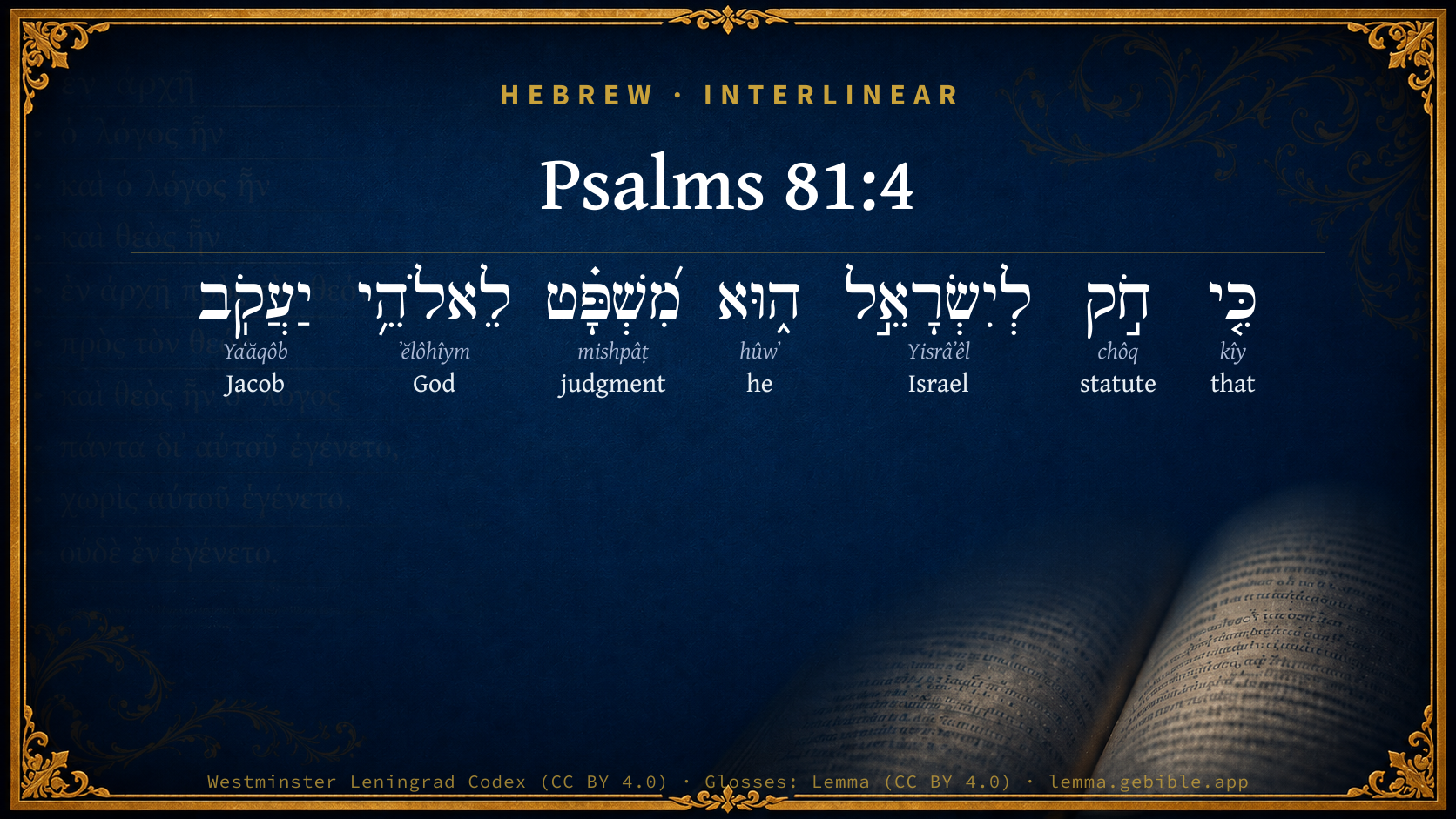
  1. כִּ֤י kîy H3588 “that” Conjunction
  2. לְיִשְׂרָאֵ֣ל Yisrâʼêl H3478 “to/for · Israel” Preposition + Noun, Proper
  3. ה֑וּא hûwʼ H1931 “he” Pronoun, Personal, 3rd Person, Masculine, Singular
  4. מִ֝שְׁפָּ֗ט mishpâṭ H4941 “judgment” Noun, Common, Masculine, Singular, Absolute
  5. לֵאלֹהֵ֥י ʼĕlôhîym H430 “to/for · God(s) of” Preposition + Noun, Common, Masculine, Plural, Construct
  6. יַעֲקֹֽב Yaʻăqôb H3290 “Jacob” Noun, Proper

About this verse

These counts appear in no published source. They are computed here, from the morphology-tagged text and Lemma’s own curated glosses. What Lemma adds →

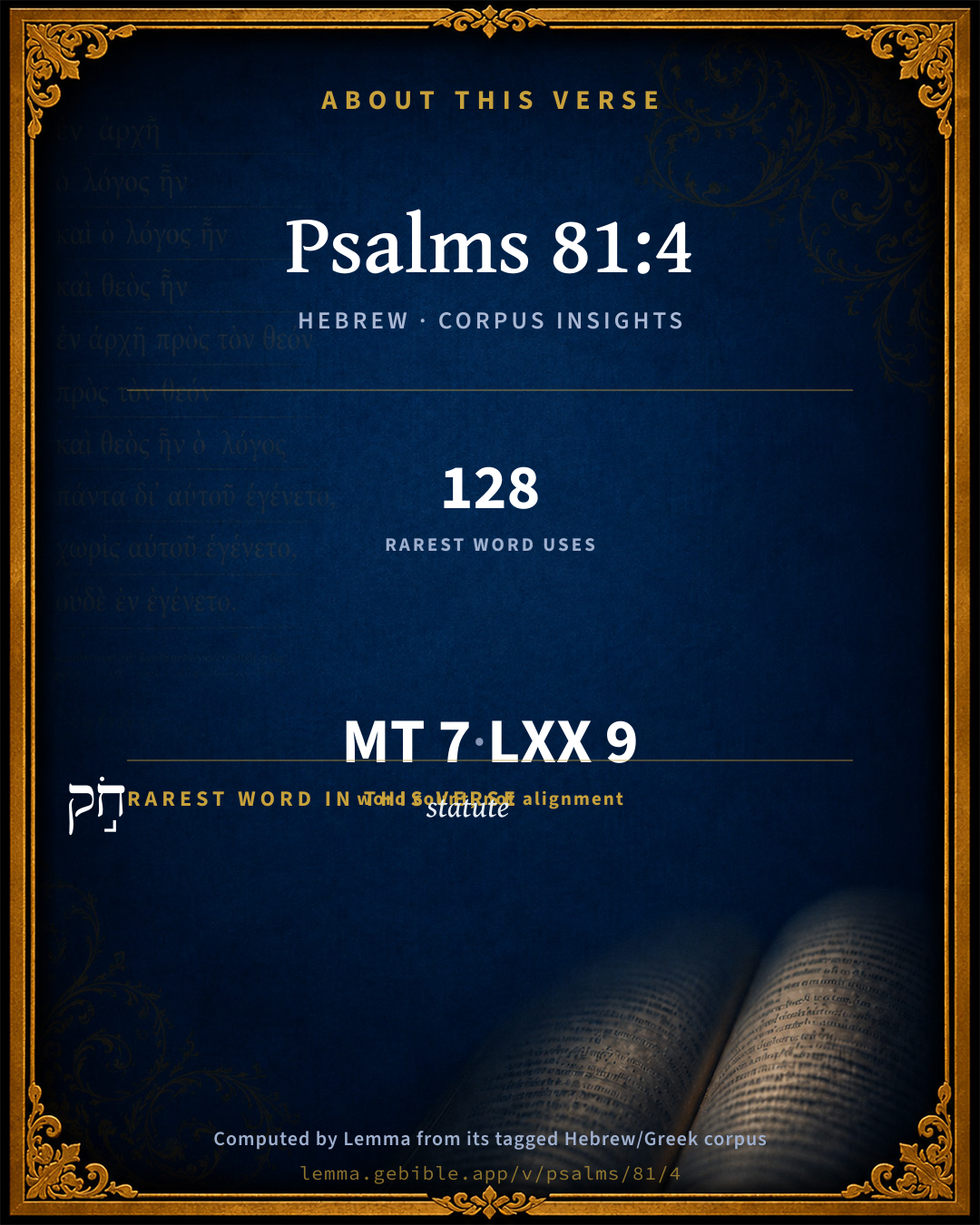
7
words
7
distinct lemmas
Wisdom
section

Grammatical profile

  • 5 nouns
  • 1 pronoun
  • 1 conjunction

Hebrew & Septuagint length

In English translation the verse runs 14 words from the Hebrew and 15 from the Septuagint (LXX English) — closely comparable.

A rough comparison of the two English renderings, which tokenize alike — not a word-level alignment.

Word counts can differ between the Hebrew and the Greek without any difference in meaning — e.g. the Hebrew direct-object marker אֵת has no separate Greek word, and Greek often adds the article ὁ.

In the original languages it is 7 Hebrew tokens and 9 Greek tokens — but the two are counted differently (Hebrew bundles its prefixes and suffixes into one token; the Greek is in lemma form), so that isn’t a like-for-like length.

Hebrew and Greek witnesses Masoretic Hebrew ↔ Greek Septuagint

The same verse in the two great witnesses to the Old Testament, shown verse-for-verse.

You’re reading Greek Psalm 80 (Hebrew Psalm 81). The Septuagint counts the superscription, so verse numbers can differ from the Hebrew — chapter-level alignment, not verse-by-verse. Numbering follows Rahlfs.

These are two independent witnesses, not word-aligned to each other, and the Septuagint is shown in lemma (dictionary) form.

Hebrew Psalms 81:4 Masoretic · Westminster Leningrad Codex

כִּ֤י חֹ֣ק לְיִשְׂרָאֵ֣ל ה֑וּא מִ֝שְׁפָּ֗ט לֵאלֹהֵ֥י יַעֲקֹֽב

For it is a statute for Israel, An ordinance of the God of Jacob.

World English Bible · Public Domain

Greek LXX Greek Psalm 80:4 Septuagint · lemma form

σαλπίζω ἐν νουμηνία σάλπιγξ ἐν εὐσήμος ἡμέρα ἑορτή ἐγώ

For this is an ordinance for Israel, and a statute of the God of Jacob.

LXX2012 (modern English Septuagint) · Public Domain

On this verse, Ellicott's Commentary for English Readers discusses the Septuagint’s reading. Read the note in Commentary ↓

Hebrew: Westminster Leningrad Codex (CC BY 4.0). Greek: Septuagint (public domain); English from LXX2012 (modern English Septuagint) (Public Domain). How the Septuagint differs from the Hebrew →

Commentary

Notes on Psalms 81:4 from classic Christian and Jewish commentators (each source and its license shown beneath its notes). The classic Christian expositions comment on the surrounding passage and are grouped to its opening verse, so a note may address several verses; the Jewish commentaries on the Tanakh (Rashi and others) are per-verse, so they appear only where the commentator wrote on this verse.

Lemma curates 59 commentaries, every one of them public domain or Creative Commons licensed, each selected and text-cleaned for this edition rather than reprinted as found. About our sources →

Trapp's Complete Commentary

John Trapp

Psa 81:4 For this [was] a statute for Israel, [and] a law of the God of Jacob.

Ver. 4. For this was a statute] The keeping of it therefore is not arbitrary, but necessary: Aut faciendum aut patiendum.

And a law] Which was to be kept as the apple of the eye, Pro 7:2.

John Trapp, A Commentary or Exposition upon All the Books of the Old and New Testament (1647–1656) — public domain. Text from a community e-Sword module.

Joseph Benson's Commentary

Psa 81:4-5. For this was a statute for Israel — This is no human device, but a divine institution; God hath appointed and commanded this solemn feast to be announced and observed in this manner. This — Namely, the blowing of trumpets; he ordained in Joseph — Among the posterity of Joseph, namely, the people of Israel, as is evident both from the foregoing verse, where they are called Israel, and from the following words of this verse, where they are described by their coming out of Egypt, which was common to all the tribes of Israel, who are sometimes called by the name of Joseph. For a testimony — For a law, often called a testimony; or, rather, for a witness and memorial of the glorious deliverance here referred to. When he — That is, he who ordained, as was now said, namely, God; went out through the land of Egypt — As a captain at the head, or on the behalf of his people, to execute his judgments upon that land; or, against that land, namely, to destroy it. Or, as many ancient and modern interpreters read it, out of the land. And so understood, this text signifies the time when this and the other feasts were instituted, namely, soon after their coming out of Egypt, even at Sinai. Where I heard, &c. — That is, my progenitors heard, for all the successive generations of Israel make one body, and are sometimes spoken of as one person; a language which I understood not — Either the language of God himself, speaking from heaven at Sinai, which was strange and terrible to them; or, rather, the Egyptian language, which at first was both very disagreeable and unknown to the Israelites, Gen 42:23, and probably continued so for some considerable time, because they were much separated, both in place and conversation, from the Egyptians, through Joseph’s pious and prudent appointment. This exposition of the passage is confirmed by Psa 114:1, where this very thing is mentioned as an aggravation of their misery; and by other places of Scripture, where it is spoken of as a curse and calamity to be with a people of a strange language. See Deu 28:49; Jer 5:15.

Joseph Benson's Commentary on the Old and New Testaments (1811–1818) — public domain. Text from a community e-Sword module.

Keil & Delitzsch

C. F. Keil & F. Delitzsch

Psa 81:4-5 now tell whence the feast which is to be met with singing and music has acquired such a high significance: it is a divine institution coming from the time of the redemption by the hand of Moses. It is called חק as being a legally sanctioned decree, משׁפּט as being a lawfully binding appointment, and עדוּת as being a positive declaration of the divine will. The ל in לישׂראל characterizes Israel as the receiver, in לאלהי the God of Israel as the owner, i.e., Author and Lawgiver. By בּצעתו the establishing of the statute is dated back to the time of the Exodus; but the statement of the time of its being established, "when He went out over the land of Egypt," cannot be understood of the exodus of the people out of Egypt, natural as this may be here, where Israel has just been called יהוסף (pathetic for יוסף), by a comparison with Gen 41:45, where Joseph is spoken of in the same words. For this expression does not describe the going forth out of a country, perhaps in the sight of its inhabitants, Num 33:3, cf. Exo 14:8 (Hengstenberg), but the going out over a country. Elohim is the subject, and צאת is to be understood according to Exo 11:4 (Kimchi, De Dieu, Dathe, Rosenmller, and others): when He went out for judgment over the land of Egypt (cf. Mic 1:3). This statement of the time of itself at once decides the reference of the Psalm to the Passover, which commemorates the sparing of Israel at that time (Exo 12:27), and which was instituted on that very night of judgment. The accentuation divides the verse correctly. According to this, שׂפת לא־ידעתּי אשׁמע is not a relative clause to מצרים: where I heard a language that I understood not (Psa 114:1). Certainly ידע שׂפה, "to understand a language," is an expression that is in itself not inadmissible (cf. ידע ספר, to understand writing, to be able to read, Isa 29:11.), the selection of which instead of the more customary phrase שׁמע לשׁון (Deu 28:49; Isa 33:19; Jer 5:15) might be easily intelligible here beside אשׁמע; but the omission of the שׁם (אשׁר) is harsh, the thought it here purposeless, and excluded with our way of taking בצאתו. From the speech of God that follows it is evident that the clause is intended to serve as an introduction of this divine speech, whether it now be rendered sermonem quem non novi (cf. Psa 18:44, populus quem non novi), or alicujus, quem non novi (Ges. 123, rem. 1), both of which are admissible. It is not in some way an introduction to the following speech of God as one which it has been suddenly given to the psalmist to hear: "An unknown language, or the language of one unknown, do I hear?" Thus Dderlein explains it: Subitanea et digna poetico impetu digressio, cum vates sese divino adflatu subito perculsum sentit et oraculum audire sibi persuadet; and in the same way De Wette, Olshausen, Hupfeld, and others. But the oracle of God cannot appear so strange to the Israelitish poet and seer as the spirit-voice to Eliphaz (Job 4:16); and moreover אשׁמע after the foregoing historical predicates has the presumption of the imperfect signification in its favour. Thus, then, it will have to be interpreted according to Exo 6:2. It was the language of a known, but still also unknown God, which Israel heard in the redemption of that period. It was the God who had been made manifest as יהוה only, so to speak, by way of prelude hitherto, who now appeared at this juncture of the patriarchal history, which had been all along kept in view, in the marvellous and new light of the judgment which was executed upon Egypt, and of the protection, redemption, and election of Israel, as being One hitherto unknown, as the history of salvation actually then, having arrived at Sinai, receives an entirely new form, inasmuch as from this time onwards the congregation or church is a nation, and Jahve the King of a nation, and the bond of union between them a national law educating it for the real, vital salvation that is to come. The words of Jahve that follow are now not the words heard then in the time of the Exodus. The remembrance of the words heard forms only a transition to those that now make themselves heard. For when the poet remembers the language which He who reveals Himself in a manner never before seen and heard of spoke to His people at that time, the Ever-living One Himself, who is yesterday and to-day the same One, speaks in order to remind His people of what He was to them then, and of what He spake to them then.

Keil & Delitzsch — Biblical Commentary on the Old Testament (1861–1891) — public domain (CC PDM 1.0). Text via the HelloAO Bible API. (Old Testament only.)

J. A. Alexander on Psalms

Joseph Addison Alexander

5. (Psa 81:4) For a law to Israel (is) this, a right (belonging) to the God of Jacob. The observance of this festival was not a mere matter of usage or conventional arrangement, but binding on the people and due to Jehovah as their God. The personal pronoun (it) at the end of the first clause isemphatic, and may be better expressed in English by a demonstrative. A right, just, that to which he is rightfully entitled.

Joseph Addison Alexander, The Psalms Translated and Explained (1850) — public domain. Text from a community e-Sword module.

Tyndale Open Study Notes

Tyndale Open Resources

81:4-5 The festival, a time to celebrate and listen to the Lord, took place at God’s appointed time.

Tyndale Open Study Notes — © Tyndale Open Resources, licensed CC BY-SA 4.0. Text via the HelloAO Bible API.

Adam Clarke's Commentary

Verse 4. This was a statute for Israel] See the statute, Nu 10:10, and Le 23:24.

Adam Clarke's Commentary on the Bible (1810–1826) — public domain. Text from a community e-Sword/MySword module.

John Calvin's Commentaries

4 For this is a statute to Israel. To give the more effect to the preceding exhortation, it is here taught that this law or ordinance had been prescribed to God’s ancient people, for the purpose of ratifying the everlasting covenant. And as in covenants there is a mutual agreement between the parties, it is declared that this statute was given to Israel, and that God, in contracting, reserved this for himself, as a right to which he was justly entitled.

John Calvin's Commentaries (1540-1563) — public domain. Text from the Calvin Translation Society English edition (1840s-50s) via the Christian Classics Ethereal Library (ccel.org). Calvin's coverage is partial (roughly two-thirds of the Bible); uncommented books and verses are honest gaps, never fabricated. The 19th-century editor's footnotes and remarks are omitted so the notes are faithfully Calvin's own voice.

Ellicott's Commentary for English Readers

(4) For this.—Better, for it is a statute. Referring either to the feast itself or to the mode of celebrating it.

Law.—Literally, judgment, as LXX. and Vulg.

A Bible Commentary for English Readers, edited by Charles John Ellicott (1878–1897) — public domain. Text from a community e-Sword module.

The Cambridge Bible for Schools and Colleges

gen. ed. J. J. S. Perowne

4. For it is a statute for Israel,

An ordinance of the God of Jacob. (R.V.)

It refers to the feast. The title God of Jacob carries our thoughts back beyond the Exodus to the providential dealings of Jehovah with the great ancestor of the nation (Gen_46:2 ff.).

4, 5. The reason for the celebration in the divine appointment of the festival as a memorial of God’s goodness to Israel.

The Cambridge Bible for Schools and Colleges (gen. ed. J. J. S. Perowne; Cambridge University Press, 1878–1918) — public domain. Text from a community e-Sword module.

John Gill's Exposition

For this was a statute for Israel,.... It was not a piece of will worship, or device of the children of Israel, but was of divine institution; that the passover should be kept at the time it was; and that the trumpets should be blown on the new moon, or first of Tisri; and that the feast of tabernacles should be kept on the fifteenth of the same month:

and a law of the God of Jacob; and therefore to be observed by Jacob's posterity: the law for the one is in Exo 12:18 and for the other is in Lev 23:24 and so all the ordinances of Christ, and of the Gospel dispensation, are to be regarded on the same account, because they are the statutes and appointments of God; and the feast of tabernacles is particularly put for them all, Zac 14:16.

John Gill's Exposition of the Whole Bible (1746–1763) — public domain (CC PDM 1.0). Text via the HelloAO Bible API.

Albert Barnes' Notes on the Bible

For this was a statute for Israel ... - See Exo 12:3. That is, it was a law for the whole Jewish people, for all who had the name Israel, for all the descendants of Jacob. The word was is not in the original, as if this had been an old commandment which might now be obsolete, but the idea is one of perpetuity: it is a perpetual law for the Hebrew people.

A law of the God of Jacob - Hebrew, a judgment; or, right. The idea is, that it was what was due to God; what was his right. It was a solemn claim that he should be thus acknowledged. It was not a matter of conventional arrangement, or a matter of convenience to them; nor was it to be observed merely because it was found to be expedient and conducive to the welfare of the nation. It was a matter of right and of claim on the part of God, and was so to be regarded by the nation. The same is true now of the Sabbath, and of all the appointments which God has made for keeping up religion in the world. All these arrangements are indeed expedient and proper; they conduce to the public welfare and to the happiness of man; but there is a higher reason for their observance than this. It is that God demands their observance; that he claims as his own the time so appropriated. Thus he claims the Sabbath, the entire Sabbath, as his own; he requires that it shall be employed in his service, that it shall be regarded as his day; that it shall be made instrumental in keeping up the knowledge of himself in the world, and in promoting his glory. Exo 20:10. People, therefore, “rob God” (compare Mal 3:8) when they take this time for needless secular purposes, or devote it to other ends and uses. Nor can this be sinless. The highest guilt which man can commit is to “rob” his Maker of what belongs to Him, and of what He claims.

Albert Barnes' Notes on the Bible (1834–1885) — public domain. Text from a community e-Sword/MySword module.

Matthew Poole's English Annotations

For this is no human device, but an appointment and command of the great God, and your Lord.

Matthew Poole's English Annotations on the Holy Bible (1683–1685) — public domain. Text from a community e-Sword/MySword module.

The Treasury of David

Charles H. Spurgeon

Ver. 4. For this was a statute for Israel, and a law of the God of Jacob. It was a precept binding upon all the tribes that a sacred season should be set apart to commemorate the Lord's mercy; and truly it was but the Lord's due, he had a right and a claim to such special homage. When it can be proved that the observance of Christmas, Whitsuntide, and other Popish festivals was ever instituted by a divine statute, we also will attend to them, but not till then. It is as much our duty to reject the traditions of men, as to observe the ordinances of the Lord. We ask concerning every rite and rubric, "Is this a law of the God of Jacob?" and if it be not clearly so, it is of no authority with us, who walk in Christian liberty.

None.

Ver. 4. The rule of ordinances and worship; pleas for going beyond it; instances in various churches; the sin and danger of such will worship.

Psalms 81:5*

Charles H. Spurgeon's The Treasury of David (1869–1885) — public domain. Psalms only. Text from a community e-Sword/MySword module.

The Pulpit Commentary

For this was a statute for Israel, and a law of the God of Jacob; rather, this is a law (Kay, Cheyne, Revised Version). See the passages quoted in the preceding note.

Authority in religion.

"For this was a statute for Israel." Reference is directly to the "blowing up the trumpet in the new moon." However that might be done, because it was felt to be suitable, or because it was pleasant, it had to be done because it was required; and it would have to be done, whether men could recognize its suitability or not, whether men found it pleasant or not. There is authority in relation to religious observances; some persons more readily recognize and respond to that authority than others; but all pious persons find somewhere and in something an ultimate basis of appeal. For some it is the inspired Scriptures, for some it is the witness of the universal Church, and for some it is the requirement of some duly authorized teacher. There has always been discussion as to the proper centre of authority in religion, and the universal Church is divided into sections by the variety of opinion on this subject.

I AUTHORITY IN RELIGION MUST SATISFY MAN CONCERNING THE TRUTH. So many men always nave been, and some always must be, incompetent to decide perplexing doctrinal or ethical questions for themselves. Some are unduly biassed by education; some have neither mental powers nor leisure time for carrying on the necessary studies. In every department of truth, most men take their opinions on the authority of others; and it is even more necessary, in regard to the higher truths of religion, that men should have their standards and their guides. True, we have the Bible; but men like Anselm, Augustine, Calvin, and Wesley, with the great teachers of later days, have been authorities in religious truth to thousands.

II AUTHORITY IN RELIGION MUST LIMIT MAN"S VAGARIES. The speculative faculty leads men, in these times, to wander in all sorts of unknown regions; and produces a restlessness and uncertainty which are seriously imperilling faith. Perhaps we read men"s books too much, and God"s book too little. Happy they who can rest in the "truths most surely believed among us," because they are declared with an authority which they can recognize.

III AUTHORITY IN RELIGION MUST ENFORCE MAN"S DUTIES. Social life has changed the conception of what is becoming to a Christian. We want guidance in the modern endeavour to live The Christian life. Self-indulgence weakens our will, and we want the help of distinct requirements in ordering our religious habits. But yielding to authority must be kept within healthy limitations, and preserve personal independence and responsibility. R.T.

The Pulpit Commentary (1880–1919), ed. H.D.M. Spence-Jones & Joseph S. Exell — public domain. Text from a community e-Sword module.

unfoldingWord translationNotes

Door43 World Missions Community

For it

Here "it" refers to the feast day.

a decree given by the God of Jacob

This can be stated in active form. AT: "the God of Jacob decreed it" or "the God of Jacob commanded it" (See: Active or Passive)

the God of Jacob

Here "Jacob" represents all of his descendants. AT: "the God of Israel, the nation of Jacob's descendants" (See: Synecdoche)

issued it as a regulation

"gave it as a law"

in Joseph

Here "Joseph" represents all of the Israelites. AT: "to the Israelites" (See: Synecdoche)

when he went against the land of Egypt

This refers to the historical events in Egypt when the people of Israel were enslaved and God rescued them. (See: Assumed Knowledge and Implicit Information)

the land of Egypt

Here "land" represents the people. AT: "the people of Egypt" (See: Metonymy)

translationWords

statute

Israel

decree

Jacob

Joseph (OT)

Egypt

know

unfoldingWord translationNotes — © Distant Shores Media and the Door43 World Missions Community, licensed CC BY-SA 4.0. Source: git.door43.org/Door43/en_tn.

Rashi

Rabbi Shlomo Yitzchaki (Rashi)

on the New Moon When the moon renews itself.

on the appointed time The appointed day for it, and so (Prov. 7:20): “on the appointed day (בכסה) he will come home”; to the appointed time that had been fixed.

Rashi on the Tanakh — English translations: “The Judaica Press complete Tanach with Rashi, translated by A. J. Rosenberg” (CC BY 4.0); “Pentateuch with Rashi's commentary by M. Rosenbaum and A.M. Silbermann, 1929-1934” (public domain); “The Metsudah Tanach series, Lakewood, N.J” (CC BY 4.0); and “The Book of Joshua, Metsudah Publications, 1997” (CC BY 4.0). Text via Sefaria.

Lesson kit

Teaching starters — assembled from the data on this page, not authored interpretation. Every prompt links to the verse data it draws on. Edit before teaching.

Psalms, in the Wisdom, opens this verse with 7 words (7 distinct Hebrew lemmas). Its most distinctive word is chôq (“statute”). A historical commentator’s framing appears above. Read the whole chapter for the surrounding context.

Discussion questions

  1. How does “statute” (chôq) shape what this verse is saying?
  2. These translations render this verse differently. What is at stake in choosing one wording over another?
  3. Compare how Trapp's Complete Commentary and Joseph Benson's Commentary read this verse. Where do they agree or differ?

Things to notice

Reading settings

Reading text

Shown beneath each verse's original-language words.

Old Testament
Old Testament edition

Read the OT as the Masoretic Hebrew (MT) or the Greek Septuagint (LXX).

English shown for the Greek Septuagint (in the Hebrew ↔ Greek comparison).

Comparing translations? Open the Compare panel on any verse page to stack up to four side by side.