Isaiah 30:16

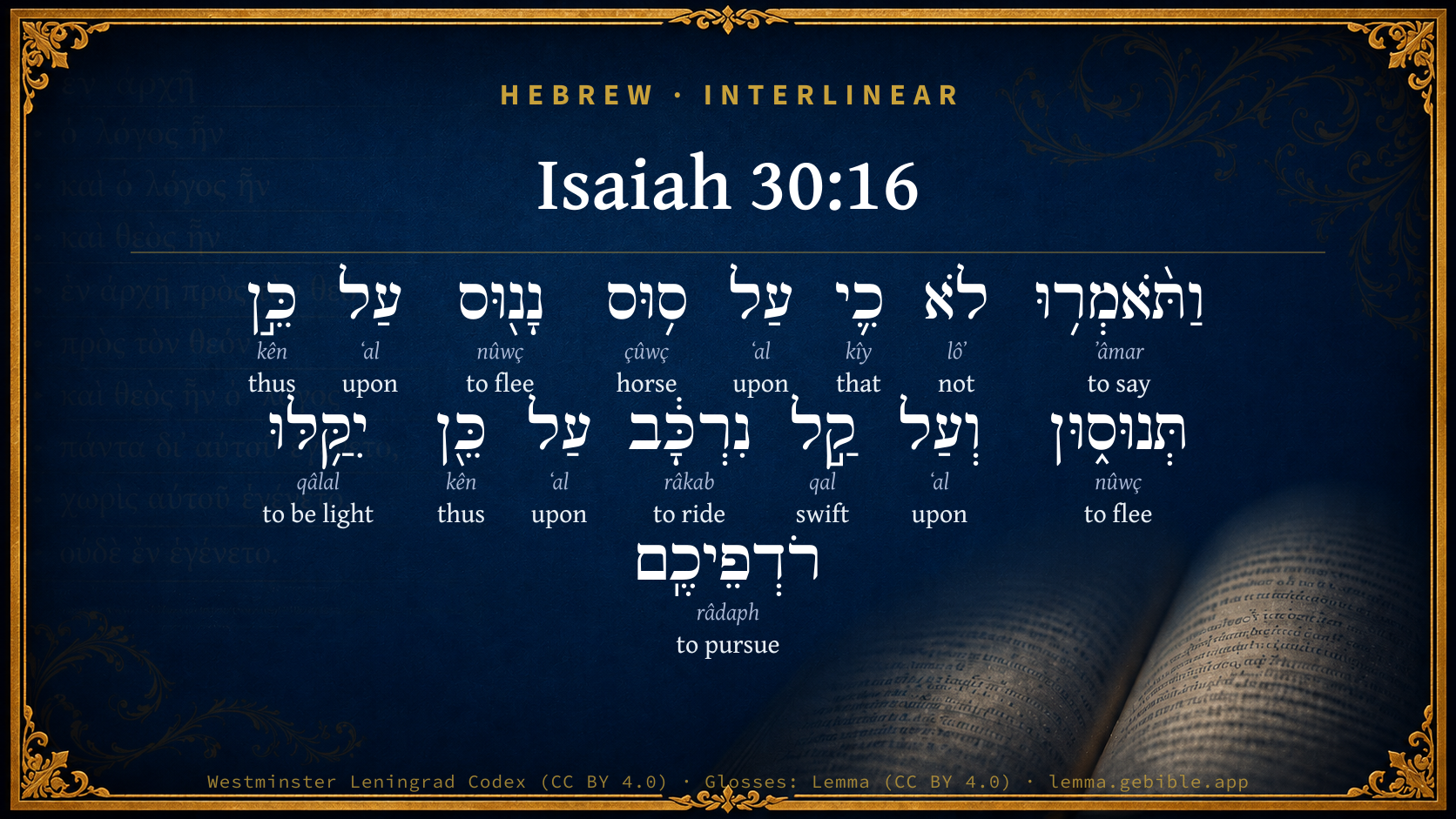
Hebrew (Westminster Leningrad Codex) Isaiah 30:16 appears in the Hebrew Old Testament. The text above is from the Westminster Leningrad Codex. Each word links to its Strong’s number, a concise gloss, and parsing drawn from the Open Scriptures Hebrew Bible morphology. Click any word for its full Brown-Driver-Briggs (BDB) entry.
Download image
Cite this verse

Isaiah 30:16 (World English Bible). Public Domain. Lemma interlinear Bible study tool, https://lemma.gebible.app/v/isaiah/30/16.

Show BibTeX & RIS
BibTeX
RIS
English Translation
but you said, No, for we will flee on horses; therefore shall you flee: and, We will ride on the swift; therefore shall those who pursue you be swift.
World English Bible · Public Domain
Download a study sheet

One document with this verse’s original text, its word-by-word gloss line, the meaning frame, cross-references with their text, attributed commentary, and full source and license credits — printable, and it pastes into notes with its structure intact.

This verse Autodidact and up

Study sheet (.html) Plain text (.txt)

A passage Seminary Student

Up to 50 verses in one chapter. A passage sheet keeps up to 6 commentary sources and 12 cross-references per verse, in the order this page ranks them, and says so on the sheet whenever that leaves anything out. Ask for a single verse and you get the Autodidact verse sheet above.

Everything on this page stays free to read, with no account — the sheet is a download of what is already on screen, not access to it.

Want to remove ads? Support Godless Engineer
Compare translations 3

The same verse in 3 English versions, stacked beneath the original-language interlinear above. Click any original word for its lexicon entry.

Each is an independent rendering of the whole verse — the interlinear is not word-aligned to these translations.

Highlighted words mark where these versions differ — a whole-verse word diff, not a word-by-word alignment.

  • World English Bible Public Domain
    but you said, No, for we will flee on horses; therefore shall you flee: and, We will ride on the swift; therefore shall those who pursue you be swift.
  • King James Version Public Domain
    But ye said, No; for we will flee upon horses; therefore shall ye flee: and, We will ride upon the swift; therefore shall they that pursue you be swift.
  • unfoldingWord Literal Text CC BY-SA 4.0
    And you said, ‘No, for on horses we will flee’ —therefore you will flee— and ‘on the swift we will ride’ —therefore your pursuers will be swift.

unfoldingWord Literal Text — © unfoldingWord, licensed CC BY-SA 4.0. Word-aligned USFM3 via Door43 (git.door43.org/unfoldingWord/en_ult).

Versions to compare (up to 4)

3 of 4 selected

Show all 18 translations

Every available English version of this verse, each an independent rendering of the whole verse.

  • World English Bible Public Domain
    but you said, No, for we will flee on horses; therefore shall you flee: and, We will ride on the swift; therefore shall those who pursue you be swift.
  • Berean Standard Bible Public Domain
    “No,” you say, “we will flee on horses.” Therefore you will flee! “We will ride swift horses,” but your pursuers will be faster.
  • Majority Standard Bible Public Domain
    “No,” you say, “we will flee on horses.” Therefore you will flee! “We will ride swift horses,” but your pursuers will be faster.
  • King James Version Public Domain
    But ye said, No; for we will flee upon horses; therefore shall ye flee: and, We will ride upon the swift; therefore shall they that pursue you be swift.
  • American Standard Version (1901) Public Domain
    but ye said, No, for we will flee upon horses; therefore shall ye flee: and, We will ride upon the swift; therefore shall they that pursue you be swift.
  • Revised Version (1885) Public Domain
    but ye said, No, for we will flee upon horses; therefore shall ye flee: and, We will ride upon the swift; therefore shall they that pursue you be swift.
  • Geneva Bible (1599) Public Domain
    For ye haue sayd, No, but we wil flee away vpon horses. Therefore shall ye flee. We will ride vpon the swiftest. Therefore shall your persecuters be swifter.
  • Douay-Rheims (1899) Public Domain
    But have said: No, but we will flee to horses: therefore shall you flee. And we will mount upon swift ones: therefore shall they be swifter that shall pursue after you.
  • Young's Literal Translation Public Domain
    And ye say, No, for on a horse we flee? Therefore ye flee, And on the swift we ride! Therefore swift are your pursuers.
  • Literal Standard Version CC BY-SA 4.0
    And you say, “No, for we flee on a horse,” || Therefore you flee, || And, “We ride on the swift!” Therefore your pursuers are swift.
  • Unlocked Literal Bible CC BY-SA 4.0
    You said, 'No, for we will flee on horses,' so you will flee; and, 'We will ride upon swift horses,' so those who pursue you will be swift.
  • unfoldingWord Literal Text CC BY-SA 4.0
    And you said, ‘No, for on horses we will flee’ —therefore you will flee— and ‘on the swift we will ride’ —therefore your pursuers will be swift.
  • Darby Bible Public Domain
    And ye said, No, but we will flee upon horses, -- therefore shall ye flee; and, We will ride upon the swift, -- therefore shall they that pursue you be swift.
  • World Messianic Bible Public Domain
    but you said, “No, for we will flee on horses;” therefore you will flee; and, “We will ride on the swift;” therefore those who pursue you will be swift.
  • Webster's Bible Public Domain
    But ye said, No; for we will flee upon horses; therefore shall ye flee: and, We will ride upon the swift; therefore shall they that pursue you be swift.
  • Free Bible Version CC BY-SA 4.0
    You replied, “No! We'll escape on horseback! We'll get away on fast horses!” But the fast ones will be the ones chasing you!
  • Bible in Basic English Public Domain
    Saying, No, for we will go in flight on horses; so you will certainly go in flight: and, We will go on the backs of quick-running beasts; so those who go after you will be quick-footed.
  • JPS Tanakh (1917) Public Domain
    But ye said: 'No, for we will flee upon horses'; therefore shall ye flee; and: 'We will ride upon the swift'; therefore shall they that pursue you be swift.

Literal Standard Version (2020), Covenant Press — licensed CC BY-SA 4.0. Text via the HelloAO Bible API (eBible.org). Unlocked Literal Bible (unfoldingWord) — licensed CC BY-SA 4.0. Text via the HelloAO Bible API (eBible.org). unfoldingWord Literal Text — © unfoldingWord, licensed CC BY-SA 4.0. Word-aligned USFM3 via Door43 (git.door43.org/unfoldingWord/en_ult). Free Bible Version, Dr. Jonathan Gallagher — licensed CC BY-SA 4.0. Text via the HelloAO Bible API (eBible.org).

Word by word

More ways to search: Search by grammar → Find every occurrence → Compare this word →

Practice this passage: Drill this verse → Learn its vocabulary →

קַ֣ל
qal
H7031
“swift”
Adjective, Adjective, Masculine, Singular, Absolute
Part of Speech
Adjective
Type
Adjective
Gender
Masculine
Number
Singular
State
Absolute
Full BDB Definition

Origin: contracted from H7043

TWOT: 2028a

swift, light, fleet - swift - one who is swift
  1. וַתֹּ֨אמְר֥וּ ʼâmar H559 “and · to say” Conjunction + Verb, Qal, Sequential Imperfect, 2nd Person, Masculine, Plural
  2. לֹא lôʼ H3808 “not” Particle, Negative
  3. כִ֛י kîy H3588 “that” Conjunction
  4. עַל ʻal H5921 “upon” Preposition
  5. ס֥וּס çûwç H5483 “horse” Noun, Common, Masculine, Singular, Absolute
  6. נָנ֖וּס nûwç H5127 “to flee” Verb, Qal, Imperfect, 1st Person, Common, Plural
  7. עַל ʻal H5921 “upon” Preposition
  8. כֵּ֣ן kên H3651 “thus” Particle, Demonstrative
  9. תְּנוּס֑וּן nûwç H5127 “to flee” Verb, Qal, Imperfect, 2nd Person, Masculine, Plural + Suffix, n
  10. וְעַל ʻal H5921 “and · upon” Conjunction + Preposition
  11. נִרְכָּ֔ב râkab H7392 “to ride” Verb, Qal, Imperfect, 1st Person, Common, Plural
  12. עַל ʻal H5921 “upon” Preposition
  13. כֵּ֖ן kên H3651 “thus” Particle, Demonstrative
  14. יִקַּ֥לּוּ qâlal H7043 “to be light” Verb, Niphal, Imperfect, 3rd Person, Masculine, Plural
  15. רֹדְפֵיכֶֽם râdaph H7291 “pursuing · you” Verb, Qal, Participle Active, Masculine, Plural, Construct + Suffix, Personal, 2nd Person, Masculine, Plural

About this verse

These counts appear in no published source. They are computed here, from the morphology-tagged text and Lemma’s own curated glosses. What Lemma adds →

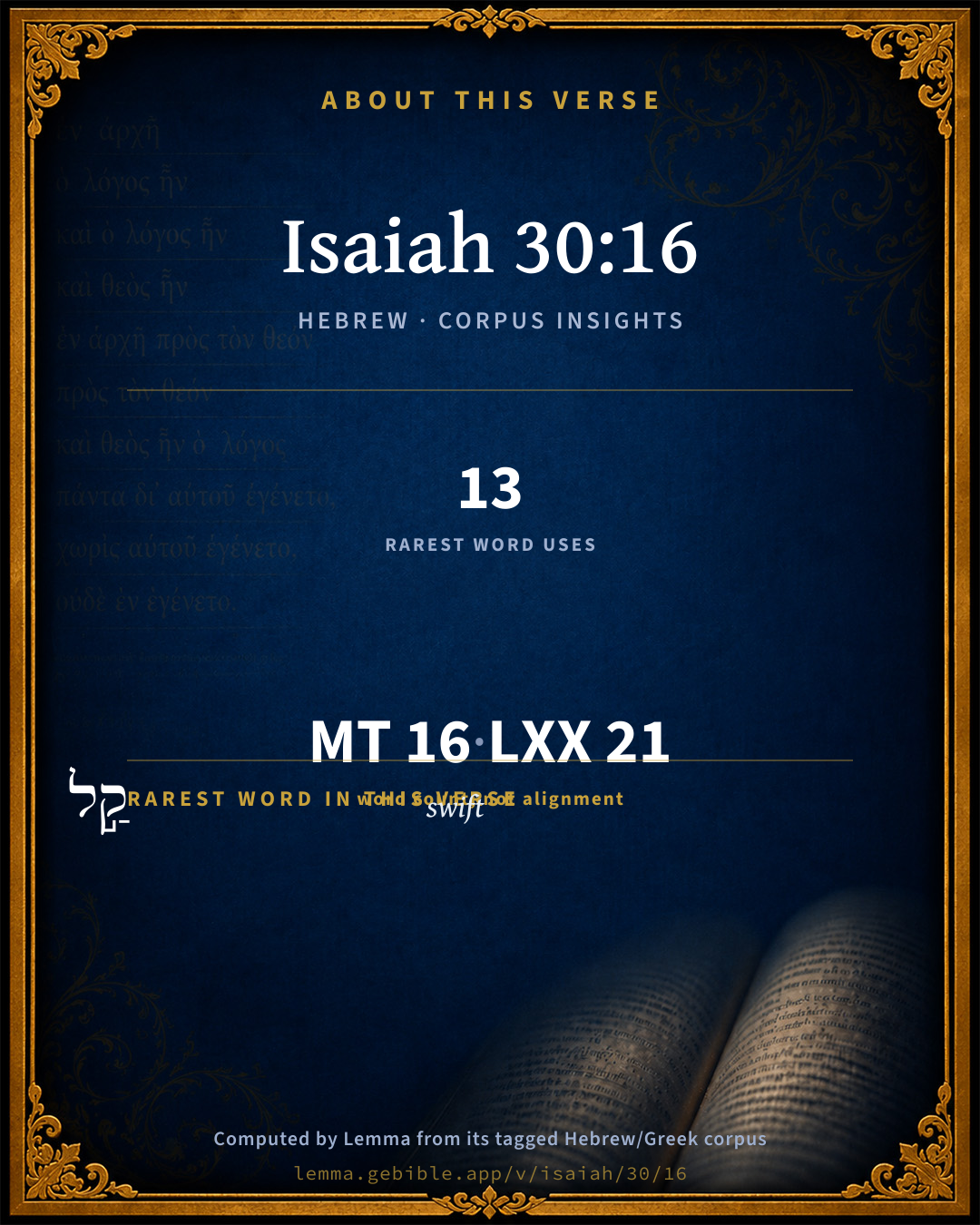
16
words
11
distinct lemmas
Prophets
section

Notable vocabulary

The rarest word here is קַ֣ל swift H7031 — appearing just 13 times in the whole Hebrew Bible.

Shared distinctive vocabulary

קַ֣ל swift H7031 occurs in 13 verses of the Hebrew Bible. Also found in:

Grammatical profile

  • 6 verbs
  • 1 noun
  • 1 adjective
  • 4 prepositions
  • 1 conjunction
  • 3 particles

Verb forms

  • וַתֹּ֨אמְר֥וּ Qal · Sequential Imperfect
  • נָנ֖וּס Qal · Imperfect
  • תְּנוּס֑וּן Qal · Imperfect
  • נִרְכָּ֔ב Qal · Imperfect
  • יִקַּ֥לּוּ Niphal · Imperfect
  • רֹדְפֵיכֶֽם Qal · Participle Active

Repetition

Words recur within this verse — often emphatic in Hebrew:

  • עַל upon H5921 ×4
  • נָנ֖וּס to flee H5127 ×2
  • כֵּ֣ן thus H3651 ×2

Hebrew & Septuagint length

In English translation the verse runs 29 words from the Hebrew and 28 from the Septuagint (LXX English) — closely comparable.

A rough comparison of the two English renderings, which tokenize alike — not a word-level alignment.

Word counts can differ between the Hebrew and the Greek without any difference in meaning — e.g. the Hebrew direct-object marker אֵת has no separate Greek word, and Greek often adds the article ὁ.

In the original languages it is 16 Hebrew tokens and 21 Greek tokens — but the two are counted differently (Hebrew bundles its prefixes and suffixes into one token; the Greek is in lemma form), so that isn’t a like-for-like length.

Cross-references

16

Topical passages linked to Isaiah 30:16 in the Treasury of Scripture Knowledge — connected by theme and wording, ordered by reader-vote popularity; previews shown in the World English Bible.

  • Isaiah 31:1 Woe to those who go down to Egypt for help, and rely on horses, and trust in chariots because they are many, and in horsemen because they are very strong, but they don't look to the Holy One of Israel, neither seek Yahweh!
  • Deuteronomy 28:25 Yahweh will cause you to be struck before your enemies; you shall go out one way against them, and shall flee seven ways before them: and you shall be tossed back and forth among all the kingdoms of the earth.
  • Psalms 33:17 A horse is a vain thing for safety, Neither does he deliver any by his great power.
  • Isaiah 31:3 Now the Egyptians are men, and not God; and their horses flesh, and not spirit: and when Yahweh shall stretch out his hand, both he who helps shall stumble, and he who is helped shall fall, and they all shall be consumed together.
  • Jeremiah 4:13 Behold, he shall come up as clouds, and his chariots [shall be] as the whirlwind: his horses are swifter than eagles. Woe to us! for we are ruined.
  • Amos 9:1 I saw the Lord standing beside the altar, and he said, "Strike the tops of the pillars, that the thresholds may shake; and break them in pieces on the head of all of them; and I will kill the last of them with the sword: there shall not one of them flee away, and there shall not one of them escape.
  • Deuteronomy 28:49 Yahweh will bring a nation against you from far, from the end of the earth, as the eagle flies; a nation whose language you shall not understand;
  • Psalms 147:10 He doesn't delight in the strength of the horse. He takes no pleasure in the legs of a man.
  • Isaiah 5:26–30 He will lift up a banner to the nations from far, And he will whistle for them from the end of the earth. Behold, they will come speedily and swiftly.
  • Isaiah 10:28–32 He is come to Aiath, he is passed through Migron; at Michmash he lays up his baggage;
  • Jeremiah 52:7 Then a breach was made in the city, and all the men of war fled, and went forth out of the city by night by the way of the gate between the two walls, which was by the king's garden; (now the Chaldeans were against the city round about;) and they went toward the Arabah.
  • Lamentations 4:19 Our pursuers were swifter than the eagles of the sky: They chased us on the mountains, they laid wait for us in the wilderness.
  • Amos 2:14–16 Flight will perish from the swift; And the strong won't strengthen his force; Neither shall the mighty deliver himself;
  • Micah 1:13 Harness the chariot to the swift steed, inhabitant of Lachish. She was the beginning of sin to the daughter of Zion; For the transgressions of Israel were found in you.
  • Habakkuk 1:8 Their horses also are swifter than leopards, and are more fierce than the evening wolves. Their horsemen press proudly on. Yes, their horsemen come from afar. They fly as an eagle that hurries to devour.
  • 2 Kings 25:5 But the army of the Chaldeans pursued after the king, and overtook him in the plains of Jericho; and all his army was scattered from him.

Cross-references courtesy of OpenBible.info (CC BY 4.0).

Hebrew and Greek witnesses Masoretic Hebrew ↔ Greek Septuagint

The same verse in the two great witnesses to the Old Testament, shown verse-for-verse.

These are two independent witnesses, not word-aligned to each other, and the Septuagint is shown in lemma (dictionary) form.

Hebrew Isaiah 30:16 Masoretic · Westminster Leningrad Codex

וַתֹּ֨אמְר֥וּ לֹא כִ֛י עַל ס֥וּס נָנ֖וּס עַל כֵּ֣ן תְּנוּס֑וּן וְעַל קַ֣ל נִרְכָּ֔ב עַל כֵּ֖ן יִקַּ֥לּוּ רֹדְפֵיכֶֽם

but you said, No, for we will flee on horses; therefore shall you flee: and, We will ride on the swift; therefore shall those who pursue you be swift.

World English Bible · Public Domain

Greek LXX Isaiah 30:16 Septuagint · lemma form

ἀλλά εἶπον ἐπι ἵππος φεύγω διά οὗτος φεύγω καί εἶπον ἐπί κοῦφος ἀναβάτης εἰμί διά οὗτος κοῦφος εἰμί ὁ διώκω σύ

but you⌃ said, We will flee upon horses; therefore shall you⌃ flee: and, We will be aided by swift riders; therefore shall they that pursue you be swift.

LXX2012 (modern English Septuagint) · Public Domain

Hebrew: Westminster Leningrad Codex (CC BY 4.0). Greek: Septuagint (public domain); English from LXX2012 (modern English Septuagint) (Public Domain). How the Septuagint differs from the Hebrew →

Targum (Aramaic paraphrase)

1

The Targum is the ancient Jewish Aramaic paraphrase of the Hebrew Scriptures — an interpretive translation, not the Hebrew text itself. Onkelos (literal) and Pseudo-Jonathan (expansive) render the Torah, and Jonathan the Prophets. Coverage is partial: where no permissively-licensed English translation exists for a verse, only the Aramaic is shown. This is verse-level text, not a word-by-word alignment to the Hebrew.

  1. Targum Jonathan Prophets (Joshua–Malachi)
    וַאֲמַרְתּוּן לָא אֱלָהֵין עַל סוּסְוָתָא נֶעְרוֹק וְעַל כֵּן תַּעַרְקוּן וְעַל קַלִילִין נִרְכּוּב עַל כֵּן יְהוֹן קַלִילִין רָדְפֵיכוֹן:

    And ye said: Nay, but we will flee on horses; therefore shall ye flee; and, We will ride upon the swift; therefore shall they be swift that pursue you.

    Targum Jonathan — Aramaic: “Mikraot Gedolot” (public domain). English: “Sefaria Community Translation” (CC0 1.0 (public-domain dedication)); “London "Chaldee Paraphrase," 1871” (public domain). Text via Sefaria.

Commentary

Notes on Isaiah 30:16 from classic Christian and Jewish commentators (each source and its license shown beneath its notes). The classic Christian expositions comment on the surrounding passage and are grouped to its opening verse, so a note may address several verses; the Jewish commentaries on the Tanakh (Rashi and others) are per-verse, so they appear only where the commentator wrote on this verse.

Lemma curates 59 commentaries, every one of them public domain or Creative Commons licensed, each selected and text-cleaned for this edition rather than reprinted as found. About our sources →

Trapp's Complete Commentary

John Trapp

Isa 30:16 But ye said, No; for we will flee upon horses; therefore shall ye flee: and, We will ride upon the swift; therefore shall they that pursue you be swift.

Ver. 16. But ye said, No.] We will not return or rest. This is a golden rule of life, In silentio et spe fortitudo vestra; but these refractories would have none of it, they knew a better way to work than all that came to. Politicians are like tumblers, that have their heads on the earth and their heels against heaven. Cross-grained they are for the most part to all good.

For we will flee upon horses.] Whereof Egypt was full, and for which it was famous of old, and so is yet, for the Mamelukes’ horses especially.

Therefore shall ye flee.] But in another sense, sc., fusi fugatique ab hoste, with the enemy at your heels.

John Trapp, A Commentary or Exposition upon All the Books of the Old and New Testament (1647–1656) — public domain. Text from a community e-Sword module.

Tyndale Open Study Notes

Tyndale Open Resources

30:16 Judah’s reliance on Egypt to supply swift horses (see Ps 33:17) amounted to a rejection of God’s help and threatened to bring about its fall.

Tyndale Open Study Notes — © Tyndale Open Resources, licensed CC BY-SA 4.0. Text via the HelloAO Bible API.

Geneva Bible (1599)

Geneva Bible translators

We will trust to escape by our horses.

Geneva Bible (1599) marginal notes — public domain. Text via Bolls.life.

Jamieson, Fausset & Brown

Robert Jamieson, A. R. Fausset & David Brown

flee--not as fugitives, but we will speed our course; namely, against the Assyrians, by the help of cavalry supplied by Egypt (Isa 31:1). This was expressly against the Mosaic law (Deu 17:16; see on Isa 2:7; Hos 14:3).

shall . . . flee--literally, "before your enemies"; their sin and its punishment correspond.

Jamieson, Fausset & Brown — Commentary Critical and Explanatory on the Whole Bible (1871) — public domain (CC PDM 1.0). Text via the HelloAO Bible API.

Ellicott's Commentary for English Readers

(16) We will flee upon horses.—These were expected as the Egyptian contingent of the forces of Judah. With them and the prestige attaching to their fame, the generals and statesmen reckoned on being able to resist Assyria. Isaiah, with his keen insight into the present temper of Egypt, tells them that the only use of the horses will be for a more rapid retreat, not for the charge of battle.

A Bible Commentary for English Readers, edited by Charles John Ellicott (1878–1897) — public domain. Text from a community e-Sword module.

The Cambridge Bible for Schools and Colleges

gen. ed. J. J. S. Perowne

16. we will flee] Translate: we will fly (against the enemy). The word, which in the next clause (as in every other instance) means “flee,” is chosen because in Hebr. it resembles in sound the word for “horses.”

upon the swift] (coursers). In ch. Isa_36:8 the Rabshakeh seems to taunt the Judæans with their childish fondness for horsemanship.

The Cambridge Bible for Schools and Colleges (gen. ed. J. J. S. Perowne; Cambridge University Press, 1878–1918) — public domain. Text from a community e-Sword module.

John Gill's Exposition

But ye said, No, for we will flee upon horses,.... Hither and thither to get help and assistance; go down to Egypt for it on them, or thither for them, as some render it; and then face the enemy, and, if we can not conquer him, will flee from him, and so provide for our safety; this is man's way of salvation, as opposed to God's way; see Hos 1:7 or this may design their fleeing on horses and camels with their riches into Egypt, both for the security of them and their persons, Isa 30:6,

therefore shall ye flee; on horses from the enemy, and be pursued and taken by him; this was fulfilled long after, when the city was taken by the Chaldeans; see Kg2 25:4,

and, We will ride upon the swift; horses or camels, to the swiftness of which they trusted, and doubted not to get off safe, but would find themselves mistaken:

therefore shall they that pursue you be swift; yea, swifter than the horses and camels they rode on, and overtake them, and either put them to death, or carry them captive. The Chaldeans are represented as very swift, Jer 4:13.

John Gill's Exposition of the Whole Bible (1746–1763) — public domain (CC PDM 1.0). Text via the HelloAO Bible API.

Albert Barnes' Notes on the Bible

But ye said, No - Ye who proposed an alliance with Egypt.

For we will flee upon horses - The word ‘flee’ (נוּס nûc), usually signifies to flee before or from any person or thing. But here it seems to have the notion of making a rapid motion in general, and not to refer to the fact that they expected to flee “from” their enemy, for it does not seem to have been a part of their expectation. The idea seems to be that by their alliance with Egypt they would secure the means of “rapid motion,” whatever might be the necesity or occasion for it, whether against or from an enemy. The sense is, ‘we will by this alliance secure the assistance of cavalry;’ and, doubtless, the design was to employ it in the attack and discomfiture of their foes. It will be recollected that Moses Deu 17:16 strictly forbade that the future monarch of the Jews should ‘multiply horses to himself, to cause the people to return to Egypt,’ and that consequently the employment of cavalry was against the laws of the nation. For the reasons of this prohibition, see the note at Isa 2:7. The attempt, therefore, in the time of Hezekiah to call in the aid of the cavalry of Egypt, was a violation of both the letter and the spirit of the Jewish institutions (compare Isa 31:1; Hos 14:4).

Therefore shall ye flee - You shall fly before your enemies; you shall be defeated and scattered.

We will ride upon the swift - That is, upon fleet horses or coursers. Arabia was celebrated, and is still, for producing fleet coursers, and the same was formerly true of Egypt (see the note at Isa 2:7).

Albert Barnes' Notes on the Bible (1834–1885) — public domain. Text from a community e-Sword/MySword module.

Haydock's Catholic Bible Commentary

Ones, or chariots. (Calmet) --- Egypt was famous for horses, Deuteronomy xvii. 16. (Forcr.[Forerius?]) --- Rebsaces ridicules the Jews for the want of them, 4 Kings xviii. 23. (Haydock)

George Leo Haydock (1774–1849), Haydock's Catholic Family Bible and Commentary, 1859 edition — public domain. Excludes Psalms (Douay-Rheims chapter numbering differs from Protestant) and Deuterocanonical books (Catholic canon only).

Matthew Poole's English Annotations

We will flee out of this land from the king of Assyria; which is very probable divers of the richer sort did, having sent their treasures before them, as we read Isa 30:6.

Matthew Poole's English Annotations on the Holy Bible (1683–1685) — public domain. Text from a community e-Sword/MySword module.

The Pulpit Commentary

Ye said, No; for we will flee upon horses; rather, we will fly upon horses. The nobles had perhaps a manly eagerness to mount the Egyptian war-horses, and rush upon the enemy at full speed, in the hope of discomfiting them. Isaiah warns them that they will not really fig on the enemy, but flee before him. We will ride upon the swift. "The swift" (kal) seems to be a mere variant for "horse," the parallelism being, as so frequently, "synonymous." Therefore shall they that pursue you be swift. However swift the horses of the Judaeans, their enemies would be as well mounted and would pursue and overtake them.

The peril of the willful.

"We will ride upon the swift; therefore shall they that pursue you be swift." We will there is man"s sin. That is not a fit position for dependent man ever to take. "They that will be rich fall into temptation and a snare." "Go to now, ye that say, Today or tomorrow we will go into such a city, and continue there a year, and buy and sell, and get gain For that ye ought to say, if the Lord will, we shall live, and do this, or that." From some points of view these strong-willed men may be regarded as the noble-men of earth. They have a purpose in life, which holds in and guides, as with bit and bridle, all the forces of their being. They are the great men in our mills and warehouses; the foremost as statesmen, and in carrying out great social and national enterprises. They seem to have a power of control over all the circumstances surrounding them, and a power of recoil from the greatest disappointments and disasters. Yet this disposition lays men open to peculiar dangers. Strong will is liable to become self-will to refuse the ordinance of God; to refuse the help of God; to refuse to wait for God. It stands up in fancied majesty and says, "I will." "Whatever God may say or do, I will. I will be rich, I will be successful, I will be great." When a man in such a spirit says, "I will," he is on the very pit-edge, and on the pit-edge blindfolded.

I WILFULNESS IS REBELLIOUSNESS. Because man is God"s servant, pledged to carry out his Master"s will, and not his own will. Man is God"s child, and in duty bound to fulfill his Father"s commands. Disobedience is rebellion.

II WILFULNESS IS WEAKNESS. Because man is entirely dependent on the God whose will he refuses, for the means of accomplishing what he determines to do. His willfulness is as weak as a child"s who has no money, no power, but depends entirely on his parents.

III WILFULNESS IS FOOLISHNESS. For it is a setting of ourselves against the Almighty God, as if he would allow us to shift and rearrange his plans. Man"s willfulness may make a noise, and bring him into trouble; but it is only a child"s attempt to hold back the flowing of the great river of God. A little time of vain trying, and then the child is swept away by the flood, which still rolls on.

IV WILFULNESS IS PERIL. It will be a marvel, almost a miracle, if such a man do not "fall into temptation and a snare, and into many foolish and hurtful lusts, which drown men in destruction and perdition. R.T.

The Pulpit Commentary (1880–1919), ed. H.D.M. Spence-Jones & Joseph S. Exell — public domain. Text from a community e-Sword module.

J. A. Alexander on Isaiah

Joseph Addison Alexander

“And ye said, No, for we will flee upon horses; therefore shall ye flee; and upon the swift will we ride; therefore shall your pursuers be swift.” The hope here ascribed to the people is not’ simply that of going swiftly, but of escaping from the dangers threatened.

Joseph Addison Alexander, The Prophecies of Isaiah (1846–1847; New York: Scribner, 1870–1878) — public domain. Text from a community e-Sword module.

Rashi

Rabbi Shlomo Yitzchaki (Rashi)

on horses will we flee (נָנוּס) We will ally ourselves with the king of Egypt, and we will bring from there swift steeds in order to flee.

Rashi on the Tanakh — English translations: “The Judaica Press complete Tanach with Rashi, translated by A. J. Rosenberg” (CC BY 4.0); “Pentateuch with Rashi's commentary by M. Rosenbaum and A.M. Silbermann, 1929-1934” (public domain); “The Metsudah Tanach series, Lakewood, N.J” (CC BY 4.0); and “The Book of Joshua, Metsudah Publications, 1997” (CC BY 4.0). Text via Sefaria.

Ibn Ezra

Rabbi Abraham ibn Ezra

ננוס. According to the grammarian R. Jonah: we shall lift ourselves up; he compares it with נֵס banner (that is lifted up), and gives thus to ננוס a meaning similar to that of נרכב we will ride, as required by the parallelism. Others taking ננוס in its usual sense, we shall flee, explain the passage thus: You fled without cause, you will therefore be compelled to flee by your pursuers.

קל The swift. An epithet of the horse, as is כר swift of the camel.

Ibn Ezra on the Tanakh — English translations: “Sefaria Community Translation” (CC0 1.0 (public-domain dedication)); “Yalkut, Sifsei Chachomim Chumash, Metsudah Publications, 2009” (CC BY 4.0); and “Commentary of Ibn Ezra on Isaiah - trans. by M. Friedlander, 1873” (public domain). Text via Sefaria.

Lesson kit

Teaching starters — assembled from the data on this page, not authored interpretation. Every prompt links to the verse data it draws on. Edit before teaching.

Isaiah, in the Prophets, opens this verse with 16 words (11 distinct Hebrew lemmas). Its most distinctive word is qal (“swift”). A historical commentator’s framing appears above. Read the whole chapter for the surrounding context.

Discussion questions

  1. What does “swift” (qal) contribute to the verse as a whole?
  2. How does 2 Samuel 2:18, which shares the word «swift», read alongside this verse?
  3. What does the repetition of “upon” (4× in this one verse) do in this verse?
  4. These translations render this verse differently. What is at stake in choosing one wording over another?
  5. «וַתֹּ֨אמְר֥וּ» is a Qal Sequential Imperfect verb. How does that grammatical form shape the action described?
  6. Compare how Trapp's Complete Commentary and Tyndale Open Study Notes read this verse. Where do they agree or differ?

Things to notice

Reading settings

Reading text

Shown beneath each verse's original-language words.

Old Testament
Old Testament edition

Read the OT as the Masoretic Hebrew (MT) or the Greek Septuagint (LXX).

English shown for the Greek Septuagint (in the Hebrew ↔ Greek comparison).

Comparing translations? Open the Compare panel on any verse page to stack up to four side by side.