

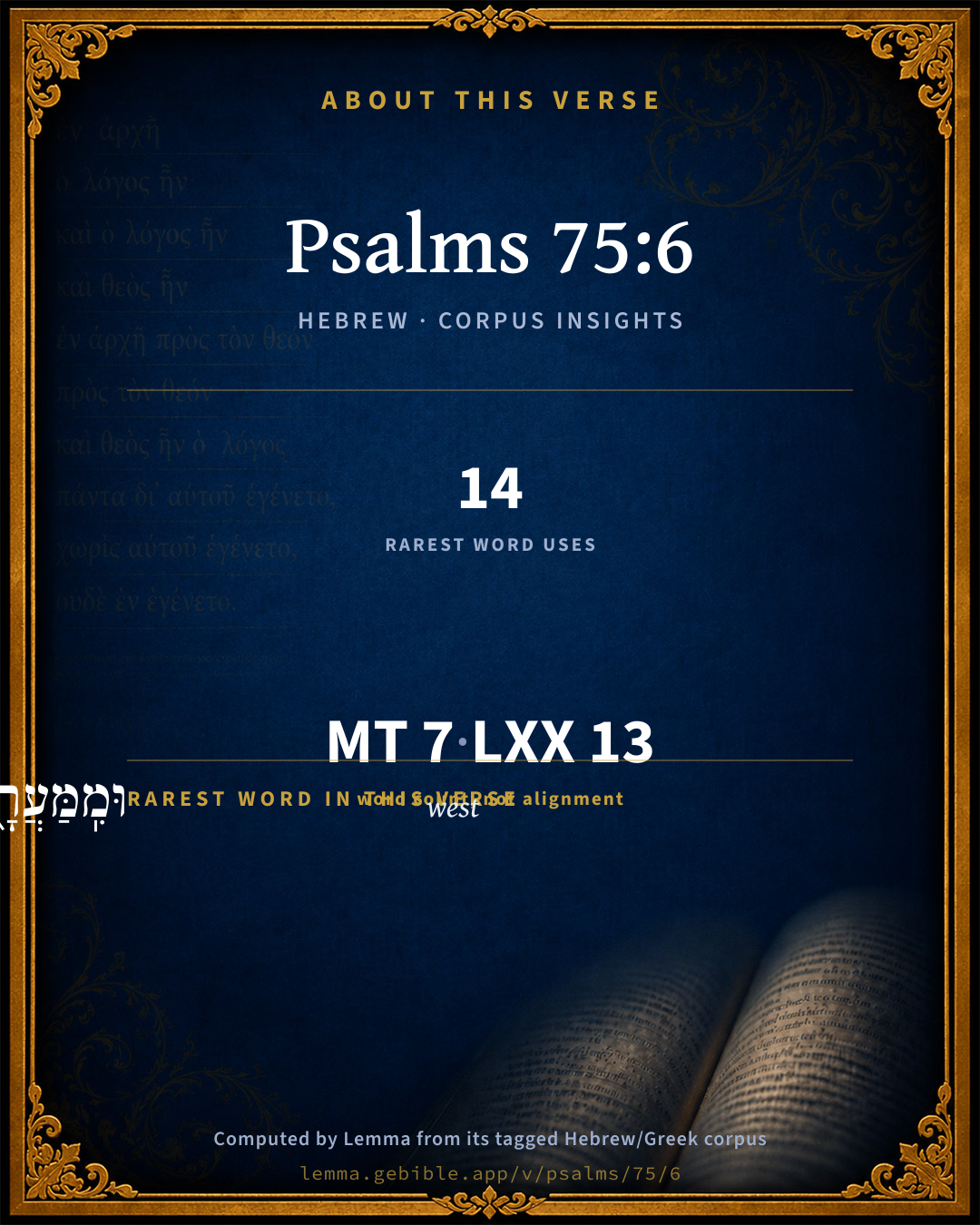
Psalms 75:6

Hebrew (Westminster Leningrad Codex) Psalms 75:6 appears in the Hebrew Old Testament. The text above is from the Westminster Leningrad Codex. Each word links to its Strong’s number, a concise gloss, and parsing drawn from the Open Scriptures Hebrew Bible morphology. Click any word for its full Brown-Driver-Briggs (BDB) entry.
Download image
Cite this verse

Psalms 75:6 (World English Bible). Public Domain. Lemma interlinear Bible study tool, https://lemma.gebible.app/v/psalms/75/6.

Show BibTeX & RIS
BibTeX
RIS
English Translation
For neither from the east, nor from the west, Nor yet from the south, comes exaltation.
World English Bible · Public Domain
Download a study sheet

One document with this verse’s original text, its word-by-word gloss line, the meaning frame, cross-references with their text, attributed commentary, and full source and license credits — printable, and it pastes into notes with its structure intact.

This verse Autodidact and up

Study sheet (.html) Plain text (.txt)

A passage Seminary Student

Up to 50 verses in one chapter. A passage sheet keeps up to 6 commentary sources and 12 cross-references per verse, in the order this page ranks them, and says so on the sheet whenever that leaves anything out. Ask for a single verse and you get the Autodidact verse sheet above.

Everything on this page stays free to read, with no account — the sheet is a download of what is already on screen, not access to it.

Want to remove ads? Support Godless Engineer
Compare translations 3

The same verse in 3 English versions, stacked beneath the original-language interlinear above. Click any original word for its lexicon entry.

Each is an independent rendering of the whole verse — the interlinear is not word-aligned to these translations.

Highlighted words mark where these versions differ — a whole-verse word diff, not a word-by-word alignment.

  • World English Bible Public Domain
    For neither from the east, nor from the west, Nor yet from the south, comes exaltation.
  • King James Version Public Domain
    For promotion cometh neither from the east, nor from the west, nor from the south.
  • unfoldingWord Literal Text CC BY-SA 4.0
    For not from the east or from the west, and not from the wilderness lifting up.

unfoldingWord Literal Text — © unfoldingWord, licensed CC BY-SA 4.0. Word-aligned USFM3 via Door43 (git.door43.org/unfoldingWord/en_ult).

Versions to compare (up to 4)

3 of 4 selected

Show all 18 translations

Every available English version of this verse, each an independent rendering of the whole verse.

  • World English Bible Public Domain
    For neither from the east, nor from the west, Nor yet from the south, comes exaltation.
  • Berean Standard Bible Public Domain
    For exaltation comes neither from east nor west, nor out of the desert,
  • Majority Standard Bible Public Domain
    For exaltation comes neither from east nor west, nor out of the desert,
  • King James Version Public Domain
    For promotion cometh neither from the east, nor from the west, nor from the south.
  • American Standard Version (1901) Public Domain
    For neither from the east, nor from the west, Nor yet from the south, `cometh' lifting up.
  • Revised Version (1885) Public Domain
    For neither from the east, nor from the west, nor yet from the south, cometh lifting up.
  • Geneva Bible (1599) Public Domain
    For to come to preferment is neither from the East, nor from the West, nor from the South,
  • Douay-Rheims (1899) Public Domain
    Lift not up your horn on high: speak not iniquity against God.
  • Young's Literal Translation Public Domain
    For not from the east, or from the west, Nor from the wilderness -- `is' elevation.
  • Literal Standard Version CC BY-SA 4.0
    For not from the east, or from the west, || Nor from the wilderness—[is] elevation.
  • Unlocked Literal Bible CC BY-SA 4.0
    It is not from the east or from the west, and it is not from the wilderness that lifting up comes.
  • unfoldingWord Literal Text CC BY-SA 4.0
    For not from the east or from the west, and not from the wilderness lifting up.
  • Darby Bible Public Domain
    For not from the east nor from the west, nor yet from the south doth exaltation [come]:
  • World Messianic Bible Public Domain
    For neither from the east, nor from the west, nor yet from the south, comes exaltation.
  • Webster's Bible Public Domain
    \\75:5\\Lift not up your horn on high: speak not with a stiff neck.
  • Free Bible Version CC BY-SA 4.0
    For no one, from the east to the west, or from the wilderness, should think so highly of themselves.
  • Bible in Basic English Public Domain
    For honour does not come from the east, or from the west, or uplifting from the south;
  • JPS Tanakh (1917) Public Domain
    (75-7) For neither from the east, nor from the west, nor yet from the wilderness, cometh lifting up.

Literal Standard Version (2020), Covenant Press — licensed CC BY-SA 4.0. Text via the HelloAO Bible API (eBible.org). Unlocked Literal Bible (unfoldingWord) — licensed CC BY-SA 4.0. Text via the HelloAO Bible API (eBible.org). unfoldingWord Literal Text — © unfoldingWord, licensed CC BY-SA 4.0. Word-aligned USFM3 via Door43 (git.door43.org/unfoldingWord/en_ult). Free Bible Version, Dr. Jonathan Gallagher — licensed CC BY-SA 4.0. Text via the HelloAO Bible API (eBible.org).

Word by word

More ways to search: Search by grammar → Find every occurrence → Compare this word →

Practice this passage: Drill this verse → Learn its vocabulary →

About this verse

These counts appear in no published source. They are computed here, from the morphology-tagged text and Lemma’s own curated glosses. What Lemma adds →

7
words
6
distinct lemmas
Wisdom
section

Notable vocabulary

The rarest word here is וּמִֽמַּעֲרָ֑ב west H4628 — appearing just 14 times in the whole Hebrew Bible.

Shared distinctive vocabulary

וּמִֽמַּעֲרָ֑ב west H4628 occurs in 14 verses of the Hebrew Bible. Also found in:

Grammatical profile

  • 1 verb
  • 3 nouns
  • 1 conjunction
  • 2 particles

Verb forms

  • הָרִֽים Hiphil · Infinitive Construct

Repetition

A word recurs within this verse — often emphatic in Hebrew:

Hebrew & Septuagint length

In English translation the verse runs 16 words from the Hebrew and 16 from the Septuagint (LXX English) — the same length.

A rough comparison of the two English renderings, which tokenize alike — not a word-level alignment.

Word counts can differ between the Hebrew and the Greek without any difference in meaning — e.g. the Hebrew direct-object marker אֵת has no separate Greek word, and Greek often adds the article ὁ.

In the original languages it is 7 Hebrew tokens and 13 Greek tokens — but the two are counted differently (Hebrew bundles its prefixes and suffixes into one token; the Greek is in lemma form), so that isn’t a like-for-like length.

Cross-references

1

Topical passages linked to Psalms 75:6 in the Treasury of Scripture Knowledge — connected by theme and wording, ordered by reader-vote popularity; previews shown in the World English Bible.

  • Psalms 3:3 But you, Yahweh, are a shield around me, My glory, and the one who lifts up my head.

Cross-references courtesy of OpenBible.info (CC BY 4.0).

Hebrew and Greek witnesses Masoretic Hebrew ↔ Greek Septuagint

The same verse in the two great witnesses to the Old Testament, shown verse-for-verse.

You’re reading Greek Psalm 74 (Hebrew Psalm 75). The Septuagint counts the superscription, so verse numbers can differ from the Hebrew — chapter-level alignment, not verse-by-verse. Numbering follows Rahlfs.

These are two independent witnesses, not word-aligned to each other, and the Septuagint is shown in lemma (dictionary) form.

Hebrew Psalms 75:6 Masoretic · Westminster Leningrad Codex

כִּ֤י לֹ֣א מִ֭מּוֹצָא וּמִֽמַּעֲרָ֑ב וְ֝לֹ֗א מִמִּדְבַּ֥ר הָרִֽים

For neither from the east, nor from the west, Nor yet from the south, comes exaltation.

World English Bible · Public Domain

Greek LXX Greek Psalm 74:6 Septuagint · lemma form

μή ἐπιαἴρω εἰς ὕψος ὁ κέρας σύ μή λαλέω κατά ὁ θεός ἀδικία

For good comes neither from the east, nor from the west, nor from the desert mountains.

LXX2012 (modern English Septuagint) · Public Domain

On this verse, Ellicott's Commentary for English Readers discusses the Septuagint’s reading. Read the note in Commentary ↓

Hebrew: Westminster Leningrad Codex (CC BY 4.0). Greek: Septuagint (public domain); English from LXX2012 (modern English Septuagint) (Public Domain). How the Septuagint differs from the Hebrew →

Commentary

Notes on Psalms 75:6 from classic Christian and Jewish commentators (each source and its license shown beneath its notes). The classic Christian expositions comment on the surrounding passage and are grouped to its opening verse, so a note may address several verses; the Jewish commentaries on the Tanakh (Rashi and others) are per-verse, so they appear only where the commentator wrote on this verse.

Lemma curates 59 commentaries, every one of them public domain or Creative Commons licensed, each selected and text-cleaned for this edition rather than reprinted as found. About our sources →

Matthew Henry's Commentary

In these verses we have two great doctrines laid down and two good inferences drawn from them, for the confirmation of what he had before said.

I. Here are two great truths laid down concerning God's government of the world, which we ought to mix faith with, both pertinent to the occasion: -

1. That from God alone kings receive their power (Psa 75:6, Psa 75:7), and therefore to God alone David would give the praise of his advancement; having his power from God he would use it for him, and therefore those were fools that lifted up the horn against him. We see strange revolutions in states and kingdoms, and are surprised at the sudden disgrace of some and elevation of others; we are all full of such changes, when they happen; but here we are directed to look at the author of them, and are taught where the original of power is, and whence promotion comes. Whence comes preferment to kingdoms, to the sovereignty of them? And whence come preferments in kingdoms, to places of power and trust in them? The former depends not upon the will of the people, nor the latter on the will of the prince, but both on the will of God, who has all hearts in his hands; to him therefore those must look who are in pursuit of preferment, and then they begin aright. We are here told, (1.) Negatively, which way we are not to look for the fountain of power: Promotion comes not from the east, nor from the west, nor from the desert, that is, neither from the desert on the north of Jerusalem nor from that on the south; so that the fair gale of preferment is not to be expected to blow from any point of the compass, but only from above, directly thence. Men cannot gain promotion either by the wisdom or wealth of the children of the east, nor by the numerous forces of the isles of the Gentiles, that lay westward, nor those of Egypt or Arabia, that lay south; no concurring smiles of second causes will raise men to preferment without the first cause. The learned bishop Lloyd (Serm. in loc.) gives this gloss upon it: "All men took the original of power to be from heaven, but from whom there many knew not; the eastern nations, who were generally given to astrology, took it to come from their stars, especially the sun, their god. No, says David, it comes neither from the east nor from the west, neither from the rising nor from the setting of such a planet, or such a constellation, nor from the south, nor from the exaltation of the sun or any star in the mid-heaven." He mentions not the north, because none supposed it to come thence; or because the same word that signifies the north signifies the secret place, and from the secret of God's counsel it does come, or from the oracle in Zion, which lay on the north side of Jerusalem. Note, No wind is so good as to blow promotion, but as he directs who has the winds in his fists. (2.) Positively: God is the judge, the governor or umpire. When parties contend for the prize, he puts down one and sets up another as he sees fit, so as to serve his own purposes and bring to pass his own counsels. Herein he acts by prerogative, and is not accountable to us for any of these matters; nor is it any damage, danger, or disgrace that he, who is infinitely wise, holy, and good, has an arbitrary and despotic power to set up and put down whom, and when, and how he pleases. This is a good reason why magistrates should rule for God as those that must give account to him, because it is by him that kings reign.

2. That from God alone all must receive their doom (Psa 75:8): In the hand of the Lord there is a cup, which he puts into the hands of the children of men, a cup of providence, mixed up (as he thinks fit) of many ingredients, a cup of affliction. The sufferings of Christ are called a cup, Mat 20:22; Joh 18:11. The judgments of God upon sinners are the cup of the Lord's right hand, Hab 2:16. The wine is red, denoting the wrath of God, which is infused into the judgments executed on sinners, and is the wormwood and the gall in the affliction and the misery. It is read as fire, red as blood, for it burns, it kills. It is full of mixture, prepared in wisdom, so as to answer the end. There are mixtures of mercy and grace in the cup of affliction when it is put into the hands of God's own people, mixtures of the curse when it is put into the hands of the wicked; it is wine mingled with gall. These vials, (1.) Are poured out upon all; see Rev 15:7; Rev 16:1; where we read of the angels pouring out the vials of God's wrath upon the earth. Some drops of this wrath may light on good people; when God's judgments are abroad, they have their share in common calamities; but, (2.) The dregs of the cup are reserved for the wicked. The calamity itself is but the vehicle into which the wrath and curse is infused, the top of which has little of the infusion; but the sediment is pure wrath, and that shall fall to the share of sinners; they have the dregs of the cup now in the terrors of conscience, and hereafter in the torments of hell. They shall wring them out, that not a drop of the wrath may be left behind, and they shall drink them, for the curse shall enter into their bowels like water and like oil into their bones. The cup of the Lord's indignation will be to them a cup of trembling, everlasting trembling, Rev 14:10. The wicked man's cup, while he prospers in the world, is full of mixture, but the worst is at the bottom. The wicked are reserved unto the day of judgment.

II. Here are two good practical inferences drawn from these great truths, and they are the same purposes of duty that he began the psalm with. This being so, 1. He will praise God, and give him glory, for the power to which he has advanced him (Psa 75:9): I will declare for ever that which thy wondrous works declare, Psa 75:1. He will praise God for his elevation, not only at first, while the mercy was fresh, but for ever, so long as he lives. The exaltation of the Son of David will be the subject of the saints' everlasting praises. He will give glory to God, not only as his God, but as the God of Jacob, knowing it was for Jacob his servant's sake, and because he loved his people Israel, that he made him king over them. 2. He will use the power with which he is entrusted for the great ends for which it was put into his hands, Psa 75:10, as before, Psa 75:2, Psa 75:4. According to the duty of the higher powers, (1.) He resolves to be a terror to evildoers, to humble their pride and break their power: "Though not all the heads, yet all the horns, of the wicked will I cut off, with which they push their poor neighbours; I will disable them to do mischief." Thus God promises to raise up carpenters who should fray the horns of the Gentiles that had scattered Judah and Israel, Zac 1:18-21. (2.) He resolves to be a protection and praise to those that do well: The horns of the righteous shall be exalted; they shall be preferred and be put into places of power; and those that are good, and have hearts to do good, shall not want ability and opportunity for it. This agrees with David's resolutions, Psa 101:3, etc. Herein David was a type of Christ, who with the breath of his mouth shall slay the wicked, but shall exalt with honour the horn of the righteous, Psa 112:9.

Matthew Henry's Commentary on the Whole Bible (1708–1710) — public domain (CC PDM 1.0). Text via the HelloAO Bible API.

Trapp's Complete Commentary

John Trapp

Psa 75:6 For promotion [cometh] neither from the east, nor from the west, nor from the south.

Ver. 6. For promotion cometh neither from the east] Dignitatis nullum est emporium. Ambitionists used to look this way and that way how to advance themselves, but all in vain. Hispanis monarchia Catholica debetur divinitus, sed in Utopia, saith one.

Nor from the south] Where the warm sunshine is.

John Trapp, A Commentary or Exposition upon All the Books of the Old and New Testament (1647–1656) — public domain. Text from a community e-Sword module.

The Biblical Illustrator

Joseph S. Exell

Psa_75:6-7

God is the judge: He putteth down one, and setteth up another.

Getting on

It is not a trivial question, whether your life, my young friend, is to be a failure or a success. Everybody is going on. We are all getting through our little span of daylight. But some people are not only going on, they are getting on. Each vocation has its rising men. How is it that men get on? It is a very simple and primary notion, capable of reception only by the most unsophisticated mind, that the most deserving always get on best. Whatever be the law, it is not that. To gain any advantage or eminence, a man must have a certain amount of merit. I am obliged to say, as the result of all my observations of the way in which human beings get on, that they get on mainly by chance or luck, in a fashion that looks fortuitous. There must be merit in walks where men have to make their own way; but that a man may get on, he must be seconded by good luck. We know, of course, that there is a Higher Hand, and we humbly recognize that. I believe that these words of the psalmist give us the entire philosophy of getting on. It is a matter of Gods sovereignty; and Gods sovereignty, as it affects human beings, we speak of as their good or ill luck. Of course, there is really no chance in the matter. Everything is rightly arranged and governed. Still, nothing can be more certain than the fact that there are men who are what we call lucky, and other men who are unlucky. The unlucky, perhaps, need it all; and the lucky can stand it all; but there is the fact. And we know that there are blessed compensations, which may make the crook in the lot a true blessing. Life is a lottery. No doubt, there is no real chance in life; but then there is no real chance in any lottery. Honest industry and perseverance, also resolute selfishness, meanness, toadyism, and unscrupulousness, tend to various forms of worldly success. But you can draw no assurance from these general principles, as to what either may do for yourself. My text is not the resort of soured disappointment: it is the confession of humbled and shamed success. The worthier way of getting on is, when a man, by his doings and character, makes a position important, which in other hands would not be so. In treatises on the arts of self-advancement and self-help, there is a fallacy at the foundation of all their instructions. They all say, Do so and so, and you will get on. But they all fail to allow for chance or Providence. Let us always keep it in our remembrance that there is something far better than any amount of worldly success, which may come of worldly failure. A wise and good man in this world will not set his heart on getting on, and will not push very much to get on. He will do his best, and humbly take, with thankfulness, what the Hand above sends him. It is not worth while to push. Seekest thou great things for thyself? Seek them not. It is not worth while. Let us trust in God, and do right, and we shall get on as much as He thinks good for us. (A. K. H. Boyd, D. D.)

The Biblical Illustrator, edited by Joseph S. Exell (c. 1880s–1900s) — public domain. Text from a community e-Sword module.

The Treasury of David

Charles H. Spurgeon

Ver. 6. For promotion cometh neither from the east, nor from the west, nor from the south. There is a God, and a providence, and things happen not by chance. Though deliverance be hopeless from all points of the compass, yet God can work it for his people; and though judgment come neither from the rising or the setting of the sun, nor from the wilderness of mountains, yet come it will, for the Lord reigneth. Men forget that all things are ordained in heaven; they see but the human force, and the carnal passion, but the unseen Lord is more real far than these. He is at work behind and within the cloud. The foolish dream that he is not, but he is near even now, and on the way to bring in his hand that cup of spiced wine of vengeance, one draught of which shall stagger all his foes.

Ver. 6. For promotion cometh neither from the east, etc. The word promotion here is used in a very expressive way; it means the desire of self advancement, Myrh (harim), and would teach us that all our inward schemes, and outward plans, cannot gain for us advancement, unless based upon the fear and love of God; we look forward to improve our circumstances, like to the ascending of a mountain, and nerve ourselves to the effort of ascent, fondly thinking that no eye watches our efforts; but as "shame is the promotion of fools, "so disappointment is often the return of rashness... From the east promotion doth not come; the word east here is very expressive, auwmm (mimmotza), the rising of the sun, the outgoing of light, the dawning of the day, and the manifesting or revealing of God. We look around; and in the early dawning of youth, with high hopes, mental energies, and perhaps superior talents, anticipate victory over our compeers, and a course of worldly success and prosperity; but alas! how often are all these hopes blighted and a succession of reverses humbles our spirits. Promotion cometh not from the west. The original is bremmw (umimmagnarab) and it means duskiness, darkness, and the setting sun, --hence the west. When the clouds of years press upon us, and darkened shadows overtake us in various ways, such as loss of dear and early friends, the buoyancy of youth gone by, hopes softened down to personal ease, and the power of the constitution reduced; then God often wills that promotion shall not come. We now approach to the last point from whence promotion cometh not, that is from the south, rbrm (mid bar) a waste place, the Arabian desert; hence the south. In dry and solitary places like the sandy desert little advancement can be looked for; like the human intellect, unless cultivated and improved by care and education it is barren as the desert to all holy feelings and improvement, the natural passions like sand choke up every patch susceptible of cultivation, and close up all the avenues to thought and devotion. A godless man is like the Arabian desert, of no profit to himself or his neighbours; like ever shifting sands being tossed to and fro by his own wayward passions; heated with the suns of turbulence, self will, and recklessness, he is a desert, a waste where God will not vouchsafe the light of his countenance for promotion. Like the disobedient Jews of old, Ps 78:49, we may speak of this man saying, "How oft did he provoke him in the wilderness and grieve him in the desert!" Let us then cultivate the higher part of our being, and then we may produce fruit unto holiness; let us not wreck so noble a ship as the soul by careless steering and neglect, but trim its sails with early good instruction, and then may we arrive at the haven where we would be. Having now illustrated the three points mentioned in our text, let us turn to the one (the north) where promotion or advancement may be looked for. Coldness is emblematical of purity, and coldness is an attribute of the north. The pure in heart shall see God. God is the northern light that gleams over the stillness of life's night. "He giveth snow like wool; he scattereth the hoar frost like ashes; he casteth forth his ice like morsels." Be it ours to be humbly dependent upon God; for whatever station he may choose to keep us in, godliness alone will prove our promotion and true riches. If our anxieties are directed toward pleasing him, then shall we prosper, and he will shew us "a pure river of water of life, clear as crystal, proceeding out of the throne of God, and the Lamb." (Re 22:1.) Condensed from a Sermon by Gregory Bateman, preached March 16th, 1862, on his entering upon the Vicarage of Ulrome.

Ver. 6. For promotion cometh neither from the east, nor from the west, nor from the south. Here are three of the four winds specified, and it is said, "promotion" comes from neither of them. But why is it not also said that promotion comes not from the north? that's the question. I answer; --it were answer enough to say, that we ought not to put questions curiously about such things; it should satisfy us that the Spirit of God is pleased to say it is so, and no more. Yet some tell us, the reason why it is not said promotion cometh not from the north, is because indeed it cometh out of the north, which, say they, is intimated in the Hebrew word for the north, which signifies hidden or secret. Promotion comes not from the east, nor west, nor south, but from the north. It comes from the north in a figure or mystery, that is, it comes from some hidden providence, or secret hand, which many take no more notice of than we do of the furthest part of the north. God promotes many in this world to power, and sends them great prosperity, we see not how or which way: the causes and contrivances of it are hidden close, and in the breast of God. This also is a truth; in that sense we may say, "Fair weather cometh from the north." Promotion is visible, but the manner of it is a secret; we see not the causes for which, nor the ways in which it cometh. It is enough to touch these niceties, and to touch them can do no hurt, while the matter arising from them hath the clear consent of, and is harmonious with other plain places of Scripture. Joseph Caryl.

Ver. 6. Promotion; or, lifting up. The word is evidently an emphatic word in the Psalm; it is the same which occurs in verses four and five, and again in verse seven and verse ten. I have, therefore, given the same rendering of it throughout. The rendering of the authorized version promotion, besides losing sight of the manifestly designed repetition of the same word, is peculiarly unfortunate in conveying a wrong idea. Lifting up, in its Hebrew sense, does not mean promotion, as we commonly understand it, but deliverance from trouble, safety, victory. The image, in particular, of lifting up the head or the horn (the last borrowed from wild beasts, such as buffaloes, etc., in whom the horn is the symbol of strength), denotes courage, strength, and victory over enemies. J. J. Stewart Perowne.

Ver. 6. Nor from the south. "From the wilderness, "the great wilderness lying in that direction. Three quarters are mentioned, the north only being omitted. This may be accounted for, supposing the Psalm to refer to Sennacherib, by the fact that the Assyrian army approached from the north; and therefore it would be natural to look in all directions but that for assistance to repel the invader. J. J. Stewart Perowne.

Ver. 6-7. "I thought to promote thee to great honour, "said the king of Moab to Balaam; and yet that promotion ended in a dishonoured and a bloody death. I have often thought of many of the Lord's servants on earth, so superciliously passed by and passed over in man's catalogue of worthies, with what glad and grateful surprise they will at length receive that promotion denied on earth, when their own Master shall say to them, "Friend, come up higher; "and then, as they sit down with Abraham, and Isaac, and Jacob in the kingdom of heaven, shall they have honour of them that sit at meat with them. Barton Bouchier.

Ver. 6-10. The rise and fall of nations and empires are in this Psalm ascribed to God. He exalts one and puts down another at his pleasure. In this he generally uses instrumentality, but that instrumentality is always rendered effectual by his own agency. When nations or individuals are prosperous, and glorious, and powerful, they usually ascribe all to themselves or to fortune. But it is God who has raised them to eminence. When they boast he can humble them. In these verses God is considered as the governor of the world, punishing the wicked, and pouring out judgment on his enemies. The calamities of war, pestilence, and famine, are all ministers of providence to execute wrath. Alexander Carson.

Ver. 6-7. The changes of providence not the tricks of fortune.

Psalms 75:7*

Ver. 6-7. See Psalms on "Ps 75:6" for further information.

Ver. 6-10. See Psalms on "Ps 72:9" for further information.

The rise and fall of nations and empires are in this Psalm ascribed to God. He exalts one and puts down another at his pleasure. In this he generally uses instrumentality, but that instrumentality is always rendered effectual by his own agency. When nations or individuals are prosperous, and glorious, and powerful, they usually ascribe all to themselves or to fortune. But it is God who has raised them to eminence. When they boast he can humble them. In these verses God is considered as the governor of the world, punishing the wicked, and pouring out judgment on his enemies. The calamities of war, pestilence, and famine, are all ministers of providence to execute wrath. Alexander Carson.

Ver. 6-7. The changes of providence not the tricks of fortune.

Ver. 6-10. See Psalms on "Ps 75:6" for further information.

Ver. 6-10. See Psalms on "Ps 75:6" for further information.

Ver. 6-10. See Psalms on "Ps 75:6" for further information.

None.

Charles H. Spurgeon's The Treasury of David (1869–1885) — public domain. Psalms only. Text from a community e-Sword/MySword module.

Joseph Benson's Commentary

Psa 75:6-7. For promotion cometh not, &c. — Though you envy and oppose my advancement, because I was but a poor shepherd, and of a mean family; yet you ought to know and consider what is notorious and visible in the world, that the dignities and sceptres of the earth are not always conferred according to human expectations and probabilities, but by God’s sovereign will and providence, as it follows. But God is judge — Namely, the righteous Judge, and supreme Lord and Governor of all the kingdoms of the earth; giving them to whomsoever he pleaseth. He putteth down one and setteth up another — It is he who hath rejected Saul and his family, and put me in his stead: and who art thou that disputest against God, and resistest his declared will?

Joseph Benson's Commentary on the Old and New Testaments (1811–1818) — public domain. Text from a community e-Sword module.

J. A. Alexander on Psalms

Joseph Addison Alexander

7. (Psa 75:6). For not from east, and (not) from west, and not from the wilderness of mountains, is the judgment on these sinners to proceed, but from a verydifferent quarter. The word translated east means properly the sunrise, or rather the place of his coming forth; the parallel term the sunset, or the place of evening. A third point of the compass is denoted by the wilderness, the great Arabian desert lying to the south of Palestine. The last word in Hebrew admits of two entirely different explanations. One of these, given in the English Bible, makes it the infinitive of the verb translated raise in Psa 75:4-5, and supposes it to mean the act of raising, or a state of exaltation. The sense will then be that promotion cometh not from any quarter upon earth, but from God and God alone. Others object that the question here is not one of promotion but of judg-ment, as appears from the foregoing and the following context. They accordingly adhere to the ancient versions in making the plural of the common Hebrew word for hill or mountain, and explain the whole phrase to mean a hilly desert or a wilderness of mountains, a description eminently applicable to Idumcea and Arabia Petraea. The essential idea is still that of the south, here added to the east and west, as a general description of the countries contiguous to Palestine. The south is mentioned last, perhaps for the sake of an emphatic reference to Egypt, as the foreign power, on which the Jews were supposed by the Assyrians to rely with special confidence. Compare Isa 36:4-6. The omission of the north may either be fortuitous or (as some suppose) intended to suggest that this was the quarter from which the hostile incursion had proceeded, as it was in fact, invaders even from the furthest east commonly entering the country from that side. The meaning of the whole verse then is, that the danger which impended from one quarter could not be averted by mere human aid from any other, but only by the means referred to in the next verse.

Joseph Addison Alexander, The Psalms Translated and Explained (1850) — public domain. Text from a community e-Sword module.

Tyndale Open Study Notes

Tyndale Open Resources

75:6 No creature has the right to rebel against its Creator.

Tyndale Open Study Notes — © Tyndale Open Resources, licensed CC BY-SA 4.0. Text via the HelloAO Bible API.

Adam Clarke's Commentary

Verse 6. For promotion cometh neither from the east, c.] As if the Lord had said, speaking to the Babylonians, None of all the surrounding powers shall be able to help you none shall pluck you out of my hand. I am the Judge: I will pull you down, and set my afflicted people up, Ps 75:7.

Calmet has observed that the Babylonians had Media, Armenia, and Mesopotamia on the EAST; and thence came Darius the Mede: that it had Arabia, Phoenicia, and Egypt on the WEST; thence came Cyrus, who overthrew the empire of the Chaldeans. And by the mountains of the desert, מדבר הרים midbar harim, which we translate SOUTH, Persia, may be meant; which government was established on the ruins of the Babylonish empire. No help came from any of those powers to the sinful Babylonians; they were obliged to drink the cup of the red wine of God's judgment, even to the very dregs. They were to receive no other punishment; this one was to annihilate them as a people for ever.

Adam Clarke's Commentary on the Bible (1810–1826) — public domain. Text from a community e-Sword/MySword module.

John Calvin's Commentaries

6. For exaltations come neither from the east nor from the west. The prophet here furnishes an admirable remedy for correcting pride, when he teaches us that promotion or advancement proceeds not from the earth but from God alone. That which most frequently blinds the eyes of men is, their gazing about on the right hand and on the left, and their gathering together from all quarters riches and other resources, that, strengthened with these, they may be able to gratify their desires and lusts. The prophet, therefore, affirms, that in not rising above the world, they are laboring under a great mistake, since it is God alone who has the power to exalt and to abase. “This,” it may be said, “seems to be at variance with common experience, it being the fact, that the majority of men who attain to the highest degrees of honor, owe their elevation either to their own policy and underhand dealing, or to popular favor and partiality, or to other means of an earthly kind. What is brought forward as the reason of this assertion, God is judge, seems also to be unsatisfactory.” I answer, that although many attain to exalted stations either by unlawful arts, or by the aid of worldly instrumentality, yet that does not happen by chance; such persons being advanced to their elevated position by the secret purpose of God, that forthwith he may scatter them like refuse or chaff. The prophet does not simply attribute judgment to God. He also defines what kind of judgment it is, affirming it to consist in this, that, casting down one man and elevating another to dignity, he orders the affairs of the human race as seemeth good in his sight. I have stated that the consideration of this is the means by which haughty spirits are most effectually humbled; for the reason why worldly men have the daring to attempt whatever comes into their minds is, because they conceive of God as shut up in heaven, and think not that they are kept under restraint by his secret providence. In short, they would divest him of all sovereign power, that they might find a free and an unimpeded course for the gratification of their lusts. To teach us then, with all moderation and humility, to remain contented with our own condition, the Psalmist clearly defines in what the judgment of God, or the order which he observes in the government of the world, consists, telling us that it belongs to him alone to exalt or to abase those of mankind whom he pleases.

From this it follows that all those who, spreading the wings of their vanity, aspire after any kind of exaltation, without any regard to or dependence upon God, are chargeable with robbing him as much as in them lies of his prerogative and power. This is very apparent, not only from their frantic counsels, but also from the blasphemous boastings in which they indulge, saying, Who shall hinder me? What shall withstand me? as if, forsooth! it were not an easy matter for God, with his nod alone, suddenly to cast a thousand obstacles in their way, with which to render ineffectual all their efforts. As worldly men by their fool-hardihood and perverse devices are chargeable with endeavoring to despoil God of his royal dignity, so whenever we are dismayed at their threatenings, we are guilty of wickedly setting limits to the sovereignty and power of God. If, whenever we hear the wind blowing with any degree of violence, we are as much frightened as if we were stricken with a thunderbolt from heaven, such extreme readiness to be thrown into a state of consternation manifestly shows that we do not as yet thoroughly understand the nature of that government which God exercises over the world. We would, no doubt, be ashamed to rob him of the title of judge; yea, there is almost no individual who would not shrink with horror at the thought of so great a blasphemy; and yet, when our natural understanding has extorted from us the confession that he is the judge and the supreme ruler of the world, we conceive of him as holding only a kind of inactive sovereignty, which I know not how to characterise, as if he did not govern mankind by his power and wisdom. But the man who believes it to be an established principle that God disposes of all men as seemeth good in his sight, and shapes to every man his condition in this world, will not stop at earthly means: he will look above and beyond these to God. The improvement which should be made of this doctrine is, that the godly should submit themselves wholly to God, and beware of being lifted up with vain confidence. When they see the impious waxing proud, let them not hesitate to despise their foolish and infatuated presumption. Again, although God has in his own hand sovereign power and authority, so that he can do whatever he pleases, yet he, is styled judge, to teach us that he governs the affairs of mankind with the most perfect equity. Whence it follows, that every man who abstains from inflicting injuries and committing deeds of mischief, may, when he is injured and treated unjustly, betake himself to the judgment-seat of God.

John Calvin's Commentaries (1540-1563) — public domain. Text from the Calvin Translation Society English edition (1840s-50s) via the Christian Classics Ethereal Library (ccel.org). Calvin's coverage is partial (roughly two-thirds of the Bible); uncommented books and verses are honest gaps, never fabricated. The 19th-century editor's footnotes and remarks are omitted so the notes are faithfully Calvin's own voice.

Ellicott's Commentary for English Readers

(6) For promotion . . .—The Authorised Version has here rightly set aside the pointing of the text, which, as the LXX. and Vulg., reads—

“For not from the east, nor from the west,

Nor from the wilderness of mountains,”

a sentence which has no conclusion. The recurrence also of parts of the verb “to lift up” in Psa_75:4-5; Psa_75:7, makes in favour of taking harîm as part of the same verb here, instead of as a noun, “mountains.” That the word midbar (wilderness) might be used for “south,” receives support from Act_8:26.

Ewald thinks the four points of the compass should be completed by inserting a conjunction, and taking the “desert” and “mountains” to represent respectively the south and north. He then supplies the conclusion of the sentence from the following verse:—

“For neither from east nor west,

Neither from desert nor mountains,

Cometh judgment; but God is Judge.”

This agrees with 1Sa_2:10; but it is hardly needful to expect such scientific accuracy as to the points of the compass in Hebrew poetry.

A Bible Commentary for English Readers, edited by Charles John Ellicott (1878–1897) — public domain. Text from a community e-Sword module.

The Cambridge Bible for Schools and Colleges

gen. ed. J. J. S. Perowne

6. According to one reading of the Heb. text we must render,

For neither from the east, nor from the west,

Nor yet from the wilderness, (cometh) lifting up.

The wilderness, to the S. of Palestine, stands for the south: and the sense is, Exalt not yourselves, for exaltation comes from no quarter of the compass, but from God. But it is better to follow a slightly different reading, which is that of all the Ancient Versions except the Targum, and render the second line, Nor yet from the wilderness of mountains, (cometh our help). The sentence is an aposiopesis, to be completed with words such as those of Psa_121:1-2. Israel looks not to any quarter of the compass for human help, but to God alone. The North is not mentioned because the Assyrians were approaching from that quarter.

6–8. The reason for this warning. Israel looks to God alone for help, and He is the supreme arbiter of human destinies.

The Cambridge Bible for Schools and Colleges (gen. ed. J. J. S. Perowne; Cambridge University Press, 1878–1918) — public domain. Text from a community e-Sword module.

John Gill's Exposition

For promotion cometh neither from the east, nor from the west, nor from the south. It is not from men, from themselves, or others, or from any quarter under the heavens, but from God; it is he that raises men to high places, and sets them there, which are often slippery ones: by him kings reign; they have their crowns and sceptres, thrones and kingdoms from him; there is no power but what is of God; riches and honour come of him, and he can take them away when he pleases; and therefore men should not be proud, haughty, and arrogant: some take these words to be the words of the fools and wicked, when they speak with a stiff neck, either as triumphing over the Messiah, his ministers, cause, and interest, reading the words thus, "neither from the east, nor from the west, nor from the south, shall there be a lifting up" (s), or an exaltation; that is, of Christ and his people, they are low, and shall never rise more; but in this they are mistaken; though now the Son of God is trampled under foot in his person and offices, there is a day coming when the Lord, and he alone, shall be exalted; though his ministers and witnesses prophesy in sackcloth, and shall be slain and lie unburied, yet they will arise again and ascend to heaven, to the great terror and astonishment of those their enemies; though Jacob is small, and it is said, by whom shall he arise? yet he shall become, great and numerous; the mountain of the Lord's house, the church, shall be established upon the top of the mountains, and exalted above the hills; and this enlargement of Christ's kingdom and interest shall be east, west, north, and south; or else as flattering themselves that no evil shall come to them from any quarter: "neither from the east, nor from the west, nor, from the desert of the mountains" (t), cometh evil; meaning to themselves, looking upon themselves as secure, and putting the evil day far from them: but there will be an awful and righteous judgment; there is a Judge ordained, a day appointed, in which the world will be judged in righteousness, and destruction and ruin will come upon the ungodly, and at a time when they are crying Peace, peace; nor shall they escape; and so the Syriac version renders the words, "for there is no escape from the west, nor from the desert of the mountains"; taking the word not to signify "promotion, elevation", or "a lifting up", as Kimchi and others, whom we follow: but Moatanus and R. Aba observe that the word always signifies "mountains" but in this place: the Targum is,

"for there is none besides me from the east to the west, nor from the north of the wildernesses, and from the south, the place of the mountains;''

no Messiah to be expected from any quarter; see Mat 24:23, no God besides him, nor any other Saviour, Isa 44:6 nor any other Judge, as follows.

(s) "exaltatio", Tigurine version, Junius & Tremellius, Piscator. (t) "Neque a desertis montibus", V. L. "neque a deserto montium", Cocceius; "neque a deserto Australi montium", Michaelis.

John Gill's Exposition of the Whole Bible (1746–1763) — public domain (CC PDM 1.0). Text via the HelloAO Bible API.

Albert Barnes' Notes on the Bible

For promotion - The word used here in the original, and rendered “promotion” - הרים hariym - is susceptible of two quite different significations. According to one - that which is adopted by our translators - it is the infinitive (Hiphil) of רום rûm, “to raise” - the word used in Psa 75:5-6, and there rendered “lift up.” Thus it would mean, that to “lift up” is not the work of people, or is not originated by the earth - does not originate from any part of it, east, west, or south, but must come from God alone. According to the other view, this word is the plural of הר har, “mountain,” and would mean that something - (something understood - as “judgment”) - comes not “from the east, nor the west, nor from the desert of mountains,” the mountainous regions of the south, but must come from God. The Septuagint, the Latin Vulgate, and the ancient versions generally, adopt the latter interpretation. De Wette renders it as our translators have done. This interpretation - rendering it promotions - seems to be the true one, for in the two previous verses this was the prominent idea - a caution against attempting to “lift themselves up,” or to exalt themselves, and in this and the following verse a reason is given for this caution, to wit, that the whole question about success or prosperity depends not on anything here below; not on any natural advantages of situation, or on any human skill or power; but on God alone. It was in vain, in regard to such an object, to form human alliances, or to depend on natural advantages; and therefore people should not depend on these things, but only on God.

Neither from the east - literally, from the outgoing; that is, of the sun. The meaning may either be that success would not depend on any natural advantages of country furnished in the East; or that the persons referred to were seeking to form alliances with an Eastern people, and then the statement would be that no such alliances would of themselves secure success.

Nor from the west - The setting; that is, the place where the sun goes down. This also may refer either to the natural advantages of a Western country, or to some alliance which it was intended to form with the people there.

Nor from the south - Margin, as in Hebrew, “desert.” The reference is to the rocky and barren regions south of Palestine, and the allusion here also may be either to some natural advantages of those regions, or to some alliance which it was proposed to form.

Albert Barnes' Notes on the Bible (1834–1885) — public domain. Text from a community e-Sword/MySword module.

Matthew Poole's English Annotations

For though you envy and oppose my advancement, because I was but a poor shepherd, and of a mean family; yet you ought to know and consider what is notorious and visible in the world, that the dignities and sceptres of the world are not always disposed according to human expectations and probabilities, but by God’s sovereign will and providence, as it follows. It is true, men that expect preferment have their eyes fixed upon the great persons of the world, who are thought to have the ‘disposition of them in their hands, and according to their several inclinations or interests; some look eastward, others westward, and others southward, expecting assistance from some of these quarters; but all in vain.

Matthew Poole's English Annotations on the Holy Bible (1683–1685) — public domain. Text from a community e-Sword/MySword module.

Whedon's Commentary on the Bible

Daniel D. Whedon

6. For promotion—Same word as “lift,” in Psa_75:4-5. He warns his enemy not to “lift” up himself in pride and scorn, for the true lifting up, or “promotion,” is from God only. Psa_75:7.

East… west… south—An enumeration, not of the cardinal points of the compass, but of those quarters from whence the contest for supremacy among the nations arose, so far as the Hebrews were affected by it, namely, the Assyrians and Babylonians on the “east;” the Egyptians on the “west,” or southwest as to southern Palestine or the kingdom of Judah, and the Arabians and Ethiopians on the “south.” All these powers had been more or less called into activity by the invasion of Sennacherib, and from time to time warred against Israel.

The south—The Hebrew word is wilderness, but is a designation of Arabia.

Daniel D. Whedon (gen. ed.), Commentary on the Old and New Testaments (1874–1909) — public domain. Text from a community e-Sword module.

The Pulpit Commentary

For promotion cometh neither from the east, nor from the west, nor from the south. So Hupfeld, Kay, Canon Cook, and the Revised Version Others suggest the meaning to be, "For it is not from the east, nor is it from the west, nor yet from the mountainous desert that help cometh." But the ellipse of the main idea is improbable. The address is to the enemies who threaten Israel, "Lift not up your horns speak not proudly for exaltation comes not from any earthly quarter east, west, north, or south" ("north" being omitted, as sufficiently implied in the others); it is God alone who gives it, and he is not likely to give it to you.

Vers. 6, 7. Divine promotions through Divine providences.

There seems to be a recalling of the sentiments expressed in Hannah"s song. (see 1Sa_2:6-8) Keeping to the relations of the psalm with Hezekiah"s trouble, we may understand him as expressing his confidence that the national deliverance would not come by securing any national alliances, either with Egypt, the power of the south, or with the kingdoms of the mountain districts round Palestine. Hezekiah"s assurance was that Divine providence would work out the Divine purpose. He believed God"s purpose was set on his deliverance, therefore he encouraged himself to watch and wait for the working of God"s providence. It is remarkable that no reference is made to the north. This Delitzsch explains: "It is a northern power which arrogantly, even to blasphemy, threatens the small Israelitish nation with destruction, and against which it looks for help neither from the east nor west, nor from the reed staff of Egypt, but from Jahve alone." The word "promotion" should be rendered "lifting up," and seems to refer to the depression and distress of the people at this time of invasion. The point is this He who trusts in God can wait for God s workings. Illustrate three ways of trusting God, and find out which of the ways alone can honour him.

I TRUSTING GOD, AND DOING NOTHING. To this pious people are often tempted. It is a very specious kind of self-delusion. It seems to be a special way of honouring God, to let him do it all. Sometimes this mistake is associated with the Divine promise to give right words when God"s servants have to stand before kings. But a promise specially made for sudden experience must not be forced to apply to ordinary, everyday, and anticipated duty.

II TRUSTING GOD, AND SEEKING HELP FROM FELLOW MAN. This is an unconscious hypocrisy. The trusting God becomes the unreality, and the reliance on man becomes the practical reality. The condition is indicated in those who "feared the Lord, and served other gods." It was the special sin of a section of the people in Hezekiah"s time. They said, "Trusting God is all very well, but we had better be doing something for the national deliverance and defence." It is our peril still. We may really be leaning on man, and think we are leaning on God.

III TRUSTING GOD, AND DOING THE DUTY OF THE HOUR. This is acceptable to God. Simply doing present duty is leaving God"s providence to work out God"s "upliftings." The duty of the hour is a step in God"s providence; each duty is a step; and on them we shall certainly rise to the realization of God"s gracious purposes concerning those who thus show their trust. R.T.

The Pulpit Commentary (1880–1919), ed. H.D.M. Spence-Jones & Joseph S. Exell — public domain. Text from a community e-Sword module.

Keil & Delitzsch

C. F. Keil & F. Delitzsch

The church here takes up the words of God, again beginning with the כּי of Psa 75:3 (cf. the כּי in Sa1 2:3). A passage of the Midrash says הרים חוץ מזה כל הרים שׁבמקרא (everywhere where harim is found in Scripture it signifies harim, mountains, with the exception of this passage), and accordingly it is explained by Rashi, Kimchi, Alshch, and others, that man, whithersoever he may turn, cannot by strength and skill attain great exaltation and prosperity.

(Note: E.g., Bamidbar Rabba ch. xxii.; whereas according to Berêshı̂th Rabba ch. lii. הרים is equivalent to דּרום.)

Thus it is according to the reading ממּדבּר, although Kimchi maintains that it can also be so explained with the reading ממּדבּר, by pointing to מרמס (Isa 10:6) and the like. It is, however, difficult to see why, in order to express the idea "from anywhere," three quarters of the heavens should be used and the north left out. These three quarters of the heavens which are said to represent the earthly sources of power (Hupfeld), are a frame without the picture, and the thought, "from no side (viz., of the earth) cometh promotion" - in itself whimsical in expression - offers a wrong confirmation for the dissuasive that has gone before. That, however, which the church longs for is first of all not promotion, but redemption. On the other hand, the lxx, Targum, Syriac, and Vulgate render: a deserto montium (desertis montibus); and even Aben-Ezra rightly takes it as a Palestinian designation of the south, when he supplements the aposiopesis by means of מי שׁיושׁיעם (more biblically יבע עזרנוּ, cf. Psa 121:1.). The fact that the north is not mentioned at all shows that it is a northern power which arrogantly, even to blasphemy, threatens the small Israelitish nation with destruction, and against which it looks for help neither from the east and west, nor from the reed-staff of Egypt (Isa 36:6) beyond the desert of the mountains of Arabia Petraea, but from Jahve alone, according to the watchword of Isaiah: שׁפטנוּ ה (Isa 33:22). The negative thought is left unfinished, the discourse hurrying on to the opposite affirmative thought. The close connection of the two thoughts is strikingly expressed by the rhymes הרים and ידים. The כּי of Psa 75:8 gives the confirmation of the negation from the opposite, that which is denied; the כּי of Psa 75:9 confirms this confirmation. If it were to be rendered, "and the wine foams," it would then have been היּין; מסך, which is undoubtedly accusative, also shows that yayin is also not considered as anything else: and it (the cup) foams (חמר like Arab. 'chtmr, to ferment, effervesce) with wine, is full of mixture. According to the ancient usage of the language, which is also followed by the Arabic, this is wine mixed with water in distinction from merum, Arabic chamr memzûg'e. Wine was mixed with water not merely to dilute it, but also to make it more pleasant; hence מסך signifies directly as much as to pour out (vid., Hitzig on Isa 5:22). It is therefore unnecessary to understand spiced wine (Talmudic קונדיטון, conditum), since the collateral idea of weakening is also not necessarily associated with the admixture of water. מזּה refers to כּוס, which is used as masculine, as in Jer 25:15; the word is feminine elsewhere, and changes its gender even here in שׁמריה (cf. Eze 23:34). In the fut. consec. ויּגּר the historical signification of the consecutive is softened down, as is frequently the case. אך affirms the whole assertion that follows. The dregs of the cup - a dira necessitas - all the wicked of the earth shall be compelled to sip (Isa 51:17), to drink out: they shall not be allowed to drink and make a pause, but, compelled by Jahve, who has appeared as Judge, they shall be obliged to drink it out with involuntary eagerness even to the very last (Eze 23:34). We have here the primary passage of a figure, which has been already hinted at in Psa 60:5, and is filled in on a more and more magnificent and terrible scale in the prophets. Whilst Obadiah (Oba 1:16, cf. Job 21:20) contents himself with a mere outline sketch, it is found again, in manifold applications, in Isaiah, Habakkuk, and Ezekiel, and most frequently in Jeremiah (Jer 25:27., Jer 48:26; Jer 49:12), where in Psa 25:15. it is embodied into a symbolical act. Jahve's cup of intoxication (inasmuch as חמה and חמר, the burning of anger and intoxicating, fiery wine, are put on an equality) is the judgment of wrath which is meted out to sinners and given them to endure to the end.

Keil & Delitzsch — Biblical Commentary on the Old Testament (1861–1891) — public domain (CC PDM 1.0). Text via the HelloAO Bible API. (Old Testament only.)

Lesson kit

Teaching starters — assembled from the data on this page, not authored interpretation. Every prompt links to the verse data it draws on. Edit before teaching.

Psalms, in the Wisdom, opens this verse with 7 words (6 distinct Hebrew lemmas). Its most distinctive word is maʻărâb (“west”). A historical commentator’s framing appears above. Read the whole chapter for the surrounding context.

Discussion questions

  1. What does “west” (maʻărâb) contribute to the verse as a whole?
  2. 1 Chronicles 7:28 shares the word «west» with this verse. How do the two illuminate each other?
  3. “not” occurs 2× in this one verse. What is the effect of the repetition?
  4. The translations on this page render this verse differently — a whole-verse word diff, not a word-by-word alignment. What might account for the different wordings?
  5. The verb «הָרִֽים» is Hiphil Infinitive Construct. How does its form color the action?
  6. Reading how Matthew Henry's Commentary and Trapp's Complete Commentary read this verse, where do the two commentators agree and where do they part?

Things to notice

Reading settings

Reading text

Shown beneath each verse's original-language words.

Old Testament
Old Testament edition

Read the OT as the Masoretic Hebrew (MT) or the Greek Septuagint (LXX).

English shown for the Greek Septuagint (in the Hebrew ↔ Greek comparison).

Comparing translations? Open the Compare panel on any verse page to stack up to four side by side.