
Psalms 38:7

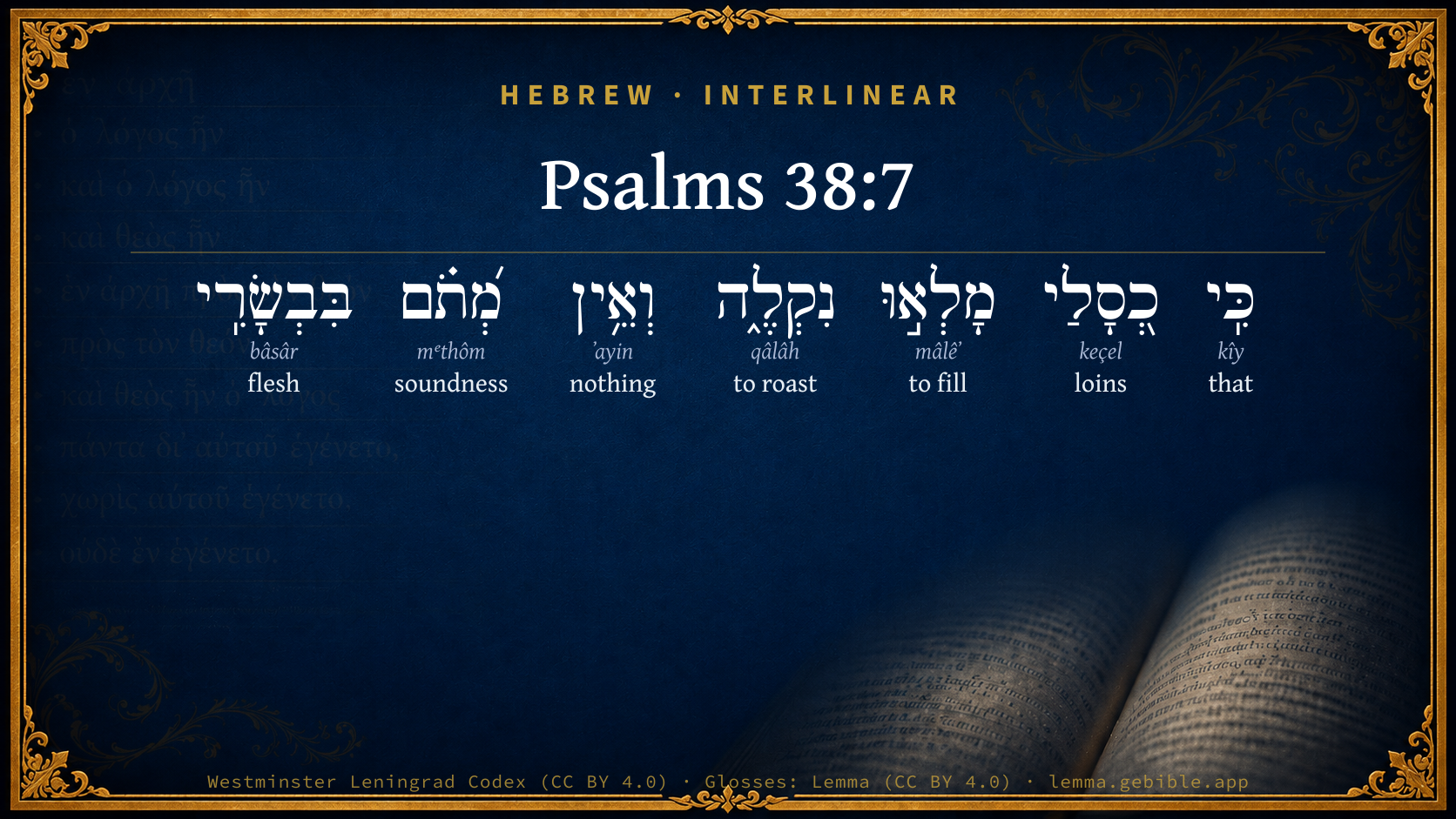
Hebrew (Westminster Leningrad Codex) Psalms 38:7 appears in the Hebrew Old Testament. The text above is from the Westminster Leningrad Codex. Each word links to its Strong’s number, a concise gloss, and parsing drawn from the Open Scriptures Hebrew Bible morphology. Click any word for its full Brown-Driver-Briggs (BDB) entry.
Download image
Cite this verse

Psalms 38:7 (World English Bible). Public Domain. Lemma interlinear Bible study tool, https://lemma.gebible.app/v/psalms/38/7.

Show BibTeX & RIS
BibTeX
RIS
English Translation
For my loins are filled with burning. There is no soundness in my flesh.
World English Bible · Public Domain
Download a study sheet

One document with this verse’s original text, its word-by-word gloss line, the meaning frame, cross-references with their text, attributed commentary, and full source and license credits — printable, and it pastes into notes with its structure intact.

This verse Autodidact and up

Study sheet (.html) Plain text (.txt)

A passage Seminary Student

Up to 50 verses in one chapter. A passage sheet keeps up to 6 commentary sources and 12 cross-references per verse, in the order this page ranks them, and says so on the sheet whenever that leaves anything out. Ask for a single verse and you get the Autodidact verse sheet above.

Everything on this page stays free to read, with no account — the sheet is a download of what is already on screen, not access to it.

Want to remove ads? Support Godless Engineer
Compare translations 3

The same verse in 3 English versions, stacked beneath the original-language interlinear above. Click any original word for its lexicon entry.

Each is an independent rendering of the whole verse — the interlinear is not word-aligned to these translations.

Highlighted words mark where these versions differ — a whole-verse word diff, not a word-by-word alignment.

  • World English Bible Public Domain
    For my loins are filled with burning. There is no soundness in my flesh.
  • King James Version Public Domain
    For my loins are filled with a loathsome disease: and there is no soundness in my flesh.
  • unfoldingWord Literal Text CC BY-SA 4.0
    For my loins are full of burning, and there is no soundness in my flesh.

unfoldingWord Literal Text — © unfoldingWord, licensed CC BY-SA 4.0. Word-aligned USFM3 via Door43 (git.door43.org/unfoldingWord/en_ult).

Versions to compare (up to 4)

3 of 4 selected

Show all 18 translations

Every available English version of this verse, each an independent rendering of the whole verse.

  • World English Bible Public Domain
    For my loins are filled with burning. There is no soundness in my flesh.
  • Berean Standard Bible Public Domain
    For my loins are full of burning pain, and no soundness remains in my body.
  • Majority Standard Bible Public Domain
    For my loins are full of burning pain, and no soundness remains in my body.
  • King James Version Public Domain
    For my loins are filled with a loathsome disease: and there is no soundness in my flesh.
  • American Standard Version (1901) Public Domain
    For my loins are filled with burning; And there is no soundness in my flesh.
  • Revised Version (1885) Public Domain
    For my loins are filled with burning; and there is no soundness in my flesh.
  • Geneva Bible (1599) Public Domain
    For my reines are full of burning, and there is nothing sound in my flesh.
  • Douay-Rheims (1899) Public Domain
    I am become miserable, and am bowed down even to the end: I walked sorrowful all the day long.
  • Young's Literal Translation Public Domain
    For my flanks have been full of drought, And soundness is not in my flesh.
  • Literal Standard Version CC BY-SA 4.0
    For my flanks have been full of drought, || And soundness is not in my flesh.
  • Unlocked Literal Bible CC BY-SA 4.0
    For within me, I am filled with burning; there is no health in my flesh.
  • unfoldingWord Literal Text CC BY-SA 4.0
    For my loins are full of burning, and there is no soundness in my flesh.
  • Darby Bible Public Domain
    For my loins are full of burning, and there is no soundness in my flesh.
  • World Messianic Bible Public Domain
    For my waist is filled with burning. There is no soundness in my flesh.
  • Webster's Bible Public Domain
    \\38:6\\I am troubled; I am bowed down greatly; I go mourning all the day long.
  • Free Bible Version CC BY-SA 4.0
    Inside I'm burning up with fever; no part of my body is healthy.
  • Bible in Basic English Public Domain
    For my body is full of burning; all my flesh is unhealthy.
  • JPS Tanakh (1917) Public Domain
    (38-8) For my loins are filled with burning; and there is no soundness in my flesh.

Literal Standard Version (2020), Covenant Press — licensed CC BY-SA 4.0. Text via the HelloAO Bible API (eBible.org). Unlocked Literal Bible (unfoldingWord) — licensed CC BY-SA 4.0. Text via the HelloAO Bible API (eBible.org). unfoldingWord Literal Text — © unfoldingWord, licensed CC BY-SA 4.0. Word-aligned USFM3 via Door43 (git.door43.org/unfoldingWord/en_ult). Free Bible Version, Dr. Jonathan Gallagher — licensed CC BY-SA 4.0. Text via the HelloAO Bible API (eBible.org).

Word by word

More ways to search: Search by grammar → Find every occurrence → Compare this word →

Practice this passage: Drill this verse → Learn its vocabulary →

About this verse

These counts appear in no published source. They are computed here, from the morphology-tagged text and Lemma’s own curated glosses. What Lemma adds →

7
words
7
distinct lemmas
Wisdom
section

Notable vocabulary

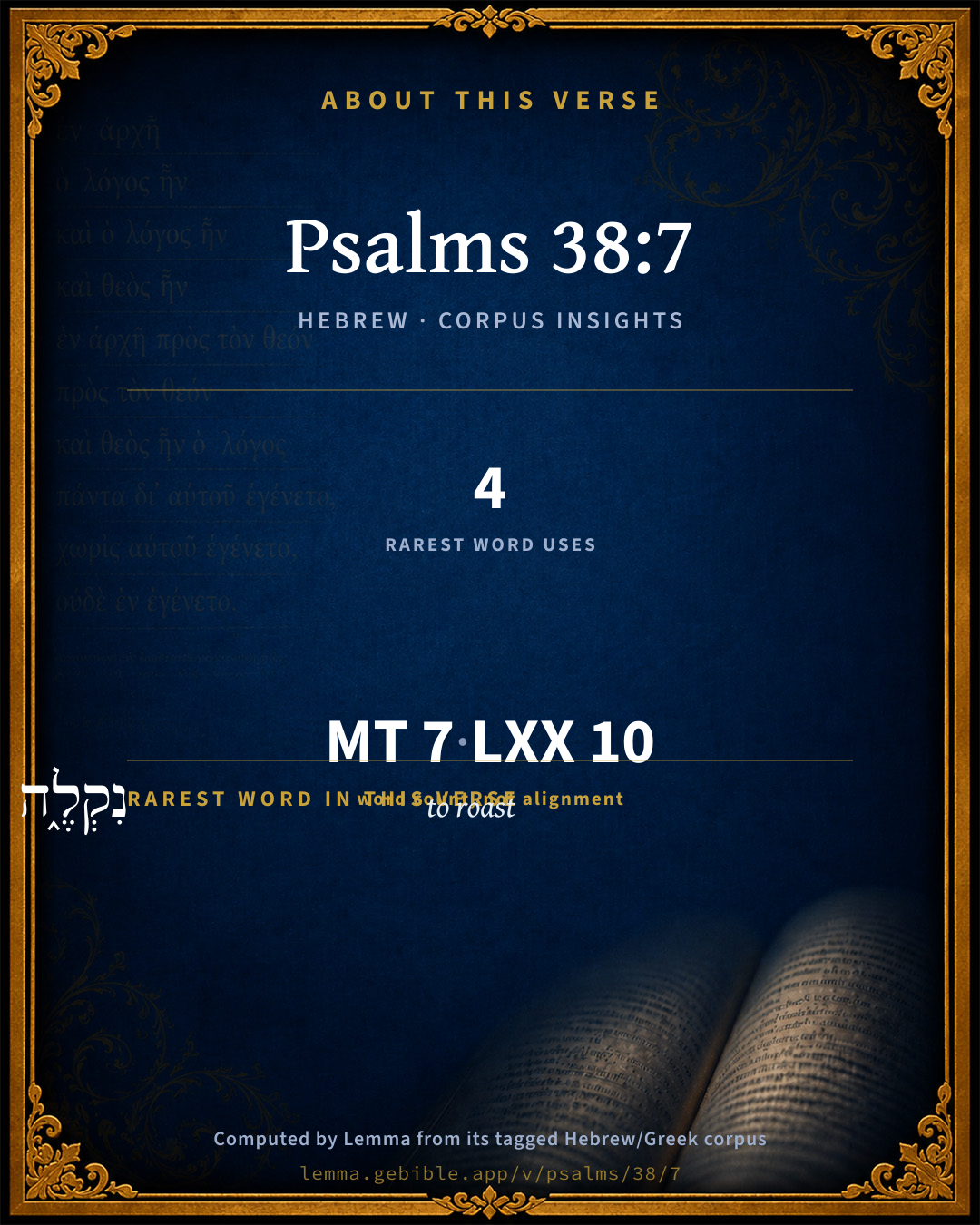
The rarest word here is נִקְלֶ֑ה to roast H7033 — appearing just 4 times in the whole Hebrew Bible.

Shared distinctive vocabulary

נִקְלֶ֑ה to roast H7033 occurs in 4 verses of the Hebrew Bible. Also found in:

Grammatical profile

  • 2 verbs
  • 3 nouns
  • 1 conjunction
  • 1 particle

Verb forms

  • מָלְא֣וּ Qal · Perfect
  • נִקְלֶ֑ה Niphal · Participle Active

Hebrew & Septuagint length

In English translation the verse runs 14 words from the Hebrew and 15 from the Septuagint (LXX English) — closely comparable.

A rough comparison of the two English renderings, which tokenize alike — not a word-level alignment.

Word counts can differ between the Hebrew and the Greek without any difference in meaning — e.g. the Hebrew direct-object marker אֵת has no separate Greek word, and Greek often adds the article ὁ.

In the original languages it is 7 Hebrew tokens and 10 Greek tokens — but the two are counted differently (Hebrew bundles its prefixes and suffixes into one token; the Greek is in lemma form), so that isn’t a like-for-like length.

Cross-references

6

Topical passages linked to Psalms 38:7 in the Treasury of Scripture Knowledge — connected by theme and wording, ordered by reader-vote popularity; previews shown in the World English Bible.

  • 2 Chronicles 21:18–19 After all this Yahweh struck him in his bowels with an incurable disease.
  • Job 7:5 My flesh is clothed with worms and clods of dust. My skin closes up, and breaks out afresh.
  • Psalms 41:8 "An evil disease," they say, "has afflicted him. Now that he lies he shall rise up no more."
  • Psalms 102:3 For my days consume away like smoke. My bones are burned as a firebrand.
  • Acts 12:23 Immediately an angel of the Lord struck him, because he didn't give God the glory, and he was eaten by worms and died.
  • Job 30:18 By great force is my garment disfigured. It binds me about as the collar of my coat.

Cross-references courtesy of OpenBible.info (CC BY 4.0).

Hebrew and Greek witnesses Masoretic Hebrew ↔ Greek Septuagint

The same verse in the two great witnesses to the Old Testament, shown verse-for-verse.

You’re reading Greek Psalm 37 (Hebrew Psalm 38). The Septuagint counts the superscription, so verse numbers can differ from the Hebrew — chapter-level alignment, not verse-by-verse. Numbering follows Rahlfs.

These are two independent witnesses, not word-aligned to each other, and the Septuagint is shown in lemma (dictionary) form.

Hebrew Psalms 38:7 Masoretic · Westminster Leningrad Codex

כִּֽי כְ֭סָלַי מָלְא֣וּ נִקְלֶ֑ה וְאֵ֥ין מְ֝תֹ֗ם בִּבְשָׂרִֽי

For my loins are filled with burning. There is no soundness in my flesh.

World English Bible · Public Domain

Greek LXX Greek Psalm 37:7 Septuagint · lemma form

ταλαιπωρέω καί κατακάμπτω ἕως τέλος ὅλος ὁ ἡμέρα σκυθρωπάζω πορεύομαι

For my soul is filled with mockings; and there is no health in my flesh.

LXX2012 (modern English Septuagint) · Public Domain

On this verse, Ellicott's Commentary for English Readers discusses the Septuagint’s reading. Read the note in Commentary ↓

Hebrew: Westminster Leningrad Codex (CC BY 4.0). Greek: Septuagint (public domain); English from LXX2012 (modern English Septuagint) (Public Domain). How the Septuagint differs from the Hebrew →

Commentary

Notes on Psalms 38:7 from classic Christian and Jewish commentators (each source and its license shown beneath its notes). The classic Christian expositions comment on the surrounding passage and are grouped to its opening verse, so a note may address several verses; the Jewish commentaries on the Tanakh (Rashi and others) are per-verse, so they appear only where the commentator wrote on this verse.

Lemma curates 59 commentaries, every one of them public domain or Creative Commons licensed, each selected and text-cleaned for this edition rather than reprinted as found. About our sources →

Trapp's Complete Commentary

John Trapp

Psa 38:7 For my loins are filled with a loathsome [disease]: and [there is] no soundness in my flesh.

Ver. 7. For my loins are filled with a loathsome disease] The loins, those scats of lust, are now grievously inflamed and pained with some imposthumated matter or pestilential carbuncle: Morbo vilissimo quem nominare dedecet, saith Aben Ezra. Femora mea prorsus occupat ardens uleus (Vat.). In quibus est concupiscentia (Theodoret). God oft punisheth sin in kind, and speaketh to the conscience in its own language, that such a sickness was the fruit of such a sin.

And there is no soundness in my flesh]

Principium dulce est, sed finis Amoris amarus,

Laeta venire Venus, tristis abire solet.

Sin is as the poison of asps, which first tickles him that is stung, and maketh him laugh; till, by little and little, it gets to the heart and then puts him to intolerable torture.

John Trapp, A Commentary or Exposition upon All the Books of the Old and New Testament (1647–1656) — public domain. Text from a community e-Sword module.

Joseph Benson's Commentary

Psa 38:7. With a loathsome disease — Hebrew, נקלה, nikleh, with vileness, or with scorching heat. “The disease,” says Poole, “might be some burning fever, breaking forth outwardly in carbuncles, or biles. It is true, this and the other expressions may be taken figuratively; but we should not forsake the literal sense of the words without necessity.” Others, however, are of opinion, that “these are figurative expressions, signifying the excessive misery and extreme wretchedness of the psalmist’s condition. And it must be acknowledged that we find the same way of speaking, and almost the same words used in Scripture, by the prophets, for the same purpose. Thus the Lord says to Ezekiel, Eze 21:6, Sigh therefore, with the breaking of thy loins; and with bitterness sigh before their eyes, where the latter clause explains the former. So Isa 21:3, exclaims, upon a like occasion, Therefore are my loins filled with pain, &c.; I was bowed down at the hearing of it. Now no man ever imagined that Ezekiel’s loins were broken, or that Isaiah had a pain in his back like that of a woman in labour: but every one understands these expressions as only denoting the prophet’s great grief and concern. And why should we not conclude that the Prophet David used the like expressions in a like sense; especially as he almost begins this Psalm with bold figurative expressions, and describes his miserable condition by the arrows of God sticking in him, and his hand pressing him sore.” — An anonymous writer quoted by Dodd.

Joseph Benson's Commentary on the Old and New Testaments (1811–1818) — public domain. Text from a community e-Sword module.

J. A. Alexander on Psalms

Joseph Addison Alexander

8. (Psa 38:7). For my loins are filled with parching, and there is no sound placein my flesh. The loins, instead of being covered with fat (Job 15:27), are filled with dryness, literally (something) parched or dried up with extreme heat. To a Hebrew reader this word would necessarily suggest the additional idea of despised, contemptible, which the same form often conveys elsewhere (e.g. 1Sa 18:23, Pro 12:9, Isa 3:5). Indeed, it may be doubted whether this is not the only sense intended here, as that of parched is always expressed elsewhere by a different participial form (Lev 2:14, Jos 5:1). On either supposition, the meaning given in the English version (a loathsome disease) is implied, if not expressed. The repetition in the last clause from Psa 38:4 (3) above brings him back to the point from which he started.

Joseph Addison Alexander, The Psalms Translated and Explained (1850) — public domain. Text from a community e-Sword module.

Adam Clarke's Commentary

Verse 7. For my loins are filled with a loathsome disease] Or rather, a burning; נקלה nikleh, from קלה kalah, to fry, scorch, &c., hence נקלה nikleh, a burning, or strongly feverish disease.

There is no soundness in my flesh.] All without and all within bears evidence that the whole of my solids and fluids are corrupt.

Adam Clarke's Commentary on the Bible (1810–1826) — public domain. Text from a community e-Sword/MySword module.

John Calvin's Commentaries

In the next verse, the word כסלים, kesalaim, which I have rendered reins, is by some translated the flanks. But the more generally received opinion is, that it denotes the part under the reins, which extends towards the haunch, or the space between the thighs and flanks, where it is supposed there had been a sore. Commentators also differ in their opinion respecting the word נקלה, nikleh, which I have rendered burning In my translation I have followed those who adhere to the original meaning of the word; for the verb קלה, kalah, signifies to burn, or to consume with fire. Others, indeed, explain it not improperly in the sense of filthiness and corruption. I am, however, not inclined to limit it to a sore. In my opinion, the sense simply is, that his reins, or flanks, or thighs, were filled with an inflammatory disease, or at least were covered over with putrid sores; for these parts of the body are most subject to inflammation, and most liable to contract putrid humours. Some expound it allegorically, as meaning, that David seemed loathsome in his own eyes, when he thought of his reproach; but this appears too forced. When he adds that he was weakened and sore broken, he still farther confirms what he had said in the preceding verses: for by these various terms he wished to express the intolerable vehemence of his grief. Now, as a man, who is distinguished by courage, does not cry out and complain, and as we know that David did not shrink in bearing his afflictions, we may gather from this, that his sufferings were severe and painful in the extreme, inasmuch as he not only wept bitterly, but was also forced to cry out and complain. The noun נהמת, nahamath, which I have rendered roaring, may be derived from another verb than that which David has here used; but the meaning is obvious, namely, that the incontrollable emotions of his heart forced him to cry out.

John Calvin's Commentaries (1540-1563) — public domain. Text from the Calvin Translation Society English edition (1840s-50s) via the Christian Classics Ethereal Library (ccel.org). Calvin's coverage is partial (roughly two-thirds of the Bible); uncommented books and verses are honest gaps, never fabricated. The 19th-century editor's footnotes and remarks are omitted so the notes are faithfully Calvin's own voice.

Ellicott's Commentary for English Readers

(7) Loathsome disease.—The Hebrew word is a passive participle of a verb meaning to scorch, and here means inflamed or inflammation. Ewald renders “ulcers.” The LXX. and Vulg., deriving from another root meaning to be light, or made light of, render “mockings.”

A Bible Commentary for English Readers, edited by Charles John Ellicott (1878–1897) — public domain. Text from a community e-Sword module.

The Cambridge Bible for Schools and Colleges

gen. ed. J. J. S. Perowne

7. with a loathsome disease] R.V. with burning; fever and inflammation. Cp. Job_30:27; Job_30:30.

The Cambridge Bible for Schools and Colleges (gen. ed. J. J. S. Perowne; Cambridge University Press, 1878–1918) — public domain. Text from a community e-Sword module.

John Gill's Exposition

I am feeble,.... Both in body, natural strength being weakened by the affliction, and dried up like a potsherd by the heat of the distemper; and in soul, being weak in the exercise of faith and other graces. The word is used of Jacob, fainting at and disbelieving the news of his son Joseph being alive, Gen 45:26;

and sore broken; in his constitution with the disease, and in his mind with trouble; especially for his sin, and under a sense of the divine displeasure; his bones were broken by his fall, and his heart broken with a sense of sin, Psa 51:8;

I have roared by reason of the disquietness of my heart: which was like the raging of the sea, as the word (l) rendered disquietness here signifies; and to which the uneasiness and restlessness of wicked men is sometimes compared, Isa 5:30; and so great was the disquietude of this good man under affliction, and sense of sin and wrath, that he had no rest night nor day; and could not forbear crying out, in a very hideous manner, like the roaring of a lion.

(l) "prae fremitu", Tigurine version, Vatablus, Junius & Tremellius, Gejerus, so Piscator, Cocceius, Michaelis.

John Gill's Exposition of the Whole Bible (1746–1763) — public domain (CC PDM 1.0). Text via the HelloAO Bible API.

Albert Barnes' Notes on the Bible

For my bones are filled with a loathsome disease - This would seem to indicate the seat of the disease, though not its nature. The word used here, according to Gesenius (Lexicon), properly denotes the internal muscles of the loins near the kidneys, to which the fat adheres. The word rendered “loathsome” - the word “disease” being supplied by our translators - is derived from קלה qâlâh, a word which means to roast, to parch, as fruit, grain, etc.; and then, in the form used here, it means scorched, burned; hence, a burning or inflammation; and the whole phrase would be synonymous with “an inflammation of the kidneys.” The word used here does not imply that there was any eruption, or ulcer, though it would seem from Psa 38:5 that this was the fact, and that the inflammation had produced this effect.

And there is no soundness in my flesh - See Psa 38:3. His disease was so deep-seated and so pervading, that there did not seem to be “any” soundness in his flesh. His whole body seemed to be diseased.

Albert Barnes' Notes on the Bible (1834–1885) — public domain. Text from a community e-Sword/MySword module.

Matthew Poole's English Annotations

Or, with filthiness; or, with scorching heat. The disease might be some burning fever, being also malignant or pestilential, either burning inwardly, or breaking forth outwardly in carbuncles or boils. It is true, this and the other expressions may be taken figuratively, of some grievous calamity; but we should not forsake the proper and the literal sense of the words without necessity, which seems not to be in this place.

Matthew Poole's English Annotations on the Holy Bible (1683–1685) — public domain. Text from a community e-Sword/MySword module.

The Treasury of David

Charles H. Spurgeon

Ver. 7. For my loins are filled with a loathsome disease a hot, dry, parching disorder, probably accompanied by loathsome ulcers. Spiritually, the fire burns within when the evil of the heart is laid bare. Note the emphatic words, the evil is loathsome, it is in the loins, its seat is deep and vitalthe man is filled with it. Those who have passed through the time of conviction understand all this. And there is no soundness in my flesh. This he had said before, and thus the Holy Spirit brings humiliating truth again and again to our memories, tears away every ground of glorying, and makes us know that in us, that is, in our flesh, there dwelleth no good thing.

Ver. 7. For my loins are filled with a loathsome disease. The word here used, according to Gesenius (Lex.), properly denotes the internal muscles of the loins near the kidneys, to which the fat adheres. The word rendered loathsome the word disease being supplied by our translatorsis derived from (hlq), kalah, a word which means to roast, to parch, as fruit, grain, etc.; and then, in the form used here, it means scorched, burned; hence, a burning or inflammation; and the whole phrase would be synonymous with an inflammation of the kidneys. The word here used does not imply that there was any eruption, or ulcer, though it would seem from verse five that this was the fact, and that the inflammation had produced this effect. Albert Barnes.

Ver. 7. A loathsome disease. In many things our estimates are extravagant; but we never over estimate the evil of sin. It is as corrupting as it is damning. It covers the soul with plague spots, with the leprosy. Isa 1:5-6. William S. Plumer.

None.

Psalms 38:8*

Charles H. Spurgeon's The Treasury of David (1869–1885) — public domain. Psalms only. Text from a community e-Sword/MySword module.

Whedon's Commentary on the Bible

Daniel D. Whedon

7. This, with Psa_38:3, must be taken literally, as should Job_7:5, not as a figure for great suffering. The participle translated loathsome disease properly means dryness, and hence a burning heat, or inflammation, which causes exhaustion of the fluids. Perhaps the true idea is burning boils.

Loins are referred to as the seat of strength, and the word is used as an emblem of strength, and ground of reliance. The strong muscles about the kidneys and lumbar region, being also the depository of fatty substance, (see Lev_3:4; Lev_3:10; Lev_3:15; Job_15:27, where it is translated flanks,) are here represented as shrunken and dried up by heat.

Daniel D. Whedon (gen. ed.), Commentary on the Old and New Testaments (1874–1909) — public domain. Text from a community e-Sword module.

The Pulpit Commentary

For my loins are filled with a loathsome disease; my loins are full of burning (Kay, Revised Version). A burning pain in the lumbar region is apparently intended. And there is no soundness in my flesh. Repeated from ver. 3.

The Pulpit Commentary (1880–1919), ed. H.D.M. Spence-Jones & Joseph S. Exell — public domain. Text from a community e-Sword module.

John Wesley's Explanatory Notes

Disease - The disease might be some burning fever, breaking forth outwardly in carbuncles, or boils. It is true, this and the other expressions may be taken figuratively, but we should not forsake the literal sense of the words without necessity.

John Wesley, Explanatory Notes Upon the Whole Bible (1754–1765) — public domain. Text via the GEBible commentary corpus.

unfoldingWord translationNotes

Door43 World Missions Community

I am filled with burning

The writer's is so sick with fever that it is as if he is burning inside. AT: "My body is burning with fever" (See: Metaphor)

there is no health in my flesh

Here "my flesh" refers to the writer. AT: "I am completely sick" (See: Synecdoche)

utterly crushed

The writer's illness is so severe that it is as if a huge weight is pressing down on him. (See: Metaphor)

anguish of my heart

Here "my heart" refers to the writer. AT: "my anguish" (See: Synecdoche)

translationWords

shame

heart

unfoldingWord translationNotes — © Distant Shores Media and the Door43 World Missions Community, licensed CC BY-SA 4.0. Source: git.door43.org/Door43/en_tn.

Rashi

Rabbi Shlomo Yitzchaki (Rashi)

I am...stunned Heb. נעויתי an expression of (Chullin 60b): “Convulsions (עוית) seize him.” Etourdissant in French, stunning.

Rashi on the Tanakh — English translations: “The Judaica Press complete Tanach with Rashi, translated by A. J. Rosenberg” (CC BY 4.0); “Pentateuch with Rashi's commentary by M. Rosenbaum and A.M. Silbermann, 1929-1934” (public domain); “The Metsudah Tanach series, Lakewood, N.J” (CC BY 4.0); and “The Book of Joshua, Metsudah Publications, 1997” (CC BY 4.0). Text via Sefaria.

Lesson kit

Teaching starters — assembled from the data on this page, not authored interpretation. Every prompt links to the verse data it draws on. Edit before teaching.

Psalms, in the Wisdom, opens this verse with 7 words (7 distinct Hebrew lemmas). Its most distinctive word is qâlâh (“to roast”). A historical commentator’s framing appears above. Read the whole chapter for the surrounding context.

Discussion questions

  1. What does “to roast” (qâlâh) contribute to the verse as a whole?
  2. Leviticus 2:14 shares the word «to roast» with this verse. How do the two illuminate each other?
  3. These translations render this verse differently. What is at stake in choosing one wording over another?
  4. The verb «מָלְא֣וּ» is Qal Perfect. How does its form color the action?
  5. Reading how Trapp's Complete Commentary and Joseph Benson's Commentary read this verse, where do the two commentators agree and where do they part?

Things to notice

Reading settings

Reading text

Shown beneath each verse's original-language words.

Old Testament
Old Testament edition

Read the OT as the Masoretic Hebrew (MT) or the Greek Septuagint (LXX).

English shown for the Greek Septuagint (in the Hebrew ↔ Greek comparison).

Comparing translations? Open the Compare panel on any verse page to stack up to four side by side.