

Genesis 42:16

Hebrew (Westminster Leningrad Codex) Genesis 42:16 appears in the Hebrew Old Testament. The text above is from the Westminster Leningrad Codex. Each word links to its Strong’s number, a concise gloss, and parsing drawn from the Open Scriptures Hebrew Bible morphology. Click any word for its full Brown-Driver-Briggs (BDB) entry.
Download image
Cite this verse

Genesis 42:16 (World English Bible). Public Domain. Lemma interlinear Bible study tool, https://lemma.gebible.app/v/genesis/42/16.

Show BibTeX & RIS
BibTeX
RIS
English Translation
Send one of you, and let him get your brother, and you shall be bound, that your words may be tested, whether there is truth in you, or else by the life of Pharaoh surely you are spies."
World English Bible · Public Domain
Download a study sheet

One document with this verse’s original text, its word-by-word gloss line, the meaning frame, cross-references with their text, attributed commentary, and full source and license credits — printable, and it pastes into notes with its structure intact.

This verse Autodidact and up

Study sheet (.html) Plain text (.txt)

A passage Seminary Student

Up to 50 verses in one chapter. A passage sheet keeps up to 6 commentary sources and 12 cross-references per verse, in the order this page ranks them, and says so on the sheet whenever that leaves anything out. Ask for a single verse and you get the Autodidact verse sheet above.

Everything on this page stays free to read, with no account — the sheet is a download of what is already on screen, not access to it.

Want to remove ads? Support Godless Engineer
Compare translations 3

The same verse in 3 English versions, stacked beneath the original-language interlinear above. Click any original word for its lexicon entry.

Each is an independent rendering of the whole verse — the interlinear is not word-aligned to these translations.

Highlighted words mark where these versions differ — a whole-verse word diff, not a word-by-word alignment.

  • World English Bible Public Domain
    Send one of you, and let him get your brother, and you shall be bound, that your words may be tested, whether there is truth in you, or else by the life of Pharaoh surely you are spies."
  • King James Version Public Domain
    Send one of you, and let him fetch your brother, and ye shall be kept in prison, that your words may be proved, whether there be any truth in you: or else by the life of Pharaoh surely ye are spies.
  • unfoldingWord Literal Text CC BY-SA 4.0
    Send one of you, and let him bring your brother, and you will be bound. Then your words will be tested the truth in you. And if not, the life of Pharaoh, surely you spies!”

unfoldingWord Literal Text — © unfoldingWord, licensed CC BY-SA 4.0. Word-aligned USFM3 via Door43 (git.door43.org/unfoldingWord/en_ult).

Versions to compare (up to 4)

3 of 4 selected

Show all 18 translations

Every available English version of this verse, each an independent rendering of the whole verse.

  • World English Bible Public Domain
    Send one of you, and let him get your brother, and you shall be bound, that your words may be tested, whether there is truth in you, or else by the life of Pharaoh surely you are spies."
  • Berean Standard Bible Public Domain
    Send one of your number to get your brother; the rest of you will be confined so that the truth of your words may be tested. If they are untrue, then as surely as Pharaoh lives, you are spies!”
  • Majority Standard Bible Public Domain
    Send one of your number to get your brother; the rest of you will be confined so that the truth of your words may be tested. If they are untrue, then as surely as Pharaoh lives, you are spies!”
  • King James Version Public Domain
    Send one of you, and let him fetch your brother, and ye shall be kept in prison, that your words may be proved, whether there be any truth in you: or else by the life of Pharaoh surely ye are spies.
  • American Standard Version (1901) Public Domain
    Send one of you, and let him fetch your brother, and ye shall be bound, that your words may be proved, whether there be truth in you: or else by the life of Pharaoh surely ye are spies.
  • Revised Version (1885) Public Domain
    Send one of you, and let him fetch your brother, and ye shall be bound, that your words may be proved, whether there be truth in you: or else by the life of Pharaoh surely ye are spies.
  • Geneva Bible (1599) Public Domain
    Send one of you which may fet your brother, and ye shall be kept in prison, that your words may be proued, whether there bee trueth in you: or els by the life of Pharaoh ye are but spies.
  • Douay-Rheims (1899) Public Domain
    Send one of you to fetch him: and you shall be in prison, till what you have said be proved, whether it be true or false: or else by the health of Pharao you are spies.
  • Young's Literal Translation Public Domain
    send one of you, and let him bring your brother, and ye, remain ye bound, and let your words be proved, whether truth be with you: and if not -- Pharaoh liveth! surely ye `are' spies;'
  • Literal Standard Version CC BY-SA 4.0
    send one of you, and let him bring your brother, and you, remain bound, and let your words be proved, whether truth be with you: and if not, [as] Pharaoh lives, surely you [are] spies”;
  • Unlocked Literal Bible CC BY-SA 4.0
    Send one of yourselves and let him get your brother. You will remain in prison, that your words may be tested, whether there is truth in you.”
  • unfoldingWord Literal Text CC BY-SA 4.0
    Send one of you, and let him bring your brother, and you will be bound. Then your words will be tested the truth in you. And if not, the life of Pharaoh, surely you spies!”
  • Darby Bible Public Domain
    Send one of you, that he may fetch your brother, but ye shall be imprisoned, and your words shall be put to the proof, whether the truth is in you; and if not, as Pharaoh lives, ye are spies.
  • World Messianic Bible Public Domain
    Send one of you, and let him get your brother, and you shall be bound, that your words may be tested, whether there is truth in you, or else by the life of Pharaoh surely you are spies.”
  • Webster's Bible Public Domain
    Send one of you, and let him bring your brother, and ye shall be kept in prison, that your words may be proved, whether there is any truth in you: or else by the life of Pharaoh surely ye are spies.
  • Free Bible Version CC BY-SA 4.0
    One of you go back and bring your other brother here. The others of you will be kept here in prison until it's clear that you're telling the truth. If not, then I swear on Pharaoh's life it proves you're spies!”
  • Bible in Basic English Public Domain
    Send one of your number to get your brother, and the rest of you will be kept in prison, so that your words may be tested to see if you are true; if not, by the life of Pharaoh, your purpose is certainly secret.
  • JPS Tanakh (1917) Public Domain
    Send one of you, and let him fetch your brother, and ye shall be bound, that your words may be proved, whether there be truth in you; or else, as Pharaoh liveth, surely ye are spies.'

Literal Standard Version (2020), Covenant Press — licensed CC BY-SA 4.0. Text via the HelloAO Bible API (eBible.org). Unlocked Literal Bible (unfoldingWord) — licensed CC BY-SA 4.0. Text via the HelloAO Bible API (eBible.org). unfoldingWord Literal Text — © unfoldingWord, licensed CC BY-SA 4.0. Word-aligned USFM3 via Door43 (git.door43.org/unfoldingWord/en_ult). Free Bible Version, Dr. Jonathan Gallagher — licensed CC BY-SA 4.0. Text via the HelloAO Bible API (eBible.org).

Word by word

More ways to search: Search by grammar → Find every occurrence → Compare this word →

Practice this passage: Drill this verse → Learn its vocabulary →

מְרַגְּלִ֖ים
râgal
H7270
“walking”
Verb, Piel, Participle Active, Masculine, Plural, Absolute
Part of Speech
Verb
Stem
Piel
Form
Participle Active
Gender
Masculine
Number
Plural
State
Absolute
Full BDB Definition

Origin: a primitive root

TWOT: 2113

to go on foot, spy out, foot it, go about, walk along, move the feet - (Qal) to be a tale-bearer, slander, go about - (Piel) - to slander - to go about as explorer, spy - (Tiphel) to teach to walk
  1. שִׁלְח֨וּ shâlach H7971 “send” Verb, Qal, Imperative, 2nd Person, Masculine, Plural
  2. מִכֶּ֣ם min H4480 “from · you” Preposition + Suffix, Personal, 2nd Person, Masculine, Plural
  3. אֶחָד֮ ʼechâd H259 “one” Adjective, Cardinal number, Masculine, Singular, Absolute
  4. וְיִקַּ֣ח lâqach H3947 “and · to take” Conjunction + Verb, Qal, Imperfect, 3rd Person, Masculine, Singular
  5. אֶת ʼêth H853 “-” Particle, Direct Object
  6. אֲחִיכֶם֒ ʼâch H251 “brother · your” Noun, Common, Masculine, Singular, Construct + Suffix, Personal, 2nd Person, Masculine, Plural
  7. וְאַתֶּם֙ ʼattâh H859 “and · you” Conjunction + Pronoun, Personal, 2nd Person, Masculine, Plural
  8. הֵאָ֣סְר֔וּ ʼâçar H631 “bind” Verb, Niphal, Imperative, 2nd Person, Masculine, Plural
  9. וְיִבָּֽחֲנוּ֙ bâchan H974 “and · to test” Conjunction + Verb, Niphal, Imperfect, 3rd Person, Masculine, Plural
  10. דִּבְרֵיכֶ֔ם dâbâr H1697 “words · your” Noun, Common, Masculine, Plural, Construct + Suffix, Personal, 2nd Person, Masculine, Plural
  11. הַֽאֱמֶ֖ת ʼemeth H571 “faithfulness” Particle, Interrogative + Noun, Common, Feminine, Singular, Absolute
  12. אִתְּכֶ֑ם ʼêth H854 “with · you” Preposition + Suffix, Personal, 2nd Person, Masculine, Plural
  13. וְאִם ʼim H518 “and · if” Conjunction + Conjunction
  14. לֹ֕א lôʼ H3808 “not” Particle, Negative
  15. חֵ֣י chay H2416 “living” Adjective, Adjective, Masculine, Singular, Absolute
  16. פַרְעֹ֔ה Parʻôh H6547 “Pharaoh” Noun, Proper
  17. כִּ֥י kîy H3588 “that” Conjunction
  18. אַתֶּֽם ʼattâh H859 “you” Pronoun, Personal, 2nd Person, Masculine, Plural

About this verse

These counts appear in no published source. They are computed here, from the morphology-tagged text and Lemma’s own curated glosses. What Lemma adds →

19
words
18
distinct lemmas
Pentateuch
section

Notable vocabulary

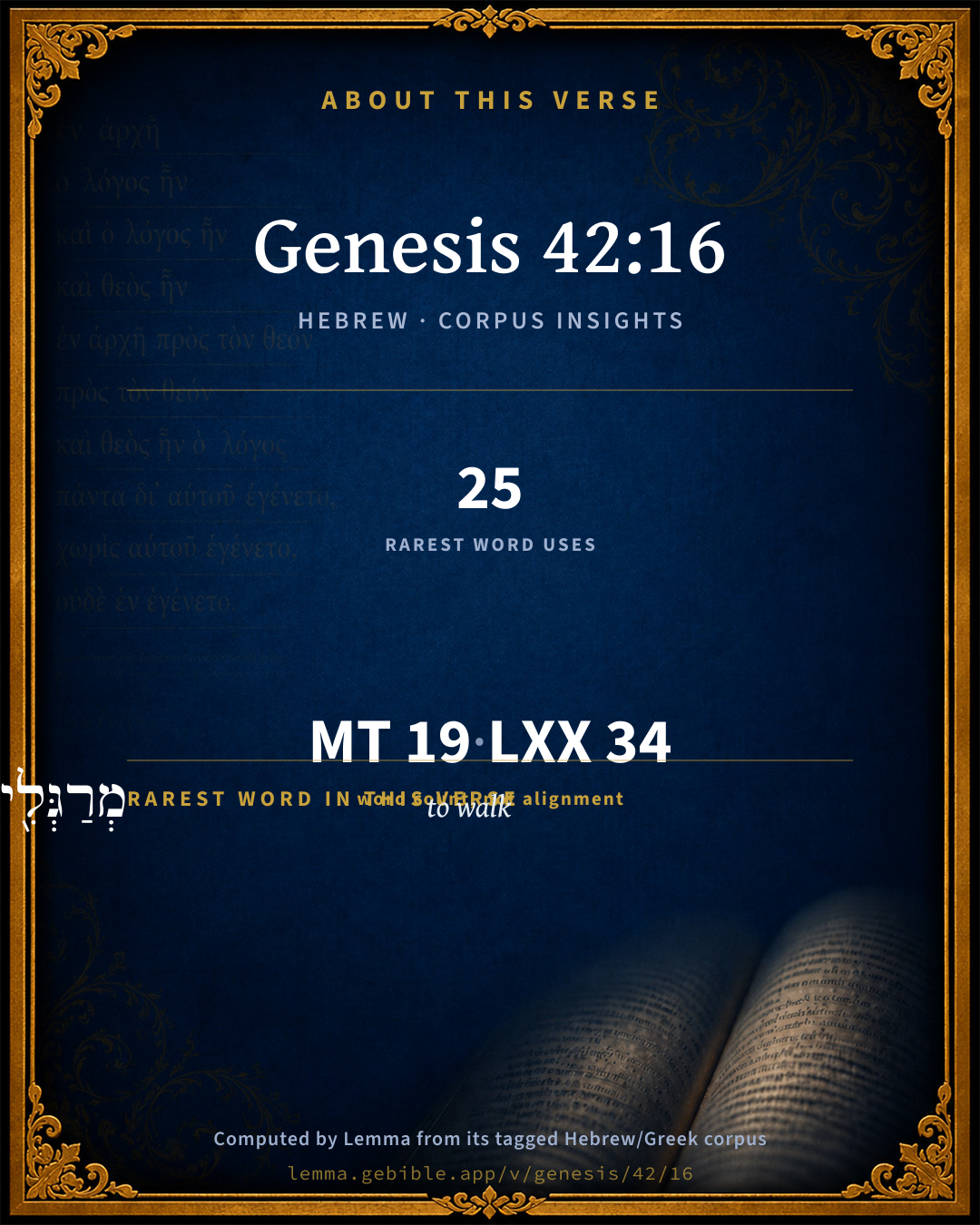
The rarest word here is מְרַגְּלִ֖ים to walk H7270 — appearing just 25 times in the whole Hebrew Bible.

Shared distinctive vocabulary

מְרַגְּלִ֖ים to walk H7270 occurs in 24 verses of the Hebrew Bible. Also found in:

Grammatical profile

  • 5 verbs
  • 4 nouns
  • 2 adjectives
  • 2 pronouns
  • 2 prepositions
  • 2 conjunctions
  • 2 particles

Verb forms

  • שִׁלְח֨וּ Qal · Imperative
  • וְיִקַּ֣ח Qal · Imperfect
  • הֵאָ֣סְר֔וּ Niphal · Imperative
  • וְיִבָּֽחֲנוּ֙ Niphal · Imperfect
  • מְרַגְּלִ֖ים Piel · Participle Active

Repetition

A word recurs within this verse — often emphatic in Hebrew:

  • וְאַתֶּם֙ you H859 ×2

Hebrew & Septuagint length

In English translation the verse runs 38 words from the Hebrew and 37 from the Septuagint (LXX English) — closely comparable.

A rough comparison of the two English renderings, which tokenize alike — not a word-level alignment.

Word counts can differ between the Hebrew and the Greek without any difference in meaning — e.g. the Hebrew direct-object marker אֵת has no separate Greek word, and Greek often adds the article ὁ.

In the original languages it is 19 Hebrew tokens and 34 Greek tokens — but the two are counted differently (Hebrew bundles its prefixes and suffixes into one token; the Greek is in lemma form), so that isn’t a like-for-like length.

Cross-references

1

Topical passages linked to Genesis 42:16 in the Treasury of Scripture Knowledge — connected by theme and wording, ordered by reader-vote popularity; previews shown in the World English Bible.

  • Genesis 42:11 We are all one man's sons; we are honest men. Your servants are not spies."

Cross-references courtesy of OpenBible.info (CC BY 4.0).

Hebrew and Greek witnesses Masoretic Hebrew ↔ Greek Septuagint

The same verse in the two great witnesses to the Old Testament, shown verse-for-verse.

These are two independent witnesses, not word-aligned to each other, and the Septuagint is shown in lemma (dictionary) form.

Hebrew Genesis 42:16 Masoretic · Westminster Leningrad Codex

שִׁלְח֨וּ מִכֶּ֣ם אֶחָד֮ וְיִקַּ֣ח אֶת אֲחִיכֶם֒ וְאַתֶּם֙ הֵאָ֣סְר֔וּ וְיִבָּֽחֲנוּ֙ דִּבְרֵיכֶ֔ם הַֽאֱמֶ֖ת אִתְּכֶ֑ם וְאִם לֹ֕א חֵ֣י פַרְעֹ֔ה כִּ֥י מְרַגְּלִ֖ים אַתֶּֽם

Send one of you, and let him get your brother, and you shall be bound, that your words may be tested, whether there is truth in you, or else by the life of Pharaoh surely you are spies."

World English Bible · Public Domain

Greek LXX Genesis 42:16 Septuagint · lemma form

ἀποστέλλω ἐκ σύ εἷς καί λαμβάνω ὁ ἀδελφός σύ σύ δέ ἀποἄγω ἕως ὁ φανερός γίγνομαι ὁ ῥῆμα σύ εἰ ἀληθεύω ἤ οὐ εἰ δέ μή νή ὁ ὑγίεια φαραώ ἦ μήν κατάσκοπος εἰμί

Send one of you, and take your brother; and go you⌃ to prison, till your words be clear, whether you⌃ speak the truth or not; but, if not, by the health of Pharao, verily you⌃ are spies.

LXX2012 (modern English Septuagint) · Public Domain

Hebrew: Westminster Leningrad Codex (CC BY 4.0). Greek: Septuagint (public domain); English from LXX2012 (modern English Septuagint) (Public Domain). How the Septuagint differs from the Hebrew →

Targum (Aramaic paraphrase)

2

The Targum is the ancient Jewish Aramaic paraphrase of the Hebrew Scriptures — an interpretive translation, not the Hebrew text itself. Onkelos (literal) and Pseudo-Jonathan (expansive) render the Torah, and Jonathan the Prophets. Coverage is partial: where no permissively-licensed English translation exists for a verse, only the Aramaic is shown. This is verse-level text, not a word-by-word alignment to the Hebrew.

  1. Targum Onkelos Torah (Genesis–Deuteronomy)
    שְׁלָחוּ מִנְּכוֹן חַד וְיִדְבַּר יָת אֲחוּכוֹן וְאַתּוּן תִּתְאַסְרוּן וְיִתְבַּחֲרוּן פִּתְגָּמֵיכוֹן הַקְּשׁוֹטּ אַתּוּן אָמְרִין וְאִם לָא חֵי פַרְעֹה אֲרֵי אַלִּילֵי אַתּוּן

    (no public-domain English translation for this verse)

    Targum Onkelos — Aramaic: “Onkelos Genesis” (public domain); “Onkelos Exodus” (public domain); “Onkelos Leviticus” (public domain); “Onkelos Numbers” (public domain); “Onkelos Deuteronomy” (public domain). English: “Sefaria Community Translation” (CC0 1.0 (public-domain dedication)); “J.W. Etheridge. The Targums of Onkelos and Jonathan Ben Uzziel on the Pentateuch. London: Longmans, Green, 1862” (public domain). Text via Sefaria.

  2. Targum Pseudo-Jonathan Torah (Genesis–Deuteronomy)
    פַּטְרוּ מִנְכוֹן חַד וְיִדְבַּר יַת אֲחוּכוֹן וְאַתּוּן תִּתְאָסְרוּן וְיִתְבָּחֲרוּן פִּתְגָמֵיכוֹן אִין קוּשְׁטָא עִמְכוֹן וְאִין לָא חַיֵי דְפַרְעה אֲרוּם אַלִלֵי אַתּוּן

    Send one of you, and bring your brother; but you shall be bound, and your words be proved if the truth is with you: and if not, (by) the life of Pharoh you are spies.

    Targum Pseudo-Jonathan — Aramaic: “Targum Jonathan on Genesis” (public domain); “Targum Jonathan on Exodus” (public domain); “Targum Jonathan on Leviticus” (public domain); “Targum Jonathan on Numbers” (public domain); “Targum Jonathan on Deuteronomy” (public domain). English: “The Targum of Jonathan ben Uzziel, trans. J. W. Etheridge, London, 1862” (public domain). Text via Sefaria.

Commentary

Notes on Genesis 42:16 from classic Christian and Jewish commentators (each source and its license shown beneath its notes). The classic Christian expositions comment on the surrounding passage and are grouped to its opening verse, so a note may address several verses; the Jewish commentaries on the Tanakh (Rashi and others) are per-verse, so they appear only where the commentator wrote on this verse.

Lemma curates 59 commentaries, every one of them public domain or Creative Commons licensed, each selected and text-cleaned for this edition rather than reprinted as found. About our sources →

Trapp's Complete Commentary

John Trapp

Gen 42:16 Send one of you, and let him fetch your brother, and ye shall be kept in prison, that your words may be proved, whether [there be any] truth in you: or else by the life of Pharaoh surely ye [are] spies.

Ver. 16. By the life of Pharaoh surely, &c.] See how easily sin entereth twice, where it had once entered. "Be not overcome of evil." {Rom 12:21} Some swear, and find it not; they would be sorry their excrements should pass from them, and they feel it not. Oh, cross this ill custom; and though ye cannot so soon turn the stream, yet swim against it. It is the devil that saith unto thee, as those Jews did to Pilate; "Do as thou hast ever done." {Mar 15:8} God also will answer such, when they plead for their swearing, that they have got a custom, and cannot leave it; as the judge did that thief that desired him to spare him, for stealing had been his custom from his youth. The judge replied, it was also his custom to give judgment against such malefactors, therefore he must be condemned, {a} "Swear neither by heaven, nor by earth, lest ye fall into condemnation," saith St James {Jas 5:12} to the converted Jews. This they had learned of the Pharisees, to whom it was familiar to swear by creatures. {Mat 5:34} And though now converted, they could not leave it: but they must, or be damned for it, choose them which, as the apostle there assures them. {b} And whereas such kind of oaths are now grown a piece of gallantry, and such as cannot swear them are thought to want the tropes and figures befitting a gentleman, God will deal with such as that judge did with one that pleaded for his life that he might not be hanged, because he was a gentleman; he told him, that therefore he should have the gallows made higher for him: so shall these have a deeper damnation, because better bred, and should have kept a better watch; as that martyr told the swearing Bishop Bonner. {c}

{a} Barker, On the Commandments.

{b} Hoc κακοηθες a iudaismo conversis tenaciter ahdaerebat. - Pareus, in Jac., v. 12.

{c} "You keep a good watch, my lord." - Act, and Mon.

John Trapp, A Commentary or Exposition upon All the Books of the Old and New Testament (1647–1656) — public domain. Text from a community e-Sword module.

John Gill's Exposition

But bring your youngest brother unto me,.... Upon their return for more corn:

so shall your words be verified; that they were true men, and had no ill design upon the land, but were come only to buy corn:

and ye shall not die; as spies, which they were otherwise threatened with; and as it is customary in all nations to put such to death when found out:

and they did so; they left one of their brethren behind; they carried corn to their houses or families in Canaan, and brought their brother Benjamin with them when they returned to Egypt.

John Gill's Exposition of the Whole Bible (1746–1763) — public domain (CC PDM 1.0). Text via the HelloAO Bible API.

Haydock's Catholic Bible Commentary

Or else by the health of Pharao you are spies. That is, if these things you say be proved false, you are to be held for spies for your lying, and shall be treated as such. Joseph dealt in this manner with his brethren, to bring them by means of affliction to a sense of their former sin, and a sincere repentance for it.

George Leo Haydock (1774–1849), Haydock's Catholic Family Bible and Commentary, 1859 edition — public domain. Excludes Psalms (Douay-Rheims chapter numbering differs from Protestant) and Deuterocanonical books (Catholic canon only).

Rashi

Rabbi Shlomo Yitzchaki (Rashi)

האמת אתכם means WHETHER THERE BE TRUTH IN YOU — therefore the ה has the vowel Patach, because it is a kind of question. And if you do not (ואם לא) bring) him חי פרעה כי מרגלים אתם BY THE LIFE OF PHARAOH, SURELY YOU ARE SPIES.

Rashi on the Tanakh — English translations: “The Judaica Press complete Tanach with Rashi, translated by A. J. Rosenberg” (CC BY 4.0); “Pentateuch with Rashi's commentary by M. Rosenbaum and A.M. Silbermann, 1929-1934” (public domain); “The Metsudah Tanach series, Lakewood, N.J” (CC BY 4.0); and “The Book of Joshua, Metsudah Publications, 1997” (CC BY 4.0). Text via Sefaria.

Radak

Rabbi David Kimhi (Radak)

if you indeed speak the truth, as you claimed when you said that you are כנים, truthful, above board.

Radak on the Tanakh — English translations: “Sefaria Community Translation” (CC0 1.0 (public-domain dedication)); “Eliyahu Munk, HaChut Hameshulash” (CC BY 4.0); “Rabbi Mike Feuer, Jerusalem Anthology” (CC BY 4.0); and “R. David Kimhi on the first book of Psalms, Translated by R.G. Finch, London, 1919” (public domain). Text via Sefaria.

Lesson kit

Teaching starters — assembled from the data on this page, not authored interpretation. Every prompt links to the verse data it draws on. Edit before teaching.

Genesis, in the Pentateuch, opens this verse with 19 words (18 distinct Hebrew lemmas). Its most distinctive word is râgal (“to walk”). A historical commentator’s framing appears above. Read the whole chapter for the surrounding context.

Discussion questions

  1. The word râgal carries the sense “to walk.” How does it shape the verse?
  2. How does Genesis 42:9, which shares the word «to walk», read alongside this verse?
  3. What does the repetition of “you” (2× in this one verse) do in this verse?
  4. These translations render this verse differently; the difference is in the English rendering, not the original. What questions does that raise?
  5. «שִׁלְח֨וּ» is a Qal Imperative verb. How does that grammatical form shape the action described?
  6. Compare how Trapp's Complete Commentary and John Gill's Exposition read this verse. Where do they agree or differ?

Things to notice

Reading settings

Reading text

Shown beneath each verse's original-language words.

Old Testament
Old Testament edition

Read the OT as the Masoretic Hebrew (MT) or the Greek Septuagint (LXX).

English shown for the Greek Septuagint (in the Hebrew ↔ Greek comparison).

Comparing translations? Open the Compare panel on any verse page to stack up to four side by side.