
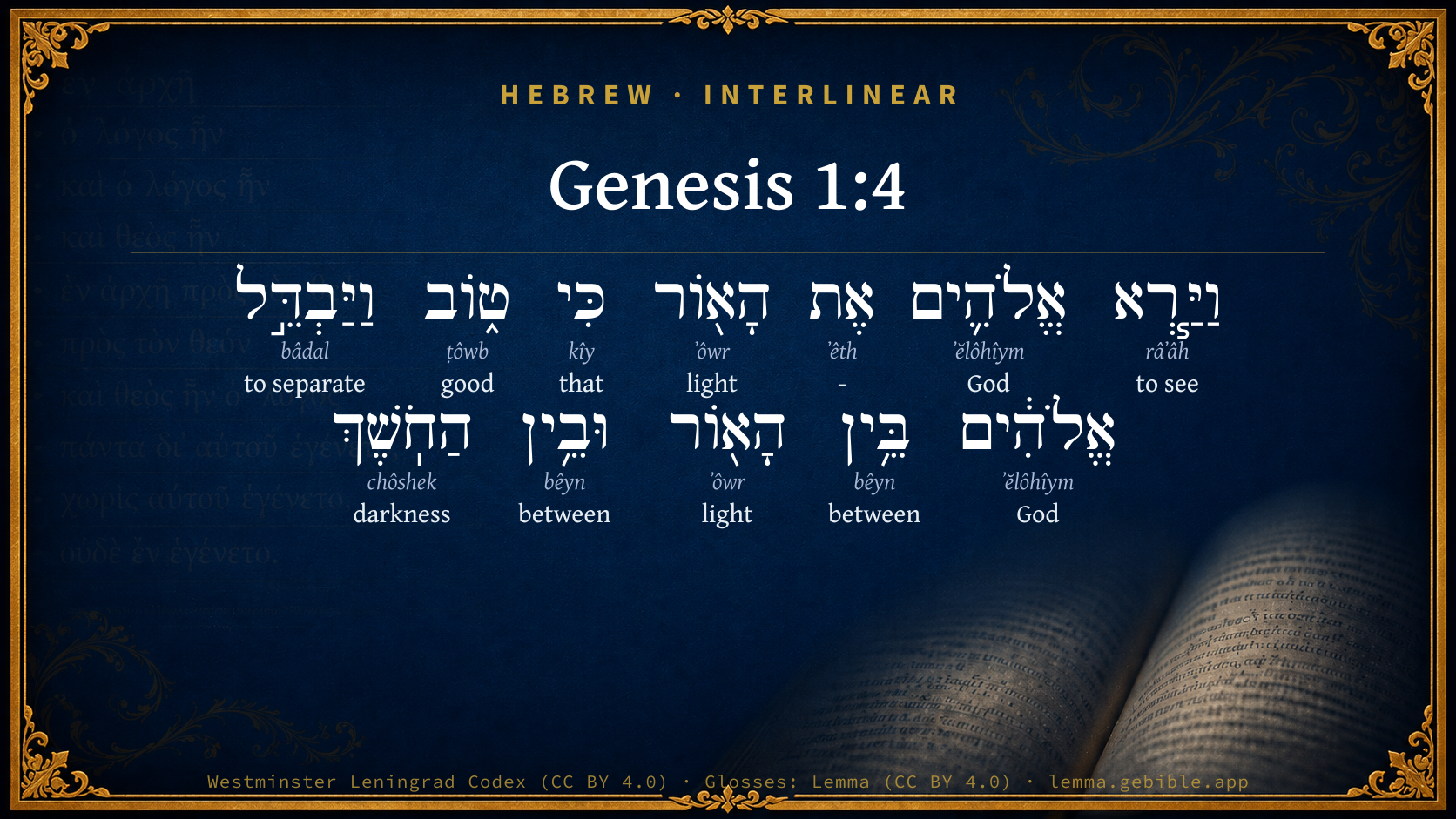
Genesis 1:4

Hebrew (Westminster Leningrad Codex) Genesis 1:4 appears in the Hebrew Old Testament. The text above is from the Westminster Leningrad Codex. Each word links to its Strong’s number, a concise gloss, and parsing drawn from the Open Scriptures Hebrew Bible morphology. Click any word for its full Brown-Driver-Briggs (BDB) entry.
Download image
Cite this verse

Genesis 1:4 (World English Bible). Public Domain. Lemma interlinear Bible study tool, https://lemma.gebible.app/v/genesis/1/4.

Show BibTeX & RIS
BibTeX
RIS
English Translation
God saw the light, and saw that it was good. God divided the light from the darkness.
World English Bible · Public Domain
Highlights
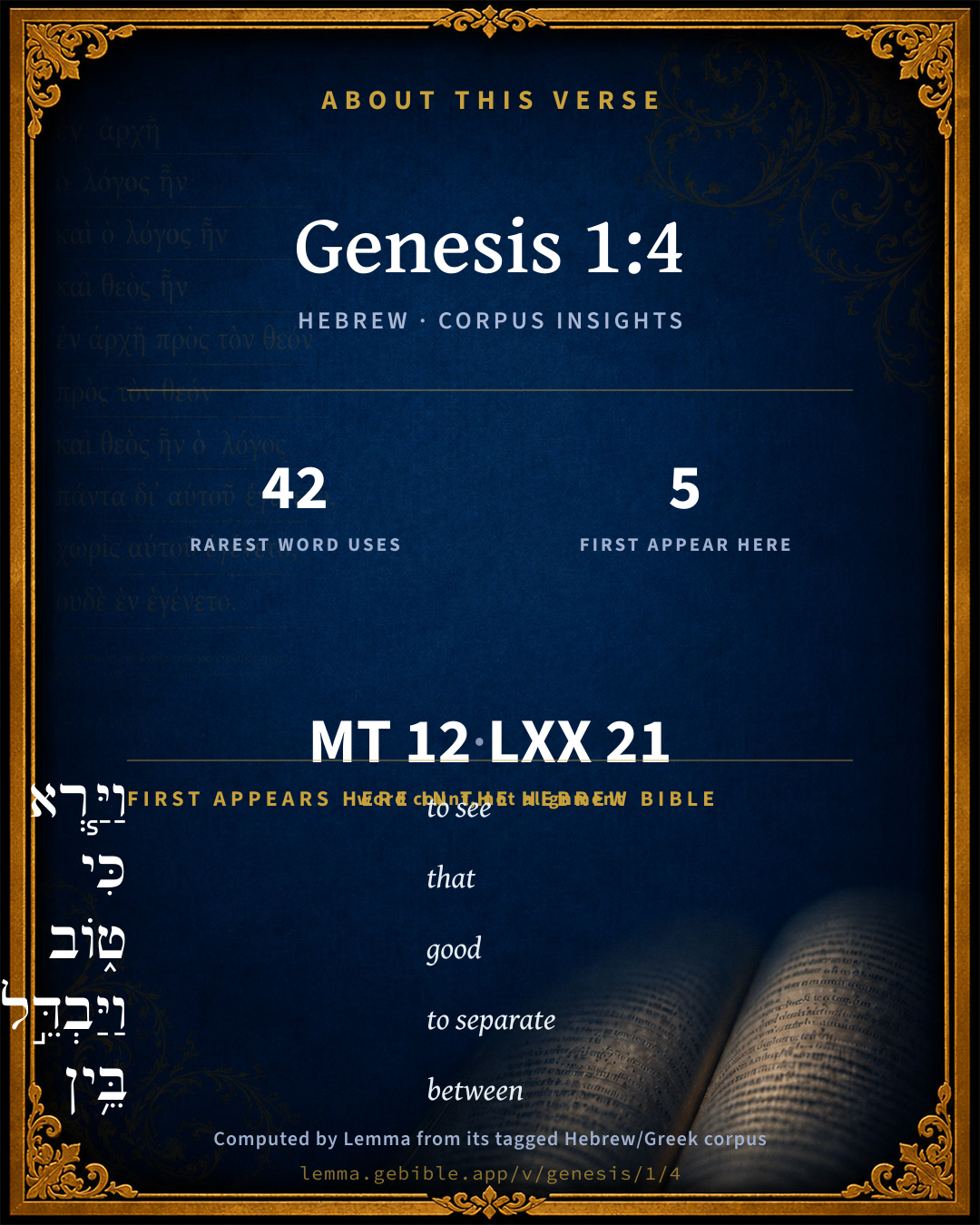
  • 5 first appearances in the Hebrew Bible
Full analysis ↓
Download a study sheet

One document with this verse’s original text, its word-by-word gloss line, the meaning frame, cross-references with their text, attributed commentary, and full source and license credits — printable, and it pastes into notes with its structure intact.

This verse Autodidact and up

Study sheet (.html) Plain text (.txt)

A passage Seminary Student

Up to 50 verses in one chapter. A passage sheet keeps up to 6 commentary sources and 12 cross-references per verse, in the order this page ranks them, and says so on the sheet whenever that leaves anything out. Ask for a single verse and you get the Autodidact verse sheet above.

Everything on this page stays free to read, with no account — the sheet is a download of what is already on screen, not access to it.

Want to remove ads? Support Godless Engineer
Compare translations 3

The same verse in 3 English versions, stacked beneath the original-language interlinear above. Click any original word for its lexicon entry.

Each is an independent rendering of the whole verse — the interlinear is not word-aligned to these translations.

Highlighted words mark where these versions differ — a whole-verse word diff, not a word-by-word alignment.

  • World English Bible Public Domain
    God saw the light, and saw that it was good. God divided the light from the darkness.
  • King James Version Public Domain
    And God saw the light, that it was good: and God divided the light from the darkness.
  • unfoldingWord Literal Text CC BY-SA 4.0
    And God saw the light, that good. Then God separated between the light and the darkness.

unfoldingWord Literal Text — © unfoldingWord, licensed CC BY-SA 4.0. Word-aligned USFM3 via Door43 (git.door43.org/unfoldingWord/en_ult).

Versions to compare (up to 4)

3 of 4 selected

Show all 18 translations

Every available English version of this verse, each an independent rendering of the whole verse.

  • World English Bible Public Domain
    God saw the light, and saw that it was good. God divided the light from the darkness.
  • Berean Standard Bible Public Domain
    And God saw that the light was good, and He separated the light from the darkness.
  • Majority Standard Bible Public Domain
    And God saw that the light was good, and He separated the light from the darkness.
  • King James Version Public Domain
    And God saw the light, that it was good: and God divided the light from the darkness.
  • American Standard Version (1901) Public Domain
    And God saw the light, that it was good: and God divided the light from the darkness.
  • Revised Version (1885) Public Domain
    And God saw the light, that it was good: and God divided the light from the darkness.
  • Geneva Bible (1599) Public Domain
    And God saw the light that it was good, and God separated the light from the darkenes.
  • Douay-Rheims (1899) Public Domain
    And God saw the light that it was good; and he divided the light from the darkness.
  • Young's Literal Translation Public Domain
    And God seeth the light that `it is' good, and God separateth between the light and the darkness,
  • Literal Standard Version CC BY-SA 4.0
    And God sees that the light [is] good, and God separates between the light and the darkness,
  • Unlocked Literal Bible CC BY-SA 4.0
    God saw the light, that it was good. He divided the light from the darkness.
  • unfoldingWord Literal Text CC BY-SA 4.0
    And God saw the light, that good. Then God separated between the light and the darkness.
  • Darby Bible Public Domain
    And God saw the light that it was good; and God divided between the light and the darkness.
  • World Messianic Bible Public Domain
    God saw the light, and saw that it was good. God divided the light from the darkness.
  • Webster's Bible Public Domain
    And God saw the light, that it was good: and God divided the light from the darkness.
  • Free Bible Version CC BY-SA 4.0
    God saw that the light was good, and he separated the light from the darkness.
  • Bible in Basic English Public Domain
    And God, looking on the light, saw that it was good: and God made a division between the light and the dark,
  • JPS Tanakh (1917) Public Domain
    And God saw the light, that it was good; and God divided the light from the darkness.

Literal Standard Version (2020), Covenant Press — licensed CC BY-SA 4.0. Text via the HelloAO Bible API (eBible.org). Unlocked Literal Bible (unfoldingWord) — licensed CC BY-SA 4.0. Text via the HelloAO Bible API (eBible.org). unfoldingWord Literal Text — © unfoldingWord, licensed CC BY-SA 4.0. Word-aligned USFM3 via Door43 (git.door43.org/unfoldingWord/en_ult). Free Bible Version, Dr. Jonathan Gallagher — licensed CC BY-SA 4.0. Text via the HelloAO Bible API (eBible.org).

Word by word

More ways to search: Search by grammar → Find every occurrence → Compare this word →

Practice this passage: Drill this verse → Learn its vocabulary →

וַיַּבְדֵּ֣ל
bâdal
H914
“and · to separate”
Conjunction + Verb, Hiphil, Sequential Imperfect, 3rd Person, Masculine, Singular
Part of Speech
Conjunction + Verb
Stem
Hiphil
Form
Sequential Imperfect
Person
3rd Person
Gender
Masculine
Number
Singular
Full BDB Definition

Origin: a primitive root

TWOT: 203

to divide, separate - (Hiphil) - to divide, separate, sever - to separate, set apart - to make a distinction, difference - to divide into parts - (Niphal) - to separate oneself from (reflexive of 1a2) - to withdraw from - to separate oneself unto - to be separated - to be excluded - to be set apart
  1. וַיַּ֧רְא râʼâh H7200 “and · to see” Conjunction + Verb, Qal, Sequential Imperfect, 3rd Person, Masculine, Singular
  2. אֱלֹהִ֛ים ʼĕlôhîym H430 “God(s)” Noun, Common, Masculine, Plural, Absolute
  3. אֶת ʼêth H853 “-” Particle, Direct Object
  4. הָא֖וֹר ʼôwr H216 “the · light” Particle, Definite Article + Noun, Common, Both, Singular, Absolute
  5. כִּי kîy H3588 “that” Conjunction
  6. ט֑וֹב ṭôwb H2896 “good” Adjective, Adjective, Masculine, Singular, Absolute
  7. אֱלֹהִ֔ים ʼĕlôhîym H430 “God(s)” Noun, Common, Masculine, Plural, Absolute
  8. בֵּ֥ין bêyn H996 “between” Preposition
  9. הָא֖וֹר ʼôwr H216 “the · light” Particle, Definite Article + Noun, Common, Both, Singular, Absolute
  10. וּבֵ֥ין bêyn H996 “and · between” Conjunction + Preposition
  11. הַחֹֽשֶׁךְ chôshek H2822 “the · darkness” Particle, Definite Article + Noun, Common, Masculine, Singular, Absolute

About this verse

These counts appear in no published source. They are computed here, from the morphology-tagged text and Lemma’s own curated glosses. What Lemma adds →

12
words
9
distinct lemmas
Pentateuch
section

First appearance in Scripture

These words make their first canonical appearance in the Hebrew Bible here:

  • וַיַּ֧רְא to see H7200
  • כִּי that H3588
  • ט֑וֹב good H2896
  • וַיַּבְדֵּ֣ל to separate H914
  • בֵּ֥ין between H996

Shared distinctive vocabulary

וַיַּבְדֵּ֣ל to separate H914 occurs in 40 verses of the Hebrew Bible. Also found in:

Grammatical profile

  • 2 verbs
  • 5 nouns
  • 1 adjective
  • 2 prepositions
  • 1 conjunction
  • 1 particle

Verb forms

  • וַיַּ֧רְא Qal · Sequential Imperfect
  • וַיַּבְדֵּ֣ל Hiphil · Sequential Imperfect

Repetition

Words recur within this verse — often emphatic in Hebrew:

  • אֱלֹהִ֛ים God H430 ×2
  • הָא֖וֹר light H216 ×2
  • בֵּ֥ין between H996 ×2

Hebrew & Septuagint length

In English translation the verse runs 17 words from the Hebrew and 18 from the Septuagint (LXX English) — closely comparable.

A rough comparison of the two English renderings, which tokenize alike — not a word-level alignment.

Word counts can differ between the Hebrew and the Greek without any difference in meaning — e.g. the Hebrew direct-object marker אֵת has no separate Greek word, and Greek often adds the article ὁ.

In the original languages it is 12 Hebrew tokens and 21 Greek tokens — but the two are counted differently (Hebrew bundles its prefixes and suffixes into one token; the Greek is in lemma form), so that isn’t a like-for-like length.

Cross-references

7

Topical passages linked to Genesis 1:4 in the Treasury of Scripture Knowledge — connected by theme and wording, ordered by reader-vote popularity; previews shown in the World English Bible.

  • Ecclesiastes 2:13 Then I saw that wisdom excels folly, as far as light excels darkness.
  • Genesis 1:18 and to rule over the day and over the night, and to divide the light from the darkness. God saw that it was good.
  • Ecclesiastes 11:7 Truly the light is sweet, And a pleasant thing it is for the eyes to see the sun.
  • Genesis 1:31 God saw everything that he had made, and, behold, it was very good. There was evening and there was morning, the sixth day.
  • Genesis 1:12 The earth brought forth grass, herbs yielding seed after their kind, and trees bearing fruit, with its seed in it, after their kind: and God saw that it was good.
  • Genesis 1:10 God called the dry land Earth, and the gathering together of the waters he called Seas. God saw that it was good.
  • Genesis 1:25 God made the animals of the earth after their kind, and the cattle after their kind, and everything that creeps on the ground after its kind. God saw that it was good.

Cross-references courtesy of OpenBible.info (CC BY 4.0).

Hebrew and Greek witnesses Masoretic Hebrew ↔ Greek Septuagint

The same verse in the two great witnesses to the Old Testament, shown verse-for-verse.

These are two independent witnesses, not word-aligned to each other, and the Septuagint is shown in lemma (dictionary) form.

Hebrew Genesis 1:4 Masoretic · Westminster Leningrad Codex

וַיַּ֧רְא אֱלֹהִ֛ים אֶת הָא֖וֹר כִּי ט֑וֹב וַיַּבְדֵּ֣ל אֱלֹהִ֔ים בֵּ֥ין הָא֖וֹר וּבֵ֥ין הַחֹֽשֶׁךְ

God saw the light, and saw that it was good. God divided the light from the darkness.

World English Bible · Public Domain

Greek LXX Genesis 1:4 Septuagint · lemma form

καί ὁράω ὁ θεός ὁ φῶς ὅτι καλός καί διαχωρίζω ὁ θεός ἀνά μέσος ὁ φῶς καί ἀνά μέσος ὁ σκότος

And God saw the light that it was good, and God divided between the light and the darkness.

LXX2012 (modern English Septuagint) · Public Domain

Hebrew: Westminster Leningrad Codex (CC BY 4.0). Greek: Septuagint (public domain); English from LXX2012 (modern English Septuagint) (Public Domain). How the Septuagint differs from the Hebrew →

Targum (Aramaic paraphrase)

2

The Targum is the ancient Jewish Aramaic paraphrase of the Hebrew Scriptures — an interpretive translation, not the Hebrew text itself. Onkelos (literal) and Pseudo-Jonathan (expansive) render the Torah, and Jonathan the Prophets. Coverage is partial: where no permissively-licensed English translation exists for a verse, only the Aramaic is shown. This is verse-level text, not a word-by-word alignment to the Hebrew.

  1. Targum Onkelos Torah (Genesis–Deuteronomy)
    וַחֲזָא יְיָ יָת נְהוֹרָא אֲרֵי טָב וְאַפְרֵשׁ יְיָ בֵּין נְהוֹרָא וּבֵין חֲשׁוֹכָא

    (no public-domain English translation for this verse)

    Targum Onkelos — Aramaic: “Onkelos Genesis” (public domain); “Onkelos Exodus” (public domain); “Onkelos Leviticus” (public domain); “Onkelos Numbers” (public domain); “Onkelos Deuteronomy” (public domain). English: “Sefaria Community Translation” (CC0 1.0 (public-domain dedication)); “J.W. Etheridge. The Targums of Onkelos and Jonathan Ben Uzziel on the Pentateuch. London: Longmans, Green, 1862” (public domain). Text via Sefaria.

  2. Targum Pseudo-Jonathan Torah (Genesis–Deuteronomy)
    וַחֲזָא יְיָ יַת נְהוֹרָא אֲרוּם טַב וְאַפְרֵישׁ יְיָ בֵּין נְהוֹרָא וּבֵין חֲשׁוֹכָא

    And the Lord beheld the light, that it was good; and the Lord divided between the light and the darkness.

    Targum Pseudo-Jonathan — Aramaic: “Targum Jonathan on Genesis” (public domain); “Targum Jonathan on Exodus” (public domain); “Targum Jonathan on Leviticus” (public domain); “Targum Jonathan on Numbers” (public domain); “Targum Jonathan on Deuteronomy” (public domain). English: “The Targum of Jonathan ben Uzziel, trans. J. W. Etheridge, London, 1862” (public domain). Text via Sefaria.

Commentary

Notes on Genesis 1:4 from classic Christian and Jewish commentators (each source and its license shown beneath its notes). The classic Christian expositions comment on the surrounding passage and are grouped to its opening verse, so a note may address several verses; the Jewish commentaries on the Tanakh (Rashi and others) are per-verse, so they appear only where the commentator wrote on this verse.

Lemma curates 59 commentaries, every one of them public domain or Creative Commons licensed, each selected and text-cleaned for this edition rather than reprinted as found. About our sources →

Trapp's Complete Commentary

John Trapp

Gen 1:4 And God saw the light, that [it was] good: and God divided the light from the darkness.

Ver. 4. And God saw the light that it was good.] - Moveover he foresaw, so one renders it. {a} He saw this long before, but he would have us to see it; he commends the goodness of this work of his to us. Good it is surely, and a goodly creature: "sweet," saith Solomon; {Ecc 11:7} "comfortable," saith David. {Psa 97:11} Which when one made question of - "That’s a blind man’s question," said the philosopher. {b} What is it then to enjoy him that is light essential? The Platonists (who were blind in divinis, and could not see afar off) could say that he was a blessed man, who enjoyed God, as the eye doth enjoy the light. {c}

And God divided the light, &c.] - Let not us confound them, {2Co 6:14 1Th 5:5-7} and so alter God’s order by doing deeds of darkness, in a day of grace, in a land of light. What make owls at Athens? or such "spots," σπιλοι χαι μωμοι, among saints, as "count it pleasure to riot in the daytime?" {2Pe 2:13} It was a shame that it should be said, There was never less wisdom in Greece, than in the time of the seven wise men of Greece. {d} It was a worse "shame," that it should be said to the Corinthians, that "some of them had not the knowledge of God"; {1Co 15:34} and that such fornication was found among them as was not heard of among the heathen. {1Co 5:1} For what fellowship hath light with darkness? {2Co 6:14} Surely none. Our morning shadows fall as far as they can toward the west, evening toward the east, noonday toward the north, &c. Alexander having a soldier of his name, that was a coward, he bade him either abandon the name of Alexander, or be a soldier. {e}

{a} praeviderat autem - Zaberellus

{b} τυφλου το ερωτημα, Aristotle

{c} Beatum esse moninem Deo fruentem, sicut occulus luce. Augustine, De Civitate Dei, l. 3.

{d} Lactant.

{e} Plutarch

John Trapp, A Commentary or Exposition upon All the Books of the Old and New Testament (1647–1656) — public domain. Text from a community e-Sword module.

Joseph Benson's Commentary

Gen 1:4. God saw the light, &c. — He beheld it with approbation, as being exactly what he designed it to be, pleasant and useful, and perfectly adapted to answer its intended end. God divided — Made a separation between the light and the darkness, as to time, place, and use, that the one should succeed and exclude the other, and that by their vicissitudes they should make the day and the night. Though the darkness was now scattered by the light, it has its place, because it has its use: for as the light of the morning befriends the business of the day, so the shadows of the evening befriend the repose of the night. God has thus divided between light and darkness, because he would daily impress upon our minds that this is a world of mixture and changes. In heaven there is perpetual light and no darkness; in hell, utter darkness and no light: but in this world they are counter-changed, and we pass daily from the one to the other, that we may expect the like vicissitudes in the providence of God.

Joseph Benson's Commentary on the Old and New Testaments (1811–1818) — public domain. Text from a community e-Sword module.

Tyndale Open Study Notes

Tyndale Open Resources

1:4 Light is antithetical to chaotic darkness (1:2); the light is declared good but the darkness is not (cp. John 1:5). God is the source of this light (cp. Gen 1:14-19). God separated the light, as he did water (cp. 1:6-8), by his creative word. Light is associated with life and blessing (Job 38:19-20; Pss 19:1-6; 97:11; 104:19-20; Isa 60:19-20) and sets a boundary on the darkness that would destroy cosmic order. Darkness often typifies terror, death, and evil (see Gen 15:12; Job 18:6, 18; Ps 88:12; Eph 5:11-12; 1 Jn 1:5).

Tyndale Open Study Notes — © Tyndale Open Resources, licensed CC BY-SA 4.0. Text via the HelloAO Bible API.

Geneva Bible (1599)

Geneva Bible translators

Hebrew, between the light, and between the darkness.

Geneva Bible (1599) marginal notes — public domain. Text via Bolls.life.

Jamieson, Fausset & Brown

Robert Jamieson, A. R. Fausset & David Brown

divided the light from darkness--refers to the alternation or succession of the one to the other, produced by the daily revolution of the earth round its axis.

Jamieson, Fausset & Brown — Commentary Critical and Explanatory on the Whole Bible (1871) — public domain (CC PDM 1.0). Text via the HelloAO Bible API.

Adam Clarke's Commentary

Verse 4. God divided the light from the darkness.] This does not imply that light and darkness are two distinct substances, seeing darkness is only the privation of light; but the words simply refer us by anticipation to the rotation of the earth round its own axis once in twenty-three hours, fifty-six minutes, and four seconds, which is the cause of the distinction between day and night, by bringing the different parts of the surface of the earth successively into and from under the solar rays; and it was probably at this moment that God gave this rotation to the earth, to produce this merciful provision of day and night. For the manner in which light is supposed to be produced, see Ge 1:16, under the word sun.

Adam Clarke's Commentary on the Bible (1810–1826) — public domain. Text from a community e-Sword/MySword module.

John Calvin's Commentaries

4 And God saw the light Here God is introduced by Moses as surveying his work, that he might take pleasure in it. But he does it for our sake, to teach us that God has made nothing without a certain reason and design. And we ought not so to understand the words of Moses as if God did not know that his work was good, till it was finished. But the meaning of the passage is, that the work, such as we now see it, was approved by God. Therefore nothing remains for us, but to acquiesce in this judgment of God. And this admonition is very useful. For whereas man ought to apply all his senses to the admiring contemplation of the works of God, we see what license he really allows himself in detracting from them.

John Calvin's Commentaries (1540-1563) — public domain. Text from the Calvin Translation Society English edition (1840s-50s) via the Christian Classics Ethereal Library (ccel.org). Calvin's coverage is partial (roughly two-thirds of the Bible); uncommented books and verses are honest gaps, never fabricated. The 19th-century editor's footnotes and remarks are omitted so the notes are faithfully Calvin's own voice.

Ellicott's Commentary for English Readers

(4) And God saw.—This contemplation indicates, first, lapse of time; and next, that the judgment pronounced was the verdict of the Divine reason.

That it was good.—As light was a necessary result of motion in the world-mass, so was it indispensable for all that was to follow, inasmuch as neither vegetable nor animal life can exist without it. But the repeated approval by the Deity of each part and portion of this material universe (comp. Psa_104:31) also condemns all Manichæan theories, and asserts that this world is a noble home for man, and life a blessing, in spite of its solemn responsibilities.

And God divided . . . —The first three creative days are all days of order and distribution, and have been called “the three separations.” But while on the first two days no new thing was created, but only the chaotic matter (described in Gen_1:2) arranged, on day three there was the introduction of vegetable life. The division on the first day does not imply that darkness has a separate and independent existence, but that there were now periods of light and darkness; and thus by the end of the first day our earth must have advanced far on its way towards its present state. (See Note, Gen_1:5.) It is, however, even more probable that the ultimate results of each creative word are summed up in the account given of it. No sooner did motion begin, than the separation of the air and water from the denser particles must have begun too. The immediate result was light; removed by a greater interval was the formation of an open space round the contracting earth-ball; still more remote was the formation of continents and oceans; but the separations must have commenced immediately that the “wind of Elohim” began to brood upon and move the chaotic mass. How far these separations had advanced before there were recurrent periods of light and darkness is outside the scope of the Divine narrative, which is not geological, but religious.

A Bible Commentary for English Readers, edited by Charles John Ellicott (1878–1897) — public domain. Text from a community e-Sword module.

The Cambridge Bible for Schools and Colleges

gen. ed. J. J. S. Perowne

4. And God … good] This phrase is repeated (Gen_1:10; Gen_1:12; Gen_1:18; Gen_1:21; Gen_1:25, and in slightly amplified form, Gen_1:31) at each successive creative act, except on the second day (Gen_1:8, where see note). The purpose of this sentence is to express (1) that the phenomena of the natural world, in their respective provinces, fulfil the will of the Creator, (2) that what is in accordance with His will is “good” in His sight.

and God divided … darkness] By this simple and concrete expression it is implied, that God assigned their own places to “light” and “darkness” respectively, and that, before the moment of separation, the light had been confused and entangled in the darkness. The two elements were now divided, and apportioned to different dwelling places, cf. Job_38:19 quoted above.

The Cambridge Bible for Schools and Colleges (gen. ed. J. J. S. Perowne; Cambridge University Press, 1878–1918) — public domain. Text from a community e-Sword module.

John Gill's Exposition

And God saw the light, that it was good,.... Very pleasant and delightful, useful and beneficial; that is, he foresaw it would be good, of great service, as Picherellus (k) interprets it; for as yet there were no inhabitants of the earth to receive any advantage by it; see Ecc 11:7 besides, it was doubtless good to answer some present purposes, to prepare for the work of the two following days, before the great luminary was formed; as to dispel the darkness of heaven, and that which covered the deep; to rarefy, exhale, and draw up the lighter parts of the chaos, in order to form the wide extended ether, the expanded air, and the surrounding atmosphere, while the Spirit of God was agitating the waters, and separating them from the earthy parts; and which also might serve to unite and harden those which were to form the dry land, and also to warm that when it appeared, that it might bring forth grass, herbs, and fruit trees:

and God divided the light from the darkness: by which it should seem that they were mixed together, the particles of light and darkness; but "by what way is the light parted", severed and divided from darkness, is a question put to men by the Lord himself, who only can answer it, Job 38:24 he has so divided one from the other that they are not together at the same place and time; when light is in one hemisphere, darkness is in the other (l); and the one by certain constant revolutions is made to succeed the other; and by the motion of the one, the other gives way; as well as also God has divided and distinguished them by calling them by different names, as Aben Ezra, and is what next follows:

(k) In Cosmopoeiam, p. 267. (l) Milton in the place above referred to says, it was divided by the hemisphere. Paradise Lost, B. 7. l. 243, &c.

John Gill's Exposition of the Whole Bible (1746–1763) — public domain (CC PDM 1.0). Text via the HelloAO Bible API.

Haydock's Catholic Bible Commentary

Good; beautiful and convenient: --- he divided light by giving it qualities incompatible with darkness, which is not any thing substantial, and therefore Moses does not say it was created. (Calmet) --- While our hemisphere enjoys the day, the other half of the world is involved in darkness. St. Augustine supposes the fall and punishment of the apostate angels are here insinuated. (L. imp. de Gen.) (Haydock)

George Leo Haydock (1774–1849), Haydock's Catholic Family Bible and Commentary, 1859 edition — public domain. Excludes Psalms (Douay-Rheims chapter numbering differs from Protestant) and Deuterocanonical books (Catholic canon only).

Matthew Poole's English Annotations

He observed with approbation that it was pleasant and amiable, agreeable to God’s purpose and man’s use; and made a distinction or separation between them in place, time, and use, that the one should succeed and shut out the other, and so by their vicissitudes make the day and the night.

Matthew Poole's English Annotations on the Holy Bible (1683–1685) — public domain. Text from a community e-Sword/MySword module.

The Pulpit Commentary

And God saw the light, that it was good. The anthropomorphism of this verse is suggestive, as teaching that from the first the absolute and all-sufficient Elohim was an intelligent Spectator of the operation of his own laws and forces, and was profoundly interested in the results which they achieved an amount and degree of interference with the vast machine of nature which would satisfy any rational theist of today. God saw, i.e. examined and judged the newly-finished product, investigated its nature and its properties, contemplated its uses, admired its excellences, noted its correspondence with his own Divine idea; and in all these respects he pronounced it good. Afterwards it is the particular arrangement effected, or condition induced, by the creative word that evokes the Divine commendation; here it is the creature itself as the one object in nature which forms the fittest representation of the Creator himself, who is Light, and in whom is no darkness at all, (1Jn_1:5) and of the true Light, which lighteth every man" (Joh_1:9) (Macdonald). And God divided between the light and the darkness. The celestial, bodies not having been constituted light-holders for the earth until the fourth day forbids the supposition that the luminous matter, on being eliminated from the chaotic mass, was forthwith transported towards and concentrated in the sun. The sun itself, it is now well known, is "a solid mass of highly igneous matter engirt by a bed of dense clouds, on the top of which there lies, encircling all, a floating phosphorescent or luminous atmosphere, the lower part of it splendid, but the upper of luster altogether dazzling, from which streams the flood of light that enlivens all surrounding spheres" (Nichol"s "Cyclopedia," art. Sun). "If, therefore, with Laplace, we may assume that the physical history of the sun was the archetype of that of the various planetary bodies that compose our system, we must think of them also, in the process of condensation, developing luminous atmospheres, which would continue encircling them, and in fact making them suns, until, through their further condensation, those phosphorescent bands were broken up, and, becoming disengaged from their parent globes, were attracted towards, and subsequently centralized in, the photosphere of the sun. So far as our earth is concerned, that happened on the fourth day. On the first day the light would either ensphere it in a radiant cloud, or exist apart from it, like a sun, though always in the plane of its orbit" (Delitzsch). If the former, then manifestly, though revolving on its axis, the earth would not experience the vicissitude of day and night, which some conjecture was not at this time established; if the latter, then the same succession of light and darkness would be begun as was afterwards rendered permanent by the fourth day"s work. The chief reasons for the latter alternative are the supposed necessity of understanding the term day as a period of twenty-four hours, and the apparent impossibility of explaining how the light could be divided from the darkness otherwise than by the diurnal revolution of the earth. The Hiphil of ldB; however, means to disjoin what was previously mixed, and may simply refer to the separation of the luminous particles from the opaque mass. By that very act the light was divided from the darkness. It was henceforth to be no more commingled. "The light denotes all that is simply illuminating in its efficacy, all the luminous element; the darkness denotes all that is untransparent, dark, shadow-casting; both together denote the polarity of the created world as it exists between the light-formations and the night-formations the constitution of the day and night" (Lange).

Ver. 4.

The value of light.

I A DIVINE CREATURE.

1. Mysteriously fashioned. Philosophers can analyze light, unfold the seven prismatic hues that lie concealed in its pure bosom, theorize with much exactitude concerning its transmission, calculate its incredible velocity, elucidate the laws of its dispersion, utilize the wondrous potencies that are treasured up in its mystic beams; but they can neither make light nor explain its production. Notwithstanding all the restless activity of modern scientific discovery, Jehovah"s two interrogations (Job_38:19, Job_38:24) remain unanswered "Where is the way where light dwelleth?" and, "By what way is the light parted, which scattereth the east wind upon the earth?

2. Exquisitely beautiful. The first made of God"s creatures, it is likewise one of the most radiantly fair. Streaming forth direct from the golden sun, or reflected in silver beams from the pale moon, painting the orient dawn with roseate hues, or bathing the western hills in a sea of glory, shimmering in whiteness through the summer air, or lying across the rain-cloud in its many-colored bow, it fascinates the eye of every intelligent beholder with its incomparable splendor.

3. Essentially immaculate. "Hail, holy light, offspring of Heaven, first born!" sings the immortal bard. "Bright effluence of bright essence," it could scarce be other than stainless in its purity. It is the one of all God"s mundane creatures that has carried with it none of the chaotic darkness. Effectually divided from the darkness at the first, it now descends upon this lower earth from celestial realms. And being pure in itself, wherever it appears it communicates its own bright nature; it refines, beautifies, and purifies.

4. Absolutely incorruptible. As it brings no contamination in its beams, so it can receive none. The atmosphere may be polluted, the land may be defiled, the waters of the ocean may be rendered impure, it can in no degree be tainted. Excluded from our presence, admitted to the darkest and the foulest abodes, captivated and compelled to be our servant, absorbed by the dull sod, stored away in coal-fields all these it may be, but not touched by earth"s impurity.

II A DIVINE GIFT.

1. A universal gift. It belongs to no one nation, country, class, or condition, being equally the heritage of all the wise and the unwise, the unthankful and the grateful, the evil and the good. (Mat_5:45) It was God"s first gift to the race.

2. A free gift. It costs nothing. The poorest beggar as well as the grandest monarch enjoys it on the same terms money and without price." So free was it to the first man that it anticipated his arrival on the earth; and to this day the seeing eye is ever preceded by the light wherewith to see. And, like the light, all God"s gifts are free. "He simply gives unto all men;" and, anticipative of man"s wants, "he prevents us with his goodness.

3. A useful gift. Many of man"s gifts are worthless; not so this of God"s. Directly or indirectly, all the earth"s glory is dependent on the light. Without light, neither would the loveliness of form be discerned, nor the beauty of color exist. Light is indispensable for the production, preservation, and enjoyment of life. In almost every department of human industry its aid is sought. It is serviceable to the man of science, to the agriculturist, to the mechanic, to the sailor, to the Traveler. "Upon whom does not his light arise?" inquires Bildad. We may ask, "Unto whom is not his light useful?

4. A silent gift. It is ever gentle and noiseless in its coming; with incredible velocity rushing through the depths of space, yet with no appearance of hurry or confusion. Almost instantaneous in its swiftness, as if, having been the first to come in contact with the living word of the Creator, it had caught the Divine property of annihilating space.

5. A welcome gift. "Truly the light is sweet," &c.. ; (Ecc_11:7) Welcome by all, it is specially so by them that "wait for the morning". (Ps 130)

III A DIVINE EMBLEM.

1. Of God, (1Jn_1:5) in respect of its glorious appearance, pure essence, diffusive character, quickening influence.

2. Of Christ, (Joh_9:3) as enlightening, healing, purifying, directing.

3. Of the Holy Spirit, (Act_2:3) m respect of its celestial origin, mysterious nature, sudden and unexpected movements.

Light an emblem of the gospel.

I THE APPROPRIATENESS OF THE METAPHOR. Light and the gospel resemble one another in respect of

1. Their source God.

2. Their purity.

3. Their influence.

4. Their gentleness.

II GOD"S WILL RESPECTING LIGHT.

1. That the world should be filled with gospel light.

2. That every man should have the light.

3. That Christians should be the light.

Application.

1. Have you this light in your hearts, in your families, in your neighborhoods?

2. Are you doing what you can to diffuse the light?

The Pulpit Commentary (1880–1919), ed. H.D.M. Spence-Jones & Joseph S. Exell — public domain. Text from a community e-Sword module.

Rashi

Rabbi Shlomo Yitzchaki (Rashi)

וירא אלהים את האור כי טוב ויבדל AND GOD SAW THE LIGHT THAT IT WAS GOOD, AND GOD CAUSED A DIVISION — Here, also, we must depend upon the statement of the Agada: He saw that the wicked were unworthy of using it (the light); He, therefore, set it apart (ויבדל), reserving it for the righteous in the world to come (Chagigah 12a). But according to the plain sense explain it thus: He saw that it was good, and that it was not seemly that light and darkness should function together in a confused manner. He therefore limited this one’s sphere of activity to the daytime, and this one’s sphere of activity to the nighttime (see Genesis Rabbah 3:6).

Rashi on the Tanakh — English translations: “The Judaica Press complete Tanach with Rashi, translated by A. J. Rosenberg” (CC BY 4.0); “Pentateuch with Rashi's commentary by M. Rosenbaum and A.M. Silbermann, 1929-1934” (public domain); “The Metsudah Tanach series, Lakewood, N.J” (CC BY 4.0); and “The Book of Joshua, Metsudah Publications, 1997” (CC BY 4.0). Text via Sefaria.

Ramban (Nachmanides)

Rabbi Moshe ben Nachman (Ramban / Nachmanides)

AND G-D SAW THE LIGHT, THAT IT WAS GOOD. Rabbi Shlomo [Rashi] wrote: “Here too (see above). The difficulty here in the text is twofold: (a) It is first written, and darkness was upon the face of the deep, and then G—d said, Let there be light. Thus there already was a separation between light and darkness. Why then does Scripture continue by stating, and G—d divided the light from the darkness? (b) Concerning all other acts of creation, the expression “And G—d saw that it was good” is found at the completion of the act of creation, while here this phrase is written (in the beginning of Verse 4) before the completion. The Agadah, which Rashi quotes, answers: (a) vayavdel means here that He set apart the light for the righteous in the world to come. (b) ki tov (that it was good) could not have been written after the separation of the light for the righteous from the ordinary light, since the remaining light was no longer perfect. Therefore, ki tov is mentioned before the setting aside of the light. we must depend on the words of the homiletic Agadah G-d saw that the wicked were unworthy of using the light, and so He set it aside for the righteous in the World to Come. But according to the plain meaning of the verse, explain it thus: He saw that the light was good, and that it was not seemly for it and the darkness to function in a confused manner. He therefore assigned the one’s sphere of activity to the daytime and the one’s sphere of activity to the nighttime.”And Rabbi Abraham ibn Ezra said: “The word vayar (and He saw) has the same meaning here as in Vera’iti ani (And I saw), which refers to the thought in the heart. And He divided refers to His giving them different names.” But the words of both Rashi and Ibn Ezra are incorrect for if they were, it would appear that there was on the part of G-d a change of mind and new counsel, as if to say that after G-d said, ‘Let there be light’ and there was light, He saw that it was good, and therefore He divided between it and darkness just as a human being who does not know the nature of something until it comes into existence! Rather, the order followed in the process of creation is that the bringing forth of things into actual existence is called amirah (saying). Thus: And G-d said, ‘Let there be light;’ And G-d said, ‘Let there be a firmament;’ And G-d said, ‘Let the earth put forth grass.’ And the permanence of things called forth into existence is called re’iyah (seeing), as And I saw in Ecclesiastes, and similarly, And the woman saw that the tree was good for food. In the language of the Rabbis we also find, “I see the words of Admon.” Likewise, And the king said unto Zadok the priest, ‘Seest thou? return into the city in peace.’ The purport of the word “seeing” is thus to indicate that their continuing existence is at His Will, and if that Will should for a second depart from them, they will turn into nought. Now just as Scripture says in connection with the work of each day, And G-d saw that it was good and on the sixth day when everything was completed it says, And G-d saw everything that He had made, and behold, it was very good, so does it say on the first day when light came into existence, And G-d saw … that it was good, meaning He desired its existence forever. The verse adds “the light” [And G-d saw ‘the light’ that it was good], because had it just said, “And G-d saw that it was good,” it would have referred to the creation of the heaven and the earth, and at that time He had not yet decreed for them permanence, as they did not remain as they were. Instead, from the substance created on the first day, the firmament was made on the second day, and on the third the waters and the dust were separated and the dry land — which He called “earth” — was formed. He then decreed for them permanence, and said concerning them, And G-d saw that it was good.

AND G-D DIVIDED THE LIGHT FROM THE DARKNESS. This is not “the darkness” mentioned in the first verse which, as explained above, refers to the element of fire; rather, the “darkness” mentioned here means the absence of light, since G-d gave a length of time to the light and decreed that it be absent afterwards until it returns.Now some commentators (2:20, Hirschfeld’s translation). See also my Hebrew commentary, 2d edition, p. 547, that Ramban may also refer here to Rabbeinu Zerachyah Halevi, who was of a similar opinion. have said that this light was created in front of the Holy One, blessed be He, that is to say, in the west, and He immediately caused it to disappear for the period of the night, and afterwards it gave light for the period of the day. This is the reason for the verse, And there was evening and there was morning, since the night came first and afterwards the day, and both of them came after the existence of the light.But this is not correct at all, for in this way they might add a short day to the six days of creation. the creation of light, and light was created at the time of sunset, it follows that there was a short day (that is, light without darkness) preceding the first day. Thus a short day is added to the six days of creation. It is possible, however, to say that the light was created in front of Him, blessed be He, but did not extend over the four elements mentioned [in the second verse, as explained above] and then He divided between it and the darkness by assigning to each a certain period. Light now remained before Him for the length of night, and then in the morning, He caused the light to shine upon the elements. In this way night preceded day.It is further possible that we should say that when the heavens and the earth came forth from nought into existence, as mentioned in the first verse, time came into being, for although our time consisting of minutes and hours is measured in light and darkness, yet from the moment some substance came into existence time was already part of it. If so, after the heavens and the earth were created they so remained for the length of a night without light. Then He said, ‘Let there be light,’ and there was light, and He decreed that it remain the same period as the first, and that after that it be absent from the elements. Thus, there was evening, and there was morning.

Ramban (Nachmanides) on the Tanakh — English translation: “Commentary on the Torah by Ramban (Nachmanides). Translated and annotated by Charles B. Chavel. New York, Shilo Pub. House, 1971-1976” (CC BY 4.0). Text via Sefaria.

Radak

Rabbi David Kimhi (Radak)

וירא אלוקים, He “saw” in His knowledge and wisdom, that the light would be good for the creatures which inhabit the “lower” universe. Even though darkness is also good for them, i.e. useful for them, as we already explained, darkness is not something to which the adjective, attribute טוב, “good,” can be applied. The reason is that darkness entails the removal of light. How can this be described as “good?” Darkness had existed already, was not a new phenomenon, it was therefore appropriate to state that the new phenomenon light was good (in the sense that it added a positive element to the universe which it had lacked.) Moreover “light” is something evident, as opposed to darkness. That which emanates from darkness is generally evil. Kohelet 11,7 already speaks of “how sweet is the light, what a delight for the eyes to behold the sun!” Whenever he mentions darkness he does so in the context of something evil, whereas he relates to light as something good, if only because it is something in the open, something that is not “ashamed” to be seen. The evil of darkness is “visible,” as opposed to its positive aspects, which are concealed. Similarly, every time the Torah uses the phrase כי טוב in the report of creation it means that the phenomenon which has been so described is good for the creatures in the lower regions, seeing that all the acts of the creative process were good, did not contain a negative element. The reason for the word ויבדל, “He separated,” after the word וירא, “He saw,” is that once G’d had “seen” that the light was good, He did not want it to be called by the same name as darkness, although both periods are part of the same “day.” This is why the Torah writes afterwards (verse 5) ויקרא, “He called, He named,” to tell us that the separation between light and darkness was confined to their being called by different names. It is impossible to interpret the word ויבדל as referring to anything else but the change of the name each part of the day is known by. Normally, the expression הבדל is applied to different substances, whereas light and darkness are neither of them a substance, so that the whole expression appears extraordinary at this point. If darkness is nothing more than the absence of light, how could the term “separated, distinguished,” be properly applied to the absence of something? This is why the Torah wrote ויבדל אלוקים וגו' instead of writing ויבדל האור, or ויבדל without adding a subjective or objective which would have meant that the light itself formed the division, the separation, as the Torah had done when describing the separation of the רקיע and the מים in verse 7. G’d effected the separation between darkness and light by calling them by different names. As to the expression ולהבדיל בין האור ובין החשך, “and to separate between the light and between the darkness,” (verse 18) this refers to the same day, i.e. a separation between parts of the same entity, the daylight hours enjoying the light of the sun, whereas the night receives only the relatively insignificant light of the moon. Relative to the brilliant light of the day such light is minor, whereas relative to the absolute darkness prevailing during the plague of darkness in Egypt it is quite significant.

Radak on the Tanakh — English translations: “Sefaria Community Translation” (CC0 1.0 (public-domain dedication)); “Eliyahu Munk, HaChut Hameshulash” (CC BY 4.0); “Rabbi Mike Feuer, Jerusalem Anthology” (CC BY 4.0); and “R. David Kimhi on the first book of Psalms, Translated by R.G. Finch, London, 1919” (public domain). Text via Sefaria.

Lesson kit

Teaching starters — assembled from the data on this page, not authored interpretation. Every prompt links to the verse data it draws on. Edit before teaching.

Genesis, in the Pentateuch, opens this verse with 12 words (9 distinct Hebrew lemmas). Its most distinctive word is bâdal (“to separate”). A historical commentator’s framing appears above. Read the whole chapter for the surrounding context.

Discussion questions

  1. How does “to separate” (bâdal) shape what this verse is saying?
  2. 5 words make their first appearance in Scripture here. What does this debut establish?
  3. How does Genesis 1:6, which shares the word «to separate», read alongside this verse?
  4. What does the repetition of “God” (2× in this one verse) do in this verse?
  5. These translations render this verse differently. What is at stake in choosing one wording over another?
  6. «וַיַּ֧רְא» is a Qal Sequential Imperfect verb. How does that grammatical form shape the action described?
  7. Compare how Trapp's Complete Commentary and Joseph Benson's Commentary read this verse. Where do they agree or differ?

Things to notice

Reading settings

Reading text

Shown beneath each verse's original-language words.

Old Testament
Old Testament edition

Read the OT as the Masoretic Hebrew (MT) or the Greek Septuagint (LXX).

English shown for the Greek Septuagint (in the Hebrew ↔ Greek comparison).

Comparing translations? Open the Compare panel on any verse page to stack up to four side by side.