
Psalms 66:10

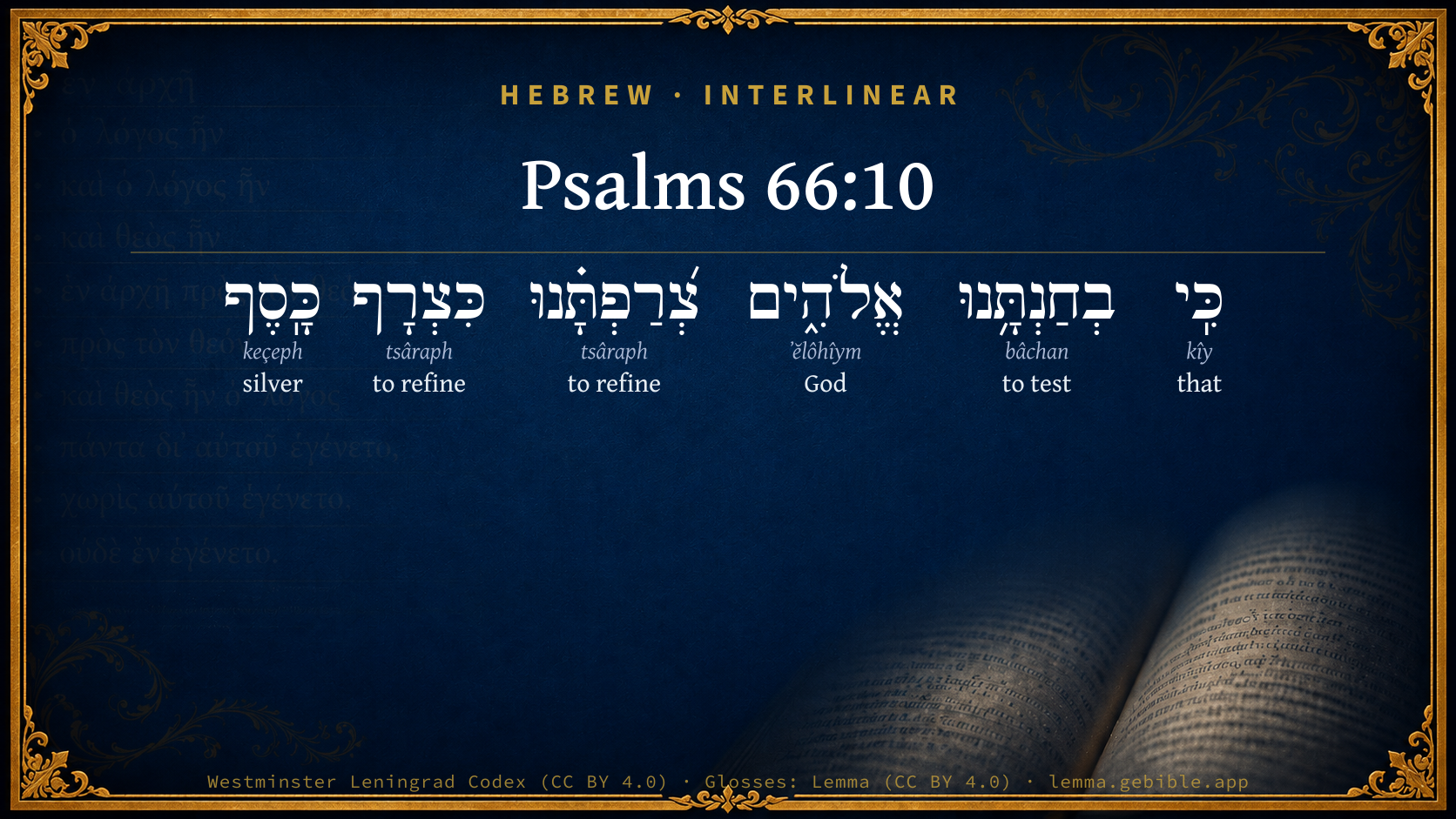
Hebrew (Westminster Leningrad Codex) Psalms 66:10 appears in the Hebrew Old Testament. The text above is from the Westminster Leningrad Codex. Each word links to its Strong’s number, a concise gloss, and parsing drawn from the Open Scriptures Hebrew Bible morphology. Click any word for its full Brown-Driver-Briggs (BDB) entry.
Download image
Cite this verse

Psalms 66:10 (World English Bible). Public Domain. Lemma interlinear Bible study tool, https://lemma.gebible.app/v/psalms/66/10.

Show BibTeX & RIS
BibTeX
RIS
English Translation
For you, God, have tested us. You have refined us, as silver is refined.
World English Bible · Public Domain
Download a study sheet

One document with this verse’s original text, its word-by-word gloss line, the meaning frame, cross-references with their text, attributed commentary, and full source and license credits — printable, and it pastes into notes with its structure intact.

This verse Autodidact and up

Study sheet (.html) Plain text (.txt)

A passage Seminary Student

Up to 50 verses in one chapter. A passage sheet keeps up to 6 commentary sources and 12 cross-references per verse, in the order this page ranks them, and says so on the sheet whenever that leaves anything out. Ask for a single verse and you get the Autodidact verse sheet above.

Everything on this page stays free to read, with no account — the sheet is a download of what is already on screen, not access to it.

Want to remove ads? Support Godless Engineer
Compare translations 3

The same verse in 3 English versions, stacked beneath the original-language interlinear above. Click any original word for its lexicon entry.

Each is an independent rendering of the whole verse — the interlinear is not word-aligned to these translations.

Highlighted words mark where these versions differ — a whole-verse word diff, not a word-by-word alignment.

  • World English Bible Public Domain
    For you, God, have tested us. You have refined us, as silver is refined.
  • King James Version Public Domain
    For thou, O God, hast proved us: thou hast tried us, as silver is tried.
  • unfoldingWord Literal Text CC BY-SA 4.0
    For you tested us, God; you refined us like the refining of silver.

unfoldingWord Literal Text — © unfoldingWord, licensed CC BY-SA 4.0. Word-aligned USFM3 via Door43 (git.door43.org/unfoldingWord/en_ult).

Versions to compare (up to 4)

3 of 4 selected

Show all 18 translations

Every available English version of this verse, each an independent rendering of the whole verse.

  • World English Bible Public Domain
    For you, God, have tested us. You have refined us, as silver is refined.
  • Berean Standard Bible Public Domain
    For You, O God, have tested us; You have refined us like silver.
  • Majority Standard Bible Public Domain
    For You, O God, have tested us; You have refined us like silver.
  • King James Version Public Domain
    For thou, O God, hast proved us: thou hast tried us, as silver is tried.
  • American Standard Version (1901) Public Domain
    For thou, O God, hast proved us: Thou hast tried us, as silver is tried.
  • Revised Version (1885) Public Domain
    For thou, O God, hast proved us: thou hast tried us, as silver is tried.
  • Geneva Bible (1599) Public Domain
    For thou, O God, hast proued vs, thou hast tryed vs as siluer is tryed.
  • Douay-Rheims (1899) Public Domain
    For thou, O God, hast proved us: thou hast tried us by fire, as silver is tried.
  • Young's Literal Translation Public Domain
    For Thou hast tried us, O God, Thou hast refined us as the refining of silver.
  • Literal Standard Version CC BY-SA 4.0
    For You have tried us, O God, || You have refined us as the refining of silver.
  • Unlocked Literal Bible CC BY-SA 4.0
    For you, God, have tested us; you have tested us as silver is tested.
  • unfoldingWord Literal Text CC BY-SA 4.0
    For you tested us, God; you refined us like the refining of silver.
  • Darby Bible Public Domain
    For thou, O God, hast proved us: thou hast tried us, as silver is tried.
  • World Messianic Bible Public Domain
    For you, God, have tested us. You have refined us, as silver is refined.
  • Webster's Bible Public Domain
    For thou, O God, hast proved us: thou hast tried us, as silver is tried.
  • Free Bible Version CC BY-SA 4.0
    God, you have tested us, refining us like silver.
  • Bible in Basic English Public Domain
    For you, O God, have put us to the test: testing us by fire like silver.
  • JPS Tanakh (1917) Public Domain
    For Thou, O God, hast tried us; Thou hast refined us, as silver is refined.

Literal Standard Version (2020), Covenant Press — licensed CC BY-SA 4.0. Text via the HelloAO Bible API (eBible.org). Unlocked Literal Bible (unfoldingWord) — licensed CC BY-SA 4.0. Text via the HelloAO Bible API (eBible.org). unfoldingWord Literal Text — © unfoldingWord, licensed CC BY-SA 4.0. Word-aligned USFM3 via Door43 (git.door43.org/unfoldingWord/en_ult). Free Bible Version, Dr. Jonathan Gallagher — licensed CC BY-SA 4.0. Text via the HelloAO Bible API (eBible.org).

Word by word

More ways to search: Search by grammar → Find every occurrence → Compare this word →

Practice this passage: Drill this verse → Learn its vocabulary →

About this verse

These counts appear in no published source. They are computed here, from the morphology-tagged text and Lemma’s own curated glosses. What Lemma adds →

6
words
5
distinct lemmas
Wisdom
section

Shared distinctive vocabulary

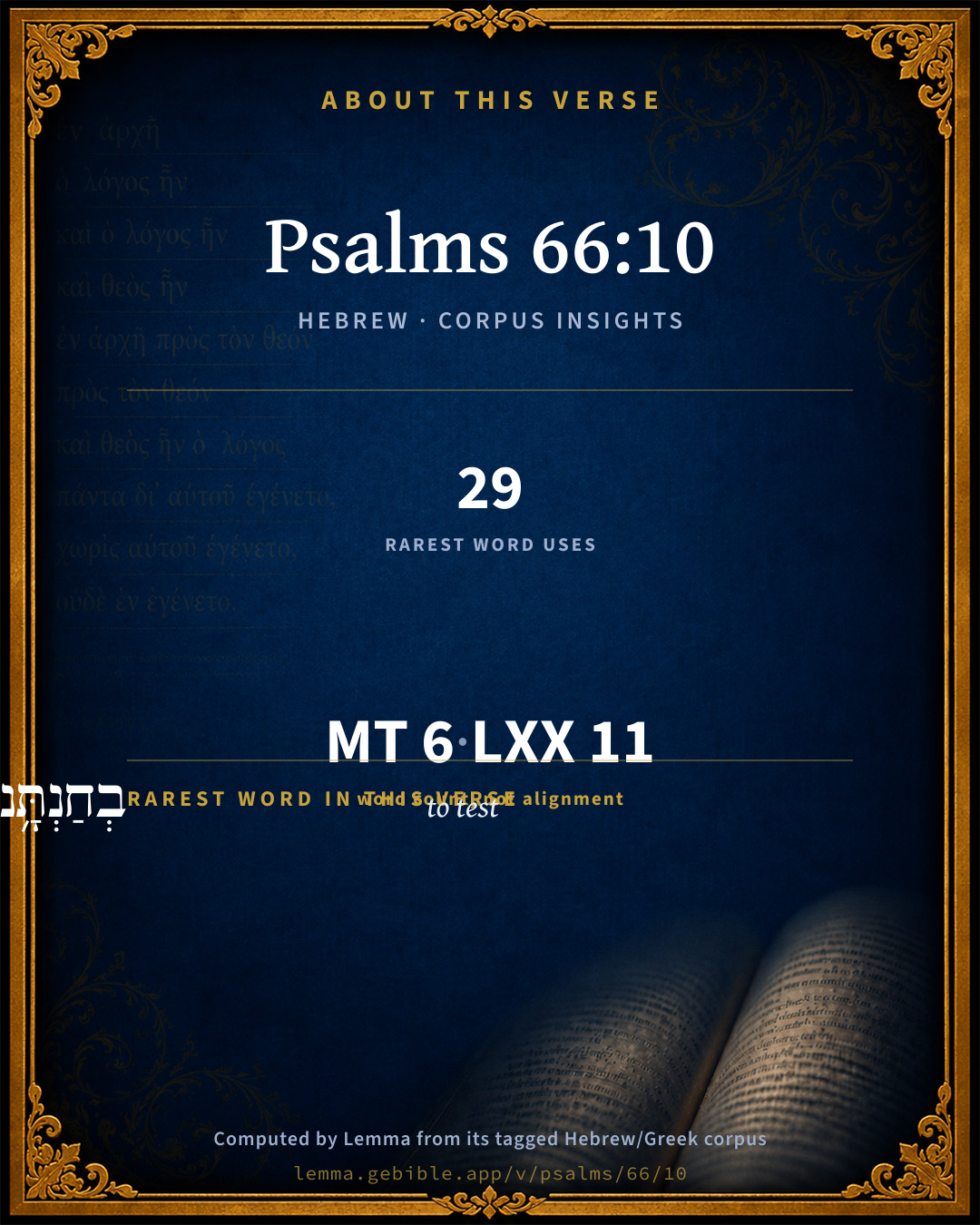
בְחַנְתָּ֥נוּ to test H974 occurs in 28 verses of the Hebrew Bible. Also found in:

Grammatical profile

  • 3 verbs
  • 2 nouns
  • 1 conjunction

Verb forms

  • בְחַנְתָּ֥נוּ Qal · Perfect
  • צְ֝רַפְתָּ֗נוּ Qal · Perfect
  • כִּצְרָף Qal · Infinitive Construct

Repetition

A word recurs within this verse — often emphatic in Hebrew:

  • צְ֝רַפְתָּ֗נוּ to refine H6884 ×2

Hebrew & Septuagint length

In English translation the verse runs 14 words from the Hebrew and 17 from the Septuagint (LXX English) — closely comparable.

A rough comparison of the two English renderings, which tokenize alike — not a word-level alignment.

Word counts can differ between the Hebrew and the Greek without any difference in meaning — e.g. the Hebrew direct-object marker אֵת has no separate Greek word, and Greek often adds the article ὁ.

In the original languages it is 6 Hebrew tokens and 11 Greek tokens — but the two are counted differently (Hebrew bundles its prefixes and suffixes into one token; the Greek is in lemma form), so that isn’t a like-for-like length.

Cross-references

9

Topical passages linked to Psalms 66:10 in the Treasury of Scripture Knowledge — connected by theme and wording, ordered by reader-vote popularity; previews shown in the World English Bible.

  • Isaiah 48:10 Behold, I have refined you, but not as silver; I have chosen you in the furnace of affliction.
  • Psalms 17:3 You have proved my heart; you have visited me in the night; You have tried me, and found nothing; I have resolved that my mouth shall not disobey.
  • 1 Peter 1:6–7 Wherein you greatly rejoice, though now for a little while, if need be, you have been put to grief in various trials,
  • Proverbs 17:3 The refining pot is for silver, and the furnace for gold, But Yahweh tests the hearts.
  • Job 23:10 But he knows the way that I take. When he has tried me, I shall come forth like gold.
  • Zechariah 13:9 I will bring the third part into the fire, And will refine them as silver is refined, And will test them like gold is tested. They will call on my name, and I will hear them. I will say, 'It is my people;' And they will say, 'Yahweh is my God.'"
  • Deuteronomy 8:2 You shall remember all the way which Yahweh your God has led you these forty years in the wilderness, that he might humble you, to prove you, to know what was in your heart, whether you would keep his commandments, or not.
  • Deuteronomy 8:16 who fed you in the wilderness with manna, which your fathers didn't know; that he might humble you, and that he might prove you, to do you good at your latter end:
  • Deuteronomy 13:3 you shall not listen to the words of that prophet, or to that dreamer of dreams: for Yahweh your God proves you, to know whether you love Yahweh your God with all your heart and with all your soul.

Cross-references courtesy of OpenBible.info (CC BY 4.0).

Hebrew and Greek witnesses Masoretic Hebrew ↔ Greek Septuagint

The same verse in the two great witnesses to the Old Testament, shown verse-for-verse.

You’re reading Greek Psalm 65 (Hebrew Psalm 66). The Septuagint counts the superscription, so verse numbers can differ from the Hebrew — chapter-level alignment, not verse-by-verse. Numbering follows Rahlfs.

These are two independent witnesses, not word-aligned to each other, and the Septuagint is shown in lemma (dictionary) form.

Hebrew Psalms 66:10 Masoretic · Westminster Leningrad Codex

כִּֽי בְחַנְתָּ֥נוּ אֱלֹהִ֑ים צְ֝רַפְתָּ֗נוּ כִּצְרָף כָּֽסֶף

For you, God, have tested us. You have refined us, as silver is refined.

World English Bible · Public Domain

Greek LXX Greek Psalm 65:10 Septuagint · lemma form

ὅτι δοκιμάζω ἐγώ ὁ θεός πυρόω ἐγώ ὡς πυρόω ὁ ἀργύριον

For you, O God, has proved us; you have tried us with fire as silver is tried.

LXX2012 (modern English Septuagint) · Public Domain

Hebrew: Westminster Leningrad Codex (CC BY 4.0). Greek: Septuagint (public domain); English from LXX2012 (modern English Septuagint) (Public Domain). How the Septuagint differs from the Hebrew →

Commentary

Notes on Psalms 66:10 from classic Christian and Jewish commentators (each source and its license shown beneath its notes). The classic Christian expositions comment on the surrounding passage and are grouped to its opening verse, so a note may address several verses; the Jewish commentaries on the Tanakh (Rashi and others) are per-verse, so they appear only where the commentator wrote on this verse.

Lemma curates 59 commentaries, every one of them public domain or Creative Commons licensed, each selected and text-cleaned for this edition rather than reprinted as found. About our sources →

Trapp's Complete Commentary

John Trapp

Psa 66:10 For thou, O God, hast proved us: thou hast tried us, as silver is tried.

Ver. 10. For thou, O God, hast proved us] Non ut ipse sciat sed ut scire nos faciat, saith Austin. God proveth his people, not thereby to better his own knowledge of them, Joh 2:25; Joh 6:6; Joh 21:17; Act 1:24, but to bring them to a better knowledge of their own both vices and graces. It is not known what corn will yield till it come to the flail; nor what grapes, till they come to the press. Grace is hid in nature, as sweet water in rose leaves; the fire of affliction fetcheth it out.

Thou hast tried us as silver] The wicked also are tried, Rev 3:10, but they prove reprobate silver, Jer 6:28; Jer 6:30, or, at best, as alchemy gold, that will not bear the seventh fire, as Job did, Job 23:10.

John Trapp, A Commentary or Exposition upon All the Books of the Old and New Testament (1647–1656) — public domain. Text from a community e-Sword module.

The Biblical Illustrator

Joseph S. Exell

Psa_66:10

For Thou, O God, hast proved us; Thou hast tried us, as silver is tried.

The souls purification by suffering

A most natural question--one asked by tried hearts in every age since the world began--is, Why, if there be a God, a merciful God, does He permit all these repeated and accumulated sufferings to afflict us? What are the Divine uses and purposes of sorrow? For we are compelled to admit that, if there be no ultimate design in and issue from sorrow, there is a fearful waste of tears and agony in the world. Some men have asked the question and received no satisfactory reply, and consequently have hastily and foolishly concluded, There is no God; there can be no God, or this could not have been. Even those who do believe in the existence of a merciful God, who do believe that He has the ordering and governance of all our lives, are yet confronted by the great mystery of suffering. They want an explanation; they want to know how it can all be reconciled with the existence and oversight of a merciful God. Thoughts like these are very old to most of us. How are they to be met? Well, I candidly confess that as yet the reason why God permits so much suffering in the world is wrapt in the same darkness as still surrounds that other mysterious question--Why has God permitted sin to enter into the world? There is no light; no effort of thought or imagination, no wide-reaching speculations have been able to solve the problem. But our text suggests several important thoughts.

I. The place of God in our trials--they may be sent by God. I say, may be sent, and thereby I mean to imply that all trials are not the effect of the immediate interposition of God. There are evils and sorrows which befall men which none would dare to say are of Gods sending, because it is evident that they are the fruit of wrong-doing. For instance, if a man has been extravagant and reckless, and has thus reduced himself to poverty, it would be a libel upon God if he were to declare that God had made him poor, since he only reaps the harvest of his own folly. There can, however, be no doubt, if we are to accept the testimony of Scripture, and to believe in the Fatherly providence of God, we must believe that He permits and sends affliction. We cannot, we dare not, forget that God has to do with us every day, and we cannot take any comfort in the cold conception that we have stern, unbending laws to deal with, and not the tender, compassionate heart of a loving Father. The human heart craves a personal and present God Then, further, if we can see Gods hand in our troubles, does it not make our troubles easier to bear?

II. The testing character of lifes trials. Men in their ordinary connections are constantly applying tests to prove the character and the ability of those with whom they have to do; seeking to discover whether there is weakness or strength, falsehood or truth. Creditors test their debtors, masters test their servants, parents test their children, and friends often prove by ingenious stratagems the faithfulness of friends. So the world, by persecutions, and flatteries, and snares, is always testing the Christian Church; demonstrating to its own superficial satisfaction the honesty or hollowness of the profession its members make. Every man having the courage to avow himself on the side of Christ is immediately put on trial by Iris relations and his neigh-bouts, who will entangle him in positions of temptation, simply to ascertain what his Christianity is worth. Little is taken on trust in this world, and we are never entirely content with any object or any pretension until it has undergone some fierce heat of trouble. Adversity is the great test. A cobweb is as good as the mightiest chain cable when there is no strain upon it. It is trial that proves one thing weak and another strong. This is true of our spiritual life, our professed faith.

III. The purifying power of lifes trials. The words, Thou hast tried us, as silver is tried, would express the thought here intended more clearly if read, Thou hast purified us, as silver is purified. (W. Braden.)

Tested for hardships

When Scoresby was selecting his men to accompany him in Arctic explorations, he needed sailors that could stand the severest exposure, and had nerve to bear the worst trials. So every man who applied to accompany the expedition was made to stand barefooted on a great block of ice while the surgeon examined his body and Scoresby inquired into his past history. Scores were rejected at once, as they had not nerve to endure the test. The men who stood the trial made up a band of brave heroes. So sometimes God tries us when He has in store for us some great undertaking. Many faint and excuse themselves from the start; some endure, and make the heroes and leaders of the Church,

The Biblical Illustrator, edited by Joseph S. Exell (c. 1880s–1900s) — public domain. Text from a community e-Sword module.

Joseph Benson's Commentary

Psa 66:10. For thou, O God, &c. — Or, nevertheless. Though thou hast hitherto helped us: and now delivered us, yet for a season thou hast sorely afflicted us; hast tried us as silver is tried — That is, severely, as if it were in a burning furnace; and with a design to try our sincerity, and to purge the dross out of our hearts, and the wicked from among us. Observe, reader, we are proved by afflictions, as silver in the fire, 1st, That our graces, by being tried, may be made more evident, and so we may be approved as silver is when it is marked sterling, which will be to our praise at the appearing of Jesus Christ, 1Pe 1:7. And, 2d, That our graces, by being exercised, may be made more strong and active, and so may be improved, as silver is when it is refined by the fire, and made more clear from its dross; and this will be to our unspeakable advantage, for thus shall we be made partakers of God’s holiness, Heb 12:10. Then are we likely to get good by our afflictions when we look upon them in this light; for then we see that they proceed from God’s mercy and love, and are intended for our honour and benefit. Public troubles, we must observe, are for the purifying of the church.

Joseph Benson's Commentary on the Old and New Testaments (1811–1818) — public domain. Text from a community e-Sword module.

J. A. Alexander on Psalms

Joseph Addison Alexander

10. (Psa 66:10) For thou hast tried us, O God, thou hast purged (or assayed) us like the purging of silver, as silver is purged, with particular reference, as some suppose, to the long-continued and repeated process of refinement necessary in the case of silver. See above, on Psa 12:6; Psa 26:2, and compare Isa 1:25; Isa 48:10, Zec 13:9, 1Pe 1:7. The general idea here is that of affliction, as a means both of trial and purgation, and is carried out in the following verses.

Joseph Addison Alexander, The Psalms Translated and Explained (1850) — public domain. Text from a community e-Sword module.

Tyndale Open Study Notes

Tyndale Open Resources

66:10 You have tested us, O God: As the silversmith heats silver to remove the dross, God’s discipline removes sin from his people (see 12:6).

Tyndale Open Study Notes — © Tyndale Open Resources, licensed CC BY-SA 4.0. Text via the HelloAO Bible API.

Jamieson, Fausset & Brown

Robert Jamieson, A. R. Fausset & David Brown

Out of severe trials, God had brought them to safety (compare Isa 48:10; Pe1 1:7).

Jamieson, Fausset & Brown — Commentary Critical and Explanatory on the Whole Bible (1871) — public domain (CC PDM 1.0). Text via the HelloAO Bible API.

Adam Clarke's Commentary

Verse 10. For thou, O God, hast proved us] This is a metaphor taken from melting and refining metals; afflictions and trials of various kinds are represented as a furnace where ore is melted, and a crucible where it is refined. And this metaphor is used especially to represent cases where there is doubt concerning the purity of the metal, the quantity of alloy, or even the nature or kind of metal subjected to the trial. So God is said to try the Israelites that he might know what was in them; and whether they would keep his testimonies: and then, according to the issue, his conduct towards them would appear to be founded on reason and justice.

Adam Clarke's Commentary on the Bible (1810–1826) — public domain. Text from a community e-Sword/MySword module.

John Calvin's Commentaries

10 For thou, O God! hast proved us We may read, Though thou, O God! etc., and then the passage comes in as a qualification of what went before, and is brought forward by the Psalmist to enhance the goodness of God, who had delivered them from such severe calamities. But there is another object which I consider him to have in view, and this is the alleviation of the grief of God’s people, by setting before them the comfort suggested by the words which follow. When visited with affliction, it is of great importance that we should consider it as coming from God, and as expressly intended for our good. It is in reference to this that the Psalmist speaks of their having been proved and tried. At the same time, while he adverts to God’s trying his children with the view of purging away their sin, as dross is expelled from the silver by fire, he would intimate, also, that trial had been made of their patience. The figure implies that their probation had been severe; for silver is cast repeatedly into the furnace. They express themselves thankful to God, that, while proved with affliction, they had not been destroyed by it; but that their affliction was both varied and very severe, appears not only from the metaphor, but from the whole context, where they speak of having been cast into the net, being reduced to straits, men riding over their heads, and of being brought through shipwreck and conflagration. The expression, laying a restraint [or chain] upon their loins, is introduced as being stronger than the one which goes before. It was not a net of thread which had been thrown over them, but rather they had been bound down with hard and insolvable fetters. The expression which follows refers to men who had shamefully tyrannised over them, and ridden them down as cattle. By fire and water are evidently meant complicated afflictions; and it is intimated that God had exercised his people with every form of calamity. They are the two elements which contribute more than any other to sustain human life, but are equally powerful for the destruction of it. It is noticeable, that the Psalmist speaks of all the cruelties which they had most unjustly suffered from the hands of their enemies, as an infliction of Divine punishment; and would guard the Lord’s people against imagining that God was ignorant of what they had endured, or distracted by other things from giving attention to it. In their condition, as here described, we have that of the Church generally represented to us; and this, that when subjected to vicissitudes, and cast out of the fire into the water, by a succession of trials, there may at last be felt to be nothing new or strange in the event to strike us with alarm. The Hebrew word רויה, revayah, which I have rendered fruitful place, means literally a well-watered land. Here it is taken metaphorically for a condition of prosperity, the people of God being represented as brought into a pleasant and fertile place, where there is abundance of pasturage. The truth conveyed is, that God, although he visit his children with temporary chastisements of a severe description, will ultimately crown them with joy and prosperity. It is a mistake to suppose that the allusion is entirely to their being settled in the land of Canaan, for the psalm has not merely reference to the troubles which they underwent in the wilderness, but to the whole series of distresses to which they were subjected at the different periods of their history.

John Calvin's Commentaries (1540-1563) — public domain. Text from the Calvin Translation Society English edition (1840s-50s) via the Christian Classics Ethereal Library (ccel.org). Calvin's coverage is partial (roughly two-thirds of the Bible); uncommented books and verses are honest gaps, never fabricated. The 19th-century editor's footnotes and remarks are omitted so the notes are faithfully Calvin's own voice.

The Cambridge Bible for Schools and Colleges

gen. ed. J. J. S. Perowne

10. proved us … tried us] Words used of testing precious metals, and smelting away the dross (Psa_17:3; Psa_26:2; Pro_17:3; Jer_9:7; Zec_13:9; Mal_3:2-3). God had declared His intention of smelting out the dross from His people by the Assyrian troubles (Isa_1:25).

The Cambridge Bible for Schools and Colleges (gen. ed. J. J. S. Perowne; Cambridge University Press, 1878–1918) — public domain. Text from a community e-Sword module.

John Gill's Exposition

For thou, O God, hast proved us,.... And by the experiment found them to be true and faithful; to have the truth of grace, and the root of the matter in them; not reprobate silver, or their grace counterfeit grace; but of the right kind, solid and substantial;

thou hast tried us as silver is tried; in a furnace, where it is put and melted by the refiner, and purified from the dross that attends it. So the Targum,

"thou hast purified us as the silversmith purifieth the silver;''

or tries it by melting and purifying it. Thus the Lord puts his people into the furnace of afflictions, and sits as a refiner and purifier of them; hereby he tries their graces, faith, patience, hope, and love, their principles and their professions; refines their graces, and makes them more bright and illustrious; removes their dross and tin, and reforms their manners; and proves them to be good silver, and approves of them, and esteems them as such, even as his peculiar treasure. From whence it appears, as well as from the following verses, that afflictions are of God; that they are for the good of his people, and not their hurt; like silver they are put into the fire of affliction, not to be destroyed and lost, but to be purged and refined; and that they are not in wrath, but in love: and this, with what follows, may respect the sufferings of the saints under Rome, Pagan and Papal; when Christ's feet, the members of his mystical body, were like unto fine brass, as if they burned in a furnace; when their graces were tried, their works were known, and their persons proved and approved, Rev 1:15; see Zac 13:9.

John Gill's Exposition of the Whole Bible (1746–1763) — public domain (CC PDM 1.0). Text via the HelloAO Bible API.

Albert Barnes' Notes on the Bible

For thou, O God, hast proved us - That is, Thou hast tried us; thou hast tested the reality of our attachment to thee, as silver is tried by the application of fire. God had proved or tried them by bringing calamity upon them to test the reality of their allegiance to him. The nature of the proof or trial is referred to in the following verses.

Thou hast tried us, as silver is tried - That is, by being subjected to appropriate tests to ascertain its real nature, and to remove from it imperfections. Compare the notes at 1Pe 1:7; notes at Isa 1:25; notes at Isa 48:10; see also Zec 13:9; Mal 3:3.

Albert Barnes' Notes on the Bible (1834–1885) — public domain. Text from a community e-Sword/MySword module.

Matthew Poole's English Annotations

For, or yet, or nevertheless. Though thou hast hitherto helped us, and now delivered us, yet for a season thou hast sorely afflicted us.

Tried us, as silver is tried, i.e. severely, as if it were in a burning furnace; and with a design to try our sincerity, and to purge out the dross, or the wicked, from among us.

Matthew Poole's English Annotations on the Holy Bible (1683–1685) — public domain. Text from a community e-Sword/MySword module.

The Treasury of David

Charles H. Spurgeon

Ver. 10. For thou, O God, hast proved us. He proved his Israel with sore trials. David had his temptations. All the saints must go to the proving house; God had one Son without sin, but he never had a son without trial. Why ought we to complain if we are subjected to the rule which is common to all the family, and from which so much benefit has flowed to them? The Lord himself proves us, who then shall raise a question as to the wisdom and the love which are displayed in the operation? The day may come when, as in this case, we shall make hymns out of our griefs, and sing all the more sweetly because our mouths have been purified with bitter draughts.

Thou hast tried us, as silver is tried. Searching and repeated, severe and thorough, has been the test; the same result has followed us as in the case of precious metal, for the dross and tin have been consumed, and the pure ore has been discovered. Since trial is sanctified to so desirable an end, ought we not to submit to it with abounding resignation.

Ver. 10. Thou, O God, hast proved us. It is not known what corn will yield, till it come to the flail; nor what grapes, till they come to the press. Grace is hid in nature, as sweet water in rose leaves; the fire of affliction fetcheth it out. --Thou hast tried us as silver. The wicked also are tried (Re 3:10), but they prove reprobate silver (Jer 6:28), or at best, as alchemy gold, that will not bear the seventh fire, as Job did (Job 23:10). John Trapp.

Ver. 10. As silver is tried. Convinced from the frequent use of this illustration, that there was something more than usually instructive in the process of assaying and purifying silver, I have collected some few facts upon the subject. The hackneyed story of the refiner seeing his image in the molten silver while in the fire, has so charmed most of us, that we have not looked further; yet, with more careful study, much could be brought out. To assay silver requires great personal care in the operator. "The principle of assaying gold and silver is very simple theoretically, but in practice great experience is necessary to insure accuracy; and there is no branch of business which demands more personal and undivided attention. The result is liable to the influence of so many contingencies, that no assayer who regards his reputation will delegate the principal process to one not equally skilled with himself. Besides the result ascertainable by weight, there are allowances and compensations to be made, which are known only to an experienced assayer, and if these were disregarded, as might be the case with the mere novice, the report would be wide from the truth." (Encyclopaedia Britannica.) Pagnini's version reads: "Thou hast melted us by blowing upon us, "and in the monuments of Egypt, artificers are seen with the blowpipe operating with small fire places, with cheeks to confine and reflect the heat; the worker evidently paying personal attention, which is evident also in Mal 3:3, "He shall sit as a refiner and purifier of silver." To assay silver requires a skilfully constructed furnace. The description of this furnace would only weary the reader, but it is evidently a work of art in itself. Even the trial of our faith is much more precious than that of gold which perisheth. He has refined us, but not with silver, he would not trust us there, the furnace of affliction is far more skilfully arranged than that. To assay silver the heat must be nicely regulated. "During the operation, the assayer's attention should be directed to the heat of the furnace, which must be neither too hot nor too cold: if too hot, minute portions of silver will be carried off with the lead, and so vitiate the assay; moreover, the pores of the cupel being more open, greater absorption will ensue, and there is liability to loss from that cause. One indication of an excess of heat in the furnace, is the rapid and perpendicular rising of the fumes to the ceiling of the muffle, the mode of checking and controlling which has been pointed out in the description of the improved furnace. When the fumes are observed to fall to the bottom of the muffle, the furnace is then too cold; and if left unaltered, it will be found that the cupellation has been imperfectly performed, and the silver will not have entirely freed itself from the base metals. (Encyclopaedia Britannica.) The assayer repeats his trying process. Usually two or more trials of the same piece are made, so that great accuracy may be secured. Seven times silver is said to be purified, and the saints through varied trials reach the promised rest." C. H. S.

Ver. 10. The assaying of the saints.

Ver. 10.

I. The design of the afflictions.

1. To prove them.

2. To reprove them. II. The illustration of that design. As silver, etc. III. The issue of the trial.

Psalms 66:11*

Charles H. Spurgeon's The Treasury of David (1869–1885) — public domain. Psalms only. Text from a community e-Sword/MySword module.

Whedon's Commentary on the Bible

Daniel D. Whedon

10. As silver is tried—Such figures indicate that the art of refining the precious metals was known to the Hebrews. The history of the tabernacle in the wilderness shows them to have been advanced in the art of metallurgy, which they had learned of the Egyptians. See Psa_12:6; Exodus 25.In the peninsula of Mount Sinai are still found numerous excavations of ancient Egyptian mines of iron and copper, also turquois and manganese, with shafts, vast slag heaps, ruins of smelting furnaces, dwellings, temples and hieroglyphics, dating anterior to, and at the time of, the exodus. In their oppressed condition it is not improbable that many of the Israelites worked in these mines. Moses led the people within a few miles of a principal colony of miners, (in Serabit el Khadim,) then evidently in full operation, “having most probably a considerable military establishment to preserve discipline, as the miners were chiefly selected from criminals and prisoners of war.”—PALMER’S Desert of the Exodus.

Daniel D. Whedon (gen. ed.), Commentary on the Old and New Testaments (1874–1909) — public domain. Text from a community e-Sword module.

The Pulpit Commentary

For thou, O God, hast proved us. The calamity bad been sent as a trial, to prove and purify. (comp. Psa_7:9 Psa_11:5) Thou hast tried us, as silver is tried. (comp. Psa_12:6 Pro_17:3 Pro_25:4 Isa_1:22, 25 48:10 Zec_13:9 Mal_3:3) Silver, according to ancient methods, required a prolonged process of refining before it could be pronounced pure. The calamity under which Israel had suffered had been of long duration.

The Pulpit Commentary (1880–1919), ed. H.D.M. Spence-Jones & Joseph S. Exell — public domain. Text from a community e-Sword module.

John Wesley's Explanatory Notes

Proved us - As it were in a burning furnace; and with a design to purge out our dross.

John Wesley, Explanatory Notes Upon the Whole Bible (1754–1765) — public domain. Text via the GEBible commentary corpus.

unfoldingWord translationNotes

Door43 World Missions Community

You brought us into a net

The writer speaks of God's punishment as if God had captured his people in a net. (See: Metaphor)

a net

a trap for a bird or an animal

you laid a heavy burden on our backs

The writer speaks of what the people have endured as having to carry heavy loads on their backs. (See: Metaphor)

You made people ride over our heads

This is a picture of being horribly defeated in battle. AT: "It is as if our enemies defeated us in battle and then drove their chariots over our fallen bodies" (See: Metaphor)

went through fire and water

God tested them with natural disasters like fires and floods. AT: "we suffered like people who suffer from fires and floods" (See: Metaphor and Merism)

spacious place

The writer speaks of the blessings that the people of Israel now have as if they had been brought into a wide open space where they are safe. AT: "open place where we are safe" (See: Metaphor)

translationWords

test

silver

burden

fire

water

unfoldingWord translationNotes — © Distant Shores Media and the Door43 World Missions Community, licensed CC BY-SA 4.0. Source: git.door43.org/Door43/en_tn.

Rashi

Rabbi Shlomo Yitzchaki (Rashi)

You tested us with distress in the exile.

You refined us to remove the dross from us when we repent before You, as they refine silver to remove its dross.

Rashi on the Tanakh — English translations: “The Judaica Press complete Tanach with Rashi, translated by A. J. Rosenberg” (CC BY 4.0); “Pentateuch with Rashi's commentary by M. Rosenbaum and A.M. Silbermann, 1929-1934” (public domain); “The Metsudah Tanach series, Lakewood, N.J” (CC BY 4.0); and “The Book of Joshua, Metsudah Publications, 1997” (CC BY 4.0). Text via Sefaria.

Lesson kit

Teaching starters — assembled from the data on this page, not authored interpretation. Every prompt links to the verse data it draws on. Edit before teaching.

Psalms, in the Wisdom, opens this verse with 6 words (5 distinct Hebrew lemmas). Its most distinctive word is bâchan (“to test”). A historical commentator’s framing appears above. Read the whole chapter for the surrounding context.

Discussion questions

  1. How does “to test” (bâchan) shape what this verse is saying?
  2. How does Genesis 42:15, which shares the word «to test», read alongside this verse?
  3. What does the repetition of “to refine” (2× in this one verse) do in this verse?
  4. The translations on this page render this verse differently — a whole-verse word diff, not a word-by-word alignment. What might account for the different wordings?
  5. «בְחַנְתָּ֥נוּ» is a Qal Perfect verb. How does that grammatical form shape the action described?
  6. Compare how Trapp's Complete Commentary and The Biblical Illustrator read this verse. Where do they agree or differ?

Things to notice

Reading settings

Reading text

Shown beneath each verse's original-language words.

Old Testament
Old Testament edition

Read the OT as the Masoretic Hebrew (MT) or the Greek Septuagint (LXX).

English shown for the Greek Septuagint (in the Hebrew ↔ Greek comparison).

Comparing translations? Open the Compare panel on any verse page to stack up to four side by side.