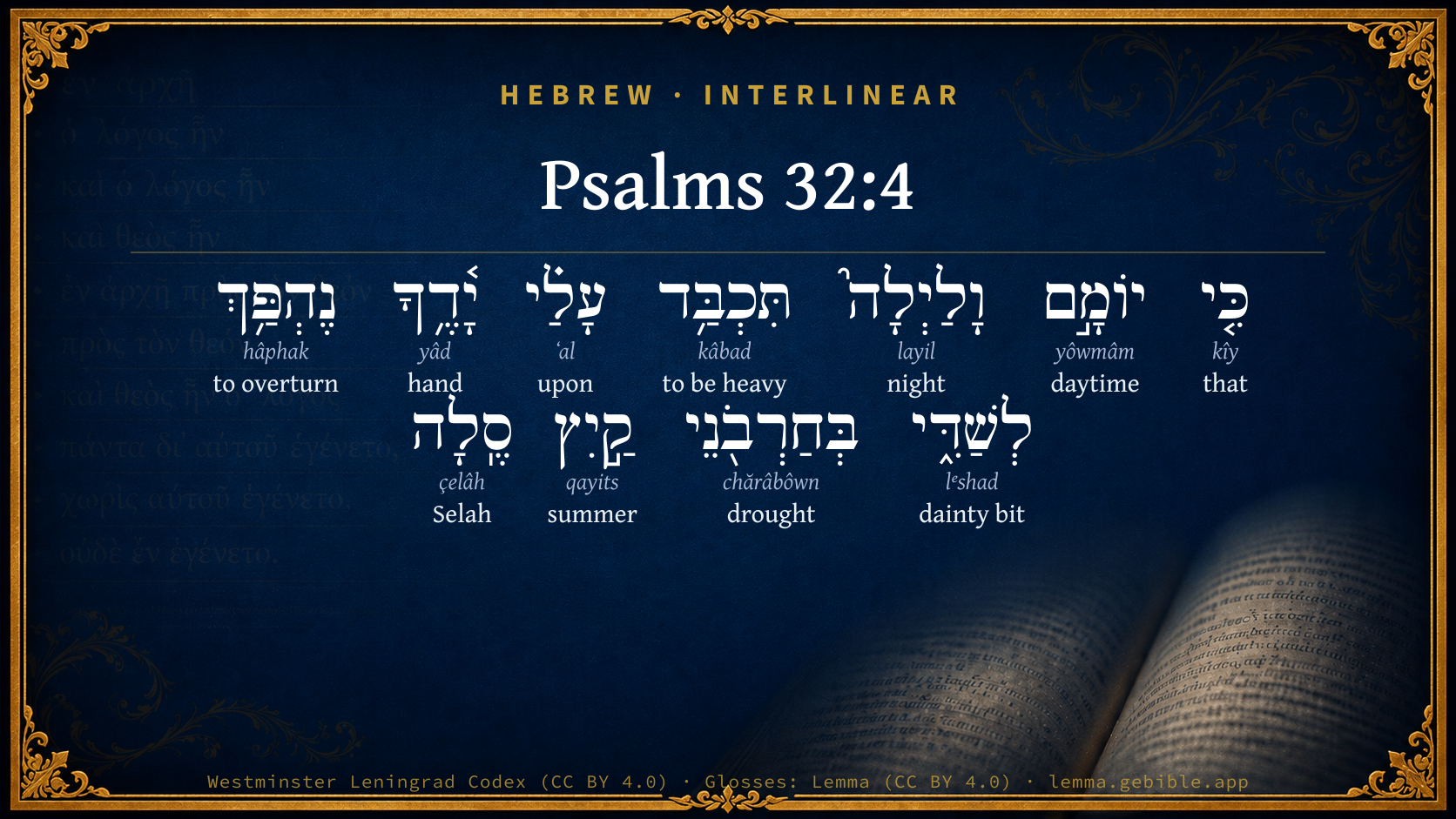
Psalms 32:4

Hebrew (Westminster Leningrad Codex) Psalms 32:4 appears in the Hebrew Old Testament. The text above is from the Westminster Leningrad Codex. Each word links to its Strong’s number, a concise gloss, and parsing drawn from the Open Scriptures Hebrew Bible morphology. Click any word for its full Brown-Driver-Briggs (BDB) entry.
Download image
Cite this verse

Psalms 32:4 (World English Bible). Public Domain. Lemma interlinear Bible study tool, https://lemma.gebible.app/v/psalms/32/4.

Show BibTeX & RIS
BibTeX
RIS
English Translation
For day and night your hand was heavy on me. My strength was sapped in the heat of summer. Selah.
World English Bible · Public Domain
Highlights
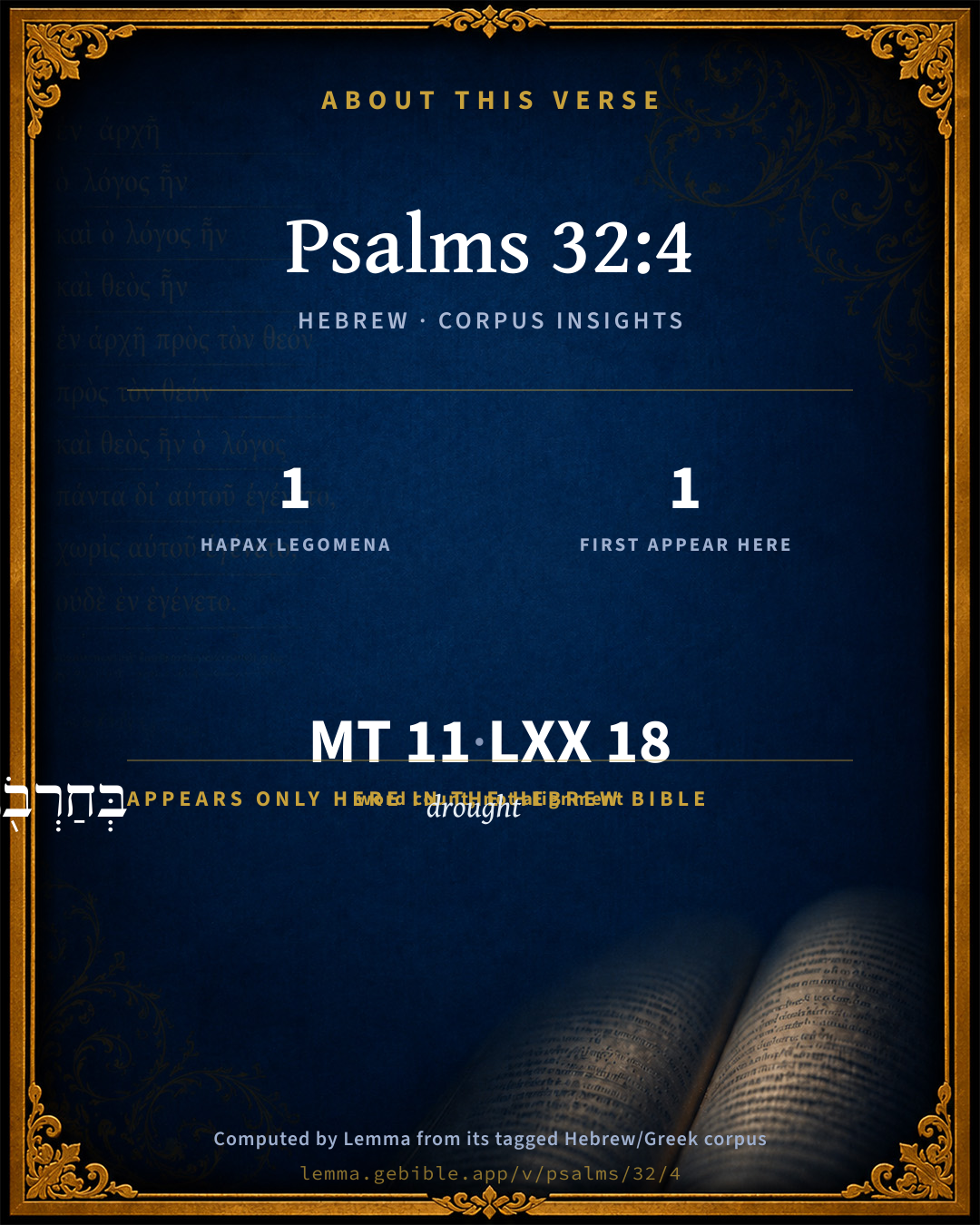
  • 1 hapax legomenon — only here in the Hebrew Bible
  • 1 first appearance in the Hebrew Bible
Full analysis ↓
Download a study sheet

One document with this verse’s original text, its word-by-word gloss line, the meaning frame, cross-references with their text, attributed commentary, and full source and license credits — printable, and it pastes into notes with its structure intact.

This verse Autodidact and up

Study sheet (.html) Plain text (.txt)

A passage Seminary Student

Up to 50 verses in one chapter. A passage sheet keeps up to 6 commentary sources and 12 cross-references per verse, in the order this page ranks them, and says so on the sheet whenever that leaves anything out. Ask for a single verse and you get the Autodidact verse sheet above.

Everything on this page stays free to read, with no account — the sheet is a download of what is already on screen, not access to it.

Want to remove ads? Support Godless Engineer
Compare translations 3

The same verse in 3 English versions, stacked beneath the original-language interlinear above. Click any original word for its lexicon entry.

Each is an independent rendering of the whole verse — the interlinear is not word-aligned to these translations.

Highlighted words mark where these versions differ — a whole-verse word diff, not a word-by-word alignment.

  • World English Bible Public Domain
    For day and night your hand was heavy on me. My strength was sapped in the heat of summer. Selah.
  • King James Version Public Domain
    For day and night thy hand was heavy upon me: my moisture is turned into the drought of summer. Selah.
  • unfoldingWord Literal Text CC BY-SA 4.0
    For by day and night your hand was heavy upon me. My vitality was changed by the heat of summer. Selah

unfoldingWord Literal Text — © unfoldingWord, licensed CC BY-SA 4.0. Word-aligned USFM3 via Door43 (git.door43.org/unfoldingWord/en_ult).

Versions to compare (up to 4)

3 of 4 selected

Show all 18 translations

Every available English version of this verse, each an independent rendering of the whole verse.

  • World English Bible Public Domain
    For day and night your hand was heavy on me. My strength was sapped in the heat of summer. Selah.
  • Berean Standard Bible Public Domain
    For day and night Your hand was heavy upon me; my strength was drained as in the summer heat. Selah
  • Majority Standard Bible Public Domain
    For day and night Your hand was heavy upon me; my strength was drained as in the summer heat. Selah
  • King James Version Public Domain
    For day and night thy hand was heavy upon me: my moisture is turned into the drought of summer. Selah.
  • American Standard Version (1901) Public Domain
    For day and night thy hand was heavy upon me: My moisture was changed `as' with the drought of summer. Selah
  • Revised Version (1885) Public Domain
    For day and night thy hand was heavy upon me: my moisture was changed as with the drought of summer. Selah
  • Geneva Bible (1599) Public Domain
    (For thine hand is heauie vpon me, day and night: and my moysture is turned into ye drought of summer. Selah)
  • Douay-Rheims (1899) Public Domain
    For day and night thy hand was heavy upon me: I am turned in my anguish, whilst the thorn is fastened.
  • Young's Literal Translation Public Domain
    When by day and by night Thy hand is heavy upon me, My moisture hath been changed Into the droughts of summer. Selah.
  • Literal Standard Version CC BY-SA 4.0
    When by day and by night Your hand is heavy on me, || My moisture has been changed || Into the droughts of summer. Selah.
  • Unlocked Literal Bible CC BY-SA 4.0
    For day and night your hand was heavy upon me. My strength withered as in summer drought. Selah
  • unfoldingWord Literal Text CC BY-SA 4.0
    For by day and night your hand was heavy upon me. My vitality was changed by the heat of summer. Selah
  • Darby Bible Public Domain
    For day and night thy hand was heavy upon me; my moisture was turned into the drought of summer. Selah.
  • World Messianic Bible Public Domain
    For day and night your hand was heavy on me. My strength was sapped in the heat of summer. Selah.
  • Webster's Bible Public Domain
    For day and night thy hand was heavy upon me: my moisture is turned into the drouth of summer. Selah.
  • Free Bible Version CC BY-SA 4.0
    You beat me day and night, my strength dried up as in the heat of summer. Selah.
  • Bible in Basic English Public Domain
    For the weight of your hand was on me day and night; my body became dry like the earth in summer. (Selah.)
  • JPS Tanakh (1917) Public Domain
    For day and night Thy hand was heavy upon me; my sap was turned as in the droughts of summer. Selah

Literal Standard Version (2020), Covenant Press — licensed CC BY-SA 4.0. Text via the HelloAO Bible API (eBible.org). Unlocked Literal Bible (unfoldingWord) — licensed CC BY-SA 4.0. Text via the HelloAO Bible API (eBible.org). unfoldingWord Literal Text — © unfoldingWord, licensed CC BY-SA 4.0. Word-aligned USFM3 via Door43 (git.door43.org/unfoldingWord/en_ult). Free Bible Version, Dr. Jonathan Gallagher — licensed CC BY-SA 4.0. Text via the HelloAO Bible API (eBible.org).

Word by word

More ways to search: Search by grammar → Find every occurrence → Compare this word →

Practice this passage: Drill this verse → Learn its vocabulary →

בְּחַרְבֹ֖נֵי
chărâbôwn
H2725
“in/at · droughts of”
Preposition + Noun, Common, Masculine, Plural, Construct
Part of Speech
Preposition + Noun
Type
Common
Gender
Masculine
Number
Plural
State
Construct
Full BDB Definition

Origin: from H2717

TWOT: 731f

drought
  1. כִּ֤י kîy H3588 “that” Conjunction
  2. יוֹמָ֣ם yôwmâm H3119 “daytime” Adverb
  3. וָלַיְלָה֮ layil H3915 “and · night” Conjunction + Noun, Common, Masculine, Singular, Absolute
  4. תִּכְבַּ֥ד kâbad H3513 “to be heavy” Verb, Qal, Imperfect, 3rd Person, Feminine, Singular
  5. עָלַ֗י ʻal H5921 “upon · me” Preposition + Suffix, Personal, 1st Person, Common, Singular
  6. יָ֫דֶ֥ךָ yâd H3027 “hand · your” Noun, Common, Both, Singular, Construct + Suffix, Personal, 2nd Person, Masculine, Singular
  7. נֶהְפַּ֥ךְ hâphak H2015 “to overturn” Verb, Niphal, Perfect, 3rd Person, Masculine, Singular
  8. לְשַׁדִּ֑י lᵉshad H3955 “dainty bit · my” Noun, Common, Masculine, Singular, Construct + Suffix, Personal, 1st Person, Common, Singular
  9. קַ֣יִץ qayits H7019 “summer” Noun, Common, Masculine, Singular, Absolute
  10. סֶֽלָה çelâh H5542 “Selah” Particle, Interjection

About this verse

These counts appear in no published source. They are computed here, from the morphology-tagged text and Lemma’s own curated glosses. What Lemma adds →

11
words
11
distinct lemmas
Wisdom
section

Notable vocabulary

1 hapax legomenon — a word that appears only here in the entire Hebrew Bible:

  • בְּחַרְבֹ֖נֵי drought H2725

First appearance in Scripture

This word makes its first canonical appearance in the Hebrew Bible here:

  • בְּחַרְבֹ֖נֵי drought H2725

Shared distinctive vocabulary

לְשַׁדִּ֑י dainty bit H3955 occurs in 2 verses of the Hebrew Bible. Also found in:

Grammatical profile

  • 2 verbs
  • 5 nouns
  • 1 preposition
  • 1 conjunction
  • 1 adverb
  • 1 particle

Verb forms

  • תִּכְבַּ֥ד Qal · Imperfect
  • נֶהְפַּ֥ךְ Niphal · Perfect

Hebrew & Septuagint length

In English translation the verse runs 20 words from the Hebrew and 22 from the Septuagint (LXX English) — closely comparable.

A rough comparison of the two English renderings, which tokenize alike — not a word-level alignment.

Word counts can differ between the Hebrew and the Greek without any difference in meaning — e.g. the Hebrew direct-object marker אֵת has no separate Greek word, and Greek often adds the article ὁ.

In the original languages it is 11 Hebrew tokens and 18 Greek tokens — but the two are counted differently (Hebrew bundles its prefixes and suffixes into one token; the Greek is in lemma form), so that isn’t a like-for-like length.

Cross-references

14

Topical passages linked to Psalms 32:4 in the Treasury of Scripture Knowledge — connected by theme and wording, ordered by reader-vote popularity; previews shown in the World English Bible.

  • 1 Samuel 5:11 They sent therefore and gathered together all the lords of the Philistines, and they said, Send away the ark of the God of Israel, and let it go again to its own place, that it not kill us and our people. For there was a deadly confusion throughout all the city; the hand of God was very heavy there.
  • Psalms 38:2–8 For your arrows have pierced me, Your hand presses hard on me.
  • Job 33:7 Behold, my terror shall not make you afraid, Neither shall my pressure be heavy on you.
  • Psalms 39:10–11 Remove your scourge away from me. I am overcome by the blow of your hand.
  • Psalms 22:15 My strength is dried up like a potsherd. My tongue sticks to the roof of my mouth. You have brought me into the dust of death.
  • Psalms 90:6–7 In the morning it sprouts and springs up. By evening, it is withered and dry.
  • Psalms 102:3–4 For my days consume away like smoke. My bones are burned as a firebrand.
  • 1 Samuel 5:6–7 But the hand of Yahweh was heavy on them of Ashdod, and he destroyed them, and struck them with tumors, even Ashdod and the borders of it.
  • 1 Samuel 6:9 Behold; if it goes up by the way of its own border to Beth-shemesh, then he has done us this great evil: but if not, then we shall know that it is not his hand that struck us; it was a chance that happened to us."
  • Job 16:21 That he would maintain the right of a man with God, Of a son of man with his neighbor!
  • Job 30:30 My skin grows black and peels from me. My bones are burned with heat.
  • Lamentations 4:8 Their visage is blacker than a coal; they are not known in the streets: Their skin cleaves to their bones; it is withered, it is become like a stick.
  • Lamentations 5:10 Our skin is black like an oven, Because of the burning heat of famine.
  • 1 Samuel 5:9 It was so, that after they had carried it about, the hand of Yahweh was against the city with a very great confusion: and he struck the men of the city, both small and great; and tumors broke out on them.

Cross-references courtesy of OpenBible.info (CC BY 4.0).

Hebrew and Greek witnesses Masoretic Hebrew ↔ Greek Septuagint

The same verse in the two great witnesses to the Old Testament, shown verse-for-verse.

You’re reading Greek Psalm 31 (Hebrew Psalm 32). The Septuagint counts the superscription, so verse numbers can differ from the Hebrew — chapter-level alignment, not verse-by-verse. Numbering follows Rahlfs.

These are two independent witnesses, not word-aligned to each other, and the Septuagint is shown in lemma (dictionary) form.

Hebrew Psalms 32:4 Masoretic · Westminster Leningrad Codex

כִּ֤י יוֹמָ֣ם וָלַיְלָה֮ תִּכְבַּ֥ד עָלַ֗י יָ֫דֶ֥ךָ נֶהְפַּ֥ךְ לְשַׁדִּ֑י בְּחַרְבֹ֖נֵי קַ֣יִץ סֶֽלָה

For day and night your hand was heavy on me. My strength was sapped in the heat of summer. Selah.

World English Bible · Public Domain

Greek LXX Greek Psalm 31:4 Septuagint · lemma form

ὅτι ἡμέρα καί νύξ βαρύνω ἐπί ἐγώ ὁ χείρ σύ στρέφω εἰς ταλαιπωρία ἐν ὁ ἐνπήγνυμι ἄκανθα διάψαλμα

For day and night your hand was heavy upon me: I became thoroughly miserable while a thorn was fastened in me. Pause.

LXX2012 (modern English Septuagint) · Public Domain

On this verse, Ellicott's Commentary for English Readers discusses the Septuagint’s reading. Read the note in Commentary ↓

Hebrew: Westminster Leningrad Codex (CC BY 4.0). Greek: Septuagint (public domain); English from LXX2012 (modern English Septuagint) (Public Domain). How the Septuagint differs from the Hebrew →

Commentary

Notes on Psalms 32:4 from classic Christian and Jewish commentators (each source and its license shown beneath its notes). The classic Christian expositions comment on the surrounding passage and are grouped to its opening verse, so a note may address several verses; the Jewish commentaries on the Tanakh (Rashi and others) are per-verse, so they appear only where the commentator wrote on this verse.

Lemma curates 59 commentaries, every one of them public domain or Creative Commons licensed, each selected and text-cleaned for this edition rather than reprinted as found. About our sources →

Trapp's Complete Commentary

John Trapp

Psa 32:4 For day and night thy hand was heavy upon me: my moisture is turned into the drought of summer. Selah.

Ver. 4. For day and night thy hand was heavy upon me] See what God can do when once he taketh a man to do. Day and night he had sinned against God; therefore day and night he suffereth; and glad he may be that he so escapeth, and is not forced to undergo an eternity of extremity. Some think that this psalm and the sixth were made much about a time, when David was recently recovered of some grievous fit of sickness. It may be meant only of his inward terrors, or chiefly, at least; his body suffering by sympathy, as having shared in his sin.

My moisture is turned into the drought of summer] My natural radical moisture, the oil that maintaineth the lamp of life, is dried up and become like a lump of clay; the vigour also and verdure of my soul is quelled and consumed with the fire of thy fierce wrath. God will bring his best people to this if they put him to it; that they shall find it to be the greatest folly in the world to buy the sweetest sin at so dear a rate.

Selah] I speak it feelingly. O quantum tormentum, &c. O aridum et exhaustum me prae maestitia, &c., O my pitiful condition! (Vatablus).

John Trapp, A Commentary or Exposition upon All the Books of the Old and New Testament (1647–1656) — public domain. Text from a community e-Sword module.

The Biblical Illustrator

Joseph S. Exell

Psa_32:4

Day and night Thy hand was heavy upon me.

Premens gravissima

Premes gravissima. Sublevans suavissima et potentissima. So wrote one of our shrewdest commentators about the hand of which the psalmist speaks, in words which may be freely translated, The hand of God, whilst pressing very hard, supports with utmost tenderness and almighty power.

I. creation. How beautifully are the two sides illustrated here. Tim schoolboy can tell us how the atmosphere is weighing upon the slenderest object on the earths surface with a constant pressure of many pounds to each square inch. The hand seen as premeds gravissima. Yet the dewdrop is not shattered, nor the harebell bruised, since the same hand is also sublevans suavissima et potentissima. Again, whilst with irresistible force all things are being dragged towards the earths centre, the insect with its gauzy wings poises itself in the liquid air, and the tiny child is unhindered in his play.

II. providence. Whatever page of history we study the same facts meet us,--on the one hand discipline and chastisement, disappointment, sorrow, pain, loss--the hand in ten thousand ways premens gravissima; on the other, the reaping of a compensating harvest of happy results, the hand sublevans susvissima et potentissima. Hers tribulation and anguish, there prosperity and peace; nations and individuals groaning beneath the weight of calamity, then led out into a wealthy place.

III. redemption. By redemption we mean the great process in all its parts by which the Father of Spirits is recovering man from spiritual ruin. Go back to the Fall. In the stern sentence passed on the first sinners, what do we see but the hand premens? in the primal promise what but the same hand sublevans? And in all that wonderful training, covering so many centuries and conducted in ways so surprising, by which the conscience of man was made alive to the guilt of sin--in all the work done by law--are we not looking at the hand of God as it descends upon the sinner, and makes him groan beneath the intolerable burden, as the psalmist did when his bones waxed old through his roaring all the day long, and his moisture was turned into the drought of summer? And does not that hand become more and more visible as sublevans suavissima et poten-tissima, as mercy streams across the midnight sky in an ever-brightening track of blessed light, prophetic of the full glory of the dawn? (T. G. Rose.)

Gods hand

I. all afflictions are Gods hand.

1. They are from Gods hand purposing and ordaining them (Rom_8:29; 1Th_3:3).

2. They are from Gods hand executing them (Isa_45:7; Gen_45:8; Job_1:21; 2Sa_16:11; Hos_6:1).

3. They are from Gods hand ordering and disposing them.

(1) In their causes, circumstances, kinds, manner, measure, and time of their beginning and ending.

(2) In their ends and issues, His own glory, in manifesting His mercy, justice, wisdom, power, etc. The everlasting salvation of His children. He stops them in their course of sin, as with a hedge of thorns (Hos_2:6), that they should not break over into the pleasant pastures of sin, therein to be fatted to the slaughter. He brings them to a true hatred of sin, when they taste the bitter fruit of it. To the exercise of mortification, and desire of heaven and heavenly things: and thus they are judged of the Lord, that they may not be condemned with the world.

II. God lays his hand heavily often upon his own dear children.

1. There is deep corruption lurking in the best, who not seldom are cast upon so deep a sleep of security that they cannot be wakened with a little shaking, till by most grievous afflictions the Lord break their bones, consume their strength, and bring them into such grief and pain as sets them roaring.

2. Smaller troubles have often a smaller work. Small things cannot make great hearts stoop; a small fire will not purge away dross from gold, but it must be quick and piercing; a small wind doth not fan away the chaff of vanity, a small correction or smart makes the child more froward, till sounder correction subdue him; small trials do not so exercise faith, nor send men out of themselves to God: for as none for the scratch of a pin, or a little headache, will seek to the physician or surgeon; so a sinner in smaller grievances of the soul will scarce think he needs go to God (Job_33:14).

3. The greater the affliction is, the more odious doth sin appear to be unto God; a strong poison must have a strong antidote: the more the godly are stricken down for sin, the more are they stirred up to godly sorrow, to hatred of it, to zeal against it, the better and more watchful do they prevent sin to come, and look better to themselves: as a good physician oftentimes letteth blood, not to make a man sick, but to prevent sickness.

4. The greater the trial is, the better experience have they of themselves.

5. Gods children have great afflictions, and are pressed with an heavy hand, that God Himself may be clearly seen to be their deliverer, when in the eyes of all flesh they are lost.

6. As great afflictions make way for abundant mercy from God to us, so also for abundant thanks from us to God. If one cure a trifling matter, it neither so binds the patient, nor yet commends the physician: but if any be cured of some deadly, and almost incurable disease, then we profess we could never have met with such a physician in all the world again, and we are accordingly thankful.

7. Were it not for great afflictions, we could never know the power of Gods Word in quickening us, cheering and comforting us in them, that it is the Word of Life, is most evidently seen in Death itself.

III. God lays his heavy hand upon his children a long time, and with much continuance.

1. Sometimes Gods children in their falls harden their hearts, and grow stiff in their sin, which was Davids case here, and then the Lord hardeneth Himself to grow stiff in displeasure. Oftentimes Gods children would sit silent, if the Lord would be as silent as they: but whom He loves, He will bring back the way that they are gone, and great hearts will not stoop for a little.

2. Christ hath not taken away the lingering of trials, but the malignity and poison of them; yea, Himself through all His life was a man full of sorrows; and we must not look to be better; He deserved them not, we have.

3. God would have us in the continuance of our trouble, to see the continuance of our sin; were our correction always short, we would not be persuaded of the greatness of our sins: plasters use to continue, and not fall off till the wound be cured.; and if a right use of afflictions were attained once, a joyful issue would soon follow: but some lust is not denied, and that adds a sting unto them.

4. God by the continuance of His hand would hold us in a continual exercise of grace, as of humility, faith, patience, prayer, repentance, etc., it being with a godly man, as one that hath a precious jewel, which he is careful to keep in his hand, so long as he watcheth, none can get it from him; but when he sleeps or slumbers, his hand opens, and it falls out, any man may have it. By continual blowing, the fire is kept in, but it dies by discontinuance. (T. Taylor, D. D.)

The Biblical Illustrator, edited by Joseph S. Exell (c. 1880s–1900s) — public domain. Text from a community e-Sword module.

The Treasury of David

Charles H. Spurgeon

Ver. 4. For day and night thy hand was heavy upon me. God's finger can crush uswhat must his hand be, and that pressing heavily and continuously! Under terrors of conscience, men have little rest by night, for the grim thoughts of the day dog them to their chambers and haunt their dreams, or else they lie awake in a cold sweat of dread. God's hand is very helpful when it uplifts, but it is awful when it presses down: better a world on the shoulder, like Atlas, than God's hand on the heart, like David. My moisture is turned into the drought of summer. The sap of his soul was dried, and the body through sympathy appeared to be bereft of its needful fluids. The oil was almost gone from the lamp of life, and the flame flickered as though it would soon expire. Unconfessed transgression, like a fierce poison, dried up the fountain of the man's strength and made him like a tree blasted by the lightning, or a plant withered by the scorching heat of a tropical sun. Alas! for a poor soul when it has learned its sin but forgets its Saviour, it goes hard with it indeed. Selah. It was time to change the tune, for the notes are very low in the scale, and with such hard usage, the strings of the harp are out of order: the next verse will surely be set to another key, or will rehearse a more joyful subject.

Ver. 4. Thy hand. A correcting hand, whereby God scourges and buffets his own children. Now the sense of God's power punishing or correcting, is called God's hand, as 1Sa 5:11. The hand of God was sore at Ekron, because of the ark; and a heavy hand in resemblance, because when men smite they lay their hand heavier than ordinary. Hence, we may note three points of doctrine: first, that all afflictions are God's hand; secondly, that God lays his hand heavily often upon his dear children; thirdly, that God often continues his heavy hand night and day on them. Thomas Taylor.

Ver. 4. My moisture is turned into the drought of summer. Another meaning may be attributed to these words. We may suppose the psalmist to be referring to spiritual drought. Charles H. Bingham, B.A., in "Lectures on the Thirty-second Psalm, "1836.

Ver. 4. My moisture is turned into the drought of summer. The summer is from the middle of August to the middle of November. The intensity of the heat is great, and almost intolerable...Up to the beginning or middle of September there are no showers, rain being as scarce in summer as snow...The dry grass of the fields sometimes takes fire, and produces desolating conflagrations, and the parched earth is cleft and broken into chasms. John Eadie, D.D., LL.D., in Biblical Cyclopaedia, 1868.

Ver. 4. The drought of summer. Dr. Russell, in his account of the weather at Aleppo, which very much resembles that of Judea, says that the verdure of the spring fades before the middle of May, and before the end of that month the whole country puts on so parched and barren an aspect that one would scarce think it capable of producing anything, there being but very few plants that have vigour enough to resist the extreme heat. Thomas Harmer's "Observations, "1775.

Ver. 4. The drought of summer. During the twelve years from 1846 to 1859 only two slight showers fell in Jerusalem between the months of May and October. One fell in July, 1858, another in June 1859. Dr. Whitty's "Water Supply of Jerusalem, "quoted in Kitto's Cyclopaedia.

Ver. 4. If God striketh those so sore whom he favoureth, how sharply and sore will he strike them whom he favoureth not. Gregory.

Ver. 4-5. If our offences have been not gnats, but camels, our sorrow must be not a drop, but an ocean. Scarlet sins call for bloody tears; and if Peter sin heinously he must weep bitterly. If, then, thy former life hath been a cord of iniquity, twisted with many threads, a writing full of great blots, a course spotted with various and grievous sins, multiply thy confessions and enlarge thy humiliation; double thy fastings and treble thy prayers; pour out thy tears, and fetch deep sighs; in a word, iterate and aggravate thy acknowledgments, though yet, as the apostle saith in another case, I say in this, "Grieve not as without hope, "that upon thy sincere and suitable repentance divine goodness will forgive thee thy sins. Nathanael Hardy.

Ver. 4. The sorrows of a convinced soul. Daily, nightly, from God, heavy, weakening, destroying.

Ver. 4. (last clause) Spiritual drought.

Psalms 32:5*

Ver. 4-5. See Psalms on "Ps 32:4" for further information.

Charles H. Spurgeon's The Treasury of David (1869–1885) — public domain. Psalms only. Text from a community e-Sword/MySword module.

J. A. Alexander on Psalms

Joseph Addison Alexander

4. (Psa 32:4) For day and night thy hand weighs upon me; changed is my moisture in (or into) droughts of summer. Selah. The for at the beginning shows the connection of this verse with that before it, as assigning the cause of the decay there mentioned. "My bones waxed old because thy hand," etc.—The future in the first clause cannot, without arbitrary violence, be taken as a preterite. It seems to have been used for the purpose of describ- ing his condition as it seemed to him at the time, when the hand of God not only weighed upon him but seemed likely still to do so. See above, on Ps. xviii. 17 (16). The word translated moisture, i. e. vital juice, analogous to the sap of plants, is so explained from an Arabic analogy; but some think this sense inappropriate in the only other case where the Hebrew word occurs (Num. xi. 8), and infer from Ps. cii. 5 (4), that it is an un- usual expression for the heart. His inward agonies are represented as intense and parching heats.

Joseph Addison Alexander, The Psalms Translated and Explained (1850) — public domain. Text from a community e-Sword module.

Tyndale Open Study Notes

Tyndale Open Resources

32:4 The psalmist attributes his suffering directly to the Lord’s hand of discipline (cp. 38:2; 39:10).

Tyndale Open Study Notes — © Tyndale Open Resources, licensed CC BY-SA 4.0. Text via the HelloAO Bible API.

Jamieson, Fausset & Brown

Robert Jamieson, A. R. Fausset & David Brown

thy hand--of God, or power in distressing him (Psa 38:2).

moisture--vital juices of the body, the parching heat of which expresses the anguish of the soul. On the other figures, compare Psa 6:2, Psa 6:7; Psa 31:9-11. If composed on the occasion of the fifty-first Psalm, this distress may have been protracted for several months.

Jamieson, Fausset & Brown — Commentary Critical and Explanatory on the Whole Bible (1871) — public domain (CC PDM 1.0). Text via the HelloAO Bible API.

John Calvin's Commentaries

4. For day and night thy hand was heavy upon me. In this verse he explains more fully whence such heavy grief arose; namely, because he felt the hand of God to be sore against him. The greatest of all afflictions is to be so heavily pressed with the hand of God, that the sinner feels he has to do with a Judge whose indignation and severity involve in them many deaths, besides eternal death. David, accordingly, complains that his moisture was dried up, not merely from simply meditating on his sore afflictions, but because he had discovered their cause and spring. The whole strength of men fails when God appears as a Judge and humbles and lays them prostrate by exhibiting the signs of his displeasure. Then is fulfilled the saying of Isaiah,

“The grass withereth, the flower fadeth, because the Spirit of the Lord bloweth upon it.” (Isaiah 40:7)

The Psalmist, moreover, tells us, that it was no common chastisement by which he had been taught truly to fear the divine wrath; for the hand of the Lord ceased not to be heavy upon him both day and night. From a child, indeed, he had been inspired with the fear of God, by the secret influence of the Holy Spirit, and had been taught in true religion and godliness by sound doctrine and instruction. And yet so insufficient was this instruction for his attainment of this wisdom, that he had to be taught again like a new beginner in the very midst of his course. Yea, although he had now been long accustomed to mourn over his sins, he was every day anew reduced to this exercise, which teaches us, how long it is ere men recover themselves when once they have fallen; and also how slow they are to obey until God, from time to time, redouble their stripes, and increase them from day to day. Should any one ask concerning David, whether he had become callous under the stripes which he well knew were inflicted on him by the hand of God, the context furnishes the answer; namely, that he was kept down and fettered by perplexing griefs, and distracted with lingering torments, until he was well subdued and made meek, which is the first sign of seeking a remedy. And this again teaches us, that it is not without cause that the chastisements by which God seems to deal cruelly with us are repeated, and his hand made heavy against us, until our fierce pride, which we know to be un-tameable, unless subdued with the heaviest stripes, is humbled.

John Calvin's Commentaries (1540-1563) — public domain. Text from the Calvin Translation Society English edition (1840s-50s) via the Christian Classics Ethereal Library (ccel.org). Calvin's coverage is partial (roughly two-thirds of the Bible); uncommented books and verses are honest gaps, never fabricated. The 19th-century editor's footnotes and remarks are omitted so the notes are faithfully Calvin's own voice.

Ellicott's Commentary for English Readers

(4) Thy hand was heavy.—The verb, as in “kept silence” in Psa_32:3, is properly present—the agony is still vividly present.

My moisture.—The Hebrew word is found only once besides (Num_11:8), where the Authorised Version has “fresh oil;” the LXX. and Vulg., “an oily cake.” Aquila has “of the breast of oil,” reading the word erroneously. Here both LXX. and Vulg. seem to have had a different reading, “I was turned to sorrow while the thorn was fixed in.” Symmachus translates somewhat similarly, but by “to destruction” instead of “to sorrow.” Aquila, “to my spoiling in summer desolation.” These readings, however, mistake the lamed, which is part of the word, for a preposition. Gesenius connects with an Arabic root, to suck, and so gets the meaning juice or moisture.

Into the drought of summer.—This is the best rendering of the Hebrew, though it might be either “as in summer dryness” or “with summer heat.” Some understand literally a fever, but it is better to take it figuratively of the soul-fever which the whole passage describes.

A Bible Commentary for English Readers, edited by Charles John Ellicott (1878–1897) — public domain. Text from a community e-Sword module.

John Gill's Exposition

For day and night thy hand was heavy upon me,.... Meaning the afflicting hand of God, which is not joyous, but grievous, and heavy to be borne; especially without his gracious presence, and the discoveries of his love: this continued night and day, without any intermission; and may design some violent distemper; perhaps a fever; since it follows,

my moisture is turned into the drought of summer. That is, the radical moisture in him was almost dried up, as brooks in the summer season; his body was parched, as it were, with the burning heat of the disease; or with an apprehension of the wrath of God under it, or both: and so he continued until be was brought to a true sense of sin, and an acknowledgment of it, when he had the discoveries of pardoning love, as is expressed in Psa 32:5. The Septuagint and Vulgate Latin versions read, "I am turned into distress, through a thorn being fixed"; and so Apollinarius paraphrases the words,

"I am become miserable, because thorns are fixed in my skin;''

reading for and which Suidas (o) interprets "sin", that being like the thorn, unfruitful and pricking; see Co2 12:7.

Selah; on this word; see Gill on Psa 3:2.

(o) In voce

John Gill's Exposition of the Whole Bible (1746–1763) — public domain (CC PDM 1.0). Text via the HelloAO Bible API.

Albert Barnes' Notes on the Bible

For day and night - I found no relief even at night. The burden was constant, and was insupportable.

Thy hand was heavy upon me - Thy hand seemed to press me down. It weighed upon me. See Job 13:21; Psa 39:10. It was the remembrance of guilt that troubled him, but that seemed to him to be the hand of God. It was God who brought that guilt to his recollection; and God “kept” the recollection of it before his mind, and on his heart and conscience, so that he could not throw it off.

My moisture - The word used here - לשׁד leshad - means properly “juice” or “sap,” as in a tree; and then, “vital-moisture,” or, as we should say, “life-blood.” Then it comes to denote vigour or strength.

Is turned into the drought of summer - Is, as it were, all dried up. I am - that is, I was at the time referred to - like plants in the heat of summer, in a time of drought, when all moisture of rain or dew is withheld, and when they dry up and wither. Nothing could more strikingly represent the distress of mind under long-continued conviction of sin, when all strength and vigour seem to waste away.

Albert Barnes' Notes on the Bible (1834–1885) — public domain. Text from a community e-Sword/MySword module.

Matthew Poole's English Annotations

Thy hand; thy afflicting hand bringing my sins to remembrance, and filling me with thy terrors for them. My very radical moisture was in a manner dried up, and wasted through excessive fears and sorrows.

Matthew Poole's English Annotations on the Holy Bible (1683–1685) — public domain. Text from a community e-Sword/MySword module.

Whedon's Commentary on the Bible

Daniel D. Whedon

4. For day and night—Here is the reason of what is stated in Psa_32:3. “Day and night” indicates a long continuance of these sufferings, as also that they were unintermitted.

Drought of summer—In summer the grass upon the hills and fields of Palestine, except in well watered places, becomes sear and dry by the heat, giving an aspect of barrenness, wholly different from the freshness and verdure of March and April.

Daniel D. Whedon (gen. ed.), Commentary on the Old and New Testaments (1874–1909) — public domain. Text from a community e-Sword module.

The Pulpit Commentary

For day and night thy hand was heavy upon me. David sees now that his sufferings at this time came from God, and were a part of the punishment of his sin. They continued without intermission both by day and by night. His conscience was never wholly at rest. My moisture is turned into the drought of summer; literally, my sap was changed through summer drought; i.e. the vital principle, which had been strong in him, was changed burnt up and exhausted by the heat of God"s wrath.

The Pulpit Commentary (1880–1919), ed. H.D.M. Spence-Jones & Joseph S. Exell — public domain. Text from a community e-Sword module.

John Wesley's Explanatory Notes

Hand - Thy afflicting hand. My moisture - Was dried up.

John Wesley, Explanatory Notes Upon the Whole Bible (1754–1765) — public domain. Text via the GEBible commentary corpus.

Rashi

Rabbi Shlomo Yitzchaki (Rashi)

For [both] day and night the fear of Your hand and Your decrees was heavy upon me.

my freshness was transformed Heb. לשדי, my moisture, and so (in Num. 11:8): “the moisture (לשד) of oil,” the moisture of oil. This is how Dunash explained it (p. 14). Menachem (p. 171) associates [it with] an expression of plunder as (above 12:6): “from the plunder (משד) of the poor”; (above 17: 9) “Because of the wicked who have robbed me (שדוני).”

as in the droughts of summer Until it dries up as the drought of summer out of my worry of the heaviness of Your hand, that I was worrying about my sins; therefore...

Rashi on the Tanakh — English translations: “The Judaica Press complete Tanach with Rashi, translated by A. J. Rosenberg” (CC BY 4.0); “Pentateuch with Rashi's commentary by M. Rosenbaum and A.M. Silbermann, 1929-1934” (public domain); “The Metsudah Tanach series, Lakewood, N.J” (CC BY 4.0); and “The Book of Joshua, Metsudah Publications, 1997” (CC BY 4.0). Text via Sefaria.

Lesson kit

Teaching starters — assembled from the data on this page, not authored interpretation. Every prompt links to the verse data it draws on. Edit before teaching.

Psalms, in the Wisdom, opens this verse with 11 words (11 distinct Hebrew lemmas). Its most distinctive word is chărâbôwn (“drought”). A historical commentator’s framing appears above. Read the whole chapter for the surrounding context.

Discussion questions

  1. The word chărâbôwn carries the sense “drought.” How does it shape the verse?
  2. 1 word here appears nowhere else in the Hebrew Bible. Why might the author reach for such rare wording?
  3. This is the first place “drought” appears in Scripture (first appears here). What does its debut here establish?
  4. How does Numbers 11:8, which shares the word «dainty bit», read alongside this verse?
  5. These translations render this verse differently. What is at stake in choosing one wording over another?
  6. «תִּכְבַּ֥ד» is a Qal Imperfect verb. How does that grammatical form shape the action described?
  7. Compare how Trapp's Complete Commentary and The Biblical Illustrator read this verse. Where do they agree or differ?

Things to notice

Reading settings

Reading text

Shown beneath each verse's original-language words.

Old Testament
Old Testament edition

Read the OT as the Masoretic Hebrew (MT) or the Greek Septuagint (LXX).

English shown for the Greek Septuagint (in the Hebrew ↔ Greek comparison).

Comparing translations? Open the Compare panel on any verse page to stack up to four side by side.