

Psalms 75:2

Hebrew (Westminster Leningrad Codex) Psalms 75:2 appears in the Hebrew Old Testament. The text above is from the Westminster Leningrad Codex. Each word links to its Strong’s number, a concise gloss, and parsing drawn from the Open Scriptures Hebrew Bible morphology. Click any word for its full Brown-Driver-Briggs (BDB) entry.
Download image
Cite this verse

Psalms 75:2 (World English Bible). Public Domain. Lemma interlinear Bible study tool, https://lemma.gebible.app/v/psalms/75/2.

Show BibTeX & RIS
BibTeX
RIS
English Translation
When I choose the appointed time, I will judge blamelessly.
World English Bible · Public Domain
Download a study sheet

One document with this verse’s original text, its word-by-word gloss line, the meaning frame, cross-references with their text, attributed commentary, and full source and license credits — printable, and it pastes into notes with its structure intact.

This verse Autodidact and up

Study sheet (.html) Plain text (.txt)

A passage Seminary Student

Up to 50 verses in one chapter. A passage sheet keeps up to 6 commentary sources and 12 cross-references per verse, in the order this page ranks them, and says so on the sheet whenever that leaves anything out. Ask for a single verse and you get the Autodidact verse sheet above.

Everything on this page stays free to read, with no account — the sheet is a download of what is already on screen, not access to it.

Want to remove ads? Support Godless Engineer
Compare translations 3

The same verse in 3 English versions, stacked beneath the original-language interlinear above. Click any original word for its lexicon entry.

Each is an independent rendering of the whole verse — the interlinear is not word-aligned to these translations.

Highlighted words mark where these versions differ — a whole-verse word diff, not a word-by-word alignment.

  • World English Bible Public Domain
    When I choose the appointed time, I will judge blamelessly.
  • King James Version Public Domain
    When I shall receive the congregation I will judge uprightly.
  • unfoldingWord Literal Text CC BY-SA 4.0
    When I take the appointed time; I, I will judge equity.

unfoldingWord Literal Text — © unfoldingWord, licensed CC BY-SA 4.0. Word-aligned USFM3 via Door43 (git.door43.org/unfoldingWord/en_ult).

Versions to compare (up to 4)

3 of 4 selected

Show all 18 translations

Every available English version of this verse, each an independent rendering of the whole verse.

  • World English Bible Public Domain
    When I choose the appointed time, I will judge blamelessly.
  • Berean Standard Bible Public Domain
    “When I choose a time, I will judge fairly.
  • Majority Standard Bible Public Domain
    “When I choose a time, I will judge fairly.
  • King James Version Public Domain
    When I shall receive the congregation I will judge uprightly.
  • American Standard Version (1901) Public Domain
    When I shall find the set time, I will judge uprightly.
  • Revised Version (1885) Public Domain
    When I shall find the set time, I will judge uprightly.
  • Geneva Bible (1599) Public Domain
    When I shall take a conuenient time, I will iudge righteously.
  • Douay-Rheims (1899) Public Domain
    We will praise thee, O God: we will praise, and we will call upon thy name. We will relate thy wondrous works:
  • Young's Literal Translation Public Domain
    When I receive an appointment, I -- I do judge uprightly.
  • Literal Standard Version CC BY-SA 4.0
    When I receive an appointment, I judge uprightly.
  • Unlocked Literal Bible CC BY-SA 4.0
    At the appointed time I will judge fairly.
  • unfoldingWord Literal Text CC BY-SA 4.0
    When I take the appointed time; I, I will judge equity.
  • Darby Bible Public Domain
    When I shall receive the assembly, I will judge with equity.
  • World Messianic Bible Public Domain
    When I choose the appointed time, I will judge blamelessly.
  • Webster's Bible Public Domain
    \\75:1\\To the chief Musician, Al-taschith, A Psalm or Song of Asaph. To thee, O God, do we give thanks, to thee do we give thanks: for that thy name is near, thy wondrous works declare.
  • Free Bible Version CC BY-SA 4.0
    God says, “When the time I have decided comes, I will judge fairly.
  • Bible in Basic English Public Domain
    When the right time has come, I will be the judge in righteousness.
  • JPS Tanakh (1917) Public Domain
    (75-3) 'When I take the appointed time, I Myself will judge with equity.

Literal Standard Version (2020), Covenant Press — licensed CC BY-SA 4.0. Text via the HelloAO Bible API (eBible.org). Unlocked Literal Bible (unfoldingWord) — licensed CC BY-SA 4.0. Text via the HelloAO Bible API (eBible.org). unfoldingWord Literal Text — © unfoldingWord, licensed CC BY-SA 4.0. Word-aligned USFM3 via Door43 (git.door43.org/unfoldingWord/en_ult). Free Bible Version, Dr. Jonathan Gallagher — licensed CC BY-SA 4.0. Text via the HelloAO Bible API (eBible.org).

Word by word

More ways to search: Search by grammar → Find every occurrence → Compare this word →

Practice this passage: Drill this verse → Learn its vocabulary →

About this verse

These counts appear in no published source. They are computed here, from the morphology-tagged text and Lemma’s own curated glosses. What Lemma adds →

6
words
6
distinct lemmas
Wisdom
section

Notable vocabulary

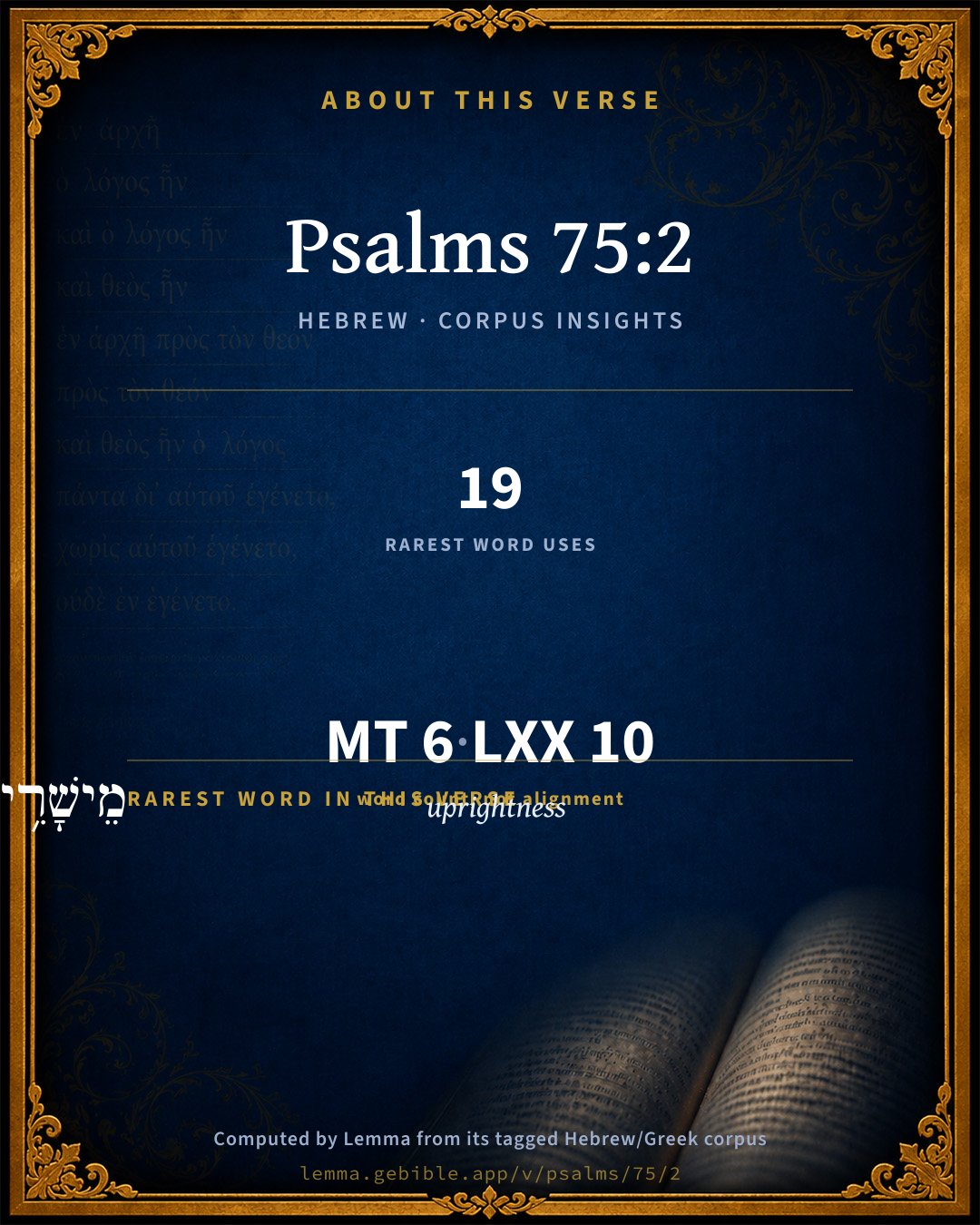
The rarest word here is מֵישָׁרִ֥ים uprightness H4339 — appearing just 19 times in the whole Hebrew Bible.

Shared distinctive vocabulary

מֵישָׁרִ֥ים uprightness H4339 occurs in 19 verses of the Hebrew Bible. Also found in:

Grammatical profile

  • 2 verbs
  • 2 nouns
  • 1 pronoun
  • 1 conjunction

Verb forms

  • אֶקַּ֣ח Qal · Imperfect
  • אֶשְׁפֹּֽט Qal · Imperfect

Hebrew & Septuagint length

In English translation the verse runs 10 words from the Hebrew and 11 from the Septuagint (LXX English) — closely comparable.

A rough comparison of the two English renderings, which tokenize alike — not a word-level alignment.

Word counts can differ between the Hebrew and the Greek without any difference in meaning — e.g. the Hebrew direct-object marker אֵת has no separate Greek word, and Greek often adds the article ὁ.

In the original languages it is 6 Hebrew tokens and 10 Greek tokens — but the two are counted differently (Hebrew bundles its prefixes and suffixes into one token; the Greek is in lemma form), so that isn’t a like-for-like length.

Cross-references

11

Topical passages linked to Psalms 75:2 in the Treasury of Scripture Knowledge — connected by theme and wording, ordered by reader-vote popularity; previews shown in the World English Bible.

  • Ecclesiastes 3:17 I said in my heart, "God will judge the righteous and the wicked; for there is a time there for every purpose and for every work."
  • Acts 17:31 because he has appointed a day in which he will judge the world in righteousness by the man whom he has ordained; of which he has given assurance to all men, in that he has raised him from the dead."
  • Acts 1:7 He said to them, "It isn't for you to know times or seasons which the Father has set within His own authority.
  • John 7:6 Jesus therefore said to them, "My time has not yet come, but your time is always ready.
  • Psalms 102:13 You will arise and have mercy on Zion; For it is time to have pity on her. Yes, the set time has come.
  • 2 Samuel 2:4 The men of Judah came, and there they anointed David king over the house of Judah. They told David, saying, The men of Jabesh Gilead were those who buried Saul.
  • 2 Samuel 5:3 So all the elders of Israel came to the king to Hebron; and king David made a covenant with them in Hebron before Yahweh: and they anointed David king over Israel.
  • 2 Samuel 8:15 David reigned over all Israel; and David executed justice and righteousness to all his people.
  • 2 Samuel 23:3–4 The God of Israel said, The Rock of Israel spoke to me: One who rules over men righteously, Who rules in the fear of God,
  • Psalms 78:70–72 He also chose David his servant, And took him from the sheepfolds;
  • Psalms 101:2 I will be careful to live a blameless life. When will you come to me? I will walk within my house with a blameless heart.

Cross-references courtesy of OpenBible.info (CC BY 4.0).

Hebrew and Greek witnesses Masoretic Hebrew ↔ Greek Septuagint

The same verse in the two great witnesses to the Old Testament, shown verse-for-verse.

You’re reading Greek Psalm 74 (Hebrew Psalm 75). The Septuagint counts the superscription, so verse numbers can differ from the Hebrew — chapter-level alignment, not verse-by-verse. Numbering follows Rahlfs.

These are two independent witnesses, not word-aligned to each other, and the Septuagint is shown in lemma (dictionary) form.

Hebrew Psalms 75:2 Masoretic · Westminster Leningrad Codex

כִּ֭י אֶקַּ֣ח מוֹעֵ֑ד אֲ֝נִ֗י מֵישָׁרִ֥ים אֶשְׁפֹּֽט

When I choose the appointed time, I will judge blamelessly.

World English Bible · Public Domain

Greek LXX Greek Psalm 74:2 Septuagint · lemma form

ἐκὁμολογέω σύ ὁ θεός ἐκὁμολογέω καί ἐπικαλέω ὁ ὄνομα σύ

When I shall take a set time, I will judge righteously.

LXX2012 (modern English Septuagint) · Public Domain

On this verse, Ellicott's Commentary for English Readers discusses the Septuagint’s reading. Read the note in Commentary ↓

Hebrew: Westminster Leningrad Codex (CC BY 4.0). Greek: Septuagint (public domain); English from LXX2012 (modern English Septuagint) (Public Domain). How the Septuagint differs from the Hebrew →

Commentary

Notes on Psalms 75:2 from classic Christian and Jewish commentators (each source and its license shown beneath its notes). The classic Christian expositions comment on the surrounding passage and are grouped to its opening verse, so a note may address several verses; the Jewish commentaries on the Tanakh (Rashi and others) are per-verse, so they appear only where the commentator wrote on this verse.

Lemma curates 59 commentaries, every one of them public domain or Creative Commons licensed, each selected and text-cleaned for this edition rather than reprinted as found. About our sources →

Trapp's Complete Commentary

John Trapp

Psa 75:2 When I shall receive the congregation I will judge uprightly.

Ver. 2. When I shall receive the congregation] i.e. The government of all the twelve tribes, as I believe I shall do shortly, according to God’s promise to me by Samuel.

I will judge uprightly] That a man is in truth, that he is in his own particular place and station, that he is really, that he is relatively.

John Trapp, A Commentary or Exposition upon All the Books of the Old and New Testament (1647–1656) — public domain. Text from a community e-Sword module.

Joseph Benson's Commentary

Psa 75:2. When I shall receive the congregation — The first verse was spoken by many persons, We give thanks, &c.; here the speaker is one, and that one is plainly a ruler, who promises that when he shall have received the congregation, or, as מועדmay be properly rendered, an appointed, or fit time, or season; that is, when he shall be established in power and authority, at a fit time and place, he will judge uprightly, and introduce a thorough reformation into a kingdom which, as the following verse makes manifest, stood greatly in need of it. From these circumstances Dr. Horne, with several other commentators, thinks it probable “David is speaking here of his advancement to the throne of Israel, and the intended rectitude of his administration when he should be settled thereon.”

Joseph Benson's Commentary on the Old and New Testaments (1811–1818) — public domain. Text from a community e-Sword module.

Whedon's Commentary on the Bible

Daniel D. Whedon

2. When I shall receive the congregation—We must certainly recognise the historic ground of Psa_75:2-3, before any spiritual or prophetic sense is admissible. The king is speaking to God. He states what he will do when he shall take his seat in the assembly, namely, perform the highest function of his office faithfully. “When I shall receive,” or take the place of authority in the stated assembly for the administration of justice, I will judge uprightly. He first thanks God for deliverance, then his heart turns to his distracted people, and, as God’s minister to them, he pledges uprightness of decision. This is part of his gratitude offering. All nations have had their times of restoring order and prosperity after the shattering effects of war, and this example of the pious king of Judah is worthy of universal adoption as the soundest state policy.

Daniel D. Whedon (gen. ed.), Commentary on the Old and New Testaments (1874–1909) — public domain. Text from a community e-Sword module.

J. A. Alexander on Psalms

Joseph Addison Alexander

3. (Psa 75:2). For I will take a set time; I will equitably judge. The best interpreters are now in favour of explaining these as the words of God himself, containing the promise upon which was built the hope expressed in the preceding verse. Take then includes the two ideas of choosing and using for the end proposed. The word translated set time is the same that means assembly in Psa 74:4; Psa 74:8. The idea of constituted time, which is included even there, is here predominant. The same use of the word occurs in Psa 102:13, Hab 2:3, Dan 8:19; Dan 11:27; Dan 11:35. There is here an obvious allusion to the stated times at which justice is publicly administered. Compare Act 19:38. As if he had said, I will appoint a time, and when it comes, I will ascend the judgment-seat. The parties to be tried are the foes and oppressors of God's people. The pronoun is emphatic; I, and no other, will be judge. See above, on Psa 1:6. Equitably, literally equities or rectitudes. See above, on Psa 17:2; Psa 58:1. The use of the plural, as an abstract, and that of the noun in an adverbial sense, are both familiar Hebrew idioms. The judging of the wicked at God's bar implies their condemnation, and, as a necessary consequence, the deliverance of those whom they oppress or injure.

Joseph Addison Alexander, The Psalms Translated and Explained (1850) — public domain. Text from a community e-Sword module.

Tyndale Open Study Notes

Tyndale Open Resources

75:2-8 The Lord will bring justice in his own time.

Tyndale Open Study Notes — © Tyndale Open Resources, licensed CC BY-SA 4.0. Text via the HelloAO Bible API.

Geneva Bible (1599)

Geneva Bible translators

When I see my time (saith God) to help your miseries, I will come and set all things in good order.

Geneva Bible (1599) marginal notes — public domain. Text via Bolls.life.

Adam Clarke's Commentary

Verse 2. When I shall receive the congregation] When the proper time is come that the congregation, my people of Israel, should be brought out of captivity, and received back into favour, I shall not only enlarge them, but punish their enemies. They shall be cut off and cast out, and become a more miserable people than those whom they now insult. I will destroy them as a nation, so that they shall never more be numbered among the empires of the earth.

Adam Clarke's Commentary on the Bible (1810–1826) — public domain. Text from a community e-Sword/MySword module.

John Calvin's Commentaries

2. When I shall have taken the congregation. The Hebrew verb יעד, yaäd, signifies to appoint a place or day, and the noun מועד, moed, derived from it, which is here used, signifies both holy assemblies, or a congregation of the faithful assembled together in the name of the Lord, and festival, or appointed solemn days. As it is certain that God is here introduced as speaking, either of these senses will agree with the scope of the passage. It may be viewed as denoting either that having gathered his people to himself, he will restore to due order matters which were in a state of distraction and confusion, or else that he will make choice of a fit time for exercising his judgment. In abandoning his people for a season to the will of their enemies, he seems to forsake them and to exercise no care about them; so that they are like a flock of sheep which is scattered, and wanders hither and thither without a shepherd. It being his object, then, to convey in these words a promise that he would remedy such a confused state of things, he very properly commences with the gathering together of his Church. If any choose rather to understand the word מועד, moed, as referring to time God is to be understood as admonishing his people, that it is their bounden duty to exercise patience until he actually show that the proper time is come for correcting vices, since he only has the years and days in his own power, and knows best the fit juncture and moment for performing this work. The interpretation to which I most incline is, That, to determine the end and measure of calamities, and the best season of rising up for the deliverance of his people, — matters, the determination of which men would willingly claim for themselves, — is reserved by God in his own hands, and is entirely subject to his own will. At the same time, I am very well satisfied with the former interpretation, which refers the passage to the gathering together of the Church. Nor ought it to seem absurd or harsh that God is here introduced as returning an answer to the prayers of his people. This graphic representation, by which they are made to speak in the first verse, while he is introduced as speaking in the second, is much more forcible than if the prophet had simply said, that God would at length, and at the determined time, show himself to be the protector of his Church, and gather her together again when she should be scattered and rent in pieces. The amount, in short, is, that although God may not succor his own people immediately, yet he never forgets them, but only delays until the fit time arrive, the redress which he has in readiness for them. To judge righteously, is just to restore to a better state matters which are embroiled and disordered. Thus Paul says,

“Seeing it is a righteous thing with God to recompense tribulation to them that trouble you; and to you who are troubled rest with us, when the Lord Jesus shall be revealed from heaven with his mighty angels.” (2 Thessalonians 1:6, 7)

God, therefore, declares that it is his office to set in order and adjust those things which are in confusion, that, entertaining this expectation, we may be sustained and comforted by means of it in all our afflictions.

John Calvin's Commentaries (1540-1563) — public domain. Text from the Calvin Translation Society English edition (1840s-50s) via the Christian Classics Ethereal Library (ccel.org). Calvin's coverage is partial (roughly two-thirds of the Bible); uncommented books and verses are honest gaps, never fabricated. The 19th-century editor's footnotes and remarks are omitted so the notes are faithfully Calvin's own voice.

Ellicott's Commentary for English Readers

(2) When I.—Rather, When I have chosen my time, I will judge uprightly. This sense: “my time” being shown by the emphatic “I” of the Hebrew. (Comp. Act_17:31.) The word rendered in the Authorised Version “congregation” (moed), has plainly here its first derivative sense of a set time, or “occasion.” (Comp. Psa_102:13; Hab_2:3.) So LXX. and Vulg. here; but Symmachus gives “synagogue.”

It is quite clear that the speaker of these words is God Himself, who suddenly, as in Psa_46:10, breaks in with the announcement of judgment. But how far the Divine utterance extends in the psalm is not quite clear. Some end it with Psa_75:3; others with Psa_75:5.

A Bible Commentary for English Readers, edited by Charles John Ellicott (1878–1897) — public domain. Text from a community e-Sword module.

The Cambridge Bible for Schools and Colleges

gen. ed. J. J. S. Perowne

2. When I reach the appointed time,

I Judge uprightly.

The ‘appointed time’ (Psa_102:13; Hab_2:3; Act_17:31) is the proper moment foreordained in the Divine counsels and known to God. The intervention of Jehovah at the moment when the Assyrians are ripe for judgement is a favourite thought with Isaiah (Isa_10:32-33; Isa_18:4-5).

The second I is emphatic: I, whatever men may do; I, whatever men may think.

2, 3. God speaks, as in Psa_46:10, and His words are virtually an answer to men’s thoughts. Men may have thought that He had abdicated His function as Judge of all the earth: not so: He was only waiting for the fitting moment for action.

The Cambridge Bible for Schools and Colleges (gen. ed. J. J. S. Perowne; Cambridge University Press, 1878–1918) — public domain. Text from a community e-Sword module.

John Gill's Exposition

When I shall receive the congregation,.... Some render it, from the Arabic signification of the word, "the promise" (o); the Spirit promised, the gifts of the Spirit, which Christ received for men, and gave to men, whereby he executes the judgment or government of the church committed to him: others the time, so the Septuagint, Vulgate Latin, Ethiopic, Syriac, and Arabic versions, to which agrees the Targum, the word signifying a set appointed time, Psa 102:14, and so may respect the time appointed for the judgment of the world, which when come, Christ will execute in a most righteous manner, as follows; see Act 17:31, but whereas the people of Israel met at the door of the tabernacle, which from thence was called "Ohel Moed", the tabernacle of the congregation; hence the word is used for a congregation, and here designs the general assembly and church of the firstborn written in heaven, even all the elect of God; these were received by Christ of his Father in eternity, when he espoused them to himself, and undertook the care of them; and they are received by him, one by one, in effectual calling; and in like manner are they received by him into glory at death; but when they are all gathered in, and are prepared for him as a bride for her husband, then will he receive them all in a body, and present them to himself a glorious church during the thousand years' reign; upon which will proceed the judgment of the wicked; see Rev 20:5,

I will judge uprightly; in equity, in strict justice, in the most righteous manner, rendering to every man according to his works; hence the future judgment is called a righteous one, and so is the Judge; no injustice will be done to men, but the strictest integrity, uprightness, and impartiality, will be observed in pronouncing the several sentences on the righteous and on the wicked, and in adjudging them to their several places and states.

(o) "promissa", Schultens animadv. p. 174. "festi dona", Gusset. p. 334.

John Gill's Exposition of the Whole Bible (1746–1763) — public domain (CC PDM 1.0). Text via the HelloAO Bible API.

Albert Barnes' Notes on the Bible

When I shall receive the congregation - The marginal rendering is, “Take a set time.” The phrase is thus rendered in most of the versions. So the Septuagint, “When I take the time” - ὅταν λάβω καιρὸν hotan labō kairon. So the Vulgate, “When I accept the time.” So Luther, “When in its own time.” So De Wette, “When I take the time.” According to this interpretation, this is the language of God, as if implying that, although “the earth” was then “dissolved,” or although disorders were allowed to exist, yet he would take a set time, or take the appointed time for judgment, and would pronounce a sentence on the conduct of people, and deal with them in a righteous manner, punishing the rebellious, and vindicating his own cause. The proper interpretation of the passage turns on the meaning of the Hebrew word rendered in the text “congregation” - מועד mô‛êd. See the word explained in the notes at Psa 74:8. It may mean a set time, an appointed season, 1Sa 13:8, 1Sa 13:11; or a coming together, an assembly, Job 30:23; or a place of assemblage, as the tabernacle, etc.; Exo 27:21; Exo 40:22; Psa 74:8. It may, therefore, be applied to the congregation of the Jewish people - the nation considered as an assemblage for the worship of God; and the idea of taking this, or receiving this, may be applied to the act of assuming authority or sovereignty over the people, and hence, the language may be used to denote the entrance on the discharge of the duties of such sovereignty. The language would be ap plicable to one who had the right of such an elevation to power - a prince - an heir apparent - in a time when his right was disputed; when there was an organized opposition to him; or when the nation was in a state of anarchy and confusion. It seems to me that this supposition best accords with the proper meaning of the language, and with the scope of the psalm.

I will judge uprightly - I will put down all this opposition to law. I will deal with exact justice between man and man. I will restore order, and the supremacy of law, to the state. The language, therefore, according to this interpretation, is not the language of God, but that of a prince having a right to the throne, and about to ascend it in a time of great misrule and disorder.

Albert Barnes' Notes on the Bible (1834–1885) — public domain. Text from a community e-Sword/MySword module.

Matthew Poole's English Annotations

When I shall receive the congregation, to wit, the whole congregation, or body of thy people, to wit, all the tribes; which are now distracted and disordered by a civil war, which is a great hinderance to the administration of justice. Or, when I shall receive or obtain the appointment, i.e. what God hath appointed and promised to me, to wit, the full and firm possession of the kingdom; or, the time or place appointed by God for that work. Some make these and the following passages the words of God concerning his church or people; which seems not probable; partly because he speaks of God in the third person, as one distinct from him that speaks these words, Psa 75:7,8; and partly because it is evident that one and the same person speaks from hence to the end of the Psalm, and the ninth verse cannot be spoken by God.

I will judge uprightly; I will not use my power tyrannically and wickedly, as Saul did, and as most other princes do; but holily and righteously, for the good of my people.

Matthew Poole's English Annotations on the Holy Bible (1683–1685) — public domain. Text from a community e-Sword/MySword module.

The Treasury of David

Charles H. Spurgeon

Ver. 2. When I shall receive the congregation I will judge uprightly. This is generally believed to be the voice of God, who will, when he accepts his people, mount his judgment seat and avenge their cause in righteousness. It is rendered by some, "I will take a set time; "and by others, "I will seize the moment."

"God never is before his time,

He is never too late."

He determines the period of interposition, and when that arrives swift are his blows and sure are his deliverances. God sends no delegated judge, but sits himself upon the throne. O Lord, let thy set time come for grace. Tarry no longer, but for the truth and the throne of Jesus be thou speedily at work. Let the appointed assize come, O Jesus, and sit thou on thy throne to judge the world in equity.

None.

Good resolutions commendable, how they should be made, strengthened, and performed.

Psalms 75:3*

Charles H. Spurgeon's The Treasury of David (1869–1885) — public domain. Psalms only. Text from a community e-Sword/MySword module.

The Pulpit Commentary

When I shall receive the congregation; rather, when I shall have appointed a set time. It is agreed that the speaker, in this verse and the next, is God, who announces that he is about to descend in judgment. This, however, he will do "at his own set time," for which men must wait patiently. (comp. Hab_2:3) I will judge uprightly; or, "with uprightness". (comp. Psa_58:1)

God"s set time for judgment.

It is not certain whether vers. 2 and 3 are to be taken as an utterance of the psalmist for himself, or whether God is here introduced as speaking. Dean Perowne thinks, "God is abruptly introduced as the speaker. The oracle is thus given as from the month of God himself, to those who may be in doubt or perplexity because their lot is cast in troublous times" But other writers think that Hezekiah is appealing to God, and assuring him that, even amidst the civil commotions and party struggles creating strong feelings, he will hold fast his integrity as chief magistrate, and judge fairly, uprightly, between man and man. "Receiving the congregation" is thus a poetical figure for the king"s daily magistracy. The Revised Version renders, "When I shall find the set time, I will judge uprightly," and this favours the view that God is the speaker. "Judgment" here probably stands for "active intervention." God often seems to delay his help; and such delay is a strain on faith and feeling. He never does really delay, because his time is set in infinite wisdom. Illustrate by the waiting at the shores of the Red Sea, for God"s set time to make the pathway through. See also Hezekiah"s waiting for God"s set time before his deliverance from the Assyrians. A "set time" implies

I THOUGHT BEFOREHAND. God knew all Hezekiah"s anxieties long before he seemed to intervene. He was interested. He watched. God was caring when he did not seem to care. How much better it is that God should observe all circumstances, and decide for the wisest moment in which to act for us! We may wish him to act at once; but in that case he could only alter our circumstances. By thoughtfully deciding on a "set time," the "best time," God is able to bless us, to carry on his sanctifying work in us. A set time implies

II THE SELECTION OF THE BEST TIME. But what is a best time can never be judged from any one point of view. God"s best is the best all round; the best for everybody; and the best in every sense. In connection with the psalm, God"s set time had to be best for Assyria, best for Sennacherib, best for Israel, best for Hezekiah, best for Shebna and his party, and best for us who have to learn from the old world story. We can so seldom make a fair judgment concerning God"s "set times" for us, because we cannot view them all round, and therefore we easily misunderstand them as seen from some point of self-interest. A "set time" implies

III EFFECTIVE ACTION WHEN THE TIME HAS COME. Illustrate by the attack of Wolseley on Tel-el-Kebir. A set time was fixed, so everything was prepared and adjusted, and the stroke was vigorously delivered. It is well for us to wait God"s time, because his time is a "set time. R.T.

The Pulpit Commentary (1880–1919), ed. H.D.M. Spence-Jones & Joseph S. Exell — public domain. Text from a community e-Sword module.

John Wesley's Explanatory Notes

Receive - The whole congregation, all the tribes.

John Wesley, Explanatory Notes Upon the Whole Bible (1754–1765) — public domain. Text via the GEBible commentary corpus.

Rashi

Rabbi Shlomo Yitzchaki (Rashi)

We have thanked You, O God for the good; we have thanked also for the evil. and...is near Your name is always near in our mouth.

they have told Our generations [have] constantly [told] Your wonders.

Rashi on the Tanakh — English translations: “The Judaica Press complete Tanach with Rashi, translated by A. J. Rosenberg” (CC BY 4.0); “Pentateuch with Rashi's commentary by M. Rosenbaum and A.M. Silbermann, 1929-1934” (public domain); “The Metsudah Tanach series, Lakewood, N.J” (CC BY 4.0); and “The Book of Joshua, Metsudah Publications, 1997” (CC BY 4.0). Text via Sefaria.

Lesson kit

Teaching starters — assembled from the data on this page, not authored interpretation. Every prompt links to the verse data it draws on. Edit before teaching.

Psalms, in the Wisdom, opens this verse with 6 words (6 distinct Hebrew lemmas). Its most distinctive word is mêyshâr (“uprightness”). A historical commentator’s framing appears above. Read the whole chapter for the surrounding context.

Discussion questions

  1. What does “uprightness” (mêyshâr) contribute to the verse as a whole?
  2. 1 Chronicles 29:17 shares the word «uprightness» with this verse. How do the two illuminate each other?
  3. These translations render this verse differently; the difference is in the English rendering, not the original. What questions does that raise?
  4. The verb «אֶקַּ֣ח» is Qal Imperfect. How does its form color the action?
  5. Reading how Trapp's Complete Commentary and Joseph Benson's Commentary read this verse, where do the two commentators agree and where do they part?

Things to notice

Reading settings

Reading text

Shown beneath each verse's original-language words.

Old Testament
Old Testament edition

Read the OT as the Masoretic Hebrew (MT) or the Greek Septuagint (LXX).

English shown for the Greek Septuagint (in the Hebrew ↔ Greek comparison).

Comparing translations? Open the Compare panel on any verse page to stack up to four side by side.