
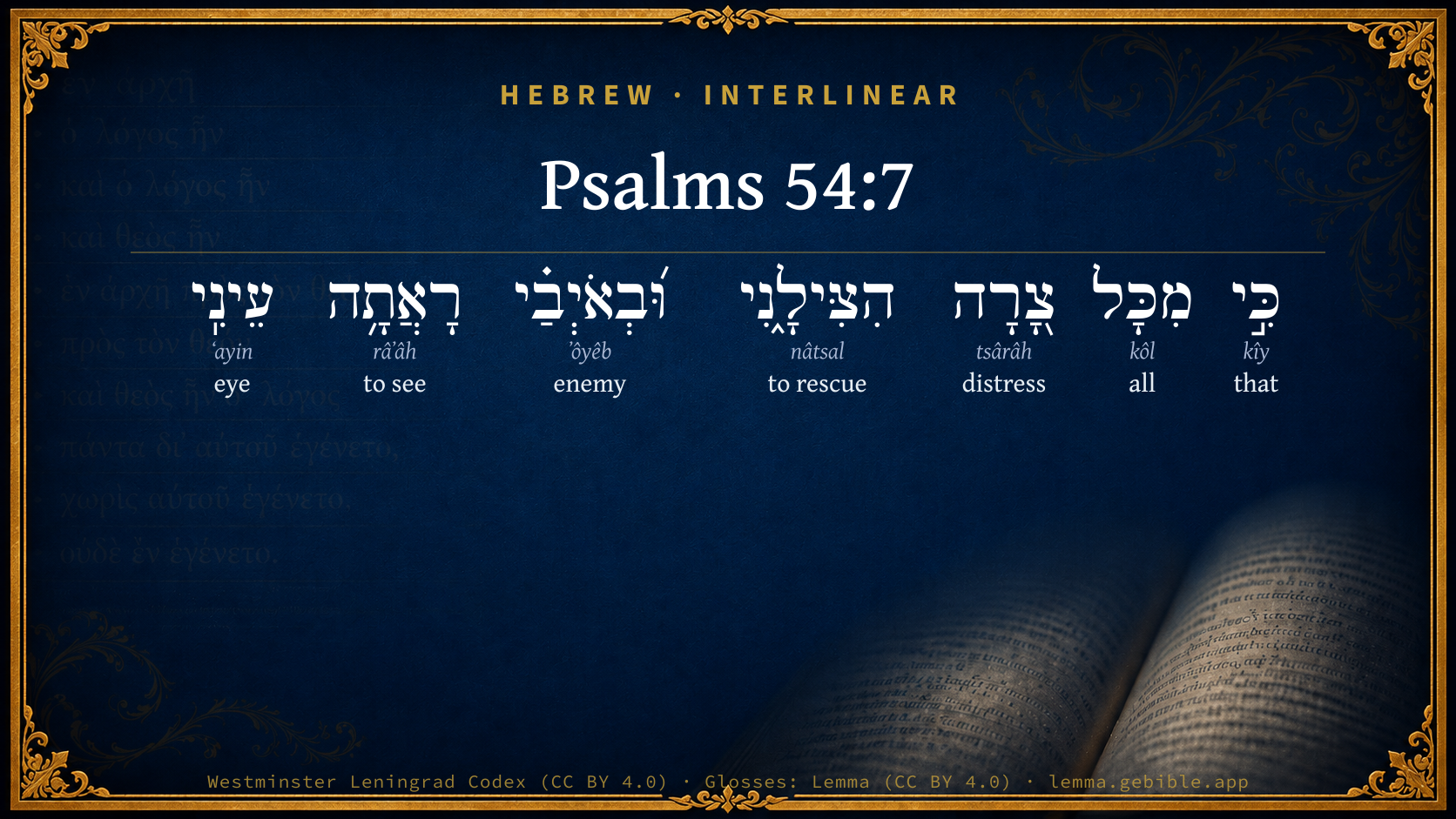
Psalms 54:7

Hebrew (Westminster Leningrad Codex) Psalms 54:7 appears in the Hebrew Old Testament. The text above is from the Westminster Leningrad Codex. Each word links to its Strong’s number, a concise gloss, and parsing drawn from the Open Scriptures Hebrew Bible morphology. Click any word for its full Brown-Driver-Briggs (BDB) entry.
Download image
Cite this verse

Psalms 54:7 (World English Bible). Public Domain. Lemma interlinear Bible study tool, https://lemma.gebible.app/v/psalms/54/7.

Show BibTeX & RIS
BibTeX
RIS
English Translation
For he has delivered me out of all trouble. My eye has seen triumph over my enemies.
World English Bible · Public Domain
Download a study sheet

One document with this verse’s original text, its word-by-word gloss line, the meaning frame, cross-references with their text, attributed commentary, and full source and license credits — printable, and it pastes into notes with its structure intact.

This verse Autodidact and up

Study sheet (.html) Plain text (.txt)

A passage Seminary Student

Up to 50 verses in one chapter. A passage sheet keeps up to 6 commentary sources and 12 cross-references per verse, in the order this page ranks them, and says so on the sheet whenever that leaves anything out. Ask for a single verse and you get the Autodidact verse sheet above.

Everything on this page stays free to read, with no account — the sheet is a download of what is already on screen, not access to it.

Want to remove ads? Support Godless Engineer
Compare translations 3

The same verse in 3 English versions, stacked beneath the original-language interlinear above. Click any original word for its lexicon entry.

Each is an independent rendering of the whole verse — the interlinear is not word-aligned to these translations.

Highlighted words mark where these versions differ — a whole-verse word diff, not a word-by-word alignment.

  • World English Bible Public Domain
    For he has delivered me out of all trouble. My eye has seen triumph over my enemies.
  • King James Version Public Domain
    For he hath delivered me out of all trouble: and mine eye hath seen his desire upon mine enemies.
  • unfoldingWord Literal Text CC BY-SA 4.0
    For he delivers me from every trouble, and my eye looks at my enemies.

unfoldingWord Literal Text — © unfoldingWord, licensed CC BY-SA 4.0. Word-aligned USFM3 via Door43 (git.door43.org/unfoldingWord/en_ult).

Versions to compare (up to 4)

3 of 4 selected

Show all 18 translations

Every available English version of this verse, each an independent rendering of the whole verse.

  • World English Bible Public Domain
    For he has delivered me out of all trouble. My eye has seen triumph over my enemies.
  • Berean Standard Bible Public Domain
    For He has delivered me from every trouble, and my eyes have stared down my foes.
  • Majority Standard Bible Public Domain
    For He has delivered me from every trouble, and my eyes have looked in triumph on my foes.
  • King James Version Public Domain
    For he hath delivered me out of all trouble: and mine eye hath seen his desire upon mine enemies.
  • American Standard Version (1901) Public Domain
    For he hath delivered me out of all trouble; And mine eye hath seen `my desire' upon mine enemies. Psalm 55 For the Chief Musician; on stringed instruments. Maschil of David.
  • Revised Version (1885) Public Domain
    For he hath delivered me out of all trouble; and mine eye hath seen my desire upon mine enemies.
  • Geneva Bible (1599) Public Domain
    For he hath deliuered me out of al trouble, and mine eye hath seene my desire vpon mine enemies.
  • Douay-Rheims (1899) Public Domain
    Turn back the evils upon my enemies; and cut them off in thy truth.
  • Young's Literal Translation Public Domain
    For, from all adversity He delivered me, And on mine enemies hath mine eye looked!
  • Literal Standard Version CC BY-SA 4.0
    For He delivered me from all adversity, || And my eye has looked on my enemies!
  • Unlocked Literal Bible CC BY-SA 4.0
    For he has rescued me from every trouble; my eye has looked in triumph on my enemies.
  • unfoldingWord Literal Text CC BY-SA 4.0
    For he delivers me from every trouble, and my eye looks at my enemies.
  • Darby Bible Public Domain
    For he hath delivered me out of all trouble; and mine eye hath seen [its desire] upon mine enemies.
  • World Messianic Bible Public Domain
    For he has delivered me out of all trouble. My eye has seen triumph over my enemies.
  • Webster's Bible Public Domain
    \\54:5\\He will reward evil to my enemies; cut them off in thy truth.
  • Free Bible Version CC BY-SA 4.0
    For he has saved me from all my troubles; and I have seen those who hated me defeated.
  • Bible in Basic English Public Domain
    Because it has been my saviour from all my trouble; and my eyes have seen the punishment of my haters.
  • JPS Tanakh (1917) Public Domain
    (54-9) For He hath delivered me out of all trouble; and mine eye hath gazed upon mine enemies.

Literal Standard Version (2020), Covenant Press — licensed CC BY-SA 4.0. Text via the HelloAO Bible API (eBible.org). Unlocked Literal Bible (unfoldingWord) — licensed CC BY-SA 4.0. Text via the HelloAO Bible API (eBible.org). unfoldingWord Literal Text — © unfoldingWord, licensed CC BY-SA 4.0. Word-aligned USFM3 via Door43 (git.door43.org/unfoldingWord/en_ult). Free Bible Version, Dr. Jonathan Gallagher — licensed CC BY-SA 4.0. Text via the HelloAO Bible API (eBible.org).

Word by word

More ways to search: Search by grammar → Find every occurrence → Compare this word →

Practice this passage: Drill this verse → Learn its vocabulary →

About this verse

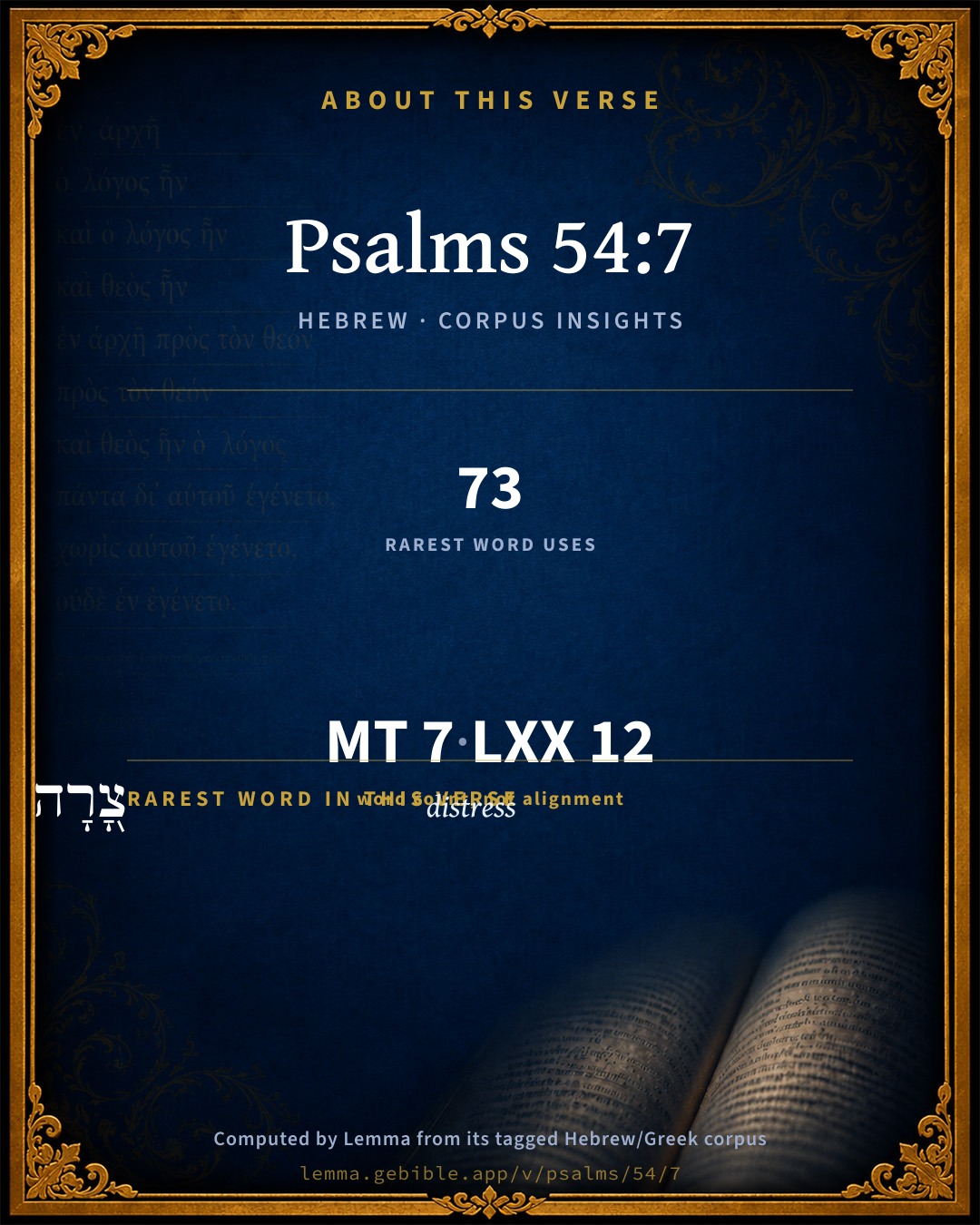
These counts appear in no published source. They are computed here, from the morphology-tagged text and Lemma’s own curated glosses. What Lemma adds →

7
words
7
distinct lemmas
Wisdom
section

Grammatical profile

  • 3 verbs
  • 3 nouns
  • 1 conjunction

Verb forms

  • הִצִּילָ֑נִי Hiphil · Perfect
  • וּ֝בְאֹיְבַ֗י Qal · Participle Active
  • רָאֲתָ֥ה Qal · Perfect

Hebrew & Septuagint length

In English translation the verse runs 17 words from the Hebrew and 19 from the Septuagint (LXX English) — closely comparable.

A rough comparison of the two English renderings, which tokenize alike — not a word-level alignment.

Word counts can differ between the Hebrew and the Greek without any difference in meaning — e.g. the Hebrew direct-object marker אֵת has no separate Greek word, and Greek often adds the article ὁ.

In the original languages it is 7 Hebrew tokens and 12 Greek tokens — but the two are counted differently (Hebrew bundles its prefixes and suffixes into one token; the Greek is in lemma form), so that isn’t a like-for-like length.

Cross-references

13

Topical passages linked to Psalms 54:7 in the Treasury of Scripture Knowledge — connected by theme and wording, ordered by reader-vote popularity; previews shown in the World English Bible.

  • Psalms 59:10 My God will go before me with his loving kindness. God will let me look at my enemies in triumph.
  • Psalms 92:11 My eye has also seen my enemies. My ears have heard of the wicked enemies who rise up against me.
  • Psalms 112:8 His heart is established. He will not be afraid in the end when he sees his adversaries.
  • Psalms 118:7 Yahweh is on my side among those who help me. Therefore I will look in triumph at those who hate me.
  • 2 Timothy 4:18 And the Lord will deliver me from every evil work, and will preserve me for his heavenly Kingdom; to whom be the glory forever and ever. Amen.
  • Psalms 37:34 Wait for Yahweh, and keep his way, And he will exalt you to inherit the land. When the wicked are cut off, you shall see it.
  • Psalms 34:6 This poor man cried, and Yahweh heard him, And saved him out of all his troubles.
  • Psalms 34:19 Many are the afflictions of the righteous, But Yahweh delivers him out of them all.
  • Psalms 58:10–11 The righteous shall rejoice when he sees the vengeance. He shall wash his feet in the blood of the wicked;
  • Psalms 91:8 You will only look with your eyes, And see the recompense of the wicked.
  • Genesis 48:16 the angel who has redeemed me from all evil, bless the lads, and let my name be named on them, and the name of my fathers Abraham and Isaac. Let them grow into a multitude in the midst of the earth."
  • 1 Samuel 26:24 Behold, as your life was much set by this day in my eyes, so let my life be much set by in the eyes of Yahweh, and let him deliver me out of all oppression.
  • 2 Samuel 4:9 David answered Rechab and Baanah his brother, the sons of Rimmon the Beerothite, and said to them, As Yahweh lives, who has redeemed my soul out of all adversity,

Cross-references courtesy of OpenBible.info (CC BY 4.0).

Hebrew and Greek witnesses Masoretic Hebrew ↔ Greek Septuagint

The same verse in the two great witnesses to the Old Testament, shown verse-for-verse.

You’re reading Greek Psalm 53 (Hebrew Psalm 54). The Septuagint counts the superscription, so verse numbers can differ from the Hebrew — chapter-level alignment, not verse-by-verse. Numbering follows Rahlfs.

These are two independent witnesses, not word-aligned to each other, and the Septuagint is shown in lemma (dictionary) form.

Hebrew Psalms 54:7 Masoretic · Westminster Leningrad Codex

כִּ֣י מִכָּל צָ֭רָה הִצִּילָ֑נִי וּ֝בְאֹיְבַ֗י רָאֲתָ֥ה עֵינִֽי

For he has delivered me out of all trouble. My eye has seen triumph over my enemies.

World English Bible · Public Domain

Greek LXX Greek Psalm 53:7 Septuagint · lemma form

ἀποστρέφω ὁ κακός ὁ ἐχθρός ἐγώ ἐν ὁ ἀλήθεια σύ ἐκὀλεθρεύω αὐτός

For you have delivered me out of all affliction, and my eye has seen my desire upon my enemies.

LXX2012 (modern English Septuagint) · Public Domain

Hebrew: Westminster Leningrad Codex (CC BY 4.0). Greek: Septuagint (public domain); English from LXX2012 (modern English Septuagint) (Public Domain). How the Septuagint differs from the Hebrew →

Commentary

Notes on Psalms 54:7 from classic Christian and Jewish commentators (each source and its license shown beneath its notes). The classic Christian expositions comment on the surrounding passage and are grouped to its opening verse, so a note may address several verses; the Jewish commentaries on the Tanakh (Rashi and others) are per-verse, so they appear only where the commentator wrote on this verse.

Lemma curates 59 commentaries, every one of them public domain or Creative Commons licensed, each selected and text-cleaned for this edition rather than reprinted as found. About our sources →

Trapp's Complete Commentary

John Trapp

Psa 54:7 For he hath delivered me out of all trouble: and mine eye hath seen [his desire] upon mine enemies.

Ver. 7. For he hath delivered me] i.e. He surely will. This is the language of faith; this is the triumph of trust.

And mine eye hath seen my desire upon mine enemies] This was not an evil eye of envy or private revenge; such as was that of him, who, when he saw a pit full of man’s blood, cried out, O formosmn spectaculum! O brave sight! or that of Antichrist, who hath oft glutted his eyes with many such goodly bloody sights; as when he caused the massacre of Paris to be painted in his palace, and had the admiral’s head sent him for a present; but as admiring God’s justice on his enemies, and love towards his people, he was well pleased with such a providence, and beheld it with comfort (Thuan.). The Arabic rendereth it, Oculus meus requievit. My eye rested. Tremellius, mine eye beholdeth mine enemies; I dare now boldly look them in the face, being strengthened with thy night, &c.

John Trapp, A Commentary or Exposition upon All the Books of the Old and New Testament (1647–1656) — public domain. Text from a community e-Sword module.

J. A. Alexander on Psalms

Joseph Addison Alexander

9. (Psa 54:7). For out of all distress he hath delivered me, and on my enemies my eye has looked. In his confident assurance of a favourable issue, he speaks of it, though future, as already past. The sudden change of person, may be avoided by translating the first verb, it (i.e. thy name) has delivered me, according to the prayer in Psa 54:3 (1). My eye has looked or gazed, with an implication of delight, or at least of acquiescence, which is commonly conveyed by this construction. This kind of satisfaction in the execution of God's threatenings is sinful only when combined with selfish malignity. Apart from this corrupt admixture, it is inseparable from conformity of will and coincidence of judgment with God. The same kind and degree of acquiescence which is felt by holy angels in heaven may surely be expressed by saints on earth, especially in their collective capacity as a church, in whose name the Psalmist is here speaking, and not merely in his own or that of any other individual.

Joseph Addison Alexander, The Psalms Translated and Explained (1850) — public domain. Text from a community e-Sword module.

Geneva Bible (1599)

Geneva Bible translators

We may lawfully rejoice for God’s judgments against the wicked, if our affections be pure.

Geneva Bible (1599) marginal notes — public domain. Text via Bolls.life.

Jamieson, Fausset & Brown

Robert Jamieson, A. R. Fausset & David Brown

mine eye . . . desire--(compare Psa 59:10; Psa 112:8), expresses satisfaction in beholding the overthrow of his enemies as those of God, without implying any selfish or unholy feeling (compare Psa 52:6-7).

Next: Psalms Chapter 55

Jamieson, Fausset & Brown — Commentary Critical and Explanatory on the Whole Bible (1871) — public domain (CC PDM 1.0). Text via the HelloAO Bible API.

Adam Clarke's Commentary

Verse 7. For he hath delivered me] Saul had now decamped; and was returned to save his territories; and David in the meanwhile escaped to En-gedi. God was most evidently the author of this deliverance.

Mine eye hath seen his desire upon mine enemies.] It is not likely that this Psalm was written after the death of Saul; and therefore David could not say that he had seen his desire. But there is nothing in the text for his desire; and the words might be translated, My eye hath seen my enemies-they have been so near that I could plainly discover them. Thus almost all the Versions have understood the text. I have seen them, and yet they were not permitted to approach me. God has been my Deliverer.

ANALYSIS OF THE FIFTY-FOURTH PSALM

There are three parts in this Psalm: -

I. David's prayer for help and salvation, Ps 54:1-3.

II. His confidence that he should have help, Ps 54:4-5.

III. His gratitude and obedience, Ps 54:6-7.

1. David's petition: 1. "Save me." 2. "Plead my cause." 3. "Hear my prayer." 4. "Give ear to my words." He is much in earnest; and yet does not desire his prayer to be heard unless his cause be just. If just, then let God plead it.

2. He produces two grounds upon which he petitions: 1. God's name. 2. God's strength. 1. He that calls on the name of the Lord shall be saved; I call: "Save me in thy name!" 2. Thou art a powerful God, able to do it: "Save me in thy strength."

The greatness of his danger causes him to urge his prayer.

1. His enemies were strangers; from whom no favour could be expected.

2. They were violent oppressors - formidable, cruel tyrants, from whom he could expect no mercy.

3. They were such as could be satisfied with nothing less than his blood: "They rise to seek after my life."

4. They had no fear of God: "They have not set God before them."

II. Notwithstanding they are all that I have already stated; and, humanly speaking, I have nothing but destruction to expect; yet I will not fear: because, 1. God is with me. 2. He is against them.

1. "God is my helper:" as he has promised, so he has done, and will do, to me.

2. "God is with them also who uphold my soul. Selah." Behold this!

But he opposes them who oppose me; is an enemy to them who are mine enemies.

1. "He shall reward evil" to such: of this being assured, he proceeds to imprecate.

2. Destroy thou them: "Cut them off in thy truth." Thou hast promised that it shall be well with the righteous; and that snares, fire, and brimstone, shall be rained on the wicked. Let God be true: Fiat justitia; ruat coelum, pereat mundus. They must be cut off.

III. For such a mercy David promises not to be unthankful.

1. For this he would offer a princely sacrifice: "I will freely sacrifice."

2. He would praise the name of the Lord: "I will praise thy name."

For this he gives two reasons: -

1. That which internally moved him: "For it is good."

2. That which was outwardly impulsive; his deliverance. 1. His deliverance was great and effectual: "Thou hast delivered me out of all my trouble." 2. His danger was so imminent that, humanly speaking, there was no escape. The enemy was within sight who was bent on his destruction; yet he was delivered; and they were confounded. On these accounts it was right that he should sing praise, and offer sacrifice. To the grateful, God is bountiful.

Adam Clarke's Commentary on the Bible (1810–1826) — public domain. Text from a community e-Sword/MySword module.

Ellicott's Commentary for English Readers

(7) This verse does not actually state what has happened, but, according to a well-known Hebrew idiom should be rendered, When he shall have delivered, &c

Hath seen his desire.—Or, hath gloated on The Hebrews use the words seeing and looking very expressively, making the simple verb do almost what the eye itself can do: show hatred, love, triumph, defeat, wistfulness, disgust, &C (See Psa_35:21; Psa_52:6; Psa_59:10; Psa_92:11; Son_6:13; &c)

A Bible Commentary for English Readers, edited by Charles John Ellicott (1878–1897) — public domain. Text from a community e-Sword module.

The Cambridge Bible for Schools and Colleges

gen. ed. J. J. S. Perowne

7. For he hath delivered me] Such a transition from the second person of Psa_54:6 to the third person is quite possible: cp. the converse transition in Psa_54:5 : but the subject of the verb maybe ‘the Name of Jehovah.’ Cp. Lev_24:11; Isa_30:27.

The perfect tense (‘hath delivered’ … ‘hath seen’) looks back from the hour of thanksgiving upon an answered prayer. Cp. Psa_52:9, “because thou hast done it.”

hath seen his desire] Cp. Psa_37:34; Psa_52:6; Psa_59:10; Psa_92:11; Psa_112:8; Psa_118:7. Such rejoicing over the fall of enemies is not of the spirit of the Gospel. But the ‘salvation’ for which the Psalmist prays is a temporal deliverance, which can only be effected at the expense of the implacable enemies who are seeking his life; and it will be a vindication of God’s faithfulness and a proof of His righteous government at which he cannot but rejoice. The defeat of evil and the triumph of good presented themselves to the saints of the O.T. in this concrete form, which sometimes has a ring of personal vindictiveness about it, yet, fairly considered, is in its real motive and character elevated far above a mere thirst for revenge. See Introd. pp. lxxxviii ff.

The Cambridge Bible for Schools and Colleges (gen. ed. J. J. S. Perowne; Cambridge University Press, 1878–1918) — public domain. Text from a community e-Sword module.

John Gill's Exposition

For he hath delivered me out of all trouble,.... As he desired, Sa1 26:24; that is, out of all his present trouble; not that he had no more afterwards; for as soon as one trouble is gone, generally speaking, another comes; but as God delivered him out of his present distress, so he believed he would deliver him out of all his afflictions in future times;

and mine eye hath seen his desire upon mine enemies: or revenge, as the Targum supplies it; not that he delighted in the destruction of his enemies, but in the justice of God glorified thereby, and in the goodness of God to him, in delivering him from them; see Rev 18:20.

Next: Psalms Chapter 55

John Gill's Exposition of the Whole Bible (1746–1763) — public domain (CC PDM 1.0). Text via the HelloAO Bible API.

Albert Barnes' Notes on the Bible

For he hath delivered me out of all trouble - This is spoken either in confident expectation of what would be, or as the statement of a general truth that God did deliver him from all trouble. It was what he had experienced in his past life; it was what he confidently expected in all time to come.

And mine eye hath seen his desire upon mine enemies - The words “his desire” are not in the original. A literal translation would be, “And on my enemies hath my eye looked.” The meaning is, that they had been overthrown; they had been unsuccessful in their malignant attempts against him; and he had had the satisfaction of “seeing” them thus discomfited. Their overthrow had not merely been reported to him, but he had had ocular demonstration of its reality. This is not the expression of malice, but of certainty. The fact on which the eye of the psalmist rested was his own safety. Of that he was assured by what he had witnessed with his own eyes; and in that fact he rejoiced. There is no more reason to charge malignity in this case on David, or to suppose that he rejoiced in the destruction of his enemies as such, than there is in our own case when we are rescued from impending danger. It is proper for Americans to rejoice in their freedom, and to give thanks to God for it; nor, in doing this, is it to be supposed that there is a malicious pleasure in the fact that in the accomplishment of this thousands of British soldiers were slain, or that thousands of women and children as the result of their discomfiture were made widows and orphans. We can be thankful for the mercies which we enjoy without having any malignant delight in those woes of others through which our blessings may have come upon us.

Albert Barnes' Notes on the Bible (1834–1885) — public domain. Text from a community e-Sword/MySword module.

Matthew Poole's English Annotations

He speaks of it as a thing already done, either to express his assurance of it, or because this Psalm was made after it was done.

His desire; or, thy vengeance; which may be understood out of Psa 54:5. But there is no necessity of any supplement. The words in the Hebrew run thus,

mine eye hath looked upon mine enemies; either with delight, as this phrase signifies, Psa 22:17; 27:4, and elsewhere; or without fear or shame. I shall not be afraid to look them in the face, having God on my side.

Matthew Poole's English Annotations on the Holy Bible (1683–1685) — public domain. Text from a community e-Sword/MySword module.

The Treasury of David

Charles H. Spurgeon

Ver. 7. For he hath delivered me out of all trouble. Up to that time deliverance had come, and for that danger also he felt that rescue was near. David lived a life of dangers and hair breadth escapes, yet he was always safe. In the retrospect of his very many deliverances he feels that he must praise God, and looking upon the mercy which he sought as though it were already received, he sang this song over it--

"And a new song is in my mouth,

To long loved music set,

Glory to thee for all the grace

I have not tasted yet."

Out of all trouble our covenant God is pledged to bring us, and therefore even now let us uplift the note of triumph unto Jehovah, the faithful preserver of them that put their trust in him. Thus far have we proved his promise good; he changes not, and therefore in all the unknown future he will be equally our guardian and defence, "showing himself strong in the behalf of them whose heart is perfect toward him."

And mine eye hath seen his desire upon mine enemies. He knew that yet he should look on his haughty foes, gazing down on them in triumph as now they looked on him in contempt. He desired this as a matter of justice, and not of personal pique. His righteous soul exulted because he knew that unprovoked and gratuitous malice would meet with a righteous punishment. Could we keep out of our hearts all personal enmity as fully as the psalmist did in this Psalm, we might yet equally feel with him a sacred acquiescence and delight in that divine justice which will save the righteous and overthrow the malicious. In closing, let us trust that if we are as friendless as this man of God, we may resort in prayer as he did, exercise the like faith, and find ourselves ere long singing the same joyous hymn of praise.

Ver. 7. Mine eye hath seen his desire upon mine enemies. Or, mine eye hath looked upon mine enemies; that is, he was able to meet them without terror. Samuel Davidson, D.D., 1852.

Ver. 7. The reader will note that the words his desire are supplied by our translators, and are not in the original text. C. H. S.

Ver. 7. (first clause). The exclamation of the newly pardoned penitent, the cry of the delivered saint, the song of the ripe Christian, the shout of the glorified believer.

Charles H. Spurgeon's The Treasury of David (1869–1885) — public domain. Psalms only. Text from a community e-Sword/MySword module.

Whedon's Commentary on the Bible

Daniel D. Whedon

7. Hath delivered… hath seen—The past tense of the verbs is the language of faith, which speaks of future events as already accomplished, “and calleth those things which be not as though they were.” Rom_4:17. Mine eye hath seen, etc.—The words his desire are not in the text, which simply reads, Mine eye has looked on my enemies; an expression to be interpreted idiomatically. Not merely that they had approached so near that he saw them in their retreat, which, indeed, is quite probable, but that he “calmly surveyed them without alarm, for he feels that the shield of God’s power and love is cast over him to protect him,” (Wordsworth,) with the idea further implied, that God had given him to see their downfall in the miscarriage of their plans, as in Psa_59:11; Psa_92:12, where “his desire” is not in the text.

Daniel D. Whedon (gen. ed.), Commentary on the Old and New Testaments (1874–1909) — public domain. Text from a community e-Sword module.

The Pulpit Commentary

For he hath delivered me out of all trouble. "The poet looks forward, and treats the future as past" (Cheyne). He sees the "troubles" over, the Ziphites disappointed and punished, himself not only preserved from the immediate danger, but altogether freed from trouble of every kind, and rejoices in the deliverance which he feels has been accorded him. And mine eye hath seen his desire upon mine enemies. There is nothing about "desire" in the original, which seems rather to mean, "Mine eye has looked, calmly and leisurely, upon my (defeated) enemies" (so Dr. Kay).

The Pulpit Commentary (1880–1919), ed. H.D.M. Spence-Jones & Joseph S. Exell — public domain. Text from a community e-Sword module.

Rashi

Rabbi Shlomo Yitzchaki (Rashi)

to those who lie in wait for me Heb. לשררי, those who eye me, an expression of (Num. 24:17): “I see him (אשורנו), but not near.”

with Your truth Since You are truthful, and You said that You would wreak vengeance upon talebearers and those who pursue to kill, therefore, cut them off.

Rashi on the Tanakh — English translations: “The Judaica Press complete Tanach with Rashi, translated by A. J. Rosenberg” (CC BY 4.0); “Pentateuch with Rashi's commentary by M. Rosenbaum and A.M. Silbermann, 1929-1934” (public domain); “The Metsudah Tanach series, Lakewood, N.J” (CC BY 4.0); and “The Book of Joshua, Metsudah Publications, 1997” (CC BY 4.0). Text via Sefaria.

Lesson kit

Teaching starters — assembled from the data on this page, not authored interpretation. Every prompt links to the verse data it draws on. Edit before teaching.

Psalms, in the Wisdom, opens this verse with 7 words (7 distinct Hebrew lemmas). Its most distinctive word is tsârâh (“distress”). A historical commentator’s framing appears above. Read the whole chapter for the surrounding context.

Discussion questions

  1. The word tsârâh carries the sense “distress.” How does it shape the verse?
  2. Psalms 59:10 shares this passage’s theme. How do the two illuminate each other?
  3. These translations render this verse differently. What is at stake in choosing one wording over another?
  4. The verb «הִצִּילָ֑נִי» is Hiphil Perfect. How does its form color the action?
  5. Reading how Trapp's Complete Commentary and J. A. Alexander on Psalms read this verse, where do the two commentators agree and where do they part?

Things to notice

Reading settings

Reading text

Shown beneath each verse's original-language words.

Old Testament
Old Testament edition

Read the OT as the Masoretic Hebrew (MT) or the Greek Septuagint (LXX).

English shown for the Greek Septuagint (in the Hebrew ↔ Greek comparison).

Comparing translations? Open the Compare panel on any verse page to stack up to four side by side.