
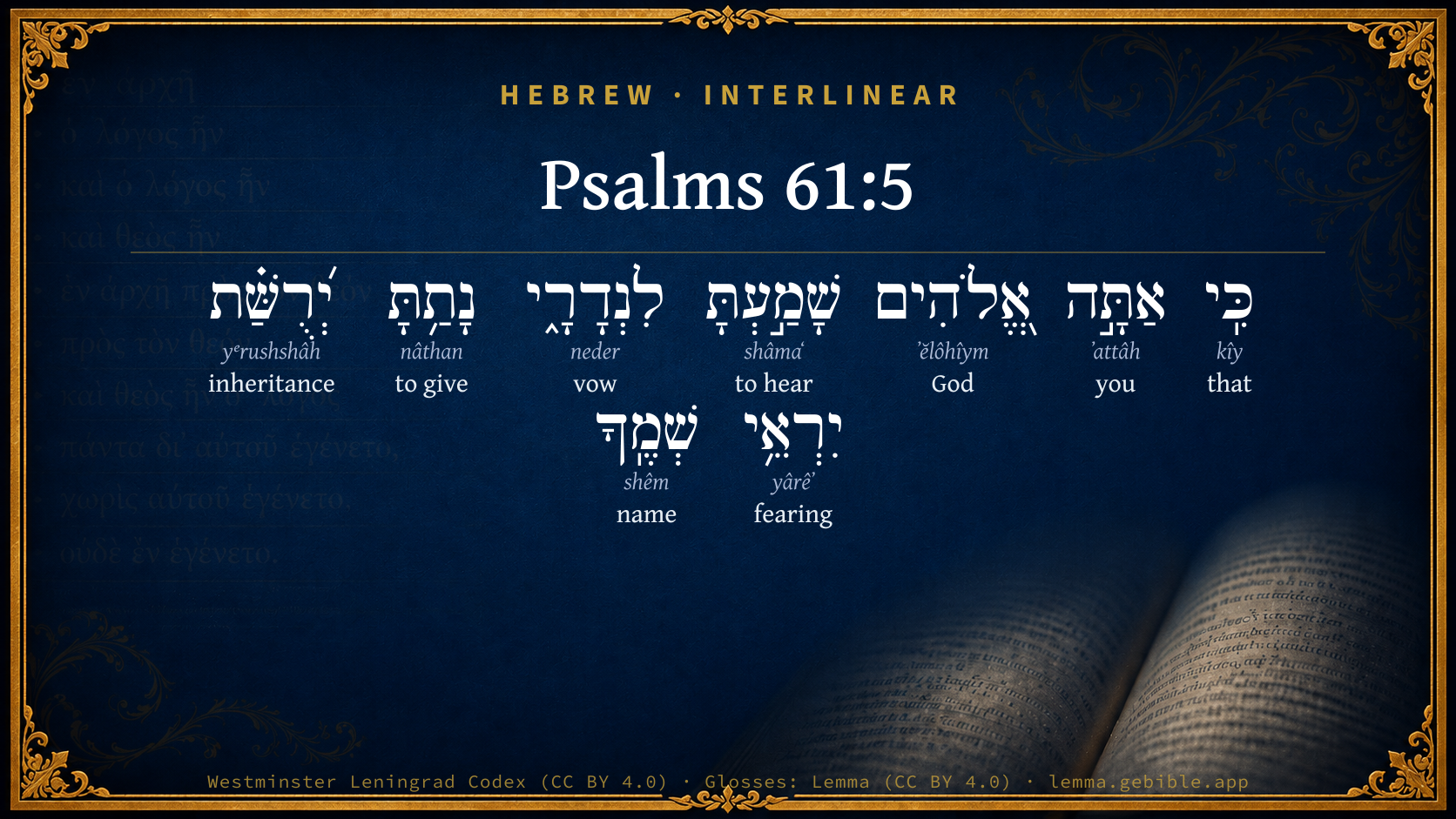
Psalms 61:5

Hebrew (Westminster Leningrad Codex) Psalms 61:5 appears in the Hebrew Old Testament. The text above is from the Westminster Leningrad Codex. Each word links to its Strong’s number, a concise gloss, and parsing drawn from the Open Scriptures Hebrew Bible morphology. Click any word for its full Brown-Driver-Briggs (BDB) entry.
Download image
Cite this verse

Psalms 61:5 (World English Bible). Public Domain. Lemma interlinear Bible study tool, https://lemma.gebible.app/v/psalms/61/5.

Show BibTeX & RIS
BibTeX
RIS
English Translation
For you, God, have heard my vows. You have given me the heritage of those who fear your name.
World English Bible · Public Domain
Download a study sheet

One document with this verse’s original text, its word-by-word gloss line, the meaning frame, cross-references with their text, attributed commentary, and full source and license credits — printable, and it pastes into notes with its structure intact.

This verse Autodidact and up

Study sheet (.html) Plain text (.txt)

A passage Seminary Student

Up to 50 verses in one chapter. A passage sheet keeps up to 6 commentary sources and 12 cross-references per verse, in the order this page ranks them, and says so on the sheet whenever that leaves anything out. Ask for a single verse and you get the Autodidact verse sheet above.

Everything on this page stays free to read, with no account — the sheet is a download of what is already on screen, not access to it.

Want to remove ads? Support Godless Engineer
Compare translations 3

The same verse in 3 English versions, stacked beneath the original-language interlinear above. Click any original word for its lexicon entry.

Each is an independent rendering of the whole verse — the interlinear is not word-aligned to these translations.

Highlighted words mark where these versions differ — a whole-verse word diff, not a word-by-word alignment.

  • World English Bible Public Domain
    For you, God, have heard my vows. You have given me the heritage of those who fear your name.
  • King James Version Public Domain
    For thou, O God, hast heard my vows: thou hast given me the heritage of those that fear thy name.
  • unfoldingWord Literal Text CC BY-SA 4.0
    For you, God, have listened to my vows. You have given the inheritance of the fearers of your name.

unfoldingWord Literal Text — © unfoldingWord, licensed CC BY-SA 4.0. Word-aligned USFM3 via Door43 (git.door43.org/unfoldingWord/en_ult).

Versions to compare (up to 4)

3 of 4 selected

Show all 18 translations

Every available English version of this verse, each an independent rendering of the whole verse.

  • World English Bible Public Domain
    For you, God, have heard my vows. You have given me the heritage of those who fear your name.
  • Berean Standard Bible Public Domain
    For You have heard my vows, O God; You have given me the inheritance reserved for those who fear Your name.
  • Majority Standard Bible Public Domain
    For You have heard my vows, O God; You have given me the inheritance reserved for those who fear Your name.
  • King James Version Public Domain
    For thou, O God, hast heard my vows: thou hast given me the heritage of those that fear thy name.
  • American Standard Version (1901) Public Domain
    For thou, O God, hast heard my vows: Thou hast given `me' the heritage of those that fear thy name.
  • Revised Version (1885) Public Domain
    For thou, O God, hast heard my vows: thou hast given me the heritage of those that fear thy name.
  • Geneva Bible (1599) Public Domain
    For thou, O God, hast heard my desires: thou hast giuen an heritage vnto those that feare thy Name.
  • Douay-Rheims (1899) Public Domain
    In thy tabernacle I shall dwell for ever: I shall be protected under the covert of thy wings.
  • Young's Literal Translation Public Domain
    For Thou, O God, hast hearkened to my vows, Thou hast appointed the inheritance Of those fearing Thy name.
  • Literal Standard Version CC BY-SA 4.0
    For You, O God, have listened to my vows, || You have appointed the inheritance || Of those fearing Your Name.
  • Unlocked Literal Bible CC BY-SA 4.0
    For you, God, have heard my vows, you have given me the inheritance of those who honor your name.
  • unfoldingWord Literal Text CC BY-SA 4.0
    For you, God, have listened to my vows. You have given the inheritance of the fearers of your name.
  • Darby Bible Public Domain
    For thou, O God, hast heard my vows; thou hast given [me] the inheritance of those that fear thy name.
  • World Messianic Bible Public Domain
    For you, God, have heard my vows. You have given me the heritage of those who fear your name.
  • Webster's Bible Public Domain
    \\61:4\\I will abide in thy tabernacle for ever: I will trust in the covert of thy wings. Selah.
  • Free Bible Version CC BY-SA 4.0
    For you, God, have heard the promises I've made. You have given all those who love your character your special blessing.
  • Bible in Basic English Public Domain
    For you, O God, have made answer to my prayers; you have given me the heritage of those who give honour to your name.
  • JPS Tanakh (1917) Public Domain
    (61-6) For Thou, O God, hast heard my vows; Thou hast granted the heritage of those that fear Thy name.

Literal Standard Version (2020), Covenant Press — licensed CC BY-SA 4.0. Text via the HelloAO Bible API (eBible.org). Unlocked Literal Bible (unfoldingWord) — licensed CC BY-SA 4.0. Text via the HelloAO Bible API (eBible.org). unfoldingWord Literal Text — © unfoldingWord, licensed CC BY-SA 4.0. Word-aligned USFM3 via Door43 (git.door43.org/unfoldingWord/en_ult). Free Bible Version, Dr. Jonathan Gallagher — licensed CC BY-SA 4.0. Text via the HelloAO Bible API (eBible.org).

Word by word

More ways to search: Search by grammar → Find every occurrence → Compare this word →

Practice this passage: Drill this verse → Learn its vocabulary →

About this verse

These counts appear in no published source. They are computed here, from the morphology-tagged text and Lemma’s own curated glosses. What Lemma adds →

9
words
9
distinct lemmas
Wisdom
section

Notable vocabulary

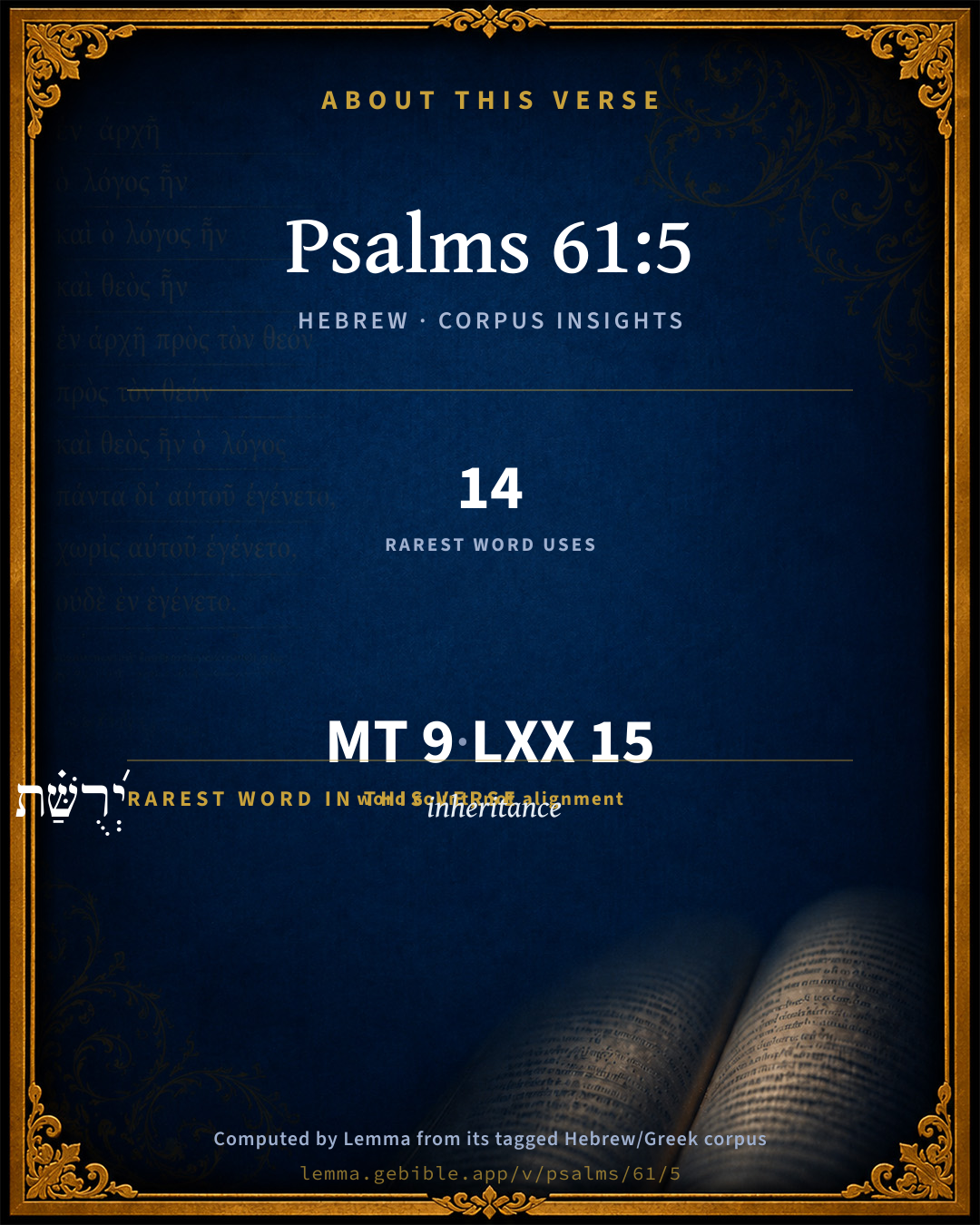
The rarest word here is יְ֝רֻשַּׁ֗ת inheritance H3425 — appearing just 14 times in the whole Hebrew Bible.

Shared distinctive vocabulary

יְ֝רֻשַּׁ֗ת inheritance H3425 occurs in 12 verses of the Hebrew Bible. Also found in:

Grammatical profile

  • 2 verbs
  • 4 nouns
  • 1 adjective
  • 1 pronoun
  • 1 conjunction

Verb forms

  • שָׁמַ֣עְתָּ Qal · Perfect
  • נָתַ֥תָּ Qal · Perfect

Hebrew & Septuagint length

In English translation the verse runs 19 words from the Hebrew and 19 from the Septuagint (LXX English) — the same length.

A rough comparison of the two English renderings, which tokenize alike — not a word-level alignment.

Word counts can differ between the Hebrew and the Greek without any difference in meaning — e.g. the Hebrew direct-object marker אֵת has no separate Greek word, and Greek often adds the article ὁ.

In the original languages it is 9 Hebrew tokens and 15 Greek tokens — but the two are counted differently (Hebrew bundles its prefixes and suffixes into one token; the Greek is in lemma form), so that isn’t a like-for-like length.

Cross-references

8

Topical passages linked to Psalms 61:5 in the Treasury of Scripture Knowledge — connected by theme and wording, ordered by reader-vote popularity; previews shown in the World English Bible.

  • Psalms 56:12 Your vows are on me, God. I will give thank offerings to you.
  • Malachi 3:16–18 Then those who feared Yahweh spoke one with another; and Yahweh listened, and heard, and a book of memory was written before him, for those who feared Yahweh, and who honored his name.
  • Psalms 86:11 Teach me your way, Yahweh. I will walk in your truth. Make my heart undivided to fear your name.
  • Psalms 115:13 He will bless those who fear Yahweh, Both small and great.
  • Psalms 16:5–6 Yahweh assigned my portion and my cup. You made my lot secure.
  • Psalms 65:1 Praise waits for you, God, in Zion. To you shall vows be performed.
  • Psalms 66:19 But most assuredly, God has listened. He has heard the voice of my prayer.
  • Acts 10:35 but in every nation he who fears him and works righteousness is acceptable to him.

Cross-references courtesy of OpenBible.info (CC BY 4.0).

Hebrew and Greek witnesses Masoretic Hebrew ↔ Greek Septuagint

The same verse in the two great witnesses to the Old Testament, shown verse-for-verse.

You’re reading Greek Psalm 60 (Hebrew Psalm 61). The Septuagint counts the superscription, so verse numbers can differ from the Hebrew — chapter-level alignment, not verse-by-verse. Numbering follows Rahlfs.

These are two independent witnesses, not word-aligned to each other, and the Septuagint is shown in lemma (dictionary) form.

Hebrew Psalms 61:5 Masoretic · Westminster Leningrad Codex

כִּֽי אַתָּ֣ה אֱ֭לֹהִים שָׁמַ֣עְתָּ לִנְדָרָ֑י נָתַ֥תָּ יְ֝רֻשַּׁ֗ת יִרְאֵ֥י שְׁמֶֽךָ

For you, God, have heard my vows. You have given me the heritage of those who fear your name.

World English Bible · Public Domain

Greek LXX Greek Psalm 60:5 Septuagint · lemma form

παραοἰκέω ἐν ὁ σκήνωμα σύ εἰς ὁ αἰών σκεπάζω ἐν σκέπης ὁ πτέρυξ σύ διάψαλμα

For you, o God, have heard my prayers; you have given an inheritance to them that fear your name.

LXX2012 (modern English Septuagint) · Public Domain

On this verse, Ellicott's Commentary for English Readers discusses the Septuagint’s reading. Read the note in Commentary ↓

Hebrew: Westminster Leningrad Codex (CC BY 4.0). Greek: Septuagint (public domain); English from LXX2012 (modern English Septuagint) (Public Domain). How the Septuagint differs from the Hebrew →

Commentary

Notes on Psalms 61:5 from classic Christian and Jewish commentators (each source and its license shown beneath its notes). The classic Christian expositions comment on the surrounding passage and are grouped to its opening verse, so a note may address several verses; the Jewish commentaries on the Tanakh (Rashi and others) are per-verse, so they appear only where the commentator wrote on this verse.

Lemma curates 59 commentaries, every one of them public domain or Creative Commons licensed, each selected and text-cleaned for this edition rather than reprinted as found. About our sources →

Matthew Henry's Commentary

In these verses we may observe,

I. With what pleasure David looks back upon what God had done for him formerly (Psa 61:5): Thou, O God! hast heard my vows, that is, 1. "The vows themselves which I made, and with which I bound my soul: thou hast taken notice of them; thou hast accepted them, because made in sincerity, and been well pleased with them; thou hast been mindful of them, and put me in mind of them." God put Jacob in mind of his vows, Gen 31:13; Gen 35:1. note, God is a witness to all our vows, all our good purposes, and all our solemn promises of new obedience. He keeps an account of them, which should be a good reason with us, as it was with David here, why we should perform our vows, Psa 61:8. For he that hears the vows we made will make us hear respecting them if they be not made good. 2. "The prayers that went along with those vows; those thou hast graciously heard and answered," which encouraged him now to pray, O God! hear my cry. He that never did say to the seed of Jacob, Seek you me in vain, will not now begin to say so. "Thou hast heard my vows, and given a real answer to them; for thou hast given me a heritage of those that fear thy name." Note, (1.) There is a peculiar people in the world that fear God name, that with a holy awe and reverence accept of and accommodate themselves to all the discoveries he is pleased to make of himself to the children of men. (2.) There is a heritage peculiar to that peculiar people, present comforts, earnests of their future bliss. God himself is their inheritance, their portion for ever. The Levites that had God for their inheritance must take up with him, and not expect a lot like their brethren; so those that fear God have enough in him, and therefore must not complain if they have but little of the world. (3.) We need desire no better heritage than that of those who fear God. If God deal with us as he uses to deal with those that love his name we need not desire to be any better dealt with.

II. With what assurance he looks forward to the continuance of his life (Psa 61:6): Thou shalt prolong the king's life. This may be understood either, 1. Of himself. If it was penned before he came to the crown, yet, being anointed by Samuel, and knowing what God had spoken in his holiness, he could in faith call himself the king, though now persecuted as an out-law; or perhaps it was penned when Absalom sought to dethrone him, and force him into exile. There were those that aimed to shorten his life, but he trusted to God to prolong his life, which he did to the age of man set by Moses (namely, seventy years), which, being spent in serving his generation according to the will of God (Act 13:36), might be reckoned as many generations, because many generations would be the better for him. His resolution was to abide in God's tabernacle for ever (Psa 61:4), in a way of duty; and now his hope is that he shall abide before God for ever, in a way of comfort. Those abide to good purpose in this world that abide before God, that serve him and walk in his fear; and those that do so shall abide before him for ever. He speaks of himself in the third person, because the psalm was delivered to the chief musician for the use of the church, and he would have the people, in singing it, to be encouraged with an assurance that, notwithstanding the malice of his enemies, their king, as they wished, should live for ever. Or, 2. Of the Messiah, the King of whom he was a type. It was a comfort to David to think, whatever became of him, that the years of the Lord's Anointed would be as many generations, and that of the increase of his government and peace there should be no end. The Mediator shall abide before God for ever, for he always appears in the presence of God for us, and ever lives, making intercession; and, because he lives, we shall live also.

III. With what importunity he begs of God to take him and keep him always under his protection: O prepare mercy and truth which may preserve him! God's promises and our faith in them are not to supersede, but to quicken and encourage prayer. David is sure that God will prolong his life, and therefore prays that he would preserve it, not that he would prepare him a strong lifeguard, or a well-fortified castle, but that he would prepare mercy and truth for his preservation; that is, that God's goodness would provide for his safety according to the promise. We need not desire to be better secured than under the protection of God's mercy and truth. This may be applied to the Messiah: "Let him be sent in the fulness of time, in performance of the truth to Jacob and the mercy to Abraham." Mic 7:20; Luk 1:72, Luk 1:73.

IV. With what cheerfulness he vows the grateful returns of duty to God (Psa 61:8): So will I sing praise unto thy name for ever. Note, God's preservation of us calls upon us to praise him; and therefore we should desire to live, that we may praise him: Let my soul live, and it shall praise thee. We must make praising God the work of our time, even to the last (as long as our lives are prolonged we must continue praising God), and then it shall be made the work of our eternity, and we shall be praising him for ever. That I may daily perform my vows. His praising God was itself the performance of his vows, and it disposed his heart to the performance of his vows in other instances. Note, 1. The vows we have made we must conscientiously perform. 2. Praising God and paying our vows to him must be our constant daily work; every day we must be doing something towards it, because it is all but little in comparison with what is due, because we daily receive fresh mercies, and because, if we think much to do it daily, we cannot expect to be doing it eternally.

Matthew Henry's Commentary on the Whole Bible (1708–1710) — public domain (CC PDM 1.0). Text via the HelloAO Bible API.

Trapp's Complete Commentary

John Trapp

Psa 61:5 For thou, O God, hast heard my vows: thou hast given [me] the heritage of those that fear thy name.

Ver. 5. For thou, O God, hast heard my vows] i.e. My prayers, which had vows of thankfulness annexed unto them. Hinc Graeci precationem dicunt προσευχην.

Thou hast given me the heritage] Even the sure mercies of David, grace and glory; and inheritance in the world to come, as the Chaldee hath it; besides what we have here.

John Trapp, A Commentary or Exposition upon All the Books of the Old and New Testament (1647–1656) — public domain. Text from a community e-Sword module.

The Biblical Illustrator

Joseph S. Exell

Psa_61:5

Thou hast given me the heritage of those that fear Thy name.

Our heritage

So, then, they that fear God have an heritage. Not, perhaps, in this world, but even as to temporal good, they are often above others. And as to spiritual good--they have indeed a goodly heritage. The Lord is their portion and His promises, and the inheritance in heaven. Now, this heritage is given. And we may know that we possess it. Thou hast given me, etc. Can we read our title clear? Blessed are they that do hunger and thirst after righteousness. (W. Jay.)

The Biblical Illustrator, edited by Joseph S. Exell (c. 1880s–1900s) — public domain. Text from a community e-Sword module.

The Treasury of David

Charles H. Spurgeon

Ver. 5. For thou, O God, hast heard my vows. Proofs of divine faithfulness are to be had in remembrance, and to be mentioned to the Lord's honour. The prayer of Ps 61:1 is certain of an answer because of the experience of Ps 61:5, since we deal with an immutable God.

Vows may rightly be joined with prayers when they are lawful, well considered, and truly for God's glory. It is great mercy on God's part to take any notice of the vows and promises of such faithless and deceitful creatures as we are. What we promise him is his due already, and yet he deigns to accept our vows as if we were not so much his servants as his free suitors who could give or withhold at pleasure.

Thou hast given me the heritage of those that fear thy name. We are made heirs, joint heirs with all the saints, partakers of the same portion. With this we ought to be delighted. If we suffer, it is the heritage of the saints; if we are persecuted, are in poverty, or in temptation, all this is contained in the title deeds of the heritage of the chosen. Those we are to sup with we may well be content to dine with. We have the same inheritance as the Firstborn himself; what better is conceivable? Saints are described as fearing the name of God; they are reverent worshippers; they stand in awe of the Lord's authority; they are afraid of offending him, they feel their own nothingness in the sight of the Infinite One. To share with such men, to be treated by God with the same favour as he metes out to them, is matter for endless thanksgiving. All the privileges of all the saints are also the privileges of each one.

Ver. 5. (first clause). About this time I began to know that there is a God who hears and answers prayer. John Newton, in his Journal.

Ver. 5. Thou, O God, hast heard my vows: that is, his prayers, which are always to be put up with vows. Indeed, that prayer is a blank which hath not a vow in it. Is it a mercy thou prayest him to give? If sincere, thou wilt vow to praise him for it, and serve him with it. Is it a sin thou prayest against? Except you juggle with God, thou wilt vow as well as pray against it. William Gurnall.

Ver. 5. The heritage. Eternal life is called an inheritance. Theodoret remarks: "The true inheritance is eternal life, concerning which Christ saith to the sheep on his right hand, Come, ye blessed of my Father, inherit the kingdom prepared for you before the foundation of the world. This inheritance the Lord giveth to them that fear him." In Eph 1:14, the Spirit is called "the earnest of our inheritance." In Col 1:12, the apostle exhorts them "to give thanks unto the Father, who hath made them meet to be partakers of the inheritance of the saints in light." On this verse we have the golden comment of Chrysostom, reiterated by Theophylact. He calls it an inheritance, to show that no man obtaineth the kingdom by his own good works; for no man hath so lived as to render himself worthy of the kingdom, but all is of the grace of God. Wherefore he saith, "When ye have done all, say that we are unprofitable servants, for we have only done that which we ought to have done." John Caspar Suicer's "Thesaurus, "1728.

Ver. 5. (second clause). Enquire whether or no it fares with us as with the saints.

Ver. 5,8.

I. Vows heard in heaven.

II. Vows to be carefully fulfilled on earth.

Ver. 5. (second clause).

I. They that fear God have a "heritage."

II. This heritage is "given."

III. We may know that we possess it. William Jay.

Psalms 61:6*

Ver. 5,8.

I. Vows heard in heaven.

II. Vows to be carefully fulfilled on earth.

Charles H. Spurgeon's The Treasury of David (1869–1885) — public domain. Psalms only. Text from a community e-Sword/MySword module.

Joseph Benson's Commentary

Psa 61:5. For thou, O God, hast heard my vows — My fervent prayers, attended with vows and promises, as was usual, especially in cases of great danger or difficulty. Thou hast taken notice of them; thou hast accepted them, because they were made in sincerity, and hast been well pleased with them. We ought always to remember that God is a witness to all our vows, all our good purposes, and solemn promises of new obedience. He keeps an account of them, which should be a sufficient reason with us (as it was with David here) why we should perform our vows. For he that hears the vows we make, will cause us to hear from him if they be not made good. Thou hast given me the heritage, &c. — Thou hast allotted me my portion with and among them that fear and worship thee, who are the excellent ones, in whom is all my delight, and upon that account I must acknowledge it to thy praise, that I have a goodly heritage. Thou hast granted me this singular mercy, to live in thy land, to enjoy thy presence, and to worship in thy tabernacle; which is the heritage which all, that fear thee, prize and desire above all things.

Joseph Benson's Commentary on the Old and New Testaments (1811–1818) — public domain. Text from a community e-Sword module.

Keil & Delitzsch

C. F. Keil & F. Delitzsch

The second part begins with a confirmation of the gracious purpose of God expressed in Psa 61:5. David believes that he shall experience what he gives expression to in Psa 61:5; for God has already practically shown him that neither his life nor his kingship shall come to an end yet; He has answered the prayers of His chosen one, that, blended with vows, resulted from the lowly, God-resigned spirit which finds expression in Sa2 15:25., and He has given or delivered up to him the land which is his by inheritance, when threatened by the rebels as robbers, - the land to which those who fear the covenant God have a just claim. It is clear enough that the receivers are "those who fear the name of Jahve;" the genitive relation describes the ירשּׁה as belonging to them in opposition to those who had usurped it. Or does ירשּׁה here perhaps mean the same as ארשׁת in Psa 21:3? Certainly not. נתן ירשּׁה ל is a customary phrase, the meaning of which, "to give anything to any one as his inheritance or as his own property," is to be retained (e.g., Deu 2:19). God has acknowledged David's cause; the land of Israel is again wrested from those to whom it does not belong; and now begins a new era in the reign of its rightful king. In view of this the king prays, in Psa 61:7, Psa 61:8, that God would add another goodly portion to the duration of his life. The words sound like intercession, but the praying one is the same person as in Psa 61:2-5. The expression מלכּא משׁיחא (the King Messiah) of the Targum shows to whom the church referred the word "king" after the extinction of the Davidic dynasty. The exalted tone of the wish expressed in Psa 61:7 (cf. Joe 2:2) favours this without absolutely requiring it (cf. עולמים, Psa 61:5, Psa 21:5, and the royal salutation, Kg1 1:31; Dan 2:4, and frequently). There ought (as also e.g., in Psa 9:8) not to be any question whether ישׁב in Psa 61:8 signifies "to sit enthroned," or "to sit" = "to abide;" when the person spoken of is a king it means "to remain enthroned," for with him a being settled down and continuous enthronement are coincident. מן in Psa 61:8 is imperat. apoc. for מגּה (after the form הס, נס, צו). The poet prays God to appoint mercy and truth as guardian angels to the king (Psa 40:12, Pro 20:28, where out of pause it is צּרוּ; cf. on the other hand Psa 78:7; Pro 2:11; Pro 5:2). Since the poet himself is the king for whom he prays, the transition to the first person in v. 9 is perfectly natural. כּן signifies, as it always does, so or thus = in accordance therewith, corresponding to the fulfilment of these my petitions, thankfully responding to it. לשׁלּמי is the infinitive of the aim or purpose. Singing praise and accompanying it with music, he will make his whole life one continuous paying of vows.

Keil & Delitzsch — Biblical Commentary on the Old Testament (1861–1891) — public domain (CC PDM 1.0). Text via the HelloAO Bible API. (Old Testament only.)

J. A. Alexander on Psalms

Joseph Addison Alexander

6. (Psa 61:5). For thou, O God, hast heard (or hearkened to) my vows (and the prayers which they accompanied); thou hast given me the heritage of those fearing (or the fearers of) thy name, i.e. the reverential worshippers of thy revealed perfections. See above, on Psa 54:1. The heritage here mentioned is participation in the honours and privileges of the chosen people, with particular though tacit reference to the vicarious royalty conferred on David, and ensured to his posterity in answer to his prayers. See above, on Ps. x21:2-4, and compare 2Sa 7:16.

Joseph Addison Alexander, The Psalms Translated and Explained (1850) — public domain. Text from a community e-Sword module.

Tyndale Open Study Notes

Tyndale Open Resources

61:5 you have heard my vows: The psalmist’s vows might also be a part of ceremonial sacrifices (66:13-15; 76:11; 116:14, 18). He praises and thanks God for his rescue. • The inheritance refers to the promise of the land (see Ps 60), the sacredness of the Temple, the joy of God’s presence (119:111), or any similar reward (16:6; 37:9, 11, 18, 22, 29, 34; 127:3).

Tyndale Open Study Notes — © Tyndale Open Resources, licensed CC BY-SA 4.0. Text via the HelloAO Bible API.

Geneva Bible (1599)

Geneva Bible translators

There is nothing that doth more strengthen our faith, than the remembrance of God’s succor in times past.

Geneva Bible (1599) marginal notes — public domain. Text via Bolls.life.

Jamieson, Fausset & Brown

Robert Jamieson, A. R. Fausset & David Brown

the heritage--or, part in the spiritual blessings of Israel (Psa 21:2-4).

vows--implies prayers.

Jamieson, Fausset & Brown — Commentary Critical and Explanatory on the Whole Bible (1871) — public domain (CC PDM 1.0). Text via the HelloAO Bible API.

Adam Clarke's Commentary

Verse 5. Hast heard my vows] Often have I purposed to be wholly thine, -to serve thee alone, - to give up my whole life to thy service: and thou hast heard me, and taken me at my word; and given me that heritage, the privilege of enjoying thee in thy ordinances, which is the lot of them that fear thy name. The Psalm seems to have been composed either after the captivity, or at the time that Cyrus published his decree in their favour, as has been remarked before.

Adam Clarke's Commentary on the Bible (1810–1826) — public domain. Text from a community e-Sword/MySword module.

John Calvin's Commentaries

5. For thou, O God! hast heard my vows. He here shows the grounds upon which he had spoken of his abiding under the wings of God. The sudden joy which he experienced arose from the circumstance of God’s having heard his prayers, and made light to spring out of darkness. By his vows we must understand his prayers, according to a common figure of speech by which the part is taken for the whole, having made vows when he prayed. In general, he would acknowledge himself indebted for his restoration entirely to an interposition of Divine power, and not to any dexterity which he had shown in gaining time for the collection of his forces, nor to any assistance which he had derived, either from the favor of the priests or the exertions of his soldiers. Had the letter ל, lamed, been prefixed to the Hebrew word יראי, yirey, which is rendered fearing, there would have been no reason left to doubt that the words which follow were of the nature of a general assertion, to the effect, that God has given the inheritance to those who fear him. As it is, they may be construed to mean, that God had given David the inheritance of those who fear him. Still I prefer attaching the more general sense to the words, and understand them as intimating that God never disappoints his servants, but crowns with everlasting happiness the struggles and the distresses which may have exercised their faith. They convey an implied censure of that unwarrantable confidence which is indulged in by the wicked, when favored, through the divine forbearance, with any interval of prosperity. The success which flatters them is merely imaginary, and speedily vanishes. But inheritance — the word here employed by David — suggests that the people of God enjoy a species of prosperity more solid and enduring; their momentary and short-lived troubles having only the effect of promoting their eternal welfare. He praises God that those who fear his name are not left to the poor privilege of rejoicing for a few days, but secured in a permanent heritage of happiness. The truth is one which cannot be questioned. The wicked, having no possession by faith of the divine benefits which they may happen to share, live on from day to day, as it were, upon plunder. It is only such as fear the Lord who have the true and legitimate enjoyment of their blessings.

John Calvin's Commentaries (1540-1563) — public domain. Text from the Calvin Translation Society English edition (1840s-50s) via the Christian Classics Ethereal Library (ccel.org). Calvin's coverage is partial (roughly two-thirds of the Bible); uncommented books and verses are honest gaps, never fabricated. The 19th-century editor's footnotes and remarks are omitted so the notes are faithfully Calvin's own voice.

Ellicott's Commentary for English Readers

(5) Heritage.—As the Authorised Version runs, the heritage is length of days, one promised generally to those who fear Jehovah (Pro_10:27; Pro_19:23), and particularly to Israel (Deu_6:2) and its kings (Deu_17:19-20, which passage may have been in the psalmist’s mind). But the LXX. and Vulg. read, “to them that fear thy name,” meaning, of course, by the heritage, Canaan.

A Bible Commentary for English Readers, edited by Charles John Ellicott (1878–1897) — public domain. Text from a community e-Sword module.

The Cambridge Bible for Schools and Colleges

gen. ed. J. J. S. Perowne

5. host heard my vows] Vows accompanied by prayers.

thou hast given me the heritage of those that fear thy name] Me is not in the original; and it is best to supply the remoter object of the verb from the complement of the nearer object, and render with LXX, (Vulg.), Jer., P.B.V., thou hast given (their) possession to them that fear thy name. ‘Possession’ is the term regularly used of Israel’s ‘occupation’ of the land of Canaan (Deu_2:19; Deu_3:18; &c.; Psa_37:9; Psa_37:11; Psa_37:22; Psa_37:29; Psa_37:34). The collapse of Absalom’s rebellion has restored the true and loyal Israelites, who shewed their fear of God’s name by adhering to the king of His choice, to the possession of their rightful inheritance, from which they were in danger of being expelled.

It is best to regard the perfects not as ‘perfects of confidence’ that his prayers will surely be heard, but as referring to past experience. The insurrection has been crushed: but the king awaits restoration (Psa_61:4).

5–8. Such prayers David can offer in confidence, for his prayers have already been partially answered. He can look forward in faith to the fulfilment of the promises God has made to His king, and he will spend the rest of his life in grateful thanksgiving.

The Cambridge Bible for Schools and Colleges (gen. ed. J. J. S. Perowne; Cambridge University Press, 1878–1918) — public domain. Text from a community e-Sword module.

John Gill's Exposition

For thou, O God, hast heard my vows,.... Or "my prayers", as the Septuagint and other versions. Vows are so called, because it was usual to make vows in trouble, when prayer was made to the Lord for help and deliverance, Psa 66:13. This is a reason why the psalmist was encouraged to put his trust in the Lord, because his prayers were heard by him; or he was sure they would be, as he had entreated, Psa 61:1. The past is put for the future, as Kimchi and Ben Melech observe; and it may be because of the certainty of his prayers being heard; and which may be concluded from the Lord's declaring himself a God hearing prayer, from the prevalent mediation of Christ, from the assistance and intercession of the Spirit, and from the exercise of faith in prayer, and the divine promises; or while he was crying to God an answer was returned, and he was delivered out of his troubles, Isa 65:24. Another reason follows:

thou hast given me the heritage of those that fear thy name: not the land of Israel, as Aben Ezra and Jarchi; which was given for an inheritance to the posterity of Abraham, Psa 105:11; and which was never more fully in their possession than in the times of David: nor the tabernacle or sanctuary of the Lord, as Kimchi; where he desired to dwell, Psa 61:4; and now had his request granted: but the heavenly glory, the incorruptible inheritance, the inheritance of the saints in light, prefigured by them both; which is the gift of God their Father to them his children; comes to them through the death of Christ the testator; is not of the law, and the works of it; is not acquired nor purchased; but is owing to the free grace of God; to predestinating grace, as the source of it; to justifying grace, through the righteousness of Christ, as the right unto it; and to regenerating and sanctifying grace, as the meetness for it. Wherefore it manifestly belongs to those that "fear the name of the Lord", himself, his perfections, particularly his goodness; who adore and admire, serve and worship him, internally and externally; not with a slavish fear, but with a filial godly fear. The Targum renders it,

"thou hast given an inheritance to them that fear thy name;''

that in the King's Bible is,

"an inheritance in the world to come;''

so the Septuagint, Vulgate Latin, and the Oriental versions; and which sense is given by Aben Ezra. It may be understood of them that fear the Lord, being the inheritance itself; as they are of Christ, David's son and antitype, and who is designed in Psa 61:6, see Deu 32:9, Psa 2:8.

John Gill's Exposition of the Whole Bible (1746–1763) — public domain (CC PDM 1.0). Text via the HelloAO Bible API.

Albert Barnes' Notes on the Bible

For thou, O God, hast heard my vows - That is, my prayers accompanied with solemn pledges or promises that I will devote myself to thy service. In some way David had the assurance that those vows and prayers had been heard; that God would answer his supplications - that he would restore him to his home, and to the privilege of uniting with others in the sacred services of the sanctuary. In what way he had this assurance we are not informed, but the statement here accords with what we often find in the Psalms. His troubled mind became calm, for he looked upon the blessing as already granted. He entertained no doubt that what he had asked would be bestowed. The mind of a true believer often feels this assurance now. Somehow he feels an undoubting persuasion that the prayer which he has offered has been heard; that God will be merciful; that the blessing which has been sought will assuredly be conferred. That there may be danger of illusion here, no one can doubt - for we are not, as David was, inspired; but no one can prove that God may not impart such a gracious assurance to the soul; no one can show that it is wrong for a believer to allow peace to flow into his soul, in the confident hope that the blessing which he had sought will be his.

Thou hast given me the heritage of those that fear thy name - The heirship which pertains to such; the privileges of those who are the true children of God. One of these privileges is that of prayer; another is the peace which results from adoption into the family of God; of feeling that we are his heirs. Compare the notes at Rom 8:16-17.

Albert Barnes' Notes on the Bible (1834–1885) — public domain. Text from a community e-Sword/MySword module.

Matthew Poole's English Annotations

My vows; my fervent prayers, attended with many vows and promises, as was usual, especially in cases of great danger or difficulty, Gen 28:20; Jdg 11:30,31. Thou hast allotted me my portion with and amongst them that fear and worship thee, who are the

excellent ones, in whom is all my delight; and upon that account I must acknowledge it to thy praise, that the lines are fallen to me in pleasant places; yea, I have a goodly heritage, Psa 16:3,6. Thou hast granted me this singular mercy, to live in God’s land, and to enjoy his presence and favour, and to worship in his tabernacle; which is the heritage that I and all that fear thee prize and desire above all things in the world.

Matthew Poole's English Annotations on the Holy Bible (1683–1685) — public domain. Text from a community e-Sword/MySword module.

Whedon's Commentary on the Bible

Daniel D. Whedon

5. My vows—A sacred bond of union and covenant between him and God, and he appeals to them as such.

Given me the heritage of those that fear thy name— “Fear” of God is often put for true piety in the Old Testament, and the promises of both temporal and spiritual good are restricted to this character. The possession here named is real, as the word denotes, not merely promissory. God had conferred on him the portion of the righteous, and his enemies cannot wrest it from him. Comp. Psa_21:2-4

Daniel D. Whedon (gen. ed.), Commentary on the Old and New Testaments (1874–1909) — public domain. Text from a community e-Sword module.

The Pulpit Commentary

For thou, O God, hast heard my vows. Thou hast heard me so often in the past, thou hast granted so many of my prayers, accepted so many of my vows, that I am emboldened to make further requests. Thou hast given me the heritage of those that fear thy Name. All the blessed inheritance of thy saints thou hast made mine, and, included in it, boldness to approach the throne of grace in full assurance of faith, and to present to thee my petitions.

The Pulpit Commentary (1880–1919), ed. H.D.M. Spence-Jones & Joseph S. Exell — public domain. Text from a community e-Sword module.

John Wesley's Explanatory Notes

Heritage - Thou hast granted me this singular mercy, to live in God's land, to enjoy his presence, and to worship in his tabernacle; which is the heritage that all that fear thee, prize and desire above all things.

John Wesley, Explanatory Notes Upon the Whole Bible (1754–1765) — public domain. Text via the GEBible commentary corpus.

Rashi

Rabbi Shlomo Yitzchaki (Rashi)

I shall dwell in Your tent to eternity Grant me the privilege in this world and in the world to come.

Rashi on the Tanakh — English translations: “The Judaica Press complete Tanach with Rashi, translated by A. J. Rosenberg” (CC BY 4.0); “Pentateuch with Rashi's commentary by M. Rosenbaum and A.M. Silbermann, 1929-1934” (public domain); “The Metsudah Tanach series, Lakewood, N.J” (CC BY 4.0); and “The Book of Joshua, Metsudah Publications, 1997” (CC BY 4.0). Text via Sefaria.

Lesson kit

Teaching starters — assembled from the data on this page, not authored interpretation. Every prompt links to the verse data it draws on. Edit before teaching.

Psalms, in the Wisdom, opens this verse with 9 words (9 distinct Hebrew lemmas). Its most distinctive word is yᵉrushshâh (“inheritance”). A historical commentator’s framing appears above. Read the whole chapter for the surrounding context.

Discussion questions

  1. How does “inheritance” (yᵉrushshâh) shape what this verse is saying?
  2. Deuteronomy 2:5 shares the word «inheritance» with this verse. How do the two illuminate each other?
  3. These translations render this verse differently; the difference is in the English rendering, not the original. What questions does that raise?
  4. The verb «שָׁמַ֣עְתָּ» is Qal Perfect. How does its form color the action?
  5. Reading how Matthew Henry's Commentary and Trapp's Complete Commentary read this verse, where do the two commentators agree and where do they part?

Things to notice

Reading settings

Reading text

Shown beneath each verse's original-language words.

Old Testament
Old Testament edition

Read the OT as the Masoretic Hebrew (MT) or the Greek Septuagint (LXX).

English shown for the Greek Septuagint (in the Hebrew ↔ Greek comparison).

Comparing translations? Open the Compare panel on any verse page to stack up to four side by side.