
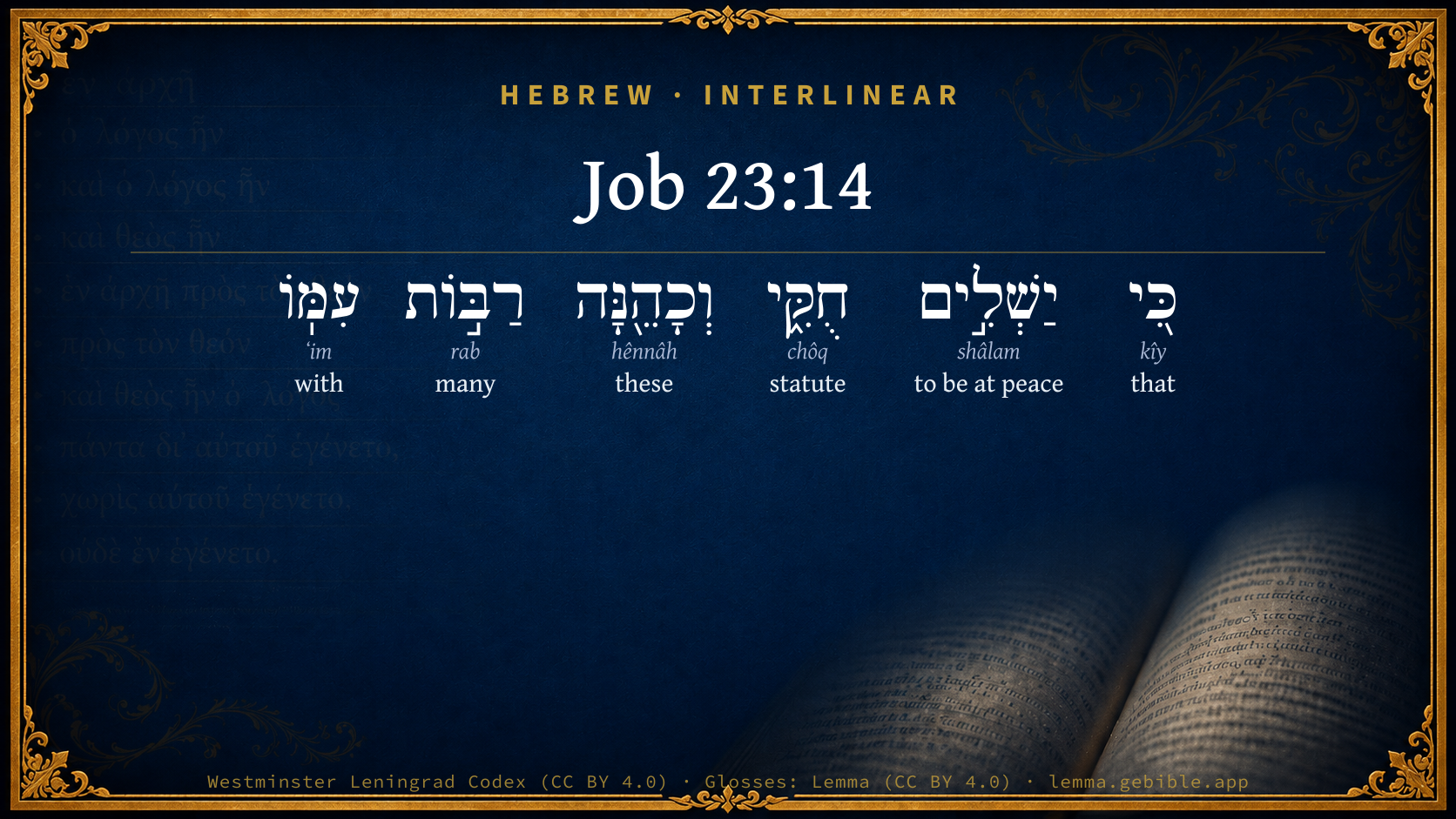
Job 23:14

Hebrew (Westminster Leningrad Codex) Job 23:14 appears in the Hebrew Old Testament. The text above is from the Westminster Leningrad Codex. Each word links to its Strong’s number, a concise gloss, and parsing drawn from the Open Scriptures Hebrew Bible morphology. Click any word for its full Brown-Driver-Briggs (BDB) entry.
Download image
Cite this verse

Job 23:14 (World English Bible). Public Domain. Lemma interlinear Bible study tool, https://lemma.gebible.app/v/job/23/14.

Show BibTeX & RIS
BibTeX
RIS
English Translation
For he performs that which is appointed for me. Many such things are with him.
World English Bible · Public Domain
Download a study sheet

One document with this verse’s original text, its word-by-word gloss line, the meaning frame, cross-references with their text, attributed commentary, and full source and license credits — printable, and it pastes into notes with its structure intact.

This verse Autodidact and up

Study sheet (.html) Plain text (.txt)

A passage Seminary Student

Up to 50 verses in one chapter. A passage sheet keeps up to 6 commentary sources and 12 cross-references per verse, in the order this page ranks them, and says so on the sheet whenever that leaves anything out. Ask for a single verse and you get the Autodidact verse sheet above.

Everything on this page stays free to read, with no account — the sheet is a download of what is already on screen, not access to it.

Want to remove ads? Support Godless Engineer
Compare translations 3

The same verse in 3 English versions, stacked beneath the original-language interlinear above. Click any original word for its lexicon entry.

Each is an independent rendering of the whole verse — the interlinear is not word-aligned to these translations.

Highlighted words mark where these versions differ — a whole-verse word diff, not a word-by-word alignment.

  • World English Bible Public Domain
    For he performs that which is appointed for me. Many such things are with him.
  • King James Version Public Domain
    For he performeth the thing that is appointed for me: and many such things are with him.
  • unfoldingWord Literal Text CC BY-SA 4.0
    For he will carry out my decree, and many like these with him.

unfoldingWord Literal Text — © unfoldingWord, licensed CC BY-SA 4.0. Word-aligned USFM3 via Door43 (git.door43.org/unfoldingWord/en_ult).

Versions to compare (up to 4)

3 of 4 selected

Show all 18 translations

Every available English version of this verse, each an independent rendering of the whole verse.

  • World English Bible Public Domain
    For he performs that which is appointed for me. Many such things are with him.
  • Berean Standard Bible Public Domain
    For He carries out His decree against me, and He has many such plans.
  • Majority Standard Bible Public Domain
    For He carries out His decree against me, and He has many such plans.
  • King James Version Public Domain
    For he performeth the thing that is appointed for me: and many such things are with him.
  • American Standard Version (1901) Public Domain
    For he performeth that which is appointed for me: And many such things are with him.
  • Revised Version (1885) Public Domain
    For he performeth that which is appointed for me: and many such things are with him.
  • Geneva Bible (1599) Public Domain
    For he will performe that, which is decreed of me, and many such things are with him.
  • Douay-Rheims (1899) Public Domain
    And when he shall have fulfilled his will in me, many other like things are also at hand with him.
  • Young's Literal Translation Public Domain
    For He doth complete my portion, And many such things `are' with Him.
  • Literal Standard Version CC BY-SA 4.0
    For He completes my portion, || And many such things [are] with Him.
  • Unlocked Literal Bible CC BY-SA 4.0
    For he carries out his decree against me; there are many like them.
  • unfoldingWord Literal Text CC BY-SA 4.0
    For he will carry out my decree, and many like these with him.
  • Darby Bible Public Domain
    For he will perform [what] is appointed for me; and many such things are with him.
  • World Messianic Bible Public Domain
    For he performs that which is appointed for me. Many such things are with him.
  • Webster's Bible Public Domain
    For he performeth the thing that is appointed for me: and many such things are with him.
  • Free Bible Version CC BY-SA 4.0
    So he will finish whatever he has planned for me—and he has many plans for me.
  • Bible in Basic English Public Domain
    For what has been ordered for me by him will be gone through to the end: and his mind is full of such designs.
  • JPS Tanakh (1917) Public Domain
    For He will perform that which is appointed for me; and many such things are with Him.

Literal Standard Version (2020), Covenant Press — licensed CC BY-SA 4.0. Text via the HelloAO Bible API (eBible.org). Unlocked Literal Bible (unfoldingWord) — licensed CC BY-SA 4.0. Text via the HelloAO Bible API (eBible.org). unfoldingWord Literal Text — © unfoldingWord, licensed CC BY-SA 4.0. Word-aligned USFM3 via Door43 (git.door43.org/unfoldingWord/en_ult). Free Bible Version, Dr. Jonathan Gallagher — licensed CC BY-SA 4.0. Text via the HelloAO Bible API (eBible.org).

Word by word

More ways to search: Search by grammar → Find every occurrence → Compare this word →

Practice this passage: Drill this verse → Learn its vocabulary →

About this verse

These counts appear in no published source. They are computed here, from the morphology-tagged text and Lemma’s own curated glosses. What Lemma adds →

6
words
6
distinct lemmas
Wisdom
section

Shared distinctive vocabulary

וְכָהֵ֖נָּה these H2007 occurs in 44 verses of the Hebrew Bible. Also found in:

Grammatical profile

  • 1 verb
  • 1 noun
  • 1 adjective
  • 1 pronoun
  • 1 preposition
  • 1 conjunction

Verb forms

  • יַשְׁלִ֣ים Hiphil · Imperfect

Cross-references

9

Topical passages linked to Job 23:14 in the Treasury of Scripture Knowledge — connected by theme and wording, ordered by reader-vote popularity; previews shown in the World English Bible.

  • 1 Thessalonians 3:3 that no one be moved by these afflictions. For you know that we are appointed to this task.
  • 1 Thessalonians 5:9 For God didn't appoint us to wrath, but to the obtaining of salvation through our Lord Jesus Christ,
  • Psalms 77:19 Your way was through the sea; Your paths through the great waters. Your footsteps were not known.
  • Psalms 97:2 Clouds and darkness are around him. Righteousness and justice are the foundation of his throne.
  • Isaiah 40:27–28 Why say you, Jacob, and speak, Israel, My way is hid from Yahweh, and the justice [due] to me is passed away from my God?
  • Romans 11:33 Oh the depth of the riches both of the wisdom and the knowledge of God! How unsearchable are his judgments, and his ways past tracing out!
  • Job 7:3 So am I made to possess months of misery, Wearisome nights are appointed to me.
  • Micah 6:9 Yahweh's voice calls to the city, And wisdom sees your name: "Listen to the rod, And he who appointed it.
  • 1 Peter 2:8 and, "A stone of stumbling, and a rock of offense." For they stumble at the word, being disobedient, whereunto also they were appointed.

Cross-references courtesy of OpenBible.info (CC BY 4.0).

Hebrew and Greek witnesses Masoretic Hebrew ↔ Greek Septuagint

The same verse in the two great witnesses to the Old Testament, shown verse-for-verse.

These are two independent witnesses, not word-aligned to each other, and the Septuagint is shown in lemma (dictionary) form.

Hebrew Job 23:14 Masoretic · Westminster Leningrad Codex

כִּ֭י יַשְׁלִ֣ים חֻקִּ֑י וְכָהֵ֖נָּה רַבּ֣וֹת עִמּֽוֹ

For he performs that which is appointed for me. Many such things are with him.

World English Bible · Public Domain

Hebrew: Westminster Leningrad Codex (CC BY 4.0). Greek: Septuagint (public domain); English from a public-domain English Septuagint. How the Septuagint differs from the Hebrew →

Commentary

Notes on Job 23:14 from classic Christian and Jewish commentators (each source and its license shown beneath its notes). The classic Christian expositions comment on the surrounding passage and are grouped to its opening verse, so a note may address several verses; the Jewish commentaries on the Tanakh (Rashi and others) are per-verse, so they appear only where the commentator wrote on this verse.

Lemma curates 59 commentaries, every one of them public domain or Creative Commons licensed, each selected and text-cleaned for this edition rather than reprinted as found. About our sources →

Trapp's Complete Commentary

John Trapp

Job 23:14 For he performeth [the thing that is] appointed for me: and many such [things are] with him.

Ver. 14. For he performeth the thing that is appointed for me] He hath performed all my necessaries; so Vatablus rendereth it. It is the word that was used for appointed or necessary food, Job 23:12. Voluntas Dei, necessitas rei, God hath decreed thus to deal with me, and therein I must rest satisfied.

And many such things are with me] I know not but that there may be many more sufferings yet decreed to come upon me in his secret counsel. Fiat voluntas Domini. Godly people, though they know not many times what the Lord will do and how he will deal with them; yet they always know that he is a merciful Father to them, and will order all for the best. This should content them, and keep them from chatting against God; and from nourishing hard conceits of him, or heavy conceits of themselves, as if wicked because afflicted.

John Trapp, A Commentary or Exposition upon All the Books of the Old and New Testament (1647–1656) — public domain. Text from a community e-Sword module.

Joseph Benson's Commentary

Job 23:14-15. He performeth, &c. — Hebrew, ישׁלום חקי, jashlim chukki, he will perfect, or finish, my appointed portion, that is, those calamities which he hath allotted to me for my portion. And many such things are with him. There are many such examples of God’s proceeding with men; and his counsels and providences, though always just, yet are often secret; and we cannot discern the reasonableness or equity of them. Therefore am I troubled at his presence, &c. — When I set this great and holy God before me, and reflect that I am in his presence, I am troubled at the consideration of his glorious majesty, and sovereign, irresistible power, by which he can do whatsoever pleaseth him, without giving any account of his matters. There is, indeed, that in God which, if we consider, we shall see cause to be afraid of him: his infinite justice and purity, compared with our sinfulness and vileness; but if, withal, we consider his grace in a Redeemer, and are conscious of our compliance with that grace, the fears will vanish, and we shall see cause to hope in him.

Joseph Benson's Commentary on the Old and New Testaments (1811–1818) — public domain. Text from a community e-Sword module.

Whedon's Commentary on the Bible

Daniel D. Whedon

Fourth strophe — The thought that he should be the helpless victim of the impenetrable purposes of an unchangeable God fills Job with unspeakable terror, Job_23:14-17.

14. The thing that is appointed for me — חקי. Same word as in Job_23:12; here meaning lot or destiny. Yes, He will accomplish my destiny. (Dillmann, Zockler.)

And many such (lots) are with him — The lot of all human lives is planned by God. He determines after what pattern they shall be moulded, what afflictions shall befall, how oft the gold shall be subjected to the alembic of sorrow, and in what new combinations of beauty the graces shall expand in flower and ripen in fruit. The many millions of beings pliant beneath the hand and heart of the divine Moulder, in varied character and experience may vie with the starry heavens in showing forth the glory of God.

Daniel D. Whedon (gen. ed.), Commentary on the Old and New Testaments (1874–1909) — public domain. Text from a community e-Sword module.

Keil & Delitzsch

C. F. Keil & F. Delitzsch

14 For He accomplisheth that which is appointed for me,

And much of a like kind is with Him.

15 Therefore I am troubled at His presence;

If I consider it, I am afraid of Him.

16 And God hath caused my heart to be dejected,

And the Almighty hath put me to confusion;

17 For I have not been destroyed before darkness,

And before my countenance, which thick darkness covereth.

Now it is the will of God, the absolute, which has all at once turned against him, the innocent (Job 23:13); for what He has decreed against him (חקּי) He also brings to a complete fulfilment (השׁלים, as e.g., Isa 44:26); and the same troubles as those which he already suffers, God has still more abundantly decreed for him, in order to torture him gradually, but surely, to death. Job intends Job 23:14 in reference to himself, not as a general assertion: it is, in general, God's way of acting. Hahn's objection to the other explanation, that Job's affliction, according to his own previous assertions, has already attained its highest degree, does not refute it; for Job certainly has a term of life before him, though it be but short, in which the wondrously inventive (Job 10:16) hostility of God can heap up ever new troubles for him. On the other hand, the interpretation of the expression in a general sense is opposed by the form of the expression itself, which is not that God delights to do this, but that He purposes (עמּו) to do it. It is a conclusion from the present concerning the future, such as Job is able to make with reference to himself; while he, moreover, abides by the reality in respect to the mysterious distribution of the fortunes of men. Therefore, because he is a mark for the enmity of God, without having merited it, he is confounded before His countenance, which is so angrily turned upon him (comp. פנים, Psa 21:10; Lam 4:16); if he considers it (according to the sense fut. hypothet., as Job 23:9), he trembles before Him, who recompenses faithful attachment by such torturing pain. The following connection with ל and the mention of God twice at the beginning of the affirmations, is intended to mean: (I tremble before Him), and He it is who has made me faint-hearted (הרך Hiph. from the Kal, Deu 20:3, and freq., to be tender, soft, disconcerted), and has troubled me; which is then supported in Job 23:17.

His suffering which draws him on to ruin he perceives, but it is not the proper ground of his inward destruction; it is not the encircling darkness of affliction, not the mysterious form of his suffering which disconcerts him, but God's hostile conduct towards him, His angry countenance as he seems to see it, and which he is nevertheless unable to explain. Thus also Ew., Hirz., Vaih., Hlgst., and Schlottm. explain the passage. The only other explanation worthy of mention is that which finds in Job 23:17 the thought already expressed in Job 3:10 : For I was not then destroyed, in order that I might experience such mysterious suffering; and interpretation with which most of the old expositors were satisfied, and which has been revived by Rosenm., Stick., and Hahn. We translate: for I have not been destroyed before darkness (in order to be taken away from it before it came upon me), and He has not hidden darkness before my face; or as an exclamation: that I have not been destroyed! which is to be equivalent to: Had I but been ... ! Apart from this rendering of the quod non = utinam, which cannot be supported, (1) It is doubly hazardous thus to carry the לא forward to the second line in connection with verbs of different persons. (2) The darkness in Job 23:17 appears (at least according to the usual interpret. caliginem) as that which is being covered, whereas it is naturally that which covers something else; wherefore Blumenfeld explains: and darkness has not hidden, viz., such pain as I must now endure, from my face. (3) The whole thought which is thus gained is without point, and meaningless, in this connection. On the other hand, the antithesis between מפּניו and מפּני, ממּנוּ and מפּני־חשׁך, is at once obvious; and this antithesis, which forces itself upon the attention, also furnishes the thought which might be expected from the context. It is unnecessary to take נצמת in a different signification from Job 6:17; in Arabic ṣmt signifies conticescere; the idea of the root, however, is in general a constraining depriving of free movement. חשׁך is intended as in the question of Eliphaz, Job 22:11 : "Or seest thou not the darkness?" to which it perhaps refers. It is impossible, with Schlottm., to translate Job 23:17: and before that darkness covers my face; מן is never other than a praep., not a conjunction with power over a whole clause. It must be translated: et a facie mea quam obtegit caligo. As the absolute פנים, Job 9:27, signifies the appearance of the countenance under pain, so here by it Job means his countenance distorted by pain, his deformed appearance, which, as the attributive clause affirms, is thoroughly darkened by suffering (comp. Job 30:30). But it is not this darkness which stares him in the face, and threatens to swallow him up (comp. מפני־חשׁך, Job 17:12); not this his miserable form, which the extremest darkness covers (on אפל, vid., Job 10:22), that destroys his inmost nature; but the thought that God stands forth in hostility against him, which makes his affliction so terrific, and doubly so in connection with the inalienable consciousness of his innocence. From the incomprehensible punishment which, without reason, is passing over him, he now again comes to speak of the incomprehensible connivance of God, which permits the godlessness of the world to go on unpunished.

Keil & Delitzsch — Biblical Commentary on the Old Testament (1861–1891) — public domain (CC PDM 1.0). Text via the HelloAO Bible API. (Old Testament only.)

Geneva Bible (1599)

Geneva Bible translators

In many points man is not able to attain to God’s judgments.

Geneva Bible (1599) marginal notes — public domain. Text via Bolls.life.

Jamieson, Fausset & Brown

Robert Jamieson, A. R. Fausset & David Brown

many such--He has yet many more such ills in store for me, though hidden in His breast (Job 10:13).

Jamieson, Fausset & Brown — Commentary Critical and Explanatory on the Whole Bible (1871) — public domain (CC PDM 1.0). Text via the HelloAO Bible API.

Adam Clarke's Commentary

Verse 14. For he performeth the thing that is appointed for me] Coverdale translates: - He rewardeth me into my bosome, and many other thinges mo doth he, as he maye by his power. חקי chukki may as well be translated bosom here as in the 12th verse; Job 23:12; but probably it may mean a portion, lot, sufficiency: For he hath appointed me my lot; and like these there are multitudes with him. He diversifies human affairs: scarcely any two men have the same lot; nor has the same person the same portion at all times. He has multitudes of resources, expedients, means, &c., which he employs in governing human affairs.

Adam Clarke's Commentary on the Bible (1810–1826) — public domain. Text from a community e-Sword/MySword module.

Ellicott's Commentary for English Readers

(14) He performeth the thing that is appointed for me.—“He will accomplish my appointed lot; He will complete that which He has decreed for me; and like these things there are many (more) with Him” (Job_10:13). Job is disposed to take the full measure of the worst, like a pessimist, that being steeled against it, he may be prepared; and so steeled, he still trusts God. (Comp. Job_13:15, Authorised Version.)

A Bible Commentary for English Readers, edited by Charles John Ellicott (1878–1897) — public domain. Text from a community e-Sword module.

The Cambridge Bible for Schools and Colleges

gen. ed. J. J. S. Perowne

14. For he performeth] Or, Yea He will perform, or, accomplish. The “thing appointed” for Job is his death through his malady, which the Almighty has resolved upon. This is the profound enigma to Job; but it is far from being a solitary one: “many such things are with Him”—the instance is but one out of many similar ones that happen under God’s rule of the world of mankind; comp. ch. Job_21:23 seq.

The Cambridge Bible for Schools and Colleges (gen. ed. J. J. S. Perowne; Cambridge University Press, 1878–1918) — public domain. Text from a community e-Sword module.

John Gill's Exposition

Therefore am I troubled at his presence,.... Not at his gracious presence, which he wanted, and every good man desires; but at his appearance as an enemy, as he apprehended him, laying and continuing his afflictive hand upon him, and indeed at his appearance as a Judge to try his cause; for though he had most earnestly desired it, yet when he thought of the sovereignty of God, and the immutability of his counsels, and of his perfect knowledge of all things; and he not knowing what he had with him, and to bring out against him, when he came to the point, might be troubled and shrink back, see Psa 77:3;

when I consider, I am afraid of him: when he considered his terrible majesty, his sovereign will, his unalterable purposes, his infinite wisdom, and almighty power, his strict justice, and spotless purity; he was afraid to appear before him, or afraid that since many such things were with him he had already experienced, there were more to be brought forth, which might be greater and heavier still.

John Gill's Exposition of the Whole Bible (1746–1763) — public domain (CC PDM 1.0). Text via the HelloAO Bible API.

Albert Barnes' Notes on the Bible

For he performeth the thing that is appointed for me - “I am now meeting only what has been determined by his eternal plan. I know not what is the “reason” why it was appointed; but I see that God had resolved to do it, and that it is vain to resist him.” So when we suffer, we may say the same thing. It is not by chance or hap-hazard that we are afflicted; it is because “God” has “appointed” that it should be so. It is not by passion or caprice on his part; not by sudden anger or wrath; but it is because he had determined to do it as a part of his eternal plan. It is much, when we are afflicted, to be able to make this reflection. I had rather be afflicted, feeling that it is “the appointment of God,” than feeling that it is “by chance” or “hap-hazard.” I had rather think that it is a part of a plan calmly and deliberately formed by God, than that it is the result of some unexpected and uncontrollable cause. In the one case, I see that mind and thought and plan have been employed, and I infer that there is a “reason” for it, though I cannot see it; in the other, I can see no proof of reason or of wisdom, and my mind finds no rest. The doctrine of divine purposes or decrees, therefore, is eminently adapted to give consolation to a sufferer. I had infinitely rather be under the operation of a plan or decree where there “may” be a reason for all that is done, though I cannot see it, than to feel that I am subject to the tossings of blind chance, where there can possibly be no reason.

And many such things are with him - The purpose does not pertain to me alone. It is a part of a great plan which extends to others - to all things. He is executing his plans around me, and I should not complain that in the development of his vast purposes I am included, and that I suffer. The idea seems to be this, that Job found consolation in the belief that he was not alone in these circumstances; that he had not been marked out and selected as a special object of divine displeasure. Others had suffered in like manner. There were “many” cases just like his own, and why should he complain? If I felt that there was special displeasure against “me;” that no others wcre treated in the same way, it would make afflictions much more difficult to bear. But when I feel that there is an eternal plan which embraces all, and that I only come in for my share, in common with others, of the calamities which are judged necessary for the world, I can bear them with much more ease and patience.

Albert Barnes' Notes on the Bible (1834–1885) — public domain. Text from a community e-Sword/MySword module.

Haydock's Catholic Bible Commentary

With him, to punish me afresh. Hebrew, "when he shall have appointed me my portion, he shall still have many such." He may treat me as a slave, allowing me only a certain portion of meat, Proverbs xxx. 8., and xxxi. 15. (Calmet)

George Leo Haydock (1774–1849), Haydock's Catholic Family Bible and Commentary, 1859 edition — public domain. Excludes Psalms (Douay-Rheims chapter numbering differs from Protestant) and Deuterocanonical books (Catholic canon only).

Matthew Poole's English Annotations

Or, he will perfect or finish my appointed portion, i.e. those calamities which he hath allotted to me for my portion, which as he hath begun to lay on me, so he is resolved to make a full end of them.

And many such things are with him; there are many such examples of God’s proceeding with men in way of absolute sovereignty and severity, and his counsels and providences, though always just, yet are oft secret, and we cannot discern the reasonableness or equity of them, which is my case.

Matthew Poole's English Annotations on the Holy Bible (1683–1685) — public domain. Text from a community e-Sword/MySword module.

The Pulpit Commentary

For he performeth the thing that is appointed for me; i.e. he will assuredly accomplish whatever he has decreed for me. I cannot expect that he will blench or change. And many such things are with him. He has many other weapons in his armoury, many other woes with which he might afflict me.

Vers. 14-17. The humbled and overwhelmed sufferer.

The position of Job is one of confusion and unexplained mystery. He is in the hands of the Almighty. His punishment, as some affirm it to be, is very heavy. It at times seems to be greater than he can bear. Yet he is uncondemned within. He holds fast to his integrity. Like his friends, he interprets sufferings into punishments for sin. Yet he is not conscious of sin, certainly not of sin to such a degree as to merit such heavy judgment. He is confounded. He can but yield. He believes in the Divine justice, although his faith in it is tried by the conflicting convictions of his mind and his inability to interpret the Divine ways. That his own righteousness will shine out ultimately he is persuaded. "When he hath tried me, "shall come forth as gold." In the mean while he is overpowered. The struggle is severe; the strain upon his faith is very great. It is the uninterpreted mystery, the apparent confliction of the Divine dealings, that bows Job to the earth. He is troubled at the Divine presence; when he thinks of God he is afraid, and his heart is dejected. This picture of the humbled, overwhelmed servant of God holding fast his faith in the consciousness of integrity, declares the true causes of the support which Job experienced in his overwhelming afflictions to be

(1) a consciousness of integrity;

(2) faith in the Divine Name;

(3) patient anticipation of final vindication.

I Without THE ASSURANCE OF PERSONAL INTEGRITY Job could not be free from the sorrows which come of condemnation. The testimony of conscience to the wrongness and disobedience of life is the keenest and most penetrative of afflictions. It reaches to the very core of the spirit. The utmost sensibility of the soul is aroused. No outward calm can allay this inner agitation. But if there is peace within; if the soul is not at war with itself; if there is the inestimable consciousness of personal freedom from condemnation, the soul may writhe in its pain, but it is upheld by the assurance that the affliction comes not weighted with the burden of retribution.

II It is through this freedom from self-reproach and self-condemnation alone that TRUE FAITH IN GOD can be sustained. Job may be overwhelmed at the thought of God, but he lacks not faith in him; and them is no sense of buried wrong weakening his trust, or impairing the comfort that comes from a belief in the deep, if hidden, Divine approval.

III And it is this which supports him in THE HOPE OF A FINAL VINDICATION The unjustly condemned may wait. Trouble may overshadow him, he may be heavily burdened, his heart may quake and fear, but he knows he shall at last rise superior to all aspersions of evildoing. Herein lies the secret of a sustaining peace in the midst of the severest of earth"s trials; this is the true ground of hope, this the encouragement to sustaining faith. R.G.

The Pulpit Commentary (1880–1919), ed. H.D.M. Spence-Jones & Joseph S. Exell — public domain. Text from a community e-Sword module.

John Wesley's Explanatory Notes

Performeth - Those calamities which he hath allotted to me. And - There are many such examples of God's proceeding with men.

John Wesley, Explanatory Notes Upon the Whole Bible (1754–1765) — public domain. Text via the GEBible commentary corpus.

Rashi

Rabbi Shlomo Yitzchaki (Rashi)

For He will complete my sentence I know that He will not draw back His hand until He completes the sentence of His decrees, the retribution that He has decreed against me.

and there are many such things with Him For He did many such things.

Rashi on the Tanakh — English translations: “The Judaica Press complete Tanach with Rashi, translated by A. J. Rosenberg” (CC BY 4.0); “Pentateuch with Rashi's commentary by M. Rosenbaum and A.M. Silbermann, 1929-1934” (public domain); “The Metsudah Tanach series, Lakewood, N.J” (CC BY 4.0); and “The Book of Joshua, Metsudah Publications, 1997” (CC BY 4.0). Text via Sefaria.

Lesson kit

Teaching starters — assembled from the data on this page, not authored interpretation. Every prompt links to the verse data it draws on. Edit before teaching.

Job, in the Wisdom, opens this verse with 6 words (6 distinct Hebrew lemmas). Its most distinctive word is hênnâh (“these”). A historical commentator’s framing appears above. Read the whole chapter for the surrounding context.

Discussion questions

  1. The word hênnâh carries the sense “these.” How does it shape the verse?
  2. How does Genesis 6:2, which shares the word «these», read alongside this verse?
  3. These translations render this verse differently; the difference is in the English rendering, not the original. What questions does that raise?
  4. «יַשְׁלִ֣ים» is a Hiphil Imperfect verb. How does that grammatical form shape the action described?
  5. Compare how Trapp's Complete Commentary and Joseph Benson's Commentary read this verse. Where do they agree or differ?

Things to notice

Reading settings

Reading text

Shown beneath each verse's original-language words.

Old Testament
Old Testament edition

Read the OT as the Masoretic Hebrew (MT) or the Greek Septuagint (LXX).

English shown for the Greek Septuagint (in the Hebrew ↔ Greek comparison).

Comparing translations? Open the Compare panel on any verse page to stack up to four side by side.