

Psalms 25:6

Hebrew (Westminster Leningrad Codex) Psalms 25:6 appears in the Hebrew Old Testament. The text above is from the Westminster Leningrad Codex. Each word links to its Strong’s number, a concise gloss, and parsing drawn from the Open Scriptures Hebrew Bible morphology. Click any word for its full Brown-Driver-Briggs (BDB) entry.
Download image
Cite this verse

Psalms 25:6 (World English Bible). Public Domain. Lemma interlinear Bible study tool, https://lemma.gebible.app/v/psalms/25/6.

Show BibTeX & RIS
BibTeX
RIS
English Translation
Yahweh, remember your tender mercies and your loving kindness, For they are from old times.
World English Bible · Public Domain
Download a study sheet

One document with this verse’s original text, its word-by-word gloss line, the meaning frame, cross-references with their text, attributed commentary, and full source and license credits — printable, and it pastes into notes with its structure intact.

This verse Autodidact and up

Study sheet (.html) Plain text (.txt)

A passage Seminary Student

Up to 50 verses in one chapter. A passage sheet keeps up to 6 commentary sources and 12 cross-references per verse, in the order this page ranks them, and says so on the sheet whenever that leaves anything out. Ask for a single verse and you get the Autodidact verse sheet above.

Everything on this page stays free to read, with no account — the sheet is a download of what is already on screen, not access to it.

Want to remove ads? Support Godless Engineer
Compare translations 3

The same verse in 3 English versions, stacked beneath the original-language interlinear above. Click any original word for its lexicon entry.

Each is an independent rendering of the whole verse — the interlinear is not word-aligned to these translations.

Highlighted words mark where these versions differ — a whole-verse word diff, not a word-by-word alignment.

  • World English Bible Public Domain
    Yahweh, remember your tender mercies and your loving kindness, For they are from old times.
  • King James Version Public Domain
    Remember, O LORD, thy tender mercies and thy lovingkindnesses; for they have been ever of old.
  • unfoldingWord Literal Text CC BY-SA 4.0
    Remember your compassion, Yahweh, and your covenant faithfulness, for they are from ancient times.

unfoldingWord Literal Text — © unfoldingWord, licensed CC BY-SA 4.0. Word-aligned USFM3 via Door43 (git.door43.org/unfoldingWord/en_ult).

Versions to compare (up to 4)

3 of 4 selected

Show all 18 translations

Every available English version of this verse, each an independent rendering of the whole verse.

  • World English Bible Public Domain
    Yahweh, remember your tender mercies and your loving kindness, For they are from old times.
  • Berean Standard Bible Public Domain
    Remember, O LORD, Your compassion and loving devotion, for they are from age to age.
  • Majority Standard Bible Public Domain
    Remember, O LORD, Your compassion and loving devotion, for they are from age to age.
  • King James Version Public Domain
    Remember, O LORD, thy tender mercies and thy lovingkindnesses; for they have been ever of old.
  • American Standard Version (1901) Public Domain
    Remember, O Jehovah, thy tender mercies and thy lovingkindness; For they have been ever of old.
  • Revised Version (1885) Public Domain
    Remember, O LORD, thy tender mercies and thy lovingkindnesses; for they have been ever of old.
  • Geneva Bible (1599) Public Domain
    Remember, O Lord, thy tender mercies, and thy louing kindnesse: for they haue beene for euer.
  • Douay-Rheims (1899) Public Domain
    Remember, O Lord, thy bowels of compassion; and thy mercies that are from the beginning of the world.
  • Young's Literal Translation Public Domain
    Remember Thy mercies, O Jehovah, And Thy kindnesses, for from the age `are' they.
  • Literal Standard Version CC BY-SA 4.0
    Remember Your mercies, O YHWH, || And Your kindnesses, for they [are] from the age.
  • Unlocked Literal Bible CC BY-SA 4.0
    Call to mind, Yahweh, your acts of compassion and of covenant faithfulness; for they have always existed.
  • unfoldingWord Literal Text CC BY-SA 4.0
    Remember your compassion, Yahweh, and your covenant faithfulness, for they are from ancient times.
  • Darby Bible Public Domain
    Remember, Jehovah, thy tender mercies and thy loving-kindnesses; for they are from everlasting.
  • World Messianic Bible Public Domain
    LORD, remember your tender mercies and your loving kindness, for they are from old times.
  • Webster's Bible Public Domain
    Remember, O LORD, thy tender mercies and thy loving kindnesses; for they have been ever of old.
  • Free Bible Version CC BY-SA 4.0
    Remember, Lord, your compassion and trustworthy love—they are eternal!
  • Bible in Basic English Public Domain
    O Lord, keep in mind your pity and your mercies; for they have been from the earliest times.
  • JPS Tanakh (1917) Public Domain
    Remember, O LORD, Thy compassions and Thy mercies; for they have been from of old.

Literal Standard Version (2020), Covenant Press — licensed CC BY-SA 4.0. Text via the HelloAO Bible API (eBible.org). Unlocked Literal Bible (unfoldingWord) — licensed CC BY-SA 4.0. Text via the HelloAO Bible API (eBible.org). unfoldingWord Literal Text — © unfoldingWord, licensed CC BY-SA 4.0. Word-aligned USFM3 via Door43 (git.door43.org/unfoldingWord/en_ult). Free Bible Version, Dr. Jonathan Gallagher — licensed CC BY-SA 4.0. Text via the HelloAO Bible API (eBible.org).

Word by word

More ways to search: Search by grammar → Find every occurrence → Compare this word →

Practice this passage: Drill this verse → Learn its vocabulary →

About this verse

These counts appear in no published source. They are computed here, from the morphology-tagged text and Lemma’s own curated glosses. What Lemma adds →

7
words
7
distinct lemmas
Wisdom
section

Shared distinctive vocabulary

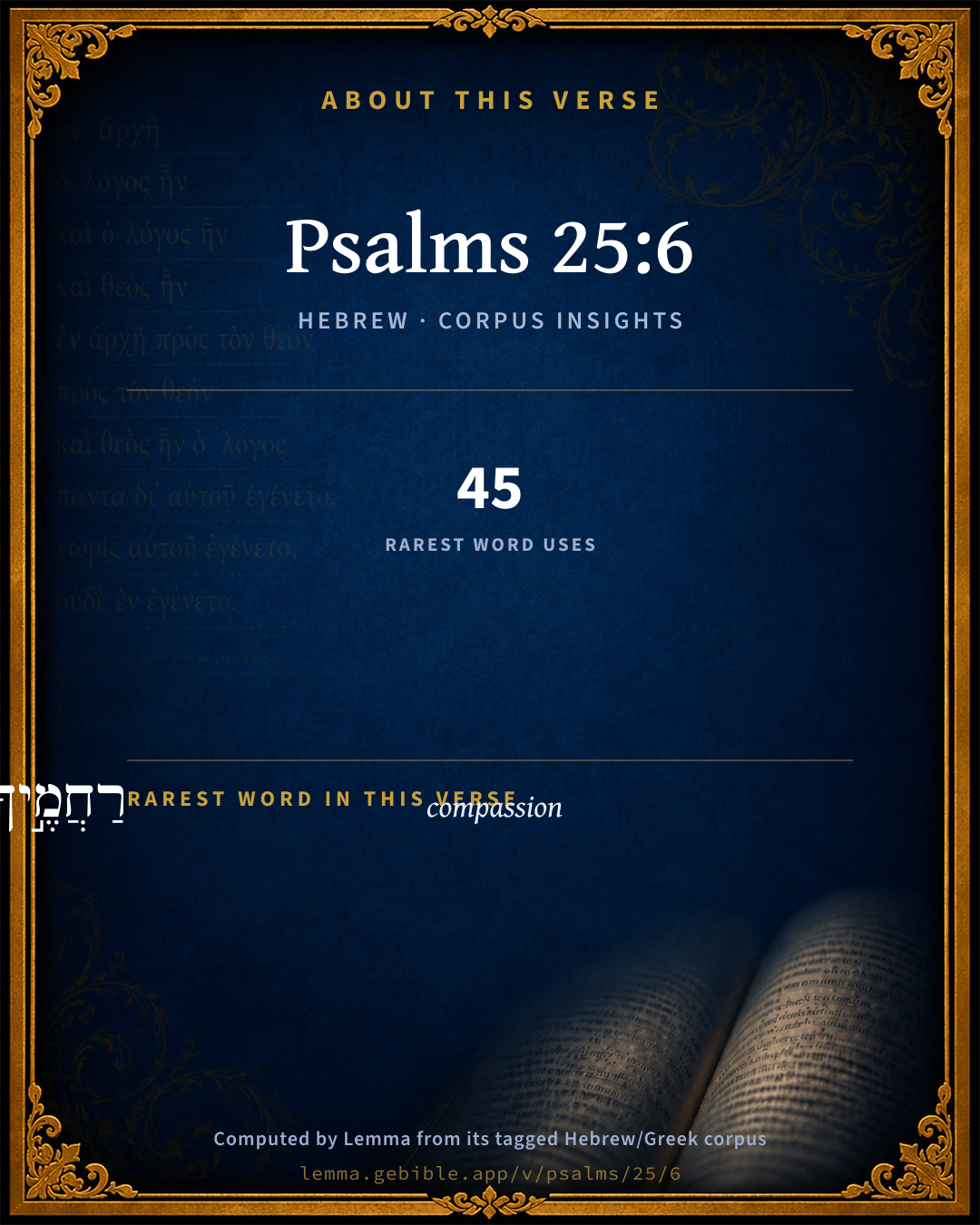
רַחֲמֶ֣יךָ compassion H7356 occurs in 44 verses of the Hebrew Bible. Also found in:

Grammatical profile

  • 1 verb
  • 4 nouns
  • 1 pronoun
  • 1 conjunction

Verb forms

  • זְכֹר Qal · Imperative

Hebrew & Septuagint length

In English translation the verse runs 15 words from the Hebrew and 13 from the Septuagint (LXX English) — closely comparable.

A rough comparison of the two English renderings, which tokenize alike — not a word-level alignment.

Word counts can differ between the Hebrew and the Greek without any difference in meaning — e.g. the Hebrew direct-object marker אֵת has no separate Greek word, and Greek often adds the article ὁ.

Cross-references

32

Topical passages linked to Psalms 25:6 in the Treasury of Scripture Knowledge — connected by theme and wording, ordered by reader-vote popularity; previews shown in the World English Bible.

  • Colossians 3:12 Put on therefore, as God's chosen ones, holy and beloved, a heart of compassion, kindness, lowliness, humility, and perseverance;
  • Psalms 103:17 But Yahweh's loving kindness is from everlasting to everlasting with those who fear him, His righteousness to children's children;
  • Luke 1:50 His mercy is for generations of generations on those who fear him.
  • Luke 1:78 Because of the tender mercy of our God, Whereby the dawn from on high will visit us,
  • 2 Corinthians 1:3 Blessed be the God and Father of our Lord Jesus Christ, the Father of mercies and God of all comfort;
  • Exodus 34:6 Yahweh passed by before him, and proclaimed, "Yahweh! Yahweh, a merciful and gracious God, slow to anger, and abundant in loving kindness and truth,
  • Micah 7:18–20 Who is a God like you, who pardons iniquity, And passes over the disobedience of the remnant of his heritage? He doesn't retain his anger forever, Because he delights in loving kindness.
  • Nehemiah 9:19 yet you in your manifold mercies didn't forsake them in the wilderness: the pillar of cloud didn't depart from over them by day, to lead them in the way; neither the pillar of fire by night, to show them light, and the way in which they should go.
  • Psalms 98:3 He has remembered his loving kindness and his faithfulness toward the house of Israel. All the ends of the earth have seen the salvation of our God.
  • Isaiah 63:15 Look down from heaven, and see from the habitation of your holiness and of your glory: where are your zeal and your mighty acts? the yearning of your heart and your compassion is restrained toward me.
  • Jeremiah 33:11 the voice of joy and the voice of gladness, the voice of the bridegroom and the voice of the bride, the voice of those who say, Give thanks to Yahweh of Hosts, for Yahweh is good, for his loving kindness endures forever; [and of them] who bring [sacrifices of] thanksgiving into the house of Yahweh. For I will cause the captivity of the land to return as at the first, says Yahweh.
  • Philippians 2:1 If there is therefore any exhortation in Christ, if any consolation of love, if any fellowship of the Spirit, if any tender mercies and compassion,
  • 1 John 3:17 But whoever has the world's goods, and sees his brother in need, and closes his heart of compassion against him, how does the love of God remain in him?
  • Genesis 24:27 He said, "Blessed be Yahweh, the God of my master Abraham, who has not forsaken his loving kindness and his truth toward my master. As for me, Yahweh has led me in the way to the house of my master's relatives."
  • Genesis 32:9 Jacob said, "God of my father Abraham, and God of my father Isaac, Yahweh, who said to me, 'Return to your country, and to your relatives, and I will do you good.'
  • Exodus 15:13 "You, in your loving kindness, have led the people that you have redeemed. You have guided them in your strength to your holy habitation.
  • 2 Chronicles 6:42 Yahweh God, don't turn away the face of your anointed: remember [your] loving kindnesses to David your servant.
  • Psalms 40:11 Don't withhold your tender mercies from me, Yahweh. Let your loving kindness and your truth continually preserve me.
  • Psalms 69:13 But as for me, my prayer is to you, Yahweh, in an acceptable time. God, in the abundance of your loving kindness, answer me in the truth of your salvation.
  • Psalms 69:16 Answer me, Yahweh, for your loving kindness is good. According to the multitude of your tender mercies, turn to me.
  • Psalms 77:7–12 "Will the Lord reject us forever? Will he be favorable no more?
  • Psalms 103:4 Who redeems your life from destruction; Who crowns you with loving kindness and tender mercies;
  • Psalms 106:1 Praise Yahweh! Give thanks to Yahweh, for he is good, For his loving kindness endures forever.
  • Psalms 106:45 He remembered for them his covenant, And repented according to the multitude of his loving kindnesses.
  • Psalms 107:1 Give thanks to Yahweh, For he is good, For his loving kindness endures forever.
  • Psalms 119:77 Let your tender mercies come to me, that I may live; For your law is my delight.
  • Psalms 136:11–26 And brought out Israel from among them; For his loving kindness endures forever;
  • Isaiah 55:7 let the wicked forsake his way, and the unrighteous man his thoughts; and let him return to Yahweh, and he will have mercy on him; and to our God, for he will abundantly pardon.
  • Jeremiah 31:20 Is Ephraim my dear son? is he a darling child? for as often as I speak against him, I do earnestly remember him still: therefore my heart yearns for him; I will surely have mercy on him, says Yahweh.
  • Luke 1:54 He has given help to Israel, his servant, that he might remember mercy,
  • Luke 1:71–72 Salvation from our enemies, and from the hand of all who hate us;
  • Philippians 1:8 For God is my witness, how I long after all of you in the tender mercies of Christ Jesus.

Cross-references courtesy of OpenBible.info (CC BY 4.0).

Hebrew and Greek witnesses Masoretic Hebrew ↔ Greek Septuagint

The same verse in the two great witnesses to the Old Testament, shown verse-for-verse.

You’re reading Greek Psalm 24 (Hebrew Psalm 25). The Septuagint counts the superscription, so verse numbers can differ from the Hebrew — chapter-level alignment, not verse-by-verse. Numbering follows Rahlfs.

These are two independent witnesses, not word-aligned to each other, and the Septuagint is shown in lemma (dictionary) form.

Hebrew Psalms 25:6 Masoretic · Westminster Leningrad Codex

זְכֹר רַחֲמֶ֣יךָ יְ֭הוָה וַחֲסָדֶ֑יךָ כִּ֖י מֵעוֹלָ֣ם הֵֽמָּה

Yahweh, remember your tender mercies and your loving kindness, For they are from old times.

World English Bible · Public Domain

Greek LXX Greek Psalm 24:6 Septuagint · lemma form

μιμνήσκω ὁ οἰκτιρμός σύ κύριος καί ὁ ἔλεος σύ ὅτι ἀπό ὁ αἰών εἰμί

Remember your compassions, O Lord, and your mercies, for they are from everlasting.

LXX2012 (modern English Septuagint) · Public Domain

Hebrew: Westminster Leningrad Codex (CC BY 4.0). Greek: Septuagint (public domain); English from LXX2012 (modern English Septuagint) (Public Domain). How the Septuagint differs from the Hebrew →

Commentary

Notes on Psalms 25:6 from classic Christian and Jewish commentators (each source and its license shown beneath its notes). The classic Christian expositions comment on the surrounding passage and are grouped to its opening verse, so a note may address several verses; the Jewish commentaries on the Tanakh (Rashi and others) are per-verse, so they appear only where the commentator wrote on this verse.

Lemma curates 59 commentaries, every one of them public domain or Creative Commons licensed, each selected and text-cleaned for this edition rather than reprinted as found. About our sources →

Trapp's Complete Commentary

John Trapp

Psa 25:6 Remember, O LORD, thy tender mercies and thy lovingkindnesses; for they [have been] ever of old.

Ver. 6. Remember, O Lord, thy tender mercies] Heb. thy bowels, which thou mayest seem to have lost, but I shall find them for thee. Where are thy bowels and thy compassions? are they restrained? If thou hast forgotten them (but that cannot be) I shall be thy remembrancer, and read them over unto thee out of the register of a sanctified memory.

For they have been ever of old] Etiam ad Adamum, qui vixit quasi mille annis, Ever since Adam, and so onward, saith R. Solomon; and why not then to me, who am one of thine, to whom thy mercy successively belongeth in my generation, as it did to mine ancestors in theirs?

John Trapp, A Commentary or Exposition upon All the Books of the Old and New Testament (1647–1656) — public domain. Text from a community e-Sword module.

The Biblical Illustrator

Joseph S. Exell

Psa_25:6-7

Remember, O Lord, Thy tender mercies.

Things to remember and to forget

It is only by a figure of speech that we can speak of God as remembering and forgetting. It is an accommodation to our human weakness and ignorance. He who sees all things at a glance has no need to remember, and is incapable of forgetting. Yet God acts towards us as if He both remembered and forgot, and it is enough for us to think of Him in that way. Here the Psalmists mind seemed to sway backward and forward between these two words remember and remember not. And so--

I. We wish to be remembered by God. It is sweet to be had in remembrance by friends. No one of us likes to be forgotten. The religious man desires, above all things, to be remembered of God. It is the sign and proof of His sincerity. If there be no serious and solemn purpose in life; if all its aims and motives and actuating impulses are vulgar, sensual, selfish, there will be no wish to have Gods eye upon it; there will be a sort of relief in the thought that He takes no notice of it, that He passes it by in forgetfulness. But to one whose endeavours are after the higher life the thought of having no place in Gods mind is dreadful.

II. We are happy in the thought that God remembers. But we wish, like the Psalmist, that He could both remember and forget. Memory brought back to David the sins of bygone years. O God, he cried, forget all those crooked and dark things, as I would forget them, and call to mind only Thine own goodness and love. What a strangely mingled cup it is that memory gives us to drink--full to the brim, overflowing with sweetness. Yet we cannot take a deep draught of the cup without coming to bitter ingredients, nay, perhaps to fiery morsels that burn and blister the mouth. Memory is as the Ebal and Gerizim of our lives. The Psalmist wished to separate these two elements of memory. He was afraid lest God should eternalise those old sins by keeping them in mind. He did not like to remember them himself. He wished to think only of the brighter, lovelier things--the Divine, the promising, the hopeful. O God, forget the evil, that I may forget it too. Yes, forget as far as possible the dark scenes of the years that lie behind. Forget the very sorrows and trials and bereavements, unless, indeed, they are so recent and so acute that it would only mock you to ask you to forget them. Bring with you out of the passing years a large and generous legacy of sweet and pure and holy memories. Be sure that all the mercies which we have ever known, all the Divine love and pity and helpfulness which we have ever proved, all that compassion and sympathy of Jesus Christ which have been our stay, will be repeated in the coming days. He will not forget. (J. G. Greenhough, M. A.)

The Divine remembrance

An aged Christian, lying on his deathbed in a state of such extreme weakness that he was often entirely unconscious of all around him, was asked the cause of his perfect peace. He replied, When I am able to think, I think of Jesus; and when I am unable to think of Him, I know he is thinking of me.

For they have been forever.--

The eternity of Gods mercies

A fair commendation of Gods mercies from the eternity thereof. His mercies had no beginning, as Himself had none, and shall have no end--From everlasting to everlasting Thou art our God. As the ocean and main sea can never be exhausted, but would furnish water to all the world, if everyone should bring vessels to draw water therefrom; so if we have faith and prayer to seek grace from God, He is all-sufficient in Himself to furnish us all. (A Symson.)

The antiquity of mercy

Let the ancientness of Divine love draw up our hearts to a very dear and honourable esteem of it. Pieces of antiquity, though of base metal, and otherwise of little use or value, how venerable are they with learned men! and ancient charters, how careful are men to preserve them; although they contain but temporary privileges, and sometimes but of trivial moment! How, then, should the great charter of heaven, so much older than the world, be had in everlasting remembrance, and the thoughts thereof be very precious to us; lying down, rising up, and all the day long accompanying us! (J. Cole.)

The Biblical Illustrator, edited by Joseph S. Exell (c. 1880s–1900s) — public domain. Text from a community e-Sword module.

Joseph Benson's Commentary

Psa 25:6-7. Remember, O Lord, thy tender mercies — O consider thy own merciful nature, and thy former manifold favours vouchsafed to me, and to other miserable sinners, and act like thyself. For they have been ever of old — Thou hast been gracious to such as I am from the beginning of the world to this day, and to me in particular from my very infancy; yea, from all eternity thou hast had a good will to me, and therefore do not now desert me. Remember not — So as to lay them to my charge; the sins of my youth — The sins committed in my young and tender years; my youthful faults and follies. These God frequently punishes in riper years, (Job 13:26,) and therefore he now prays that God would not so deal with him. Nor my transgressions — Nor any of my succeeding or other sins; for thy goodness’ sake — Being a sinner, I have nothing to plead for myself but thy free mercy and goodness, which I now implore.

Joseph Benson's Commentary on the Old and New Testaments (1811–1818) — public domain. Text from a community e-Sword module.

Tyndale Open Study Notes

Tyndale Open Resources

25:6 compassion: See also 51:1; 57:1; 103:8.

Tyndale Open Study Notes — © Tyndale Open Resources, licensed CC BY-SA 4.0. Text via the HelloAO Bible API.

Jamieson, Fausset & Brown

Robert Jamieson, A. R. Fausset & David Brown

Confessing past and present sins, he pleads for mercy, not on palliations of sin, but on God's well-known benevolence.

Jamieson, Fausset & Brown — Commentary Critical and Explanatory on the Whole Bible (1871) — public domain (CC PDM 1.0). Text via the HelloAO Bible API.

Adam Clarke's Commentary

Verse 6. Remember, O Lord, thy tender mercies, and thy loving-kindness] The word רחמים rachamim, means the commiseration that a man feels in his bowels at the sight of distress. The second word, חסדים chasadim, signifies those kindnesses which are the offspring of a profusion of benevolence.

They have been ever of old.] Thou wert ever wont to display thyself as a ceaseless fountain of good to all thy creatures.

Adam Clarke's Commentary on the Bible (1810–1826) — public domain. Text from a community e-Sword/MySword module.

John Calvin's Commentaries

6. Remember, O Jehovah; From this it appears, in the first place, that David was grievously afflicted and tried, so much so that he had lost all sense of God’s mercy: for he calls upon God to remember for him his favor, in such a manner as if he had altogether forgotten it. This, therefore, is the complaint of a man suffering extreme anguish, and overwhelmed with grief. We may learn from this, that although God, for a time, may withdraw from us every token of his goodness, and, apparently regardless of the miseries which afflict us, should, as if we were strangers to him, and not his own people, forsake us, we must fight courageously, until, set free from this temptation, we cordially present the prayer which is here recorded, beseeching God, that, returning to his former manner of dealing, he would again begin to manifest his goodness towards us, and to deal with us in a more gracious manner. This form of prayer cannot be used with propriety, unless when God is hiding his face from us, and seems to take no interest at all in us. Moreover David, by having recourse to the mercy or compassion and goodness of God, testifies that he trusts not to his own merit as any ground of hope. He who derives every thing from the fountain of divine mercy alone, finds nothing in himself entitled to recompense in the sight of God. But as the intermission which David had experienced was an obstacle which prevented his free access to God, he rises above it, by the very best remedy — the consideration, that although God, who from his very nature is merciful, may withdraw himself, and cease for a time to manifest his power, yet he cannot deny himself; that is to say, he cannot divest himself of the feeling of mercy which is natural to him, and which can no more cease than his eternal existence. But we must firmly maintain this doctrine, that God has been merciful even from the beginning, so that if at any time he seem to act with severity towards us, and to reject our prayers, we must not imagine that he acts contrary to his real character, or that he has changed his purpose. Hence we learn for what end it is that the Scriptures every where inform us, that in all ages God has regarded his servants with a benignant eye, and exercised his mercy towards them. “Et use de douceur envers eux.” — Fr.

John Calvin's Commentaries (1540-1563) — public domain. Text from the Calvin Translation Society English edition (1840s-50s) via the Christian Classics Ethereal Library (ccel.org). Calvin's coverage is partial (roughly two-thirds of the Bible); uncommented books and verses are honest gaps, never fabricated. The 19th-century editor's footnotes and remarks are omitted so the notes are faithfully Calvin's own voice.

Ellicott's Commentary for English Readers

(6) Ever of old.—Better, from ancient times

A Bible Commentary for English Readers, edited by Charles John Ellicott (1878–1897) — public domain. Text from a community e-Sword module.

The Cambridge Bible for Schools and Colleges

gen. ed. J. J. S. Perowne

6. An appeal to Jehovah’s unchangeableness (Mal_3:6). The love of ancient days cannot be exhausted (Jer_2:2; Jer_31:3).

For they have been ever of old] Lit., for they have been from everlasting. Cp. Psa_103:17; Psa_93:2.

The Cambridge Bible for Schools and Colleges (gen. ed. J. J. S. Perowne; Cambridge University Press, 1878–1918) — public domain. Text from a community e-Sword module.

John Gill's Exposition

Remember, O Lord, thy tender mercies and thy loving kindnesses,.... Not the providential mercy and kindness of God, in the care of him in his mother's womb, at the time of his birth, in his nurture and education, and in the preservation of him to the present time; but the special mercy, grace, and love of God in Christ: the sense of the petition is the same with that of Psa 106:4; which are expressed in the plural number, because of the largeness and abundance of it, and because of the various acts and instances of it; the Lord is rich and plenteous in mercy, abundant in goodness; his love is exceeding great, and numerous are the ways and methods in which it is declared, both in eternity and in time; and though he can never forget his love, nor the people whom he loves, for they are engraven on his hand, and set as a seal on his heart; yet he sometimes seems, by the conduct of his providence, as if he did not remember it, and had no tender affection for them; and their unbelief is ready to say, the Lord has forgotten to be gracious; and the design of such a petition as this is to entreat a fresh discovery and application of the grace, mercy, and loving kindness of God, and which he allows his people to put him in remembrance of;

for they have been ever of old: meaning not only from the time of his birth, and in after appearances of God for him, nor the favours shown to the people of Israel in former times at the Red sea, and in the wilderness and elsewhere, and to the patriarchs from the beginning of the world; but the love of God from everlasting, which appears in the choice of his people in Christ, before the foundation of the world, in the everlasting covenant of grace made with him, and in the setting of him up as the Mediator of it, and in putting his people into his hands, with all grace and spiritual blessings for them before the world began; and which love as it is from everlasting it is to everlasting, and remains invariably the same.

John Gill's Exposition of the Whole Bible (1746–1763) — public domain (CC PDM 1.0). Text via the HelloAO Bible API.

Albert Barnes' Notes on the Bible

Remember, O Lord - That is, In thy future treatment of me, bring to remembrance what thou hast done, and treat me in the same manner still. The language is that of one who felt that God had always been kind and gracious, and who asked for the future a continuance of the favors of the past. If we would recall, the goodness of God in the past, we should find enough to lay the foundation of prayer in reference to that which is to come. If we saw and fully understood all that has happened to us, we would need to offer no other prayer than that God might deal with us in the future as He has done in the past.

Thy tender mercies - Margin, as in Hebrew: “thy bowels.” The Hebrew word means the “inner parts” regarded by the Hebrews as the seat of the affections. See the notes at Isa 16:11.

And thy loving-kindnesses - Thy tokens of favor; thy acts of mercy and compassion.

For they have been ever of old - “For from eternity are they.” The language is that of a heart deeply impressed with a sense of the goodness God. In looking over his own life, the author of the psalm saw that the mercies of God had been unceasing and constant toward him from his earliest years. In words expressive of warm love and gratitude, therefore, he says that those acts of mercy had never failed - had been from eternity. His thoughts rise from the acts of God toward himself to the character of God, and to His attributes of mercy and love; and his heart is full of the idea that God is “always” good; that it belongs to His very nature to do good.

Albert Barnes' Notes on the Bible (1834–1885) — public domain. Text from a community e-Sword/MySword module.

Matthew Poole's English Annotations

O consider thy own merciful nature, and thy former manifold favours vouchsafed to me, and to other miserable sinners, and do like thyself. Thou hast been gracious to such as I am from the beginning of the world to this day, and to me in particular from my very infancy, as he oft acknowledgeth in this book; yea, from all eternity thou hast had a good will to me, and therefore do not now desist and desert me.

Matthew Poole's English Annotations on the Holy Bible (1683–1685) — public domain. Text from a community e-Sword/MySword module.

The Treasury of David

Charles H. Spurgeon

Ver. 6. Remember, O Lord, thy tender mercies and thy lovingkindnesses. We are usually tempted in seasons of affliction to fear that our God has forgotten us, or forgotten his usual kindness towards us; hence the soul doth as it were put the Lord in remembrance, and beseech him to recollect those deeds of love which once he wrought towards it. There is a holy boldness which ventures thus to deal with the Most High, let us cultivate it; but there is also an unholy unbelief which suggests our fears, let us strive against it with all our might. What gems are those two expressions, "tender mercies and lovingkindnesses!" They are the virgin honey of language; for sweetness no words can excel them; but as for the gracious favours which are intended by them, language fails to describe them.

"When all thy mercies, O my God,

My rising soul surveys,

Transported with the view, I am lost

In wonder, love and praise."

If the Lord will only do unto us in the future as in the past, we shall be well content. We seek no change in the divine action, we only crave that the river of grace may never cease to flow. For they have been ever of old. A more correct translation would be "from eternity." David was a sound believer in the doctrine of God's eternal love. The Lord's lovingkindnesses are no novelties. When we plead with him to bestow them upon us, we can urge use and custom of the most ancient kind. In courts of law men make much of precedents, and we may plead them at the throne of grace. "Faith, "saith Dickson, "must make use of experiences and read them over unto God, out of the register of a sanctified memory, as a recorder to him who cannot forget." With a unchangeable God it is a most effectual argument to remind him of his ancient mercies and his eternal love. By tracing all that we enjoy to the fountain head of everlasting love we shall greatly cheer our hearts, and those do us but sorry service who try to dissuade us from meditating upon election and its kindred topics.

Ver. 6. Thy tender mercies. O how does one deep call upon another! The depths of my multiplied miseries, calls, loudly calls, upon the depth of thy manifold mercies; even that mercy whereby thou dost pardon my sin and help mine infirmities; that mercy whereby thou dost sanctify me by thy grace, and comfort me by thy Spirit; that mercy whereby thou dost deliver me from hell, and possess me of heaven. Remember, O Lord, all those thy mercies, thy tender mercies, which have been of old unto thy saints. Robert Mossom.

Ver. 6. Thy tender mercies and thy lovingkindnesses...have been ever of old. Let the ancientness of divine love draw up our hearts to a very dear and honourable esteem of it. Pieces of antiquity, though of base metal, and otherwise of little use or value, how venerable are they with learned men! and ancient charters, how careful are men to preserve them; although they contain but temporary privileges, and sometimes but of trivial moment! How then should the great charter of heaven, so much older than the world, be had in everlasting remembrance, and the thoughts thereof be very precious to us; lying down, rising up, and all the day long accompanying of us! ...That which is from everlasting shall be to everlasting; if the root be eternal, so are the branches ...Divine love is an eternal fountain that never leaves running while a vessel is empty or capable of holding more; and it stands open to all comers: therefore, come; and if ye have not sufficient of your own, go and borrow vessels, empty vessels, not a few; "pay your debts out of it, and live on the rest" 2Ki 4:7, to eternity. Elisha Coles on "God's Sovereignty", 1678.

Ver. 6. The antiquity of mercy.

Ver. 6-7. The Three Remembers.

Psalms 25:7*

Charles H. Spurgeon's The Treasury of David (1869–1885) — public domain. Psalms only. Text from a community e-Sword/MySword module.

Whedon's Commentary on the Bible

Daniel D. Whedon

6. Tender mercies—Literally, bowels, as the supposed seat of the tender emotions of pity and compassion. As this is a psychological term, here occurring for the first time in the psalms, it is proper to note that the passions and feelings of men were named after those internal parts of the human body where the particular phenomena of sensations occasioned by them manifested themselves, and modern physiological science confirms the wonderful agreement of this psychical terminology with the entire ganglionic system. No metaphysical philosophy can avoid this figurative use of language. See on Psa_16:7.

Ever of old—Literally, from everlasting. The argument is, because the tender mercies of God were from old, or from everlasting, therefore it is in harmony with his settled order of government to show compassion in this case. Hence the phrase, “for thy goodness’ sake,” Psa_25:7

Daniel D. Whedon (gen. ed.), Commentary on the Old and New Testaments (1874–1909) — public domain. Text from a community e-Sword module.

The Pulpit Commentary

Remember, O Lord, thy tender mercies, and thy loving-kindnesses. Past mercies form a ground for the expectation of future blessings. God"s character cannot change; his action as one time will always be consistent and harmonious with his action at another. If he has been kind and merciful to David in the past, David may count on his continuing the same in the future. For they have been ever of old. Not lately only, or to David only, have his mercies been shown, but through all past time, to all his servants, from of old.

The Pulpit Commentary (1880–1919), ed. H.D.M. Spence-Jones & Joseph S. Exell — public domain. Text from a community e-Sword module.

Keil & Delitzsch

C. F. Keil & F. Delitzsch

The supplicatory reminiscere means, may God never forget to exercise His pity and grace towards him, which are (as the plurals imply) so rich and superabundant. The ground on which the prayer is based is introduced with כּי (nam, or even quoniam). God's compassion and grace are as old in their operation and efficacy as man's feebleness and sin; in their counsels they are eternal, and therefore have also in themselves the pledge of eternal duration (Psa 100:5; Psa 103:17).

Keil & Delitzsch — Biblical Commentary on the Old Testament (1861–1891) — public domain (CC PDM 1.0). Text via the HelloAO Bible API. (Old Testament only.)

J. A. Alexander on Psalms

Joseph Addison Alexander

6. Remember thy mercies, O Jehovah, and thy favours, for from eternity are they. The prayer for future favours is here founded upon those experienced already.— Of old is an inadequate translation, and even in the stronger form, ever of old, less exact and expressive than the literal translation from eternity, to which there is the less objection here, as the words relate not merely to God's acts but to his attributes.

Joseph Addison Alexander, The Psalms Translated and Explained (1850) — public domain. Text from a community e-Sword module.

unfoldingWord translationNotes

Door43 World Missions Community

Call to mind

This is an idiom. This does not mean God forgot something. The writer is asking God to think about and consider his acts of compassion and faithfulness. AT: "Remember" or "Think about" (See: Idiom)

your acts of compassion and of covenant faithfulness

The abstract nouns "compassion" and "faithfulness" can be stated as adjectives. AT: "how you have been compassionate and faithful to your covenant" (See: Abstract Nouns)

for they have always existed

Here "they" personifies God's compassion and covenant faithfulness. AT: "for that is how you have always been" (See: Personification)

Do not think about the sins of my youth

The abstract noun "sins" can be stated as "sinned." AT: "Do not think about how I sinned against you when I was young" (See: Abstract Nouns)

or my rebelliousness

The abstract noun "rebelliousness" can be stated as "rebelled." AT: or about how I have rebelled against you" (See: Abstract Nouns)

Call me to mind

This is an idiom. This does not mean God forgot something. The writer is asking God to think about him. AT: "Remember me" or "Think about me" (See: Idiom)

with covenant faithfulness because of your goodness

The abstract nouns "faithfulness" and "goodness" can be stated as adjectives. AT: "and be faithful to me because of your covenant, because you are good" (See: Abstract Nouns)

translationWords

mind

compassion

covenant faithfulness

sin

rebel

good

unfoldingWord translationNotes — © Distant Shores Media and the Door43 World Missions Community, licensed CC BY-SA 4.0. Source: git.door43.org/Door43/en_tn.

Rashi

Rabbi Shlomo Yitzchaki (Rashi)

for they have been since time immemorial Since the days of Adam, to whom You said, (Gen. 2: 17), “for on the day that you eat from it you must die,” but You gave him Your day, which is a thousand years.

Rashi on the Tanakh — English translations: “The Judaica Press complete Tanach with Rashi, translated by A. J. Rosenberg” (CC BY 4.0); “Pentateuch with Rashi's commentary by M. Rosenbaum and A.M. Silbermann, 1929-1934” (public domain); “The Metsudah Tanach series, Lakewood, N.J” (CC BY 4.0); and “The Book of Joshua, Metsudah Publications, 1997” (CC BY 4.0). Text via Sefaria.

Lesson kit

Teaching starters — assembled from the data on this page, not authored interpretation. Every prompt links to the verse data it draws on. Edit before teaching.

Psalms, in the Wisdom, opens this verse with 7 words (7 distinct Hebrew lemmas). Its most distinctive word is racham (“compassion”). A historical commentator’s framing appears above. Read the whole chapter for the surrounding context.

Discussion questions

  1. The word racham carries the sense “compassion.” How does it shape the verse?
  2. How does Genesis 43:14, which shares the word «compassion», read alongside this verse?
  3. These translations render this verse differently. What is at stake in choosing one wording over another?
  4. «זְכֹר» is a Qal Imperative verb. How does that grammatical form shape the action described?
  5. Compare how Trapp's Complete Commentary and The Biblical Illustrator read this verse. Where do they agree or differ?

Things to notice

Reading settings

Reading text

Shown beneath each verse's original-language words.

Old Testament
Old Testament edition

Read the OT as the Masoretic Hebrew (MT) or the Greek Septuagint (LXX).

English shown for the Greek Septuagint (in the Hebrew ↔ Greek comparison).

Comparing translations? Open the Compare panel on any verse page to stack up to four side by side.