
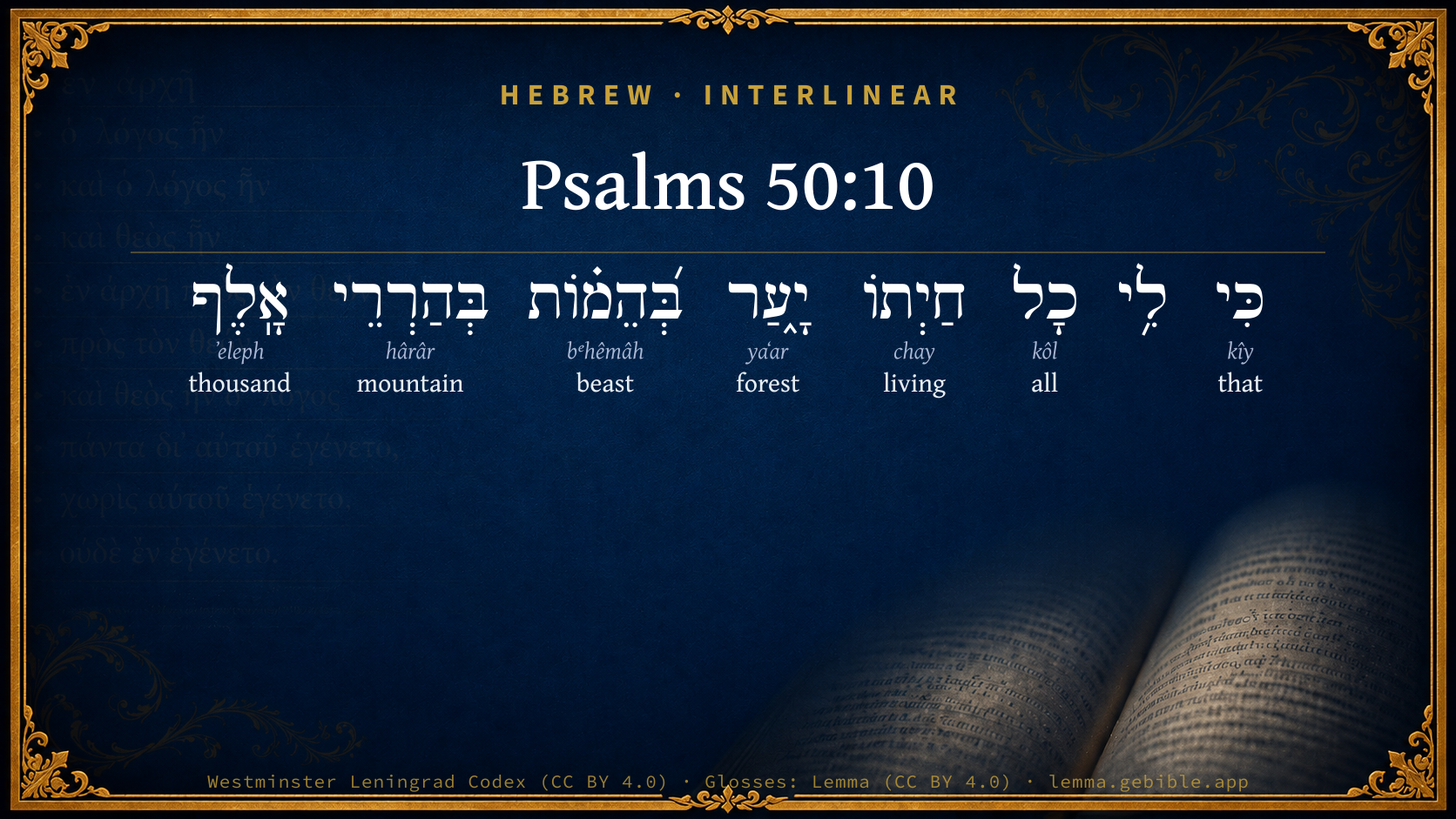
Psalms 50:10

Hebrew (Westminster Leningrad Codex) Psalms 50:10 appears in the Hebrew Old Testament. The text above is from the Westminster Leningrad Codex. Each word links to its Strong’s number, a concise gloss, and parsing drawn from the Open Scriptures Hebrew Bible morphology. Click any word for its full Brown-Driver-Briggs (BDB) entry.
Download image
Cite this verse

Psalms 50:10 (World English Bible). Public Domain. Lemma interlinear Bible study tool, https://lemma.gebible.app/v/psalms/50/10.

Show BibTeX & RIS
BibTeX
RIS
English Translation
For every animal of the forest is mine, And the cattle on a thousand hills.
World English Bible · Public Domain
Download a study sheet

One document with this verse’s original text, its word-by-word gloss line, the meaning frame, cross-references with their text, attributed commentary, and full source and license credits — printable, and it pastes into notes with its structure intact.

This verse Autodidact and up

Study sheet (.html) Plain text (.txt)

A passage Seminary Student

Up to 50 verses in one chapter. A passage sheet keeps up to 6 commentary sources and 12 cross-references per verse, in the order this page ranks them, and says so on the sheet whenever that leaves anything out. Ask for a single verse and you get the Autodidact verse sheet above.

Everything on this page stays free to read, with no account — the sheet is a download of what is already on screen, not access to it.

Want to remove ads? Support Godless Engineer
Compare translations 3

The same verse in 3 English versions, stacked beneath the original-language interlinear above. Click any original word for its lexicon entry.

Each is an independent rendering of the whole verse — the interlinear is not word-aligned to these translations.

Highlighted words mark where these versions differ — a whole-verse word diff, not a word-by-word alignment.

  • World English Bible Public Domain
    For every animal of the forest is mine, And the cattle on a thousand hills.
  • King James Version Public Domain
    For every beast of the forest is mine, and the cattle upon a thousand hills.
  • unfoldingWord Literal Text CC BY-SA 4.0
    For every beast of the forest to me, the cattle on a thousand hills.

unfoldingWord Literal Text — © unfoldingWord, licensed CC BY-SA 4.0. Word-aligned USFM3 via Door43 (git.door43.org/unfoldingWord/en_ult).

Versions to compare (up to 4)

3 of 4 selected

Show all 18 translations

Every available English version of this verse, each an independent rendering of the whole verse.

  • World English Bible Public Domain
    For every animal of the forest is mine, And the cattle on a thousand hills.
  • Berean Standard Bible Public Domain
    for every beast of the forest is Mine—the cattle on a thousand hills.
  • Majority Standard Bible Public Domain
    for every beast of the forest is Mine—the cattle on a thousand hills.
  • King James Version Public Domain
    For every beast of the forest is mine, and the cattle upon a thousand hills.
  • American Standard Version (1901) Public Domain
    For every beast of the forest is mine, And the cattle upon a thousand hills.
  • Revised Version (1885) Public Domain
    For every beast of the forest is mine, and the cattle upon a thousand hills.
  • Geneva Bible (1599) Public Domain
    For all the beastes of the forest are mine, and the beastes on a thousand mountaines.
  • Douay-Rheims (1899) Public Domain
    For all the beasts of the woods are mine: the cattle on the hills, and the oxen.
  • Young's Literal Translation Public Domain
    For Mine `is' every beast of the forest, The cattle on the hills of oxen.
  • Literal Standard Version CC BY-SA 4.0
    For every beast of the forest [is] Mine, || The livestock on the hills of oxen.
  • Unlocked Literal Bible CC BY-SA 4.0
    For every beast of the forest is mine, and the cattle on a thousand hills.
  • unfoldingWord Literal Text CC BY-SA 4.0
    For every beast of the forest to me, the cattle on a thousand hills.
  • Darby Bible Public Domain
    For every beast of the forest is mine, the cattle upon a thousand hills;
  • World Messianic Bible Public Domain
    For every animal of the forest is mine, and the livestock on a thousand hills.
  • Webster's Bible Public Domain
    For every beast of the forest is mine, and the cattle upon a thousand hills.
  • Free Bible Version CC BY-SA 4.0
    for I own all the animals of the forest, and the cattle on a thousand hills belong to me.
  • Bible in Basic English Public Domain
    For every beast of the woodland is mine, and the cattle on a thousand hills.
  • JPS Tanakh (1917) Public Domain
    For every beast of the forest is Mine, and the cattle upon a thousand hills.

Literal Standard Version (2020), Covenant Press — licensed CC BY-SA 4.0. Text via the HelloAO Bible API (eBible.org). Unlocked Literal Bible (unfoldingWord) — licensed CC BY-SA 4.0. Text via the HelloAO Bible API (eBible.org). unfoldingWord Literal Text — © unfoldingWord, licensed CC BY-SA 4.0. Word-aligned USFM3 via Door43 (git.door43.org/unfoldingWord/en_ult). Free Bible Version, Dr. Jonathan Gallagher — licensed CC BY-SA 4.0. Text via the HelloAO Bible API (eBible.org).

Word by word

More ways to search: Search by grammar → Find every occurrence → Compare this word →

Practice this passage: Drill this verse → Learn its vocabulary →

About this verse

These counts appear in no published source. They are computed here, from the morphology-tagged text and Lemma’s own curated glosses. What Lemma adds →

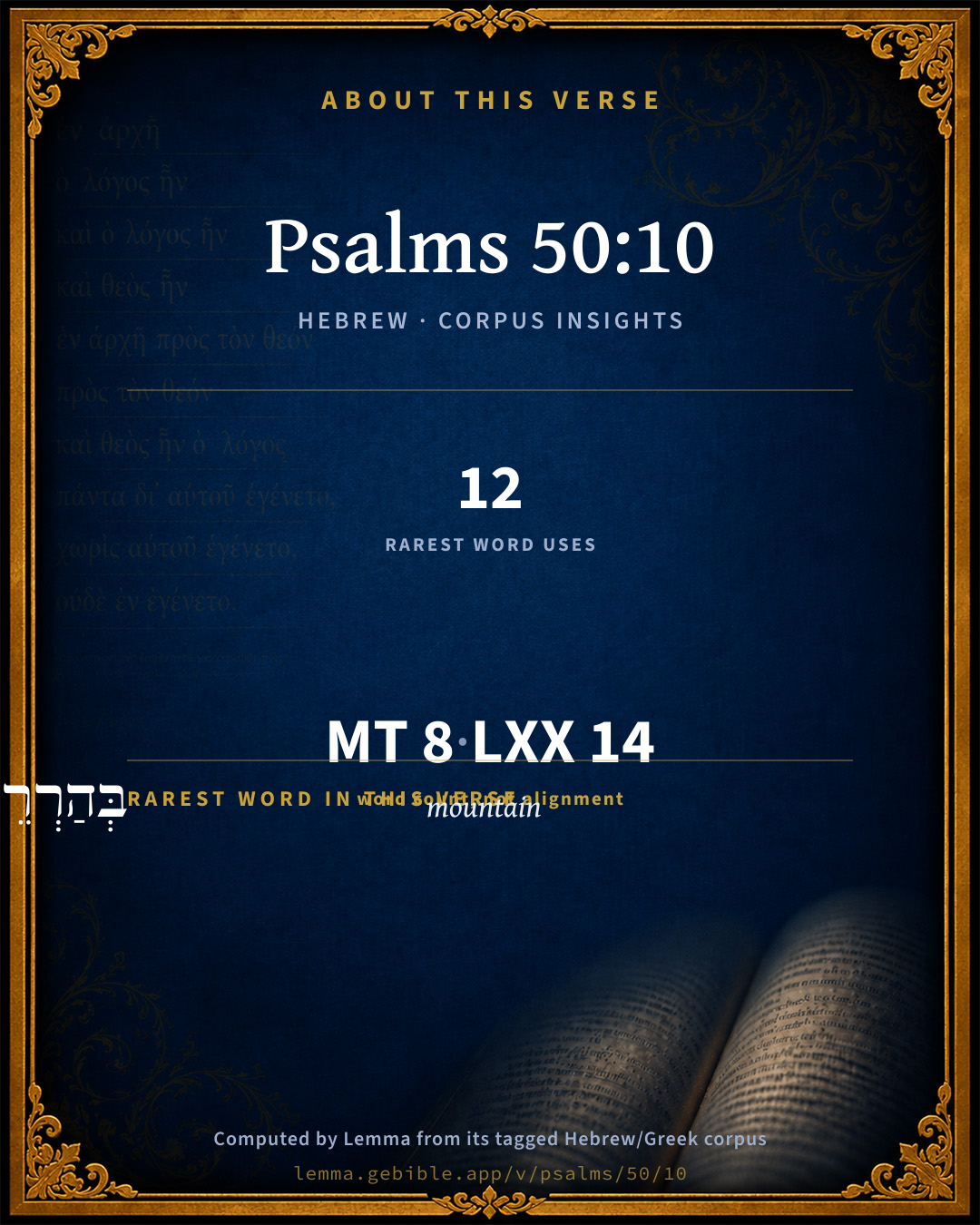
8
words
7
distinct lemmas
Wisdom
section

Notable vocabulary

The rarest word here is בְּהַרְרֵי mountain H2042 — appearing just 12 times in the whole Hebrew Bible.

Shared distinctive vocabulary

בְּהַרְרֵי mountain H2042 occurs in 12 verses of the Hebrew Bible. Also found in:

Grammatical profile

  • 5 nouns
  • 1 adjective
  • 1 preposition
  • 1 conjunction

Hebrew & Septuagint length

In English translation the verse runs 15 words from the Hebrew and 17 from the Septuagint (LXX English) — closely comparable.

A rough comparison of the two English renderings, which tokenize alike — not a word-level alignment.

Word counts can differ between the Hebrew and the Greek without any difference in meaning — e.g. the Hebrew direct-object marker אֵת has no separate Greek word, and Greek often adds the article ὁ.

In the original languages it is 8 Hebrew tokens and 14 Greek tokens — but the two are counted differently (Hebrew bundles its prefixes and suffixes into one token; the Greek is in lemma form), so that isn’t a like-for-like length.

Cross-references

13

Topical passages linked to Psalms 50:10 in the Treasury of Scripture Knowledge — connected by theme and wording, ordered by reader-vote popularity; previews shown in the World English Bible.

  • Jeremiah 27:5–6 I have made the earth, the men and the animals that are on the surface of the earth, by my great power and by my outstretched arm; and I give it to whom it seems right to me.
  • Psalms 8:6–8 You make him ruler over the works of your hands. You have put all things under his feet:
  • Psalms 104:14 He causes the grass to grow for the cattle, And plants for man to cultivate, That he may bring forth food out of the earth:
  • Psalms 104:24–25 Yahweh, how many are your works! In wisdom have you made them all. The earth is full of your riches.
  • Daniel 2:38 and wherever the children of men dwell, the animals of the field and the birds of the sky has he given into your hand, and has made you to rule over them all: you are the head of gold.
  • Genesis 1:24–25 God said, "Let the earth bring forth living creatures after their kind, cattle, creeping things, and animals of the earth after their kind," and it was so.
  • Genesis 2:19 Out of the ground Yahweh God formed every animal of the field, and every bird of the sky, and brought them to the man to see what he would call them. Whatever the man called every living creature, that was its name.
  • 1 Chronicles 29:14–16 But who am I, and what is my people, that we should be able to offer so willingly as this? For all things come of you, and of your own have we given you.
  • Jonah 4:11 Shouldn't I be concerned for Nineveh, that great city, in which are more than one hundred twenty thousand persons who can't discern between their right hand and their left hand; and also much cattle?"
  • Genesis 8:17 Bring forth with you every living thing that is with you of all flesh, including birds, cattle, and every creeping thing that creeps on the earth; that they may breed abundantly in the earth, and be fruitful, and multiply on the earth."
  • Genesis 9:2–3 The fear of you and the dread of you will be on every animal of the earth, and on every bird of the sky. Everything that the ground teems with, and all the fish of the sea are delivered into your hand.
  • Genesis 31:9 Thus God has taken away the cattle of your father, and given them to me.
  • Job 40:15–24 "See now, behemoth, which I made as well as you. He eats grass as an ox.

Cross-references courtesy of OpenBible.info (CC BY 4.0).

Hebrew and Greek witnesses Masoretic Hebrew ↔ Greek Septuagint

The same verse in the two great witnesses to the Old Testament, shown verse-for-verse.

You’re reading Greek Psalm 49 (Hebrew Psalm 50). The Septuagint counts the superscription, so verse numbers can differ from the Hebrew — chapter-level alignment, not verse-by-verse. Numbering follows Rahlfs.

These are two independent witnesses, not word-aligned to each other, and the Septuagint is shown in lemma (dictionary) form.

Hebrew Psalms 50:10 Masoretic · Westminster Leningrad Codex

כִּי לִ֥י כָל חַיְתוֹ יָ֑עַר בְּ֝הֵמ֗וֹת בְּהַרְרֵי אָֽלֶף

For every animal of the forest is mine, And the cattle on a thousand hills.

World English Bible · Public Domain

Greek LXX Greek Psalm 49:10 Septuagint · lemma form

ὅτι ἐμός εἰμί πᾶς ὁ θηρίον ὁ δρυμός κτῆνος ἐν ὁ ὄρος καί βοῦς

For all the wild beasts of the thicket are mine, the cattle on the mountains, and oxen.

LXX2012 (modern English Septuagint) · Public Domain

On this verse, Ellicott's Commentary for English Readers discusses the Septuagint’s reading. Read the note in Commentary ↓

Hebrew: Westminster Leningrad Codex (CC BY 4.0). Greek: Septuagint (public domain); English from LXX2012 (modern English Septuagint) (Public Domain). How the Septuagint differs from the Hebrew →

Commentary

Notes on Psalms 50:10 from classic Christian and Jewish commentators (each source and its license shown beneath its notes). The classic Christian expositions comment on the surrounding passage and are grouped to its opening verse, so a note may address several verses; the Jewish commentaries on the Tanakh (Rashi and others) are per-verse, so they appear only where the commentator wrote on this verse.

Lemma curates 59 commentaries, every one of them public domain or Creative Commons licensed, each selected and text-cleaned for this edition rather than reprinted as found. About our sources →

Trapp's Complete Commentary

John Trapp

Psa 50:10 For every beast of the forest [is] mine, [and] the cattle upon a thousand hills.

Ver. 10. For every beast of the forest is mine] God is the great proprietary; and all is his by primitive right. It is but of his own, therefore, that any man giveth him aught; as David freely acknowledgeth, 1Ch 29:14; and that great emperor, who, dedicating his rich communion table to Jesus Christ, wrote upon it τα σο εκ των σων σοι προσφερομεν, Thine own, and of thine own, Lord, present we unto thee (Justinian apud Cedren.). And yet vain man is apt to conceit that God is obliged unto him when he offereth unto God any part of his goods.

And the cattle upon a thousand hills] Or, upon the hills of a thousand owners.

John Trapp, A Commentary or Exposition upon All the Books of the Old and New Testament (1647–1656) — public domain. Text from a community e-Sword module.

J. A. Alexander on Psalms

Joseph Addison Alexander

10. (Psa 50:10) For to me (belongs) every beast of the forest, the cattle in hills of a thousand. This last idiomatic phrase may either mean a thousand hills, or hills where the cattle rove by thousands, with probable allusion to the hilly grounds of Bashan beyond Jordan. See above, on Psa 22:13 (12). According to etymology, the noun in the first clause means an animal, and that in the second beasts or brutes in general. See above, on Psa 49:13(12). But when placed in antithesis, the first denotes a wild beast, and the second domesticated animals or cattle. Both words were necessary to express God's sovereign propriety in the whole animal creation. Thus understood, the verse assigns a reason for the negative assertion in the one before it. Even if God could stand in need of animal oblations, for his own sake, or for their sake, he would not be under the necessity of coming to man for them, since the whole animal creation is his property and perfectly at his disposal.

Joseph Addison Alexander, The Psalms Translated and Explained (1850) — public domain. Text from a community e-Sword module.

Tyndale Open Study Notes

Tyndale Open Resources

50:10 I own the cattle on a thousand hills: God has no needs; he possesses everything.

Tyndale Open Study Notes — © Tyndale Open Resources, licensed CC BY-SA 4.0. Text via the HelloAO Bible API.

Geneva Bible (1599)

Geneva Bible translators

Though he did delight in sacrifice, yet had he no need of man’s help thereunto.

Geneva Bible (1599) marginal notes — public domain. Text via Bolls.life.

Adam Clarke's Commentary

Verse 10. Every beast of the forest is mine] Can ye suppose that ye are laying me under obligation to you, when ye present me with a part of my own property?

Adam Clarke's Commentary on the Bible (1810–1826) — public domain. Text from a community e-Sword/MySword module.

Ellicott's Commentary for English Readers

(10) A thousand hills.—Literally, mountains of a thousand, an expression for which there is no analogy, but which might conceivably mean, “mountains where the cattle are by thousands;” but surely the LXX. and Vulg. are right here, in rendering “oxen” instead of “a thousand,” and we should read “hills of oxen.”

A Bible Commentary for English Readers, edited by Charles John Ellicott (1878–1897) — public domain. Text from a community e-Sword module.

John Gill's Exposition

For every beast of the forest is mine,.... By creation and preservation; and therefore he stood in no need of their bullocks and he goats;

and the cattle upon a thousand hills; meaning all the cattle in the whole world.

John Gill's Exposition of the Whole Bible (1746–1763) — public domain (CC PDM 1.0). Text via the HelloAO Bible API.

Albert Barnes' Notes on the Bible

For every beast of the forest is mine - All the beasts that roam at large in the wilderness; all that are untamed and unclaimed by man. The idea is, that even if God “needed” such offerings, he was not dependent on them - for the numberless beasts that roamed at large as his own would yield an ample supply.

And the cattle upon a thousand hills - This may mean either the cattle that roamed by thousands on the hills, or the cattle on numberless hills. The Hebrew will bear either construction. The former is most likely to be the meaning. The allusion is probably to the animals that were pastured in great numbers on the hills, and that were claimed by men. The idea is, that all - whether wild or tame - belonged to God, and he had a right to them, to dispose of them as he pleased. He was not, therefore, in any way dependent on sacrifices. It is a beautiful and impressive thought, that the “property” in all these animals - in all living things on the earth - is in God, and that he has a right to dispose of them as he pleases. What man owns, he owns under God, and has no right to complain when God comes and asserts his superior claim to dispose of it at his pleasure. God has never given to man the absolute proprietorship in “any” thing; nor does he invade our rights when he comes and claims what we possess, or when in any way he removes what is most valuable to us. Compare Job 1:21.

Albert Barnes' Notes on the Bible (1834–1885) — public domain. Text from a community e-Sword/MySword module.

Matthew Poole's English Annotations

I would command or dispose them at my pleasure, without thy leave or assistance, even the cattle which feed upon innumerable hills, or in valleys and fields.

Matthew Poole's English Annotations on the Holy Bible (1683–1685) — public domain. Text from a community e-Sword/MySword module.

The Treasury of David

Charles H. Spurgeon

Ver. 10. For every beast of the forest is mine. How could they imagine that the Most High God, possessor of heaven and earth, had need of beasts, when all the countless hordes that find shelter in a thousand forests and wildernesses belong to him? And the cattle upon a thousand hills. Not alone the wild beasts, but also the tamer creatures are all his own. Even if God cared for these things, he could supply himself. Their cattle were not, after all, their own, but were still the great Creator's property, why then should he be beholden to them. From Dan to Beersheba, from Nebaioth to Lebanon, there fed not a beast which was not marked with the name of the great Shepherd; why, then, should he crave oblations of Israel? What a slight is here put even upon sacrifices of divine appointment when wrongly viewed as in themselves pleasing to God! And all this to be so expressly stated under the law! How much more is this clear under the gospel, when it is so much more plainly revealed, that "God is a Spirit, and they that worship him must worship him in spirit and in truth"? Ye Ritualists, ye Sacramentarians, ye modern Pharisees, what say ye to this?

Ver. 10. "For to me (belongs) every beast of the forest, the cattle in hills of a thousand." This last idiomatic phrase may either mean a thousand hills, or hills where the cattle rove by thousands, with probable allusion to the hilly grounds of Bashan beyond Jordan. According to etymology, the noun in the first clause means an animal, and that in the second beasts or brutes in general. But when placed in antithesis, the first denotes a wild beast, and the second domesticated animals or cattle. Both words were necessary to express God's sovereign propriety in the whole animal creation. Thus understood, the verse assigns a reason for the negative assertion in the one before it. Even if God could stand in need of animal oblations, for his own sake, or for their sake, he would not be under the necessity of coming to man for them, since the whole animal creation is his property and perfectly at his disposal. J. A. Alexander.

Charles H. Spurgeon's The Treasury of David (1869–1885) — public domain. Psalms only. Text from a community e-Sword/MySword module.

The Pulpit Commentary

For every beast of the forest is mine, and the cattle upon a thousand hills. So the Revised Version, Dr. Kay, Canon Cook, the Four Friends, and others; but many critics regard such a rendering as impossible. Of these, some translate, "And the cattle upon the hills, where there are thousands" (Hupfeld, Hengstenberg, etc.); while others read for pla, and render, "And the cattle upon the mountains of God" (Olshausen, Cheyne).

The Pulpit Commentary (1880–1919), ed. H.D.M. Spence-Jones & Joseph S. Exell — public domain. Text from a community e-Sword module.

Rashi

Rabbi Shlomo Yitzchaki (Rashi)

the behemoth of the thousand mountains That is (the bull) destined for the future feast [of the righteous], which grazes on a thousand mountains daily, and every day they grow back. Others explain this to mean one thousand mountains or one thousand parasangs (i.e., one mountain that is 1,000 parasangs long, or perhaps it should read: 1,000 bulls. The plural “mountains” indicates that there were many mountains of that type.[Shem Ephraim]) Others explain that this is like (Deut. 7:13): “the litter of your cattle (אלפיך).” i.e., mountains full of cattle, because he says, “I will not take from your household a bull.”

Rashi on the Tanakh — English translations: “The Judaica Press complete Tanach with Rashi, translated by A. J. Rosenberg” (CC BY 4.0); “Pentateuch with Rashi's commentary by M. Rosenbaum and A.M. Silbermann, 1929-1934” (public domain); “The Metsudah Tanach series, Lakewood, N.J” (CC BY 4.0); and “The Book of Joshua, Metsudah Publications, 1997” (CC BY 4.0). Text via Sefaria.

Lesson kit

Teaching starters — assembled from the data on this page, not authored interpretation. Every prompt links to the verse data it draws on. Edit before teaching.

Psalms, in the Wisdom, opens this verse with 8 words (7 distinct Hebrew lemmas). Its most distinctive word is hârâr (“mountain”). A historical commentator’s framing appears above. Read the whole chapter for the surrounding context.

Discussion questions

  1. The word hârâr carries the sense “mountain.” How does it shape the verse?
  2. Numbers 23:7 shares the word «mountain» with this verse. How do the two illuminate each other?
  3. These translations render this verse differently; the difference is in the English rendering, not the original. What questions does that raise?
  4. Reading how Trapp's Complete Commentary and J. A. Alexander on Psalms read this verse, where do the two commentators agree and where do they part?

Things to notice

Reading settings

Reading text

Shown beneath each verse's original-language words.

Old Testament
Old Testament edition

Read the OT as the Masoretic Hebrew (MT) or the Greek Septuagint (LXX).

English shown for the Greek Septuagint (in the Hebrew ↔ Greek comparison).

Comparing translations? Open the Compare panel on any verse page to stack up to four side by side.