
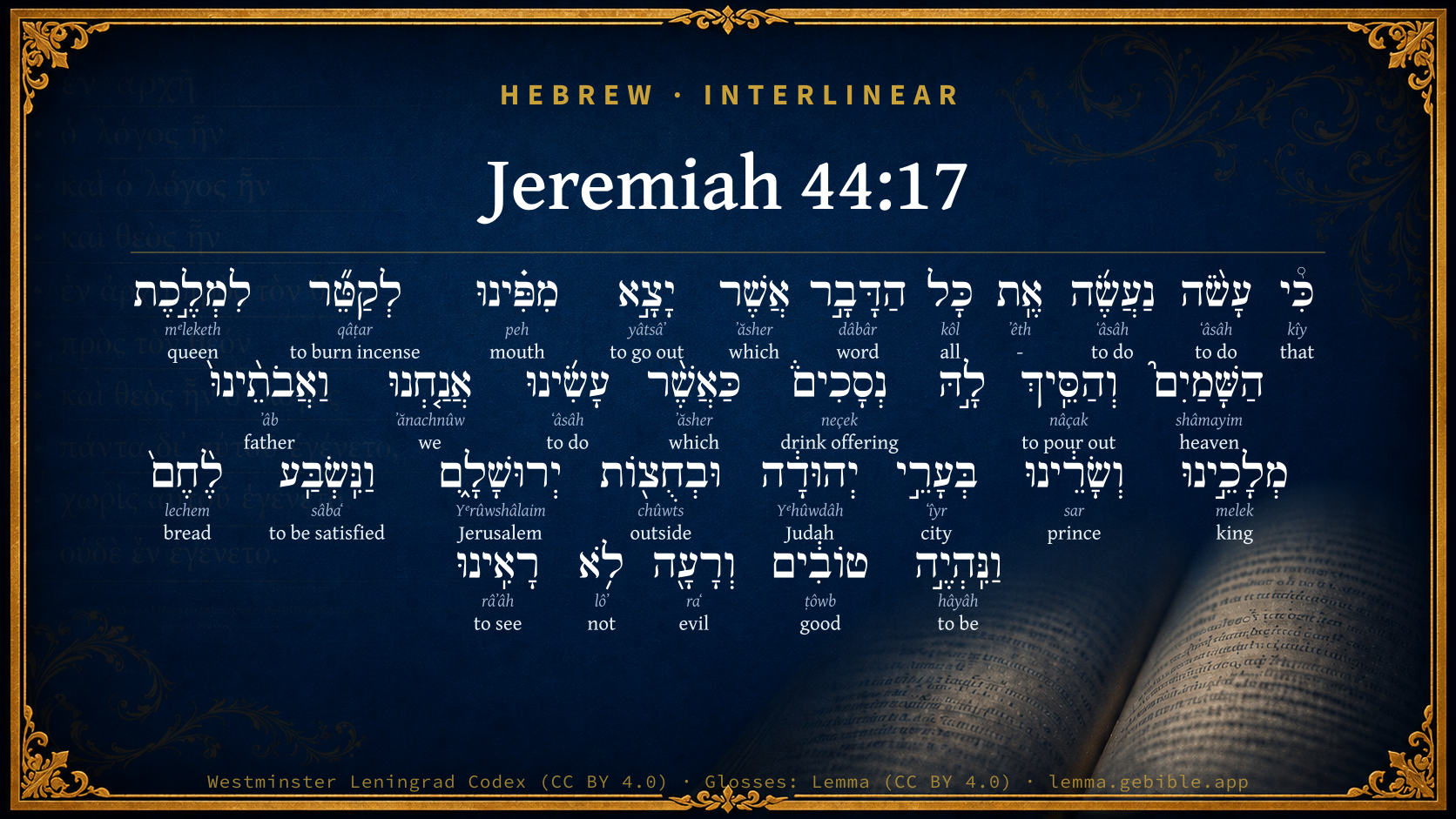
Jeremiah 44:17

Hebrew (Westminster Leningrad Codex) Jeremiah 44:17 appears in the Hebrew Old Testament. The text above is from the Westminster Leningrad Codex. Each word links to its Strong’s number, a concise gloss, and parsing drawn from the Open Scriptures Hebrew Bible morphology. Click any word for its full Brown-Driver-Briggs (BDB) entry.
Download image
Cite this verse

Jeremiah 44:17 (World English Bible). Public Domain. Lemma interlinear Bible study tool, https://lemma.gebible.app/v/jeremiah/44/17.

Show BibTeX & RIS
BibTeX
RIS
English Translation
But we will certainly perform every word that is gone forth out of our mouth, to burn incense to the queen of the sky, and to pour out drink-offerings to her, as we have done, we and our fathers, our kings and our princes, in the cities of Judah, and in the streets of Jerusalem; for then had we plenty of food, and were well, and saw no evil.
World English Bible · Public Domain
Download a study sheet

One document with this verse’s original text, its word-by-word gloss line, the meaning frame, cross-references with their text, attributed commentary, and full source and license credits — printable, and it pastes into notes with its structure intact.

This verse Autodidact and up

Study sheet (.html) Plain text (.txt)

A passage Seminary Student

Up to 50 verses in one chapter. A passage sheet keeps up to 6 commentary sources and 12 cross-references per verse, in the order this page ranks them, and says so on the sheet whenever that leaves anything out. Ask for a single verse and you get the Autodidact verse sheet above.

Everything on this page stays free to read, with no account — the sheet is a download of what is already on screen, not access to it.

Want to remove ads? Support Godless Engineer
Compare translations 3

The same verse in 3 English versions, stacked beneath the original-language interlinear above. Click any original word for its lexicon entry.

Each is an independent rendering of the whole verse — the interlinear is not word-aligned to these translations.

Highlighted words mark where these versions differ — a whole-verse word diff, not a word-by-word alignment.

  • World English Bible Public Domain
    But we will certainly perform every word that is gone forth out of our mouth, to burn incense to the queen of the sky, and to pour out drink-offerings to her, as we have done, we and our fathers, our kings and our princes, in the cities of Judah, and in the streets of Jerusalem; for then had we plenty of food, and were well, and saw no evil.
  • King James Version Public Domain
    But we will certainly do whatsoever thing goeth forth out of our own mouth, to burn incense unto the queen of heaven, and to pour out drink offerings unto her, as we have done, we, and our fathers, our kings, and our princes, in the cities of Judah, and in the streets of Jerusalem: for then had we plenty of victuals, and were well, and saw no evil.
  • unfoldingWord Literal Text CC BY-SA 4.0
    For we will certainly do all the things that we said we would do—burn incense to the queen of heaven and pour out drink offerings to her just as we, our ancestors, our kings, and our leaders did in the cities of Judah and the streets of Jerusalem. Then we will be filled with food and will prosper, without experiencing any disaster.

unfoldingWord Literal Text — © unfoldingWord, licensed CC BY-SA 4.0. Word-aligned USFM3 via Door43 (git.door43.org/unfoldingWord/en_ult).

Versions to compare (up to 4)

3 of 4 selected

Show all 18 translations

Every available English version of this verse, each an independent rendering of the whole verse.

  • World English Bible Public Domain
    But we will certainly perform every word that is gone forth out of our mouth, to burn incense to the queen of the sky, and to pour out drink-offerings to her, as we have done, we and our fathers, our kings and our princes, in the cities of Judah, and in the streets of Jerusalem; for then had we plenty of food, and were well, and saw no evil.
  • Berean Standard Bible Public Domain
    Instead, we will do everything we vowed to do: We will burn incense to the Queen of Heaven and offer drink offerings to her, just as we, our fathers, our kings, and our officials did in the cities of Judah and in the streets of Jerusalem. At that time we had plenty of food and good things, and we saw no disaster.
  • Majority Standard Bible Public Domain
    Instead, we will do everything we vowed to do: We will burn incense to the Queen of Heaven and offer drink offerings to her, just as we, our fathers, our kings, and our officials did in the cities of Judah and in the streets of Jerusalem. At that time we had plenty of food and good things, and we saw no disaster.
  • King James Version Public Domain
    But we will certainly do whatsoever thing goeth forth out of our own mouth, to burn incense unto the queen of heaven, and to pour out drink offerings unto her, as we have done, we, and our fathers, our kings, and our princes, in the cities of Judah, and in the streets of Jerusalem: for then had we plenty of victuals, and were well, and saw no evil.
  • American Standard Version (1901) Public Domain
    But we will certainly perform every word that is gone forth out of our mouth, to burn incense unto the queen of heaven, and to pour out drink-offerings unto her, as we have done, we and our fathers, our kings and our princes, in the cities of Judah, and in the streets of Jerusalem; for then had we plenty of victuals, and were well, and saw no evil.
  • Revised Version (1885) Public Domain
    But we will certainly perform every word that is gone forth out of our mouth, to burn incense unto the queen of heaven, and to pour out drink offerings unto her, as we have done, we and our fathers, our kings and our princes, in the cities of Judah, and in the streets of Jerusalem: for then had we plenty of victuals, and were well, and saw no evil.
  • Geneva Bible (1599) Public Domain
    But wee will doe whatsoeuer thing goeth out of our owne mouth, as to burne incense vnto the Queene of heauen, and to powre out drinke offerings vnto her, as we haue done, both we and our fathers, our Kings and our princes in the cities of Iudah, and in the streetes of Ierusalem: for then had wee plentie of vitailes and were well and felt none euill.
  • Douay-Rheims (1899) Public Domain
    But we will certainly do every word that shall proceed out of our own mouth, to sacrifice to the queen of heaven, and to pour out drink offerings to her, as we and our fathers have done, our kings, and our princes in the cities of Juda, and in the streets of Jerusalem: and we were filled with bread, and it was well with us, and we saw no evil.
  • Young's Literal Translation Public Domain
    for we certainly do everything that hath gone out of our mouth, to make perfume to the queen of the heavens, and to pour out to her libations, as we have done, we, and our fathers, our kings, and our heads, in cities of Judah, and in streets of Jerusalem, and -- we are satisfied with bread, and we are well, and evil we have not seen.
  • Literal Standard Version CC BY-SA 4.0
    for we certainly do everything that has gone out of our mouth, to make incense to the queen of the heavens, and to pour out drink-offerings to her, as we have done, we, and our fathers, our kings, and our heads, in cities of Judah, and in streets of Jerusalem, and—we are satisfied with bread, and we are well, and we have not seen calamity.
  • Unlocked Literal Bible CC BY-SA 4.0
    For we will certainly do all the things that we said we would do—burn incense to the queen of heaven and pour out drink offerings to her just as we, our ancestors, our kings, and our leaders did in the cities of Judah and the streets of Jerusalem. Then we will be filled with food and will prosper, without experiencing any disaster.
  • unfoldingWord Literal Text CC BY-SA 4.0
    For we will certainly do all the things that we said we would do—burn incense to the queen of heaven and pour out drink offerings to her just as we, our ancestors, our kings, and our leaders did in the cities of Judah and the streets of Jerusalem. Then we will be filled with food and will prosper, without experiencing any disaster.
  • Darby Bible Public Domain
    but we will certainly do every word that is gone forth out of our mouth, to burn incense to the queen of the heavens, and to pour out drink-offerings to her, as we have done, we and our fathers, our kings and our princes, in the cities of Judah and in the streets of Jerusalem; and we had plenty of bread, and were well, and saw no evil.
  • World Messianic Bible Public Domain
    But we will certainly perform every word that has gone out of our mouth, to burn incense to the queen of the sky and to pour out drink offerings to her, as we have done, we and our fathers, our kings and our princes, in the cities of Judah and in the streets of Jerusalem; for then we had plenty of food, and were well, and saw no evil.
  • Webster's Bible Public Domain
    But we will certainly do whatever thing proceedeth from our own mouth, to burn incense to the queen of heaven, and to pour out drink-offerings to her, as we have done, we, and our fathers, our kings, and our princes, in the cities of Judah, and in the streets of Jerusalem: for then we had plenty of provisions, and were well, and saw no evil.
  • Free Bible Version CC BY-SA 4.0
    In fact we're going to do everything we said we would. We'll burn incense to the Queen of Heaven and offer drink offerings to worship her as we did before, just like our fathers, our kings, and our officials who did the same things in the towns of Judah and in the streets of Jerusalem. Back then we had plenty of food and we were well off and nothing bad happened to us.
  • Bible in Basic English Public Domain
    But we will certainly do every word which has gone out of our mouths, burning perfumes to the queen of heaven and draining out drink offerings to her as we did, we and our fathers and our kings and our rulers, in the towns of Judah and in the streets of Jerusalem: for then we had food enough and did well and saw no evil.
  • JPS Tanakh (1917) Public Domain
    But we will certainly perform every word that is gone forth out of our mouth, to offer unto the queen of heaven, and to pour out drink-offerings unto her, as we have done, we and our fathers, our kings and our princes, in the cities of Judah, and in the streets of Jerusalem; for then had we plenty of food, and were well, and saw no evil.

Literal Standard Version (2020), Covenant Press — licensed CC BY-SA 4.0. Text via the HelloAO Bible API (eBible.org). Unlocked Literal Bible (unfoldingWord) — licensed CC BY-SA 4.0. Text via the HelloAO Bible API (eBible.org). unfoldingWord Literal Text — © unfoldingWord, licensed CC BY-SA 4.0. Word-aligned USFM3 via Door43 (git.door43.org/unfoldingWord/en_ult). Free Bible Version, Dr. Jonathan Gallagher — licensed CC BY-SA 4.0. Text via the HelloAO Bible API (eBible.org).

Word by word

More ways to search: Search by grammar → Find every occurrence → Compare this word →

Practice this passage: Drill this verse → Learn its vocabulary →

לִמְלֶ֣כֶת
mᵉleketh
H4446
“to/for · queen of”
Preposition + Noun, Common, Feminine, Singular, Construct
Part of Speech
Preposition + Noun
Type
Common
Gender
Feminine
Number
Singular
State
Construct
Full BDB Definition

Origin: from H4427

TWOT: 1199c

queen
  1. כִּ֩י kîy H3588 “that” Conjunction
  2. עָשֹׂ֨ה ʻâsâh H6213 “to do” Verb, Qal, Infinitive Absolute
  3. נַעֲשֶׂ֜ה ʻâsâh H6213 “to do” Verb, Qal, Imperfect, 1st Person, Common, Plural
  4. אֶֽת ʼêth H853 “-” Particle, Direct Object
  5. כָּל kôl H3605 “all of” Noun, Common, Masculine, Singular, Construct
  6. הַדָּבָ֣ר dâbâr H1697 “the · word” Particle, Definite Article + Noun, Common, Masculine, Singular, Absolute
  7. אֲשֶׁר ʼăsher H834 “which” Particle, Relative
  8. יָצָ֣א yâtsâʼ H3318 “to go out” Verb, Qal, Perfect, 3rd Person, Masculine, Singular
  9. מִפִּ֗ינוּ peh H6310 “from · mouth · our” Preposition + Noun, Common, Masculine, Singular, Construct + Suffix, Personal, 1st Person, Common, Plural
  10. לְקַטֵּ֞ר qâṭar H6999 “to burn incense” Preposition + Verb, Piel, Infinitive Construct
  11. הַשָּׁמַיִם֮ shâmayim H8064 “the · heaven(s)” Particle, Definite Article + Noun, Common, Masculine, Plural, Absolute
  12. וְהַסֵּֽיךְ nâçak H5258 “and · to pour out” Conjunction + Verb, Hiphil, Infinitive Absolute
  13. נְסָכִים֒ neçek H5262 “drink offerings” Noun, Common, Masculine, Plural, Absolute
  14. כַּאֲשֶׁ֨ר ʼăsher H834 “like/as · which” Preposition + Particle, Relative
  15. עָשִׂ֜ינוּ ʻâsâh H6213 “to do” Verb, Qal, Perfect, 1st Person, Common, Plural
  16. אֲנַ֤חְנוּ ʼănachnûw H587 “we” Pronoun, Personal, 1st Person, Common, Plural
  17. וַאֲבֹתֵ֨ינוּ֙ ʼâb H1 “and · fathers · our” Conjunction + Noun, Common, Masculine, Plural, Construct + Suffix, Personal, 1st Person, Common, Plural
  18. מְלָכֵ֣ינוּ melek H4428 “kings · our” Noun, Common, Masculine, Plural, Construct + Suffix, Personal, 1st Person, Common, Plural
  19. וְשָׂרֵ֔ינוּ sar H8269 “and · princes · our” Conjunction + Noun, Common, Masculine, Plural, Construct + Suffix, Personal, 1st Person, Common, Plural
  20. בְּעָרֵ֣י ʻîyr H5892 “in/at · cities of” Preposition + Noun, Common, Feminine, Plural, Construct
  21. יְהוּדָ֔ה Yᵉhûwdâh H3063 “Judah” Noun, Proper
  22. וּבְחֻצ֖וֹת chûwts H2351 “and · in/at · streets of” Conjunction + Preposition + Noun, Common, Masculine, Plural, Construct
  23. יְרוּשָׁלִָ֑ם Yᵉrûwshâlaim H3389 “Jerusalem” Noun, Proper
  24. וַנִּֽשְׂבַּֽע sâbaʻ H7646 “and · to be satisfied” Conjunction + Verb, Qal, Sequential Imperfect, 1st Person, Common, Plural
  25. לֶ֨חֶם֙ lechem H3899 “bread” Noun, Common, Both, Singular, Absolute
  26. וַנִּֽהְיֶ֣ה hâyâh H1961 “and · to be” Conjunction + Verb, Qal, Sequential Imperfect, 1st Person, Common, Plural
  27. טוֹבִ֔ים ṭôwb H2896 “good” Adjective, Adjective, Masculine, Plural, Absolute
  28. וְרָעָ֖ה raʻ H7451 “and · evil” Conjunction + Noun, Common, Feminine, Singular, Absolute
  29. לֹ֥א lôʼ H3808 “not” Particle, Negative
  30. רָאִֽינוּ râʼâh H7200 “to see” Verb, Qal, Perfect, 1st Person, Common, Plural

About this verse

These counts appear in no published source. They are computed here, from the morphology-tagged text and Lemma’s own curated glosses. What Lemma adds →

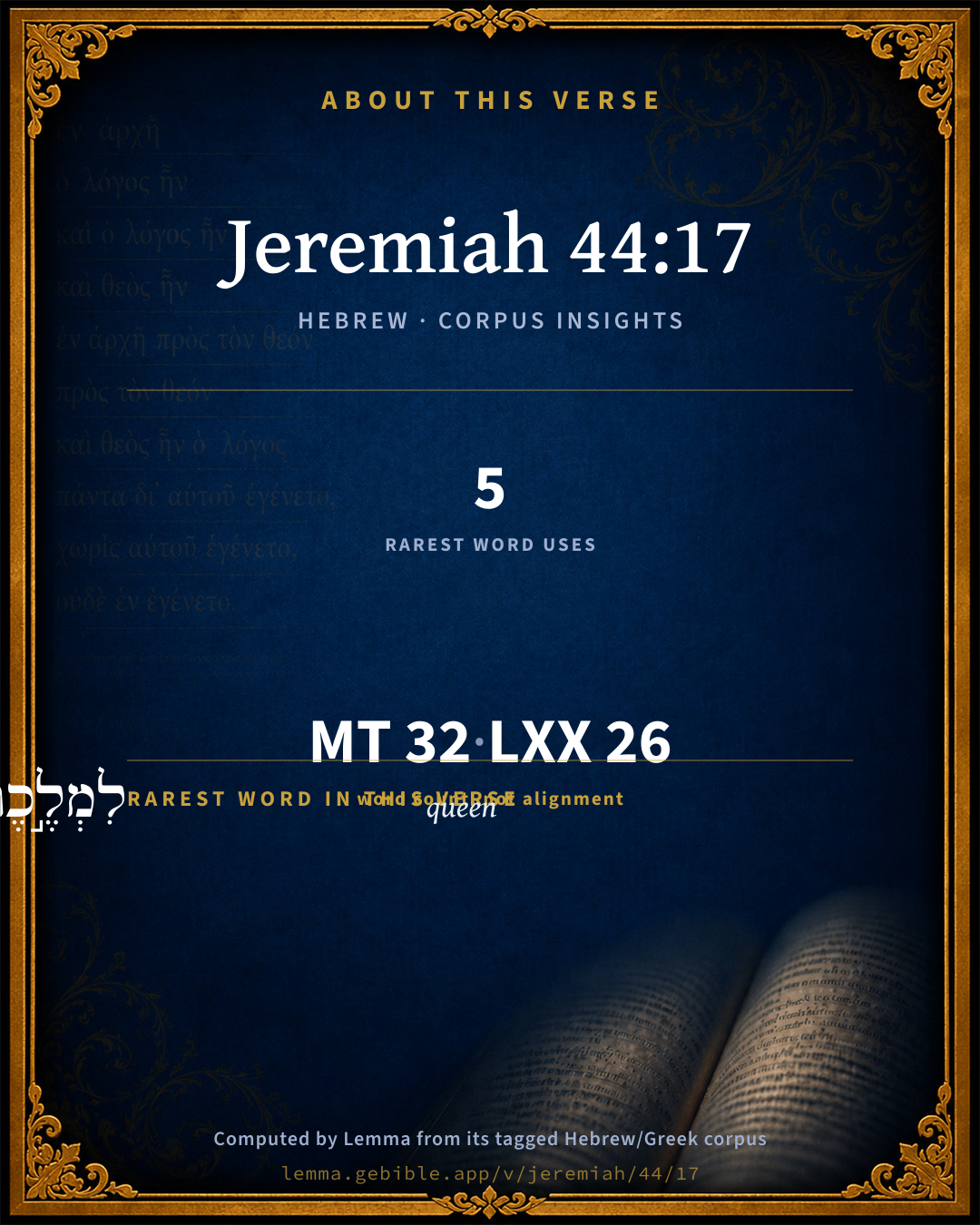
32
words
28
distinct lemmas
Prophets
section

Notable vocabulary

The rarest word here is לִמְלֶ֣כֶת queen H4446 — appearing just 5 times in the whole Hebrew Bible.

Shared distinctive vocabulary

לִמְלֶ֣כֶת queen H4446 occurs in 5 verses of the Hebrew Bible. Also found in:

Grammatical profile

  • 9 verbs
  • 15 nouns
  • 1 adjective
  • 1 pronoun
  • 1 preposition
  • 1 conjunction
  • 4 particles

Verb forms

  • עָשֹׂ֨ה Qal · Infinitive Absolute
  • נַעֲשֶׂ֜ה Qal · Imperfect
  • יָצָ֣א Qal · Perfect
  • לְקַטֵּ֞ר Piel · Infinitive Construct
  • וְהַסֵּֽיךְ Hiphil · Infinitive Absolute
  • עָשִׂ֜ינוּ Qal · Perfect
  • וַנִּֽשְׂבַּֽע Qal · Sequential Imperfect
  • וַנִּֽהְיֶ֣ה Qal · Sequential Imperfect
  • רָאִֽינוּ Qal · Perfect

Repetition

Words recur within this verse — often emphatic in Hebrew:

  • עָשֹׂ֨ה to do H6213 ×3
  • אֲשֶׁר which H834 ×2

Hebrew & Septuagint length

In the original languages it is 32 Hebrew tokens and 26 Greek tokens — but the two are counted differently (Hebrew bundles its prefixes and suffixes into one token; the Greek is in lemma form), so that isn’t a like-for-like length.

Cross-references

23

Topical passages linked to Jeremiah 44:17 in the Treasury of Scripture Knowledge — connected by theme and wording, ordered by reader-vote popularity; previews shown in the World English Bible.

  • Jeremiah 7:18 The children gather wood, and the fathers kindle the fire, and the women knead the dough, to make cakes to the queen of the sky, and to pour out drink-offerings to other gods, that they may provoke me to anger.
  • Nehemiah 9:34 neither have our kings, our princes, our priests, nor our fathers, kept your law, nor listened to your commandments and your testimonies with which you did testify against them.
  • Exodus 16:3 and the children of Israel said to them, "We wish that we had died by the hand of Yahweh in the land of Egypt, when we sat by the flesh-pots, when we ate our fill of bread, for you have brought us out into this wilderness, to kill this whole assembly with hunger."
  • Deuteronomy 23:23 That which is gone out of your lips you shall observe and do; according as you have vowed to Yahweh your God, a freewill-offering, which you have promised with your mouth.
  • 2 Kings 17:16 They forsook all the commandments of Yahweh their God, and made them molten images, even two calves, and made an Asherah, and worshiped all the host of the sky, and served Baal.
  • Jeremiah 44:21 The incense that you burned in the cities of Judah, and in the streets of Jerusalem, you and your fathers, your kings and your princes, and the people of the land, didn't Yahweh remember them, and didn't it come into his mind?
  • Jeremiah 44:25 Thus says Yahweh of Hosts, the God of Israel, saying, You and your wives have both spoken with your mouths, and with your hands have fulfilled it, saying, We will surely perform our vows that we have vowed, to burn incense to the queen of the sky, and to pour out drink-offerings to her: establish then your vows, and perform your vows.
  • Ezekiel 20:8 But they rebelled against me, and would not listen to me; they did not every man cast away the abominations of their eyes, neither did they forsake the idols of Egypt. Then I said I would pour out my wrath on them, to accomplish my anger against them in the midst of the land of Egypt.
  • Hosea 2:5–9 For their mother has played the prostitute. She who conceived them has done shamefully; For she said, 'I will go after my lovers, Who give me my bread and my water, My wool and my flax, My oil and my drink.'
  • Philippians 3:19 whose end is destruction, whose god is the belly, and whose glory is in their shame, who think about earthly things.
  • Numbers 30:12 But if her husband made them null and void in the day that he heard them, then whatever proceeded out of her lips concerning her vows, or concerning the bond of her soul, shall not stand: her husband has made them void; and Yahweh will forgive her.
  • Judges 11:36 She said to him, My father, you have opened your mouth to Yahweh; do to me according to that which has proceeded out of your mouth, because Yahweh has taken vengeance for you on your enemies, even on the children of Ammon.
  • 2 Kings 22:17 Because they have forsaken me, and have burned incense to other gods, that they might provoke me to anger with all the work of their hands, therefore my wrath shall be kindled against this place, and it shall not be quenched.
  • Psalms 12:4 Who have said, "With our tongue we will prevail. Our lips are our own. Who is lord over us?"
  • Psalms 106:6 We have sinned with our fathers. We have committed iniquity. We have done wickedly.
  • Jeremiah 19:13 and the houses of Jerusalem, and the houses of the kings of Judah, which are defiled, shall be as the place of Topheth, even all the houses on whose roofs they have burned incense to all the host of the sky, and have poured out drink-offerings to other gods.
  • Jeremiah 44:9 Have you forgotten the wickedness of your fathers, and the wickedness of the kings of Judah, and the wickedness of their wives, and your own wickedness, and the wickedness of your wives which they committed in the land of Judah, and in the streets of Jerusalem?
  • Numbers 30:2 When a man vows a vow to Yahweh, or swears an oath to bind his soul with a bond, he shall not break his word; he shall do according to all that proceeds out of his mouth.
  • Isaiah 48:5 therefore I have declared it to you from of old; before it came to pass I shown it you; lest you should say, My idol has done them, and my engraved image, and my molten image, has commanded them.
  • Jeremiah 32:29–32 and the Chaldeans, who fight against this city, shall come and set this city on fire, and burn it, with the houses, on whose roofs they have offered incense to Baal, and poured out drink-offerings to other gods, to provoke me to anger.
  • Mark 6:26 The king was exceedingly sorry, but for the sake of his oaths, and of his dinner guests, he didn't wish to refuse her.
  • 1 Peter 1:18 knowing that you were redeemed, not with corruptible things, with silver or gold, from the useless way of life handed down from your fathers,
  • Daniel 9:5–8 we have sinned, and have dealt perversely, and have done wickedly, and have rebelled, even turning aside from your precepts and from your ordinances;

Cross-references courtesy of OpenBible.info (CC BY 4.0).

Hebrew and Greek witnesses Masoretic Hebrew ↔ Greek Septuagint

The same verse in the two great witnesses to the Old Testament, shown verse-for-verse.

These are two independent witnesses, not word-aligned to each other, and the Septuagint is shown in lemma (dictionary) form.

Hebrew Jeremiah 44:17 Masoretic · Westminster Leningrad Codex

כִּ֩י עָשֹׂ֨ה נַעֲשֶׂ֜ה אֶֽת כָּל הַדָּבָ֣ר אֲשֶׁר יָצָ֣א מִפִּ֗ינוּ לְקַטֵּ֞ר לִמְלֶ֣כֶת הַשָּׁמַיִם֮ וְהַסֵּֽיךְ לָ֣הּ נְסָכִים֒ כַּאֲשֶׁ֨ר עָשִׂ֜ינוּ אֲנַ֤חְנוּ וַאֲבֹתֵ֨ינוּ֙ מְלָכֵ֣ינוּ וְשָׂרֵ֔ינוּ בְּעָרֵ֣י יְהוּדָ֔ה וּבְחֻצ֖וֹת יְרוּשָׁלִָ֑ם וַנִּֽשְׂבַּֽע לֶ֨חֶם֙ וַנִּֽהְיֶ֣ה טוֹבִ֔ים וְרָעָ֖ה לֹ֥א רָאִֽינוּ

But we will certainly perform every word that is gone forth out of our mouth, to burn incense to the queen of the sky, and to pour out drink-offerings to her, as we have done, we and our fathers, our kings and our princes, in the cities of Judah, and in the streets of Jerusalem; for then had we plenty of food, and were well, and saw no evil.

World English Bible · Public Domain

Greek LXX Structure differs

In the Septuagint, Jeremiah is about an eighth shorter than the Hebrew and arranges its material differently — the Oracles Against the Nations (Hebrew chapters 46–51) appear in the middle of the Greek book, after 25:13. Because the chapter and verse boundaries do not line up, a verse-for-verse comparison with the Hebrew is not shown.

A verse-for-verse comparison isn’t shown here because the chapters and verses don’t line up. Switch to the LXX edition with the MT / LXX toggle above to read the Greek directly.

Hebrew: Westminster Leningrad Codex (CC BY 4.0). Greek: Septuagint (public domain); English from a public-domain English Septuagint. How the Septuagint differs from the Hebrew →

Targum (Aramaic paraphrase)

1

The Targum is the ancient Jewish Aramaic paraphrase of the Hebrew Scriptures — an interpretive translation, not the Hebrew text itself. Onkelos (literal) and Pseudo-Jonathan (expansive) render the Torah, and Jonathan the Prophets. Coverage is partial: where no permissively-licensed English translation exists for a verse, only the Aramaic is shown. This is verse-level text, not a word-by-word alignment to the Hebrew.

  1. Targum Jonathan Prophets (Joshua–Malachi)
    אֲרֵי מֶעְבַּד נַעְבֵיד יַת כָּל פִּתְגָמָא דִנְפַק מִפּוּמָנָא לְאַסָקָא בּוּסְמִין לְכוֹכְבַת שְׁמַיָא וּלְנַסָכָא לָהּ נִסְכִין כְּמָא דַעֲבַדְנָא אֲנַחְנָא וְאַבְהָתָנָא מַלְכָּנָא וְרַבְרְבָנָא בְּקִרְוַיָא דְבֵית יְהוּדָה וּבְשׁוּקֵי יְרוּשְׁלֵם וַהֲוֵינָא סָבְעִין לַחְמָא וַהֲוֵינָא שָׁלָן שְׁלֵיוָא וּבִישְׁתָא לָא חֲזֵינָא:

    (no public-domain English translation for this verse)

    Targum Jonathan — Aramaic: “Mikraot Gedolot” (public domain). English: “Sefaria Community Translation” (CC0 1.0 (public-domain dedication)); “London "Chaldee Paraphrase," 1871” (public domain). Text via Sefaria.

Commentary

Notes on Jeremiah 44:17 from classic Christian and Jewish commentators (each source and its license shown beneath its notes). The classic Christian expositions comment on the surrounding passage and are grouped to its opening verse, so a note may address several verses; the Jewish commentaries on the Tanakh (Rashi and others) are per-verse, so they appear only where the commentator wrote on this verse.

Lemma curates 59 commentaries, every one of them public domain or Creative Commons licensed, each selected and text-cleaned for this edition rather than reprinted as found. About our sources →

Trapp's Complete Commentary

John Trapp

Jer 44:17 But we will certainly do whatsoever thing goeth forth out of our own mouth, to burn incense unto the queen of heaven, and to pour out drink offerings unto her, as we have done, we, and our fathers, our kings, and our princes, in the cities of Judah, and in the streets of Jerusalem: for [then] had we plenty of victuals, and were well, and saw no evil.

Ver. 17. But we will certainly do whatsoever thing goeth forth out of our own mouth.] Heb., We will doing do every word that hath gone forth from our mouth; that we may be dicti nostri dominae, as big as our words, our vows especially, {as Jer 44:25} which we made to worship the queen of heaven, in case we came safe into Egypt.

To burn incense to the queen of heaven.] See Jer 7:18.

As we have done, we and our fathers, our kings and our princes.] Antiquity is here pleaded, and authority, and plenty and peace. These are now the Popish pleas, and the pillars of that rotten religion. It is the old religion, say they, and hath potent princes for her patrons, and is practised in Rome, the mother Church, and hath plenty and peace where it is professed, and where they have nothing but mass and matins. These are their arguments, but very poor ones, as were easy to evince. But as women, counted the devouter sex, have always carried a great stroke with their husbands, as did Eve, Jezebel, Eudoxia, &c., the women of Antioch could much against Paul and Barnabas; {Act 13:50} so the people are indeed a weighty but unwieldy body, slow to remove from what they have been accustomed to. {a} The Irish will not be persuaded to put gears and harness on their horses, but will have the plough still tied to their tails as they have been; neither in matters of religion will they be drawn to leave their old mumpsimus {b} for the new sumpsimus, {c} so powerful is usage, and so sweet our present though perverse opinions and persuasions.

For then had we plenty of victuals.] Just so doth the Church of Rome borrow her mark from the market’s plenty or cheapness of all things. But one chief reason of that is the scarcity of money that was in our fathers’ days, and the plenty thereof that is in ours, by means of the rich mines in the West Indies, not discovered till the days of Henry VII. Holinshed saith that some old men he knew who told of times in England when it was accounted a great matter that a farmer could show five shillings or a noble together in silver.

And were well, and saw no evil.] Ubi utilitas ibi pietas, saith Epictetus; and deos quisque sibi utiles cudit, saith another: for profit men will be of any religion. If the belly may be filled, the back fitted, &c., modoferveat olla, so the pot may boil, much will be yielded to. {d} It is well observed that the Papists are most corrupt in those things where their profit, ease, or honour is engaged. In the doctrine of the Trinity, and other points that touch not upon these, they are sound.

{a} Plus valet malum inclitum quam bonum insolitum.

{b} One who obstinately adheres to old ways, in spite of the clearest evidence that they are wrong; an ignorant and bigoted opponent of reform.

{c} A correct expression taking the place of an incorrect but popular one

{d} ’Oπαυ το συμφερον εκει το ευσεβες. Si ventri bene, si lateri. - Horat.

John Trapp, A Commentary or Exposition upon All the Books of the Old and New Testament (1647–1656) — public domain. Text from a community e-Sword module.

Tyndale Open Study Notes

Tyndale Open Resources

44:17 The Judean refugees imagined that they had freedom. They apparently believed that obedience to the Lord entailed bondage and that their pagan worship was the way to fulfillment. • The Queen of Heaven was worshiped under a variety of names throughout the ancient Near East. In Assyria and Babylon she was called “Ishtar,” and the Canaanites called her “Astarte.” In the Old Testament, she is usually called “Ashtoreth” and associated with Baal. Solomon worshiped Ashtoreth and built shrines for her, but Josiah eventually destroyed those shrines (2 Kgs 23:13; see 1 Kgs 11:5). Ashtoreth was associated with the planet Venus and with all types of reproduction among plants and animals, so she was a popular idol among farmers and herdsmen. Offerings of incense, food, and liquids were regarded as magical triggers that would induce reproduction and prosperity.

Tyndale Open Study Notes — © Tyndale Open Resources, licensed CC BY-SA 4.0. Text via the HelloAO Bible API.

Geneva Bible (1599)

Geneva Bible translators

Or, saw.

Read Jer. 7:18, it seemeth that the Papists gathered of this place Salve Regina, and Regina caeli latare, calling the virgin Mary Queen of heaven, and so of the blessed virgin and mother of our Savior Christ, made an idol: for here the Prophet condemneth their idolatry.

Hebrew, we were satiated with bread.

This is still the argument of idolaters, which esteem religion by the belly, and instead of acknowledging God’s works, who sendeth both plenty and dearth, health and sickness, they attribute it to their idols, and so dishonor God.

Geneva Bible (1599) marginal notes — public domain. Text via Bolls.life.

Jamieson, Fausset & Brown

Robert Jamieson, A. R. Fausset & David Brown

whatsoever . . . goeth . . . out of our . . . mouth--whatever vow we have uttered to our gods (Jer 44:25; Deu 23:23; Jdg 11:36). The source of all superstitions is that men oppose their own will and fancies to God's commands.

queen of heaven--(See on Jer 7:18); Ashtaroth or Astarte.

we . . . fathers . . . king, &c.--The evil was restricted to no one class: all from the highest to the lowest shared the guilt.

then had we plenty--Fools attribute their seeming prosperity to God's connivance at their sin: but see Pro 1:32; Ecc 8:11-13. In fact, God had often chastised them for their idolatry (see Jdg 2:14); but it is the curse of impiety not to perceive the hand of God in calamities.

victuals--Men cast away the bread of the soul for the bread that perisheth (Deu 8:3; Joh 6:27). So Esau (Heb 12:16).

Jamieson, Fausset & Brown — Commentary Critical and Explanatory on the Whole Bible (1871) — public domain (CC PDM 1.0). Text via the HelloAO Bible API.

John Calvin's Commentaries

Here they shew more openly their obstinacy; for having said that they had no faith in Jeremiah, as he had not been sent by God, they now add that they would indeed be the worshippers of God, but according to their own will. We have here discovered to us the fountain of all superstitions. This passage sufficiently proves whence these flow, and from what source proceed all the corruptions by which religion has been vitiated in all ages, even from the willfulness and pride of men. While therefore men arrogate so much to themselves as to make a law respecting the worship of God, all things must necessarily go wrong. It was for this reason I said that this is the origin of all errors. How then is religion to remain pure? even by depending on God’s mouth, by subjecting ourselves to his word, and by putting a bridle on ourselves, so as not to introduce anything except what he commands and approves. The right rule then as to the worship of God is, to adopt nothing but what he prescribes. On the other hand religion becomes vitiated and degenerates into superstition as soon as men seek to be legislators for themselves, when they say, Doing we shall do every word that cometh forth from our mouth.

This willfulness is indeed what humble men will condemn if they only consult common sense; but it is an evil innate in all, to seek to worship God as it seems good to them. But Jeremiah here paints for us as it were on a tablet the beginning of all superstitions: men set up their own will and fancies in opposition to the commands of God.

He afterwards adds, To offer incense to the frame-work of the heavens. Interpreters differ as to the meaning of this clause. We have stated some things already in the seventh chapter; but as a great part of you were not then present, it is necessary to repeat what was then said. Some derive the last word but one from מלך, melek, which means to reign; and hence they give this rendering, “to the queen of the heavens;” and this is the explanation of Jerome. But others derive the word from לאך, lak, and render it “work;” and some more rashly, “ministry;” and others, “framework,” or, fabric, (machina.) There are also those deduce the word from הלך, elek, which is to walk; and they think that all the stars or planets are included in this term; and we indeed see that walking or motion is what belongs to all the stars. But if the word comes from the verb to reign, “the queen of the heavens” must be taken for the principal star, as the Chaldee paraphrase regards it.

But some consider that the sun is intended, and some the moon. The sun in Hebrew is of the feminine gender; therefore the sun may properly be called a queen in that language. But if we take it as meaning frame-work, one of the radical letters א, aleph, is wanting, as in the seventh chapter. The Prophet, however, seems to mention here the whole machinery of the heavens, as though the unbelieving had said, that as wonderful glory appeared there, their worship was doubtless pleasing to God, when his majesty was adored in the stars and in the whole frame-work of the heavens. I do not therefore consider that one starts meant, but the very heavens or all the stars; and though the word is in the singular number, yet it means what is commonly called the hosts of heaven.

They then said, “We shall go on in our usual manner; for we have hitherto offered incense to the fabric (or the frame-work) of the heavens, and poured libations; we shall not then desist from what we have usually done: “and they further said, “So have we done, we, and our fathers, and our kings, and our princes.” Here they set up the authority of fathers in opposition to the authority of God, as it was usually done.

We see also in our day that the Papists superciliously boast of the Fathers and the Catholic Church, when the plain truth is brought forward. They think that darkness overspreads the Word of God, and that whatever is adduced from the Law, from the Prophets, and from the Gospel, is reduced to nothing when they object and say that it is otherwise, that the fathers have spoken otherwise, that it was otherwise understood in old times. We hence see that the Papists of this day fight with the same weapons as idolaters formerly employed; and though the devil transforms himself in various ways, yet superstitious men ever adopt this principle, that whatever is handed down from our forefathers ought to be held sacred; and hypocrites do especially harden themselves in this error, when they can boast of kings and princes, as was the case in this instance; for they said, that they followed what had been done, not only by the common people, but even by kings and princes. They took it as granted that kings and princes could not have fallen into ignorance. The truth is, that greatness and splendor cover the ignorance and folly of kings. So when simple men speak of kings, their eyes are blinded or dazzled by the magnificence displayed, so that they think kings to be without dispute wise and endowed with the best understanding. Hence it is that Satan is wont often to use such masks for the purpose of deceiving men. Let us therefore learn to render to God altogether the honor of prescribing by his word the law as to religion; and thus let no altitude or dignity be allowed to overshadow the authority of God; but on the contrary, let kings and princes be constrained to submit when God appears.

They afterwards added, In the cities of Judah, and in the streets of Jerusalem And they mentioned these places in order to sanction their own superstitions; for the holiness of Jerusalem was to them a cover for all vices, as we see to be the case at this day with respect to Rome, which is boastfully extolled by the Papists, as though the hypocrisy which sends forth the most nauseous filth through the whole world, were the most perfect holiness. Whatever then comes from Rome, they would have to be counted as a heavenly oracle. In the same manner the wretched Jews dared to set up Jerusalem in opposition to God. Great, indeed, was the dignity of the city, not such is that of Rome at this day; for the Papists have not taken from God’s word the encomiums, by which they extol that city, which is really a foetid and an abominable brothel. Jerusalem had its dignity from God himself; but the Jews in their folly degraded Jerusalem when they corrupted the Law and instituted fictitious worship, according to their own will. And yet we see that they armed themselves with this name, as a weapon, against the Prophet, as though they brought God to fight against himself. Jerusalem had no dignity but that with which God himself had favored it; but they boasted that it was a holy city, that whatever was done in it was to be deemed holy and lawful, and not to be disputed, as though God’s Law had been lying buried under the dignity of the city. Now Jerusalem had derived its splendor and all the dignity it had from the Law only. But this, as I have said, was the wickedness of men, that they corrupted and perverted the benefits of God.

They then added, that they were satisfied with bread, when they burned incense to the work or workmanship of the heavens It has ever been a common thing with the despisers of God, that they have been inebriated with earthly things, so as to disregard God himself, and to think that all their superstitions would go unpunished. But whence comes this error? even because men deceive themselves, when God patiently bears with them. God does not immediately take vengeance on the profanation of his name, he does not immediately punish hypocrites and idolaters, he does not immediately fulminate against ungodly and spurious modes of worship: his forbearance seems to be taken as an inducement to sin, as an excitement to licentiousness. When, therefore, the Jews adduced this defense, that they were satisfied with bread, it was the same thing as though they had said, “As long as God spared us, and suspended his judgment, it was well with us.” But they ought not to have abused the forbearance of God, and thus to have heaped on themselves judgment, as Paul says. Now there was also another cause of error, for when God drew men back from error by chastising them more severely, as they deserved, after seeing they were still obstinate, they then began so to regard God’s judgment, as foolishly to think that the cause proceeded from religion being changed. So, at the beginning of the Gospel we see that there were similar complaints among all the ungodly, as the ancients have recorded, and especially Tertullian, in his apologies: “If the Tiber inundated, if any calamity happened, if hail or frost, the fault was ascribed to the name of Christ and his doctrine. From the time religion has been changed, we have not ceased to be miserable.” But they did not consider as they ought to have done, that when they were blind and sunk in errors, God for a long time bore with them, and that after the doctrine of the gospel had shone forth, they still wickedly followed their accustomed impiety, which before might have been excused on the ground of ignorance: from the time God had shewn to them the way of salvation, they had resisted it, as it were designedly and willfully, so that they deserved a heavier punishment.

Such was the impiety of the ancient people according to this answer, We were satisfied with bread when we poured out libations to the frame-work of the heavens; that is, as God did not immediately punish their impiety, they were happy and saw no evil. And yet it is certain that they said what was untrue, for God had often chastised them, and at the time they were sedulous and devoted to their false worship. They had gone astray to idolatry before Jeremiah was born; nay, before Isaiah had commenced his office as a Prophet: and we know how severely at that time God punished them for their wickedness; for in the time of Isaiah the kingdom of Israel was distressed, and then wholly destroyed. Jerusalem, as Isaiah says, became like a cottage, and the whole country was laid waste; and at this time they poured out libations to the workmanship of heaven and burnt incense. We know how great was the zeal of Ahaz, and of other wicked kings. Hezekiah, indeed, and Josiah labored to restore the pure worship of God; but Manasseh, the son and successor of Hezekiah, immediately subverted everything. While then they were so fervid in their superstitions, did all things succeed according to their wishes, as they now boasted? By no means, for God pursued them with the sword, with famine, and with pestilence.

What then did this boasting mean, that they were satisfied with bread, and were happy, and saw no evil, at the time they poured out libations? The truth is, that madness so drives on headlong the ungodly, that they perceived not God’s hand, when stretched forth against them. But even had they truly said, that they were happy at the time they pro-stituted themselves to idols, yet they could not have hence inferred, that their false worship was approved by God; for when he bears with men for a time, he does not yet cease to be their judge; for he will at length, in his own time, sum-. mort to his tribunal the ungodly whom he has long spared. In short, hypocrites at first trifle with God, and thus turn his mercy to an occasion of sinning, as though there were no punishment; this is one thing: and in the second place, they are not roused by the scourges of God, but remain stupid when God chastises them. It follows, —

John Calvin's Commentaries (1540-1563) — public domain. Text from the Calvin Translation Society English edition (1840s-50s) via the Christian Classics Ethereal Library (ccel.org). Calvin's coverage is partial (roughly two-thirds of the Bible); uncommented books and verses are honest gaps, never fabricated. The 19th-century editor's footnotes and remarks are omitted so the notes are faithfully Calvin's own voice.

The Cambridge Bible for Schools and Colleges

gen. ed. J. J. S. Perowne

17. every word that is gone forth out of our mouth] For this phrase as employed of vows see Num_30:2; Num_30:12; Deu_23:23; Jdg_11:36; Psa_66:13 f.

the queen of heaven] See on ch. Jer_7:18.

victuals] lit. as mg. bread.

The Cambridge Bible for Schools and Colleges (gen. ed. J. J. S. Perowne; Cambridge University Press, 1878–1918) — public domain. Text from a community e-Sword module.

John Gill's Exposition

But we will certainly do whatsoever thing goeth out of our own mouth,.... And not what went out of the mouth of God, or his prophet: but whoever they had resolved on within themselves to do, and had declared with their mouths they would, or had vowed with their lips; so Abarbinel interprets it of a vow; this they were determined to perform, let God and his prophet say what they would:

to burn incense unto the queen of heaven; which, according to Abarbinel, was the moon, which is the queen of heaven, as the sun is king; it was called by the Heathens Coelestis and Urania: but there are some that think that some great star in heaven, that is king over the rest, is meant; so the Targum renders it, the star of heaven; which they understand of the sun, as Kimchi observes; the sun being much worshipped in Egypt; but Kimchi himself derives the word for "queen", here used, not from the root which signifies "to reign"; but from another, which signifies "to work"; and so renders it, "the work", or "frame of heaven"; the sun, moon, and stars; and so the Syriac version is "the host of heaven"; See Gill on Jer 7:18; and to this deity, be it what it will, they burned incense; and they were determined to continue it, and all other idolatrous rites and practices particularly:

and to pour out drink offerings unto her; which was another part of ceremonial worship, which the true God required of the people of Israel; but were here resolved to give it to another god:

as we have done, we, and our fathers, our kings, and our princes, in the cities of Judah, and in the streets of Jerusalem; they plead custom and prescription, antiquity and authority; the examples of ancestors and kings; the general practice of their nation, both in the metropolis of it, and in its several cities, where it not only universally obtained, but was visibly and openly done; and, more, they plead the temporal advantage of it:

for then had we plenty of victuals, and were well, and saw no evil: had fulness of bread, and of all provisions; health, peace, and safety; and no judgment was upon them, seen or felt by them; the sword, famine, or pestilence. The goddess Coelestis, or the moon, which seems to be here meant, was, as Tertullian (d) says "pluviarum pollicitatrix", "the promiser of rains" and so of all good things: or, "were merry" (e), as the Heathens were at their new moons, when they indulged to their cups, and lived jovially; hence that of Horace (f).

(d) Apolog. c. 23. (e) "et eramus hilares", Junius & Tremellius, Piscator. (f) "Da lunae propere novae, Da noctis mediae, poculum". Carmin. l. 3. Ode 19.

John Gill's Exposition of the Whole Bible (1746–1763) — public domain (CC PDM 1.0). Text via the HelloAO Bible API.

Albert Barnes' Notes on the Bible

Whatsoever thing ... - Or, the whole word (or thing) which hath gone forth out of our mouth; i. e., the vows we have made. They would not let Jeremiah’s expostulations prevent the carrying out of the special object which had brought them together: otherwise the Queen of heaven would be offended, and avenge himself.

Albert Barnes' Notes on the Bible (1834–1885) — public domain. Text from a community e-Sword/MySword module.

Haydock's Catholic Bible Commentary

The queen of heaven; the moon, which they worshipped under this name, (Challoner) as also under that of the Celestial Venus, (Theodoret) Diana, and Isis. It seems the Jews had engaged by vow (ver. 27.) to restore her worship. (Calmet) --- The women more particularly adored the moon: yet all were guilty, chap. vii. 18., and 4 Kings xxiii. 5. (Worthington)

George Leo Haydock (1774–1849), Haydock's Catholic Family Bible and Commentary, 1859 edition — public domain. Excludes Psalms (Douay-Rheims chapter numbering differs from Protestant) and Deuterocanonical books (Catholic canon only).

Matthew Poole's English Annotations

Here is the root of all sinners’ disobedience, their resolution to please and humour themselves, not knowing how in any thing to deny themselves; hence it is that denying ourselves is by Christ made the first law or condition of his disciples. By the

queen of heaven some here understand the sun, which notion is favoured from the words being of the feminine gender, which signifieth the sun in Hebrew; others reading it not the queen, but the

frame of heaven, by it understanding the sun, moon, and stars.

Drink-offerings were a Divine homage which God had commanded to be paid to him, Lev 23:13; Num 6:17. Their arguments for it were,

1. Custom and antiquity, they and their fathers had used to do it.

2. The example of their kings and princes.

3. The plenty and prosperity they had while they did so, as if their idolatry had been the cause of it.

Matthew Poole's English Annotations on the Holy Bible (1683–1685) — public domain. Text from a community e-Sword/MySword module.

Whedon's Commentary on the Bible

Daniel D. Whedon

17. Goeth forth out of our own mouth — Probably alluding to the religious vows they had taken.

Daniel D. Whedon (gen. ed.), Commentary on the Old and New Testaments (1874–1909) — public domain. Text from a community e-Sword module.

The Pulpit Commentary

Whatsoever thing goeth forth; rather, the whole word which hath gone forth. A particular vow to the divinity is meant. The queen of heaven. (see on Jer_7:18) Then had we plenty of victuals, etc. An extremely important passage, as revealing the view taken of their misfortunes by Jews of the average type. Jeremiah regarded the misfortunes of his country as proofs of the displeasure of Jehovah; these Jews, on the other hand, of his impotence.

Vers. 17, 18. The apparent profitableness of sin.

This was what they asserted. And there seemed something in the assertion. All the great nations around them, and of which they knew anything, were idolaters Assyria, Type, Babylon, Egypt, and the powerful Philistine, desert and other tribes. But Israel was in great trouble and humiliation. But the argument would have been valid if at the time of their fidelity they had always suffered, and if in their disobedience they had always prospered. They knew, if they would speak the truth, that the very reverse was the fact. When faithful, a thousand fell at their side, etc., but it came not nigh them. But when disobedient though God bore with them for a while, and this forbearance they perverted into an argument for their sin, as so many do still then it was their troubles came. But, no doubt, ungodliness did and does at times seem to be the most profitable course. This is so because

I If it were not so, then there could be no such thing as faith.

II Nor could there be holiness no love of goodness and God for their own sake.

III The ungodly are held back by no scruples as the godly are.

IV And they have the advantage of concentration of energy. They care only for one world; the believer cares for two, and most not for this but for the next.

V The long suffering of God may lead them to repentance.

VI Therefore, let us not grudge the wicked their prosperity, nor deem their ways better than the ways of God. C.

Wretched reasons for a wrong resolve.

When we come to a good resolution there can always be found good reasons for it. But when we come to a had resolve the reasons for it do not always appear so bad as they are. They can be plausibly urged and maintained, and appear very valid until they are more closely examined and the light of God"s Word is brought to bear upon them. Then they appear what they really are. That Word is the Ithuriel"s spear, which detects and declares what seemed to be something altogether different. Thus is it with the reasons urged here by the miserable exiles in Egypt for their persistence in their idolatry. Note

I THEIR RESOLVE. It was

(1) that they would not hearken to the prophet of God; and

(2) they would go on paying their vows, and burning their incense "unto the queen of heaven." Now,

(3) this was a resolve proved to be wrong by the plain Word of God, the example of the noblest men of their race, the experience of their forefathers, and by the sorrows that had come and were yet to come upon themselves. But they urged

II THEIR REASONS. These were:

1. Their vows. As if a sinful vow could be made less sinful by keeping it; cf. Herod"s vow to Herodias"s daughter. Bad promises are ever better broken than kept.

2. Custom, which they said had in its favour:

(1) Antiquity. Their fathers did so. Yes; some of them had; but not all, nor the best.

(2) Authority. Their kings, princes, etc. But this, also, largely false.

(3) Unity. They all did it, But there were a faithful few still.

(4) Universality. It was done everywhere. Not everywhere, hut, no doubt, extensively and very much, it was true, in Jerusalem, the metropolis of their land. All this was but a portion of the truth.

3. They pleaded advantage. They were better off when they acted thus; only trouble came when they worshipped God. No doubt sentence against their evil work was not executed speedily, and for a while their prosperity was not interrupted. Hence they perverted this forbearance of God as men do still into a pretext for going on in their evil way. Then when the judgments did come, and under the lash of them they gave up their idols, it was only an outward abandonment, not a genuine repentance, and such con. duct did not bring back the forfeited, favour of God. Hence, they said, it had been better not to have forsaken their idols at all

III AND THESE WRETCHED REASONS ARE IN FORCE STILL. How many excuse and defend their idolatry of the world and self and sin on the ground of custom, of gain thereby, and of loss if they act otherwise! And the force of these so called reasonings is great indeed with "men of this world." Where, then, can be found that reasoning which will beat back and beat down their fatal force? In this alone the Divine Spirit acting through a consistent, believing, happy Church. C.

The Pulpit Commentary (1880–1919), ed. H.D.M. Spence-Jones & Joseph S. Exell — public domain. Text from a community e-Sword module.

Scofield Reference Notes

C. I. Scofield

queen of heaven

See Jer 44:18; Jer 44:19. (See Scofield "Jdg 2:13").

The Scofield Reference Bible (1917 edition), notes by C. I. Scofield — public domain. Text from a community e-Sword module.

Lesson kit

Teaching starters — assembled from the data on this page, not authored interpretation. Every prompt links to the verse data it draws on. Edit before teaching.

Jeremiah, in the Prophets, opens this verse with 32 words (28 distinct Hebrew lemmas). Its most distinctive word is mᵉleketh (“queen”). A historical commentator’s framing appears above. Read the whole chapter for the surrounding context.

Discussion questions

  1. What does “queen” (mᵉleketh) contribute to the verse as a whole?
  2. How does Jeremiah 7:18, which shares the word «queen», read alongside this verse?
  3. What does the repetition of “to do” (3× in this one verse) do in this verse?
  4. The translations on this page render this verse differently — a whole-verse word diff, not a word-by-word alignment. What might account for the different wordings?
  5. «עָשֹׂ֨ה» is a Qal Infinitive Absolute verb. How does that grammatical form shape the action described?
  6. Compare how Trapp's Complete Commentary and Tyndale Open Study Notes read this verse. Where do they agree or differ?

Things to notice

Reading settings

Reading text

Shown beneath each verse's original-language words.

Old Testament
Old Testament edition

Read the OT as the Masoretic Hebrew (MT) or the Greek Septuagint (LXX).

English shown for the Greek Septuagint (in the Hebrew ↔ Greek comparison).

Comparing translations? Open the Compare panel on any verse page to stack up to four side by side.