Psalms 59:16

Hebrew (Westminster Leningrad Codex) Psalms 59:16 appears in the Hebrew Old Testament. The text above is from the Westminster Leningrad Codex. Each word links to its Strong’s number, a concise gloss, and parsing drawn from the Open Scriptures Hebrew Bible morphology. Click any word for its full Brown-Driver-Briggs (BDB) entry.
Download image
Cite this verse

Psalms 59:16 (World English Bible). Public Domain. Lemma interlinear Bible study tool, https://lemma.gebible.app/v/psalms/59/16.

Show BibTeX & RIS
BibTeX
RIS
English Translation
But I will sing of your strength. Yes, I will sing aloud of your loving kindness in the morning. For you have been my high tower, A refuge in the day of my distress.
World English Bible · Public Domain
Download a study sheet

One document with this verse’s original text, its word-by-word gloss line, the meaning frame, cross-references with their text, attributed commentary, and full source and license credits — printable, and it pastes into notes with its structure intact.

This verse Autodidact and up

Study sheet (.html) Plain text (.txt)

A passage Seminary Student

Up to 50 verses in one chapter. A passage sheet keeps up to 6 commentary sources and 12 cross-references per verse, in the order this page ranks them, and says so on the sheet whenever that leaves anything out. Ask for a single verse and you get the Autodidact verse sheet above.

Everything on this page stays free to read, with no account — the sheet is a download of what is already on screen, not access to it.

Want to remove ads? Support Godless Engineer
Compare translations 3

The same verse in 3 English versions, stacked beneath the original-language interlinear above. Click any original word for its lexicon entry.

Each is an independent rendering of the whole verse — the interlinear is not word-aligned to these translations.

Highlighted words mark where these versions differ — a whole-verse word diff, not a word-by-word alignment.

  • World English Bible Public Domain
    But I will sing of your strength. Yes, I will sing aloud of your loving kindness in the morning. For you have been my high tower, A refuge in the day of my distress.
  • King James Version Public Domain
    But I will sing of thy power; yea, I will sing aloud of thy mercy in the morning: for thou hast been my defence and refuge in the day of my trouble.
  • unfoldingWord Literal Text CC BY-SA 4.0
    But I, I will sing your strength, and I will sing aloud in the morning your covenant faithfulness! For you are a stronghold to me and a refuge in the day of trouble to me.

unfoldingWord Literal Text — © unfoldingWord, licensed CC BY-SA 4.0. Word-aligned USFM3 via Door43 (git.door43.org/unfoldingWord/en_ult).

Versions to compare (up to 4)

3 of 4 selected

Show all 18 translations

Every available English version of this verse, each an independent rendering of the whole verse.

  • World English Bible Public Domain
    But I will sing of your strength. Yes, I will sing aloud of your loving kindness in the morning. For you have been my high tower, A refuge in the day of my distress.
  • Berean Standard Bible Public Domain
    But I will sing of Your strength and proclaim Your loving devotion in the morning. For You are my fortress, my refuge in times of trouble.
  • Majority Standard Bible Public Domain
    But I will sing of Your strength and proclaim Your loving devotion in the morning. For You are my fortress, my refuge in times of trouble.
  • King James Version Public Domain
    But I will sing of thy power; yea, I will sing aloud of thy mercy in the morning: for thou hast been my defence and refuge in the day of my trouble.
  • American Standard Version (1901) Public Domain
    But I will sing of thy strength; Yea, I will sing aloud of thy lovingkindness in the morning: For thou hast been my high tower, And a refuge in the day of my distress.
  • Revised Version (1885) Public Domain
    But I will sing of thy strength; yea, I will sing aloud of thy mercy in the morning: for thou hast been my high tower, and a refuge in the day of my distress.
  • Geneva Bible (1599) Public Domain
    But I wil sing of thy power, and will prayse thy mercy in the morning: for thou hast bene my defence and refuge in the day of my trouble.
  • Douay-Rheims (1899) Public Domain
    They shall be scattered abroad to eat, and shall murmur if they be not filled.
  • Young's Literal Translation Public Domain
    And I -- I sing `of' Thy strength, And I sing at morn `of' Thy kindness, For thou hast been a tower to me, And a refuge for me in a day of adversity.
  • Literal Standard Version CC BY-SA 4.0
    And I sing of Your strength, || And at morning I sing of Your kindness, || For You have been a tower to me, || And a refuge for me in a day of adversity.
  • Unlocked Literal Bible CC BY-SA 4.0
    But I will sing about your strength, and in the morning I will sing about your steadfast love! For you have been my high tower and a refuge in the day of my distress.
  • unfoldingWord Literal Text CC BY-SA 4.0
    But I, I will sing your strength, and I will sing aloud in the morning your covenant faithfulness! For you are a stronghold to me and a refuge in the day of trouble to me.
  • Darby Bible Public Domain
    But as for me, I will sing of thy strength; yea, I will sing aloud of thy loving-kindness in the morning; for thou hast been to me a high fortress, and a refuge in the day of my trouble.
  • World Messianic Bible Public Domain
    But I will sing of your strength. Yes, I will sing aloud of your loving kindness in the morning. For you have been my high tower, a refuge in the day of my distress.
  • Webster's Bible Public Domain
    \\59:15\\Let them wander up and down for food, and grudge if they are not satisfied.
  • Free Bible Version CC BY-SA 4.0
    But I will sing of your strength; in the morning I will sing for joy about your trustworthy love. For you have been my protection; my place of safety in my time of trouble.
  • Bible in Basic English Public Domain
    But I will make songs of your power; yes, I will give cries of joy for your mercy in the morning; because you have been my strength and my high tower in the day of my trouble.
  • JPS Tanakh (1917) Public Domain
    (59-17) But as for me, I will sing of Thy strength; yea, I will sing aloud of Thy mercy in the morning; for Thou hast been my high tower, and a refuge in the day of my distress.

Literal Standard Version (2020), Covenant Press — licensed CC BY-SA 4.0. Text via the HelloAO Bible API (eBible.org). Unlocked Literal Bible (unfoldingWord) — licensed CC BY-SA 4.0. Text via the HelloAO Bible API (eBible.org). unfoldingWord Literal Text — © unfoldingWord, licensed CC BY-SA 4.0. Word-aligned USFM3 via Door43 (git.door43.org/unfoldingWord/en_ult). Free Bible Version, Dr. Jonathan Gallagher — licensed CC BY-SA 4.0. Text via the HelloAO Bible API (eBible.org).

Word by word

More ways to search: Search by grammar → Find every occurrence → Compare this word →

Practice this passage: Drill this verse → Learn its vocabulary →

וּ֝מָנ֗וֹס
mânôwç
H4498
“and · refuge”
Conjunction + Noun, Common, Masculine, Singular, Absolute
Part of Speech
Conjunction + Noun
Type
Common
Gender
Masculine
Number
Singular
State
Absolute
Full BDB Definition

Origin: from H5127

TWOT: 1327a

flight, refuge, place of escape - flight - refuge, place of escape
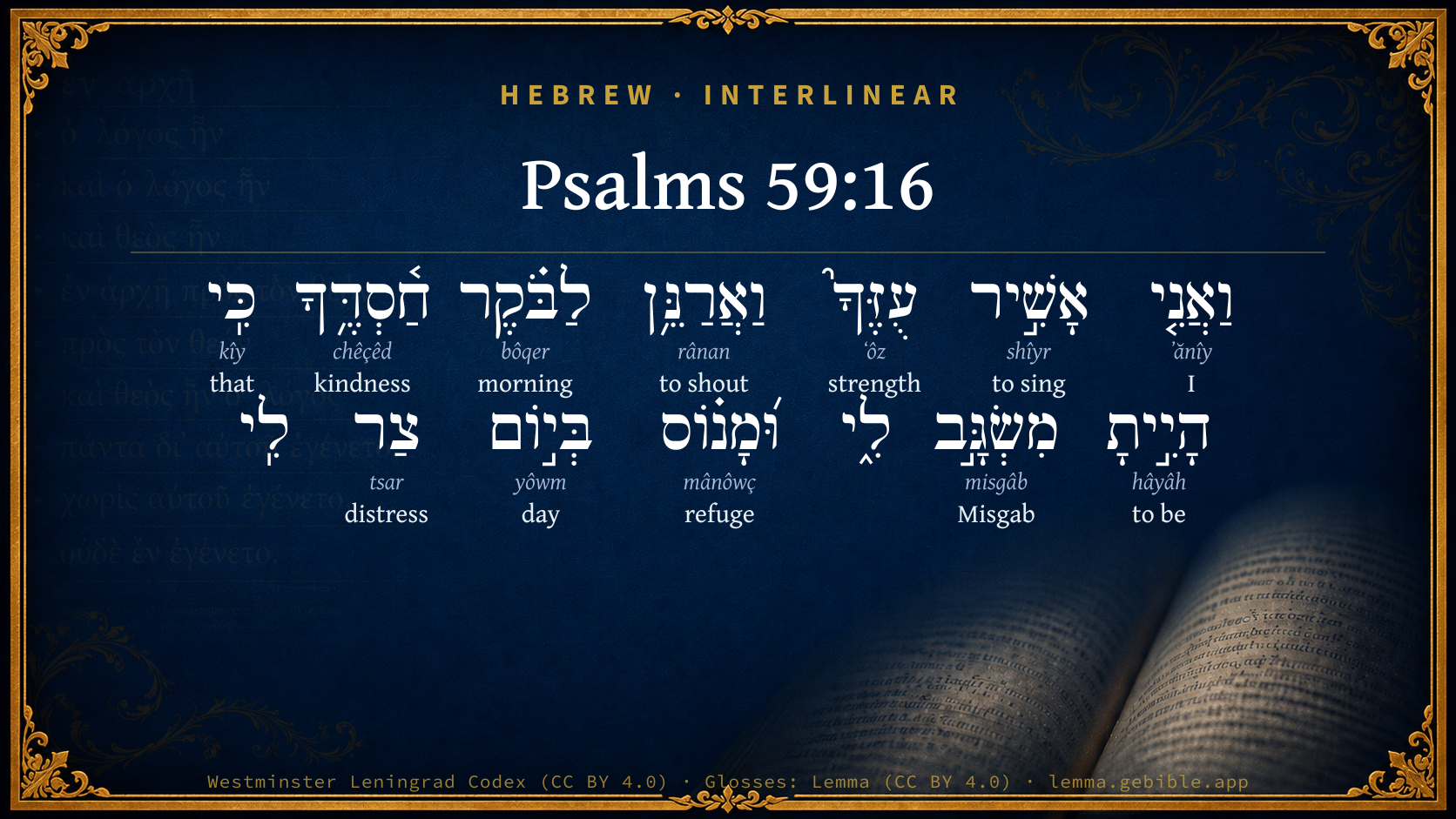
  1. וַאֲנִ֤י ʼănîy H589 “and · I” Conjunction + Pronoun, Personal, 1st Person, Common, Singular
  2. אָשִׁ֣יר shîyr H7891 “to sing” Verb, Qal, Imperfect, 1st Person, Common, Singular
  3. עֻזֶּךָ֮ ʻôz H5797 “strength · your” Noun, Common, Masculine, Singular, Construct + Suffix, Personal, 2nd Person, Masculine, Singular
  4. וַאֲרַנֵּ֥ן rânan H7442 “and · to shout” Conjunction + Verb, Piel, Imperfect, 1st Person, Common, Singular
  5. לַבֹּ֗קֶר bôqer H1242 “to/for the · morning” Preposition, Determined + Noun, Common, Masculine, Singular, Absolute
  6. חַ֫סְדֶּ֥ךָ chêçêd H2617 “kindness · your” Noun, Common, Masculine, Singular, Construct + Suffix, Personal, 2nd Person, Masculine, Singular
  7. כִּֽי kîy H3588 “that” Conjunction
  8. הָיִ֣יתָ hâyâh H1961 “to be” Verb, Qal, Perfect, 2nd Person, Masculine, Singular
  9. מִשְׂגָּ֣ב misgâb H4869 “Misgab” Noun, Common, Masculine, Singular, Absolute
  10. בְּי֣וֹם yôwm H3117 “in/at · day of” Preposition + Noun, Common, Masculine, Singular, Construct
  11. צַר tsar H6862 “distress” Verb, Qal, Perfect, 3rd Person, Masculine, Singular

About this verse

These counts appear in no published source. They are computed here, from the morphology-tagged text and Lemma’s own curated glosses. What Lemma adds →

14
words
12
distinct lemmas
Wisdom
section

Notable vocabulary

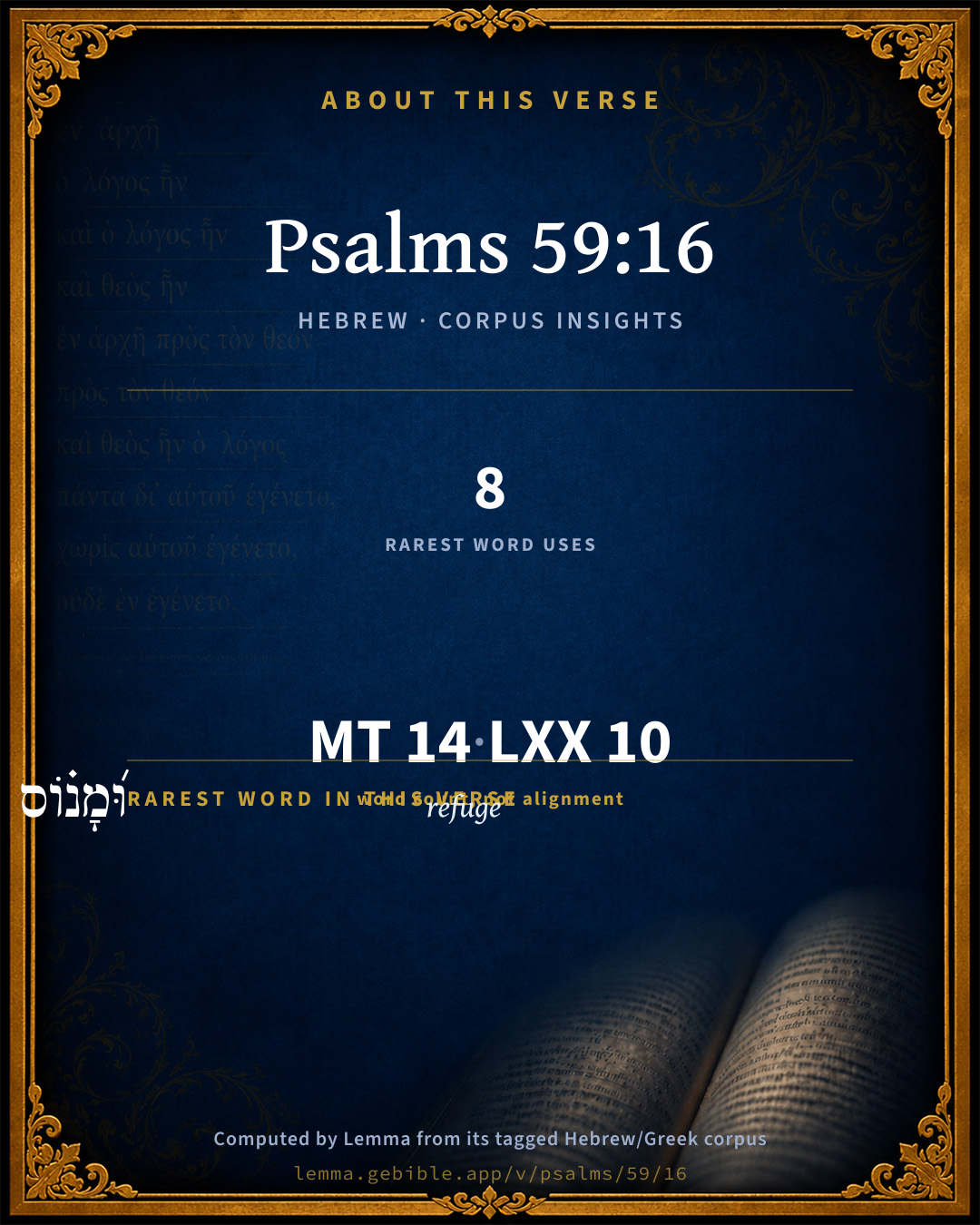
The rarest word here is וּ֝מָנ֗וֹס refuge H4498 — appearing just 8 times in the whole Hebrew Bible.

Shared distinctive vocabulary

וּ֝מָנ֗וֹס refuge H4498 occurs in 8 verses of the Hebrew Bible. Also found in:

Grammatical profile

  • 4 verbs
  • 6 nouns
  • 1 pronoun
  • 2 prepositions
  • 1 conjunction

Verb forms

  • אָשִׁ֣יר Qal · Imperfect
  • וַאֲרַנֵּ֥ן Piel · Imperfect
  • הָיִ֣יתָ Qal · Perfect
  • צַר Qal · Perfect

Hebrew & Septuagint length

In English translation the verse runs 34 words from the Hebrew and 32 from the Septuagint (LXX English) — closely comparable.

A rough comparison of the two English renderings, which tokenize alike — not a word-level alignment.

Word counts can differ between the Hebrew and the Greek without any difference in meaning — e.g. the Hebrew direct-object marker אֵת has no separate Greek word, and Greek often adds the article ὁ.

In the original languages it is 14 Hebrew tokens and 10 Greek tokens — but the two are counted differently (Hebrew bundles its prefixes and suffixes into one token; the Greek is in lemma form), so that isn’t a like-for-like length.

Cross-references

30

Topical passages linked to Psalms 59:16 in the Treasury of Scripture Knowledge — connected by theme and wording, ordered by reader-vote popularity; previews shown in the World English Bible.

  • Psalms 21:13 Be exalted, Yahweh, in your strength, So we will sing and praise your power.
  • Ephesians 3:20 Now to him who is able to do exceedingly abundantly above all that we ask or think, according to the power that works in us,
  • Romans 15:9 and that the Gentiles might glorify God for his mercy. As it is written, "Therefore will I give praise to you among the Gentiles, And sing to your name."
  • Psalms 30:5 For his anger is but for a moment; His favor is for a lifetime. Weeping may stay for the night, But joy comes in the morning.
  • Psalms 143:8 Cause me to hear your loving kindness in the morning, For I trust in you. Cause me to know the way in which I should walk, For I lift up my soul to you.
  • Psalms 31:7 I will be glad and rejoice in your loving kindness, For you have seen my affliction. You have known my soul in adversities.
  • Ephesians 1:6–7 to the praise of the glory of his grace, by which he freely bestowed favor on us in the Beloved,
  • Psalms 138:7 Though I walk in the midst of trouble, you will revive me. You will stretch forth your hand against the wrath of my enemies. Your right hand will save me.
  • Job 37:23 We can't reach the Almighty, He is exalted in power; In justice and great righteousness he will not oppress.
  • Psalms 59:9–10 Oh, my Strength, I watch for you, For God is my high tower.
  • Psalms 77:2 In the day of my trouble I sought the Lord. My hand was stretched out in the night, and didn't get tired. My soul refused to be comforted.
  • 1 Samuel 17:37 David said, Yahweh who delivered me out of the paw of the lion, and out of the paw of the bear, he will deliver me out of the hand of this Philistine. Saul said to David, Go, and Yahweh shall be with you.
  • Psalms 36:5 Your loving kindness, Yahweh, is in the heavens. Your faithfulness reaches to the skies.
  • Psalms 61:2–3 From the end of the earth, I will call to you, when my heart is overwhelmed. Lead me to the rock that is higher than I.
  • Psalms 88:13 But to you, Yahweh, I have cried. In the morning, my prayer comes before you.
  • Psalms 101:1 I will sing of loving kindness and justice. To you, Yahweh, I will sing praises.
  • Psalms 116:1–5 I love Yahweh, because he listens to my voice, And my cries for mercy.
  • 2 Corinthians 1:10 who delivered us out of so great a death, and does deliver; on whom we have set our hope that he will also still deliver us;
  • Psalms 4:1 Answer me when I call, God of my righteousness. Give me relief from my distress. Have mercy on me, and hear my prayer.
  • Psalms 5:3 Yahweh, in the morning you shall hear my voice. In the morning I will lay my requests before you, and will watch expectantly.
  • Psalms 46:1 God is our refuge and strength, A very present help in trouble.
  • Psalms 145:11 They will speak of the glory of your kingdom, And talk about your power;
  • Hebrews 5:7 He, in the days of his flesh, having offered up prayers and petitions with strong crying and tears to him who was able to save him from death, and having been heard for his godly fear,
  • 1 Samuel 19:11–12 Saul sent messengers to David's house, to watch him, and to kill him in the morning: and Michal, David's wife, told him, saying, If you don't save your life tonight, tomorrow you will be slain.
  • Psalms 89:1 I will sing of the loving kindness of Yahweh forever. With my mouth, I will make known your faithfulness to all generations.
  • Psalms 106:8 Nevertheless he saved them for his name's sake, That he might make his mighty power known.
  • Jeremiah 30:7 Alas! for that day is great, so that none is like it: it is even the time of Jacob's trouble; but he shall be saved out of it.
  • Exodus 15:6 Your right hand, Yahweh, is glorious in power, Your right hand, Yahweh, dashes the enemy in pieces.
  • 2 Samuel 22:3 God, my rock, in him will I take refuge; My shield, and the horn of my salvation, my high tower, and my refuge; My savior, you save me from violence.
  • Psalms 86:13 For your loving kindness is great toward me. You have delivered my soul from the lowest Sheol.

Cross-references courtesy of OpenBible.info (CC BY 4.0).

Hebrew and Greek witnesses Masoretic Hebrew ↔ Greek Septuagint

The same verse in the two great witnesses to the Old Testament, shown verse-for-verse.

You’re reading Greek Psalm 58 (Hebrew Psalm 59). The Septuagint counts the superscription, so verse numbers can differ from the Hebrew — chapter-level alignment, not verse-by-verse. Numbering follows Rahlfs.

These are two independent witnesses, not word-aligned to each other, and the Septuagint is shown in lemma (dictionary) form.

Hebrew Psalms 59:16 Masoretic · Westminster Leningrad Codex

וַאֲנִ֤י אָשִׁ֣יר עֻזֶּךָ֮ וַאֲרַנֵּ֥ן לַבֹּ֗קֶר חַ֫סְדֶּ֥ךָ כִּֽי הָיִ֣יתָ מִשְׂגָּ֣ב לִ֑י וּ֝מָנ֗וֹס בְּי֣וֹם צַר לִֽי

But I will sing of your strength. Yes, I will sing aloud of your loving kindness in the morning. For you have been my high tower, A refuge in the day of my distress.

World English Bible · Public Domain

Greek LXX Greek Psalm 58:16 Septuagint · lemma form

αὐτός διασκορπίζω ὁ ἐσθίω ἐάν δέ μή χορτάζω καί γογγύζω

But I will sing to your strength, and in the morning will I exult in your mercy; for you have been my supporter, and my refuge in the day of my affliction.

LXX2012 (modern English Septuagint) · Public Domain

Hebrew: Westminster Leningrad Codex (CC BY 4.0). Greek: Septuagint (public domain); English from LXX2012 (modern English Septuagint) (Public Domain). How the Septuagint differs from the Hebrew →

Commentary

Notes on Psalms 59:16 from classic Christian and Jewish commentators (each source and its license shown beneath its notes). The classic Christian expositions comment on the surrounding passage and are grouped to its opening verse, so a note may address several verses; the Jewish commentaries on the Tanakh (Rashi and others) are per-verse, so they appear only where the commentator wrote on this verse.

Lemma curates 59 commentaries, every one of them public domain or Creative Commons licensed, each selected and text-cleaned for this edition rather than reprinted as found. About our sources →

Trapp's Complete Commentary

John Trapp

Psa 59:16 But I will sing of thy power; yea, I will sing aloud of thy mercy in the morning: for thou hast been my defence and refuge in the day of my trouble.

Ver. 16. In the morning] That time wherein they thought to have surprised me, 1Sa 19:11, but thou hast secured me. See Isa 65:14.

John Trapp, A Commentary or Exposition upon All the Books of the Old and New Testament (1647–1656) — public domain. Text from a community e-Sword module.

The Biblical Illustrator

Joseph S. Exell

Psa_59:16-17

But I will sing of Thy power; yea, I will sing aloud of Thy mercy in the morning.

Meditation and praise

I. The subject of the psalmists meditation.

1. He meditated upon the Divine mercy. All the perfections of the Divine nature are glorious, and furnish matter for delightful meditation. But it is from His mercy that we draw our chief consolation, encouragement, and hope.

2. He contemplated God as his refuge in trouble. Thou hast been my defence and refuge, etc. We have every encouragement to put our trust in God. He is represented as a rock, a fortress, a high tower, a shield, and a buckler. God as a refuge--

(1) Is near--always at hand.

(2) Affords the greatest security.

(3) Is suitable. Our troubles differ, but He is a suitable refuge in every trouble,

(4) David proved God as his refuge. Saul had laid plots to destroy him, but the Lord had delivered him. We also have obtained support and relief by trusting in God.

3. He contemplated God as his strength and confided in His power. In what respects are we to consider God as the strength of His people?

(1) He defends them from danger by His power.

(2) He assists and strengthens them for duty by His grace.

II. The influence of the psalmists meditation. It led him to praise God.

1. Praising God is most reasonable.

2. Is a pleasant and delightful exercise.

3. Should be a part of every days employment. Divine goodness is daily manifested, and should be daily acknowledged.

4. Will tend to prepare us to meet the trials which may yet be before us.

5. Will tend to meeten us for the enjoyment of heaven.

6. Requires a suitable frame of mind. True praise springs from gratitude; and is promoted by a consideration of what God is, what He has (lone for us, and what he has promised to do for us.

Conclusion.

1. How great are the privileges of the people of God!

2. How important seriously to consider whether we are interested in these privileges.

3. Learn the importance of continuing to make God our refuge in trouble. (Anon.)

In the morning.--

Morning energy

The morning is my time fixed for my meeting the Lord. What meaning there is in the word morning; it is a cluster of rich grapes. Let me crush them and drink the sacred wine. In the morning --then God meant me to be at my best in strength and hope; I have not to climb in my weariness; in the night I have buried yesterdays fatigue, and in the morning I take a new lease of energy. Give God thy strength--all thy strength He asks only what He first gave. In the morning--then He may mean to keep me long that He may make me rich. In the morning--then it is an endless road He bids me climb, else how could I reach it ere the sun be set? Sweet morning! there is hope in its music. (Joseph Parker.)

The God of my mercy.--

Personal appropriation of mercy

If God show mercy to thousands, labour to know that this mercy is for you. He is the God of my mercy. A man that was ready to drown saw a rainbow; saith he, What am I the better, though God will not drown the world, if I drown. So, what are we the better--God is merciful--if we perish? Let us labour to know Gods special mercy for us. (Watson.)

.

Psa_60:1-12

The Biblical Illustrator, edited by Joseph S. Exell (c. 1880s–1900s) — public domain. Text from a community e-Sword module.

The Treasury of David

Charles H. Spurgeon

Ver. 16. Let them wander up and down for meat. Like dogs that have missed the expected carcass, let them go up and down dissatisfied, snapping at one another, and too disappointed to be quiet and take the matter easily.

And grudge if they be not satisfied. Let them act like those who cannot believe that they have lost their prey: like a herd of Oriental dogs, unhoused, unkennelled, let them prowl about seeking a prey which they shall never find. Thus the menial followers of Saul paraded the city in vain hope of satisfying their malice and their master. "Surely, "say they, "we shall have him yet. We cannot endure to miss him. Perhaps he is in yonder corner, or concealed is such a hiding place. We must have him. We grudge him his life. Our lust for his blood is hot, nor can we be persuaded but that we shall light upon him." See the restlessness of wicked men; this will increase as their enmity to God increases, and in hell it will be their infinite torment. What is the state of the lost, but the condition of an ambitious camp of rebels, who have espoused a hopeless cause, and will not give it up, but are impelled by their raging passions to rave on against the cause of God, of truth, and of his people.

Ver. 16. Let them wander up and down, etc. A beggarly and indigent, and so an unsatisfied and wearisome condition, shall be their lot; the greatest worldly plague that can fall on any--large appetites and no possessions or acquires to satisfy them. Henry Hammond.

Ver. 16. And grudge if they be not satisfied. A contented man, if he has not what he would have, yet doth not grudge, doth not quarrel with providence, nor fret within himself; but those whose God is their belly, if that be not filled and its appetites gratified, fall out both with God and themselves. It is not poverty, but discontent that makes a man unhappy. Matthew Henry.

Ver. 16. The hunger of a dog is deservedly their plague, of whom a resemblance of that unclean animal's disposition hath been the sin. Reader, be it thy care to avoid such sins, and cultivate a spirit of lively devotion; that, instead of receiving thy portion where there is weeping, wailing, and gnashing of teeth, thou mayest sing to the God of thy mercy for ever. Benjamin Boothroyd.

None.

Psalms 59:16*

Ver. 16. But I will sing of thy power. The wicked howl, but I sing and will sing. Their power is weakness, but thine is omnipotence; I see them vanquished and thy power victorious, and for ever and ever will I sing of thee.

Yea, I will sing aloud of thy mercy in the morning. When those lovers of darkness find their game is up, and their midnight howlings die away, then will I lift up my voice on high and praise the lovingkindness of God without fear of being disturbed. What a blessed morning will soon break for the righteous, and what a song will be theirs! Sons of the morning, ye may sigh tonight, but joy will come on the wings of the rising sun. Tune your harps even now, for the signal to commence the eternal music will soon be given; the morning cometh and your sun shall go no more down for ever.

For thou hast been my defence. The song is for God alone, and it is one which none can sing but those who have experienced the lovingkindness of their God. Looking back upon a past all full of mercy, the saints will bless the Lord with their whole hearts, and triumph in him as the high place of their security.

And refuge in the day of my trouble. The greater our present trials the louder will our future songs be, and the more intense our joyful gratitude. Had we no day of trouble, where were our season of retrospective thanksgiving? David's besetment by Saul's bloodhounds creates an opportunity for divine interposition and so for triumphant praise.

Ver. 16. We must not pass by the contrast with the wretched condition of the wicked, which is indicated by the pronoun hmh, they, in Ps 59:15, an ygaw, but I, which are in exact antithesis; also the "evening, "mentioned above, and the "morning, "now occurring for the times of trouble and happiness, and the dog like noise of the wicked, and the singing with joyful sound of David, to pass by other particulars, likewise give to the diverse states additional difference. Hermann Venema.

Ver. 16. Cantabo and exaltabo, I will sing, and I will sing aloud. Here is singing only of God's power; but there is singing aloud of his mercy; as if his mercy were more exaltable than his power, and that reached the very heavens; this unto the clouds. Ps 26:5. From Humphrey Sydenham's Sermon, entitled, "The Well toned Cymball, "1637.

Ver. 16. The heavenly chorister.

I. His song is sweet in contrast with the revilings of

others--but I.

II. It treats of subjects which terrify others--thy

power.

III. It grows louder on tender themes--thy mercy.

IV. It has its choice seasons--in the morning.

V. It is tuned by experience--for thou hast.

VI. It is all to God's glory--thy power,

thy mercy, thou hast.

Psalms 59:17*

Charles H. Spurgeon's The Treasury of David (1869–1885) — public domain. Psalms only. Text from a community e-Sword/MySword module.

J. A. Alexander on Psalms

Joseph Addison Alexander

17. (Psa 59:16). And I will sing thy strength, and celebrate in the morning thy mercy; for thou hast been a high place to me, a refuge in my distress. The pronoun at the beginning is emphatic, I, on my part, as contrasted with these wretches. Thy strength or power, thus exerted in my behalf. In the morning, or at break of day, which is the primary meaning of the term. The phrase is in obvious antithesis to at evening in Psa 59:14. There may also be allusion to the frequent use of night and morning, as emblems of suffering and relief. Compare the words of David in 2Sa 23:4. A height, high place, or place of safety, as in Psa 59:9 above. In my distress, or retaining the original construction, in distress to me. The form of expression is the same as in Psa 18:6.

Joseph Addison Alexander, The Psalms Translated and Explained (1850) — public domain. Text from a community e-Sword module.

Geneva Bible (1599)

Geneva Bible translators

Which didst use the policy of a weak woman to confound the enemy’s strength, as 1 Sam. 19:12.

Geneva Bible (1599) marginal notes — public domain. Text via Bolls.life.

Jamieson, Fausset & Brown

Robert Jamieson, A. R. Fausset & David Brown

Contrast the lot of God's servant, who employs his time in God's praise.

sing aloud . . . in the morning--when they retire famishing and disappointed, or it may denote delightful diligence in praise, as in Psa 30:5.

Next: Psalms Chapter 60

Jamieson, Fausset & Brown — Commentary Critical and Explanatory on the Whole Bible (1871) — public domain (CC PDM 1.0). Text via the HelloAO Bible API.

Adam Clarke's Commentary

Verse 16. I will sing of thy power] For it was because thy hand was upon me for good, that I have thus succeeded in my enterprises.

Yea, I will sing aloud of thy mercy] I shall publish abroad what thou hast done; and done not for my worthiness, nor for the worthiness of the people; but for thy own mercy's sake.

In the day of my trouble.] When I came with small means and feeble help, and had the force and fraud of many enemies to contend with, besides the corruption and unfaithfulness of my own people; thou wast then my defence; and in all attacks, whether open or covered, my sure refuge. I will, therefore, sing of thy mercy in the morning-I will hasten to acquit myself of a duty I owe to thee for such singular interpositions of mercy and power.

Adam Clarke's Commentary on the Bible (1810–1826) — public domain. Text from a community e-Sword/MySword module.

John Calvin's Commentaries

16 But I will sing of thy power By this he does not mean merely that he would have occasion to sing at some future period, but prepares himself presently for the exercise of thanksgiving; and he proceeds to acknowledge that his deliverance would be at once an illustrious effect of Divine power, and conferred of mere grace. It may be true, that David escaped at this time from the hands of his enemies without stir, and with secrecy, through the dexterity of his wife; still, by means of this artifice, God disappointed the preparations and forces of Saul, and may, therefore, with propriety be said to have exerted his power. We may suppose, however, that David takes occasion, from this particular instance, to look further back, and embrace, in his view, the various Divine interpositions which he had experienced.

John Calvin's Commentaries (1540-1563) — public domain. Text from the Calvin Translation Society English edition (1840s-50s) via the Christian Classics Ethereal Library (ccel.org). Calvin's coverage is partial (roughly two-thirds of the Bible); uncommented books and verses are honest gaps, never fabricated. The 19th-century editor's footnotes and remarks are omitted so the notes are faithfully Calvin's own voice.

The Cambridge Bible for Schools and Colleges

gen. ed. J. J. S. Perowne

16, 17. Render,

Yet as for me, I shall sing of thy strength;

Yea, I shall sing aloud of thy lovingkindness in the morning:

For thou hast been a high tower for me,

And a refuge In the day of my distress.

Unto thee, O my strength, will I make melody,

For God is my high tower, the God of my lovingkindness.

Thou hast been, for in the language of faith he looks back upon the deliverance from the morning of peace which succeeds the night of anxiety.

The refrain is slightly varied from Psa_59:9 : the patient waiting of the night is changed into the joyous song of the morning.

The Cambridge Bible for Schools and Colleges (gen. ed. J. J. S. Perowne; Cambridge University Press, 1878–1918) — public domain. Text from a community e-Sword module.

John Gill's Exposition

Unto thee, O my strength, will I sing,.... That is, to God, whom he made his strength, and put his trust in for strength, and from whom he received it; and he therefore determined to sing praise to him for it, and give him the glory of it;

for God is my defence: as before in Psa 59:9;

and the God of my mercy; See Gill on Psa 59:10.

Next: Psalms Chapter 60

John Gill's Exposition of the Whole Bible (1746–1763) — public domain (CC PDM 1.0). Text via the HelloAO Bible API.

Albert Barnes' Notes on the Bible

But I will sing of thy power - That is, I will praise thee for the manifestation of thy power in rescuing me from danger.

Yea, I will sing aloud of thy mercy in the morning - When the light dawns; when these troubles are over; when the night of calamity shall have passed by. There is an allusion here, probably, to the fact that they encompassed the place of his abode at night Psa 59:6, Psa 59:14; but there is also the implied idea that that night was emblematic of sorrow and distress. The morning would come; morning after such a night of sorrow and trouble; a morning of joy and gladness, when he would feel that he had complete deliverance. Then would he praise God aloud. Compare the notes at Isa 21:12.

For thou hast been my defense and refuge in the day of my trouble - That is, he looked to the time when he would feel this; when looking back he could say this; when in view of it he would praise God.

Albert Barnes' Notes on the Bible (1834–1885) — public domain. Text from a community e-Sword/MySword module.

Whedon's Commentary on the Bible

Daniel D. Whedon

16. But I will sing of thy power—The antithesis is here brought out between David’s enemies and himself. They shall wander up and down like hungry dogs for food and find nothing; but I, fully rescued, will “sing of thy power,” etc.

In the morning—Contrasted with the night work of his enemies. They continue all night in fruitless attempts to destroy me, but I, in the morning, will sing… of thy mercy.

Daniel D. Whedon (gen. ed.), Commentary on the Old and New Testaments (1874–1909) — public domain. Text from a community e-Sword module.

The Pulpit Commentary

But I will sing of thy power; rather, of thy strength the same word as that used in vers. 9 and 17. Yea, I will sing aloud of thy mercy in the morning. When the morning came, David had escaped, (1Sa_19:12) and could "sing of God"s mercy" securely at Ramah, where he had joined Samuel. For thou hast been my Defense and Refuge in the day of my trouble; or, my High Tower, as in vers. 9 and 17.

The Pulpit Commentary (1880–1919), ed. H.D.M. Spence-Jones & Joseph S. Exell — public domain. Text from a community e-Sword module.

unfoldingWord translationNotes

Door43 World Missions Community

you have been my high tower and a refuge

High towers and refuges are places that people can go to for shelter from their enemies. The psalmist speaks of God protecting him as if God were a strong, safe shelter. AT: "you have protected me like a high tower and a refuge" (See: Metaphor)

in the day of my distress

"whenever I have had troubles"

To you, my strength, I will sing praises

"To you, my strength" can be combined as one clause. AT: "You are my strength, so I will sing praises to you" (See: Sentence Structure)

my strength

God's being the psalmist's strength represents God protecting him. AT: "my protector" (See: Metonymy)

for God is my high tower

High towers are places that people can go to for shelter from their enemies. The psalmist speaks of God protecting him as if God were a strong, safe shelter. AT: "you have protected me like a high tower" (See: Metaphor)

the God of covenant faithfulness

The abstract noun "faithfulness" can be translated with an adjective. This can be expressed in a separate sentence. AT: "He is the God who is faithful to his covenant" (See: Abstract Nouns)

translationWords

strength

watchtower

refuge

day

praise

God

covenant faithfulness

unfoldingWord translationNotes — © Distant Shores Media and the Door43 World Missions Community, licensed CC BY-SA 4.0. Source: git.door43.org/Door43/en_tn.

Rashi

Rabbi Shlomo Yitzchaki (Rashi)

They will roam about to eat as the dogs do all night if they are not sated, so that they can lodge out of satiety, and sleep.

Rashi on the Tanakh — English translations: “The Judaica Press complete Tanach with Rashi, translated by A. J. Rosenberg” (CC BY 4.0); “Pentateuch with Rashi's commentary by M. Rosenbaum and A.M. Silbermann, 1929-1934” (public domain); “The Metsudah Tanach series, Lakewood, N.J” (CC BY 4.0); and “The Book of Joshua, Metsudah Publications, 1997” (CC BY 4.0). Text via Sefaria.

Lesson kit

Teaching starters — assembled from the data on this page, not authored interpretation. Every prompt links to the verse data it draws on. Edit before teaching.

Psalms, in the Wisdom, opens this verse with 14 words (12 distinct Hebrew lemmas). Its most distinctive word is mânôwç (“refuge”). A historical commentator’s framing appears above. Read the whole chapter for the surrounding context.

Discussion questions

  1. How does “refuge” (mânôwç) shape what this verse is saying?
  2. How does 2 Samuel 22:3, which shares the word «refuge», read alongside this verse?
  3. These translations render this verse differently. What is at stake in choosing one wording over another?
  4. «אָשִׁ֣יר» is a Qal Imperfect verb. How does that grammatical form shape the action described?
  5. Compare how Trapp's Complete Commentary and The Biblical Illustrator read this verse. Where do they agree or differ?

Things to notice

Reading settings

Reading text

Shown beneath each verse's original-language words.

Old Testament
Old Testament edition

Read the OT as the Masoretic Hebrew (MT) or the Greek Septuagint (LXX).

English shown for the Greek Septuagint (in the Hebrew ↔ Greek comparison).

Comparing translations? Open the Compare panel on any verse page to stack up to four side by side.