Isaiah 3:8

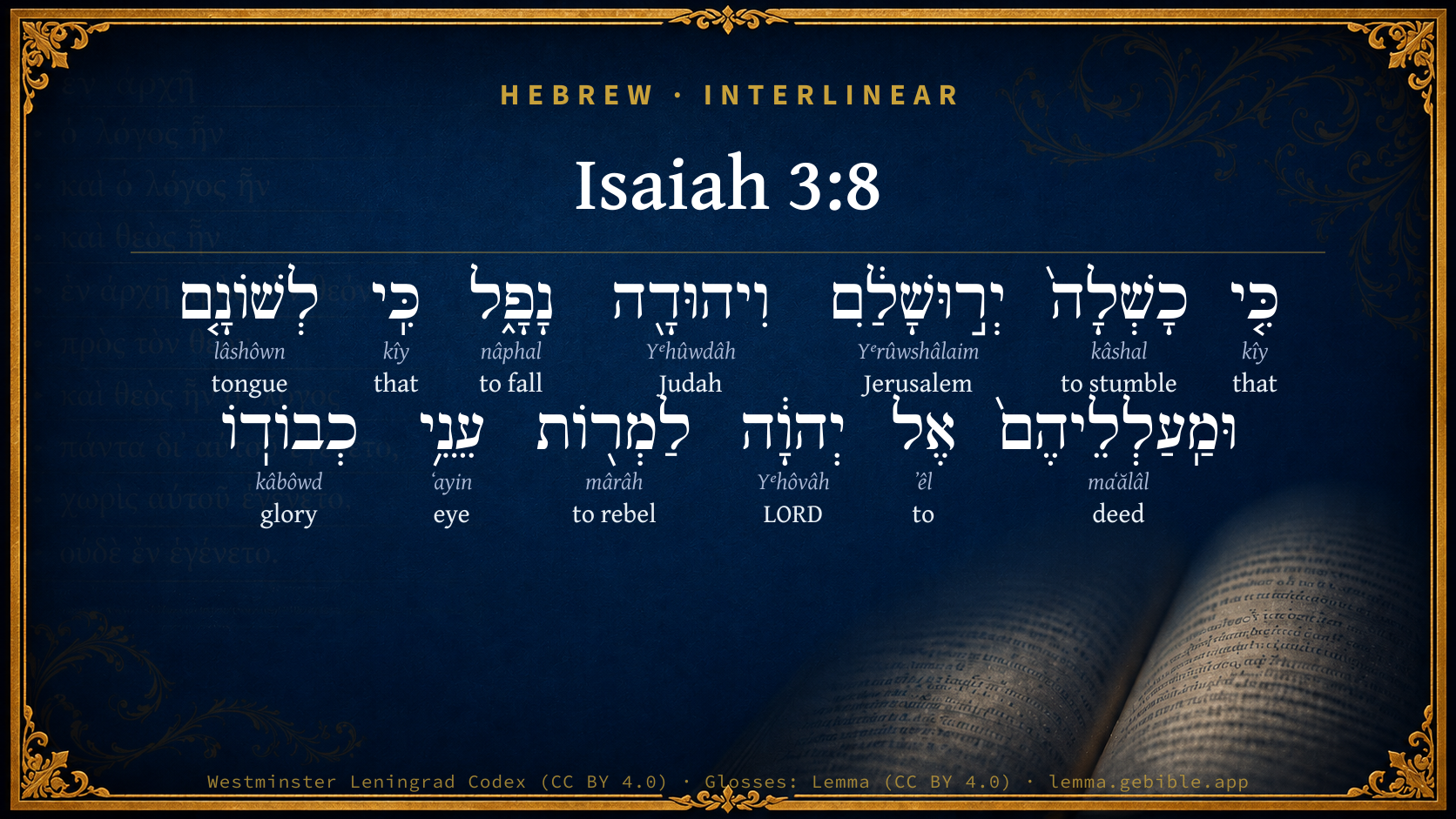
Hebrew (Westminster Leningrad Codex) Isaiah 3:8 appears in the Hebrew Old Testament. The text above is from the Westminster Leningrad Codex. Each word links to its Strong’s number, a concise gloss, and parsing drawn from the Open Scriptures Hebrew Bible morphology. Click any word for its full Brown-Driver-Briggs (BDB) entry.
Download image
Cite this verse

Isaiah 3:8 (World English Bible). Public Domain. Lemma interlinear Bible study tool, https://lemma.gebible.app/v/isaiah/3/8.

Show BibTeX & RIS
BibTeX
RIS
English Translation
For Jerusalem is ruined, and Judah is fallen; Because their tongue and their doings are against Yahweh, To provoke the eyes of his glory.
World English Bible · Public Domain
Download a study sheet

One document with this verse’s original text, its word-by-word gloss line, the meaning frame, cross-references with their text, attributed commentary, and full source and license credits — printable, and it pastes into notes with its structure intact.

This verse Autodidact and up

Study sheet (.html) Plain text (.txt)

A passage Seminary Student

Up to 50 verses in one chapter. A passage sheet keeps up to 6 commentary sources and 12 cross-references per verse, in the order this page ranks them, and says so on the sheet whenever that leaves anything out. Ask for a single verse and you get the Autodidact verse sheet above.

Everything on this page stays free to read, with no account — the sheet is a download of what is already on screen, not access to it.

Want to remove ads? Support Godless Engineer
Compare translations 3

The same verse in 3 English versions, stacked beneath the original-language interlinear above. Click any original word for its lexicon entry.

Each is an independent rendering of the whole verse — the interlinear is not word-aligned to these translations.

Highlighted words mark where these versions differ — a whole-verse word diff, not a word-by-word alignment.

  • World English Bible Public Domain
    For Jerusalem is ruined, and Judah is fallen; Because their tongue and their doings are against Yahweh, To provoke the eyes of his glory.
  • King James Version Public Domain
    For Jerusalem is ruined, and Judah is fallen: because their tongue and their doings are against the LORD, to provoke the eyes of his glory.
  • unfoldingWord Literal Text CC BY-SA 4.0
    For Jerusalem has stumbled and Judah has fallen because their tongue and their deeds against Yahweh, to defy the eyes of his glory.

unfoldingWord Literal Text — © unfoldingWord, licensed CC BY-SA 4.0. Word-aligned USFM3 via Door43 (git.door43.org/unfoldingWord/en_ult).

Versions to compare (up to 4)

3 of 4 selected

Show all 18 translations

Every available English version of this verse, each an independent rendering of the whole verse.

  • World English Bible Public Domain
    For Jerusalem is ruined, and Judah is fallen; Because their tongue and their doings are against Yahweh, To provoke the eyes of his glory.
  • Berean Standard Bible Public Domain
    For Jerusalem has stumbled and Judah has fallen because they spoke and acted against the LORD, defying His glorious presence.
  • Majority Standard Bible Public Domain
    For Jerusalem has stumbled and Judah has fallen because they spoke and acted against the LORD, defying His glorious presence.
  • King James Version Public Domain
    For Jerusalem is ruined, and Judah is fallen: because their tongue and their doings are against the LORD, to provoke the eyes of his glory.
  • American Standard Version (1901) Public Domain
    For Jerusalem is ruined, and Judah is fallen; because their tongue and their doings are against Jehovah, to provoke the eyes of his glory.
  • Revised Version (1885) Public Domain
    For Jerusalem is ruined, and Judah is fallen: because their tongue and their doings are against the LORD, to provoke the eyes of his glory.
  • Geneva Bible (1599) Public Domain
    Doubtlesse Ierusalem is fallen, and Iudah is fallen downe, because their tongue and workes are against the Lord, to prouoke the eyes of his glory.
  • Douay-Rheims (1899) Public Domain
    For Jerusalem is ruined, and Juda is fallen: because their tongue, and their devices are against the Lord, to provoke the eyes of his majesty.
  • Young's Literal Translation Public Domain
    For stumbled hath Jerusalem, and Judah hath fallen, For their tongue and their doings `are' against Jehovah, To provoke the eyes of His glory.
  • Literal Standard Version CC BY-SA 4.0
    For Jerusalem has stumbled, and Judah has fallen, || For their tongue and their doings [are] against YHWH, || To provoke the eyes of His glory.
  • Unlocked Literal Bible CC BY-SA 4.0
    For Jerusalem has stumbled, and Judah has fallen, because their speech and their actions are against Yahweh, defying the eyes of his glory.
  • unfoldingWord Literal Text CC BY-SA 4.0
    For Jerusalem has stumbled and Judah has fallen because their tongue and their deeds against Yahweh, to defy the eyes of his glory.
  • Darby Bible Public Domain
    For Jerusalem stumbleth and Judah falleth, because their tongue and their doings are against Jehovah, to provoke the eyes of his glory.
  • World Messianic Bible Public Domain
    For Jerusalem is ruined, and Judah is fallen; because their tongue and their doings are against the LORD, to provoke the eyes of his glory.
  • Webster's Bible Public Domain
    For Jerusalem is ruined, and Judah is fallen: because their tongue and their doings are against the LORD, to provoke the eyes of his glory.
  • Free Bible Version CC BY-SA 4.0
    For Jerusalem has collapsed and Judah has fallen because of what they said and did in opposition to the Lord, rebelling right in front of him.
  • Bible in Basic English Public Domain
    For Jerusalem has become feeble, and destruction has come on Judah, because their words and their acts are against the Lord, moving the eyes of his glory to wrath.
  • JPS Tanakh (1917) Public Domain
    For Jerusalem is ruined, and Judah is fallen; because their tongue and their doings are against the LORD, to provoke the eyes of His glory.

Literal Standard Version (2020), Covenant Press — licensed CC BY-SA 4.0. Text via the HelloAO Bible API (eBible.org). Unlocked Literal Bible (unfoldingWord) — licensed CC BY-SA 4.0. Text via the HelloAO Bible API (eBible.org). unfoldingWord Literal Text — © unfoldingWord, licensed CC BY-SA 4.0. Word-aligned USFM3 via Door43 (git.door43.org/unfoldingWord/en_ult). Free Bible Version, Dr. Jonathan Gallagher — licensed CC BY-SA 4.0. Text via the HelloAO Bible API (eBible.org).

Word by word

More ways to search: Search by grammar → Find every occurrence → Compare this word →

Practice this passage: Drill this verse → Learn its vocabulary →

וּמַֽעַלְלֵיהֶם֙
maʻălâl
H4611
“and · deeds · their”
Conjunction + Noun, Common, Masculine, Plural, Construct + Suffix, Personal, 3rd Person, Masculine, Plural
Part of Speech
Conjunction + Noun
Type
Common
Gender
Masculine
Number
Plural
State
Construct
Full BDB Definition

Origin: from H5953

TWOT: 1627e

deed, practice - practice (usually bad) - deeds - acts
  1. כִּ֤י kîy H3588 “that” Conjunction
  2. כָשְׁלָה֙ kâshal H3782 “to stumble” Verb, Qal, Perfect, 3rd Person, Feminine, Singular
  3. יְר֣וּשָׁלִַ֔ם Yᵉrûwshâlaim H3389 “Jerusalem” Noun, Proper
  4. וִיהוּדָ֖ה Yᵉhûwdâh H3063 “and · Judah” Conjunction + Noun, Proper
  5. נָפָ֑ל nâphal H5307 “to fall” Verb, Qal, Perfect, 3rd Person, Masculine, Singular
  6. כִּֽי kîy H3588 “that” Conjunction
  7. לְשׁוֹנָ֤ם lâshôwn H3956 “tongue · their” Noun, Common, Both, Singular, Construct + Suffix, Personal, 3rd Person, Masculine, Plural
  8. אֶל ʼêl H413 “to” Preposition
  9. יְהוָ֔ה Yᵉhôvâh H3068 “LORD” Noun, Proper
  10. לַמְר֖וֹת mârâh H4784 “to rebel” Preposition + Verb, Hiphil, Infinitive Construct
  11. עֵנֵ֥י ʻayin H5869 “eyes of” Noun, Common, Both, Dual, Construct
  12. כְבוֹדֽוֹ kâbôwd H3519 “glory · his” Noun, Common, Both, Singular, Construct + Suffix, Personal, 3rd Person, Masculine, Singular

About this verse

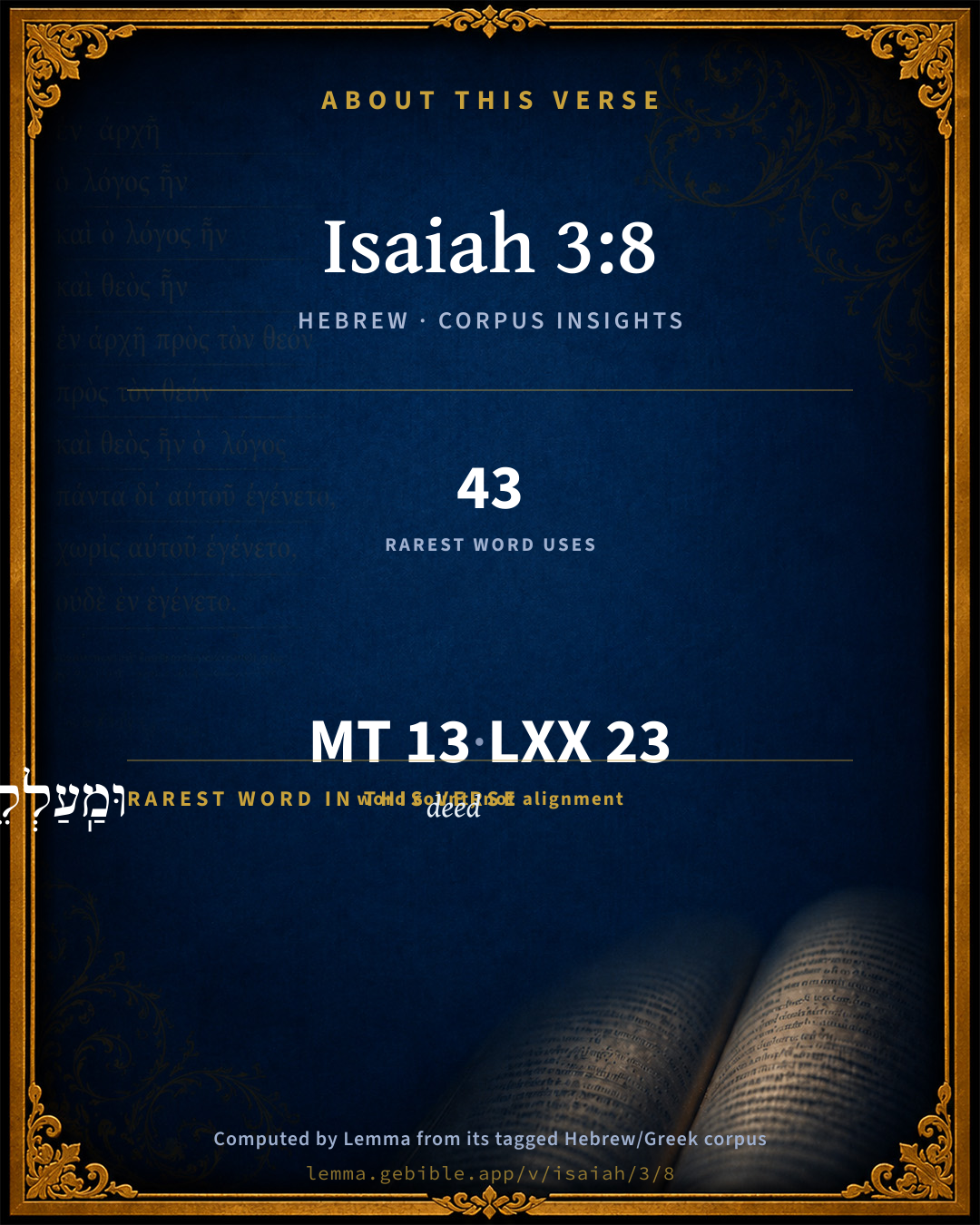
These counts appear in no published source. They are computed here, from the morphology-tagged text and Lemma’s own curated glosses. What Lemma adds →

13
words
12
distinct lemmas
Prophets
section

Shared distinctive vocabulary

וּמַֽעַלְלֵיהֶם֙ deed H4611 occurs in 41 verses of the Hebrew Bible. Also found in:

Grammatical profile

  • 3 verbs
  • 7 nouns
  • 1 preposition
  • 2 conjunctions

Verb forms

  • כָשְׁלָה֙ Qal · Perfect
  • נָפָ֑ל Qal · Perfect
  • לַמְר֖וֹת Hiphil · Infinitive Construct

Repetition

A word recurs within this verse — often emphatic in Hebrew:

  • כִּ֤י that H3588 ×2

Hebrew & Septuagint length

In English translation the verse runs 24 words from the Hebrew and 22 from the Septuagint (LXX English) — closely comparable.

A rough comparison of the two English renderings, which tokenize alike — not a word-level alignment.

Word counts can differ between the Hebrew and the Greek without any difference in meaning — e.g. the Hebrew direct-object marker אֵת has no separate Greek word, and Greek often adds the article ὁ.

In the original languages it is 13 Hebrew tokens and 23 Greek tokens — but the two are counted differently (Hebrew bundles its prefixes and suffixes into one token; the Greek is in lemma form), so that isn’t a like-for-like length.

Cross-references

25

Topical passages linked to Isaiah 3:8 in the Treasury of Scripture Knowledge — connected by theme and wording, ordered by reader-vote popularity; previews shown in the World English Bible.

  • Ezekiel 9:9 Then said he to me, The iniquity of the house of Israel and Judah is exceeding great, and the land is full of blood, and the city full of wrestling [of judgment]: for they say, Yahweh has forsaken the land, and Yahweh doesn't see.
  • 1 Corinthians 10:22 Or do we provoke the Lord to jealousy? Are we stronger than he?
  • Hosea 7:16 They return, but not to the Most High. They are like a faulty bow. Their princes will fall by the sword for the rage of their tongue. This will be their derision in the land of Egypt.
  • Malachi 3:13–15 "Your words have been stout against me," says Yahweh. "Yet you say, 'What have we spoken against you?'
  • 2 Chronicles 28:5–7 Therefore Yahweh his God delivered him into the hand of the king of Syria; and they struck him, and carried away of his a great multitude of captives, and brought them to Damascus. He was also delivered into the hand of the king of Israel, who struck him with a great slaughter.
  • 2 Chronicles 28:18 The Philistines also had invaded the cities of the lowland, and of the South of Judah, and had taken Beth-shemesh, and Aijalon, and Gederoth, and Soco with the towns of it, and Timnah with the towns of it, Gimzo also and the towns of it: and they lived there.
  • 2 Chronicles 33:6–7 He also made his children to pass through the fire in the valley of the son of Hinnom; and he practiced sorcery, and used enchantments, and practiced sorcery, and dealt with those who had familiar spirits, and with wizards: he worked much evil in the sight of Yahweh, to provoke him to anger.
  • 2 Chronicles 33:11 Therefore Yahweh brought on them the captains of the host of the king of Assyria, who took Manasseh in chains, and bound him with fetters, and carried him to Babylon.
  • 2 Chronicles 36:17–19 Therefore he brought on them the king of the Chaldeans, who killed their young men with the sword in the house of their sanctuary, and had no compassion on young man or virgin, old man or gray-headed: he gave them all into his hand.
  • Psalms 73:8–11 They scoff and speak with malice. In arrogance, they threaten oppression.
  • Isaiah 1:7 Your country is desolate. Your cities are burned with fire. Strangers devour your land in your presence, And it is desolate, As overthrown by strangers.
  • Isaiah 5:18–19 Woe to those who draw iniquity with cords of falsehood, And wickedness as with cart rope;
  • Isaiah 9:17 Therefore the Lord will not rejoice over their young men, neither will he have compassion on their fatherless and widows; for everyone is profane and an evil-doer, and every mouth speaks folly. For all this his anger is not turned away, but his hand is stretched out still.
  • Isaiah 57:4 Against whom do you sport yourselves? against whom make you a wide mouth, and put out the tongue? Aren't you children of disobedience, a seed of falsehood,
  • Isaiah 65:3–5 a people who provoke me to my face continually, sacrificing in gardens, and burning incense on bricks;
  • Jeremiah 26:6 then will I make this house like Shiloh, and will make this city a curse to all the nations of the earth.
  • Jeremiah 26:18 Micah the Morashtite prophesied in the days of Hezekiah king of Judah; and he spoke to all the people of Judah, saying, Thus says Yahweh of Hosts: Zion shall be plowed as a field, and Jerusalem shall become heaps, and the mountain of the house as the high places of a forest.
  • Lamentations 5:16–17 The crown is fallen from our head: Woe to us! for we have sinned.
  • Ezekiel 8:4–6 Behold, the glory of the God of Israel was there, according to the appearance that I saw in the plain.
  • Ezekiel 8:12 Then said he to me, Son of man, have you seen what the elders of the house of Israel do in the dark, every man in his chambers of imagery? for they say, Yahweh doesn't see us; Yahweh has forsaken the land.
  • Ezekiel 8:17–18 Then he said to me, Have you seen [this], son of man? Is it a light thing to the house of Judah that they commit the abominations which they commit here? for they have filled the land with violence, and have turned again to provoke me to anger: and, behold, they put the branch to their nose.
  • Micah 3:12 Therefore Zion for your sake will be plowed like a field, And Jerusalem will become heaps of rubble, And the mountain of the temple like the high places of a forest.
  • Habakkuk 1:13 You who have purer eyes than to see evil, and who cannot look on perversity, why do you tolerate those who deal treacherously, and keep silent when the wicked swallows up the man who is more righteous than he,
  • Matthew 12:36–37 I tell you that every idle word that men speak, they will give account of it in the day of judgment.
  • Jude 1:15 to execute judgment on all, and to convict all the ungodly of all their works of ungodliness which they have done in an ungodly way, and of all the hard things which ungodly sinners have spoken against him."

Cross-references courtesy of OpenBible.info (CC BY 4.0).

Hebrew and Greek witnesses Masoretic Hebrew ↔ Greek Septuagint

The same verse in the two great witnesses to the Old Testament, shown verse-for-verse.

These are two independent witnesses, not word-aligned to each other, and the Septuagint is shown in lemma (dictionary) form.

Hebrew Isaiah 3:8 Masoretic · Westminster Leningrad Codex

כִּ֤י כָשְׁלָה֙ יְר֣וּשָׁלִַ֔ם וִיהוּדָ֖ה נָפָ֑ל כִּֽי לְשׁוֹנָ֤ם וּמַֽעַלְלֵיהֶם֙ אֶל יְהוָ֔ה לַמְר֖וֹת עֵנֵ֥י כְבוֹדֽוֹ

For Jerusalem is ruined, and Judah is fallen; Because their tongue and their doings are against Yahweh, To provoke the eyes of his glory.

World English Bible · Public Domain

Greek LXX Isaiah 3:8 Septuagint · lemma form

ὅτι ἀνααἱρέω ἰερουσαλήμ καί ὁ ἰουδαία συνπίπτω καί ὁ γλῶσσα αὐτός μετά ἀνομία ὁ πρός κύριος ἀπειθέω διότι νῦν ταπεινόω ὁ δόξα αὐτός

For Jerusalem is ruined, and Judea has fallen, and their tongues have spoken with iniquity, disobedient as they are towards the Lord.

LXX2012 (modern English Septuagint) · Public Domain

On this verse, Keil & Delitzsch discusses the Septuagint’s reading. Read the note in Commentary ↓

Hebrew: Westminster Leningrad Codex (CC BY 4.0). Greek: Septuagint (public domain); English from LXX2012 (modern English Septuagint) (Public Domain). How the Septuagint differs from the Hebrew →

Targum (Aramaic paraphrase)

1

The Targum is the ancient Jewish Aramaic paraphrase of the Hebrew Scriptures — an interpretive translation, not the Hebrew text itself. Onkelos (literal) and Pseudo-Jonathan (expansive) render the Torah, and Jonathan the Prophets. Coverage is partial: where no permissively-licensed English translation exists for a verse, only the Aramaic is shown. This is verse-level text, not a word-by-word alignment to the Hebrew.

  1. Targum Jonathan Prophets (Joshua–Malachi)
    אֲרֵי אִתְקִילוּ יַתְבֵי יְרוּשְׁלֵם וֶאֱנַשׁ יְהוּדָה גָלוּ אֲרֵי מַמְלֵל פּוּמְהוֹן וַאֲגַר עוֹבָדֵיהוֹן גְלַן קֳדָם יְיָ וּמַרְגְזִין קֳדָם יְקָרֵיהּ:

    Because the inhabitants of Jerusalem have stumbled, therefore the men of Judah shall go into captivity; surely the speech of their mouth and the wages of their works are revealed before the Lord, and they have provoked to anger His glory.

    Targum Jonathan — Aramaic: “Mikraot Gedolot” (public domain). English: “Sefaria Community Translation” (CC0 1.0 (public-domain dedication)); “London "Chaldee Paraphrase," 1871” (public domain). Text via Sefaria.

Commentary

Notes on Isaiah 3:8 from classic Christian and Jewish commentators (each source and its license shown beneath its notes). The classic Christian expositions comment on the surrounding passage and are grouped to its opening verse, so a note may address several verses; the Jewish commentaries on the Tanakh (Rashi and others) are per-verse, so they appear only where the commentator wrote on this verse.

Lemma curates 59 commentaries, every one of them public domain or Creative Commons licensed, each selected and text-cleaned for this edition rather than reprinted as found. About our sources →

The Cambridge Bible for Schools and Colleges

gen. ed. J. J. S. Perowne

8. Jerusalem is ruined] A reference to the “ruin,” Isa_3:6.

their tongue and their doings] In word and deed they defy Jehovah and provoke the eyes of His glory. Cf. Hab_1:13, “of too pure eyes to behold evil.”

8, 9. The ruin so vividly depicted is to the prophet’s mind as certain as if it had been already accomplished, because the moral condition of the country, and especially of its present rulers, is one that Jehovah cannot tolerate. The perfects in Isa_3:8 are those of prophetic certainty.

The Cambridge Bible for Schools and Colleges (gen. ed. J. J. S. Perowne; Cambridge University Press, 1878–1918) — public domain. Text from a community e-Sword module.

Trapp's Complete Commentary

John Trapp

Isa 3:8 For Jerusalem is ruined, and Judah is fallen: because their tongue and their doings [are] against the LORD, to provoke the eyes of his glory.

Ver. 8. For Jerusalem is fallen.] Therefore I will not meddle, since it is a very sad thing to be physician to a dying State, quando conclamatum est, when men are forsaken of their hopes.

Because their tongue and their doings are against the Lord] They set their mouths against heaven, and like so many wolves they howl upwards; they lay the reins on the neck, and let their unruly tongues run riot. And as they talk so they act, doing "wickedly with both hands earnestly," against the author of their being and well being.

To provoke the eyes of his glory.] His eyes run to and fro through the earth; and all the wickedness in the world is committed before his face This they know, and yet go on in sin, as if they did it on purpose to provoke him, and to see what he can do. Oecolampadius noteth, that God’s eyes are here mentioned, because men are easily provoked to anger by a hurt in the eye. And Junius here observeth that God’s eyes are called the eyes of his glory, because as he is glorious in himself, so he is either to be glorified by us, or else he will surely glorify himself upon us, such especially as are obstinate and impudent, as here.

John Trapp, A Commentary or Exposition upon All the Books of the Old and New Testament (1647–1656) — public domain. Text from a community e-Sword module.

The Biblical Illustrator

Joseph S. Exell

Isa_3:8

For Jerusalem is ruined

Jerusalem is ruined!--forfeited privilege

What a verse is the eighth! We cannot even now read it without quailing under the awful representation--For Jerusalem is ruined.

We thought Jerusalem never could be ruined: the mountains were round about her, and to the old psalmists those mountains signified the security of the righteous. Is beauty no protection? is ancient history of no account? will not the dead kings of Judah speak for her in the time of her trial? We cannot live upon our past, upon our forefathers, upon our vanished glories; morality must be as fresh as the dew of the morning; our righteousness must be as clear, personal, and definite as the action which we perform at the living moment. A man cannot lay up a character and fall back upon it if his present conduct is out of keeping with it; he himself takes the juice and sap out of the character which he once lived. (J. Parker, D. D.)

The eyes of His glory

The glory of God is that eternal manifestation of His holy nature in its splendour which man pictures to himself anthropomorphically, because he cannot conceive of anything more sublime than the human form. It is in this glorious form that Jehovah looks upon His people. In this is mirrored His condescending yet jealous love, His holy love, which breaks forth into wrath against all who requite His love with hate. (F. Delitzsch.)

The fall of the Campanile at St. Marks, Venice

Latterly it had been ignobly used as an office for the State lotteries which are demoralising Italy. In cutting the wall for the purposes of that office, the whole building had been weakened. The event spoke as a parable whose meaning could not be missed. That great, stately tower, with its history of a thousand years, fell, because of the little lottery office which cut into it and weakened it. There is an application of the parable to our own national life. Is it possible that a great empire like ours can fall through the gambling habit--the lowest and meanest of the vices--insidiously spreading through all classes of the community? Is it possible to conceive that such a vice should so undermine the character of the people, that the stately structure, built by heroic men in the past, shall crash down in swift ruin at the end? (R. F. Horton, D. D.)

Ruinous effect of sin

Its is just like what happens sometimes in a forest. In a calm day, when all else is silent, something crashes heavily through the branches, and we know a tree has fallen, No axe was lifted, no white lightning streamed, there was only a passing breeze. The wind that did but gently sway the little flower, shook down that towering tree, because long before the catastrophe, its vital progress had been disturbed, and millions of foul insects had entered it, which, leaving its bark untouched, and its boughs unshorn of their glory, had slowly, silently, withered its strong fibres and hollowed its core. (C. Stanford.)

The Biblical Illustrator, edited by Joseph S. Exell (c. 1880s–1900s) — public domain. Text from a community e-Sword module.

Keil & Delitzsch

C. F. Keil & F. Delitzsch

The prophet then proceeds, in Isa 3:8-12, to describe this deep, tragical misery as a just retribution."For Jerusalem is ruined and Judah fallen; because their tongue and their doings (are) against Jehovah, to defy the eyes of His glory." Jerusalem as a city is feminine, according to the usual personification; Judah as a people is regarded as masculine.

(Note: As a rule, the name of a people (apart from the personification of the people as beth, a house) is only used as a feminine, when the name of the land stands for the nation itself (see Gesenius, Lehrbegr. p. 469).)

The two preterites Câs'lah and nâphal express the general fact, which occasioned such scenes of misery as the one just described. The second clause, beginning with "because" (Chi), is a substantive clause, and attributes the coming judgment not to future sin, but to sin already existing. "Again Jehovah:" אל is used to denote a hostile attitude, as in Isa 2:4; Gen 4:8; Num 32:14; Jos 10:6. The capital and the land are against Jehovah both in word and deed, "to defy the eyes of His glory" (lamroth ‛ēnē Chebodo). עני is equivalent to עיני; and lamroth is a syncopated hiphil, as in Isa 23:11, and like the niphal in Isa 1:12 : we find the same form of the same word in Psa 78:17. The kal mârâh, which is also frequently construed with the accusative, signifies to thrust away in a refractory manner; the hiphil himrâh, to treat refractorily, literally to set one's self rigidly in opposition, obniti; mar, stringere, to draw tightly, with which unquestionably the meaning bitter as an astringent is connected, though it does not follow that mârâh, himrâh, and hemar (Exo 23:21) can be rendered παραπικραίνειν, as they have been in the Septuagint, since the idea of opposing, resisting, fighting in opposition, is implied in all these roots, with distinct reference to the primary meaning. The Lamed is a shorter expression instead of למען, which is the term generally employed in such circumstances (Amo 2:7; Jer 7:18; Jer 32:29). But what does the prophet mean by "the eyes of His glory?" Knobel's assertion, that Châbod is used here for the religious glory, i.e., the holiness of God, is a very strange one, since the Châbod of God is invariably the fiery, bright doxa which reveals Him as the Holy One. but his remark does not meet the question, inasmuch as it does not settle the point in dispute, whether the expression "the eyes of His glory" implies that the glory itself has eyes, or the glory is a quality of the eyes. The construction is certainly not a different one from "the arm of His glory" in Isa 52:10, so that it is to be taken as an attribute. But this suggests the further question, what does the prophet mean by the glory-eyes or glorious eyes of Jehovah? If we were to say the eyes of Jehovah are His knowledge of the world, it would be impossible to understand how they could be called holy, still less how they could be called glorious. This abstract explanation of the anthropomorphisms cannot be sustained. The state of the case is rather the following. The glory (Châbod) of God is that eternal and glorious morphē which His holy nature assumes, and which men must picture to themselves anthropomorphically, because they cannot imagine anything superior to the human form. In this glorious form Jehovah looks upon His people with eyes of glory. His pure but yet jealous love, His holy love which breaks out in wrath against all who meet it with hatred instead of with love, is reflected therein.

Keil & Delitzsch — Biblical Commentary on the Old Testament (1861–1891) — public domain (CC PDM 1.0). Text via the HelloAO Bible API. (Old Testament only.)

Tyndale Open Study Notes

Tyndale Open Resources

3:8-9 The failure of human strength and societal organization can be a form of divine judgment. • to his face: The people of Judah had become bold in their wickedness like the people of Sodom (3:9; see also 1:9-10).

Tyndale Open Study Notes — © Tyndale Open Resources, licensed CC BY-SA 4.0. Text via the HelloAO Bible API.

Jamieson, Fausset & Brown

Robert Jamieson, A. R. Fausset & David Brown

Reason given by the prophet, why all shrink from the government.

eyes of his glory--to provoke His "glorious" Majesty before His "eyes" (compare Isa 49:5; Hab 1:13). The Syriac and LOWTH, by a slight change of the Hebrew, translate, "the cloud of His glory," the Shekinah.

Jamieson, Fausset & Brown — Commentary Critical and Explanatory on the Whole Bible (1871) — public domain (CC PDM 1.0). Text via the HelloAO Bible API.

Adam Clarke's Commentary

Verse 8. The eyes - "The cloud"] This word appears to be of very doubtful form, from the printed editions, the MSS., and the ancient versions. The first yod in עיני eyney, which is necessary according to the common interpretation, is in many of them omitted; the two last letters are upon a rasure in two MSS. I think it should be ענן anan, "a cloud," as the Syriac reads; and the allusion is to the cloud in which the glory of the Lord appeared above the tabernacle; see Ex 16:9-10; Ex 40:34-38; Nu 16:41-42.

Either of the readings gives a very good sense. The allusion may be to the cloud of the Divine presence in the wilderness: or the eyes of the Lord may be meant, as they are in every place beholding the evil and the good. And he cannot look upon iniquity but with abhorrence; therefore, the eyes of his glory might be well provoked by their crimes.

Adam Clarke's Commentary on the Bible (1810–1826) — public domain. Text from a community e-Sword/MySword module.

Ellicott's Commentary for English Readers

(8) For Jerusalem is ruined . . .—The outward evils of the kingdom are traced to their true source. Men have provoked, in the prophet’s bold anthropomorphic language, “the eyes of His glory,” the manifestation of His being as All-knowing, Almighty, All-holy.

A Bible Commentary for English Readers, edited by Charles John Ellicott (1878–1897) — public domain. Text from a community e-Sword module.

John Gill's Exposition

For Jerusalem is ruined, and Judah is fallen, This is a reason given why the government of them is refused; they were fallen into such a ruinous condition, that there was no probability of recovering them. And the reason of this their fall and ruin is,

because their tongue and their doings are against the Lord; against the Lord Jesus Christ, whom they reproached and vilified as an impostor, a blasphemer, and a seditious person; and whom they spit upon, buffeted, scourged, and crucified:

to provoke the eyes of his glory; whose glory, as seen by some in the days of his humiliation, was as the glory of the only begotten of the Father; and, upon his ascension, he was crowned with glory and honour: and as his eyes saw, as well as his ears heard, all their blasphemy and wickedness; so they refusing to have him to reign over them, he was provoked to come in his kingdom with power, and cause his wrath to fall upon them to the uttermost, in the destruction of their country, city, and temple.

John Gill's Exposition of the Whole Bible (1746–1763) — public domain (CC PDM 1.0). Text via the HelloAO Bible API.

Albert Barnes' Notes on the Bible

For Jerusalem ... - The prophet proceeds to show the cause of this state of things. ‘These are the words of the prophet, and not of him who was chosen leader.’ - “Jerome.”

Is ruined - It would be so ruined, and the prospect of preserving it would be so completely taken away, that no one could be induced to undertake to defend and protect it.

Judah - The kingdom of Judah, of which Jerusalem was the capital; Note Isa 1:1.

Is fallen - Hebrew, “falls;” that is, is about to fall - as a tower or a tree falls to ruin. If the “capital” fell and was ruined, the kingdom would also fall as a matter of course.

Because their tongue ... - This is the “reason” why Judah was ruined. By word and deed - that is, in every way they opposed God. The “tongue” here represents their “language,” their manner of speaking. It was proud, haughty, rebellious, perhaps blasphemous.

To provoke - To irritate; to offend.

The eyes of his glory - This is a Hebrew expression to denote “his glorious eyes.” The eye quickly expresses anger or indignation. We perceive these passions in the flashing of the eye sooner than in any other part of the countenance. Hence, to “provoke the eyes,” is an expression signifying simply to excite to anger, or to excite him to punish them. Lowth proposes to render this ‘to provoke the cloud of his glory’ - referring to the Shekinah or cloud that rested over the ark in the temple. By a slight variation of the Hebrew text, reading ענן ‛ânân instead of עני ‛ēnēy, it may be so read, and the Syriac so translates it: but the change in the Hebrew text does not seem to be authorized.

Albert Barnes' Notes on the Bible (1834–1885) — public domain. Text from a community e-Sword/MySword module.

Haydock's Catholic Bible Commentary

For. The prophet tells what will happen. (Menochius) --- And their. Septuagint, "are sinful, disbelieving what regards the Lord. Wherefore now their glory is brought low." (Haydock) --- They must have followed a very different Hebrew copy from ours. (Calmet)

George Leo Haydock (1774–1849), Haydock's Catholic Family Bible and Commentary, 1859 edition — public domain. Excludes Psalms (Douay-Rheims chapter numbering differs from Protestant) and Deuterocanonical books (Catholic canon only).

Matthew Poole's English Annotations

Of his glorious majesty, whom they ought to reverence and adore.

Matthew Poole's English Annotations on the Holy Bible (1683–1685) — public domain. Text from a community e-Sword/MySword module.

Whedon's Commentary on the Bible

Daniel D. Whedon

8. The causes of this ruin are now stated. Its character is implied in its causes. It is moral ruin, drawing after it, of course, ruin political and national. “Jerusalem reels, Judah falls,” all because of their tongue and their doings. They have mocked God in pretended temple worship. They have at the same time insulted him in acts of idolatry among the hills, groves, and gardens. They have provoked the eyes of his glory. They have affronted — brazenly faced down — “the eyes of glory,” which streamed forth in love for his faithful ones. The eye, as an outward sense, is the quickest to indicate thought and emotion — to light up with joy or flash in indignation. The word “glory” is a probable allusion to the shekinah, which, in its shining and its withdrawal, or darkening, gave outward expression to the emotions of Jehovah.

Daniel D. Whedon (gen. ed.), Commentary on the Old and New Testaments (1874–1909) — public domain. Text from a community e-Sword module.

The Pulpit Commentary

Vers. 8-26. THE CAUSE OF THE JUDGMENT SHOWN TO BE THE SINS OF JERUSALEM.

1. The sins of the men. (Vers. 8-15). These are declared to be partly sins of speech, but mainly sins of act (ver. 8). Of sins of speech the only one specified is the open and shameless declaration of their wickedness (ver. 9). Under the head of sins of act are enumerated

(1) childishness and effeminacy;

(2) irreligion and leading people away from God (ver. 12);

(3) oppression of the poor and afflicted (vers. 14, 15).

The enumeration of the sins is mixed with exhortation and comment in such a way as to give rise to the conjecture that we have here, not the original prophecy as the author penned it, but a later "summary" of several prophetical discourses, which summary itself is "a little fragmentary" (Cheyne).

Jerusalem is ruined; or, has come to ruin the "perfect of prophetic certainty" (Cheyne) . (comp. Amo_5:2, "The virgin of Israel is fallen Their tongue and their doings . Sins of the tongue are denounced in the Old Testament as well as in the New, though not, perhaps, so frequently. (see Exo_20:7 Exo_21:17 Exo_22:28 Exo_23:1, 2 Psa_31:18 Psa_94:4, etc.) To provoke the eyes of his glory. This is an unusual metaphor. God"s glory seems here to be identified with himself, as being of his very essence; and thus "provoking the eyes of his glory" is simply provoking him to look on them with anger.

Vers. 8-15. The reasons of judgment.

In man"s sufferings they must own they are subject to the reasonable rule of him who is eternal Reason.

I ANTAGONISM TO THE DIVINE RULE. In word and deed.

1. In current talk, writing, speechifying, it is difficult to detect where the falsehood lies. It consists in the suppression of certain important sides of truth, and in putting forward interested, partial views of things. The literature of a people cannot be sound, if it be sunk in greed of gold and luxury as Judah had been. The hollowness consists in the reference of everything to a low standard of value. Not until a great preacher, prophet, or writer a Savonarola, a Latimer, a Carlyle arises to shed the splendor of eternal truth upon our ways, do we discover how false and mean they have been.

2. We find we have "provoked the eyes of God"s majesty" by our way of life. What hard-heartedness and brazen defiance of humanity and morality is brought to light from time to time, when some reformer directs attention to an abuse! Men cynically "make fortunes" out of the flesh and blood of their fellow-creatures. Have not in our time the cries of factory children, and over-toiled seamstresses, and drowning sailors, and "gutter children" gone up into the cars of the Lord of hosts? Isaiah is modern as well as ancient, for the Word he delivers is eternal.

II THE NEMESIS OF EVIL, THE RECOMPENSE OF GOOD.

1. Wickedness is suicidal. "Woe to their soul, for to themselves they did evil!" Here lights the deepest curse, here rankles at last the arrow; in the soul! Dante sees in hell (c. 12.), in three circles, those who have wronged their neighbor, their God, and themselves. But every species of wrong works out its woe in self. "Man can do violence To himself and his own blessings; and for this He in the second round must aye deplore With unavailing penitence his crime. Whoe"er deprives himself of life and light, In reckless banishment his talent wastes, And sorrows there where he should dwell in joy.

Men may afford the loss of property, of a limb, of health; but not of love, not of the soul. The denial of love, or the waste of it, means the loss of the soul.

2. Goodness is self-rewarding. Often is the good man compared to a tree, bringing forth fruit by a law of nature, according to its kind and in its season. There is strict and beautiful sequence in life and character. No curse, no blessing, "causeless comes." The bitter fruit we bring forth comes from interference with the Divine nature God has given us. It is said that wanton Arabs sometimes "Foil a dwarf palm Of bearing its own proper wine and oil, By grafting into it the stranger-vine, Which sucks its heart out, sly and serpentine, Till forth one vine-palm fastens to the root, And red drops moisten the insipid fruit. (R. Browning, "Sordello." p. 131. )

Such is sin and sin"s result on the being; a parody and mockery of that sound and true life so beautifully presented under the image of a tree in the first psalm.

III MISRULE. There has been weakness and effeminacy in high places. And this is often more mischievous than strong and open violence. A vast growth of vicious and interested passions springs up in the neighborhood of a weak court. It is the opportunity for many bad men to exert their ambition. A powerful will generally works some good at the head of affairs, even though its wielder be not a good man. But feebleness is always baneful in public life. Everything is uncertain when the purpose is vacillating, and no settled principle exists. The feeble ruler will be swayed by every gust of caprice, by every personal influence that attacks his ear, every passion that enslaves his heart. Several of our kings John, Richard II, the Charleses have been examples of this. The country may be compared to a beautiful vineyard which the rulers have been appointed to. (Isa_5:1-7) They have trampled it down and despoiled it, and have "ground the sufferers" faces." The image is taken from the mill, where a substance is worn down until nothing is left. The contemporary prophet Micah uses still stronger language. (Mic_3:2, Mic_3:3) The rulers flay the people, and cutting them in pieces, cast them, as it were, into a caldron. Unhappily this picture has its counterpart today in many Eastern lands. The women of the harem practically rule and devour the people in their greed. Personally, the description may be applied. God has entrusted to each of us a garden or vineyard to keep. Diligence and faithfulness will have their reward. For sloth, neglect, waste, and abuse, God will enter into judgment with us. J.

The secret of national ruin.

"Their tongue and their doings are against the Lord." This is given distinctly as the reason and the explanation of the ruin of Judah. The prophet goes right past all accidents and all national events, and fixes on the moral cause of the ruin. A nation is bad at the core when it can doubt and dishonor God; and no such nation can stand long. God will surely arise to vindicate himself and to shake terribly the earth. Isaiah uses a singular figure: "To provoke the eyes of his glory." The offence which willfulness and iniquity give to the holiness of God is compared to the sensitiveness of the human eye. Matthew Henry says, "In word and action they brake the Law of God, and therein designed an affront to him; they willfully intended to offend him, in contempt of his authority and defiance of his justice. Their tongue was against the Lord, for they contradicted his prophets; and their doings were no better, for they acted as they talked. It was an aggravation of their sin that God"s eye was upon them, and that his glory was manifested among them; but they provoked him to his face, as if the more they knew of his glory the greater pride they took in slighting it, and turning it into shame.

I REBELLIOUS SPEECH A CORRUPTING FORCE. Apply to boastful, self-conceited speech; the speech of the masterful and ambitious man. Apply to the influence of the infidel lecturer, or infidel literature, The young especially are carried away by it to self-indulgence, and find in it excuse for vicious practices. Infidelity never lays foundations for virtue to build on. It is ever the substratum of vice. Illustrate from the French Revolution.

II REBELLIOUS DEEDS A CALL FOR JUDGMENT. The bad deeds are the proper fruitage of bad speech. Illustrate by the evil work of the demagogue. Break down the sacred restraints of faith in God, and evils rush in like a flood. When man feels free to do what he likes, his likes are sure to be bad ones. Impress that no account of a man"s ruin, or a nation"s ruin, will suffice which deals only with his circumstances. Nobody was ever ruined by accident. Man"s tongue and doings will always provide the explanation of his extreme calamities. R.T.

The Pulpit Commentary (1880–1919), ed. H.D.M. Spence-Jones & Joseph S. Exell — public domain. Text from a community e-Sword module.

J. A. Alexander on Isaiah

Joseph Addison Alexander

The Prophet here explains his use of the word ruin in reference to the commonwealth of Israel, by declaring that it had in fact destroyed itself by the offence which its iniquities had given to the holiness of God, here compared to the sensitiveness of the human eye. Do not wonder at its being called a ruin, “for Jerusalem totters and Judah falls (or Jerusalem is tottering, and Judah falling), because their tongue and their doings (words and deeds being put for the whole conduct) are against Jehovah (strictly to or towards, but in this connection necessarily implying opposition and hostility), to resist (i.e., so as to resist, implying both the purpose and effect) His holy eyes (and thereby to offend them). “ Jerusalem and Judah, though peculiarly the Lord’s, were nevertheless to fall and be destroyed for their iniquities.

Joseph Addison Alexander, The Prophecies of Isaiah (1846–1847; New York: Scribner, 1870–1878) — public domain. Text from a community e-Sword module.

unfoldingWord translationNotes

Door43 World Missions Community

Connecting Statement:

The prophet begins to comment on this situation.

Jerusalem has stumbled, and Judah has fallen

Disobeying God is spoken of as if it were stumbling and falling. (See: Metaphor)

the eyes of his glory

Here "the eyes" stands for God himself, who is glorious. AT: "him who is glorious" or "Yahweh who is glorious" (See: Synecdoche)

The look on their faces witnesses against them

Expressions of arrogance on people's faces are spoken of as if the expressions were persons who could testify against the proud people. AT: "The prideful looks on their faces show that they oppose Yahweh" (See: Personification)

they tell of their sin like Sodom; they do not hide it

Here the people of Judah are said to be like the people of Sodom, because they openly boasted about their sins. AT: "like the people of Sodom, they talk about their sins and let everyone know about them" (See: Simile)

For they have completed a catastrophe for themselves

The catastrophe is still coming, but the people have finished doing what will cause it to come. The catastrophe's causes are spoken of here as if they were the catastrophe itself. AT: "For they have done everything that will cause a catastrophe to happen" (See: Metonymy)

translationWords

Jerusalem

Judah

Yahweh

testimony

sin

Sodom

woe

unfoldingWord translationNotes — © Distant Shores Media and the Door43 World Missions Community, licensed CC BY-SA 4.0. Source: git.door43.org/Door43/en_tn.

Rashi

Rabbi Shlomo Yitzchaki (Rashi)

For Jerusalem stumbled They are all faulty and falling, and no one assists the next one. Why? Because they refused to obey, and now, they all provoke.

for their tongue and their deeds are against the Lord [lit. to the Lord;] against Him to provoke Him.

to provoke the eyes of His glory to provoke before His glory. Another explanation is: to provoke the matters of His glory.

Rashi on the Tanakh — English translations: “The Judaica Press complete Tanach with Rashi, translated by A. J. Rosenberg” (CC BY 4.0); “Pentateuch with Rashi's commentary by M. Rosenbaum and A.M. Silbermann, 1929-1934” (public domain); “The Metsudah Tanach series, Lakewood, N.J” (CC BY 4.0); and “The Book of Joshua, Metsudah Publications, 1997” (CC BY 4.0). Text via Sefaria.

Ibn Ezra

Rabbi Abraham ibn Ezra

כי לשונם ומעלליהם אל ה׳ For their tongue and their doings with regard to the Lord.

למרות To provoke. ל has Pathah, because of the omission of ה, the characteristic of the Hiphil; להמרות ═ למרות comp. להנחותם ═ לנחותם to lead them (Ex. 13:21).

The eyes of His glory. Publicly.

Ibn Ezra on the Tanakh — English translations: “Sefaria Community Translation” (CC0 1.0 (public-domain dedication)); “Yalkut, Sifsei Chachomim Chumash, Metsudah Publications, 2009” (CC BY 4.0); and “Commentary of Ibn Ezra on Isaiah - trans. by M. Friedlander, 1873” (public domain). Text via Sefaria.

Lesson kit

Teaching starters — assembled from the data on this page, not authored interpretation. Every prompt links to the verse data it draws on. Edit before teaching.

Isaiah, in the Prophets, opens this verse with 13 words (12 distinct Hebrew lemmas). Its most distinctive word is maʻălâl (“deed”). A historical commentator’s framing appears above. Read the whole chapter for the surrounding context.

Discussion questions

  1. How does “deed” (maʻălâl) shape what this verse is saying?
  2. Deuteronomy 28:20 shares the word «deed» with this verse. How do the two illuminate each other?
  3. “that” occurs 2× in this one verse. What is the effect of the repetition?
  4. These translations render this verse differently; the difference is in the English rendering, not the original. What questions does that raise?
  5. The verb «כָשְׁלָה֙» is Qal Perfect. How does its form color the action?
  6. Reading how The Cambridge Bible for Schools and Colleges and Trapp's Complete Commentary read this verse, where do the two commentators agree and where do they part?

Things to notice

Reading settings

Reading text

Shown beneath each verse's original-language words.

Old Testament
Old Testament edition

Read the OT as the Masoretic Hebrew (MT) or the Greek Septuagint (LXX).

English shown for the Greek Septuagint (in the Hebrew ↔ Greek comparison).

Comparing translations? Open the Compare panel on any verse page to stack up to four side by side.