
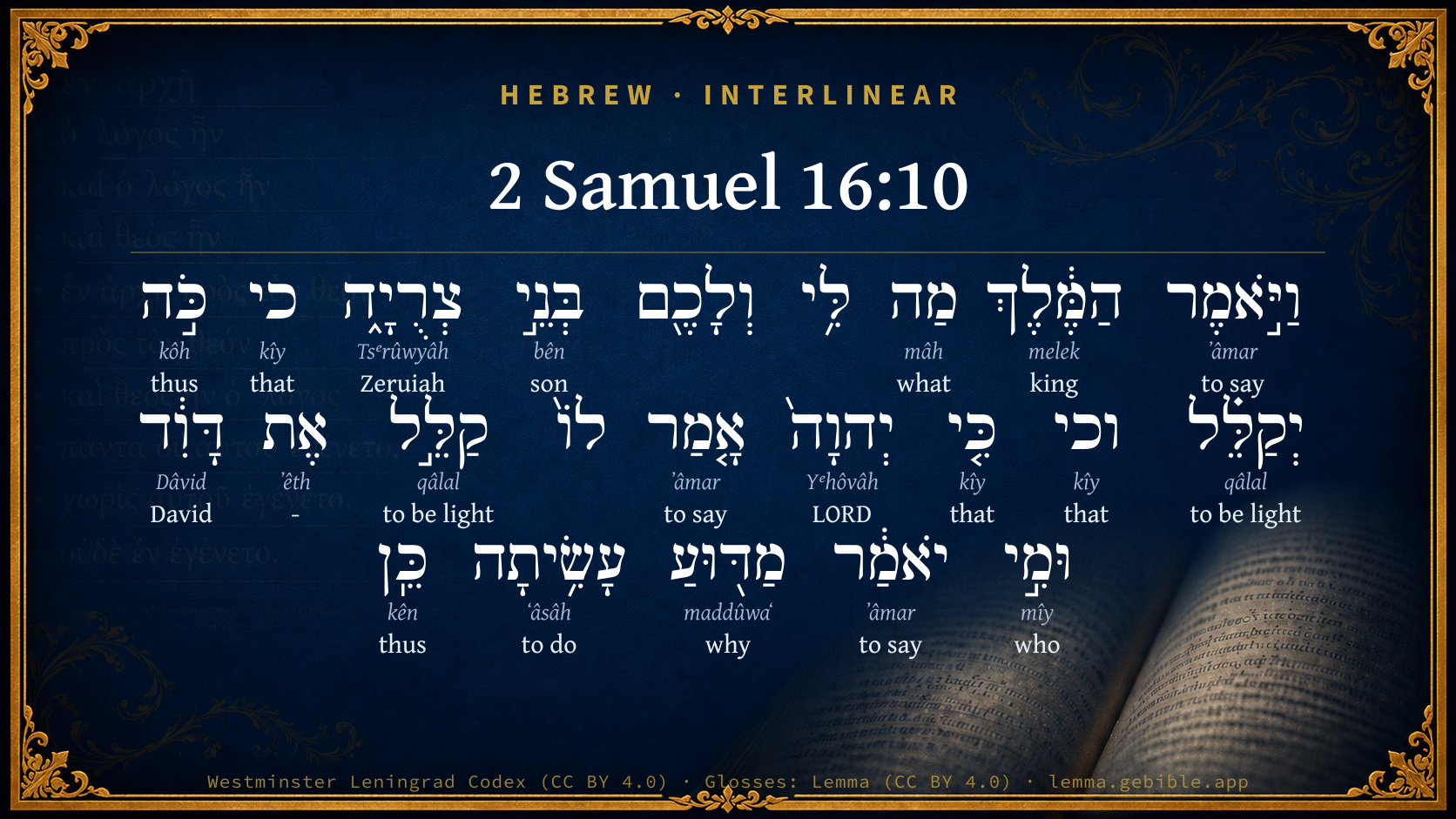
2 Samuel 16:10

Hebrew (Westminster Leningrad Codex) 2 Samuel 16:10 appears in the Hebrew Old Testament. The text above is from the Westminster Leningrad Codex. Each word links to its Strong’s number, a concise gloss, and parsing drawn from the Open Scriptures Hebrew Bible morphology. Click any word for its full Brown-Driver-Briggs (BDB) entry.
Download image
Cite this verse

2 Samuel 16:10 (World English Bible). Public Domain. Lemma interlinear Bible study tool, https://lemma.gebible.app/v/2-samuel/16/10.

Show BibTeX & RIS
BibTeX
RIS
English Translation
The king said, What have I to do with you, you sons of Zeruiah? Because he curses, and because Yahweh has said to him, Curse David; who then shall say, Why have you done so?
World English Bible · Public Domain
Download a study sheet

One document with this verse’s original text, its word-by-word gloss line, the meaning frame, cross-references with their text, attributed commentary, and full source and license credits — printable, and it pastes into notes with its structure intact.

This verse Autodidact and up

Study sheet (.html) Plain text (.txt)

A passage Seminary Student

Up to 50 verses in one chapter. A passage sheet keeps up to 6 commentary sources and 12 cross-references per verse, in the order this page ranks them, and says so on the sheet whenever that leaves anything out. Ask for a single verse and you get the Autodidact verse sheet above.

Everything on this page stays free to read, with no account — the sheet is a download of what is already on screen, not access to it.

Want to remove ads? Support Godless Engineer
Compare translations 3

The same verse in 3 English versions, stacked beneath the original-language interlinear above. Click any original word for its lexicon entry.

Each is an independent rendering of the whole verse — the interlinear is not word-aligned to these translations.

Highlighted words mark where these versions differ — a whole-verse word diff, not a word-by-word alignment.

  • World English Bible Public Domain
    The king said, What have I to do with you, you sons of Zeruiah? Because he curses, and because Yahweh has said to him, Curse David; who then shall say, Why have you done so?
  • King James Version Public Domain
    And the king said, What have I to do with you, ye sons of Zeruiah? so let him curse, because the LORD hath said unto him, Curse David. Who shall then say, Wherefore hast thou done so?
  • unfoldingWord Literal Text CC BY-SA 4.0
    And the king said, “What to me and to you, sons of Zeruiah? If he curses because Yahweh has said to him, ‘Curse David,’ then who shall say, ‘Why have you done thus’?”

unfoldingWord Literal Text — © unfoldingWord, licensed CC BY-SA 4.0. Word-aligned USFM3 via Door43 (git.door43.org/unfoldingWord/en_ult).

Versions to compare (up to 4)

3 of 4 selected

Show all 18 translations

Every available English version of this verse, each an independent rendering of the whole verse.

  • World English Bible Public Domain
    The king said, What have I to do with you, you sons of Zeruiah? Because he curses, and because Yahweh has said to him, Curse David; who then shall say, Why have you done so?
  • Berean Standard Bible Public Domain
    But the king replied, “What have I to do with you, O sons of Zeruiah? If he curses me because the LORD told him, ‘Curse David,’ who can ask, ‘Why did you do this?’”
  • Majority Standard Bible Public Domain
    But the king replied, “What have I to do with you, O sons of Zeruiah? If he curses me because the LORD told him, ‘Curse David,’ who can ask, ‘Why did you do this?’”
  • King James Version Public Domain
    And the king said, What have I to do with you, ye sons of Zeruiah? so let him curse, because the LORD hath said unto him, Curse David. Who shall then say, Wherefore hast thou done so?
  • American Standard Version (1901) Public Domain
    And the king said, What have I to do with you, ye sons of Zeruiah? Because he curseth, and because Jehovah hath said unto him, Curse David; who then shall say, Wherefore hast thou done so?
  • Revised Version (1885) Public Domain
    And the king said, What have I to do with you, ye sons of Zeruiah? Because he curseth, and because the LORD hath said unto him, Curse David; who then shall say, Wherefore hast thou done so?
  • Geneva Bible (1599) Public Domain
    But the King saide, What haue I to doe with you, ye sonnes of Zeruiah? for he curseth, eue because the Lord hath bidden him curse Dauid: who dare then say, Wherfore hast thou done so?
  • Douay-Rheims (1899) Public Domain
    And the king said: What have I to do with you, ye sons of Sarvia? Let him alone and let him curse: for the Lord hath bid him curse David: and who is he that shall dare say, why hath he done so?
  • Young's Literal Translation Public Domain
    And the king saith, `What -- to me and to you, O sons of Zeruiah? for -- let him revile; even because Jehovah hath said to him, Revile David; and who saith, Wherefore hast Thou done so?'
  • Literal Standard Version CC BY-SA 4.0
    And the king says, “And what do I [have to do] with you, O sons of Zeruiah? For let him revile; even because YHWH has said to him, Revile David; and who says, Why have You done so?”
  • Unlocked Literal Bible CC BY-SA 4.0
    But the king said, “What have I to do with you, sons of Zeruiah? Perhaps he is cursing me because Yahweh has said to him, 'Curse David.' Who then could say to him, 'Why are you cursing the king?'”
  • unfoldingWord Literal Text CC BY-SA 4.0
    And the king said, “What to me and to you, sons of Zeruiah? If he curses because Yahweh has said to him, ‘Curse David,’ then who shall say, ‘Why have you done thus’?”
  • Darby Bible Public Domain
    And the king said, What have I to do with you, ye sons of Zeruiah? so let him curse, for Jehovah has said to him, Curse David! Who shall then say, Why dost thou so?
  • World Messianic Bible Public Domain
    The king said, “What have I to do with you, you sons of Zeruiah? Because he curses, and because the LORD has said to him, ‘Curse David,’ who then shall say, ‘Why have you done so?’”
  • Webster's Bible Public Domain
    And the king said, What have I to do with you, ye sons of Zeruiah? so let him curse, because the LORD hath said to him, Curse David. Who shall then say, Why hast thou done so?
  • Free Bible Version CC BY-SA 4.0
    “What's that got to do with you, you sons of Zeruiah?” the king replied. “If he's cursing me because the Lord told him to, then who can question what he's doing?”
  • Bible in Basic English Public Domain
    And the king said, What have I to do with you, you sons of Zeruiah? Let him go on cursing, for the Lord has said, Put a curse on David, and who then may say, Why have you done so?
  • JPS Tanakh (1917) Public Domain
    And the king said: 'What have I to do with you, ye sons of Zeruiah? So let him curse, because the LORD hath said unto him: Curse David; who then shall say: Wherefore hast thou done so?'

Literal Standard Version (2020), Covenant Press — licensed CC BY-SA 4.0. Text via the HelloAO Bible API (eBible.org). Unlocked Literal Bible (unfoldingWord) — licensed CC BY-SA 4.0. Text via the HelloAO Bible API (eBible.org). unfoldingWord Literal Text — © unfoldingWord, licensed CC BY-SA 4.0. Word-aligned USFM3 via Door43 (git.door43.org/unfoldingWord/en_ult). Free Bible Version, Dr. Jonathan Gallagher — licensed CC BY-SA 4.0. Text via the HelloAO Bible API (eBible.org).

Word by word

More ways to search: Search by grammar → Find every occurrence → Compare this word →

Practice this passage: Drill this verse → Learn its vocabulary →

צְרֻיָ֑ה
Tsᵉrûwyâh
H6870
“Zeruiah”
Noun, Proper
Part of Speech
Noun
Type
Proper
Full BDB Definition

Origin: pass part from the same as H6875

TWOT: None

Zeruiah = "balsam" - sister of David and mother of the 3 leading heroes of David's army - Abishai, Joab, and Asahel
  1. וַיֹּ֣אמֶר ʼâmar H559 “and · to say” Conjunction + Verb, Qal, Sequential Imperfect, 3rd Person, Masculine, Singular
  2. הַמֶּ֔לֶךְ melek H4428 “the · king” Particle, Definite Article + Noun, Common, Masculine, Singular, Absolute
  3. מַה mâh H4100 “what” Particle, Interrogative
  4. בְּנֵ֣י bên H1121 “sons of” Noun, Common, Masculine, Plural, Construct
  5. כי kîy H3588 “that” Conjunction
  6. כֹּ֣ה kôh H3541 “thus” Adverb
  7. יְקַלֵּ֗ל qâlal H7043 “to be light” Verb, Piel, Imperfect, 3rd Person, Masculine, Singular
  8. וכי kîy H3588 “and · that” Conjunction + Conjunction
  9. כִּ֤י kîy H3588 “that” Conjunction
  10. יְהוָה֙ Yᵉhôvâh H3068 “LORD” Noun, Proper
  11. אָ֤מַר ʼâmar H559 “to say” Verb, Qal, Perfect, 3rd Person, Masculine, Singular
  12. קַלֵּ֣ל qâlal H7043 “be light” Verb, Piel, Imperative, 2nd Person, Masculine, Singular
  13. אֶת ʼêth H853 “-” Particle, Direct Object
  14. דָּוִ֔ד Dâvid H1732 “David” Noun, Proper
  15. וּמִ֣י mîy H4310 “and · who” Conjunction + Particle, Interrogative
  16. יֹאמַ֔ר ʼâmar H559 “to say” Verb, Qal, Imperfect, 3rd Person, Masculine, Singular
  17. מַדּ֖וּעַ maddûwaʻ H4069 “why” Particle, Interrogative
  18. עָשִׂ֥יתָה ʻâsâh H6213 “to do” Verb, Qal, Perfect, 2nd Person, Masculine, Singular
  19. כֵּֽן kên H3651 “thus” Particle, Demonstrative

About this verse

These counts appear in no published source. They are computed here, from the morphology-tagged text and Lemma’s own curated glosses. What Lemma adds →

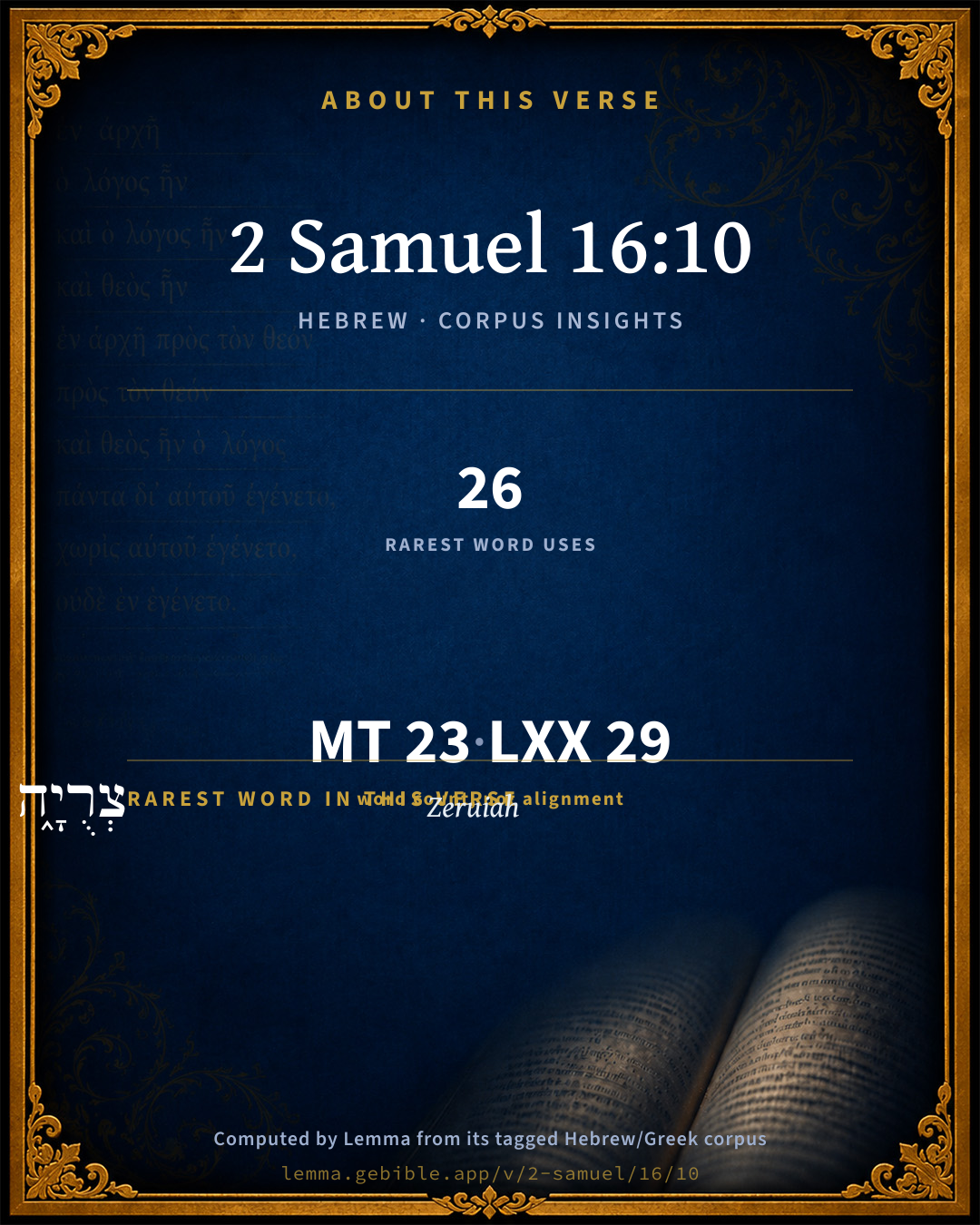
23
words
15
distinct lemmas
Historical
section

Shared distinctive vocabulary

צְרֻיָ֑ה Zeruiah H6870 occurs in 25 verses of the Hebrew Bible. Also found in:

Grammatical profile

  • 6 verbs
  • 5 nouns
  • 3 prepositions
  • 3 conjunctions
  • 1 adverb
  • 5 particles

Verb forms

  • וַיֹּ֣אמֶר Qal · Sequential Imperfect
  • יְקַלֵּ֗ל Piel · Imperfect
  • אָ֤מַר Qal · Perfect
  • קַלֵּ֣ל Piel · Imperative
  • יֹאמַ֔ר Qal · Imperfect
  • עָשִׂ֥יתָה Qal · Perfect

Repetition

Words recur within this verse — often emphatic in Hebrew:

  • וַיֹּ֣אמֶר to say H559 ×3
  • יְקַלֵּ֗ל to be light H7043 ×2
  • כי that H3588 ×3

Hebrew & Septuagint length

In English translation the verse runs 35 words from the Hebrew and 42 from the Septuagint (LXX English) — closely comparable.

A rough comparison of the two English renderings, which tokenize alike — not a word-level alignment.

Word counts can differ between the Hebrew and the Greek without any difference in meaning — e.g. the Hebrew direct-object marker אֵת has no separate Greek word, and Greek often adds the article ὁ.

In the original languages it is 23 Hebrew tokens and 29 Greek tokens — but the two are counted differently (Hebrew bundles its prefixes and suffixes into one token; the Greek is in lemma form), so that isn’t a like-for-like length.

Cross-references

15

Topical passages linked to 2 Samuel 16:10 in the Treasury of Scripture Knowledge — connected by theme and wording, ordered by reader-vote popularity; previews shown in the World English Bible.

  • 2 Samuel 19:22 David said, What have I to do with you, you sons of Zeruiah, that you should this day be adversaries to me? shall there any man be put to death this day in Israel? for don't I know that I am this day king over Israel?
  • Romans 9:20 But indeed, O man, who are you to reply against God? Will the thing formed ask him who formed it, "Why did you make me like this?"
  • John 18:11 Jesus therefore said to Peter, "Put the sword into its sheath. The cup which the Father has given me, shall I not surely drink it?"
  • Genesis 50:20 As for you, you meant evil against me, but God meant it for good, to bring to pass, as it is this day, to save many people alive.
  • 2 Samuel 3:39 I am this day weak, though anointed king; and these men the sons of Zeruiah are too hard for me. May Yahweh reward the evil-doer according to his wickedness."
  • Daniel 4:35 All the inhabitants of the earth are reputed as nothing; and he does according to his will in the army of heaven, and among the inhabitants of the earth; and none can stay his hand, or tell him, What do you?
  • Matthew 16:23 But he turned, and said to Peter, "Get behind me, Satan! You are a stumbling-block to me, for you are not setting your mind on the things of God, but on the things of men."
  • 1 Peter 2:23 Who, when he was cursed, didn't curse back. When he suffered, didn't threaten, but committed himself to him who judges righteously;
  • 1 Kings 2:5 Moreover you know also what Joab the son of Zeruiah did to me, even what he did to the two captains of the hosts of Israel, to Abner the son of Ner, and to Amasa the son of Jether, whom he killed, and shed the blood of war in peace, and put the blood of war on his sash that was about his loins, and in his shoes that were on his feet.
  • 1 Kings 22:21–23 There came forth a spirit, and stood before Yahweh, and said, I will entice him.
  • 2 Kings 18:25 Am I now come up without Yahweh against this place to destroy it? Yahweh said to me, Go up against this land, and destroy it.
  • Job 9:12 Behold, he snatches away; who can hinder him? Who will ask him, 'What are you doing?'
  • Ecclesiastes 8:4 for the king's word is supreme. Who can say to him, "What are you doing?"
  • Lamentations 3:38–39 Doesn't evil and good come out of the mouth of the Most High?
  • Luke 9:54–56 When his disciples, James and John, saw this, they said, "Lord, do you want us to command fire to come down from the sky, and destroy them, just as Elijah did?"

Cross-references courtesy of OpenBible.info (CC BY 4.0).

Hebrew and Greek witnesses Masoretic Hebrew ↔ Greek Septuagint

The same verse in the two great witnesses to the Old Testament, shown verse-for-verse.

These are two independent witnesses, not word-aligned to each other, and the Septuagint is shown in lemma (dictionary) form.

Hebrew 2 Samuel 16:10 Masoretic · Westminster Leningrad Codex

וַיֹּ֣אמֶר הַמֶּ֔לֶךְ מַה לִּ֥י וְלָכֶ֖ם בְּנֵ֣י צְרֻיָ֑ה כי כֹּ֣ה יְקַלֵּ֗ל וכי כִּ֤י יְהוָה֙ אָ֤מַר לוֹ֙ קַלֵּ֣ל אֶת דָּוִ֔ד וּמִ֣י יֹאמַ֔ר מַדּ֖וּעַ עָשִׂ֥יתָה כֵּֽן

The king said, What have I to do with you, you sons of Zeruiah? Because he curses, and because Yahweh has said to him, Curse David; who then shall say, Why have you done so?

World English Bible · Public Domain

Greek LXX 2 Samuel 16:10 Septuagint · lemma form

καί εἶπον ὁ βασιλεύς τίς ἐγώ καί σύ υἱός σαρουιας ἀποἵημι αὐτός καί οὕτως καταἀράομαι ὅτι κύριος εἶπον αὐτός καταἀράομαι ὁ δαυίδ καί τίς εἶπον ὡς τίς ποιέω οὕτως

And the king said, What have I to do with you, you⌃ sons of Saruia? even let him alone, and so let him curse, for the Lord has told him to curse David: and who shall say, Why have you done thus?

LXX2012 (modern English Septuagint) · Public Domain

On this verse, Ellicott's Commentary for English Readers discusses the Septuagint’s reading. Read the note in Commentary ↓

Hebrew: Westminster Leningrad Codex (CC BY 4.0). Greek: Septuagint (public domain); English from LXX2012 (modern English Septuagint) (Public Domain). How the Septuagint differs from the Hebrew →

Targum (Aramaic paraphrase)

1

The Targum is the ancient Jewish Aramaic paraphrase of the Hebrew Scriptures — an interpretive translation, not the Hebrew text itself. Onkelos (literal) and Pseudo-Jonathan (expansive) render the Torah, and Jonathan the Prophets. Coverage is partial: where no permissively-licensed English translation exists for a verse, only the Aramaic is shown. This is verse-level text, not a word-by-word alignment to the Hebrew.

  1. Targum Jonathan Prophets (Joshua–Malachi)
    וַאֲמַר מַלְכָּא מַה לִי וּלְכוֹן בְנֵי צְרוּיָה כְּדֵין יְלַטִיט אֲרֵי יְיָ אֲמַר לֵיהּ לַטֵיט יַת דָוִד וּמַן יֵימַר מַה דֵין עֲבַדְתָּא כֵּן:

    (no public-domain English translation for this verse)

    Targum Jonathan — Aramaic: “Mikraot Gedolot” (public domain). English: “Sefaria Community Translation” (CC0 1.0 (public-domain dedication)); “London "Chaldee Paraphrase," 1871” (public domain). Text via Sefaria.

Commentary

Notes on 2 Samuel 16:10 from classic Christian and Jewish commentators (each source and its license shown beneath its notes). The classic Christian expositions comment on the surrounding passage and are grouped to its opening verse, so a note may address several verses; the Jewish commentaries on the Tanakh (Rashi and others) are per-verse, so they appear only where the commentator wrote on this verse.

Lemma curates 59 commentaries, every one of them public domain or Creative Commons licensed, each selected and text-cleaned for this edition rather than reprinted as found. About our sources →

Trapp's Complete Commentary

John Trapp

2Sa 16:10 And the king said, What have I to do with you, ye sons of Zeruiah? so let him curse, because the LORD hath said unto him, Curse David. Who shall then say, Wherefore hast thou done so?

Ver. 10. What have I to do with you, ye sons of Zeruiah?] So that Joab, it seemeth, as well as Abishai, had a hand in this request of revenge, and is therefore thus shaken up, unless it were so that Abner’s death were now laid afresh in his dish, as that wherewith Shimei had newly twitted David Ambrose, citing these words of David, crieth out. O altitudo prudentiae! O altitudo patientiae! O devorandae contumeliae grande inventum! Ecce verborum contumelia parricidii levavit aerumnam, &c. Reproaches make graces more splendent. As the gardener planteth his unsavoury herbs, garlic and onions, near his sweetest roses, saith Plutarch, that so the smell thereof may be the more prized.

Because the Lord hath said unto him, Curse David,] sc., By the secret impulse of some evil spirit, saith Piscator: or by a secret command of providence, say others: and this consideration framed David’s heart to so much patience, that he was "as a deaf man that heard not, and as a dumb man in whose mouth are no reproofs." {Psa 38:13-14} He could sit and sing,

“ Incessunt, taceo: culpant, fero: crimina spargunt,

Dissimulo: mordent, abque dolore meo.

Latrant, non moveor: frendent, non curo: minantur,

Non metuo: mordent labra, laboro nihil."

Who shall then say, Wherefore hast thou done so?] God is αιυπευθυνος, not bound to give an account to any: neither needeth he so to do, since his will is the rule of right, and his judgments are sometimes secret, always just, David knew there was cause enough.

John Trapp, A Commentary or Exposition upon All the Books of the Old and New Testament (1647–1656) — public domain. Text from a community e-Sword module.

Joseph Benson's Commentary

2Sa 16:10. What have I to do with you? &c. — In this matter I ask not your advice, nor will I follow it. Your violent counsels are no way pleasing or fit for me at present. The Lord hath said unto him, Curse David — God, by bringing me into this distressed condition, hath caused me to appear a proper object of his scorn, hath left him to his own wickedness, and now gives him an opportunity, in the course of his providence, of pouring forth the malignity of his heart, without restraint, or fear of being punished for so doing. We cannot suppose David meant that God, strictly speaking, had either bid Shimei curse him, or had excited him so to do: but merely that, his heart being full of malice and rage, God had now put it into his power to give full vent to these diabolical passions as a punishment to David. Unto this the good king humbly submits, looking upon it as coming from the hand of God, who had delivered him up to this contempt. And in this David’s patience and meekness were admirable, for it is not an easy thing to stifle all emotions of revenge when there is a high provocation to it, and no difficulty in taking it. David did not scorn these curses as proceeding from the mouth of a base wretch, not worthy to be regarded, but acknowledged that his sins had merited this chastisement, and that God was just in suffering him to be afflicted with it. Who shall then say, Wherefore hast thou done so? — Who shall reproach God’s providence for permitting this? Or, who shall restrain him from executing his just judgment against me?

Joseph Benson's Commentary on the Old and New Testaments (1811–1818) — public domain. Text from a community e-Sword module.

Tyndale Open Study Notes

Tyndale Open Resources

16:10 If the Lord has told him to curse me: David felt it might have been punishment for past sins. • David was—contrary to Shimei’s charges—reducing the violence that surrounded him.

Tyndale Open Study Notes — © Tyndale Open Resources, licensed CC BY-SA 4.0. Text via the HelloAO Bible API.

Geneva Bible (1599)

Geneva Bible translators

David felt that this was the judgment of God for his sin, and therefore humbleth himself to his rod.

Geneva Bible (1599) marginal notes — public domain. Text via Bolls.life.

Adam Clarke's Commentary

Verse 10. Because the Lord hath said] The particle וכי vechi should be translated for if, not because. FOR IF the Lord hath said unto him, Curse David, who shall then say, Wherefore hast thou done so!

Adam Clarke's Commentary on the Bible (1810–1826) — public domain. Text from a community e-Sword/MySword module.

Ellicott's Commentary for English Readers

(10) So let him curse.—This translation follows the margin of the Hebrew, as the LXX. and Vulg. also do. David, throughout, recognises that all his sufferings were from the Lord’s hand, and he wishes to submit himself entirely to His will. He does not, of course, mean to justify Shimei’s wrong; but only to say that, as far as his sin bears upon himself, it is of Divine appointment and he cannot resent it.

A Bible Commentary for English Readers, edited by Charles John Ellicott (1878–1897) — public domain. Text from a community e-Sword module.

The Cambridge Bible for Schools and Colleges

gen. ed. J. J. S. Perowne

10. What have I to do with you] ‘What have we in common? leave me alone.’ The phrase is used to repel an unwelcome suggestion, and repudiate participation in the thoughts and feelings of another. Cp. ch. 2Sa_19:22; Joh_2:4.

ye sons of Zeruiah] Joab probably seconded Abishai’s request. For David’s abhorrence of his nephews’ ferocity, see ch. 2Sa_3:39.

so let him curse, &c.] This is the rendering of the traditional reading (Qrî). The written text (Kthîbh) may be rendered, when he curseth, and when the Lord, &c., who then shall say, &c.: or, for he curseth because the Lord, &c.

The Cambridge Bible for Schools and Colleges (gen. ed. J. J. S. Perowne; Cambridge University Press, 1878–1918) — public domain. Text from a community e-Sword module.

John Gill's Exposition

And the king said, what have I to do with you, ye sons of Zeruiah?.... It seems as if Joab, the brother of Abishai, joined with him in this request to have leave to take off the head of Shimei; and though David had to do with them as his relations, his sister's sons, and as they were generals in his army; yet in this case he would have nothing to do with them, would not take their advice, nor suffer them to take revenge on this man for his cursing him: or "what is it to me, or to you" (u)? what signifies his cursing? it will neither hurt me nor you:

so let him curse; go on cursing after this manner; do not restrain him from it, or attempt to stop his mouth: or, "for he will curse" (w); so is the textual reading; you will not be able to restrain him, for the following reason:

because the Lord hath said unto him, curse David; not by way of command, or a precept of his; for to curse the ruler of the people is contrary to the word and law of God, Exo 22:28, nor by any operation of his spirit moving and exciting him to it; for the operations of the Spirit are to holiness, and not to sin; but by the secret providence of God ordering, directing, and overruling all circumstances relative to this affair. Shimei had conceived enmity and hatred to David; God left him to the power of this corruption in his breast, opened a way in Providence, and gave him an opportunity of exercising it on him: it was not a bare permission of God that Shimei should curse David; but it was his will, and he ordered it so in Providence, that he should do it; which action was attended with the predetermined concourse of divine Providence, so far as it was an action; though, as a sinful action, it was of Shimei, sprung from his own heart, instigated by Satan; but as a correction and chastisement of David, it was by the will, order, and appointment of God, and as such David considered it, and quietly submitted to it:

who shall then say, wherefore hast thou done so? for though Shimei might justly be blamed, and reproved for it, yet the thing itself was not to be hindered or restrained, it being according to the will and providence of God, to answer some good end with respect to David.

(u) "quid mihi et vobis", V. L. Pagninus, Montanus. (w) "quia", Moatanus.

John Gill's Exposition of the Whole Bible (1746–1763) — public domain (CC PDM 1.0). Text via the HelloAO Bible API.

Albert Barnes' Notes on the Bible

What have I to do ... - See the marginal references compare Mat 8:29; Joh 2:4, and a similar complaint about the sons of Zeruiah 2Sa 3:39. And for a like striking incident in the life of the Son of David, see Luk 9:52-56.

Albert Barnes' Notes on the Bible (1834–1885) — public domain. Text from a community e-Sword/MySword module.

Haydock's Catholic Bible Commentary

Hath bid him curse. Not that the Lord was the author of Semei’s sin, which proceeded purely from his own malice, and the abuse of his free-will; but that knowing and suffering his malicious disposition to break out on this occasion, he made use of him as his instrument to punish David for his sins. (Challoner) --- He adored the justice of God; who is often said to do what he does not hinder, or what he only permits. (Estius) --- David is here a noble figure of Jesus Christ, excusing his executioners, (Haydock) and receiving the insults of the Jews, without complaining. (Calmet) --- If Semei had not been guilty of sin, but acted according to God’s will, he could not have been justly punished, 3 Kings ii. (Worthington)

George Leo Haydock (1774–1849), Haydock's Catholic Family Bible and Commentary, 1859 edition — public domain. Excludes Psalms (Douay-Rheims chapter numbering differs from Protestant) and Deuterocanonical books (Catholic canon only).

Matthew Poole's English Annotations

What have I to do with you? to wit, in this matter I ask not your advice, nor will I follow it; nor do I desire you should at all concern yourselves in it, but wholly leave it to me, to do what I think fit.

Because the Lord hath said unto him; not that God commanded it by his word, for that severely forbids it, Exo 22:28; or moved him to it by his Spirit, for neither was that necessary nor possible, because God tempteth no man, Jam 1:13; but that the secret providence of God did order and overrule him in it. God did not put any wickedness into Shimei’s heart, for he had of himself a heart full of malignity and venom against David; but only left him to his own wickedness; took away that common prudence which would have kept him from so foolish and dangerous an action; directed his malice that it should be exercised against David, rather than another man, as when God gives up one traveller into the hands of a robber rather than another; inclined him to be at home, and then to come out of his doors at that time when David passed by him; and brought David into so distressed a condition, that he might seem a proper object of his scorn and contempt. And this is ground enough for this expression, the Lord said, not by the word of his precept, but by the word of his providence, in respect whereof he is said to command the ravens, 1Ki 17:4, and to send forth his word and commandment to senseless creatures, Psa 147:15,18.

Who shall then say? not unto Shimei, for it was justly said so to him afterwards, 1Ki 2:9, but unto the Lord; who shall reproach God’s providence for permitting this? Or, who shall by words or actions restrain him from executing God’s just judgment against me?

Matthew Poole's English Annotations on the Holy Bible (1683–1685) — public domain. Text from a community e-Sword/MySword module.

Whedon's Commentary on the Bible

Daniel D. Whedon

10. Ye sons of Zeruiah — Perhaps Joab joined with Abishai in the request to avenge the king.

The Lord hath said unto him, Curse David — By this we are not to understand that God personally communicated with Shimei, and by direct revelation ordered him to curse David; but that David recognised in Shimei’s cursing one method of receiving the divine judgments upon himself for his past sins. It was an instance where God made the wrath of one man an instrument of scourging another for his crimes. David felt that the hand of God was in it.

Pure from the blood of Saul in vain,

He dares not to the charge reply;

Uriah’s doth the charge maintain,

Uriah’s doth against him cry.

Let Shimei curse: the rod he bears

For sins which Mercy had forgiven,

And in the wrongs of man reveres

The awful righteousness of Heaven.

Lord, I adore thy gracious will —

Through every instrument of ill

My Father’s goodness see;

Accept the complicated wrong

Of Shimei’s hand and Shimei’s tongue

As kind rebukes from thee. — C. Wesley.

Daniel D. Whedon (gen. ed.), Commentary on the Old and New Testaments (1874–1909) — public domain. Text from a community e-Sword module.

John Wesley's Explanatory Notes

What have I, &e. - In this matter I ask not your advice, nor will I follow it; nor do I desire you should at all concern yourselves in it. The Lord - God did not put any wickedness into Shimei's heart, for he had of himself an heart full of malignity against David; but only left him to his own wickedness; and brought David into so distressed a condition, that he might seem a proper object of his scorn. And this is ground enough for this expression, the Lord said, not by the word of his precept, but by the word of his providence, in respect whereof he is said to command the ravens, 1 Kings xvii, 4, and to send forth his word to senseless creatures, Psalm 1xlvii, 15, 18. Who shall reproach God's providence for permitting this? Or, who shall restrain him from executing his just judgment against me?

John Wesley, Explanatory Notes Upon the Whole Bible (1754–1765) — public domain. Text via the GEBible commentary corpus.

Rashi

Rabbi Shlomo Yitzchaki (Rashi)

He should curse [me] like this. He should curse like this.

God told him. Is it possible that a man like him who is head of the Sanhedrin would curse the king if he were not told [to do so] by God?

Rashi on the Tanakh — English translations: “The Judaica Press complete Tanach with Rashi, translated by A. J. Rosenberg” (CC BY 4.0); “Pentateuch with Rashi's commentary by M. Rosenbaum and A.M. Silbermann, 1929-1934” (public domain); “The Metsudah Tanach series, Lakewood, N.J” (CC BY 4.0); and “The Book of Joshua, Metsudah Publications, 1997” (CC BY 4.0). Text via Sefaria.

Lesson kit

Teaching starters — assembled from the data on this page, not authored interpretation. Every prompt links to the verse data it draws on. Edit before teaching.

2 Samuel, in the Historical, opens this verse with 23 words (15 distinct Hebrew lemmas). Its most distinctive word is Tsᵉrûwyâh (“Zeruiah”). A historical commentator’s framing appears above. Read the whole chapter for the surrounding context.

Discussion questions

  1. The word Tsᵉrûwyâh carries the sense “Zeruiah.” How does it shape the verse?
  2. How does 1 Samuel 26:6, which shares the word «Zeruiah», read alongside this verse?
  3. What does the repetition of “to say” (3× in this one verse) do in this verse?
  4. The translations on this page render this verse differently — a whole-verse word diff, not a word-by-word alignment. What might account for the different wordings?
  5. «וַיֹּ֣אמֶר» is a Qal Sequential Imperfect verb. How does that grammatical form shape the action described?
  6. Compare how Trapp's Complete Commentary and Joseph Benson's Commentary read this verse. Where do they agree or differ?

Things to notice

Reading settings

Reading text

Shown beneath each verse's original-language words.

Old Testament
Old Testament edition

Read the OT as the Masoretic Hebrew (MT) or the Greek Septuagint (LXX).

English shown for the Greek Septuagint (in the Hebrew ↔ Greek comparison).

Comparing translations? Open the Compare panel on any verse page to stack up to four side by side.