

Psalms 73:27

Hebrew (Westminster Leningrad Codex) Psalms 73:27 appears in the Hebrew Old Testament. The text above is from the Westminster Leningrad Codex. Each word links to its Strong’s number, a concise gloss, and parsing drawn from the Open Scriptures Hebrew Bible morphology. Click any word for its full Brown-Driver-Briggs (BDB) entry.
Download image
Cite this verse

Psalms 73:27 (World English Bible). Public Domain. Lemma interlinear Bible study tool, https://lemma.gebible.app/v/psalms/73/27.

Show BibTeX & RIS
BibTeX
RIS
English Translation
For, behold, those who are far from you shall perish. You have destroyed all those who are unfaithful to you.
World English Bible · Public Domain
Highlights
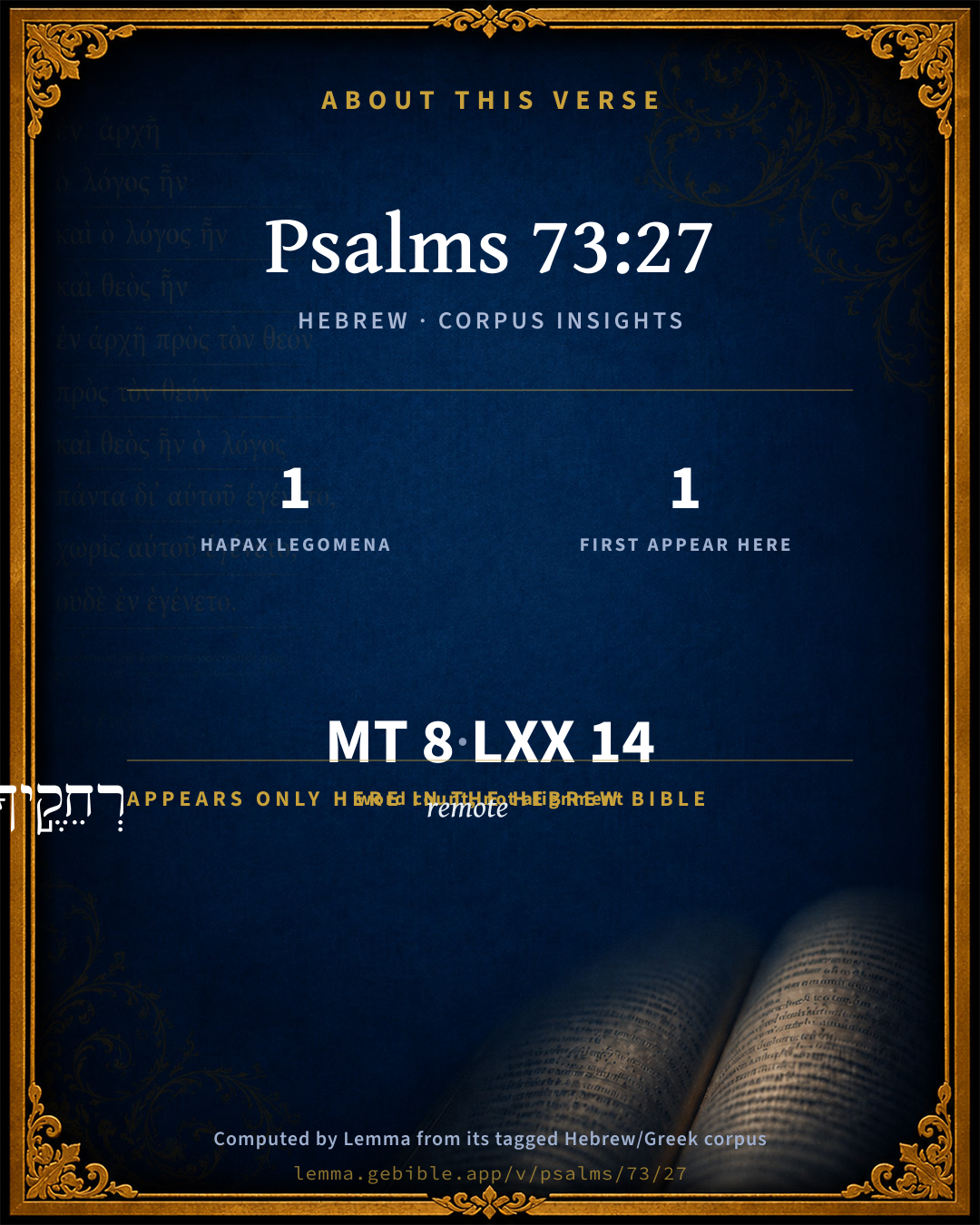
  • 1 hapax legomenon — only here in the Hebrew Bible
  • 1 first appearance in the Hebrew Bible
Full analysis ↓
Download a study sheet

One document with this verse’s original text, its word-by-word gloss line, the meaning frame, cross-references with their text, attributed commentary, and full source and license credits — printable, and it pastes into notes with its structure intact.

This verse Autodidact and up

Study sheet (.html) Plain text (.txt)

A passage Seminary Student

Up to 50 verses in one chapter. A passage sheet keeps up to 6 commentary sources and 12 cross-references per verse, in the order this page ranks them, and says so on the sheet whenever that leaves anything out. Ask for a single verse and you get the Autodidact verse sheet above.

Everything on this page stays free to read, with no account — the sheet is a download of what is already on screen, not access to it.

Want to remove ads? Support Godless Engineer
Compare translations 3

The same verse in 3 English versions, stacked beneath the original-language interlinear above. Click any original word for its lexicon entry.

Each is an independent rendering of the whole verse — the interlinear is not word-aligned to these translations.

Highlighted words mark where these versions differ — a whole-verse word diff, not a word-by-word alignment.

  • World English Bible Public Domain
    For, behold, those who are far from you shall perish. You have destroyed all those who are unfaithful to you.
  • King James Version Public Domain
    For, lo, they that are far from thee shall perish: thou hast destroyed all them that go a whoring from thee.
  • unfoldingWord Literal Text CC BY-SA 4.0
    For behold, those who are far from you will perish; you destroy every one being unfaithful to you.

unfoldingWord Literal Text — © unfoldingWord, licensed CC BY-SA 4.0. Word-aligned USFM3 via Door43 (git.door43.org/unfoldingWord/en_ult).

Versions to compare (up to 4)

3 of 4 selected

Show all 18 translations

Every available English version of this verse, each an independent rendering of the whole verse.

  • World English Bible Public Domain
    For, behold, those who are far from you shall perish. You have destroyed all those who are unfaithful to you.
  • Berean Standard Bible Public Domain
    Those far from You will surely perish; You destroy all who are unfaithful to You.
  • Majority Standard Bible Public Domain
    Those far from You will surely perish; You destroy all who are unfaithful to You.
  • King James Version Public Domain
    For, lo, they that are far from thee shall perish: thou hast destroyed all them that go a whoring from thee.
  • American Standard Version (1901) Public Domain
    For, lo, they that are far from thee shall perish: Thou hast destroyed all them that play the harlot, `departing' from thee.
  • Revised Version (1885) Public Domain
    For, lo, they that are far from thee shall perish: thou hast destroyed all them that go a whoring from thee.
  • Geneva Bible (1599) Public Domain
    For loe, they that withdrawe themselues from thee, shall perish: thou destroyest all them that goe a whoring from thee.
  • Douay-Rheims (1899) Public Domain
    For behold they that go far from thee shall perish: thou hast destroyed all them that are disloyal to thee.
  • Young's Literal Translation Public Domain
    For, lo, those far from Thee do perish, Thou hast cut off every one, Who is going a whoring from Thee.
  • Literal Standard Version CC BY-SA 4.0
    For behold, those far from You perish, || You have cut off everyone, || Who is going whoring from You.
  • Unlocked Literal Bible CC BY-SA 4.0
    Those who are far from you will perish; you will destroy all those who are unfaithful to you.
  • unfoldingWord Literal Text CC BY-SA 4.0
    For behold, those who are far from you will perish; you destroy every one being unfaithful to you.
  • Darby Bible Public Domain
    For behold, they that are far from thee shall perish; thou destroyest every one that goeth a whoring from thee.
  • World Messianic Bible Public Domain
    For, behold, those who are far from you shall perish. You have destroyed all those who are unfaithful to you.
  • Webster's Bible Public Domain
    For lo, they that are far from thee shall perish: thou hast destroyed all them that go astray from thee.
  • Free Bible Version CC BY-SA 4.0
    Those people who are far from God will die. You destroy all those unfaithful to you.
  • Bible in Basic English Public Domain
    For those who are far away from you will come to destruction: you will put an end to all those who have not kept faith with you.
  • JPS Tanakh (1917) Public Domain
    For, lo, they that go far from Thee shall perish; Thou dost destroy all them that go astray from Thee.

Literal Standard Version (2020), Covenant Press — licensed CC BY-SA 4.0. Text via the HelloAO Bible API (eBible.org). Unlocked Literal Bible (unfoldingWord) — licensed CC BY-SA 4.0. Text via the HelloAO Bible API (eBible.org). unfoldingWord Literal Text — © unfoldingWord, licensed CC BY-SA 4.0. Word-aligned USFM3 via Door43 (git.door43.org/unfoldingWord/en_ult). Free Bible Version, Dr. Jonathan Gallagher — licensed CC BY-SA 4.0. Text via the HelloAO Bible API (eBible.org).

Word by word

More ways to search: Search by grammar → Find every occurrence → Compare this word →

Practice this passage: Drill this verse → Learn its vocabulary →

About this verse

These counts appear in no published source. They are computed here, from the morphology-tagged text and Lemma’s own curated glosses. What Lemma adds →

8
words
8
distinct lemmas
Wisdom
section

Notable vocabulary

1 hapax legomenon — a word that appears only here in the entire Hebrew Bible:

  • רְחֵקֶ֣יךָ remote H7369

First appearance in Scripture

This word makes its first canonical appearance in the Hebrew Bible here:

  • רְחֵקֶ֣יךָ remote H7369

Shared distinctive vocabulary

הִ֝צְמַ֗תָּה to cut off H6789 occurs in 14 verses of the Hebrew Bible. Also found in:

Grammatical profile

  • 3 verbs
  • 1 noun
  • 1 adjective
  • 1 preposition
  • 1 conjunction
  • 1 particle

Verb forms

  • יֹאבֵ֑דוּ Qal · Imperfect
  • הִ֝צְמַ֗תָּה Hiphil · Perfect
  • זוֹנֶ֥ה Qal · Participle Active

Hebrew & Septuagint length

In English translation the verse runs 20 words from the Hebrew and 22 from the Septuagint (LXX English) — closely comparable.

A rough comparison of the two English renderings, which tokenize alike — not a word-level alignment.

Word counts can differ between the Hebrew and the Greek without any difference in meaning — e.g. the Hebrew direct-object marker אֵת has no separate Greek word, and Greek often adds the article ὁ.

In the original languages it is 8 Hebrew tokens and 14 Greek tokens — but the two are counted differently (Hebrew bundles its prefixes and suffixes into one token; the Greek is in lemma form), so that isn’t a like-for-like length.

Cross-references

12

Topical passages linked to Psalms 73:27 in the Treasury of Scripture Knowledge — connected by theme and wording, ordered by reader-vote popularity; previews shown in the World English Bible.

  • James 4:4 You adulterers and adulteresses, don't you know that friendship with the world is enmity with God? Whoever therefore wants to be a friend of the world makes himself an enemy of God.
  • Psalms 119:155 Salvation is far from the wicked, For they don't seek your statutes.
  • Exodus 34:15 Don't make a covenant with the inhabitants of the land, lest they play the prostitute after their gods, and sacrifice to their gods, and one call you and you eat of his sacrifice;
  • Numbers 15:39 and it shall be to you for a fringe, that you may look on it, and remember all the commandments of Yahweh, and do them; and that you not follow after your own heart and your own eyes, after which you use to play the prostitute;
  • Psalms 106:39 Thus were they defiled with their works, And prostituted themselves in their deeds.
  • Revelation 17:1–5 One of the seven angels who had the seven bowls came and spoke with me, saying, "Come here. I will show you the judgment of the great prostitute who sits on many waters,
  • Job 21:14–15 They tell God, 'Depart from us, For we don't want to know about your ways.
  • Isaiah 29:13 The Lord said, Because this people draw near [to me], and with their mouth and with their lips to honor me, but have removed their heart far from me, and their fear of me is a commandment of men which has been taught [them];
  • Jeremiah 12:2 You have planted them, yes, they have taken root; they grow, yes, they bring forth fruit: you are near in their mouth, and far from their heart.
  • Matthew 15:7–8 You hypocrites! Well did Isaiah prophesy of you, saying,
  • Ephesians 2:13 But now in Christ Jesus you who once were far off are made near in the blood of Christ.
  • Ephesians 2:17 He came and preached peace to you who were far off and to those who were near.

Cross-references courtesy of OpenBible.info (CC BY 4.0).

Hebrew and Greek witnesses Masoretic Hebrew ↔ Greek Septuagint

The same verse in the two great witnesses to the Old Testament, shown verse-for-verse.

You’re reading Greek Psalm 72 (Hebrew Psalm 73). The Septuagint counts the superscription, so verse numbers can differ from the Hebrew — chapter-level alignment, not verse-by-verse. Numbering follows Rahlfs.

These are two independent witnesses, not word-aligned to each other, and the Septuagint is shown in lemma (dictionary) form.

Hebrew Psalms 73:27 Masoretic · Westminster Leningrad Codex

כִּֽי הִנֵּ֣ה רְחֵקֶ֣יךָ יֹאבֵ֑דוּ הִ֝צְמַ֗תָּה כָּל זוֹנֶ֥ה מִמֶּֽךָּ

For, behold, those who are far from you shall perish. You have destroyed all those who are unfaithful to you.

World English Bible · Public Domain

Greek LXX Greek Psalm 72:27 Septuagint · lemma form

ὅτι ἰδού ὁ μακρύνω ἑαυτοῦ ἀπό σύ ἀποὀλλύω ἐκὀλεθρεύω πᾶς ὁ πορνεύω ἀπό σύ

For, behold, they that remove themselves far from you shall perish: you have destroyed every one that goes a whoring from you.

LXX2012 (modern English Septuagint) · Public Domain

Hebrew: Westminster Leningrad Codex (CC BY 4.0). Greek: Septuagint (public domain); English from LXX2012 (modern English Septuagint) (Public Domain). How the Septuagint differs from the Hebrew →

Commentary

Notes on Psalms 73:27 from classic Christian and Jewish commentators (each source and its license shown beneath its notes). The classic Christian expositions comment on the surrounding passage and are grouped to its opening verse, so a note may address several verses; the Jewish commentaries on the Tanakh (Rashi and others) are per-verse, so they appear only where the commentator wrote on this verse.

Lemma curates 59 commentaries, every one of them public domain or Creative Commons licensed, each selected and text-cleaned for this edition rather than reprinted as found. About our sources →

Trapp's Complete Commentary

John Trapp

Psa 73:27 For, lo, they that are far from thee shall perish: thou hast destroyed all them that go a whoring from thee.

Ver. 27. For, lo, they that are far from thee shall perish] How can they do otherwise, when as salvation is far from them? Psa 119:155. And upon this ground it is that I do so earnestly desire to be with thee; since

Thou hast destroyed (or shut up from punishment) all them that go a whoring from thee] Having their hearts full of harlotry, as appeareth by their courting the creature.

John Trapp, A Commentary or Exposition upon All the Books of the Old and New Testament (1647–1656) — public domain. Text from a community e-Sword module.

Joseph Benson's Commentary

Psa 73:27. For lo, they that are far from thee shall perish — That is, they that forsake thee and thy ways, preferring the prosperity of this present evil world to thy love, and favour, and service; they who estrange themselves from an acquaintance with thee, and a conformity to thee; who are alienated from thy life, through the ignorance of thee, which is in them, and rest short of, or decline from, union and communion with thee; that say, if not in words, yet in effect, “Depart from us, for we desire not the knowledge of thy ways.” Thou hast destroyed — And thou wilt still certainly and dreadfully destroy; all them that go a whoring from thee — Who, having professed subjection to thee, shall afterward revolt from thee, which is called whoredom, or adultery (figuratively speaking) in Scripture. For none are more hateful to God than wilful and wicked apostates from the principles and practice of the true religion which they once owned.

Joseph Benson's Commentary on the Old and New Testaments (1811–1818) — public domain. Text from a community e-Sword module.

J. A. Alexander on Psalms

Joseph Addison Alexander

Psa 73:27. For lo, those far from thee shall perish; thou hast destroyed all (or every one) whoring from thee. This verse assigns his reason for relying upon God and making him his portion. Those far from thee, literally, thy far (ones). They certainly will perish, for all such have perished heretofore. The union between God and his people being often represented by the figure of a conjugal relation, their violation of the covenant is spoken of as spiritual whoredom or adultery. See above on Psa 14:1, and compare Lev 20:6, Num 14:33. In the same sense our Saviour calls the unfaithful Israel of his day a wicked and adulterous generation. See Mat 12:39; Mat 16:4, Mar 8:38. The persons threatened with destruction here are not merely sinners in general, but the wicked members of the ancient church or chosen people in particular.

Joseph Addison Alexander, The Psalms Translated and Explained (1850) — public domain. Text from a community e-Sword module.

Geneva Bible (1599)

Geneva Bible translators

That is, forsake thee to seek others.

Geneva Bible (1599) marginal notes — public domain. Text via Bolls.life.

Adam Clarke's Commentary

Verse 27. They that are far from thee shall perish] The term perish is generally used to signify a coming to nothing, being annihilated; and by some it is thus applied to the finally impenitent, they shall all be annihilated. But where is this to be found in the Scriptures? In no part, properly understood. In the new heavens and the new earth none of the wicked shall be found; for therein dwells righteousness-nothing but God and righteous spirits; but at the same time the wicked shall be in their own place. And to suppose that they shall be annihilated, is as great a heresy, though scarcely so absurd, as to believe that the pains of damnation are emendatory, and that hell-fire shall burn out. There is presumptive evidence from Scripture to lead us to the conclusion, that if there be not eternal punishment, glory will not be eternal; as the same terms are used to express the duration of both. No human spirit that is not united to God can be saved. Those who are FAR FROM THEE shall perish-they shall be lost, undone, ruined, and that without remedy. Being separated from God by sin, they shall never be rejoined; the great gulf must be between them and their Maker eternally.

All them that go a whoring from thee.] That is, all that worship false gods; all idolaters. This is the only meaning of the word in such a connexion. I have explained this elsewhere.

Adam Clarke's Commentary on the Bible (1810–1826) — public domain. Text from a community e-Sword/MySword module.

John Calvin's Commentaries

27. For, lo! they who depart from thee shall perish. Here he proves, by an argument taken from things contrary, that nothing was better for him than simply to repose himself upon God alone; for no sooner does any one depart from God than he inevitably falls into the most dreadful destruction. All depart from him who divide and scatter their hope among a variety of objects. The phrase to go a whoring is of similar import; for it is the worst kind of adultery to divide our heart that it may not continue fixed exclusively upon God. This will be more easily understood by defining the spiritual chastity of our minds, which consists in faith, in calling upon God, in integrity of heart, and in obedience to the Word. Whoever then submits not himself to the Word of God, that feeling him to be the sole author of all good things, he may depend upon him, surrender himself to be governed by him, betake himself to him at all times, and devote to him all his affections, such a person is like an adulterous woman who leaves her own husband, and prostitutes herself to strangers. David’s language then is equivalent to his pronouncing all apostates who revolt from God to be adulterers.

John Calvin's Commentaries (1540-1563) — public domain. Text from the Calvin Translation Society English edition (1840s-50s) via the Christian Classics Ethereal Library (ccel.org). Calvin's coverage is partial (roughly two-thirds of the Bible); uncommented books and verses are honest gaps, never fabricated. The 19th-century editor's footnotes and remarks are omitted so the notes are faithfully Calvin's own voice.

The Cambridge Bible for Schools and Colleges

gen. ed. J. J. S. Perowne

27. they that are far from thee] Better, they that go far from thee, Vulg., qui elongant se a te. Desertion of God the source of life (Psa_36:9) can lead only to ruin and death.

all them that go a whoring from thee] All Israelites who are faithless to the covenant with God. The figure of marriage is used to express the closeness of Jehovah’s relation to His people (Hos_2:2 ff;; Isa_54:5-6; and often), and consequently apostasy is spoken of as infidelity to the marriage vow.

27, 28. The final contrast of death and life.

The Cambridge Bible for Schools and Colleges (gen. ed. J. J. S. Perowne; Cambridge University Press, 1878–1918) — public domain. Text from a community e-Sword module.

John Gill's Exposition

For, lo, they that are far from thee,.... Who are alienated from the life of God, far from the law of God, and subjection and obedience to it; and from righteousness either moral or evangelical, and from the love and fear of God, and worship of him:

shall perish; not merely at death, as even righteous men do, but be lost eternally:

thou hast destroyed all them that go a whoring from thee; that follow after other gods, and worship them; which is spiritual adultery and fornication, the Scriptures often speak of, and intend by it idolatry; see Deu 31:16 or who set their hearts and affections upon the creature, and have them alienated from God; and love the creature more and besides the Creator: the past tense seems to be put for the future, and so some render it, "thou shalt destroy", or "cut off" (i); destroy them soul and body, and punish them with an everlasting destruction in hell; the Targum is,

"that wander from thy fear;''

that is, from the worship of God.

(i) "perdes", Tigurine version, Musculus, so some in Vatablus; "exscindes", Michaelis.

John Gill's Exposition of the Whole Bible (1746–1763) — public domain (CC PDM 1.0). Text via the HelloAO Bible API.

Albert Barnes' Notes on the Bible

For, lo, they that are far from thee shall perish - All that are estranged from thee; all who are not thy friends. They will certainly be destroyed. For them there can be no hope. This is the fact which solved the difficulty of the psalmist in regard to the divine dealings with people, Psa 73:3-7. The fact that there will be a righteous judgment, in which God will deal with people according to their deserts, made all plain. Compare Psa 73:16-20.

Thou hast destroyed - That is, Thou wilt certainly destroy. The psalmist places himself in the future, and speaks of this as if it were already done. It will be so certainly done that he could speak of it as if it were already accomplished.

All them that go a whoring from thee - The relation of God to his people is often compared in the Scriptures with the marriage relation (compare Ps. 45); and a departure from Him is compared with a want of fidelity to the marriage contract. See Mat 12:39; Mat 16:4; Jer 3:8-9; Jer 5:7; Jer 13:27; Eze 23:37; Rev 2:22 :

Albert Barnes' Notes on the Bible (1834–1885) — public domain. Text from a community e-Sword/MySword module.

Matthew Poole's English Annotations

They that are far from thee; they that forsake thee and thy ways, preferring the prosperity of this present evil world before thy love, and favour, and service; they who estrange themselves from the love, and life, and acquaintance of God; that say to God, Depart from us, for we desire not the knowledge of thy ways, as they did, Job 21:14.

Thou hast destroyed; thou will certainly and dreadfully destroy them.

Them that go a whoring from thee; those who having professed subjection to thee, shall afterwards revolt from thee, and sell themselves to work wickedness; which is called whoredom in Scripture. For none are more hateful to God, than willful and wicked apostates from the principles and practice of the true religion, which once they owned.

Matthew Poole's English Annotations on the Holy Bible (1683–1685) — public domain. Text from a community e-Sword/MySword module.

The Treasury of David

Charles H. Spurgeon

Ver. 27. For, lo, they that are far from thee shall perish. We must be near God to live; to be far off by wicked works is death.

Thou hast destroyed all them that go a whoring from thee. If we pretend to be the Lord's servants, we must remember that he is a jealous God, and requires spiritual chastity from all his people. Offences against conjugal vows are very offensive, and all sins against God have the same element in them, and they are visited with the direst punishments. Mere heathens, who are far from God, perish in due season; but those who, being his professed people, act unfaithfully to their profession, shall come under active condemnation, and be crushed beneath his wrath. We read examples of this in Israel's history; may we never create fresh instances in our own persons.

None.

Ver. 27.

I. The sad conditions.

II. The terrible punishments.

III. The implied consolations.

Psalms 73:28*

Charles H. Spurgeon's The Treasury of David (1869–1885) — public domain. Psalms only. Text from a community e-Sword/MySword module.

Whedon's Commentary on the Bible

Daniel D. Whedon

27. They that are far from thee—The far-off ones. Exactly the New Testament description of the heathen world without the knowledge of God. Act_2:39; Eph_2:13; Eph_2:17.

All them that go a whoring from thee—Israel is the spouse of God, and falling away to idolatry is breaking the marriage vow. The figure is common, (Jer_3:14; compare Exo_34:15; Jas_4:4; Rev_17:5,) and is the intensified parallel of “far from thee” in the first hemistich.

Daniel D. Whedon (gen. ed.), Commentary on the Old and New Testaments (1874–1909) — public domain. Text from a community e-Sword module.

The Pulpit Commentary

For lo, they that are far from thee shall perish. As God is the source of all life, to be "far from him" is to perish to have this life depart from us, even if existence of any kind remains. The psalmist is vague with respect to the ultimate fate of the wicked, confident only of the continued existence, in a condition which he declares to be "good," of the righteous. Thou hast destroyed all them that go a-whoring from thee. The strong phrase here used is rare in the Psalms, occurring only in this place and in Psa_106:39. It commonly refers to idolatrous practices, but is used sometimes of other kinds of declension and alienation from God. (see Lev_20:6 Num_14:33)

The Pulpit Commentary (1880–1919), ed. H.D.M. Spence-Jones & Joseph S. Exell — public domain. Text from a community e-Sword module.

John Wesley's Explanatory Notes

Go a whoring - Those who revolt from thee, to work wickedness; which is called whoredom in scripture.

John Wesley, Explanatory Notes Upon the Whole Bible (1754–1765) — public domain. Text via the GEBible commentary corpus.

Keil & Delitzsch

C. F. Keil & F. Delitzsch

The poet here once more gives expression to the great opposites into which good fortune and misfortune are seemingly, but only seemingly, divided in a manner so contradictory to the divine justice. The central point of the confirmation that is introduced with כּי lies in Psa 73:28. "Thy far removing ones" was to be expressed with רחק, which is distinct from רחוק. זנה has מן instead of מתּחת or מאחרי after it. Those who remove themselves far from the primary fountain of life fall a prey to ruin; those who faithlessly abandon God, and choose the world with its idols rather than His love, fall a prey to destruction. Not so the poet; the nearness of God, i.e., a state of union with God, is good to him, i.e., (cf. Psa 119:71.) he regards as his good fortune. קרבה is nom. act. after the form יקהה, Arab. waqhat, obedience, and נצּרה, a watch, Psa 141:3, and of essentially the same signification with ḳurba (קרבה), the Arabic designation of the unio mystica; cf. Jam 4:8, ἐγγίσατε τῷ Θεῷ καὶ ἐγγιεῖ ὑμῖν. Just as קרבת אלהים stands in antithesis to רחקיך, so לי טּוב stands in antithesis to יאבדו and הצמתה. To the former their alienation from God brings destruction; he finds in fellowship with God that which is good to him for the present time and for the future. Putting his confidence (מחסּי, not מחסי) in Him, he will declare, and will one day be able to declare, all His מלאכות, i.e., the manifestations or achievements of His righteous, gracious, and wise government. The language of assertion is quickly changed into that of address. The Psalm closes with an upward look of grateful adoration to God beforehand, who leads His own people, ofttimes wondrously indeed, but always happily, viz., through suffering to glory.

Keil & Delitzsch — Biblical Commentary on the Old Testament (1861–1891) — public domain (CC PDM 1.0). Text via the HelloAO Bible API. (Old Testament only.)

unfoldingWord translationNotes

Door43 World Missions Community

General Information:

Asaph continues to talk about God.

Those who are far from you

Here the idea of staying far from God is compared to being unwilling to obey him. AT: "Those who do not want to obey you" (See: Metaphor)

my refuge

The writer speaks of Yahweh as if he were a place to which a person could flee for safety. (See: Metaphor)

translationWords

perish

faithful

refuge

declare

works

unfoldingWord translationNotes — © Distant Shores Media and the Door43 World Missions Community, licensed CC BY-SA 4.0. Source: git.door43.org/Door43/en_tn.

Rashi

Rabbi Shlomo Yitzchaki (Rashi)

who strays from You Who separates himself from You.

Rashi on the Tanakh — English translations: “The Judaica Press complete Tanach with Rashi, translated by A. J. Rosenberg” (CC BY 4.0); “Pentateuch with Rashi's commentary by M. Rosenbaum and A.M. Silbermann, 1929-1934” (public domain); “The Metsudah Tanach series, Lakewood, N.J” (CC BY 4.0); and “The Book of Joshua, Metsudah Publications, 1997” (CC BY 4.0). Text via Sefaria.

Lesson kit

Teaching starters — assembled from the data on this page, not authored interpretation. Every prompt links to the verse data it draws on. Edit before teaching.

Psalms, in the Wisdom, opens this verse with 8 words (8 distinct Hebrew lemmas). Its most distinctive word is râchêq (“remote”). A historical commentator’s framing appears above. Read the whole chapter for the surrounding context.

Discussion questions

  1. What does “remote” (râchêq) contribute to the verse as a whole?
  2. 1 word here appears nowhere else in the Hebrew Bible. Why might the author reach for such rare wording?
  3. This is the first place “remote” appears in Scripture (first appears here). What does its debut here establish?
  4. How does 2 Samuel 22:41, which shares the word «to cut off», read alongside this verse?
  5. These translations render this verse differently; the difference is in the English rendering, not the original. What questions does that raise?
  6. «יֹאבֵ֑דוּ» is a Qal Imperfect verb. How does that grammatical form shape the action described?
  7. Compare how Trapp's Complete Commentary and Joseph Benson's Commentary read this verse. Where do they agree or differ?

Things to notice

Reading settings

Reading text

Shown beneath each verse's original-language words.

Old Testament
Old Testament edition

Read the OT as the Masoretic Hebrew (MT) or the Greek Septuagint (LXX).

English shown for the Greek Septuagint (in the Hebrew ↔ Greek comparison).

Comparing translations? Open the Compare panel on any verse page to stack up to four side by side.