
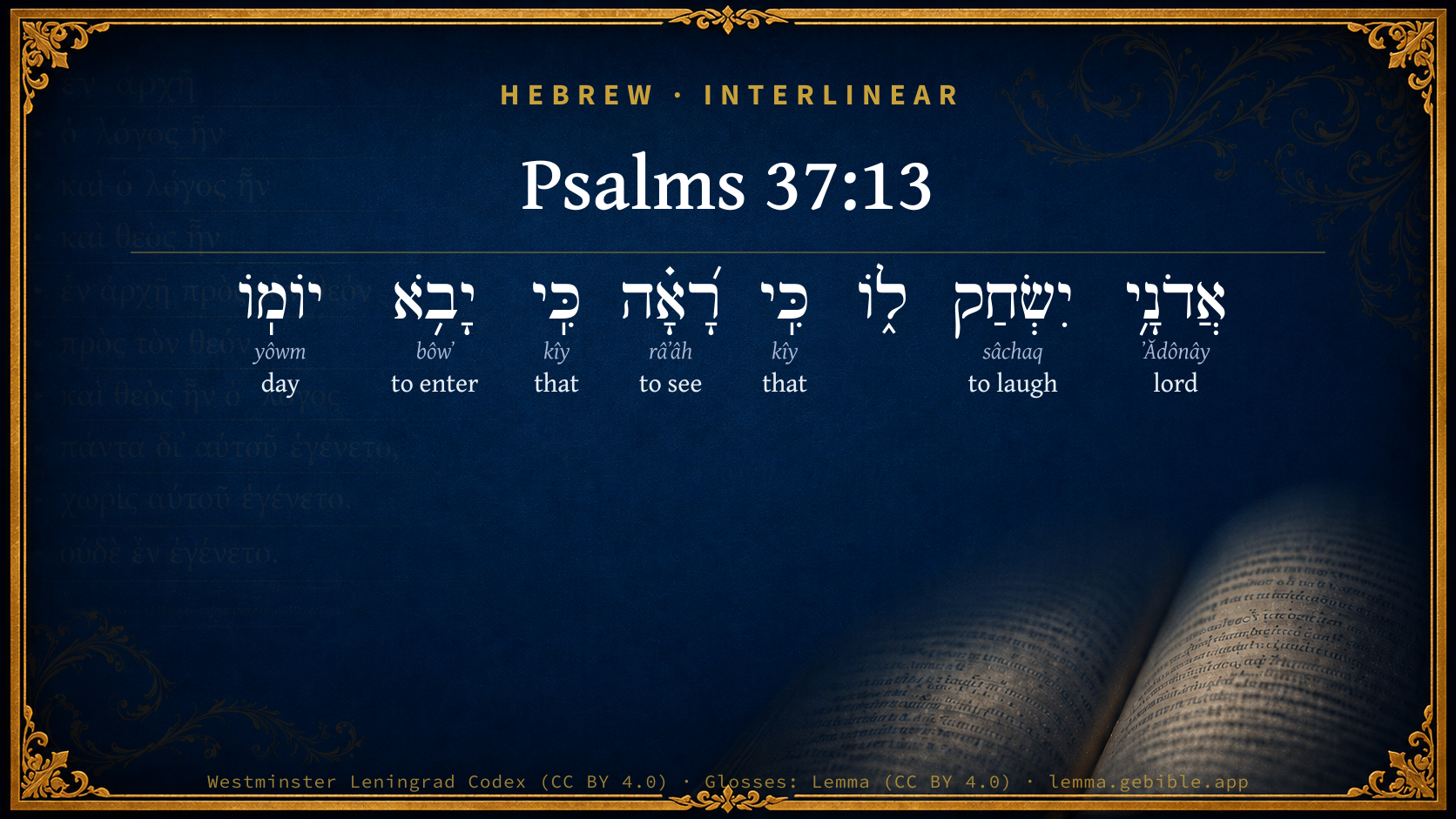
Psalms 37:13

Hebrew (Westminster Leningrad Codex) Psalms 37:13 appears in the Hebrew Old Testament. The text above is from the Westminster Leningrad Codex. Each word links to its Strong’s number, a concise gloss, and parsing drawn from the Open Scriptures Hebrew Bible morphology. Click any word for its full Brown-Driver-Briggs (BDB) entry.
Download image
Cite this verse

Psalms 37:13 (World English Bible). Public Domain. Lemma interlinear Bible study tool, https://lemma.gebible.app/v/psalms/37/13.

Show BibTeX & RIS
BibTeX
RIS
English Translation
The Lord will laugh at him, For he sees that his day is coming.
World English Bible · Public Domain
Download a study sheet

One document with this verse’s original text, its word-by-word gloss line, the meaning frame, cross-references with their text, attributed commentary, and full source and license credits — printable, and it pastes into notes with its structure intact.

This verse Autodidact and up

Study sheet (.html) Plain text (.txt)

A passage Seminary Student

Up to 50 verses in one chapter. A passage sheet keeps up to 6 commentary sources and 12 cross-references per verse, in the order this page ranks them, and says so on the sheet whenever that leaves anything out. Ask for a single verse and you get the Autodidact verse sheet above.

Everything on this page stays free to read, with no account — the sheet is a download of what is already on screen, not access to it.

Want to remove ads? Support Godless Engineer
Compare translations 3

The same verse in 3 English versions, stacked beneath the original-language interlinear above. Click any original word for its lexicon entry.

Each is an independent rendering of the whole verse — the interlinear is not word-aligned to these translations.

Highlighted words mark where these versions differ — a whole-verse word diff, not a word-by-word alignment.

  • World English Bible Public Domain
    The Lord will laugh at him, For he sees that his day is coming.
  • King James Version Public Domain
    The LORD shall laugh at him: for he seeth that his day is coming.
  • unfoldingWord Literal Text CC BY-SA 4.0
    The Lord laughs at him, for he sees that his day is coming.

unfoldingWord Literal Text — © unfoldingWord, licensed CC BY-SA 4.0. Word-aligned USFM3 via Door43 (git.door43.org/unfoldingWord/en_ult).

Versions to compare (up to 4)

3 of 4 selected

Show all 18 translations

Every available English version of this verse, each an independent rendering of the whole verse.

  • World English Bible Public Domain
    The Lord will laugh at him, For he sees that his day is coming.
  • Berean Standard Bible Public Domain
    but the Lord laughs, seeing that their day is coming.
  • Majority Standard Bible Public Domain
    but the Lord laughs, seeing that their day is coming.
  • King James Version Public Domain
    The LORD shall laugh at him: for he seeth that his day is coming.
  • American Standard Version (1901) Public Domain
    The Lord will laugh at him; For he seeth that his day is coming.
  • Revised Version (1885) Public Domain
    The Lord shall laugh at him: for he seeth that his day is coming.
  • Geneva Bible (1599) Public Domain
    But the Lord shall laugh him to scorne: for he seeth, that his day is comming.
  • Douay-Rheims (1899) Public Domain
    But the Lord shall laugh at him: for he foreseeth that his day shall come.
  • Young's Literal Translation Public Domain
    The Lord doth laugh at him, For He hath seen that his day cometh.
  • Literal Standard Version CC BY-SA 4.0
    The Lord laughs at him, || For He has seen that his day comes.
  • Unlocked Literal Bible CC BY-SA 4.0
    The Lord laughs at him, for he sees that his day is coming.
  • unfoldingWord Literal Text CC BY-SA 4.0
    The Lord laughs at him, for he sees that his day is coming.
  • Darby Bible Public Domain
    The Lord laugheth at him; for he seeth that his day is coming.
  • World Messianic Bible Public Domain
    The Lord will laugh at him, for he sees that his day is coming.
  • Webster's Bible Public Domain
    The Lord will laugh at him: for he seeth that his day is coming.
  • Free Bible Version CC BY-SA 4.0
    But the Lord laughs at them, for he sees their coming day of judgment.
  • Bible in Basic English Public Domain
    He will be laughed at by the Lord, who sees that his day is coming.
  • JPS Tanakh (1917) Public Domain
    The Lord doth laugh at him; for He seeth that his day is coming.

Literal Standard Version (2020), Covenant Press — licensed CC BY-SA 4.0. Text via the HelloAO Bible API (eBible.org). Unlocked Literal Bible (unfoldingWord) — licensed CC BY-SA 4.0. Text via the HelloAO Bible API (eBible.org). unfoldingWord Literal Text — © unfoldingWord, licensed CC BY-SA 4.0. Word-aligned USFM3 via Door43 (git.door43.org/unfoldingWord/en_ult). Free Bible Version, Dr. Jonathan Gallagher — licensed CC BY-SA 4.0. Text via the HelloAO Bible API (eBible.org).

Word by word

More ways to search: Search by grammar → Find every occurrence → Compare this word →

Practice this passage: Drill this verse → Learn its vocabulary →

About this verse

These counts appear in no published source. They are computed here, from the morphology-tagged text and Lemma’s own curated glosses. What Lemma adds →

8
words
6
distinct lemmas
Wisdom
section

Shared distinctive vocabulary

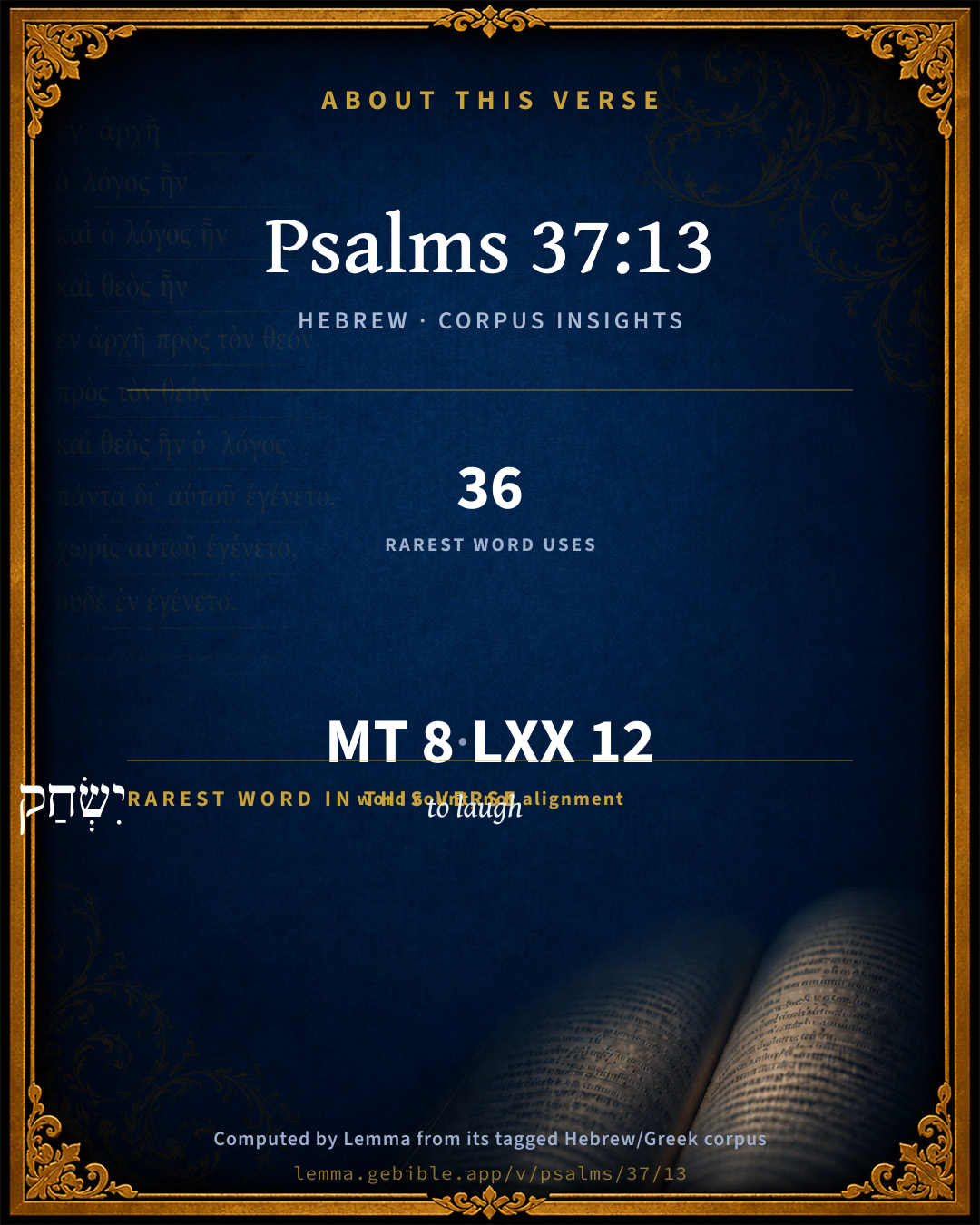
יִשְׂחַק to laugh H7832 occurs in 36 verses of the Hebrew Bible. Also found in:

Grammatical profile

  • 3 verbs
  • 2 nouns
  • 1 preposition
  • 2 conjunctions

Verb forms

  • יִשְׂחַק Qal · Imperfect
  • רָ֝אָ֗ה Qal · Perfect
  • יָבֹ֥א Qal · Imperfect

Repetition

A word recurs within this verse — often emphatic in Hebrew:

  • כִּֽי that H3588 ×2

Hebrew & Septuagint length

In English translation the verse runs 14 words from the Hebrew and 15 from the Septuagint (LXX English) — closely comparable.

A rough comparison of the two English renderings, which tokenize alike — not a word-level alignment.

Word counts can differ between the Hebrew and the Greek without any difference in meaning — e.g. the Hebrew direct-object marker אֵת has no separate Greek word, and Greek often adds the article ὁ.

In the original languages it is 8 Hebrew tokens and 12 Greek tokens — but the two are counted differently (Hebrew bundles its prefixes and suffixes into one token; the Greek is in lemma form), so that isn’t a like-for-like length.

Cross-references

8

Topical passages linked to Psalms 37:13 in the Treasury of Scripture Knowledge — connected by theme and wording, ordered by reader-vote popularity; previews shown in the World English Bible.

  • Psalms 2:4 He who sits in the heavens will laugh. The Lord will have them in derision.
  • Proverbs 1:26 I also will laugh at your disaster. I will mock when calamity overtakes you;
  • 1 Samuel 26:10 David said, As Yahweh lives, Yahweh will strike him; or his day shall come to die; or he shall go down into battle and perish.
  • Daniel 5:26 This is the interpretation of the thing: MENE; God has numbered your kingdom, and brought it to an end;
  • Ezekiel 21:25 You, deadly wounded wicked one, the prince of Israel, whose day is come, in the time of the iniquity of the end,
  • Ezekiel 21:29 while they see for you false visions, while they divine lies to you, to lay you on the necks of the wicked who are deadly wounded, whose day is come in the time of the iniquity of the end.
  • Job 18:20 Those who come after shall be astonished at his day, As those who went before were frightened.
  • Jeremiah 50:27 Kill all her bulls; let them go down to the slaughter: woe to them! for their day is come, the time of their visitation.

Cross-references courtesy of OpenBible.info (CC BY 4.0).

Hebrew and Greek witnesses Masoretic Hebrew ↔ Greek Septuagint

The same verse in the two great witnesses to the Old Testament, shown verse-for-verse.

You’re reading Greek Psalm 36 (Hebrew Psalm 37). The Septuagint counts the superscription, so verse numbers can differ from the Hebrew — chapter-level alignment, not verse-by-verse. Numbering follows Rahlfs.

These are two independent witnesses, not word-aligned to each other, and the Septuagint is shown in lemma (dictionary) form.

Hebrew Psalms 37:13 Masoretic · Westminster Leningrad Codex

אֲדֹנָ֥י יִשְׂחַק ל֑וֹ כִּֽי רָ֝אָ֗ה כִּֽי יָבֹ֥א יוֹמֽוֹ

The Lord will laugh at him, For he sees that his day is coming.

World English Bible · Public Domain

Greek LXX Greek Psalm 36:13 Septuagint · lemma form

ὁ δέ κύριος ἐκγελάω αὐτός ὅτι προβλέπω ὅτι ἥκω ὁ ἡμέρα αὐτός

But the Lord shall laugh at him: for he foresees that his day will come.

LXX2012 (modern English Septuagint) · Public Domain

Hebrew: Westminster Leningrad Codex (CC BY 4.0). Greek: Septuagint (public domain); English from LXX2012 (modern English Septuagint) (Public Domain). How the Septuagint differs from the Hebrew →

Commentary

Notes on Psalms 37:13 from classic Christian and Jewish commentators (each source and its license shown beneath its notes). The classic Christian expositions comment on the surrounding passage and are grouped to its opening verse, so a note may address several verses; the Jewish commentaries on the Tanakh (Rashi and others) are per-verse, so they appear only where the commentator wrote on this verse.

Lemma curates 59 commentaries, every one of them public domain or Creative Commons licensed, each selected and text-cleaned for this edition rather than reprinted as found. About our sources →

Trapp's Complete Commentary

John Trapp

Psa 37:13 The Lord shall laugh at him: for he seeth that his day is coming.

Ver. 13. The Lord will laugh at him] See Psa 2:4. The righteous also shall have a time to laugh at him, Psa 52:6, and meanwhile comforteth himself with this, that God laughed at him, and that therefore himself had no great cause to cry, since ridendo irritos reddit, by laughing at them he blasted all their designs, and that with disgrace; men love not to be laughed at.

For he seeth that his day is coming] His dismal day, his death’s day (which will also be his doomsday), that day wherein God hath determined to slay them with their own sword, and to save the righteous; as it is in the two next verses. But especially that last and great day of the world, wherein

Dicetur reprobis, Ite, Venite probis.

He will say to the reprobate, go, and come to the righteous.

John Trapp, A Commentary or Exposition upon All the Books of the Old and New Testament (1647–1656) — public domain. Text from a community e-Sword module.

J. A. Alexander on Psalms

Joseph Addison Alexander

13. (Psa 37:13) The Lord, the sovereign of the universe, as well as the protector of his people, laughs, or will laugh, at him, with derisive pity. See above, on Psa 2:4.—For, because, he sees, he has already seen, as something fixed and certain, that his day, his own appointed day of vengeance, or more probably, the sinner's day of punishment, will come, is coming. However long it may be put off, God knows that it will come at last, a fearful intimation of the certainty of future retribution. Compare Ecc 8:11, 2Pe 3:4, Heb 10:37.

Joseph Addison Alexander, The Psalms Translated and Explained (1850) — public domain. Text from a community e-Sword module.

Jamieson, Fausset & Brown

Robert Jamieson, A. R. Fausset & David Brown

(Compare Psa 2:4).

seeth--knows certainly.

his day--of punishment, long delayed, shall yet come (Heb 10:37).

Jamieson, Fausset & Brown — Commentary Critical and Explanatory on the Whole Bible (1871) — public domain (CC PDM 1.0). Text via the HelloAO Bible API.

Adam Clarke's Commentary

Verse 13. He seeth that his day is coming.] The utter desolation of your oppressors is at hand. All this may be said of every wicked man.

Adam Clarke's Commentary on the Bible (1810–1826) — public domain. Text from a community e-Sword/MySword module.

Ellicott's Commentary for English Readers

(13) Shall laugh.—Comp. Psa_2:4, Note; his day, i.e., the day of trouble or retribution for the wicked, as we see from Psa_137:7; Job_18:20, etc.

A Bible Commentary for English Readers, edited by Charles John Ellicott (1878–1897) — public domain. Text from a community e-Sword module.

The Cambridge Bible for Schools and Colleges

gen. ed. J. J. S. Perowne

13. Doth laugh (Psa_2:4 note) … for he hath seen. The punishment of the wicked has been foreseen and foreordained from the first.

his day] The appointed day of retribution and ruin. Cp. Psa_137:7; Oba_1:12; 1Sa_26:10; Job_18:20.

The Cambridge Bible for Schools and Colleges (gen. ed. J. J. S. Perowne; Cambridge University Press, 1878–1918) — public domain. Text from a community e-Sword module.

John Gill's Exposition

The wicked have drawn out the sword,.... That is, out of the scabbard; they drew upon the righteous, in order to sheath it in them; or they sharpened the sword, as Aben Ezra observes some interpret the word; it may be literally rendered, "opened the sword" (q), which before lay hid in the scabbard:

and have bent their bow; having put the arrow in it, in order to shoot. The former expression may design the more open, and this the more secret way of acting against the righteous; and their view in both is

to cast down the poor and needy, who are so, both in a temporal and spiritual sense; to cause such to fall either into sin, or into some calamity or another:

and to slay such as be of upright conversation; who walk according to the rule of the word of God, and as becomes the Gospel of Christ: nothing less than the blood and life of these men will satisfy the wicked; and it is an aggravation of their wickedness that they should attempt to hurt men of such character who are poor and needy, holy, harmless, inoffensive, and upright; and this points at the reason why they hate them, and seek their ruin, because of the holiness and uprightness of their lives; see Joh 15:19.

(q) "aperuerunt gladium", Gejerus.

John Gill's Exposition of the Whole Bible (1746–1763) — public domain (CC PDM 1.0). Text via the HelloAO Bible API.

Albert Barnes' Notes on the Bible

The Lord shall laugh at him - See the notes at Psa 2:4. That is, he will regard all his attempts as vain - as not worthy of serious thought or care. The language is that which we use when there is no fear or apprehension felt. It is not that God is unfeeling, or that he is disposed to deride man, but that he regards all such efforts as vain, and as not demanding notice on the ground of anything to be apprehended from them.

For he seeth that his day is coming - The day of his destruction or overthrow. He sees that the wicked man cannot be ultimately successful, but that destruction is coming upon him. There is nothing ultimately to be apprehended from his designs, for his overthrow is certain.

Albert Barnes' Notes on the Bible (1834–1885) — public domain. Text from a community e-Sword/MySword module.

Matthew Poole's English Annotations

Shall laugh at him, i.e. shall despise and deride all their hopes and endeavours against the good, as most vain and foolish.

His day; either,

1. God’s day, which is a usual phrase, as Isa 2:12; 13:9. Or,

2. His own day, as 1Sa 26:10; Eze 21:25,29. Both signify the same thing, the day appointed by God for his punishment or destruction, as Isa 9:4; Jer 50:27.

Matthew Poole's English Annotations on the Holy Bible (1683–1685) — public domain. Text from a community e-Sword/MySword module.

The Treasury of David

Charles H. Spurgeon

Ver. 13. The Lord shall laugh at him. The godly man needs not trouble himself, but leave well deserved vengeance to be dealt out by the Lord, who will utterly deride the malice of the good man's enemies. Let the proud scorner gnash his teeth and foam at the mouth; he has one to deal with who will look down upon him and his ravings with serene contempt. For he seeth that his day is coming. The evil man does not see how close his destruction is upon his heels; he boasts of crushing others when the foot of justice is already uplifted to trample him as the mire of the streets. Sinners, in the hand of an angry God, and yet plotting against his children! Poor souls, thus to run upon the point of Jehovahs's spear.

Ver. 13. The Lord shall laugh at him, etc. He seems to provide very coldly for our consolation under sorrow, for he represents God as merely laughing. But if God values highly our salvation, why does he not set himself to resist the fury of our enemies, and vigorously oppose them? We know that this, as has been said in Ps 2:4, is a proper trial of our patience when God does not come forth at once, armed for the discomfiture of the ungodly, but connives for a time, and withholds his hand. Lest the flesh should still murmur and complain, demanding why God should only laugh at the wicked, and not rather take vengeance upon them, the reason is added, that he sees the day of their destruction at hand. For he seeth that his day is coming. John Calvin.

Ver. 13. For he seeth that his day is coming. He laughs at such poor worms, who make themselves so great upon the earth, and act so loftily in their impotence, seeing it must so soon be over with them. Berleb. Bible, quoted by E. W. Hengstenberg.

Ver. 13. For he seeth that his day is coming. His dismal day, his death's day, which will also be his doom's day. John Trapp.

None.

Psalms 37:14*

Charles H. Spurgeon's The Treasury of David (1869–1885) — public domain. Psalms only. Text from a community e-Sword/MySword module.

Whedon's Commentary on the Bible

Daniel D. Whedon

13. The Lord shall laugh—See on Psa_2:4.

His day is coming— The day which God has appointed for his just retribution.

Daniel D. Whedon (gen. ed.), Commentary on the Old and New Testaments (1874–1909) — public domain. Text from a community e-Sword module.

The Pulpit Commentary

The Lord shall laugh at him. (comp. Psa_2:4 Psa_59:8; and see the comment on the former passage) For he seeth that his day is coming; i.e. God sees that the day of the wicked man"s visitation is approaching. (see above, vers. 2, 9, 10; and comp. 1Sa_26:10)

The Pulpit Commentary (1880–1919), ed. H.D.M. Spence-Jones & Joseph S. Exell — public domain. Text from a community e-Sword module.

John Wesley's Explanatory Notes

His day - The day appointed by God for his punishment or destruction.

John Wesley, Explanatory Notes Upon the Whole Bible (1754–1765) — public domain. Text via the GEBible commentary corpus.

Lesson kit

Teaching starters — assembled from the data on this page, not authored interpretation. Every prompt links to the verse data it draws on. Edit before teaching.

Psalms, in the Wisdom, opens this verse with 8 words (6 distinct Hebrew lemmas). Its most distinctive word is sâchaq (“to laugh”). A historical commentator’s framing appears above. Read the whole chapter for the surrounding context.

Discussion questions

  1. How does “to laugh” (sâchaq) shape what this verse is saying?
  2. Judges 16:25 shares the word «to laugh» with this verse. How do the two illuminate each other?
  3. “that” occurs 2× in this one verse. What is the effect of the repetition?
  4. These translations render this verse differently; the difference is in the English rendering, not the original. What questions does that raise?
  5. The verb «יִשְׂחַק» is Qal Imperfect. How does its form color the action?
  6. Reading how Trapp's Complete Commentary and J. A. Alexander on Psalms read this verse, where do the two commentators agree and where do they part?

Things to notice

Reading settings

Reading text

Shown beneath each verse's original-language words.

Old Testament
Old Testament edition

Read the OT as the Masoretic Hebrew (MT) or the Greek Septuagint (LXX).

English shown for the Greek Septuagint (in the Hebrew ↔ Greek comparison).

Comparing translations? Open the Compare panel on any verse page to stack up to four side by side.